My Boards
View Pictures
  • My Boards
← Artworks

Textile Fragments and Floral Designs

Intricate textile fragments showcasing floral patterns, embroidery, and historical textile designs from various cultures.

Textile fragment, print of autumn plants on blue ground, anonymous, Japan, 1764 - 1771, Meiwa period, silk, height 29 cm × width 20.5 cm
166 assets in this story
6145-29801139
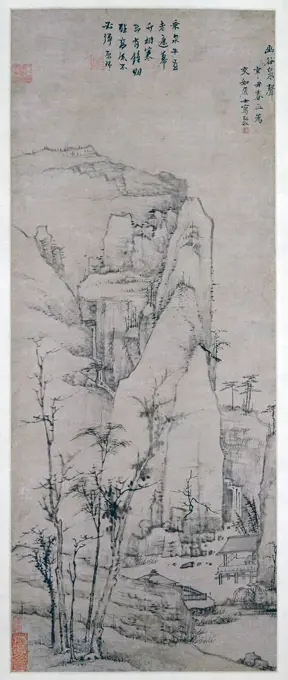
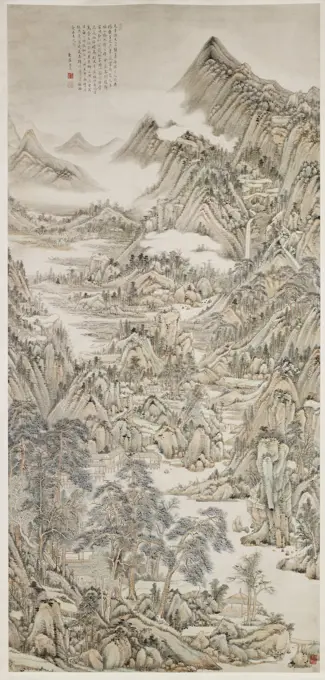
The Sound of Spring in a Lonely Valley 1661 Hongren Chinese Inscriptions after the artist (right): "The Sound of Spring in a Lonely Valley, the first lunar month of spring in the xinchou year January 30-February 28, 1661, painted for the gentleman Jiaoru, Hongren" and after Chen Shu jinshi degree, 1649, left Hongren, a filial son who helped support his mother after his father's premature death, passed the local civil-service examination during the late Ming period but ended his pursuit of an official career after the fall of the dynasty in 1644. Becoming a Buddhist monk as a way of avoiding service under the Manchus, Hongren spent the rest of his life in his native Anhui Province, where he became the central figure in the so-called Anhui School of painters, whose common bond was their fascination with the rugged scenery of Yellow Mountain (Mount Huang).Hongren favored a dry linear technique that echoes the style of the Yuan dynasty recluse-painter Ni Zan (1306-1374). In this scroll
6145-46404782
Festoten with grape fees, pumpkins and a cuckoo. .
4443-73183299
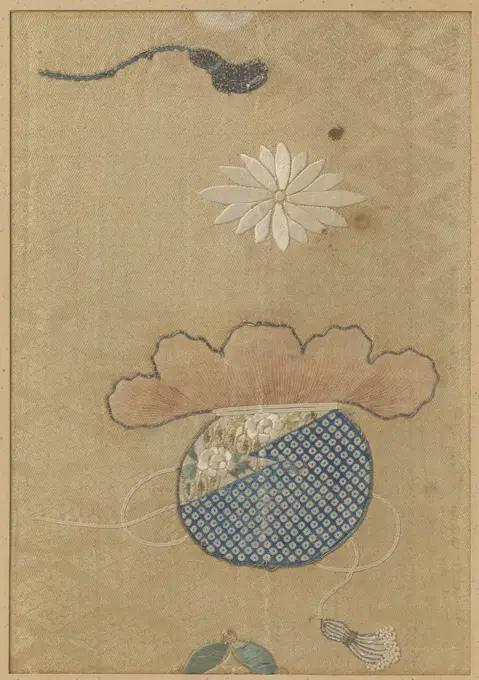
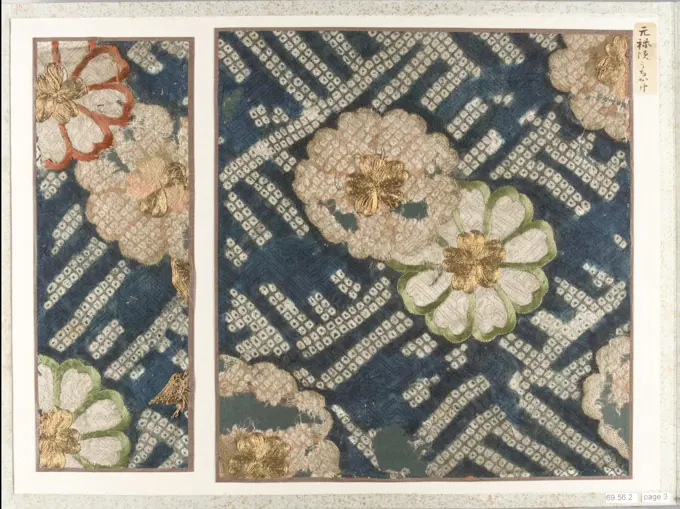
Textile fragment, embroidery and print of a brocade bag and flower on beige damask background., anonymous, Japan, 1830 - 1844, Tenpo period (1830-1844), silk, height 29.3 cm × width 20.4 cm
6145-29834831
Piece 18th-19th century Japan. Piece. Japan. 18th-19th century. Silk. Textiles-Woven
6145-50494152
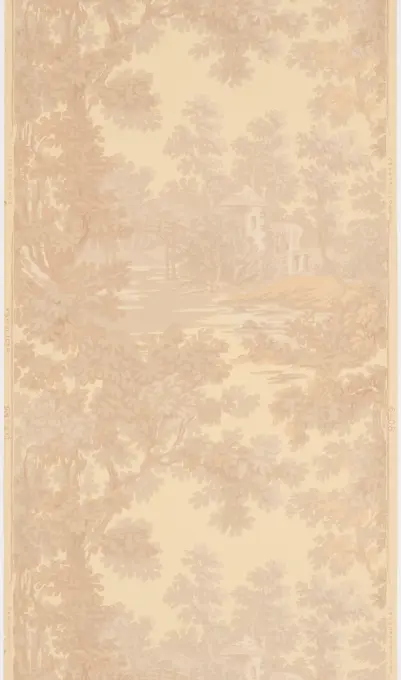
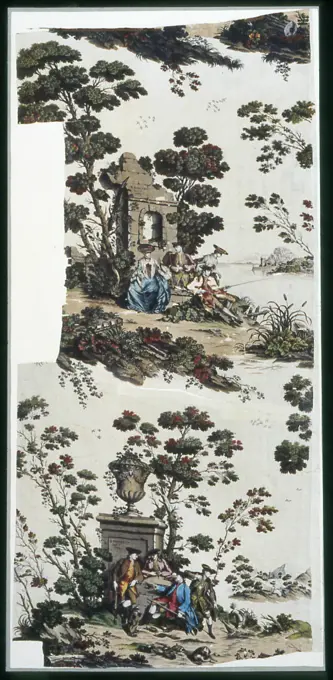
Sidewall (USA); Manufactured by Thomas Strahan & Co., Manufactory (United States); machine-printed; 131 x 56 cm (51 9/16 x 22 1/16 in.)
6145-46671961
The painting with lion bowls of a button, with a few leaves above. .
6145-43560055
Fragment (Japan)
6145-29821399
Textile Fragment 7th-8th century Byzantine. Textile Fragment 474227
6145-29186728
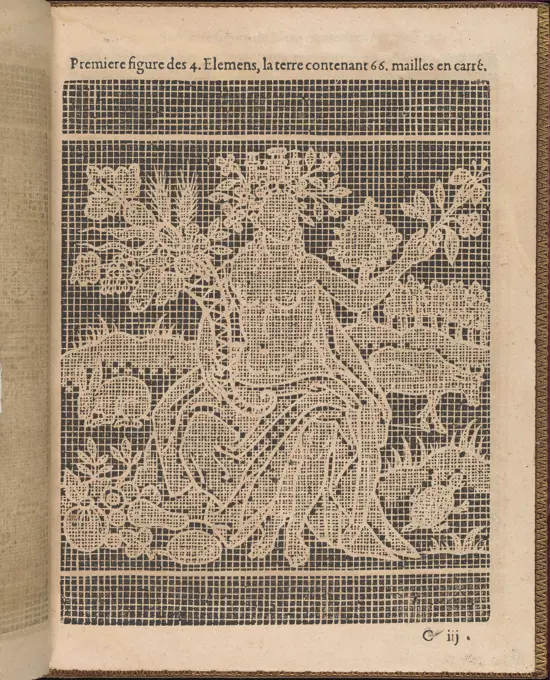
La Pratique de l'Aiguille, page 11 (recto) 1605 Matthias Mignerak Written by Matthias Mignerak, title page engraved by Pierre Firens, French, born Paris 1641, dedicated to Marie de Medici, Florence 1575-1642 Cologne, published by Jean Le Clerc, Paris.From top to bottom, and left to right:Design is printed upon a grid and is decorated with a scene depicting the personification of water pouring 2 pots of water and fish into the ocean.. La Pratique de l'Aiguille, page 11 (recto) 662991
6145-29786841
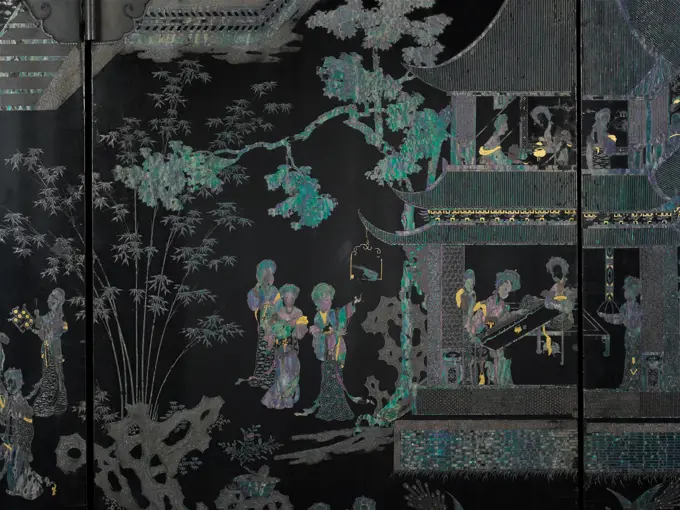
Women in a Palace late 17th century China In China, images of a romanticized world, where elegant women spend their time dancing and playing music, often have historical overtones. Many such scenes are thought to allude to the richness of court life during the Han dynasty (206 B.C.-A.D. 220), an endless source for the antiquarian interests of the seventeenth century. Some also illustrate the tragic story of the beautiful Wang Zhaojun, who was sent by Emperor Yuan (reigned 75-33 B.C.) to marry a Xiongnu chieftain in an attempt to pacify these powerful barbarians. Although this screen does not show the standard scene of a painter rendering her image, it is interesting to note that a single horse is depicted standing beneath a willow tree in the center. This animal may represent Wangs imminent departure from her safe, and luxurious, life at the court to the less sheltered world of the grasslands in the distant north. Listen to experts illuminate this artwork's story Listen Play or pause
4409-17468694
Jug. Dated: c. 1941. Dimensions: overall: 50.8 x 38.1 cm (20 x 15 in.) Original IAD Object: 18" High 6 1/2" Base. Medium: watercolor and graphite on paperboard. Museum: National Gallery of Art, Washington DC. Author: John Tarantino.
6145-29751210
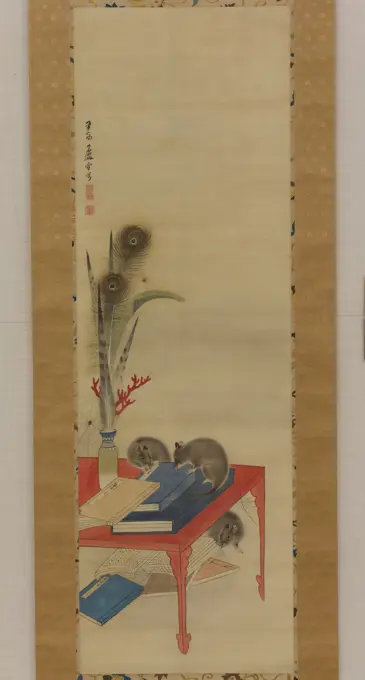
Rats on a Scholars Desk ca. 1794-95 Nagasawa Rosetsu ???? A trio of rats crawls upon and under a scholars low red-lacquer table, with piles of stitch-bound books scattered over its surface and beneath. A ceramic vase holds peacock and hawk feathers and a stem of red coral, all appropriate for a decoration of a desk of a literatus. But spiders have spun webs, suggesting it has been a long while since anyone consulted these tomes. Punctilious brushwork creates an effect that is at once realistic yet decorative. This composition, so colorful and playful, is quite unlike anything else in Rosetsus known corpus (though the full range of the artists output remains to be investigated), and seems to be inspired by Shanghai-style paintings or woodblock prints and book illustrations popular in the late Edo period, which had been transmitted through Nagasaki. The polychromy seems to correspond to works of the artists Hiroshima period (1794-95) and shortly after, by which time he had a cultiva
4409-17584477
Kerria and Iris, from the illustrated book "Picture Book: Flowers of the Four Seasons (Ehon shiki no hana)," vol. 1. Kitagawa Utamaro  ; Japanese, 1753 ()-1806. Date: 1801. Dimensions: . Color woodblock print; 2 pages from illustrated book. Origin: Japan. Museum: The Chicago Art Institute, Chicago, USA.
6145-29706190
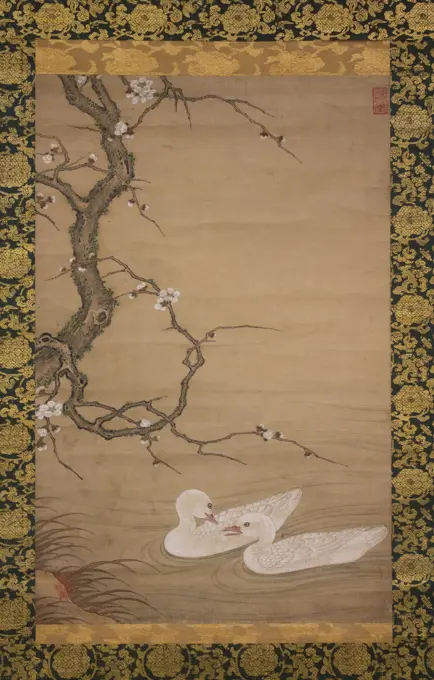
Plum Tree and Waterfowl early 16th century Attributed to Kano Masanobu  A pair of water birds glide beneath the fragile branches of a plum tree in this work bearing the seals of Kano Masanobu, founder of the Kano school of painting, which dominated mainstream Japanese painting for four centuries. The plum tree’s delicate white blossoms and a tangle of drying reeds in the lower left corner are indicative of late winter. As with many other early Kano-school paintings in the bird-and-flower genre, each of the motifs is drawn with black ink outlines, while ink washes and accents are used to suggest the texture of the tree’s bark, to which malachite green lichens cling. The birds’ downy bodies are described with a meticulous application of shell white (gofun), the same pigment used for the petals of the plum blossoms.. Plum Tree and Waterfowl. Attributed to Kano Masanobu  (Japanese, 1434-1530). Japan. early 16th century. Hanging scroll; ink and color on paper. Muromachi period (1392
6145-30153734
Panel (Furnishing Fabric) Made 1769 Middlesex. Linen and cotton, plain weave; copperplate and block printed . Robert Jones and Company (Producer)
6145-59120301
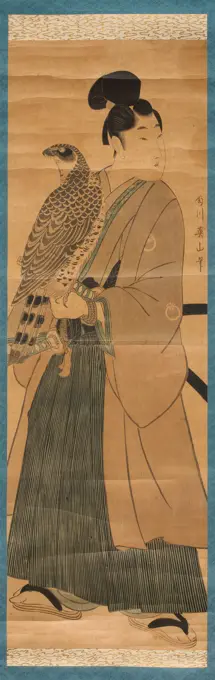
Middle of the skeleton; Kikugawa, Eizan (1787-1867); around 1830 (1825-00-00-1830-00-00);Dembiński, Stanisław (1891-1940) - collection, gift (provenance), woodcuts, Japanese (culture), kakemono, men, falcons, Japanese art
6145-29765811
Connoisseur's Book of Silk Fragments late 19th century Japan This album, probably compiled in the late nineteenth to early twentieth century, contains fragments of kosode from the seventeenth to nineteenth century. Precedents for compiling albums of textiles can be found among the records of tea ceremony aficionados, who preserved and studied textiles associated with the tea ceremony, such as mountings for paintings and bags for treasured utensils. The identity of the textile connoisseur who owned this album is not known. Since several of the kosode fragments in the album have counterparts among the Nomura collection's screens, it seems likely that the compiler was one of Nomura's contemporaries who took part in the avid textile collecting of the first few decades of the twentieth century.. Connoisseur's Book of Silk Fragments 65616
6145-58850270
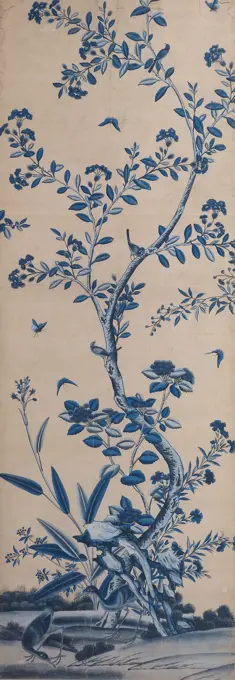
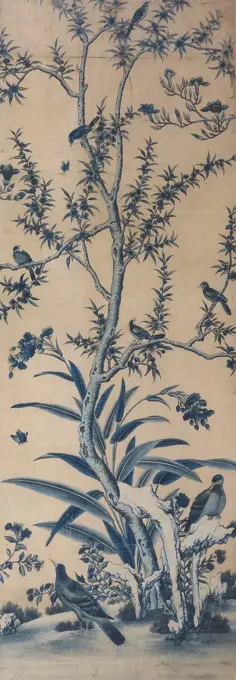
Wallpaper with trees, leaves and flowers, parrot and bird ,, 1700 - 1800 Two lanes, consisting of three parts, from walls on cream -colored paper painted to templates. The complete performance, which covers five jobs, shows three different performances of trees with leaves and flowers. China (possibly) paper Two lanes, consisting of three parts, from walls on cream -colored paper painted to templates. The complete performance, which covers five jobs, shows three different performances of trees with leaves and flowers. China (possibly) paper
4409-17560816
Macaw on a pine branch. Utagawa Hiroshige  ; Japanese, 1797-1858. Date: 1830-1840. Dimensions: 37.8 x 16.7 cm (14 7/8 x 6 5/8 in.). Color woodblock print; otanzaku. Origin: Japan. Museum: The Chicago Art Institute, USA.
6145-55187009
Page from Shi Zhu Zhai China Qing dynasty (1644-1911), Qianlong period (1736-95) View more. Page from Shi Zhu Zhai. China. Polychrome woodblock print; ink and color on paper. Qing dynasty (1644-1911), Qianlong period (1736-95). Prints
6145-29125713
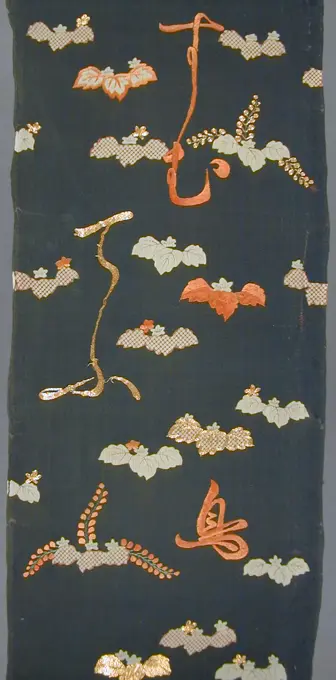
Kosode (Kimono) Fragment with Paulownias and Japanese and Chinese Characters. Japan, mid-Edo period (1615-1868), late 18th century. Textiles. Silk plain weave (crepe; chirimen), stenciled paste-resist (katazome) and imitation stenciled tie-dyed (kata-kanoko shibori), and ink, with silk and gilt-paper-wrapped-silk-thread embroidery
4409-17375383
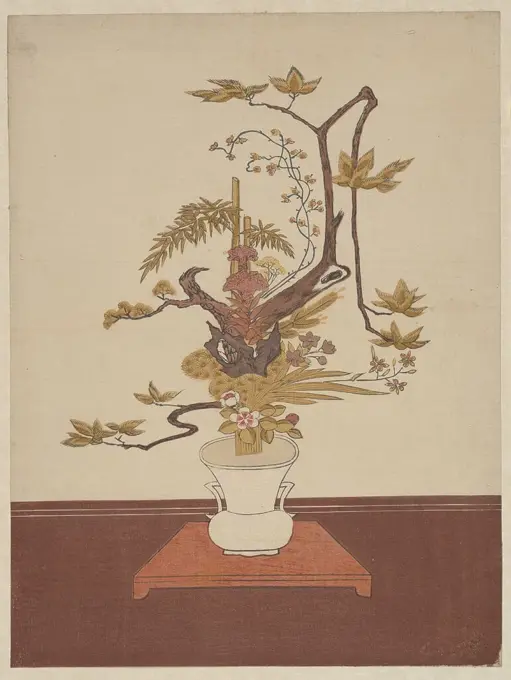
Ike Bana (Flower Arrangement) in the Ike-no-bo Style. Artist: Suzuki Harunobu (Japanese, 1725-1770). Culture: Japan. Dimensions: H. 11 1/8 in. (28.3 cm); W. 8 3/8 in. (21.3 cm). Date: probably 1765. Museum: Metropolitan Museum of Art, New York, USA.
6145-30175221
Wallpaper Panel with Birds and Flowering Trees 1775-1825 China. Hand-painted paper .
4409-17266302
PAPELES RECORTADOS EN ESTAÑO CON SERES MITOLOGICOS CHINOS -. Location: PRIVATE COLLECTION. MADRID. SPAIN.
6145-29740616
Piece 18th-19th century Japan. Piece 67383
6145-30152002
Tenian (Furnishing Fabric) Made 1780-1785 Middlesex. Cotton, plain weave; copperplate printed . Bromley Hall (Manufacturer)
6145-29230210
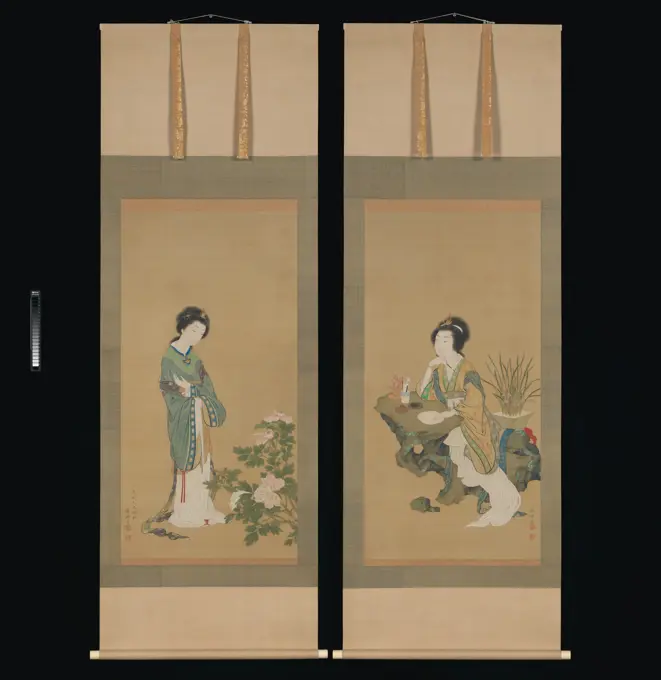
Yanji with Orchids and Yang Guifei with Peonies 1785 Genki (Komai Ki) Each scroll features a Chinese beauty who is lavishly dressed and exquisitely coiffed in the fashion of a Tang aristocratic lady. Though not identified by the artist, we can safely assume that he intended the beauty eyeing peonies on the left to refer to Yang Guifei (Japanese: Ykihi), the infamous consort of Emperor Xuanzong (685-792) of the Chinese Tang dynasty, whose beauty was said “to put the flowers to shame.” The court lady with brush in hand, seated at a desk fashioned from a scholar’s stone with potted orchids behind her, is more difficult to identify. However, she is likely Yanji (Japanese: Enkitsu), a low-ranking concubine of Emperor Wen of Zheng who had an auspicious dream of orchids. Genki is recognized as one of the two most talented artists, along with Matsumura Goshun (1752-1811), to emerge from the circle of Maruyama kyo (1733-1795), the founder of a school of naturalistic painting in Kyoto.. Yanji
4443-19524786
Design for an Embroidered or Woven Horizontal Border of the 'Fabrique de St. Ruf', Fabrique de Saint Ruf, Lyon, France, Brush and white gouache on glazed tracing paper, Leaf boughs follow the outline of indented scallops. A fan motif stands over them. Slightly more than four repeats are shown., France, 1800-1815, Drawing, Drawing
160-1547
Detail of Japanese textile print
6145-43542574
Fragment (Japan)
6145-29175238
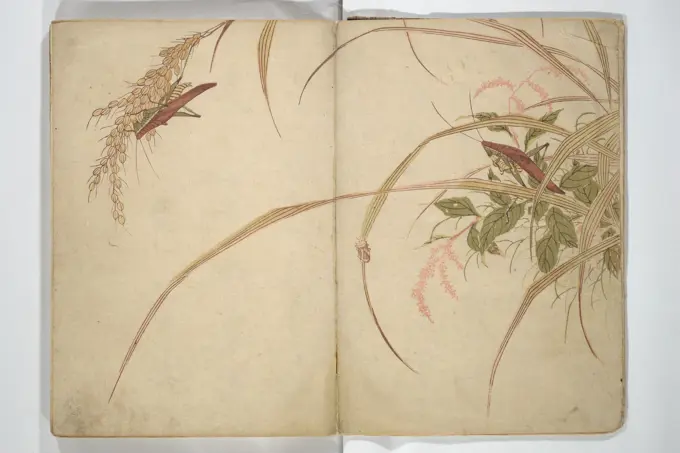
Shunkei Picture Album 1820 Mori Shunkei Japanese. Shunkei Picture Album. Mori Shunkei (Japanese, active 1800-20). Japan. 1820. Woodblock printed book (orihon, accordion-style); ink and color on paper. Edo period (1615-1868). Illustrated Books
4409-17560660
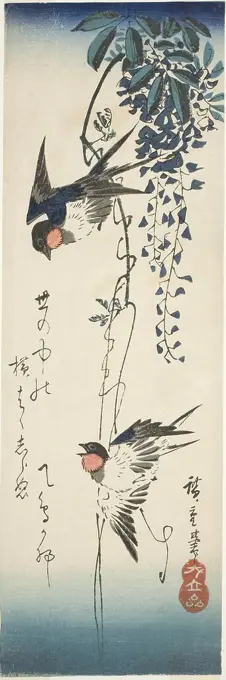
Swallows and wisteria. Utagawa Hiroshige  ; Japanese, 1797-1858. Date: 1840-1849. Dimensions: 34 x 11.3 cm (12 1/2 x 4 1/2 in.). Color woodblock print; aitanzaku. Origin: Japan. Museum: The Chicago Art Institute, USA.
6145-29831471
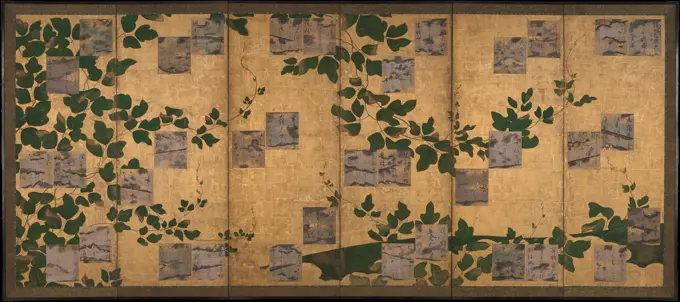
Anthology of Japanese and Chinese Poems (Wakan reish) with Underpainting of Arrowroot Vines early 17th century Konoe Nobuhiro Japanese Thirty-six poem cards; ink, color, gold, and silver on paper Swaying arrowroot vines (kuzu) in autumnal decline serve as the background for an array of Japanese and Chinese poems inscribed on poem cards (shikishi). In East Asia the arts of poetry, calligraphy, and painting are considered the “three perfections,” and since the ninth century, the Japanese have decorated screens with paintings and poems inscribed in fine calligraphy.Three pairs of shikishi are pasted on each panel: each pair is inscribed with a couplet from a Chinese poem at the right and a waka (a thirty-one-syllable Japanese-style poem) at the left. The poems share common themes such as the four seasons, bamboo, pines, or clouds. The idiosyncratic style of calligraphy, with hooks at the ends of strokes and the tall, elongated profile of the characters, is attributable to the nobleman-c
6145-46303592
Photo album by Carl Heinrich Fliegenschmidt, prison director in Oslebshausen; Album. Photo album in green gray linen band. The frontplat is decorated with red flowers. The bracts have a floral pattern. The album contains 12 blades with 48 passe partouts. 47 prints are located therein, which are stuck to carton for the most part. They are recordings of the interior and exterior of the prison of Oslebshausen and the outbuildings. In addition, three photos of prison in Cassel-Wehlheids, family photos, a few village scenes and buildings of the Humboldt University in Berlin. The album probably belonged to Carl Heinrich Fliegenschmidt (DA. 1928), which was director of the "criminal adjustment Oslebshausen". His name is mentioned repeatedly in the album. Whether he was the photographer is unclear.
6145-30180179
Fukusa (Gift Cover) Made 1801-1900 Japan. Mon side silk, plain weave with ìcrepe-likeî effect (kabe-ito wefts) (kabe-ori); dye extracted through stenciled chemical dye stripper (bassen); impressed; patterned side silk and silver-and-gold-leaf-over-lacquered-paper strip wrapped cotton, slit tapestry weave; silk, running ìcontrollingî stitches; corners silk, tubular 1 1 oblique interlacing over cotton core, knotted; silk-wrapped wood form and re-plied silk, fringe tassels .
6145-30175252
Wallpaper Panel with Birds and Flowering Trees 1775-1825 France. Hand-painted paper .
6145-29149963
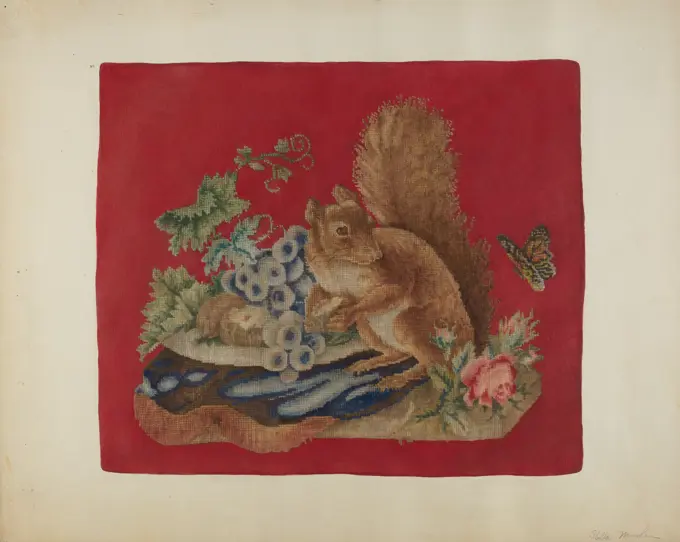
Squirrel on Grapevine 19th century Shibata Zeshin Japanese. Squirrel on Grapevine. Shibata Zeshin (Japanese, 1807-1891). Japan. 19th century. Two-panel folding screen; ink on paper. Screens
6145-46340334
Head of a samurai under cherry blossom. The head of a samurai among kerse blossoms.
1525-22162450
Korean Painting
4443-75460934
Fleurs et oiseaux japonais., 1866 - 1878. Decorative arts, France. Porcelain with European and Japanese influences, featuring birds and leaves
4409-17450530
Valance (section). Dated: c. 1936. Dimensions: overall: 28.4 x 39.1 cm (11 3/16 x 15 3/8 in.). Medium: watercolor and graphite on paper. Museum: National Gallery of Art, Washington DC. Author: Helen E. Gilman.
4409-17552865
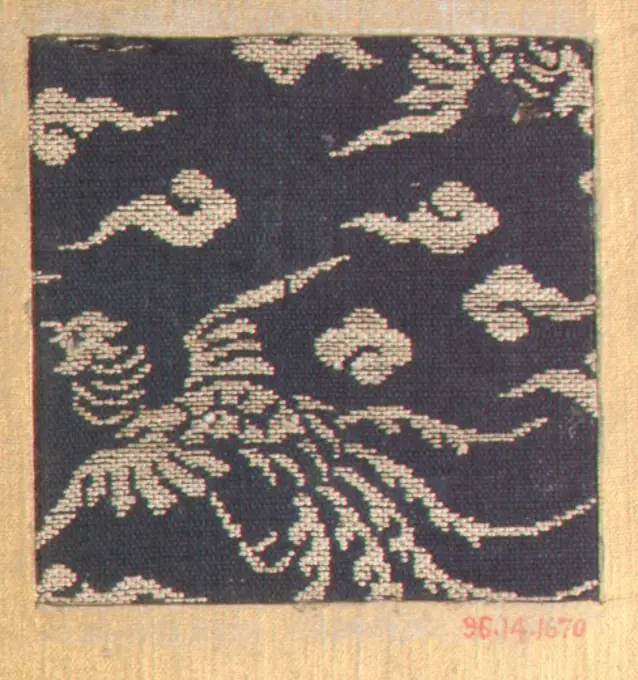
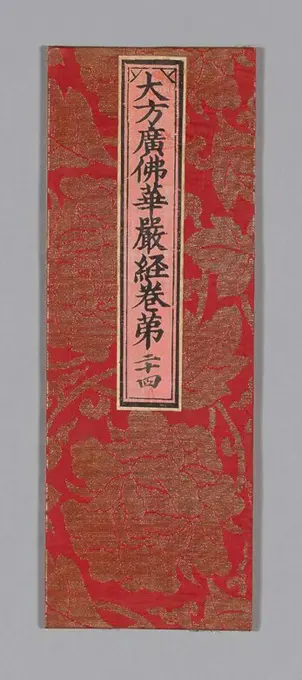
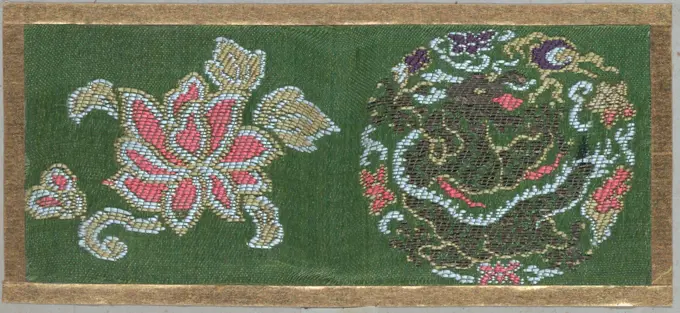
Sutra Cover. China. Date: 1590-1599. Dimensions: 33.8 × 12.1 cm (13 1/4 × 4 3/4 in.)Warp repeat: 27 cm (10 5/8 in.). Silk and gold-leaf-over-lacquered-paper strips, warp-float faced 4:1 satin weave with supplementary patterning wefts bound in weft-float faced 1:4 satin interlacings; label: silk, warp-float faced 3:1 'Z' twill weave; painted with ink; over paper;. Origin: China. Museum: The Chicago Art Institute, Chicago, USA.
6145-30181297
Sutra Cover Made 1590-1599 China. Silk and gold-leaf-over-lacquered-paper strips, warp-faced 4 1 satin weave with supplementary patterning wefts bound in weft-float faced 1 4 satin interlacings; label silk, plain weave; painted with ink; over paper .
4443-21765098
Aquarium with gold winds, draughtsman: Gerrit Willem Dijsselhof, 1876 - 1924, paper, h 269 mm × w 376 mm
4443-19518054
Au Bords de la Riviere, Block printed on joined sheets, Large central circular colonade next to a triumphal arch. To the right, a bridge with figural sculptutes over waterfall. To the left, a female seated on park bench speaking with a gentleman, a male statue on pedestal, and a smaller bridge crossing a stream., France, 1795, Wallcoverings, Scenic panels, Scenic panels
4409-17528315
Sketch of ivy. Draughtsman: Gerrit Willem Dijsselhof. Dating: 1876 - 1924. Measurements: h 163 mm × w 104 mm. Museum: Rijksmuseum, Amsterdam.
1848-51660070
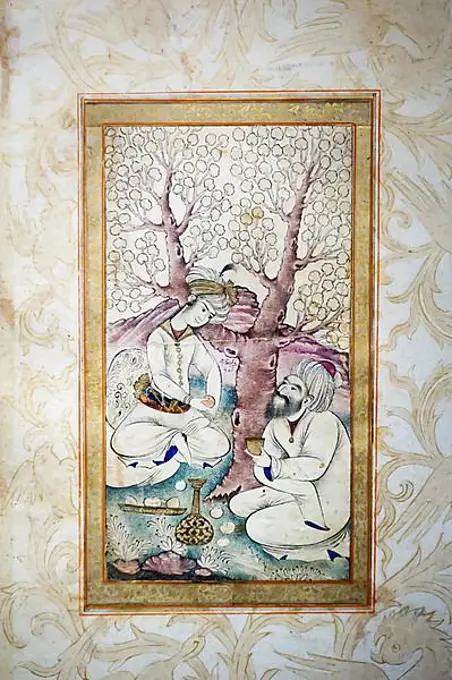
Painting, miniature, two men at tea ceremony, Reza Abbasi Museum, Tehran Iran
6145-29852373
Stella Mosher, Chair Seat Cover, c 1942 Chair Seat Cover
6145-29810947
Case (Inrō) with Design of Two Hō-ō Birds in Flight among Flowering Kiri Branches 18th century Japan. Case (Inrō) with Design of Two Hō-ō Birds in Flight among Flowering Kiri Branches 59029
6145-30148640
Fukusa (Gift Cover) Made 1775-1800 Japan. Mon side wool, plain weave; appliquÈ with wool, plain weave; fulled (gorofukuren); embroidered, some areas over paper, with silk, gold-leaf-on-paper-strip wrapped silk, and gold-leaf-over-laquered-paper-strip wrapped cotton and wrapped silk in back, Chinese knot, satin, single satin, surface satin, stem and straight stitches; (probably) bamboo, rolled paper and silk padded satin and stem stitches; laidwork and couching; some embroidered areas painted; lining silk, 7 1 satin damask weave (donsu); interlined with cotton, plain weave; sewn with front and lining matched in size (Tachikiri awase); silk, running controlling stitches along all edges .
6145-30188419
Peonies 1801-1900 China. Fan (oviod); ink and color on silk .
6145-30180458
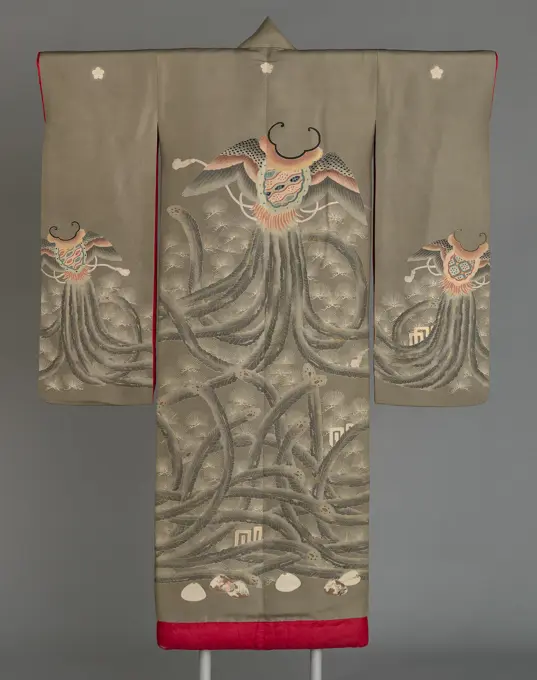
Uchikake Made 1870-1890 Japan. Silk, predominant-warp, weft-ribbed plain weave, resist dyed and painted with dye and India ink; embroidered with silk, gold-leaf-over-lacquered-paper strips and gold-leaf-over-lacquered-paper-strip-wrapped silk in satin, silk-padded satin and straight stitches; laidwork, couching and Chinese knots; lining 5 1 twill damask weave .
4443-73255234
Kyoto, Yamada Naosaburo, Sekka, Kamisaka, Momoyogusa, Flowers of a Hundred Worlds, Hakuho, White Phoenix, verso - stamped, White phoenix with long tail; against beige background. Print from part 1 of the album Momoyogusa, print, prints, Japan (collection), height 302 mm, width 601 mm, Japanese, 1866 - 1942, print maker, printmaker, 1909-05-05 - 1909-05-05, first quarter 20st century, first quarter 20th century, paper, colour woodcut, Publication (Event), Publication, publisher
6145-43510066
Fragment (Japan)
6145-29811844
Piece 18th-19th century Japan. Piece 66054
6145-51817148
Scholar's Objects and Books (Chaekgeori) with Auspicious Animals and Plants Scholar's Objects and Books (Chaekgeori) with Auspicious Animals and Plants, 19th century. Ten-panel folding screen, ink and color on paper, 76 3/8 × 127 9/16 in. (194.0 × 324.0 cm).   Asian Art 19th century
4409-17521389
Sutra Cover. China. Date: 1590-1599. Dimensions: 34.8 × 12.1 cm (13 3/4 × 4 3/4 in.)Repeat: 20.2 × 10.8 cm (8 1/ × 4 3/8 in.). Silk and gold-leaf-over-lacquered-paper strips, warp-float faced 4:1 satin weave with supplementary patterning wefts bound in weft-float faced 1:4 satin interlacings; label: silk, plain weave; painted with ink; glued over paper. Origin: China. Museum: The Chicago Art Institute, Chicago, USA.
6145-59034295
Wu, Sidan  (n.1924-08-25-D.2013), reverie by the water, 1951. Cernuschi Museum, Asia Museum of the city of Paris.
4443-19555897
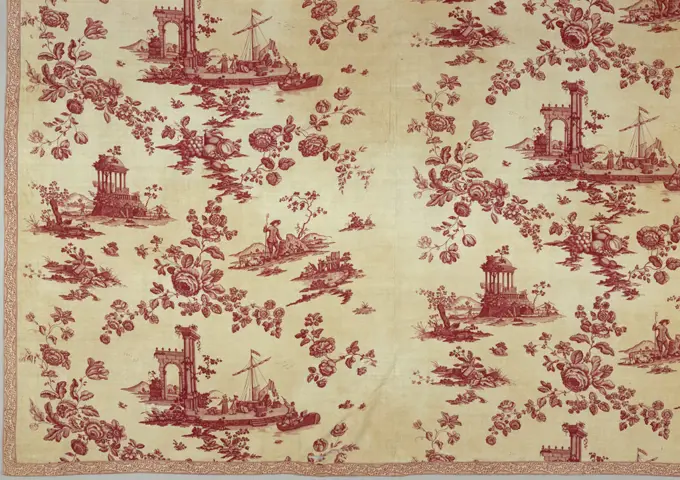
Panel, Medium: cotton Technique: plain weave printed by engraved copper plate; plate break is visible just under the large rose in the center, Various widely spaced scenes inckuding classical ruins, a shepherd, seaport/trading scenes and scattered flowers in red on white ground., Crayford, Kent, England, 1768-74, printed, dyed & painted textiles, Panel
6145-59010384
Folded range, Facing decor: a scene representing 2 back women watching a horse race, back decor: canvas printed with horseshoe. GAL1986.1.118A Painted crush canvas leaf, wooden frame
6145-30180178
Fukusa (Gift Cover) Made 1801-1900 Japan. Mon side silk, gold-leaf-over-lacquered-paper-strip wrapped silk, slit and single dovetailed tapestry weave (tsuzure); pattern side silk, gold-leaf-over-lacquered-paper-strip-wrapped silk, slit and single dovetailed tapestry weave (tsuzure); corners gold-leaf-over-lacquered-paper-strip wrapped cotton, 1 1 tubular oblique interlacing over cotton core, knotted; gold-leaf-over-lacquered-paper-strip-wrapped silk wrapped cotton ball, and re-plied fringe tassels .
4443-28729965
Landscape After Huang Gongwang, 1752, Wang Yu, Chinese, active 1710-1750, 107 1/16 x 50 3/16 in. (271.9 x 127.5 cm)141 x 62 3/4 in. (358.14 x 159.39 cm) (mount), Ink and color on paper, China, 18th century, This monumental composition pays tribute to the famous Yuan dynasty scholar-painter Huang Gongwang (1269-1354). It is an attempt to combine two of Huangs preferred compositional methods in one landscape. One of them is pingyuan, or 'level-distance' perspective, defined as looking from a place in the foreground into the far distance across a flat landscape. The other is gaoyuan, or 'high-distance,' in which the viewer is placed at the bottom of a grand mountain looking up toward the summit. The painting shows a panoramic level-distance view. The spectators eye is carried back into the depth of the composition through clearly marked stages. A rolling outline closes the high peaks in the background to demonstrate the 'high distance.'
1848-63255666
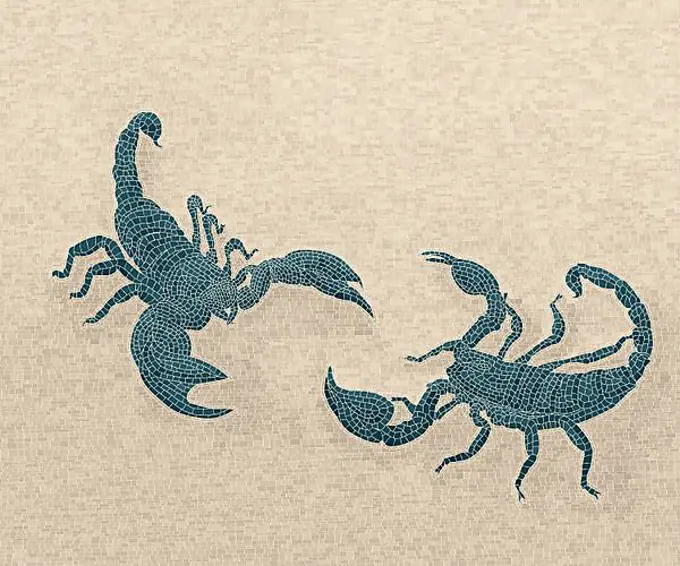
Scorpions mosaic art, vector illustration
6145-58829233
Mans under-kimono, anonymous, c. 1920 - c. 1940 Erotic scenes. Man's hanjuban. No crests. Japan silk painting Erotic scenes. Man's hanjuban. No crests. Japan silk painting
6145-45778748
Square Bottle With Caricatures of the Trade Speculation of 1720. Square bottle of porcelain with a narrow, spreading neck, painted on the glaze in blue, red, green, yellow, purple, brown, black and gold. Two performances twice on the wall: a European man in a landscape in a flowering plant, under his one arm a bunch of carrots and a letter with 'horn carrots' in the other hand; a river landscape with a monkey in the foreground, which bombed a bombed on a red affit leaving various notes with the inscriptions' evening action ',' running fire ',' West ',' 1000 ',' He jumps', 'Bergit Hole 'and' Agter Teijt '. On the shoulder a band with napkin and lotus flowers. Around the neck a band with a spiral pattern. A crack in the wall. Arita, European show in Europe decorated ? In the Japanese Kakiemon style.
1746-28970161
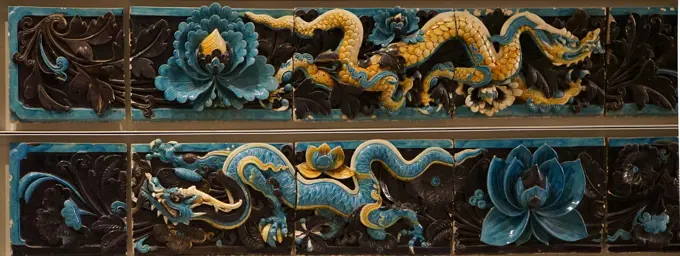
Lead-glazed stoneware dragon tiles, from the Shanxi Province, China. Dated 15th Century
PREVIOUS
of 2
NEXT
2401 S. Ervay, Suite 206
Dallas, Texas 75215
United States
Get Started
Free ResearchMy BoardsMy Cart
For Creators
How To License Your ContentContributor PortalFrame of Mind
Resources
API accessPricing
Contact
+1 866 236 0087help@viewpictures.co.uk Contact form
©2026 View Pictures. All Rights Reserved. -B
This site is protected by reCAPTCHA and Google Privacy Policy and Terms of Service apply.