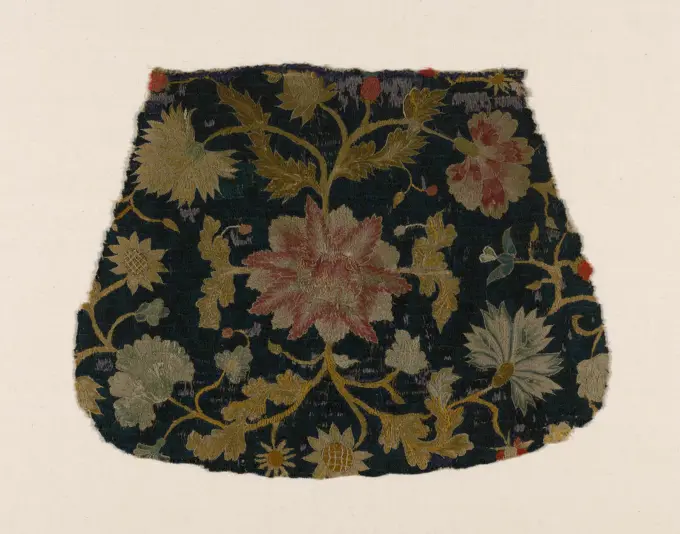
Textile Patterns and Fabrics

An array of woven textiles featuring floral and ornamental designs. Soft color palettes in silk and other materials depict historical craftsmanship.

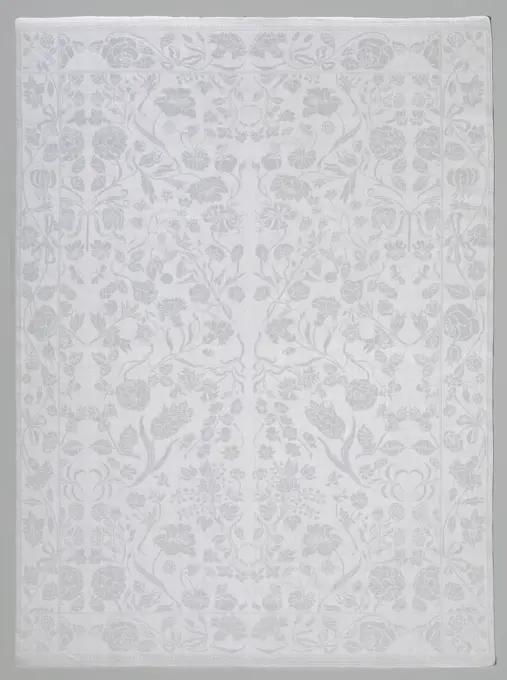
Textile, Medium: silk Technique: 5-harness satin damask, Large-scale symmetrical fantastic flower-and-fruit design. Narrow plain cloth selvages with heavy warps., Spain, 17th century, woven textiles, Textile
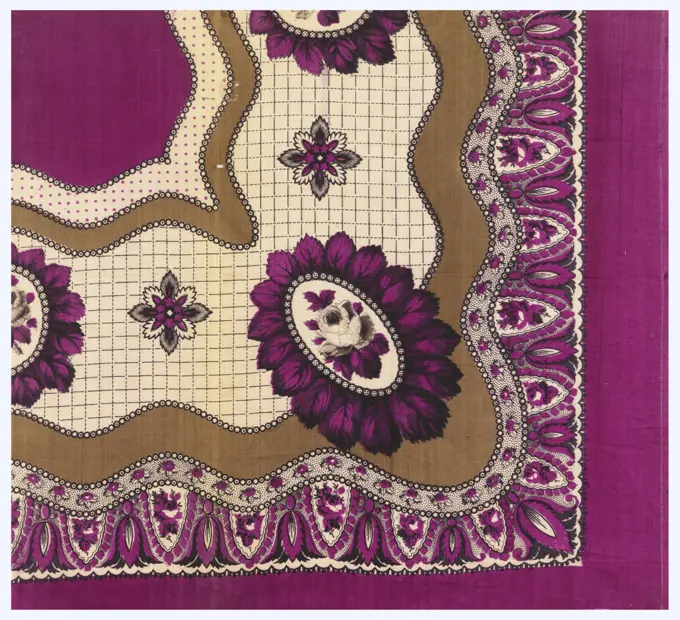
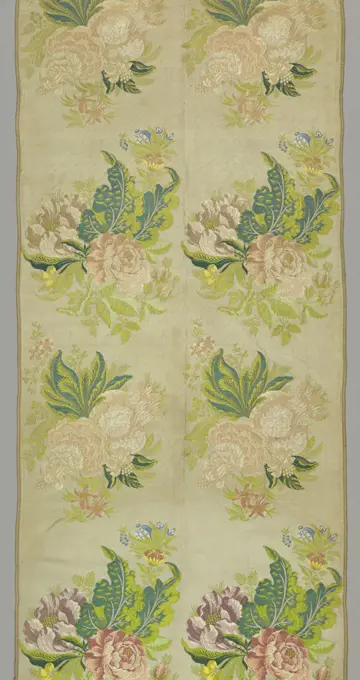
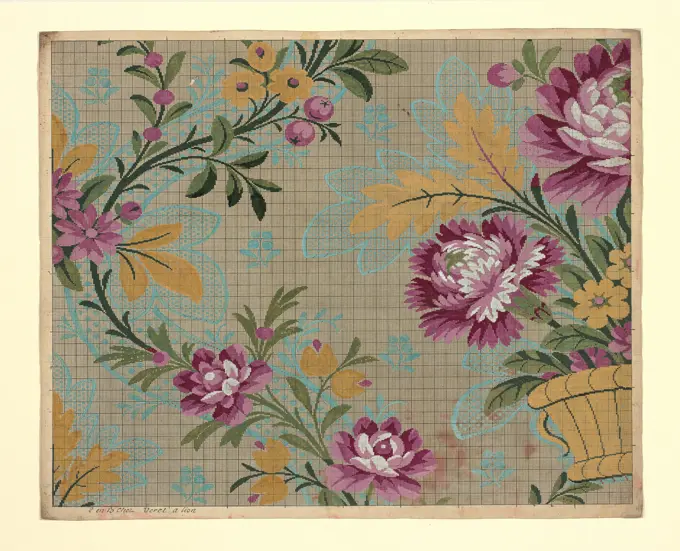
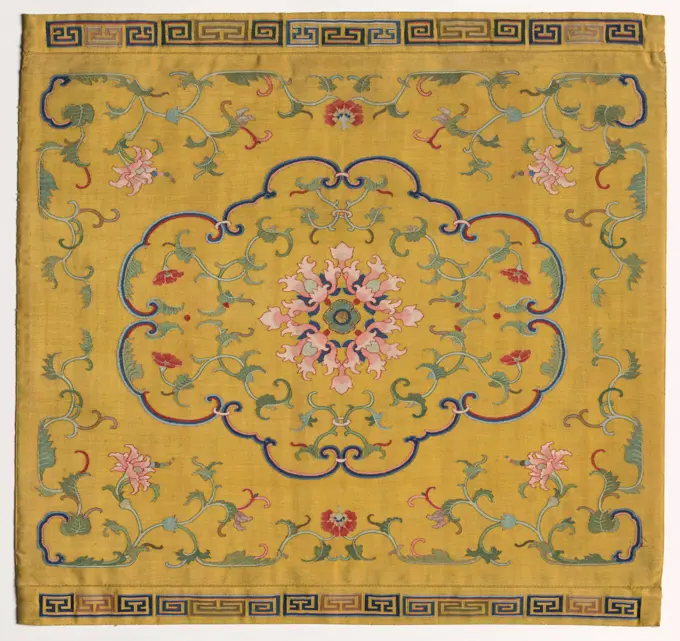
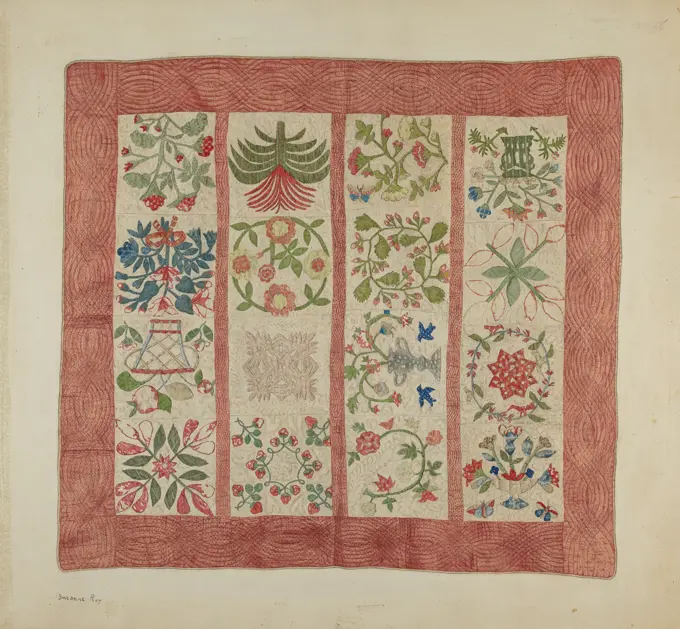
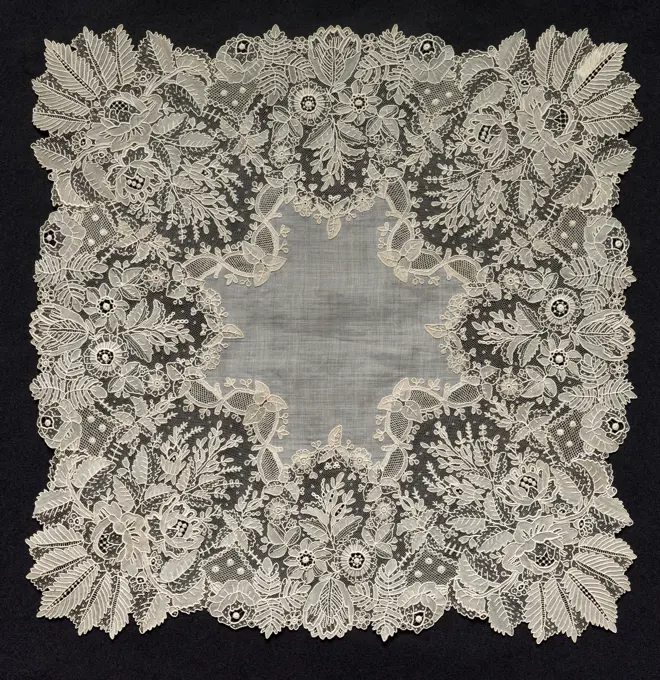
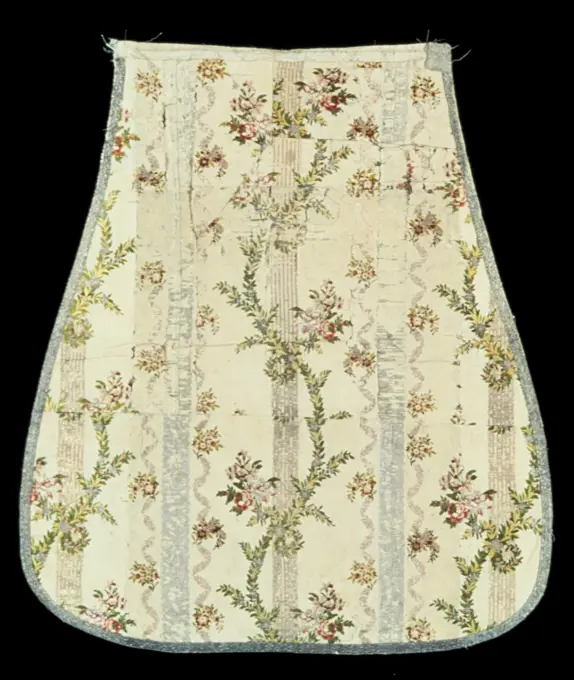
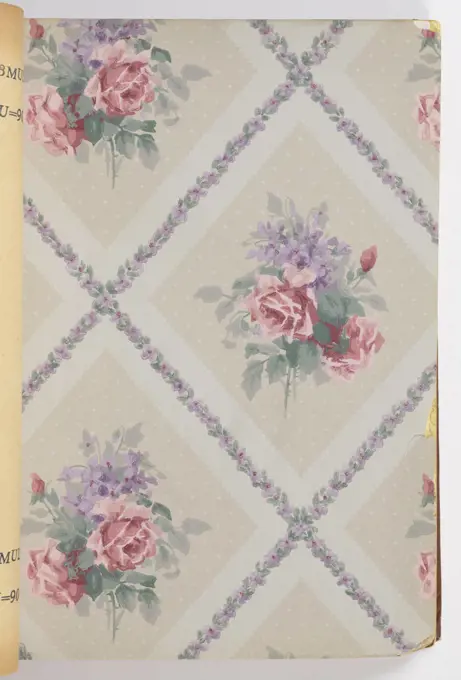
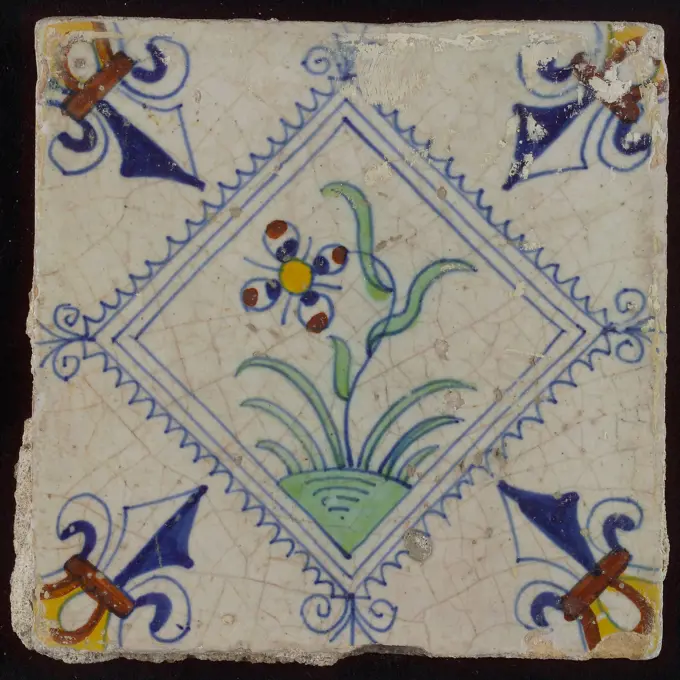
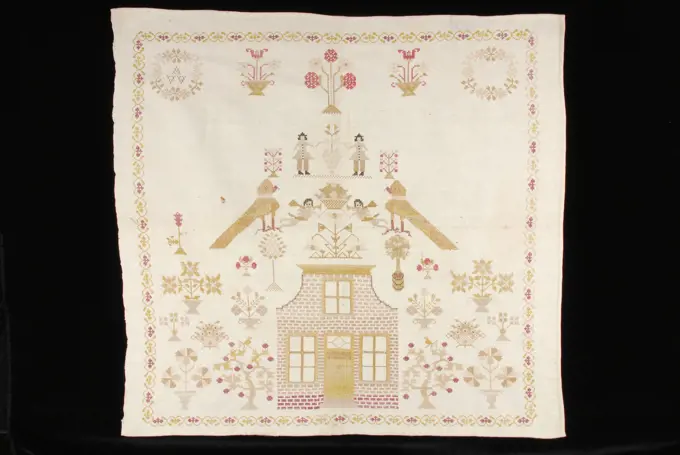
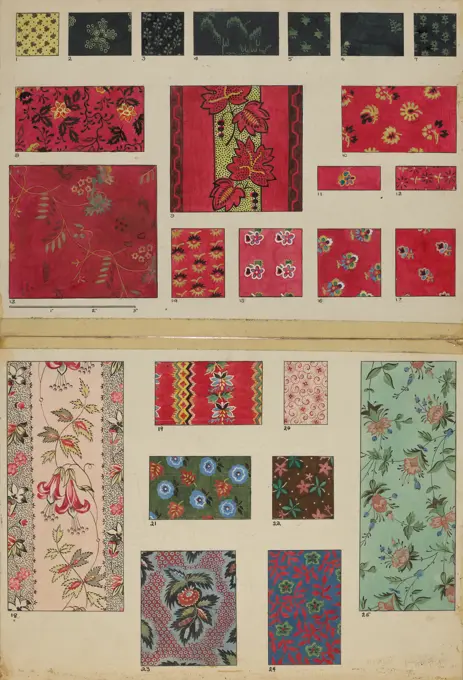
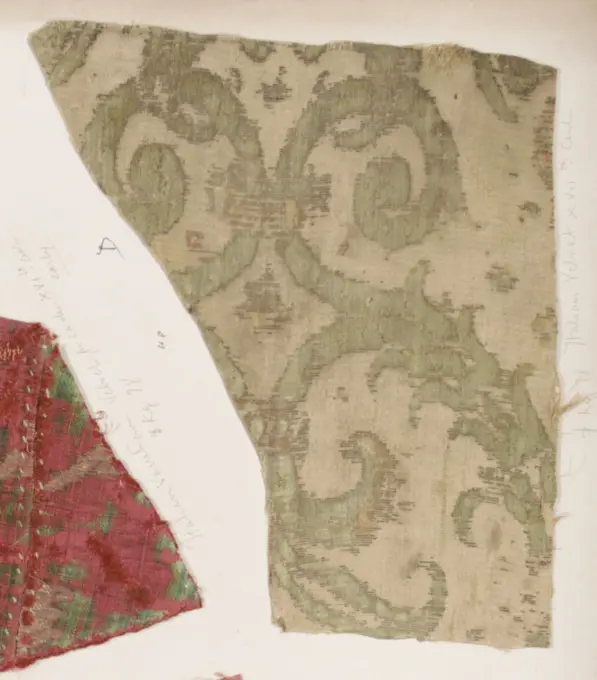
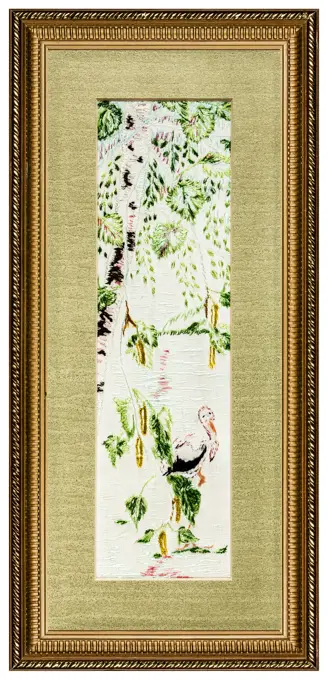
Tablecloth of linen with a wide border fillet side with arabesk leaves and lilies. Linen tablecloth with a wide edge natural-colored edge embroidery, fillet side. Rectangular model with a lace edge of straight tracks on which a symmetrical pattern is without corner pattern. The pattern in the crossbans continues, the pattern of the length paths stops there. In both webs there are wavy tanks with arabesk leaves, with standing in each golf valley and hanging in each wave top a vertical leaf stalk with a lily in the top. Halfway through the wave line, sloping branches, with a doubling palm with it and a composite leaf branch. The motifs are embroidered on the knotted ground with square meshes. Along the outer edge of the side is a narrow border linen sewn that is finished with a border of clamping side with dots.Scarf sample, Medium: silk Technique: printed on plain weave, Quarter of a printed scarf in magenta, tan, white, and black. Field of plain magenta and wavy-edged border with medallions., France, mid-19th century, printed, dyed & painted textiles, Scarf sampleBrocaded Silk, 1723 - 1774. France, 18th century, Period of Louis XV (1723-1774). Brocade on tabby; silk; overall: 48.3 x 47.1 cm (19 x 18 9/16 in.).Band 18th century German. Band 215233Frieze, Carey Bros. W.P. Mfg. Co., Philadelphia, Pennsylvania, founded 1882, Machine-printed paper, Floral bouquets above floral swags; bands of beading. Two borders printed across the width., Philadelphia, Pennsylvania, USA, 1905-1915, Wallcoverings, FriezeFrieze, Oatmeal paper, Large-scale pink and white poppy flowers printed on top half of brown 'oatmeal' or 'ingrain' paper., possibly USA, ca. 1900, Wallcoverings, FriezeBack doubleur. 1906 - 1897. Broglie, Albert de (1821-1901). bindings (gathered matter components), Book covers. Spencer Collection. BookbindingPiece 18th-19th century Japan. Piece 66785Border, Medium: cotton Technique: cross stitch embroidery, Valance or border in heavy white cotton embroidered in dark blue cotton in a design of five large detached roundels containing highly stylized plants and animals. Border has a design of stylized flowers., China, 19th century, embroidery & stitching, BorderSidewall (possibly France); block-printed, distemper colors, machine made paper; 107 x 50 cm (42 1/8 x 19 11/16 in.)Fragments; cotton; Repeat H: 41.9 cm (16 1/2 in.)Piece 1872-86 British. Piece. British. 1872-86. Cotton. Textiles-PrintedTextile, Medium: silk Technique: discontinuous supplementary weft patterning (brocade), Length of brocaded with with large bouquets of pale pink roses with green foliage on an ivory ground., France, 18th century, woven textiles, TextileSamples (USA); Manufactured by Orinoka Mills (United States); Warp x Weft (a): 26 × 25.5 cm (10 1/4 × 10 1/16 in.) Warp x Weft (b): 25 × 24.5 cm (9 13/16 × 9 5/8 in.)Leaf with alternating a bird (parrot and a peacock) and a flower pattern, anonymous, 1750 - 1799  Leaf with alternating a bird (parrot and a peacock) and a flower pattern. Left and right identical halves. Netherlands (possibly) paper. block printing (relief printing process) ornament derived from plant forms. ornament derived from animal forms. ornamental birds: parrot. ornamental birds: peacockSquare, 18th-19th century. Russia, 18th-19th century. Brocade; silk, gold and silver threads; average: 108 x 108 cm (42 1/2 x 42 1/2 in.).Piece ca. 1785 French. Piece 222019Piece 18th-19th century Japan. Piece 66305Pillow Sham with Embroidering Yarns Made 1675-1725 Shropshire. Linen, plain weave; underlaid with cotton, plain weave; embroidered with silk in back, chain, open chain, leaf, Roman, Roumanian, satin and stem stitches; edged with linen, plain weave tape . Jane Bolas VaughanBliżej Kultury unknownHarry Jennings, Coverlet, c 1937 CoverletMise-en-carte (Point-paper) Made 1760-1790 France. Ink and gouache on hand drawn graph paper . Germain Frères (Designer)Napkin of white linen, anonymous, 1660 - 1670 White Linnamasten napkin with a pattern of stripped flowers, flower branches and fruits. Northern Netherlands (Possible) linen (material) damask White Linnamasten napkin with a pattern of stripped flowers, flower branches and fruits. Northern Netherlands (Possible) linen (material) damaskFragment Made 1701-1800 France. .Panel (formerly a Curtain from a Sedan Chair). France. Date: 1715-1725. Dimensions: a: 180.3 x 107.2 cm (71 x 42 1/8 in.)b: 96.5 x 53.7 cm (37 7/8 x 21 1/4 in.)c: 98.5 x 53.9 cm (38 3/4 x 21 1/4 in.)Warp repeat: 68- 70.4 cm (26 3/4-27 3/4 in.)Loom width: 54 cm (21 1/4 in.)Width between selvages: 52.8 cm (20 3/4 in.). Silk, gold and silver gilt strips wound around silk fiber core, warp-float faced 7:1 satin weave with supplementary brocading wefts tied by supplementary binding warps in 3:1 twill interlacing and self-patterned by areas of plain weave. Origin: France. Museum: The Chicago Art Institute, Chicago, USA.Fragment; cotton; Warp x Weft: 217.5 x 26 cm (7 ft. 1 5/8 in. x 10 1/4 in.) Repeat H: 52 cm (20 1/2 in.); Bequest of Elinor Merrell; 1995-50-50Textile (England); woolSet of Cushion Covers, 1700s. China, Qing dynasty (1644-1911). Silk, metallic thread; overall: 48.9 x 51.4 cm (19 1/4 x 20 1/4 in.).Tissue unknownValentine - In Love I Hope to ConquerPart of a carpet with round and curly shapes, Anonymous, 1899 - 1930 print   paper  carpet, rug. fantasy ornament. ornament ~ round and curved formsFabric fragment. unknown, authorSuzanne Roy, Appliqued Bedspread, c 1938 Appliqued BedspreadSquare chalice-veil. Portugal, C. 1700. Silk embroidered with polychrome silk threads, silver tread. Museu do Oriente. Lisbon.Bird and Anemone, Medium: cotton Technique: printed, Design of flowering branches and perched birds, in pink on a red ground., England, designed 1882, printed, dyed & painted textiles, Textile, TextileBorder (USA); machine-printed paper, ungrounded; 91 x 49 cm (35 13/16 x 19 5/16 in.)Sidewall - Sample (USA); machine-printed; 67 x 48 cm (26 3/8 x 18 7/8 in.)Handkerchief third quarter 19th century possibly Swiss. Handkerchief 169438Sample of printed IInen Unknown, Wiener WerkstätteSampler (Italy); silk embroidery on linen foundationTextile (England); cotton; Warp x Weft: 31.5 x 27.2 cm (12 3/8 x 10 11/16 in.)Textile (England); Designed by Arthur Wilcock; cottonOak toplight with carved antique vase, surrounded by curl ornaments, cutting window toplight carvings sculpture footage woodTextile 19th century Japan. Textile 68062Fragment. Italy. Date: 1601-1700. Dimensions: . Origin: Italy. Museum: The Chicago Art Institute, Chicago, USA.Two Fragments Made 1720-1750 France. Silk, plain compound cloth .Textile (Spain); cottonFragment cotton with multicolored embroidery in silk. Fragment, presumably from the same bedspread as BK-NM-3613, of tamisheries on cotton. The pattern has thin spiral drinks, to which rosette flowers, bowl flowers, pomegranates, berries and leaves. Bed linen, possibly a bedspread.Persian ornamentKosode (Kimono) Fragment with Chrysanthemums and Chevron Pattern. Japan, Edo period (1615-1868), late 17th century. Textiles. Silk satin (shusu), tie-resist-dyed (kanoko shibori) and silk- and gilt-paper-wrapped-silk-thread embroideryPocketbook, Medium: silk Technique: embroidered in chain stitches on plain weave Label: silk with silk chain stitch embroidery, Pocketbook of cream-colored silk taffeta embroidered with verse and flowering vine in pink, green and tan silk. Twisted cream-colored silk floss cord around edges; pink silk lining., Verse:, quil soit le dépositaire, des sentiments dun coeur qui sait taimer, il nen est point quiun ami vueilletaire, il e nest tant quil ne peut exprimer, France, late 18th century, costume & accessories, PocketbookWilliam Hoffman, Coverlet, c 1936 CoverletBook Cover; metal inlayNapkin with weapon Grosett family with weapon preaching pro patria auxilio deo ,, c. 1760 - c. 1780 Napkin from Wit Linnamastt with weapon of the Grosett family, with helmet and helmet sign and the weapon spell "Pro Patria Auxilio Deo". The initials F.C. - Probably Francis Grosett Collins - applied. Scotland (Possible) linen (material) damask Napkin from Wit Linnamastt with weapon of the Grosett family, with helmet and helmet sign and the weapon spell "Pro Patria Auxilio Deo". The initials F.C. - Probably Francis Grosett Collins - applied. Scotland (Possible) linen (material) damaskPiece ca. 1750 French. Piece 220461Edith Magnette, Patchwork for Quilting, c 1939 Patchwork for QuiltingNapkin from white Linnamast with pattern of stripped fruits ,, 1820 Wit linen Damstin napkin with a pattern of stripped fruits and an edge of flowers, marked with crown DWV 12 1820. Stitched in red: \2*. Netherlands linen (material) damask Wit linen Damstin napkin with a pattern of stripped fruits and an edge of flowers, marked with crown DWV 12 1820. Stitched in red: \2*. Netherlands linen (material) damaskLength of velvet late 15th century Italian, Venice Sumptuous velvets, such as this example, were among the most highly prized luxury fabrics of the Renaissance. Utilizing variations on a relatively small number of decorative motifs, most notably the pomegranate, palmette, artichoke, and garland, these silken-pile textiles developed from earlier fifteenth-century subtle voided patterns, formed by the appearance of the ground fabric where there was no pile on the surface, into visually and technically more complex designs. Here, the symmetrical pattern of elaborate artichoke forms within lobed compartments surrounded by ogivally arranged intertwined leaves and flowers is woven with metal thread, and some details are executed with metal loops (bouclé) for additional texture. The jewel-tone silk velvet primarily forms the background, which, in areas, has a subtle "sculpted" leaf pattern achieved by juxtaposing two different heights of the velvet pile.Woven in Italyparticularly Florence, VSidewall, Machine-printed paper, Floral stripe pattern with iris flowers on stems alternating with green stripe containing petite floral motifs strung together., USA, 1905-1915, Wallcoverings, SidewallTextile (France); Designed by Herman A. Elsberg (American, 1869-1938); silkNeedlepoint (Point de Gaze) Lace Handkerchief, 19th century. Belgium, Brussels, 19th century. Linen center with border of needlepoint lace; average: 37.5 x 37.5 cm (14 3/4 x 14 3/4 in.).Bedcover, Medium: cotton Technique: block printed on plain weave, Chintz bedcover composed of a large central panel and two end pieces that have been stitched on. Floral pattern printed in red, blue and deep purple on a white ground., India, 1780-90, printed, dyed & painted textiles, BedcoverFragment of a multi -colored Zijddamast, Anonymous, 1730 - 1740 A silk tissue. On a beige soil a continuous pendulum with various light-salmon colorful, yellow and blue flowers and salmon-colored and silver leaves. France (possibly) silk damask A silk tissue. On a beige soil a continuous pendulum with various light-salmon colorful, yellow and blue flowers and salmon-colored and silver leaves. France (possibly) silk damaskFragment decorated with pine, plum, and chrysanthemum over stylized pine bark, 19th century, Unknown Ryukyuan, 8 7/8 × 6 1/4 in. (22.54 × 15.88 cm), Cloth: cotton; bingata (stencil resist with applied pigments), Japan, 19th centurySprinkled purple ornament tile, openwork stylized pointed leaves coming from corner, surrounded by creeper leaves, oak leaves, wall tile tile material ceramic earthenware enamel, Baked 2x glazed painted Yellow shard square two nail holes. Purple on white.Tablecloth with roses and rose branches and multicolored edges, anonymous, c. 1920 - c. 1930 Tablecloth from Linnamast with multicolored woven edges (cotton). In the middle rose branches in white, rose branches in the green, red and white rose branches against a yellow stock. Brand of branches with rose buttons in green, red and white. Around Ajourzomen. In a corner the monogram PVR, embroidered in green. Six finger cloths (BK-1980-168-A to BK-1980-168-F) belong to the tablecloth (BK-1980-168-A). Germany (possibly) linen (material) damask Tablecloth from Linnamast with multicolored woven edges (cotton). In the middle rose branches in white, rose branches in the green, red and white rose branches against a yellow stock. Brand of branches with rose buttons in green, red and white. Around Ajourzomen. In a corner the monogram PVR, embroidered in green. Six finger cloths (BK-1980-168-A to BK-1980-168-F) belong to the tablecloth (BK-1980-168-A). Germany (possibly) linen (material) damaskPair Of Garters (Germany); wool, linen; Warp x Weft: 120.5 x 3 cm (47 7/16 x 1 3/16 in.)Gold brocade 18th century French. Gold brocade 220584Textile, Medium: silk Technique: plain weave with supplementary wefts, Symmetrical arrangement of polychrome flowers on off-white., 18th century, woven textiles, TextileHandkerchief, 1914-1918, France, maker unknown. Gift of Jonathan and Jeremy Krebs in memory of Margaret Krebs, 2011.Orphrey band fragment, Medium: silk, linen, metallic Technique: complementary weft twill, A flowering tree and wreath in green, red and white on a light brown ground. Inscriptions in blue., Germany, 15th century, woven textiles, Orphrey band fragmentChasuble fragment, 19th century, 16 x 29 in. (40.64 x 73.66 cm), Silk, metallic thread; woven fabric, France, 19th centuryTextile (France); Manufactured by Oberkampf & Cie. (France); cottonPanel Made 1765-1785 Lyon. Silk, satin weave with brocading wefts tied in twill weave . Philippe de La Salle (Designer)Frivolita bag in rectangular model of ivory tub, on which 21 sprinkled flower branches embroidered with colorful ribbons, with silk clamping side. Bag in flat and rectangular model of ivory-colored taft, on which flour branches scattered on both sides 21 are embroidered with colorful ribbons and floss silk. The bag is bordered with a silk clamping side and lined with ivory silk. At the top is an opening that can be closed with a solid ribbon silk ribbon.Sampler, Medium: silk, metallic thread Technique: embroidered, Isolated flowering plants and insects embroidered in multicolored silk and a variety of metallic yarns filling a rectangle of ivory silk. In the center is a naturalistic rose surrounded by concentric circles of other flowers including tulip, pansy, carnation, grape vine, oak branch, etc. Among the plants and flowers is a butterfly, beetle, centipede, dragonfly, winged aegis with twined serpents, and an eagle clutching arrows., Europe, 1800-1850, embroidery & stitching, SamplerFrieze (USA); Manufactured by Maxwell & Co., S.A. (United States); machine-printed paper; 91.5 x 44.9 x 5 cm (36 x 17 11/16 x 1 15/16 in.)Birge, M.H. Birge & Sons Co., 1834, Machine-printed paper, Hard cover bound volume of papers, containing small repeating patterns with matching borders., Buffalo, New York, USA, 1912, Wallcoverings, Sample book, Sample bookTile, flower on ground in brown, yellow, green and blue on white, inside serrated square with plume, corner pattern french lily, corner point: yellow, wall tile tile footage ceramic earthenware glaze, baked 2x glazed painted Rotterdam Hillegersberg-Schiebroek Hillegersberg Zuid Kleiweg Bellevue Originating from the former Huize Bellevue Kleiweg 427 Rotterdam.Textile; silkUnfinished sampler worked in cross stitch in colored silk on white cotton with matting binding, marked AVV, sampler embroidery needlework imagery silk cotton, textile embroidery Large square piece of cream-colored cotton in matting weave with selvedge on the left and narrow hem edge of 0.4 cm on the other sides. The piece is embroided in cross stitch with silk in the colors ocher yellow mustard yellow beige light brown golden brown medium brown carmine pink red and black. The sampler is symmetrically arranged but not completed. Right and left above are still large open spaces. Around an edge of clovers embroided in an almost closed heart shape: AVV handicraft bible spy Canaan religionIrene Schaefer and Mary Berner, Patchwork and Applique Quilt, c 1936 Patchwork and Applique QuiltFragments; silkTextile Swatches Onondaga Silk Company, Inc. (1925-1981). , 1948-1959. Silk, metal, 23 1/2 x 8 1/2 in. (59.7 x 21.6 cm).    1948-1959Handwork with Bourbon Lelies, Aagje Tiket, c. 1900 Handicraft of window in blue and white with bourbon lilies in laid wire and cord rollments, on white satin square. Belonging to series of eight white and ten colored crafts, made by Aagje Tiket for achieving the deed of beautiful and/or useful handicrafts at the industrial school, BK-1974-105-A to R. Amsterdam Handicraft of window in blue and white with bourbon lilies in laid wire and cord rollments, on white satin square. Belonging to series of eight white and ten colored crafts, made by Aagje Tiket for achieving the deed of beautiful and/or useful handicrafts at the industrial school, BK-1974-105-A to R. AmsterdamFrieze (USA); Manufactured by Standard Wall-Paper Company; machine-printed paper; 224 x 49.5 cm (88 3/16 x 19 1/2 in.)Fragment 12th century German, Rhine. Fragment 216591Square, Medium: cotton Technique: block printed, Square printed in small, scattered reddish-pink floral pattern on a white ground. Floral border with two larger bouquets in two opposing corners. Carefully hemmed on all sides., France, early 19th century, printed, dyed & painted textiles, SquareTextile (France); silkHanging 17th-18th century. Hanging 451172Fragment 17th century Italian. Fragment 230415Field of sixteen tiles with flower pots. Field of sixteen tiles (4 x 4) with a multicolored (blue, green and orange) flowerpot with in the corners, an oxen head.Cap crown, Medium: linen Technique: bobbin lace, Brussels style, Cap crown with symmetrical pot of flowers surrounded by a floral vine., early 18th century, lace, Cap crownPiece ca. 1750 French. Piece 220284Indian ornamentSpanning fabric with backdrop of branches, leaves, flowers and fruits, anonymous, c. 1750 - c. 1790 A lane multicolored painted cream spancing material from silk. See description at A. China silk printing / painting A lane multicolored painted cream spancing material from silk. See description at A. China silk printing / paintingEmbroidered picture in the frame, isolated on white background Embroidered picture in the frame, isolated on white background Copyright: xZoonar.com/OleksandrxKostiuchenkox 9750085Border, Block-printed paper, Horizontal design, in yellow and green on a blue field. Rosette and foliage scrolls, with bead-and-reel across top, and bead-and-reel and leaf across bottom., France, ca. 1835, Wallcoverings, BorderFlorence Truelson, Friendship Quilt, c 1937 Friendship QuiltTwo Chair Seats Made 1712-1722 United States. Linen, plain weave; embroidered with wool yarns in bullion, flat, Roman, satin, stem, and surface satin stitches . Abigail Davenport (Williams)