My Boards
View Pictures
  • My Boards
← Artworks

Traditional Asian Landscape Paintings

Various traditional landscapes depicting serene natural scenes with water, mountains, and architecture, showcasing the nuances of Asian painting styles.
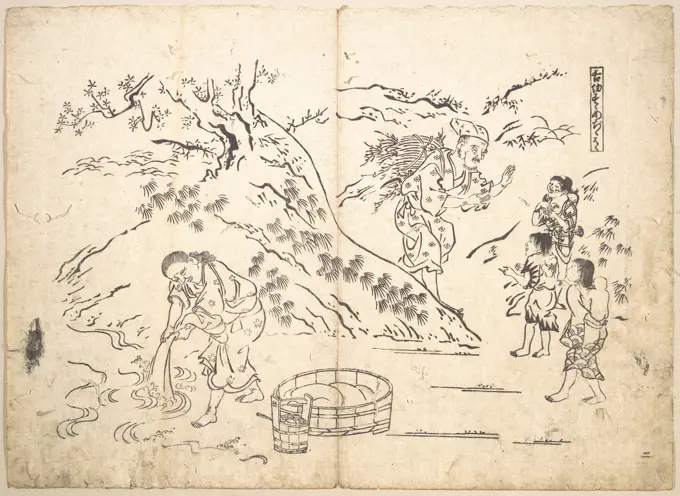
Fagot-gatherer Finds Boy with Sparrow Okumura Masanobu Japanese. Fagot-gatherer Finds Boy with Sparrow 55760
159 assets in this story
6145-58825677
DE MAAN BOVEN HET RODE KLIF, TSUKIOKA YOSHITOSHI, 1885-1889 Rowing boat sailing a high cliff at the bottom. Tokyo paper color woodcut Rowing boat sailing a high cliff at the bottom. Tokyo paper color woodcut
6145-29800975
Sketches Reproduced from Works of Famous Artists 1814 Kawanabe Kysai Japanese. Sketches Reproduced from Works of Famous Artists. Kawanabe Kysai (Japanese, 1831-1889) and many others. Japan. 1814. Ink and color on paper. Edo period (1615-1868). Illustrated Books
4409-28962864
The Goddess Chang'e in the Lunar Palace. Date: 19th century. Origin: China. Period: Qing dynasty. Ink and color on silk. Museum: Freer Gallery of Art and Arthur M. Sackler Gallery.
6145-29820032
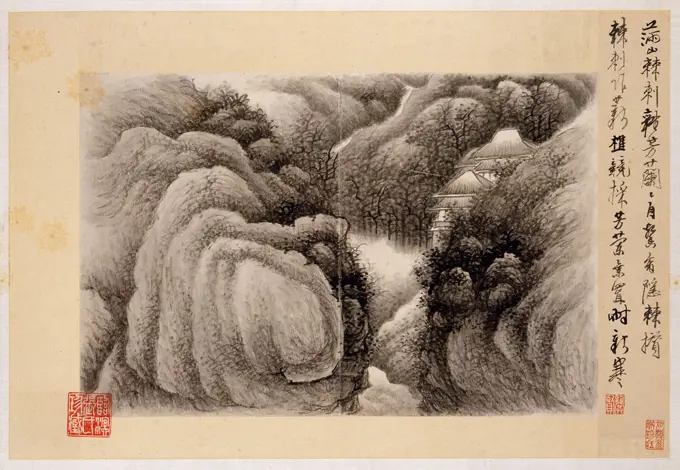
Landscapes with Poems 1688 Gong Xian Chinese Remaining loyal to the vanquished Ming dynasty, the hermit Gong Xian came to terms with himself as an yimin, or leftover subject,” under the Qing dynasty (1644-1911). In this leaf, from an album in which he compared his favorite haunts in and around the former Ming capital of Nanjing with the abodes of the immortals, Gong complemented his image of a reclusive dwelling with a poem that contrasts the ability of orchids, symbols of virtuous men, to endure the cold winter, while brambles — lowly men — are used as firewood. The artist perfected a technique of ink wash and dotting that enabled him to achieve both density and translucency in his paintings. Listen to experts illuminate this artwork's story Listen Play or pause #7307. Ink Landscapes with Poems Supported by Bloomberg Philanthropies We're sorry, the transcript for this audio track is not available at this time. We are working to make it available as soon as possible.. Landscapes with
4069-469
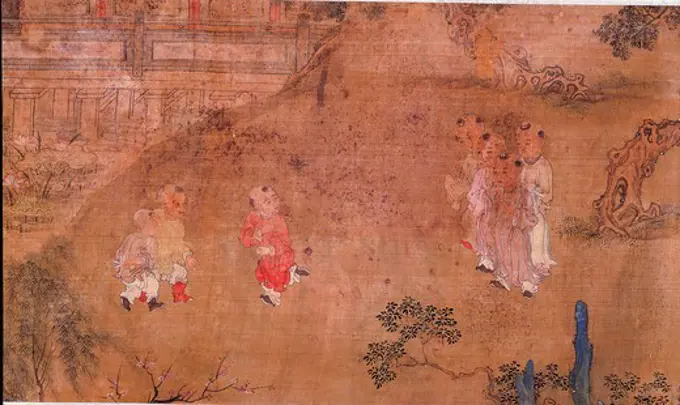
Children playing, from 100 Children At Play scroll, Ming Period, 16th - 17th century, China, detail
4409-17410391
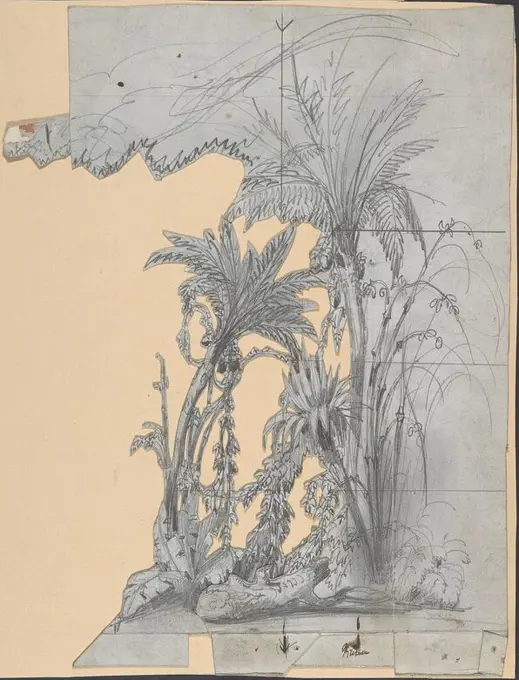
Design for a Stage Set at the Opéra, Paris. Artist: Eugène Cicéri (French, Paris 1813-1890 Fontainebleau). Dimensions: Irregular sheet: 11 5/16 x 8 5/8 in. (28.7 x 21.9 cm). Date: 1830-90. Museum: Metropolitan Museum of Art, New York, USA.
4409-17418970
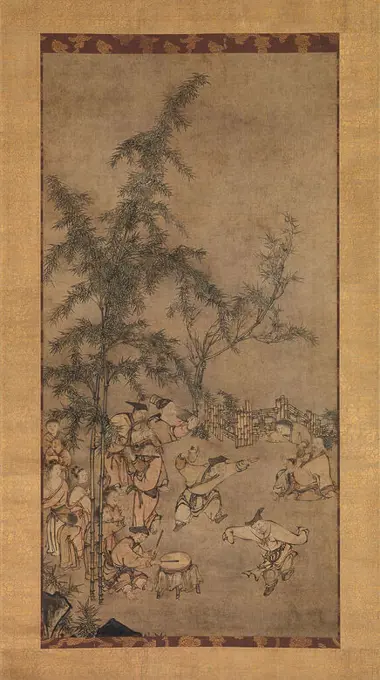
Seven Sages of the Bamboo Grove. Artist: Sesson Shukei (ca. 1504-ca. 1589). Culture: Japan. Dimensions: Image: 40 5/16 × 20 3/8 in. (102.4 × 51.7 cm)Overall with mounting: 79 3/4 × 26 7/16 in. (202.5 × 67.2 cm)Overall with knobs: 79 3/4 × 28 9/16 in. (202.5 × 72.6 cm). Date: 1550s.In China during the turbulent years of the early Western Jin dynasty (265-317), seven literati secluded themselves in a bamboo grove outside the capital. There they escaped from the strictures of officialdom and Confucian conduct, drinking wine, engaging in witty Daoist discourse called qingtan, and playing music and chess. Their story became legend and the frequent subject of painting in China, and eventually Japan. In this unusually exuberant interpretation by Sesson, the sages dance wildly in the company of equally ebullient women and children. Even the bamboo seems to sway to the sages' drumbeat.Although this type of departure from traditional iconography led to the occasional characterization of Sesson a
6145-29706316
Taira no Koremori’s Farewell,” from The Tale of the Heike (Heike monogatari) ca. 1640 Iwasa Matabei (Katsumochi) This painting pictorializes a scene from The Tale of the Heike, the great early medieval tale of war, valor, and tragic love that commemorates the Genpei War of 1180-85, which pitted the two great courtier families—the Taira (Heike clan) and Minamoto (Genji clan)—against each other. Matabei captures one of the most pivotal and poignant episodes of the entire tale, showing one of the last heirs to the Taira family’s power, Lieutenant General (Ch?j?) Koremori, bidding farewell to his wife. As an artist, Matabei established a reputation for adding psychological suggestiveness to his compositions, seen here in the central figures, where the poses and effective use of blank space imply that both realize they will hereafter be separated. In contrast, the attendants have animated facial expressions, manifesting the exaggerated features for which the artist became famous.. Taira n
6145-59597902
Erh-Chi and WO-Hunag search together for Keizer Shun Ts'ang-Wu, Pieter Schenk (I), 1702 print Equipped with 18th-century coloring.  paper etching Chinese
1899-19134829
China: 'Riders and Mountain Pavilions'. Qing Dynasty painter Huang Shen (1687-1772) (Nanjing Museum, Nanjing)
4409-17490388
Sino-Japanese War: The Japanese Navy Victorious Off Takushan. Date/Period: Meiji Period, dated 1895. Print. Tryptich woodblock print, ink and colors on paper Tryptich woodblock print, ink and colors on paper. Height: 13.50 mm (0.53 in); Width: 28 mm (1.10 in). Author: Ogata Gekko.
6145-58825680
Nocturnal Game District, Okumura Masanobu, 1705 - 1750 Picnicking company, looking at long -standing boat with man lying on roof, looking at full moon. Japan paper color woodcut Picnicking company, looking at long -standing boat with man lying on roof, looking at full moon. Japan paper color woodcut
6145-54679710
Mount Utsu (Utsu no yama), from The Tales of Ise (Ise monogatari) Painting by Tawaraya Sōtatsu Japanese Inscribed by Takeuchi Toshiharu Japanese ca. 1634 This poem card comes from a set of more than twenty surviving sheets, each of which is illustrated with a scene from the tenth-century Tales of Ise and accompanied by a poem from the relevant chapter inscribed by a calligrapher of the day. In this episode, a courtier traveling on Mount Utsu (literally, mountain of sadness) meets an itinerant monk on his way to Kyoto and asks him to give his regards to a lover in the distant capital.Suruga naru Utsu no yamabe no utsutsu ni mo yume ni mo hito ni awanu narikeri Amid the sad hillsof Mount Utsuin Suruga Province,I cannot meet my lover,not even in my dreams.Trans. John T. Carpenter
4409-17387551
Zhu ji. Artist: Kuwagata Keisai (Japanese, 1764-1824). Culture: Japan. Dimensions: 10 x 14 7/8 in. (25.4 x 37.8 cm). Date: 1789. Museum: Metropolitan Museum of Art, New York, USA.
6145-29216815
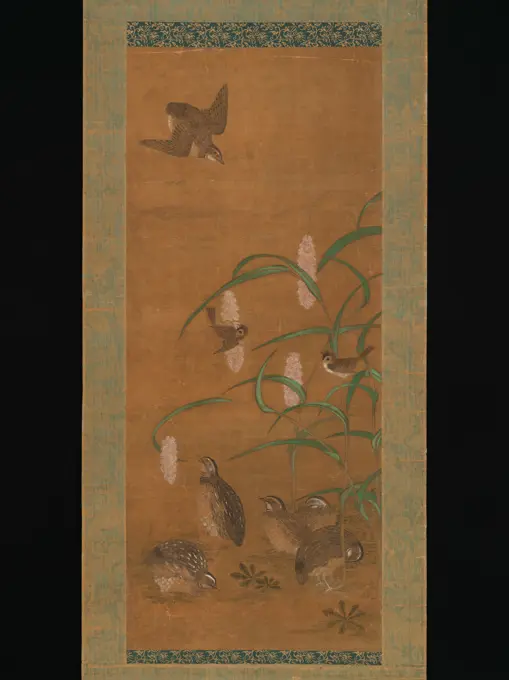
Quail, Sparrows, and Millet early 16th century Japan A flock of quails and pair of sparrows gather around stalks of millet, their heads heavy with ripe seed on an autumn day. The theme of quails and autumn grasses was widely depicted in China during the Southern Song dynasty (1127-1279), most often by painters in attendance at the imperial court. Many works on the theme were brought to Japan and entered the collections of Buddhist temples, while a select few entered prestigious private collections such as that of the Ashikaga family, who ruled Japan as military dictators during the Muromachi period. These works served as important models for later Japanese artists. The present example reflects the unidentified Japanese painters familiarity with these earlier Chinese works.. Quail, Sparrows, and Millet. Japan. early 16th century. Hanging scroll; ink and color on silk. Muromachi period (1392-1573). Paintings
6145-30386248
Figures standing beneath a tree - (unidentifiedillustration). Artist: Edwin Austin Abbey, American, 1852-1911, M.A. (HON.) 1897
4443-21724484
Hunter by a birch, Gerardus Emaus de Micault, 1799 - 1863, Design for a print., draughtsman: Gerardus Emaus de Micault, 1799 - 1863, paper, pen, brush, h 72 mm × w 57 mm
4409-28962630
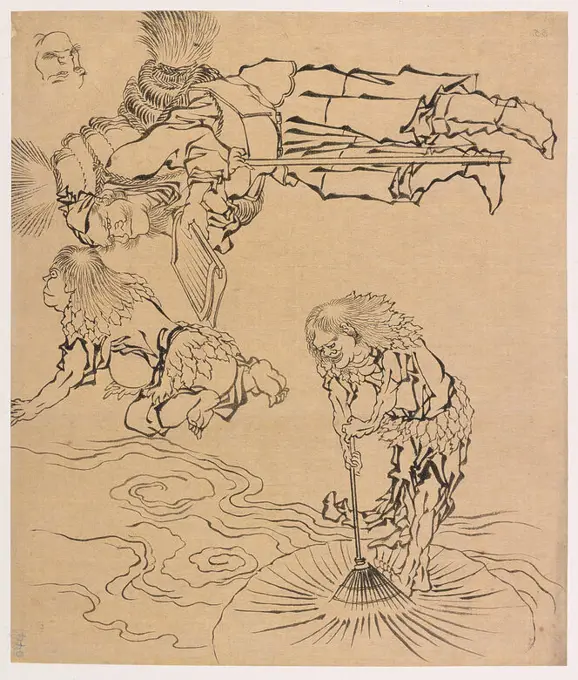
Legendary beings. ink on paper. Origin: Japan. Period: Edo period. Date: 1760-1849. Museum: Freer Gallery of Art and Arthur M. Sackler Gallery.
4409-17380182
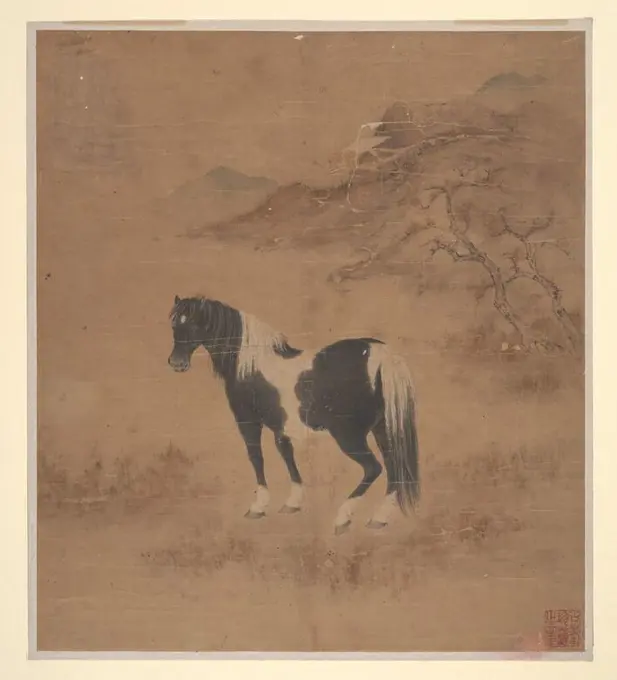
Horse and Landscape. Artist: Unidentified Artist; In the style of Giuseppe Castiglione (Italian, Milan 1688-1766 Beijing). Culture: China. Dimensions: 12 3/4 x 11 1/4 in. (32.4 x 28.6 cm). Museum: Metropolitan Museum of Art, New York, USA.
6145-29726100
Print Katsushika Hokusai Japanese. Print 54431
4443-19545140
Frieze, Maxwell & Co., S.A., Chicago, Illinois, USA, Machine-printed paper, liquid mica, Landscape frieze with view of trees and horizon in the background, while a meandering row of pink flowers is in the foreground., USA, 1905-1915, Wallcoverings, Frieze
4443-28729039
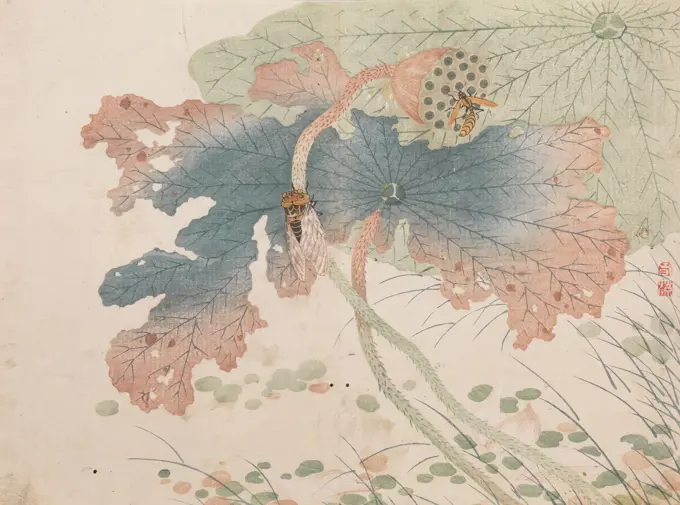
Selected Insects from Close at Hand (Chūka senzen 下選蠕), 1820, 7th month, Mori Shunkei, 8 1/4 × 5 9/16 × 1/2 in. (20.96 × 14.13 × 1.27 cm), Woodblock printed book; ink and color on paper, Japan, 19th century
6145-55951055
Ise monogatari = The Tales of Ise.. text. Illustrations. 1608. Spencer Collection
6145-55951062
Ise monogatari = The Tales of Ise.. text. Illustrations. 1608. Spencer Collection
6145-51834928
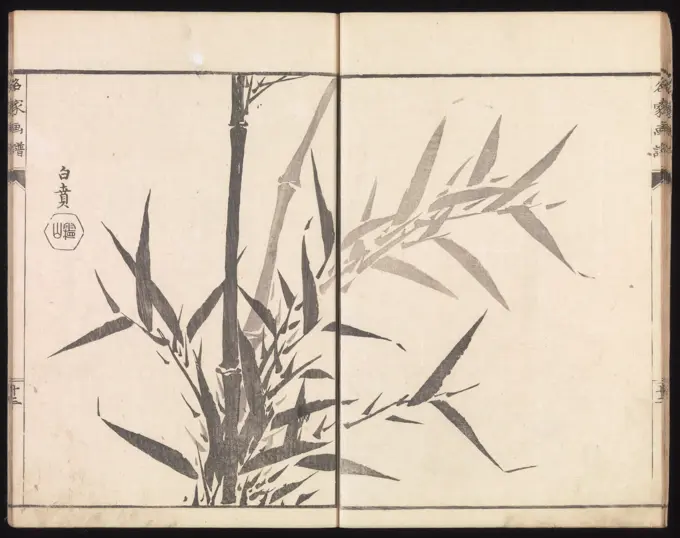
Mustard Seed Garden, a Chinese Painter's Manual Mustard Seed Garden, a Chinese Painter's Manual, 1782. Woodblock printed book, ink and color on paper, Each: 11 3/4 x 6 13/16 x 3/16 in. (29.8 x 17.3 x 0.5 cm).   Asian Art 1782
6145-51821860
Kunmo Zu-i Taisei. Kashiragaki Zoho After the original by Nakamura Tekisai (Japanese, 1629-1702). Kunmo Zu-i Taisei. Kashiragaki Zoho, 1629-1702. Paper, H: 8 7/8" - W: 6 1/4".   Asian Art 1629-1702
6145-29773913
Wise Men and Children 19th century Unidentified artist. Wise Men and Children 40431
4409-28962449
Blossoming wisteria on a bamboo trellis. Date: 16th-17th century. Origin: Japan. Period: Momoyama period. Color, gold, and silver on paper. Museum: Freer Gallery of Art and Arthur M. Sackler Gallery.
6145-59466986
Val van Phaëthon, anonymous, 1688 - 1698 print Phaëthon pours into the water with the solar wagon and horses, after Jupiter has hit him with a lightning bolt. Nymphs and river gods look shocked on land. Some river gods are struck forward over their urn. Netherlands paper etching / engraving fall of Phaethon; he is struck by a thunderbolt of Jupiter
6145-29135567
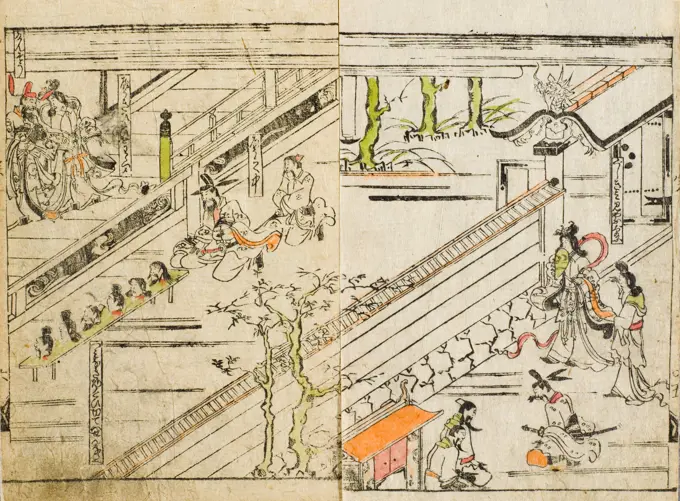
Court Scene with Decapitated Heads. Japan, second half 17th century. Prints; woodblocks. Pair of hand-colored woodblock print pages from a book
6145-30168335
The Five Virtues Artist's working dates 1890-1900 China. Ren Yi was among the most successful and influential among Chinese painters of the so-called Shanghai School. Arriving in Shanghai in 1857, he took the artistic name ìbonianî (one-hundred years), claiming that it would take him a century to achieve success. However, by 1875 Ren Yi was the best-known painter in Shanghai. His highly sought-after bird-and-flower paintings initially followed the Song dynasty (960ñ1279) convention of applying rich color fields within outlines, producing decorative patterning with lifelike representation. This work represents his mature, more spontaneous style that is characterized by looser brushwork, more ink washes, and greater tonal variation.These five pairs of birds represent the Five Cardinal Relationships, following the Neo-Confucian principle that strict and proper implementation of hierarchy among different groups achieves social harmony. Above, a pair of long-tailed phoenixes roosting in the
6145-52954210
Japanese Drawing Japan early 19th century View more. Japanese Drawing. Japan. early 19th century. On paper. Edo period (1615-1868). Paintings
4443-28727524
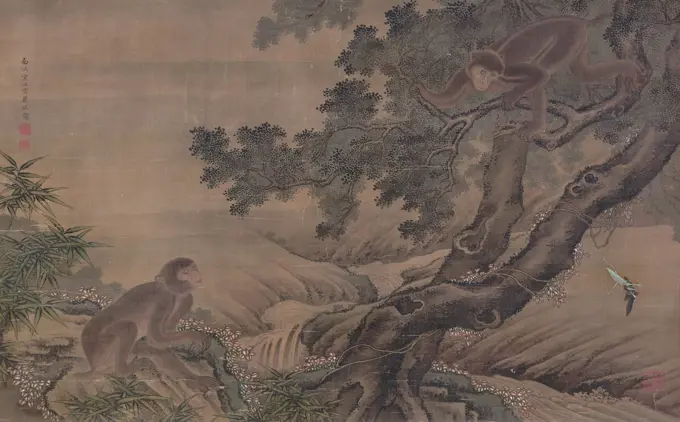
Monkeys Watching a Praying Mantis Catching a Wasp, second half 18th century, Iwai Kōun, Japanese, 24 × 38 7/16 in. (60.96 × 97.63 cm) (image)61 3/16 × 42 3/4 in. (155.42 × 108.59 cm) (mount, without roller), Ink and color on paper, Japan, 18th century, Nothing is known about the painter Iwai Kōun except that he was born in Nagasaki, the only port town in Japan that allowed foreigners to trade and live there during the Edo period (1603-1868). Nagasaki paintings reflect the strong influence of Chinese art, which arrived there on merchant ships. On the right side of this painting, a praying mantis has caught a wasp and is about to kill it. A monkey in the tree above watches the spectacle, while he is observed by another monkey on the far left.
6145-29706397
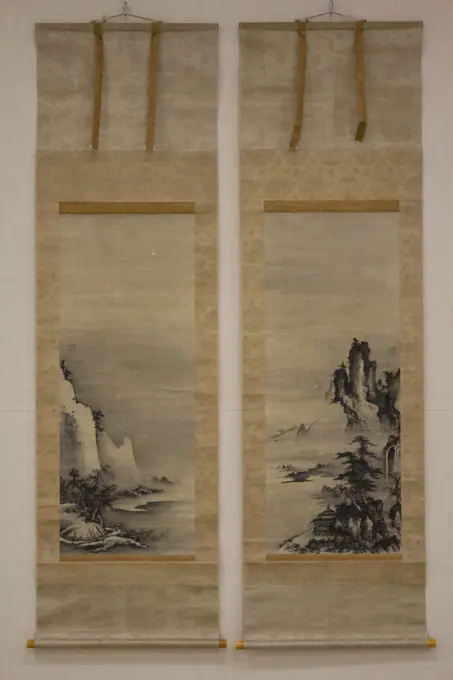
Landscapes of Autumn and Winter 17th century Spurious seal of Tensh Shbun. Landscapes of Autumn and Winter. Spurious seal of Tensh Shbun (Japanese, active 1414-before 1463). Japan. 17th century. Diptych of hanging scrolls; ink and color on paper. Edo period (1615-1868). Paintings
6145-29214880
Tiger 14th century Unidentified Listen to experts illuminate this artwork's story Listen Play or pause #8812. Tiger Supported by Bloomberg Philanthropies We're sorry, the transcript for this audio track is not available at this time. We are working to make it available as soon as possible.. Tiger. Unidentified , 14th century. China. 14th century. Hanging scroll; ink on silk. Yuan dynasty (1271-1368). Paintings
6145-29136534
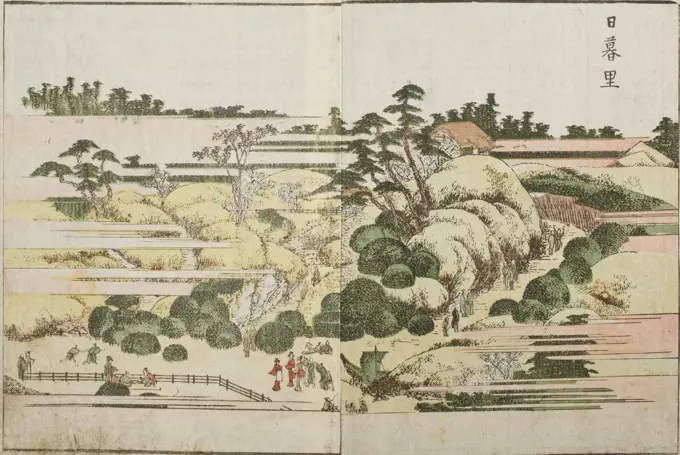
Nippori. Katsushika Hokusai (Japan, 1760-1849). circa 1802. Books. Double-page book illustration; color woodblock print
6145-30323386
Robert Smirke, 1752-1845, British, Oberon and Puck. Pen and brown ink with brown wash and gouache over graphite with gum.
1899-19136855
China: Qingming Shang Tu or 'Along the River During the Qingming Festival' (detail), Zhang Zeduan (1085-1145) original scroll painting dating from the Northern Song Dynasty (960-1127)
4409-17565133
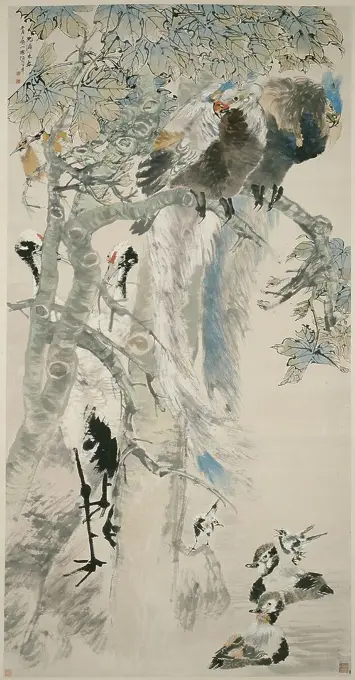
The Five Virtues. Ren Yi zi Bonian; Chinese, 1840-1895. Date: 1890-1900. Dimensions: 185.9 × 97.2 cm (73 1/2 × 38 1/4 in.). Hanging scroll; ink and colors on paper. Origin: China. Museum: The Chicago Art Institute, USA.
4409-17372159
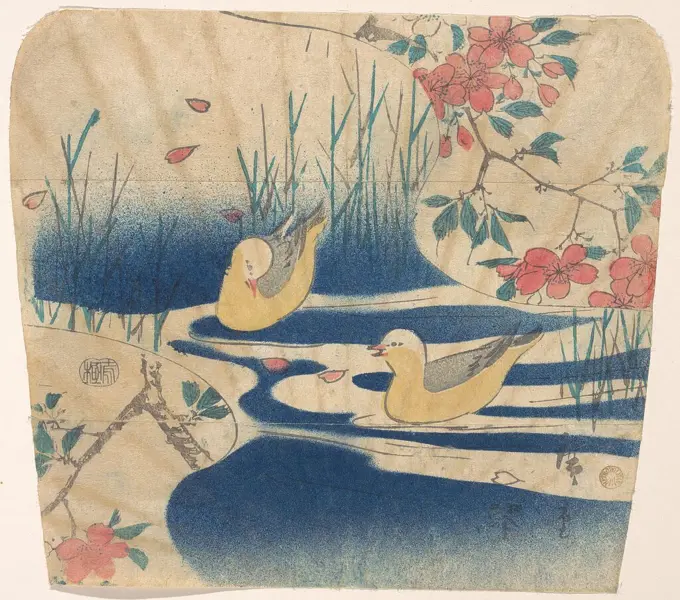
Hooded Gulls and Cherry Blossoms. Artist: Utagawa Hiroshige (Japanese, Tokyo (Edo) 1797-1858 Tokyo (Edo)). Culture: Japan. Dimensions: H. 7 7/8 in. (20 cm); W. (top) 9 in. (22.9 cm); (bottom) 7 3/4 in. (19.7 cm). Date: probably 1850-62. Museum: Metropolitan Museum of Art, New York, USA.
6145-55951085
Ise monogatari = The Tales of Ise.. text. Illustrations. 1608. Spencer Collection
6145-29710287
Design for a Stage Set at the Opéra, Paris 1830-90 Eugène Cicéri French. Design for a Stage Set at the Opéra, Paris 359098
6145-59579119
Kawakami hot water sources, 1917 print Two travelers walk into the Water Sources Complex Kawakami, which is located in the Fukushima prefecture in the north of Japan.  paper color woodcut hot spring, geyser. medicinal spring Kawakami ONSEN
6239-71008666
Genji monogatari 54  | Library of Congress
4409-17562633
Chrysanthemum and Narcissus, from the illustrated book "Picture Book: Flowers of the Four Seasons (Ehon shiki no hana)," vol. 2. Kitagawa Utamaro  ; Japanese, 1753 ()-1806. Date: 1801. Dimensions: . Color woodblock print; 2 pages from illustrated book. Origin: Japan. Museum: The Chicago Art Institute, Chicago, USA.
6145-30174484
MarikoNo 21, from the series Fifty-three Stations of the Tokaido (Tokaido gojusan tsugi), also known as the Reisho Tokaido 1842-1857 Japan. Color woodblock print; oban . Utagawa Hiroshige
4409-17417547
Album of Copies of Chinese Paintings. Artist: Kano Tsunenobu (Japanese, 1636-1713); .1. After Zhao Mengfu (Chinese, 1254-1322); .2: After Yintuoluo (Chinese, active 13th century); .3: After Wang Lipen (Chinese, born late Yuan, active early Ming dynasty); .4: After Po Citing (Chinese, died 1337(); active first half of the 14th century); .6: After Puming (Chinese, active 14th century); .7: After Sheng Mou (Chinese, active ca. 1310-1360); .8: After Danzhirui (active early 14th century); .9: After Jin Dashou (active 13th century); .10: After Wang Yuan (Chinese, ca. 1280-after 1349); .13 After Chen Rong (active 1235-62); .14: After Muqi (Chinese, active ca. 1250-80); .15: After Guo Xi (Chinese, ca. 1000-ca. 1090); .16: After Yan Ciping (Chibese, active 12th century); .17: After Zhang Yüehu (active 13th century); .18: After Luochuang (active 13th century); .19: After Ren Renfa (Chinese, 1255-1328); .20: After Luo Xinzhong (active 13th century); .21: After Wen Tong (Chinese, 1019-1079); .22:
6145-54590885
Anonymous watercolor depicting a Chinese hunting scene with figures and animals in a landscape.
6145-29835838
One Hundred Paintings by Krin (Krin hyakuzu) 1815 (first two volumes) and-1826 (two sequel volumes) Sakai Hitsu Japanese. One Hundred Paintings by Krin (Krin hyakuzu). Sakai Hitsu (Japanese, 1761-1828). Japan. 1815 (first two volumes) and-1826 (two sequel volumes). Four volumes of woodblock printed books; ink on paper. Edo period (1615-1868). Prints
1899-19136849
China: Qingming Shang Tu or 'Along the River During the Qingming Festival' (detail), Zhang Zeduan (1085-1145) original scroll painting dating from the Northern Song Dynasty (960-1127)
6145-29820213
Piece 18th-19th century Japan. Piece 66643
4409-17549437
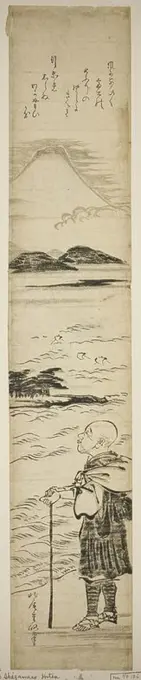
Priest Saigyo Contemplating Mount Fuji. Kitao Shigemasa; Japanese, 1739-1820. Date: 1770-1779. Dimensions: 26 1/2 x 4 7/8 in. Color woodblock print; hashira-e. Origin: Japan. Museum: The Chicago Art Institute, Chicago, USA.
6145-51820605
Fishermen (Album Leaf) Fishermen (Album Leaf), 14th century. Ink and light color on silk, Overall: 15 1/8 x 18 3/4 in. (38.4 x 47.6 cm).   Asian Art 14th century
4409-28963020
Birds and Fruit. Origin: China. Period: Qing dynasty. Ink and color on silk. Date: 1741. Museum: Freer Gallery of Art and Arthur M. Sackler Gallery.
4409-17300262
CODICE TRUJILLO DEL PERU - TOMO II, F 117 - CAZA DE GATOS MONTESES O LEONES - ACUARELA - SIGLO XVIII. Author: MARTINEZ COMPAÑON BALTASAR. Location: PALACIO REAL-BIBLIOTECA. MADRID. SPAIN.
6145-43595130
Collection of paintings by Chen Shiceng. Rong Bao Zhai (1672- ), publishing house, Chen, Shiceng, painter
6145-29175193
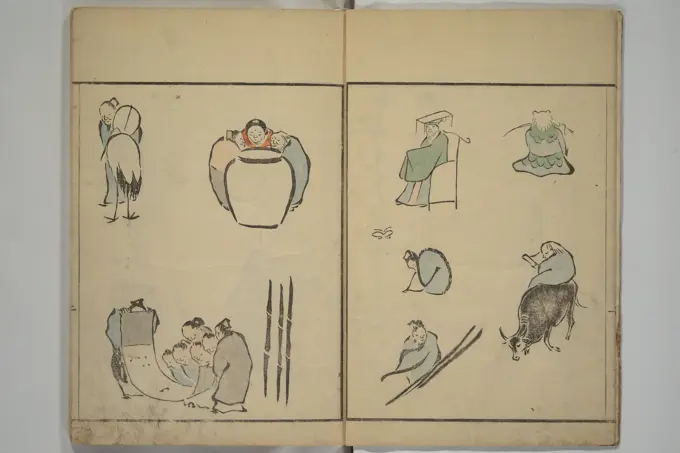
How to Draw Figures Simply 1799 Kuwagata Keisai Japanese. How to Draw Figures Simply. Kuwagata Keisai (Japanese, 1764-1824). Japan. 1799. Set of three woodblock printed books; ink and color on paper. Edo period (1615-1868). Illustrated Books
6145-43558157
Drawing, View of Naples (or vicinity); Italy; brush and gouache on paper
6145-59223670
Fables of Fontaine - Part one, Jean de la Fontaine, 1894 book Part one (of two) with fourteen fables, illustrated by four different Japanese artists; 27 magazines; Cover sheet with title and landscape in which different animals, Mount Fuji in the background; title page; Two pages Foreword, dated; Fourteen illustrations, each over two pages; Fourteen Fables, numbered; Table of contents; Rear leaf, colophon. Franceprint maker: Tokyoprint maker: Tokyoprint maker: Tokyoprint maker: Tokyoprinter: Tokyoprinter: TokyoFrancepublisher: France paper color woodcut
PREVIOUS
of 2
NEXT
2401 S. Ervay, Suite 206
Dallas, Texas 75215
United States
Get Started
Free ResearchMy BoardsMy Cart
For Creators
How To License Your ContentContributor PortalFrame of Mind
Resources
API accessPricing
Contact
+1 866 236 0087help@viewpictures.co.uk Contact form
©2026 View Pictures. All Rights Reserved. -A
This site is protected by reCAPTCHA and Google Privacy Policy and Terms of Service apply.