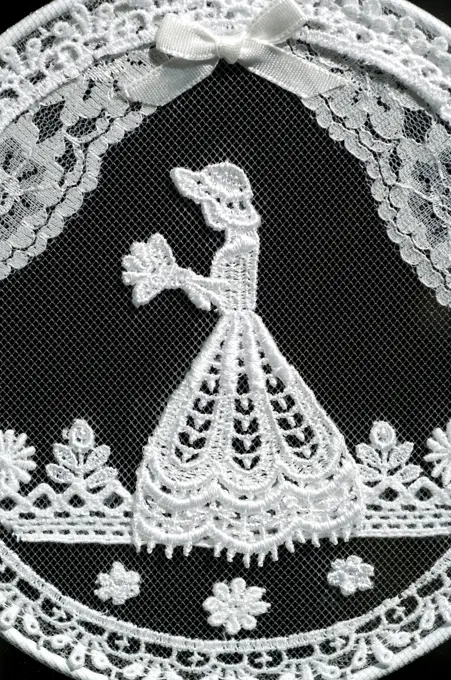
Vintage Lace Fragments

Exquisite samples of lace from various periods, showcasing delicate patterns and historical textile artistry.

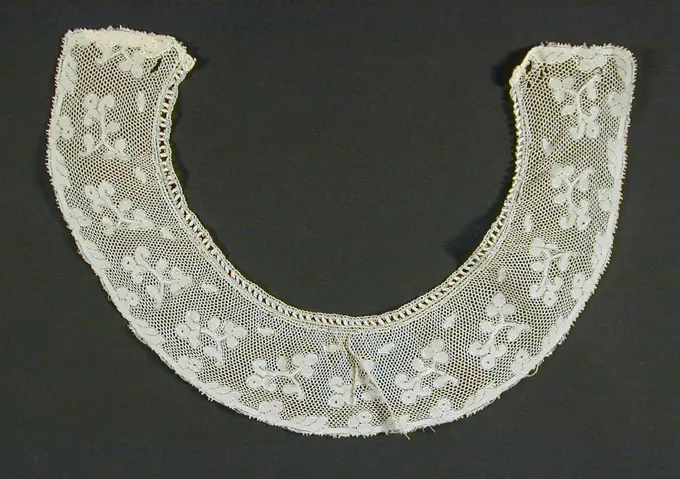
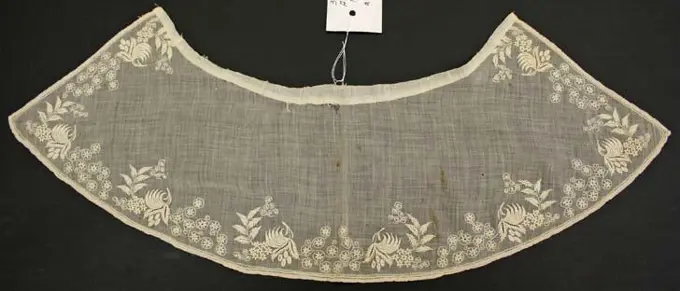
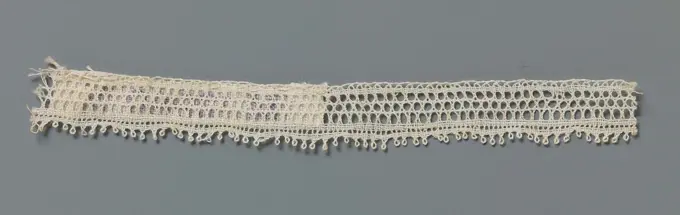
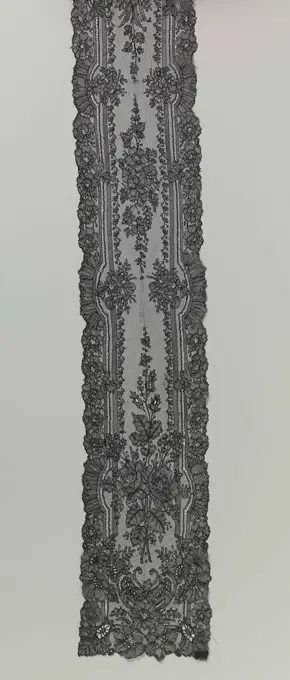
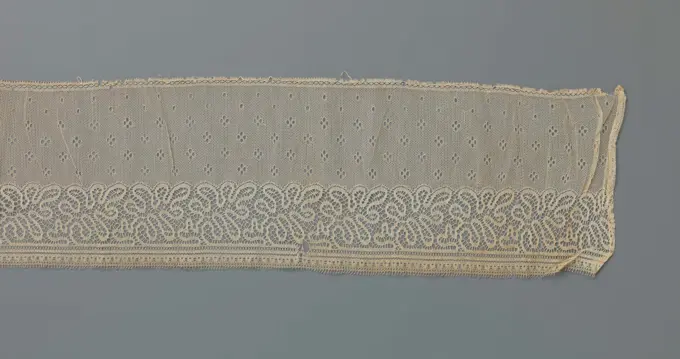
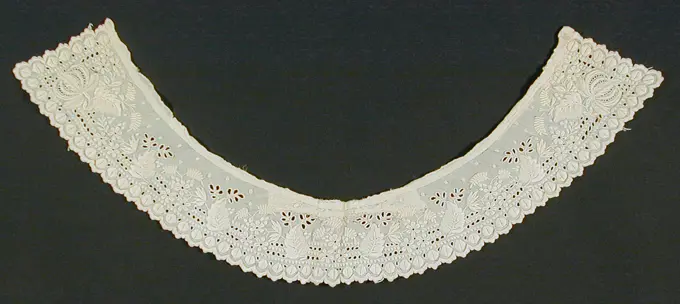
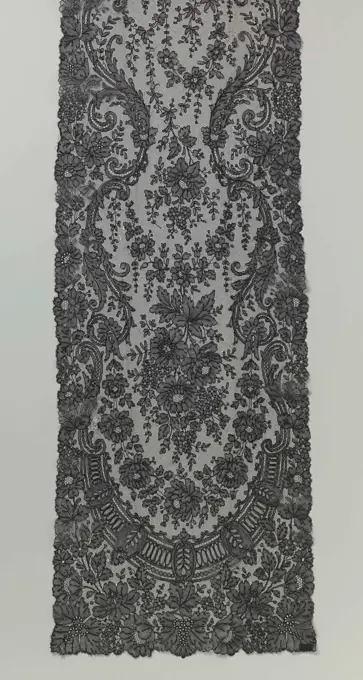
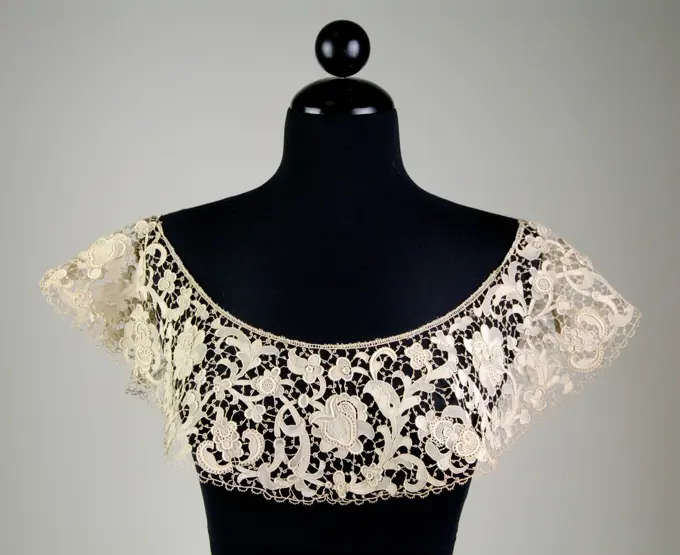
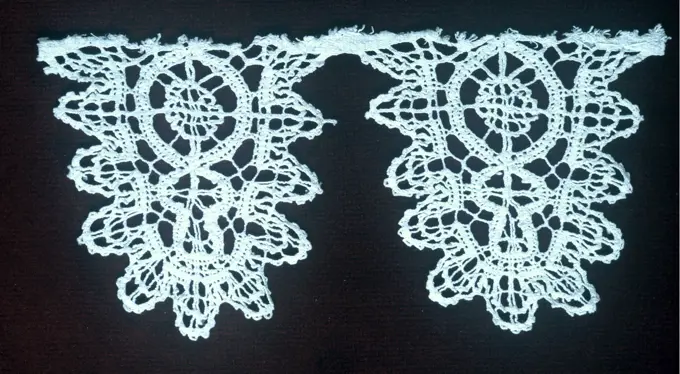
Collar of needle side with flower branch in U-shaped cartouche, anonymous, c. 1860 - c. 1880 Collar of natural -colored needle side: Brussels mesh side. The repeating pattern consists of a U-shaped cartouche with a flower branch with two rosette flowers and two chalice flowers. The 'legs' of the U are formed by two straight pillars, crowned by a rosette flower and a three -lobby leaf. There is an oval medallion with a rosette flower in the center under each pillar. Between the pillars and the successive medallions, there is a decorative frame with five lobes and below that a pendulum of three leaves between two rosette flowers. Together with this pendulum, the medallions take care of the scrap edge along the underside of the strip. The motives are equipped with contour threads, the three circles in the pillars and the rosette flower in each medallion are equipped with relief contours. The motifs are connected to each other by a fine mesh ground, a mesh side. Belgium linen (material) Br
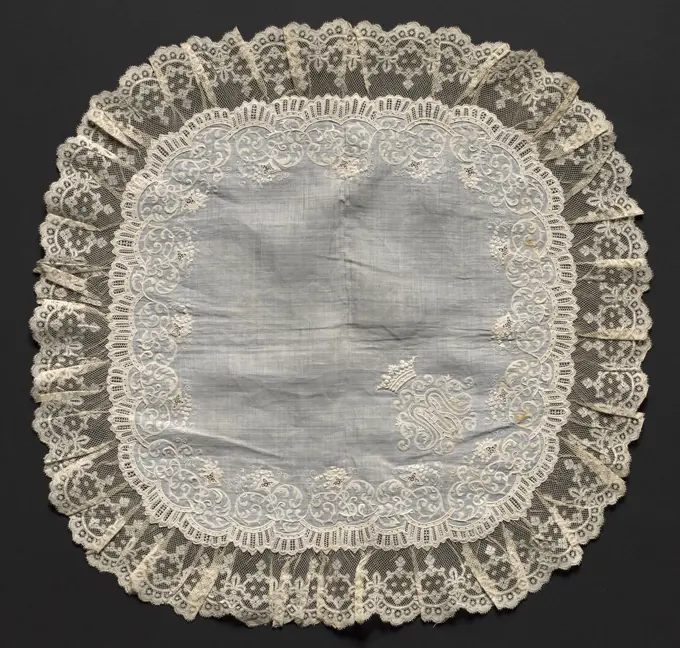
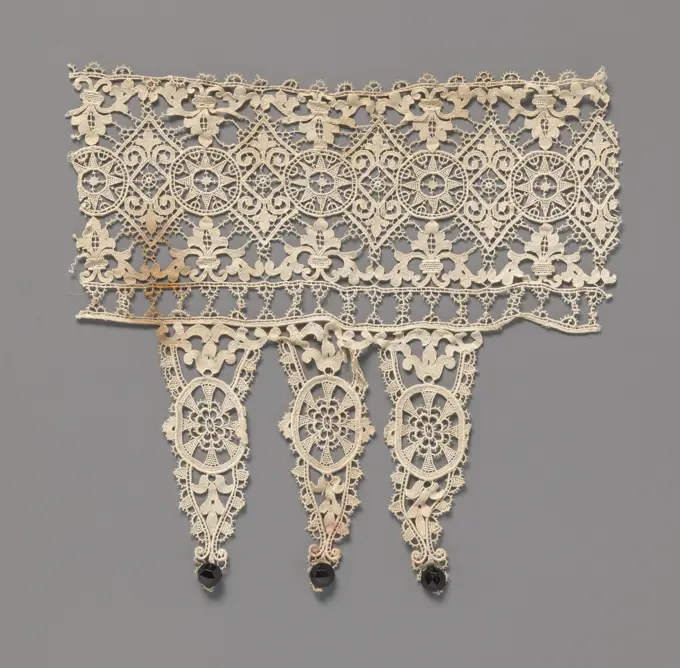
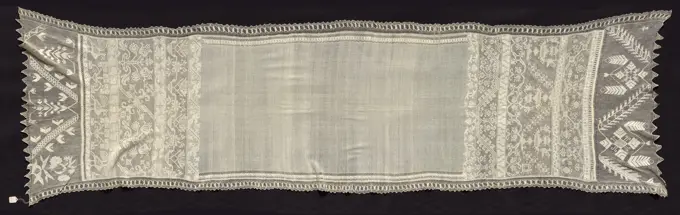
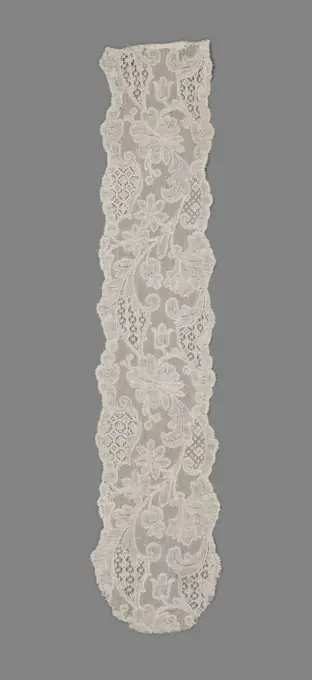
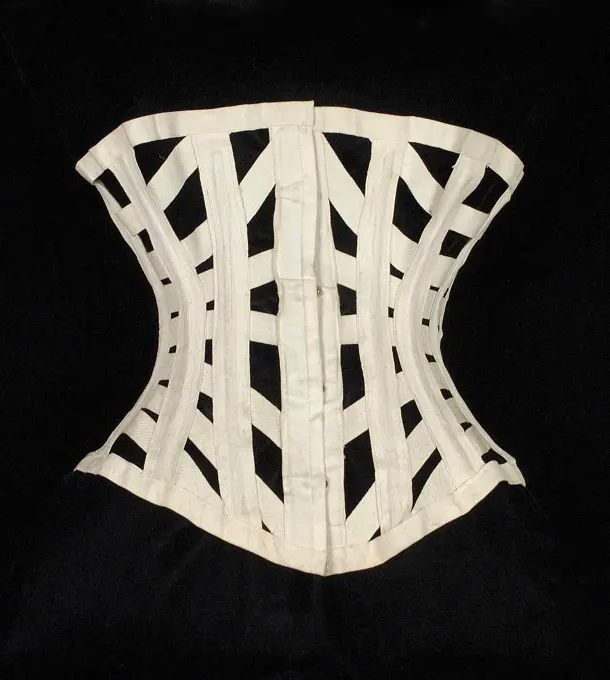
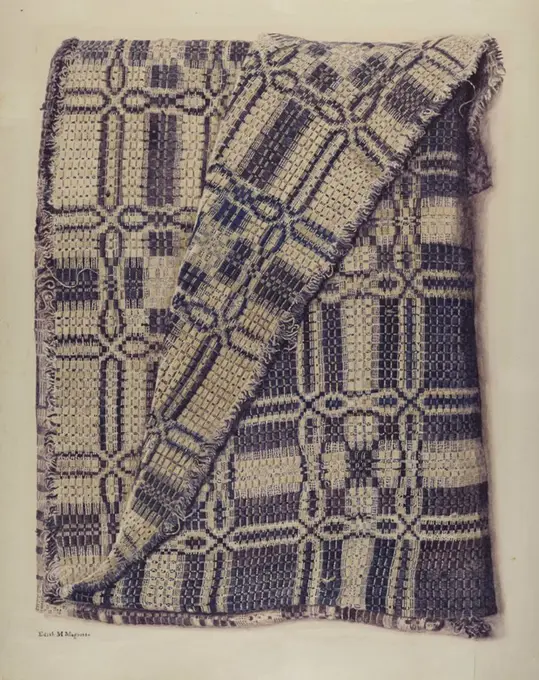
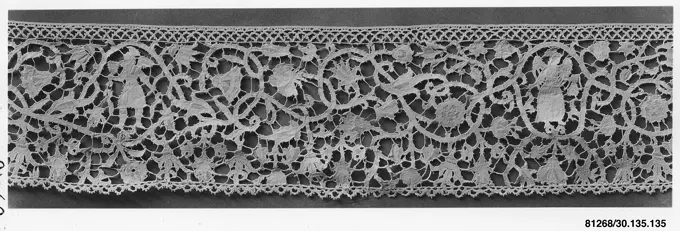
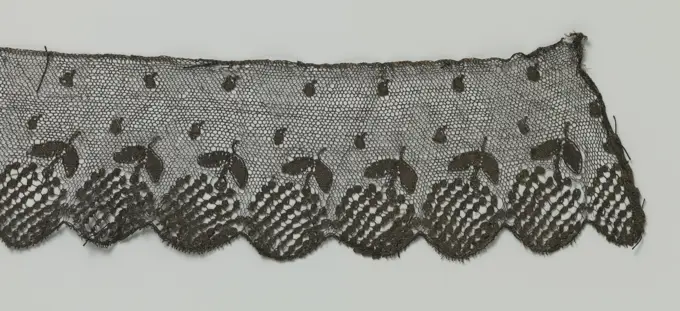
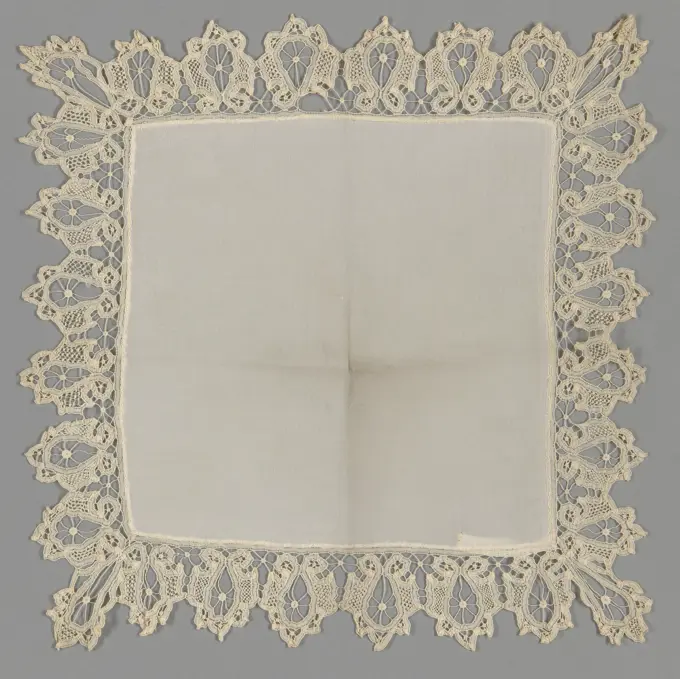
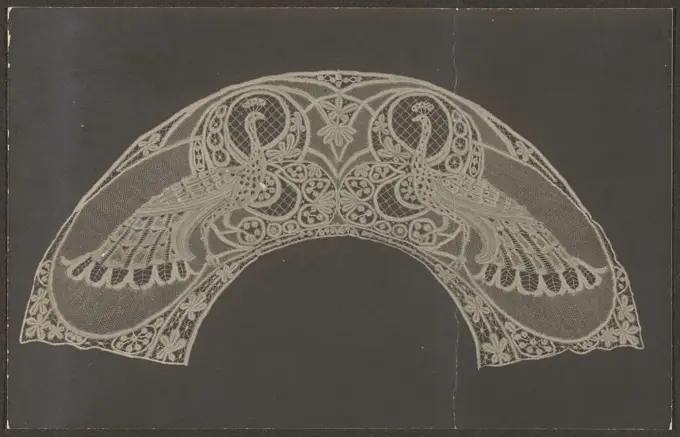
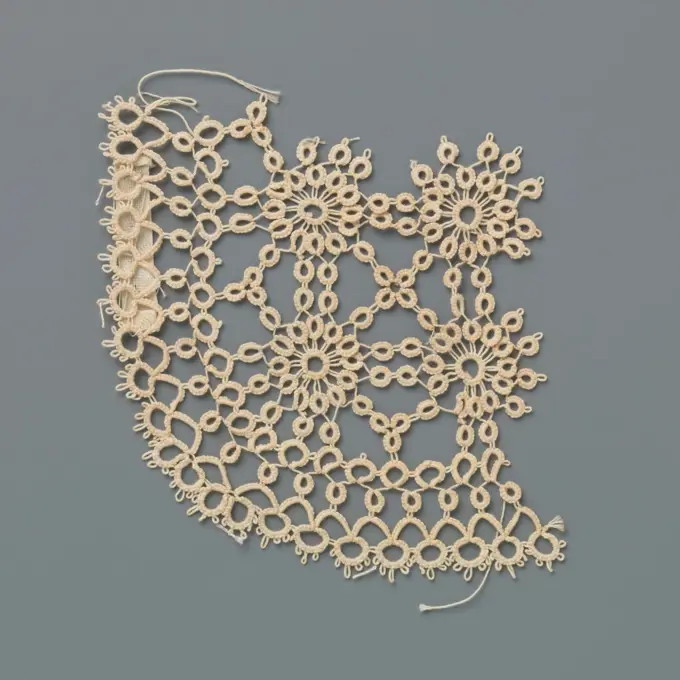
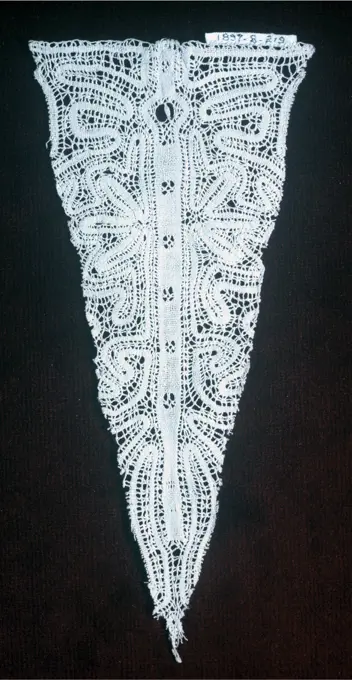
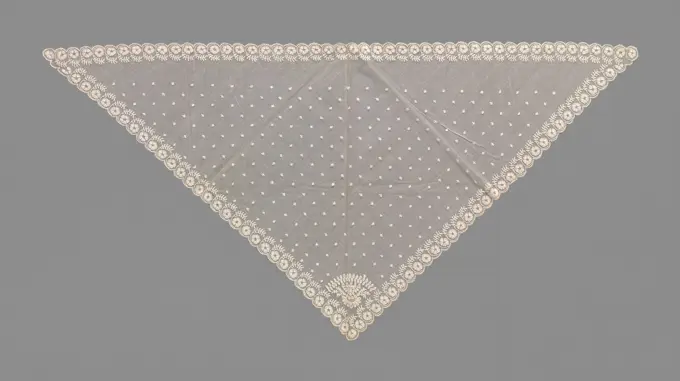
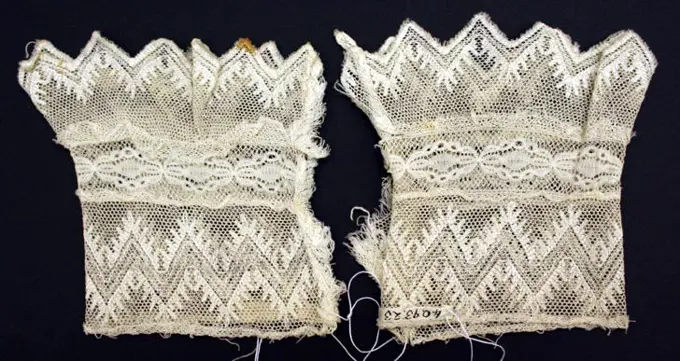
Flounce 18th century Italian, Burano. Flounce 218794Bliżej Kultury unknownEdging 16th century Italian, Venice. Edging 221085Flounce, Medium: silk Technique: bobbin lace, white silk, Flounce with fine 'point de Paris' mesh and border of leaf festoons., France or Spain, 19th century, lace, FlounceLace insert (lard);  19th century (1880-00-00-1920-00-00);Fragment early 18th century Italian, Burano. Fragment 218829Cravat End. Flanders, Brussels. Date: 1730-1749. Dimensions: 28.5 × 35.1 cm (11 1/4 × 13 3/4 in.). Linen, needle lace. Origin: Flanders. Museum: The Chicago Art Institute, Chicago, USA.Edge, Medium: linen Technique: bobbin lace (late Valenciennes ground), A rose vine flowing horizontally with hanging rose wreaths. A scalloped edge formed by large and small roses. A naturalistic effect is attempted in the large roses with shading., 19th century, lace, EdgeFingerlum rug of linen with needle side with birds in a tree, anonymous, c. 1900 - c. 1914 Natural linen finger rug with needle tilt fillings in open work. Octagonal midfield with two birds on in tree. Rand with a repeating pattern of pomegranates contained between C-Voluten. Kiskunhalas linen (material) needle lace ground Natural linen finger rug with needle tilt fillings in open work. Octagonal midfield with two birds on in tree. Rand with a repeating pattern of pomegranates contained between C-Voluten. Kiskunhalas linen (material) needle lace groundEdging 1700-1750 French. Edging 222842Insertion 16th century Italian, Venice. Insertion. Italian, Venice. 16th century. Bobbin lace. Textiles-LacesCuffs, Medium: linen Technique: bobbin lace appliqué on machine-made net, Cuffs with a design of floral sprays and borders applied to net., Honiton, England, 19th century, lace, CuffsKraag met slippen, van applicatiekant.Collar of natural brussels application side: dick side applicated on tulle. Elongated narrow model with rounded wider ends and sloping edge. The outer edge consists of a concatenation of elongated C-volutes with lobes that form the slip edge. Around the ends the slip edge, which is formed here, is changed by a daisy with lobes on either side with leaves and mashes. The midfield of the tie is filled with floral drinks and mates.Fragment of bobbin lace unknownWoman's Collar. Belgium, Western Flanders, mid-19th century. Costumes. Cotton Valenciennes d'ypres bobbin laceEmbroidered Handkerchief, 18th century. Switzerland, 18th century. Embroidery: linen; average: 45.7 x 47 cm (18 x 18 1/2 in.).Japon strip of application side with wavy slender and bell -flower branches, anonymous, c. 1835 - c. 1849 Japon strip of Brussels application side, bobbin with a needle side decorative stitches, attached to machine tulle. The strip was made as a bottom strip of three strips for a crinoline gown. On the strip there is a continuous pattern with a wavy and open -worked leaf vend. Three rosette flowers and a large to the right bend branch with bell flowers from each golf top. There are always two richly decorated garlands under one wave, which form the deep scallops. The motifs are made in linen stroke and the motifs are largely provided with relief contours made with a thicker wire and here and there with burst relief contours (ribs). One kind of decorative land (needle side), with thickened buttons decorated meshes, fills part of the motifs. The top edge is finished with a zoompje. Brussels  Brussels Applied Japon strip of Brussels application side, bobbin with a needle side decorative sLace, 1700s, Germany, maker unknown. Acquisition history unknown.Border Made 1675-1725 Italy. Linen, needle lace worked on a plain weave; cut and drawn thread work grid; edged with bobbin straight lace (probably a 19th century addition) .Border early 18th century possibly Italian. Border 226267Japon decoration of application side with mimosataks, anonymous, c. 1890 - c. 1909 Japon decoration of natural -colored application side, Kloskant Applicated on machine tulle. A rectangular piece of tulle is finished on the two short sides with flat scallops. On the short axle is an almost symmetrical wavy branch with three bunches of mimosataks and wide -spread side branches with feathered leaves. The branch starts with a bow above a horizontal C-Volut. Belgium (possibly) linen (material) Japon decoration of natural -colored application side, Kloskant Applicated on machine tulle. A rectangular piece of tulle is finished on the two short sides with flat scallops. On the short axle is an almost symmetrical wavy branch with three bunches of mimosataks and wide -spread side branches with feathered leaves. The branch starts with a bow above a horizontal C-Volut. Belgium (possibly) linen (material)Cuff from crochetware with impeller motif. Cuff of natural colored crocheted. Eight rows with impellers made with crochet sticks. The range forms a wavy edge on the bottom. The top is trimmed with a woven edge.Machine furniture decorations with gitten on long pointed sculpts, anonymous, c. 1900 Furniture decoration of natural -colored machine side: Etskant. The side imitates needle side: Reticella and Punto in Aria. On a rectangular strip there are three pointed sculpts with a rosette in a standing oval medallion in the middle and a black button of git or an imitation of git at the tip. Switzerland cotton (textile). jet (coal) Furniture decoration of natural -colored machine side: Etskant. The side imitates needle side: Reticella and Punto in Aria. On a rectangular strip there are three pointed sculpts with a rosette in a standing oval medallion in the middle and a black button of git or an imitation of git at the tip. Switzerland cotton (textile). jet (coal)Edging, Medium: silk Technique: bobbin lace, blonde style, Edging lace showing a pattern of flowers and leaves that form scallops along one side., Spain, 19th century, lace, EdgingBatist cuff decorated with English embroidery, c. 1875 - c. 1925 Batist cuff decorated with English embroidery. The cuff has a Schulprand that has been trimmed with a feston stitch. maker: West-EuropaNetherlands whole: Batiste Batist cuff decorated with English embroidery. The cuff has a Schulprand that has been trimmed with a feston stitch. maker: West-EuropaNetherlands whole: BatistePelerine 1830-36 American or European. Pelerine 118957Collar 19th century probably French. Collar 102659Cloth with Border of Vegetal Motifs and Insertion with Bird Motifs, 18th century. Cyprus , 18th century. Plain weave wool with needle lace, burato insertion (twined ground and darned in two directions), filet/lacis border and edging (knotted ground and darned in one direction), drawn work, and embroidery; bleached linen (est.), wool (est.), and cotton (est.); overall: 72.6 x 233.6 cm (28 9/16 x 91 15/16 in.). Textiles often incorporate multiple needlework techniques within a single piece. One of the techniques in this example of lace is called cutwork. In cutwork, portions of the textile ground, such as a linen or cotton cloth, are cut away and threads are removed to create holes. The edges of the hole are then reinforced with embroidery and a pattern of needle lace can be created within the perimeter. Rather than adding to the cloth to create a design, the craftsperson removes threads to fabricate a pattern.Cutslip from Mechelse side, Anonymous, c. 1750 Cutslip from Kloskant. The pattern consists of a swinging flower drink, and volutes that are filled with decorative stitches. The scalloped edge is trimmed with picots. West-Europa linen (material). Mechlin (lace) Cutslip from Kloskant. The pattern consists of a swinging flower drink, and volutes that are filled with decorative stitches. The scalloped edge is trimmed with picots. West-Europa linen (material). Mechlin (lace)Parasoldek made of white machining side (of cotton), With a pattern of stripped geranium leaves, Gustav Schnitzler, c. 1875 - c. 1900 White machinery parasoldek (from cotton). The deck is round with a scalloped edge. The side has a pattern of stripped geranium leaves. NijmegenSwitzerland (possibly) cotton (textile) White machinery parasoldek (from cotton). The deck is round with a scalloped edge. The side has a pattern of stripped geranium leaves. NijmegenSwitzerland (possibly) cotton (textile)Batist handkerchief with a wide edge bobbin with winding ribbons, anonymous, c. 1880 Batist handkerchief with a wide edge bobbin: Eastern European side. Square model with scrap edge. Swinging ribbons form the same symmetrical pattern on each side. The pattern consists of volutes, snail houses and loops. The ribbons are made in separate linen battle with contour threads along both sides. The ribbons are separated by short crossing pairs. The scrap edge stems from the pattern with the winding ribbons. The Batisten Middle part may not be original. It is unfinished with a wide overlapping edge at the back on the bobbin edge. Europe (possibly) linen (material). cotton (textile) bobbin lace / tape lace (bobbin lace) / East European lace Batist handkerchief with a wide edge bobbin: Eastern European side. Square model with scrap edge. Swinging ribbons form the same symmetrical pattern on each side. The pattern consists of volutes, snail houses and loops. The ribbons are made in separate linen Handkerchief ca. 1882 American. Handkerchief 122252Częstochowa. Treasury of the monastery in Jasna Góra - Kapa from the 18th century; Trzciński, Stanisław (1867-1939); around 1896 (1890-00-00-1900-00-00);Scarf collar from bobbin with two curved flower branches around large flower with two feathered leaves in the curve on the back, anonymous, c. 1830 - c. 1840 Scarf collar of natural -colored bobbin: blonde. U-shaped model where the legs of the U bend out halfway. From loose parts a continuous pattern along the edges, the edges have been hit separately. In midfield in each leg a whimsical more or less triangular field. In the middle, on the curve (the part that lies on the back and shoulders), there is a large flower with two large feathered leaves left where one up and the other is down. A few smaller flowers around the large flower. Left and right is symmetrical compared to this a curved branch with six flowers and a few leaves. The motifs are largely made in netslag and various smaller motifs are made in linen battle. The motifs are equipped with shiny contour threads and are connected by a fine star -shaped grid. A Parisian soil has been used around the motif in the middle. In the mEdging (Spain); silkFragment; linen; Bequest of Miss Adele Kneeland through Mrs. Philip Ainsworth Means; 1939-64-11-a,bHandkerchief 1840-80 French or Swiss. Handkerchief 236968Strook kloskant met Parijse grond.Strip natural colosside, Buckingham side. The strip consists of a Maas soil, a Paris soil, with a double band in linse on the top a single and at the bottom. The straps are very narrow and finished on the bottom of the strip with picots.Das of mutsenslip van kloskant met de Oost-Indische kers.Das or barbe of black chulsboard: Chantilly side. Stretched rectangular shape. Two-sided symmetrical design. On a mesh fence, spread apart, ranks () And roses with spitce foothills to both sides. Around a wide straight profile list and doubled narrower profile lists, which always form a shell with radiating leaves. At the ends there is a symmetrical setting of a C-volute, three times a dash of three 'East Indian cherry chires' and two overhoek ovals.BorderCorset ca. 1872 Royal Worcester Corset Company American. Corset 173652Strook machinale kant met schuingeplaatste en diep ingesneden zevenlobbige bloemen.Strip natural-colored machining. The repeating pattern exists, slightly below the middle line, from the contours of a shouted flower with seven deeply incised lobes such as petals. The flower is sitting on a crooked stalk with two small leaves, and rises to the straight decorative edge along the bottom of the strip. This edge consists of six narrow lines with a different pattern. The contours of the flowers and the flowers are interconnected by a machining 'braid soil'. Above the center line, the machine tulet is decorated with four rows of groups of four oval recesses placed in diamond form. Above these four rows are two rows with single oval recesses. The top of the strip has the pattern of a decorative edge with a row of snowflakes. The short sides of the strip are finished with a soil.Collar. United States, circa 1850. Costumes; Accessories. Linen plain weave, drawn threadwork, cotton embroideryBorder. Date/Period: Early 17th century. Border. Medium: linen. Technique: bobbin lace, continuous braid-like. Author: UNKNOWN.Woven Coverlet. Dated: c. 1941. Dimensions: overall: 69.8 x 54.4 cm (27 1/2 x 21 7/16 in.). Medium: watercolor and graphite on paper. Museum: National Gallery of Art, Washington DC. Author: Edith Magnette.Border early 17th century Italian Punto in arialiterally, "stitches in the air"is one of the earliest styles of needle lace, which is itself developed from cutwork of primarily geometric design. When lacemakers transitioned to using a foundation of threads laid out according to a pattern drawn on parchment, they were able to incorporate more fluid lines and curves into their designs.. Border 222453Strip bobbin with hanging round bunches, anonymous, c. 1830 Strip of black bobbin, blonde. The repeating pattern consists of connected round bunches along the underside of the strip, which hang down on a crooked stalk with two leaves and thus form semi -rounds. Above the flowers is a stray pattern of two rows of round motifs. The flowers are made with a decorative soil of rows of connected rows of connected round motifs, connected by crossing couples. The leaves and (connected) round motifs are made in linen stroke and equipped with thicker contour threads. The motifs are connected by a fine Maas soil, a tuler land. The top of the strip is straight finished. The scrap edge on the bottom is finished with picots. Belgium silk bobbin lace / blonde (lace) Strip of black bobbin, blonde. The repeating pattern consists of connected round bunches along the underside of the strip, which hang down on a crooked stalk with two leaves and thus form semi -rounds. Above the flowers is a stray patternFragment 17th century Italian. Fragment 214812. Spray of needle and clamping and embroidery, with two associated demolition (B and C).Spread from Needle and Clos side and embroidery ,, 1600 - 1625 Spread of needle and bobbin and embroidery, with two corresponding demolition (B and C). West-Europa . bobbin lace / embroidering Spread of needle and bobbin and embroidery, with two corresponding demolition (B and C). West-Europa . bobbin lace / embroideringCollar. Culture: Maltese. Date: third quarter 19th century.A good example of Maltese lace, the leaf and tulip pattern emerging from intricate Maltese cross ground in this piece is effective and visually appealing. Museum: Metropolitan Museum of Art, New York, USA.Fragment (Italy); linen; Bequest of Marian Hague; 1971-50-378piece of embroidery in the Casa de las Balcones, La Orotava, Tenerife, Canary Islands, SpainSjaal van kloskant met halve cirkelbogen.Scarf of black climbing side: Chantilly side. A long rectangle has a closed, double-sided symmetrical decor on a tamelik. The straight, hard rosettes hardly any scalloped edge is accompanied by a wavy list of stretched S-volutes with akanthus leaves. This list is terminated on two sides by a tight semi-circle arc, topped with leaf rides. In the middle is a wreath of anemones (), Of which loose branches and garlands depend. There are wingerd leaves in the corners.Collar 1700-1945 American or European. Collar 119278Collar (Belgium); linenLace collar National Coronarska School, Modes Dudrewiczowa, MariaCollar ca. 1857 American. Collar 119214Collar;  the twenties of the 20th century (1901-00-00-1939-00-00);Magdalena, Witwińska, Dar (provenance)ESCLAVINA-S XIX CAT 452. Author: CRISTOBAL BALENCIAGA (1895-1972). Location: EXPOSICION BALENCIAGA. Lyon. France.Border of a chalice cover, Medium: linen Technique: bobbin made continuous tape with bars added, Border of a chalice cover with a pattern of floral scroll work connected by bars., Italy, late 17th-early 18th century, lace, Border of a chalice coverHeaddress 1790-1820 French. Headdress 115889Fichu from edge embroidery on machine tulle with exotic flowers. Fichu of natural-colored edge embroidery - tambouree on machine tulle - Lierse side. Triangular model. A row of flour branches with two large exotic dependable flowers runs along two scalloped edges. Above and around two different groups of three flowers. A circular motif of the same flowers is made in the point. The third edge is finished with a soil. The Fichu is cut out of a square.Batist's mantle or chamber with sculpting edge and intermediate sinks from Kloskant with connected circles, anonymous, c. 1735 - c. 1745 Hooded mantle or room towel made of natural batist and natural -colored bobbin. Half -circle -shaped model, formed by five strips of batist with bobbin sinks. The lower strip of batist is finished with a border bobbin with oval -shaped sculptures. The upper strip of batist is wider than the other strips and is strongly wrinkled on a coarse linen benche. A narrow version of the collar is attached to this boost, which partially overlaps the wide collar. The narrow collar consists of three strips of batist with two intermediate sinks of bobbin and is finished with a scrap edge. The strips of the narrow collar are not wrinkled, but smoothly turned on and received in shape by couple seams. The shocked intermediate sinks have a continuous pattern of two regularly wavy lines that cross each other and thus form a succession of circles. The lines are made in lBliżej Kultury unknownBedcover Made 1825-1875 France. Cotton, plain weave; quilted .Shawl Made 1860-1869 England. Silk and mohair, Pusher machine lace .Bonnet, early 1900s. Germany, Frankfurt, Early 20th Century. Net with embroidery; overall: 29.8 x 15.2 x 22.9 cm (11 3/4 x 6 x 9 in.).Iberian decorative plate for belt clasp, silver and gold, Huelva Museum, Huelva, Andalusia, Spain.Fragment ca. 1550-1600 Italian. Fragment 212729Machinale application side with fan -shaped flowers and three -part leaves, anonymous, c. 1900 Cuff made of natural -colored machine side: Etskant applied on mechanical tulle. The etching side imitates Duchesse side. Cone -shaped model. Pattern with fan -shaped flowers between which smaller rosette flowers and three -part leaves on short stems. Calais rayon. cotton (textile) Cuff made of natural -colored machine side: Etskant applied on mechanical tulle. The etching side imitates Duchesse side. Cone -shaped model. Pattern with fan -shaped flowers between which smaller rosette flowers and three -part leaves on short stems. Calais rayon. cotton (textile)Photo of a fan leaf from side with two dowling peacocks. Photo of a fan leaf from side with two dowling peacocks. The photo belongs to five other photos from side with inventory numbers: BK-1979-33-B-1 to B-6. The photo described here has been stuck together with photo BK-1979-33-B-4 on a black cardboard, BK-1979-33-B-5 and BK-1979-33-B-6 are stuck on the back. It concerns lace objects made by L.W. Van Der Meulen-Nulle and J.H. PLITING FABER. They worked as a lace teacher at the national academy of craftsmanship.Fanchon van zwarte kloskant met strooipatroon.Fanchon of black silk climbing side, chantilly side. A round end and barred middle part ends in two short rounded slips. A wide spreading pattern of flower branches and large mashes is surrounded by a pearl table and connected rosettes. The motifs are connected by a Maas soil. The motifs are made in cut-off with contour wires to the motifs.Fragment British, Buckinghamshire early 19th centuryEin schönes Muster von natürlichem losem Puder für die kosmetische Gesichtspflege. Beigefarbener vertikaler Hintergrund. Eine Kopie Raum. Blank Layout. Mockup. A beautiful swatch of natural loose powder for cosmetic facial skin care. Beige vertical background. A copy space. Blank layout. mockup Copyright: xZoonar.com/MarinaxMoskalyukx 22792212Strip vague blue bobbin with ovals that form deep pointed sculptes, anonymous, c. 1925 - c. 1949 Strip of natural -colored bobbin: blonde. The color tends vague to blue. The repeating pattern consists of an oval with one pointed point that hangs down and forms a deep shell. The successive scallops are connected by an openwork circle, in which an X-shaped motif is made in form. The ovals are formed by a decorative soil, a rose ground, around which a wide open work runs from contour threads between which are blocks made in shape. An extra decorative band runs around the lower part of the ovals, which is formed by a succession of openwork and fine picots finished. The contour threads consist of a combination of a bundle of floss threads and a twisted wire. At the top, the motifs are connected by a traly land, a tuler floor. The top is straight. Belgium (possibly) silk bobbin lace / blonde (lace) Strip of natural -colored bobbin: blonde. The color tends vague to blue. The repeating patternCollar (Spain); silkKloskant motif in the form of a kidney, Sophia Gerardine Cenijn-Smit, c. 1914 Motif in the form of a kidney of natural-colored bobbin: Cluny side. The contour of the kidney is made in linen battle with an openwork outer edge with braids. Within the contour connections with double braids with one picot in the middle of each braid. Amsterdam linen (material) bobbin lace / Cluny lace Motif in the form of a kidney of natural-colored bobbin: Cluny side. The contour of the kidney is made in linen battle with an openwork outer edge with braids. Within the contour connections with double braids with one picot in the middle of each braid. Amsterdam linen (material) bobbin lace / Cluny laceCoverlet Made 1858 Illinois. Cotton and wool, plain weave with supplementary patterning wefts bound in plain interlacings with extended supplementary weft and main warp fringe; two loom widths joined . William Fasig (Weaver)Border, Medium: linen, metallic thread Technique: needle lace, interlacing, Border fragment has open rounded tabs with long points extending from the edge. Tabs are attached to narrow band with a geometric pattern of diamond-shapes and squares., possibly Italy, 16th century, lace, BorderBertha ca. 1890 Italian. Bertha 168734Collar 1700-1943 American. Collar 118907Fragment rinsing work with four circles and a part of a decorative edge. Fragment natural colored knotted side: Frivolité. Pattern with four circles and a part of a decorative edge. The circles are in a square composition. A decorative tire runs along two sides and forms a rounded corner. Unfinished ends.Monogram on tablecloth, Sweden.Cuffs 19th century British. Cuffs 119776Collar, Medium: linen Technique: needlework on net, Collar with a design of flowers and leaves on curving stems enclosed in an ornamental border., France, 19th century, embroidery & stitching, CollarFragment; linen; 1897-8-219Application of Brussels needle side in the shape of a butterfly. Application of natural-colored Brussels needle side, in the form of a butterfly. The body of the butterfly is closed, the double wings are trimmed with open circles and decorated with stylized flowers. The butterfly belongs to a series of a total of 4 objects in which the development to achieve this end product is demonstrated.Panel. France. Date: 1720-1740. Dimensions: 242.3 × 66.1 cm (95 3/8 × 26 in.)Warp repeat: 68.6 cm (27 in.). Wool and linen, plain weave with supplementary pile warps forming cut solid velvet; stamped; of a type known as "velours de trek". Origin: France. Museum: The Chicago Art Institute, Chicago, USA.Handkerchief, Fragment of a Border, Collar, Two Cuffs Made 1880-1890 Belgium. Cotton, needle lace of a type known as Point de Gaze .Accessory set fourth quarter 19th century American or European. Accessory set 170277Collar early 17th century Italian, Venice. Collar 212494Fichu van kantborduurwerk op gaas met bloemen gevat in sikkelvormige takken langs de schulpenrand.FICHU of natural-colored edge embroidery: tambourish on mesh fabric with sling binding. Triangular model with a fine sloping edge along all sides. The midfield is littered with a spreading pattern of leaves and on the edge is a flower in each shell, around the left side of each flower is a sickle-shaped branch. In the point below state a flower basket with branches that are suitable as a range.Fragment (Italy); linenSix Flounces Made 1840-1860 France. Silk, warp-faced plain weave; brocaded .Fragment; linen; 1897-8-205Dick. A baptism with crafts and a middle motif. Horse with a baptism dress: Inv. Nr. BK-1980-1-a.Lace ca. 1880 American. Lace 120914Fan unknownEurope, Belgium, Brugge (aka Brug or Bruge). Historic Brugge, UNESCO World Heritige Site. World famous Belgium lace.