Vintage Lace Fragments

Exquisite samples of lace from various periods, showcasing delicate patterns and historical textile artistry.

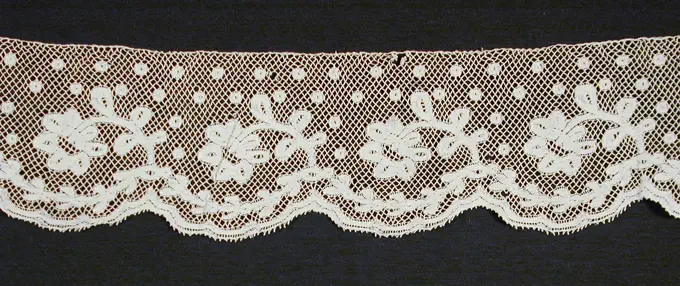
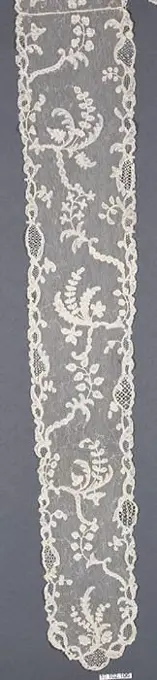
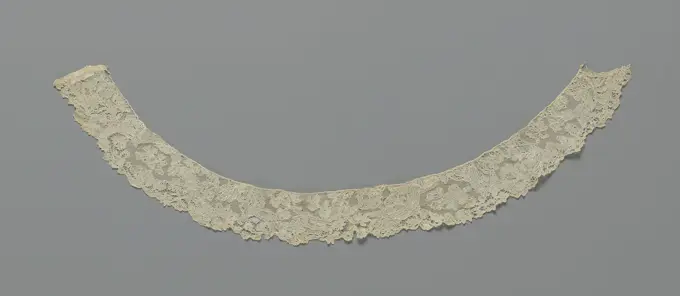
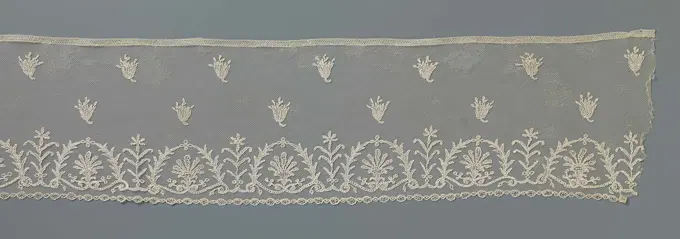
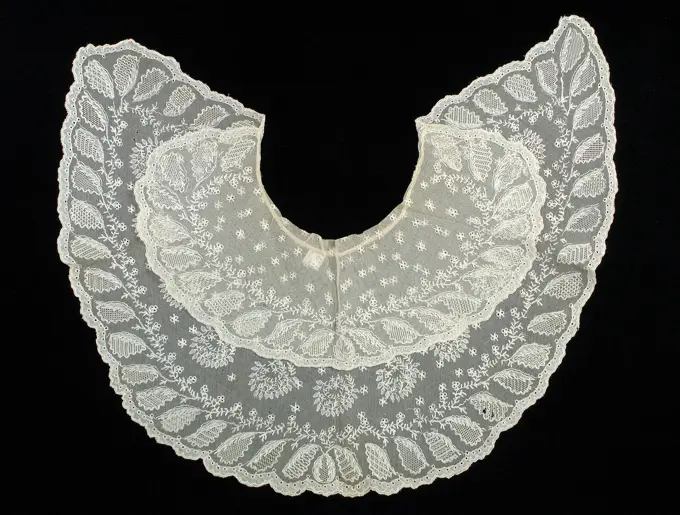
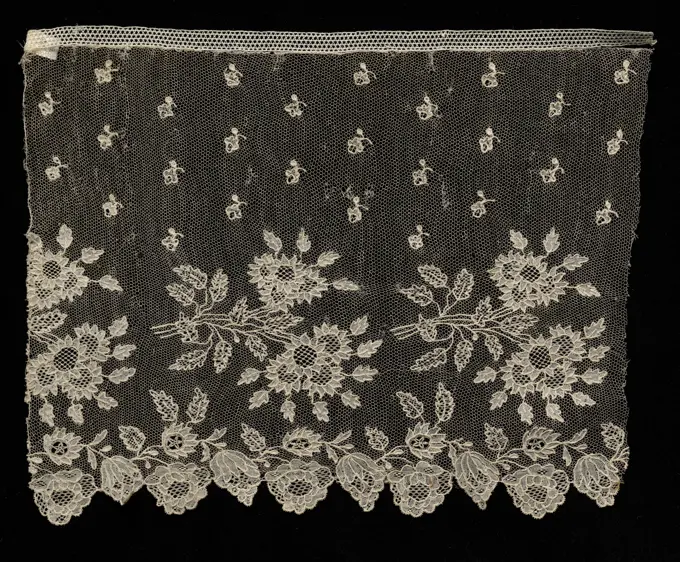
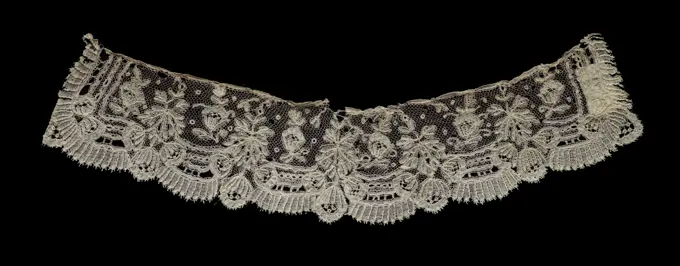
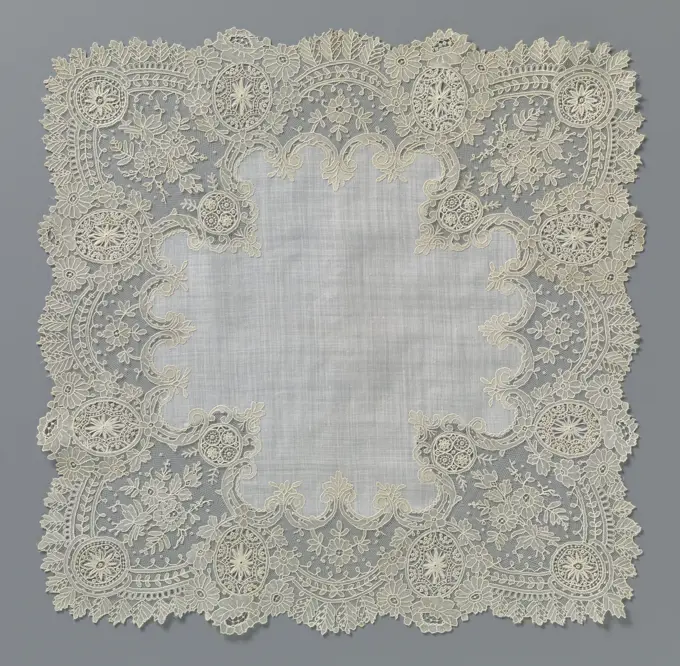
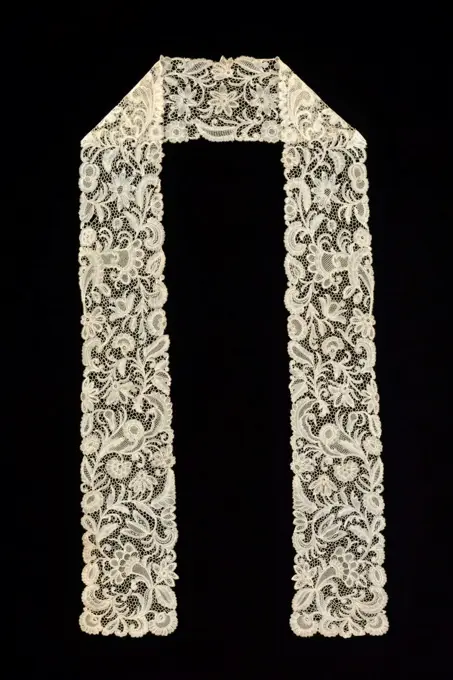
Collar of needle side with flower branch in U-shaped cartouche, anonymous, c. 1860 - c. 1880 Collar of natural -colored needle side: Brussels mesh side. The repeating pattern consists of a U-shaped cartouche with a flower branch with two rosette flowers and two chalice flowers. The 'legs' of the U are formed by two straight pillars, crowned by a rosette flower and a three -lobby leaf. There is an oval medallion with a rosette flower in the center under each pillar. Between the pillars and the successive medallions, there is a decorative frame with five lobes and below that a pendulum of three leaves between two rosette flowers. Together with this pendulum, the medallions take care of the scrap edge along the underside of the strip. The motives are equipped with contour threads, the three circles in the pillars and the rosette flower in each medallion are equipped with relief contours. The motifs are connected to each other by a fine mesh ground, a mesh side. Belgium linen (material) Br
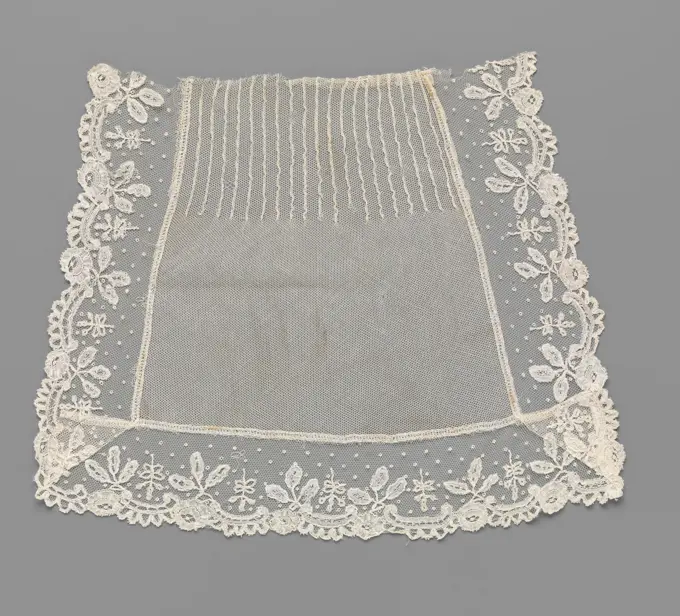
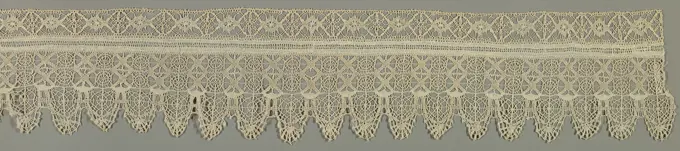
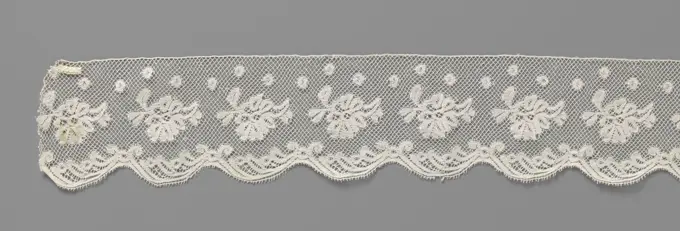
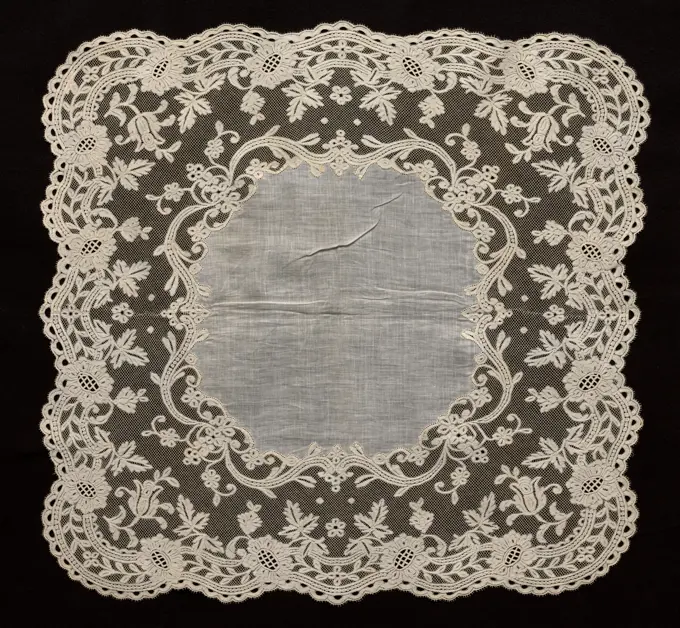
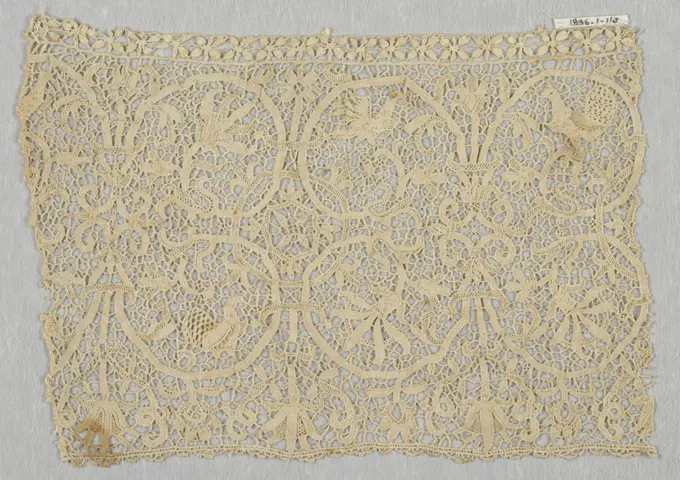
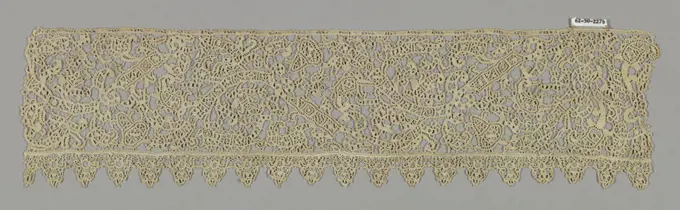
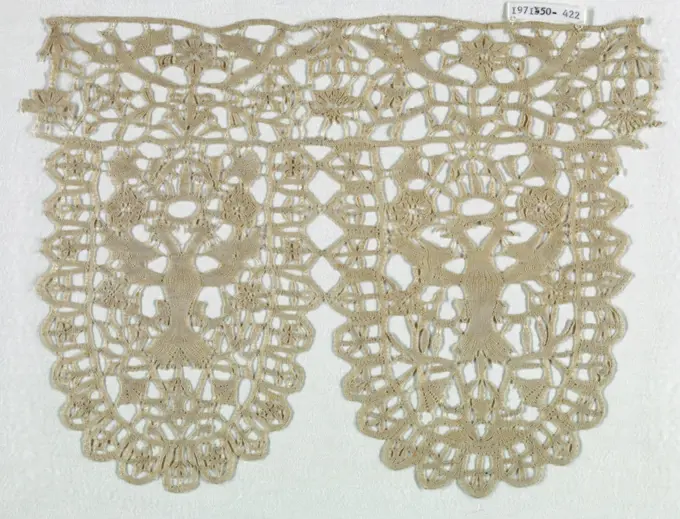
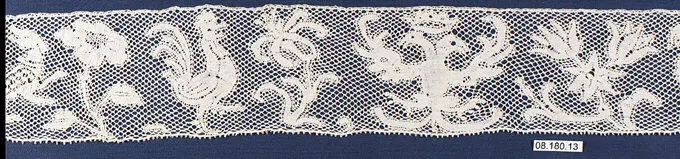
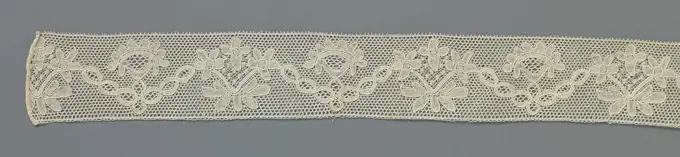
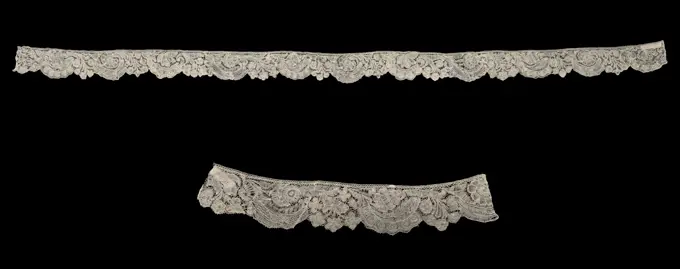
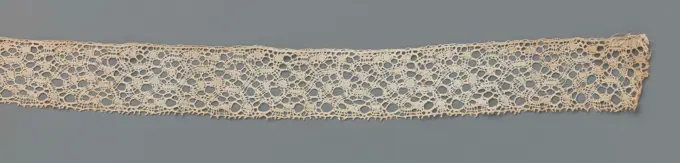
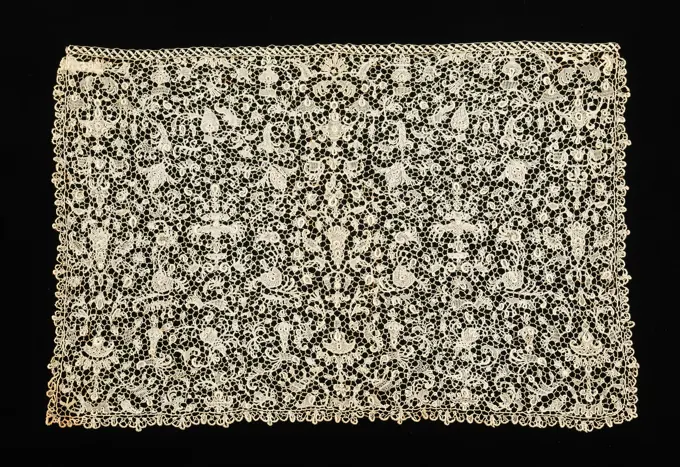
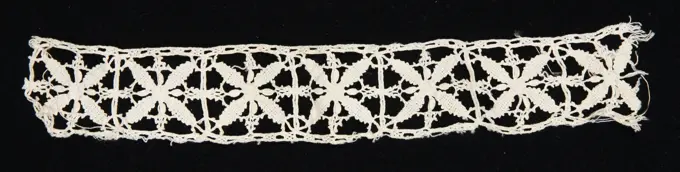
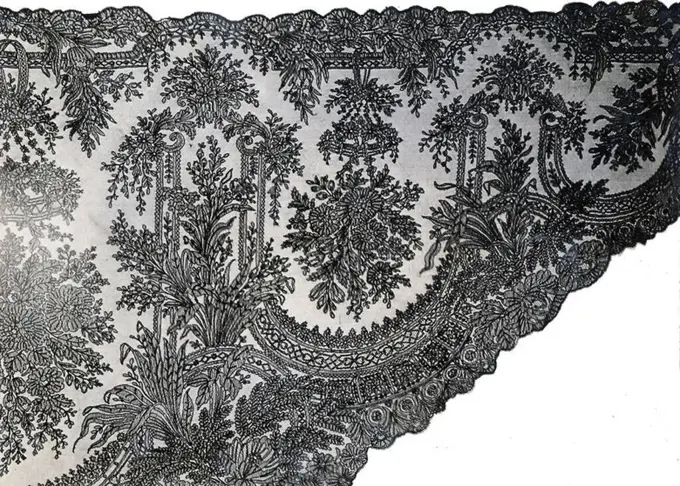
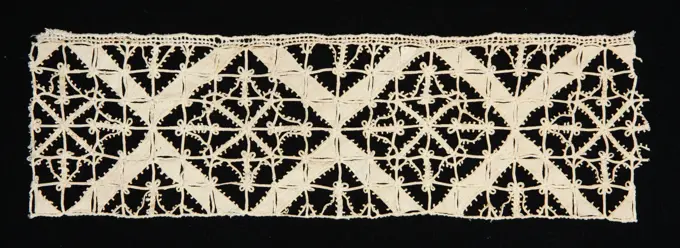
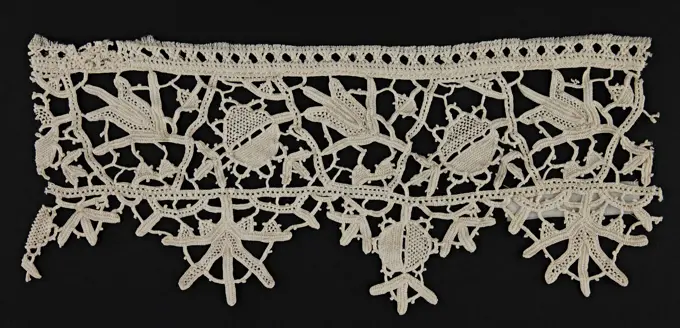
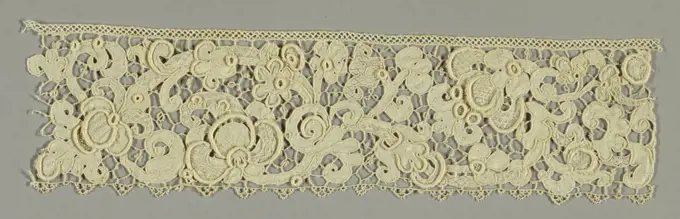
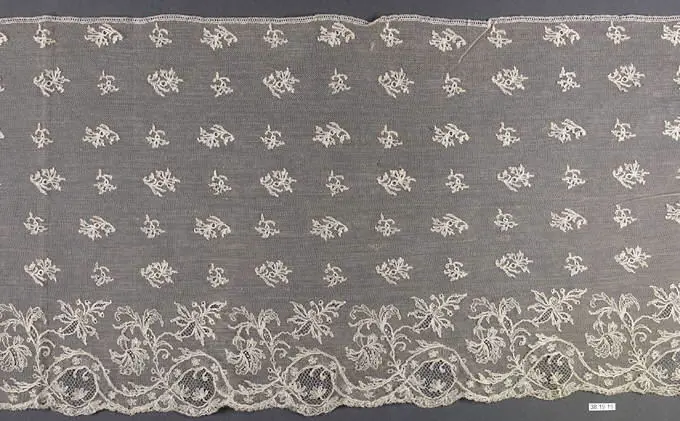
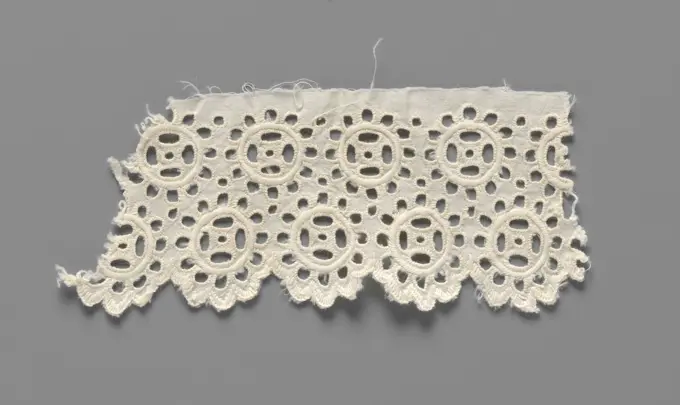
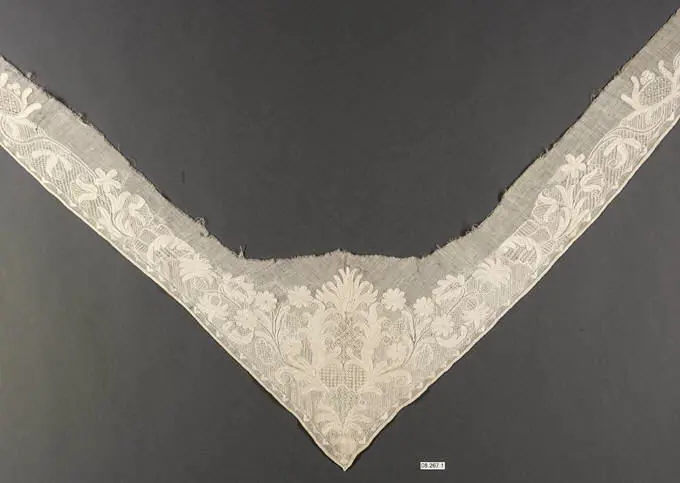
Fragment, Medium: linen Technique: needle lace, Fragment with a delicate vine and flower pattern has raised three-dimensional details. Pattern areas connected by brides with wheels and picots., Italy, 17th century, lace, FragmentBorder Made 1750-1825 Italy. Linen, bobbin straight lace .Length of Lace. Belgium, Western Flanders, mid-19th century. Textiles; textile lengths. Cotton Valenciennes d'ypres bobbin laceCravat 18th century French. Cravat 220053Cuff of needle side with tongued flower, anonymous, c. 1885 - c. 1899 Cuff of natural -colored needle side: Venetian relief side. Against an open bar of land is an ongoing pattern of tendrils with pomegranates and a tongened flower. A list of doubled arches along three sides. Belgium linen (material) Venetian raised work Cuff of natural -colored needle side: Venetian relief side. Against an open bar of land is an ongoing pattern of tendrils with pomegranates and a tongened flower. A list of doubled arches along three sides. Belgium linen (material) Venetian raised workBorder Made 1775-1800 France. Linen, needle lace of a type known as Point d'Argentan with buttonholed mesh ground .Strook gehaakte kant met waaiervormige bloemen.Strip natural-colored Irish crochet side. Pattern with impeller-shaped flowers with stems and a crocheted irregular maase ground with picots. The top is finished with a straight edge. The semi-circular shelter on the lower edge are deposited with picoted arcs.Fragment; linenBobbin Lace Cap Square, 19th century. England, Honiton, 19th century. Lace, bobbin: linen; average: 18.5 x 87.7 cm (7 5/16 x 34 1/2 in.).Fragment (Ireland); linenEdging, Technique: bobbin lace, Bobbin lace pillow border, floral scrolls; mid-18th century Flemish, mid-18th century, lace, EdgingInsertion 18th century Spanish. Insertion 215183Barbe mid-18th century Flemish. Barbe 218854Jabot of machine tulle with an edge application side with lying c-volutes and roses.jabot of machining tulle that is finished along three sides with a strip of natural brussels application side: dick side applicated on tulle. Trapezoidal model because the rectangular midfield is provided on the top with sewn-sewing stirring. The strip of application side has been folded down around the corners. Lace pattern: Under a spreading pattern of moes, it consists of a repeating pattern along the outer edge of the strip from a row lying c-volutes with a godridge edge underneath. There is always one rose between the C-voltages above a sprig of three oval leaves. Above each C-volt a straight down hanging thin twig with oval leaves and leaves like a bow. The motifs are clamped in linen stroke with recesses and contour wires. In the florets a needle lace ring, a distinction circuit. The side is probably made around 1900 and it was only used later for finishing the jabot.Bobbin Lace (Needlepoint Design) Edging of Points, second half of 16th century. Italy, Genoa, second half of 16th century. Lace, bobbin; average: 5.1 x 15 cm (2 x 5 7/8 in.).Cuff, Medium: linen Technique: bobbin lace appliqué on machine-made net, Cuff with applied floral spray and border., Belgium, 19th century, lace, CuffBorder; linenStrip of needle side with small dense and large open circles, anonymous, c. 1900 - c. 1949 Strip of natural needle side - reticella - between edges open sewing: work with pulled out threads. The repeating and symmetrical pattern consists of one row of squares, which are made up of four small squares. Each large square has been crossed, at every intersection alternating a small closed and a large openwork circle. Demizes along the edges. The top and bottom of the strip are straight finished with open diamonds (work with threads pulled out). unknown cotton (textile) Strip of natural needle side - reticella - between edges open sewing: work with pulled out threads. The repeating and symmetrical pattern consists of one row of squares, which are made up of four small squares. Each large square has been crossed, at every intersection alternating a small closed and a large openwork circle. Demizes along the edges. The top and bottom of the strip are straight finished with open diamonds (work Fragment, Medium: cotton Technique: crochet, Crocheted lace border with conventionalized floral repeated five times., Ireland, 19th century, knotted, knitted and crocheted textiles, FragmentFragment Swedish, Skane 19th centuryStrip bobbin with anemones, anonymous, c. 1850 - c. 1874 On a coarse mesh stock (square Maas) is a running pattern of detached anemones above a slightly varied leaf sculp. The strip consists of five parts that are sewn together and was sewn in 1966 on a strip with a similar, but not identical pattern. Valenciennes side. Sluis (Possible) linen (material) Bobbi Lace / Valenciennes Lace On a coarse mesh stock (square Maas) is a running pattern of detached anemones above a slightly varied leaf sculp. The strip consists of five parts that are sewn together and was sewn in 1966 on a strip with a similar, but not identical pattern. Valenciennes side. Sluis (Possible) linen (material) Bobbi Lace / Valenciennes LaceCollar of mixed side with bouquets and insects, anonymous, c. 1725 - c. 1749 Collar of natural -colored mixed side: Needle side - Brussels mesh side - in combination with a cracked drochel soil. The pattern has loose bouquets with insects and swinging openwork tires on a cracked soil. The tire motif is partly in pulps of needle side and spinning from bobbin. Motives with contour threads. Brussels (possibly) linen (material) mixed lace / mixed Brussels / Brussels point de gaze Collar of natural -colored mixed side: Needle side - Brussels mesh side - in combination with a cracked drochel soil. The pattern has loose bouquets with insects and swinging openwork tires on a cracked soil. The tire motif is partly in pulps of needle side and spinning from bobbin. Motives with contour threads. Brussels (possibly) linen (material) mixed lace / mixed Brussels / Brussels point de gazeFragment of bobbin lace unknownFragment 17th century Italian, possibly Milan. Fragment 214899Dress of three strips of bobbin with symmetrical candle -sling motifs that alternate, anonymous, c. 1700 Dress of natural -colored bobbin: ribbon side. The rug consists of three strips of each other. The repeating and symmetrical pattern consists of two candle -sling motifs per strip that alternate. The motifs are formed by long narrow ribbons cloated in linen battle with openwork edges. The ribbons form the contours of the motifs and many loops. Various decorative lands have been applied within the contours, closed compared to the traly land with, among other things, snowflake grounds and linen battle with very fine recesses. Schulpenrand all around. Southern Netherlands linen (material) bobbin lace / tape lace (bobbin lace) Dress of natural -colored bobbin: ribbon side. The rug consists of three strips of each other. The repeating and symmetrical pattern consists of two candle -sling motifs per strip that alternate. The motifs are formed by long narrow ribbons cloated in linen battleStrook kloskant met drieblad.Natural collate strip: Duchesse-Side. On an open braid soil there is an ongoing pattern that is more closed along the scalloped outside than along the inside. A thin wavy rank is in the middle and is decorated, among other things, with three spitsoval leaves and with an imposed inner leaves. Together with three blossoms and an anemone, two leaves form the uneven slot.Needlepoint (Venetian Raised Point) Lace Edging, 18th century. Italy, Venice, 18th century. Lace, needlepoint: linen; average: 50.2 x 7.7 cm (19 3/4 x 3 1/16 in.).Japonstrook van applicatiekant met spitsboogrand en klokjes.Japon strip natural-colored application side: needle side applicated on machine tulle. This type of side is also known as the name: Point d'Angleterre. The outer, ornamental edge consists of palms, under pointed arches, interspersed with a standing twig. The outside is right ended by an eye list. A scattering pattern of hanging bells flowers fills the entire edges above the edges.Strip 18th century French. Strip 212350Insertion with Added Points Made 1590-1610 Italy. Linen, bobbin part lace .Strip of needle side with volute leaves and pomegranates, anonymous, c. 1675 - c. 1699 Strip of natural -colored needle side: Venetian needle side "gros point". Pattern with two elongated -ranging tifles, on which volute leaves, pomegranates and variations of palm flowers. A wide linen band is sewn along the top. The motifs are made up of feston stitches with fine lines made here and there with recesses and with relief contours. In various places, the releëf contours are very strongly encouraged with thick -founded cordons, whether or not decorated with bow edges and picots. Different ornamental grounds have been used in Bloemharten, among other things. The motifs are connected by bars decorated with picots. The underside and continuously along one short side is finished with a straight border with half -rader picots. The other short side has been cut Venice linen (material) Venetian gros point (heavy raised Venetian lace) Strip of natural -colored needle side: Venetian needle side "grStrip bobbin with large tulip, anonymous, c. 1750 Strip of natural-colored bobbin, binche side. On a grid, a five -hour ground, is a running pattern of a slender with large tulip, a petal of which has an inner drawing of a flower branch. The rank is interrupted by large, lobed and halved cross -bodies with rosettes and pearl edge. The motifs are made in linen battle with openwork edges and in netslag. A snowflake soil has been used as a decorative soil. The scoops are uneven and stretched. The finish of the sculptures is largely damaged. Southern Netherlands linen (material) Bobbi Lace / Binche Lace Strip of natural-colored bobbin, binche side. On a grid, a five -hour ground, is a running pattern of a slender with large tulip, a petal of which has an inner drawing of a flower branch. The rank is interrupted by large, lobed and halved cross -bodies with rosettes and pearl edge. The motifs are made in linen battle with openwork edges and in netslag. A snowflake soil has been used as a deBorder, Medium: linen Technique: bobbin lace (late Valenciennes ground), Border patterned by the repeat of a scroll supporting flowers that form a lower border with floral swags and hanging floral garlands in the upper section., Valenciennes, France, mid-19th century, lace, BorderBobbin Lace Valenciennes Handkerchief, 19th century. France or Flanders, 19th century. Linen center with bobbin lace border; average: 48.3 x 49.6 cm (19 x 19 1/2 in.).Edging Italian, probably Burano late 19th centuryLace laceCollar ca. 1825 American. Collar 170348Fragment, Medium: linen Technique: needle lace (punto in aria), Ribbon-like solid scrolls spring from urn and terminate in blossoms. Peacocks and other birds perch in foliage., Europe, 18th century, lace, FragmentJapon strip from climbing side with shield-shaped medallions. Japon strip from black climbing side: Chantilly side. Closed motifs are closed on an open mesh fond. Three symmetrical turmbled medallions rise on the nodes of the slippers, which are caught in two pairs of C volutes. Above the slot a large, above the medallions, a small flower tough occurs, with tagged flower leaves as a crowning. The inner edge is decorated with a chain of heart-shaped leaves.Strip 16th century Mexican. Strip 215302Fragment (Border). Italy. Date: 1601-1625. Dimensions: 5 x 25.6 cm (2 x 10 in.)Width repeat: 4.2 cm (1 5/8 in.). Linen, bobbin straight lace. Origin: Italy. Museum: The Chicago Art Institute, Chicago, USA.Border, Medium: linen Technique: needle lace (punto in aria), Border of serpentine bands of floral and foliated forms irregularly placed., Italy, early 17th century, lace, BorderFragment, Medium: Technique: bobbin lace, discontinuous tape, Fragment of a band with birds and flowers, two oval tabs each with a double-headed eagle., Europe, 17th century, lace, FragmentNeedlepoint (Burano Point) Lace Edging, second half of 18th century. Italy, Burano, second half of 18th century. Lace, needlepoint; average: 17.8 x 22.9 cm (7 x 9 in.).Border (Belgium); linenChalice Cover (Italy); linenStrip bastard with seven -lobe flower in eleven lobe sculpt, anonymous, c. 1600 - c. 1649 Strip of natural -colored Genoese bobbin. The pattern is formed by a repeating and symmetrical composition of two flowing flowers, the upper with six lobes, the lower one with seven. This double flower is placed in a semicircular eleven -lobe sculpt. The pattern is made up of a winding strap in linen stroke with a braid ground. We worked with thick threads. The upper edge is unfinished or cut, the strip is kept in connection with a sewn woven strap. Italy (possibly) linen (material) bobbin lace / Genoese pillow lace Strip of natural -colored Genoese bobbin. The pattern is formed by a repeating and symmetrical composition of two flowing flowers, the upper with six lobes, the lower one with seven. This double flower is placed in a semicircular eleven -lobe sculpt. The pattern is made up of a winding strap in linen stroke with a braid ground. We worked with thick threads. The upper edge is unfinishedNeedlepoint (Burano Point) Lace Cuff, late 18th century. Italy, Burano, late 18th century. Lace, needlepoint: linen; average: 9 x 25.4 cm (3 9/16 x 10 in.).Insertion 16th century Italian. Insertion 220936Border 18th century Austrian. Border 214368Fragment zijden satijnbrokaat.Fragment of satin brochat. The pattern is made of gold on blue silk (green faded) and has a pattern of alternating a job within which geometric shapes, a job within which flower bouquets and a job within which flower garlands. The pattern is identical to BK-NM-1232.Border Made 1634-1666 Flanders. Linen, needle lace .Strook kloskant met zigzag-slinger en driehoekig boeket.Strip natural colosside, Paris side. The repeating and continuous pattern consists of a zigzag garland of connected openwork ovals with a range flower and a V-shaped bouquet with three flowers. The motifs are connected by a Maas soil, a Paris soil. The motifs are made in linen stroke with thicker and shiny contour wires. As ornamental ground, a snowflakes soil has been applied in the bouquets and a coarse Maas soil in the ovals and the fan flower. Upper and bottom are straight finished, with the underside with picots. The short sides are finished with a soil.Border. Date/Period: Mid- 18th century. Border. Medium: linen. Technique: needle lace. Author: UNKNOWN.Bobbin Lace Edging, mid 18th century. England, Devonshire, mid-18th century. Lace, bobbin; average: 4.5 x 23.5 cm (1 3/4 x 9 1/4 in.).Border; linenParasoldek van Naaldkant with Umbreukad, Anonymous, c. 1880 Eight Spitsovale fields are bordered by fine arches of Treurwil branches. There is always a bouquet of three nodding flowers on these fields. By an umbrella town, the fields are tied and prosecuted in a horseshoe -shaped shell with a large rose and with oak leaves. This horseshoe has been formed by a five -double tire, including with circles, which extends on the inside of an intermediate shell. This smaller shell shows a range of oak leaves and a fan of Godrons, with an edge of three flowers, namely a rose between two Margrites. The oak leaves are held half in the shade. Point the Gaze de Bruxelles. Brussels linen (material) Eight Spitsovale fields are bordered by fine arches of Treurwil branches. There is always a bouquet of three nodding flowers on these fields. By an umbrella town, the fields are tied and prosecuted in a horseshoe -shaped shell with a large rose and with oak leaves. This horseshoe has been formed by a fiveStrook kloskant met een wirwar van ovale knopjes.Strip natural colosside: Old cravings. The pattern consists of a jumble of oval buttons with mostly C-shaped appendices. The motifs are connected by a braid ground. The motifs are made in linen stroke with openwork edges. Upper and bottom of the strip are straight finished, the underside with picots.Bobbin Lace Cuff, early 19th century. Belgium, Brussels , early 19th century. Lace, bobbin; overall: 7.5 x 18 cm (2 15/16 x 7 1/16 in.).Bobbin Lace Edging, 18th century. Spain, Huelva, 18th century. Lace, bobbin; average: 9 x 15.3 cm (3 9/16 x 6 in.).Lace fourth quarter 17th century French This is an exquisitely crafted needle lace cravat end. Lace was often utilized as neckwear in the 17th and 18th centuries for aesthetic purposes and to emphasize the fine quality the wearer could afford. This particular piece is finely detailed with mirror-image motifs which take no identifiable shape but are nevertheless intriguing. The addition of the raised work adds a sense of depth and texture to already arresting surface effect.. Lace 158348Bobbin Lace (Rose Lace) Edging of Round Points, 17th century. Italy, Genoa, 17th century. Lace, bobbin; average: 10.2 x 25.7 cm (4 x 10 1/8 in.).Lace, bobbin, Mid 19th Century, Italy, maker unknown. Gift of Yvonne Riddiford, 2007.Japon strip of needle side with standing oval medallions in a rich pattern of flower garlands. Natural coniferous jacket strip: Alençon side. The repeating pattern consists of standing oval medallions in a rich pattern of flower garlands. There is always one medallion under every golf top of the pendulum along the top of the strip, with fine leaves and orangebloemsem. Lush garlands with roses, anemones and forget-me-staples are hanging over this pendulum, apparently stick through the medallions, excise the edges of it and partly form the pattern of the bottom of the strip. The flowers go down in size. The sloping edge is further supplemented by a sling of roses. The motifs are made with feston sign with recesses and decorative stitches. The motifs are equipped with relief contours. The motifs are connected by a hexagonal maase soil where the sides of the mesh are rotated. Many decorative stitches in, among other things, flower hearts and the decorative trims of the medallions, mainly RScarf Made 1865-1885 Belgium. Cotton, bobbin straight lace of a type known as Valenciennes with a square Valenciennes mesh ground (made in two sections) .Half Shawl. France or England. Date: 1865-1875. Dimensions: 132.7 × 288.6 cm (52 1/4 × 113 5/8 in.). Silk, Pusher machine lace. Origin: England. Museum: The Chicago Art Institute, Chicago, USA.Collar. Culture: British. Dimensions: L. 21 x W. 6 1/2 inches53.3 x 16.5 cm. Date: 17th century. Museum: Metropolitan Museum of Art, New York, USA.Piece 18th century Italian, Burano. Piece 218124Edging mid-18th century Flemish, Brussels. Edging 222804Lace laceSpread of lace with maltic cross and sun motifs ,, c. 1860 - c. 1880 Lace bedspread. Midfield with point coupé and edges of Cluny Kloskant. The fine linen batist shows large cut out squares that are filled with open embroidery stitches. Pattern: Small squares are saved in the linen that are connected with separate impact and chain wires. Intermediate large open squares in turn show a Maltzerkruis and a radiant sun. A strip of open tissue, regularly interrupted by three Entre-Deux runs along the upper and bottom side. On the sides, an Entre deux and a wide wrinkled strip of tulle, finished with a cluny side edge. Idrija linen (material). batiste. bobbin lace / embroidering / Cluny lace Lace bedspread. Midfield with point coupé and edges of Cluny Kloskant. The fine linen batist shows large cut out squares that are filled with open embroidery stitches. Pattern: Small squares are saved in the linen that are connected with separate impact and chain wires. Intermediate large open squares in Strip bobbin with flower ornaments, anonymous, c. 1725 - c. 1749 Strip of natural -colored bobbin: Mechelse side. The repeating pattern consists of a continuous decorative band that alternately forms a horseshoe -shaped cartouche and a trapezoidal cartouche. In both cartouches a carnation hangs down to the underside of the strip. On the outside of the horseshoe a curling stem rises on each side on each side. On the left a stem with a chalice flower and three rosette flowers and one rosette flower on the right. The motifs are made in linen battle with recesses and with thicker and shiny contour threads. The motifs are connected by a fine grid, the Mechelen soil. In the cartouches, decorative lands have been used, including a snowflake land. The scrap edge follows the pattern and is finished with picots. The top is straight. Mechelen linen (material) bobbin lace / Mechlin (lace) Strip of natural -colored bobbin: Mechelse side. The repeating pattern consists of a continuous decorative banFragment of punto in aria needlelace unknownFanchon of edge embroidery with flower turns.Fanchon of natural-colored edge embroidery: Lierse lace (machine tulle with tamboo work). The fanchon consists of a middle part with two slips. The symmetrical pattern consists of tendrils with flowers, leaves and berries that spring from a central part with three flowers. The scalloped edges are trimmed with picots.Strip bobbin with a circle in lying arc above three golf lines, anonymous, c. 1860 Strip of natural-colored bobbin, cluny side. The repeating pattern consists of three synchronous wavy lines. In every valley of the upper wave line is an open -up arch that includes a circle. The bow is a kind of dented oval in which vertical connections have been made in form. In the circle, a flower is made with four leaves in shape and crossing couples. Slight connections between the golf lines made in linen stroke have also been made at a short distance from each other, with both braids and crossing couples. A regularly winding fourth line made in linen battle, runs along the underside of the strip and forms a three -lobe shell under the golf valleys. The top of the strip is straight finished. The scrap edge along the bottom is finished with picots. France cotton (textile) bobbin lace / Cluny lace Strip of natural-colored bobbin, cluny side. The repeating pattern consists of three synchronous wavy liBorder, Medium: linen Technique: raised needle lace, Border of Gros Point de Venise with curvilinear forms in a floral and foliated design. Pattern outlined by cordonnet and connected by brides picotées and interspersed by portes and gaze quadrillée., Venice, Italy, 17th century, lace, BorderAlencon lace laceBlack bobbin scarf with three rows of winches (musical instruments), anonymous, c. 1805 - c. 1849 Scarf of black bobbin: blonde. Rectangular model, made in parts. In midfield, the pattern consists of three rows of winches (musical instrument, precursor of the harp), each in a wreath of leaves, flowers and berries. The winches are placed diagonally and are alternately slanted up or slanted down. The wreaths around the winches run together. Left and right at the end of the rows with winches, is a very large spring -shaped leaf that is bent to a semicircle, in a further 'empty' field. A long-shaped flower and a chalice flower, among other things, spring from the cavity of the leaf. The large spring -shaped leaf repeats itself with other types of flowers in the edge of the Stola, where it is connected with split flower branches for an edge with large scoops. The motifs are made in linen battle, with a thicker wire than used before the ground. The motives are provided with thick contour thrFragment, Medium: linen Technique: bobbin lace (Binche style with snowball ground), Symmetrical floral design with scalloped edge., Belgium, early 18th century, lace, FragmentFour Borders Made 1865-1885 Belgium. Cotton, bobbin straight lace of a type known as Valenciennes with a square Valenciennes mesh ground .Handkerchief with a rim of needle side with eight oval and eight circles, anonymous, c. 1870 - c. 1890 Handkerchief with a border of natural -colored needle side, Brussels mesh side. Around a large cross -shaped batist middle piece runs a narrow lace edge with eight deep scums, the final pieces of which are formed by eight ovals. The corner sculptes always show two circles standing above the other. The Schulprand consists of a leaf branch and an edge of leaves that form the shells. Small, hollow C-volutes form the inner edge. Brussels linen (material) Brussels Gaze Point Handkerchief with a border of natural -colored needle side, Brussels mesh side. Around a large cross -shaped batist middle piece runs a narrow lace edge with eight deep scums, the final pieces of which are formed by eight ovals. The corner sculptes always show two circles standing above the other. The Schulprand consists of a leaf branch and an edge of leaves that form the shells. Small, hollow C-volutes form the innerBobbin Lace Collar, 18th century. Belgium, Mechelen, 18th century. Lace, bobbin: linen; average: 45.7 x 7 cm (18 x 2 3/4 in.).Blouse Pieces (Philippines); piña (pineapple) fiber, cottonFlounce 18th century Flemish. Flounce 226289Border Made 1750-1759 France. Linen, needle lace of a type known as Point d'Argentan with buttonholed mesh ground .Fragment; medium:Strook machinale kant met rozetbloem onder twee grote ovale bladeren.Stretch natural-colored side: Machine gender side. The repeating pattern consists of the center line of the strip from a rosette flower under two one-sided targeted large oval leaves. Left above the rosette flower, next to the leaves, is still a small rosette flower. Along the straight bottom is a row of palms. The motifs are equipped with contour wires and they are connected by a fine machine tulet that is strewn with square moes. The Moeses are made in machining. An ornamental ground has been applied in the motifs, a machining rose. Upper and bottom of the strip are straight finished, the underside with picots.Strip of batist with lace pledger with two rows of open worked margrites and a sculpes edge, C.I. Bosch Reitz-Teding van Berkhout, c. 1860 Strip natural -colored batist with lace bobbins: English embroidery. The repeating pattern from two rows of consecutive openwork Margrites, the rows of jumps and around the lower flowers have been created, with five embroidered lobes per shell. The batist is not finished on the long and short sides. Amsterdam cotton (textile) Strip natural -colored batist with lace bobbins: English embroidery. The repeating pattern from two rows of consecutive openwork Margrites, the rows of jumps and around the lower flowers have been created, with five embroidered lobes per shell. The batist is not finished on the long and short sides. Amsterdam cotton (textile)Strip Machinal side with Drieblad on a steel, anonymous, c. 1875 - c. 1899  Strip of natural -colored machine side: Machinale Brussels Duchesse. The repeating pattern consists of a three -sheet with a twice -curling stem that lies along the underside of the strip. The motifs are made in linen battle with openwork edges and contour threads. The successive leaves with stems are connected to each other by a mechanical braiding ground. In the first loop that makes the curling steel, a block is made, suggesting a cracked shape of shape. The top of the strip is straight finished. The scrap edge along the underside stems from the pattern with the Drieblad. Europe cotton (textile)Piece 18th century Northern German. Piece 215386Ensemble 19th century. Ensemble 127245Fragment of needlelace unknownWoman's Collar. England or United States, Massachusetts, Ipswich, 1840-1850. Costumes; Accessories. Linen plain weave, cotton bobbin laceStrip bobbin with pear-shaped fruits on S-shaped stems with flowers, anonymous, c. 1750 - c. 1770 Strip of natural-colored bobbin, Valenciennes side. The repeating pattern consists of an S-shaped stem with two pear-shaped fruits on one end between leaves and alternately an anjer or a bunch with five flowers with pointed petals on the other. The pattern along the underside is formed by a succession of an oval between leaves, a wide horn -shaped leaf, three rosette flowers and an elongated tormented shape. The motifs are connected by a Maas soil, the Round Valenciennes ground. The motifs are made in linen battle with recesses and openwork edges. The faintly scalloped underside follows the pattern along the bottom and is finished with picots. The top is straight. Southern Netherlands linen (material) Bobbi Lace / Valenciennes Lace Strip of natural-colored bobbin, Valenciennes side. The repeating pattern consists of an S-shaped stem with two pear-shaped fruits on one end between leaves andBand (France); linen and horsehairLappet fourth quarter 19th century Flemish. Lappet 156021Dress of lace pledger with rising suns along diamond shape, anonymous, c. 1900 - c. 1949 Square rug of natural -colored lace bobbins, cut work. Pattern with a square that is made up of four small squares. Each small square is divided by a diagonal line, with a 'rising sun' on the outside and a triangle on the inside. Together this provides a diamond shape with a four -pointed star in the middle in the large square. Around the large square on all sides, a border with rectangles, filled with bundles of wires or with a dense grid with openwork diamonds. A finished edge in linen battle on all sides. unknown cotton (textile) Square rug of natural -colored lace bobbins, cut work. Pattern with a square that is made up of four small squares. Each small square is divided by a diagonal line, with a 'rising sun' on the outside and a triangle on the inside. Together this provides a diamond shape with a four -pointed star in the middle in the large square. Around the large square on all sides, a boEdge, Medium: linen Technique: bobbin lace made in Lille style with heavy outlining thread, 19th century, lace, EdgeFragment knotted side with two circles. Fragment natural-colored knotted side: Chebka side. Two connected cables.Lace Insertion, 1560-1600. Italy, Genoa, 16th century. Linen; lace, open cutwork (reticella) and bobbin; average: 12.7 x 25.4 cm (5 x 10 in.).