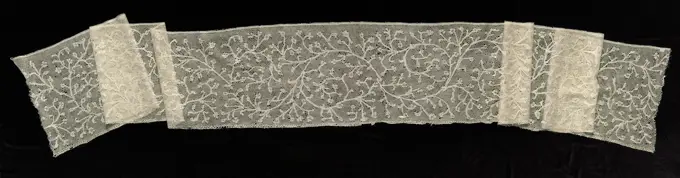
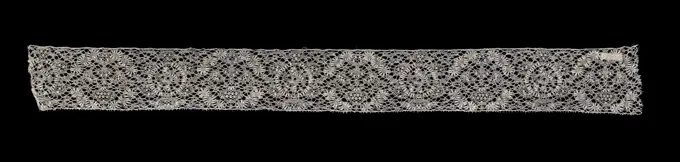
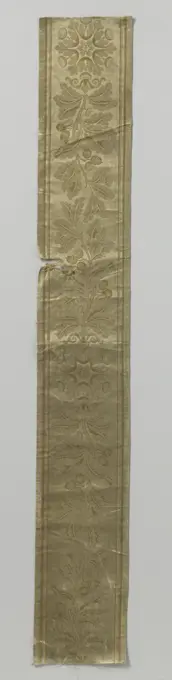
17th to 18th Century Lace Fragments

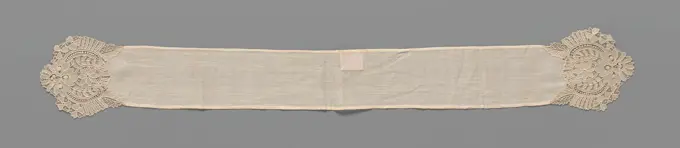
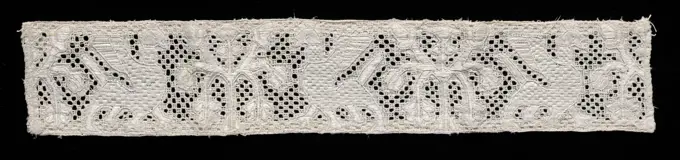
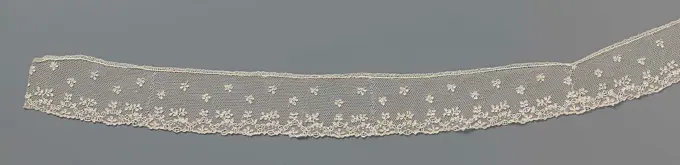
Fragments of vintage lace pieces from various periods, showcasing elaborate patterns and textures that reflect traditional textile craftsmanship.

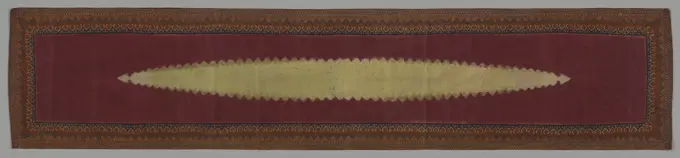
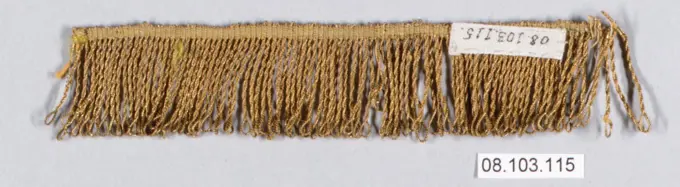
Fringe, Medium: silk Technique: soumak weave, Red fringe with a soumak heading and picots with looped and twisted skirt threads., Spain, 16th century, trimmings, Fringe
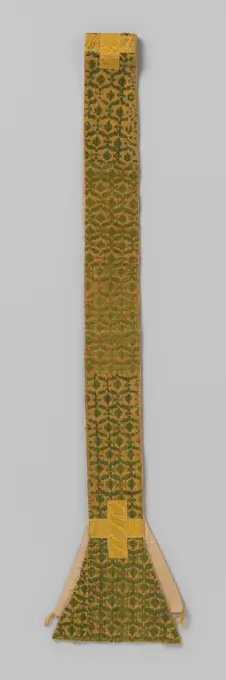
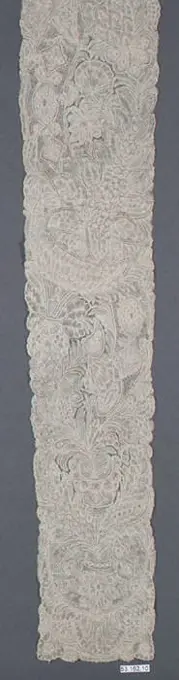
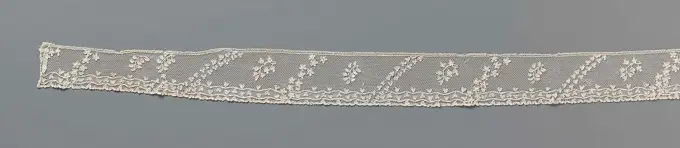
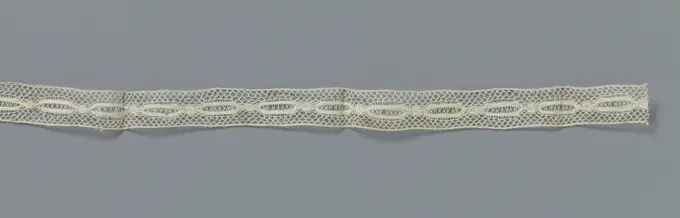
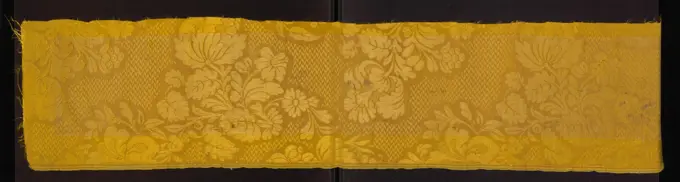
Strip 18th century Flemish. Strip. Flemish. 18th century. Bobbin lace. Textiles-LacesFragment 1625-50 Italian. Fragment 212557Needlepoint Lace (Argentan Lace) Lappet, 1774-1792. France, Argentan, 18th century (Louis XVI Period, 1774-1792). Lace, needlepoint: linen; average: 114.4 x 10.2 cm (45 1/16 x 4 in.).Galloon 17th-18th century Unknown. Galloon 213849Strook kloskant met een aaneengesloten rij van cirkeltjes en trapeziumvormige veldjes.Natural collate strip, Swedish side. The strip is attached with pins on a light blue carton, with seven other strips. Above the strip is written on the cardboard "Laces from Dalecarlia. (Dalarna)". The repeating and continuous pattern is formed by a bundle wires that worked through a maas basis, a diamond-shaped nozzle ground. These meshes are interrupted by a simple ornamental land of always three larger oval meshes. Around these three oval meshes, the thick thread forms a trapezoidal field and then form a configuration of three circular fields in the nozzle ground and then another trapezoidal field around the oval meshes. And so on. Upper and bottom of the strip are straight finished and provided with picots.Fragment 18th century Italian, Venice. Fragment 218867Border, Medium: linen Technique: needle lace with ground of loop & twist with loop & twist return, Commonly called Point de Gaze worked in a design of medallions and rococo bands and ornamental jours, floral bouquets, birds, basket and garden implements., Belgium, 19th century, lace, BorderGalloon 18th century French. Galloon 213998Fringe, Medium: silk Technique: soumak weave, Red fringe with a soumak heading and picots with looped and twisted skirt threads., Spain, 16th century, trimmings, FringeBobbin Lace Lappet, first half of 18th century. Flanders, first half of 18th century. Lace, bobbin: linen; average: 11.5 x 129.6 cm (4 1/2 x 51 in.).Edging 17th century Italian, Genoa. Edging 221124Trimming, Medium: silk Technique: woven, Design of a central zigzag line with a leaf form in the opposing triangles., Spain, 17th century, trimmings, TrimmingGalloon late 18th-early 19th century European. Galloon. European. late 18th-early 19th century. Silk. Textiles-TrimmingsBorder, Medium: linen Technique: needle lace, Border of Gros Point de Venise or Point Colbert with large scroll-like branch with stylized floral forms., Italy or France, 1665-75, lace, BorderBand. Culture: Spanish. Dimensions: Overall: 37 5/8 x 4 3/4 x 1/2 in. (95.6 x 12.1 x 1.3 cm). Date: late 15th century. Museum: Metropolitan Museum of Art, New York, USA.Edging, Medium: linen Technique: bobbin lace, peasant style lace or early student, Italy, 19th century, lace, EdgingGalloon 17th-18th century Unknown. Galloon 213863Strip bobbin with hanging twig with three -lobbish flower, anonymous, c. 1850 - c. 1870 Strip of natural -colored bobbin, Lille side. The repeating pattern consists of a loose hanging twig with a three -lobe flower. A continuous line of inverted arches runs along the bottom. The twigs are on a fine diamond -shaped Maas soil, the tuler land. The sparing fullwork is made in linen battle with thicker and shiny contour threads. The strip has been widened along the top with a strip of tulle. The bottom is straight finished and provided with picots. The short sides are cut diagonally and finished with a zoompje. Belgium (possibly) linen (material) bobbin lace / Lille lace Strip of natural -colored bobbin, Lille side. The repeating pattern consists of a loose hanging twig with a three -lobe flower. A continuous line of inverted arches runs along the bottom. The twigs are on a fine diamond -shaped Maas soil, the tuler land. The sparing fullwork is made in linen battle with thicker and shiny coMolding; wood, carved; 1917-12-22Breast Wrapper(Kemben)Cap streamers, Technique: bobbin lace, Pair of bobbin lace lappets joined, floral vine; mid-18th century Valenciennes Fond, mid-18th century, lace, Cap streamersBand, Medium: natural linen Technique: bobbin lace, continuous braid-like, Fragment of a coarse-worked band in a geometric pattern., Italy, 16th-17th century, lace, BandBorder, Medium: linen Technique: bobbin lace, continuous tape with bars added, Band of peasant lace with rounded points in design using continuous tape., Italy, 17th-18th century, lace, BorderFragment, Medium: linen Technique: bobbin lace, Binche style with no ground, 17th-18th century, lace, FragmentBorder 17th century Spanish or Italian. Border 226108Sampler (Germany); cottonFragment, Medium: silk, metallic Technique: plain weave with supplementary weft, Design of triangular shapes in a diamond grid in gold on green., France, 17th century, woven textiles, FragmentBand. Date/Period: Late 17th-early 18th century. Band. Medium: linen. Technique: bobbin made continuous tape with bars added. Author: UNKNOWN.Band (Italy); linenBorder, Medium: linen Technique: needle lace, Border of Point de Venise à Rose with serpentine floral sprays outlined by cordonnet. Pattern connected by bars with picots and outlined by cordonnet., Italy, 17th century, lace, BorderBatist tie with the needle side with medallion and flower between C-voluten, anonymous, c. 1850 - c. 1874 Das of natural -colored batist with the needle side ends: Brussels mesh side. The symmetrical pattern consists of a rosette flower in a medallion contained between two C-Voluten, including a second, larger flower. There are leaves and flowers around the medallion. Europe That: Silk. Kant: Linen (material) Brussels Gaze Point Das of natural -colored batist with the needle side ends: Brussels mesh side. The symmetrical pattern consists of a rosette flower in a medallion contained between two C-Voluten, including a second, larger flower. There are leaves and flowers around the medallion. Europe That: Silk. Kant: Linen (material) Brussels Gaze PointGimp probably European 19th centuryEdging late 18th century French. Edging 218301Textile, Medium: silk Technique: plain compound twill, Design of alternating stylized chrysanthemums and other flowers. The predominant color is tan with areas of dark blue, light blue, yellow, green and off-white., Japan, 19th century, woven textiles, TextileBelt, Second quarter of the 20th century, 41 x 2 3/4 in. (104.14 x 6.99 cm), Silk, cotton, white metal; needlework, Afghanistan, 20th centuryFragment of the lace;  18th century (1701-00-00-1800-00-00);Trimming, Medium: silk Technique: woven, Yellow trimming fragment in a design of ornamented lozenges with scrolls and leaf forms., France, 19th century, trimmings, TrimmingNeedlepoint Lace Insertion, 17th century. Denmark, 17th century. Lace, needlepoint: linen ground with design in satin stitch; average: 5.5 x 30.5 cm (2 3/16 x 12 in.).Strook naaldkant met strooiblaadjes en rankenrand.Strip natural-colored coniferous lace: Alençon side. Spreading motif with two rows of twigs with four or five leaves, on a fine hexagonal maas soil. The pattern on the bottom of the strip consists of arcs filled with a finer maas soil. In the arcs alternately a configuration of four slices or a twig. A single and a double branch varied from the arcs. The arcs are formed by small joint ovals, filled with an ornamental soil with rover picots. All leaves filled with full work with barely recesses. Slight slip edge with connected leaves and oval finished with ragfine picots. The top is trimmed with a border clamping side.Band, Medium: linen Technique: needle lace, Border composed of two narrow bands, crossing and forming ovals, which are filled with floral sprays., France, mid-18th century, lace, BandTrimming (France); silkBorder (France); linenBobbin Lace Flounce, 19th century. Italy, Abruzzi, Pescocostanzo , 19th century. Lace, bobbin: linen; average: 35.6 x 331.5 cm (14 x 130 1/2 in.).Galloon 17th-18th century probably European. Galloon 213870Bobbin Lace Edging, 18th century. Belgium, Binche, 18th century. Lace, bobbin: linen; average: 43.8 x 5.1 cm (17 1/4 x 2 in.).Needlepoint Lace Edging, 18th century. France, Alençon, 18th century. Lace, needlepoint: linen; average: 154.3 x 7.4 cm (60 3/4 x 2 15/16 in.).Louis XVI or Trianon, Jules Desfossé, French, active 1851 - 1863, Block-printed paper, High pilaster in gray and off-white with grisaille trophies and decorations bordered by molding strips of brownish-yellow and further ornamented with leafy arabesques and festoons in the same color, on off-white ground., Paris, France, 1851-65, Wallcoverings, Decorative panel, Decorative panelNeedlepoint and Bobbin Lace (Mezzo Punto) Edging, 17th century. Italy, Venice, 17th century. Lace, needlepoint; average: 11.5 x 135 cm (4 1/2 x 53 1/8 in.).Border, Medium: linen Technique: bobbin lace (early Valenciennes ground), Border fragment with large scrolling vines, some containing flower heads. Parts of the ground contain flowers that resemble tulips., Belgium, 18th century, lace, BorderDesign for the Decoration of the Barrel of a Firearm ca. 1797-1805 Workshop of Nicolas Noël Boutet French. Design for the Decoration of the Barrel of a Firearm. French, Versailles. ca. 1797-1805. Pencil, ink, gray wash on paper. Versailles. Works on Paper-DrawingsFlounce 17th-18th century Flemish. Flounce. Flemish. 17th-18th century. Bobbin lace. Textiles-LacesRibbon, linen strap with flowers of green silk and white sides edges, anonymous, c. 1700 - c. 1800 Ribbon, linen strap with flowers of green silk and white silk edges. West-Europa linen (material). versiering: silk Ribbon, linen strap with flowers of green silk and white silk edges. West-Europa linen (material). versiering: silkBorder, Block-printed on continuous paper, Top wide band with guilloche pattern enclosing a quatrefoil and overlapping cable or rope twist on either side. Narrower underband with a rod of wrapped ribbon and quatrefoils. Printed in green, white, black, and grey on grey background., France, 1835-45, Wallcoverings, BorderTrimming (France); silkCap Streamers (Belgium); linenLace, 1800s, Venice, maker unknown. Gift of Mrs CJ Lindsay, 1953.Fanchon of applicationant with Moesjesfond.Fanchon of natural applicators, climbing side applied to machine tulle. Around a mesh soften meshed with meshs, a bow of arcs of a loop-connected c-volutes, which are decorated along the outside with Campanes.Stola of Green Silk Luwel ,, c. 1500 - c. 1599 Stola of green citized velvet on the ground of gold -colored taf, a pattern of small leaves bent around a diamond -shaped figure, in green velvet of cutting and drawn pole. The Stola belongs to a Kazuifel (BK-NM-11587-A) and a manipel (BK-NM-11587-B). Italy silk. velvet (fabric weave) Stola of green citized velvet on the ground of gold -colored taf, a pattern of small leaves bent around a diamond -shaped figure, in green velvet of cutting and drawn pole. The Stola belongs to a Kazuifel (BK-NM-11587-A) and a manipel (BK-NM-11587-B). Italy silk. velvet (fabric weave)Two hat slips (barbes) from Argentankant, Anonymous, c. 1750 - c. 1800 Two hat slips from Argentankant. The pattern consists of sprinkling flowers between wavy flower vines on a tongue. The contours are raised. The Schulprand is trimmed with picots. France linen (material). Argentan Lace Two hat slips from Argentankant. The pattern consists of sprinkling flowers between wavy flower vines on a tongue. The contours are raised. The Schulprand is trimmed with picots. France linen (material). Argentan LaceGalloon 18th century French. Galloon. French. 18th century. Metal thread. Textiles-TrimmingsEdging (USA); cottonBobbin Lace Flounce, late 17th century. Italy, Milan, late 17th century. Lace, bobbin; average: 28.3 x 381.5 cm (11 1/8 x 150 3/16 in.).Band (Italy); silk embroidery on linen foundationBorder. Date/Period: 1700-1750. Border. Medium: linen. Technique: bobbin lace. Author: UNKNOWN.Fringe early 19th century probably European. Fringe 213611Collar from uniform, embroidered unknownFragments of silk fabric from stools  a pattern of vegetable branches with pomegranate fruit unknownLappets early 18th century Flemish, Brussels. Lappets 227660Bobbin Lace (Point d'Angleterre) Edging, mid 18th century. Belgium, Brussels, mid 18th century. Lace, bobbin; average: 5.8 x 61 cm (2 5/16 x 24 in.).Strook naaldkant met dubbele diagonale lijnen en bladertakken.Strip natural needle side, Argentan side. Pattern with over the full width a variety of diagonal lines with hanging leafy branches on a fine soil with hexagonal meshes that are close to the feston sign. The rhythm of the pattern is as follows: a double diagonal line of triple circles; a branch with triple leaves; a diagonal line of a dozen sprinkled rosette flowers; A branch with pear-shaped leaves. The pattern along the underside consists of a double, slightly wavy rank with heart-shaped leaves on both sides. These tendrils are interrupted by the diagonal lines. An even finer Maas soil between the tenders. Full work with minimal recesses in all leaves. Slip edge on the underside through a concatenation of small heart-shaped and oval leaves, partly arising from the tendrils pattern. The top is trimmed with a border clamping side.Border (possibly Germany); flocked; 101 x 25 cm (39 3/4 x 9 13/16 in.)Band, Medium: silk, metallic thread Technique: appliqué, Narrow band with an appliqué of leaves in yellow on red., Italy, 17th century, embroidery & stitching, BandMachine -side intermediate side with chain of pointed soils and moesjes, anonymous, c. 1800 - c. 1899 Piles of natural-colored machine side: Machinal Valenciennes side. The repeating pattern consists of a succession of alternately a rush -in and a musher. They are made in linen battle with openwork edges. The motif is made in a grid, a machine square Valenciennes ground. Top and bottom of the strip are straight. The strip is wrapped on a blue card with a price indication. On a blue card with a price indication. Europe cotton (textile) Piles of natural-colored machine side: Machinal Valenciennes side. The repeating pattern consists of a succession of alternately a rush -in and a musher. They are made in linen battle with openwork edges. The motif is made in a grid, a machine square Valenciennes ground. Top and bottom of the strip are straight. The strip is wrapped on a blue card with a price indication. On a blue card with a price indication. Europe cotton (textile)Textile Sample from Sample Book 19th century Japan. Textile Sample from Sample Book 68211Border, Medium: linen Technique: bobbin lace (Valenciennes ground), Small-scale floral allover pattern forming cartouches., France, 1700-1750, lace, BorderFragment (Border) Made 969 CE-1171 Egypt. Linen, compound weave . IslamicGalloon 18th century French. Galloon 225028Galloon 18th century French. Galloon 214050Border (France); block-printed and flocked on machine made paper; 48 x 8 cm (18 7/8 x 3 1/8 in.)Border, Medium: linen Technique: bobbin lace made in Lille style with heavy outlining thread, Band of bobbin peasant lace in a lozenge pattern., Italy, 18th-19th century, lace, BorderPiece 18th century () European. Piece 225139Trimming (France); silkBand Fragment 10th-15th century Peru; central coast (). Band Fragment 307799Torah belt, 20th century, 1 7/8 x 34 x 7/8 in. (4.76 x 86.36 x 2.22 cm), Brass, enamel, 20th centuryKloskant's intermediate facility with a center line of Spitsovalen, Anonymous, c. 1600 - c. 1624 Piles of natural -colored bobbin side. The pattern consists of a center line of Spitsovalen between which always placed in one and upper edge, a small Spitsovaaltje. The motives are connected by a sparingly applied Maas soil. The motifs are made in linen battle with recesses and openwork edges. Top and bottom of the strip are straight. The intermediate facility comes from or intended for bedding. Friesland (possibly) linen (material) bobbin lace Piles of natural -colored bobbin side. The pattern consists of a center line of Spitsovalen between which always placed in one and upper edge, a small Spitsovaaltje. The motives are connected by a sparingly applied Maas soil. The motifs are made in linen battle with recesses and openwork edges. Top and bottom of the strip are straight. The intermediate facility comes from or intended for bedding. Friesland (possibly) linen (material) bobbin laceTrimming (Italy); silk, metallic threadCeremonial Shawl, 20th century, 75 1/2 x 17 in. (191.77 x 43.18 cm), Cotton; woven fabric, Myanmar (Burma), 20th centuryGalloon 18th century German. Galloon 215544Border (Belgium); linenFragment of the fabric;  Ok. PO. 18th century (1740-00-00-1760-00-00);fabricsGalloon 18th century French. Galloon 213913Trimming (France); 1909-2-199Lappet ca. 1700 French. Lappet 218197Border, Technique: bobbin lace, Bobbin lace edge, floral unit border; late 18th century Maline, late 18th century, lace, BorderLace, 1700s , maker unknown. Bequest of Mrs Alice Bakewell, 1965.Trimming, Medium: silk Technique: woven, Blue, white and green trimming fragment in a design of an angular stem with conventionalized flowers and leaves., France, 19th century, trimmings, TrimmingBorder (France); block-printed on handmade paper; 86.5 x 7 cm (34 1/16 x 2 3/4 in.)Obi (Sash) Made 1801-1900 Japan. Silk, plain weave. .Fragment of a wall covering, anonymous, c. 1825 An edge of silk wall covering in silk lampas. On light blue fond, in beige and white, six -leaf rosettes, on which an upright and a downward oak branch with acorns. Straight lists left and right. NOTE: MEERSHIP; 3 mm, plain binding. Europe silk lampas (textile material) / twill An edge of silk wall covering in silk lampas. On light blue fond, in beige and white, six -leaf rosettes, on which an upright and a downward oak branch with acorns. Straight lists left and right. NOTE: MEERSHIP; 3 mm, plain binding. Europe silk lampas (textile material) / twillStrip bobbin with flowerpot in kidney -shaped medallion, anonymous, anonymous, c. 1740 - c. 1760 Strip of natural -colored bobbin: pot side. The repeating and symmetrical pattern consists of a stylized oval flowerpot in a kidney -shaped medallion. The medallion stands on an elongated accolade -shaped line from which ten flowers spring on short stems. Among other things, it concerns chalice flowers and a fan -shaped flower at each end. The motifs are made in linen battle with openwork edges and are connected by a five -part ground. In the medallions and in some flowers, a coarser diamond -shaped grid has been used as a decorative land. The top and bottom of the strip are straight finished, with the bottom with picots. Southern Netherlands linen (material) bobbin lace / pot lace Strip of natural -colored bobbin: pot side. The repeating and symmetrical pattern consists of a stylized oval flowerpot in a kidney -shaped medallion. The medallion stands on an elongated accolade -shaped line fr