18th Century Lace Strips

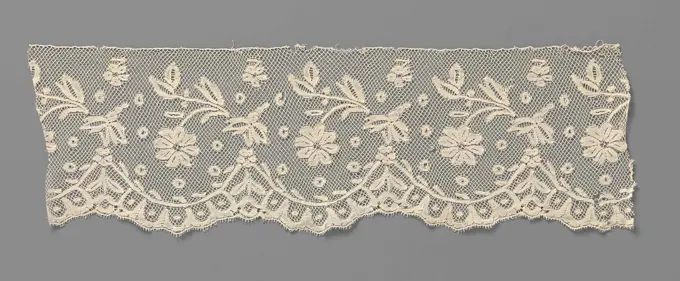
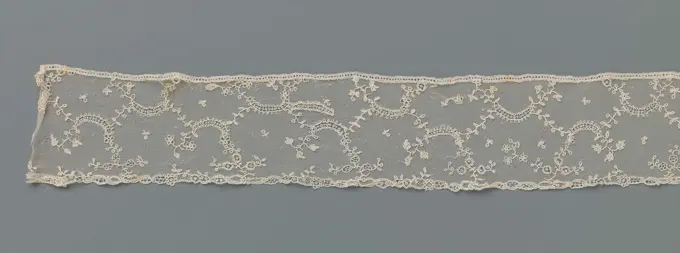
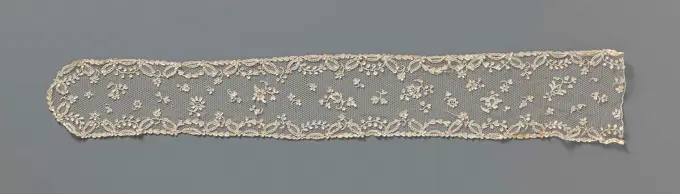
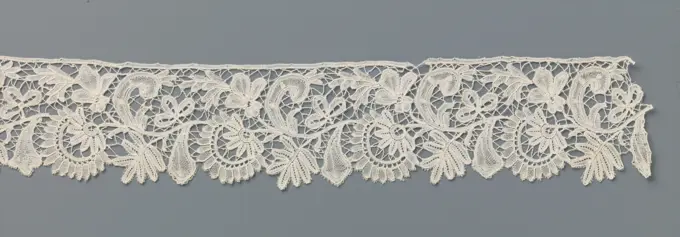
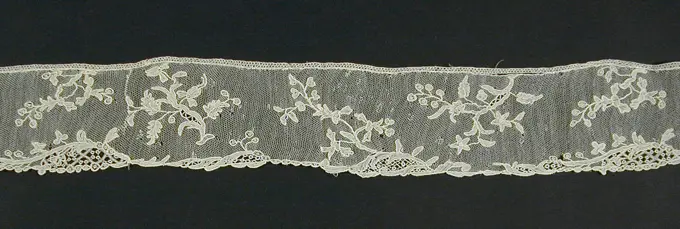
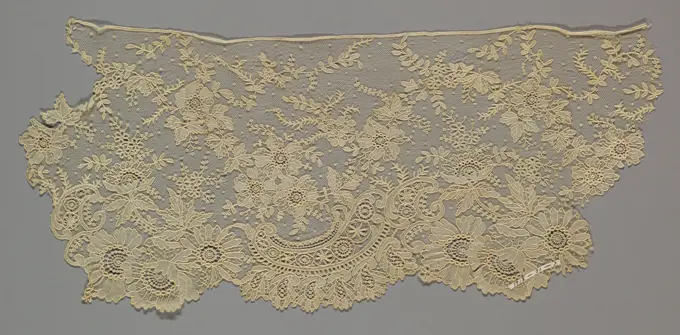
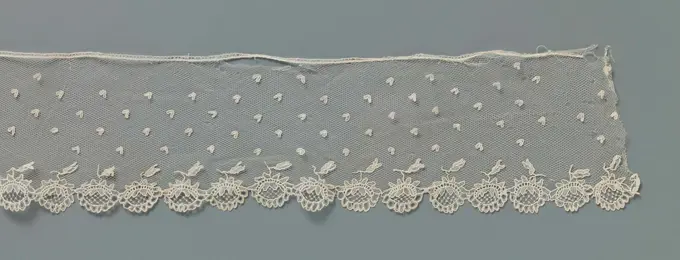
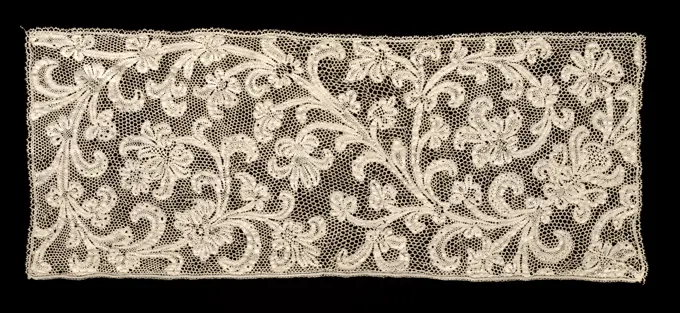
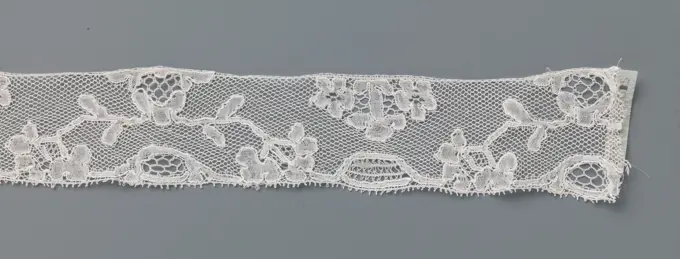
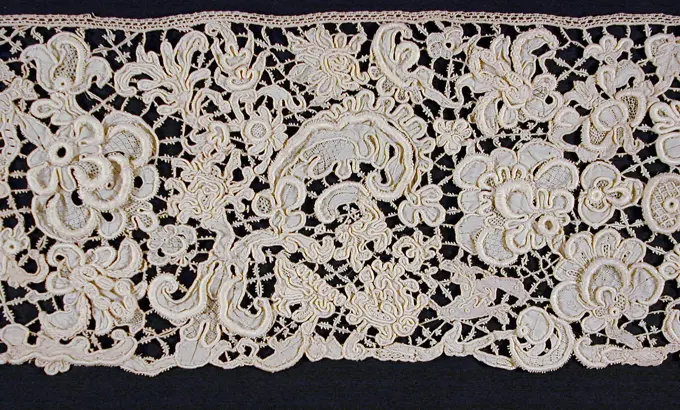
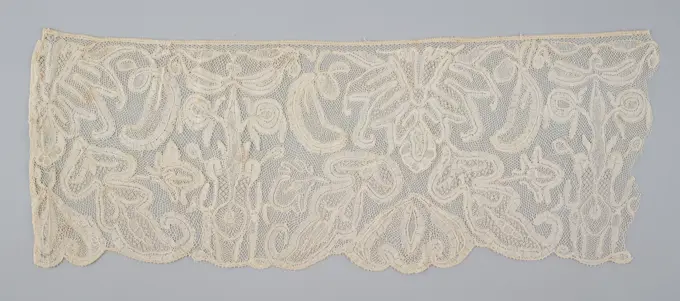
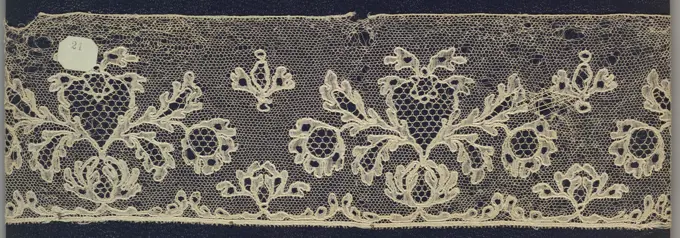
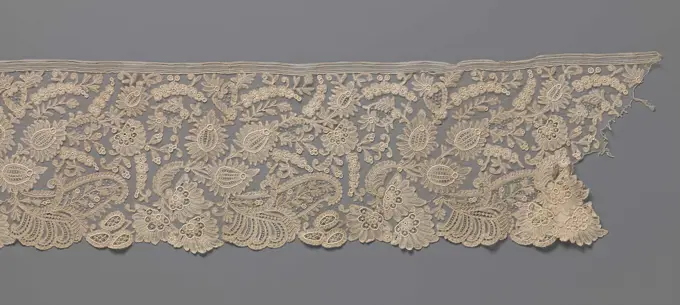
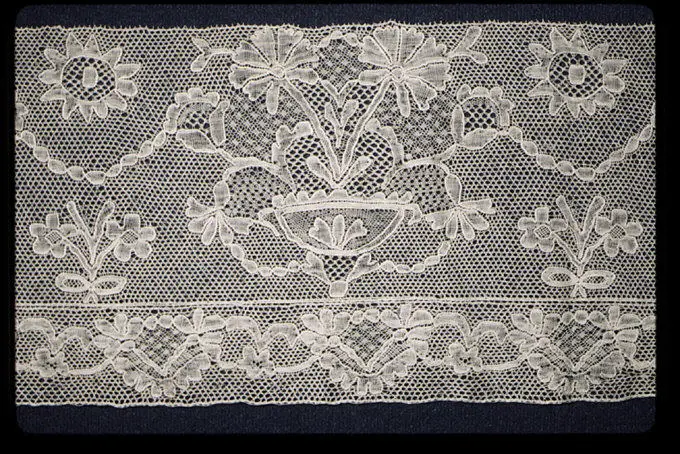
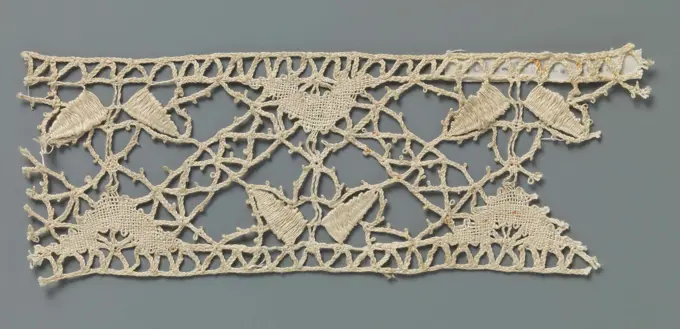
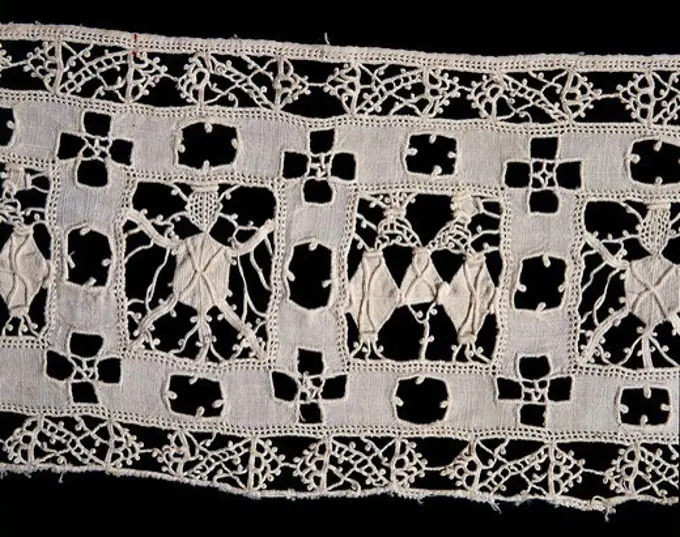
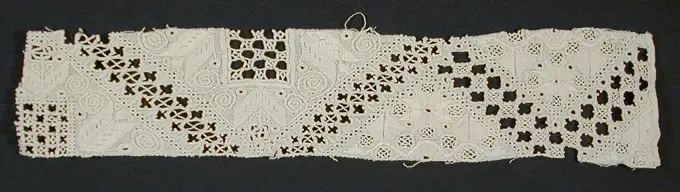
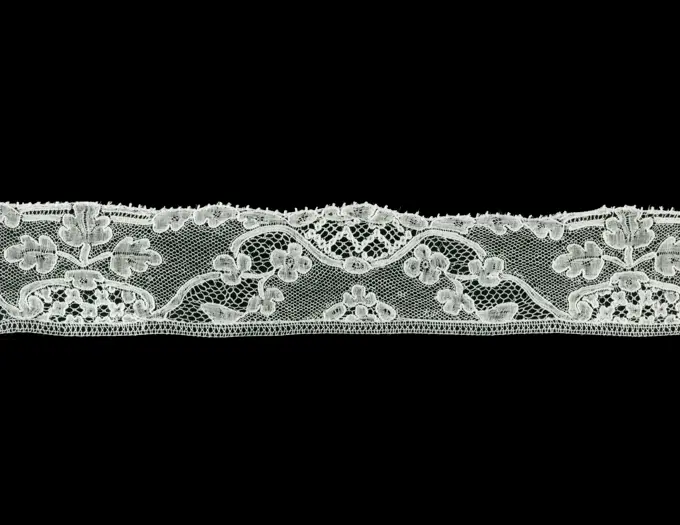
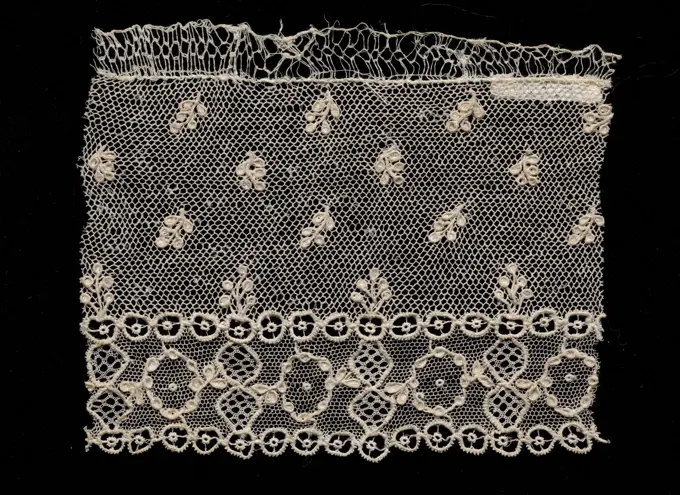
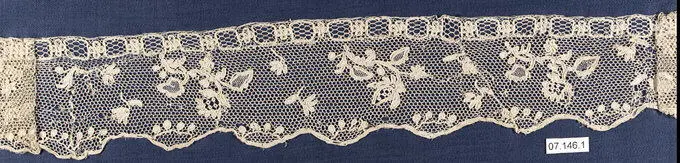
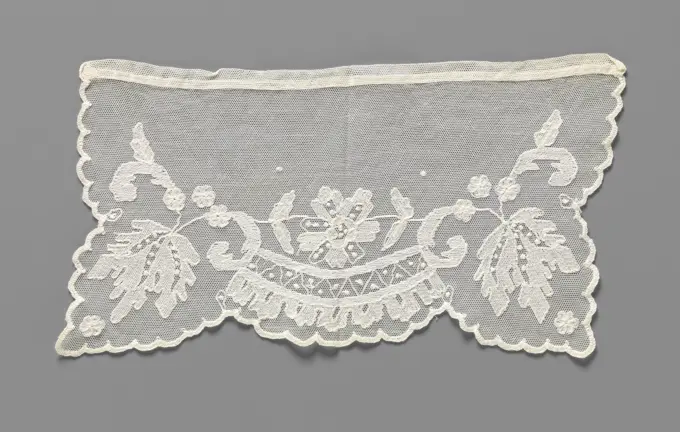
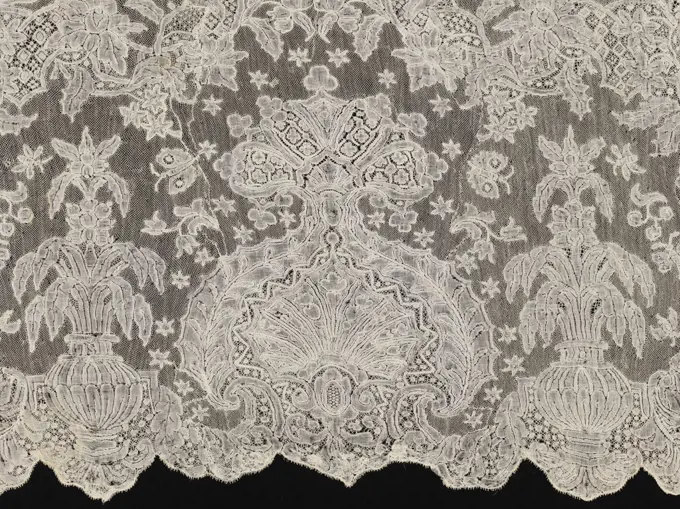
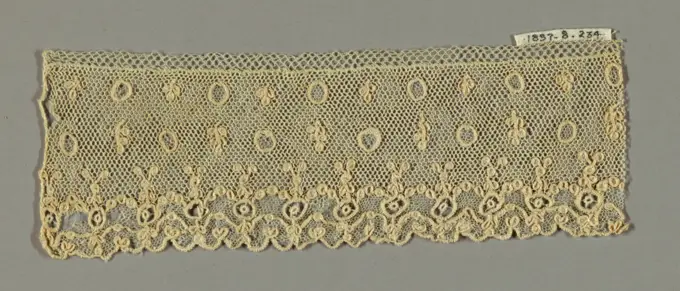
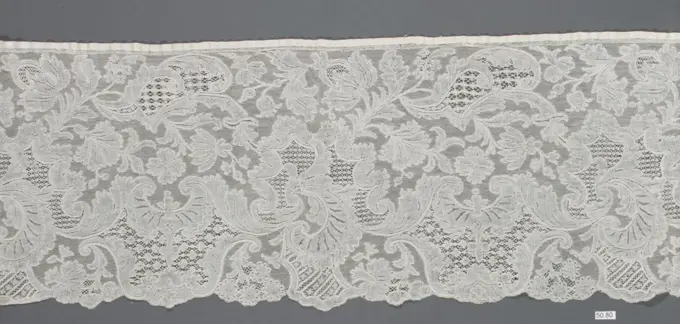
A collection of vintage lace strips featuring intricate floral and geometric patterns, showcasing skilled craftsmanship from the 18th century in various styles.

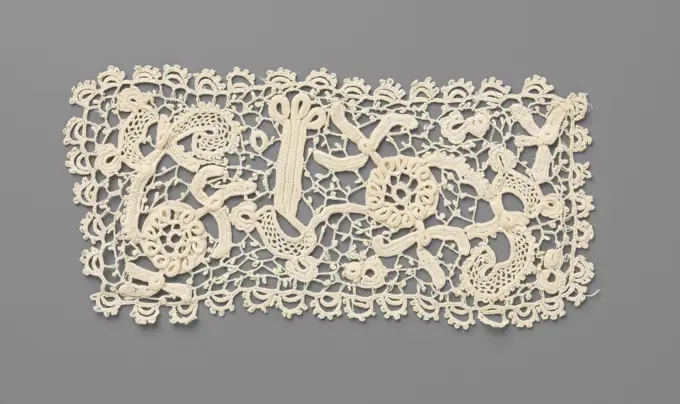
Piles of crocheted side with three -leaf flower under arch, anonymous, c. 1900 Piles of natural -colored Irish crocheted side. The repeating pattern consists of a flower with three round petals under an arc. The arcs are alternately directed with the open side to the bottom and top of the strip. A spray pattern of half moons is crocheted in the diamond -shaped soil with picots. Top and bottom of the strip are straight. Ireland cotton (textile) Piles of natural -colored Irish crocheted side. The repeating pattern consists of a flower with three round petals under an arc. The arcs are alternately directed with the open side to the bottom and top of the strip. A spray pattern of half moons is crocheted in the diamond -shaped soil with picots. Top and bottom of the strip are straight. Ireland cotton (textile)
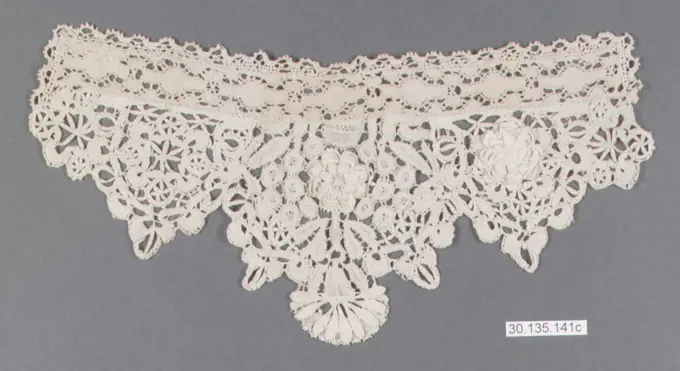
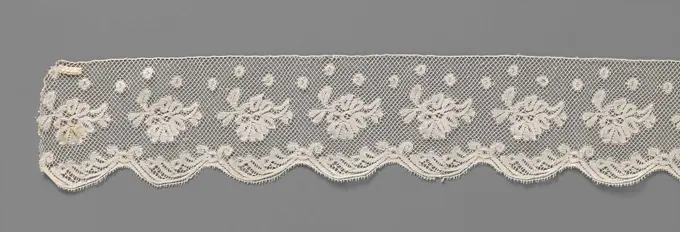
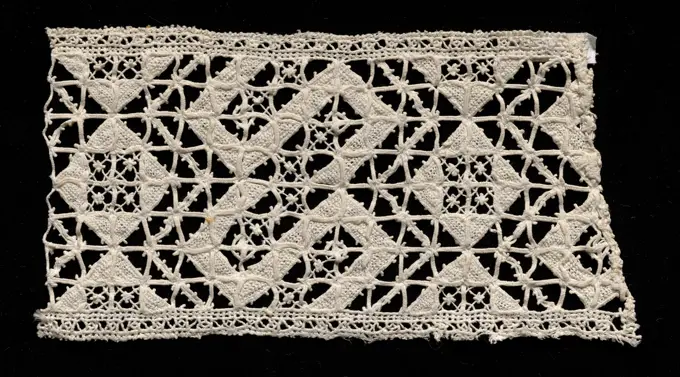
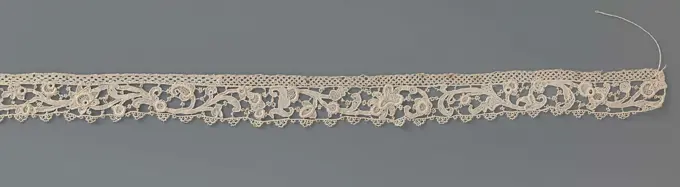
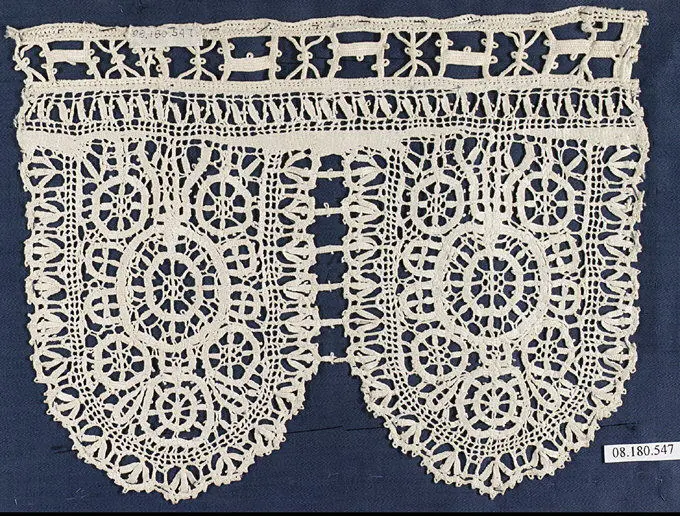
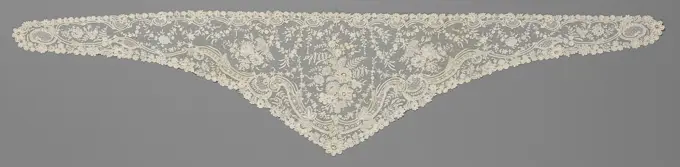
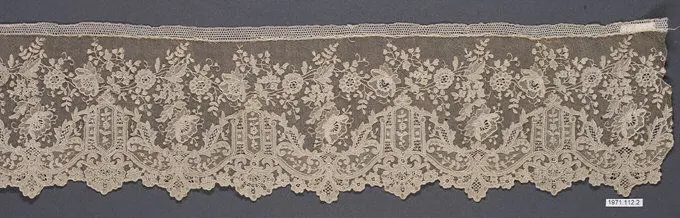
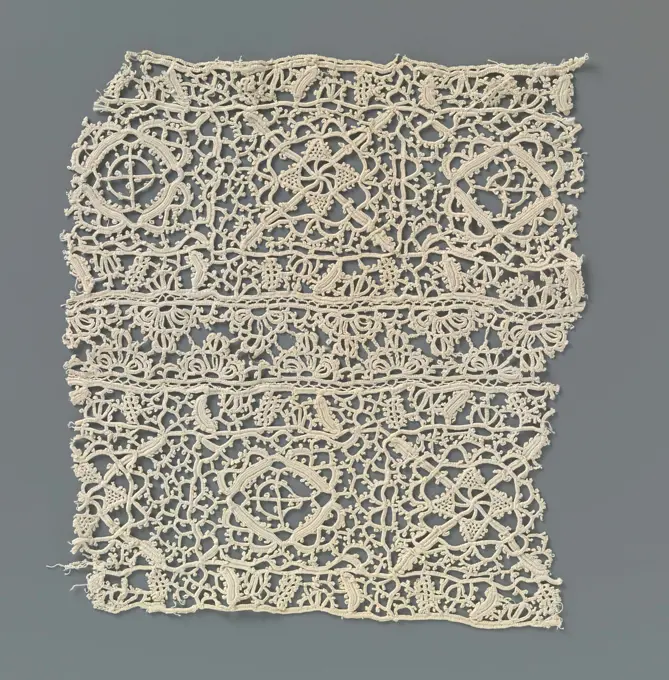
Flounce 18th century Flemish. Flounce. Flemish. 18th century. Bobbin lace. Textiles-LacesStrook kloskant met gegodroneerde schulpen.Strip natural colosside: Valenciennes-side. Pattern with embraced semi-circlical slump, above which a hanging daisy between 'sequins'.Strook applicatiekant met twee rijen aan elkaar geschakelde boogjes.Strip natural colored Brussels application side: needle side applicated on slighten ground. The repeating pattern consists of two rows of openwork arcs, which are connected to oval ranks together with oval leaves. The upper row of arcs lie down with the convex side, the bottom row of arcs stand with the convex side up. Between the arcs scattered flowers and on the arcs are winding twigs. The sparse full work is enclosed by widely spotted thread bundles. The top is finished with a separate clust strap. The virtually straight finished bottom is equipped with very fine picots.Piles of crocheted side with three -leaf flower under arch, anonymous, c. 1900 Piles of natural -colored Irish crocheted side. The repeating pattern consists of a flower with three round petals under an arc. The arcs are alternately directed with the open side to the bottom and top of the strip. A spray pattern of half moons is crocheted in the diamond -shaped soil with picots. Top and bottom of the strip are straight. Ireland cotton (textile) Piles of natural -colored Irish crocheted side. The repeating pattern consists of a flower with three round petals under an arc. The arcs are alternately directed with the open side to the bottom and top of the strip. A spray pattern of half moons is crocheted in the diamond -shaped soil with picots. Top and bottom of the strip are straight. Ireland cotton (textile)Band, Medium: linen Technique: bobbin made continuous tape with net added (Valenciennes style net), Band of Milanese-style lace in a scroll pattern., Italy, 18th century, lace, BandStrip bobbin with four-lobbish rosette above and below a zigzag band, anonymous, c. 1840 - c. 1860 Strip of natural -colored bobbin, blonde. The repeating and continuous pattern consists of a zigzag band, which divided the strip into triangular fields. There is a four -lobe rosette in the center of each field. Along the top and bottom of the strip runs a scallop, which consists of a succession of circles. The scallops are finished with picots. The motifs are connected by a coarse mesh soil, strewn with square moes. The zigzag band, rosettes and circling edges are made in linen stroke, with the rosettes equipped with a contour wire. unknown silk. blonde (lace) / bobbin lace Strip of natural -colored bobbin, blonde. The repeating and continuous pattern consists of a zigzag band, which divided the strip into triangular fields. There is a four -lobe rosette in the center of each field. Along the top and bottom of the strip runs a scallop, which consists of a succession of circles. The scalDas van kloskant met kraallijst.Strict rectangular with a layout in compartments. In the middle a branch with rose between two-point stars or cobwebs. From here hangs left and right twigs with varied flowers and leaves. At the end a reserve with Rose, Marguerite and Flower TROS. Valenciennes side.Sleeve piece (one of a pair) early 18th century French. Sleeve piece (one of a pair) 227675Fragment; medium:Bobbin Lace (Needlepoint Design) Insertion, second half of 16th century. Italy, Genoa, second half of 16th century. Lace, bobbin; average: 3.5 x 11.2 cm (1 3/8 x 4 7/16 in.).Strip bobbin with multifaceted flowers and arches, anonymous, c. 1700 - c. 1749 Strip of natural -colored bobbin: Brabant side. It concerns two sewing cuffs of a choir shirt. The repeating pattern consists of a wide variety of flowers and leaves that tumble over each other. Striking are the thick leaves or C-Voluten, which form arches around the center axis at some distance from each other. Under each bow is a similar composition with an oval (chalice) flour on a slightly bent stem. The fields between the arches are filled alternately, including with a U-shaped frame in which eight rosette flowers form a circle, crowned by a composition with C-volutes and ovals. The motifs are made in netslag and linen battle with openwork edges and recesses. Very sparingly use has been made of contour threads to accentuate some motif parts. The motifs are largely connected by a grid, a Parisian soil. The motifs under the arches are connected by a potented braid ground. This braiding land has also beenMutsenslip van naaldkant met bloemenstrooipatroon en spitsovaaltjes.Hatslip of natural needle side, Argent tank. Spreading pattern from twigs to whom alternately a small or larger flower, leaves and / or berries. Ground with meshes that are close to the buttonhole stitches. The pattern along the lower edge consists of two-way-around spindle releases between which a flower or berry branch exprements. The oval pairs are connected by a bow of leaves and / or berries and hearts. Among these arcs along the bottom edge a flat, oval oval. The oval-shaped figures in the pattern are filled with a fine hexagonal Maas soil (alençong soil). Different ornamental grounds in the flowers. Full work without recesses in flowers, leaves and berries. Sloppy edge on the underside through a concatenation of heart-shaped leaves, regularly interrupted by a rosette flower and the flat oval oval. The top is finished with a straight edge.Strip bobbin with aster, anonymous, c. 1900 - c. 1924 Strip of natural-colored bobbin: Duchesse side. On an open braid ground is a unilaterally oriented running slender, which ends in a wide spiral drink and out in one and profil. Netherlands (possibly) linen (material) bobbin lace Strip of natural-colored bobbin: Duchesse side. On an open braid ground is a unilaterally oriented running slender, which ends in a wide spiral drink and out in one and profil. Netherlands (possibly) linen (material) bobbin laceLength of Lace. France, 1760-1770s. Textiles; textile lengths. Linen point d'Alençon needle laceFragment (Belgium); linen; 1918-31-7Strip application side with campanes, anonymous, c. 1890 Strip of natural -colored application side, bobbin lacquered on mechanical tulle. On a fond littered with mosjes, semi -rounds with a border of Campanes, a clockflower hanging to the right and a twig -bent twig to the left. Brussels (possibly) linen (material) Strip of natural -colored application side, bobbin lacquered on mechanical tulle. On a fond littered with mosjes, semi -rounds with a border of Campanes, a clockflower hanging to the right and a twig -bent twig to the left. Brussels (possibly) linen (material)Strook kloskant met zonnebloemenrand.Strip natural-colored application side, needle side applicated on slighten ground. Under a scattering pattern of V-shaped leaves along the underside of the strip a border with a repeating pattern of a hanging sunflower. The successive and connected flowers form a slip edge, with lobed semicircular slot. The drachelland has largely removed behind the sunflowers. The sparing top is made with feston stitches. The motifs are equipped with festived contour wires. In the open-worked flower heart, an ornamental ground has been applied with asterisks at the intersections of a thin diamond-shaped Maas soil. The top of the strip is finished with a splitting strap. There are some seams in the strip.Strip bobbin with spruce and rosette or "gran ros", anonymous, c. 1800 - c. 1899 Strip of natural -colored bobbin, Swedish side. The strip is attached to a light blue cardboard with pins, with seven other strips. Above the strip is on the cardboard "Laces from Dalecarlia. (Dalarna)" written and underneath "Furtree-Rose. (Gran Ros)", in which Furtree should probably have been 'Fir Tree', which means Spar in English and that itself Have it translated into Swedish as 'Gran'. The pattern is formed by a bundle of wires, which has been worked through a mesh soil, a diamond -shaped tuneral ground. The threads form the contours of a stylized spruce with a stylized rosette with four diamond -shaped contours around a simple decorative soil of four large round meshes. Along the top of the strip are made in two triangles between these motifs. Top and bottom of the strip are straight and equipped with picots. One short side is finished with small buttons in the threads. Dalarna linen (material) bobCuff made of crocheted side with a twist twig and star -shaped flower, anonymous, c. 1890 - c. 1909 Cuff made of natural Irish crocheted side. Pattern in which a flower branch with a rosette flower and several elongated leaves is interspersed with a hanging star -shaped flour on a short stem without leaves. Crochet diamond -shaped Maas soil with picots. The top is finished with a straight edge. The wavy lower edge is trimmed with potentially three -part arches. Ireland cotton (textile) Cuff made of natural Irish crocheted side. Pattern in which a flower branch with a rosette flower and several elongated leaves is interspersed with a hanging star -shaped flour on a short stem without leaves. Crochet diamond -shaped Maas soil with picots. The top is finished with a straight edge. The wavy lower edge is trimmed with potentially three -part arches. Ireland cotton (textile)Edge; linen; 1933-1-91Band, Medium: linen Technique: bobbin lace, Binche style with snowball ground, Fragment of a band with very fine symmetrical flowers on a curving vine. Binche style with snowball ground., Belgium, late 17th century, lace, BandPortion of Bobbin Lace (Punto di Milano) Flounce, 17th-18th century. Italy, Milan, 17th-18th century. Lace, bobbin; average: 31.1 x 75 cm (12 1/4 x 29 1/2 in.).Strip bastard with branches of branches from triangular cartouche, c. 1750 - c. 1770 Strip of natural -colored bobbin: Mechelse side. The pattern consists of an arc formed by two branches from a triangular cartouche along the top of the strip. In the middle of the arc lies along the underside of the strip, a rush -in -shaped cartouche. This composition is interspersed with a compound flower adjacent to the top with a trapezoidal cartouche placed against the underside on it. The motifs are connected by a fine Maas soil. The motifs are made in linen battle with thicker and shiny contour threads. A few different decorative lands have been used in the cartouches and between the flower branches. Up and bottom are straight finished with picots along the bottom. Southern Netherlands linen (material) bobbin lace / Mechlin (lace) Strip of natural -colored bobbin: Mechelse side. The pattern consists of an arc formed by two branches from a triangular cartouche along the top of the strip. In the mFragment of Lace Flounce. Italy, Venice, 1650-1700. Costumes. Venetian needle lace (punto groppo)Length of Lace. Italy, 1620. Textiles; textile lengths. Linen needle laceStrook kloskant met halfcirkelvormige gelobde bloem aan gebogen steeltje.Strip natural colosside: Valenciennes-side. Work has been done with coarse wires. The short sides are sewn together. The strip may be intended for or used to a tablecloth. The repeating pattern consists on the center line from a lying up curved stalk with a semi-circular lobed flower with it. The flower is crowned by two curling leaves, between which a smaller oval flower rings to a short handle. Along the bottom, a regularly wavy band runs with varied skipping and reflecting waves. Between the consecutive flowers, there are always three meadows at the top of the strip, above the wave line, a stylized French lily. The motifs are made in linen stroke with openwork edges and here and there a single large recess or some little ones as leaf growers. The motifs are connected by a square valenciennes ground. An ornamental ground has been applied in the flower heart of the large flowers, a snowflakes soil. The top of theLace edging, 1750-1800, Belgium, maker unknown. Gift of Mrs G. Acland Allen, 1955.Fragment; linen; 1933-1-95Band; 1974-52-21Lace, 1800s, maker unknown. Acquisition history unknown.Fragment; linen; Bequest of Miss Adele Kneeland through Mrs. Philip Ainsworth Means; 1939-64-15-a/bStrip side. Strip lacePiece (one of two) late 17th century Spanish or Italian. Piece (one of two) 227623Strook gemengde kant vol grote bloemen.Strip natural colored mixed side: climbing side with needle ladies and with a needle lace ground, a mesh side ground. This type of side is also known as the name: Point d'Angleterre. The repeating pattern consists of large flowers, which are connected to each other over the full width of the strip. The thick kordons of widely scented thread bundles are striking, which are used in particular around the flower hearts. Other finer relief contours around the motifs are made with a wire that is thicker than the wires used for the motifs. The top is trimmed with a border clamping side. The short sides of the strip are finished and two brass are parentheses and two brass eyelets on the other side.Fragment of the lace;  18th century (1701-00-00-1800-00-00);Strip mixed side with wide spiral rank, anonymous, c. 1690 - c. 1699 Strip of natural -colored mixed side - Mezzo Punto - with a messing around or woven ribbon and a needley strand. On a mesh ground (needle side) is a pattern that consists of wide curling stems with exotic flowers. The contours of the flowers and stems consist of burst or woven ribbons. Different decorative land (needle side) have been used within the contours. A messing bow edge serves as a finish along the outside, with the exception of one short side that is finished with a straight strap. Milan (possibly) linen (material) mixed lace / tape lace (mixed lace) Strip of natural -colored mixed side - Mezzo Punto - with a messing around or woven ribbon and a needley strand. On a mesh ground (needle side) is a pattern that consists of wide curling stems with exotic flowers. The contours of the flowers and stems consist of burst or woven ribbons. Different decorative land (needle side) have been used within the contours. ABobbin Lace Edging, 18th century. Flanders, 18th century. Lace, bobbin: linen; average: 18.5 x 48.3 cm (7 5/16 x 19 in.).Strip bobbin with two compositions of C-volutes and daisies, anonymous, c. 1860 Strip of natural -colored bobbin: fine bridge flower arrangements. The repeating pattern consists of two, largely symmetrical compositions of C-volutes and daisies. The one composition consists of two C-Voluten, which are placed together at the bottom of the strip. Along the outside of the volutes have been made in large increasing lobes, with the three largest forming a lobed shell. Between the C-Voluten there are two chalice flowers and a daisy, with a hanging palm leaf above, crowned by three rosette flowers. The other composition consists of three highly curved C-Voluten under an elongated C-Volute. A row with seven contiguous rosette flowers below forms the other lobed shell. Above the lying C-Volut is an A-symmetrical settlement of larger and smaller rosette flowers and daisy. The motifs are connected by a potented braid ground. They are largely made in separate linen battle with openwork edges and reBorder ca. 1750 Flemish. Border 212795Border Made 1801-1825 France. Linen and horsehair, needle lace of a type known as Point d'Argentan with a whipped mesh ground .Piece 16th-17th century Italian. Piece 226414Edging 17th century Italian, Liguria. Edging 221018Strip application side with wine range, anonymous, c. 1800 - c. 1815 Strip of natural -colored Brussels Application side: Needle side Applicated on Drochelgrond. Under a spray pattern of wine leaves, a continuous slender runs along the lower edge, from which branches sprout to two sides with wine leaves and grape bunches. The very flat scrap edge is formed by straight upright wine leaves, interspersed by wreaths with pearl edges and filled with decorative stitches. Motives are constructed with feston stitches and are accentuated by relief contours of wide -ranging wire bundles. The top is straight finished with a messing strap. Brussels linen (material) Brussels Applied Strip of natural -colored Brussels Application side: Needle side Applicated on Drochelgrond. Under a spray pattern of wine leaves, a continuous slender runs along the lower edge, from which branches sprout to two sides with wine leaves and grape bunches. The very flat scrap edge is formed by straight upright wine leavesTussenzetsel van kloskant met driehoekjes.Interesting of natural colosside. The repeating pattern consists of triangles made in linen stroke, which are alternately along the top and bottom of the strip and are connected to each other by a cut-away diagonal orbit of picoted braids. On the opposite side of each triangle, two narrow arrowhead motifs are made in shape stroke with three ribs. On either side the strip is finished with a double braid with a zigzagging braid in between.Strip bobbin with flower branch full of rosette flowers, anonymous, c. 1740 - c. 1760 Strip of natural -colored bobbin: Mechelse side. The repeating and continuous pattern consists of a narrow horn-shaped reserve and a rocaillic reserve lying along the bottom edge from which a flower branch originates full of short side branches with rosette flowers, such as with a forget-me-not. Along the top edge, with a fold continuously on one short side, a narrower strip is sewn with a pattern of different rocaillic reserves and a few flowers and leaves. The motifs are connected in both strips by a fine Maas soil, the Mechelen soil. The motifs are made in linen battle with few recesses, and is equipped with very thick contour threads. Different decorative grounds, with coarser meshes, have been used in the reserves and between the rosette flowers. The faintly scalloped underneath of both strips are finished with picots. The sides sewn together are straight. Mechelen linen (material) bobbin lace / Laces, 16th century. Linen cloth hem, embroidered in cutwork (Punto Tagliato) lace, open stitches and panels, filled in reticella stitch lace, cm 10,5 high, approximately 1585. Detail.Kloskant dress strip with shield -shaped medallions, anonymous, c. 1850 Black bobbin jelly strip: Chantilly side. Closed motifs are grouped separately on an open mesh stock. On the junctions of the sculptes, three symmetrical shield-shaped medallions rise, which are caught in two pairs of C-volutes. Above the sculpts, a large flower feast is found above the medallions, with cracked petals as a crown. The inner edge is decorated with a chain of heart -shaped leaves. Bayeux (possibly) silk bobbin lace Black bobbin jelly strip: Chantilly side. Closed motifs are grouped separately on an open mesh stock. On the junctions of the sculptes, three symmetrical shield-shaped medallions rise, which are caught in two pairs of C-volutes. Above the sculpts, a large flower feast is found above the medallions, with cracked petals as a crown. The inner edge is decorated with a chain of heart -shaped leaves. Bayeux (possibly) silk bobbin laceStrook kloskant met een aaneenschakeling van verschillende ovale vormen.Strip natural colosside, Buckingham side. The continuous pattern exists along the underside of the strip from a concatenation of various oval shapes and some heart-shaped leaves. The motifs are connected to each other by a Maas soil, a tulet. The motifs are made in linen stroke with thick and shiny contour wires. A rose soil has been applied as ornamental ground. The top of the strip is straight finished. The slip edge along the underside is finished with picots.Cuff (one of a pair) 17th century British. Cuff (one of a pair) 222461Fragment; linenLace, 1800s, Belgium, maker unknown. Gift of Mrs CJ Lindsay, 1953.Strip bobbin with five -leaf, anonymous, c. 1890 Strip of natural -colored bobbin, fine bridge flower arrangements. On an open bars stock there are concentric U-shapes with a running pattern of branches, on which an anemone, a five-leaf and a bunch of three almond-shaped fruits or leaves. Bruges (possibly) linen (material) bobbin lace Strip of natural -colored bobbin, fine bridge flower arrangements. On an open bars stock there are concentric U-shapes with a running pattern of branches, on which an anemone, a five-leaf and a bunch of three almond-shaped fruits or leaves. Bruges (possibly) linen (material) bobbin laceStrook applicatiekant met een strooipatroon en rozetjes in ovaaltjes langs de onderzijde.Strip natural colored Brussels application side: needle side applicated on slighten ground. The repeating pattern consists of a scattering pattern of twigs and various rosette flowers with or without stem and along the underside of the strip of oval formed by a strong curled twig with a rosette at the end. The motifts are mainly made of widely spotted thread bundles. As ornamental ground, a coarse hexagonal maas soil has been applied in the ovals. The top is finished with a separate clust strap. The very bland scaled underside is finished with very fine picots.Cooper Union Museum Lace Study Card, Medium: linen Technique: bobbin lace, Narrow straight-edged border with a large, solidly massed floral design., Netherlands, late 17th century, lace, Border, BorderBand (Italy); linenStrook kloskant met anemonen.On a coarse meshing (Square Maas) there is an ongoing pattern of detached anemones above a slightly varied leaf switch. The strip consists of five parts sewn together and is sewn on a strip in 1966 with a similar, but not identical pattern. Valenciennes side.Needlepoint (Cutwork) Lace Insertion, 16th century. Italy, 16th century. Lace, needlepoint: linen; average: 8 x 15 cm (3 1/8 x 5 7/8 in.).Strip bobbin with continuous wavy slender with berries and butterfly, anonymous, c. 1770 - c. 1780 Strip of natural -colored bobbin: Mechelse side. The repeating pattern consists of a continuous and wavy slender with small leaves on both sides, a single short branch with a berry on it and a few flowers. At the start of each wave top is a butterfly or butterfly -shaped flour, the slender makes a loop twice within one wave. The faintly scalloped underside is formed by a double narrow pendulum, which forms a succession of pointed -shaped cartouches. Under each wave top there is always a larger cartouche in the pattern along the lower edge, with a browse branch and a star -shaped flower. The motifs are connected by a fine Maas soil, the Mechelen soil. The motifs are made in linen battle with thicker and shiny contour threads. Different decorative lands have been applied in the cartouches along the underside, in the loops, berries and flower hearts. The faintly scalloped underside stems froStrip bobbin with vases and flaming flowers, anonymous, c. 1800 - c. 1899 Strip of natural -colored bobbin: pot side. The repeating and symmetrical pattern consists of two types of vases. Both vases have a pedestal, a middle part, a top and handles, but with other shapes and one vase is wider than the other. From the handles of the wider vase, a flower in the shape of a flame, with a smaller and bending rosette flower at the bottom of the stem, originates on both sides. The motifs are made in linen battle with openwork edges and recesses. The motifs are connected by a Paris soil. A decorative land has been used in the center of the flaming flowers, a snowflake land. All sides of the strip are cut straight and not finished. Flanders linen (material) bobbin lace / pot lace Strip of natural -colored bobbin: pot side. The repeating and symmetrical pattern consists of two types of vases. Both vases have a pedestal, a middle part, a top and handles, but with other shapes and one vase is wideStrip of bobbin with hanging flowers in the scrap, anonymous, c. 1830 - c. 1840 Strip of natural -colored bobbin: Mechelse side. Under a stray pattern of flowers is a row of one -sided flower branches, with five small flowers and one large flower. The largest flowers hang down and form the scrap edge for a long time the underside of the strip. The motifs are connected by a grid, a Mechelen soil. The motifs are made in linen battle and thicker contour threads run around the motifs. Two types of decorative grounds have been used and decorations in square forms. The top and one side are finished with a straight edge, the other side is not finished. Mechelen linen (material) bobbin lace / Mechlin (lace) Strip of natural -colored bobbin: Mechelse side. Under a stray pattern of flowers is a row of one -sided flower branches, with five small flowers and one large flower. The largest flowers hang down and form the scrap edge for a long time the underside of the strip. The motifs are connected Strook naaldkant met stervormige bloem.Strip natural needle side: Venetian rosary. Pattern with tendrils to which flowers and leaves spring with different shapes and dimensions, without repetitive motif. Central is a star-shaped flower with seven petals. Irregular bars soil with picots. The top is trimmed with a border clamping side. The underside is finished with a straight picro edge with arcs.Strip (one of two) 17th century Italian. Strip (one of two) 219411Border, Medium: linen Technique: bobbin lace, Binche style with Binche ground, Binche-style border showing garland enclosing a crown and the initials 'E.P.', Belgium, late 17th-early 18th century, lace, BorderBobbin Lace (Rose Lace) Insertion, first half of 17th century. Italy, Genoa, first half of 17th century. Lace, bobbin; average: 6.1 x 28 cm (2 3/8 x 11 in.).Fragment, Medium: linen Technique: plain weave embroidered with withdrawn element work, Fragment of a woven linen border with pointed tabs on one edge. Geometric design has rectangular quadrants decorated with embroidery and small squares with needlemade filling stitches., possibly Italy, possibly Spain, 16th-17th century, embroidery & stitching, FragmentFragment ca. 1810 British, Buckinghamshire. Fragment 212758Fragment, Medium: linen Technique: bobbin lace (Valenciennes style with twisted ground), Bobbin lace band attached to narrow strip of linen. Pattern of symmetrical branching leaves with scalloped edge., Belgium, late 17th century, lace, FragmentFragment of the lace;  18th century (1701-00-00-1800-00-00);Japonstrook van applicatiekant met de peervormige medaillons.Japon strip of natural colored application side, dick edge and needle side applicated on machine tulle. Against a background, which is widowed with mates, closed worked slopes are filled with a pear-shaped medallion with violets and a circle arc with a flower branch. The pear shape is surrounded by a flower wreath with a flower branch in the top. The branch above the circle arc is c-shaped and has two large dependent sodes, a dune rose and an anemone (both of needle lace) and hanging bells.Kraag van haakwerk met ruit- en waaiermotief.Narrow straight collar of natural crocheted crochet. Three rows with diamonds made with unloading. Bye and two rows with impellers made with crocheted sticks. The range forms a wavy edge on the bottom. The top is trimmed with a woven edge.Strip bobbin with horizontal flower branches, anonymous, c. 1830 - c. 1850 On a fine grid, a Mechelen soil (also known as ice soil), there are rich twigs, with three small roses; In between some scattered berry branches. An edge with open grid -work filling consists of contiguous spiral ranks, including three roses and edges of Campanes, which form the sculpes. Mechelen side. Belgium linen (material) bobbin lace / Mechlin (lace) On a fine grid, a Mechelen soil (also known as ice soil), there are rich twigs, with three small roses; In between some scattered berry branches. An edge with open grid -work filling consists of contiguous spiral ranks, including three roses and edges of Campanes, which form the sculpes. Mechelen side. Belgium linen (material) bobbin lace / Mechlin (lace)Fragment, Medium: linen Technique: bobbin lace, Fragment of Lille-style insertion and edging lace., France, 19th century, lace, FragmentStrip bobbin with palmets and eleven -lobby sculptes, anonymous, c. 1625 - c. 1635 Strip of natural -colored bobbin, Old Flemish side. In the elongated semicircular scallops there is a repeating and symmetrical motif of two palmets placed one with seven lobes. Each shell is surrounded by eleven lobes up to the straight upper edge. The pattern is made up of a winding strap in linen and braids. The upper palmets have made a flower (or star) consisting of six leaves in the center in the center. Flanders (Possible) linen (material) bobbin lace / old Flemish lace Strip of natural -colored bobbin, Old Flemish side. In the elongated semicircular scallops there is a repeating and symmetrical motif of two palmets placed one with seven lobes. Each shell is surrounded by eleven lobes up to the straight upper edge. The pattern is made up of a winding strap in linen and braids. The upper palmets have made a flower (or star) consisting of six leaves in the center in the center. Flanders (Possible) lBobbin Lace (Plaited Lace) Edging with Points, second half of 16th century. Italy, Genoa, second half of 16th century. Lace, bobbin; average: 3.5 x 15.9 cm (1 3/8 x 6 1/4 in.).Embroidery Fragment. Italy, 1550-1650. Textiles; fragments. Linen plain weave with cutwork and linen thread embroideryBorder Made 1750-1775 Mechlin. Linen, bobbin straight lace of a type known as Mechlin with a Mechlin mesh ground .Border 18th century Flemish. Border. Flemish. 18th century. Bobbin lace. Textiles-LacesStrip application side with waving leaves, anonymous, c. 1840 - c. 1850 Strip of natural -colored application side: needle side applicated on mechanical tulle. This type of lace is also known under the name: Point d'Angleterre. Two -thirds part is littered with leaves, a third part consists of a symmetrical scallop of a rosette and an open medallion, connected by sickle -shaped leaves. A waving, incised leaf grows from those medallions. Brussels (possibly) linen (material) Strip of natural -colored application side: needle side applicated on mechanical tulle. This type of lace is also known under the name: Point d'Angleterre. Two -thirds part is littered with leaves, a third part consists of a symmetrical scallop of a rosette and an open medallion, connected by sickle -shaped leaves. A waving, incised leaf grows from those medallions. Brussels (possibly) linen (material)Needlepoint Lace Edging, 18th century. France, Alençon, 18th century. Lace, needlepoint: linen ; overall: 9 x 11.5 cm (3 9/16 x 4 1/2 in.).Border (From a Cover) Made 1701-1750 Southern Italy. Linen, plain weave; pulled thread work in single faggot and darning stitches .Siercraft for an evening mantle of mixed side with rose hedge, Martha Berkers, 1915 Ornamental piece for an evening mantle of natural -colored mixed side - bobbin in combination with needle side - Brussels Duchesse. There are roses on a wide -spread braid that usually support on two leaves. An intermediate ornament consists of single and double volutes and many small flowers. Lock linen (material) mixed lace / mixed Brussels Ornamental piece for an evening mantle of natural -colored mixed side - bobbin in combination with needle side - Brussels Duchesse. There are roses on a wide -spread braid that usually support on two leaves. An intermediate ornament consists of single and double volutes and many small flowers. Lock linen (material) mixed lace / mixed BrusselsStrook kloskant met gegodronneerde schulp.A wavy branch with feathered leaves and three star-shaped flowers grows from right to left. One of the flowers is oriented outward and forms a small intermediate switch between larger ones, which are built up as a promoted bow or a plowed collar with an open grid work filling (needle side). As a finishing of the fine meshing (square mesh), a nice edge of palms rang along the inside, applied as a side head. Brabantse Valenciennes side.Cap Crown (Italy); linenFragment (Border) Made 1601-1650 Italy. Linen, bobbin straight lace .Piece ca. 1600 Italian. Piece 212478Piece 18th century Italian. Piece 214975Bobbin Lace (Needlepoint Design) Edging of Round Points, 16th-17th century. Italy, Genoa, 16th-17th century. Lace, bobbin; average: 12.1 x 22.6 cm (4 3/4 x 8 7/8 in.).Palla Van Kloskant with jumping deer and a tree or fruit, anonymous, c. 1775 - c. 1799 Palla of natural -colored bobbin: Antwerp side. There are two animals in the middle of the pattern: a deer with a tree or fruit in between. The motifs are made in linen battle with thicker and shiny contour threads and they are connected by a grid: a Valenciennes-ground. The palla is finished all around with a strip of bobbin: Mechelen side, with spider soil and with a pattern of leaves and flowers. Southern Netherlands linen (material) bobbin lace / Antwerp lace / Mechlin (lace) Palla of natural -colored bobbin: Antwerp side. There are two animals in the middle of the pattern: a deer with a tree or fruit in between. The motifs are made in linen battle with thicker and shiny contour threads and they are connected by a grid: a Valenciennes-ground. The palla is finished all around with a strip of bobbin: Mechelen side, with spider soil and with a pattern of leaves and flowers. Southern Netherlands lineManchet van gehaakte kant met ronde bloemen en langwerpige kelkbloemen.Cuff of natural colored Irish crochet side. Rectangular model. Pattern with two round flowers and two elongated skellar flowers. The cuff is finished around with a sloping edge of double arcs, with picots on the outer bow.Edging 18th century French. Edging 213240Cuff made of lace -ups with a symmetrical pattern of a rose above a decorative band with a zigzag and godrons, anonymous, c. 1850 - c. 1899 Cuff made of lace -ups: machine tulle with tracing. Rectangular model with sculp edges. The punched symmetrical pattern consists of a rose above a decorative band with a zigzag and godrons. On either side of the rose there are two slanted volute leaves between which three small rosette floors and including a large incised leaf, which points with the tip to the angle where there is still a rosette flower. The top of the cuff is finished with a zoompje. The other sides have lobed sculpting edges, which are finished with feston stitches. West-Europa cotton (textile). embroidering Cuff made of lace -ups: machine tulle with tracing. Rectangular model with sculp edges. The punched symmetrical pattern consists of a rose above a decorative band with a zigzag and godrons. On either side of the rose there are two slanted volute leaves between which three smaFlounce, Medium: linen Technique: Mechlin style bobbin lace, N. Europe, mid-18th century, lace, FlounceFragment; linenFragment 18th century Italian, Genoa. Fragment 214897FICHU of mixed side with bouquet with blue-bells.fichu from natural mixed side: Brussels climbing side with a needle lace ground, a fine mesh side ground. This type of side is also known as the name: Point d'Angleterre. A triangularly wideed backpiece runs into narrow, rounded points. Around a wavy ribbon filled with slices, which is wide in the tip and narrow in the top edge. The ribbon is composed of seed beads and c-voluten. The Butien edge consists of roses with beaded hearts. The backpiece has a meading net meadows (needle side), on which a large bouquet of three large rosette flowers and in the top two twigs Blue-Bells or Boshyacinthen. Fine garlands hang off from the top edge.Kloskant intermediate base with connected openwork oval, anonymous, c. 1885 - c. 1899  Interest little edge of Genoese bobbin. The pattern consists of a row of connected openwork ovals. In the center of each oval, as with spokes in a wheel, there is a network of braids with four meshes. Top and bottom of the strip are straight. Italy linen (material) bobbin lace / Genoese pillow laceBorder 1850s French. Border 229309Strip crochet side with reticella motifs. Strip natural colored Irish crochet side, imitation reticella. The wide strip has been built up from two narrower strips, wherein the original undersides are adjusted to each other with chotte bow edges. The top and bottom are finished with a straight edge.Sleeve of application side with the peer -shaped medallions, anonymous, c. 1840 - c. 1849 Sleeve of a natural application side, bobbin and needle side applied on mechanical tulle. Against a background, which is widely littered with moesjes, closed -worked Schulpen in turn filled with a pear -shaped medallion with violets and a circle arch with a flower branch. The pear shape is surrounded by a flower wreath with a flower branch in the top. The branch above the circle arc is C-shaped and shows two large hanging chalice, a dune rose and an anemone (both of the needle side) and hanging bells. Brussels linen (material) Sleeve of a natural application side, bobbin and needle side applied on mechanical tulle. Against a background, which is widely littered with moesjes, closed -worked Schulpen in turn filled with a pear -shaped medallion with violets and a circle arch with a flower branch. The pear shape is surrounded by a flower wreath with a flower branch in the top. The branch above the ciCuffs. Culture: probably Flemish. Date: late 17th century.This fine design, in w hich the lace pattern fills up the entire piece, is characterized by intricate patterning within the motifs. The central male Christian figure, representing either a saint or Christ, is atypical of imagery seen in lace accessories. Museum: Metropolitan Museum of Art, New York, USA.