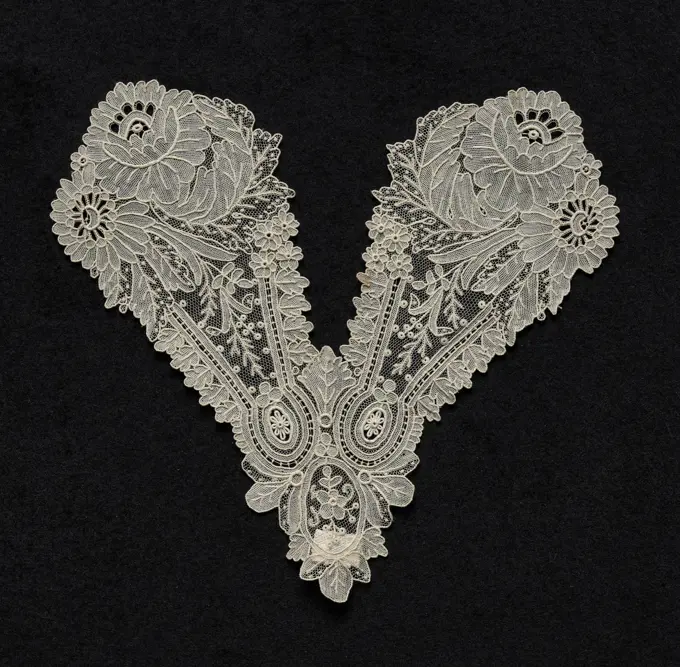
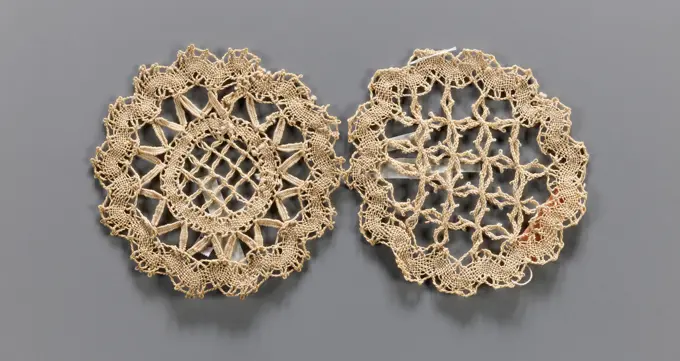
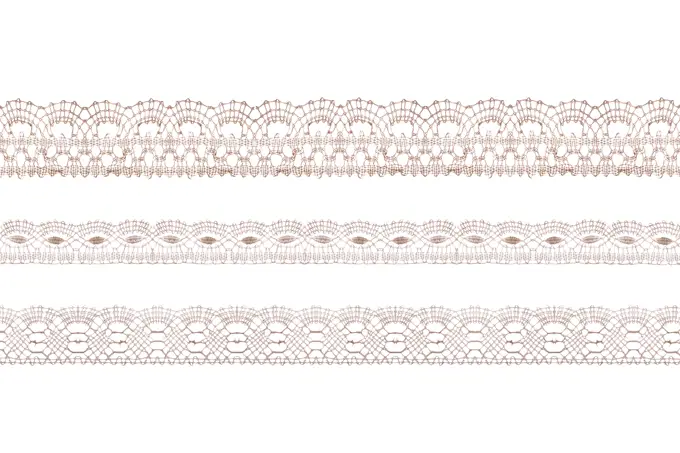
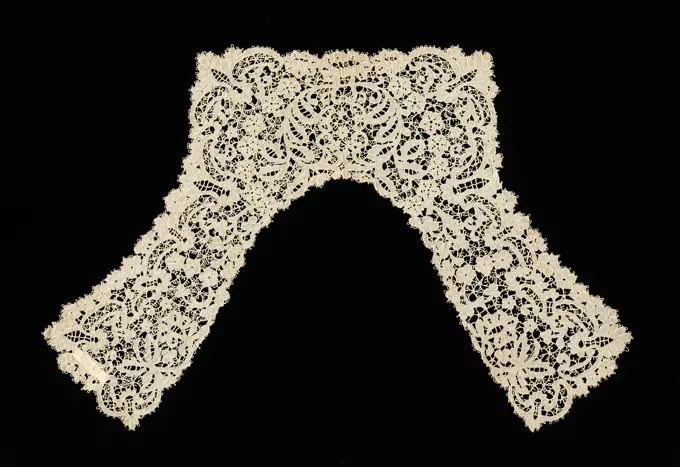
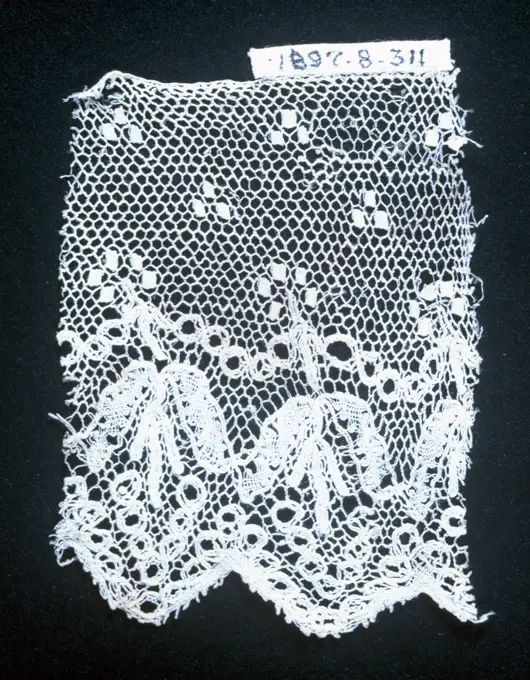
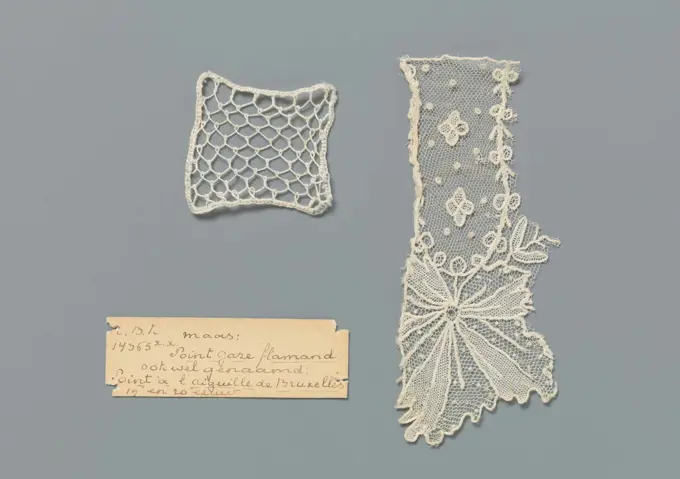
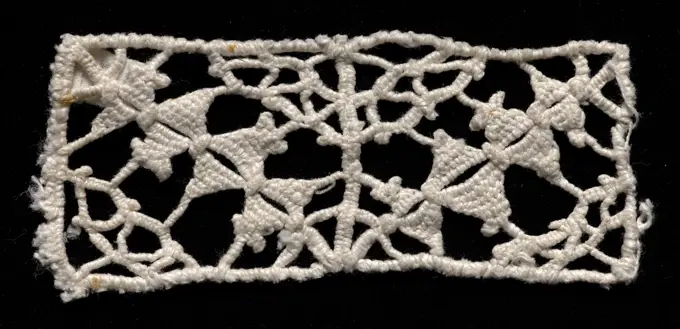
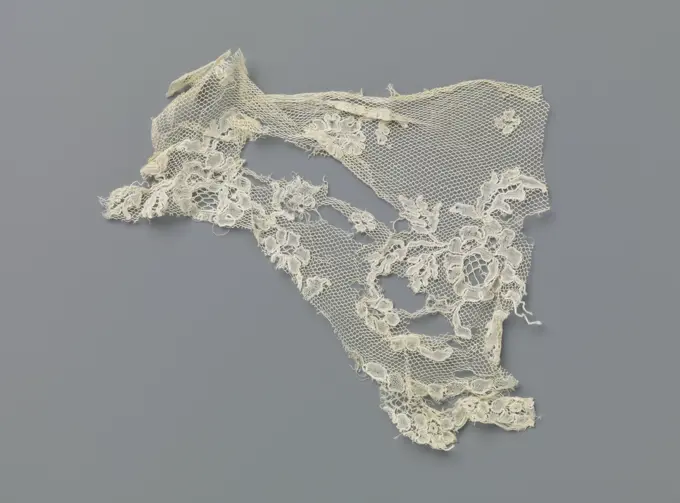
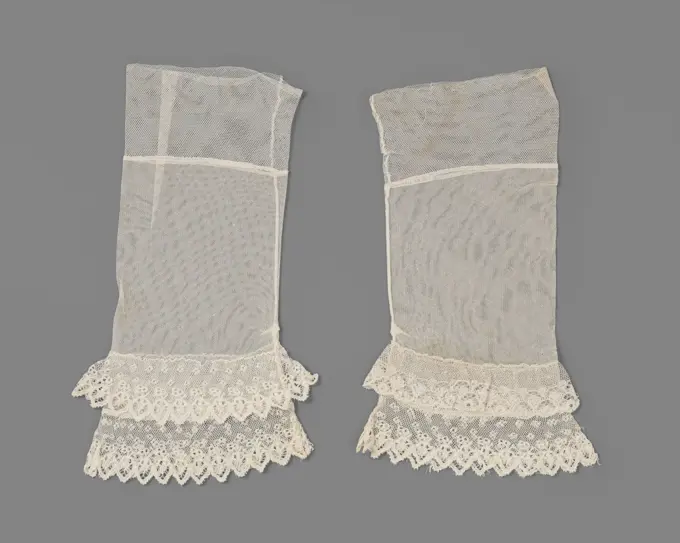
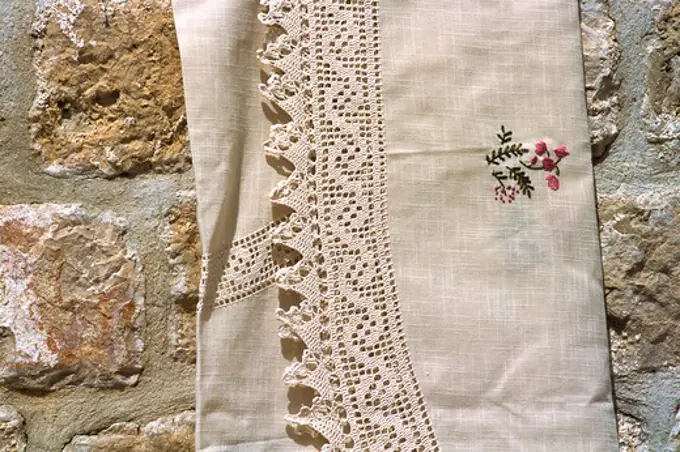
18th Century Lace Strips

A collection of vintage lace strips featuring intricate floral and geometric patterns, showcasing skilled craftsmanship from the 18th century in various styles.

Piles of crocheted side with three -leaf flower under arch, anonymous, c. 1900 Piles of natural -colored Irish crocheted side. The repeating pattern consists of a flower with three round petals under an arc. The arcs are alternately directed with the open side to the bottom and top of the strip. A spray pattern of half moons is crocheted in the diamond -shaped soil with picots. Top and bottom of the strip are straight. Ireland cotton (textile) Piles of natural -colored Irish crocheted side. The repeating pattern consists of a flower with three round petals under an arc. The arcs are alternately directed with the open side to the bottom and top of the strip. A spray pattern of half moons is crocheted in the diamond -shaped soil with picots. Top and bottom of the strip are straight. Ireland cotton (textile)
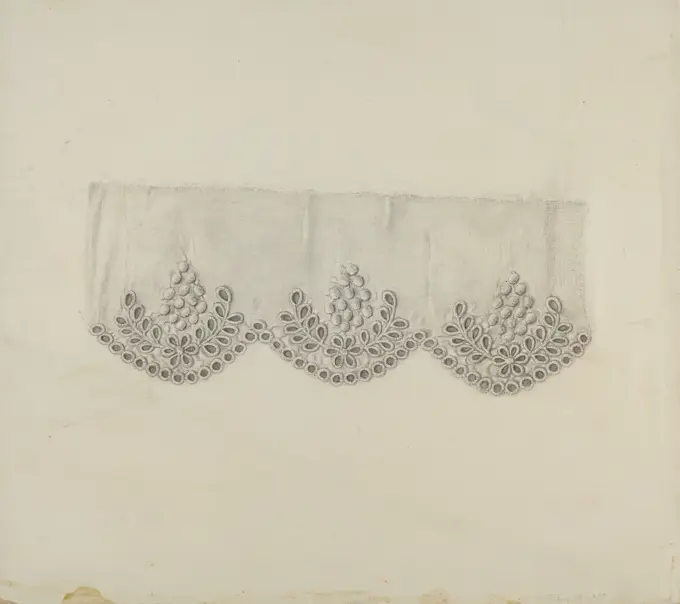
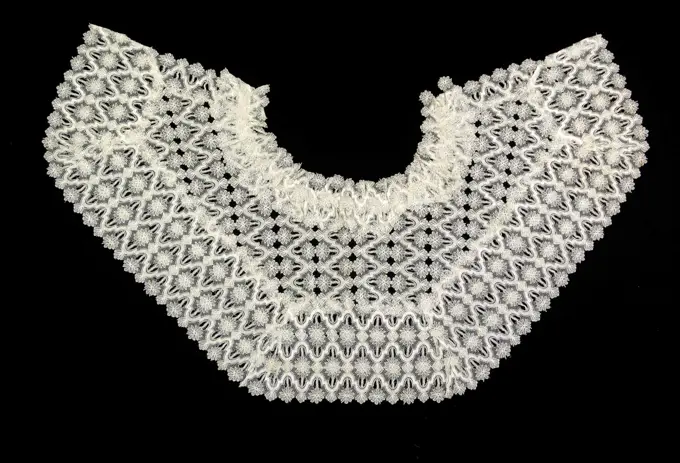
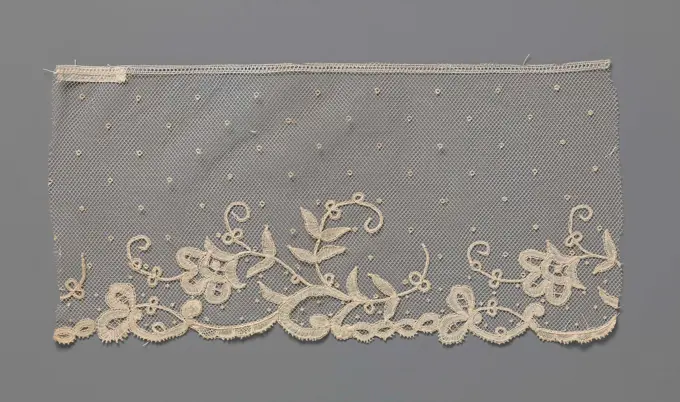
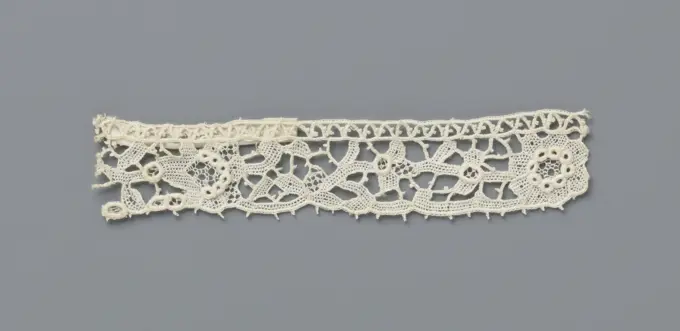
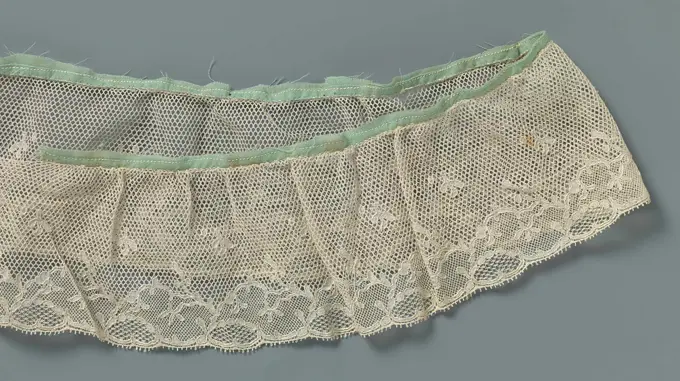
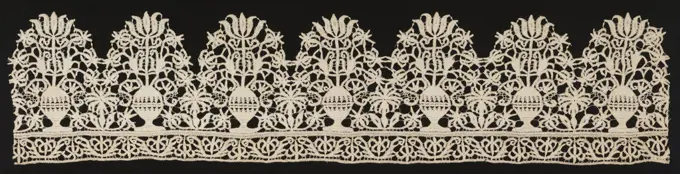
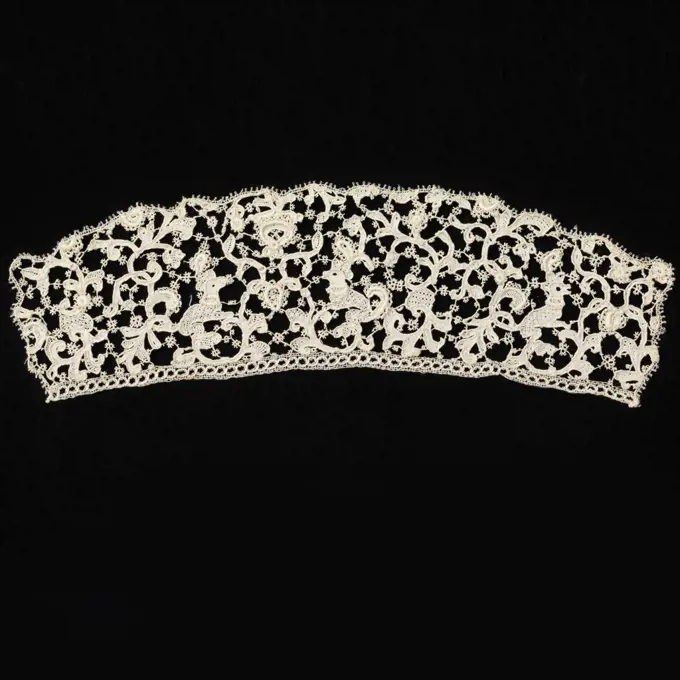
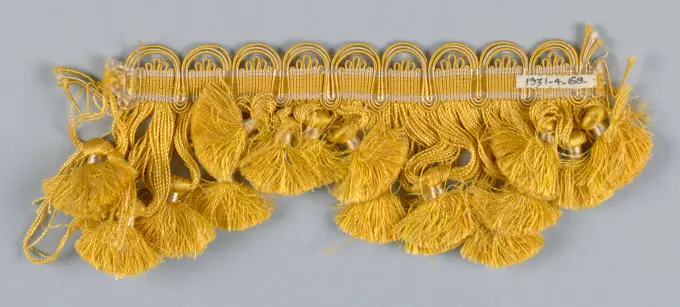
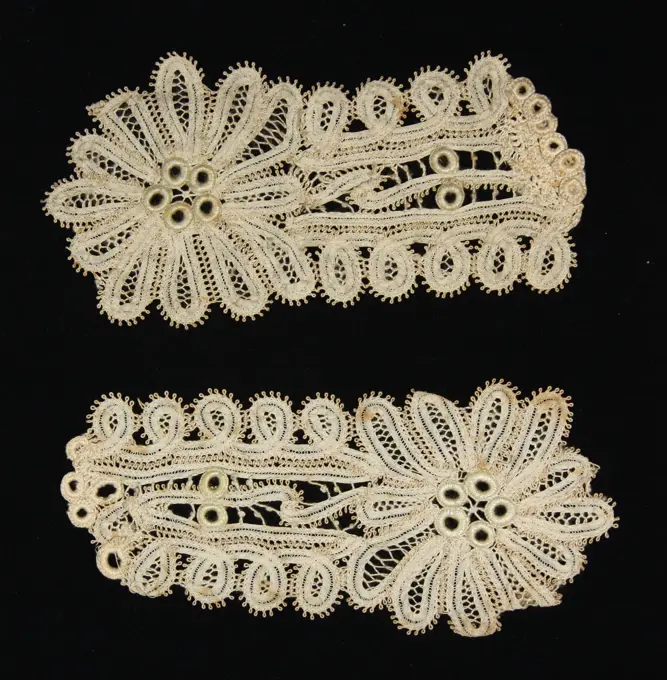
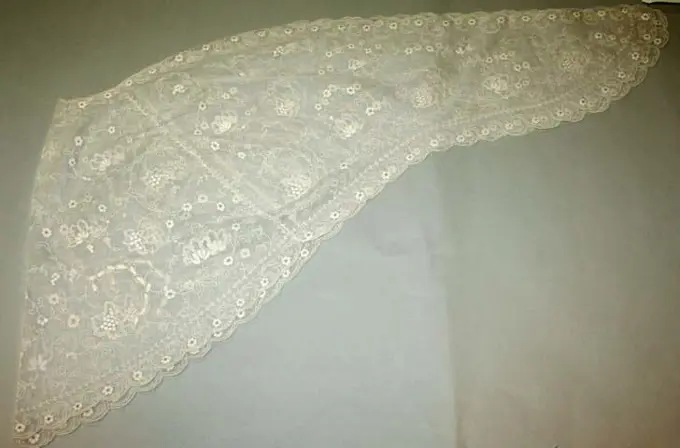
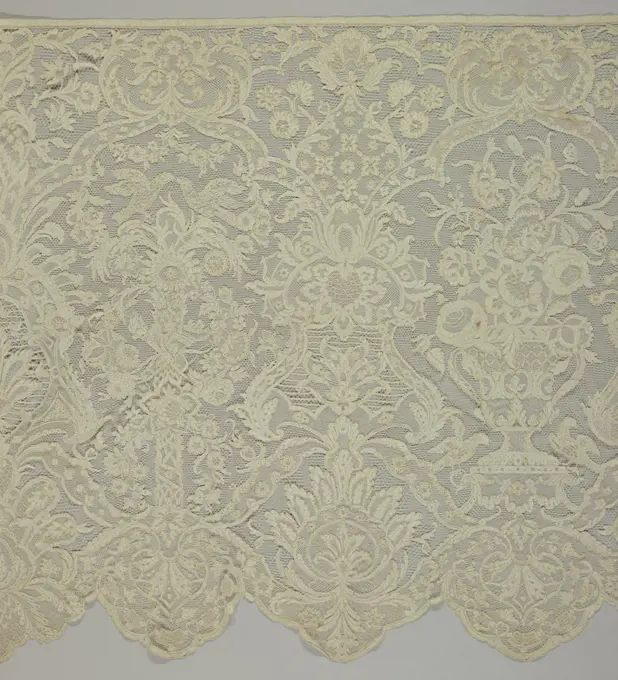
Flounce, Medium: linen Technique: needle lace, Scalloped flounce with six-sided mesh containing large urns with flowers and cartouches with leafy fronds., France, 1745-55, lace, FlounceBorder, Medium: linen Technique: bobbin lace, continuous braid-like, 17th-18th century, lace, BorderCollar, Medium: linen Technique: needle lace, Collar of Plat Point de Venise worked in large-scale design of flowers and leaves. Narrow edge of needle lace., Italy, 17th century, lace, CollarCover, Medium: linen Technique: withdrawn element work, bobbin lace, Small cover with bobbin lace edging and fringe has an eagle inside a stepped diamond motif., Italy, 16th-17th century, lace, CoverMarie Famularo, Embroidered Edging, c 1938 Embroidered EdgingFragment, Medium: linen Technique: needle lace, Irregularly-shaped fragment with entwined leaves and fantastical flowers., France, 18th century, lace, FragmentPelerine 1835-40 American. Pelerine 173306Strip crochet side with five-pointed stars and flowers made with open circles. Part of a strip of natural-colored Irish crochet side. The original, repetitive pattern consists of a double row with a total of eight triangular floral motifs made with open circles, interspersed with one five-pointed star with a circle in the middle and a circle of each point. Crocheted irregular mesh soil with picots. Top and bottom are finished with a straight edge.Strook applicatiekant met één bloem aan krullende tak.Strip natural applicating office: dick edge - bridges Flower work - Appliqued on machine tulle. Lying branch with curly side branch and one flower attached to a fine hexagonal maase with a regular spreading of open moes. A long stretched pattern with bows and ovals forms the piced slip edge on the bottom. The motifs seem to be made from ribbon side, however, they are made from Grove Brugse Kant, whereby the stylish ribbon side in that time is used as inspiration. The top is trimmed with a border clamping side.Band (Italy); linenFragment with a Floral (tendril) Motif, 1500s-1600s. Italy, 16th-17th century. Needle lace, filet/lacis (knotted ground and darned in one and two directions); bleached and blue dyed linen (est.); overall: 12.5 x 7.4 cm (4 15/16 x 2 15/16 in.).Fragment, Medium: linen Technique: bobbin lace (Mechlin style), Serpentine stem with leaves and flowers and Lille ground., Belgium, 18th century, lace, FragmentCut-out, Lockwood de Forest, American, 1850-1932, Pierced and cut-out sheet brass foil, Trailing foliate vine with stylized flowerheads on a bordered rectangular panel, 1881-90, metalwork, Decorative Arts, Cut-outFragment and ornaments, Medium: linen Technique: machine made tape with hand made fillings, a.) Scalloped border with a design of four-petal flowers above a border of leaf-shaped motifs. b.) Star-shaped doily in a design of a central flower with eight petals surrounded by waving lines and ovals. c. and d.) Two oval ornaments in a design of a spray of eight leaves partly surrounded by a leafy wreath., France, late 19th century, lace, Fragment and ornamentsCollar of climbing side with edge of daisies. Collar of natural colosside: Parisian side. The square backpiece takes place in two points. A coarse Paris soil is strewn with meadows made in shape stroke and surrounded by a chain of daisies. The petals are made in scroll. Every flower heart is decorated with a spider. The petals are surrounded by thicker and shiny contour wires.Cap crown, Medium: silk, metal-wrapped silk Technique: embroidery on brocade, Panel embroidered for use as the crown of a cap. Embroidered in a floral pattern of carnations and roses, edged with metal lace., Austria, 19th century, embroidery & stitching, Cap crownCollar ca. 1850 Irish. Collar 168329Strip bobbin with light blue and green painted flowers and leaves with a few gold -colored accents, anonymous, c. 1740 - c. 1760 Strip of natural-colored bobbin, binche side, where the pattern is painted light blue and green, with a few gold-colored accents. The painting is not completely finished. The strip is sewn with a few stitches on a strip with the same but unpainted pattern. The pattern consists of feathered leaves, bent and curled, with a plume flower and a flower in the shape of a pine cone. The motifs are connected by a decorative land, a snowflake ground. The fullwork is largely made in linen battle with openwork edges. A mains filling has been used between some leaves and in the flowers. The underside of the strip is straight. The top is finished with a separate strap. Southern Netherlands linen (material) Bobbi Lace / Binche Lace Strip of natural-colored bobbin, binche side, where the pattern is painted light blue and green, with a few gold-colored accents. The painting iStrip of needle side with different horizontal flowers in a rank on a slender and thick -fested circles, anonymous, c. 1900  Strip of needle side: Venetian relief side with thick -founded circles. Pattern with different lying flowers in a row on a slender. The motifs are connected to each other with fewly potented bars. Ornamental stitches, including diamond stitch, in the flower hearts and in a few petals. The very flat scrap edge is finished with picots. The top of the strip is straight finished. Belgium linen (material) Venetian raised workBobbin Lace Edging, 18th century. Spain, 18th century. Lace, bobbin; average: 10.2 x 21.7 cm (4 x 8 9/16 in.).Band; linen; Bequest of Marian Hague; 1971-50-274Machinal side with seven flower debts, anonymous, c. 1895 - c. 1905 Collar of natural -colored machine side, etching side. Half -round model with a symmetrical pattern of seven large flower debts. In midfield there are four rosette flowers on the imitation land between two fan -shaped flowers. The semicircular faintly scalloped inner edge is formed by C-Voluutjes and circles. Europe Collar of natural -colored machine side, etching side. Half -round model with a symmetrical pattern of seven large flower debts. In midfield there are four rosette flowers on the imitation land between two fan -shaped flowers. The semicircular faintly scalloped inner edge is formed by C-Voluutjes and circles. EuropeFragment, Medium: linen Technique: bobbin lace, continuous tape with bars added, 17th century, lace, FragmentExcerpt bobbin with inverted fan -shaped motif in scrap edge, anonymous, c. 1850 - c. 1899 fragment Fragment black bobbin: chantilly side. The fragment is elongated in shape, with a scrap edge on one long side, the other sides have been cut irregularly. The repeating pattern consists of a diamond -shaped configuration of four rosette flowers, including a more or less fan -shaped motif. The successive fans are connected to leaves by arches. There are four rosette flowers under each bow, which form the suspension points of the continuous decorative tape that also forms the scrap edge. The decorative band consists of two garlands between which there are loose round motifs. The motifs are made in netslag with contour threads. They are connected to each other by a fine Maas soil, a tuler floor. A rose soil has been applied as a decorative land. The scrap edge is finished with picots. Belgium (possibly) silk bobbin laceBatist handkerchief with double decorative frame with Leerkens and J-shaped motifs, c. 1890 Natural -colored batist handkerchief finished with natural -colored bobbin: fine brugs flower arrangements. The bobbin side consists of a double decorative frame along the edges of the handkerchief. The inner decorative frame consists of four extremely narrow lines that are connected by square forms. The decorative filling that consists of this list is also called 'Leerkens' (ladders). To this is the second, outer, decorative frame with a repeating pattern of one row of J-shaped curls with a dot above the curling end. The J-shaped motifs are connected to each other with a braid and to the inner decorative frame. Outside, they are connected to the faint scaffold edge, which is formed by a succession of plains, made alternately in linen and mains, to which a thick contour thread winds around. In each corner there is a J-shaped motif with ditto plains in each corner, but then the plains are directeLace veil, black unknownBatist scarf collar decorated with whitework and Rijssel side, Anonymous, c. 1830 - c. 1840 Batist scarf collar decorated with whitework in the form of flowers and berry branches. On the neck side the collar is trimmed with a strip of Rijssel side. West-Europa whole: Cotton (textile). strip: Lille lace Batist scarf collar decorated with whitework in the form of flowers and berry branches. On the neck side the collar is trimmed with a strip of Rijssel side. West-Europa whole: Cotton (textile). strip: Lille laceHandkerchief made of needle side with hanging flower branches. A wide edge of lace has a soil of nozzle-oriented miter feeds, on which scattered leaves and a closed edge of hanging flower branches. Alençon side.Strip application side with mimosataks, anonymous, c. 1890 - c. 1909 Strip of natural -colored application side, bobbin lacquered on mechanical tulle. The pattern shows a row of mimosa branches to the right. The strip is sewn to BK-BR-J-255. Belgium (possibly) linen (material) Strip of natural -colored application side, bobbin lacquered on mechanical tulle. The pattern shows a row of mimosa branches to the right. The strip is sewn to BK-BR-J-255. Belgium (possibly) linen (material)Shawl, Medium: yak wool Technique: bobbin lace, Black triangular shaped shawl with a design of flower sprays, curving motifs and a scalloped border., England, 19th century, lace, ShawlFragment; linenKloskant handkerchief with C-shaped twigs, anonymous, c. 1900 Two Entre-Deux are sewn around a square batist cloth and a scalloped edge with a stock of square meshes. The Schulprand is wrinkled in the corners. The ongoing pattern exhibits immediately targeted C-shaped twigs. Valenciennes side. Belgium (possibly) linen (material). batiste Bobbi Lace / Valenciennes Lace Two Entre-Deux are sewn around a square batist cloth and a scalloped edge with a stock of square meshes. The Schulprand is wrinkled in the corners. The ongoing pattern exhibits immediately targeted C-shaped twigs. Valenciennes side. Belgium (possibly) linen (material). batiste Bobbi Lace / Valenciennes LaceStrook machinale kant met ovale velden en groen lint langs de bovenkant.Strip natural-colored machining: machine paris side. The repeating pattern exists along the underside of the strip of more or less oval fields that are at some distance from each other. From each oval, a branch exprceeds on one side, which goes with an arc to the next oval and thus forms a closed field. Above this edge with fields there is a row of loose leaf branches in the machine Paris soil, always with a mole next to it. In the fields, finer ornamental grounds are applied than the Paris soil at the top of the strip. Along the top is a green ribbon sewn, where the strip is turned on slightly. A piece of the green ribbon is missing in two places. The very slight sloping edge along the bottom of the strip is finished with picots. The short sides are put together.Handkerchief 1875-89 French. Handkerchief 228913Machine Lace (Embroidered Net) Fichu, 19th century. Ireland, Limerick, 19th century. Cotton embroidery in tambour stitch on white machine-made net; overall: 75 x 127 cm (29 1/2 x 50 in.).Dress of knotted side with loose slopes with three loops and picots. Natural knotted side dress: Frivolité. Round model. Sloppy edge of tubes that sitting at some distance from each other to the dress and consist of three loops with picots and a fourth loop that forms the connection with the dress.Border, Medium: linen Technique: bobbin lace, Border of bobbin lace with one straight and one scalloped edge. Design is a stem with three flowers and four leaves placed at right angles to edge., USA, ca. 1900, lace, BorderCollar 1830s American. Collar 119408Border Made 1875-1900 Italy. Linen, needle lace .Border 17th century Italian. Border. Italian. 17th century. Needle lace, punto avorio. Textiles-LacesPelerine 1830s British. Pelerine 119004CollarKraag van gemengde kant met een flauw v-vormig model.Collar of natural ribbon side (mixed side): luxury owl, with a woven ribbon and coniferous folks. FIND V-shaped model, with rectangular ends and a widened triangular center. The symmetrical pattern consists of motifs whose contours are formed by a narrow woven ribbon. In the middle is the largest flower with a quadruped center, flanked by volutes under which a triangular point hangs. In addition to this central palmet flower on each side, an openwork oval flower, made with two skills placed against each other, oval leaves and three times a triple flower. The triple flowers and the central flower have an increased (relief) and festonated circular flower heart. Within the contours with which the motifs are formed, ornamental grounds are applied (needle side) with grover yarn than used to make the ribbon. The motifs are connected by a bars soil (needle side). The unequal slip edge comes from the pattern and is finished around with a bowBorder, Medium: linen Technique: bobbin lace, discontinuous tape, Deeply scalloped border with a vase of flowers in each scallop. Narrow bobbin lace in flower pattern joined to straight edge of border., Belgium, early-mid-17th century, lace, BorderStrip of cotton with lace plunge with openwork flowers and berries, C.I. Bosch Reitz-Teding van Berkhout, c. 1860 - c. 1880 Strip of natural cotton with lace bobbins: English embroidery. The strip has a scrap edge and a repeating and continuous pattern with a wavy slender with openwork flowers, leaves and berries. Amsterdam cotton (textile) Strip of natural cotton with lace bobbins: English embroidery. The strip has a scrap edge and a repeating and continuous pattern with a wavy slender with openwork flowers, leaves and berries. Amsterdam cotton (textile)Fragment early 17th century Italian. Fragment 219841Fragment 18th century Greek. Fragment 214731Fragment, Medium: linen Technique: lace of early premade bobbin tape with needle work fillings, 17th century, lace, FragmentBorder Made 1725-1775 Mechlin. Linen, bobbin straight lace of a type known as Mechlin with a snowflake mesh ground .Handkerchief, 1800s. France, 19th century. Embroidery: linen; overall: 40.6 x 40.6 cm (16 x 16 in.).Needlepoint (Point de Gaze) Jabot, 19th century. Belgium, Brussels, 19th century. Lace, needlepoint: linen; average: 17.2 x 15.6 cm (6 3/4 x 6 1/8 in.).Napkin;  20th century (1901-00-00-1940-00-00);Pastel color lace ribbons isolated shot Delicate pastel lace ribbons isolated shot ,model released, Symbolfoto Copyright: xZoonar.com/AndreyxGuryanovx 14345908 ,model released, Symbolfoto ,property releasedWoman's Shawl (Pelerine)Flounce Made 1701-1750 Italy. Linen, bobbin part lace (made in large sections) .Collar ca. 1890 American. Collar. American. ca. 1890. LinenBorder; 1974-52-52Collar ca. 1890 Irish This is a good example of traditional Irish cutwork lace, known as Carrickmacross, with traditional Irish motifs incorporated into the design. Carrickmacross lace was often made at home as a craft rather than in professional ateliers, but nevertheless has an appealing quality.. Collar 156526Round blanket. Cotton, macrame, crochet laceKloskant collar with hanging tulip, anonymous, c. 1900 - c. 1909 Collar of natural-colored bobbin: Valenciennes side. U-shaped model, made from a strip of side with a sewn triangular piece of lace along the legs of the U with a fine square grid, without further decoration. Description of the strip: on a rough grid (square grille), which is littered with 'sequins', there is a running pattern. Unilaterally targeted hanging tulips are loose above stretched scales of a garland with hanging berries. Netherlands (possibly) linen (material) Bobbi Lace / Valenciennes Lace Collar of natural-colored bobbin: Valenciennes side. U-shaped model, made from a strip of side with a sewn triangular piece of lace along the legs of the U with a fine square grid, without further decoration. Description of the strip: on a rough grid (square grille), which is littered with 'sequins', there is a running pattern. Unilaterally targeted hanging tulips are loose above stretched scales of a garland with hanging berBorder for a cover. Culture: Italian. Dimensions: L. 13 x W. 13 inches (33.0 x 33.0 cm) ; Border: 2 1/2 inches (6.4 cm). Date: 16th century. Museum: Metropolitan Museum of Art, New York, USA.Strip bobbin with vertical and horizontal lines in semicircular shell, anonymous, c. 1800 - c. 1900 Strip of natural -colored bobbin. The pattern consists of horizontal lines between which pairs crossed ensure a dash pattern. In the middle of the lines, a small circle has always been realized. The horizontal lines are made in linen battle. With a double decorative wire, a curved line has been made along the underside, creating a semicircular shell. This is finished with a braid that forms narrow triangular lobes. Brazil linen (material) bobbin lace Strip of natural -colored bobbin. The pattern consists of horizontal lines between which pairs crossed ensure a dash pattern. In the middle of the lines, a small circle has always been realized. The horizontal lines are made in linen battle. With a double decorative wire, a curved line has been made along the underside, creating a semicircular shell. This is finished with a braid that forms narrow triangular lobes. Brazil linen (material) boBracelet 18th-19th century. Bracelet 446726Collar with a row of pearls above the scalloped edge above which a leaf edge with flour, anonymous, c. 1850 - c. 1900 Collar with a row of pearls above the scalloped edge, above which a leaf edge with flower, moesjes and ajour work. West-Europa linen (material) embroidering Collar with a row of pearls above the scalloped edge, above which a leaf edge with flower, moesjes and ajour work. West-Europa linen (material) embroideringFichu Belgian, Brussels late 19th centuryEdge; linen; Bequest of Marian Hague; 1971-50-341Ornament 17th century Italian. Ornament 214886Fragment, Medium: linen Technique: needle lace (commonly called Rosaline), Fragment of elaborate coral shapes. Pattern outlined by cordonnet and connected by brides picotées, interspersed by portes and gaze quadrillée., Belgium or Italy, 18th century, lace, FragmentFringe Sample (USA); silkLace laceCollar early 17th century Italian, Genoa. Collar 221797Fichu early 19th century American or European. Fichu 119392Fragment; linen; 1897-8-311Border 16th century Italian. Border 214816Lace, 1800s, maker unknown. Acquisition history unknown.Plate, Molded and pierced salt-glazed stoneware, Round, low basket, molded to resemble weaving. Scrollwork and piercing along sides., Staffordshire, England, ca. 1760, ceramics, Decorative Arts, PlateSteel needle side with mesh side ground. Steel natural-colored coniferous side with a hexagonal maas soil: a mesh side ground. The application of this type of Maas land with single meshes formed by rows of festivals worked back and forth is characteristic of Brussels mesh edge. The edges of the steel are finished with feston stitches.Table mat, Medium: linen Technique: bobbin lace, Oval mat with a squaw and papoose, tepee, and brave with bow on a mesh ground with a picot border., Wisconsin, USA, ca. 1900, lace, Table matCollar 1700-1941 American. Collar 119181Fragment, Medium: silk Technique: cut and uncut voided supplementary warp pile in cloth foundation (pile-on-pile velvet), Small-patterned or 'miniature' velvet with a white ground shot with silver thread. Lines of laurel leaves in white cut, and black and white uncut pile, crossing diagonally forming lozenges, each lozenge enclosing a minute floral spray in black and white uncut pile, with only center of flower in white cut pile., France, 1750-1800, woven textiles, FragmentLace, 1800s , maker unknown. Gift of Watt, 1989.Needlepoint (Reticella) Lace Insertion, 17th century. Italy, 17th century. Lace, needlepoint: linen; average: 3.2 x 7.7 cm (1 1/4 x 3 1/16 in.).. Collar with scented leaves between spiders caught in an edge of scented squares deposited with a smoothly mounted strip machining. The collar is straight from behind and has two slips on the front.Border (France); block-printed on handmade paper; 60.5 x 29 cm (23 13/16 x 11 7/16 in.)Strip bobbin with pearl and rosette list, anonymous, c. 1830 - c. 1850 There is a running pattern on the traly land, a Mechelen soil (also known as ice ground), with a few stripped four -pass -shaped mulets. Along the inside there are small hanging rosette branches, a dune rose in the middle on larger volute stems, which spring with the same flower that forms the final piece of the pure circular arch -shaped scallops. The sculptes consist of a pearl and rosette list, which encloses a middle track with gridwork. Mechelen side. Belgium linen (material) bobbin lace / Mechlin (lace) There is a running pattern on the traly land, a Mechelen soil (also known as ice ground), with a few stripped four -pass -shaped mulets. Along the inside there are small hanging rosette branches, a dune rose in the middle on larger volute stems, which spring with the same flower that forms the final piece of the pure circular arch -shaped scallops. The sculptes consist of a pearl and rosette list, which encloseBorder (Italy); linenUnderemen of tulle with cuff consisting of two strips of lace, anonymous, c. 1875 - c. 1890 Underemen of tulle, straight model. The cuff consists of two bobbin strips with a pointed edge. Netherlands . Bucks point (lace) Underemen of tulle, straight model. The cuff consists of two bobbin strips with a pointed edge. Netherlands . Bucks point (lace)Clunykant collar, anonymous, c. 1920 - c. 1930 Narrow collar of Kloskant decorated with a row of square motifs with crosses of leaf motifs. Pointed corners with a stylized leaf and floral motif. Belgium (possibly) . Cluny lace Narrow collar of Kloskant decorated with a row of square motifs with crosses of leaf motifs. Pointed corners with a stylized leaf and floral motif. Belgium (possibly) . Cluny laceTurkish needle work embroidery Ornamental with lace patterns, details, flowersCroatia, Dubrovnik, Outdoor Market, Handicrafts, Lace ClothSteel needle side with Burano-soil. Steel natural needle side as an example of a Burano ground. Study material. The steel is made of coarse wires as an example of this needle lace ground, which was used in Burano side. It is a characteristic coniferous battlement of rectangular meshes formed by feston stitches from left to right and from right to left the loops between the feston stitches twice to pick up twice. With the steel that was made around 1925, a fragment of antique burano side in which this technique has been used.