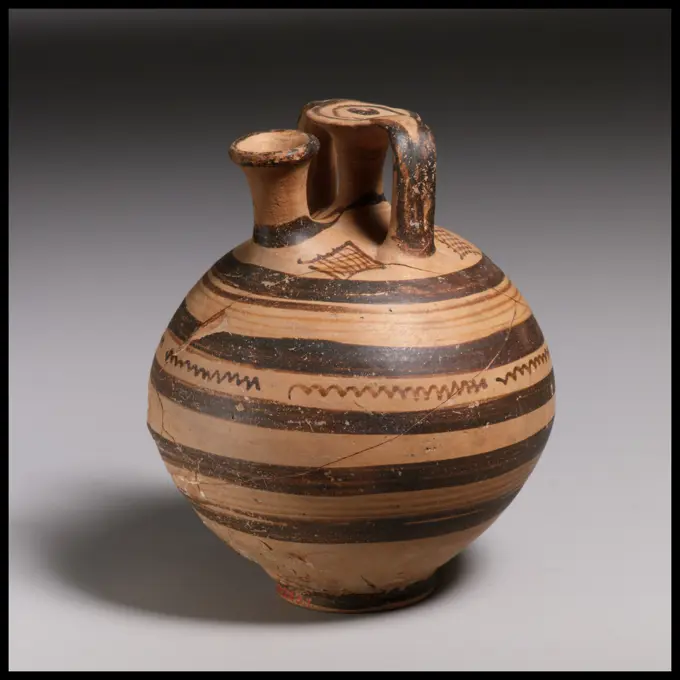
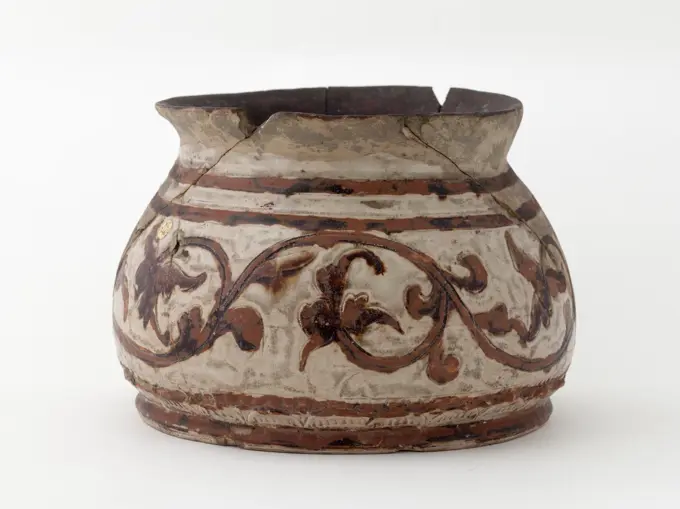
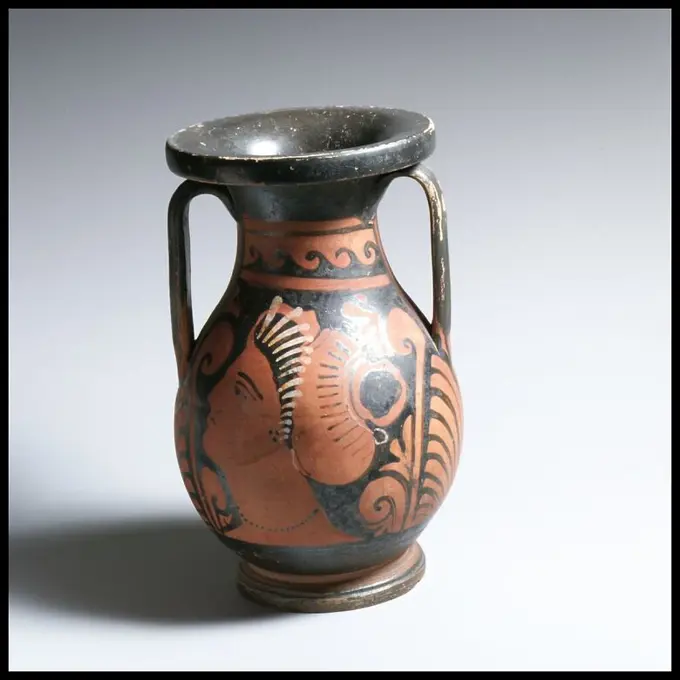
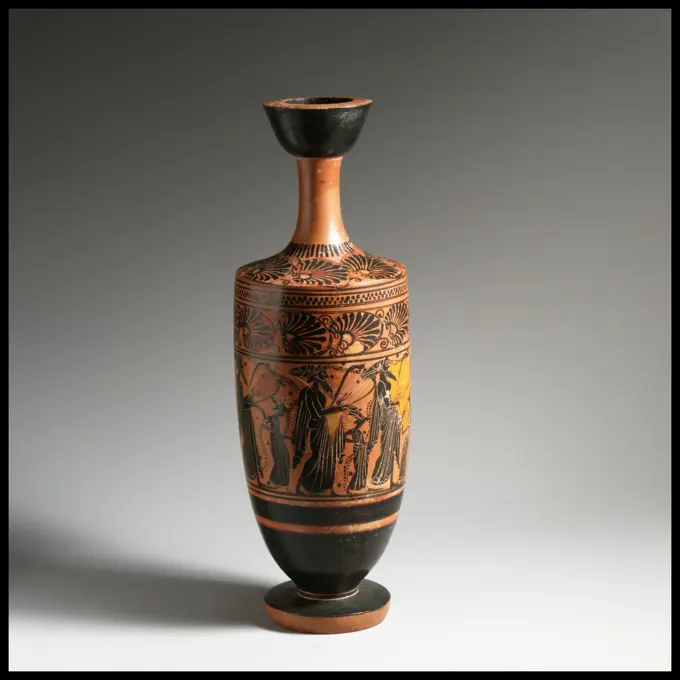
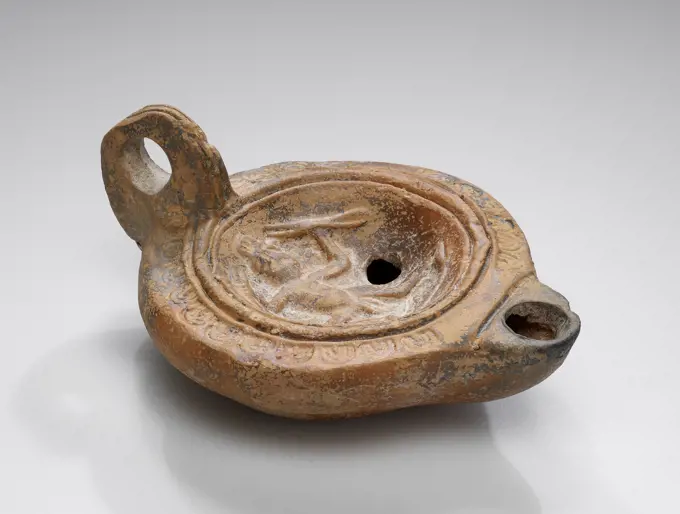
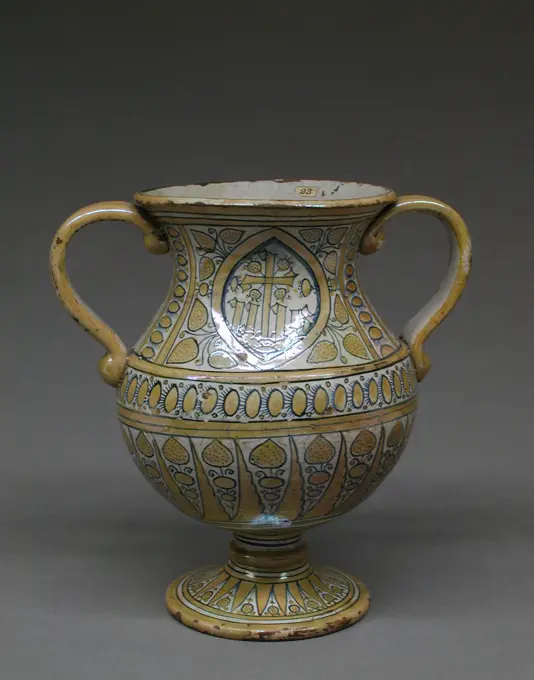
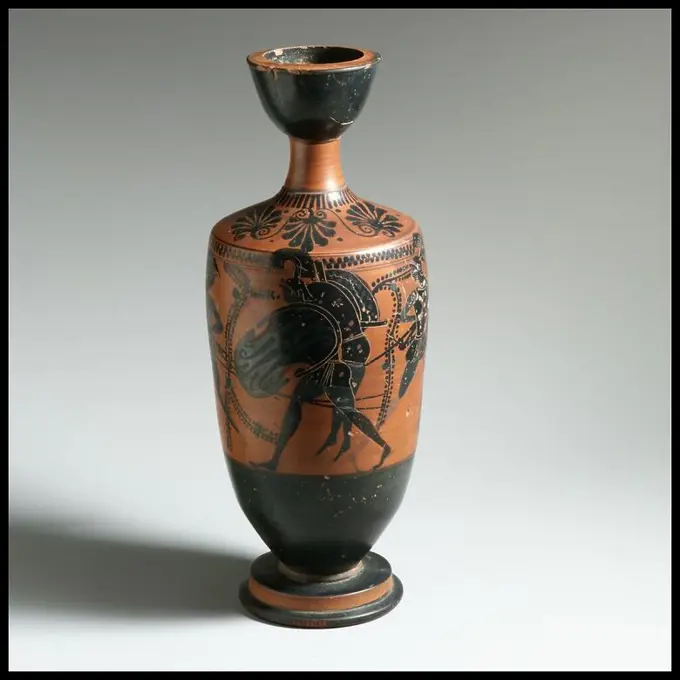
Ancient Decorative Vessels

Features historical glass and terracotta jars with intricate designs, showcasing craftsmanship from Greek and Roman cultures.

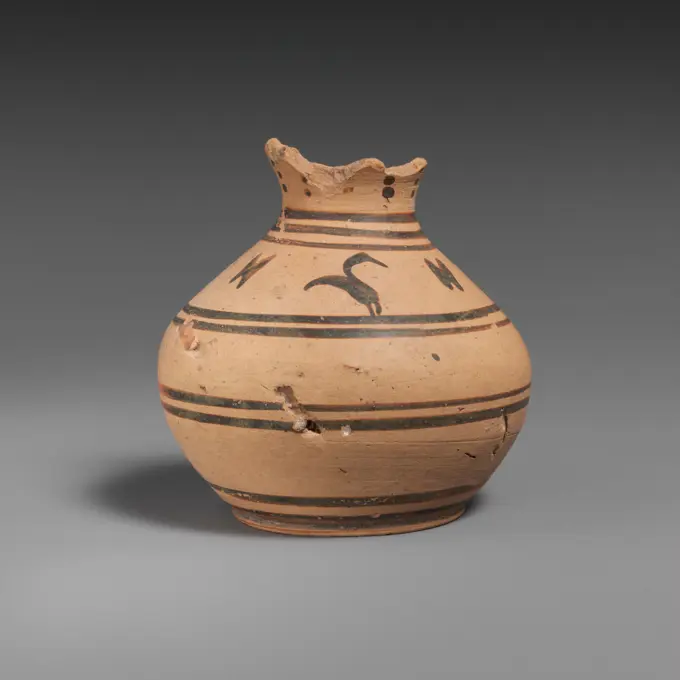
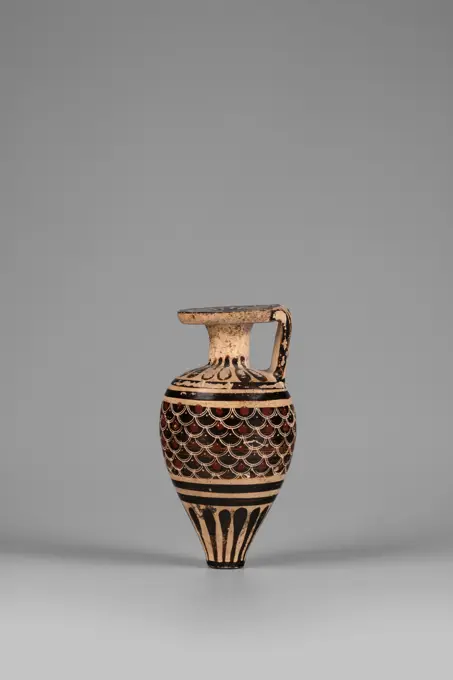
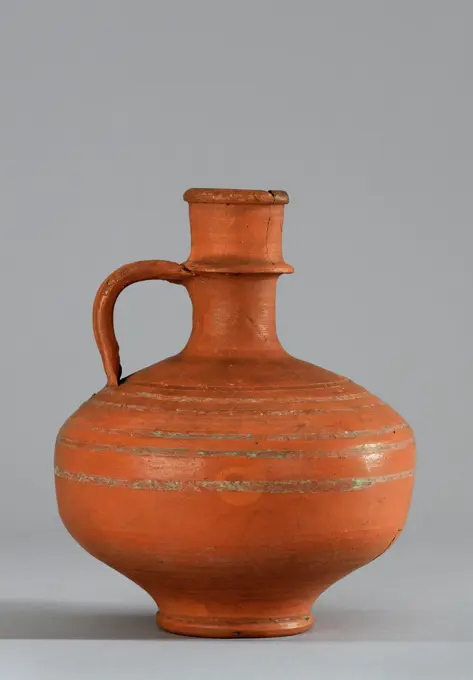
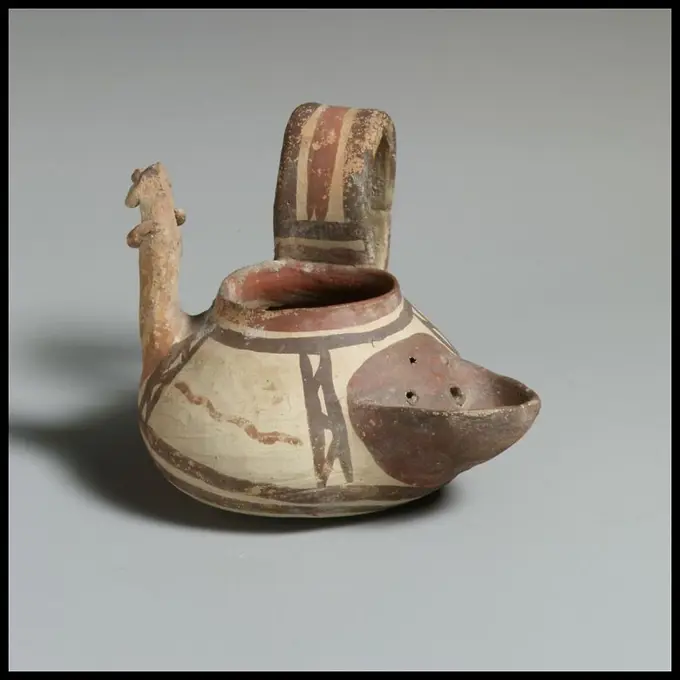
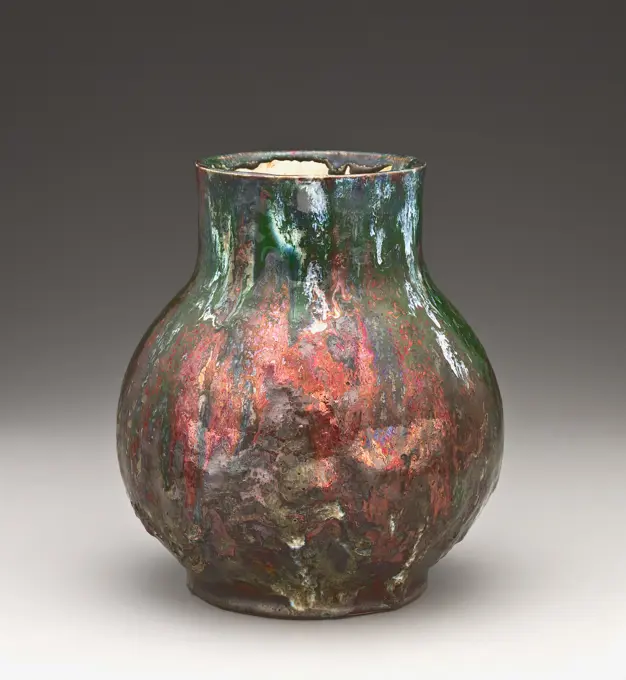
Pot with Figures and Horses, 19th century, 18 x 17 7/8 x 17 7/8 in. (45.72 x 45.4 x 45.4 cm), Ceramic, Burkina Faso, 19th century
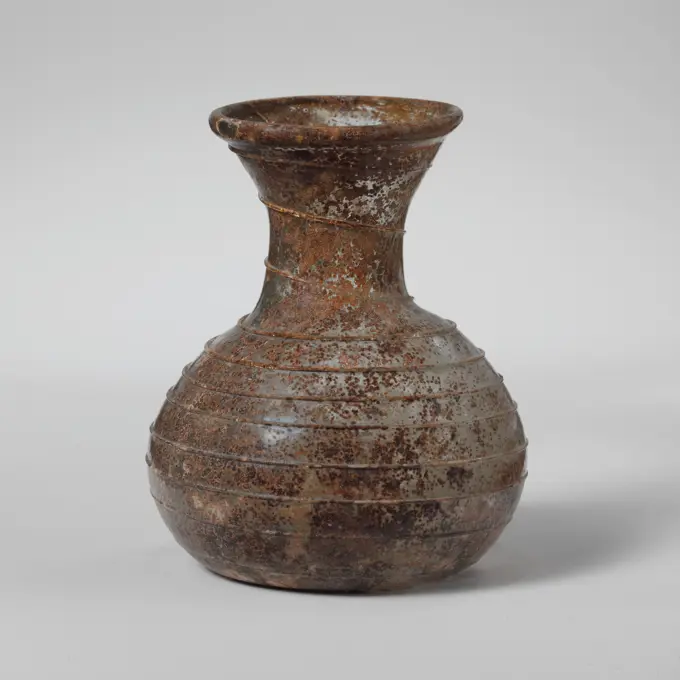
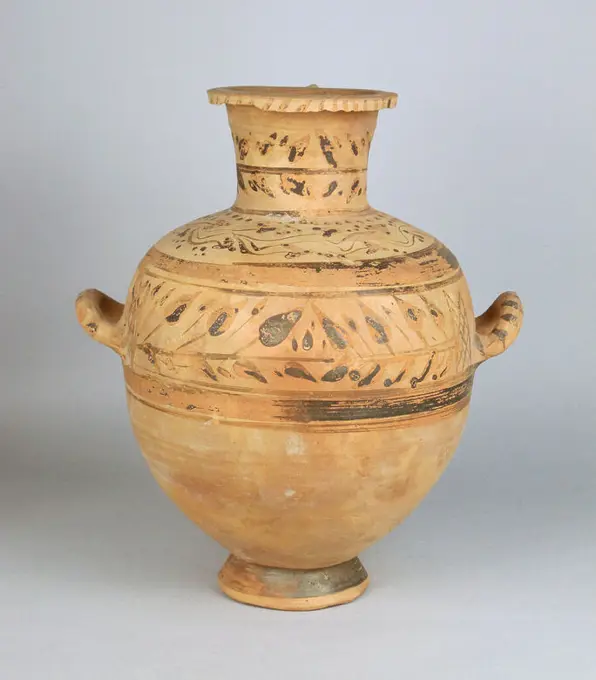
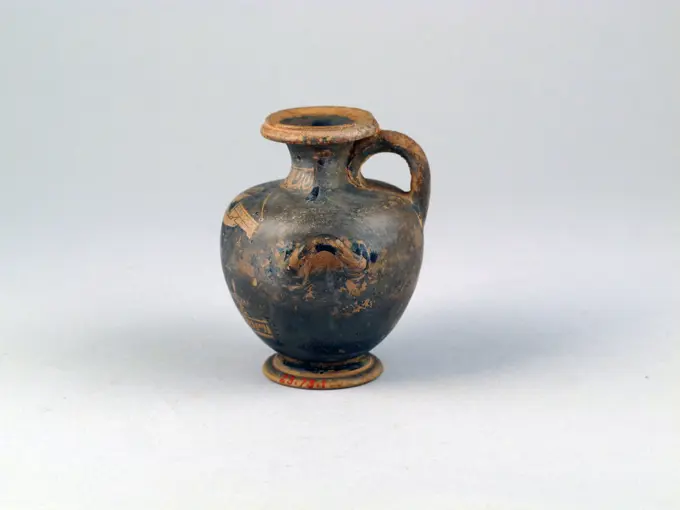
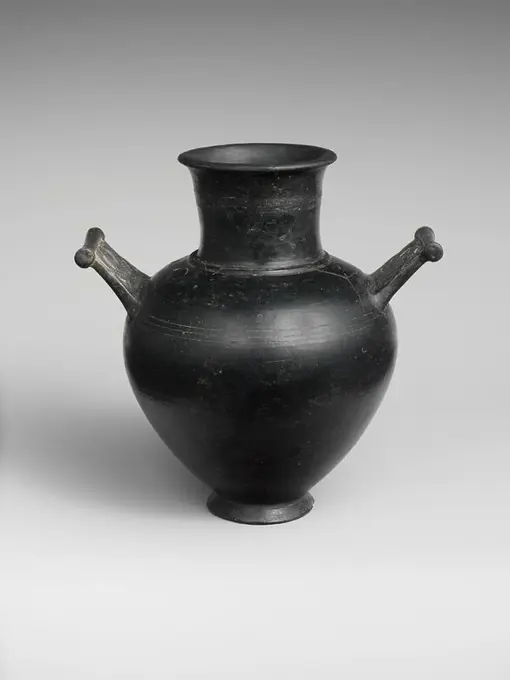
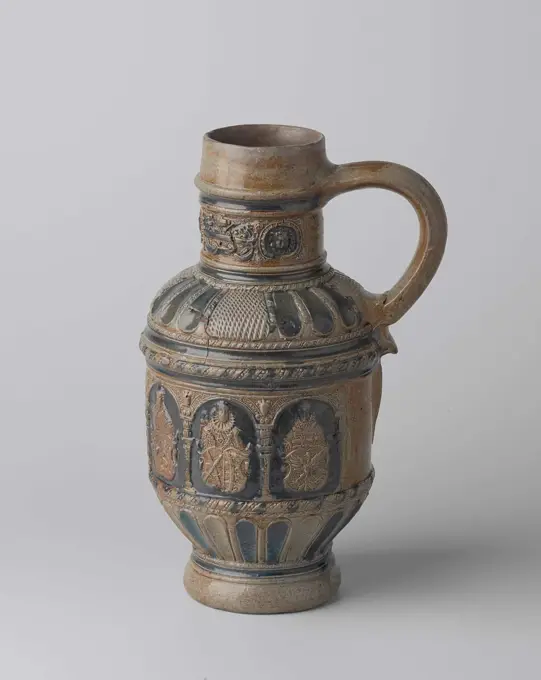
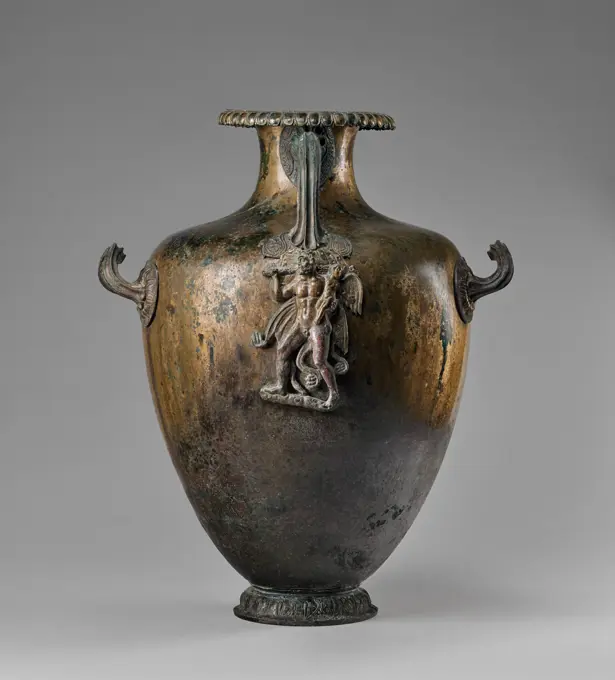
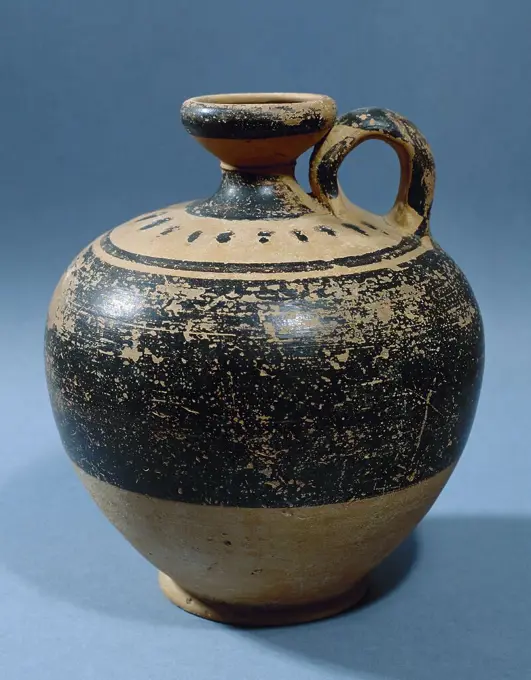
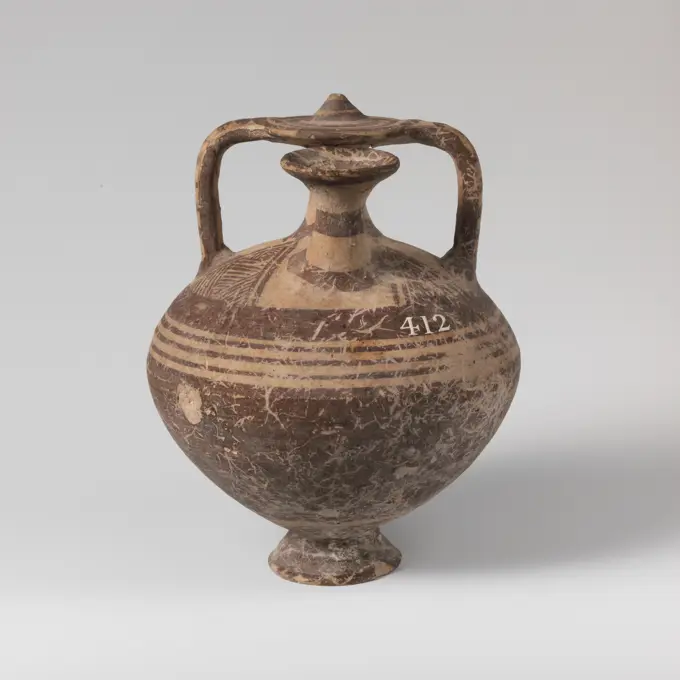
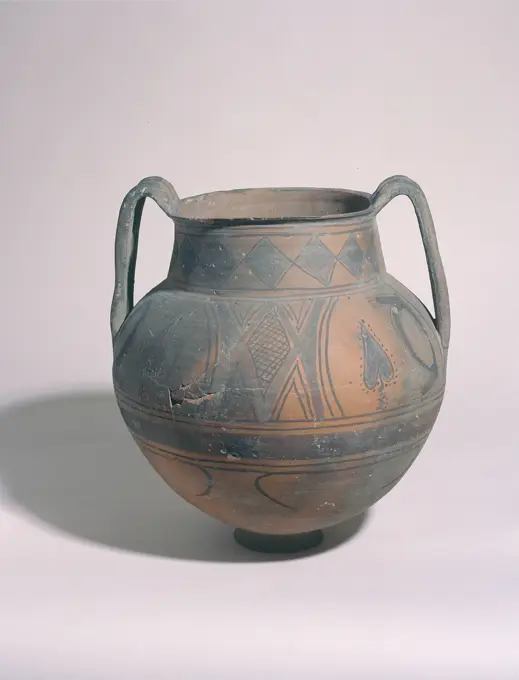
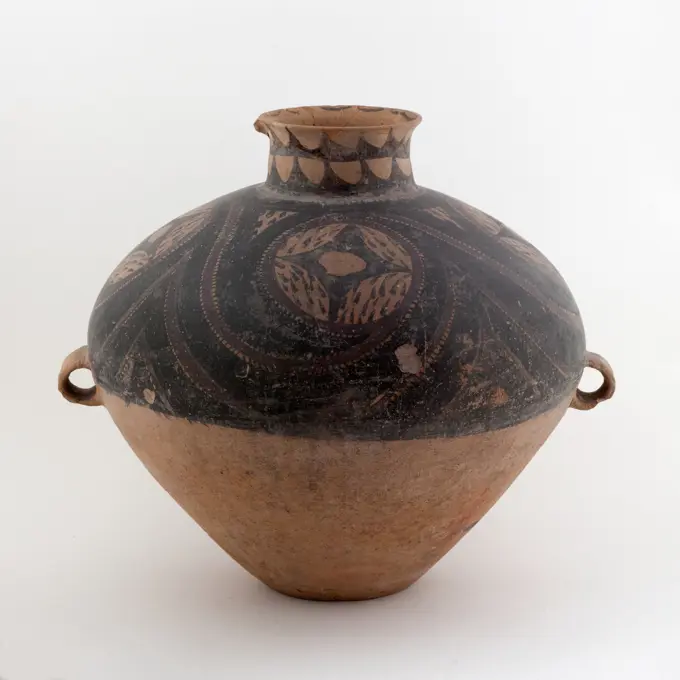
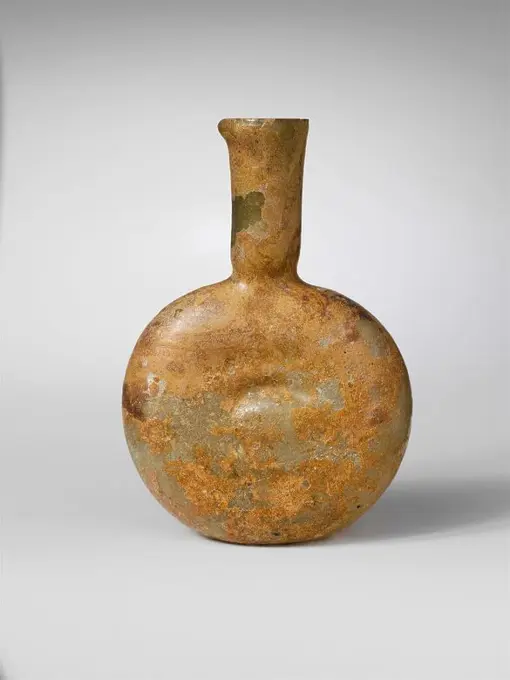
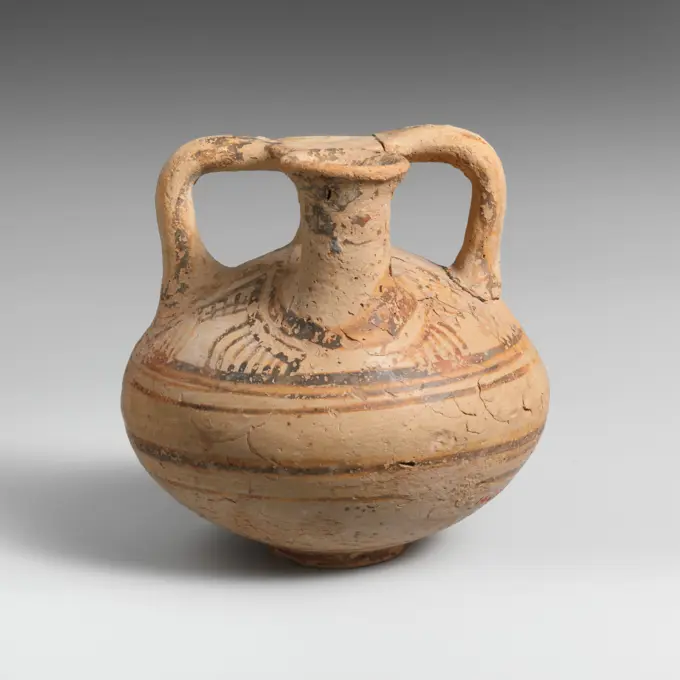
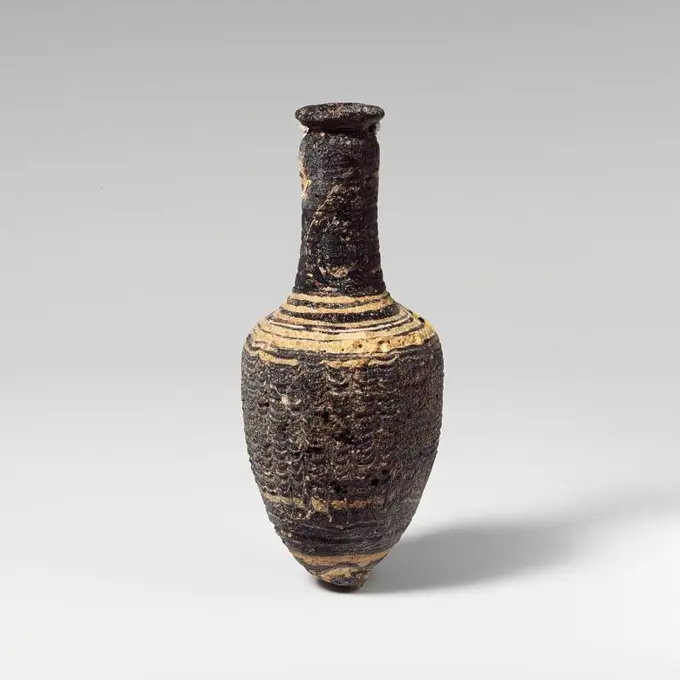
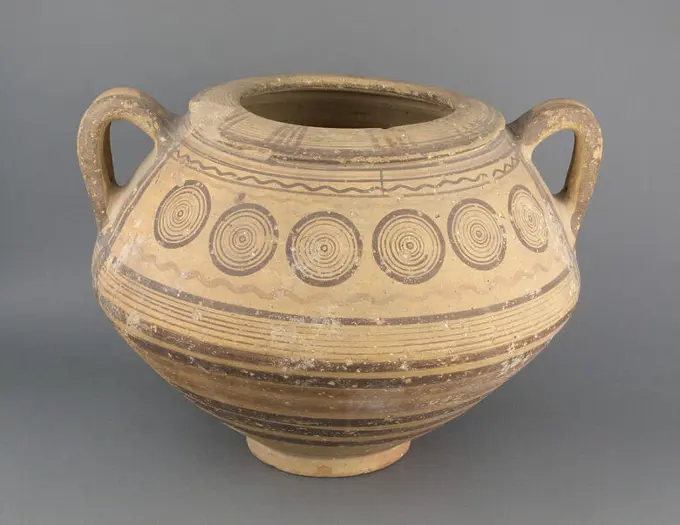
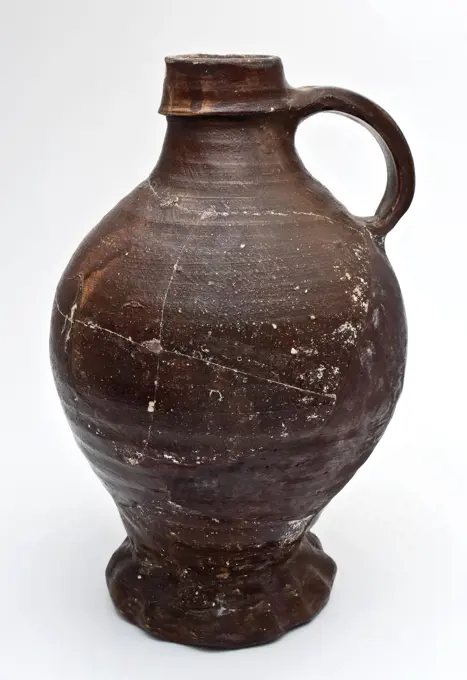
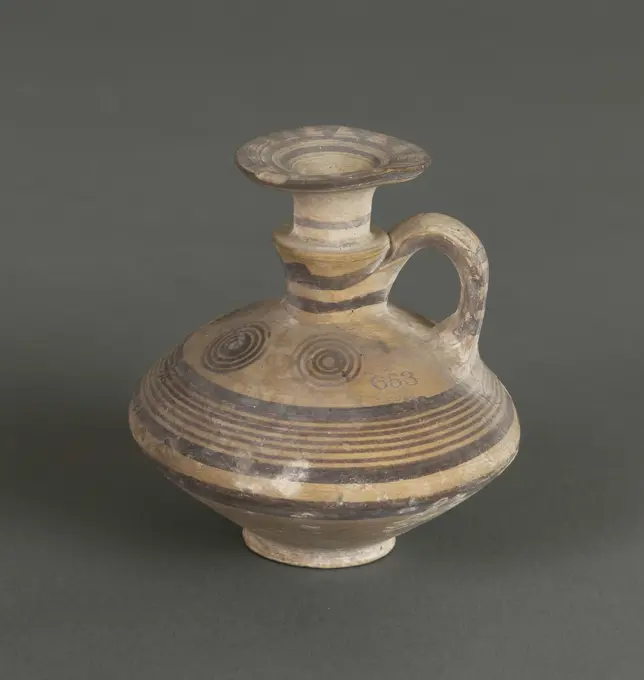
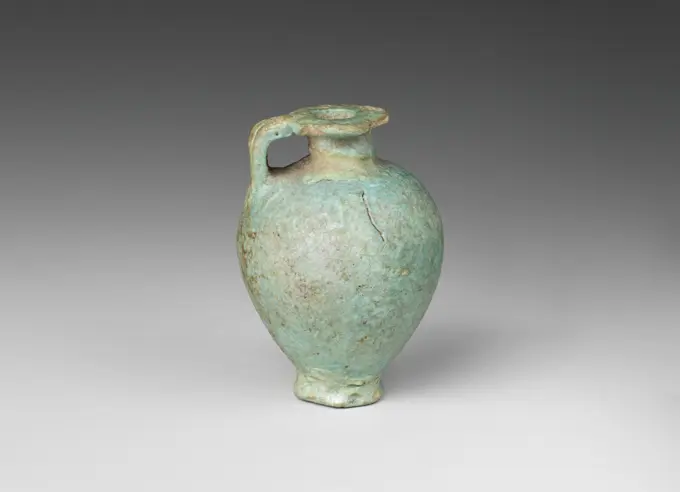
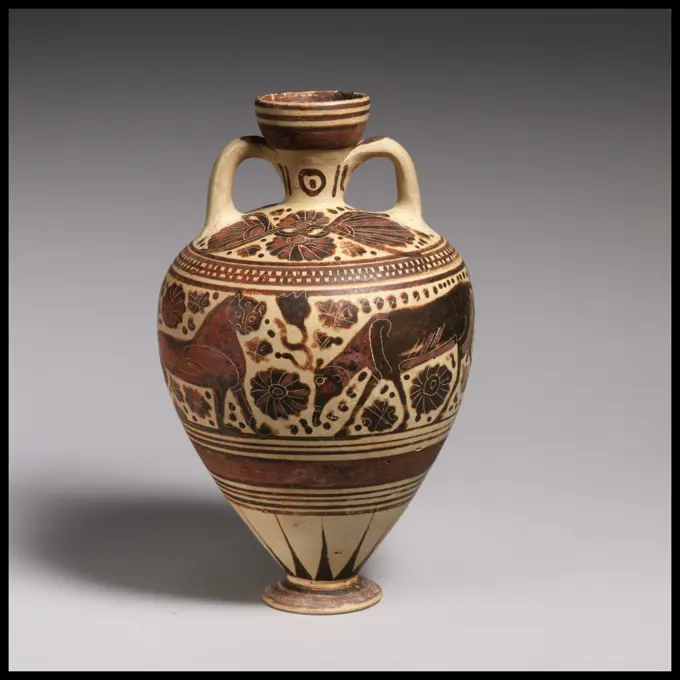
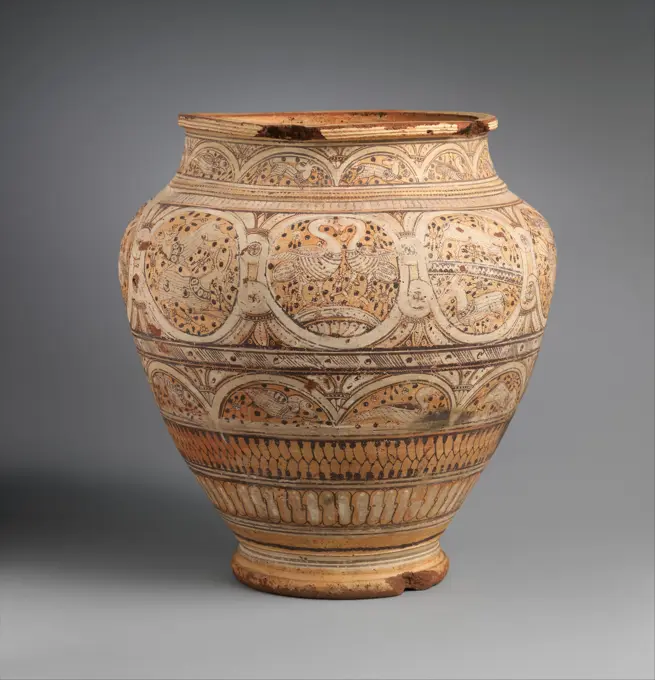
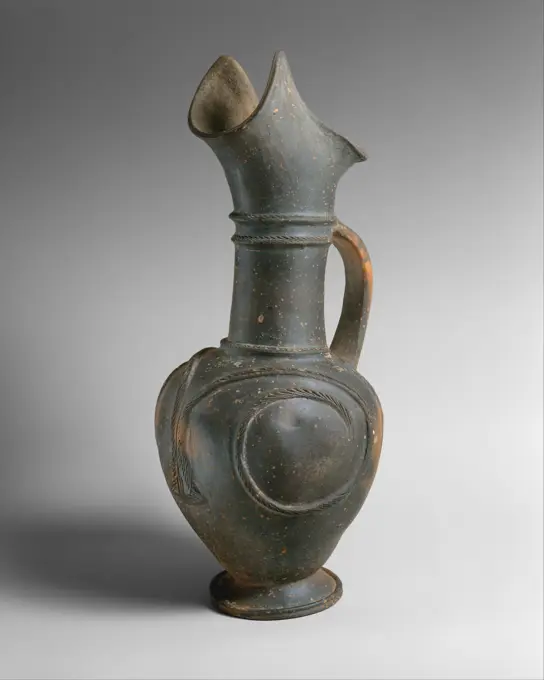
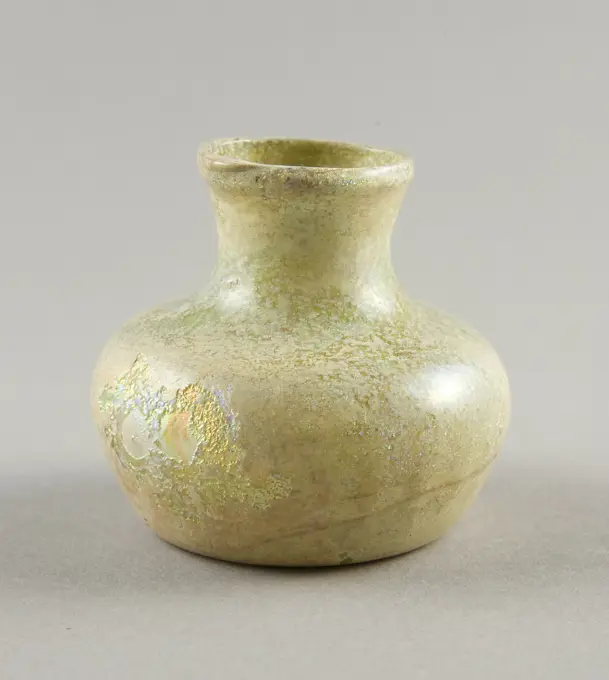
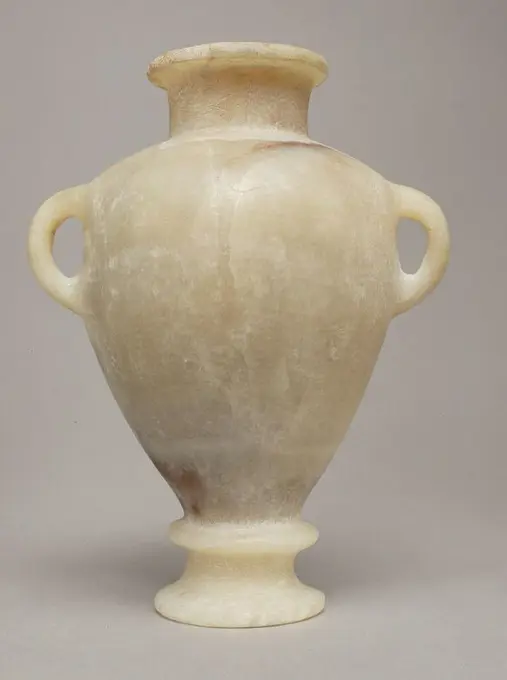
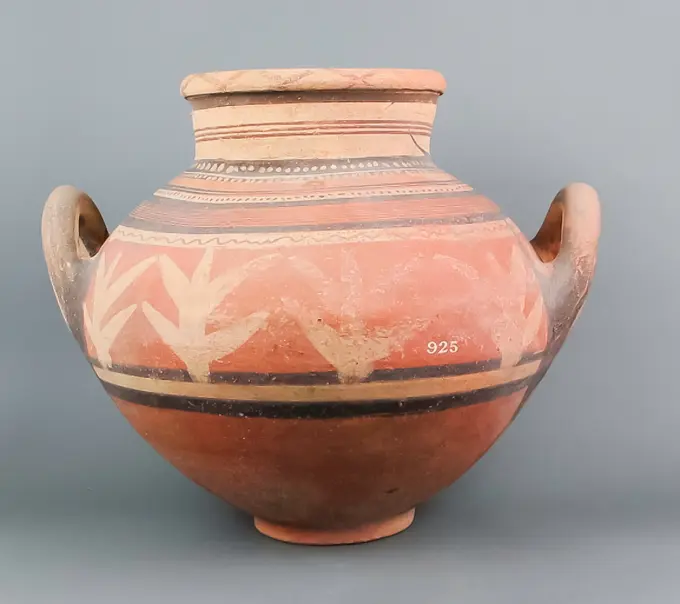
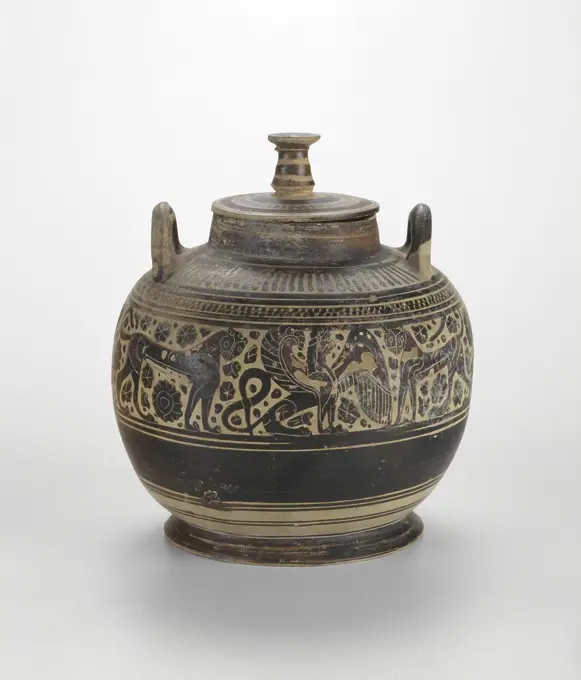
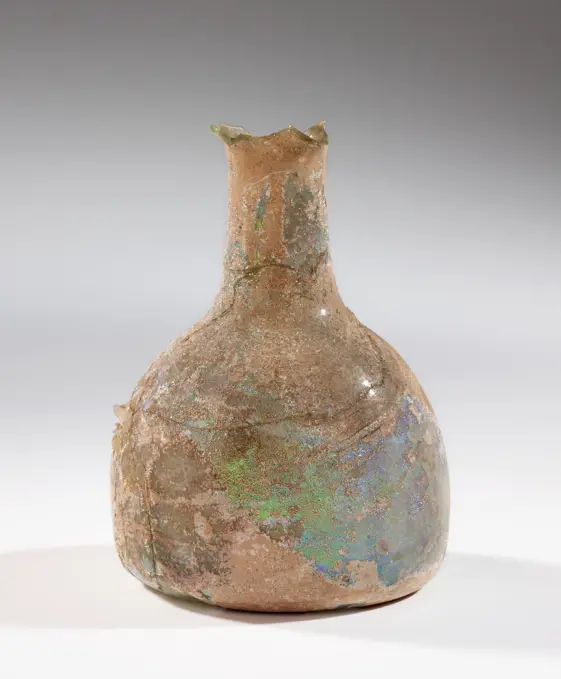
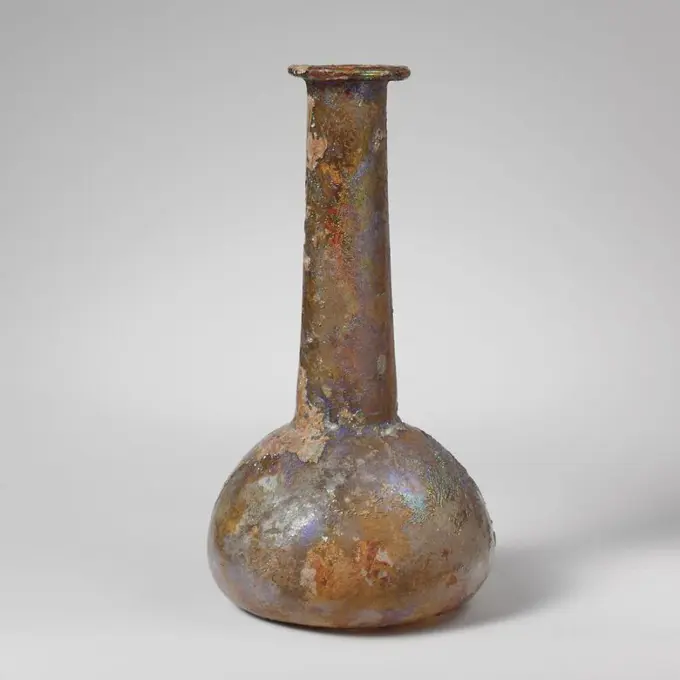
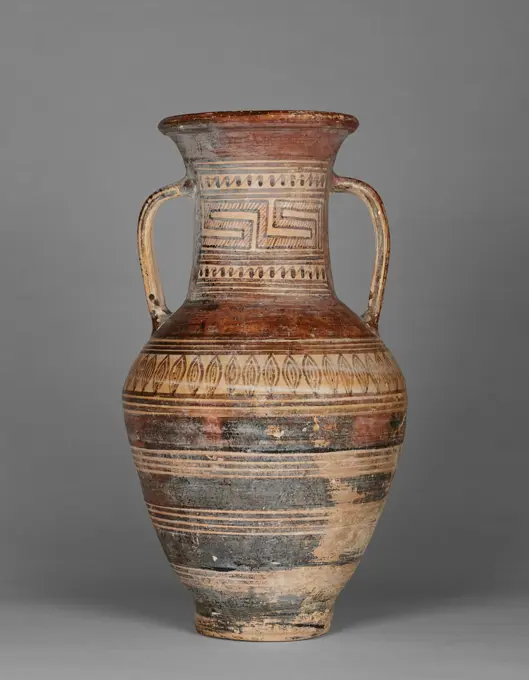
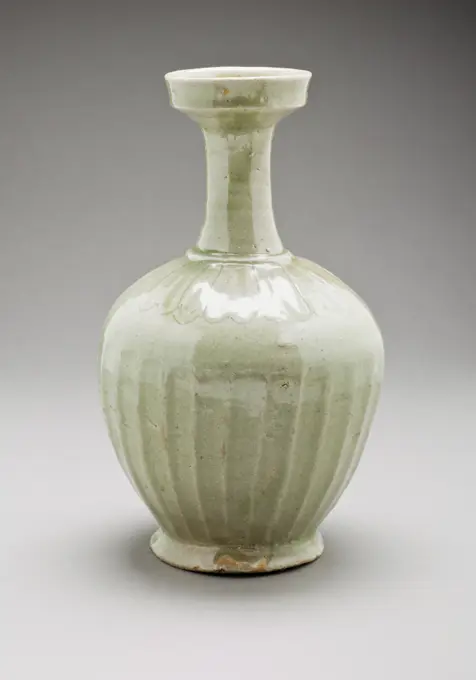
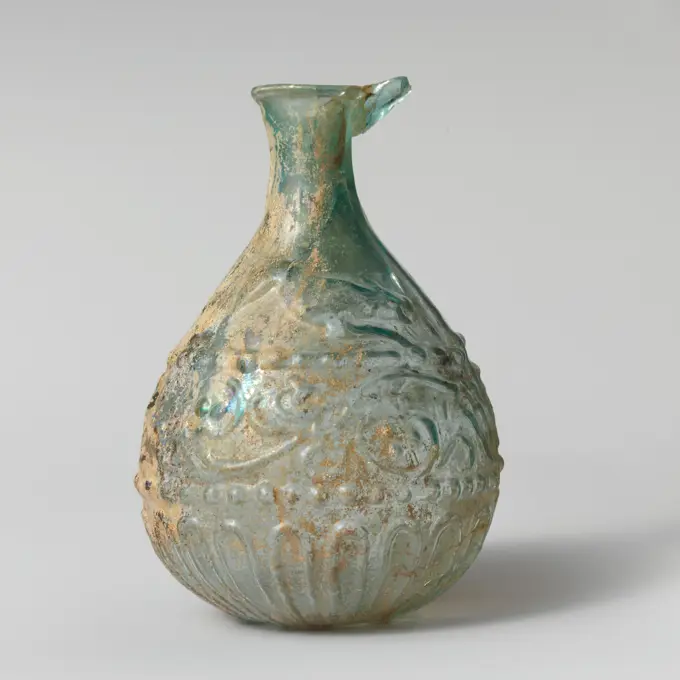
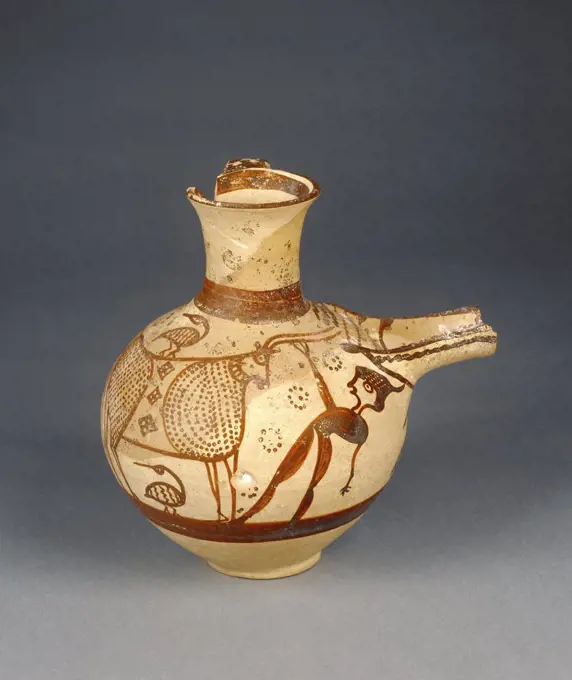
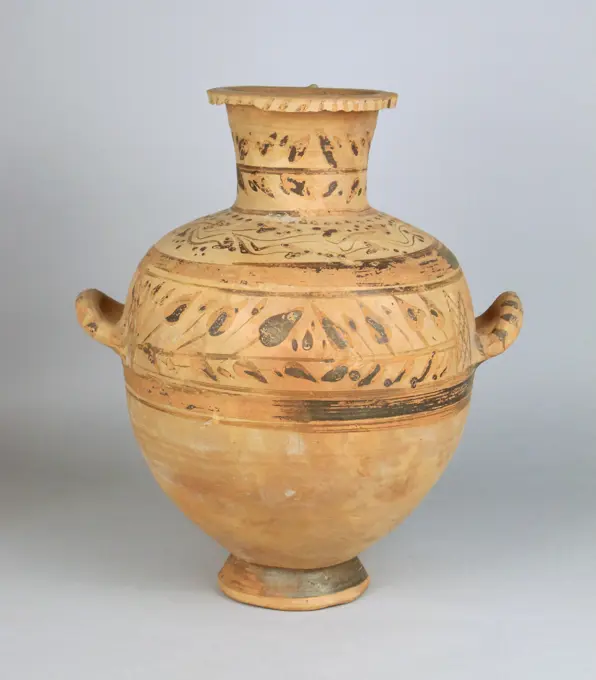
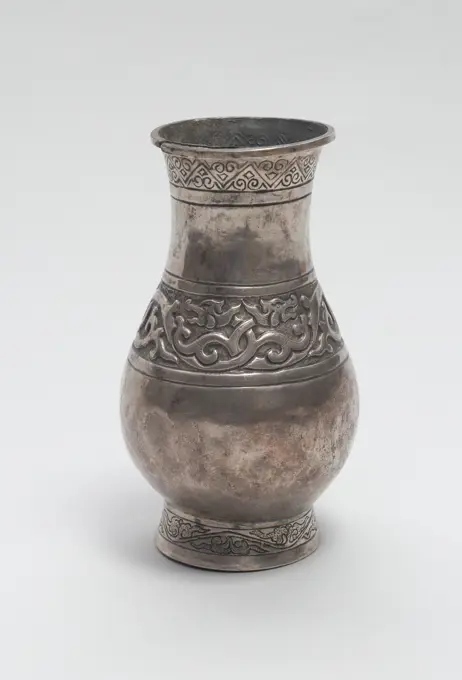
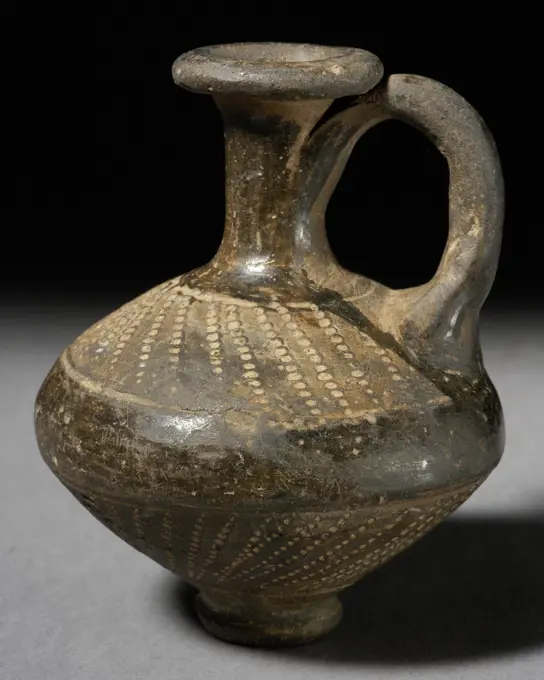
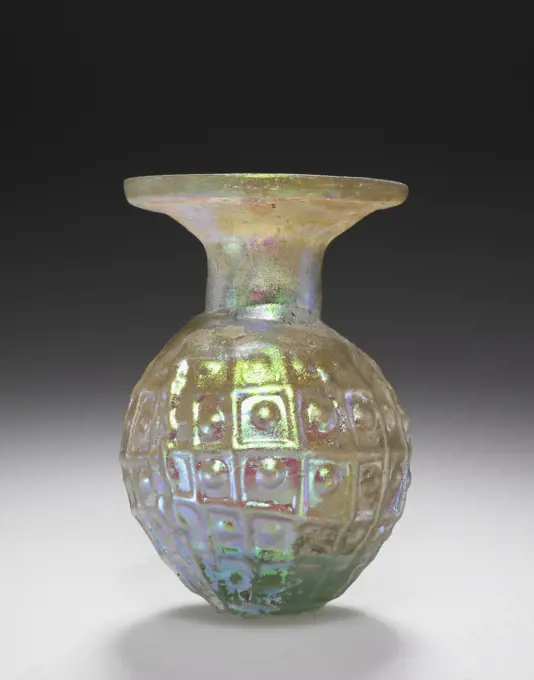
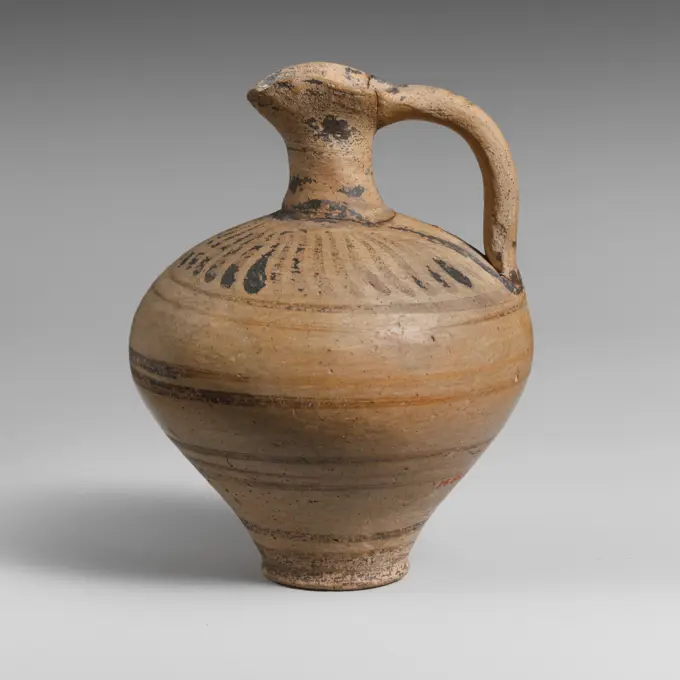
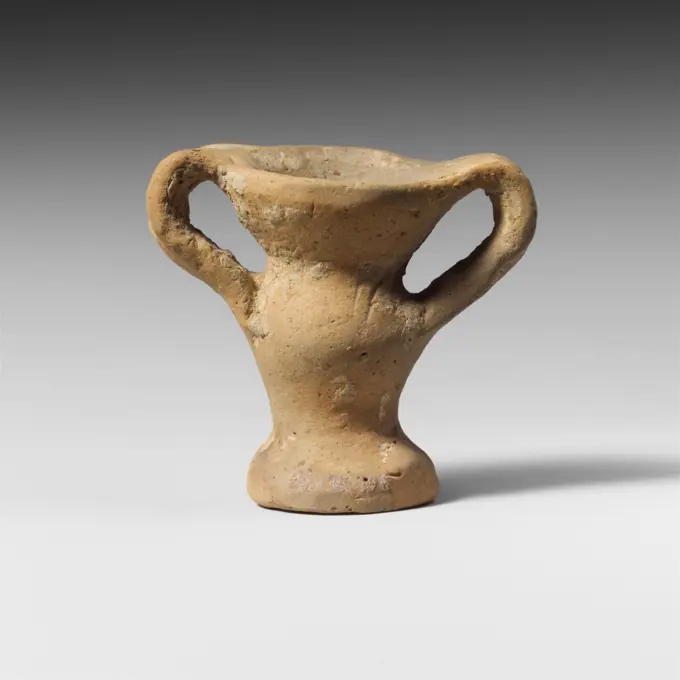
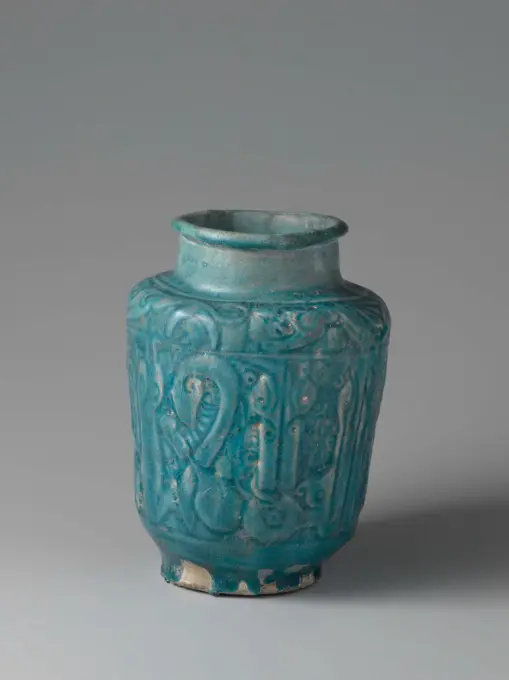
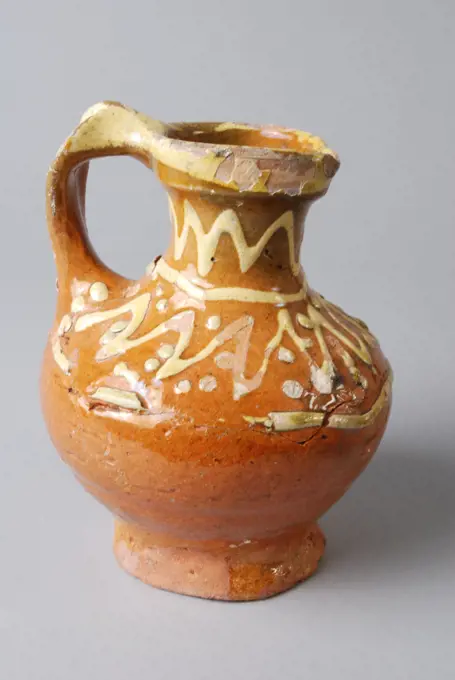
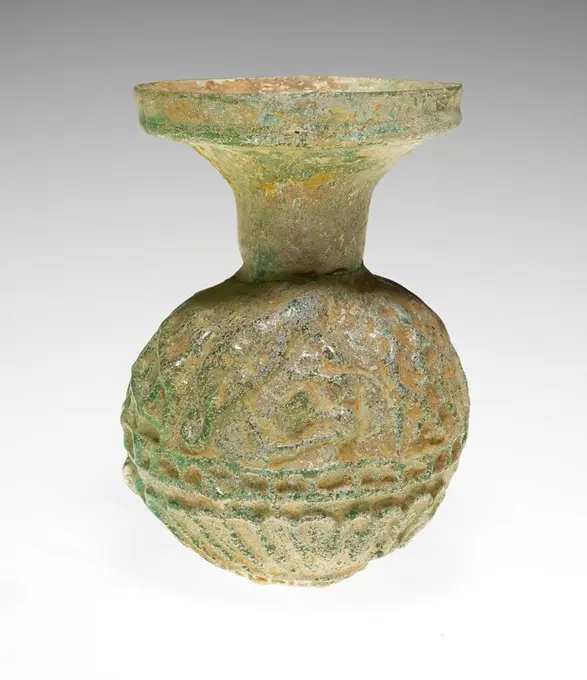
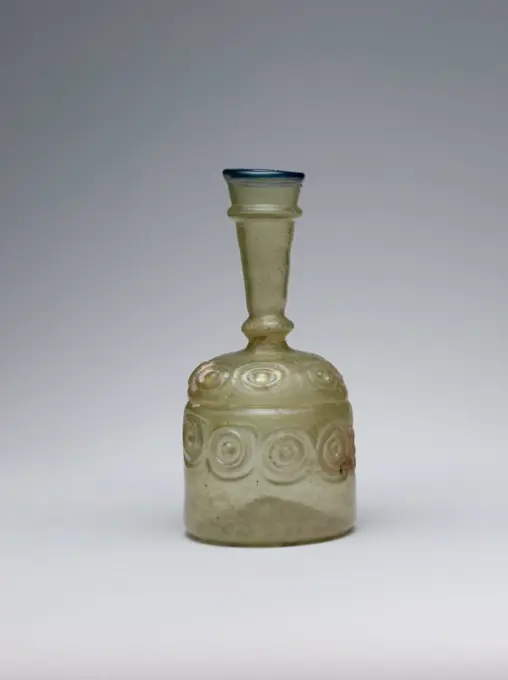
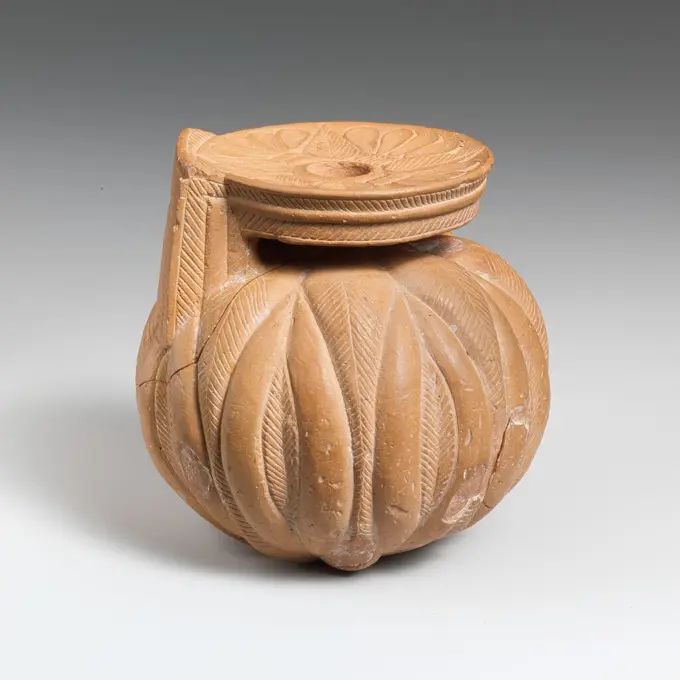
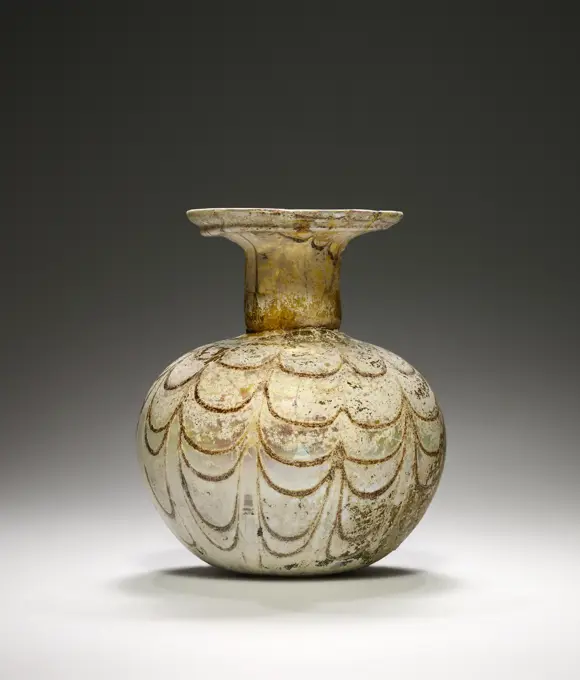
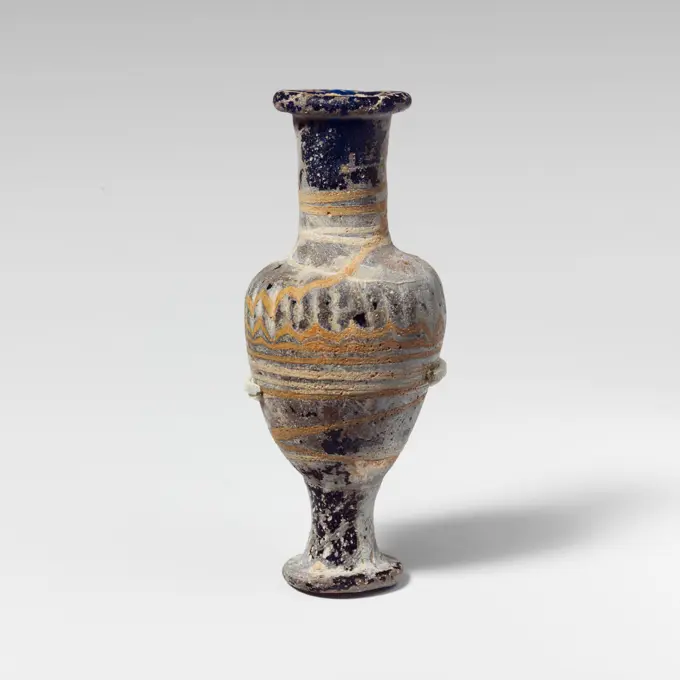
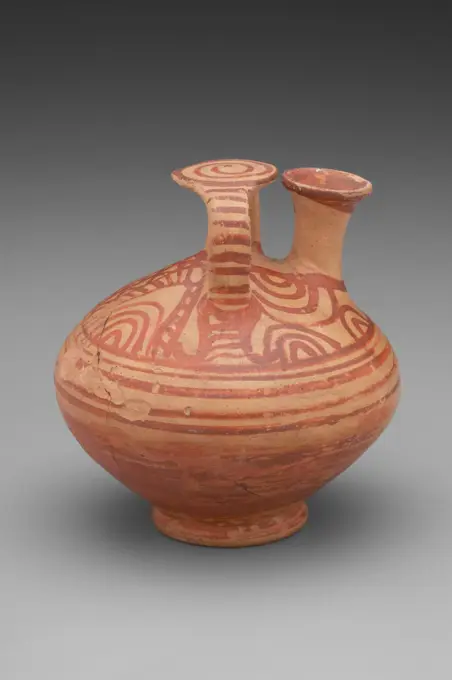
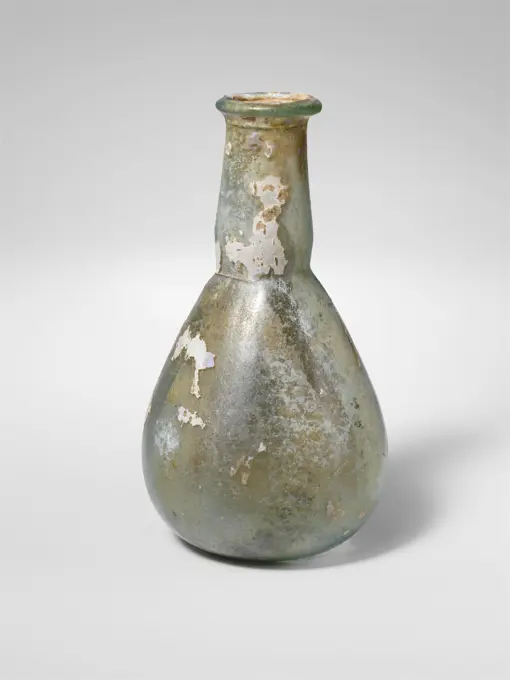
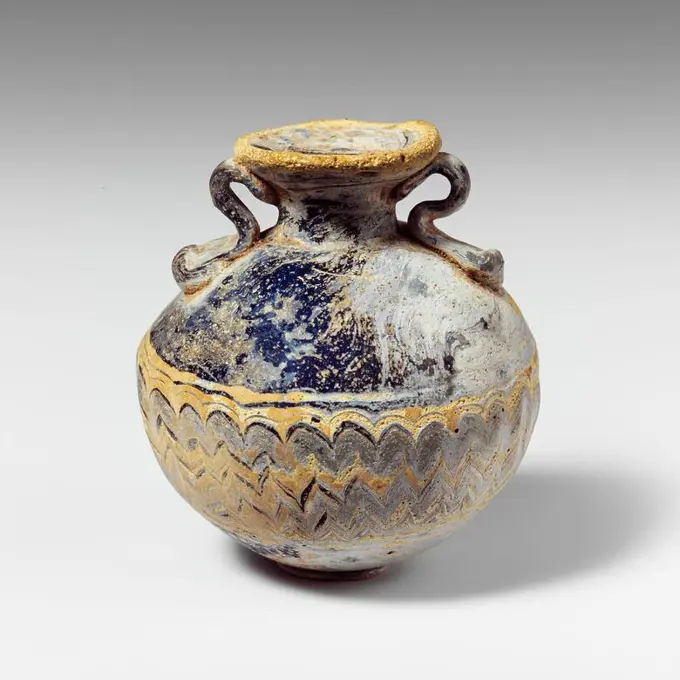
Glass aryballos (perfume bottle). Culture: Greek, Eastern Mediterranean. Dimensions: 2 3/8 × 2 1/16 in. (6 × 5.2 cm)Diam. of rim: 1 in. (2.6 cm). Date: late 6th-5th century B.C..Translucent blue, with same color handles; trails in opaque yellow, with another probably in opaque turquoise blue. Broad inward-sloping rim-disk with vertical projecting lip to mouth; short cylindrical neck; irregular, almost spherical body; convex, slightly projecting bottom; two strap handles applied in long, flattened pads to top of body, drawn up and outward, then curving in and trailed on to underside of rim-disk.Yellow trail applied to outer edge of rim-disk; another wide yellow trail applied on upper body and wound down in spiral, at first in horizontal lines, then tooled into a close-set zigzag pattern around central section of body, formed by uneven, shallow vertical tooling indents, and ending on underside in two more horizontal lines; a second trail in turquoise blue probably added to middle of Glass flask 2nd-3rd century A.D. Roman Colorless with greenish tinge, with same color trail.Rim folded round and in; funnel-shaped mouth; short, concave neck; squat, bulbous body; kick in bottom, with traces of encircling pontil.Trail evenly wound in a spiral from below rim around neck and body.Intact, except for crack in rim and mouth, and part of trail missing around neck; many bubbles; brown, enamel-like weathering and some iridescence.. Glass flask 239620Terracotta Hadra hydria (water jar). Culture: Greek, Egypt, Alexandria-Hadra. Dimensions: Overall: 13 1/4 x 11 13/16 in. (33.7 x 30 cm). Date: 3rd century B.C.. Museum: Metropolitan Museum of Art, New York, USA.Hydria, miniature 5th century B.C. Greek, Attic. Hydria, miniature. Greek, Attic. 5th century B.C.. Terracotta; red-figure. Classical. VasesPot with Figures and Horses, 19th century, 18 x 17 7/8 x 17 7/8 in. (45.72 x 45.4 x 45.4 cm), Ceramic, Burkina Faso, 19th centuryTerracotta amphora with lid. Culture: Etruscan. Dimensions: H.: 7 11/16 in. (19.5 cm). Date: ca. 650-600 B.C..On each handle is a human profile head between wings. Museum: Metropolitan Museum of Art, New York, USA.Brown can of stoneware. Brown can be made of stoneware with blackish or greenish cobalt color. The straight-walled center piece is decorated with the Keurvorstenfries. The neck is decorated with 3 medalloles.Kalpis. UnknownGreek art. Spain. Catalonia. Lekythos Found in Empuries. Used for storing, especially olive oil. Origen: Greece East. 6th century BC. Archaeological Museum of Catalonia. Girona.Jar. Terracotta. China, Neolithic. Paris, Cernuschi museum. 72782-5 Anse, Asian art, decorative, neolithic motif, Chinese pot, potteryTerracotta stirrup jar ca. 1075-1050 B.C. Cypriot Proto-white painted ware with bands and triangles.. Terracotta stirrup jar 240356Crater in clay (face A), ancient Greece VIth century BC ". Clay. Museum of Fine Arts of the city of Paris, Petit Palais. 26983-12 Ancient antiquity, clay, crater, archaic Greece, dishes, Greek vaseSatsuma (Ceramic Production Region) Vase in ANSES (Mimitsuki Hana-ike) (usual name), 1750. Inlays of white earth under the cover. Cernuschi Museum, Asia Museum of Asia in the city of Paris. The two handles take the form of an elephant elephant with elongated trompe.Vase. Terracotta. China, Neolithic, Banshan. Paris, Cernuschi museum. 72782-7 Anse, Asian art, banshan, decorative, neolithic motif, pottery, terracotta, Chinese vaseBottle, late 1200s-1300s. Siam, Sawankhalok ware, late 13th-14th Century. Stoneware; overall: 16.2 cm (6 3/8 in.).Glass lentoid bottle. Culture: Roman. Dimensions: 3 7/16 in. (8.8 cm)Diam. of rim: 11/16 in. (1.8 cm)Width: 2 3/8 in. (6.1 cm)Other: 1 in. (2.5 cm). Date: 2nd-3rd century A.D..Colorless.Knocked-off rim, slightly folded out, over, and in on one side; funnel-shaped neck, tooled in around base; globular, flattened body; small, flat bottom, with trace of pontil scar.On one side, indented, eliptical grooves.Intact; pinprick bubbles; dulling, slight iridescence, and brownish enamel-like weathering. Museum: Metropolitan Museum of Art, New York, USA.Terracotta stirrup jar ca. 1300-1200 B.C. Minoan Decorated with bands and cross-hatching.. Terracotta stirrup jar. Minoan. ca. 1300-1200 B.C.. Terracotta; Fine painted ware. Late Minoan IIIB. VasesVessel, 10 7/16 x 9 7/8 x 9 7/8 in. (26.51 x 25.08 x 25.08 cm), Terra cotta, Burkina FasoGlass amphoriskos (perfume bottle). Culture: Greek, Eastern Mediterranean. Dimensions: H.: 5 13/16 in. (14.8 cm). Date: 2nd to mid-1st century B.C..Uncertain color, appearing black, with base-knob in translucent greenish yellow; trails in opaque yellow and opaque white.Rim-disk, sloping deeply inward, with rounded edge and tooled indent around top of neck; tall cylindrical neck; broad angular shoulder; ovoid body, turning in to almost pointed bottom; vestiges of large knob-base; very slight vestiges of two vertical strap handles applied over trails on shoulder and pressed on to sides of neck.Yellow trail applied to top of neck and wound spirally down and across shoulder, a second thin white trail applied around neck, then both tooled into a close-set festoon pattern to lower body, with twenty-five uneven upward strokes, and continuing in thick spiral lines to pointed bottom.Body complete but most of handles and base-knob missing, with most of trails completely weathered, leaving onDinos. Culture: Cypriot. Dimensions: 10 1/4in. (26cm). Date: 600-480 B.C..Two-handled vase with angular form, bands, wavy lines, and concentric circles. Museum: Metropolitan Museum of Art, New York, USA.Stoneware jug on pinched foot, brown engobe, bulb model with narrow neck, jug crockery holder soil find ceramic stoneware clay engobe glaze salt glaze, belly 14.4 foot 9.5 hand turned glazed baked Stoneware jug dark brown rings on shoulder and belly pinched foot flat ear Narrow neck with profile ring at the height of the attachment of the ear. Ear crooked and sloppy fastened Egg-shaped jug with narrow neck archeology Capelle aan den IJssel House to Capelle castle indigenous pottery import serve serving crockery kitchenware tableware Soil discovery: moat castle house ± 1395-1500 Capelle aan den IJssel 1963.Jug ca. 1050-900 B.C. Cypriot. Jug. Cypriot. ca. 1050-900 B.C.. Terracotta. Iron Age. VasesJug Late Period 664-332 B.C. View more. Jug. 664-332 B.C.. Faience. Late Period. From Egypt. Dynasty 26-30Can with woman portrait. Spherical can of multicolor painted plusgraing pottery. The can stand on a foot and has a squeezed spout. The ear is flat and wide. Under the spout is a woman's portrait painted from a waded woman. Around the portrait are regularly painted leaves.Terracotta amphoriskos (perfume vase) ca. 575-550 B.C. Greek, Corinthian On the body, fallow deer and panthers.On the shoulder, goat and palmette-cross.. Terracotta amphoriskos (perfume vase) 255279Storage Jar 7th century The painted patterns on this large storage jar are arranged to emphasize the swelling shape of the vessel. The animal, bird, and plant motifs are closely related to those found on contemporary textiles.. Storage Jar 453623Terracotta jug ca. 1600-1450 B.C. Cypriot Base Ring Ware vessel walls are thin and hard, exhibiting a metallic quality. The term "Base-Ring" refers to the ring base characteristic of many of the jugs and bowls in this ware.. Terracotta jug 240671Jar 301 CE-600 CE Syria. Glass . IslamicAmphora of Canaanite shape. Dimensions: H. 24.5 cm (9 5/8 in.); diam. 14.2 cm (5 9/16 in.); width at handles: 19 cm (7 1/2 in.). Dynasty: Dynasty 18. Reign: reign of Thutmose III. Date: ca. 1479-1425 B.C.. Museum: Metropolitan Museum of Art, New York, USA.Lamp. UnknownAmphora 750-600 B.C. Cypriot Frieze of trees in white, bands, dots, and wavy line.. Amphora. Cypriot. 750-600 B.C.. Terracotta. Cypro-Archaic I. VasesPyxis (Container for Personal Objects). Greek; Corinth; Attributed to the Ampersand Painter. Date: 580 BC-570 BC. Dimensions: 14 × 15 × 15 cm (5 1/2 × 5 7/8 × 5 7/8 in.). Terra-cotta, decorated in the black-figure technique. Origin: Corinth. Museum: The Chicago Art Institute, USA.Bottle;  IX-X century (801-00-00-1000-00-00);bottles, Islam (culture), Islamic artGlass perfume bottle. Culture: Roman. Dimensions: 6 1/8in. (15.5cm)Other: 3 1/4in. (8.3cm)Diam. of rim: 1 3/8 in. (3.5 cm). Date: 2nd-3rd century A.D..Colorless.Rim folded out, over, and in; cylindrical neck, expanding downwards; squat, bulbous body; flat bottom.Intact, except for small hole in side of body; many bubbles; heavy iridescent weathering and pitting; some brown, gritty accretions on rim and inside neck. Museum: Metropolitan Museum of Art, New York, USA.Geometric amphora. UnknownAmphora carved with geometric patterns, red potteryOlpe. Attributed to Painter of Malibu 85.AE.89 (namepiece)Wide-mouthed Bottle with Incised and Carved Lotus Petal Design. Korea, Goryeo dynasty (918-1392), 10th-12th century. Furnishings; Accessories. Wheel-thrown stoneware with carved and incised decoration and green glazeTerracotta oinochoe (jug) late 8th century B.C.-early 7th century B.C. Greek, Attic On the shoulder, four birds.. Terracotta oinochoe (jug). Greek, Attic. late 8th century B.C.-early 7th century B.C.. Terracotta. Geometric. VasesVase (usual name). Sandstone, celadon, openwork decor. Cernuschi Museum, Asia Museum of Asia in the city of Paris.. Quartz frying goods can be decorated with a bond with black spirals and circles under a transparent turquoise glaze.Aryballos wąskodenny. unknown, authorSigillée jug. Low-Empire. Ceramic. Paris, Carnavalet museum. Decor of white painted lines Antiquity, low-Empire, Ceramic, Sigillee jug, Roman, ancient timeTerracotta one-handled vase with strainer. Culture: Native Italic, Daunian. Dimensions: H. 3 3/4 in. (9.5 cm)length 4 3/4 in. (12.1 cm). Date: mid-5th century B.C..A ritual function has been identified for this distinctive shape with one handle at the side, an everted lip containing a strainer, and a standing human figure. Museum: Metropolitan Museum of Art, New York, USA.Glass hunt-and-scroll bottle 1st century A.D. Roman Translucent blue green; handle in same color.Everted fine rim, folded over and in; flaring mouth; short concave neck, splayed at base and merging with piriform body; flat bottom; handle trailed over rim and top of neck and drawn upwards; continuous mold seam runs from neck, down side, and across bottom, with two distinct vertical creases in relief on neck, and bottom divided into two levels by misaligned mold.On body, decoration in relief in three registers, separated by two horizontal rows of knobs: at top, large dog (or lion) with long tail, facing right, crouching on forepaws on one side of mold and a deer standing facing right with head erect on the other side, flanked by a slender tree to left and a curving tendril to right; center, two wavy tendril scrolls with berries divided by a broad palmette on one side and a slender lotus bud on the other across the mold seams; bottom, twenty-one upturned flutes, two of which overlap at juMycenaean Sieve Jug; Attributed to Painter 20, Mycenaean, active 1250 B.C. - 1225 B.C.; Cyprus (); 1250 - 1225 B.C.; Terracotta; Object: H: 16.6 x Diam. (body): 13 cm (6 9/16 x 5 1/8 in.)Can go to three claw legs and spout ending in Dierenkop, Anonymous, 1375 - 1425 The jug, which is cast like a whole, is on three legs that are provided with claw feet. The legs are six -square. The rear area is somewhat eroded. The object has a convex, slightly flat stomach and a high neck. The transition from the abdomen to the onset of the neck is marked by a rib, the center of the neck by a rib, the termination of the neck through a collar. This has a round but outward slightly sharp edge. The spout, which has been applied to the abdomen with a rib -profiled attachment, is vertically directed up. He bends out with the end of the animal head. The cross -section of the spout is more or less five -fold. Of this, the surface on the outside is a bit around. The rod, which connects the neck with the spout, has the shape of an arm with one hand. The handle is attached to the abdomen with a lip profiled by ribs and against the collar of the neck. It is straight and inwards around the surfacTerracotta Hadra hydria (water jar) 3rd century B.C. Greek, Egypt, Alexandria-Hadra. Terracotta Hadra hydria (water jar). Greek, Egypt, Alexandria-Hadra. 3rd century B.C.. Terracotta. Hellenistic. VasesMug. Culture: Hungarian, Transylvania. Dimensions: Overall: 3 7/8 x 2 15/16 in. (9.8 x 7.4 cm). Date: 1704.This mug is engraved with the coat of arms of the Serdi family and an inscription that states Sofia Serdi commissioned the piece in 1704. She was married to Istvn Andrssy (1650-1725), a general under Francis II Rkczi (1676-1735), who fought in an uprising against the Habsburg emperor from 1703 to 1711. Several pieces from the Salgo Collection were once part of the Andrssy treasury.LiteratureEuropean Silver. Sale cat., Sotheby's, Geneva, May 8, 1989, p. 71, no. 205.Judit H. Kolba. Hungarian Silver: The Nicolas M. Salgo Collection. London, 1996, p. 97, no. 75.ExhibitedA Magyar trtneti tvsmu-killts lajstroma. Exh. cat. Orszgos Magyar Iparmuvszeti Mzeum. Budapest, 1884, room 5, case 3, p. 27.Rgi ezstkilltsnak ler lajstroma. Exh. cat. edited by Kroly Csnyi. Orszgos Magyar Iparmuvszeti Mzeum. Museum of Applied Arts. BudapeJar (Hu) ca. 2650-2350 B.C. China Listen to experts illuminate this artwork's story Listen Play or pause #7395. Jar (Hu), Part 1 Play or pause #8978. Jar (Hu), Part 2 Supported by Bloomberg Philanthropies We're sorry, the transcript for this audio track is not available at this time. We are working to make it available as soon as possible.. Jar (Hu) 44723Tell el-Yahudiya type juglet ca. 1802-1640 B.C. Middle Kingdom. Tell el-Yahudiya type juglet. ca. 1802-1640 B.C.. Pottery. Middle Kingdom. From Egypt, Memphite Region, Lisht North, cemetery south of pyramid below House A1:1, Pit 907, MMA excavations, 1920-21. Dynasty 13Vessel with dragon frieze 13th century China. Vessel with dragon frieze. China. 13th century. Silver. Southern Song dynasty (1127-1279). MetalworkJar: Northern Brown Ware, Yuan dynasty (1271-1368). China, Yuan dynasty (1271-1368). Glazed buff stoneware with underglaze slip application; overall: 35.9 cm (14 1/8 in.).Vase with animals and an inscription in relief, anonymous, c. 1100 - c. 1299 Vase of quartz fritry, decorated with a scripture band and a frieze of animals in relief on which a monochrome turquoise glaze has been applied. Iran earthenware. glaze vitrification Vase of quartz fritry, decorated with a scripture band and a frieze of animals in relief on which a monochrome turquoise glaze has been applied. Iran earthenware. glaze vitrificationJar, AD 222-650. Iran, Sasanian period, 3rd-7th Century. Earthenware; overall: 50.8 cm (20 in.).Juglet. Egypt, Second Intermediate Period (1640 - 1532 BCE). Furnishings; Serviceware. CeramicVesselSprinkler Flask; Eastern Mediterranean, Roman Empire; 3rd-4th century A.D; Glass; 8.3 × 6.3 cm (3 1,4 × 2 1,2 in.)Vase ca. 1520 Italian, Deruta. Vase. Italian, Deruta. ca. 1520. Maiolica (tin-glazed earthenware), lustered. Ceramics-PotteryJar 18th century. Jar 446936Terracotta stirrup jar ca. 1300-1200 B.C. Mycenaean With spout and two handles; decorated with bands, wavy line, and cross-hatched squares.. Terracotta stirrup jar 247876JugVase ". Terracotta. Vietnam-Xe-Xive s. Paris, Cernuschi museum. 72185-3 Vietnamese object, terracotta, vasePelike. Culture: Greek, South Italian, Apulian. Dimensions: Height: 8 1/4 in. (21 cm)Diameter: 5 1/8 × 4 5/8 × 3 7/16 in. (13 × 11.8 × 8.7 cm). Date: ca. 350-325 B.C.. Museum: Metropolitan Museum of Art, New York, USA.Lekythos 1st quarter of 5th century B.C. Attributed to the Haimon Painter Procession of lyrists and castanet players.. Lekythos 254180 : Attributed to the Haimon Painter, Lekythos, 1st quarter of 5th century B.C., Terracotta, H. 13 5/8 in. (34.6 cm) diameter 4 9/16 in. (11.5 cm). The Metropolitan Museum of Art, New York. Rogers Fund, 1941 (41.162.13)Glass jug 2nd-3rd century A.D. Roman Translucent blue green; handle in same color but with some green streaks.Tubular rim folded out, down, round, and in, and then pressed on to inside of flaring mouth; short, slightly funnel-shaped cylindrical neck, with tooling marks at base; narrow, sloping shoulder; conical body, with convex sides; broad, concave bottom; strap handle applied to shoulder with two rounded claw pads at sides and central rib, drawn up and out, turned in horizontally, drawn up in S shape to form a vertical fold as thumb rest above rim, and then trailed on to outer edge of rim and top of neck.Intact; few bubbles in body but some black and streaks in handle; dulling, weathering, and iridescence, with most of surfaces covered with a limy encrustation.. Glass jug 239714Jar. Dark brown cover sandstone. Paris, Cernuschi museum. 78845-17 Asian art, ancient ceramic, containerTerracotta juglet ca. 1375-1300 B.C. Minoan The body is decorated with horizontal bands, and the shoulder is decorated with rays.. Terracotta juglet. Minoan. ca. 1375-1300 B.C.. Terracotta; Fine painted ware. Late Minoan IIIA2. VasesBottle with Cupped Mouth and Mock Ring Handles. China. Date: 25 AD-220 AD. Dimensions: H. 44.0 cm (17 5/16 in.); diam. 24.0 cm (9 7/16 in.). Earthenware with lead green glaze. Origin: China. Museum: The Chicago Art Institute, Chicago, USA.Terracotta miniature jar with two handles 7th-6th century B.C. Greek, Laconian Two handles, traces of white paint.. Terracotta miniature jar with two handles 251762 Greek, Laconian, Terracotta miniature jar with two handles, 7th6th century B.C., Terracotta, H. 2 1/16 in. (5.2 cm). The Metropolitan Museum of Art, New York. Gift of A. J. B. Wace, 1924 (24.195.196). Vase of quartz frying goods, decorated with a scripture and a frieze of animals in relief that a monochrome turquoise glaze has been applied.Earthenware oil jug on stand with standing ear and clip, sludge on the neck and shoulder, oil jug holder kitchen utensils earthenware ceramics earthenware glaze lead glaze clay, hand-turned decorated glazed fried lemonade Pottery jug. Ball-shaped model with slender neck and stand ring Neck with cuff collar. Standing ear at the top of the pinched red shard Fully glazed Decorated in sludge technology Decoration consists of sloppily applied yellow wave line and randomly placed dots. Yellow top and zigzag line around the neck. Stripes on the ear archeology indigenous pottery oil tear lamp illuminate serve pourTerracotta amphora (jar) 4th century B.C. Greek, South Italian, Apulian In the general shape of the body, lip, handles, and foot, the vase is a descendant of the Panathenaic prize amphora. The ribbing on the body, by contrast, reflects a predilection of contemporary Apulian workshops. The fine foliate ornament on the neck, which originally would have been gilded, is both decorative and an evocation of the original function of the shape as a prize vase.. Terracotta amphora (jar) 247957Jar (Amphora) with Dragon Handles, 600s. China, Sui dynasty (581-618) to early Tang dynasty (618-907). Glazed stoneware with modeled and applied decoration; diameter: 20.3 cm (8 in.); overall: 41.6 cm (16 3/8 in.).Two-Spouted Strainer Askos (Flask) with Lid, 300-200 BC. South Italian, Daunian or Canosan. Ceramic; diameter of mouth: 14.5 cm (5 11/16 in.); overall: 37 x 31 cm (14 9/16 x 12 3/16 in.).Bowl. Culture: Japan. Dimensions: H. 4 in. (10.2 cm); Diam. 4 1/4 in. (10.8 cm). Date: ca. 1500. Museum: Metropolitan Museum of Art, New York, USA.Panathenaic Amphora with Lid; Attributed to the Nichomachos Group; Athens, Greece; about 320 B.C; Terracotta; 112 × 42 cm (44 1,8 × 16 9,16 in.)Ovoid sake bottle with a yellow glaze and brown marks, anonymous Egg -shaped sake blade of stoneware with dented walls and a wooden stop, covered with a yellow glaze and painted in brown. Four brown spots on the belly. Old label on the bottom with 'W504'.  stoneware. glaze. stop: wood (plant material) vitrification Egg -shaped sake blade of stoneware with dented walls and a wooden stop, covered with a yellow glaze and painted in brown. Four brown spots on the belly. Old label on the bottom with 'W504'.  stoneware. glaze. stop: wood (plant material) vitrificationCandlestick 12th century. Candlestick 447963Sprinkler or Dropper Bottle. Roman; probably Eastern Mediterranean. Date: 201 AD-400 AD. Dimensions: 8.4 × 6.2 × 6.2 cm (3 3/8 × 2 1/8 × 2 1/8 in.). Glass, mold-blown technique. Origin: Syria. Museum: The Chicago Art Institute, Chicago, USA. Author: Ancient Levantine.Beaker 'trichterhalsbecher' with a portrait, anonymous, c. 1550 - c. 1599 Cup (funnel neck cup) of stoneware on wavy foot with a spherical body and funnel -shaped neck. The C-shaped ear is attached to the shoulder and abdomen. The KAN is decorated with rotation and on the belly in relief with three printed and imposed medallions with a portrait and the inscription 'Penelope VLYC'. Siegburg. Siegburg stoneware. glaze vitrification Cup (funnel neck cup) of stoneware on wavy foot with a spherical body and funnel -shaped neck. The C-shaped ear is attached to the shoulder and abdomen. The KAN is decorated with rotation and on the belly in relief with three printed and imposed medallions with a portrait and the inscription 'Penelope VLYC'. Siegburg. Siegburg stoneware. glaze vitrificationGlass bottle with twohandlesJug with Vertical Spout. Western Iran, circa 1000-650 B.C.. Furnishings; Serviceware. Buff wareBottle with Impressed Decorations. Dimensions: H. 7 1/2 in. (18.5 cm)Max. Diam. 3 7/16 in. (8.7 cm). Date: 10th-11th century.This bottle was created with a number of complex glass-working techniques. The piece was made in two parts that were joined at the horizontal seam. Decoration was impressed with tongs before the pieces were joined. The blue glass thread around the rim gives a spark of color to this otherwise transparent piece. The bottle's decoration consists of repeating bulls-eyes, a pattern that was especially popular in decorating the surfaces of small bronze vessels. Museum: Metropolitan Museum of Art, New York, USA.Terracotta aryballos (oil flask). Culture: East Greek . Dimensions: H.: 2 1/4 in. (5.7 cm). Date: 7th century or later.Globular with decoration in low relief; on flat mouth, four pointed and ribbed leaves; on body, pointed and ribbed leaves. Museum: Metropolitan Museum of Art, New York, USA.Vase. Terre Civa. Vietnam. Paris, Muse Cernuschi. Vase Asian art, art of extreme orient, art of Vietnam, Vietnamese art, terracotta, dishesSprinkler Flask. UnknownLamp; Anatolia; 1st - 4th century; Terracotta; 2.3 x 7 x 9.7 cm (7,8 x 2 3,4 x 3 13,16 in.)Vase ca. 1520 Italian, Deruta. Vase. Italian, Deruta. ca. 1520. Maiolica (tin-glazed earthenware), lustered. Ceramics-PotteryGlass unguentarium (perfume bottle) 3rd century B.C. Greek, Eastern Mediterranean Translucent cobalt blue, with opaque yellow and white trails.Everted, horizontal rim disk with rounded outer lip; tall cylindrical neck; narrow, curving shoulder; ovoid body, tapering downwards; tall, applied foot, with concave sides expanding outward to rounded lip around bottom; flat but slightly uneven bottom with kick at center.White trail applied on shoulder and wound twice around base of neck, then in spiral down side of body, ending above foot; yellow trail applied over white, starting on neck and wound around twice, then drawn across shoulder and in spiral down body, and trailed off upwards again, ending midway up body; top of body tooled into numerous shallow, vertical ridges, creating a narrow band of zigzags in trails.Intact; dulling, pitting, and iridescent weathering.. Glass unguentarium (perfume bottle) 239910Jar. Roman; Levant or Syria. Date: 301 AD-500 AD. Dimensions: H. 8.3 cm (3 1/4 in.); diam. 8.6 cm (3 3/8 in.). Glass, blown technique. Origin: Syria. Museum: The Chicago Art Institute, Chicago, USA. Author: ANCIENT ROMAN.Jug with a lid. Plaue a.d.Havel, factoryLekythos. Culture: Greek, Attic. Dimensions: 11 3/4in. (29.8cm). Date: late 6th century B.C.. Museum: Metropolitan Museum of Art, New York, USA.Vase ca. 1896-1908 Hugh C. Robertson Steeped in ceramics from birth, Hugh C. Robertson pursued his craft with fierce devotion and a passion for experimentation. From a family of trained English ceramists, he honed his skills in New Jersey before settling in Massachusetts as one of the founders of Chelsea Keramic Art Works and later, Dedham Pottery. Robertsons lifelong explorations in glazes, particularly their color and texture, make him one of the key figures of American art pottery at the turn of the twentieth century.From Chelsea to Dedham, Robertson continued to pursue his passion for innovation, employing the grayish-white stoneware used for Dedhams dinnerware to throw simple forms covered with bold combinations of colored and textured glazes. Dedham Potterys vases are larger, thicker, and heavier than their Chelsea predecessors, and simple, solid forms predominate. Many of the Dedham vases in the Ellison Collection at The Metropolitan Museum of Art have varying combinations ofLamp. UnknownEwer 12th-13th century This earthenware pitcher was excavated from Nishapur in eastern Iran along with several other unglazed vessels (including 36.20.7 and 36.20.8). It provides a good example of one technique used at the site to create vessels with complex shapes. Like the other unglazed pieces found alongside it, this piece was made in several parts. Its bulbous body is composed of casts from two hemispherical molds that had been stamped with impressions. These impressions created the raised repeat patterns that decorate this part of the surface. The two hemispherical parts were then joined with a binding medium of wet clay. This join is still clearly visible in the band of smoothed clay that runs across the center of the body. After these two pieces were connected, the undecorated neck and handle were thrown on the potters wheel and attached to the molded body.. Ewer 449058Cup. UnknownStirrupjarGreek civilization, Helladic period, 11th-8th century b.C. Pitcher with truncated spout, early Iron Age. From the prehistoric settlement of Asseros, Lagadas, Thessaloniki.Glass perfume bottle 1st-2nd century A.D. Roman Translucent pale light blue.Rim folded out, over, and in, flattened on upper surface; funnel-shaped neck with slightly bulging sides and tooled indent around base; ovoid body; glat bottom.Complete, but crack around neck immediately below rim and other vertical cracks in neck and body; some pinprick bubbles; dulling, faint iridescence, and patches of creamy white weathering on exterior, soil encrustation and whitish weathering on interior.. Glass perfume bottle 244705