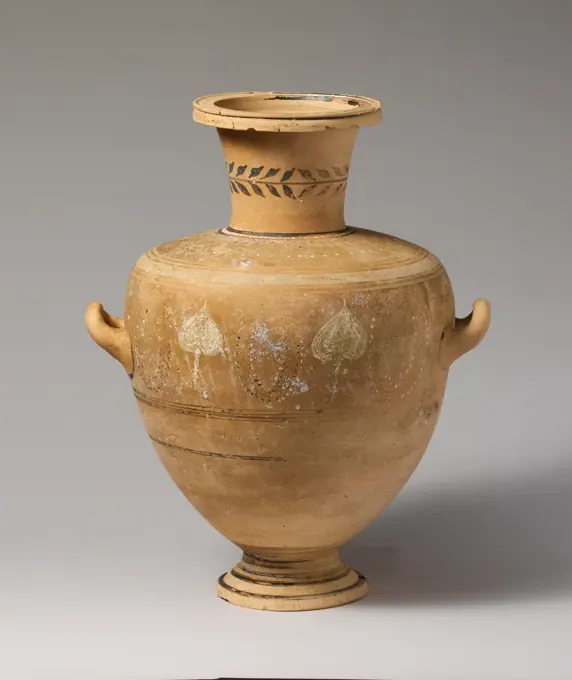
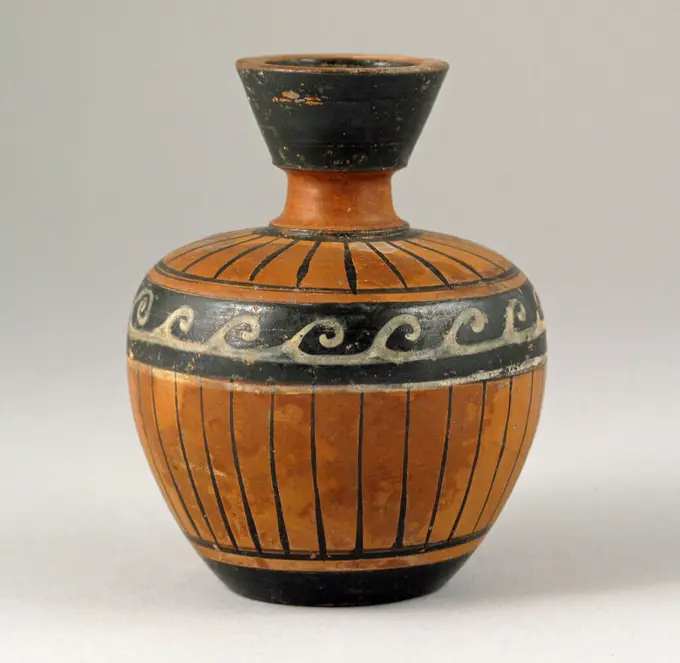
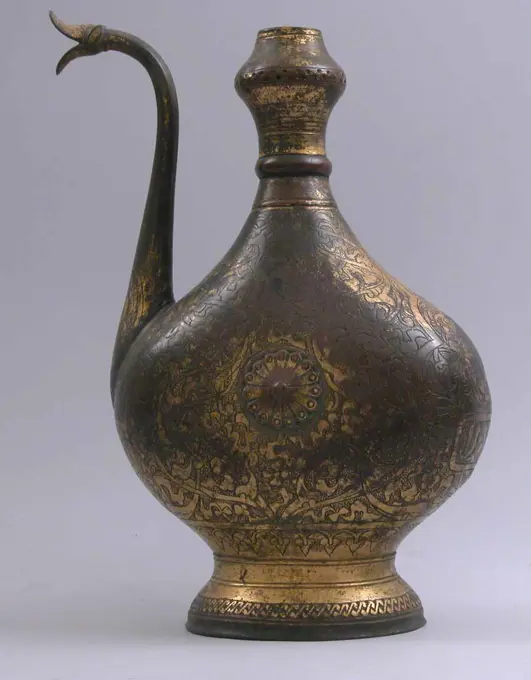
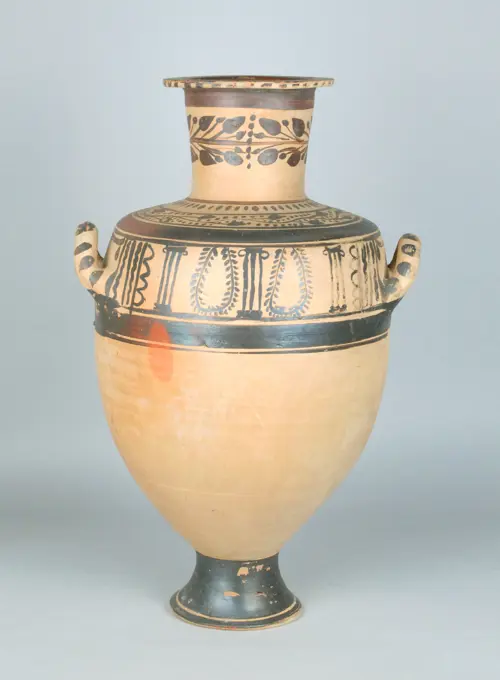
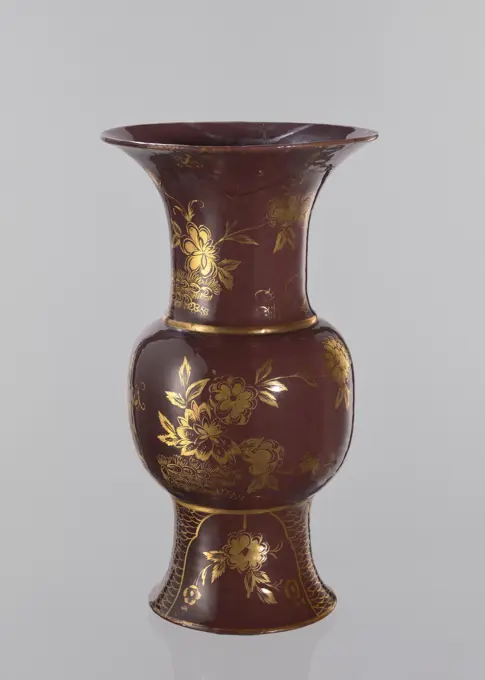
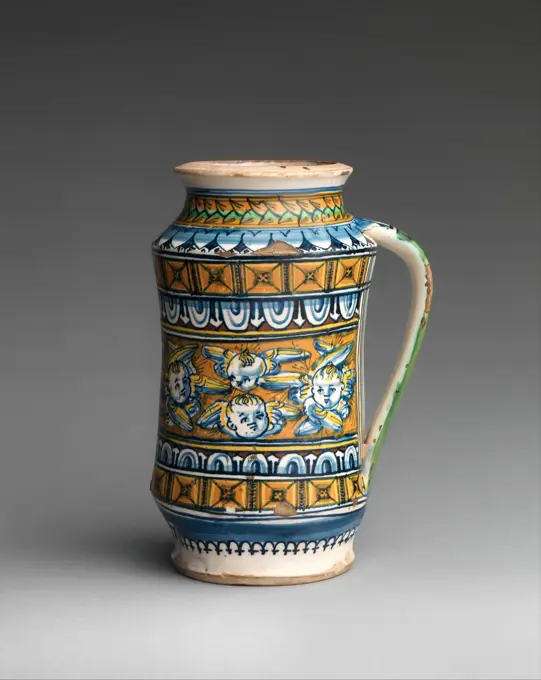
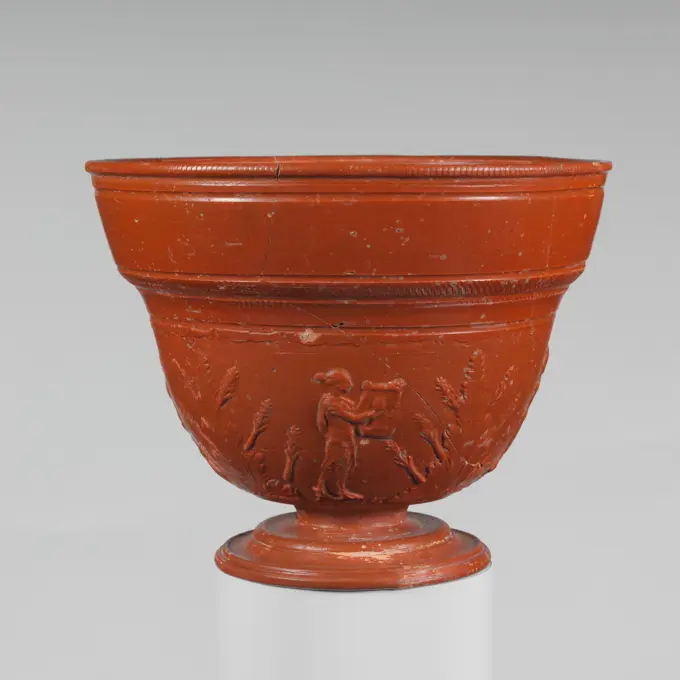
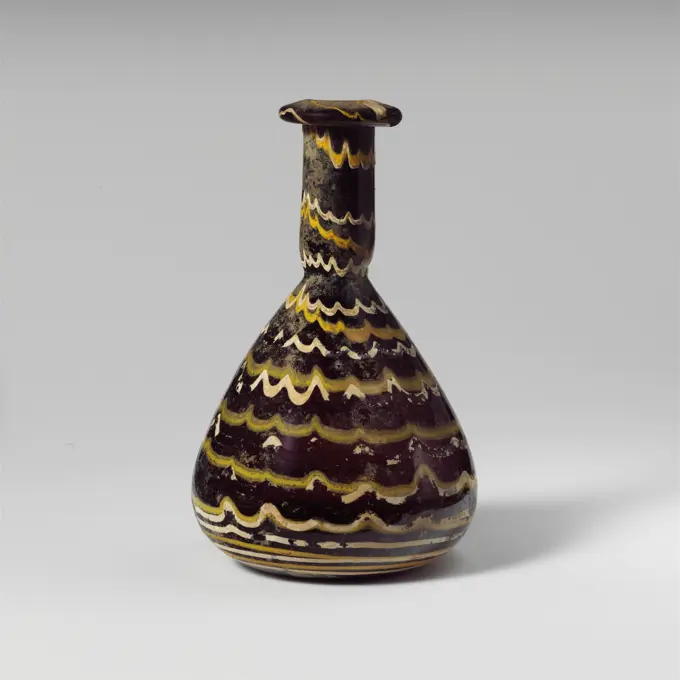
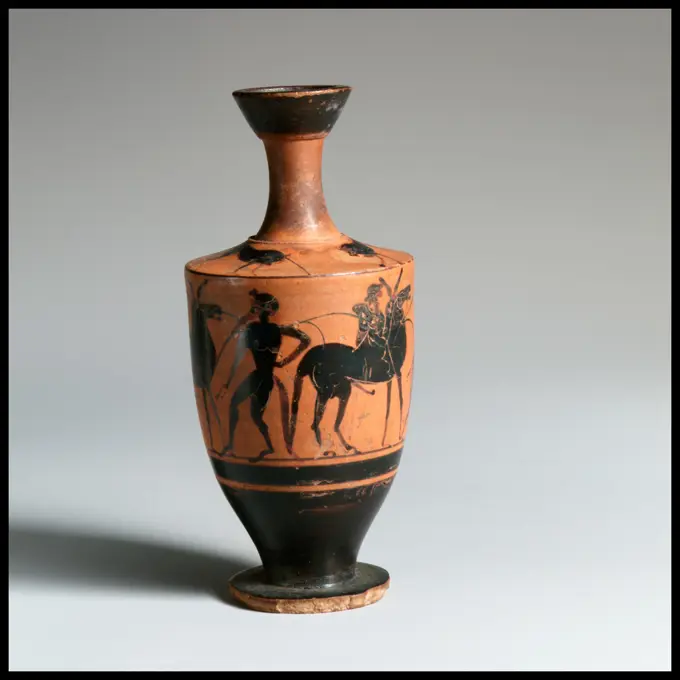
Ancient Greek Pottery

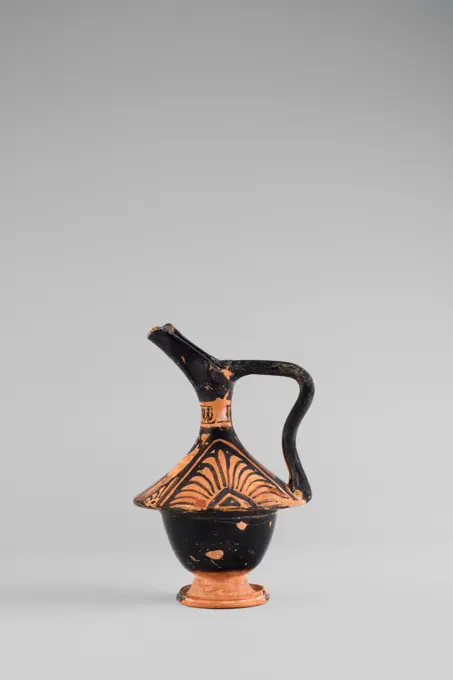
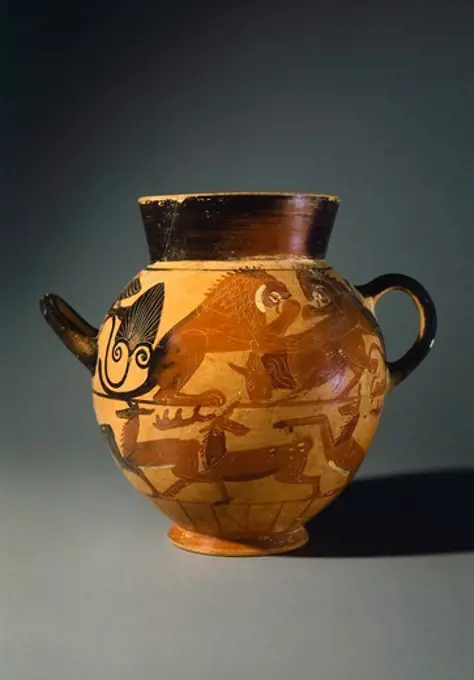
Elegant ancient Greek pottery, including perfume bottles and water jars, highlighting intricate designs and craftsmanship from various historical periods.

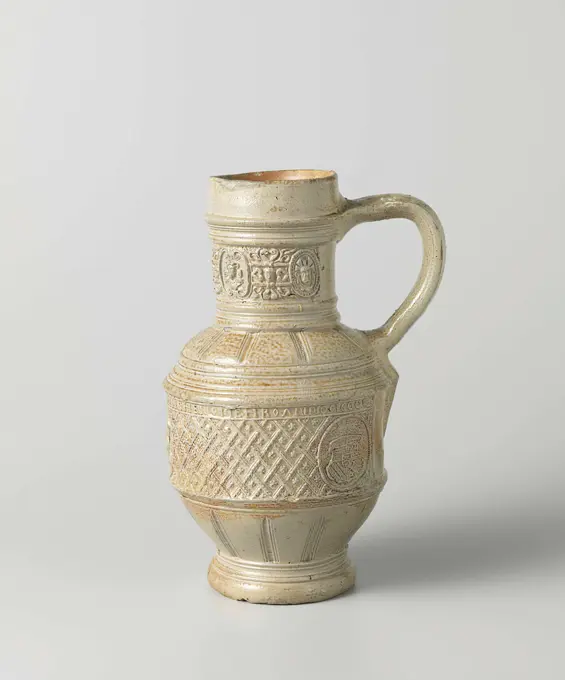
Stoneware jug with round neck appliqués, shoulder with band of plant motifs, cannnelures, dated, jug crockery holder soil find ceramic stoneware glaze salt glaze h 26.0, K (possible the initials of the maker of the mold) archeology import pottery serve serve wine beer
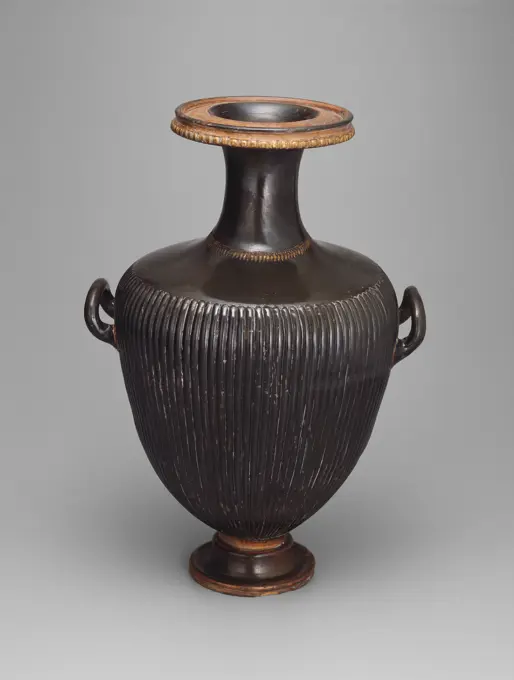
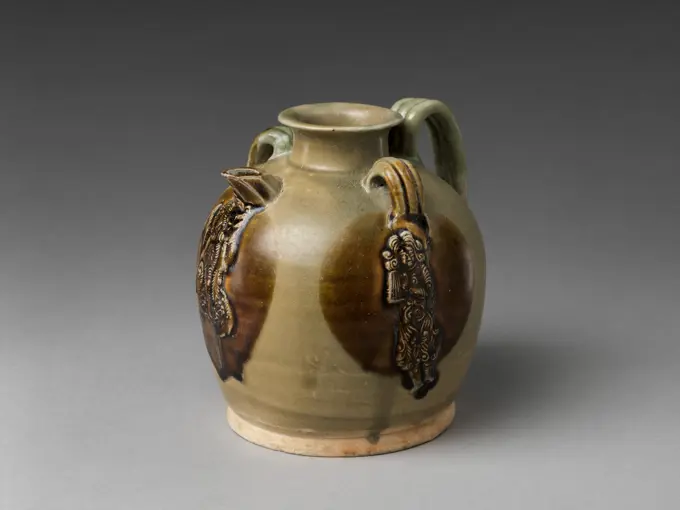
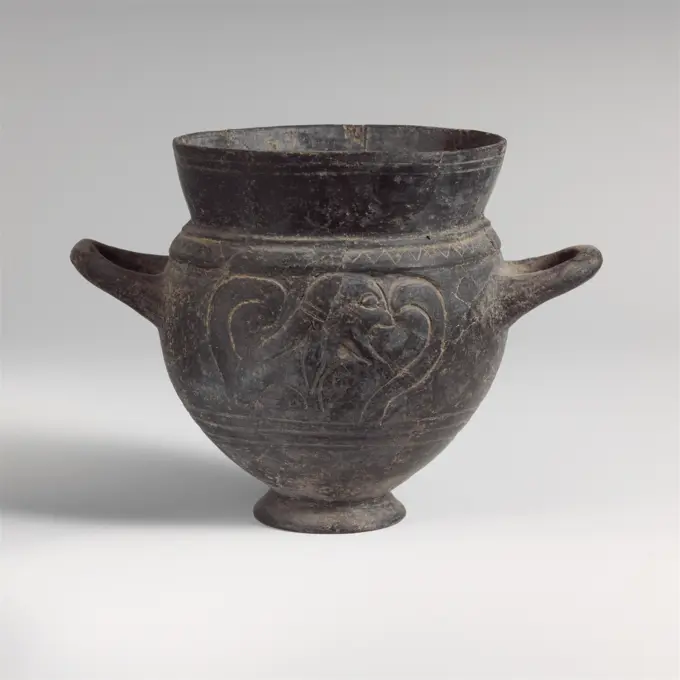
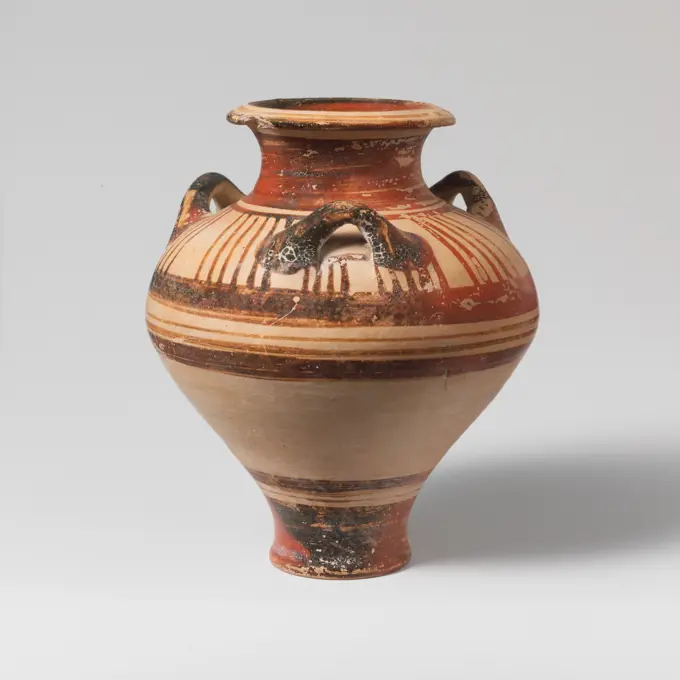
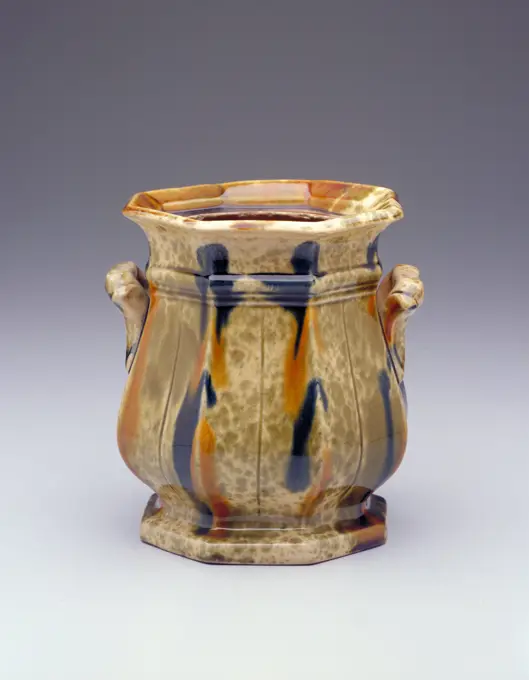
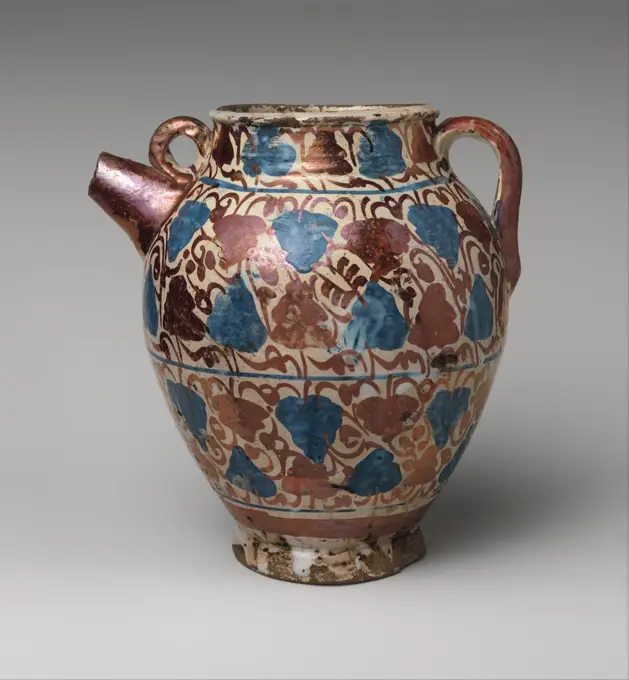
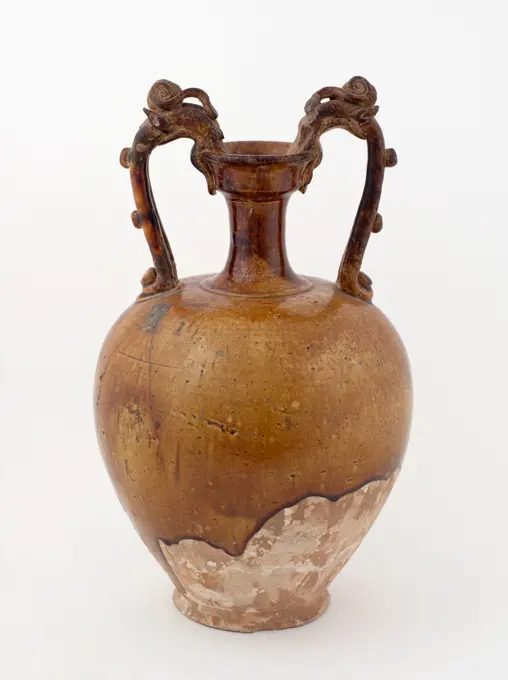
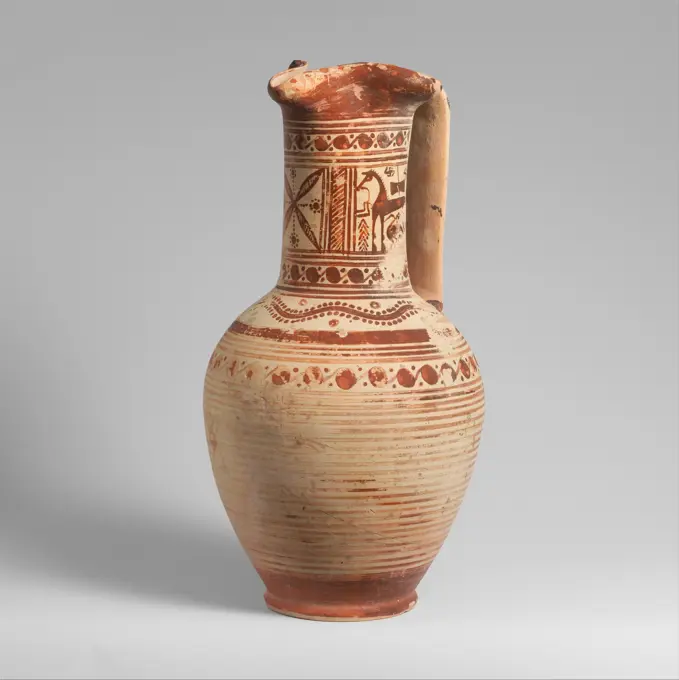
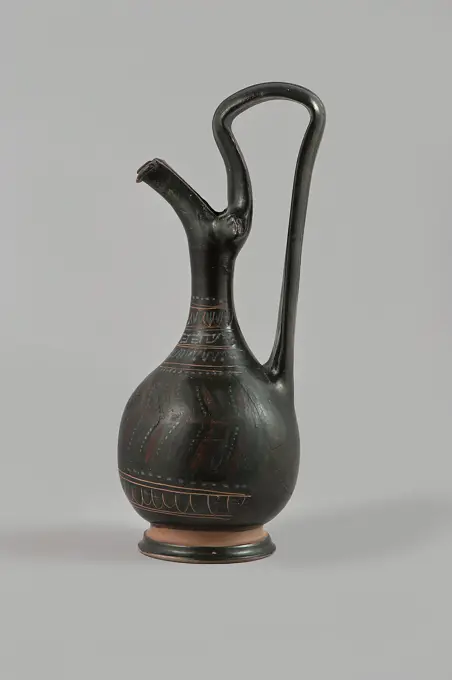
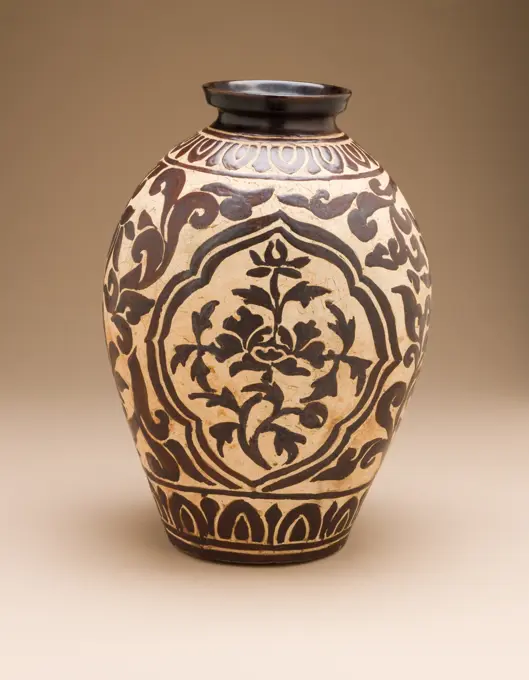
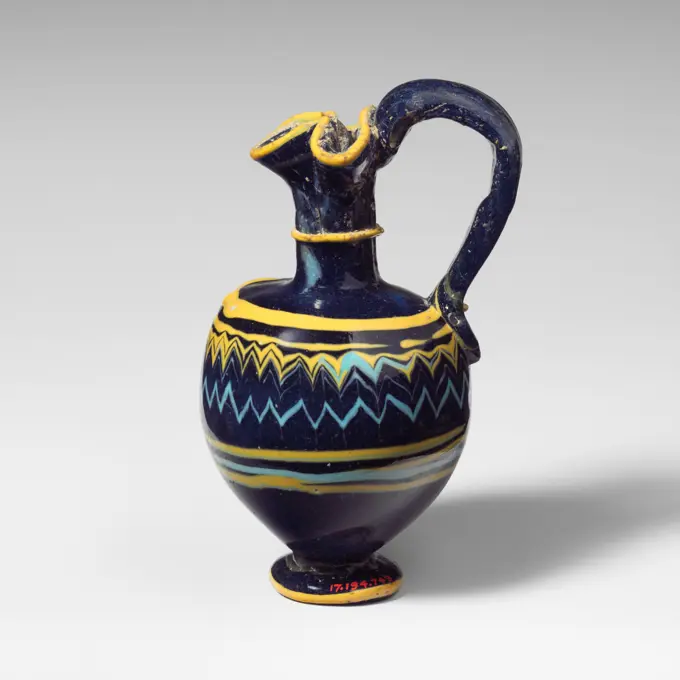
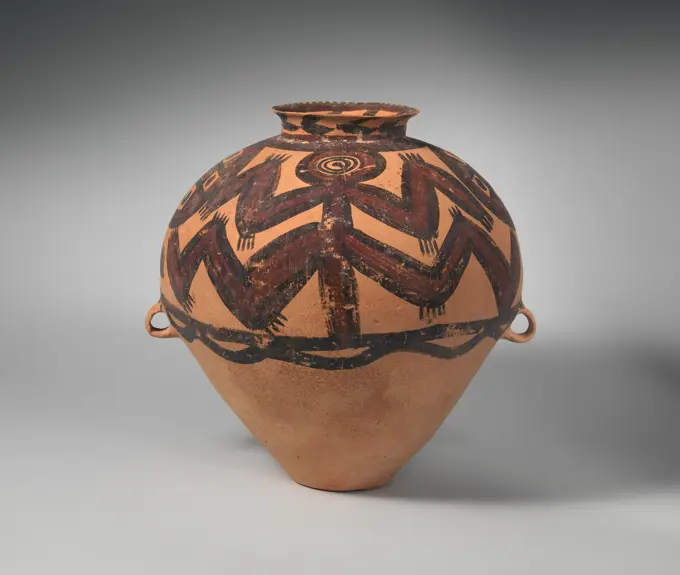
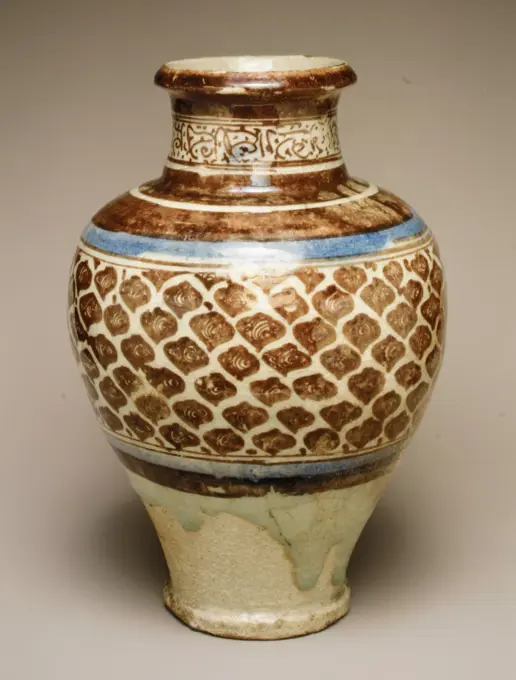
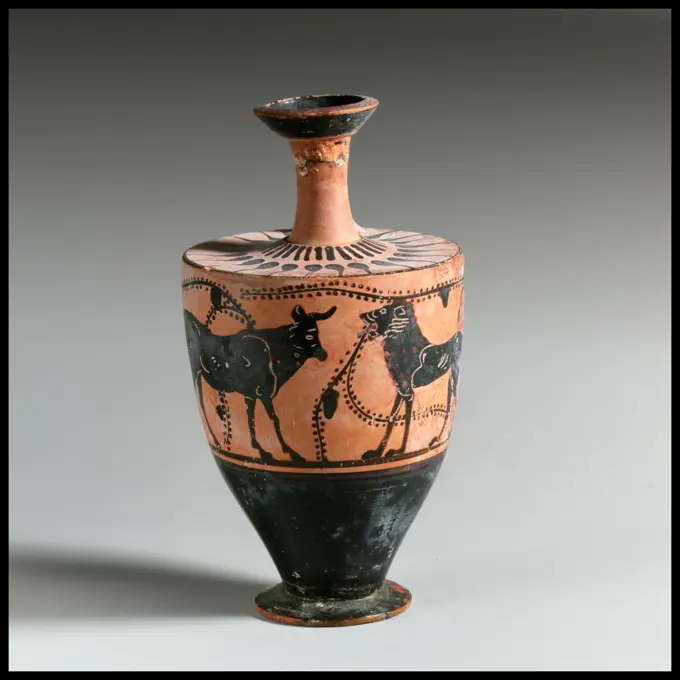
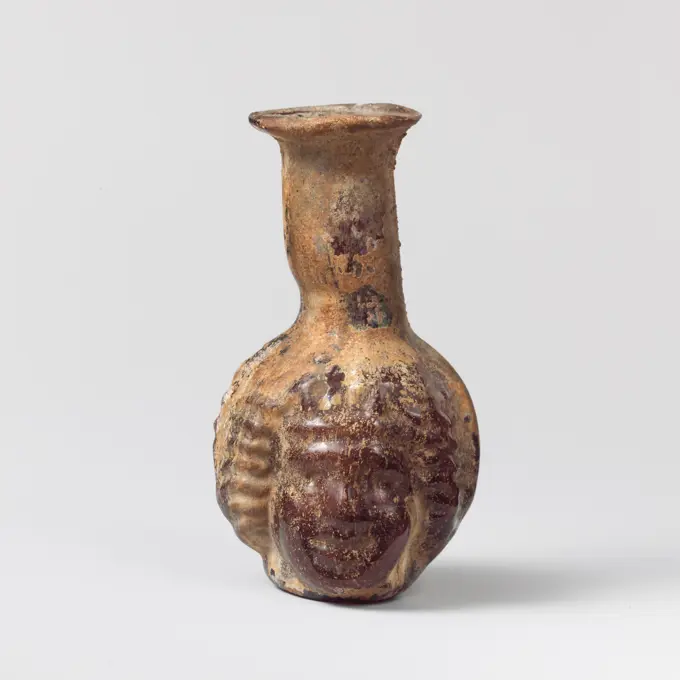
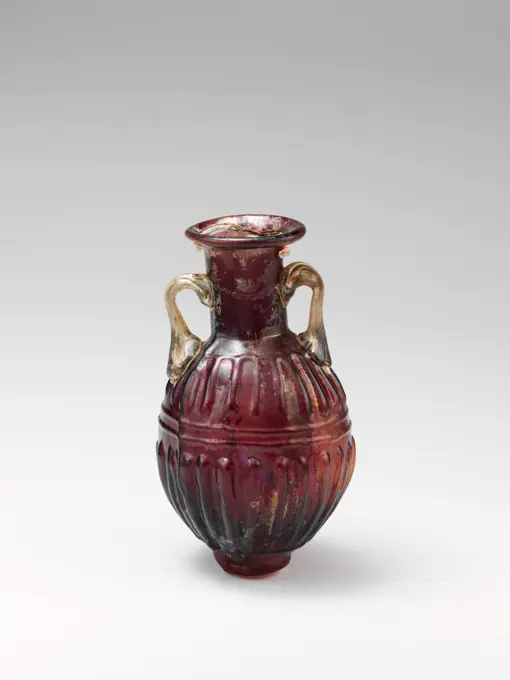
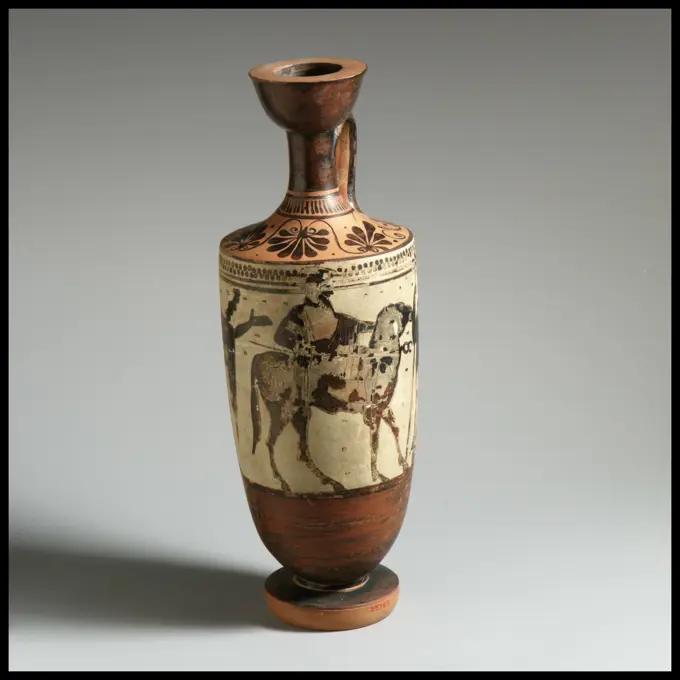
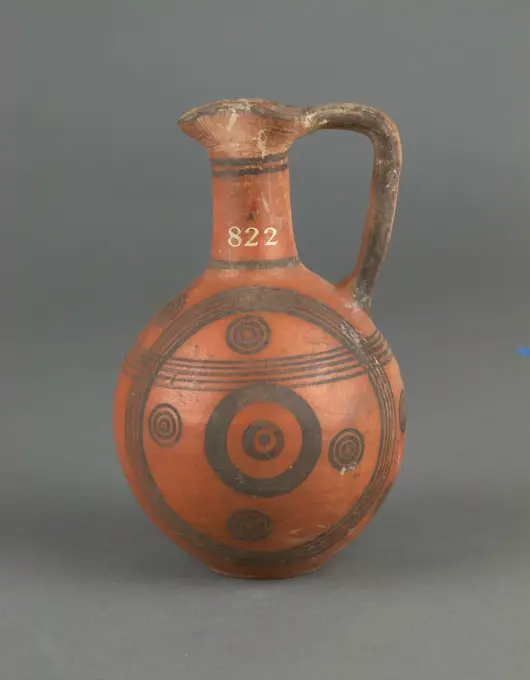
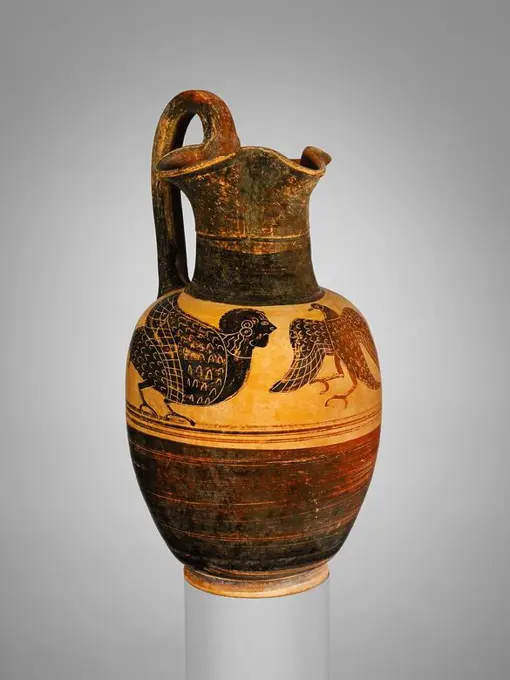
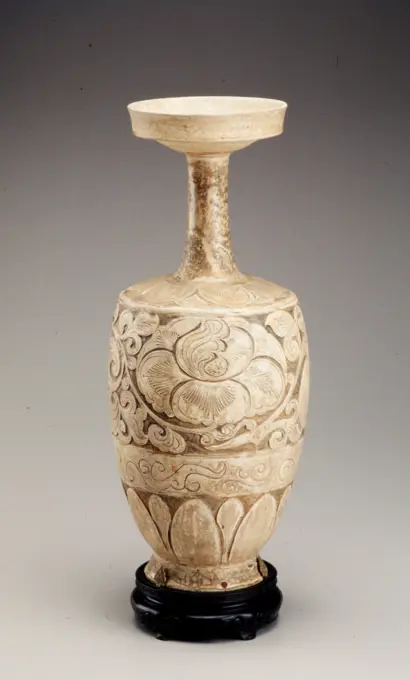
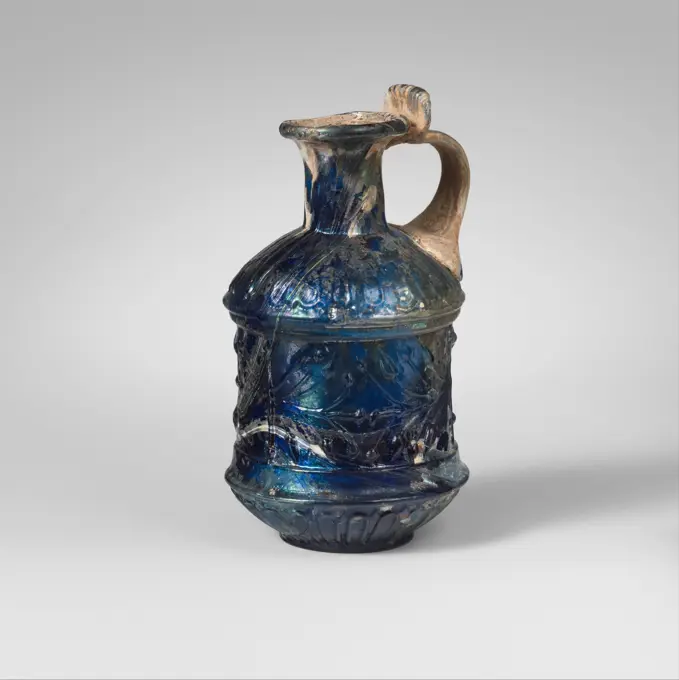
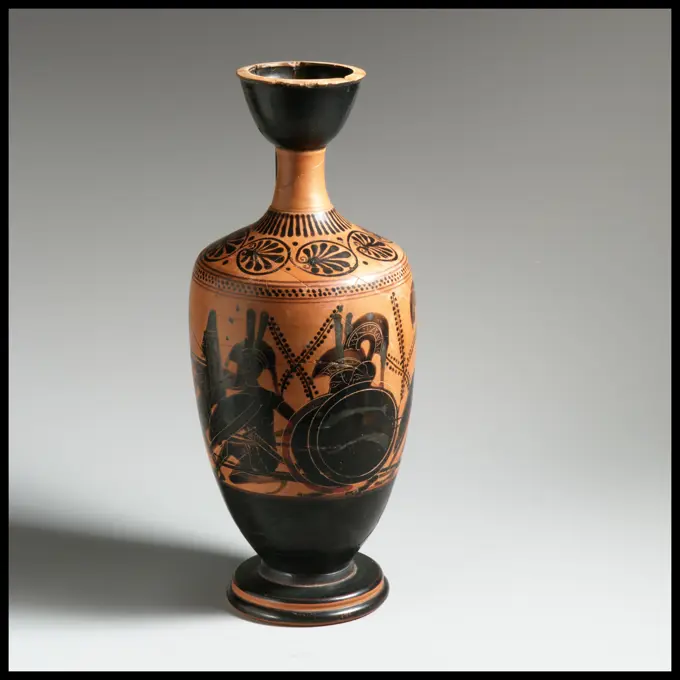
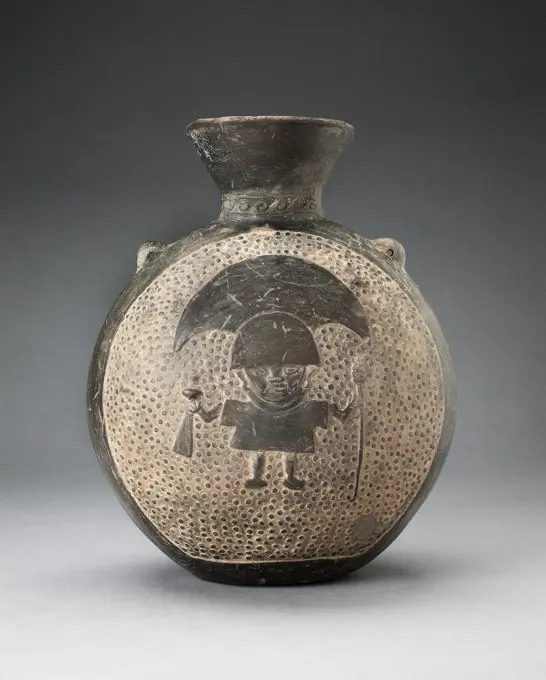
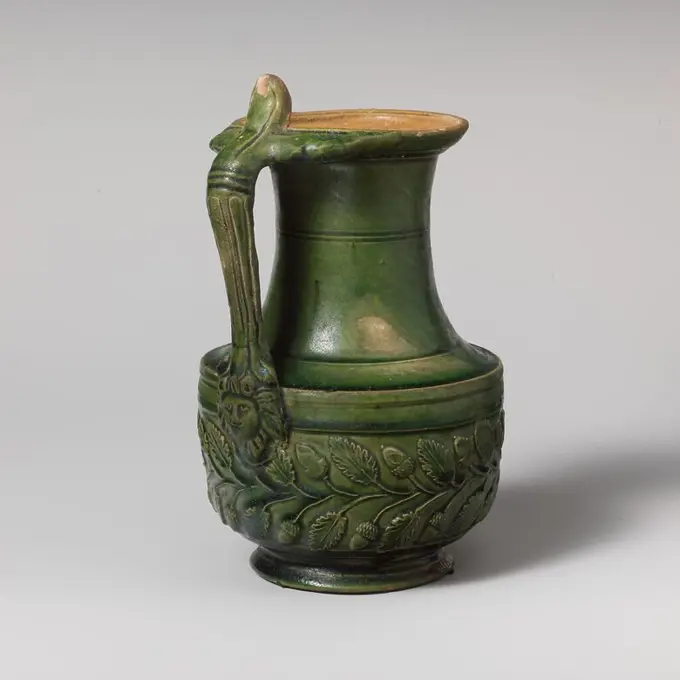
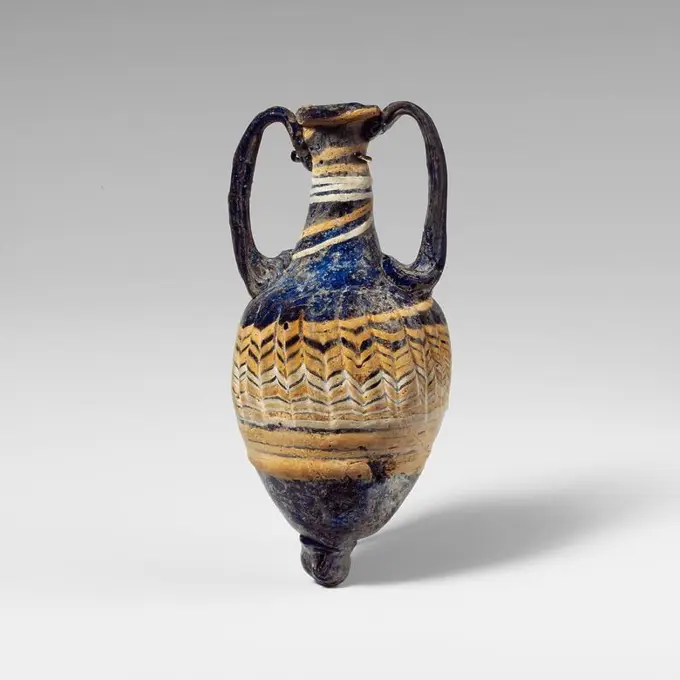
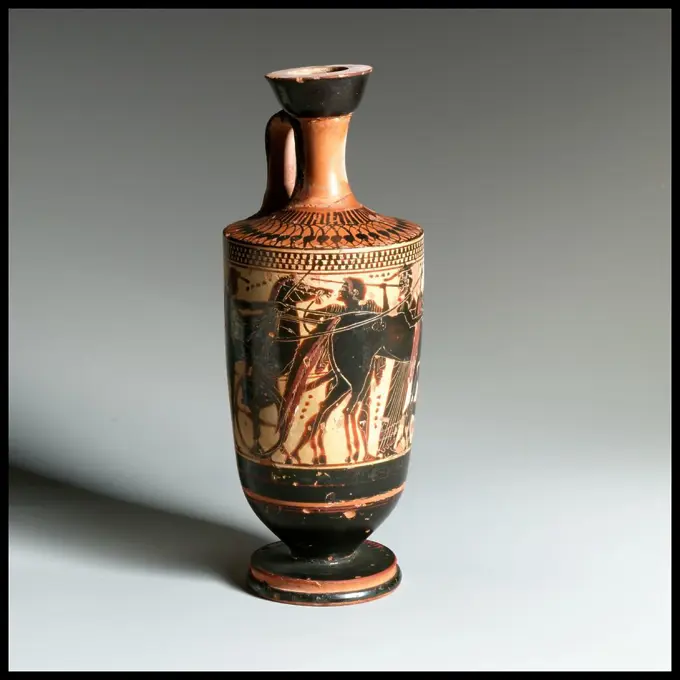
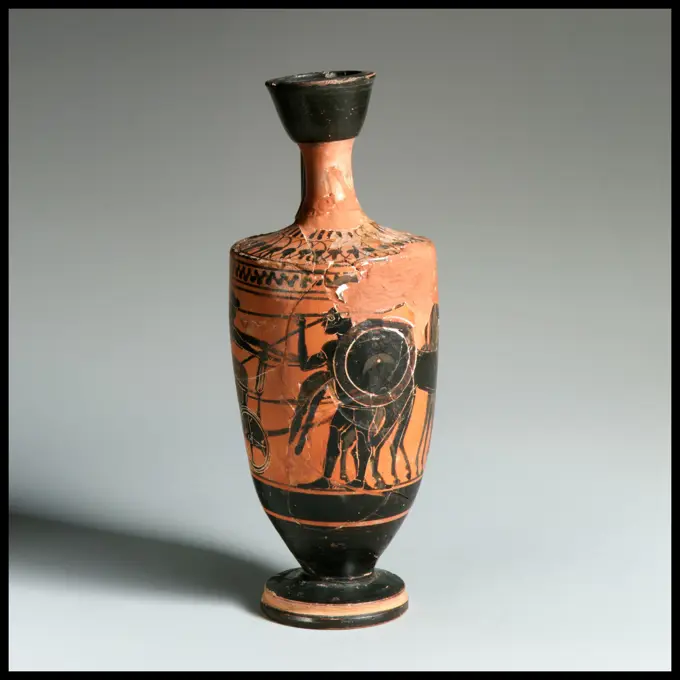
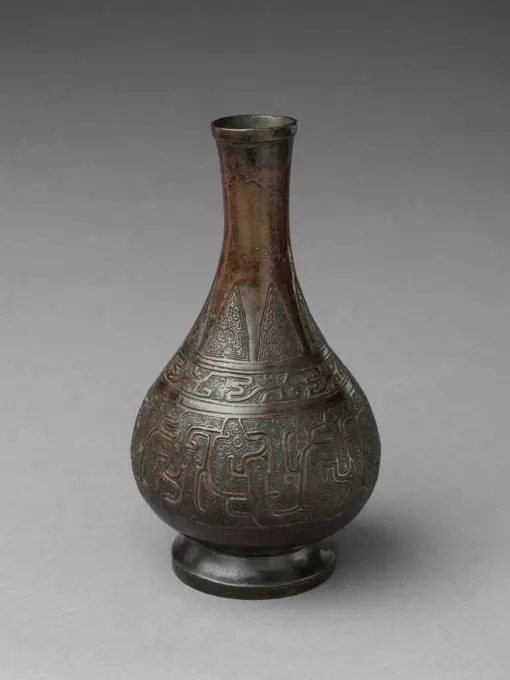
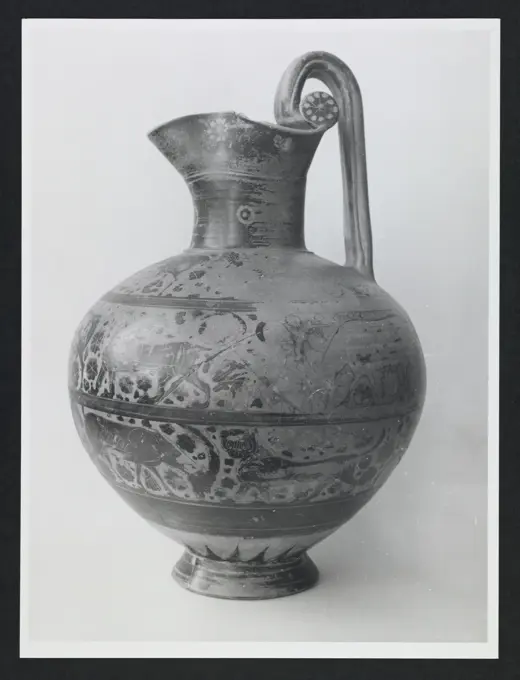
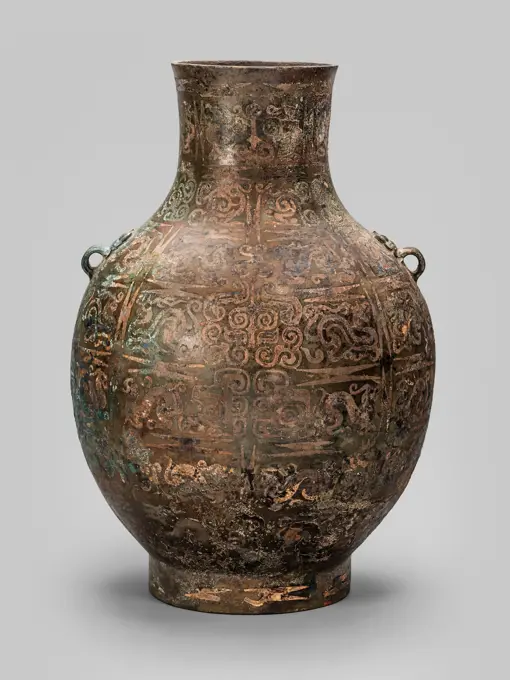
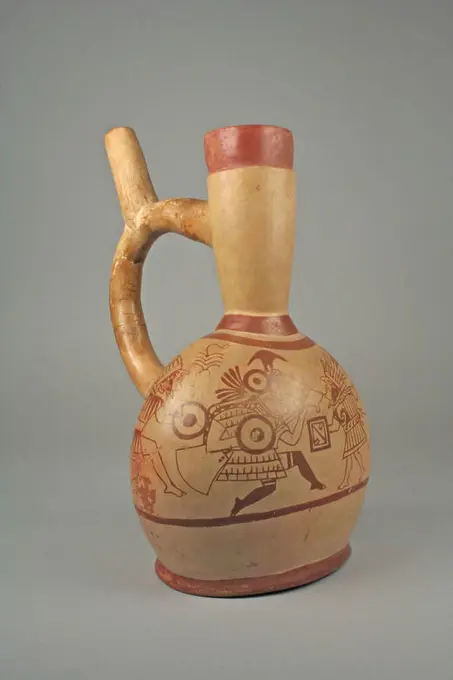
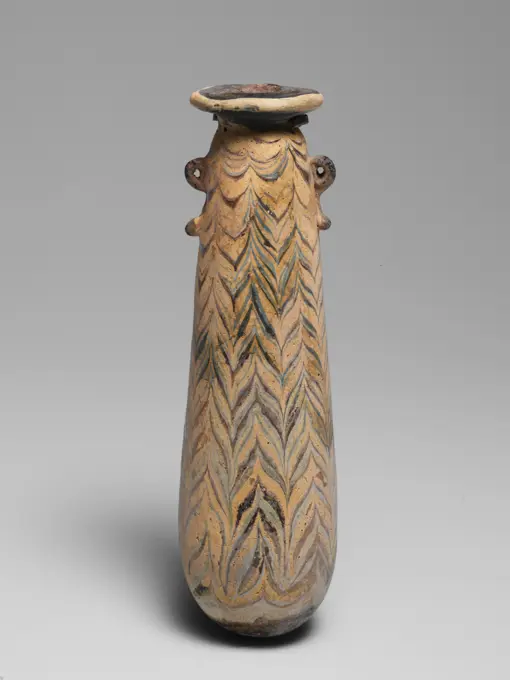
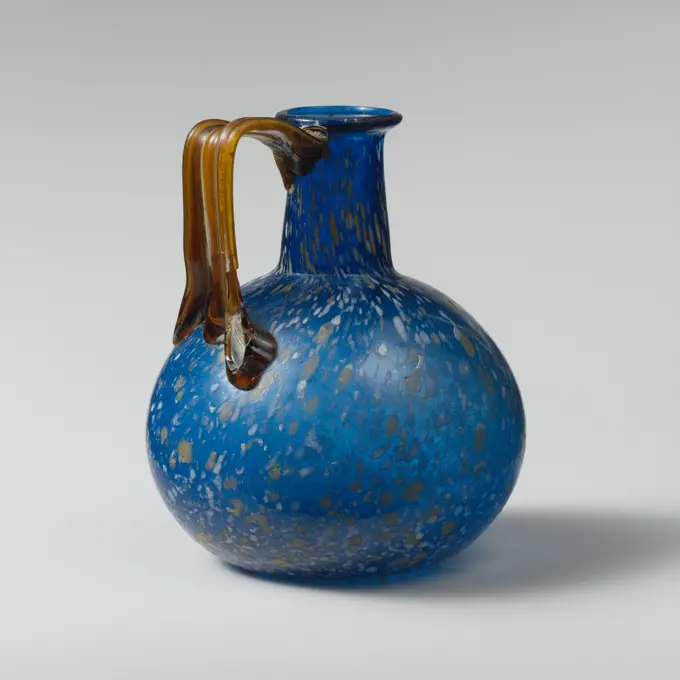
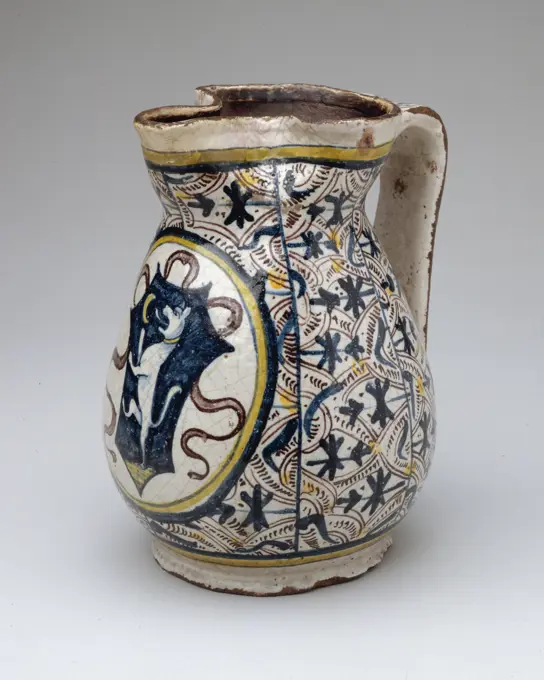
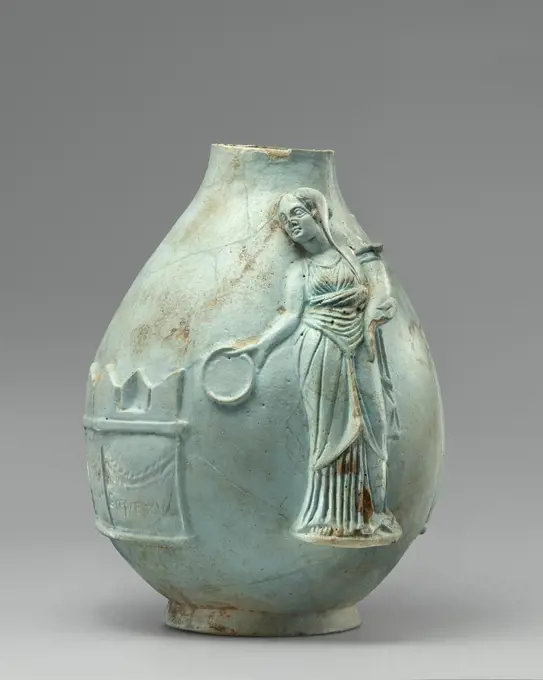
Glass amphoriskos (perfume bottle) 2nd to mid-1st century B.C. Greek, Eastern Mediterranean Translucent blue, with same color pad-base and handles; trail in opaque yellow.Slanting rim-disk, sloping inward, with thick rounded outer edge and jagged vertical lip to mouth; cylindrical neck, expanding downward; broad sloping shoulder; straight-sided ovoid body; broad circular pad-base, flattened but uneven on underside and with round edge; two vertical s-shaped handles applied on shoulder, trailed up along lower part of neck, and pressed on to underside of rim and top neck.Yellow trail applied to edge of rim-disk, wound spirally down neck and across shoulder, where it is tooled into a festoon pattern, with nine upward strokes, continuing in almost horizontal lines at top of body but then tooled into a feather pattern in six uneven panels of alternating upward and downward strokes over rest of body to pad-base.Complete except for chip in rim and upper half of one handle; dulling, slight iridGlass oinochoe (perfume jug) late 6th-5th century B.C. Greek, Eastern Mediterranean Opaque white, with handle and foot in same color; trails in translucent purple.Applied broad trefoil rim-disk; rather tall cylindrical neck, slanting forward; broad sloping shoulder; ovoid body; applied outsplayed foot with uneven concave bottom; handle attached to top of body over trail decoration, drawn up and out, then turned in and pressed on to back of neck below rim.One trail attached at edge of rim-disk; a second fine trail wound horizontally once around shoulder; a thicker trail begun on shoulder and wound spirally, at first in horizontal lines, then tooled into a close-set zigzag pattern around upper half of body; below this, a fourth trail wound horizontally three times around body; finally, a fifth trail wound around edge of foot.Complete, but broken and repaired bottom of body and top of foot; some dulling and pitting, iridescent weathering, and patches of creamy brown encrustation.These glaTerracotta oinochoe (jug). Culture: Greek, Attic. Dimensions: H. as restored 8 3/16 in. (20.8 cm). Date: ca. 900 B.C..From the Hymettos deposit (see 30.118.1). Museum: Metropolitan Museum of Art, New York, USA.Terracotta Hadra hydria (water jar) late 3rd century B.C. Greek, Ptolemaic, Cretan This hydria was made by a skilled craftsman: it has a thin, delicate rim, which is concave underneath; a back handle fashioned with three crisp ridges; and an elaborately turned foot, articulated with three grooves and four glazed lines. The high level of potting in conjunction with the painted decoration, which combined incision with prodigious use of added white, must have made this an object of great elegance in antiquity.. Terracotta Hadra hydria (water jar) 245563Aryballos. Culture: Greek, Attic. Dimensions: Overall: 2 3/8 in. (6.1 cm)Diameter: 1 13/16 × 11/16 × 3/4 in. (4.6 × 1.7 × 1.9 cm). Date: early 4th century B.C.. Museum: Metropolitan Museum of Art, New York, USA.PlayHydria (Water Jar) 350 BCE-330 BCE Puglia. The ribbed body of this vase was formed in a mold, then attached to the separately made feet, handles, neck, and mouth and coated with black gloss before being fired. Certain parts were left in the natural color which, along with the egg-and-dart pattern on the lower edge of the rim, provides decorative contrast. The pattern and the necklace represented on the neck were made from tiny pieces of clay which were gilded.. terracotta, black-glaze technique, with gilded raised clay decoration and ribbing . Ancient GreekPlayEwer with dancing figures ca. 9th century China The curly hair of the dancer appliqued to the ewer suggests that this figure is not of Chinese ethnicity. He may represent a South or Southeast Asian individual, or even someone from Central Asia. Similar dancing figures, depicted on ceramics from north China, often represent Sogdians, a trading people based in present-day Uzbekistan, known for their whirling dances.. Ewer with dancing figures. China. ca. 9th century. Stoneware with white slip, pigment, and applied decoration under straw glaze (Changsha ware). Tang dynasty (618-907). CeramicsStoneware jug with round neck appliqués, shoulder with band of plant motifs, cannnelures, dated, jug crockery holder soil find ceramic stoneware glaze salt glaze h 26.0, K (possible the initials of the maker of the mold) archeology import pottery serve serve wine beerGlass oinochoe (perfume jug) mid-4th-early 3rd century B.C. Greek, Eastern Mediterranean or Italian Translucent cobalt blue, with handle in same color; trails in opaque yellow and opaque white, with specks of opaque turquoise blue.Applied trefoil rim-disk; cylindrical neck; broad rounded shoulder; straight-sided body with marked downward taper; applied low circular coiled pad-base, slightly concave on bottom; strap handle attached in claw pad to outer edge of shoulder and top of body, drawn up, curved round and down, and appied to back of rim-disk.A fine yellow trail attached at edge of rim-disk; another unmarvered yellow trail wound spirally five times around neck; on body, alternating bands of yellow and white trails wound round from shoulder to pad-base and tooled into a close-set feather pattern in fourteen vertical panels with alternating upward and downward strokes, another fine yellow trail attached at edge of pad-base.Broken and repaired, with part of front of trefoil rim missiTerracotta drinking cup with two handles ca. 550 B.C. Etruscan Two-handled, on each side the upper part of a winged figure.. Terracotta drinking cup with two handles 246192Terracotta pithoid jar ca. 1400-1200 B.C. Mycenaean Pear-shaped vase with three handles, and horizontal and vertical band.. Terracotta pithoid jar 240340Jug with seventeen personifications, anonymous, c. 1579 - c. 1600 Jug of stoneware on a high base with a cylindrical body with slightly narrower, round shoulder and long neck. The C-shaped ear is attached to the neck and shoulder. Covered with a brown Engobe. On the abdomen a broad bond with a printed and imposed decoration of seventeen personifications with their names. Astrology, the seven virtues and the nine muses: Astrologia, Fides, Caritas, Spes, Iustitia, PRVDENCIA, Temperatia, Fortitvdo, Paspeamene, Tialia, EVT , Terpsichory, Clio, Poli, Caliope, Erato, Vrania. Among the female figures the inscription 'Bei Mei Mister Baldem Mennickin Potenbecker living Toten Raren in Leiden and brought anno Dvsent 1579'. To the right of the last lady the word 'Novem'. The shoulder and the lower part of the abdomen with entered courses. On the neck a band with curl and windows. Raeren. Rae stoneware. glaze. engobe vitrification Jug of stoneware on a high base with a cylindrical body with slightlJug of stoneware. Dark gray with blue jug of stoneware. Decorated with 6 rosettes in circles. To the neck mascarons and arabesken.Decanter 1815-41 Probably Keene Glass Works. Decanter 3071Terracotta amphora (jar) 1050-950 B.C. Cypriot The handles are in the form of a stylized goat's head.. Terracotta amphora (jar) 240276Khmer Vase, 12th Century. Cambodia, 12th century. Earthenware with dark brown glaze; overall: 28.2 cm (11 1/8 in.).Miniature hydria;  2. PO. 4th century BC (-350-00-00--301-00-00);Covered Jar. Thailand, Sawankhalok, 16th century. Furnishings; Serviceware. Stoneware with underglaze black painted decorationOinochoe, 325-300 BC. From South Italy. An Ancient Greek wine jug - also spelled 'oenochoe' - characterised by its curved handle and trefoil-shaped mouth.Cracker jar, 1849, Edwin Bennet; Artist: William Bennet, American, active 1849-1856, 6 1/2 x 6 1/4 x 6 1/4 in. (16.5 x 15.9 x 15.9 cm), Glazed ceramic, United States, 19th centuryTerracotta oinochoe (jug) 4th century B.C. Greek, Attic Aphrodite and ErotesPlastic adjuncts had been part of the decoration of Attic vases from the Geometric period on.The execution of the decoration in applied, low relief was a short-lived phenomenon that lasted from the second half of the fourth into the third century B.C. The fragility of the relief accounts for the often poor condition of the objects. This one had extensive remains of gilding and blue color.. Terracotta oinochoe (jug) 254516 Greek, Attic, Terracotta oinochoe (jug), 4th century B.C., Terracotta, H. 5 1/4 in. (13.4 cm). The Metropolitan Museum of Art, New York. Fletcher Fund, 1944 (44.11.10)Hydria (Water Jar) 400 BCE-350 BCE Greece. The black-glazed body of this water jar is decorated with vertical ribbing, but under the vertical handle there is a stack of three inverted ìvîs. There is a frieze of red-figured ovolos on the edge of the mouth.. terracotta, decorated in the black-glaze technique . Ancient GreekJug (Bartmann jug) with coats of arms, anonymous, c. 1550 - c. 1624 Jug (beard fancier) of stoneware on the standing surface with a spherical body and narrow neck with a pinched spout. The C-shaped ear is attached to the neck and shoulder. Profiles on the neck. Covered with a brown Engobe. Three times printed and imposed medallion with three different crowned weapons surrounded by leaf vines. On the neck, continuously on the shoulder, a bearded man. Frechten. Cheek stoneware. glaze. engobe vitrification Jug (beard fancier) of stoneware on the standing surface with a spherical body and narrow neck with a pinched spout. The C-shaped ear is attached to the neck and shoulder. Profiles on the neck. Covered with a brown Engobe. Three times printed and imposed medallion with three different crowned weapons surrounded by leaf vines. On the neck, continuously on the shoulder, a bearded man. Frechten. Cheek stoneware. glaze. engobe vitrificationJug 1435-75 Spanish The ivy-leaf pattern was one of the most common motifs in fifteenth-century Valencian lusterware, which found a ready market in Italy and the Netherlands and can often be seen in paintings of the period.. Jug 468523Amphora ". Ceramic. China, Tang dynasty. Paris, Cernuschi museum. 73679-8 Amphora, handle, Asian art, Chinese, Ceramic, Chinese Ceramic, Tang Dynasty, Chinese Pottery, Terracotta, Tete DragonVase with two mascarons;  1st quarter of the 20th century (1901-00-00-1925-00-00);Terracotta oinochoe (jug) ca. 750-740 B.C. Attributed to the Cesnola Painter On the neck, in metopes, tethered horses and birdsThe oinochoe comes from the same workshop as the large pedestaled krater with lid (74.51.965) exhibited in the Belfer Court on the main floor. It is noteworthy that several pieces from the same workshop were exported from Euboea to Cyprus.. Terracotta oinochoe (jug) 240426Epichysis. unknown, authorKantharos;  IV-Pocz Tex of the 3rd century BC (-400-00-00--291-00-00);Flattened Bottle with Lotus Scroll Design in Iron Glaze. Korea, Goryeo dynasty (918-1392), 13th-14th century. Furnishings; Serviceware. Wheel-thrown and shaped stoneware with carved and slip-covered ground and glaze-painted decorationGlass oinochoe (perfume jug) late 6th-5th century B.C. Greek, Eastern Mediterranean Translucent cobalt blue but with one patch of turquoise blue on neck; applied foot and handle in cobalt blue but with opaque yellow streaks; trails in opaque yellow and opaque turquoise blue.Applied broad trefoil rim-disk; tall cylindrical neck, slanting forward; broad uneven shoulder, almost horizontal at front; bulbous body curving in towards bottom; applied outsplayed foot with uneven slightly hollow bottom; handle attached in a large flattened pad to outer edge of shoulder over trail decoration, drawn up and out, then turned in, arching above rim-disk, and pressed on to back of neck below rim.Yellow trail, streaked with turquoise blue, attached at edge of rim-disk; an unmarvered yellow trail, also with turquoise streaks, wound once around center of neck; a third yellow trail applied as a broad marvered pad to edge of shoulder and wound down spirally, then tooled around upper body; a turquoise blue tJar with Painted Decoration of "Frog" Pattern ca. 2300-2000 B.C. China. Jar with Painted Decoration of "Frog" Pattern. China. ca. 2300-2000 B.C.. Earthenware with painted decoration. Neolithic period, Majiayao culture, Machang phase. CeramicsStorage Jar (Aryballus). Culture: Inca. Dimensions: H. 11 1/2 x W. 9 1/4 in. (29.2 x 23.5 cm). Date: 15th-early 16th century. Museum: Metropolitan Museum of Art, New York, USA.Double Vase, Apulia, Italy. Messapian Civilization, 4th Century BC.Jug. The neck of the jug is embellished with an angel bearing the arms of England. The body is decorated twice with the arms of Salentin von Isenburg-Grenzau (Archbishop of Cologne) between two rampant lions. There does not seem to be any connection between the English and the Cologne coats of arms; the potter simply used the templates available to him in the workshop.Jar with a Pattern of Spiral-Filled Trefoils 12th century This jar, excavated in the first decade of the twentieth century, exemplifies the findings that excited collectors and made Raqqa famous. Gertrude Bell, a traveler, archaeologist, and political officer, saw the jar in Aleppo in 1909 and later visited Raqqa; she was impressed by the amount of shards covering” the ground and noted that the site seemed honeycombed” with diggings by the local residents.. Jar with a Pattern of Spiral-Filled Trefoils 450942Lekythos early 5th century B.C. Attributed to the Little Lion Class Bull and lion.. Lekythos. Greek, Attic. early 5th century B.C.. Terracotta; black-figure. Late Archaic. VasesGlass double head-shaped bottle 2nd century A.D. Roman, Syrian Translucent patchy purple.Uneven rim folded out, round, and in; flaring mouth; cylindrical neck, slanting to one side and with deep tooling indent at base; plastic body; oval base with rounded edges and slightly concave bottom; small round pontil mark on bottom. Mold seams visible on sides of head, extending to base of neck.Body in the shape of two heads, back to back, one with a smiling face, the other with a serious face; smiling face with fillet across forehead and hair parted down middle and arranged in regular horizontal rows to sides of face; the serious face with wavy hair to sides and prominent topknot; smiling face has arched eyebrows extending to bridge of nose, eyes with indents for pupils, open mouth, thick lips, and rounded chin; serious face is less well defined with raised eyebrows, a broad flat nose, pursed lips, and a receding chin.Intact; limy encrustation, thick creamy weathering, and brilliant iridescencEpichysis czerwonofigurowy z przedstawieniem Erosa. unknown, authorGlass amphoriskos (perfume flask) 1st century A.D. Roman Translucent reddish purple; handles in colorless glass with a smoky green tinge.Tubular rim, folded out, over, and in, and flattened into flaring mouth; tall cylindrical neck; ovoid body; low cylindrical base, with flat but uneven bottom; two small rod handle attached in a claw pad to top of body, drawn up, round, and in, and pressed onto middle part of neck. One prominent continuous mold seam down neck, around body, and across bottom.On body, frieze of twenty-two widely-spaced, downturned rounded ribs on upper body ( twelve on one side, ten on the other) and twenty-four upturned rounded ribs on lower body; between them two horizontal raised lines.Complete, but broken and repaired around rim and top of neck; few bubbles; dulling and iridescence, with one patch of deep pitting and brillaint iridescence on body, on exterior, some weathering and iridescence on interior.. Glass amphoriskos (perfume flask). Roman. 1st century A.D.. GlLadle by the Painter of Tityos, viewed from side B. Black-figure pottery from Vulci (Lazio). Etruscan Civilisation, 520-510 BC.Lekythos ca. 480 B.C. Attributed to the Athena Painter. Lekythos 251803 : Attributed to the Athena Painter, Lekythos, ca. 480 B.C., Terracotta, Overall: 11 7/8in. (30.2cm) Diameter: 4 3/16  2 7/16  2 7/8 in. (10.6  6.2  7.3 cm). The Metropolitan Museum of Art, New York. Fletcher Fund, 1925 (25.78.5)Amphoriskos (Container for Oil). Eastern Mediterranean, possibly from Rhodes. Date: 550 BC-450 BC. Dimensions: 8.1 × 4.8 × 4.8 cm (3 3/16 × 1 7/8 × 1 7/8 in.). Glass, core-formed technique. Origin: Eastern Mediterranean Region. Museum: The Chicago Art Institute, Chicago, USA. Author: Ancient Eastern Mediterranean.Apothecary Jar with Running Hares and a Dog. Dimensions: H. 7 1/4 in. (18.4 cm)Diam. 4 in. (10.2 cm). Date: 12th century.This jar was used to store solid substances (dried herbs, roots, bark, seeds, and fruit, or salts, minerals, and metals) most likely employed in the preparation of drugs or home remedies. The iconography is not directly connected to the jar's function, but the chasing animals and the Arabic benedictory words addressed to the owner convey an overall propitious symbolism. For their cleverness and speed the hare seems to have been regarded as especially auspicious. Museum: Metropolitan Museum of Art, New York, USA.Jug 750-600 B.C. Cypriot. Jug. Cypriot. 750-600 B.C.. Terracotta. Cypro-Archaic I. VasesTerracotta oinochoe (jug). Culture: Etruscan. Dimensions: H. 11 1/16 in. (28.1 cm). Date: ca. 525-500 B.C..Sirens and an eagleThe Micali Painter is the most prolific and best-known Etruscan painter of black-figure pottery. His workshop was probably located at Vulci. Museum: Metropolitan Museum of Art, New York, USA.Red-Figure Hydria, c. 320 BCE, Attributed to the White Sakkos Painter, Italian (Apulia, now Puglia), Italian (Apulia, now Puglia), 25 1/2 x 17 1/2 x 13 3/8 in. (64.77 x 44.45 x 33.97 cm), Earthenware, colored slips, Italy, 4th-3rd century BCE, Apulia, a prosperous Greek colony on the Adriatic coast of Italy, was a major center of terracotta vase production. Apulian vases are distinctive for their large size; some are over a meter tall. Such large vases may have been created for inclusion in the spacious tombs that came into vogue among wealthy families in the 4th century b.c. The size of these vases allowed painters to indulge in complex figural compositions that appear to float on black backgrounds, which are divided into registers by bands of intricate floral patterns.Vase, early 11th century, H.17-1/4 in., Tz'u-chou ware Stoneware with white slip and carved floral decor under a clear glaze, China, 11th century, Manufactured during the tenth and eleventh centuries, vessels such as this decorated with deeply carved peony ornament are amongst the earliest of Cizhou type wares. The most striking shapes include a small group of five tall vases with long, narrow necks, high shoulders, and a large dish-shaped mouth, of which this is one.Black -refyed oinochoe;  4th century A.C. (301-00-00-400-00-00);Glass jug 1st half of 1st century A.D. Roman Translucent cobalt blue, with handle in same color.Rim folded out, round, and pressed into flaring mouth; cylindrical neck with irregular indents around top; convex sloping shoulder; cylindrical body with recessed central panel, then cup-shaped below; low circular base with flat lower edge and flat bottom; a strap handle applied to shoulder in a large bifurcated pad, drawn up in an outward curving loop, and pressed onto top of neck and underside of rim, with projecting thumb rest above rim. Three mold seams run from base of neck, across shoulder, and down sides to top of prominent horizontal ridge; a separate cup-shaped section forms the lower body and base.Decoration in three registers: on shoulder, downturned tongues in raised outline, interspersed at bottom with pointed darts, with two horizontal raised ridges below; on body, central panel divided into three sections by a vertical thrysos-like staff or rod, with bud-like knobs on each endTerracotta lekythos (oil flask) late 6th-early 5th century B.C. Attributed to the Painter of Vatican G.49 Hoplites and archer in an ambushThe row of warriors keeping low to the ground suggests that the situation is an ambush.. Terracotta lekythos (oil flask). Greek, Attic. late 6th-early 5th century B.C.. Terracotta; black-figure. Archaic. VasesJar with Relief of Standing Figure with Crescent Headdress, Holding Ritual Objects Made 1200-1450 North Coast. Ceramic . ChimúTerracotta jug. Culture: Roman, Asia Minor, Tarsus. Dimensions: H. 6 1/2 in. (16.5 cm). Date: 1st half of 1st century A.D..This jug is attributed to one of the workshops producing lead-glazed vessels at Tarsus in southeast Asia Minor. Most of the production was devoted to making drinking cups, and this is a rare example of a different shape that was clearly much influenced by contemporary metalwork. Museum: Metropolitan Museum of Art, New York, USA.Aryballos. UnknownEwer 16th century This ewer is typical of the objects that were displayed in open niches in reception rooms of upper-class Syrian residences during the Ottoman period. Ewer 452729Spherical stone jar with pewter lid. Spherical jar of stoneware, with a pewter lid. The wide neck is short and cylindrical. The C-shaped ear on the right serves as an attachment point of the claw attached to the lid. The jug is on a foot. The belly is in relief decorated with small circular coercaged rings with a flower in the center. The jug of blue is colored between the rings. The foot and neck are decorated with ridges. The flat lid with vaulted silk has been marked with a crowned tower between the letters C and Q.Bowl with Cover. Pakistan, Taxila region, 1st century. Furnishings; Serviceware. Gray schistJug. Gray with blue jug of stoneware. Decorated with the arms of Amsterdam.Terracotta Hadra hydria (water jar) 3rd century B.C. Greek, Egypt, Alexandria-Hadra On body, columns with wreaths between; on shoulder, band of laurel; on neck, laurel sprays.. Terracotta Hadra hydria (water jar). Greek, Egypt, Alexandria-Hadra. 3rd century B.C.. Terracotta. Hellenistic. VasesTsun vase; Bielino (Manufaktura Fajansu; 1779-1800), Wolff, Karol (fl. Ca 1800); End of the 18th century (1780-00-00-1800-00-00);One-handled storage jar (albarello) ca. 1510-30 Italian, Siena The single-handled form is uncommon, and each of the dozen known examples is decorated with the same palette and winged cherub design. This suggests that they were commissioned together as a single pharmacy series.. One-handled storage jar (albarello) 199751Glass amphoriskos (perfume bottle). Culture: Greek, Eastern Mediterranean or Italian. Dimensions: H.: 4 5/16 x 1 15/16 in. (11 x 5 cm). Date: 3rd century B.C..Translucent cobalt blue, with handles and base-knob in same color; trails in opaque yellow and opaque white.Irregular oval-shaped horizontal rim with tooling marks on top surface; tall conical neck; uneven sloping shoulder; large ovoid body, tapering downwards; applied coil base-knob; strap handles applied in a large pads to shoulder, drawn up and slightly outward, then curving in and pressed on to top of neck under rim. Irregular tooling indents and weathered scars around lower body.White trail applied to middle of neck, drawn across shoulder, then tooled into a close-set zigzag pattern around upper half of body, formed by uneven vertical tooling indents, and ending in a horizontal line around center of body; yellow trail applied on rim and wound down neck in spiral over white trail, drawn across shoulder, then mingling with Terracotta oinochoe (jug). Culture: Greek, Euboean. Dimensions: H. 14 1/16 in. (35.7 cm). Date: ca. 750-740 B.C..On the neck, in metopes, tethered horses and birdsThe oinochoe comes from the same workshop as the large pedestaled krater with lid (74.51.965) exhibited in the Belfer Court on the main floor. It is noteworthy that several pieces from the same workshop were exported from Euboea to Cyprus. Museum: Metropolitan Museum of Art, New York, USA.Glass amphoriskos (perfume bottle) 5th century B.C. Greek, Eastern Mediterranean Opaque streaky red brown, with handles and base-knob in same color; trails in opaque yellow and opaque turquoise blue.Outsplayed, inward-sloping rim-disk; cylindrical neck; broad sloping shoulder; ovoid body tapering to a point; circular base-knob with rounded edge and small indent on bottom; two ring handles applied over trail decoration, drawn up from shoulder, turned in, and pressed on to neck.One yellow trail attached at edge of rim-disk; another yellow trail applied to shoulder and wound unevenly round in a spiral and twice around top of body in horizontal lines, then tooled into a close-set zigzag pattern, at which point a turquoise blue trail is added, becoming wider towards bottom; below, a third yellow trail wound horizontally around lower part of body.Intact; dulling, slight pitting, faint iridescent weathering, and traces of encrustation around handles.During the fifth century B.C., the colors oVase (usual name). Sandstone, molding, celadon, molded decor. Cernuschi Museum, Asia Museum of Asia in the city of Paris.Skyphos ca. 325-300 B.C. Greek, South Italian, Apulian. Skyphos 244867Terracotta lebes gamikos (round-bottomed bowl with handles and stand used in weddings). Culture: Greek, Attic. Dimensions: H. without lid 17 1/8 in. (43.5 cm)diameter 8 7/16 in. (21.4 cm). Date: ca. 420 B.C..Obverse, seated woman with two women and youthReverse, two womenAt each handle, NikeThe scene shows preparations for a wedding. The seated bride, who holds a mirror, is flanked by attendants holding a dinos (deep bowl), probably of bronze, and a casket. The youth at the right might be the groom. Museum: Metropolitan Museum of Art, New York, USA.Terracotta lekythos (perfume flask). Culture: Greek, Attic. Dimensions: H. 8 1/16 in. (20.4 cm); diameter 3 1/16 in. (7.7 cm). Date: early 5th century B.C..Harnessing of a chariot. Museum: Metropolitan Museum of Art, New York, USA.Jug (Bartmann jug) with a lion in a medallion, anonymous, c. 1700 - c. 1799 Jug (beard fancier bush) on standing surface with a spherical body and narrow, long neck. The C-shaped ear is attached to the neck and shoulder. Profile on the neck. Covered with a brown Engobe. On the belly in relief a printed and imposed medallion with a lion  Between stars. On the neck, continuously on the shoulder, a bearded man. Frechten. Cheek stoneware. glaze. engobe vitrification Jug (beard fancier bush) on standing surface with a spherical body and narrow, long neck. The C-shaped ear is attached to the neck and shoulder. Profile on the neck. Covered with a brown Engobe. On the belly in relief a printed and imposed medallion with a lion  Between stars. On the neck, continuously on the shoulder, a bearded man. Frechten. Cheek stoneware. glaze. engobe vitrificationLekythos 1st quarter of the 5th century B.C. Greek, Attic. Lekythos. Greek, Attic. 1st quarter of the 5th century B.C.. Terracotta; black-figure. Late Archaic. VasesJar with a Kufic Pattern; Montelupo, Italy; mid-15th century; Tin-glazed earthenware; 18.1 x 9.5 x 13 cm (7 1,8 x 3 3,4 x 5 1,8 in.)Jug with a mask, chip carving and fluting, anonymous, c. 1600 - c. 1620 Can of stoneware on a high base with a spherical body and narrow neck with pinched spout. The C-shaped ear is attached to the neck and shoulder. Profiles on the neck, belly and foot. Partly covered with cobalt blue. The lower part of the abdomen with canelures with a bond of stamped leaf vines above it and is separated from the shoulder by a band. Canelures and compartments with notch cutting on the shoulder. On the front of the neck in relief a printed and imposed mask. The ear is marked with a stamped 'F'. Raeren/ Westerwald. Raeren (possibly) stoneware. glaze. cobalt (mineral) vitrification Can of stoneware on a high base with a spherical body and narrow neck with pinched spout. The C-shaped ear is attached to the neck and shoulder. Profiles on the neck, belly and foot. Partly covered with cobalt blue. The lower part of the abdomen with canelures with a bond of stamped leaf vines above it and is separated from tFlower vase late 12th-13th century China This sweet vase features a typical ceramic form decorated with archaic-style bronze motifs. Its form is in a manner that resembles top-quality celadon vessels from the Southern Song dynasty. The broad band of stylized dragon interlace encircling the vessels belly is derived from 5th-4th century. B.C. bronze models, but its treatment is much bolder. Such décor also can be found on an excavated piece, which helps to securely date this vessel to the 12th or 13th century. The successful combination of ceramic form and bronze décor demonstrates the creative fusion of contemporary form and function with an antique medium and decoration.. Flower vase. China. late 12th-13th century. Copper alloy. Southern Song dynasty (1127-1279). MetalworkLazio Roma Grottaferrata Museo46. Hutzel, Max 1960-1990 German-born photographer and scholar Max Hutzel (1911-1988) photographed in Italy from the early 1960s until his death. The result of this project, referred to by Hutzel as Foto Arte Minore, is thorough documentation of art historical development in Italy up to the 18th century, including objects of the Etruscans and the Romans, as well as early Medieval, Romanesque, Gothic, Renaissance and Baroque monuments. Images are organized by geographic region in Italy, then by province, city, site complex and monument.Jug 16th-17th century possibly Italian, Squillache. Jug. possibly Italian, Squillache. 16th-17th century. Lead-glazed earthenware. Ceramics-PotteryJug;  1050-950 BC ; Cypriot-geometric period I (-1050-00-00--950-00-00);J. - Purchase, BoguszUrn, late 1700s - 1800s. England, late 18th or 19th century. Earthenware; overall: 15 cm (5 7/8 in.).Jar (hu) Made 475 BCE-221 BCE China. The introduction of metallic inlay enriched bronze vessels with color. In this jar, curvilinear silhouettes of birds, feline creatures, and stags were cast from flat sheets of copper and arranged in pairs in the clay mold assembly. Telltale signs of this technique appear around the foot rim, where some of these copper inlays broke and were displaced when molten bronze was poured into the assembly.These inlaid images, which were probably inspired by contemporary designs in lacquer painting and embroidery, provide some of the earliest evidence of pictorial representation in Chinese art. In this vessel, such images are stylized to form S-curves, and are more decorative than realistic. The monster mask, a prominent design on earlier bronze vessels, is also abstracted; its horns, nose, and jaws are converted into spirals. Four masklike configurations are centered on the bulge of this vessel; two appear beneath three-dimensional monster masks, which origiJar with ear, with era 1600. Jar with ear of stoneware. On the cylindrical belly a band with three medallions, in the middle a pelican her boy feeding. Along the top a border with inscription and the year 1600. Four mascarons on the neck.Amphoriskos; Eastern Mediterranean; 6th - 4th century B.C; Glass; 7.3 cm (2 7,8 in.)Warrior Bottle. Culture: Moche. Dimensions: H. 11 1/4 x W. 6 3/4 in. (28.6 x 17.2 cm). Date: 4th-7th century.War, battle, and warriors in processions are major themes in Moche art. However, the archaeological record shows little evidence of warfare. Moche sites are not fortified. Weapons such as clubs and lances, as well as warrior garments, are present in few high-status burials. Moche warfare did exist, but scholars do not agree on its nature. Some maintain that Moche warfare was primarily secular and expansionist. Moche warriors would have fought against members of different coastal or highland ethnicities in order to gain new territory and irrigable land. Other scholars argue that Moche warfare probably had a strong ritual character; combats would have involved Moche men from different valleys and led to the capture of prisoners perhaps destined to be sacrificed during religious ceremonies. Both types of warfare might have existed in Moche society. Whereas some painted scenes showJug. Westerwald (ośrodek ceramiczny ; ca 1400- ), potter's workshopThulhaadhoo (Tuladu) is a small island located at the extreme south-western rim of South Maalhosmadulu Atoll (Baa Atoll) to the north-west of Male. It has long been renowned throughout the Maldives as an island of skilled lacquer-workers, and today this craft is enjoying a revival. Asia's smallest and least-known nation, the Republic of Maldives, lies scattered from north to south across a 750-kilometre sweep of the Indian Ocean 500 kilometres south-west of Sri Lanka. More than 1000 islands, together with innumerable banks and reefs, are grouped in a chain of nineteen atolls which extends from a point due west of Colombo to just south of the equator.Pot with Concentric Swirls. Thailand, Ban Chiang culture, 3rd millenum B.C.. Furnishings; Cookware. Earthenware with painted red slipJug. Culture: Spanish. Dimensions: Overall: 8 5/8 in. (21.9 cm). Date: second half 15th century. Museum: Metropolitan Museum of Art, New York, USA.Glass alabastron (perfume bottle) 5th century B.C. Greek, Eastern Mediterranean Opaque dark purple, with handles in same color; trails in opaque yellow and opaque turquoise blue.Broad slightly uneven horizontal rim-disk; short cylindrical neck; narrow rounded shoulder; straight-sided cylindrical body with upward taper; convex bottom; two vertical ring handles with tails, applied over trail decoration.A yellow trail attached at edge of rim-disk; another thicker yellow trail applied to neck; a fine turquoise blue trail also applied at top of body; both wound down in a spiral, tooled into a pattern in part resembling a zigzag, in part a feather, ending with a thick turquoise blue trail around the bottom.Intact; dulling, pitting, and weathering with areas of yellow-brown encrustation.. Glass alabastron (perfume bottle). Greek, Eastern Mediterranean. 5th century B.C.. Glass; core-formed, Group I. Classical. GlassJARRA CON DECORACION E INSCRIPCION DE PINTURA BLANCA. Nº INV. MA/P/12. (ALTURA 47 CM. ANCHO MAXIMO 27,6 CM) MUSULMAN. (EXPOSICION :ARTE ISLAMICO ESPAÑOL)(DEPOSITO: MUSEO DE MADINAT AL-ZAHRA ).Terracotta alabastron (perfume vase). Culture: Greek, Corinthian. Dimensions: H. 3 1/8 in. (7.9 cm). Date: ca. 620-590 B.C..A rooster; in the field, rosettes. Museum: Metropolitan Museum of Art, New York, USA.Glass jug 1st century A.D. Roman Translucent cobalt blue; handle in translucent honey brown; blobs in opaque white and yellow.Rim folded out, round, and in; cylindrical neck, expanding slightly downwards; squat globular body; low concave bottom; three-ribbed strap handle applied to upper body, drawn up almost vertically, then turned in horizontally, and trailed onto neck and underside of rim.Surface covered with round and elongated blobs.Body intact, but crack and one weathered break in lower part of handle; some pinprick and elongated bubbles; slight pitting and weathering, with some soil encrustation around top of handle.Blown vessels with applied blobs of differently colored, marvered glass were very fashionable in the Julio-Claudian and Early Flavian periods. Some examples have been found in Pompeii. The vivid patterns can be seen as an attempt by glass blowers to imitate the polychrome effects of marbled cast glass.. Glass jug. Roman. 1st century A.D.. Glass; blown and decorated wArmorial Jug (boccale) ca. 1460-80 Italian, Florence or vicinity. Armorial Jug (boccale). Italian, Florence or vicinity. ca. 1460-80. Maiolica (tin-glazed earthenware). Ceramics-PotteryQueen's Vase with Berenike II; Egypt; 243 - 222 B.C; Faience; 22.2 × 14 cm (8 3,4 × 5 1,2 in.)Pa. German Jar. Dated: c. 1938. Dimensions: overall: 42.6 x 31.1 cm (16 3/4 x 12 1/4 in.) Original IAD Object: 9 1/2" high; 7 3/4" wide. Medium: watercolor, gouache, and pen and ink on paperboard. Museum: National Gallery of Art, Washington DC. Author: William L. Antrim.Terracotta bowl ca. A.D. 1-10 Roman Around exterior, in relief, Apollo; Odysseus.. Terracotta bowl. Roman. ca. A.D. 1-10. Terracotta; Arretine ware. Early Imperial, Augustan. VasesGlass bottle with marvered trails 1st century A.D. or later Roman Translucent deep purple; trails in opaque white and yellow.Thick rim, folded out, down, round, and in, forming slight constriction around mouth, with slightly conical beveled upper surface; cylindrical neck with tooled indent around base; conical body, curving in at base; bottom slightly concave at center.Two trails, one in white, the other in yellow, applied at rim and wound in a spiral down neck and side, the yellow trail ending around edge of bottom and the white ending in a loop across bottom; both marvered and tooled into an irregular zigzag pattern.Intact, except for one small chip in rim and weathering of trails; some bubbles; pitting, dulling, and faint iridescent weathering.. Glass bottle with marvered trails 255489Lekythos 6th century B.C. Attributed to the Little Lion Class. Lekythos. Greek, Attic. 6th century B.C.. Terracotta; black-figure. Archaic. VasesCan. Can be made of stoneware with a tin lid. The round body is decorated with rosettes printed in flat relief on a blue fond. A mask is depicted for on the straight neck.Terracotta tankard late 8th-early 7th century B.C. Greek, Attic On the neck, waterbirds.. Terracotta tankard 253142 Greek, Attic, Terracotta tankard, late 8thearly 7th century B.C., Terracotta, H. 3 in. (7.6 cm). The Metropolitan Museum of Art, New York. Gift of the Greek Government, 1930 (30.118.7)Bowl. Guatemala or Mexico, Northeastern Petén or Southern Campeche region, Maya, 600-900 CE. Ceramics. Slip-painted ceramic