My Boards
View Pictures
  • My Boards
← Artworks

Ancient Greek Vases

Collection of terracotta vases showcasing scenes from Greek mythology, including heroic figures and festive gatherings, in distinctive black-figure style.

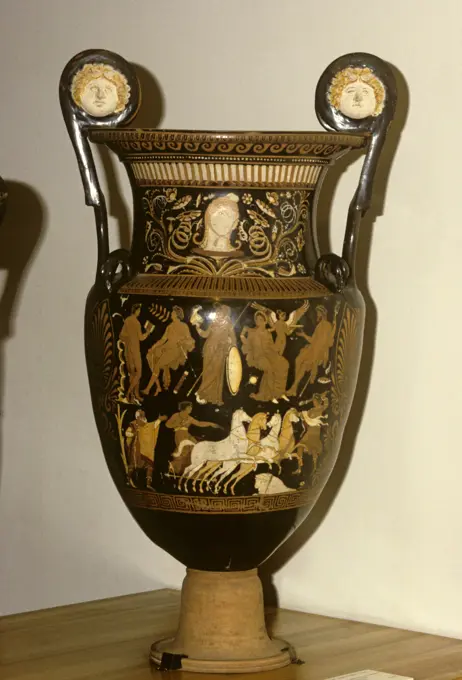
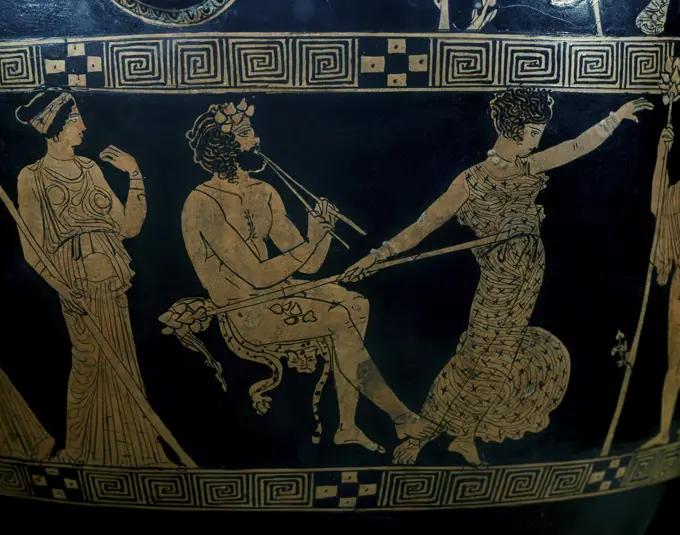
Krater representing a wedding procession, pottery from Magna Grecia, Italy. Greek Civilization, 5th-4th Century BC.
141 assets in this story
1788-18625
Geometric period krater
4409-62748522
Terracotta kylix (drinking cup). Greek, Attic, red-figure, ca 490 B.C. Attributed to Makron. Interior, youth and girl dancing with krotala (castanets). Metropolitan Museum of Art. Ny. USA. Author: Master of Saints Francis.
7155-70378845
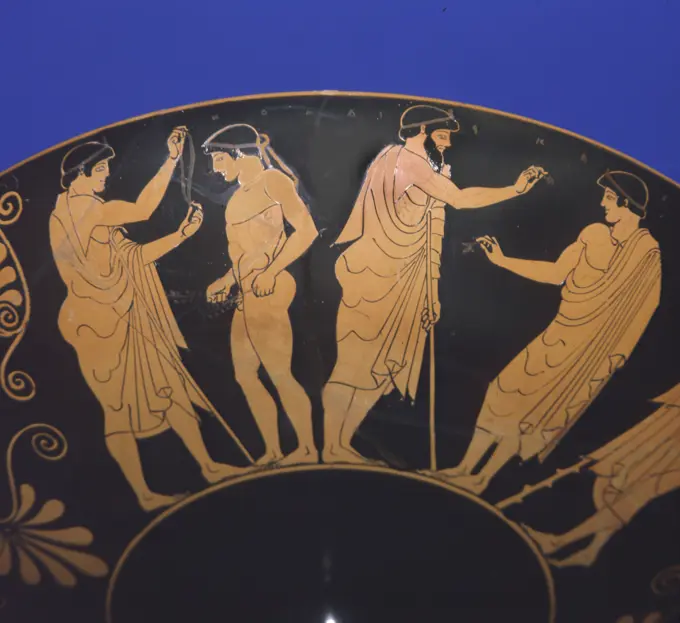
Prize giving. Athenian drinking cup from Vulci. 500 BC. Athlete presented with victory tokens. Greek vase painting.
6176-66096621
Penthesilea and Achilles
6145-29218778
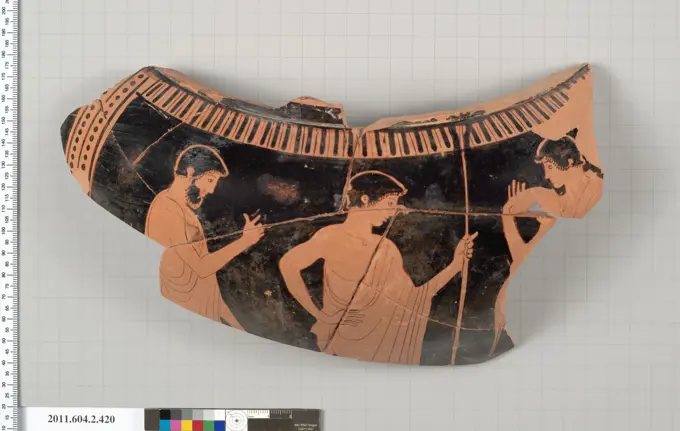
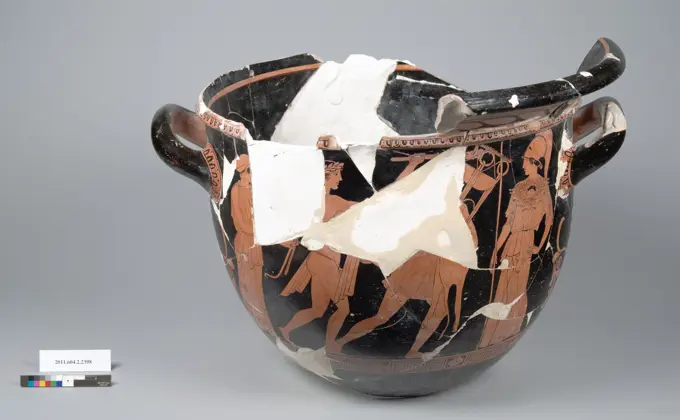
Terracotta fragment of a column-krater (bowl for mixing wine and water) 460-440 B.C. Greek, Attic Bit of the neck; at the shoulder, a band of tongues; draped, bearded male to right with his right arm bent and his hand raised; filleted youth with a himation, with his right arm bent and his hand on his hip and his left hand holding a spear; filleted youth to left, with a himation, with his right arm raised, holding a helmet in his left hand; the panel ornament is comprised of a vertical line between dots. Terracotta fragment of a column-krater (bowl for mixing wine and water). Greek, Attic. 460-440 B.C.. Terracotta; red-figure. Classical. Vases
6145-48837500
Attic Red-Figure Kylix. Attributed to Carpenter Painter (Greek (Attic), active 515 - 500 B.C.)
6145-59125635
Attic Red-Figure Cup Type B. Attributed to Onesimos, painter (Greek (Attic), active 500 - 480 B.C.) and Euphronios, potter (Greek (Attic), active 520 - 480 B.C.) about 490 B.C. The cup is mended from several fragments. The tondo on the interior is framed by a band of meander pattern. Within, a youth (wreathed, himation over shoulder, slippers) stoops to hold the head of his elder (wreathed and wearing a fillet, otherwise nude) who is vomiting. A staff lies to the left, and there is a partially preserved potter's inscription in added red. A: Komos. A youth (himation over his shoulders, staff in the background) walks to the right with his head down, looking into a drinking vessel (skyphos) and pointing towards a woman, who leans back on a striped cushion. She has a large skyphos in her left hand, and raises her right hand palm up. Her hair is tied up with a fillet. A second youth at right crouches, right arm akimbo, left hand raised and gesticulating. B: Komos. A nude youth with an erect
4409-20921149
VASIJA CERAMICA. Location: MUSEO RUIZ DE LUNA. TALAVERA DE LA REINA. Toledo. SPAIN.
6145-29230340
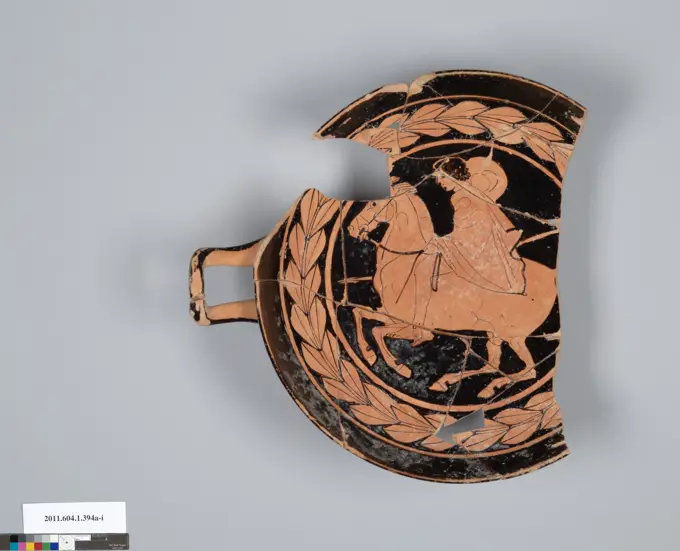
Terracotta fragment of a kylix (drinking cup) mid-5th century B.C. Greek, Attic Interior, Horse and rider. The rider wears a chlamys and petasos and holds a spear in his right hand. Around the tondo is a band of laurel leaves. Obverse, two youths with himatia draped over their heads, and leaning on sticks, flanking a youth with himation; two repair holes are visible; Reverse, repair, two youths with himatia draped over their heads, and leaning on sticks, flanking a youth with himation. Terracotta fragment of a kylix (drinking cup). Greek, Attic. mid-5th century B.C.. Terracotta; red-figure. Classical. Vases
6176-67049050
Persephone Taking Leave of Pluto with Hermes and Demeter standing nearby, c550BC-c525 BC.
1788-16224
Black-figure pottery, Lekythos by Amasis Painter depicting nuptial cortege with dancers and musicians
7155-70381184
Europe, Italy. Vase painting. Death of Hippolytus. Darius painter, Krater Apulian. 340 BC.
6145-52505710
Style Rhodien Ionian "Wild Goat" oenochoe, known as the "Lévy Oenochoe," 640-630 B.C., Louvre, Paris. Hachette (Firm). still image. 1910. The Miriam and Ira D. Wallach Division of Art, Prints and Photographs: Picture Collection. Pottery , Greece, Pottery, Greek, Antiquities, Pitchers, Vases , To 499, Containers , To 499, Animals in art
6145-30189773
Vessel Depicting a Sacrificial Ceremony for a Royal Accession 650 CE-800 CE Mexico. This vessel, used to consume a chocolate drink, depicts a key event in a royal Maya accession ceremony, which shows the relationship between human sacrifice and the assumption of power. The expectant king is flanked by servants, musicians, and masked nobles, while a terrified captiveóbound to a scaffoldóawaits his death. It is probable that the victim was a warrior from a rival community defeated by the prospective king during a coronation war. Such sacrifices were required as proof of a new rulerís military abilities, provided an offering to his patron gods, and served as a sign of the triumphant reign to follow.. Ceramic and pigment . Maya
6145-29230501
Terracotta fragment of a bell-krater (bowl for mixing wine and water) 460-440 B.C. Greek, Attic Obverse, Artemis to right, wearing a peplos and sakkos, holding a bow and arrows in her left hand; wreathed Apollo to right with a chlamys, with his right arm extended; Herakles to right, wearing an chitonikos with his lion skin, with his right arm raised over his head, holding his club in his hand, and the tripod in his left hand; helmeted Athena to left; wearing a peplos and her aegis, with her left hand below her hip, holding her spear in her right hand; Reverse, draped youth to left, and looking to right, wearing a himation with his right arm bent; winged woman to right wearing a sakkos, chiton, and himation; head, neck, left shoulder and hand of a draped, wreathed youth, looking to left, with a bit of his lyre (Eos and Kephalos), which is preserved below the fascia; on both the obverse and reverse, below the rim, a band of laurel; below, a fascia with an egg pattern with dots in the in
6145-29811578
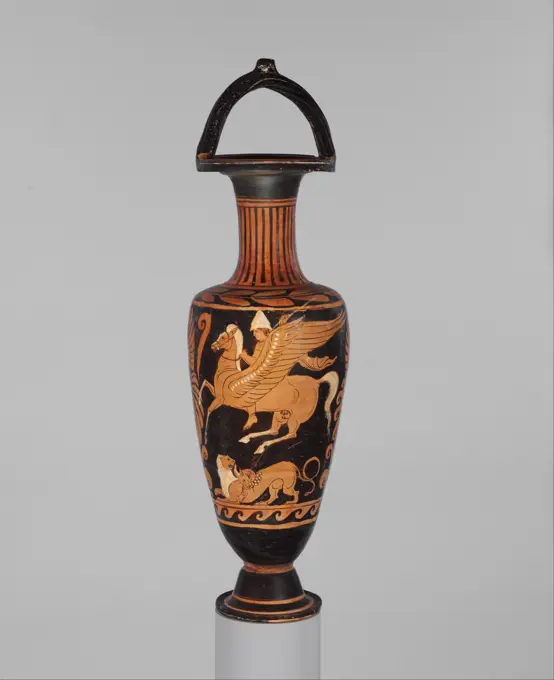
Terracotta bail-amphora (jar) ca. 330-310 B.C. Attributed to the Ixion Painter Obverse, Bellerophon and the chimaeraReverse, two youthsThe Ixion Painter was the foremost Campanian artist of the later fourth century, and the bail-amphora was favored in that region. The painter exploited the awkward, narrow verticality to depict Pegasos and Bellerophon airborne above the wounded chimaera. This mythical creature had a lion's body, a goat's forepart on its back, and a snake's tail.. Terracotta bail-amphora (jar). Greek, South Italian, Campanian. ca. 330-310 B.C.. Terracotta; red-figure. Hellenistic. Vases
4409-17290716
Roman Sculptor / 'Krater with reliefs of a Centaur Fighting'. Ca. 50 a.C.. White marble, Italian marble. Museum: Museo del Prado, Madrid, España. Author: TALLER ROMANO.
7155-70379282
Red Figure cup. Attic. Dionysus/Bacchus, Ariadne, and Eros. 400 BC.
6145-29787935
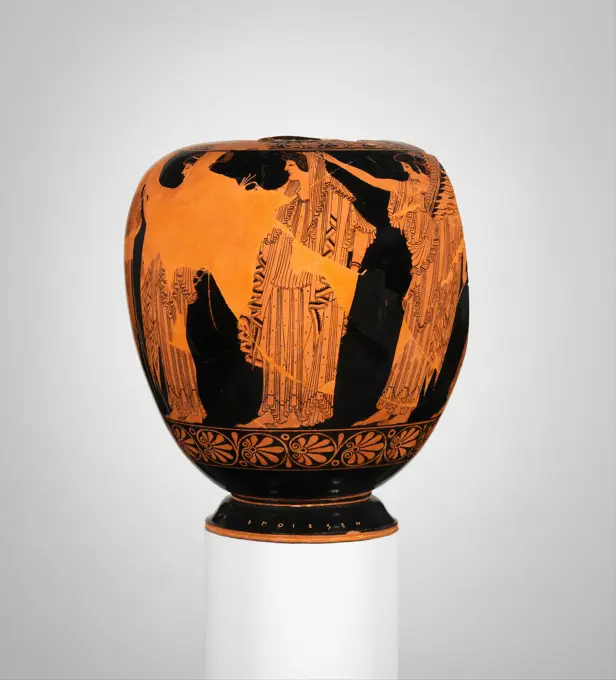
Two fragments of a terracotta oinochoe, joins 1981.11.9 ca. 520 B.C. Euthymides, Potter By the last decade of the sixth century B.C., there were artists who had achieved a virtuosic mastery of the red-figure technique and were responsible for the predominance that it gained over black-figure. Euthymides, a potter and painter,was one of these innovators belonging to what has been called the Pioneer Group. While Euthymides' signature as potter appears on the foot here, the painter remains unidentified. The goddesses following Hermes are Aphrodite, Athena, and Hera.. Two fragments of a terracotta oinochoe, joins 1981.11.9 255772
4409-17404061
Fragment of a terracotta bell-krater (bowl for mixing wine and water). Culture: Greek, Attic. Dimensions: Overall: 11 1/4 x 9 3/8in. (28.6 x 23.8cm). Date: ca. 450-440 B.C..Five athletesThe names of the figures were inscribed. Those preserved are Megakles and Euthykles. Representations of athletes afforded artists the opportunity to depict the human body in varying poses. Of note here is the frontal face, which suggests an interest in conveying not only physical appearance but also a state of being. Museum: Metropolitan Museum of Art, New York, USA.
1746-21124299
Attic vessel depicting a women offering at a tomb. By the Woman Painter. Dated 420 BC
463-3369
Dance of the Meanads in front of Dionysus Attic Vase Painting  Studio of the Meidias Painter 400 B.C. Badisches Iandesmuseum, Karisruhe, Germany
1788-41702
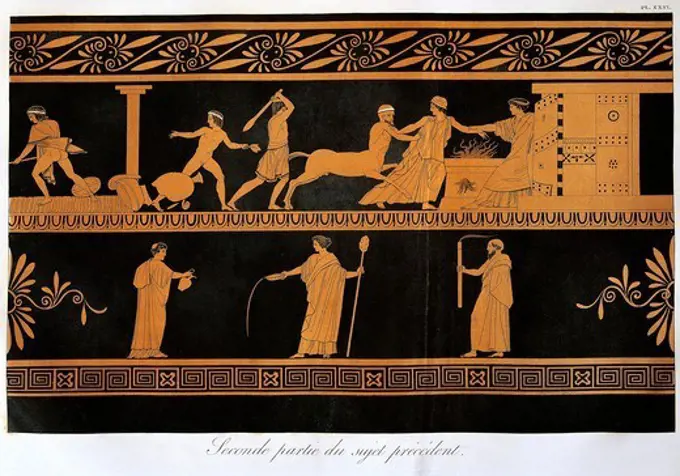
Battle of Lapiths and centaurs, engraving by Benedict Piringer (1780-1826) from a Greek original, from Collection de Vases Grecs de Ms le Comte de Lamberg, by Alexandre de Laborde, 1813-1824, Paris.
4409-18205521
Josep Aragay i Blanchart / Jarrón, siglo XX. Museu de Ceràmica de Barcelona.
4409-8013
LECITO GRIEGO - DETALLE DE DOS ATLETAS. Location: MUSEO ARQUEOLOGICO DE CATALUÑA. Barcelona. SPAIN.
4409-17390277
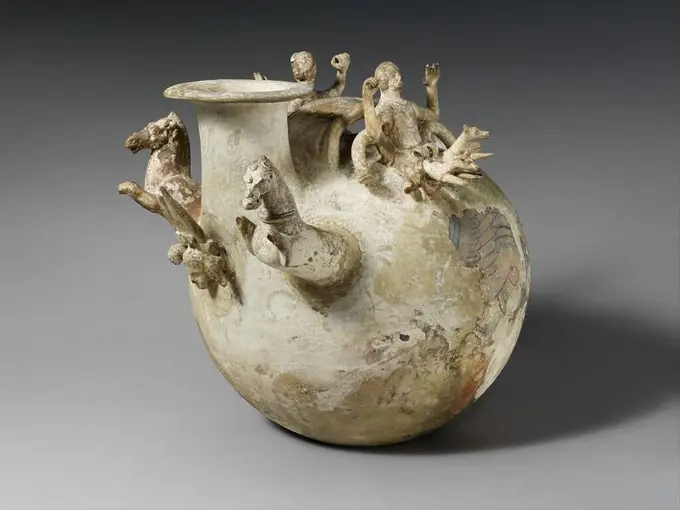
Terracotta askos (flask with a handle over the top). Culture: Greek, South Italian, Canosan. Dimensions: H. 17 3/8 in. (44.20 cm.)D. 16 in. (40.7 cm.). Date: 3rd century B.C..Scylla, the Homeric monster with the upper body of an alluring woman and scaly limbs eminating from her hips, rises from the body of this vase. Scylla lurked in a cave on the Straits of Messina, seizing and devouring passing dolphins, sharks, or sailors. Scylla was a popular subject on Canosan vases of this type, which characteristically combine sculpted and painted images. On the body of this vase remain traces of the richly colored ornament in pink and blue paint on a white slip. Museum: Metropolitan Museum of Art, New York, USA.
4409-17393238
Terracotta vase in the form of a black African youth's head. Culture: Etruscan. Dimensions: H. 9 in. (22.9 cm). Date: 4th century B.C..This vase combines the distinctive neck of the so-called Shape VII oinochoe with a naturalistic head of a young black African boy. His curls and the central rosette were made separately. Vases in figural form were popular items in several Mediterranean cultures. The Etruscans produced both terracotta and metal versions. Museum: Metropolitan Museum of Art, New York, USA.
1788-15055
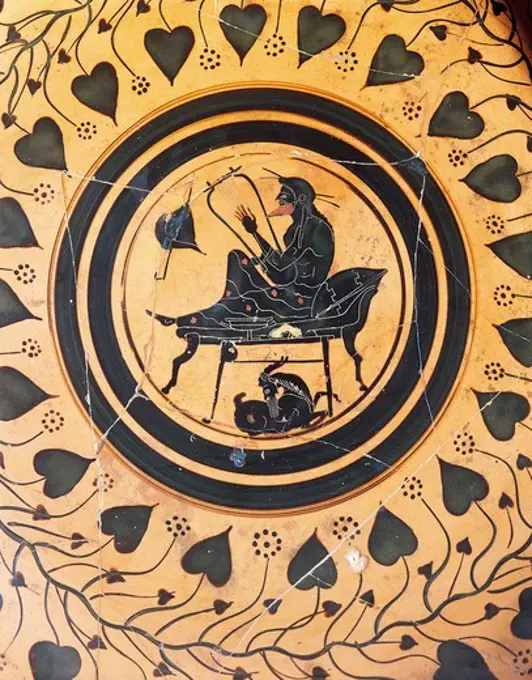
Etruscan civilization, Black-figure pottery, Kylix depicting lyre player, From Falerii Veteres, (Viterbo Province)
1525-28038678
Cadus, vintage engraved illustration. Dictionary of words and things - Larive and Fleury - 1895.
7155-70379265
Greek vase painting. Dionysus/Bacchus and Ariadne. 470 BC.
6145-50633512
Vase Heavenly
6188-54911758
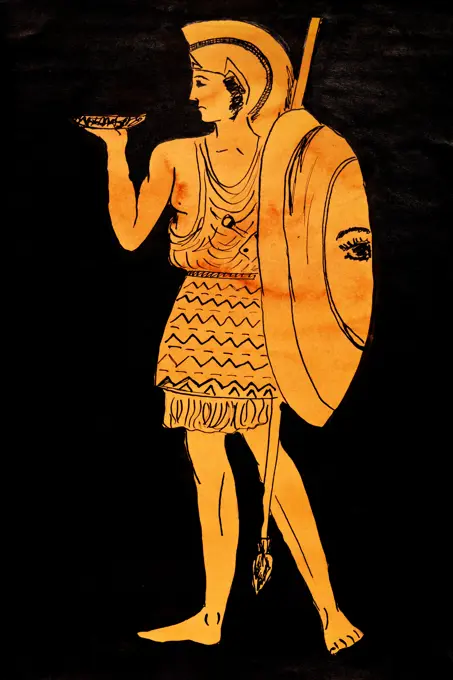
ancient greece Warrior historical costume - ancient greece Warrior stylized classical Greek painting 5th century BC ,property released Copyright: xZoonar.com/ValeryxVoennyyx 5026475 ,model released, Symbolfoto ,property released
6145-29710049
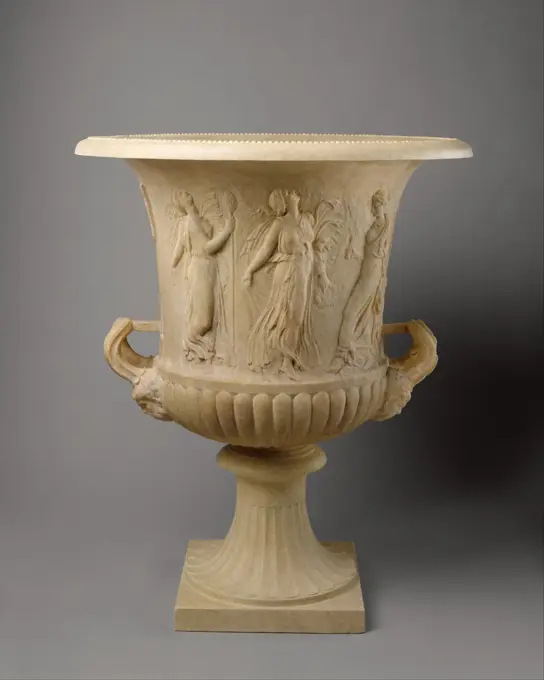
Marble calyx-krater with reliefs of maidens and dancing maenads 1st century A.D. Roman The peristyle courtyards and gardens of the villas belonging to wealthy Romans were filled with fountains, sculpture, and monumental ornaments such as this vase. Many of these decorative works were eclectic combinations of shapes and motifs drawn from the long, rich tradition of Greek art that had been produced some five hundred years earlier in the sixth and fifth centuries B.C. The six female figures that surround this vase are copies and adaptations taken from famous classical reliefs. On one side, two modestly wrapped maidens approach a girl playing a double flute, while on the other side, three maenads, followers of Dionysos, dance in abandon to the music of wooden clappers. Gnarled trees above the handles evoke an outdoor setting.. Marble calyx-krater with reliefs of maidens and dancing maenads. Roman. 1st century A.D.. Marble, Pentelic. Imperial. Stone Sculpture
6145-59181732
Lazio Viterbo Viterbo Museo Civico37. Hutzel, Max 1960-1990 Views of paintings (Middle Ages through 18th c.), frescoes, a tabernacle, coffin, sculpture reliefs, portal fragments, busts, sculpture, tapestry found in the Pinacoteca, Second floor gallery and Second floor cloister sequences. Antiquities: Many views of Etruscan and Roman fragments, sculpture, sarcophagi, pottery, masks, jewelry and other objects found in the Storeroom sequence (inventory numbers on back of prints), and the Cloister, Second floor Cloister, Valle Giulia, Sala Romana and Sala Etrusca sequences. General Notes: There are eight separate numerical sequences for this location. The cloister as an architectural structure, rather than museum site, is documented in the record and file for S. Maria della Verita, Cloister, all views of which are stored in Medieval core collection. Five views from the Museo Civico Second floor cloister sequence are stored in Medieval. German-born photographer and scholar Max Hutzel (1911-
6176-66096657
As in the epic poem Odyssey by the Greek bard Homer, Odysseus follows Nausicaa in her chariot to the palace.
4409-19059208
decorated krater, wine bowl, made in Lucania, 410-400 BC, British museum, London, England, Great Britain.
6145-29248764
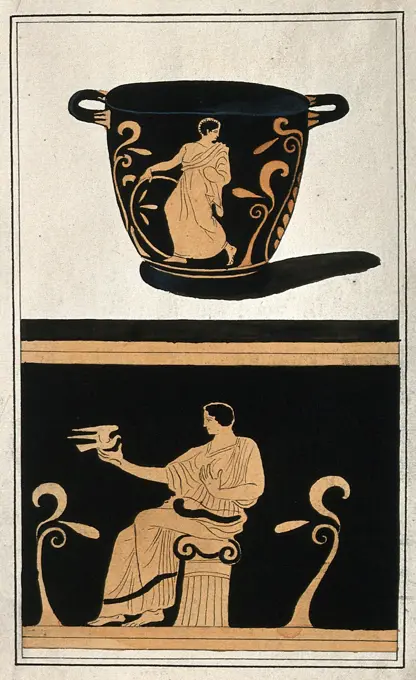
Above, a red-figured Greek wine bowl (krater); below, detail of the decoration showing a seated man holding a dove. Watercolour by A. Dahlstein, 1760/1780 ().
6145-29118044
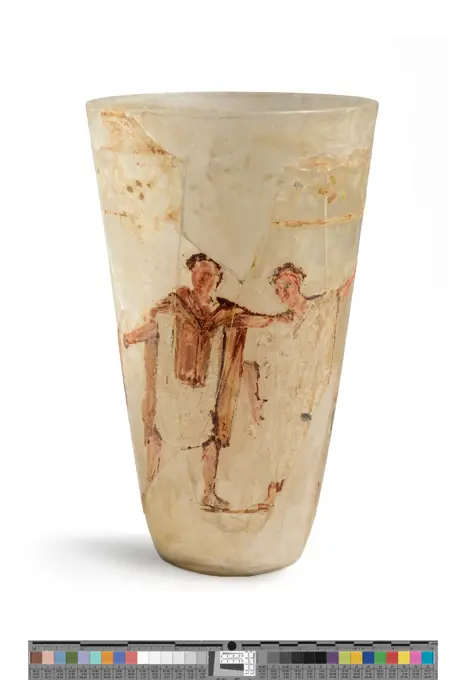
Beaker with a Theatrical Scene. Roman Empire, probably from Syria, Palestine, or Egypt, 50-100. Furnishings; Serviceware. Free-blown, painted, and gilt glass
6189-55132211
Dioniso persiguiendo una ménade, Crátera - calyx-Krater-, 440 a. C, Agrigento, í. tica, Grécia, Fundación Calouste Gulbenkian, («Fundaçío Calouste Gul...
6145-48839971
Kylix. Unknown
1746-19666518
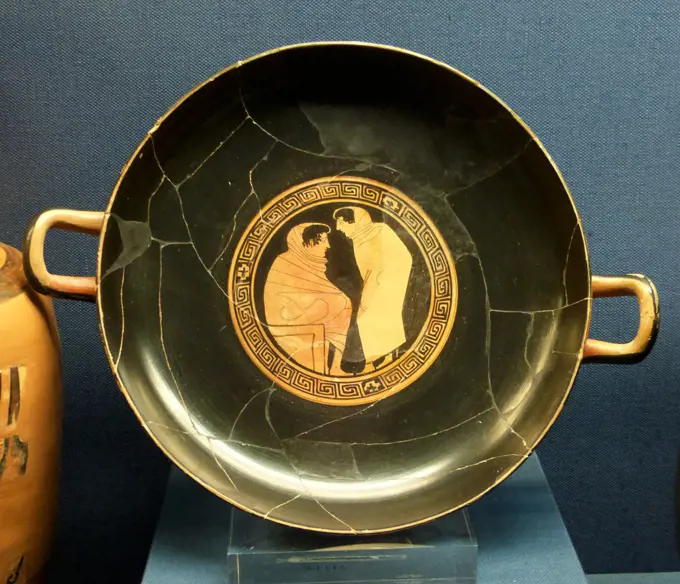
Attic red-figure kylix decorated inside with a scene of conversation between two male figures. Attributed to the Painter of Brussels. Circle of the Penthesilea Painter. 460-450 BC
PREVIOUS
of 2
NEXT
2401 S. Ervay, Suite 206
Dallas, Texas 75215
United States
Get Started
Free ResearchMy BoardsMy Cart
For Creators
How To License Your ContentContributor PortalFrame of Mind
Resources
API accessPricing
Contact
+1 866 236 0087help@viewpictures.co.uk Contact form
©2026 View Pictures. All Rights Reserved. -B
This site is protected by reCAPTCHA and Google Privacy Policy and Terms of Service apply.