Ancient Textile Fragments

Various historical textile fragments featuring intricate patterns and motifs, showcasing artistry from different periods, including geometric shapes and animal designs.
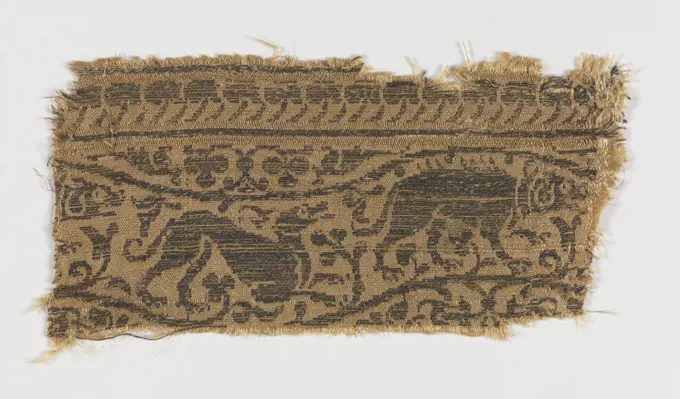
Fragment, Medium: silk, metallic Technique: 2/1 twill pattern by plain weave, Two different animals within curving band., Italy, 14th-15th century, woven textiles, Fragment
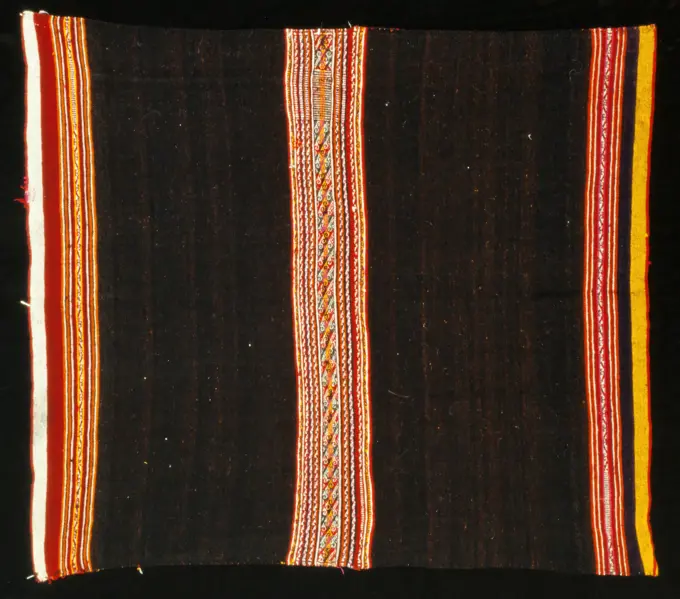
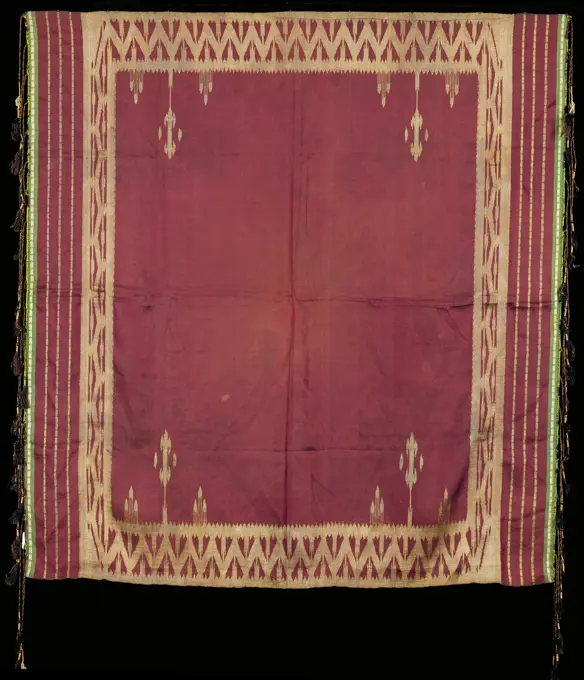
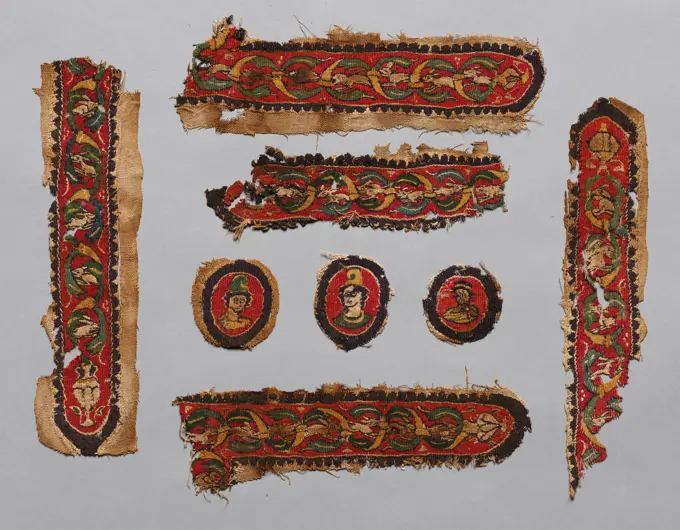
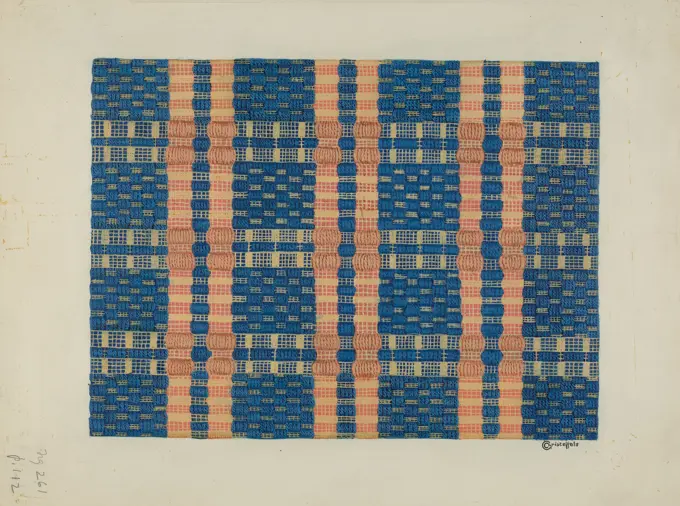
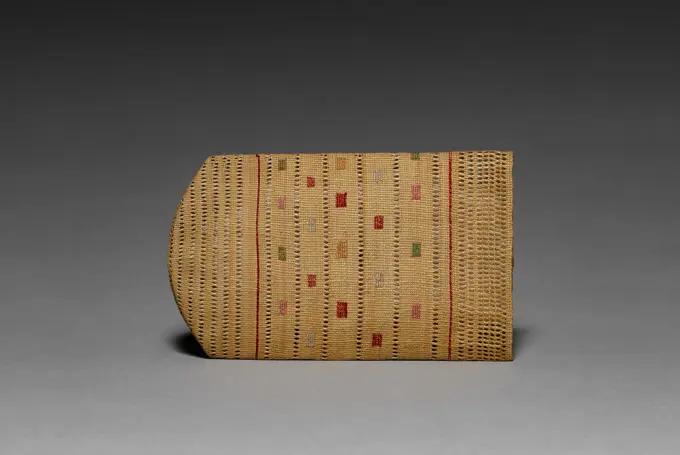
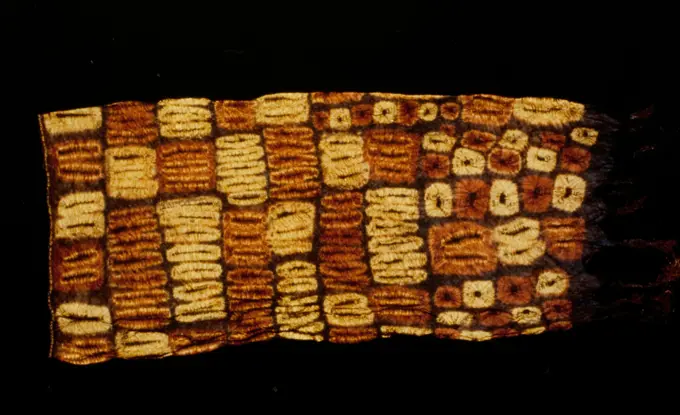
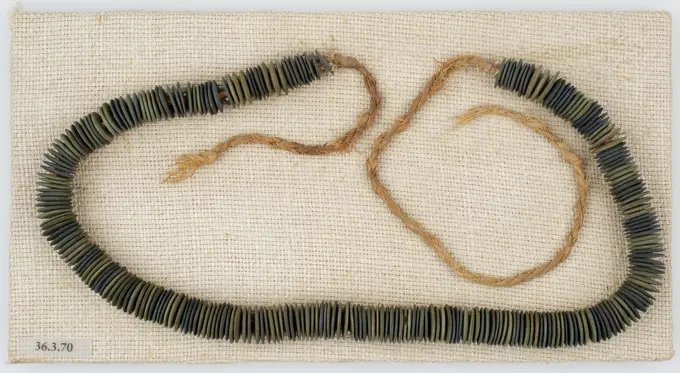
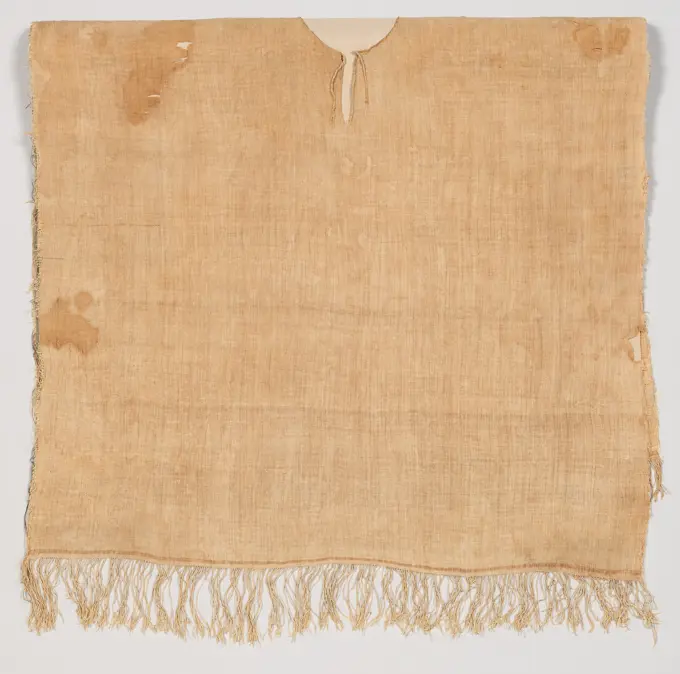
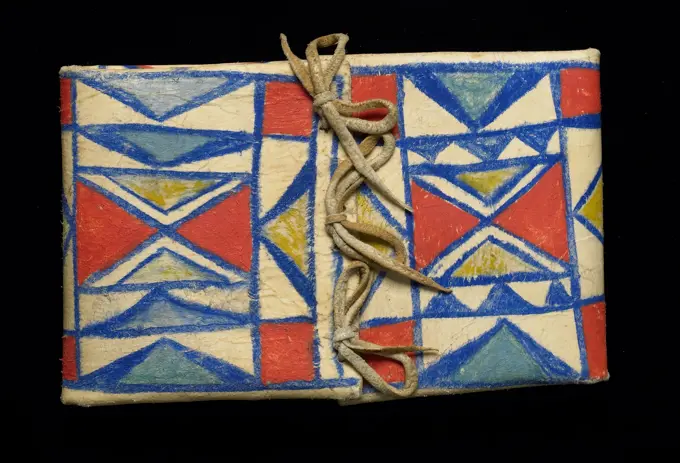
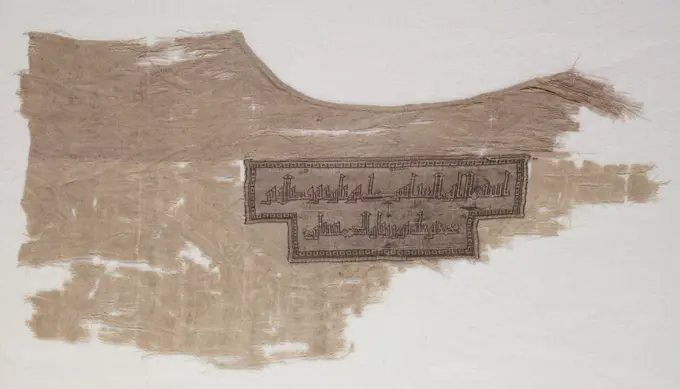
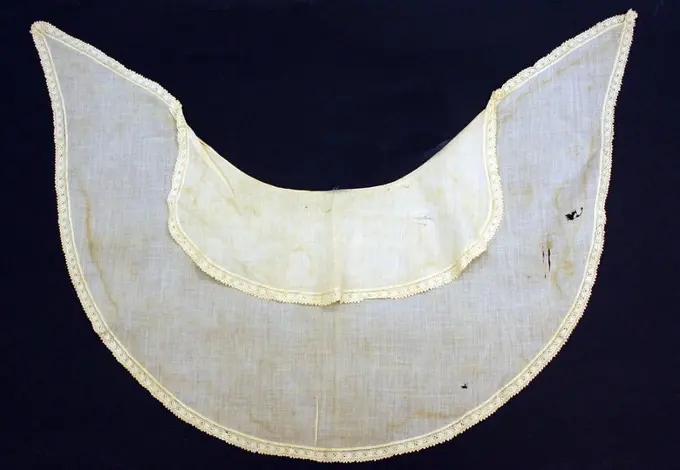
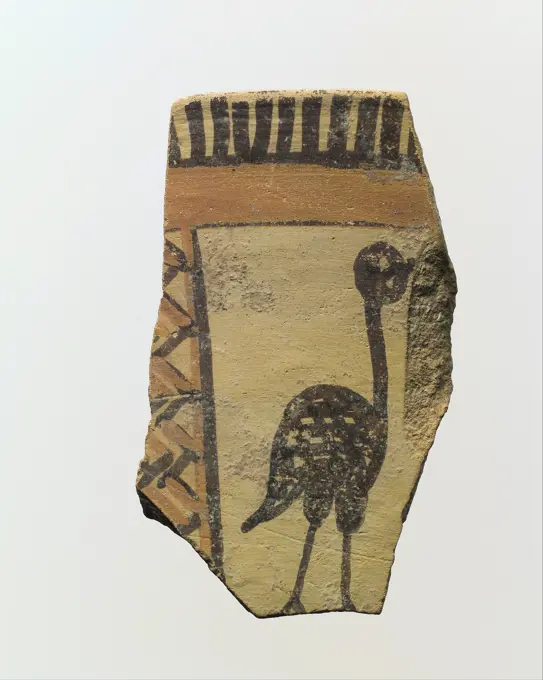
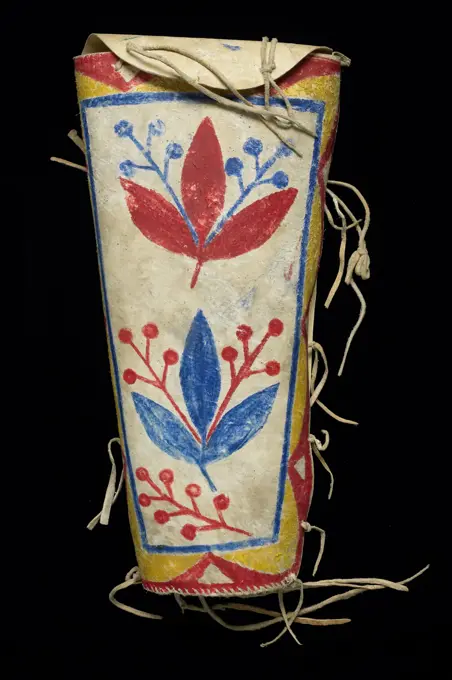
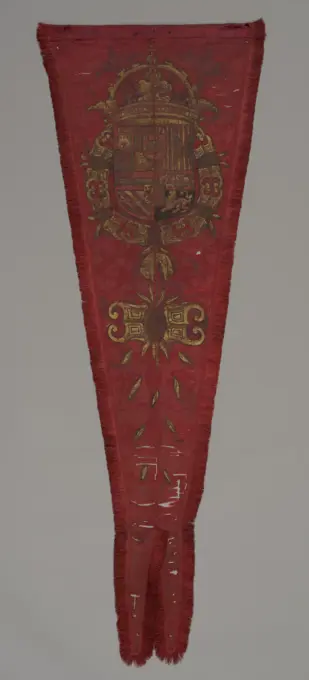
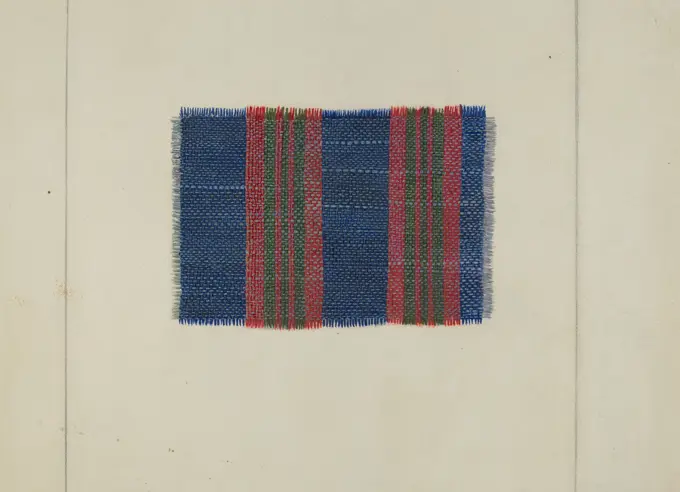
Trimming Fragment (Italy); silk and metallic gold thread; 1932-3-672 Band Fragments with Botanical and Geometric Decoration Coptic. 2 Band Fragments with Botanical and Geometric Decoration, 5th-7th century C.E. Wool, 2 3/8 x 5 3/8 in. (6 x 13.7 cm).   Egyptian, Classical, Ancient Near Eastern Art 5th-7th century C.E.Shawl (Llklla), 1965-1975, 37 x 43 in. (94.0 x 109.2 cm), Wool, Bolivia, 20th centuryFragment zijdeweefsel, , c. 1300 - c. 1399 Fragment of 2 pattern side pieces put together with a repeating pattern in green and gold from dragons with the heads of each other, interspersed with lobed oval medallions in which two lions bothered to each other. Italy Ketting an element: Silk. lampas (textile material) / double weave Fragment of 2 pattern side pieces put together with a repeating pattern in green and gold from dragons with the heads of each other, interspersed with lobed oval medallions in which two lions bothered to each other. Italy Ketting an element: Silk. lampas (textile material) / double weaveKesrowan, c. 1950-1960, 45 1/4 x 48 1/4 in. (114.9 x 122.6 cm) (without fringe), Rayon or silk, Syria, 20th centuryFragment, Medium: cotton Technique: resist-printed on plain weave, Unbleached plain weave cotton resist-printed in red, now faded to brown. Series of vertical bands with pattern reserved in ground color. Furthest left, large Kufic letters; following, remains of a vine patterns; following, another vine pattern; far right, what may be a portion of inscription., India, 14th-15th century, printed, dyed & painted textiles, FragmentFragments from a Tunic, 500s - 1500s. Egypt, 6th - 16th century. Tabby weave with inwoven tapestry ornament, linen and wool; overall: 45 x 53 cm (17 11/16 x 20 7/8 in.).Band (Italy); linenFragments; silk, metallicWall hanging made of silk fabric unknownCornelius Christoffels, Coverlet, c 1940 CoverletScheepsvlag, Anonymous, 1800 - 1890 flag. ship flag Three jobs Red-white-blue. Inscription: Ned Vl 4 «Kd. Netherlands woolSample (USA); linenSampler, Medium: silk, cotton and linen embroidery on linen foundation Technique: embroidered in satin, eyelet, stem, back and cross stitches on plain weave with withdrawn element work, Letters and detached geometric motifs. Withdrawn element work with needle-made fillings using linen., Friesland, Netherlands, 1688, embroidery & stitching, SamplerFragments Of A Chasuble; wool, linenKontusz sash/belt. Manufaktura Paschalisa Jakubowicza (Warszawa ; wytwórnia pasów ; 1788-1794), authorTools for a needle side motif in the form of tailor linen on which green parchment is sewn with white trace wires in bookmark form, Kantwerkschool (The Hague), c. 1906 - c. 1910 Tools for a needle side motif in the form of double tailor linen on which green parchment is sewn. On the parchment, a decorative band is made with white tracer wires with six rosette flowers in a row, each with six petals and caught in a circle. There are always two dots between the successive circles. The workpiece in the making seems like a bookmark, with a point at one end and a dovetail at the other end. The rosette flowers and dots are already filled with a variation of feston stitches. On the parchment is written with pencil: "1.50". The Hague linen (material). parchment (animal material) sewing Tools for a needle side motif in the form of double tailor linen on which green parchment is sewn. On the parchment, a decorative band is made with white tracer wires with six rosette flowers in a row, each with Fragment multicolored brochure, anonymous, 1740 - 1760 Five fragments of pink satin, in which flowers and houses are woven. NOTE: MEERSHIP; 0.6 cm 4 Coarse Nichters, Multicolored.  silk. Five fragments of pink satin, in which flowers and houses are woven. NOTE: MEERSHIP; 0.6 cm 4 Coarse Nichters, Multicolored.  silk.Textile (Egypt); linen, silkConciliate belt;  18th century (1701-00-00-1800-00-00);Padement of gold and silver thread. Idesement or Gold and Silver Wire.Indian Trade Textile(Leluhur)Empty wooden cutting board for preparing ingredients for preparing a delicious dish. Kitchen utensilsFragment (Italy); silkBand (Italy); linen; Bequest of Marian Hague; 1971-50-199Trimming (France); silkExcerpt of an embroidery, anonymous, c. 1500 - c. 1600 Fragment of an embroidered praetexta or aurifries of a Dalmatics. The fragment consists of red satin on a linen lining. The embroidery has rinceaux of gold and silk in the colors yellow and green. The fragment is part of two fragments with invnrs. BK-NM-1239-B-1 and BK-NM-1239-B-3. Netherlands (possibly)Italy (possibly) satin. linen (material). silk embroidering Fragment of an embroidered praetexta or aurifries of a Dalmatics. The fragment consists of red satin on a linen lining. The embroidery has rinceaux of gold and silk in the colors yellow and green. The fragment is part of two fragments with invnrs. BK-NM-1239-B-1 and BK-NM-1239-B-3. Netherlands (possibly)Italy (possibly) satin. linen (material). silk embroideringPiece 17th century Japan. Piece. Japan. 17th century. Silk / Compound weave. Textiles-WovenShoulder Band Fragment 5th-6th century. Shoulder Band Fragment 447854Baby carrier, 20th century, 213 x 28 in. (541 x 71.1 cm) (approximately), Cotton, silk, China, 20th centuryTextile, Medium: cotton, wool Technique: slit tapestry, non-horizontal wefts, Fragment of a border of a garment: border patterned by diagonal bands of interlocked bird or serpent heads in multi-colors with a narrow interlock patterned band in red and pink at top and bottom. Yellow tab fringe at bottom and isolated stepped triangles with interlocked bird or serpent heads at the top which originally were continuous with the plain fabric of the main body of the garment., Peru, 1200-1500, woven textiles, TextileEmbroidered Band for Curtain, 1800s. Morocco, Chechauen, 19th century. Embroidery: silk on linen tabby ground; overall: 98 x 31 cm (38 9/16 x 12 3/16 in.).Textile Fragment 18th century. Textile Fragment. 18th century. Silk. Made in Iran. TextilesFragment, Medium: linen Technique: bobbin lace (continuous tape with connections), Fragment with a wavy, ribbon-like, floral design., Belgium, 17th century, lace, FragmentCollar (USA); silkGallon;  beginning of the 19th century (1801-00-00-1810-00-00);Shard: Bust and Profile of a Figure ca. 4th-5th century Pakistan. Shard: Bust and Profile of a Figure 51100Fragment from a Border Made 1601-1700 Italy. Linen, plain weave; embroidered with silk floss in double running and back stitches .Curtain of a bedgar of yellow waved wool with green passion and hanging spools, c. 1795 - c. 1815 Curtain of a bedgar of yellow waved wool, omboard with a green passion with a yellow motif and with a green and yellow border with hanging spools that are wounded with yellow and green side. Northern Netherlands wool. passement: silk. ringen: metal Curtain of a bedgar of yellow waved wool, omboard with a green passion with a yellow motif and with a green and yellow border with hanging spools that are wounded with yellow and green side. Northern Netherlands wool. passement: silk. ringen: metalNeedlepoint (Drawnwork) Lace Cuff, 19th century. Italy, 19th century. Lace, needlepoint: linen; average: 8.3 x 17.2 cm (3 1/4 x 6 3/4 in.).Fragment Made 1000-1476 Peru. Cotton, plain weave; painted . ChancayTextile Fragment 5th century. Textile Fragment 443906Cigarette or Needle Case, c 1875- 1917 (source unknown). Arctic, Aleut, Attu, Post-Contact. Plain twine, wild rye grass with crossed openwork, patterned twined start, intersecting layered spokes, and plaited finish; silk embroidery (catalogue card); overall: 2 x 11.5 cm (13/16 x 4 1/2 in.).Strip mid-18th century Flemish. Strip 227267Strip of gold side with wide wavy band and fan shapes, anonymous, c. 1700 - c. 1799 Strip bobbin, gold side. The pattern consists of scales with fan forms, which are created below and above a wide wavy band of vertically tense threads. The scallops consist alternately of a fan crowned by a smaller fan and a heart crowned by a fan. A cross is made in the heart in the heart. Work has been done with slat gold thread, smooth filé yarn and ribbed filé yarn, in different thicknesses. France (possibly) . bobbin lace Strip bobbin, gold side. The pattern consists of scales with fan forms, which are created below and above a wide wavy band of vertically tense threads. The scallops consist alternately of a fan crowned by a smaller fan and a heart crowned by a fan. A cross is made in the heart in the heart. Work has been done with slat gold thread, smooth filé yarn and ribbed filé yarn, in different thicknesses. France (possibly) . bobbin laceWoman's skirt, 20th century, 33 1/2 x 15 11/16 in. (85.09 x 39.85 cm) (without fringe), Raffia; oblique interlacing, resist tie-dye and stitched-resist dye, Côte d'Ivoire, 20th century, The Dida of Côte d'Ivoire produce some of the most striking and unique textiles found in Sub-Saharan Africa. Using the unusual technique of oblique interlacing, Dida artisans painstakingly plait up to 1,500 strands of raffia into a long, narrow tubular form. When the garment is completed, it is embellished with intricate, bound and stitched-resist dye techniques in repeating patterns of rectangles, circles and elongated ovals.Piece 18th century French. Piece 213356Fragment of a door, anonymous, c. 1400 - c. 1500 Fragment of a door consisting of three wide boards, which are connected by iron staples. The door is attached with iron handles, sometimes ending in a stylized lily. Probably it is the fragments of doors from the St. Servaaskerk in Maastricht. Northern Netherlands wood (plant material). iron (metal) Fragment of a door consisting of three wide boards, which are connected by iron staples. The door is attached with iron handles, sometimes ending in a stylized lily. Probably it is the fragments of doors from the St. Servaaskerk in Maastricht. Northern Netherlands wood (plant material). iron (metal)Piece 18th century French. Piece 224028Shebiu Necklace of Hatnefer ca. 1492-1473 B.C. New Kingdom This necklace was found in the tomb of Hatnefer inside a basket that is now in the Egyptian Museum, Cairo. The basket also contained a razor, a sealed pottery juglet, a pottery jar, and a linen sheet.The necklace consists of lentil-shaped beads made of Egyptian faience, a ceramic material made of quartz frit. The beads are still strung on the original two-ply linen cord.. Shebiu Necklace of Hatnefer 548732Embroidery patch made of red cotton on cotton., C. 1900 Embroidery patch made of cotton on cotton. The embroidery has four square motifs, two corner patterns and different edge patterns. The lap is finished all around with a knotted frills. Netherlands cotton (textile) embroidering Embroidery patch made of cotton on cotton. The embroidery has four square motifs, two corner patterns and different edge patterns. The lap is finished all around with a knotted frills. Netherlands cotton (textile) embroideringSkirt Cloth (KainSungkit)Sampler (Netherlands); silk, cotton and linen embroidery on linen foundation; 23 x 31.5 cm (9 1/16 x 12 3/8 in.); Bequest of Mrs. Henry E. Coe; 1941-69-35Child's Shirt 650-400 B.C. Late Period This shirt was found within the wrappings of the mummy of a girl judged by the excavator to be 9 or 10 years old. Its side seams had been ripped open and it was wrapped like a shawl.. Child's Shirt 548288Sample early 19th century French. Sample 219327Parfleche, 8 7/8 x 5 5/8 x 1 in. (22.54 x 14.29 x 2.54 cm), Animal hide, pigment, United StatesBand (Peru); cotton and wool warp, wool weftBand Fragment (Egypt); warp; s-spun linen. wefts; s-spun linen, s-spun woolsPiece 17th century Japan. Piece 71116Fragment from a Mantle. Probably central coast, Peru. Date: 1000-1476. Dimensions: 25.4 x 19.1 cm (10 x 7 1/2 in.). Cotton and wool (camelid), two- and three-color complementary weft plain weave with inner warps and self-patterned by weft floats; band of plain weave with slit tapestry tab fringe. Origin: Peru. Museum: The Chicago Art Institute, Chicago, USA. Author: Chancay.Element of a Border for an Icon Frame 10th century Byzantine. Element of a Border for an Icon Frame. Byzantine. 10th century. Cloisonné enamel, gold. Enamels-CloisonnéFragment, Medium: cotton, silk Technique: satin stitch embroidery, Square of cotton solidly embroidered in an allover geometric and stylized floral pattern., Balkans, 19th century, embroidery & stitching, FragmentFragment zijdeweefsel, anonymous, c. 1300 - c. 1399 Fragment red-purple side with pattern in yellow of circles and tires surrounded by vines. In the circles with gold thread an opposite running griffin with "Grifone" on the wing. Birds sitting in the ties. Italy silk. metal thread Fragment red-purple side with pattern in yellow of circles and tires surrounded by vines. In the circles with gold thread an opposite running griffin with "Grifone" on the wing. Birds sitting in the ties. Italy silk. metal threadPiece 19th century Japan. Piece 71985Fragments from a Garment with Inscription, 1900s. Iran or Iraq. Silk: lampas weave, brocaded; average: 26.5 x 48.7 cm (10 7/16 x 19 3/16 in.). These two fragments are a portion of a sleeve and the neck edge of a garment. Centered below the neckline is a T-shaped cartouche bordered with a block motif and enclosing two lines of inscription.Fragment. Possibly Chimú; Possibly north coast, Peru. Date: 1250-1470. Dimensions: 13.7 x 7.6 cm (5 3/8 x 3 in.). Cotton and wool (camelid), bands of plain weave and plain weave with supplementary brocading wefts. Origin: Peru. Museum: The Chicago Art Institute, Chicago, USA.Fragment; linen; Bequest of Marian Hague; 1971-50-237Tunic Fragment 7th-9th century Wari. Tunic Fragment 309761Sherd from restoration of vertical column andinscription.  Artist: Kleophrades Painter, Greek, Attic, ca. 505-475 B.C.Part of a Bed Hanging, 19th century, 83 1/2 x 63 3/4 in. (212.1 x 161.9 cm), linen; needlework, Turkey, 19th centuryTextile (USA); cottonNeckpiece. Culture: American or European. Date: 1700-1945. Museum: Metropolitan Museum of Art, New York, USA.Circus Pony Robe. Dated: 1941. Dimensions: overall: 50.8 x 62.1 cm (20 x 24 7/16 in.) Original IAD Object: 44" long; 57 1/2" wide. Medium: watercolor and graphite on paperboard. Museum: National Gallery of Art, Washington DC. Author: Herman O. Stroh.Piece of fabric. unknown, authorCope Hood; silk, metallic threads; Warp x Weft: 37 x 42.5 cm (14 9/16 x 16 3/4 in.)Belt plate. Bronze. III-nth centuries before J.-C. Northern China. Paris, Cernuschi museum. 59514-11 Chinese antiquity, bronze, belt, ancient, plateWool Textile Fragments with ColoredPattern.Tail (replica) for beadwork apron of Senebtisi ca. 1850-1775 B.C. Middle Kingdom. Tail (replica) for beadwork apron of Senebtisi 692413Gallon-corner;  XVIII/19th century (1791-00-00-1810-00-00);Sherd ca. 5600-5000 B.C. Halaf Halaf pottery was made by hand and decorated with very finely executed designs in one or two colors. The surface of the finest pottery was then highly burnished and a glossy effect was achieved by the use of fluxes, which serve to lower the melting point of the pigments, in some cases accidentally achieving true glazes. This fragment of a thin walled vessel has the exterior painted with light and dark brown decoration consisting of a stylized bird in profile with back arched, a long neck, and a large circular head. A vertical zigzag pattern on the left and a dark brown band partly frame the bird. The rim edge has a horizontal band with vertical stripes.. Sherd 327376Mitaine from beige silk Egyptian braid. Mitaine from beige silk Egyptian braid. Fingerless, finished down law. Over the entire height, four-fold moes are sprinkled over the RIsterfond. At the wrist a finer mesh stock begins decorated with an Ajour zigzagrand.Part of a lace border plot on machine tulle, anonymous, c. 1850 - c. 1899 Part of a collar of natural -colored lace bobbins, removal on mechanical tulle. The pattern pattern has a bond with godrons and a horizontal flower branch interspersed with a large three -lobe leaf with three flowers above it. In the tip of the collar, the pattern has a pointed bond with Godrons. One short and one long side are finished with a feston stitch. The top is finished with a zoompje. The other short side is not finished, but cut. West-Europa Part of a collar of natural -colored lace bobbins, removal on mechanical tulle. The pattern pattern has a bond with godrons and a horizontal flower branch interspersed with a large three -lobe leaf with three flowers above it. In the tip of the collar, the pattern has a pointed bond with Godrons. One short and one long side are finished with a feston stitch. The top is finished with a zoompje. The other short side is not finished, but cut. West-EuropaNorma Lockwood, Pocketbook, c 1939 PocketbookIkat-dyed Blanket Made 1875-1900 Malaysia. . IbanDress with the weapons of Sickinge and Jongema and seven small objects; Exhibition Dutch heraldry from the textile collection of the Rijksmuseum. .Frill of gold.frill or gold.Wreath fillet, funerary Greek or Roman. Wreath fillet, funerary. Greek or Roman. Gold. Gold and SilverFringe, Medium: silk, metallic thread (gold strips wound on a silk core) Technique: plain weave, Red and metallic gold fringe with a woven heading in a trellis design formed by an overlay of gold threads. Fringe over a skirt of twisted red threads., Italy, 16th century, trimmings, FringeGalloon 17th-18th century Unknown. Galloon 213838Merklap of cotton on which with red silk ih.scholtz.als.hal, various other initials, jumping deer, flower pots and rabbits, anno 1874, Johanna Hendrika Scholtz, 1874 Symmetrically built up, but not initials mirror image. IH.Scholtz, the craftsman; ALS and DLS (in Krans), the parents; MG, MS, MN, MB, De Regentessen ('Mothers'). The meaning of the other initials is unknown. Rabbits, whether or not in a closed garden, formed a popular pattern on the brand laps of the craft schools in Amsterdam. This one-embroidered wipes distinguish itself from others by the careful way of working: the front and back are identical, but in mirror image. Dutch Reformed Diaconie Orphanage Lap: Cotton (textile). Embroidery: Silk embroidering  Amsterdam Symmetrically built up, but not initials mirror image. IH.Scholtz, the craftsman; ALS and DLS (in Krans), the parents; MG, MS, MN, MB, De Regentessen ('Mothers'). The meaning of the other initials is unknown. Rabbits, whether or not in a closed garden, formed aBracelet with glass inlay 3rd-4th century A.D. Roman. Bracelet with glass inlay. Roman. 3rd-4th century A.D.. Gold, glass. Late Imperial or Late Antique. Gold and SilverBorder Made 1880-1900 France. Cotton and linen, Leavers machine lace, an imitation of a bobbin lace known as Mechlin .Fries with single ornaments, leaf from the episode "Zierhat Boichengen. Arranged by Johann Halueren Goltschmidgenge". Gift by Justus BrinckmannPanel. Egypt, 12th or first half of 13th century. Wood. Wood, carved and paintedFringe (Greece); silkBurse, embroidered, red  the Korab and Dołęga coat of arms unknownParfleche, c. 1910, 15 1/8 x 7 x 2 in. (38.42 x 17.78 x 5.08 cm) (without ties), Animal hide, pigment, United States, 20th century, It is unusual for pictorial decoration to appear on rawhide containers; only a few exist that were created in later years. This object shows a chokecherry leaf and berry indicating that the container was possibly used for gathering chokecherries, an important ingredient for preparing food among Plains Indian cultures. The berry was often used in pemmican, a mixture of dried meat, berries, and fat that was easily stored and transported; it provided a significant amount of nutrition for Plains people, particularly in the winter months. In addition, women of some tribes used chokecherry juice to size their rawhide containers, which protected the rawhide from wear and exposure to the elements. The painted design therefore reflects the container's function as well as the elements that went into its creation.Przeszo Przyszoci unknownSteel bobbin with coarse wire as an example of a ribbon in linen stroke with recesses used in Russian ribbon side, anonymous, c. 1900 - c. 1930 sample Steel natural and colored bobbin with coarse wire as an example of a ribbon in linen stroke with recesses. This type of ribbon is used in Russian ribbon side. West-Europa cotton (textile) bobbin lace / tape lace (bobbin lace) / Russian tape laceFrank J Mace, Linsey Woolsey, c 1937 Linsey Woolsey