Ancient Textile Fragments

Various historical textile fragments featuring intricate patterns and motifs, showcasing artistry from different periods, including geometric shapes and animal designs.
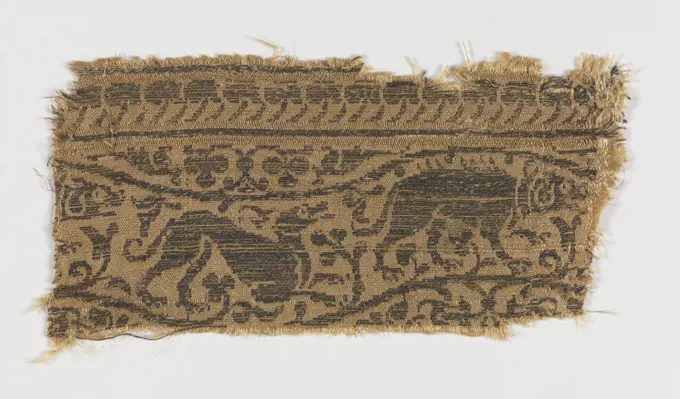
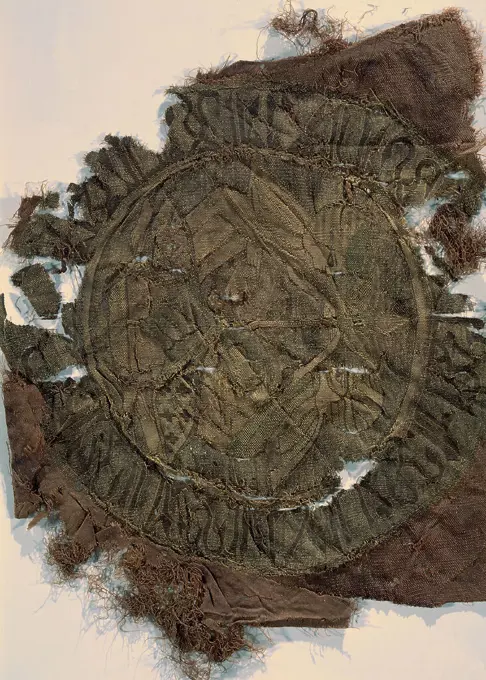
Fragment, Medium: silk, metallic Technique: 2/1 twill pattern by plain weave, Two different animals within curving band., Italy, 14th-15th century, woven textiles, Fragment
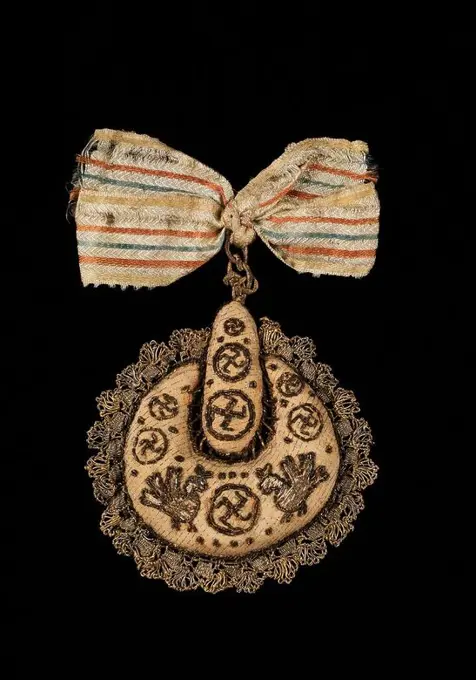
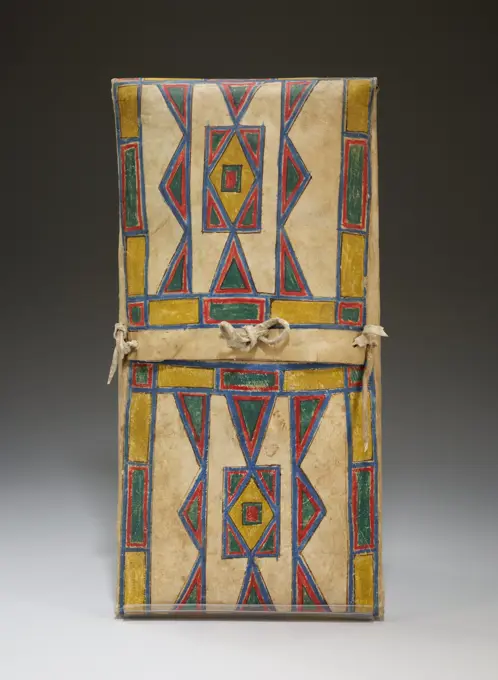
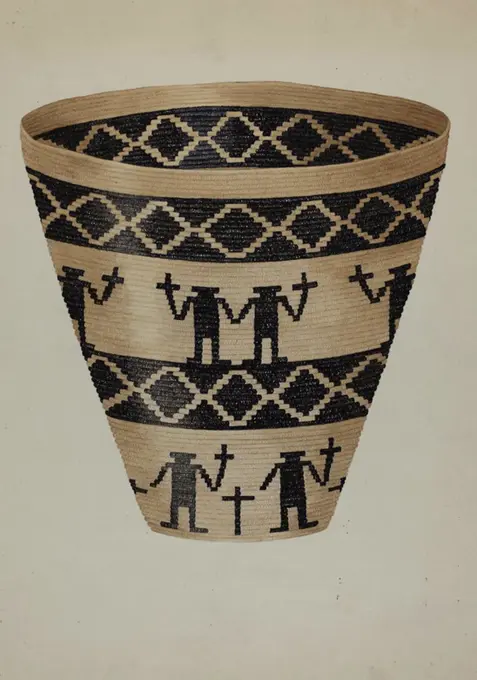
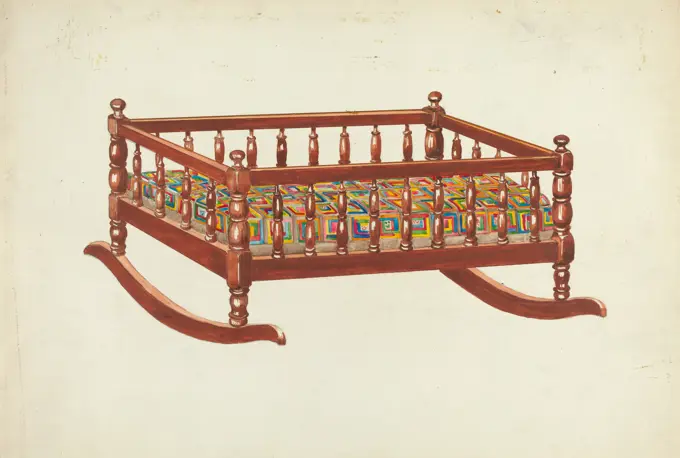
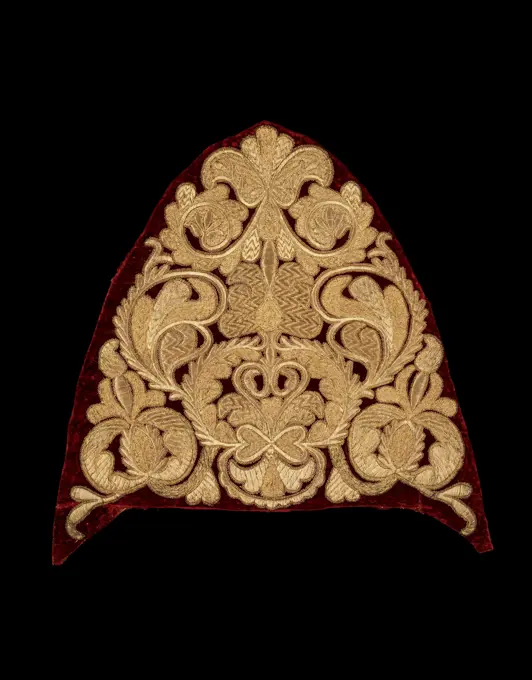
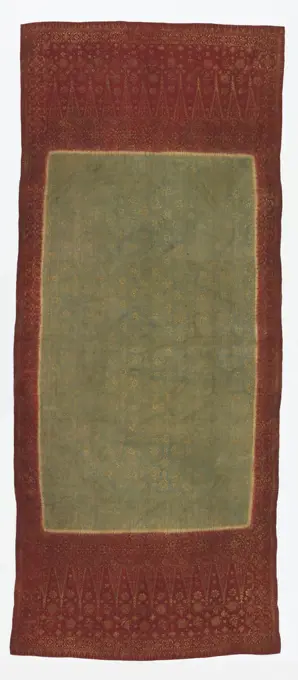
Selendang (shoulder cloth), Medium: silk Technique: tied resist, stitched resist (tritik), and printed with metallic pigments(prada), Red and green rectangular panel of silk. White rectangular border around the green separates it from the surrounding red. The gold printing (prada technique) makes use of the 'tumpal' motif (row of isosceles triangles) and other geometric and floral shapes., Palembang, Sumatra, Indonesia, 19th century, printed, dyed & painted textiles, Selendang (shoulder cloth)Weefselfragment met tabula, anonymous, c. 200 - c. 399 Natural linen tissue fragment with woven geometric motif in purple of a tabula with a triangle at the top and a triangle that ends in a line that ends in an oval. Within the tabula, a pattern of window and circular braid is woven in flying wire technology. A braid pattern in the corners. The triangles are filled with three geometric motifs. Egypt Ketting an element: Linen (material). Entry: Wool tapestry Natural linen tissue fragment with woven geometric motif in purple of a tabula with a triangle at the top and a triangle that ends in a line that ends in an oval. Within the tabula, a pattern of window and circular braid is woven in flying wire technology. A braid pattern in the corners. The triangles are filled with three geometric motifs. Egypt Ketting an element: Linen (material). Entry: Wool tapestryYam Mask, c. 1975, 10 3/4 x 9 1/8 x 7 9/16 in. (27.31 x 23.18 x 19.21 cm), Plant fibers, pigment, Papua New Guinea, 20th centuryLinen fragment on which a silk with silk embroidered, c. 1680 White linen fragment, on which a soil of white side tensed. Bloemen flowers are embroidered on the side. Spain linen (material). silk embroidering White linen fragment, on which a soil of white side tensed. Bloemen flowers are embroidered on the side. Spain linen (material). silk embroideringEpaulet -Hair accessory. Culture: Russian. Date: 1830-80.This object is from the collection of Natalia de Shabelsky (1841-1905), a Russian noblewoman compelled to preserve what she perceived as the vanishing folk art traditions of her native country. Traveling extensively throughout Great Russia, she collected many fine examples of textile art of the wealthy peasant class. From the 1870s until moving to France in 1902, Shabelsky amassed a large collection of intricately embroidered hand-woven household textiles and opulent festival garments with rich decoration and elaborate motifs. The Brooklyn Museum holdings include many fine examples including the majority of the garments. Portions of Shabelsky's collection are also housed at the Museum of Fine Arts, Boston, the Cleveland Art Museum, and the Russian Museum of Ethnography in St. Petersburg.Braid ornaments were a common part of the maiden's festival costume in Russia. The swastika is an ancient symbol of good luck in Russian culture. The coFringe (Italy); silkTibet: Necklace ornament, with coral, turquoise and cowrie-shell decorations.Piece 18th century China. Piece 71884Cuff early 19th century Hungarian. Cuff 213239Length of trim, cotton, silk, wool, wood, Woven looped trim in blue and white cord., England, mid-19th century, trimmings, Trimming, TrimmingTextile 19th century Japan. Textile 68049Arras cover. unknown, authorParfleche, c. 1870s, 13 x 25 3/4 x 5 in. (33.02 x 65.41 x 12.7 cm), Buffalo rawhide, pigments, United States, 19th centuryFrank Maurer, Wool Tablecloth, c 1938 Wool TableclothPiece 18th-19th century Japan. Piece 66988Piece 18th century Japan. Piece 71846Border (France); linen, silk, metallic thread; Bequest of Marian Hague; 1971-50-124Piece of fabric. unknown, authorTerracotta fragment of an oinochoe (jug) second quarter of the 5th century B.C. Greek, Attic Part of a draped woman wearing a chiton and himation; below, meander and cross squares. Terracotta fragment of an oinochoe (jug). Greek, Attic. second quarter of the 5th century B.C.. Terracotta; red-figure. Classical. VasesCIIp of needlework sampler unknownBasket. Dated: c. 1936. Dimensions: overall: 35.1 x 25.6 cm (13 13/16 x 10 1/16 in.) Original IAD Object: Diam. of top-161/2". 15"high. Diam of bottom:7".. Medium: watercolor, colored pencil, and graphite on paper. Museum: National Gallery of Art, Washington DC. Author: Gordena Jackson.Piece 17th century Japan. Piece 72240Textile Fragment 4th-5th century. Textile Fragment 443953Band; linen and silk; 1963-92-3Margaret Linsley, Doll's Cradle and Quilt, c 1953 Doll's Cradle and QuiltAltar Border Made 1701-1800 Greece. .TEJIDO ARABE. Location: ALHAMBRA-MUSEO TEXTIL. GRANADA. SPAIN.Fragments, before 1968. Unassigned, Probably Modern. average: 26 x 22.7 cm (10 1/4 x 8 15/16 in.).Hat van Buckram with three onto stripe decorations and embroidered strips, anonymous, c. 1850 Hat van Buckram with three on, with cord -filled stripe decorations. The round hat floor is trimmed with a sculpted strip decorated with a chain stitch; A doubled strip on the forehead. West-Europa buckram embroidering Hat van Buckram with three on, with cord -filled stripe decorations. The round hat floor is trimmed with a sculpted strip decorated with a chain stitch; A doubled strip on the forehead. West-Europa buckram embroideringFeathered Tabard or Tunic, 600-1500. Andes, 7th-15th century. Feather mosaic on cotton; average: 102.9 x 101.6 cm (40 1/2 x 40 in.).White napkin with woven checker pattern, anonymous, c. 1800 - c. 1930  Europe textile materials  Europe textile materialsFragment, Medium: Warp; S-spun linen, Wefts; S-spun linen, S-spun wool. Technique: slit tapestry with supplementary weft wrapping, Small fragment depicting a leaf., Egypt, 3rd-4th century, woven textiles, FragmentPrinting Block (India); wood2 of Nooses, from The Cloisters Playing Cards ca. 1475-80 South Netherlandish The Cloisters set of fifty-two cards constitutes the only known complete deck of illuminated ordinary playing cards (as opposed to tarot cards) from the fifteenth century. There are four suits, each consisting of a king, queen, knave, and ten pip cards. The suit symbols, based on equipment associated with the hunt, are hunting horns, dog collars, hound tethers, and game nooses. The value of the pip cards is indicated by appropriate repetitions of the suit symbol. The figures, which appear to be based on Franco-Flemish models, were drawn in a bold, free, and engaging, if somewhat unrefined, hand. Their exaggerated and sometimes anachronistic costumes suggest a lampoon of extravagant Burgundian court fashions. Although some period card games are named, it is not known how they were played. Almost all card games did, however, involve some form of gambling. The condition of the set indicates that the cards were hMantle Nasca. Mantle, 0-100 C.E. Camelid fiber, 108 11/16 x 50 13/16 in. (276.1 x 129.1 cm).   Arts of the Americas 0-100 C.E.Fragment German, Rhine 12th-13th centuryFragment 16th century Italian. Fragment. Italian. 16th century. Silk. Textiles-VelvetsLamaist priest hat, Kangxi period, 1662-1722, L.21-1/8 x W.15-1/8 in., Silk brocade, China, 17th-18th centurySampler, Medium: linen embroidery on linen foundation Technique: withdrawn element and embroidery on plain weave, The top three bands from a sampler., England, ca. 1650, embroidery & stitching, SamplerSampler 19th century German. Sampler 228576Statue robe early 16th century French. Statue robe 221442Fragment of yellow cream-colored banner cloth deposited with golden frills. On the front a crowned ornate W, including the inscription: Dialing Kurassiers No 1. Fragment of yellow cream-colored banner cloth deposited with golden frills. A crowned graceful w, including the inscription: Dialing Kurassiers No 1; Along the silk green branches with orange berries. On the parade capacity the crowned weapon of the kingdom, with banderole on which the arms spell: your Maintiendrai, held by two crowned lions; This whole is surrounded by two up bent laundry branches, which are held together at the bottom through a rose bow; Along the silk green branches with orange berries.Rosette Fragment Coptic. , 5th-7th century C.E. Flax, wool, 3 x 3 1/4 in. (7.6 x 8.3 cm).   Egyptian, Classical, Ancient Near Eastern Art 5th-7th century C.E.Ornament with mascarons, anonymous, after monogram miss ib (16th century), 1525 - 1580 print Lower part of a sheath. A cadela with leaf vines, mascarons, two birds and a mascaron with horns of volutes. Mirror -image copy of a sheath with Venus and Cupido by the monogrammist IB.  paper engraving anthropomorphic ornamentSample of Cloth ca. 2353-2323 B.C. Old Kingdom. Sample of Cloth 570876Stockings. Culture: British. Date: ca. 1860. Museum: Metropolitan Museum of Art, New York, USA.Sampler (USA); Embroidered by Fanny Hill (American); cotton embroidery on linen foundationBelt and Pouch 18th-19th century. Belt and Pouch 444632Handkerchief 1831-32 French. Handkerchief 169479Belt, Fragment or Textile Fragment, Undetermined Possibly Inca. , 1400-1700 C.E. or Undetermined. Camelid fiber, 1 1/4 × 5 in. (3.2 × 12.7 cm).   Arts of the Americas 1400-1700 C.E. or UndeterminedTowel, 19th century, 29 1/2 x 18 3/4 in. (74.93 x 47.6 cm), Cotton, silk, metal threads; needlework, Turkey, 19th centuryPicture frame -Fragment of Peruvian fabric unknownStocking of yellow wool, without heel, hand knitted, c. 1879 - c. 1880 Stocking of yellow wool, without heel. Hand knitted. Inscription, embroidered in red cross stitch: '1 MH'. Amsterdam whole: Wool knitting / embroidering Stocking of yellow wool, without heel. Hand knitted. Inscription, embroidered in red cross stitch: '1 MH'. Amsterdam whole: Wool knitting / embroideringCilindro de madera para estampación, siglo XIX. Museu de l'Estampació de Premià de Mar.Tools for a needle side motif in the form of tailor linen on which green parchment is sewn with white tracer threads in fan shape with Artdeco roses and half a sunflower, lace working school (The Hague), c. 1906 - c. 1910 Tools for a needle side motif in the form of double tailor linen on which green parchment is sewn. On the parchment, a fan shape was made with artdeco roses and half a sunflower with white trace wires. Part of the trace wires has already been processed with feston stitches. On the parchment is written twice with pencil: "1.50". The Hague linen (material). parchment (animal material) sewing Tools for a needle side motif in the form of double tailor linen on which green parchment is sewn. On the parchment, a fan shape was made with artdeco roses and half a sunflower with white trace wires. Part of the trace wires has already been processed with feston stitches. On the parchment is written twice with pencil: "1.50". The Hague linen (material). parchment (animal material)The hand of Fatima. Silver alloy metalwork from morocco. early 20th century. Islamic art. the fingers represent the Five Pillars of Islam. the hand wards away the evil eyeA sash from the funeral of Adam Mickiewicz in Krakow on July 4, 1890Fragment Made 1476-1532 Peru. Simple cloth. Brocade interlocking tapestry (old card) . ChuquibambaOranjelint ,, 1725 - 1750 ribbon (material) Small ribbon with twice the inscription between two twigs. Inscription: Vivat Oranje. Netherlands silk printingDarning Sampler, Medium: cotton, wool, silk Technique: embroidered in running (pattern darning) and cross stitches on plain weave foundation, Twenty darning stitches., Germany, 1811, embroidery & stitching, Darning SamplerSandal Soles 4th-7th century Coptic. Sandal Soles 479348Fringe early 18th century Spanish. Fringe 225052Example of lace stitch Italian 19th-20th centuryH-Comb, 1500-1600. Made in France or England. Pinto Collection - Purchased from Edward H Pinto, 1965.. Richly carved boxwood combs were given as expensive love tokens in medieval times. The carver chose boxwood because it was the only wood with a sufficiently straight and dense grain to allow him to carve such fine teeth without splitting. He cut the teeth using a double-bladed saw called a stadda. A skilled craftsman with a steady hand could usually cut up to fifty teeth per inch.Ex libris van Irwin Laughlin, anonymous, 1881 - 1941 Circle -shaped bond with a buckle at the bottom, with the words 'aka aliis hic mihi' in the middle. Print is part of an album.  paper etching / engraving Circle -shaped bond with a buckle at the bottom, with the words 'aka aliis hic mihi' in the middle. Print is part of an album.  paper etching / engravingSquare Shawl (Turnover) Made 1820-1840 Russia. Wool, strips of 2 2 'S' twill weave; borders of dovetailed tapestry weave, reversible; attached Harlequin tabs of pieced 2 2 'S' twill weaves; warp fringe .Apparel Made into a cushion. Culture: Italian or Spanish. Dimensions: 17 x 22 1/4 in. (43.2 x 57.1 cm). Date: 16th or 17th century. Museum: Metropolitan Museum of Art, New York, USA.MUNICIPALE BANDS ,, 1795 ribbon (material). label Ribbon with 3 lanes, red, white and blue, the edges of white rip side, inscription in white lane with black letters, corners folded and attached to the downside with a rectangular piece of faded orange side, of which r. Stand out for a little bit, and with a common thread. The front of the ribbon is from silk, the flip side of linen. On the left of the rope, the label is: by the Batavian Republic branch After the Revolution of 1795, the National Band was worn by the Municipal Councils. Inscription: Municipality. Netherlands silk. linen (material). yarn. rope. paper printingAnonymous, recall bar of the 1939-1945 war cross by Louis Pouly (attributed title), 1944. Metal, fabric. Museum of the Liberation of Paris - General Leclerc Museum - Jean Moulin Museum.Headdress 1830-80 Russian This object is from the collection of Natalia de Shabelsky (1841-1905), a Russian noblewoman compelled to preserve what she perceived as the vanishing folk art traditions of her native country. Traveling extensively throughout Great Russia, she collected many fine examples of textile art of the wealthy peasant class. From the 1870s until moving to France in 1902, Shabelsky amassed a large collection of intricately embroidered hand-woven household textiles and opulent festival garments with rich decoration and elaborate motifs. The Brooklyn Museum holdings include many fine examples including the majority of the garments. Portions of Shabelsky's collection are also housed at the Museum of Fine Arts, Boston, the Cleveland Art Museum, and the Russian Museum of Ethnography in St. Petersburg.. Headdress 157552Handscreen, Engraved and hand-colored paper leaf, turned wood handle, Handscreen with an engraved and hand-colored design. Obverse: a shepherdess enclosed within a frame of arabesques and foliage. Reverse: a map of South America., France, ca. 1750, costume & accessories, HandscreenTextile Witcombe, McGeachin & Company (early 20th century). Textile, 1927-1933. Cotton, 17 3/4 x 21 in. (45.1 x 53.3 cm).    1927-1933Textile Fragment, undetermined Chimú. , 1000-1400. Cotton, camelid fiber, (15.0 x 7.0 cm).   Arts of the Americas 1000-1400Standard Banner (Sashimono) probably 18th century Japanese. Standard Banner (Sashimono) 23881