Antique Carpets and Fabrics

A collection of exquisite carpets and textile fragments featuring elaborate patterns and historical significance, showcasing traditional craftsmanship.

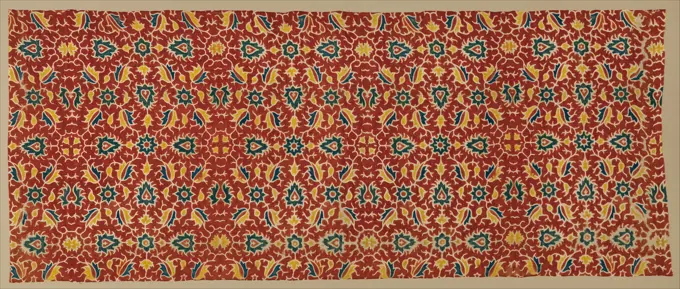
Pillow cover, Medium: silk on linen Technique: embroidered on plain weave, Embroidered cushion cover showing a diamond lattice with symmetrical flowering vine in red silk on linen., Italy, 16th-17th century, embroidery & stitching, Pillow cover
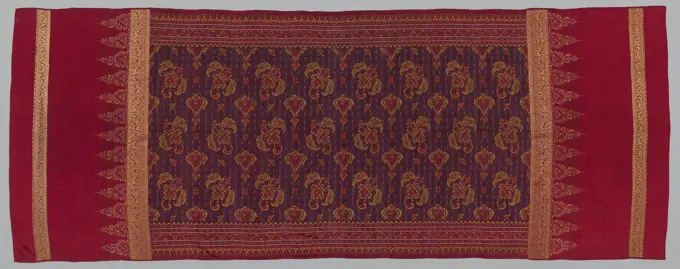
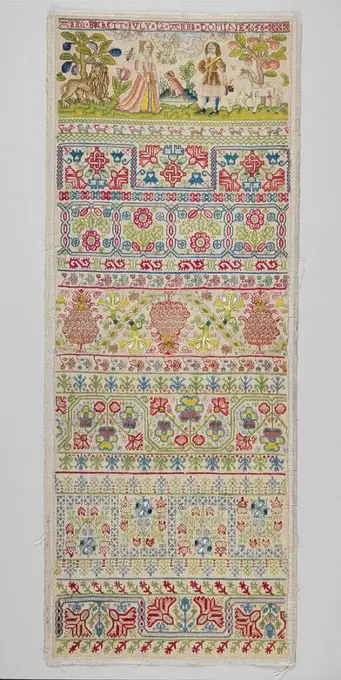
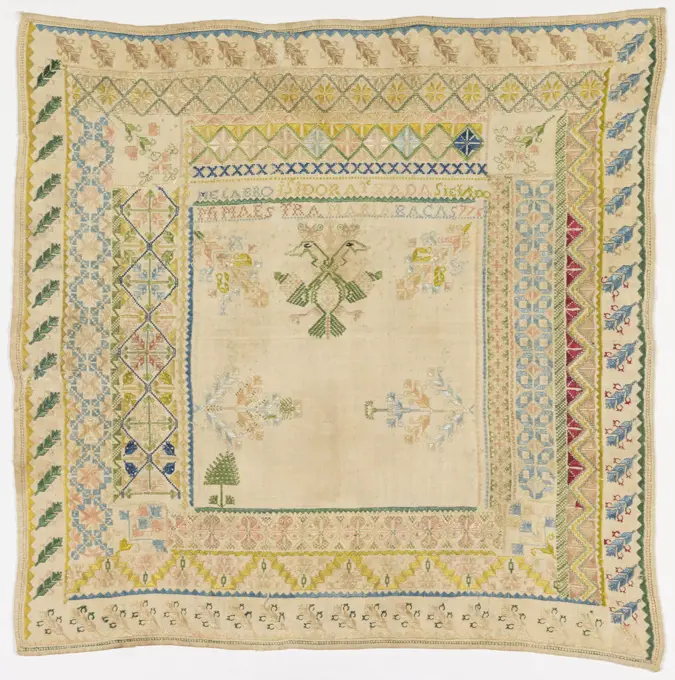
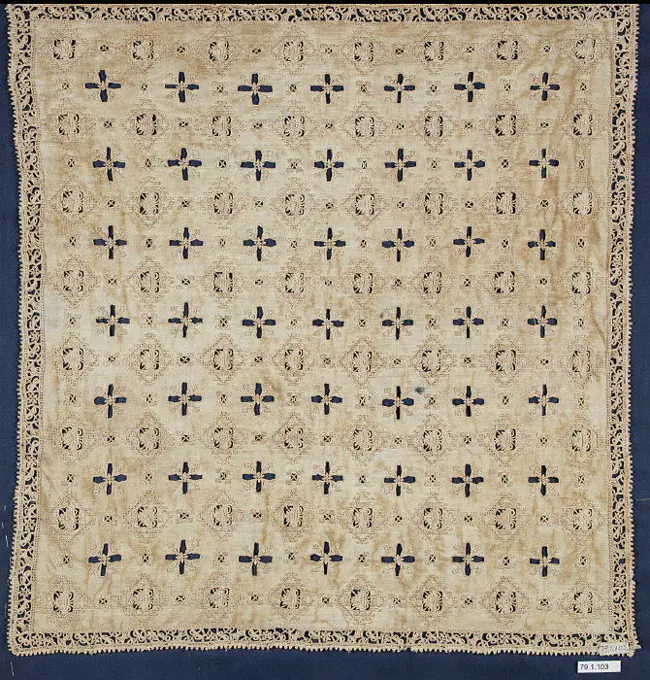
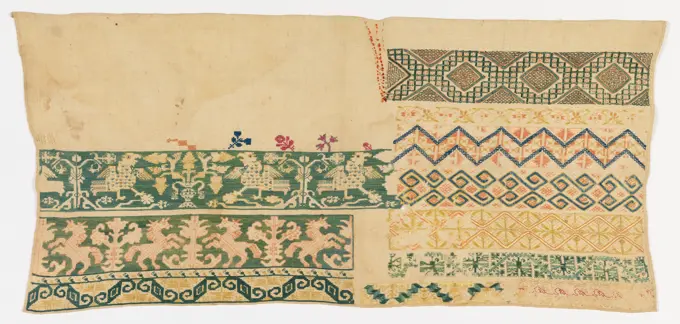
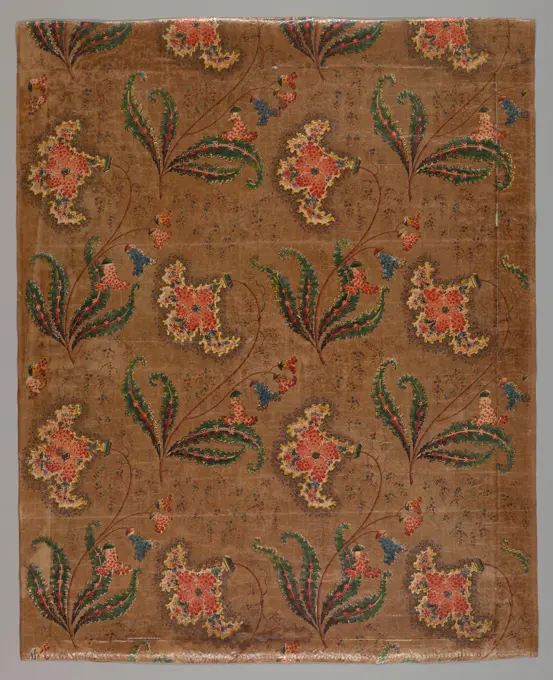
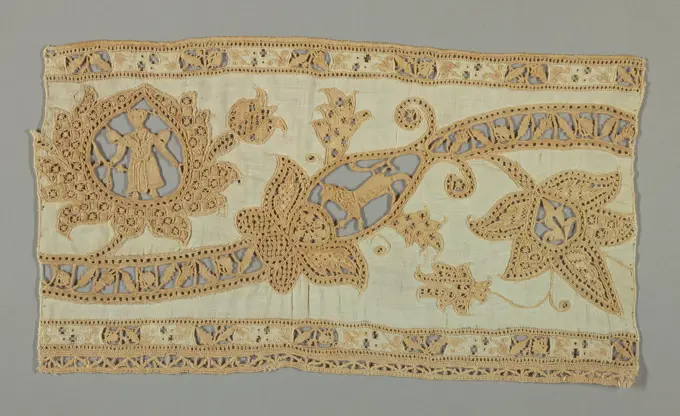
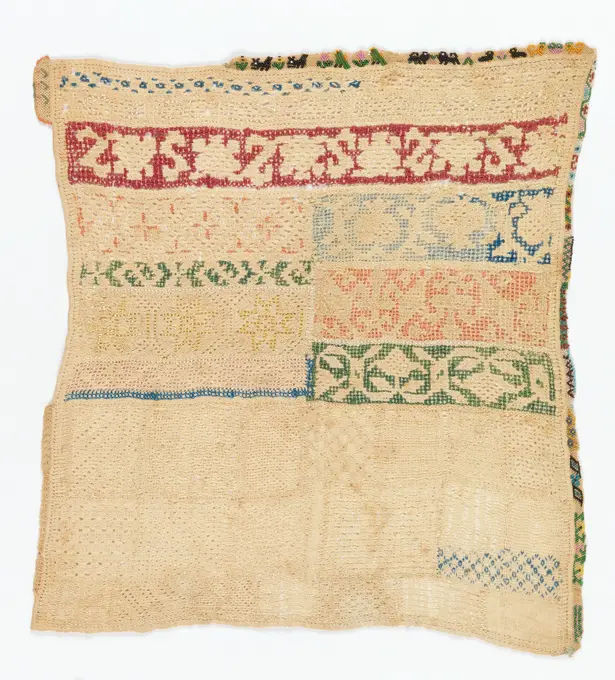
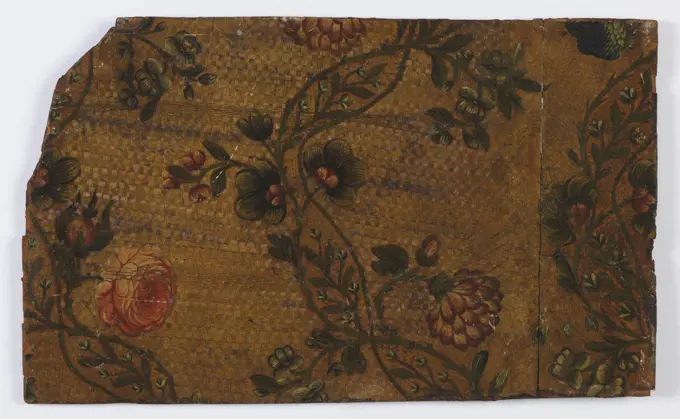
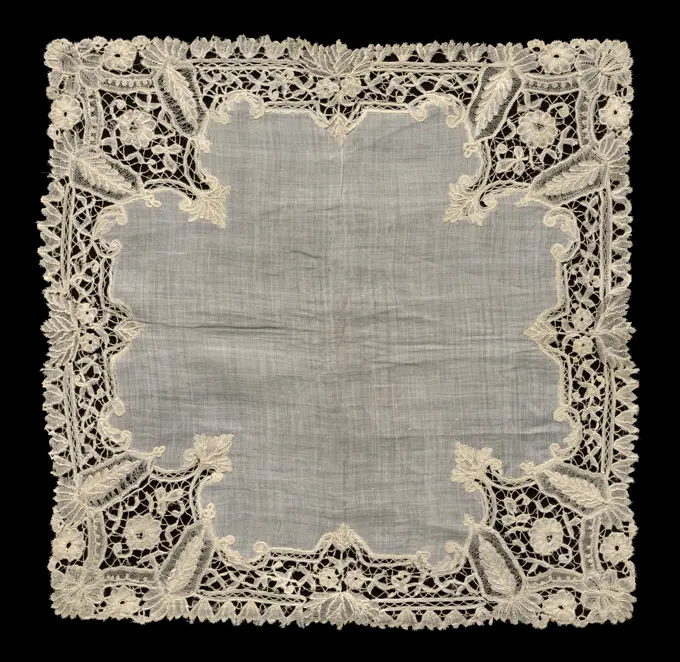
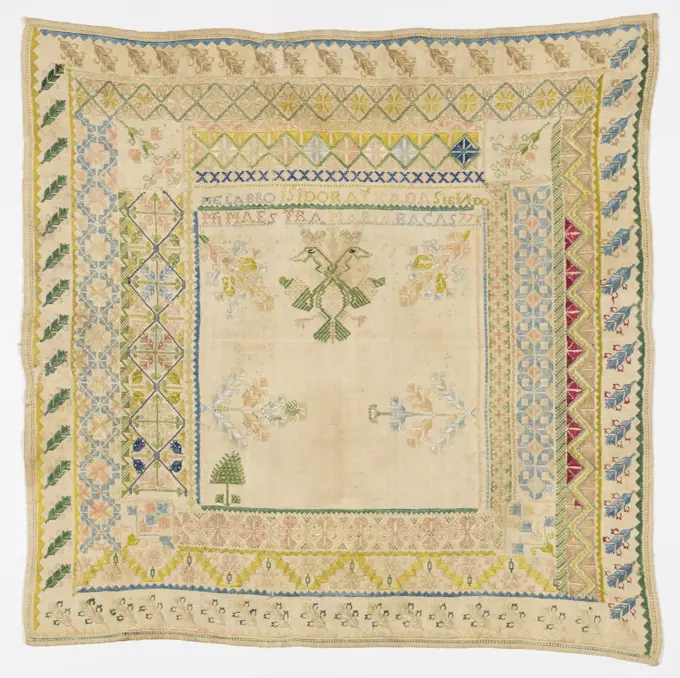
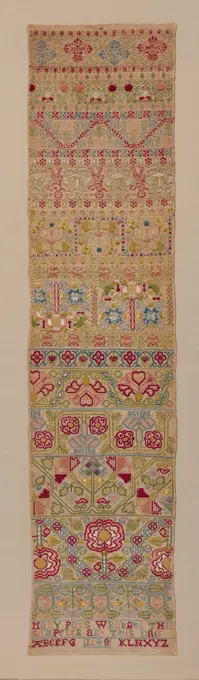
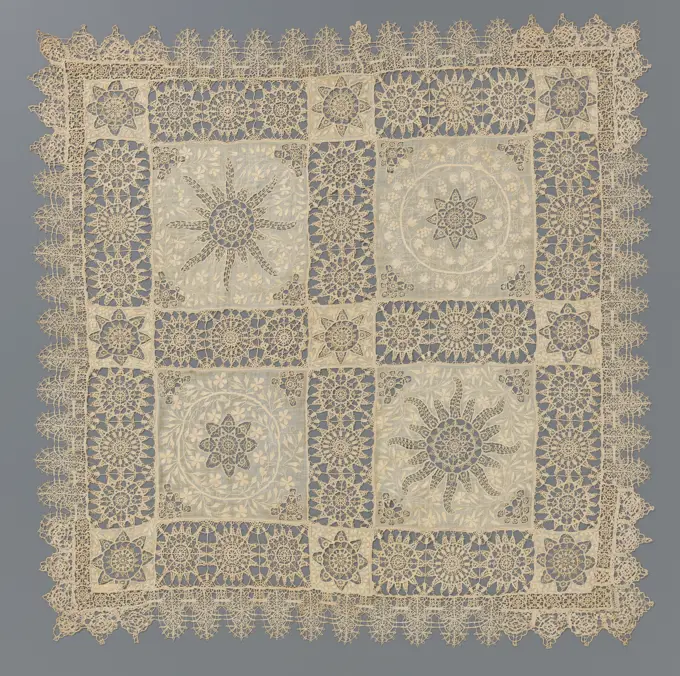
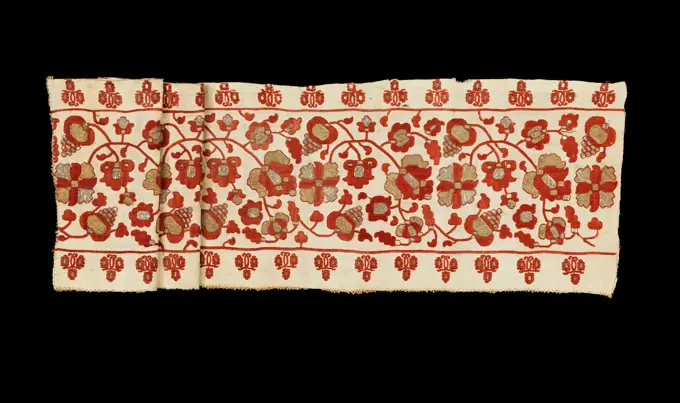
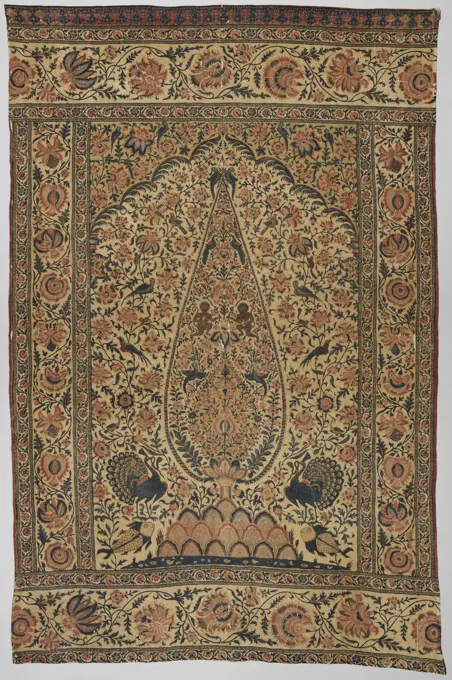
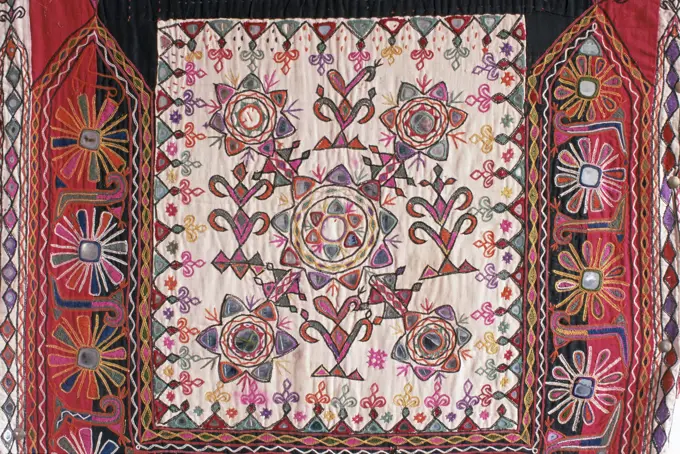
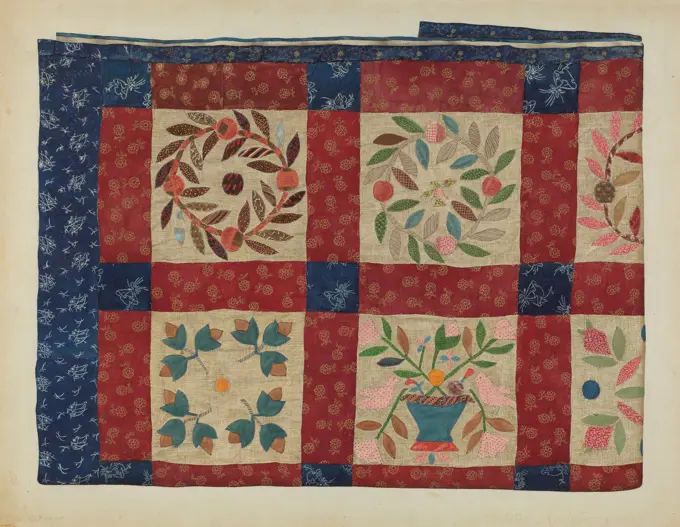
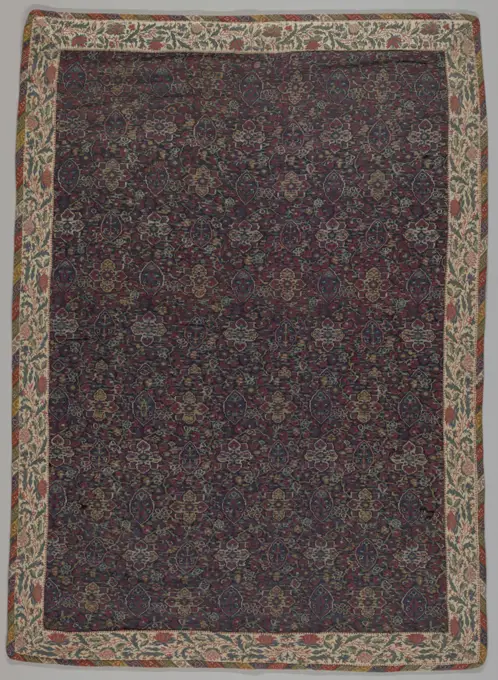
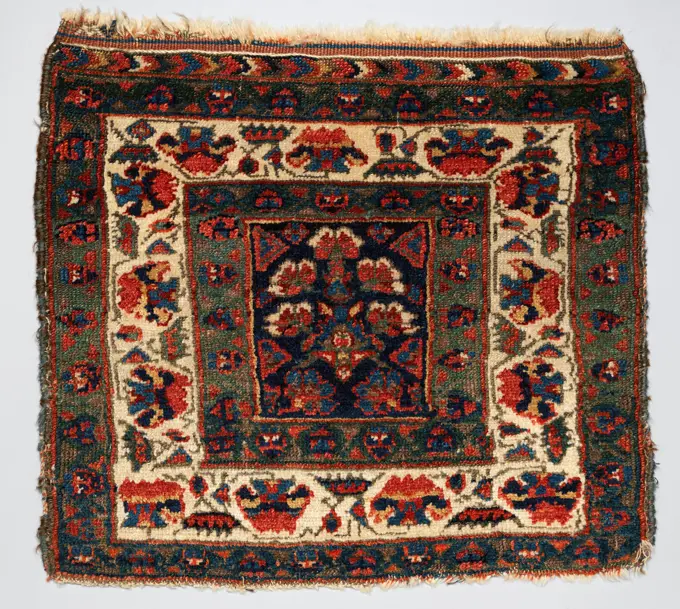
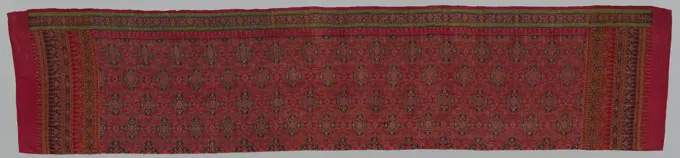
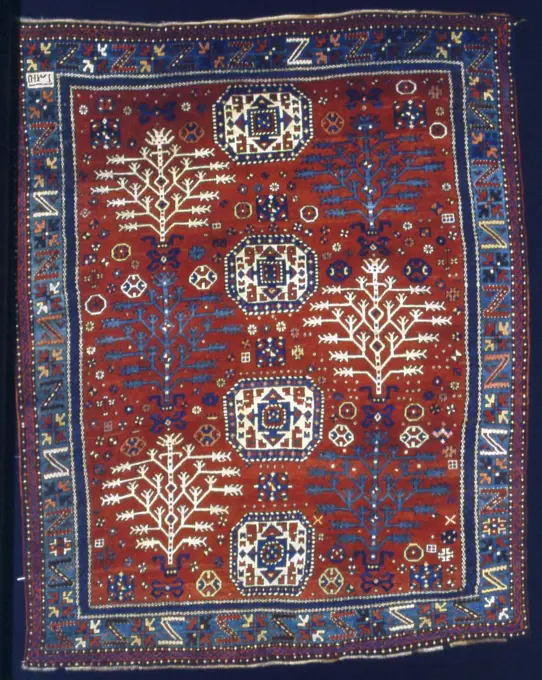
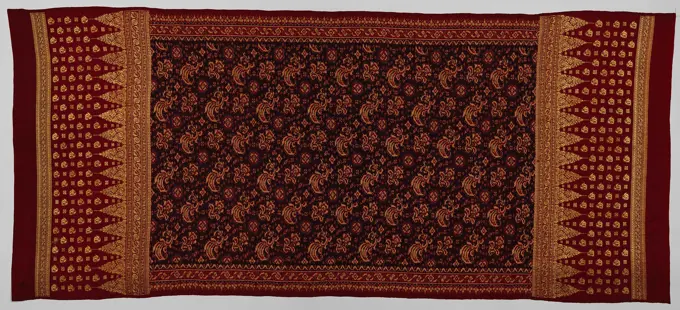
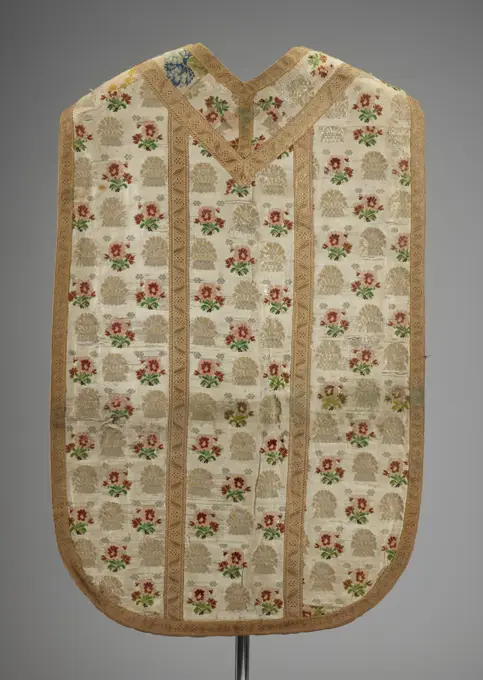
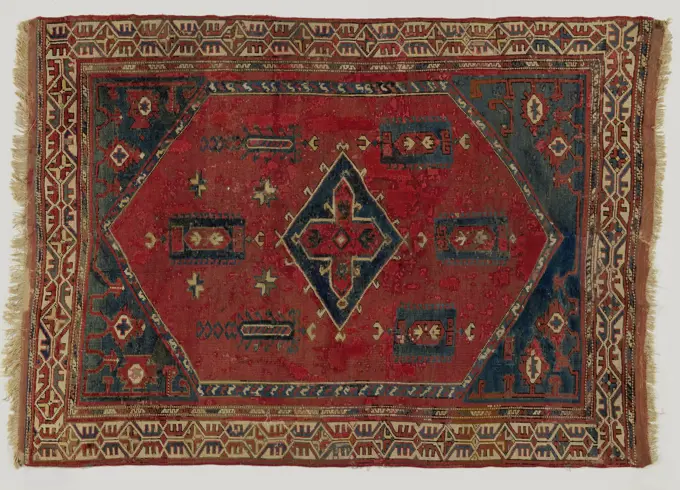
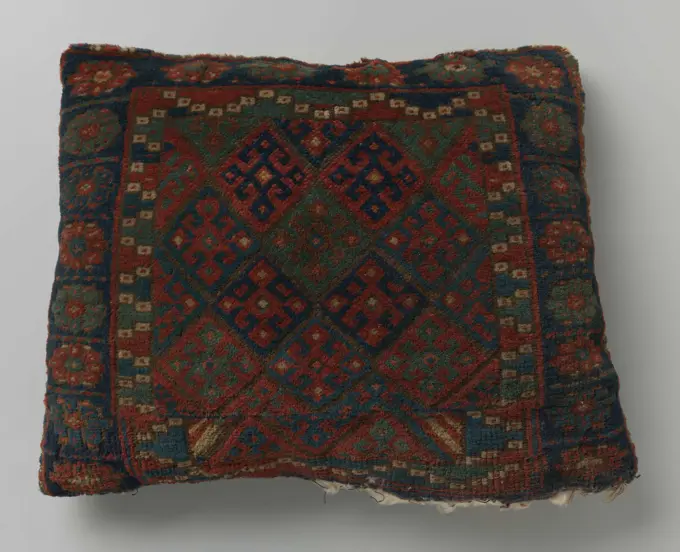
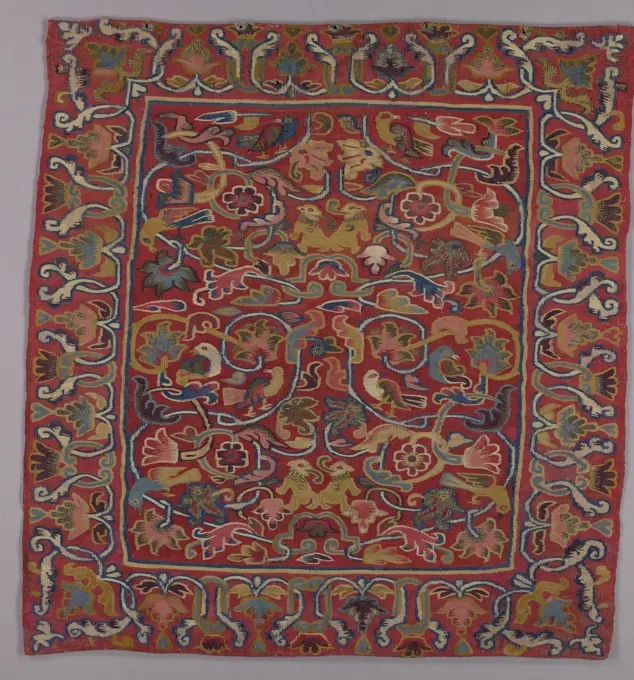
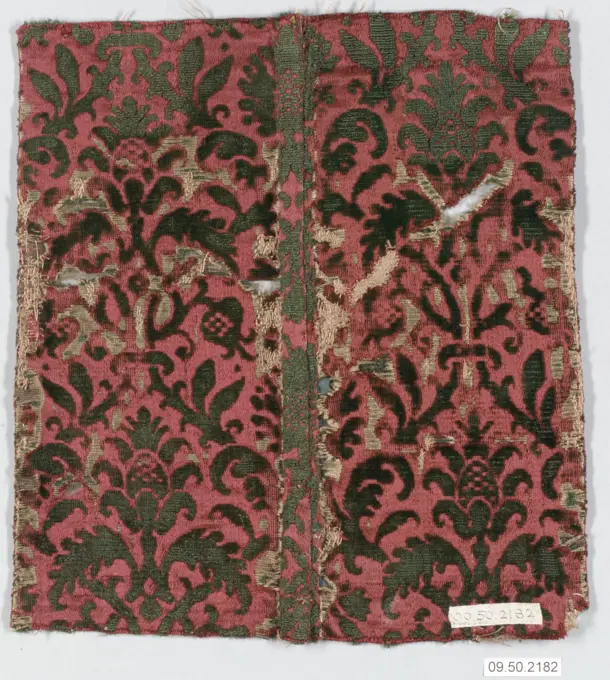
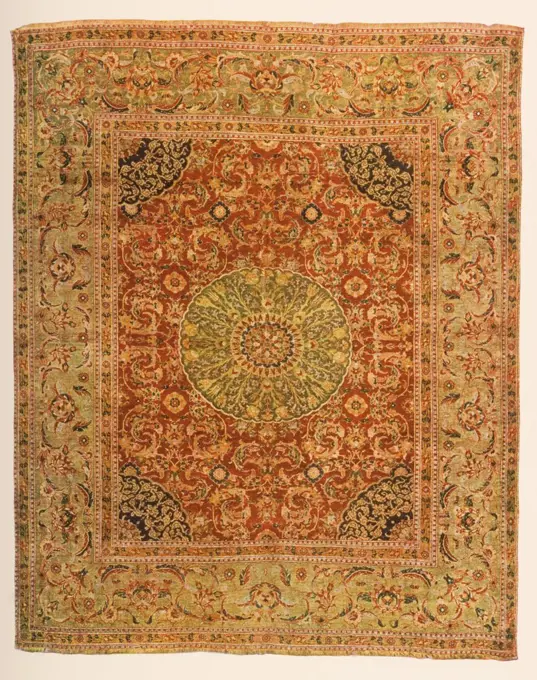
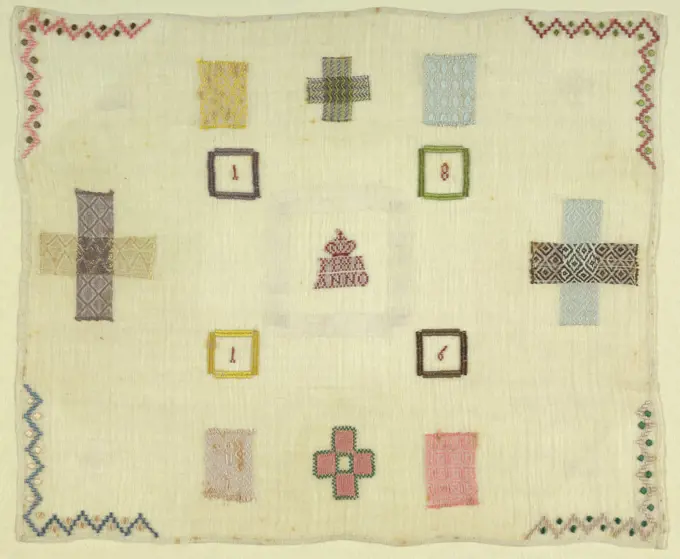
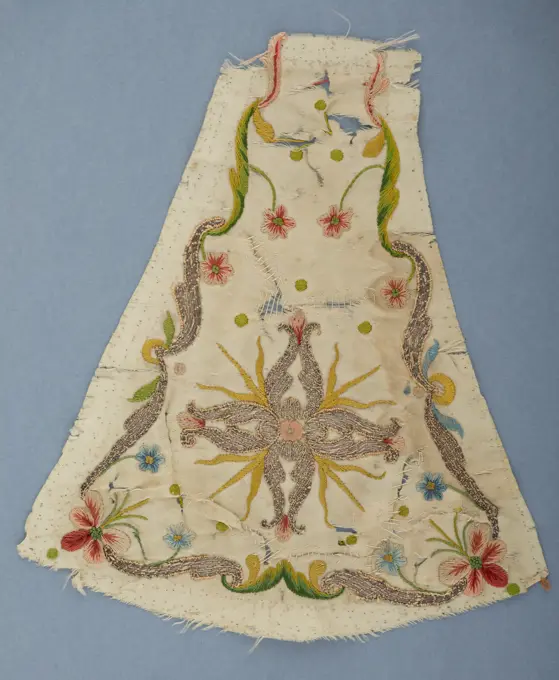
Cushion Cover Made 1601-1700 Skíros. Linen, plain weave; embroidered with silk in running (pattern darning), satin, and stem stitches; edged with silk and horsehair, needle lace .Fragment, Medium: silk, metallic thread Technique: damask weave with supplementary weft, Fragment of dark red silk damask brocaded in gold with a design of a central palmette flanked by slender serpentine leaves and flowers., 17th-18th century, woven textiles, FragmentShoulder Cloth, 1800s. Indonesia, Sumatra, Palembang, 19th century. Weft ikat and gold, tabby weave, brocaded; silk and gold; overall: 226 x 89.9 cm (89 x 35 3/8 in.).Fragment, Medium: silk, metallic Technique: woven, Polychrome discs on a red ground. Pieced., India, 19th century, woven textiles, FragmentSampler. Culture: British. Dimensions: H. 27 7/8 x W. 10 3/8 inches (70.8 x 26.4 cm); Framed: H. 30 3/4 x W. 12 1/4; D. 1 1/4 (78.1 x 31.1; 3.2 cm). Maker: Anna Buckett. Date: 1656.Band samplers comprise neatly worked rows of patterns suitable for repeating motifs or figural motifs on the long narrow strip of linen canvas. This is the most common type of extant seventeenth-century sampler, and its standard format was established by about 1630. The foundation was generally cut from one complete width of plain-weave linen, so that the selvages are present at what becomes the top and bottom of the finished work, and the sides are hemmed. Polychrome band samplers are typical, although some band samplers combined rows of whitework, cutwork, and needle lace with the polychrome patterns (see MMA, 57.122.368). A band sampler such as this would have most likely been a task completed by a schoolgirl under the supervision of an embroidery instructor of some kind. In fact, a band sampler was usuaFragment, Medium: silk, metallic Technique: woven, Close pattern of scrolls and curves., China, 19th century, woven textiles, FragmentSampler, Medium: silk embroidery on linen foundation Technique: embroidered in running, cross, buttonhole, chain, and wrapping stitches on plain weave foundation, edged with picots, Eight darning crosses; one set in patch; three repaired tears., Netherlands, 1712, embroidery & stitching, SamplerCover 16th century possibly Spanish. Cover. possibly Spanish. 16th century. Linen, cutwork. Textiles-LacesSampler; silk embroidery on cotton foundationFragment of the decorative belt; Egyptian workshop; XI-XIV century (1001-00-00-1400-00-00);Piece 18th-19th century Japan. Piece 67624Dress of oriental textile with multicolored embroidery. Rug of multicolored chord, decorated with floral drinks and ornament, lined with cotton.Textile (England); cotton; Length 8cm x Width 6.4cmOriental carpet, Anonymous, 1740 - 1815 Eastern carpet, arabesken-flowers dress. In midfield rosettes and lotuses on stems and arabesken against a corn -blue background. The mid -part red edge is decorated with kufic characters. Caucasus wool. cotton (textile) Eastern carpet, arabesken-flowers dress. In midfield rosettes and lotuses on stems and arabesken against a corn -blue background. The mid -part red edge is decorated with kufic characters. Caucasus wool. cotton (textile)Sampler, Medium: silk embroidery on linen foundation Technique: embroidered on plain weave, A female figure on the left side and a male figure on the right, surrounded by spot motifs of flowering plants. At the bottom center, a basket of fruit with a bird perched on top, flanked by the letters S and H. Two crowns at upper edge. A narrow wavy border on all four sides., Netherlands, 18th century, embroidery & stitching, SamplerCutwork Border (Italy); linenPrayer dress for a girl. Prayer dress for a girl, Z.G. Kis-GhioDes of knotted wool with a double mih bar of white in midfield with scattered stuffing of small mane. Edge with white zigzag tires.Piece 18th-19th century Japan. Piece 67072Fragment; silkBand Sampler (Mexico); silk on linen, glass beads; Bequest of Marian Hague; 1971-50-161Fragment (China); silk, metallicSampler (Spain); cotton on linenPortion of a Bed Sheet or Valance, 1500s - 1600s. Greece, Sporades Islands, Skyros, 16th-17th century. Embroidery: silk on linen tabby ground; overall: 54.6 x 42 cm (21 1/2 x 16 9/16 in.).Table Cover Made 1601-1700 Italy. Silk, plain weave; edged with silk, plain gauze weave; embroidered with silk in satin and stem stitches .Sidewall, stamped leather, silvered, varnished, and painted, Diapered field, varnished silver; foliage in green, flowers in green and blue (Louis XV painted leather), Holland, ca. 1750, Wallcoverings, SidewallBobbin Lace (Duchesse) Handkerchief, 19th century. Flanders, 19th century. Lace, bobbin; average: 34.6 x 34.6 cm (13 5/8 x 13 5/8 in.).Sampler, Isidora Taxada, Medium: silk embroidery on cotton foundation Technique: embroidered in satin, cross, stem, chain, four-sided, back, and running stitches on plain weave foundation, Center field with double-headed eagle surrounded by bands of geometric and floral pattern in concentric squares. Unfinished., Spain, possibly 1776, embroidery & stitching, SamplerEmbroidered band sampler 1648 Mary Pots From the early 17th century into the early 18th century, long, narrow samplers such as this one were typical. Called "band samplers" because of the multiple bands of pattern, this type represents the transition from purely practical piece of fabric with patterns stitched for future reference, to something that is both decorative and functional.. Embroidered band sampler 219509Towel late 16th century Italian. Towel 212817Handkerchief 1850 American. Handkerchief 122500Handkerchief Made 1701-1800 England. Linen, plain weave; embroidered in cotton and linen yarns; pulled threadwork in interlocking lace, overcast, herringbone, and single faggot stitches; cut and drawn work in buttonhole, Italian hem, open chain and twisted button hole stitches; with areas of padding and inserts of twist net; embroidered in back, buttonhole, detached overcast, double running, eyelet hole, flame, open chain, padded satin, Roumanian, running, satin, sheaf filling, and stem filling stitches; laid work; couching .Fragment of Sari 18th-19th century. Fragment of Sari. 18th-19th century. Silk. Attributed to present-day Pakistan, Sindh. Textiles-CostumesFragments of canvas fabric unknownShoulder Cloth(Selendang)Textile Sample from Sample Book 19th century Japan. Textile Sample from Sample Book 68265Textile Fragment 9th century. Textile Fragment 451876Band, Medium: silk, metal threads Technique: cut and uncut supplementary warp pile (velvet), Large-scale symmetrical repeat of crown clasping two out-curving lobed leaves alternating or framing spreading bouquet of tulips flanked by small birds. In crimson cut and uncut velvet on gold ground now sparsely covered with tarnished silver. Lobed guard strip top and bottom. Two broad selvages striped in pink., Spain, 17th century, woven textiles, BandUnknown, Tabriz Carpet, early 20th century, wool.Textile Fragment 6th-7th century. Textile Fragment. 6th-7th century. Wool, linen; plain weave, tapestry weave. Attributed to Egypt. TextilesVase Carpet 17th century This carpet overflows with naturalistically rendered flowers and plants, organized around one central medallion and four quarter- medallions in each corner. A similar medallion design can be seen on many decorative leather book covers from the same period, and it is likely that the manuscript design was incorporated into the visual repertoire of Safavid weavers. Artists working in the court atelier produced drawings and designs for artisans working in a variety of different media. The designs and trends generated by the court were then adopted by commercial workshops that created high-quality carpets like this one.. Vase Carpet 452187Sleeve Band (China); wool on cottonSewing Case (USA); cotton, wool, silkPiece 18th century Japan. Piece 71277Piece 18th-19th century Japan. Piece 67310.Demolition of needle and bobbin and embroidery ,, 1600 - 1625 Demolition of needle and bobbin and embroidery, with accompanying bedspread and a second demolition (A, C) West-Europa . bobbin lace / embroidering Demolition of needle and bobbin and embroidery, with accompanying bedspread and a second demolition (A, C) West-Europa . bobbin lace / embroideringFragment of a shirt fourth quarter 18th century Ukrainian This object is from the collection of Natalia de Shabelsky (1841-1905), a Russian noblewoman compelled to preserve what she perceived as the vanishing folk art traditions of her native country. Traveling extensively throughout Great Russia, she collected many fine examples of textile art of the wealthy peasant class. From the 1870s until moving to France in 1902, Shabelsky amassed a large collection of intricately embroidered hand-woven household textiles and opulent festival garments with rich decoration and elaborate motifs. The Brooklyn Museum holdings include many fine examples including the majority of the garments. Portions of Shabelsky's collection are also housed at the Museum of Fine Arts, Boston, the Cleveland Art Museum, and the Russian Museum of Ethnography in St. Petersburg.. Fragment of a shirt 157571Purse (France); silkBid rug of sits with an image of a cypress and fish ,, c. 1700 - c. 1800 Bid rug of sits with an image of a mihrab. From a scaly formation, a cypress -shaped tree raises, in which a symmetrical flower branch populated with monkeys, parrots and pheasants. Equal flower branches are populated around the Cypres with birds and squirrels. On either side of the tree is a showing off Paauw with a snake in the mouth. Fish are depicted under the peacocks. Eastern textile. In the cotton (textile) printing Bid rug of sits with an image of a mihrab. From a scaly formation, a cypress -shaped tree raises, in which a symmetrical flower branch populated with monkeys, parrots and pheasants. Equal flower branches are populated around the Cypres with birds and squirrels. On either side of the tree is a showing off Paauw with a snake in the mouth. Fish are depicted under the peacocks. Eastern textile. In the cotton (textile) printingThai textilePillowcase from a Bed Linen Set, 19th century, 26 3/8 x 17 3/4 in. (66.99 x 45.09 cm), Normandy lace, linen and cotton lace, satin, France, 19th centuryTraditional Rabari tribal embroidered fabrics, Kutch, Gujarat state, India, AsiaCatherine Fowler, Applique Quilt, 1935 1942 Applique QuiltFragment, Medium: silk on linen Technique: embroidered, Fragment showing a stylized, symmetrical vine in red silk on a natural ground with red and white fringe., Patmos, Greece, 19th century, embroidery & stitching, FragmentHanging Made 1825-1900 Japan. Cotton, plain weave; covered with paper; embroidered with silk, cotton and wild silk, in bullion, satin, single satin, and stem stitches; Chinese knot, laid work and couching; edged with silk and gold-leaf-over-lacquered-paper strip, warp-float faced 4 1 'z' twill interlacings of secondary binding warps and supplementary patterning wefts .Panel, Medium: wool, cotton backing Technique: twill tapestry weave, Rectangular panel of fine twill tapestry has a tight arrangement of small-scale quatrefoils and ogives enclosing flowers with interspaces filled with floral and foliate motifs. Colors are dark red, blue, green, purple, yellow, and white. Bordered and piped with different bands of imitation tapestry, one floral, one geometric. Backed with red cotton twill., India, 19th century, woven textiles, PanelSquare cover, 19th century, 23 1/4 x 26 1/2 in. (59.1 x 67.3 cm), linen, silk; needlework, 19th centuryWomans Ceremonial Skirt (Tapis)Face from Half of Double Saddle Bag (Khorjin) 19th century. Face from Half of Double Saddle Bag (Khorjin). 19th century. Wool (warp, weft, and pile); asymmetrically knotted pile, single wefted-construction, tapestry weave. From probably Iran, Fars. Textiles-WovenHalf of a "Sampot" (Skirt Cloth), 1800s - early 1900s. Cambodia, 19th - early 20th century. Tabby weave, weft ikat; silk; overall: 76.2 x 345.3 cm (30 x 135 15/16 in.). Ikat-dyed silks from Southeast Asia are weft ikats. Both the technique and the use of silk originated in India and spread to those parts of Southeast Asia that were accessible to international trade. There, it gradually replaced the earlier technique of warp ikat using cotton. The antiquity of this technique in Cambodia is indicated by weft-ikat designs that are preserved on sculptures of the Ankor period (9th-13th centuries). The diagonal lattice pattern in the central field of this textile was common throughout Southeast Asia. Because the textile was inteded to be a skirt cloth, there is little figural representation in its design.Hanging (Iran); cottonGarden rug Made 1890 Kazakhstan. .Textile; silk, cotton, metallic yarns; Warp x Weft: 87 x 65.7 cm (34 1/4 x 25 7/8 in.)Fragment or cloth of yellow and red satin brokate with a pattern of double crowned eagles with flower ornaments, anonymous, c. 1590 - c. 1610 Fragment or canvas of yellow and red satin brocade, a local bluestone, with a pattern of double crowned eagles, surrounded in the corners by a flower ornament and framed by an edge of tight rinceaux. Italy (possibly) Ketting an element: Silk. Entry: Linen (Material) broach Fragment or canvas of yellow and red satin brocade, a local bluestone, with a pattern of double crowned eagles, surrounded in the corners by a flower ornament and framed by an edge of tight rinceaux. Italy (possibly) Ketting an element: Silk. Entry: Linen (Material) broachShoulder cloth; Songket, Single Angel Lepus Limar, Kain Bongsong. Shoulder draft with floral and large motifs.Sarong  floral and diagonal patterns unknownChasuble made of patterned brocade unknownSide chair back and seat cover 1738 British. Side chair back and seat cover 229442Band (Peru); woolSampler; Embroidered by Mary Mitchell; silk, linen, and cotton embroidery on linen foundationTable Scarf. Dated: c. 1938. Dimensions: overall: 43.1 x 35.1 cm (16 15/16 x 13 13/16 in.) Original IAD Object: 19 1/2" wide; 18 1/2" long. Medium: watercolor and graphite on paper. Museum: National Gallery of Art, Washington DC. Author: Erwin Schwabe.Square Shawl. India. Date: 1840-1845. Dimensions: 205.6 x 195.3 cm (81 x 76 7/8 in.). Wool, double interlocking twill tapestry weave, woven in rectangular sections; attached "Harlequin" tabs: pieced twill weaves; embroidered in back and satin stitches; laid work and couching; warp fringe. Origin: India. Museum: The Chicago Art Institute, Chicago, USA.Rug, 19th century, 63 x 46 in. (160.02 x 116.8 cm), Wool, cotton, Turkey, 19th centuryEastern carpet ,, c. 1700 Oriental carpet with in the middle of midfield Eem blue window on a red ground. In the corners of palmache motifs on a blue soil. The edge is decorated with geometric windows in which a cross. Little Asia wool. cotton (textile) Oriental carpet with in the middle of midfield Eem blue window on a red ground. In the corners of palmache motifs on a blue soil. The edge is decorated with geometric windows in which a cross. Little Asia wool. cotton (textile)Pillow or bag, with raster design, divided into windows with crucifix .. cushion, original bag, Jaffi Kurdistan-Mosul. The midfield is divided into windows through a brown grid on which a cross flower is located. Triple border whose middle distributed is in rectangles in which a separate rosette is always.Sampler. Date/Period: 1834. Sampler. Medium: silk embroidery on cotton foundation. Technique: cross, buttonhole, and counted satin stitches on plain weave. Author: UNKNOWN.'Lotto' Carpet 16th century Carpets displaying this striking design of stylized vegetal arabesques in yellow on a red ground are often called "Lotto" carpets after a famous altarpiece by Italian Renaissance painter Lorenzo Lotto that depicts a similar carpet. Early examples of Lotto carpets exhibit borders like the one seen here. Thought to derive from a rectilinear form of Arabic script known as kufic, this type of interlaced border is characteristic of many early Turkish carpets.Related link:Link to Discover Carpet Art Website. 'Lotto' Carpet. 16th century. Wool (warp, weft and pile); symmetrically knotted pile. Attributed to Turkey. Textiles-RugsPrayer Rug, 18th century, 73 x 57 in. (185.42 x 144.8 cm), Wool, Turkey, 18th centuryCoronation of King August III;  before 1734 (1733-00-00-1734-00-00);August III (Polish King - 1696-1763), Szwarc, Szymon (1884-197.) - collection, Palmet (ornament), regalia, coronation clothing, purchase (provenance)Piece 17th century Japan. Piece 71781Fragment Made 1801-1900 Spain. silk .Fragment, Medium: silk, cotton, metallic Technique: plain weave weave plus plain weave, Symmetrical plant forms in white and shiny green., 17th century, woven textiles, FragmentDye-Patterned Silk 17th century India This multicolored Indian silk made its way to China, where it was used to line the embroidered Chinese coverlet with the dragon center. The pattern was produced by clamp-resist dyingan ingenious technique for producing polychrome textiles. A folded cloth is tightly pressed and clamped between pairs of wooden blocks carved with the desired decorative pattern. Then the whole unit is immersed in a dye bath. Drilled channels in the blocks enable dye to flow into selected areas. Channels for different colors allow dyes to be applied sequentially, as openings are sealed or unsealed for each hue.cat. no. 2. Dye-Patterned Silk 70582Hanging first half 19th century. Hanging 447849Seat cover late 17th-early 18th century () Peruvian. Seat cover 230938Headcloth first quarter 19th century American. Headcloth 169140Piece 16th-17th century Italian. Piece 216978Fragment silk tissue with multicolored embroidery. Fragment white silk tissue with multicolored embroidery. On the rectangular fragment, a V shape is embroidered that is filled with scattered flowers and leaves and along the legs of the V a floral drink. Outside the V-form, the pattern also has scattered flowers and leaves.Ceremonial Cloth (Pua sungkit) Made 1801-1900 Indonesia. Three panels joined Side panels cotton, stripes of plain weave and of warp resist dyed (warp ikat) plain weave; Center panel cotton, plain weave with supplementary patterning and brocading and twining wefts and supplementary wrapping elements . IbanTextile, Medium: silk embroidery on linen foundation Technique: embroidered in cross and roumanian stitches on plain weave, Fragment of embroidery in red, blue, tan, green and cream silk in a floral design., Yannina, Greece, 18th century, embroidery & stitching, TextileCeremonial Hanging Made 1675-1725 India. Cotton, plain weave; mordant dyed; hand-painted .Face from Half of Double Saddle Bag (Khorjin) 19th century. Face from Half of Double Saddle Bag (Khorjin). 19th century. Wool; sumak brocaded, tapestry weave. From probably Northwestern Iran. Textiles-Woven-BrocadePiece 18th century Japan. Piece 71510Tabula, anonymous, c. 300 - c. 499 Tabula in linen chain and woolen impact. On purple soil centrally a square with a natural woven cross in the middle, around which four oekkoeken with composite crosses. Around two lists with on the one hand brake work motif and a continuous circle motif. All this in flying wire technology. The tabula is composed of two right -wing fragments, possibly from one object. Egypt Ketting an element: Linen (material). Entry: Wool tapestry Tabula in linen chain and woolen impact. On purple soil centrally a square with a natural woven cross in the middle, around which four oekkoeken with composite crosses. Around two lists with on the one hand brake work motif and a continuous circle motif. All this in flying wire technology. The tabula is composed of two right -wing fragments, possibly from one object. Egypt Ketting an element: Linen (material). Entry: Wool tapestryMedallion rug of Damascus from XVI centuryDarning sampler, Medium: silk embroidery on linen foundation Technique: embroidered in satin, cross, and running stitches (pattern darning) on plain weave foundation, Four darning crosses, one with knitting, in the middle crowned monogram. Four decorative squares and each numeral of the date in a embroidered square. Central patch was not removed and reinserted., 1816, embroidery & stitching, Darning samplerEnding of the stole, embroidered, white unknownHandkerchief. France, circa 1780. Costumes; Accessories. Linen plain weave, cotton embroideryAfrica, Tanzania, Zanzibar, Stone Town. Close-up of hand-made carpet.Wall hanging made from fragments of fabric unknown