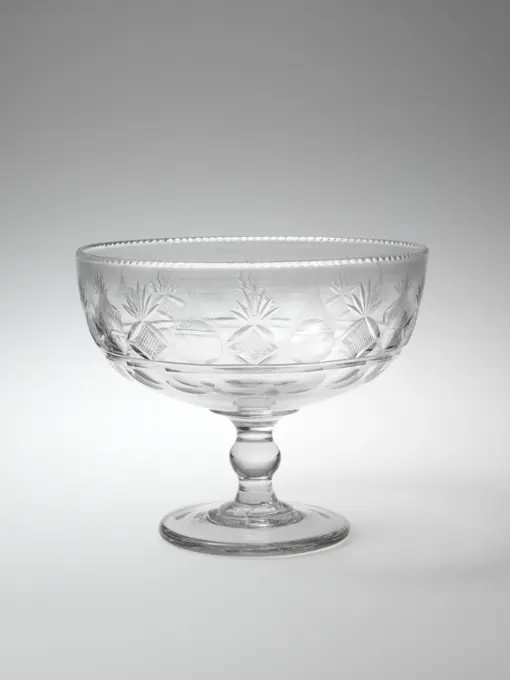
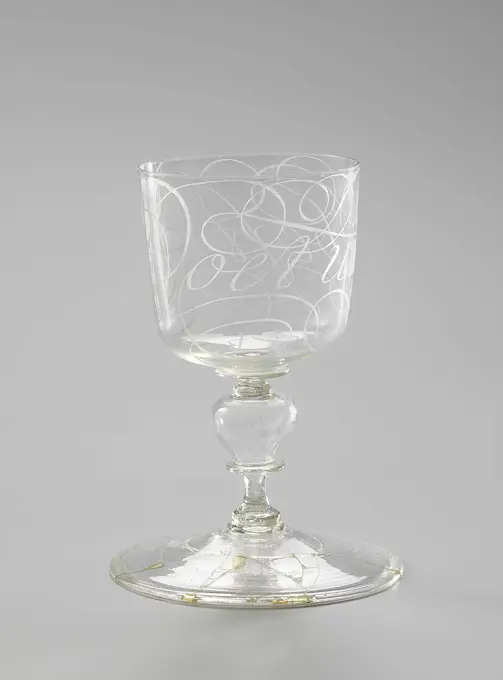
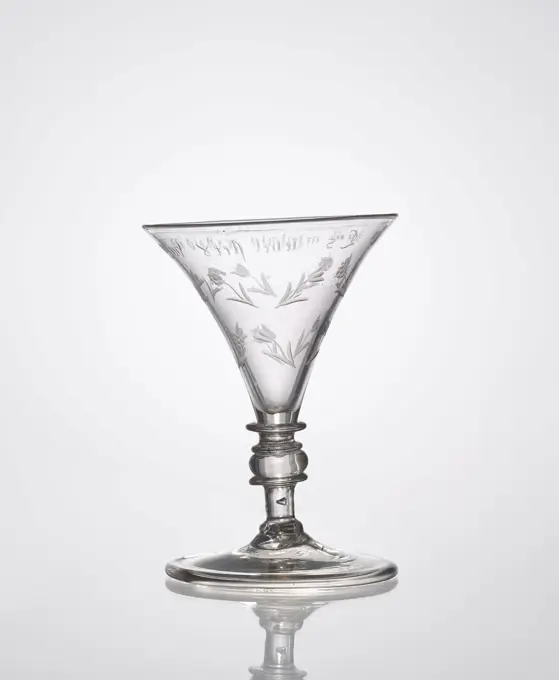
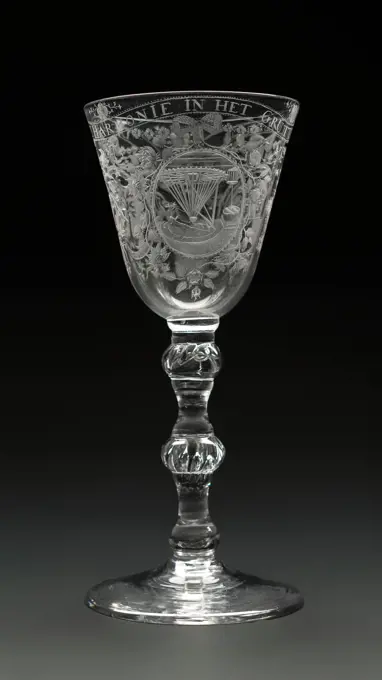
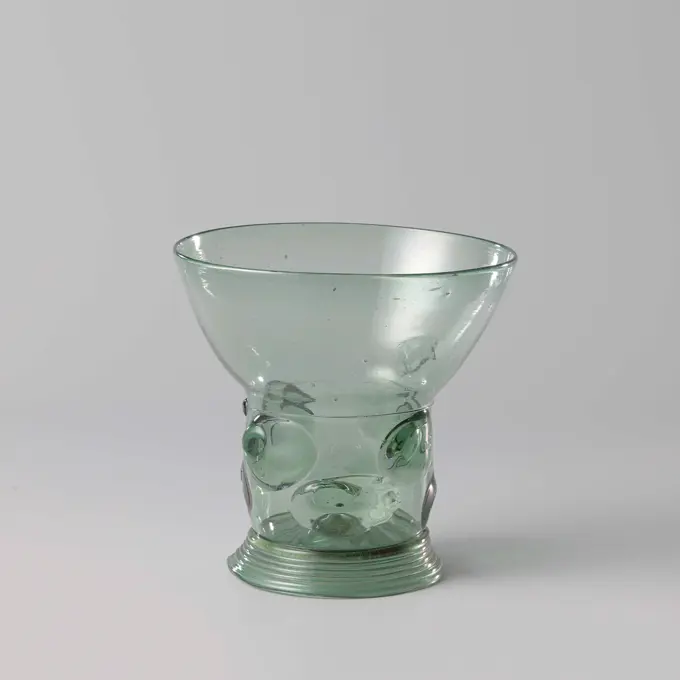
Antique Chalice Glassware

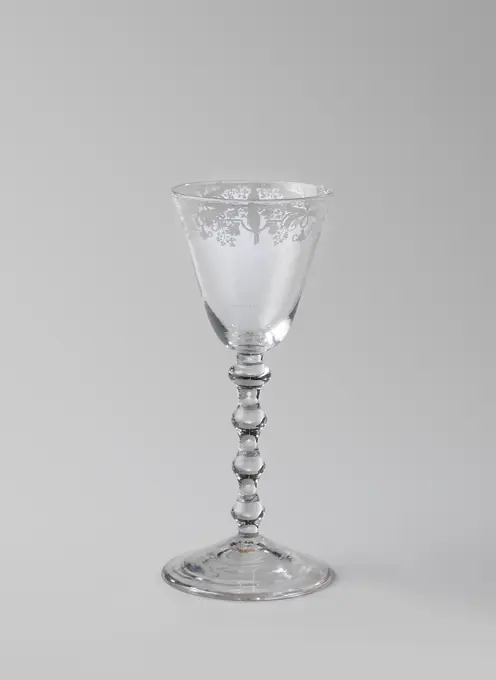
A collection of handcrafted chalice glasses, showcasing intricate designs with historical motifs, crafted between the 18th and 19th centuries.

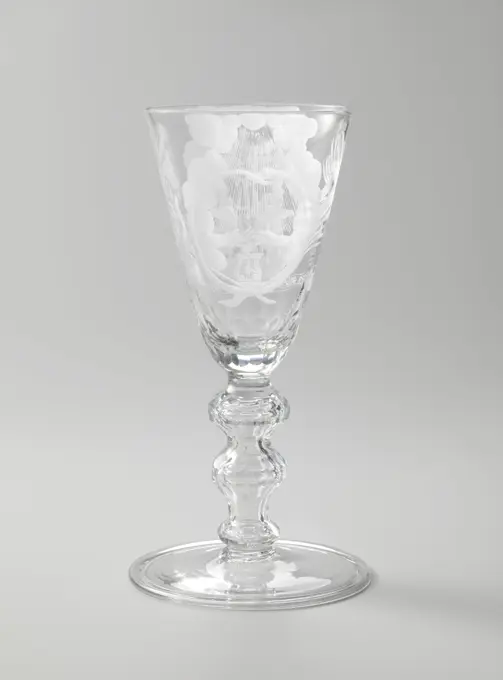
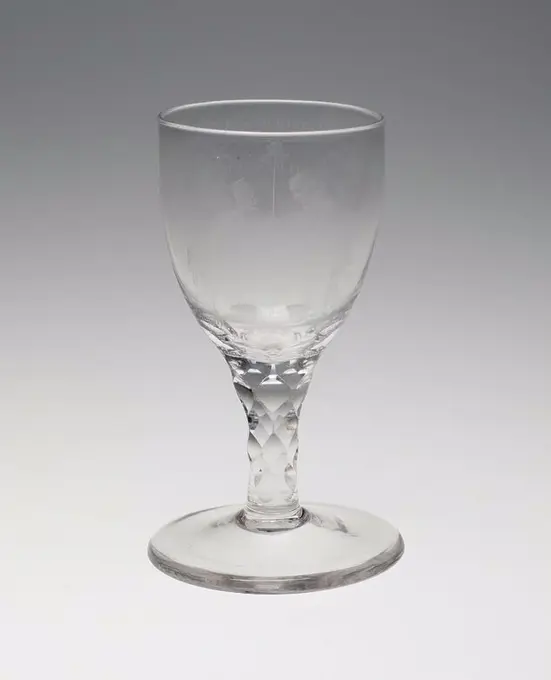
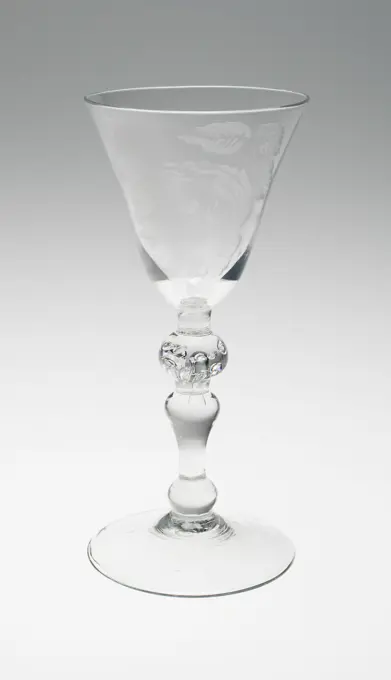
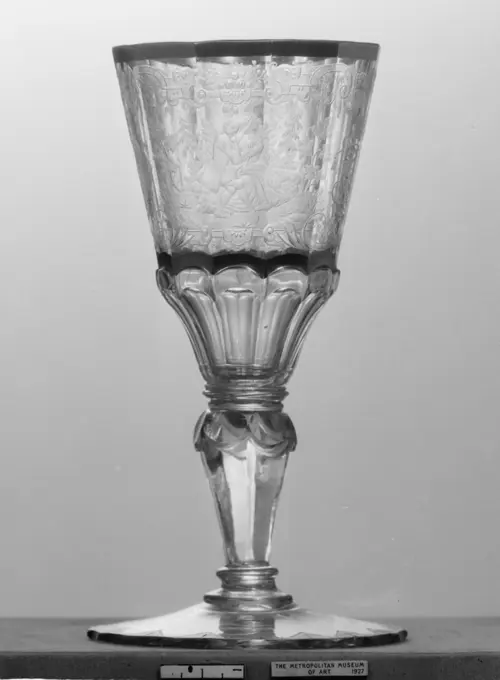
Chalice glass with a three -mast and the coat of arms of the city of Amsterdam, c. 1725 - c. 1750 Vaulted foot with turned around. The trunk made up of a ring and a facet -cut knot with bubble. Conical chalice with facet cut, rounded underside. On the chalice a three -mast with the inscription S.lands.welvardt. On the downside the coat of arms of the city of Amsterdam on a banderole with the text Amsteldam, flanked by two lions. glassblower: BohemenNorthern Netherlands glass grinding / glassblowing  Amsterdam Vaulted foot with turned around. The trunk made up of a ring and a facet -cut knot with bubble. Conical chalice with facet cut, rounded underside. On the chalice a three -mast with the inscription S.lands.welvardt. On the downside the coat of arms of the city of Amsterdam on a banderole with the text Amsteldam, flanked by two lions. glassblower: BohemenNorthern Netherlands glass grinding / glassblowing  Amsterdam
Chalice glass with a three -mast and the coat of arms of the city of Amsterdam, c. 1725 - c. 1750 Vaulted foot with turned around. The trunk made up of a ring and a facet -cut knot with bubble. Conical chalice with facet cut, rounded underside. On the chalice a three -mast with the inscription S.lands.welvardt. On the downside the coat of arms of the city of Amsterdam on a banderole with the text Amsteldam, flanked by two lions. glassblower: BohemenNorthern Netherlands glass grinding / glassblowing Amsterdam Vaulted foot with turned around. The trunk made up of a ring and a facet -cut knot with bubble. Conical chalice with facet cut, rounded underside. On the chalice a three -mast with the inscription S.lands.welvardt. On the downside the coat of arms of the city of Amsterdam on a banderole with the text Amsteldam, flanked by two lions. glassblower: BohemenNorthern Netherlands glass grinding / glassblowing Amsterdam
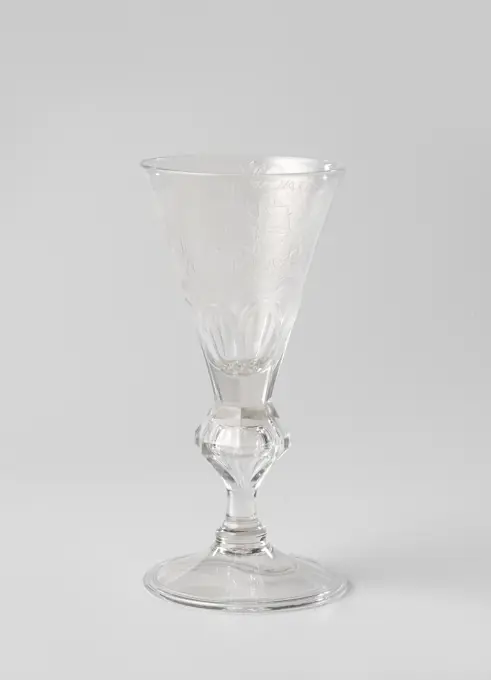
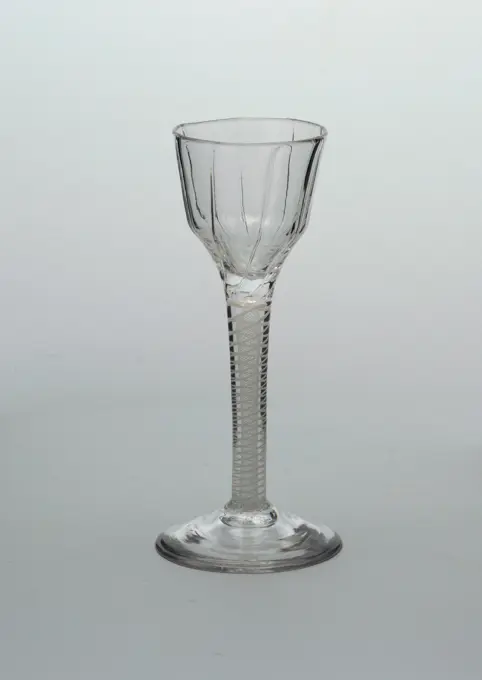
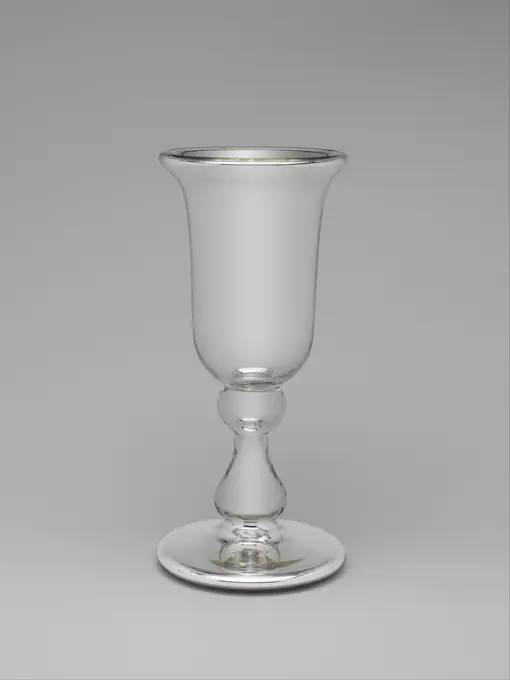
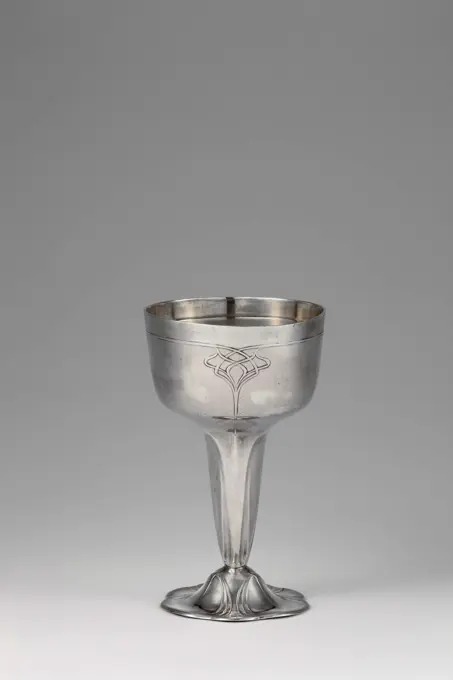
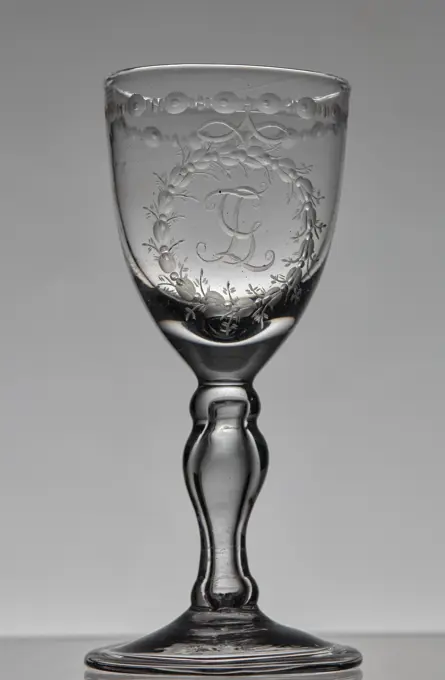
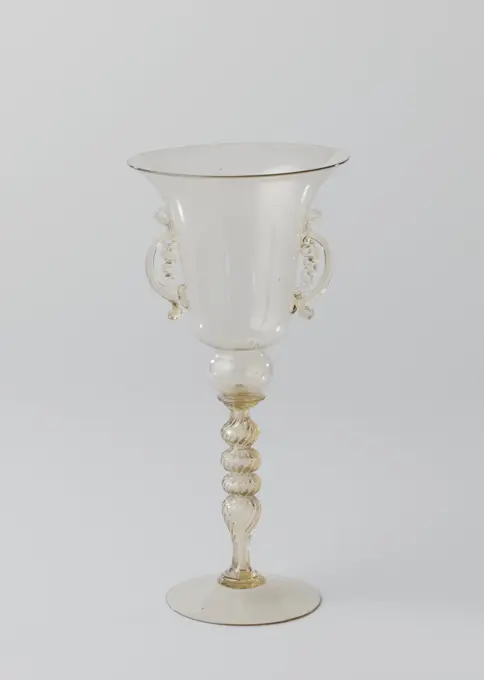
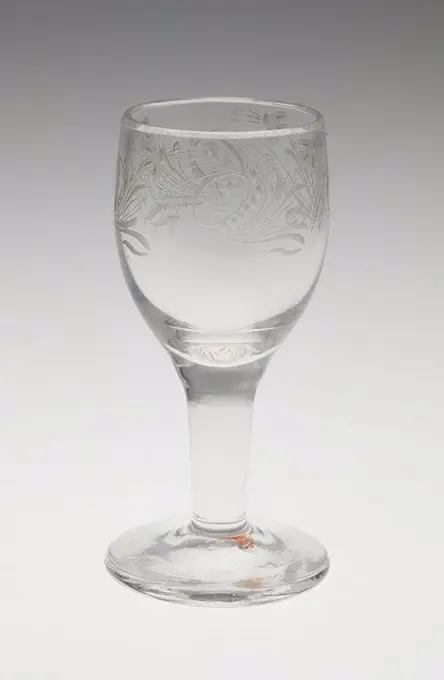
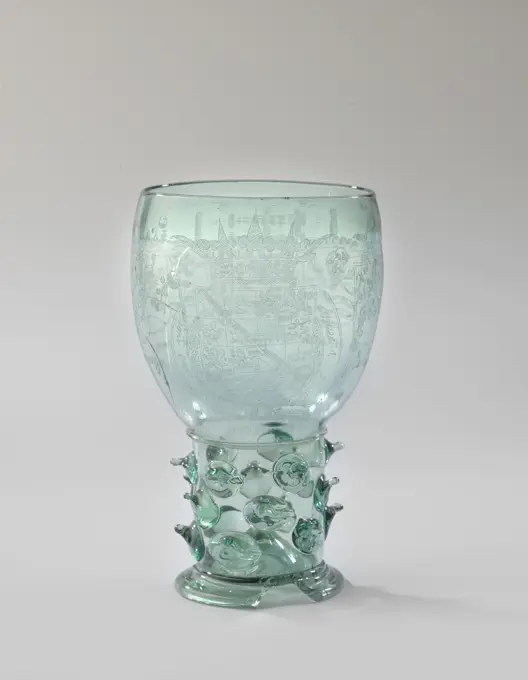
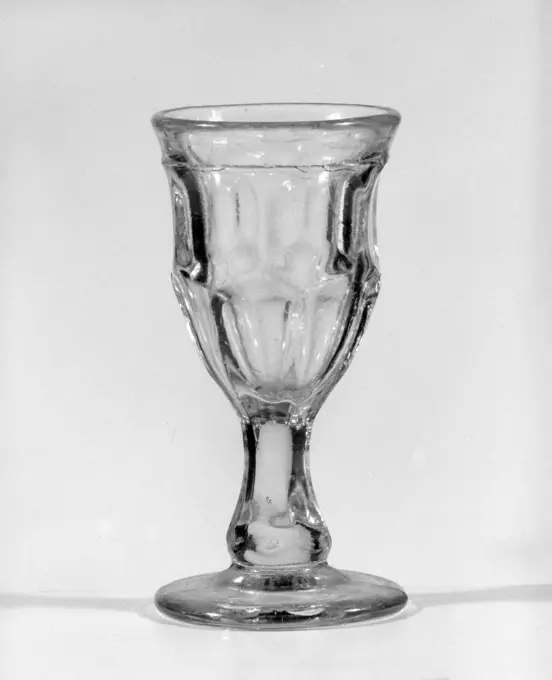
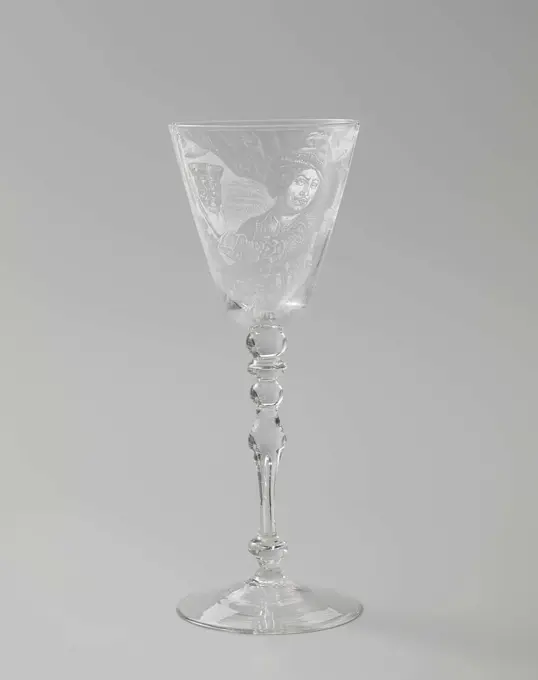
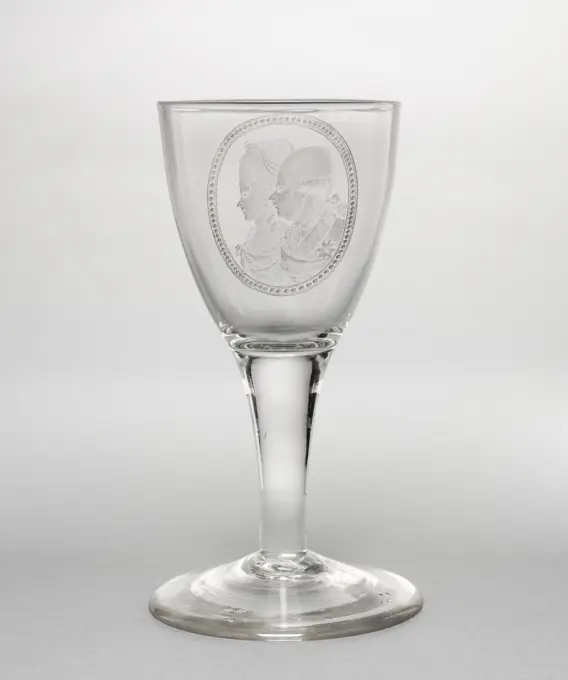
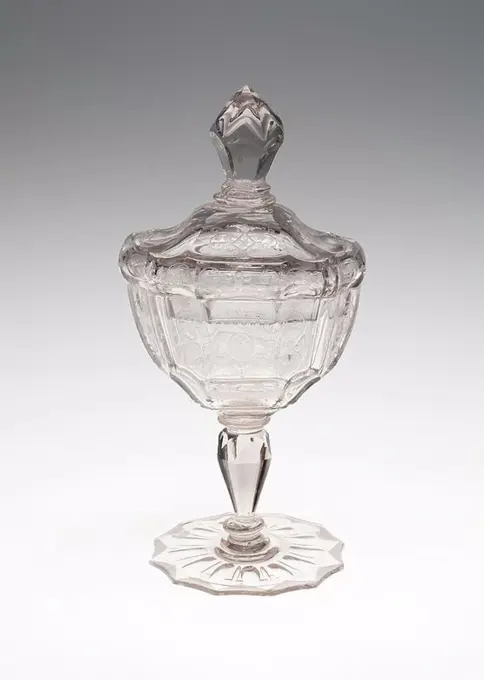
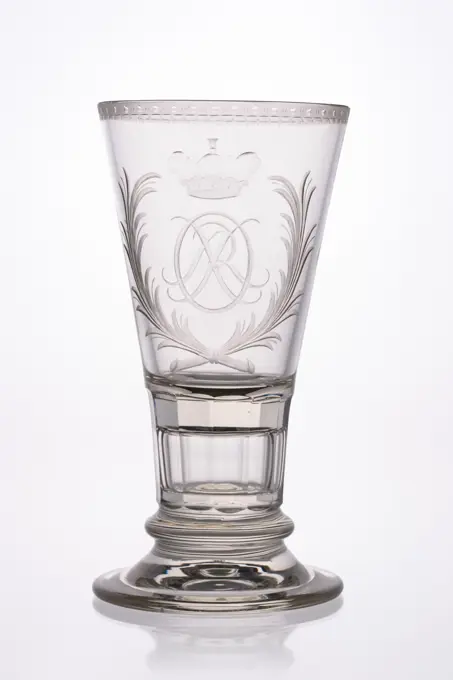
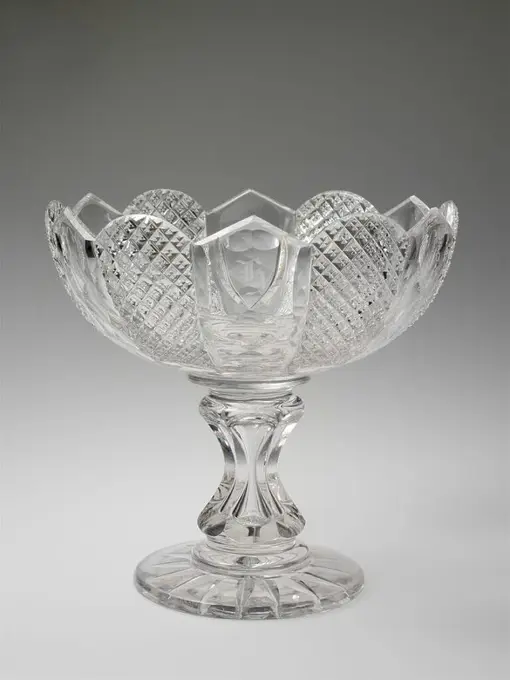
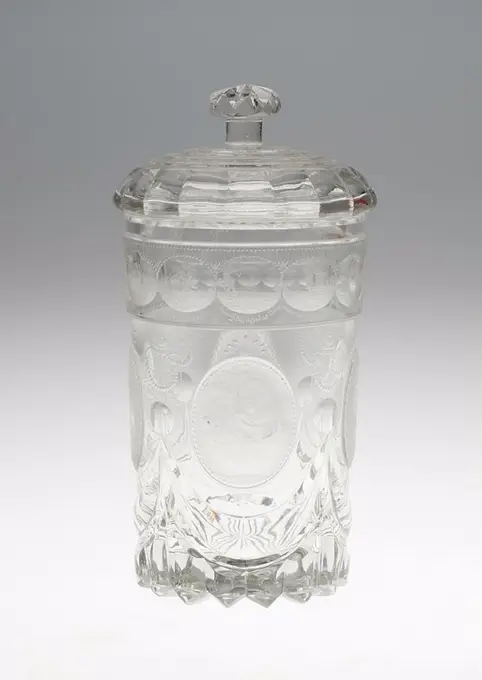
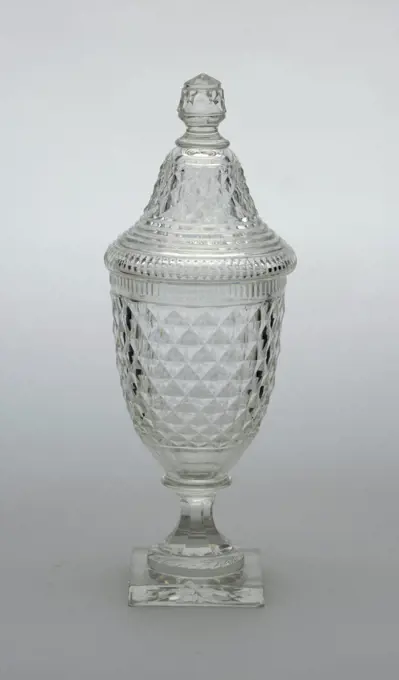
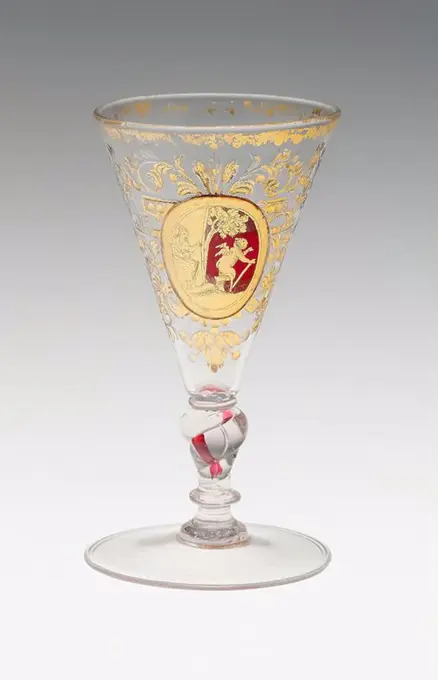
Chalice glass with a three -mast and the coat of arms of the city of Amsterdam, c. 1725 - c. 1750 Vaulted foot with turned around. The trunk made up of a ring and a facet -cut knot with bubble. Conical chalice with facet cut, rounded underside. On the chalice a three -mast with the inscription S.lands.welvardt. On the downside the coat of arms of the city of Amsterdam on a banderole with the text Amsteldam, flanked by two lions. glassblower: BohemenNorthern Netherlands glass grinding / glassblowing  Amsterdam Vaulted foot with turned around. The trunk made up of a ring and a facet -cut knot with bubble. Conical chalice with facet cut, rounded underside. On the chalice a three -mast with the inscription S.lands.welvardt. On the downside the coat of arms of the city of Amsterdam on a banderole with the text Amsteldam, flanked by two lions. glassblower: BohemenNorthern Netherlands glass grinding / glassblowing  AmsterdamMarriage glass, anonymous, c. 1725 - c. 1750 Flat. Facetted baluster tribe with buttons and a bubble. On the conical chalice on one side a winged heart that keeps two hands above an altar. Around a snake that bites in its tail; Above the name of God. On the other side a man and a woman reaching each other's hand over an altar on which XXV stands, there is a tree on it, above it a winged heart. Around a snake that bites in its tail. Furthermore crossed palm and laurel branches and a banderol with the inscription: God's love flame nourishes our tribe. The glass is sick. Glassblower: Saksennorthern Netherlands glass glassblowing Flat. Facetted baluster tribe with buttons and a bubble. On the conical chalice on one side a winged heart that keeps two hands above an altar. Around a snake that bites in its tail; Above the name of God. On the other side a man and a woman reaching each other's hand over an altar on which XXV stands, there is a tree on it, above it a winged heart. Around a snakeBokaal with the weapons of William IV and the Zeven Provinciën, Anonymous, c. 1725 - c. 1750 Vaulted foot with pontil brand. Balus -shaped trunk with two nodes. A bubble has been put into the trunk. Funnel -shaped chalice rounded at the bottom with slightly curved edge. The curve of the foot, the trunk and the underside of the chalice are cut in facets. On the chalice, the crowned weapon of Stadholder Prince William IV is engraved, surrounded by the garter of the eponymous order with the saying 'Honi soit qui mal y pense' and twigs with orange apples. The weapons of the Seven Provinces are engraved around. glassblower: GermanyNorthern Netherlands glass glassblowing  Seven Provinciën Vaulted foot with pontil brand. Balus -shaped trunk with two nodes. A bubble has been put into the trunk. Funnel -shaped chalice rounded at the bottom with slightly curved edge. The curve of the foot, the trunk and the underside of the chalice are cut in facets. On the chalice, the crowned weapon of StadholCup; Non -like Lona Huta; 1. W. 18th century (1700-00-00-1725-00-00);Bowl, with hares and dogs. Hollow Baluster trunk with a knot and three discs. The chalice in boxes divided into some of which running hare and dogs sharpened. Lid and base decorated.Kelkglas with an ornament edge. Conical foot. Baluster-shaped strain with four knots. Funnel-shaped chalice with rounded bottom. Along the mouth edge of the chalice a symmetrical ornament edge composed of band work, volutes, tendrils, bells and three parrots.Wine glass, anonymous, 1746 Vaulted foot. The baluster -shaped trunk has four knots, a flat knot, and two air bubbles, one of which is elongated. The conical chalice has a rounded bottom. On the chalice, above a balustrade with fountain and a water -spit Meerman, and for a crowned anchor with a burning heart and two tortments, two merging hands. The hands protrude from cuffs that come from two round shields with the family weapons of the Rotterdam families Meyners and Sleght, under a bright sun. To the left of the family weapons a seated female figure (Fortuna ()) With a horn of abundance and a palm branch, on the right -hand Mercy with bare breasts, two putti, a torch and a laurel wreath. Under the performance, in a symmetrical cartouche the city coat of arms of Rotterdam and the date Den XI Mey 1746. On the other side of the glass a garden vase under a canopy with lambrequin. A tire of rolling and leaf work runs along the mouth edge and the performances. glassblower: EnglandNorthern Sweetmeat Glass 1700-1799 England. Glass .Celery vase 1810-25 Benjamin Bakewell & Co.. Celery vase 1502Wineglass 1735-51 British. Wineglass. British. 1735-51. Glass. GlassSweetmeat glass ca. 1790 Irish. Sweetmeat glass. Irish. ca. 1790. Glass. GlassGoblet 1750-1760 Germany. Glass .Commemorative cupSweetmeat Glass 1700-1799 England. Glass .Kelkglas with a three-master and the coat of arms of the city of Amsterdam. Vaulted foot with beaten edge. The stem made up of a ring and a facet cut knot with air bubble. Conical chalice with facet cut, rounded bottom. On the chalice a three-master with the inscription s.lands.welvarddt. On the down side the arm of the city of Amsterdam on a banderole with the text Amsteldam, flanked by two lions.Tall Goblet or Vase 1870-1880 England. Glass; engraved .Wine Glass (probably England); glass.Wineglass 1750-1800 British, probably Bristol or possibly Dutch. Wineglass. British, probably Bristol or possibly Dutch. 1750-1800. Glass. GlassWine Glass 1850-70 American. Wine Glass. American. 1850-70. Pressed glass. Made in Portland, Maine, United StatesWineglass. Culture: British. Dimensions: Height: 5 1/2 in. (14 cm). Date: first half 18th century. Museum: Metropolitan Museum of Art, New York, USA.Glass;  1920-39 (1920-00-00-1939-00-00);Slinger glass with bell-shaped chalice. Slinger glass with conical foot and a ballustroid tribe. In the trunk opask white garlands around white network spiral. Bell-shaped chalice.Dwarf Ale Glass 1750-1850 England. Glass .Bokaal with a three -mast, a plowing farmer and the inscription: Salus Patriæ, Anonymous, c. 1725 - c. 1750 Concave-economic foot. Facetted baluster tribe with two knots. Conical chalice with faceted, rounded soil. Plowing a sailing ship and a farmer on the chalice. Above that Salus Patriæ. glassblower: GermanyNorthern Netherlands glass grinding / glassblowing Concave-economic foot. Facetted baluster tribe with two knots. Conical chalice with faceted, rounded soil. Plowing a sailing ship and a farmer on the chalice. Above that Salus Patriæ. glassblower: GermanyNorthern Netherlands glass grinding / glassblowingVase 1855-75 New England Glass Company To imitate silver in glass, the glassblower poured a solution containing metallic silver into the cavity between the walls of a double walled vessel, and the solution adhered to its interior. The hole at the bottom was sealed to prevent discoloration and, in this case, was marked with the name of the manufactory.. Vase. American. 1855-75. Blown silvered glass. Made in East Cambridge, Massachusetts, United StatesFour Continents Standing Cup; After Johannes Meyer (1655 - 1712); Germany; glassWine Glass 1715-1725 England. Glass .Compote 1820-35 Bakewell, Page & Bakewell. Compote. Bakewell, Page & Bakewell (1808-1882). American. 1820-35. Blown and cut glass. Made in Pittsburgh, Pennsylvania, United States. Low, conical foot with beaten edge. Baluster-shaped, hollow stem. Cylinder-shaped, on the underside chalice, on which it is scalloped in Italian letters 'does your best' and under the foot 'who does STAEGH in the good to doing a good acquirting the best at' t Lest 'Willem van Heemskerk Ao 1681'.Cup; Lauenstein; 3. W. 18th century (1750-00-00-1775-00-00);Kelkglas with an ornament edge. Kelkglas on baluster trunk with three buttons, one with a breaque blades. The celk border is decorated with Louis XV ornament.Wineglass (marriage glass) 1730-50 British, probably Newcastle glass with Dutch engraving. Wineglass (marriage glass). British, probably Newcastle glass with Dutch engraving. 1730-50. Glass. GlassChalip glass on a square base on the 25-year marriage of Barend Glasius and Grietje de Groot, 1791 Chalice glass on curved foot on square base. Short, faceted tribe. Curved chalice with faceted bottom. On the chalice the engraved text: to celebrate the 25 -year wedding day, from // Dwedle Lord Barend Glasius and Lady Grietje de Groot. // on 9 Maij 1791. glassblower: EnglandNorthern Netherlands glass glassblowing Chalice glass on curved foot on square base. Short, faceted tribe. Curved chalice with faceted bottom. On the chalice the engraved text: to celebrate the 25 -year wedding day, from // Dwedle Lord Barend Glasius and Lady Grietje de Groot. // on 9 Maij 1791. glassblower: EnglandNorthern Netherlands glass glassblowingGlass;  1920-39 (1920-00-00-1939-00-00);Wine glass with portraits of William V and Wilhelmina of Prussia, anonymous, c. 1790 Conical foot. Straight trunk, turning into a slightly curved chalice. On the chalice a double portrait of Stadholder Prince Willem V (1748-1806) and his wife Princess Wilhelmina van Pruisen (1751-1820), bordered on orange-apples, in the middle, connected by a bow. glassblower: EnglandNorthern Netherlands glass glassblowing Conical foot. Straight trunk, turning into a slightly curved chalice. On the chalice a double portrait of Stadholder Prince Willem V (1748-1806) and his wife Princess Wilhelmina van Pruisen (1751-1820), bordered on orange-apples, in the middle, connected by a bow. glassblower: EnglandNorthern Netherlands glass glassblowingLid of jar, with pictures of putti with burning hearts. Cup with lid, of bright, colorless glass, with engraved prints of Putti. At the front a representation of a putto above an altar on which two burning hearts lie. Above the inscription: ich hab ge nung an einen. On the back a putto in a landscape with five burning hearts in his right hand. Above the inscription: Nimt Welches du Wilst.Wine glass. Niemcy Południowe, creator, Niderlandy, creatorGlass;  around 1770 (1760-00-00-1780-00-00);Egg Cup 1830-70 Possibly New England Glass Company. Egg Cup 3387Chalice engraved with rosmoles, family arms, city arms and De goede Harmonie in the Grutters Gilde, wine glass drinking glass drinking utensils tableware holder lead glass glass, grams free blown and formed radgraving polishing goblet wineglass in clear colorless lead glass Pontil mark under round light ascending hollow base. Double bubble balustrade made of double balustere double balustere with two round balusters with round knot. Rounded round funnel-shaped chalice with fire-rounded edge The good Harmony in the Grutters Guild Rotterdam heraldry Gruttersgilde guild served drinking treasureArt Nouveau small cup. Orivit AG (Kolonia ; wytwórnia złotnicza ; 1894-1905 ; 1906-1914), manufacturerWine Glass 1740-1755 England .Chalice glass with leaf vine and birds, anonymous, c. 1675 - c. 1700 Flat base with turned around and pontil brand. Four -lobe, hollow, baluster -shaped trunk with three discs. Funnel -shaped chalice. On the chalice a leaf vank and birds are engraved. glassblower: Low CountriesNorthern Netherlands glass glassblowing Flat base with turned around and pontil brand. Four -lobe, hollow, baluster -shaped trunk with three discs. Funnel -shaped chalice. On the chalice a leaf vank and birds are engraved. glassblower: Low CountriesNorthern Netherlands glass glassblowingGoblet. This glass is exceptionally thinly blown and very transparent. It does not come from Venice, but is known to have been made in the Netherlands. The form of the hollow stem, a baluster with lion heads, was extremely popular north of the Alps. Several different variants of this type of glass are reproduced in a remarkable surviving copy of a 16th-century Flemish sale catalogue.Roemer, anonymous, 1621 Low, spun from a wire. Deep inserted soil. The short strain, which is occupied with two rows of Doornnoppen, is blown as a whole with the high, curved chalice. A smooth thread indicates the transition from the trunk to the chalice. On the chalice are engraved an anjelier, a wild rose, an African, a dragonfly, a shell and the Italian inscription 'Bella Dori Gentil, Noi Uaghi Fiori // da in Prendiam Gli Honori'. The glass is signed on the trunk 'Anna Roemers' and carries the year 'Anno 1621'.  glass glassblowing Low, spun from a wire. Deep inserted soil. The short strain, which is occupied with two rows of Doornnoppen, is blown as a whole with the high, curved chalice. A smooth thread indicates the transition from the trunk to the chalice. On the chalice are engraved an anjelier, a wild rose, an African, a dragonfly, a shell and the Italian inscription 'Bella Dori Gentil, Noi Uaghi Fiori // da in Prendiam Gli Honori'. The glass is signed on the trunk 'Anna RoemersPrzeszłośc Przyszłości Huta Uarzecko NalibockieWing glass, anonymous, c. 1800 - c. 1900 Conical foot. Hollow, baluster -shaped trunk with twisted ribs and three knots. C-shaped wings in which a spiral ornament. Trumpet -shaped chalice with rounded bottom. Venice glass glassblowing Conical foot. Hollow, baluster -shaped trunk with twisted ribs and three knots. C-shaped wings in which a spiral ornament. Trumpet -shaped chalice with rounded bottom. Venice glass glassblowingKelkglass with a naked woman and a Cupido and the inscription: Plus de Coup: Plus de Plaisir, c. 1725 - c. 1750 Vaulted foot. Straight trunk with elongated bubble, overflowing in trumpet -shaped chalice. On the chalice an engraved vorulation of a naked woman and a cupid and the inscription: plus the coup: plus de plaisir. glassblower: EnglandNorthern Netherlands glass glassblowing Vaulted foot. Straight trunk with elongated bubble, overflowing in trumpet -shaped chalice. On the chalice an engraved vorulation of a naked woman and a cupid and the inscription: plus the coup: plus de plaisir. glassblower: EnglandNorthern Netherlands glass glassblowingChalice 1675-1700 Georg Reischl. Chalice 194995Wine Glass. England. Date: 1775-1799. Dimensions: 11.4 × 4.8 cm (4 1/2 × 1 7/8 in.). Glass. Origin: England. Museum: The Chicago Art Institute, Chicago, USA.Wine Glass. England or Netherlands Engraved: Northern Netherlands. Date: 1795. Dimensions: 13.5 × 6.7 cm (5 5/16 × 2 5/8 in.). Glass; cut and stipple engraved. Origin: England. Museum: The Chicago Art Institute, Chicago, USA.Champagne Glass 1878-90 George Duncan and Sons. Champagne Glass 1936. Vaulted foot. Slim baluster trunk with buttons, a disk and two air bubbles. Conical chalice with a rounded basis. On the chalice a representation of two crowned, flaming hearts on a rock flanked by putti. Along the mouth edge the inscription: stant resistant and faithful.Cart with painting in Schwarzlot, with a deer hunt. Conical foot with beaten edge. Hollow, baluster-shaped, ground strain. Fully shaped chalice with thickened, ground bottom faceted with inserted air bubble. On the chalice is painted in a landscape with musicians, a deer afterwards by a dog, birds and insects. At the foot and under the landscape a stylized branch. Along the top edge a cartel edge.Roemer with the weapon of Prince Maurits surrounded by the garter, Anonymous, in or after 1613 - c. 1625 Low, spun from a wire. Inserted soil. The trunk, which is set with three rows of Doornnoppen, is blown as a whole with the curved chalice. A smooth thread indicates the transition from the trunk to the chalice. On the chalice, the crowned weapon of Prince Maurits, surrounded by the garter of the eponymous order and the motto 'Honi Soi Qui Mal Y Pense' is engraved. Furthermore, the weapons of the seven provinces are depicted around the chalice thirteen orange apples. glassblower: Low CountriesNorthern Netherlands glass glassblowing Low, spun from a wire. Inserted soil. The trunk, which is set with three rows of Doornnoppen, is blown as a whole with the curved chalice. A smooth thread indicates the transition from the trunk to the chalice. On the chalice, the crowned weapon of Prince Maurits, surrounded by the garter of the eponymous order and the motto 'Honi Soi Qui Mal Y Pense' is eCordial Glass 1830-70 American With the development of new formulas and techniques, glass-pressing technology had improved markedly by the late 1840s. By this time, pressed tablewares were being produced in large matching sets and innumerable forms. During the mid-1850s, colorless glass and simple geometric patterns dominated. Catering to the demand for moderately-priced dining wares, the glass industry in the United States expanded widely, and numerous factories supplied less expensive pressed glassware to the growing market. At the Exhibition of the Industry of All Nations at New Yorks Crystal Palace in 1853, for example, the New England Glass Company exhibited 130 pieces of one design, "consisting of bowls, tumblers, champagnes, wines, and jelly glasses." This object belongs to one such service. Although the glass manufactory is not known, the glassware is very typical of the large services that were very popular with Americas middle class in the nineteenth century.. Cordial GlassKelkglas with leaf volutes. Small chalice glass with flat foot. Back to the top narrowing trunk with a knot. Horn-shaped chalice with wavy edge. The chalice and the foot are painted in email with white leaf volutes. Punched piping along the edges.Footed Beaker; Lower Rhineland (possibly), Germany; 1500 - 1550; Free-blown pale yellow-green glass with applied decoration; 11.9 cm (4 11,16 in.)Glass;  1. W. 19th century (1801-00-00-1825-00-00);Wine Glass 1749 England . Frans Greenwood (Engraver). The Dordrecht dealer and collector Frans Greenwood is renowned as the inventor of stipple-engraving. He probably drew his inspiration from mezzotint engravings. Both techniques are well suited conveying half tones’, or the transitions between varying grey tones. This image is based on a mezzotint by Bloteling after a painting by Jan van Mieris.Translation of inscription: Out of sight, out of mind.Wine glass, one of a set of ten, c. 1920, 8 1/4 x 3 1/4 in. (20.96 x 8.26 cm), Aventurine glass, Italy, 20th centuryWine Glass 1700-1725 Bohemia. Glass with engraved gold leaf decoration .Lid of Roemer. Vaulted lid with a cut-out edge and a massive convex button.Roemer with two rows of braam buds. Large grummer with inserted bottom on high, light concave foot with beaten edge. The wide, corporate chalice as a whole blown with the trunk that is busy with two rows of braam buds. The transition from the chalice to the trunk indicated by a ribbed wireFlute; Non -like Lona Huta; 3. W. 18th century (1750-00-00-1775-00-00);Goblet, pressed glass, Clear glass. Tapering cylindrical cup on flaring conical stem on stepped circular foot. Cup molded with Japanese-inspired decoration of fret work, flowers, and flowing stems and leaves on a pebble-textured ground above a broad band of hatched lines., ca. 1880, glasswares, Decorative Arts, GobletGoblet: Portrait of William V, Prince of Orange and his wife, Frederica Sophia Wilhelmine of Prussia, c. 1780. Manner of David Wolff (Dutch, 1732-1798). Glass; diameter: 8.3 cm (3 1/4 in.); overall: 15.3 x 7.2 cm (6 x 2 13/16 in.). Wolff was one of the most famous Dutch engravers of glass in the 18th century. The glasses upon which he worked were chiefly of English manufacture.Cup; Glucksburg (Huta Szk A; 1700-Post 1756); 3. W. 18th century (1750-00-00-1775-00-00);Bronisław Krystall. Testament (Warsaw - exhibition - 2015/2016), Krystall, Bronisław (1887-1983) - collection, devils, testamentary record (provenance)Wineglass ca. 1740 German, Silesia. Wineglass. German, Silesia. ca. 1740. Glass. GlassGoblet (Ireland); glassRummer Tumbler 1850-70 Bakewell, Pears and Company. Rummer Tumbler 6912Standing cup ca. 1745 Engraved by Christian Gottfried Schneider The arms engraved on the side of this standing cup belong to the von Zastrow family of Prussia, Silesia.. Standing cup. German, Silesia. ca. 1745. Glass. Engraved by Christian Gottfried Schneider (German, 1710-1773). GlassChalice early 20th century (original dated 15th century) Irish. Chalice. Irish. early 20th century (original dated 15th century). Silver gilt. Reproductions-MetalworkSpoonfuls, Cornelis Knuysting, 1802 Silver spoon vase. The oval vase rests on a diamond -shaped plinth. The chalice -shaped container has an openwork decoration. The sloping edge is interrupted by 12 segment -shaped reserves in which the spoons can hang. Rotterdam silver (metal) Silver spoon vase. The oval vase rests on a diamond -shaped plinth. The chalice -shaped container has an openwork decoration. The sloping edge is interrupted by 12 segment -shaped reserves in which the spoons can hang. Rotterdam silver (metal)Cup with lid, with three stacked wine barrels and the inscription: wellvaaren.van.de.wyn.coopy. Boardbook: wellvaaren.van.de.wyn.coopy. Ornaments from grape vines, around three wine barrels, on which a chalice.Sugar Bowl. Attributed to Bakewell, Page & Bakewell; American, 1813-32; Pittsburgh, Pennsylvania. Date: 1820-1835. Dimensions: 19.1 × 11.1 × 11.4 cm (7 1/2 × 4 3/8 × 4 1/2 in.). Glass. Origin: Pittsburgh. Museum: The Chicago Art Institute, Chicago, USA.Wineglass 17th century Italian, Venice (Murano) During the Renaissance, Venetian glassmakers, working on the island of Murano, were celebrated across Europe for their fine and sparkling work. Called cristallo” emulating the clarity of rock crystal, in the hands of the most skilled glassblowers the medium could be delightfully manipulated, variously stretched paper-thin flat, or playfully twisted, or blown into molds with spectacular patterns.. Wineglass 186048Wine Glass 1750-1799 England. Glass .Betel holder, anonymous, 1700 - 1725 Oval holder of silver, for sirih leaves. The broadening body stands on a vaulted rejuvenating foot. Foot and body are driven with flower vines. Jakarta silver (metal) Oval holder of silver, for sirih leaves. The broadening body stands on a vaulted rejuvenating foot. Foot and body are driven with flower vines. Jakarta silver (metal)Cup; Weissbach (Huta Szk A; 1617-1754), Weiberge (Huta Szk ; 1740-1760 (1740-00-00-1760-00-00);Covered Bowl. Germany. Date: 1725-1735. Dimensions: H. 17.8 cm (7 in.). Glass. Origin: Germany. Museum: The Chicago Art Institute, Chicago, USA.. Conical foot. Smooth, dredging tribe, undervantage in a curved chalice. On the chalice, in a rectangular field with beveled corners, a representation of a grinning man in half, which counts money. Above the performance the text: the pleasure.Glass; Lobmeyr, J. & L. (Vienna; 1823-); 1920-39 (1920-00-00-1939-00-00);Compote. Culture: American. Dimensions: H. 9 11/16 in. (24.6 cm); Diam. 10 1/4 in. (26 cm). Maker: Attributed to Christian Dorflinger (1828-1915). Date: 1855-60.This compote is from the same larger luxury glass table service as a decanter and three drinking vessels in the collection (2015.459.1a,b; 2015.459.2-.4). The compote bears an engraved gothic style "H" in a carved shield on one of the alternating clear vertical panels. The service descended in the family of Johns Hopkins (1795-1873), prominent businessman, entrepreneur, abolitionist, and philanthropist of Baltimore, Maryland. Hopkins may have purchased the service for use in his country estate, Clifton, outside of Baltimore, which he extensively renovated into an Italianate mansion in 1858. It is known that he enjoyed entertaining there, welcoming family, friends and dignitaries, including the Prince of Wales (later King Edward VII). The glass is exceptionally well cut and designed, representing some of the best of independentCovered Beaker. Bohemia, Czech Republic. Date: 1815-1825. Dimensions: 20.3 × 9.5 cm (8 × 3 3/4 in.). Glass. Origin: Bohemia. Museum: The Chicago Art Institute, Chicago, USA.Wing glass with funnel -shaped chalice, anonymous, c. 1600 - c. 1700 Wing glass on the curved foot of silver. The trunk made up of a rod made in loops with white, red and yellow threads. Completed three pinched. Funnel -shaped chalice. Low Countries glass. silver (metal) glassblowing Wing glass on the curved foot of silver. The trunk made up of a rod made in loops with white, red and yellow threads. Completed three pinched. Funnel -shaped chalice. Low Countries glass. silver (metal) glassblowingWig Stand; tin-glazed earthenware; Bequest of Richard Cranch Greenleaf in memory of his mother, Adeline Emma Greenleaf; 1962-60-2-bJar and lid, Glass, Slender urn-shaped body cut with shallow diamond pattern all over, a row of thin fluting at top edge, wide flutes at base; fluted stem on square base cut with star on bottom; tall bell-shaped cover cut with shallow diamond pattern and prismatic rings, faceted finial., England, ca. 1830, glasswares, Decorative Arts, Jar and lidWine Glass. Bohemia, Czech Republic. Date: 1725-1735. Dimensions: 11.8 × 6.5 cm (4 5/8 × 2 9/16 in.). Glass. Origin: Bohemia. Museum: The Chicago Art Institute, Chicago, USA.Communion set, Dirk Wor (attributed to), 1736 Silver of silver. Decorated with Louis XIV ornamented edges with palmets, chalices, leaf, grid and band work. With appliqued weapon from Philip Diodati. Dordrecht silver (metal) Silver of silver. Decorated with Louis XIV ornamented edges with palmets, chalices, leaf, grid and band work. With appliqued weapon from Philip Diodati. Dordrecht silver (metal)Jug, anonymous, c. 1640 Ovale can be made of rock crystal on a low foot and with a high -placed ear. Gold frame with email. The upper -long -running eight -lobe barrel is decorated with garlands, fruit bunches, dragons and tifles. Malib gold (metal). Ovale can be made of rock crystal on a low foot and with a high -placed ear. Gold frame with email. The upper -long -running eight -lobe barrel is decorated with garlands, fruit bunches, dragons and tifles. Malib gold (metal).Berkenmeier with two rows of flat studs. Berkenmeier with inserted soil on conical, spun base from a wire. The light convex chalice as a whole blown up with the trunk, which is busy with two rows of large flat studs. The transition from the chalice to the trunk indicated by a smooth wire.Aperitif Glass, one of five, c. 1920, 7 3/8 x 2 1/2 in. (18.73 x 6.35 cm), Aventurine glass, Italy, 20th century. .Wine Glass and Cover 1725-1735 Bohemia. Glass with engraved gold leaf decoration .Kembeyer, Anonymous, 1646 Low, Cunnic, spun from a wire. Deep unstaled soil. The trunk, which is set with two rows of large flat studs, is blown as a whole with the funnel -shaped chalice. A smooth thread indicates the transition from the trunk to the chalice. On the chalice, the saying 'Vincens Tui' is calligraphy (in translation: 'Overcome yourself'), a butterfly, a cherry, a violet and a fly. The engraving is signed and wears the year on the tribe 'Anna Roemers 1646' and again under the foot 'An'.  glass glassblowing Low, Cunnic, spun from a wire. Deep unstaled soil. The trunk, which is set with two rows of large flat studs, is blown as a whole with the funnel -shaped chalice. A smooth thread indicates the transition from the trunk to the chalice. On the chalice, the saying 'Vincens Tui' is calligraphy (in translation: 'Overcome yourself'), a butterfly, a cherry, a violet and a fly. The engraving is signed and wears the year on the tribe 'Anna Roemers 1646' and again under the foot Tumbler, Fern” Pattern. Designer George Sakier, American, 1897-1988 Manufacturer: Fostoria Glass Company, American, 1887-1986Goblet ca. 1815 Anthony Rasch. Goblet 4131