Antique Decorative Boxes

An array of ornate antique boxes and caskets from various cultures and centuries, featuring intricate carvings and historical significance, rich in detail and craftsmanship.
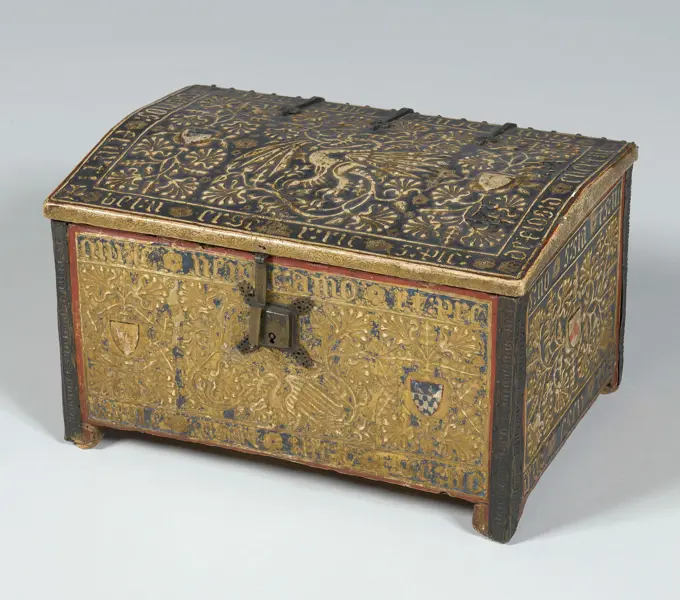
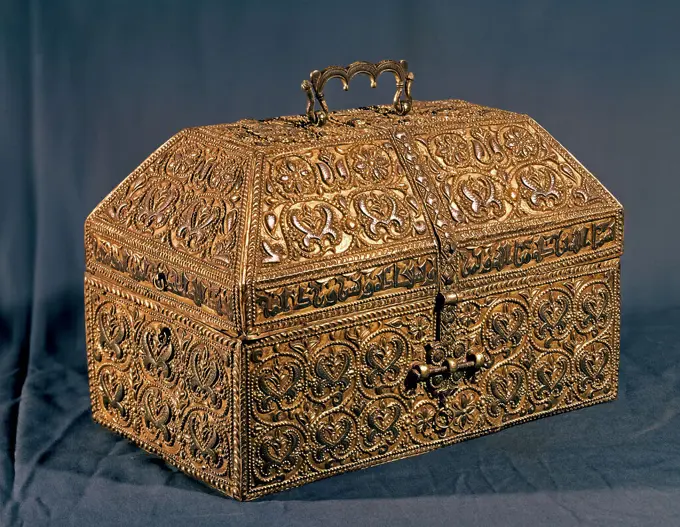
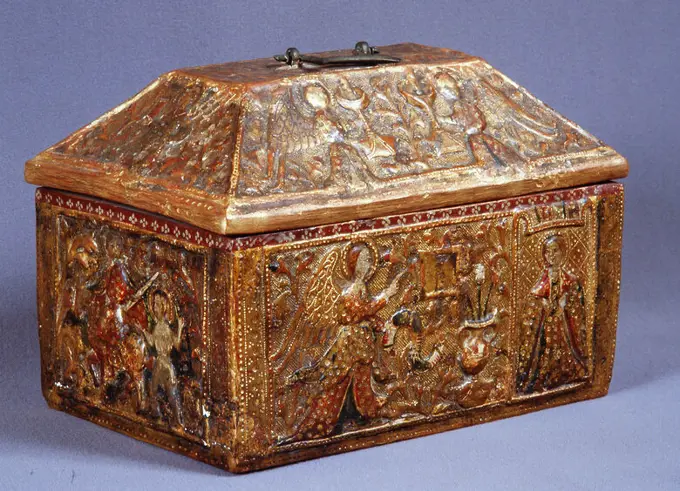
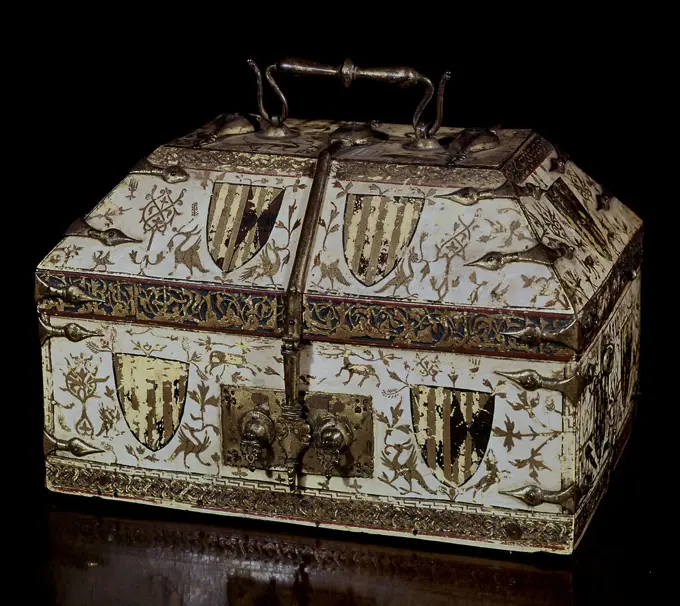
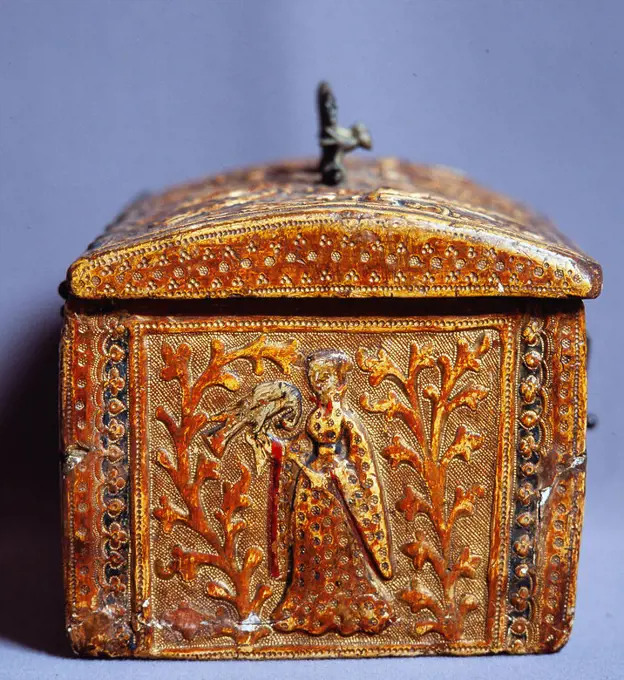
. Small casket of polychromed poplar wood, with decorations in gold-plated stucco consisting of leaf drinks with a dragon flanked in the middle and on the lid, flanked by coats of arms with inscriptions in Latin. At the rear four standing fields with leaf raft, including inscriptions. The batter on the corners formed by thin copper plates also shows inscriptions. The lock and handles are copper. The green upholstery inside is partially worn out.
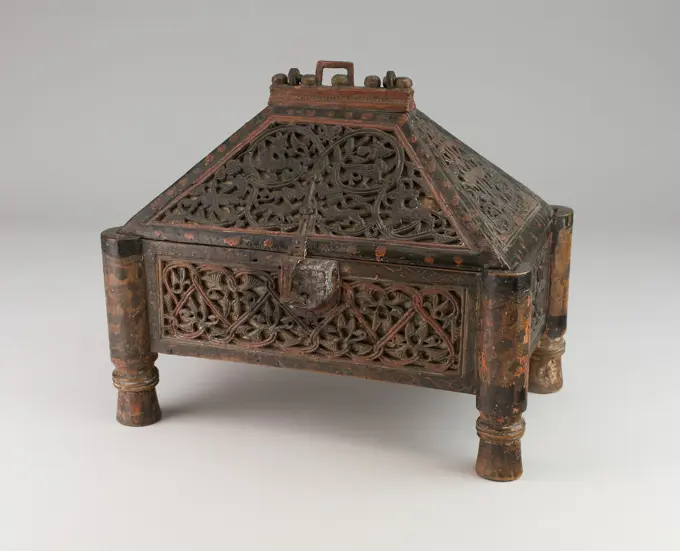
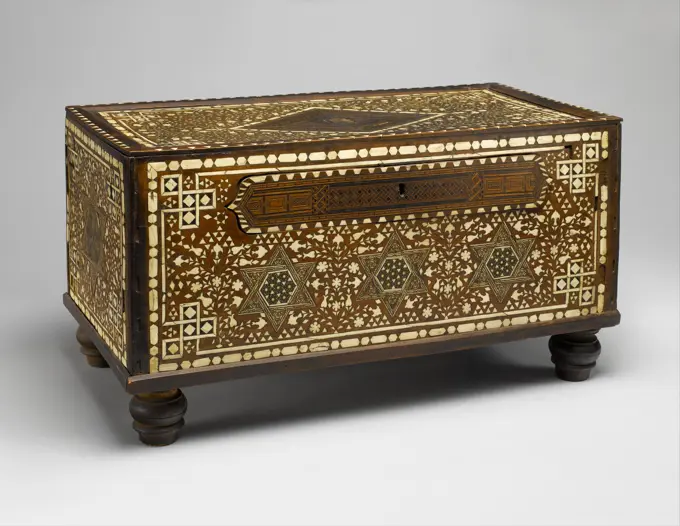
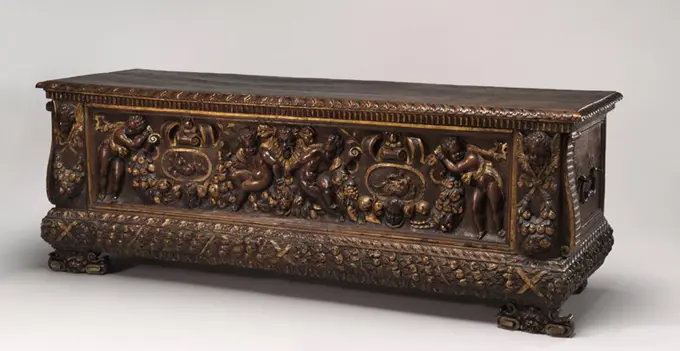
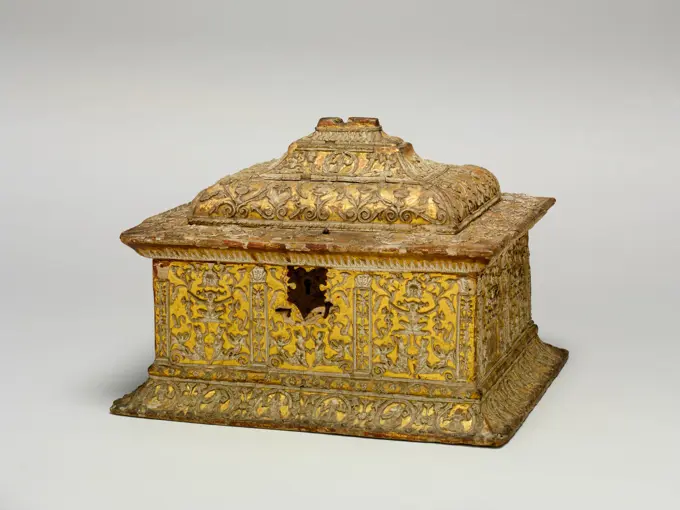
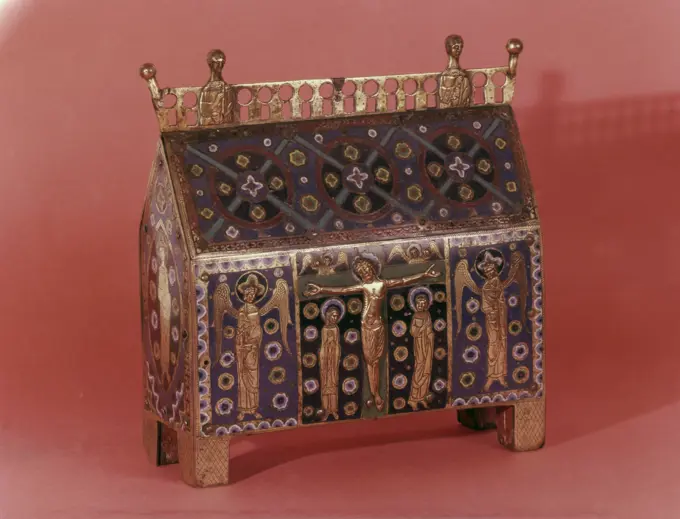
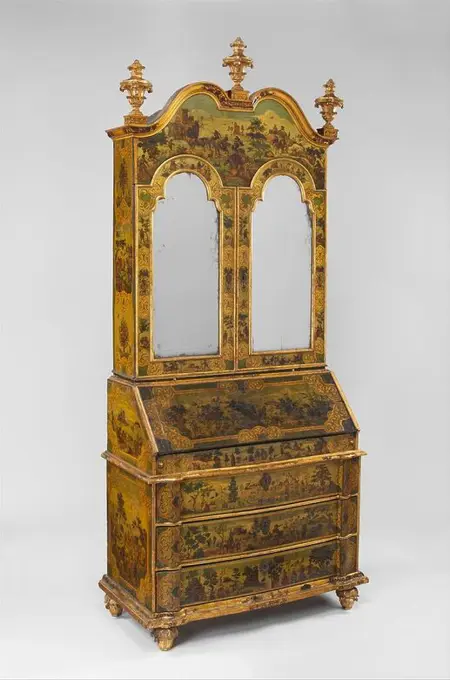
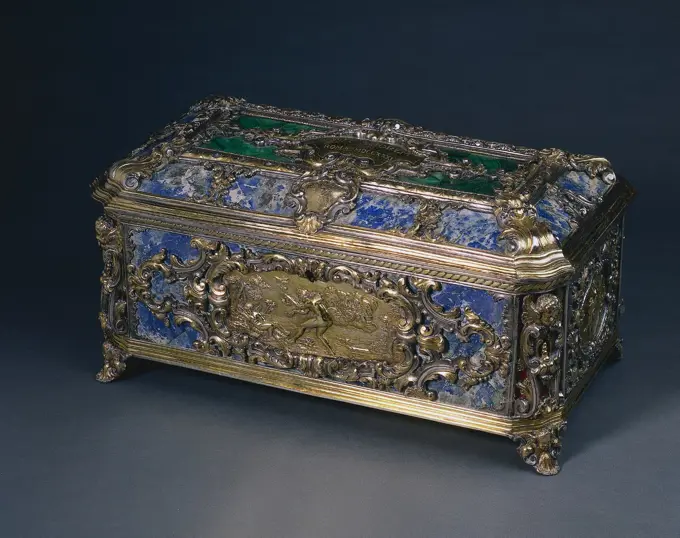
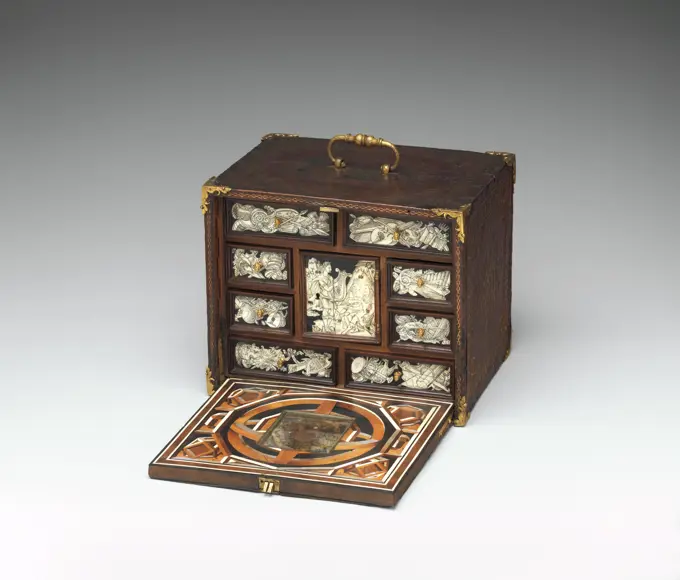
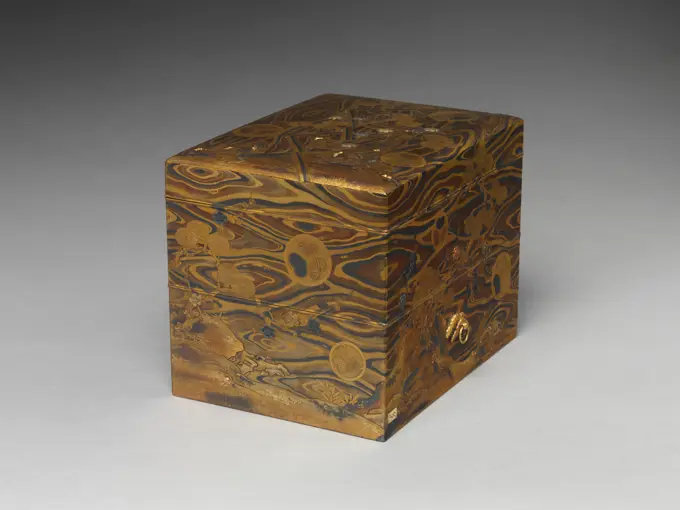
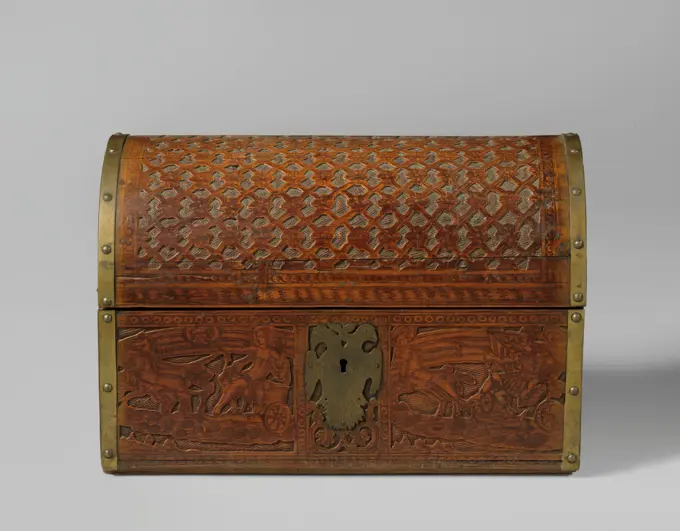
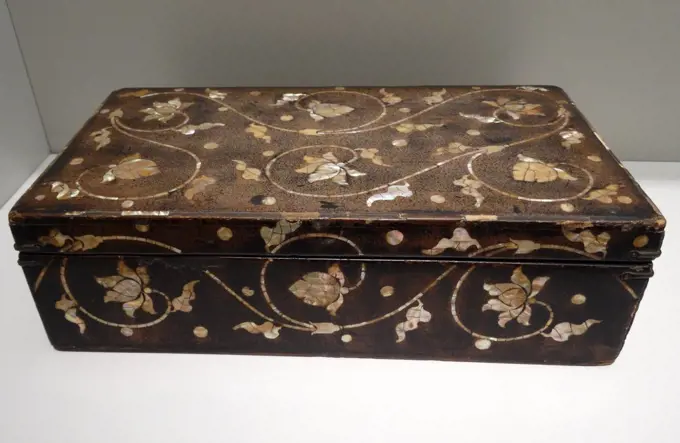
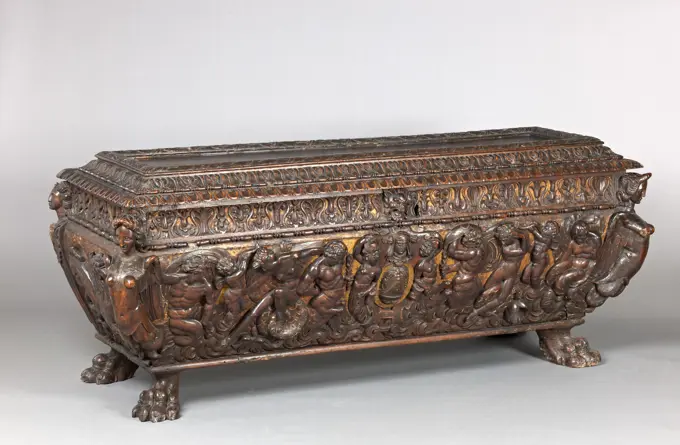
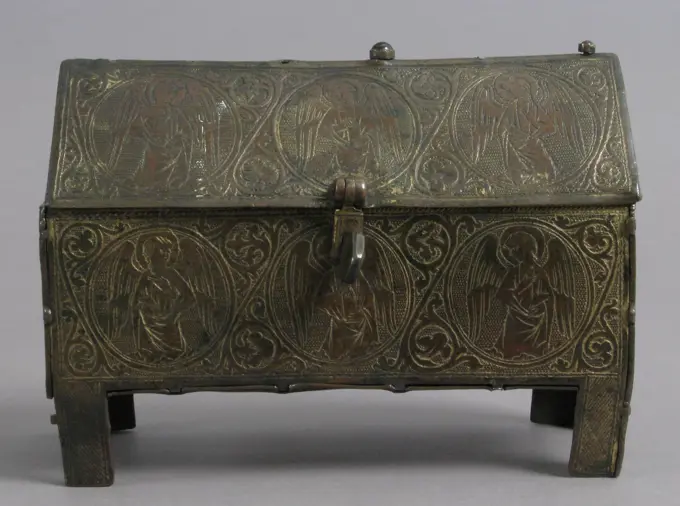
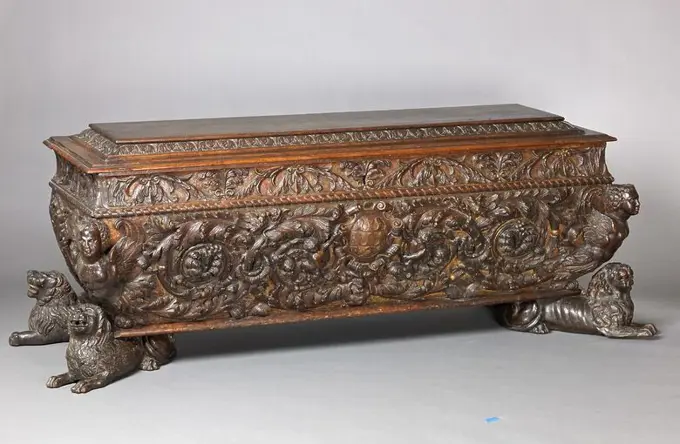
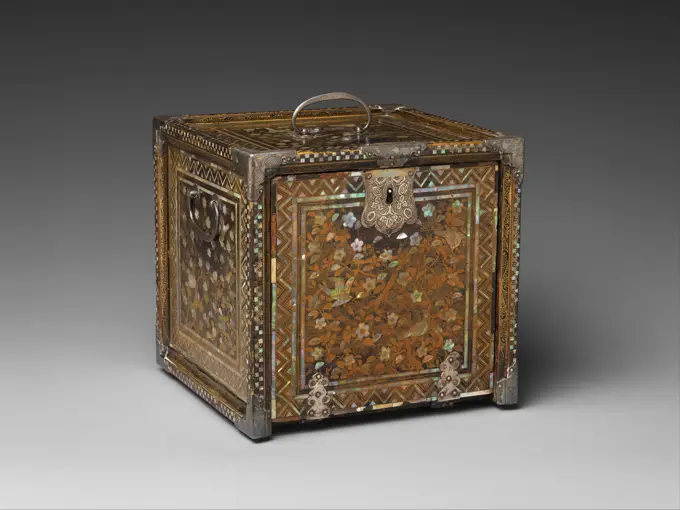
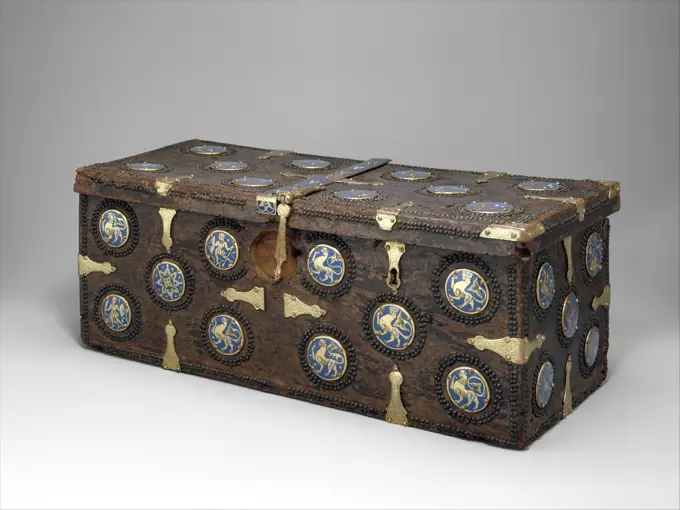
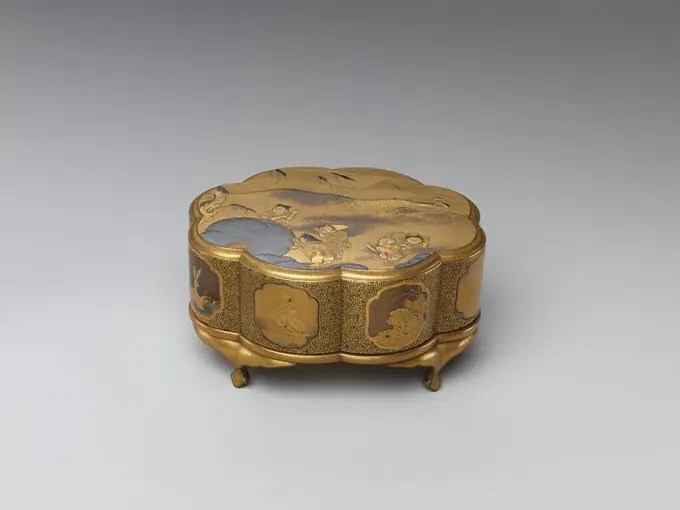
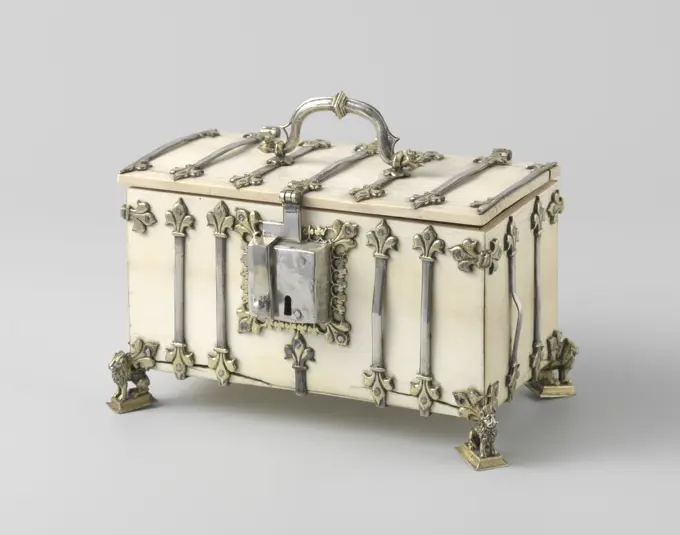
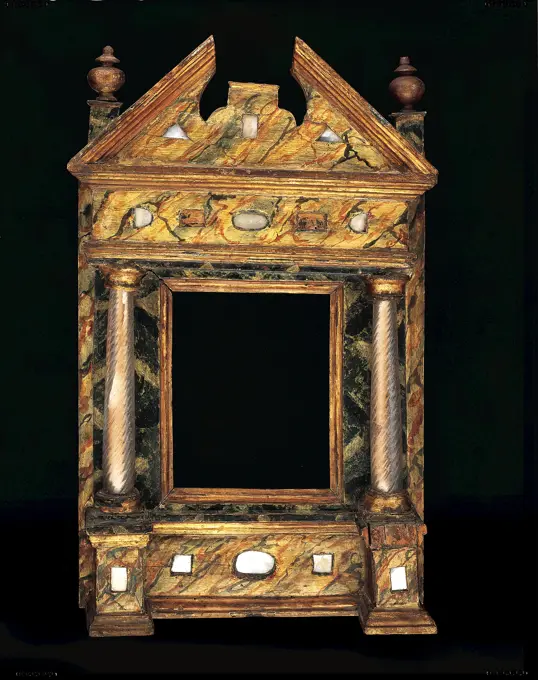
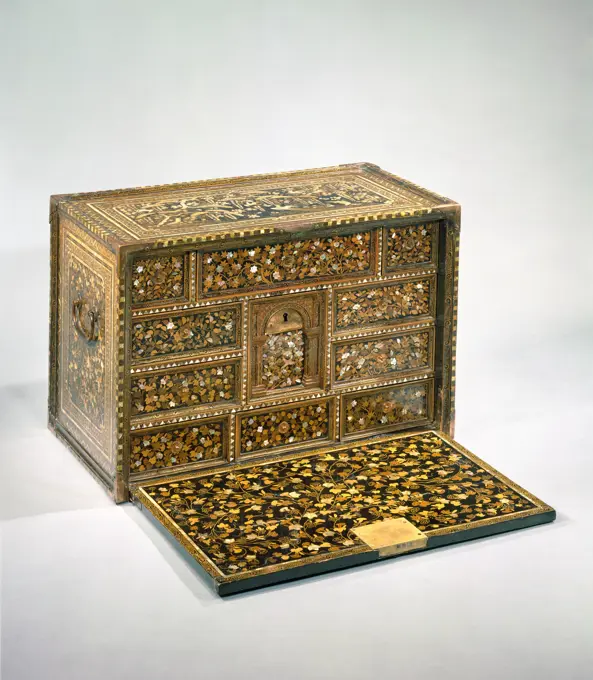
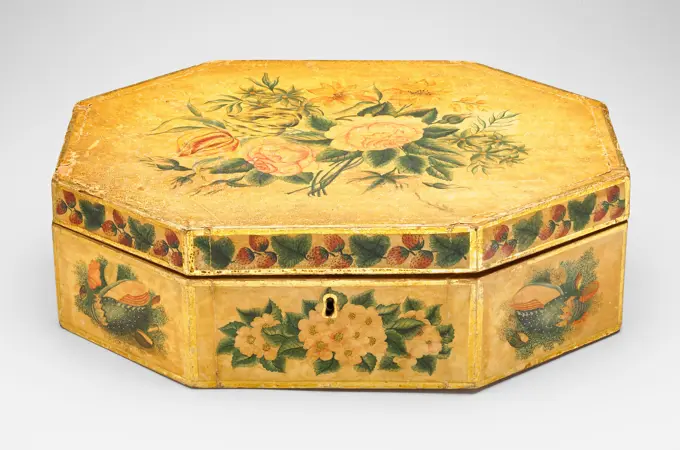
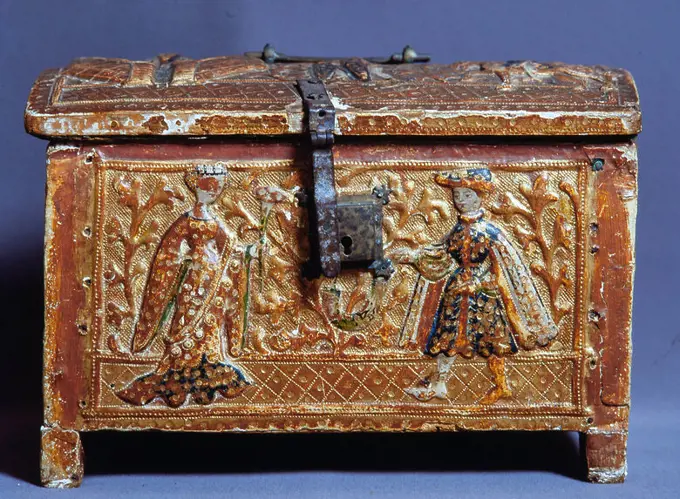
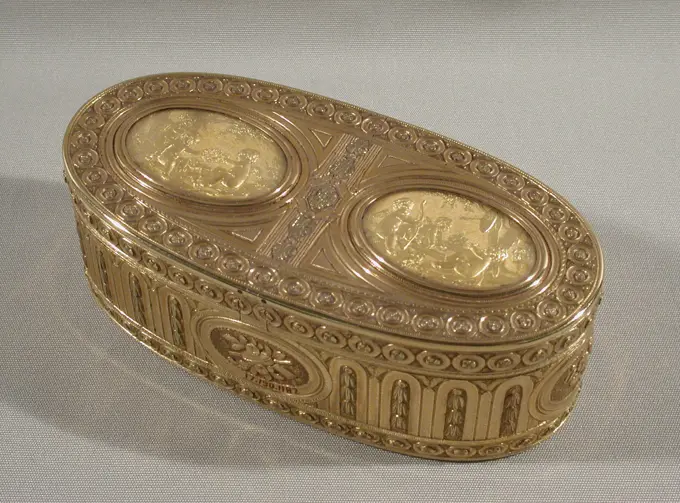
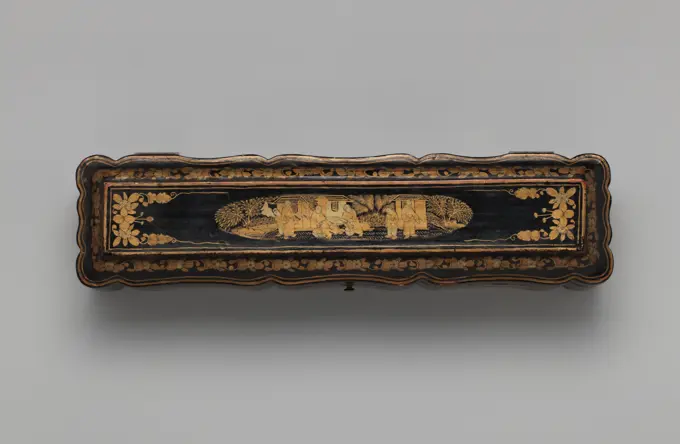
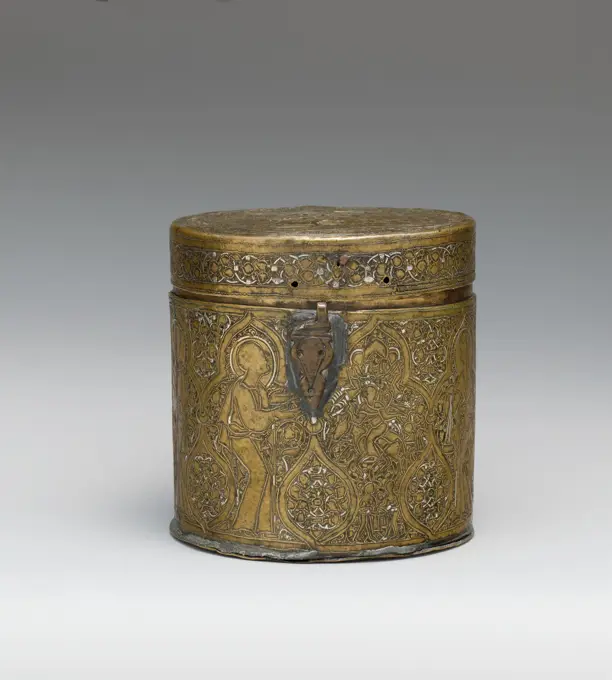
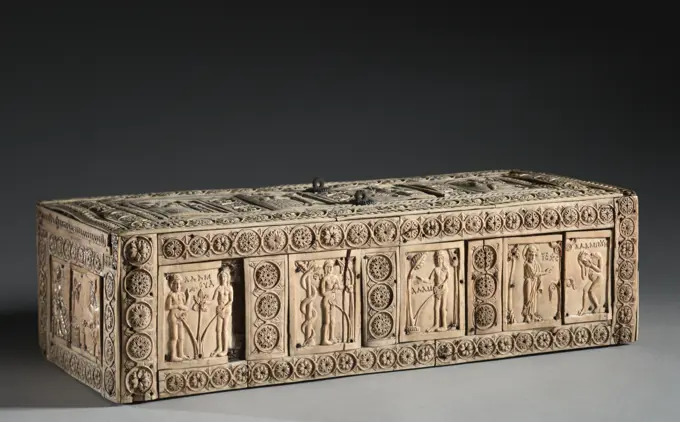
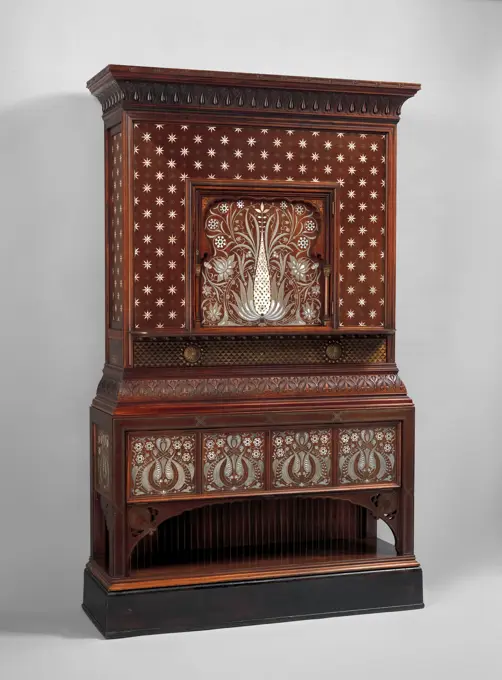
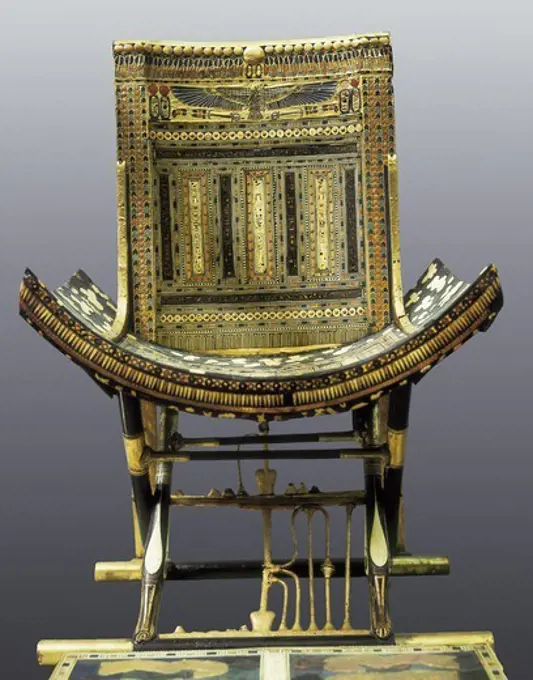
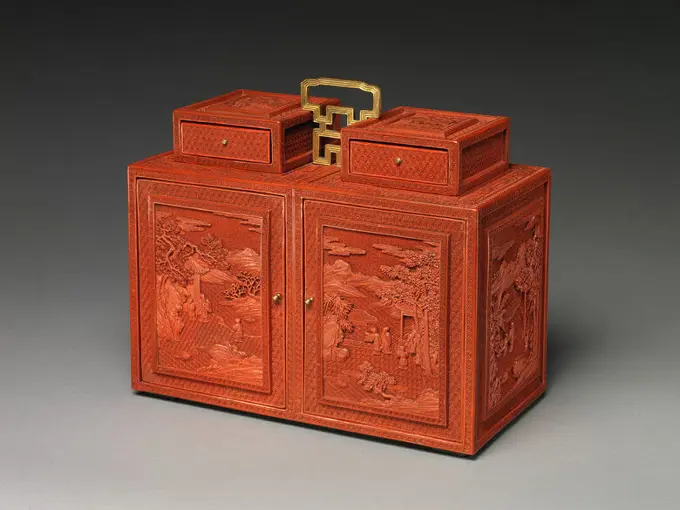
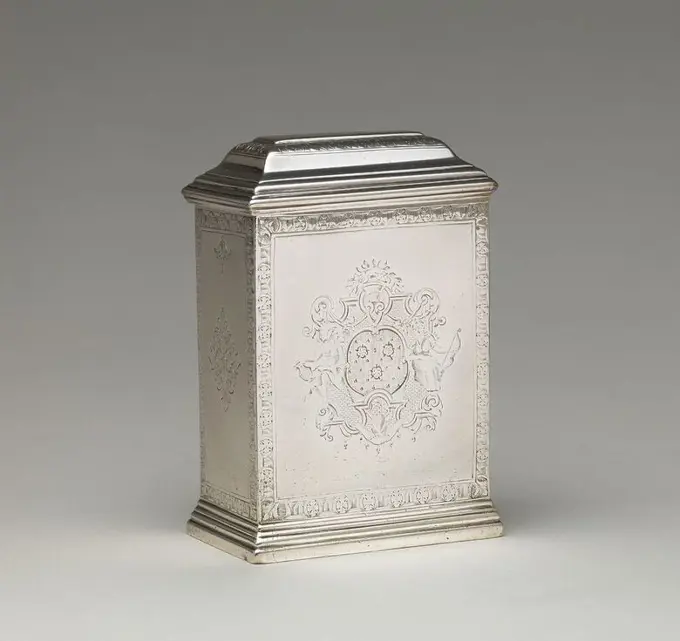
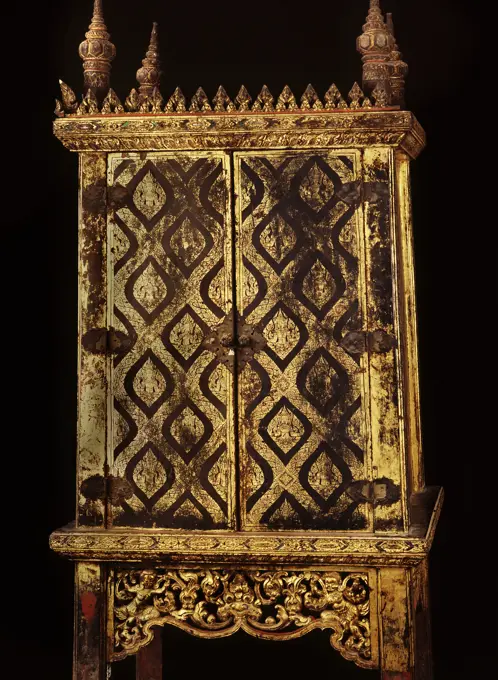
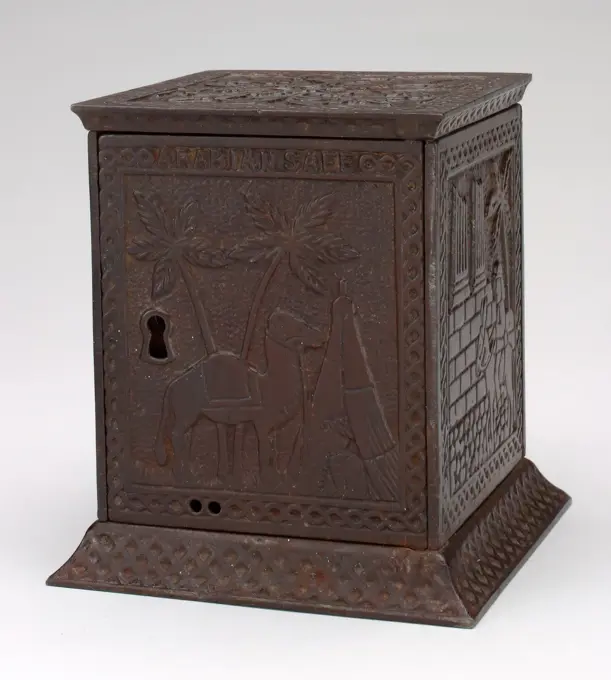
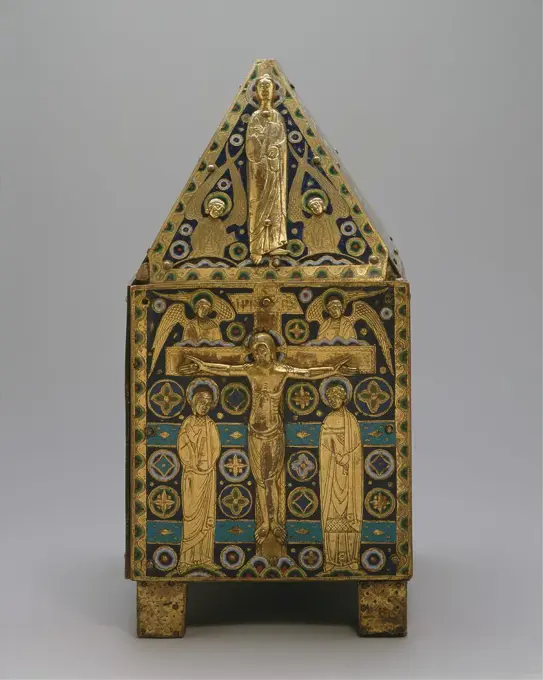
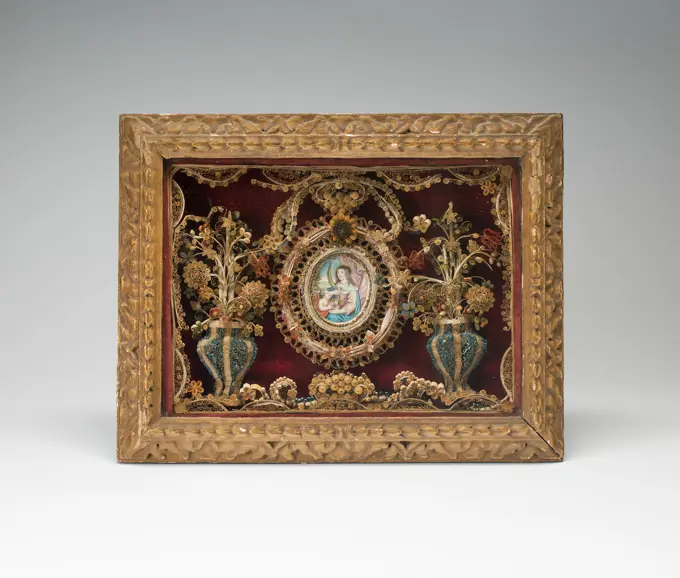
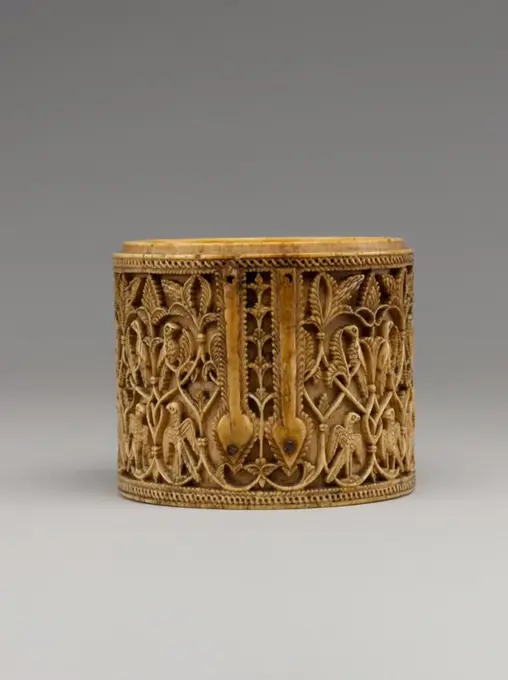
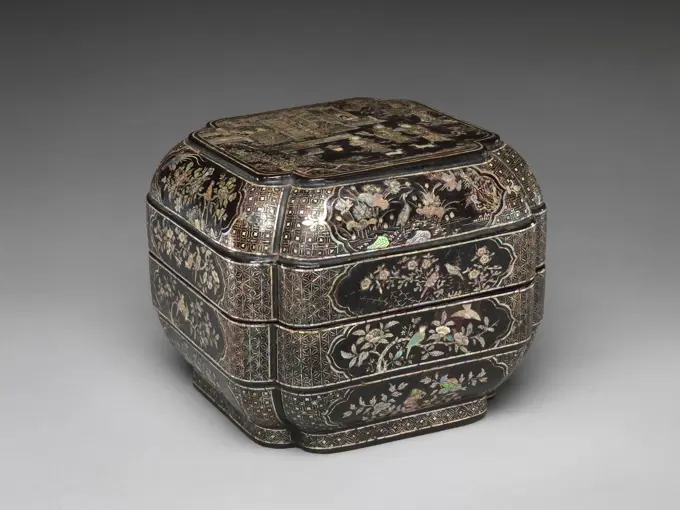
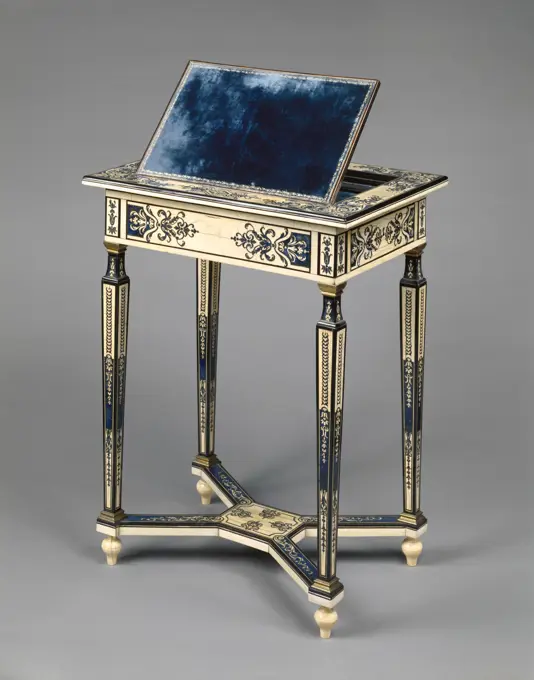
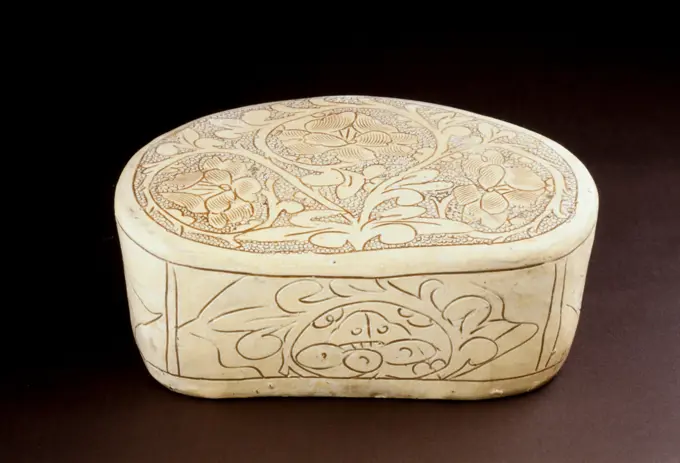
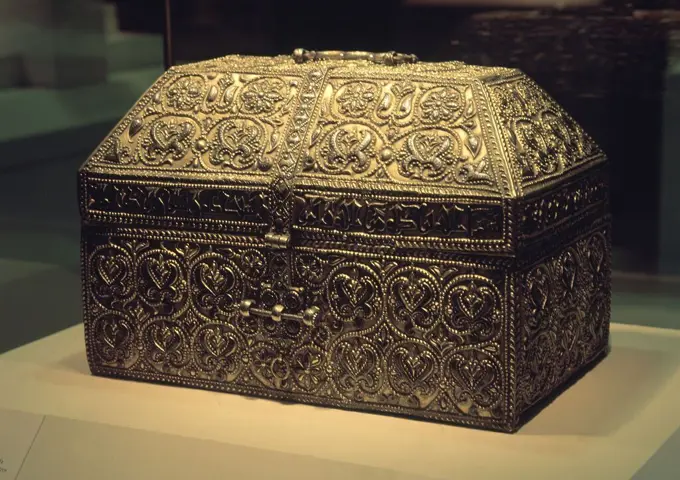
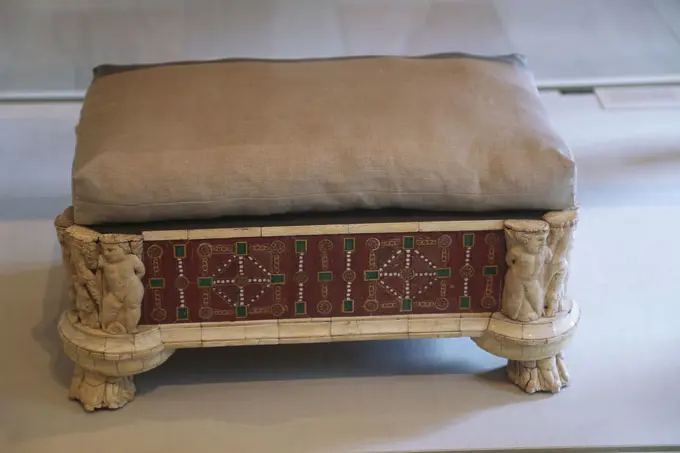
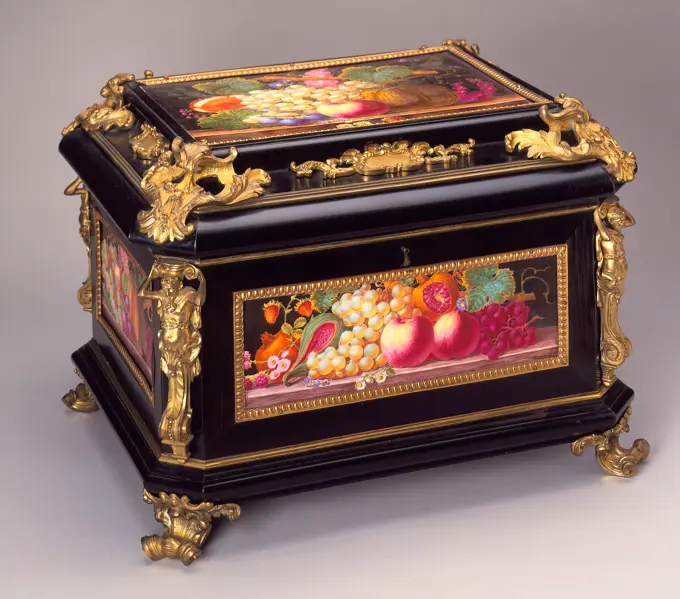
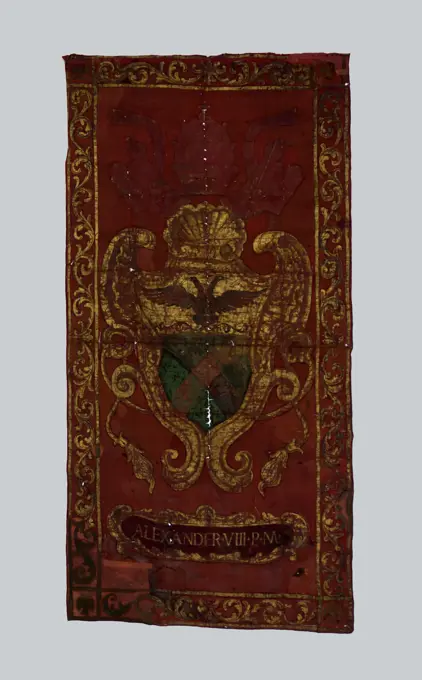
Bearquery box with leather. Birth dial with leather surpassed, rectangular soil shape, flat side walls, which partly belong to the lid, inherent foot and lid list, blue over the depth curved lid, closure by copper hooks and eyes; Depootjes are missing, covered with black leather, that gilt stamped decorative motifs (rosettes, stars, flowers, man's heads, inside double table frame. From inside lined with salmon-colored satin fabric, decorated with windows, including rosettes.Box 1675-1700 American. Box 908Casket 1201-1300 Germany. Wood, iron, tin, paint, and traces of paper .Box 13th century German. Box 463561Incense Burner with Dragon, Phoenix, and Sea Creatures 16th-17th century China. Incense Burner with Dragon, Phoenix, and Sea Creatures 73380. Small casket of polychromed poplar wood, with decorations in gold-plated stucco consisting of leaf drinks with a dragon flanked in the middle and on the lid, flanked by coats of arms with inscriptions in Latin. At the rear four standing fields with leaf raft, including inscriptions. The batter on the corners formed by thin copper plates also shows inscriptions. The lock and handles are copper. The green upholstery inside is partially worn out.Iron coffin. A square iron casket with double hidden slot and two handles. The keys are missing.Bath Box 17th-18th century The technique of marquetry and inlaying of wood with contrasting material has always enjoyed great popularity in Egypt, going back to Pharaonic times. Fine examples of Islamic work in the technique date from the ninth century onward. The right-angle linear interlace that surrounds the main panels of decoration, as well as the motifs that fill the elongated cartouche-shaped panel on the front and the lozenge-shaped panel on the top, descend directlyand with little changefrom such decoration to be found on ninth-century Egyptian marquetry. The so-called star of David motifs, as well as the patterns of stars and hexagons that fill the larger ones, derive from Roman art, especially floor mosaics, and were especially popular in marquetry and woodwork of the Islamic period. Less distant echoes of decoration in other media are the outside borders of alternating hexagons and elongated hexagons, which ultimately derive from Seljuq architectural ornament and enjoyed Cassone with Garlands and Cupids. Dated: c. 1540/1560. Dimensions: overall: 171.2 x 57 x 60.4 cm (67 3/8 x 22 7/16 x 23 3/4 in.). Medium: walnut with gilded gesso. Museum: National Gallery of Art, Washington DC. Author: Italian 16th Century.Casket (cassetta) late 15th-early 16th century Italian, Ferrara The variety of fantastic ornament employed for the decoration of this casket was derived from Roman wall decoration. After centuries of burial, these decorations were revealed during the excavations of the Golden house of Nero in Rome, begun about 1480. As they were found underground in grotto-like spaces, they were named grottesche, or grotesques.. Casket (cassetta). Italian, Ferrara. late 15th-early 16th century. Gesso on wood (pastiglia). Woodwork-Furniture. These caskets on stands probably served no practical purpose. They were made as works of art, to add lustre to a princely chamber. They are ornamented with marquetry of tortoiseshell and brass, supplementedwith some pewter. Boulle specialized in this technique, which is known as boullework. The shape of the fittings accords well with the patterns of the marquetry.Casket (cofanetto or scrigno) 1575-1600 Italian, Venice Richly decorated with shimmering tablets of painted mother-of-pearl and gilded ivory, this casket incorporates gouaches showing mythological themes that celebrate female beauty. These depictions, combined with the fact that the lid originally enclosed a mirror, indicate that this cofanetto held toilet articles. The exterior framework is painted alla dasmaschina, showing decorative patterns resembling those used to embellish Saracenic steel.Daniëlle Kisluk-Grosheide, 2010. Casket (cofanetto or scrigno) 193644Chest, Enamel Relic Antiques-Furniture Stift Kremsmunster, Austria (Benedictine Abbey) Corner Cupboard. Bernard II van Risenburgh (French, after 1696 - about 1766, master before 1730)Desk (Secretary). Culture: Italian, Venice. Dimensions: Overall: 102 x 44 x 23 in. (259.1 x 111.8 x 58.4 cm). Date: ca. 1730-35.In shape, the secretary is influenced by English and Dutch examples. Its decoration, imitating Oriental lacquer, consists of cutout and colored prints pasted to the surface and varnished. This technique, known as lacca povera or lacca contrafatta, was employed by professionals and amateurs alike. The skillful use and arrangement of the prints indicate that this piece was executed in a professional workshop. Museum: Metropolitan Museum of Art, New York, USA.unknown (unknown), work, Pikari (Schlesia), 1700-l. end/1800-l. alkup, facet grinding, copper engraved, arts and crafts, OBJECT; hare; fox cub (2), h. 16 cmBoncompagni-Ludovisi-Ottoboni Marriage Casket, 1731. Italy, Rome. Silver, partially gilt, malachite, lapis lazuli, enamel; overall: 19.1 x 40.7 x 22.9 cm (7 1/2 x 16 x 9 in.).Miniature collector's cabinet ca. 1600 After a composition by Bernard Salomon French Trophies of arms and musical instruments decorate the drawer fronts, while the central door panel shows Orpheus playing before Pluto and Proserpine to regain Eurydice from the Underworld. The composition is based on a 1559 woodcut by Bernard Salomon (ca. 1508-1561). The fall front has complex geometrical forms (polyhedra) rendered in perspective that resemble late sixteenth-century designs by Wenzel Jamnitzer and Lorenz Stoer. The coat of arms of Albrecht VII Archduke of Austria (1559-1621), who ruled the Spanish Netherlands with his wife, Isabella of Spain, appears to have been added after the cabinet was completed.. Miniature collector's cabinet. After a composition by Bernard Salomon (French, ca. 1508-ca. 1561). German, possibly Nuremberg. ca. 1600. Dyed and gold-tooled leather on secondary woods pine, poplar, pear, yew; veneers of ivory, mother-of-pearl, pear, plum, ebony, rosewood, holly, ash, greARCA DE ESMALTE DE LIMOGES - SIGLO XII. Location: COLEGIATA DE SAN ISIDORO. LEON. SPANIEN.Incenser burner with archaic style patterns late 17th-early 18th century China. Incenser burner with archaic style patterns. China. late 17th-early 18th century. Porcelain painted in overglaze polychrome enamels (Jingdezhen ware). Qing dynasty (1644-1911), Kangxi period (1662-1722). CeramicsSnuifdoos, anonymous, 1775 Oval snuff box in 4 colors of gold, with Louis XVI decoration. The lid and the 4 compartments have an oval rosette in the middle. Master sign: ILW in rectangle. France (possibly) gold (metal) Oval snuff box in 4 colors of gold, with Louis XVI decoration. The lid and the 4 compartments have an oval rosette in the middle. Master sign: ILW in rectangle. France (possibly) gold (metal)Commode. France; Jean Henri Riesener (French, 1734-1806). Date: 1770-1780. Dimensions: 95.9 × 165.7 × 56.5 cm (37 3/4 × 65 1/4 × 22 1/4 in.). Oak, mahogany, kingwood, purple heart, and unidentified exotic woods, gilt bronze, and marble. Origin: France. Museum: The Chicago Art Institute, Chicago, USA.ARQUETA DE HISAM II - PERIODO CALIFAL - MADERA PLATA DORADA Y NIELADA REALIZADA EN EL AÑO 976 - 27x38x23. Location: CATEDRAL-MUSEO DIOCESANO. GERONA. SPAIN.Arqueta, siglo XV. Fundación Juan March.ARQUETA DE MADERA CHAPADA EN MARFIL CON INSCRIPCION ARABE Y ESCUDO DE ARMAS DE ARAGON Y CATALUÑA PROCEDENTE DE SEGORBE - SIGLO XIV. Location: ACADEMIA DE LA HISTORIA-COLECCION. MADRID. SPAIN.Replica of a chest, the original is conserved in the Gerona cathedral which al-Haken II, second Umayyad Caliph of Córdoba, had made for his son and successor Hasam II, also known as Hisham II, Made from embossed nielloed silver and dates from circa 976. Displayed in the museum at the ruins of the 10th century fortified palace and city of Medina Azahara, also known as Madinat al-Zahra, Cordoba Province, Spain. The Caliphate City of Medina Azahara is a UNESCO World Heritage Site. EDITORIAL ONLY.Cutlery canteen, Johannes Schiotling, 1772 The rectangular, mahogany box with a high rising back has multiple curved sides, protruding corner styles and a lid with silver hinges. He rests on four cast, silver legs in the form of a high -rising flower branch. Coming from the legs, walk along the underside of the firal, silver edges. Those at the front are made up of two lying C-volutes on either side of an asymmetrical, open worked cartouche of two standing C-Voluten, crowned by a foam edge; those on both sides from two lying C-volutes on either side of a similar, tilted cartouche described above; The one at the rear of two lying C-volutes on either side of an ornament, composed of a rocaille and C-volutes with a foam edge afraid of a flower garland. The cast, silver, hinged ears are constructed from against each other -turning volutes. They are attached to cast, silver, asmetrical, openwork cartouches, made up of rocailles and flower branches. The cast, silver slot plate on the front oBox 1690-1710 American. Box 934Cosmetic Box (mayudzukuri-bako) with Pine, Bamboo, Plum, and Tokugawa Family Crest on Wood-Grain Ground early 18th century Japan This two-tiered cosmetics box would have contained an inner tray with several smaller boxesnow missingfor items such as facial powder, combs, and mirrors. The lid's structure, typical of those found on eyebrow cosmetic boxes, is similar to the decorative paper wrappings for precious items. The exquisite maki-e (decoration in gold and/or silver sprinkled powder) decoration shows the "Three Friends of Winter"pine, bamboo, and pluma popular pattern of auspicious motifs that originated in China. The decoration, set on an elegant background in imitation of woodgrain, is executed with several types of gold and silver maki-e, decorative techniques such as metal inlay, line drawing, metal foil application, geometric metal foil cuttings, and several other time-consuming lacquer techniques. The metal fittings take the form of a pine. The background technique, the aChest, decorated with pen and thick ink with mythological figures, signs of the zodiac and sitting female figures. Bol lid., Anonymous, 1600 - 1699 Case of yew, decorated with performances with the pen and thick ink drawn, deepened the skies and provided with a 1. The front and rear board show mythological figures within a circular edge, accompanied by signs of the zodiac. The side walls wear sitting female figures with a passer and globe. At the front a double yellow -cut eagle as a key plate. The bulb round lid with network with equestrian. Copper corner tires, hinges with maskarons and handles. Germany (possibly) wood (plant material). yew (wood). copper (metal). ink. steel (alloy) Case of yew, decorated with performances with the pen and thick ink drawn, deepened the skies and provided with a 1. The front and rear board show mythological figures within a circular edge, accompanied by signs of the zodiac. The side walls wear sitting female figures with a passer and globe. At the froCabinet. Dated: c. 1595/1600 and later. Dimensions: overall: 33.7 x 35.1 x 29.2 cm (13 1/4 x 13 13/16 x 11 1/2 in.) overall (base): 1.3 x 35.1 x 29.2 cm (1/2 x 13 13/16 x 11 1/2 in.). Medium: ebony and ebony veneer over spruce and walnut, with silver and gilded silver mounts. Museum: National Gallery of Art, Washington DC. Author: Attributed to Boas Ulrich.Korean Mother-of-Pearl Box. Dated 16th CenturyReliquary Chasse withAngels.  Artist: UnknownCassone ca. 1550-80 (rebuilt, with later additions) Italian (Tuscany or Rome). Cassone. Italian (Tuscany or Rome). ca. 1550-80 (rebuilt, with later additions). Walnut, carved and partially gilded.. Woodwork-FurnitureChasse ca. 1300 French or German. Chasse 467496Cassone. Culture: Italian (Rome or Siena). Dimensions: H. 67.8 cm, W. 193 cm, D. 70 cm. Date: ca. 1550-80 (rebuilt, with extensive replacements). Museum: Metropolitan Museum of Art, New York, USA.Portable Cabinet with Drawers 16th century Japan This cabinet belongs to a category of goods known as nanban (literally, "southern barbarians"), which were produced in Japan in the late sixteenth and early seventeenth centuries for trade with Portugal and other European countries. The form of the cabinet derives from writing chests used in Portugal and Spain. Comparable works, made with wood, lacquer, mother-of-pearl, and ivory, were produced in India for the same markets. The leaves and flowers and the geometric borders seen here are not found on contemporaneous works made for use in Japan. It is possible that they demonstrate an awareness of Indian designs transmitted via such trade goods as lacquers and textiles.. Portable Cabinet with Drawers 40331Pa. German Sample Chest. Dated: c. 1939. Dimensions: overall: 24.7 x 35.3 cm (9 3/4 x 13 7/8 in.) Original IAD Object: 21 3/4" high; 10 1/4" long; 10 1/2" deep. Medium: watercolor and graphite on paper. Museum: National Gallery of Art, Washington DC. Author: Betty Jean Davis.Foot Warmer (Netherlands); woodCoffret ca. 1190 French Rarely do such handsome enamel chests survive intact. Replete with charming images of animals and warriors, this example may have been used by either a worldly prince or a church official.. Coffret. French. ca. 1190. Copper: engraved, stippled, and gilt; champlevé enamel: dark, medium, and light blue; green, yellow, red, and white; wood core with applied parchment, gesso; traces of red paint.. Made in Limoges, France. Enamels-ChamplevéIncense box with Chinese children playing with snowballs. Culture: Japan. Dimensions: H. 2 3/4 in. (7 cm); W. 5 in. (12.7 cm); D. 4 in. (10.2 cm). Date: 18th century.This eight-lobed incense box has small curvy legs. The decoration on the lid shows Chinese children playing with large snowballs or snowflakes; in the background are a snow-covered tree and waves of a lake. On the side of the box, various symbolic or auspicious animals are depicted in cartouches, such as the hare, tiger, crane, and lion. Inside the box are three small incense containers. Two of these are in the shape of butterflies, while the other is a rhomboid box placed between them, and decorated with a peony pattern. The incense box is decorated with several maki-e (decoration with gold and/or silver sprinkled powder) techniques, among them the meticulous okibirame (individual gold flakes placed onto the sticky lacquer surface) and mother-of-pearl inlay. The box is very finely executed, with attention paid to every dBox with Painted Ox Horn. Korea, Joseon dynasty (1392-1910), 19th century. Furnishings; Accessories. Reverse painted ox horn veneer on wood core with ivory inlay and brass fittingsReliquary, anonymous, c. 1500 Case of ivory, rectangular, with silver mounted. The coffin rests on four sitting lions, the band -shaped batter ends in gilded lilies. The final plate is provided with radiating, gilded lilies on the four corners. The handle on the lid ends on either side in fool heads. France (possibly) silver (metal). ivory gilding Case of ivory, rectangular, with silver mounted. The coffin rests on four sitting lions, the band -shaped batter ends in gilded lilies. The final plate is provided with radiating, gilded lilies on the four corners. The handle on the lid ends on either side in fool heads. France (possibly) silver (metal). ivory gildingTable;  19th century (1801-00-00-1900-00-00);Paduan 16th Century, A Sand Box, c 1500 A Sand-BoxTabernacle frame early 17th century Italian, Venice. Tabernacle frame. Italian, Venice. early 17th century. Poplar, mother of pearl, marble. FramesCabinet of Drawers with Birds, Flowers, and Court Carriage late 16th century Japan The Portuguese and Spanish who visited Japan during the Momoyama period were fascinated by the exotic appearance of golddecorated lacquer associated with the taste of warlord Toyotomi Hideyoshi (1537-1598). As a result, lacquer commissioned for the European market typically adopted this flamboyant style (Kōdaiji makie). Among the earliest goods exported from Japan, such pieces are known collectively as nanban (Southern Barbarian), the Japanese appellation for foreigners. The form of this cabinet is based on the European vargueno or escritorios, a chest of drawers with a drop front that served as a surface for writing. Its decorative patterns depict Japanese subjects, including a court carriage and courtiers, maple, mandarin orange, and cherry trees, camellia flowers, wisteria branches, and birds. The decorative bands of the borders are embellished with geometric designs.. Cabinet of Drawers with Birds,Trinket Box c 1820 United States. Wood, paper, watercolor, and gilt paper . Artist unknownArqueta, siglo XV. Fundación Juan March.Cabinet, anonymous, c. 1650 - c. 1699 Cabinet on Ebony. The four twisted legs rest on bulbs and show houses connected by a double Y-shaped cross. The chassis has a drawer, the cabinet two doors behind which four drawers (1-2-1) under an open compartment. Front, upper and sides and the fronts of the drawers in the interior are decorated with stabbed lotus vines; Birds in the upper corners of the doors. Seizure of the buyer. Dutch East Indies, second half of the 17th century. Indonesia ebony (wood). copper (metal) Cabinet on Ebony. The four twisted legs rest on bulbs and show houses connected by a double Y-shaped cross. The chassis has a drawer, the cabinet two doors behind which four drawers (1-2-1) under an open compartment. Front, upper and sides and the fronts of the drawers in the interior are decorated with stabbed lotus vines; Birds in the upper corners of the doors. Seizure of the buyer. Dutch East Indies, second half of the 17th century. Indonesia ebony (wood). copper (metal)Double snuffbox 1771-72 Melchior-René Barré In eighteenth-century Europe, Paris led the production of high-quality luxury goods. Parisian goldsmiths made a wide range of small, personal articles such as snuffboxes; étuis to hold sealing wax, tweezers, or utensils for sewing; souvenirs, which contained thin ivory tablets for note taking; and shuttles for knotting lace. Gold snuffboxes and boxes decorated with portrait miniatures were prized and frequently given as royal gifts, often to ambassadors or members of the court in lieu of cash payments for their services. Coveted and admired, these boxes were produced from a variety of materials. The best were skillfully made of gold and embellished with diamonds, enameled decoration, lacquer, and other luxurious materials. By the middle of the century, the taking of snuff had become an entrenched social ritual, and the snuffbox, too, had become an important social prop. Snuffboxes were considered highly fashionable accessories, with some mercFan box Chinese 19th century View more. Fan box. Chinese. 19th century. Wood. FansPyxis Depicting Standing Saints or Ecclesiastics and the Entry into Jerusalem with Christ Riding a Donkey mid-to late13th century During the course of the thirteenth century, luxurious inlaid brasses signed by al-Mawsili (from Mosul) artists or made in their style began to display a very particular iconography borrowing from Christian motifs, namely Gospel scenes, images related to the life of Christ, and standing figures of saints and ecclesiastics. These images appear alongside traditional Islamic themes that were popular in the Seljuq era, such as the courtly cycle and astrology. It is noteworthy that such Christian motifs were largely depicted with deliberate variations. The artists either did not entirely understand the iconography or they did not care much about the established canon. The juxtaposition of Christian and medieval Islamic themes suggests that these brasses were probably intended for specific communities, underscoring the complex multicultural milieu of the western SImperial Presentation Box with Napoleon III's Cipher, gold, diamonds, A gold box with a personalized lid. The letter 'N' in each of the lid's corners in diamonds. The center of the lid is decorated with another larger letter 'N' in diamonds with a diamond crown above the letter. Along the sides of the box there is an abstract design carved in gold., France, ca. 1855, containers, Decorative Arts, box, boxIvory Box with Scenes of Adam and Eve, 1000-1100s. Byzantium, Constantinople, Byzantine period, 11th-12th century. Ivory, wood; overall: 14.3 x 46.7 x 20.3 cm (5 5/8 x 18 3/8 x 8 in.).Brasier 1600-1625 Florence. Wood, bronze, gilt bronze, and silvered metal .Gothic chest with lid, XV century, Palma Cathedral Museum, Majorca, Balearic Islands, Spain, EuropeBox late 18th-early 19th century French. Box 187263 French, Box, late 18thearly 19th century, Straw on wood, paper, 5 1/8  7 3/4 in. (13  19.7 cm). The Metropolitan Museum of Art, New York. Edward C. Moore Collection, Bequest of Edward C. Moore, 1891 (91.1.912)Rococo corner cupplate, corner cabinet cupboard cabinet furniture furniture interior design wood oak wood rosewood violet wood brass marble stone, Marble top and round door with marquetry brass fittings in the cupboard under the tray drawer rococoIslamic civilization, Mameluca art. Brass box inlaid with silver, for holding KoranMount (France), early 19th century; bronze (gilt)Cabinet 1884-85 George A. Schastey & Co. George A. Schastey (1839-1894) headed one of the principal cabinetmaking and decorating firms of Americas Gilded Age. Born in Merseburg, Germany, he immigrated to New York as a young boy in 1849. After fighting for the Union in the Civil War, Schastey took up work in New Yorks expanding furniture trade with several of the citys leading cabinetmakers and decorators before opening his own business in 1873. At its peak in the early 1880s, George A. Schastey & Co. employed at least 125 people in its workshops. Schasteys distinctive designs are steeped in Renaissance sources with flourishes from the Islamic world.In August 1885, the New York Times reported on Schasteys new showroom at Broadway and West Fifty-Third Street. The published account applauded the firms stylistic and technical capabilities in furniture and architectural woodwork, highlighting its superior taste in interior design. The articles author remarked that a large cabinet, liChild's Throne, 1822. Pierre-Marie Balny le Jeune (French, 1832). Carved and gilded wood, leather upholstery; overall: 84 x 45.1 x 42 cm (33 1/16 x 17 3/4 x 16 9/16 in.).Ecclesiastical chair. 1333 BC. Inlaid ebony wood with ivory and glass. Egyptian art. New Kingdom. Furniture. EGYPT. CAIRO. Cairo. Egyptian Museum. Proc: EGYPT. QUENA. Dayr al-Bahri. Valley of the Kings. Tomb of Tutankhamun.Cabinet with Figures in a Landscape. Culture: China. Dimensions: H. 13 in. (33 cm); W. 7 7/8 in. (20 cm); L. 35.9 in. (35.9 cm). Date: 18th century.This two-door cabinet looks as if it is two separate boxes held together by the gilt-bronze handles at the top, but it is actually a single piece. The six side panels are decorated with figures along a riverbank or on a garden terrace by the water, with receding hills in the far distance. The tops of the two drawers are adorned with deer in a landscape. The sharp, precise carving of the red lacquer is characteristic of works produced in Qianlong workshops, as is the deeply carved brocade pattern that serves as the background. Museum: Metropolitan Museum of Art, New York, USA.Anonymous. Cabinet composed of a two -leaf wardrobe and several drawers; Decor of landscapes and characters in gold lacquer on a black background. Lacquer. Museum of Fine Arts of the City of Paris, Petit Palais. Cabinet, cabinet, landscape decor, black background, lacquer object, gold, character, drawerBandbox (USA); block-printed paper on pasteboard support; 18 x 10 x 8 cm (7 1/16 x 3 15/16 x 3 1/8 in.)Tea caddy (one of a pair). Culture: British, London. Dimensions: Height: 4 1/2 in. (11.4 cm). Maker: Augustin Courtauld (British, 1685-1751). Date: 1726/27. Museum: Metropolitan Museum of Art, New York, USA.KACHEL, c. 1800 - c. 1899    wood (plant material)Lacquered manuscript cabinet dating from the reign of King Narai in the 17th century, Thailand, Southeast Asia, AsiaAmerican 20th Century, Pa German Chest, 1935 1942 Pa. German ChestJewel Casket, 1850-1885. Gilt, brass and enamel, in the form of an early medieval house reliquary (container for holy relics) and made in Birmingham.Safe still bank, early 20th century, 4 3/8 x 2 3/4 x 2 1/16 in. (11.11 x 6.99 x 5.24 cm), Tin, pigment, 20th centuryVirginal. This musical instrument is sitting upon a stand and is engraved with a Latin motto. Created by Hans Ruckers, a master of the Saint Luke's Guild of Antwerp.Arabian Safe' still bank, 1882, Kyser & Rex Company, Philadelphia, c. 1879-1898, 4 1/4 x 4 5/8 x 4 3/16 in. (10.8 x 11.75 x 10.64 cm), Iron, 19th centuryTabernacle. Culture: French. Dimensions: Overall: 12 1/2 x 6 1/2 x 6 11/16 in. (31.8 x 16.5 x 17 cm). Date: ca. 1200-1210.This tabernacle was found in Bethlehem Square, Prague, in the nineteenth century, on the site of the Romanesque church of Saints Philip and James. Museum: Metropolitan Museum of Art, New York, USA.Jewel casket; c.1870 England; Birmingham. Attributed to John Hardman & Co.; Gilt; brass and enamel.Wood Block, associated with 1983-29-1 to 21; USA; wood, metal; 37 x 29.5 x 7 cm (14 9/16 x 11 5/8 x 2 3/4 in.)Shadow Box with Miniature of Saint Ursula 1675-1725 England. Rolled paperwork, colored and gilded; velvet; and wood frame .Cylindrical Box (Pyxis). Dimensions: H. 2 5/8 in. (6.7 cm)Diam. 3 1/4 in. (8.3 cm). Date: 10th century.Late Antique and Byzantine pyxides generally had flat lids, but the lids covering the cylindrical vessels of this Andalusian group are all domical. Thus, the missing lid of this example would probably have been domical as well. Made principally for the personal use of Umayyad nobility, these containers held precious aromatics and cosmetics. Museum: Metropolitan Museum of Art, New York, USA.Tiered Box with Figural Scenes, Flowers, and Birds first half of the 15th century China The adorable girls peeking around the wall at the woman and dogs in the garden are found in at least two other works from the period. This scene likely illustrates a well-known moment from a literary work or a play. Every panel and column of the architecture is decorated with a distinct pattern, attesting to the painstaking labor needed to create the scene. Each of the sixteen cartouches on the sides shows different flowers and birds.. Tiered Box with Figural Scenes, Flowers, and Birds 40258Kist van Coromandelhout with batter from Tin, Anton Fortuin, 1929 Case of Coromandelhout, inlaid with tin and with tin fittings, resting on double square legs. The coffin has extended corners and rules. The sides are provided with wavy tin batter at the top; The key plate on the front is included here. The flooded lid has a middle rule, on which a handle in the shape of a shell. The two panels are each inlaid with four stylized seaporses, between which cutting with the initials and May 8, 1929, within a cartouch form. designer: Northern NetherlandsNetherlands wood (plant material). tin (metal) Case of Coromandelhout, inlaid with tin and with tin fittings, resting on double square legs. The coffin has extended corners and rules. The sides are provided with wavy tin batter at the top; The key plate on the front is included here. The flooded lid has a middle rule, on which a handle in the shape of a shell. The two panels are each inlaid with four stylized seaporses, between which cutting Folding stool ca. 2030-1640 B.C. Middle Kingdom. Folding stool. ca. 2030-1640 B.C.. Wood, leather, bronze or copper alloy. Middle Kingdom. From Egypt, Middle Egypt, Meir, Khashaba excavations, 1910-11. Dynasty 11-13Box 18th century French This box is decorated with raised straw flowers against a straw ground. The sides display a flame-stitch pattern, which was often used in needlework.. Box. French. 18th century. Straw on cardboard; paper lining. Natural SubstancesCeremonial Grinding Table (Metate) 1 CE-500 CE Nicoya. Volcanic stone . NicoyaArqueta, siglo XV. Fundación Juan March.Writing Table. UnknownSecretaire in black lacquer. Secretaire in black lacquer, decorated with golden lacquer and gold powder and inlaid with mother-of-pearl. The base cabinet has two drawers on which, Japanese landscapes of inlaid mother-of-pearl. A valve above which also an oval, with pearl and golden lacquer the representation of the landing of the troops to an engraving of Cornelis Brouwer (FMH 5531/1). The loose top with two detached ivory columns with red copper basement and capitals, has two doors, both with inscriptions.Bliżej Kultury unknownAltar Caisse. Bin consisting of chapelous niche and a layer of bottom with cut-away fries. NIS on the front bounded with two columns with capital on which Pinnacles embed that acclage the boom with above window racing. Rear wall with gothic windows separated by columns with capitals on which rib violence.. Globus box in an elongated shape with rounded corners, from thick paper with brunette leather coated and printed with gold-plated floral ornaments. On the lid an edge of fine flower refrences that framed a rectangular surface with symmetrically ordered oriental motifs. Around the side of the box a job with some, stylized flowers. A printed double diamond pattern decorates the bottom of the box, which is furthermore left unforded. Closure by means of two copper hooks and eyes, a hook of which is missing. The inside is equipped with marbled paper, with the lid and on the bottom dark blue velvet coating. Inside the box a cylinder-shaped sleeve of thick paper, coated with black leather with a gold-plated edge against the ends, in which glass hair tubes ().Pillow, 11th century, 4 7/8 x 11 x 7 in. (12.38 x 27.94 x 17.78 cm) (outer frame), Tz'u-chou ware Slip-covered stoneware with incised floral decor against a 'fish roe' ground, China, 11th century, This bean-shaped head-rest represents a sub-group of cizhou ware, mainly pillows whose floral designs were created by incising through a white slip and setting them off against a punch marked, so-called 'fish-roe' ground. Cizhou wares with incised designs on a ground of closely stamped rings like this example were produced from the tenth to early twelfth century. The ring-punch ground design was most likely influenced by Tang dynasty (618-906) metalwork wherein ring-punched grounds were used to set off major design motifs in gold and silver vessels.Chest, Anonymous, c. 1560 - c. 1570ARQUETA DE HISAM II - PERIODO CALIFAL - MADERA PLATA DORADA Y NIELADA REALIZADA EN EL AÑO 976 - 27x38x23. Location: CATEDRAL-MUSEO DIOCESANO. GERONA. SPAIN.Astronomical watch ca. 1580 German. Astronomical watch. German. ca. 1580. Gilt metal. HorologyFurniture roman. Couch and footstool bone carving and glass inlays. 2nd century AD. From Rome. Metropolitan Museum. New York, USA.Casket with Plaques. Derby Porcelain Works (England, 1756-1848). England, circa 1815. Furnishings; Accessories. Porcelain, rosewood, ormoluBanner of Pope Alexander VIII (reigned 1689-91) ca. 1689-91 probably Italian, Rome. Banner of Pope Alexander VIII (reigned 1689-91) 26948Antique Cash Register.Patch box 1784-89 French, Paris. Patch box. French, Paris. 1784-89. Gold, enamel; hair. Metalwork-Gold and Platinum