Antique Glassware and Candlesticks

Showcases exquisite antique glassware and candlesticks, featuring intricate designs and historical styles, perfect for highlighting elegance and craftsmanship.

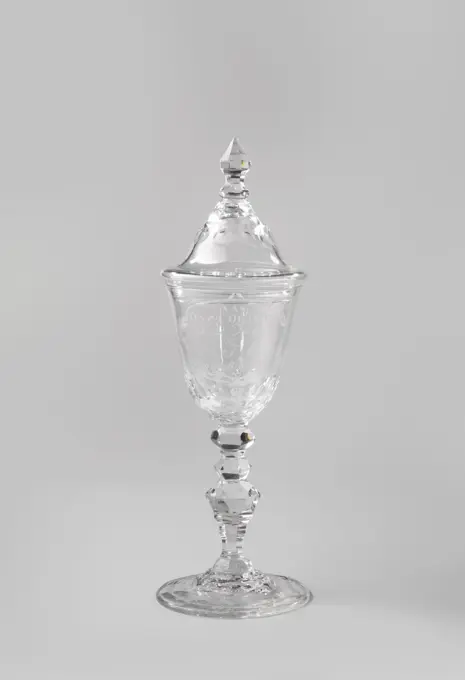
Jar with lid, with a hunting scene, anonymous, c. 1850 - c. 1875 Flat, octagonal, faceted foot. Facet cut, baluster -shaped tribe. Funnel -shaped, rounded and faceted chalice at the bottom. Vaulted, faceted lid with overhanging edge and a facet cut, baluster -shaped button, ending in a point. On the chalice, in Neo-Louis XV style, in gold a hunting scene with a hunter with a shot duck. On the foot and the lid a deer, a stork and a dog surrounded by rocaille ornament. The facets on foot, trunk and button with gold. Bohemia glass glassblowing / grinding / gilding Flat, octagonal, faceted foot. Facet cut, baluster -shaped tribe. Funnel -shaped, rounded and faceted chalice at the bottom. Vaulted, faceted lid with overhanging edge and a facet cut, baluster -shaped button, ending in a point. On the chalice, in Neo-Louis XV style, in gold a hunting scene with a hunter with a shot duck. On the foot and the lid a deer, a stork and a dog surrounded by rocaille ornament. The facets on foot, trunk
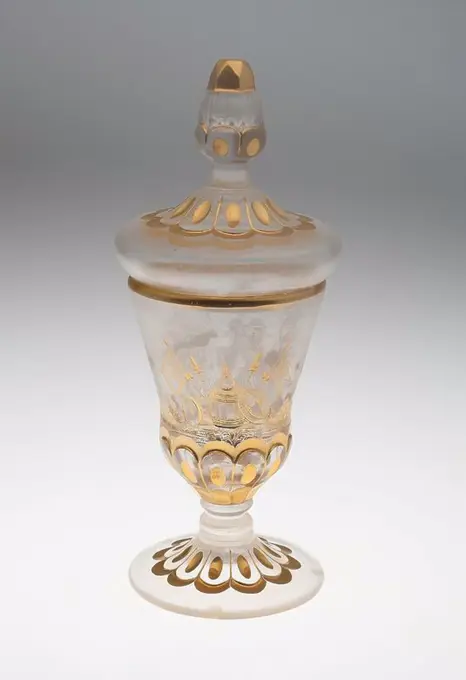
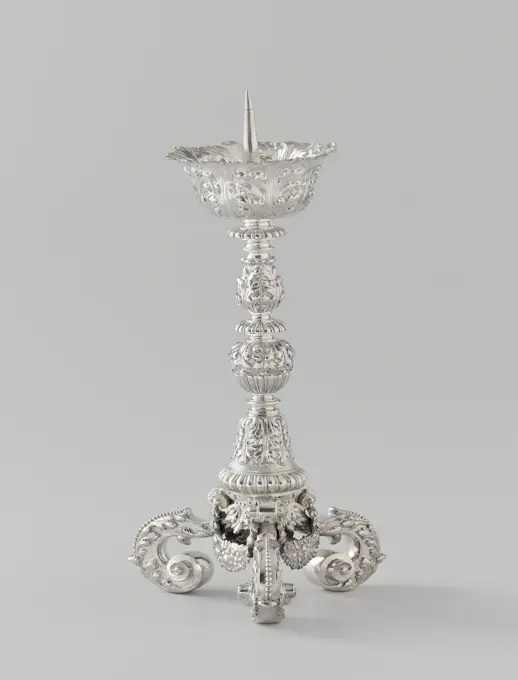
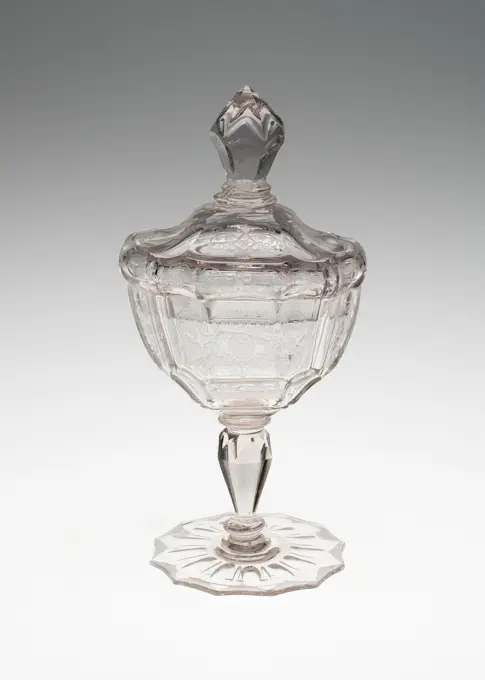
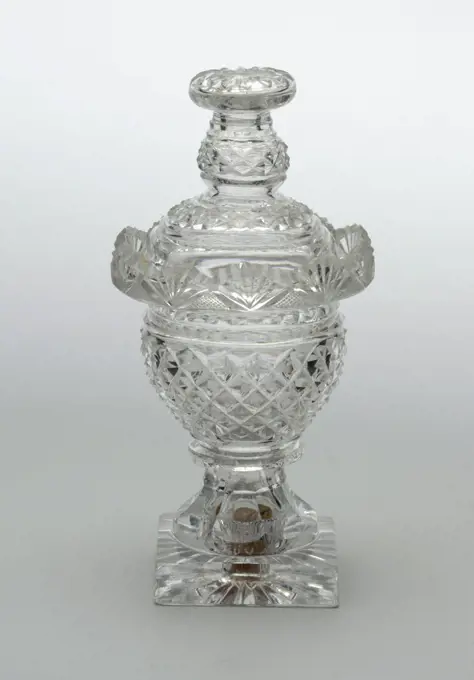
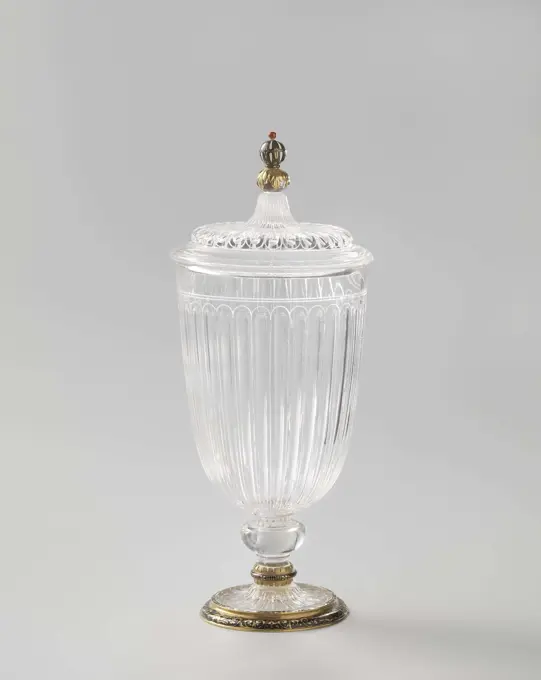
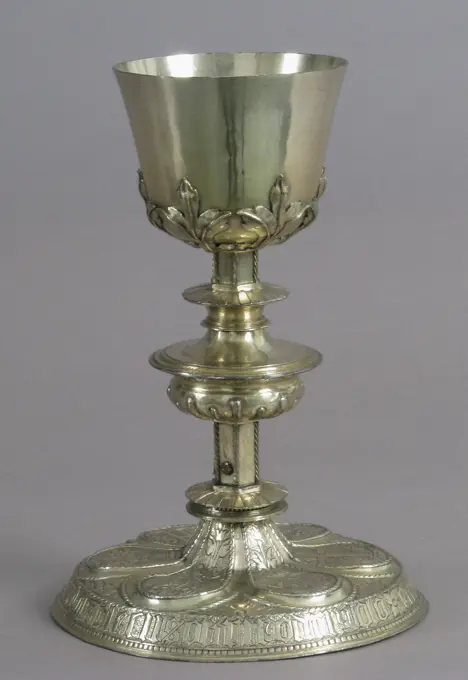
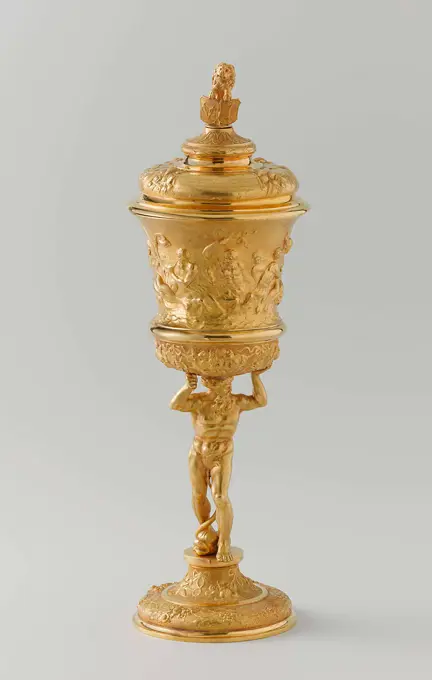
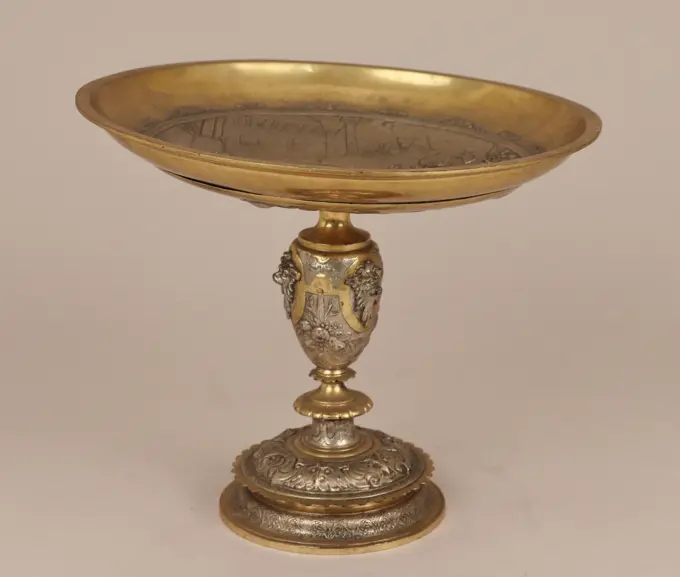
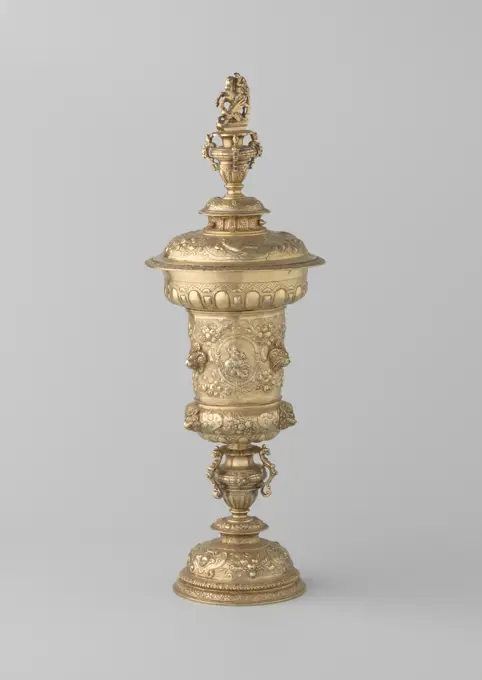
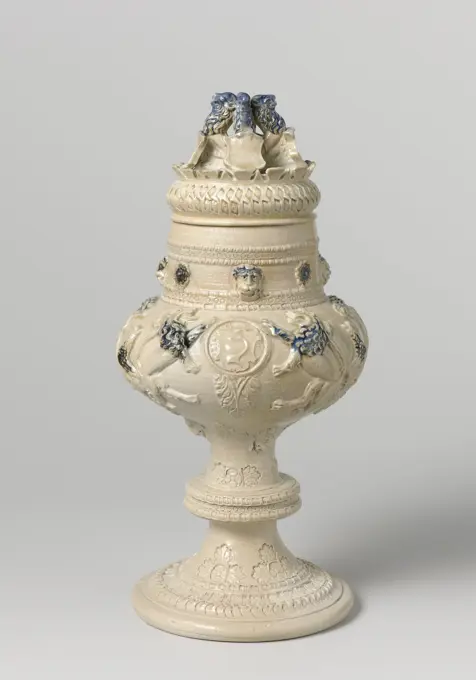
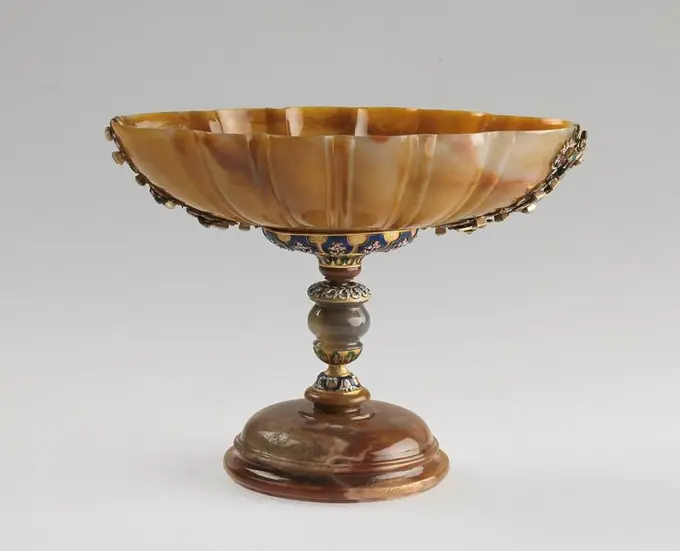
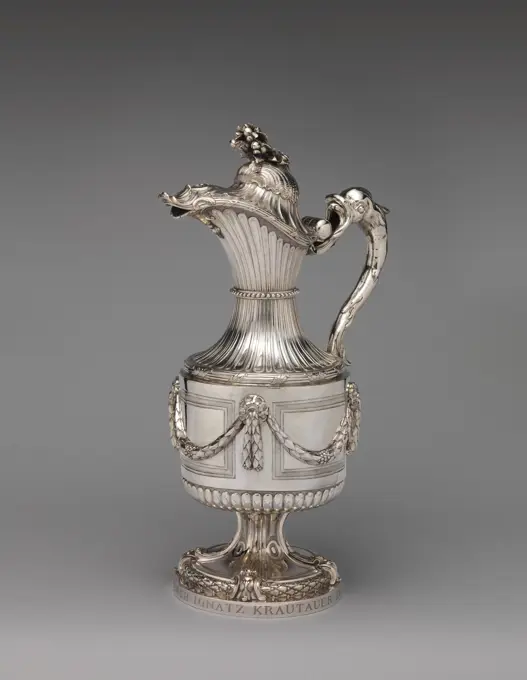
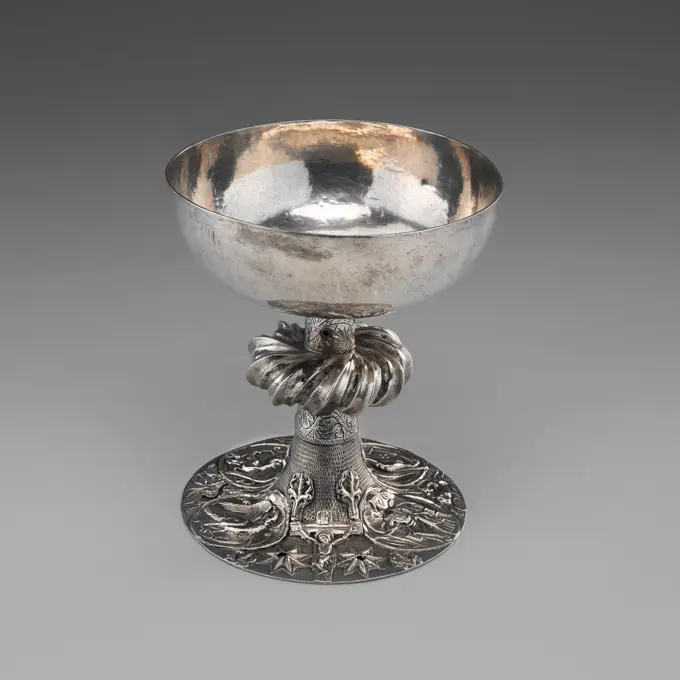
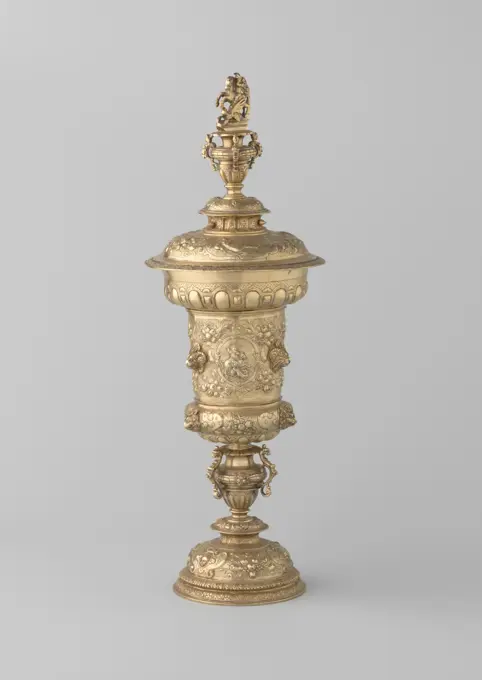
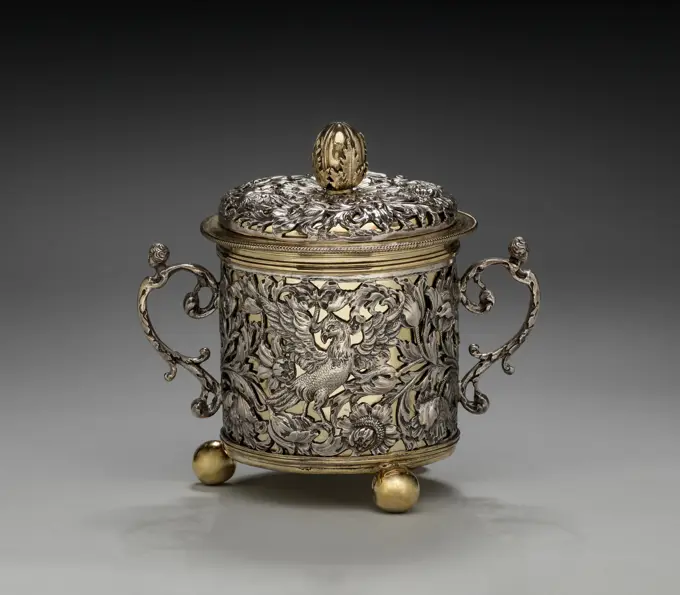
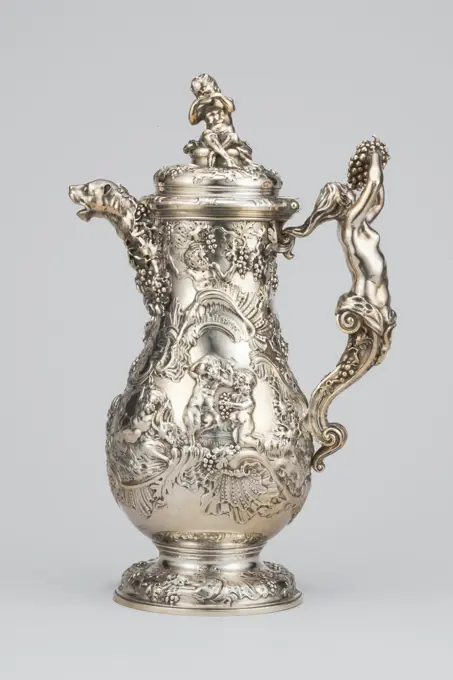
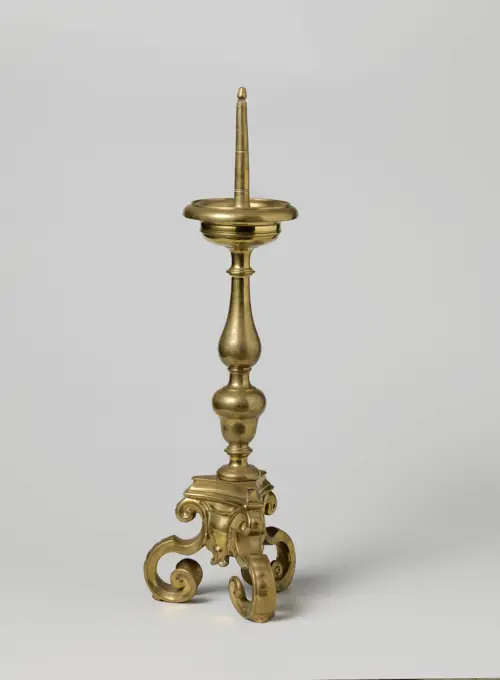
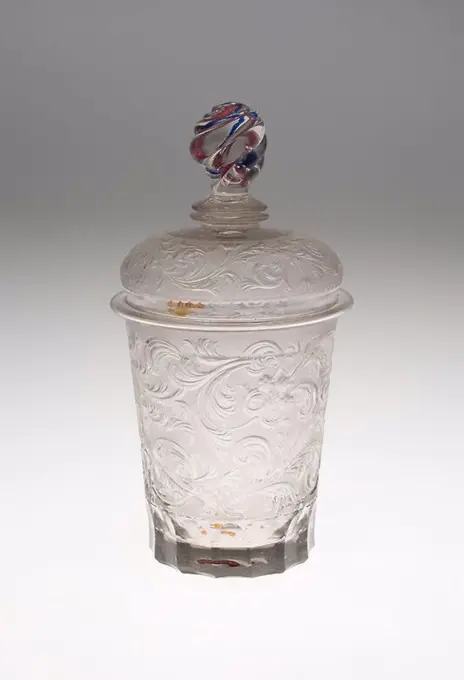
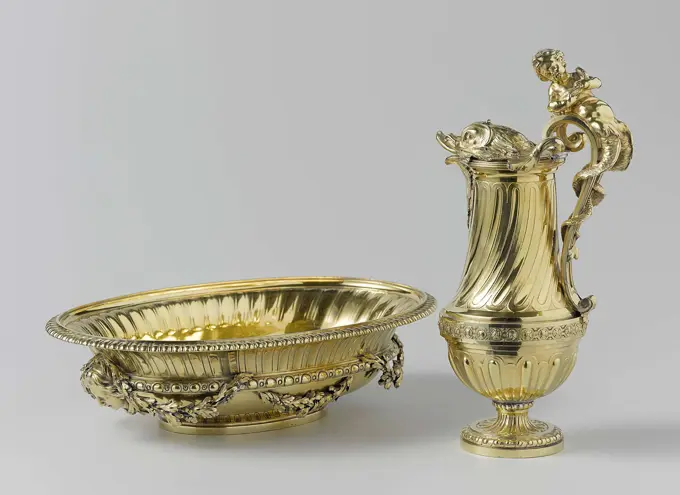
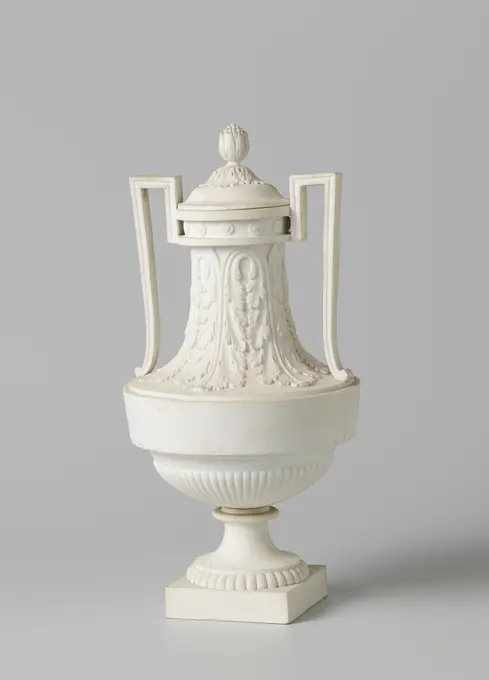
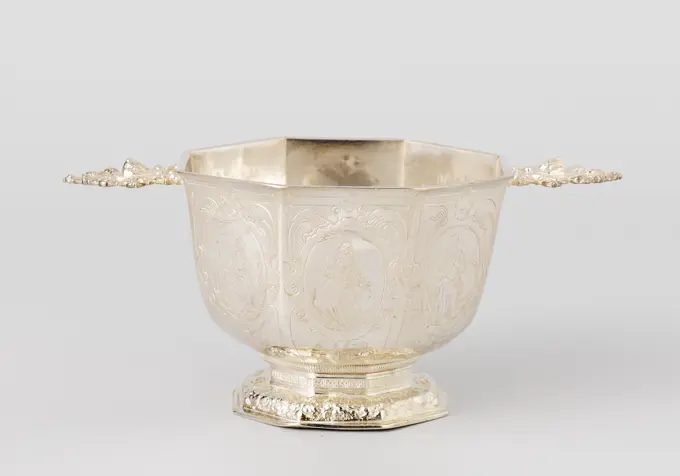
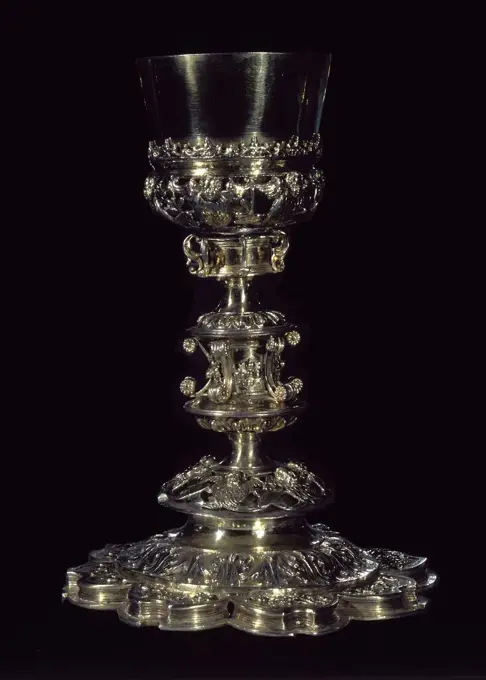
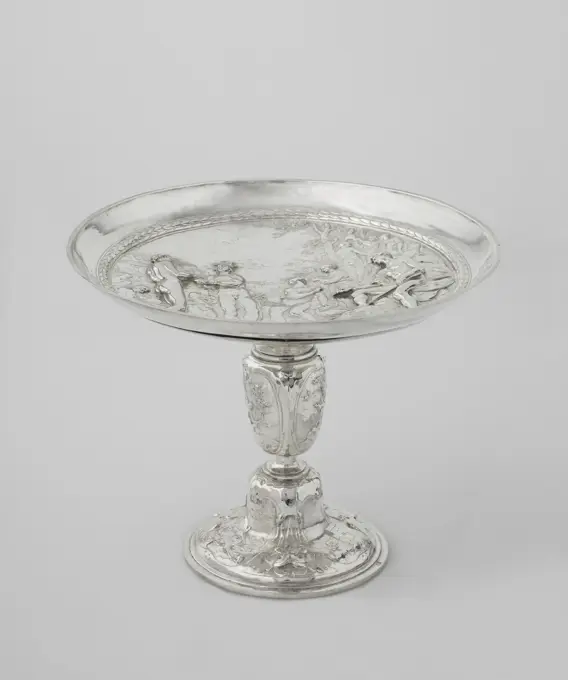
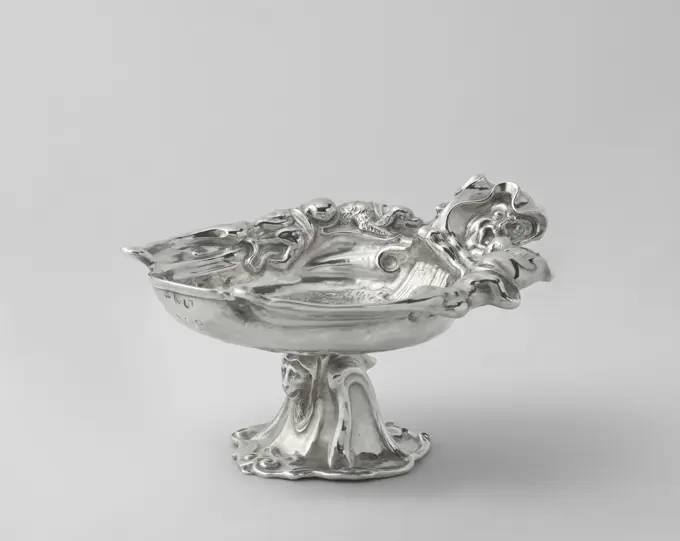
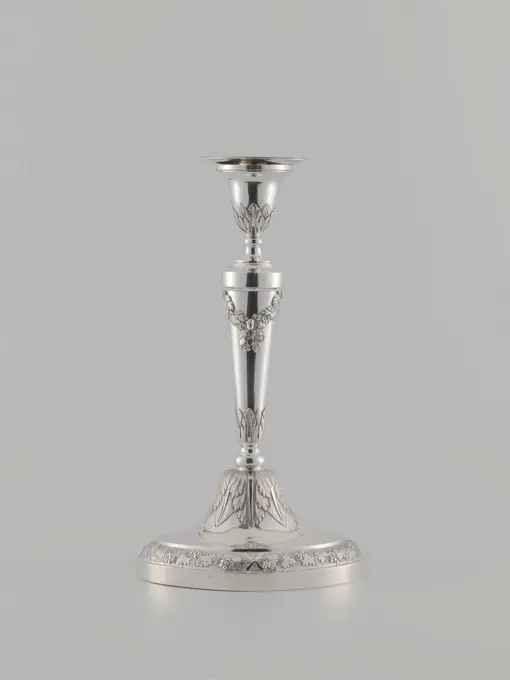
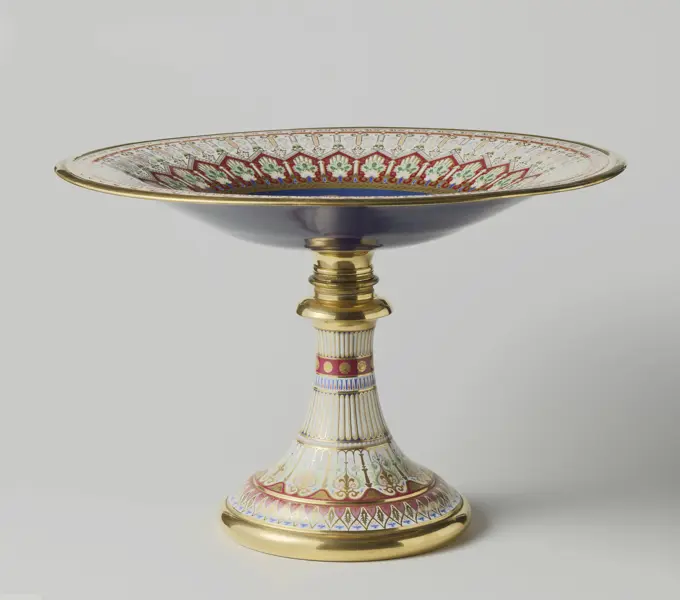
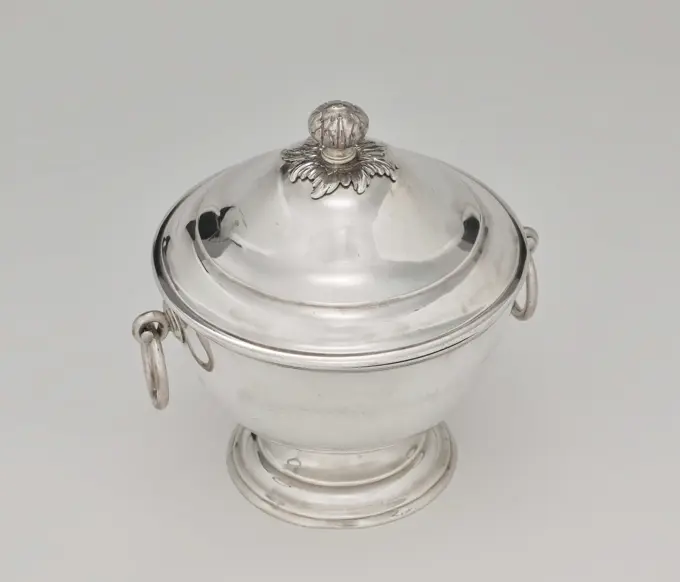
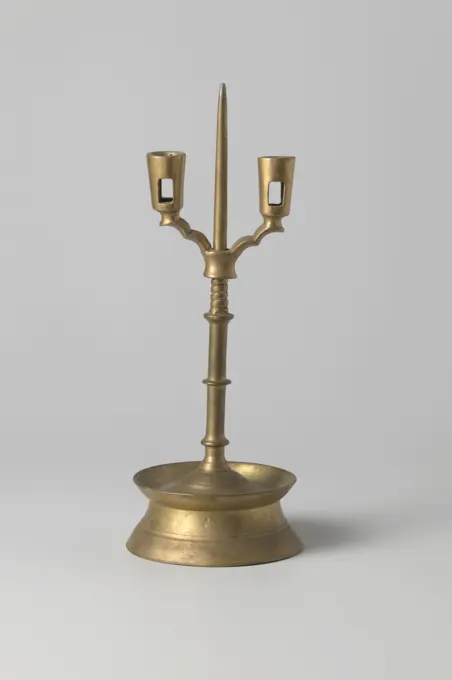
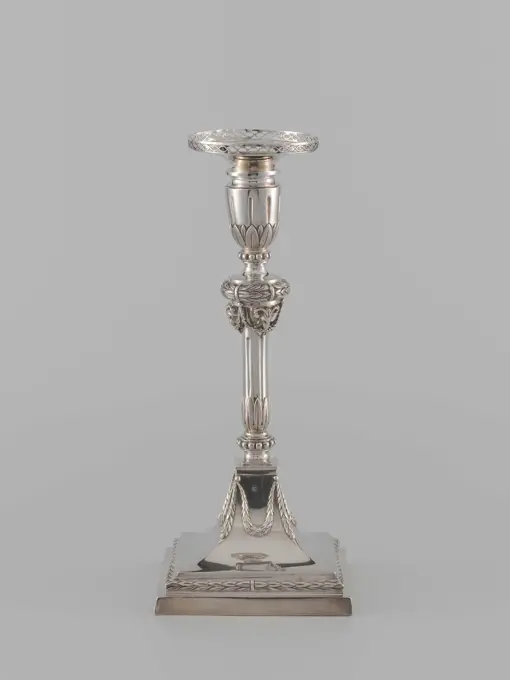
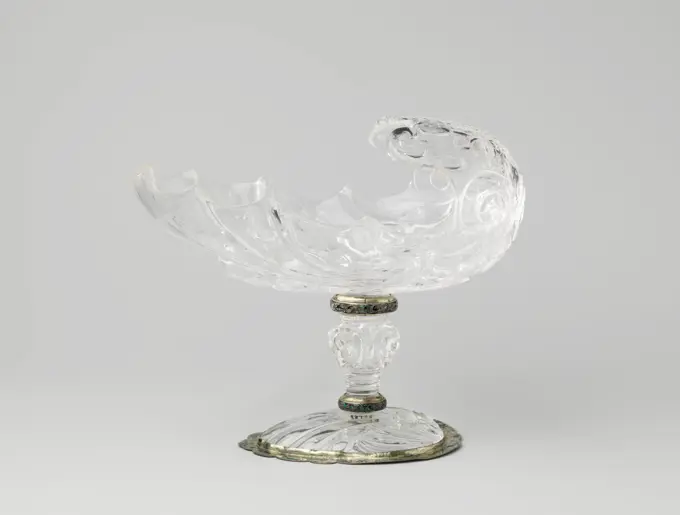
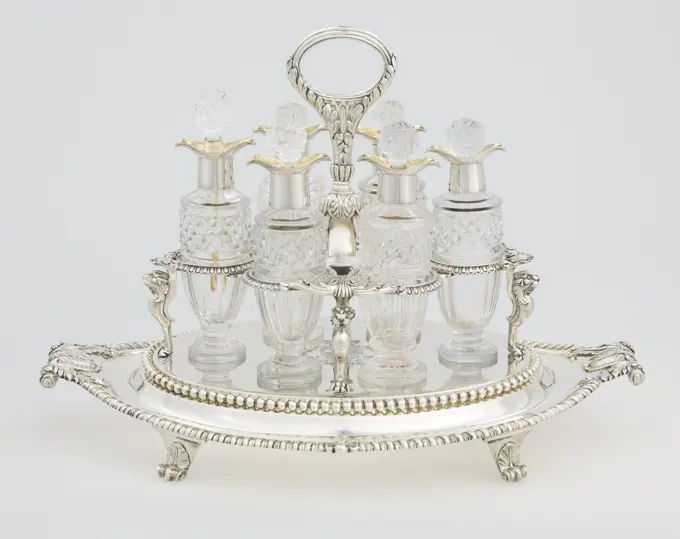
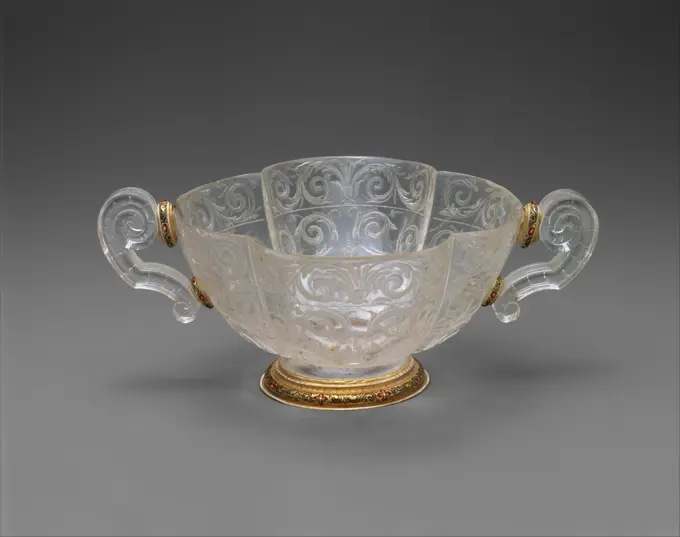
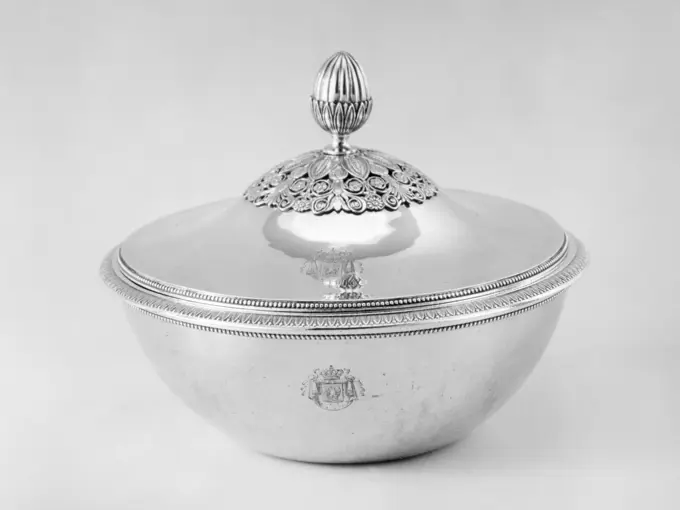
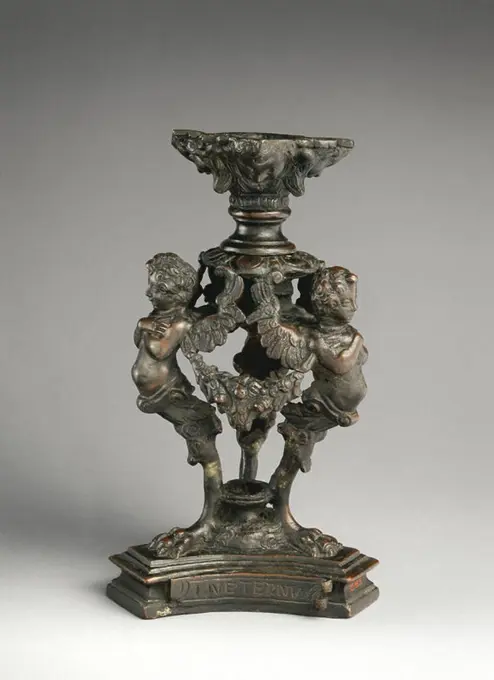
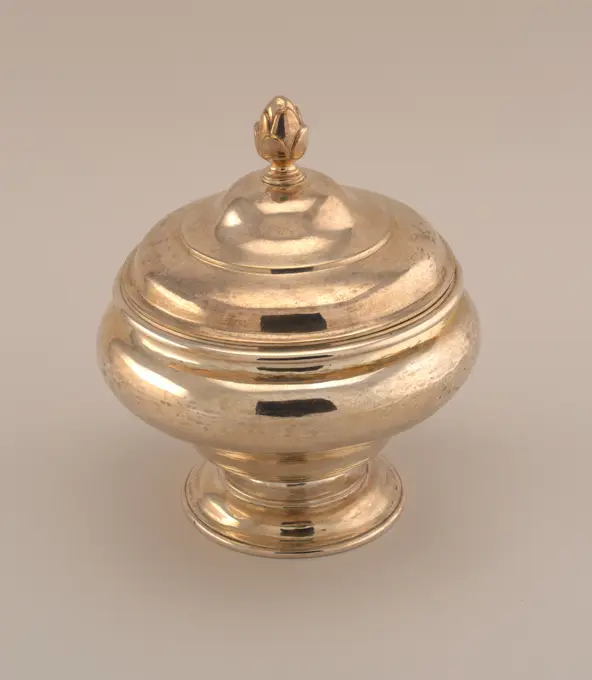
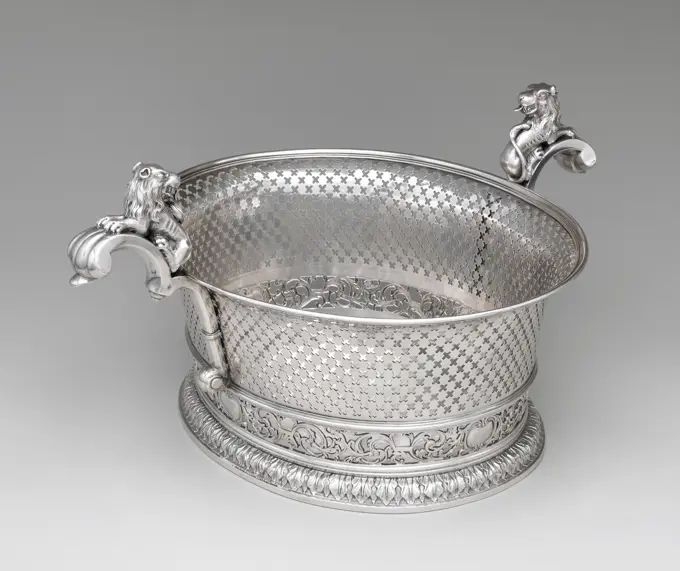
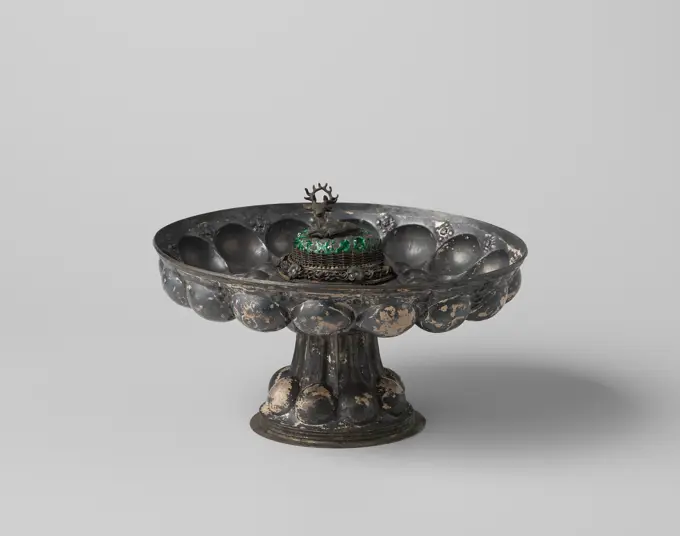
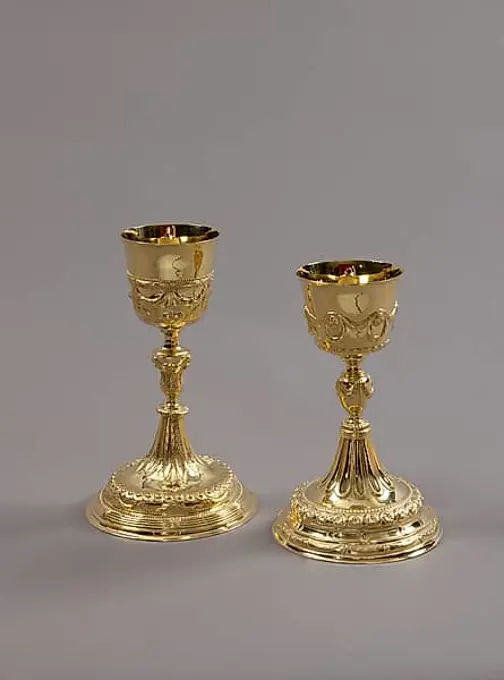
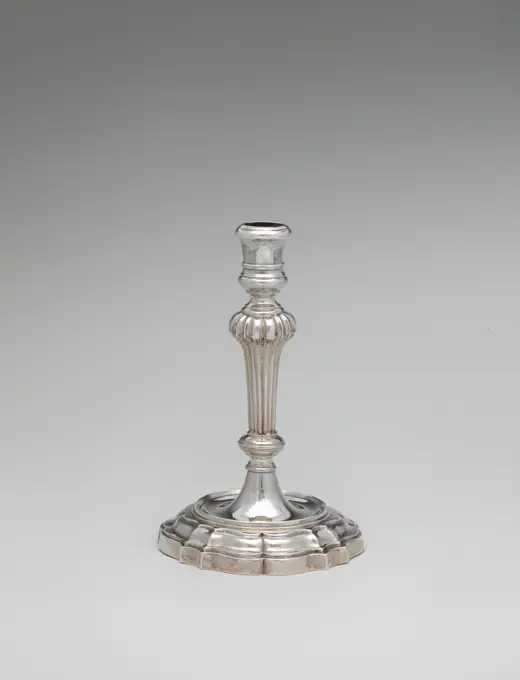
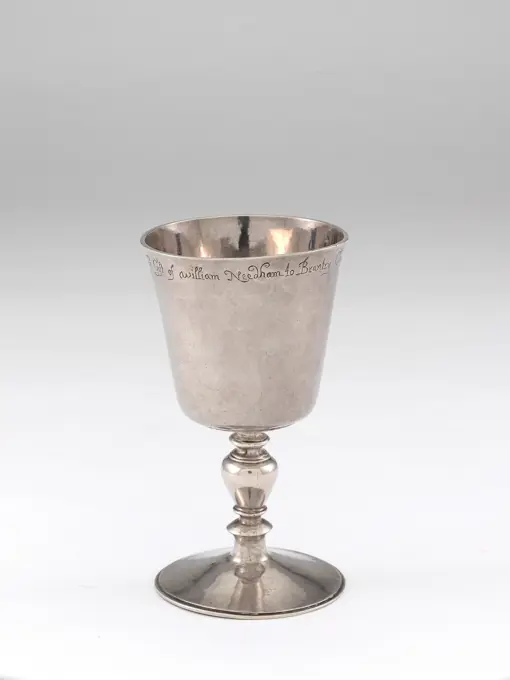
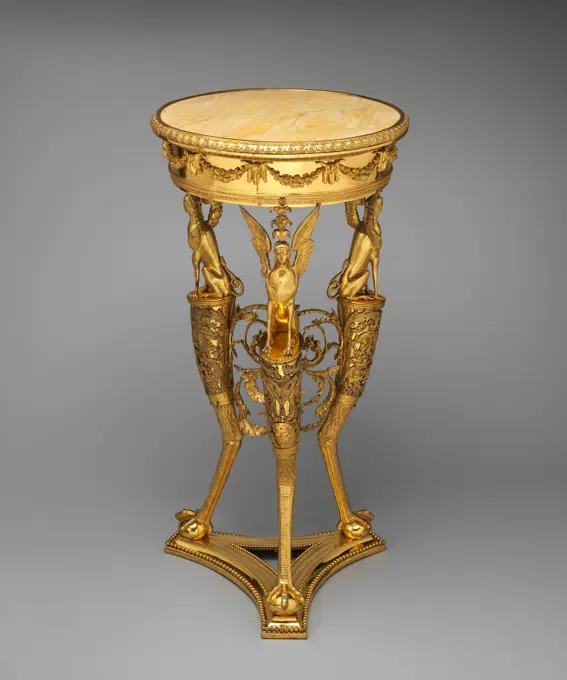
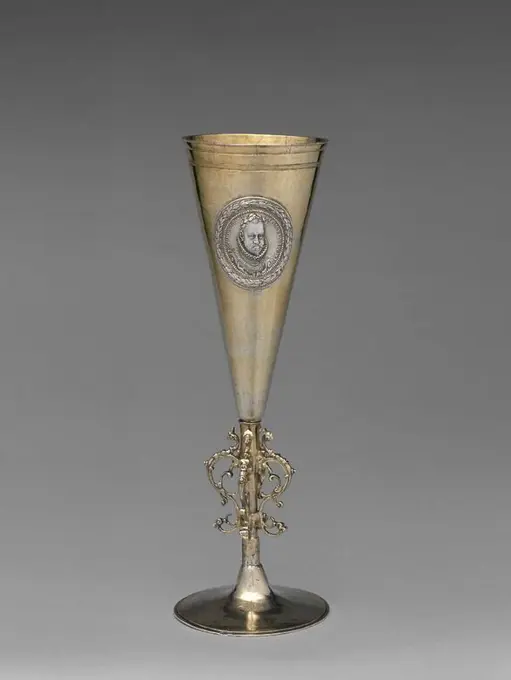
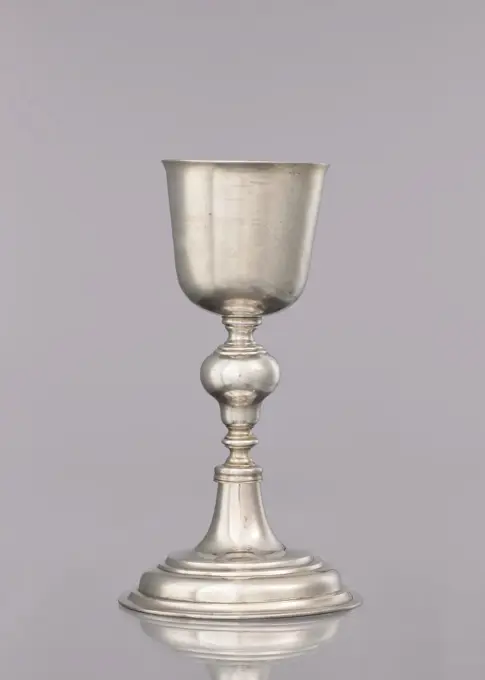
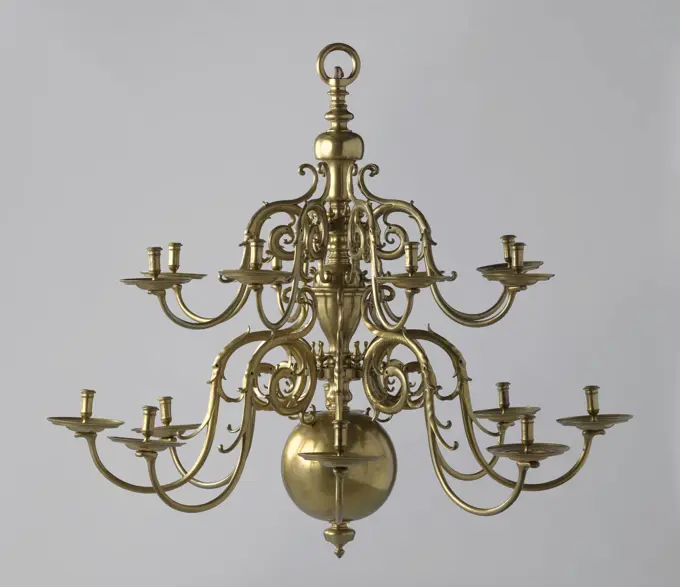
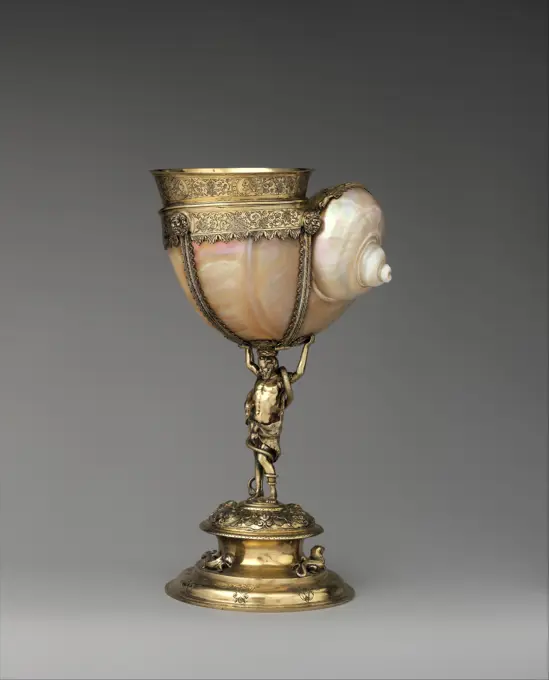
. Candlestick of silver, in Louis XIV style. The channeled tribe runs upwardly broader and is closed by a rosette list to which three garlands hang.WIne Glass and Cover. Germany, Potsdam and Zechlin. Date: 1735-1745. Dimensions: 25.9 x 9.5 cm (10 3/16 x 3 3/4 in.). Glass; engraved and gilt decoration. Origin: Potsdam. Museum: The Chicago Art Institute, Chicago, USA.PIEZA DE VIDRIO DE LA GRANJA. Location: MUSEE D'ARTS DECORATIFS. MADRID. SPANIEN.Altar kandelaar, Christiaan Warenberg (attributed to), 1710 The round candlestick rests on three four -sided, volute -shaped legs. The sides of the legs have deepened, punched fields and are decorated with acanthus leaves; A cord of smaller pearls runs over the front of each leg, resting on a leaf curl. The legs are connected at the top by straight rods, hidden from a culot-like motif. Flower festons hang off the upper curls of the volutes (one renewed on B. The trunk is made up of successively a clock -shaped, a vase -shaped and a baluster -shaped part. The convex bottom edge of the bell shape is decorated with alternately wide and narrow godrons. In addition, this part shows two layers over each other placed acanthus leaves on a punched soil. Clock and vase shape are separated by a multiple profiled connecting piece. The vase is divided into an upper and upper part, similarly decorated as the lower edge and the upper part of the bell shape. The baluster is almost entirely contained iKelkglas. Flat foot with beaten edge. Hollow, baluster-shaped strain, blown in the form with mascarons and a garland with rosettes under a grinding edge above which a ribbed nodus. Walled chalice, decorated with three flat, vertically ribbed tires. At the top edge and on the trunk remains of gilding.Jar with lid, with a hunting scene, anonymous, c. 1850 - c. 1875 Flat, octagonal, faceted foot. Facet cut, baluster -shaped tribe. Funnel -shaped, rounded and faceted chalice at the bottom. Vaulted, faceted lid with overhanging edge and a facet cut, baluster -shaped button, ending in a point. On the chalice, in Neo-Louis XV style, in gold a hunting scene with a hunter with a shot duck. On the foot and the lid a deer, a stork and a dog surrounded by rocaille ornament. The facets on foot, trunk and button with gold. Bohemia glass glassblowing / grinding / gilding Flat, octagonal, faceted foot. Facet cut, baluster -shaped tribe. Funnel -shaped, rounded and faceted chalice at the bottom. Vaulted, faceted lid with overhanging edge and a facet cut, baluster -shaped button, ending in a point. On the chalice, in Neo-Louis XV style, in gold a hunting scene with a hunter with a shot duck. On the foot and the lid a deer, a stork and a dog surrounded by rocaille ornament. The facets on foot, trunkCovered Bowl 1725-1735 Germany. Glass .. Jar in Renaissance style. The lid is crowned by a women's figure.Cock lid, anonymous, c. 1750 - c. 1775 Vaulted lid with a button made up of a nodus under a point. Foot, trunk, underside chalice, top cover and button faceted. Northern Netherlandsglassblower: Bohemen glass grinding Vaulted lid with a button made up of a nodus under a point. Foot, trunk, underside chalice, top cover and button faceted. Northern Netherlandsglassblower: Bohemen glass grindingCaster, Glass, Urn shape on square star out base. Flat fluted skin and foot with rug knop. All over diamond cut pattern with prismatic rings. Upturned rim with fan flutes and baluster finial with pierced, radial cut button top pierced with holes., Europe, ca. 1800-30, glasswares, Decorative Arts, Caster. The stark simplicity of the shape of this beaker is derived from Classical architecture. The fluted ornamentation brings to mind the columns of ancient temples.Chalice 16th century Diego Muñoz This chalice made of silver was used during the celebration of the Eucharist to serve the consecrated wine. It was produced by the Spanish silversmith Diego Muñoz, whose makers mark appears between the medallions on the vessels foot. A second mark, showing an aqueduct surmounted by a bust and the letters SECO below, belongs to the town of Segovia. According to the inscription engraved on the rim of the foot, the chalice once was "the property of the chapel of Señor Pero Lopez, son of the deceased Lord Rodrigo Lopez.". Chalice 468336Bokaal van Henricus Swaerdecroon.Cup with gold lid. On the round pedestal is a seagin with raised arms on which the chalical cuppa rests. The cup was a gift to Hendrik Swaerdeckroon because of his merits in East Indies.Cablite with cover; End of the 17th century (1680-00-00-1700-00-00);Tazza 19th century, after 17th century original Franchi and Son This electrotype is after a seventeenth-century original, at the time of reproduction in the Victoria and Albert Museum, London.. Tazza 185847Galvanoplastic reproduction of the Cup of St. Jorisgilde of Middelburg. Galvanoplastic reproduction of the Cup of St. Jorisgilde of Middelburg. The cuppa, on a baluster-shaped strain, with three coats of arms and lion heads; On the lid four medallions with fruit and flower ornaments and a figure of St. Joris.Neo -coocked salt shaker; Schreider, Edward (Fl. Ca 1858-Ca 1872); 1872 (1872-00-00-1872-00-00);Banking Foundation Leopolda Kroneneberg (Warsaw - 1996-) - collection, gift (provenance), spice vessel, Neorokoko (style), Palmet (ornament), spices (vessel), rococo (style), salt (vessel)Candlestick, multicolored painted with a kakiemon decor, meissener porzellan manufaktur, c. 1740 - c. 1745 Candlestick of painted porcelain. The candlestick has a round, scalloped foot with a profiled trunk with two nodes. The 'Altbrandenstein' pattern is painted on the candle holder and the foot edge. On the foot, a tiger is painted around a bamboo stalk in flowers. The candlestick is marked. Float porcelain Candlestick of painted porcelain. The candlestick has a round, scalloped foot with a profiled trunk with two nodes. The 'Altbrandenstein' pattern is painted on the candle holder and the foot edge. On the foot, a tiger is painted around a bamboo stalk in flowers. The candlestick is marked. Float porcelainJumbo /Elephant pattern covered compote on pedestal c 1883-1885 Canton. Glass . Canton Glass Company (Manufacturer)Covered goblet with the coat of arms of the Von Schwindt family, Anno Knütgen (attributed to workshop of), 1577 Cup with lid of stoneware on a high, spreading base with a spherical body and wide neck. Profiles on the neck and foot. Partly covered with cobalt blue. On the belly twice in relief a printed and imposed medallion with the coat of arms of the Von Schwindt family, flanked by Leeuwen. On the weapon the letters 'G.S.' and the date '1577'. In between two griffins on either side of a tree. The neck with a band Leewenkoppen, interspersed with rosettes. The transition from the belly to the foot with lion heads and stylized leaves. Decorative tires and stamped flowers with leaves on the foot. The lid with four shield -bearing lions within a tilt band. Siegburg. Siegburg Stoneware. Glaze. Cobalt (Mineral). frame: tin (metal) vitrification Cup with lid of stoneware on a high, spreading base with a spherical body and wide neck. Profiles on the neck and foot. Partly covered with cobalt bStanding cup 19th century, after 17th century original British, after German, Nuremberg original This electrotype is after a seventeenth-century original () in the Treasury of the Kremlin, Moscow, at the time of reproduction.. Standing cup 186526Anonymous; Taller Milanés () / 'Boat-shaped cup with a band of birds and flowers on the mount'. Ca. 1686. Agate, Diamond, Enamel, Emerald, Jasper, Gold, Ruby. Museum: Museo del Prado, Madrid, España.Dish with cover and liner 1775-76 Jacques-Nicolas Roettiers. Dish with cover and liner 206552Ewer 1775 Ignatz Krautauer. Ewer 232120Galvanoplastic reproduction of a candlestick with twisted strain with mythological representations from the popta treasure. Galvanoplastic reproduction of a candlestick with a round foot and a twisted trunk with mythological representations.Candlestick 1755-60 Myer Myers American. Candlestick 1322Mass cup;  approx. 1230 (1225-00-00-1235-00-00);John the Evangelist (Saint- -A 100), Marek (Saint, Apostle, Evangelist-- -I 68), Mateusz (Saint, Apostle, Evangelist---"60), Crucifixion (iconogr.), Evangelists symbols (iconogr.), Romanism, purchase (provenance), Łukasz Evangelist (Saint)Galvanoplastic reproduction of the cup of the St. Jorisgilde van Middelburg, Fa. Elkington & Co., 1881 Galvanoplastic reproduction of the cup of St. Jorisgilde van Middelburg. The cuppa, on a baluster -shaped tribe, with three coats of arms and lion heads; On the lid four medallions with fruit and flower ornaments and a figure of St. Joris. London copper (metal). silver (metal)   Middelburg Galvanoplastic reproduction of the cup of St. Jorisgilde van Middelburg. The cuppa, on a baluster -shaped tribe, with three coats of arms and lion heads; On the lid four medallions with fruit and flower ornaments and a figure of St. Joris. London copper (metal). silver (metal)   MiddelburgWine Glass and Cover 1725-1735 Bohemia. Glass with engraved gold leaf decoration .Sweetmeat Dish with Cover 1725-1735 Schleswig. Glass .Two-Handled Cup and Cover, 1677. England, London, 17th century (Charles II). Silver and silver gilt; overall: 17.2 x 11.5 cm (6 3/4 x 4 1/2 in.). Due to its size and ornament, this vessel may have functioned as a caudle cup, containing a mixture of ale or wine and bread, oatmeal, eggs, sugar, and spices that was given to women after childbirth to help them regain their strength. The scrolling foliage and exotic birds along the exterior of this cup were likely based on prints circulating in the 1600s. The reclining female figures capping the handles and the acanthus bud finial on the lid recall common architectural motifs.Bashing basket from the lid; Jaszinow, Aleksander (Fl. 1795-1826); 1 19th century (1801-00-00-1825-00-00);Pomander. Culture: Italian. Dimensions: Overall: 2 1/2 × 1 1/8 in. (6.4 × 2.9 cm). Date: 17th century. Museum: Metropolitan Museum of Art, New York, USA.Wine Jug 1739-1740 London. This jug was originally one of a pair made by one of two German emigrÈ silversmiths, Charles Kandler or Charles Frederick Kandler. It bears the mark FK, which was registered in 1735 to Charles Frederick Kandler, who presumably took over a family workshop from a relative. It is possible that both Kandlers were related to Johann Joachim Kandler, chief modeler at the Meissen Porcelain Manufactory from 1733 to 1775, who designed the Art Instituteís lively and ornamental monkey band sculpture. Whatever the family relationship might have been, the Kandler style in silver, characterized by a profusion of cast and hammered three-dimensional ornament, emerged in the late 1720sóas early, if not even earlier, than the sculptural style at Meissen.The exuberant decoration of the piece is perfectly balanced with its function. Since it is a wine ewer, it is covered with figures associated with Dionysus (also called Bacchus), the Classical god of wine a seated infant Pan plaGoblet ca. 1815 Anthony Rasch. Goblet 4128Candlestick, multicolored painted with a kakiemon decor, meissener porzellan manufaktur, c. 1740 - c. 1745 Candlestick of painted porcelain. The candlestick has a round, scalloped foot with a profiled trunk with two nodes. The 'Altbrandenstein' pattern is painted on the candle holder and the foot edge. On the foot, a tiger is painted around a bamboo stalk in flowers. The candlestick is marked. Float porcelain Candlestick of painted porcelain. The candlestick has a round, scalloped foot with a profiled trunk with two nodes. The 'Altbrandenstein' pattern is painted on the candle holder and the foot edge. On the foot, a tiger is painted around a bamboo stalk in flowers. The candlestick is marked. Float porcelainCandlestick with foot in lobe style, anonymous, c. 1650 - c. 1700 Foot, trunk, fat catcher and pin are cast separately. The triangular in tabstyle is made up of three S-Voluten, which are connected by three cartouches, and which carry the triangular basis for the trunk. This consists of a vase and a baluster. The profiled fat catcher has a rib in the middle of the strongly protruding edge. The candle pin decorated with grooved rings is carefully profiled at the foot and ends in a acorn at the top. The candlestick is weighted inside at the bottom to give more firmness. Low Countries brass (alloy) casting Foot, trunk, fat catcher and pin are cast separately. The triangular in tabstyle is made up of three S-Voluten, which are connected by three cartouches, and which carry the triangular basis for the trunk. This consists of a vase and a baluster. The profiled fat catcher has a rib in the middle of the strongly protruding edge. The candle pin decorated with grooved rings is carefully profiTumbler with Cover. Germany, Potsdam. Date: 1700-1725. Dimensions: H. 17.8 cm (7 in.). Glass. Origin: Potsdam. Museum: The Chicago Art Institute, Chicago, USA.Pricket Candlestick 1475-1500 Northern Europe. Brass .. The ewer and basin were part of a toilet service that King Charles III of Spain gave Marie Louise of Parma, who married his eldest son in 1765. These are the only parts of the service that have been preserved. The ewer was used to pour water into the basin for the ladys toilet.Buddhist Altar Bell, 10th century, 6 7/16 x 2 3/4 in. (16.35 x 6.99 cm), Bronze, Indonesia, 10th centuryCandlestick - Inconnu / UnknownUrn from biscuit, Louis XVI, white with straight ears. Urn from biscuit, Louis XVI, white with straight ears. Part of a few. Brand pressed on side foot: Ma (Nubactu) Re de Mer Le Duc d'Angouleme a Paris.Salt barrel with driven fish, shells and marine animals. Silver pulley salt barrel. Fish, shells and sea animals are driven on the foot. On top of a weapon and a banderle with the name Catarina gaeijkema and the year 1689.Tea tray, cake stands, jam dish, sugar bowls, coffee pot and milk jug, Martin Guillaume Biennais, c. 1817 Cake scale of gilded silver. A flat plateau with vertically raised, narrow edge. Foot and shaft with acanthus leaves decorated. On the leaf engraved the crowned imperial monogram. Paris silver (metal). gilding (material). ebony (wood) gilding Cake scale of gilded silver. A flat plateau with vertically raised, narrow edge. Foot and shaft with acanthus leaves decorated. On the leaf engraved the crowned imperial monogram. Paris silver (metal). gilding (material). ebony (wood) gildingSoup vase; Bandau, Johann Georg I (1734-1812); The nine years of the 18th century (1790-00-00-1799-00-00);Standing salt 19th century, after 16th century original Elkington & Co. British This electrotype is after the sixteenth-century original, a treasure of the Kremlin, Moscow at the time of reproduction.. Standing salt 186489Unknown, vase with lid. Porcelain. Petit Palais, Museum of Fine Arts of the City of Paris.Urn.   Maker: Henry Harland, American, 1789-1841Brandewijnkom, Pieter Jacobs Clinckhamer, 1672 Brandy bowl of silver with a high, octagonal, engraved cuppa and two horizontal, cast roller work. Harlingen silver (metal) Brandy bowl of silver with a high, octagonal, engraved cuppa and two horizontal, cast roller work. Harlingen silver (metal)Jar with a hunting performance. Bowl with lid, with three buttons in the trunk, the middle with a red spiral. Chalice divided into the round in boxes in which cut a hunting performance.Wine cup with cover ca. 1565 Mounts by Affabel Partridge British The red-glazed ground of this cup was originally decorated with a finely-drawn gold decoration which has now largely worn off. This style of painting in gold on a colored ground was produced in China primarily for the Japanese market, where it was termed kinrande ("gold brocaded.") Queen Elizabeth I was presented with a similar mounted cup in 1582.. Wine cup with cover 204931CALIZ-PLATA DORADA-S XVI-TALLER DE SANGUESA. Location: ST. -JOHANNIS-KIRCHE. Ochagavia. NAVARRA. SPAIN.Tazza (footed drinking cup). Enraged for not having been invited to a wedding banquet, Discordia (goddess of strife) tosses amidst the guests a golden apple inscribed: To the fairest.’ Juno, Minerva and Venus quarrel over the precious trinket. The gods ask Paris, a mortal, to judge who should have the apple. He awards it to Venus, because she bribed him with the promise of the most beautiful woman on earth. Here, Venus returns the apple to Mercury.Drinking cup with fools heads. This cup is best viewed from above. The almost symmetrical rim consists of two fools heads. Their hoods extend on either side onto a rim that enfolds two small dogs and then flows into the Auricular (soft, fleshy, lobe-like) ornament that is the trademark of the Van Vianen family. Depicting below the fools heads a stream of water pours into the bowl, in which a dolphin andother sea creatures are swimming.Close-up of an oil lamp, EnglandCompote c 1882 New York City. Silver and silver gilt . Charles OsborneScent Bottle, mid-1800s. Continental, mid-19th century. Ivory with gold and silver mounts set with jewels; overall: 7.7 x 2.6 cm (3 1/16 x 1 in.).. Candlestick with foot. Signature and dated.Tazza (Footed Dish), royal porcelain manufactory, c. 1836 - c. 1837 dish Tazza (scale on foot) from porcelain, with a copper frame with iron pin to place in the high foot. Painted with email colors and gold. On the Plat the Personification of the Night, a winged woman with two sleeping children on her arm accompanied by an owl. The inner edge with decorative tires with (leaf) terrants and geometric shapes. The outside of the dish is blue. On the foot a similar decoration as the inner wall of the bowl: different tires with tips, curls and geometric shapes. Marked with the scepter . Berlin Porcelain. Glaze. Gold (Metal). frame: bronze (metal) gilding / vitrification night. ornaments ~ artDing vessel;  19th century (1801-00-00-1900-00-00);Cup early 20th century (original dated ca. 1481) British. Cup 463503Amphora-rhyton. UnknownSoup tureen. Bandau, Johann Georg I (fl. 1768-1816), goldsmithCandlestick from brass, anonymous, c. 1400 - c. 1500 The low profiled Konical foot has a raised edge at the top, and serves as a fat catcher. The round trunk with three knots and a thread runs point so that the upper part can be used as a candle pin. The trunk is sounding in the foot. The two-armor turner is placed on the trunk, which has a narrow opening that is not too narrow for the trunk in the middle, in which a thread that is not suitable for this trunk is applied. The turner forms one whole with the two almost Cylindrian candle holders, in which openings are applied to the front and back in the wall. The turner is with the holders, who show remarkably large cast galls on the inside, a falsification from the nineteenth century. Southern Netherlands (possibly) brass (alloy) casting The low profiled Konical foot has a raised edge at the top, and serves as a fat catcher. The round trunk with three knots and a thread runs point so that the upper part can be used as a candle pin. The . Candlestick consisting of a square foot and a round trunk, candle holder and separate fat catcher.Vase with cobalt blue überfang with sharpened decoration, anonymous, c. 1850 Square, gilded bronze base and trunk in neo -Renaissance style with gray -veined marble intermediate piece. Trumpet -shaped chalice made of clear colorless glass with a cobalt blue überfang, dragged away in windows, fish blowing and circles. Scalloped upper edge. France (possibly) Glass. Foot: Bronze (Metal). Foot: Marble (Rock) glassblowing / gilding Square, gilded bronze base and trunk in neo -Renaissance style with gray -veined marble intermediate piece. Trumpet -shaped chalice made of clear colorless glass with a cobalt blue überfang, dragged away in windows, fish blowing and circles. Scalloped upper edge. France (possibly) Glass. Foot: Bronze (Metal). Foot: Marble (Rock) glassblowing / gildingStanding Dish, anonymous, anonymous (rejected attribution), c. 1625 - c. 1650 Shell of rock crystal in a frame of gilded silver with email. The shell -shaped vessel, with a vault on one side, rests on a thick shaft with oval base. Under the barrel, a medallion with a chinoiserie is installed in email. Prague frame: Silver (Metal). frame:. frame: Gilding (Material) gilding Shell of rock crystal in a frame of gilded silver with email. The shell -shaped vessel, with a vault on one side, rests on a thick shaft with oval base. Under the barrel, a medallion with a chinoiserie is installed in email. Prague frame: Silver (Metal). frame:. frame: Gilding (Material) gildingPair of candlesticks ca. 1750 Bartholomew Stokes. Pair of candlesticks 198031Cruet set, 1807, Paul Storr; Manufacturer: Rundell, Bridge & Rundell, English (London), English, 1771-1844, 8 1/2 x 12 x 8 in. (21.59 x 30.48 x 20.32 cm), Silver, glass, England, George IIIBowl third quarter 16th century Rock crystal made by Sarracchi Brothers See also 17.190.1702.. Bowl 205614Circular dish with cover (part of a dining service) ca. 1805 Martin-Guillaume Biennais French. Circular dish with cover (part of a dining service) 206298Standing cup 1700-1750 Central German. Standing cup. Central German. 1700-1750. Glass. GlassPunch bowl with cover first half 19th century Irish. Punch bowl with cover. Irish. first half 19th century. Glass. GlassCandlestick fragment. Culture: Italian, Venice. Dimensions: Overall (confirmed): 13 × 7 11/16 × 6 7/8 in. (33 × 19.5 × 17.5 cm). Date: 16th-17th century. Museum: Metropolitan Museum of Art, New York, USA.Sugar Bowl And Cover; silverBasket 1731/32 John Edwards II British Silver baskets, often referring in their design to wicker prototypes, were made in pairs as part of a dinner service and were used for serving bread or cake. This basket and its mate were part of a large acquisition of silver made by the 8th Earl of Exeter to furnish the Elizabethan manor Burghley House.. Basket 238823Galvanoplastic reproduction of a bowl with a deer within fence from the Lüneburg Ratssilber. Galvanoplastic reproduction of a bowl with swellings, on which lying deer on green email, high foot of gold-plated silver.Beaker. The bottom edge of the mount rests on three lionshaped feet, recalling the lions paws found on Gothic candlesticks.Marble pyxis (box). Culture: Greek. Dimensions: H. 7 15/16 in. (20.2 cm)diameter 4 5/8 in. (11.7 cm). Date: late 5th-early 4th century B.C..Greek marble-working of the Classical period is generally associated with architecture and monumental sculpture. This vase is remarkable for its precision and delicacy. It is likely that it was orginally painted. Museum: Metropolitan Museum of Art, New York, USA.Spreader with round holes in the lid, belonging to a spice service, Anthonie Grill (attributed to), 1642 Spreader belonging to a spice service. The spreader rests on a sea lobby on which a flattened nodus and a diabolov -shaped intermediate piece are stacked. Above, the body that has the shape of a pineal - in a slimmer version than of the oil can - is decorated with drop -shaped bulges. The high screw -up lid narrows upwards, after which it widened in a stretched spherical top. This part has round holes. The lid is decorated on the bottom with vertical grooves that are bordered by a profiled edge. The top is crowned by a button in the shape of a pineal. Amsterdam silver (metal). gilding (material) casting / gilding Spreader belonging to a spice service. The spreader rests on a sea lobby on which a flattened nodus and a diabolov -shaped intermediate piece are stacked. Above, the body that has the shape of a pineal - in a slimmer version than of the oil can - is decorated with drop -shaWestward Ho! pattern Compote; Manufactured by James Gillinder & Sons (United States); USA; pressed glass, acid frosted; Overall: 22.9 x 18.1 x 18.1 cm (9 x 7 1/8 x 7 1/8 in.)Two chalices, goldsmithing and textile art from the 16th to the 20th century, St., Sankt, SaintMiniature cruet with cover. Culture: Dutch, Amsterdam. Dimensions: Height: 2 1/8 in. (5.4 cm). Maker: S. A. , possibly. Date: 1738. Museum: Metropolitan Museum of Art, New York, USA.Hot water urn 1830-31 Probably by John Angell. Hot water urn 204695Candlestick 1740-50 Formerly attributed to Jacob Hurd American. Candlestick 1316Plate 1825-1865 France. Glass . Baccarat GlassworksSalt 1846 Samuel Kirk and Son. Salt 7069Wine Cup c 1660 Boston. This wine cup is among the earliest and rarest examples of colonial American silver, made in the Massachusetts Bay Colony around 1660 by John Hull and Robert Sanderson. Born in England and raised in Boston, Hull was appointed mintmaster for the Colony in 1652, partnering then with Sanderson. The cupís restrained style and lack of ornamentation express the Puritan values of early settlers. Commissioned by William Needham, later sexton of Old South Church in Boston, the vessel was used domesticallyóa decidedly uncommon possession even for an established family of the time. An inscription was added to the cup when Needham donated it to Braintree Church in 1688.. Silver . John HullTable 19th century, after 18th century original After an original by Pierre Antoine Bellangé French This electrotype is after a late eighteenth-century French original in the Hermitage, St. Petersburg. The form resembles a well-known Roman tripod in Naples.. Table. British, Birmingham, after French original. 19th century, after 18th century original. Electroformed copper, gilt, yellow marble. Metalwork-ElectrotypeConical cup. Culture: Hungarian, Kolozsvr. Dimensions: Height: 7 7/8 in. (20 cm). Maker: Pl Zilahy (active ca. 1635-52). Date: ca. 1640.The plaquette on this cup commemorates Holy Roman Emperor Rudolph II (1552-1612), the great Habsburg collector, who amassed a legendary Kunstkammer (art chamber). He chose Prague as his main residence, transforming the city into a politically tolerant and vibrant artistic center. For this vessel, the goldsmith translated the highly refined conical shape of a sharply tapering glass goblet into an alluring silver cup.LiteratureImportant English, Irish and Continental Silver. Sale cat., Sotheby's, New York, April 16, 1996, n.p., no. 91.ReferencesA cup with a similarly adorned stem was sold by Dr. Fischer Kunstauktionen in Heilbronn, November 27, 2010, no. 1007.Elemr Koszeghy. Magyarorszgi tvsjegyek a kzpkortl 1867-ig / Merkzeichen der Goldschmiede Ungarns vom Mittelalter bis 1867. Budapest, 1936, no. 997 maker's mark.WolfrChalice. Schmidt, Samuel Gotthelf (1752 lub 1753-1827), goldsmithMiskelk, anonymous, c. 1475 - c. 1525 The driven and ciseled object consists of foot (with the edge), tribe, nodus and cuppa. Around the trunk are the bottom of the tribe, the nodus and the upper part and riveted. The cuppa is attached to the rosette. The foot has six lobes with a profiled flared edge, which was applied to the foot in six parts. On one of them, a cross with oblique ends is engraved on a blocked field. The Nodus has six facets, on which four-leaf stylized rosettes, as well as at the top and bottom, six leaf-like motifs are applied. The Cuppa is on the bottom in a six -leaf chalice with engraved ornament. The foot has two trembling stitches at the bottom, which suggest that it has been inspected. Germany brass (alloy) engraving / gilding The driven and ciseled object consists of foot (with the edge), tribe, nodus and cuppa. Around the trunk are the bottom of the tribe, the nodus and the upper part and riveted. The cuppa is attached to the rosette. The foot has six lobes golden candlestick against the wall with the mirrorCarafe in the form of an eagle, anonymous, c. 1800 - Before 1875 Vase -shaped body with thick ribs, mounted in the shape of an eagle, with two legs, a tail and an eagle's head of gilded silver. The removable head acts as a stop. Tail, neck and head are engraved with scales; The tail, neck and head with feathers. Germany (possibly) Glass. frame: Silver (Metal) glassblowing / gilding / engraving Vase -shaped body with thick ribs, mounted in the shape of an eagle, with two legs, a tail and an eagle's head of gilded silver. The removable head acts as a stop. Tail, neck and head are engraved with scales; The tail, neck and head with feathers. Germany (possibly) Glass. frame: Silver (Metal) glassblowing / gilding / engravingCALIZ DE PLATA SOBREDORADA S XVIII. Location: IGLESIA DE SANTA MARIA DEL CAMPO. Coruña. SPAIN.Hanging ring made of two heights, Anonymous, 1650 Brass hanging ring. Under the round ring a short pipe shape, with a widening. A loose ring can be placed below. Amsterdam (possibly) copper (metal) casting Brass hanging ring. Under the round ring a short pipe shape, with a widening. A loose ring can be placed below. Amsterdam (possibly) copper (metal) casting. Silver . Francis CrumpDecel van Zwischenglas, Anonymous, c. 1720 - c. 1740 In facets of cut lid with pointed, also faceted button. In the lid a medallion of windows surrounded by a stylized leaf vank. With accompanying cup (BK-NM-10754-269-1). Bohemia glass glassblowing / grinding In facets of cut lid with pointed, also faceted button. In the lid a medallion of windows surrounded by a stylized leaf vank. With accompanying cup (BK-NM-10754-269-1). Bohemia glass glassblowing / grindingStanding cup base and figure late 16th century, shell and mount 19th century Casper Bendel German. Standing cup 193578