Antique Lace Patterns

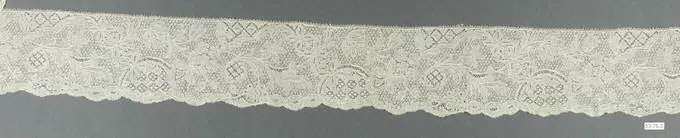
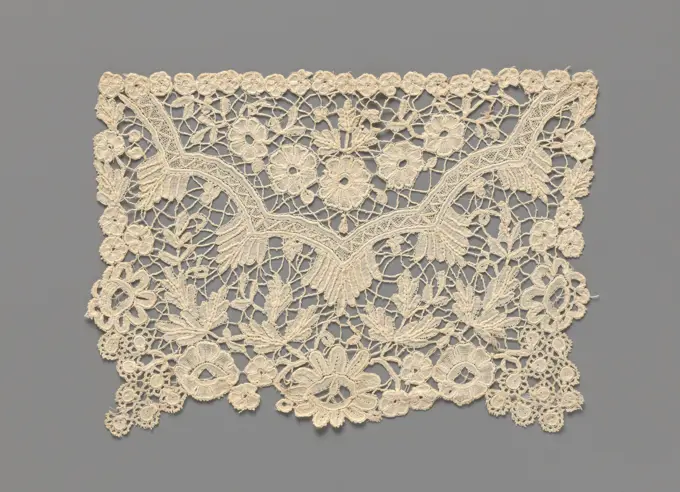
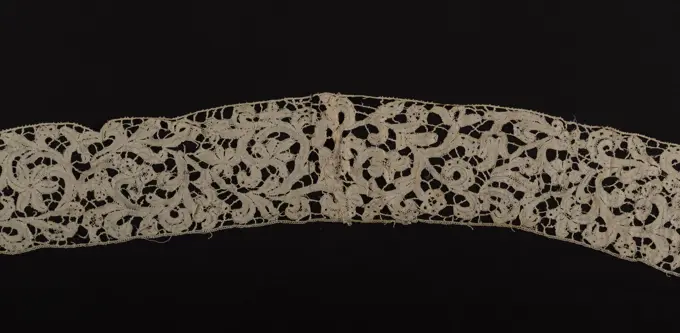
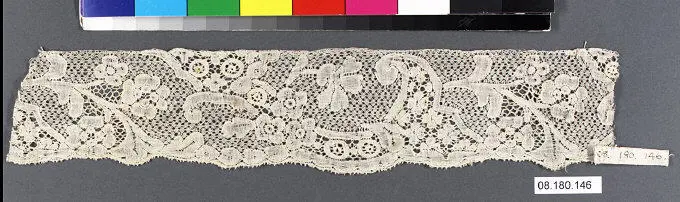
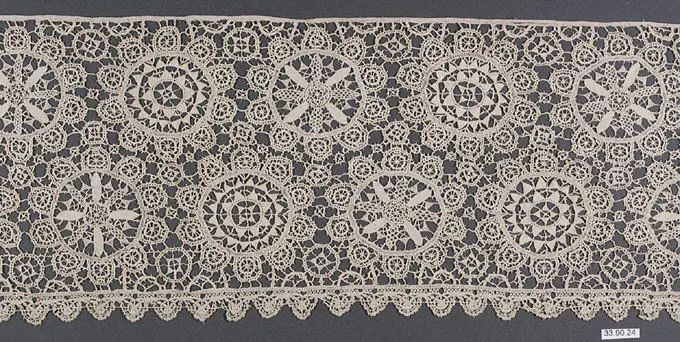
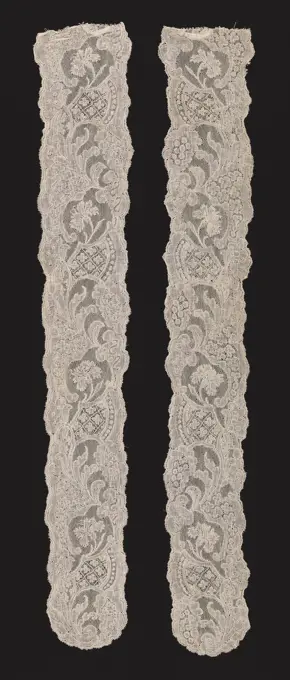
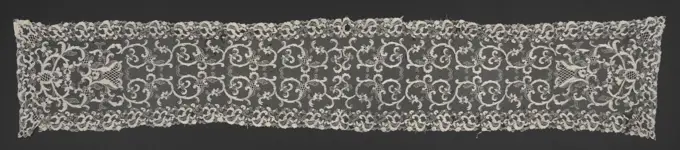
Delicate lace strips featuring intricate floral and geometric patterns, showcasing craftsmanship from various historical periods in lace making.
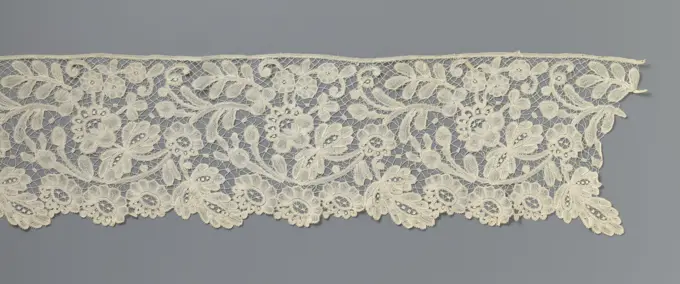
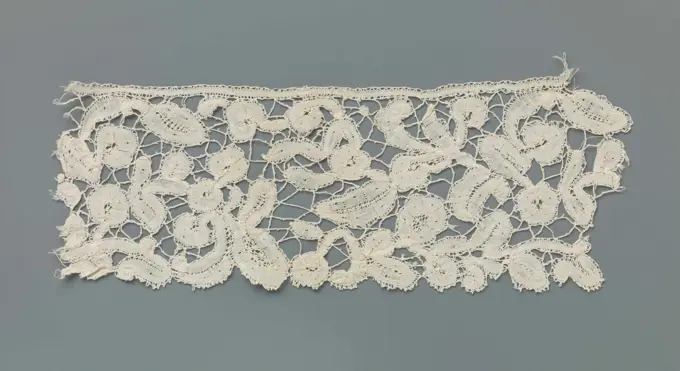
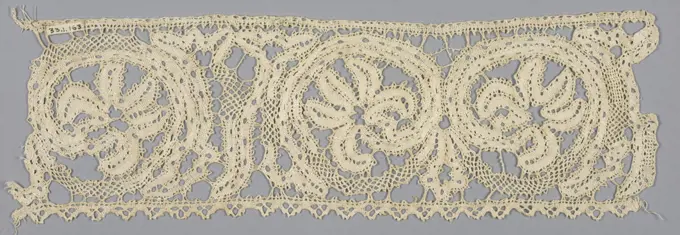
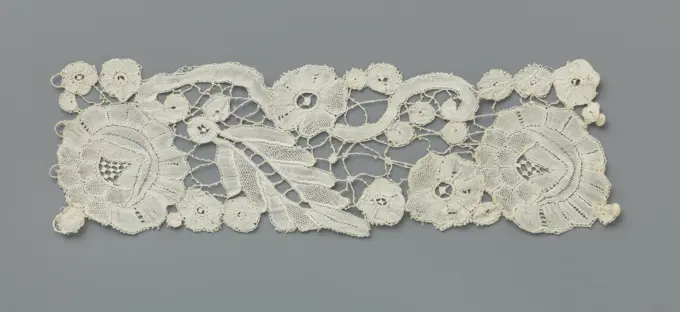
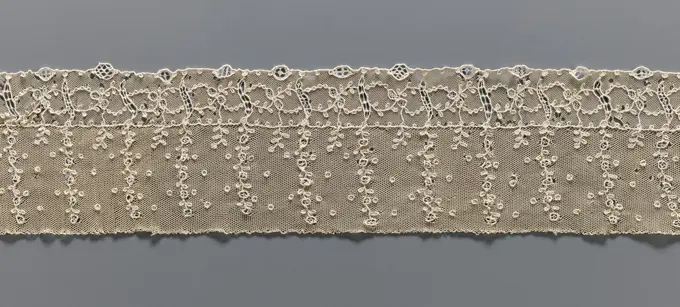
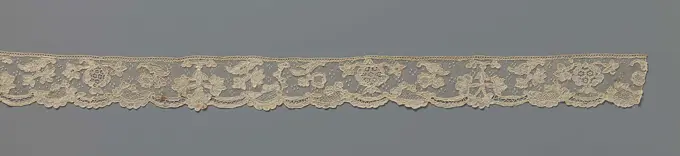
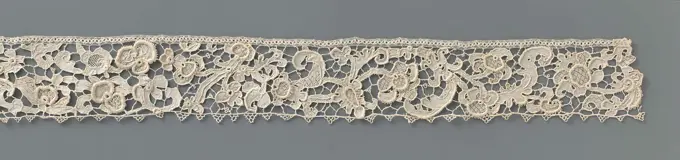
Strip of bobbin with three rosette flowers and a three -lobe leaf such as scum, anonymous, c. 1899 - c. 1900 Strip of natural -colored bobbin: fine bridge flower arrangements. The repeating pattern consists of three slanted oval rosette flowers and a large three -lobbish leaf along the lower edge. Above every three rosette flowers there is a curved stem with two rosette hips on one side and on the other hand a kink in the stem and rose hips targeted rosette flower on the end. A few leaves and smaller rosette flowers spring from this rosette flower. Above every shell that is formed by the three -lobe leaf, a rosette boom hangs down on a curved stem. The motifs are connected by a potented braid ground. The motifs are made in netslag and linen battle, with openwork edges and recesses. The motifs are equipped with thin to very thick contour threads and burst relative contours. In a part of the openwork petals or flower hearts, cubes are made in shape or in Linneslag. The top of the strip i
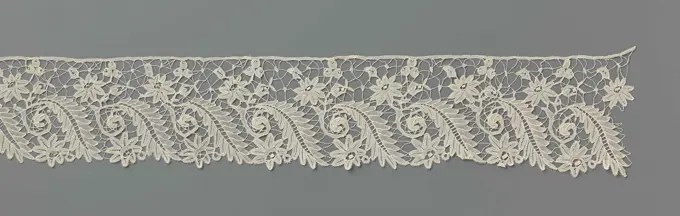
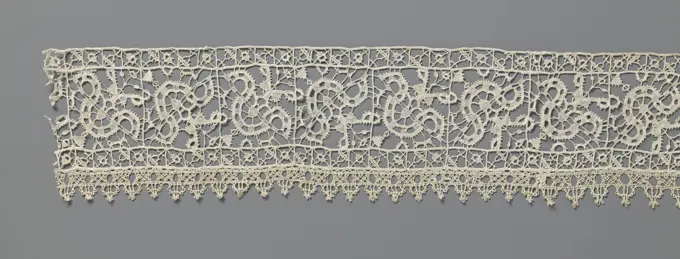
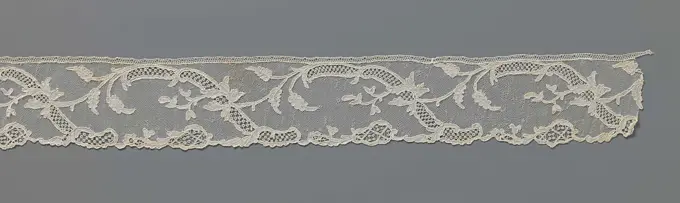
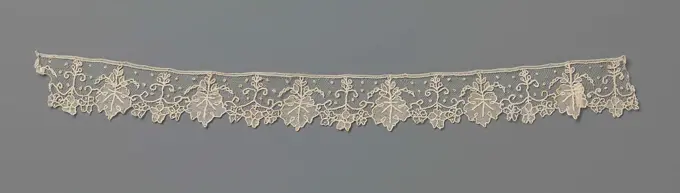
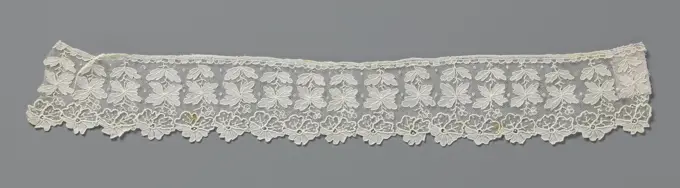
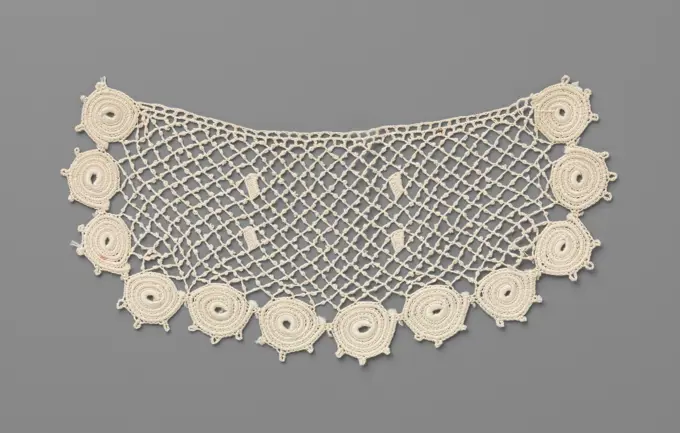
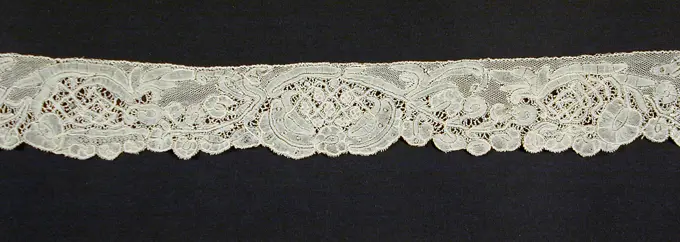
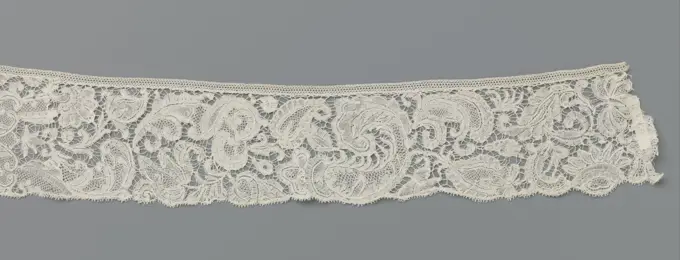
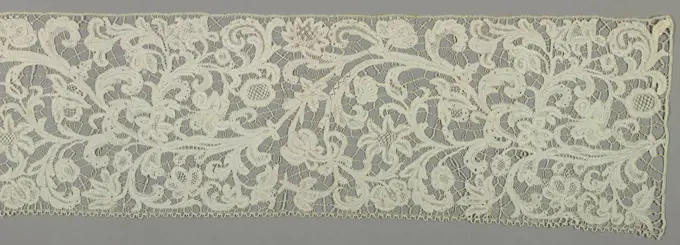
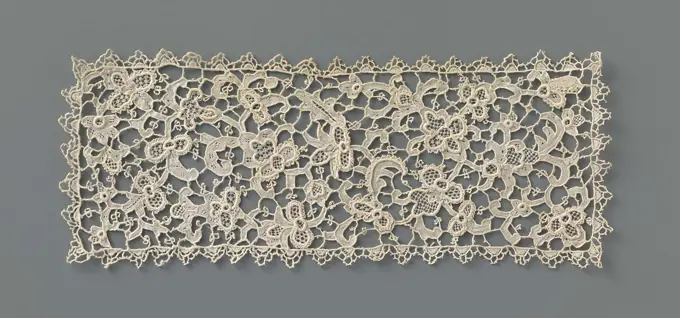
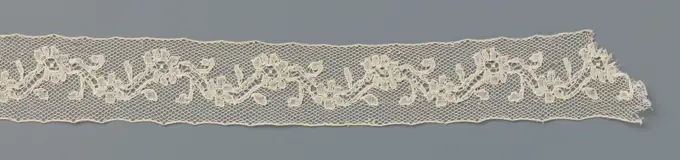
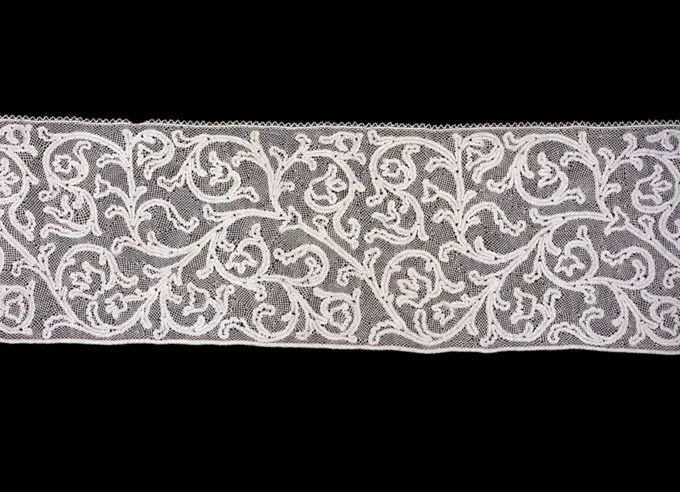
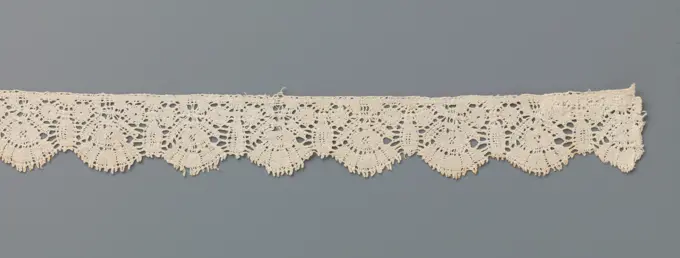
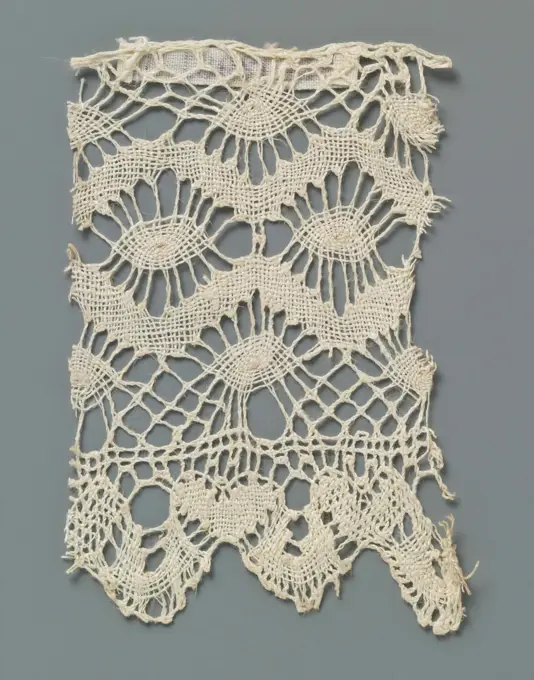
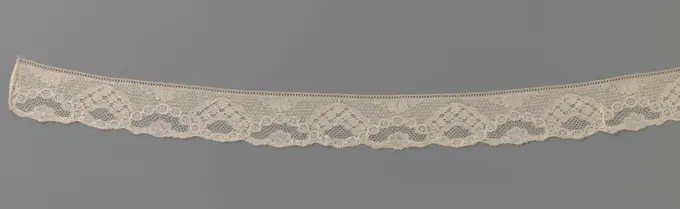
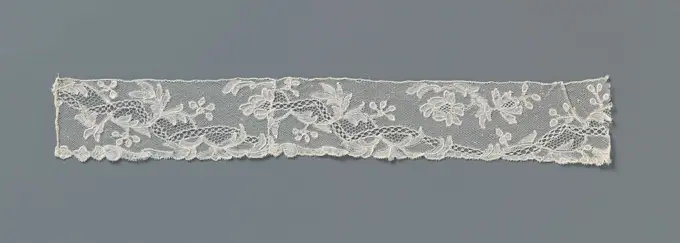
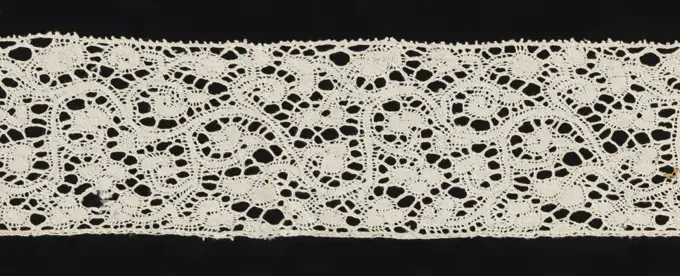
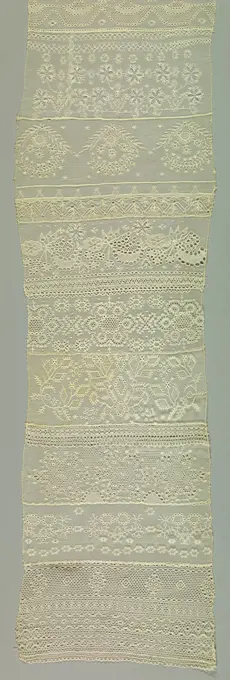
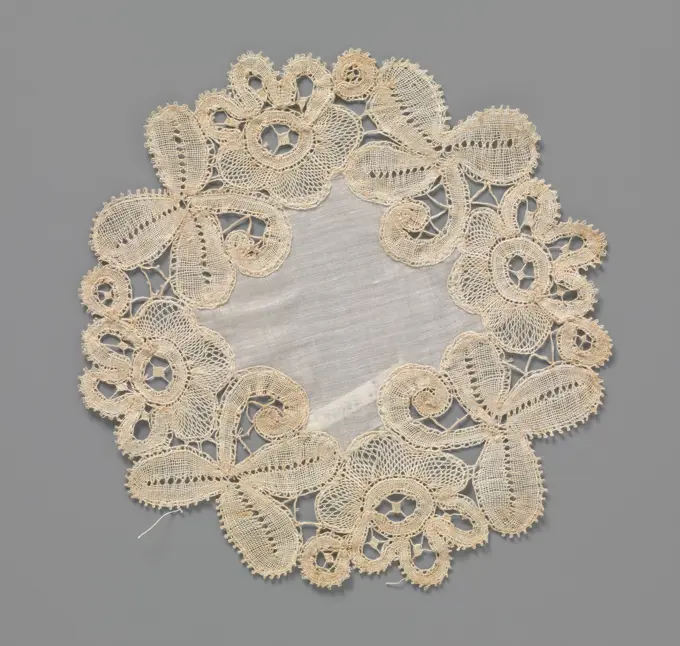
Strip of bobbin with wavy volute drink, anonymous, c. 1650 - c. 1699 Strip of natural-colored bobbin, old-Flemish side. The pattern consists of a wavy volute drink with various large and smaller flowers and curling leaves. The motifs are connected by a Maas soil. The motifs are made in linen battle with recesses and openwork edges. Different decorative lands have been used as filling of flowers and leaves. The top is straight. The underside is light waving and follows the edges of the motifs. Flanders linen (material) bobbin lace / Flanders lace Strip of natural-colored bobbin, old-Flemish side. The pattern consists of a wavy volute drink with various large and smaller flowers and curling leaves. The motifs are connected by a Maas soil. The motifs are made in linen battle with recesses and openwork edges. Different decorative lands have been used as filling of flowers and leaves. The top is straight. The underside is light waving and follows the edges of the motifs. Flanders linen (matStrook kloskant met gevederde bladeren.Natural collate strip: Duchesse-Side. On a very open braid soil with cobwebs is a running pattern that is heavier on the shult side. In the middle is a row of tight spiral stems with a hanging, feeded leaf with open grain. Star-shaped flowers and berries are available for their times.Edging early 19th century Italian, Venice. Edging 212743Border (Belgium); linenStrip of bobbin with three rosette flowers and a three -lobe leaf such as scum, anonymous, c. 1899 - c. 1900 Strip of natural -colored bobbin: fine bridge flower arrangements. The repeating pattern consists of three slanted oval rosette flowers and a large three -lobbish leaf along the lower edge. Above every three rosette flowers there is a curved stem with two rosette hips on one side and on the other hand a kink in the stem and rose hips targeted rosette flower on the end. A few leaves and smaller rosette flowers spring from this rosette flower. Above every shell that is formed by the three -lobe leaf, a rosette boom hangs down on a curved stem. The motifs are connected by a potented braid ground. The motifs are made in netslag and linen battle, with openwork edges and recesses. The motifs are equipped with thin to very thick contour threads and burst relative contours. In a part of the openwork petals or flower hearts, cubes are made in shape or in Linneslag. The top of the strip iStrook kloskant met eenvoudige bloemen en bladeren.Natural collate strip: Duchesse-Side. Simply designed flower and leaf motifs and volutes are connected by a braid soil. Along the edge, among other things, a spinner with two curly leaves.Strook kloskant met een middenbaan van aaneengeschakelde ruiten.Strip natural colosside. The repeating and geometric pattern consists of a concatenation of diamond-shaped motifs, which form a wide path over the center line of the strip. The windows have an open-worked edge or a cut-away center. The motifs are connected by a maas soil, a fat mat of grille. A concatenation of spindle-shaped recesses in the mesh soil forms a decorative edge along the bottom of the strip. The motifs are made in linen stroke with open editors. Both the full work and the recesses are largely equipped with thick contour wires. An ornamental ground has been applied in the windows with a cut-away center. The top and bottom of the strip are straight finished, the underside with picots.Strook kloskant met hartjes strooipatroon en dennenappelmotief onder ijle zigzag-lijn.Strip natural colosside: Mechelen side. Under a thrift pattern of four rows of hearts, a thin zigzag line, with a pine cone-shaped motif, under each zigzag valley, which hangs down to the bottom of the strip. Between the pine cone motifs lies a cutter decorative edge along the underside of the strip, decorated with cubes made in shape stroke. The motifs are connected by a fine Maas soil, a Mechelen soil. The sparse fullwork is made in linen stroke with thicker and shiny contour wires. The top and bottom of the strip are straight finished, the underside with picots.Strip needle side with vases, anonymous, c. 1600 - c. 1620 Strip of natural needle side - reticella - with a strip of bobbin with pointed sculpts on the bottom. Needle side: The repeating pattern consists of squares in which a bang -cut vase, in turn is tilted to the left and to the right. The vase is connected with small dogs and arches on the sides of the square and on the top and bottom through a frame of filled squares. The motifs are made with feston stitches, decorated with recesses and with closed picots. The motifs are connected to each other by tolal bars and bars with feston stitches. The horizontally continuous lines are made with a lace -up band. Along the underside of the Reticella strip has been sewn from Kloskant with a pattern of rectangles and windows with elongated triangular scallops that are finished with open picots. Italy linen (material) bobbin lace Strip of natural needle side - reticella - with a strip of bobbin with pointed sculpts on the bottom. Needle side: Strook naaldkant met gespiegelde s-vormige sierband en iris.Strip natural-colored coniferous lace: Alençon side. The repeating pattern consists of a flat S-shaped decorative tire in mirror image. The band continues at the top in a wavy branch of pointed and feathered leaves and with an iris that lies over the next ornamental band. The tires touch the top of the strip and run diagonally with a slight S-shaped curve to end along the underside of the strip. The motifs are made up of feston stitches where sparingly very fine recesses are used for decoration. The motifs are equipped with relief contours and are interconnected by a fine hexagonal Maas soil, an alençon ground. Ornamental grounds with radar picots are used in decorative tires, seed beads and flower hearts. The flat sloping edge is finished with picots. The top of the strip is finished with a splitting strap.Fragment of the lace;  18th century (1701-00-00-1800-00-00);Length of Lace. Belgium, Brussels, 1725-1750. Textiles; textile lengths. Linen Point d'Angleterre or Brussels bobbin laceTie van Kloskant with bead list, anonymous, c. 1880 - c. 1890 Strictly rectangular with a division into compartments. In the middle a branch with rose between two eight -pointed stars or spinning webs. From here, branches hang out on the left and right with multifaceted flowers and leaves. At the end a reserve with Roos, Margriet and Bloemtros, which is struggled by Rocailles. Valenciennes side. Ieper (possibly) linen (material) Bobbi Lace / Brabant Valenciennes Lace Strictly rectangular with a division into compartments. In the middle a branch with rose between two eight -pointed stars or spinning webs. From here, branches hang out on the left and right with multifaceted flowers and leaves. At the end a reserve with Roos, Margriet and Bloemtros, which is struggled by Rocailles. Valenciennes side. Ieper (possibly) linen (material) Bobbi Lace / Brabant Valenciennes LaceNeedle -sided Engageante with a symmetrical pattern with a flower vase of tendrils on which feathered leaves and irises, anonymous, c. 1725 - c. 1749 Engageante of natural -colored needle side: flat Venetian net soil side (). The pattern has a vase with symmetrically suitable flowers, flanked by two running ranks, on which large flowers with "house in the house" work. Moreover, the pattern has an iris flanked by bunches. The motifs are made with undisputed feston stitches, with countless fine recesses between them. A slightly thicker, but equally fine contour wire has been used to accentuate pattern parts. The motifs are connected by a fine Maas soil with transfers. In and around most flowers and leaves, very fine decorative lands have been used in many variants, including decorative land with diamonds, 'patrixties', cubes and zigzag lines. The scrap edge stems from the pattern and is finished with picots. The top is straight and finished with a messing strap. On the left, the EngageanStrip Application side with circles and loops, anonymous, c. 1850 - c. 1874  Strip natural -colored Brussels Application side: Kloskant Applicated on Machine Tulle. Strooi pattern with two rows of circles, or large open mouses. Silly regular arches along the lower edge, which always forms a loop at the intersection to the next arch. The arches are cloned in linen stroke and trimmed with smaller picoted arches. Relief contours along the motifs with a thicker thread. The upper edge is trimmed with a messing strap. Brussels linen (material) Brussels AppliedHats strip Van Kloskant with Zigzag Rivière, Anonymous, c. 1750 - c. 1760 Strip of natural -colored Brussels bobbin. A rivière in Zigzaglijn is crossed by spiral ranks, which enclose fan -shaped medallions. The motives are connected by a drachel soil. A coarser hexagonal soil has been used in the Rivières. On the fields that are bordered by the Rivière, there are twigs on which flowers in the form of pomegranates, pears or winged insects. The strip was probably used or made for a hat. Brussels linen (material) bobbin lace / Brussels bobbin lace Strip of natural -colored Brussels bobbin. A rivière in Zigzaglijn is crossed by spiral ranks, which enclose fan -shaped medallions. The motives are connected by a drachel soil. A coarser hexagonal soil has been used in the Rivières. On the fields that are bordered by the Rivière, there are twigs on which flowers in the form of pomegranates, pears or winged insects. The strip was probably used or made for a hat. Brussels linen (material) bobbin Strook naaldkant met klimop blaadjes.Large winger leaves of a standing straight sprig of being interspersed with this branch of which three violets hang down. Point the Gaze de Bruxelles.Strip of needle side with eye pattern, anonymous, c. 1790 - c. 1799 Strip of natural-colored needle side: Alençon side. The midfield shows a coarse, the edge a fine Maas soil. The field is filled with scattered eyes. The transition is formed by double garlands, one of which consists of a ribbon, the other of a slender with leaves. Fine shell edge of circles with various decorative stitches. France linen (material) Alençon Lace Strip of natural-colored needle side: Alençon side. The midfield shows a coarse, the edge a fine Maas soil. The field is filled with scattered eyes. The transition is formed by double garlands, one of which consists of a ribbon, the other of a slender with leaves. Fine shell edge of circles with various decorative stitches. France linen (material) Alençon LaceStrip bobbin with palm flower in heart -shaped vase, anonymous, c. 1625 - c. 1649 Strip of natural -colored bobbin: Old Flemish side. Pattern of connected and symmetrical scales that consist of a paving palm flower in a heart -shaped vase with foot. The motifs are connected by a braid ground. The motives are made in linen battle. The top is straight. Southern Netherlands linen (material) bobbin lace / old Flemish lace Strip of natural -colored bobbin: Old Flemish side. Pattern of connected and symmetrical scales that consist of a paving palm flower in a heart -shaped vase with foot. The motifs are connected by a braid ground. The motives are made in linen battle. The top is straight. Southern Netherlands linen (material) bobbin lace / old Flemish laceStrip bobbin with striped daddy rolls along the underside, c. 1800 - c. 1899 Strip of natural -colored bobbin, Parisian side. Under two sealed rows of three -lobe leaves, the repeating pattern on the center line of the strip exists from a fan -shaped leaf. A curved stem hangs down between the successive fan -shaped leaves, with a large striped Papaverbol, which lies against the underside of the strip. Between the Papaverbollen is a rosette flower surrounded by whimsical edges and leaves. The motives are placed against each other and connected to each other by a Maas soil, a Paris soil. The motifs are made in linen battle with elongated recesses and thicker and shiny contour threads. The recesses in the leaves are decorated with crossing couples and a rose soil has been applied in the recesses in the Papaverbol. The top of the strip is straight finished. The scums along the bottom are finished with picots. Flanders linen (material) bobbin lace / Paris lace Strip of natural -colored bobbFragments of needle laceBorder 17th century Italian or Flemish. Border 219774Bobbin Lace (Punto di Milano) Cuff, 17th century. Italy, Milan, 17th century. Lace, bobbin; average: 28 x 16.6 cm (11 x 6 9/16 in.).Strip of needle side with rosette flowers and butterfly -shaped leaves, anonymous, c. 1880 Strip of natural needle side, point the gaze de bruxelles. Repetitive motive of one asymmetrical rosette flower with butterfly -shaped leaves on a fine soil with single twisted meshes, which is littered with a few mosques. The scums along the underside are formed by rosette flowers. The top is finished with a straight edge. Brussels linen (material) Strip of natural needle side, point the gaze de bruxelles. Repetitive motive of one asymmetrical rosette flower with butterfly -shaped leaves on a fine soil with single twisted meshes, which is littered with a few mosques. The scums along the underside are formed by rosette flowers. The top is finished with a straight edge. Brussels linen (material)Border ca. 1600 Netherlandish. Border. Netherlandish. ca. 1600. Needle lace. Textiles-LacesManchet van gehaakte kant met ronde spiraalschulpen.Cuff of natural colored Irish crochet side. Rectangular model with rounded corners. Four mashs, slightly curved rectangles, in two rows in a diamond-shaped network with picots. Finished on three sides with a sloping edge of co-switched round spiral slot, which are formed by a rounded and embedded wire bundle. The top is just finished.Edging 17th century Italian, Genoa. Edging 221114Length of Lace. 19th century; cream cotton Mechlin bobbin lace; 32 x 2 in.. Unknown origin, 19th century. Textiles; textile lengths. Cream. cotton Mechlin bobbin laceBorder early 18th century Flemish. Border 227625Fragment of the lace;  XVII/18th century (1690-00-00-1710-00-00);Strook applicatiekant met symmetrisch voluutmotief.Strip natural-colored application side, dick side with single needle ladder applicated on machine tulle. Spreading dotty with moes on a fine hexagonal maas soil. Repetitive motif with alternating a branch with two bell-shaped flowers and a symmetrical filler motif. Scalloped bottom edge with alternating three daisies and a large flower. Motifs in linen stroke including thick contour wires and decorative stitches in the flowers. In the small leaves, closted relief contours are made, so-called ribs. The top is trimmed with a border clamping side. The hearts from the flowers and the mates are made in needle labels.Borders (France); linenStrip of needle side with palmets and volutes, anonymous, c. 1650 - c. 1699 Strip of natural needle side: Venetian relief side. The repeating pattern consists of flower vines, palmets and volutes. The motifs are made with feston stitches and equipped with relief contours and cordons. The motifs are connected to each other with picoted bars. The top is trimmed with a border bobbin. The underside is finished with an arc edge consisting of one and several picots alternately. Venice linen (material) Venetian raised work Strip of natural needle side: Venetian relief side. The repeating pattern consists of flower vines, palmets and volutes. The motifs are made with feston stitches and equipped with relief contours and cordons. The motifs are connected to each other with picoted bars. The top is trimmed with a border bobbin. The underside is finished with an arc edge consisting of one and several picots alternately. Venice linen (material) Venetian raised workSlip of a tie from Kloskant with wide V-shaped cartouche with zigzag line and rosette flowers, anonymous, c. 1880 - c. 1890 Slip of a tie of natural-colored bobbin: Duchesse side. Rectangular model. The symmetrical pattern consists of a wide V-shaped cartouche with zigzag line, which is closed at the top with a succession of rosette flowers. Five larger rosette flowers within the cartouche. Palmet leaves hang down on the cartouche. Below that, equally divided along the edges of the tie slip, five of the largest flowers of the pattern, with leaves. Between these flowers one or a few rosette flowers and a bunch of flower on each of the two corners. The motives are made in linen battle with very sparingly applied recesses. There are thick contour threads and relief contours that consist of thread bundles have been used as leaf grafts. In four of the largest flowers, an asterisk was made as a flower heart with a needle side technique. The Cartouche is partly made in netslag. The motifs areLength of LaceStrip of needle side with cornflowers, anonymous, c. 1800 - c. 1820 Two -thirds of the width is filled with a spreading pattern of falling cornflowers on a coarse soil (of flooded bars). A third of the width forms a right-winged outer edge (with a single Alençon-Fond), lined with two pearl lists, and decorated with a horizontal flank of stringed stalks, each with three cornflowers, which are always in the same direction. Alençon side. France linen (material) Alençon Lace Two -thirds of the width is filled with a spreading pattern of falling cornflowers on a coarse soil (of flooded bars). A third of the width forms a right-winged outer edge (with a single Alençon-Fond), lined with two pearl lists, and decorated with a horizontal flank of stringed stalks, each with three cornflowers, which are always in the same direction. Alençon side. France linen (material) Alençon LacePiece early 18th century Flemish, Mechlin. Piece 214501Border 18th century Italian. Border 226111Verdubbelde strook naaldkant met hartvormige rankjes.Strip natural needle side: Flat Venetian side. On a ground of regular six-sided mesh is a fine pattern of two symmetrical, heart-shaped ranks connected by serpentine ranks. Straight finish of large triangles.Needlepoint (Punto in Aria) and Bobbin Lace Edging, 17th century. Italy, 17th century. Lace, needlepoint and bobbin ; average: 5.8 x 11.5 cm (2 5/16 x 4 1/2 in.).Strip bobbin with rich symmetrical flower compositions, anonymous, c. 1740 - c. 1760  Strip of natural -colored Brussels bobbin. The pattern consists of various symmetrical compositions with large flowers, leaves and volutes. There is a great wealth of leaf and flower shapes. The motifs are connected by picoted braids. The motifs are made in linen battle with recesses and openwork edges and with mains fillings. Various motives are equipped with burst relief contours. Various decorative lands have been applied, including fine snowflake grounds, rose grounds and fine mesh grounds decorated with squares made in shape. The top is finished with a separate strap. The irregularly scalloped underside stems from the pattern and is finished with picots. Brussels linen (material) bobbin lace / Brussels bobbin laceStanding neck strip of needle side with swinging ribbon, anonymous, c. 1860 - c. 1880 Collar of natural -colored needle side: Brussels mesh side. Running. Crown -shaped scoops standing above a winding ribbon, alternate with a triple branch with rose and leaves placed behind the ribbon. Furthermore, a bouquet, bunches and some moes. Brussels linen (material) Brussels Gaze Point Collar of natural -colored needle side: Brussels mesh side. Running. Crown -shaped scoops standing above a winding ribbon, alternate with a triple branch with rose and leaves placed behind the ribbon. Furthermore, a bouquet, bunches and some moes. Brussels linen (material) Brussels Gaze PointBorder, Medium: linen Technique: bobbin lace, peasant style, possibly Spain, 18th-19th century, lace, BorderStrip bobbin with bows of stems with a large round flower, anonymous, c. 1780 - c. 1799 Strip of natural -colored bobbin: Mechelse side. The repeating symmetrical pattern consists of an arc formed by two hanging flower stems, with a large round flower with openwork flower heart and a whimsical lobby border. Under the arch is an oval cartouche along the underside of the strip, flanked by pointed leaves and crowned by a V-shaped leaf with a loose flower above. The motifs are connected by a fine Maas soil, a Mechelen soil. The motifs are made in linen battle with few recesses and with shiny and thicker contour threads. In the cartouches and flower hearts, diamond -shaped decorative lands have been used. Top and bottom of the strip are straight finished, with the bottom with picots. Southern Netherlands linen (material) bobbin lace / Mechlin (lace) Strip of natural -colored bobbin: Mechelse side. The repeating symmetrical pattern consists of an arc formed by two hanging flower stems, with Strook kloskant met kromme takjes.On a coarse and meadows meshing (square mesh), above a semi-circular shell, is an open pattern of an overhanging twig with a flower. The strip consists of four parts sewn together, which is set to a strip in 1966 with a similar, but not identical pattern. Valenciennes side.Band (Belgium); linen; Bequest of Marian Hague; 1971-50-399Flounce 17th century Italian Punto in arialiterally, "stitches in the air"is one of the earliest styles of needle lace, which is itself developed from cutwork of primarily geometric design. When lacemakers transitioned to using a foundation of threads laid out according to a pattern drawn on parchment, they were able to incorporate more fluid lines and curves into their designs.. Flounce 222716Cap Streamers (Belgium); linenBobbin Lace (Needlepoint Design) Insertion, second half of 16th century. Italy, Genoa, second half of 16th century. Lace, bobbin; average: 5.5 x 36.5 cm (2 3/16 x 14 3/8 in.).Border; linenStrook kloskant met spiraal en gespiegelde voluten.Strip natural colosside: Old clamp side. The repetitive and largely symmetrical pattern consists of a double volute, which is mirrored over the width axis and below a semicircular shell, which is formed by a spiral. The motifs are formed by closted ribbons made in linen stroke with openwork edges. The spiral is surrounded by a regular winding narrower ribbon. There are crossbars between the mirrored volutes. The motifs are connected to each other by braids. The top edge is finished with a separate splitting strap.Strip bobbin with palm flower in sculptes, anonymous, c. 1600 - c. 1649 Strip of natural -colored bobbin: Antwerp side. In the semicircular scallops there is a repeating and symmetrical motif of one palm -flower, which hangs down on a straight stem from the straight upper edge. There are two pairs of leaves on the stem, including volute leaves. The motives are made in linen battle. The motifs are connected by a more or less diamond -shaped grid. The top of the strip is straight finished. The scums are finished with picots. Flanders linen (material) bobbin lace / Antwerp lace Strip of natural -colored bobbin: Antwerp side. In the semicircular scallops there is a repeating and symmetrical motif of one palm -flower, which hangs down on a straight stem from the straight upper edge. There are two pairs of leaves on the stem, including volute leaves. The motives are made in linen battle. The motifs are connected by a more or less diamond -shaped grid. The top of the strip is straight finisheShawl;  XIX/XXW. (1880-00-00-1930-00-00);Fragment, Medium: linen Technique: bobbin lace, peasant style, Circular scroll with leaf terminal, no mesh, occasional connections., Russia, 19th century, lace, FragmentEdging 17th century Italian, Genoa. Edging 220948Siercraft for an evening mantle of mixed side with rose hedge, Martha Berkers, 1915 Ornamental piece (cuff) for an evening mantle of natural -colored mixed side - bobbin in combination with needle side - Brussels Duchesse. There are roses on a wide -spread braid that usually support on two leaves. An intermediate ornament consists of single and double volutes and many small flowers. With natural fabric buttons and button loops on the short sides. Lock linen (material) mixed lace / mixed Brussels Ornamental piece (cuff) for an evening mantle of natural -colored mixed side - bobbin in combination with needle side - Brussels Duchesse. There are roses on a wide -spread braid that usually support on two leaves. An intermediate ornament consists of single and double volutes and many small flowers. With natural fabric buttons and button loops on the short sides. Lock linen (material) mixed lace / mixed BrusselsFragment (Italy); linenBorder, Medium: linen Technique: bobbin lace, discontinuous tape, Guipure lace with a design of foliate scrolls., Italy, 1650-99, lace, BorderShaped Border Made 1860-1889 England. Cotton, linen, and silk, machine-made lace of a type known as Leavers .Modestie van naaldkant met klaverbladeren.Modestie of natural needle side: Venetian rosary. An asymmetrical flower and tendrilment pattern. Open bars soil. Continuous triangles form the finish to four sides.Strip bobbin with three longitudinal stripes, anonymous, c. 1800 - c. 1809 Strip of natural -colored bobbin: Lille side. The continuous pattern starts under the center line and consists of two rows of circles, with a horizontal slender with small leaves on both side. A wavy line runs along the bottom row of circles that forms shells, with one circle in each shell. The motifs are connected by a fine grid, a tuler land. The sparing fullwork is made in linen battle, with thicker and shiny contour threads. The top of the strip is straight finished. The shells along the bottom are finished with picots. Lille linen (material) bobbin lace Strip of natural -colored bobbin: Lille side. The continuous pattern starts under the center line and consists of two rows of circles, with a horizontal slender with small leaves on both side. A wavy line runs along the bottom row of circles that forms shells, with one circle in each shell. The motifs are connected by a fine grid, a tuler land. The sparing fBorder Made 1601-1625 Italy. Cotton, bobbin straight-lace .Bobbin Lace (Needlepoint Design) Edging of Points, second half of 16th century. Italy, Genoa, second half of 16th century. Lace, bobbin; average: 5.8 x 19.7 cm (2 5/16 x 7 3/4 in.).Kloskant intermediate mate with zigzag line, anonymous, c. 1875 - c. 1949 Piles of Natural -colored bobbin side: Mechelse side. In the middle of the fine grid, a Mechelen soil (also known as ice soil), an openwork band runs in Zigzaglijn, cut over by two types of rosettes. Belgium linen (material) bobbin lace / Mechlin (lace) Piles of Natural -colored bobbin side: Mechelse side. In the middle of the fine grid, a Mechelen soil (also known as ice soil), an openwork band runs in Zigzaglijn, cut over by two types of rosettes. Belgium linen (material) bobbin lace / Mechlin (lace)Fragment of the lace;  End of the 18th century (1791-00-00-1800-00-00);Needle's antipendium edge with star -shaped flowers, anonymous, c. 1675 - c. 1699 Antependium edge of white needle side with a pattern of spiral vines with flowers including some star -shaped flowers. Very open soil with some potented bars. The top is trimmed with a straight edge bobbin with a woven band above it. The underside is finished with a straight picotrand with arches. Venise flat. Venice linen (material) flat Venetian (needle point) Antependium edge of white needle side with a pattern of spiral vines with flowers including some star -shaped flowers. Very open soil with some potented bars. The top is trimmed with a straight edge bobbin with a woven band above it. The underside is finished with a straight picotrand with arches. Venise flat. Venice linen (material) flat Venetian (needle point)Lace, 1774-1793, France, maker unknown. Gift of Mrs G. Acland Allen, 1955.Flounce Made 1650-1775 Italy. Linen, bobbin part lace .Bobbin Lace (Needlepoint Design) Insertion, second half of 16th century. Italy, Genoa, second half of 16th century. Lace, bobbin; average: 6.1 x 20.7 cm (2 3/8 x 8 1/8 in.).Cape early 19th century British. Cape. British. early 19th century. no medium availableStrip 18th century French or Danish. Strip 227264Fragment late 18th century French. Fragment 214627Fragment (Italy); linenStrook kloskant met hoorn van overvloed afgesloten door een acanthusblad.Strip natural colosside: Binche-Side. The repeating pattern consists of a horn of abundance, which is closed by an acanthus sheet. Apparently from below this Acanthus leaf, a leaf stalk releases from the edge of the horn, to which a three-dyed flower hangs. These flowers, possibly carnations, shapes shot along the bottom of the strip. The tubing edge along the underside of the strip is formed between the 'flower shuts' by a sheet that lies under the handset of abundance. The motifs are made in linen battle with openwork edges and recesses. The motifs are connected by a grille, a five-gag soil. Some different ornamental grounds have been applied, including a snowflaking ground in the horn of abundance and in the field above the hanging flower. The top of the strip is straight finished. The sloping edge is finished with picots.Strip bobbin with waving flowers, anonymous, c. 1600 - c. 1649 Strip of natural -colored bobbin, Old Flemish side. The pattern consists of symmetrical scales, which are formed by thistle flowers hanging downwards, always one per shell. Between the flowers is a vertically placed Spitsovaal, at the top of two sides flanked by a circle. The motifs are connected by a braid ground. The motives are made in linen battle with few recesses. The scoops are trimmed with picots. The top is finished with a straight edge. Flanders (Possible) linen (material) bobbin lace / old Flemish lace Strip of natural -colored bobbin, Old Flemish side. The pattern consists of symmetrical scales, which are formed by thistle flowers hanging downwards, always one per shell. Between the flowers is a vertically placed Spitsovaal, at the top of two sides flanked by a circle. The motifs are connected by a braid ground. The motives are made in linen battle with few recesses. The scoops are trimmed with picots. The top iStrip of dumpling with spitsovals around double zigzag line. Strip natural colosside: sloping. The repeating pattern consists of a double zigzag line between which a chain of coated diamond-shaped fields is created. In each field there is always one Spitsoval, which is connected to the zigzag lines with crossing couples. Also in the corners below and above the lines there is always one Spitsoval. These spitsavals are interconnected with a grille: a coarse nozzle ground. Along the bottom of the strip, a slump edge is formed by a variety of a heart-shaped motif and a hanging fan-shaped motif. The zigzag lines, spinders and impeller-shaped motifs are made in linen stroke. The heart-shaped motifs are alternately made in linen stroke and in a cut-off. The top of the strip is straight finished.Sleeve ruffle, Medium: linen Technique: bobbin lace, Mechlin style, Sleeve ruffle of Mechlin lace has the upper part ornamented with buds in diagonal rows. At the border, a row of scrolls with flowers and leaves. Edge is straight., Belgium, early 19th century, lace, Sleeve ruffleFragment; linen; 1933-1-31Piece 18th century French. Piece. French. 18th century. Needle lace, point dAlençon. Textiles-LacesStrip of a climbing side with fan-shaped bow with four-leaf clovers. Strip natural colosside: Mechelen side. The repeating and continuous pattern consists of a regularly wavy pendulum from connected circles or wheels. A fan-shaped double bow runs over each golf valley filled with four-leaf clovers. Under every golf top stands along the bottom edge a six-spectant flower between two elongated leaves. The motifs are made in linen stroke with few recesses and thicker and shiny contour wires. The motifs are interconnected by an ornamental soil, a fine snowflakes soil, along the top of the wavy pattern and with a coarse grille under the fan-shaped arches and the pendulum with wheels. The bland scalloped underside is finished with picots. The top is finished with a separate clust strap.Strook naaldkant met bloemen en medaillons.Strip natural-colored coniferous lace: Alençon side. Pattern with alternating three flowers and a medallion with always a more or more mirrored flower branch. The medallions are fitted between two flowers and are filled with various ornamental grounds. On the fine hexagonal maas soil also a scattering pattern of very small meadows in diamond pattern. The pattern on the bottom of the strip consists of a few flowers along openwork fantasy forms, filled with various ornamental grounds. The scalloped lower edge stems from this lower pattern. The top is trimmed with a border clamping side.Mutsenstrook van kloskant met zigzag-rivière.Strip natural colored Brussels climbing side. A river in zigzag line is crossed by spiral raft, enclosing impeller-shaped medallions. The motifs are connected by a draft ground. A coarse hexagonal soil has been applied in the Rivieres. On the fields that are bounded by the Rivier are twigs, to which flowers in the form of pomegranates, pears or winged insects. The strip is probably used or made for a hat.Strook gemengde kant met lus afgewisseld door klokvormig motief.Strip natural-colored ribbon side (mixed side): a split ribbon in combination with coniferous folks and a bars soil (needle side). The ribbon is made in linen stroke with openwork edges and varies alternately a loop with a lying window underneath and an elongated bell-shaped motif. Within the contours that the ribbon forms, different needle coffins, ornamental grounds, are applied. The motifs are connected by a picoted bars soil. The top of the strip is finished with a straight ribbon. The toothed sloping edge along the underside comes from the pattern.Band, Medium: linen Technique: bobbin lace, Binche style with no grounds, Scroll pattern with brides., Italy, 17th-18th century, lace, BandStrook kloskant met ster en halve maan.Strip of black climbing side, Cluny side. Symmetrical design with deep slippers and braid soil. Each scallop is filled with an eight-pointed star that is covered by a horizontal half moon. The slot edge is finished with arcs and fine dots of picoted braids. The top of the strip is straight finished.Border first half 18th century Flemish. Border. Flemish. first half 18th century. Bobbin lace. Textiles-LacesStrook naaldkant met hangende tak.Strip natural needle side: Venetian relief side. On an irregular barrier ground is a broken rank with palm-free flowers and volute leaves. Straight list of dots, in turn large and small.Fragment, Medium: linen Technique: bobbin made continuous tape with connections added, Fragment of a wide band with plant like shapes., Italy, 17th century, lace, FragmentBorder; medium:Silk bobbin early 19th century Spanish. Silk bobbin 218346Strip crocheted side with reticella motifs, anonymous, c. 1890 - c. 1909 Strip of natural Irish crocheted side, imitation reticella. The top and bottom are finished with a straight edge. The sides are finished with a potente fan -shaped sculptures. Ireland cotton (textile) Strip of natural Irish crocheted side, imitation reticella. The top and bottom are finished with a straight edge. The sides are finished with a potente fan -shaped sculptures. Ireland cotton (textile)Fragment of lace. unknown, authorSampler, Medium: cotton Technique: embroidery on net, Twelve designs worked as cross border; edged at top and bottom with narrow bobbin lace., mid-19th century, lace, SamplerKleed of doily van kloskant met klavertje drie en rozetbloem.Dress or dilly of natural climbing side: Bruges flower work. Round model with scalloped square center piece from Batist. The repeating pattern consists alternately from a three-leaf clover and a rosette flower. On the outer edge is always a circle between the leaf and the flour. The motifs are clamped in a cut-off and linse stroke, with open editors and recesses such as leaf growers. The motifs are accentuated by contour wires. In the flowers are cubes made in shape stroke. There are some connections made between the motifs with picoted braids. The sloping edge stems from the pattern and is finished with picots around.Strook kloskant met ruitvormig veld tussen gespiegelde waaiers.Strip natural colosside, blonde. The repeating pattern consists of a impeller mirrored over the length axis, which form slots on the top and bottom of the strip. A cut-away diamond field is formed between the mirrored impellers in which an ornamental ground is applied. The windows are equipped with continuous contour wires, which cross each other on the length axis.Needle's slip with a symmetrical pattern of thin curls with multifaceted flowers, anonymous, c. 1685 - c. 1699 Slip of natural -colored needle side: flat Venetian side. The symmetrical pattern consists of thin terres that move winding from the middle and end with many curling branches in numerous flower species. The slip is finished with a straight edge, along which two types of potented arches. The motifs are connected by bars with picots. Venice linen (material) flat Venetian (needle point) Slip of natural -colored needle side: flat Venetian side. The symmetrical pattern consists of thin terres that move winding from the middle and end with many curling branches in numerous flower species. The slip is finished with a straight edge, along which two types of potented arches. The motifs are connected by bars with picots. Venice linen (material) flat Venetian (needle point)Sub -sleek for children's clothing from machine side, anonymous, c. 1860 Underemen for children's clothing made of natural-colored machine side: Machinal Valenciennes side. Tapered Model with turned cuff with glass knot. Along the cuff a wrinkled strip of lace. A tunnel with a cord along the bottom. Pattern of leaf vines and flowers. West-Europa cotton (textile). knoop: glass Underemen for children's clothing made of natural-colored machine side: Machinal Valenciennes side. Tapered Model with turned cuff with glass knot. Along the cuff a wrinkled strip of lace. A tunnel with a cord along the bottom. Pattern of leaf vines and flowers. West-Europa cotton (textile). knoop: glassStrip of mechanical side with a row of snowflakes above a wavy edge of scoop, anonymous, c. 1900 - c. 1924  Strip of natural-colored machine side: machine valenciennes side. The repeating pattern consists of a row of snowflakes above a wavy scrap edge. The wavy line is formed from the Maas soil by a narrow strap that refers to an arc after every golf valley. The motifs are equipped with openwork edges and small recesses and are connected by a machine Valenciennes ground with square Maas. The top of the strip is straight finished. The silly scrap edge along the bottom is finished with picots. Europe cotton (textile)Strip Application side with wide -spread fruit branches, anonymous, c. 1885 - c. 1899 Strip of natural -colored application side, bobbin lacquered on mechanical tulle. There are some scattered leaf branches on an unadorned stock. The edge consists of three twigs growing from the flat scalley, including with pairs of almond -shaped fruits. Belgium (possibly) linen (material) Strip of natural -colored application side, bobbin lacquered on mechanical tulle. There are some scattered leaf branches on an unadorned stock. The edge consists of three twigs growing from the flat scalley, including with pairs of almond -shaped fruits. Belgium (possibly) linen (material)Strook naaldkant met kleine dichte en grote open cirkels.Strip natural-colored coniferous lace - Reticella - Between edges open sewing: work with pulled out wires. The repeating and symmetrical pattern consists of one row of squares, which are made up of four small squares. Each large square has crossed, at every intersection around and a small closed and a large openwork circle. Along the edges half circles. The top and bottom of the strip are straight finished with open diamonds (work with pulled out wires).