Antique Lace Textiles

Historical lace pieces featuring intricate patterns, showcasing Flemish and Italian designs from the 17th and 18th centuries.

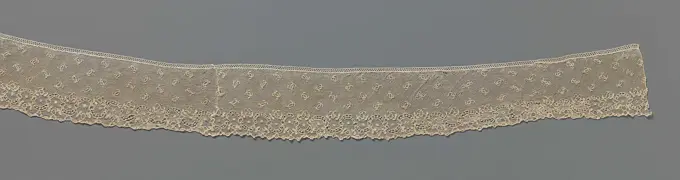
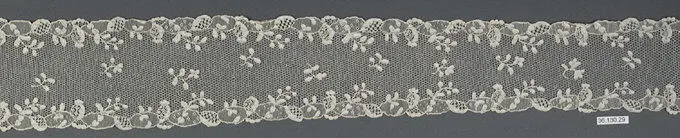
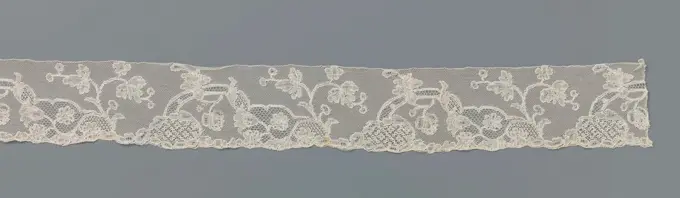
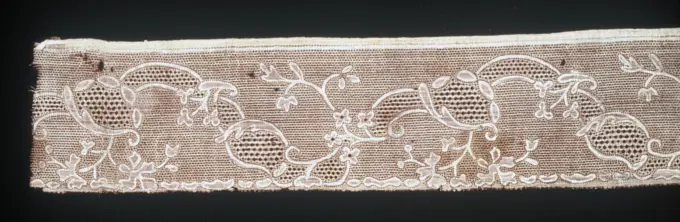
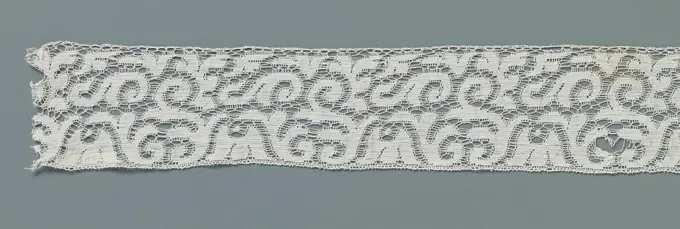
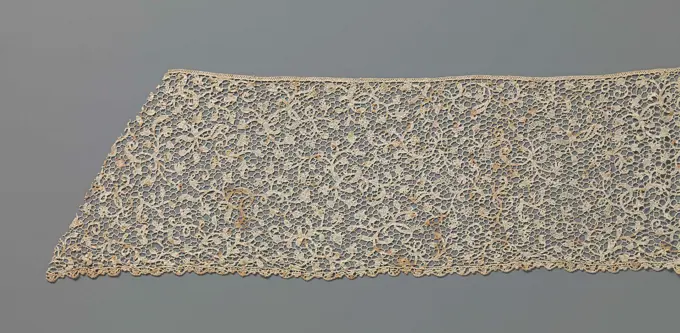
Border, Medium: linen Technique: bobbin lace, Mechlin style, N. Europe, late 18th century, lace, Border
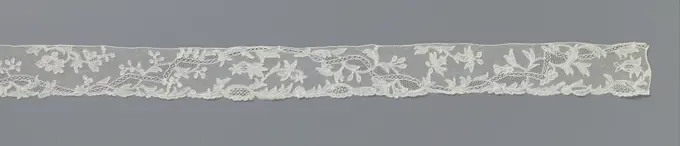
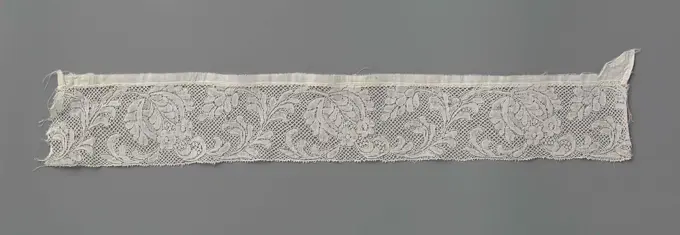
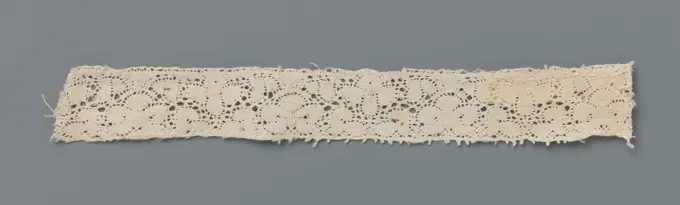
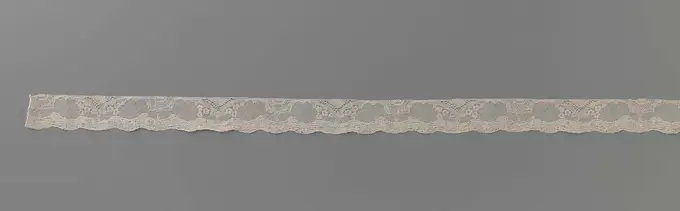
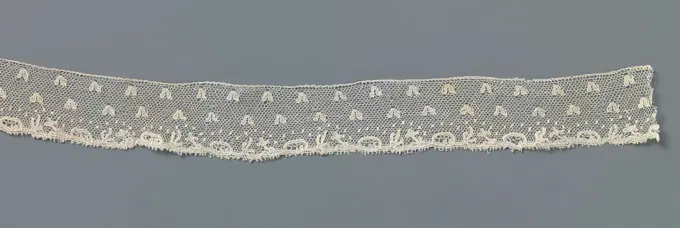
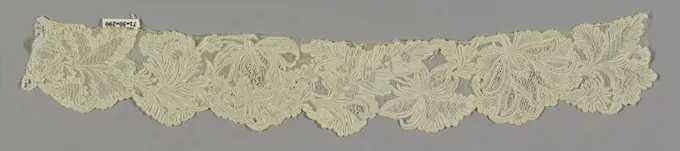
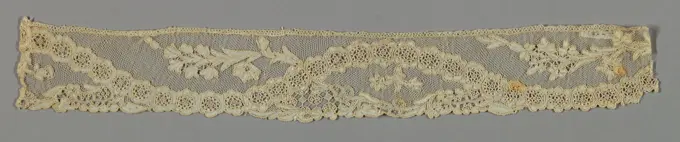
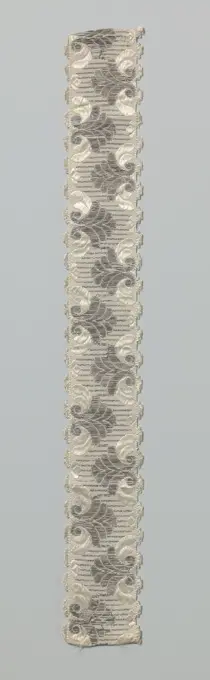
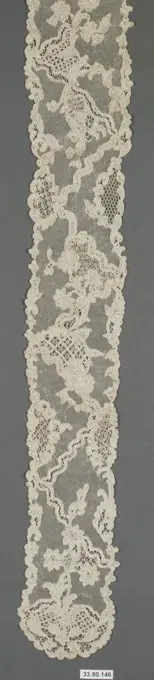
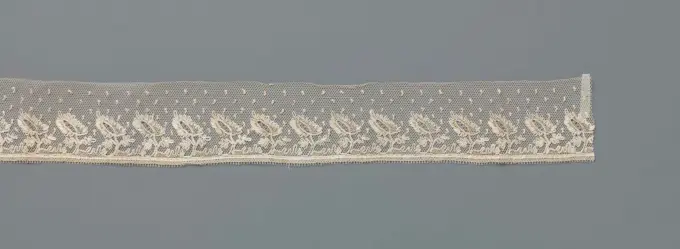
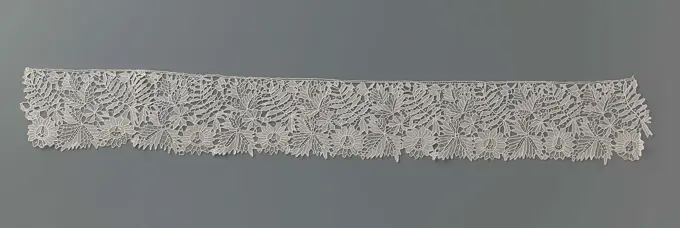
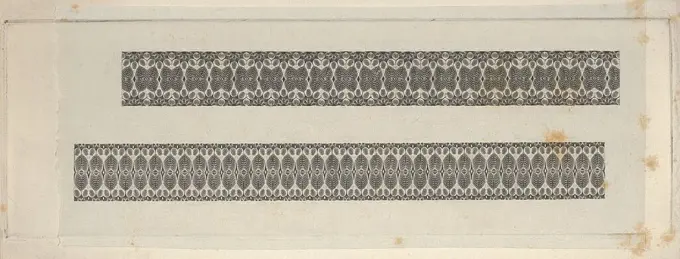
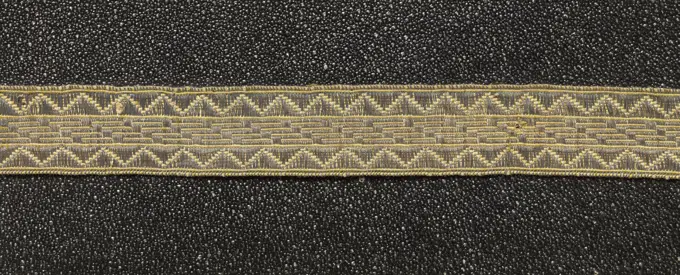
Border early 18th century Flemish, Mechlin. Border. Flemish, Mechlin. early 18th century. Bobbin lace. Textiles-LacesInsertion 17th century Italian. Insertion 221001Border early 18th century Flemish. Border. Flemish. early 18th century. Bobbin lace. Textiles-LacesLappet; linenBand (Italy); linenInsertion ca. 1800 Flemish. Insertion 212848Trimming (France); silkDas van imitatie Blondekant.DASJE, Machine side with yellow fond. Scalloped edge of Rococo fields and ovals from which flower branches jump. Side type: Blonde imitation.Border, Medium: linen Technique: bobbin lace, Mechlin style, N. Europe, late 18th century, lace, BorderEdging mid-18th century Flemish. Edging. Flemish. mid-18th century. Bobbin lace. Textiles-LacesStrip bobbin with a peony between two curved leaves, anonymous, c. 1685 - c. 1699 Strip of natural -colored Dutch bobbin. The repeating and symmetrical pattern consists of a peony between two bending leaves, which spring from the bottom of the flour. The motives are connected by a very sparingly used irregular grid. The motifs are made in linen battle with openwork edges. The top and bottom are straight finished, with picots on one side. A darker thread runs through parts of the pattern, according to an apparently random pattern. This was probably created during the coloring of the strip, whereby the dye is better absorbed by some threads than by others. Antwerp (possibly) linen (material) bobbin lace Strip of natural -colored Dutch bobbin. The repeating and symmetrical pattern consists of a peony between two bending leaves, which spring from the bottom of the flour. The motives are connected by a very sparingly used irregular grid. The motifs are made in linen battle with openwork edgStrip bobbin with three berries on a twig, anonymous, c. 1875 - c. 1899 On a stock of square meshes are stiff twigs above a wide and closed scallops, on which three berries grow. A mush is placed between each twig. Valenciennes side. Ieper (possibly) linen (material) Bobbi Lace / Valenciennes Lace On a stock of square meshes are stiff twigs above a wide and closed scallops, on which three berries grow. A mush is placed between each twig. Valenciennes side. Ieper (possibly) linen (material) Bobbi Lace / Valenciennes LaceFragment of the lace;  18th century (1701-00-00-1800-00-00);Bobbin Lace Edging, 18th century. Italy, Milan, 18th century. Lace, bobbin design on mesh ground: linen; average: 11.5 x 129.6 cm (4 1/2 x 51 in.).Strip 18th century Flemish. Strip. Flemish. 18th century. Bobbin lace. Textiles-LacesHats strip Van Kloskant with Zigzag Rivière, Anonymous, c. 1750 - c. 1760 Strip of natural -colored Brussels bobbin. A rivière in Zigzaglijn is crossed by spiral ranks, which enclose fan -shaped medallions. The motives are connected by a drachel soil. A coarser hexagonal soil has been used in the Rivières. On the fields that are bordered by the Rivière, there are twigs on which flowers in the form of pomegranates, pears or winged insects. The strip was probably used or made for a hat. Brussels linen (material) bobbin lace / Brussels bobbin lace Strip of natural -colored Brussels bobbin. A rivière in Zigzaglijn is crossed by spiral ranks, which enclose fan -shaped medallions. The motives are connected by a drachel soil. A coarser hexagonal soil has been used in the Rivières. On the fields that are bordered by the Rivière, there are twigs on which flowers in the form of pomegranates, pears or winged insects. The strip was probably used or made for a hat. Brussels linen (material) bobbin Shawl;  XIX/XXW. (1890-00-00-1930-00-00);Strook kloskant met gespleten tak en tulp.Strip natural colosside: Binche-Side. At a grille, a five-gaming ground, is a spiral branch that has been occupied with feathered leaves. A large tulip, in which a split branch with two flowers and a small grape denses alternate. The motifs are made in linen stroke and cut-off with open editors. As ornamental soil, a snowflakes soil has been sparingly used. The top of the strip is straight finished and trimmed down batist to a narrow job. The straight bottom of the strip side is finished with picots.Strook kloskant met gestileerde bloemen om en om gericht vanuit de onder- en bovenzijde van de strook.Strip of a climbing side, Antwerp side. The pattern consists of stylized flowers and leaves, which occur from the lower and top of the strip. The motifs are connected to each other by a very sparing used and irregular Maas soil. The motifs are made in linen stroke with openwork edges. The top and bottom of the strip are immediately finished, with picots on one side.Textile fragment, Medium: Technique: plain compound satin, Repeats of lotus and other indistinct ornaments filled with fancy weave patterns - the satin backgound is black - wefts are light blue and rose tan., Japan, 19th century, woven textiles, Textile fragmentStrook kloskant met halve ruitvormige en gelobde cirkelvormige medaillons.Strip natural colosside: Mechelen side. The repeating pattern exists along the top edge from half medallions, diamond-shaped interspersed by lobd circular. The pattern along the slight sculpture consists of a closed band in which the contours are made of stylized flowers and leaves with openwork edges. The motifs are connected by a fine Maas soil. The motifs are made in linselag with slightly thicker contour wires and partly with openwork edges. Two different ornamental grounds are used in the medallions. The shelters along the underside are finished with picots. The top is just finished. A seam was made at the start of the strip.Strook kloskant met twee rijen omgekeerde v-vormige motiefjes.Strip natural colosside: Lille side. The upper half of the pattern consists of two rows of reverse V-shaped motifs and interspersed along the underside from ovals by two different twigs. A staggered row of square mates runs between these two patterns. The motifs are connected by a fine grille, a tulet. The energy-saving fireworks is made in linen stroke, with thicker and shiny contour wires. One type of ornamental soil has been applied in the ovals. The top is just finished. The very bland scaled underside is finished with picots.Matching border to pair of lappets 18th century French. Matching border to pair of lappets 227700Strip bobbin with whimsical spreading motifs and rank, anonymous, c. 1800 - c. 1899  Strip of natural -colored bobbin: Lille side. A wavy slender runs under two rows of whimsical motifs, with a rosette flower on each wave top. A whimsical arch runs over each rosette flower, formed by an elongated leaf. Similar inverted arches, interspersed with ovals, form the faint scoops along the underside of the strip. The motifs are connected by a fine grid, a tuler land. The sparing fullwork is made in linen battle, with thicker and shiny contour threads. In the ovals, a mush is made alternately, made in shape. The top and bottom of the strip are straight finished, with the bottom with picots. Southern Netherlands linen (material) bobbin lace / Lille laceJoined lappets early 19th century French The Metropolitan Museum's great lace collection was started when the Museum became the first among American museums to organize a permanent collection of lace with the acceptance of the McCallum Collection in 1879 and the bequests of Mrs. John Jacob Astor, Mrs. Robert L. Stuart, Mrs. Augustus Cleveland, and Mrs. A. W. Winters shortly thereafter. In 1893 a loan collection of antique laces shown at the World's Columbian Exposition in Chicago was assembled by a committee of New York women headed by Catharine Augusta Newbold. About 1900 Miss Newbold arranged and labeled an exhibition of laces and linenworks lent to the Metropolitan Museum by Mrs. James Boorman Johnstone and the Misses Johnstone. "Her scholarly knowledge of lace technique enabled the Museum for the first time to offer a comprehensive display of lace illustrating its historical development," wrote Miss Frances Morris, then curator of the textile department. Miss Newbold's name occurs Kloskant intermediate mate with zigzag line, anonymous, c. 1875 - c. 1949 Piles of Natural -colored bobbin side: Mechelse side. In the middle of the fine grid, a Mechelen soil (also known as ice soil), an openwork band runs in Zigzaglijn, cut over by two types of rosettes. Belgium linen (material) bobbin lace / Mechlin (lace) Piles of Natural -colored bobbin side: Mechelse side. In the middle of the fine grid, a Mechelen soil (also known as ice soil), an openwork band runs in Zigzaglijn, cut over by two types of rosettes. Belgium linen (material) bobbin lace / Mechlin (lace)Band, Medium: linen Technique: needle lace with ground of loop and twist with twist return, A band of elaborate flowers and leaves., Italy, early 18th century, lace, BandEdge (France); linen; 1938-31-2Strook naaldkant met in elkaar hakende boogjes.Strip natural-colored coniferous lace: Alençon side. Spreading pattern of browsing arcs, on a fine hexagonal maas soil. The pattern on the underside consists of a concerted row of medallions on an even finer hexagonal maas soil. In the center of each medallion is a hole with a circular cordon. The top is trimmed with a border clamping side. Candy bottom edge with Raderpicots at regular distance.Tussenzetsel van kloskant met zigzaglijn.Interesting of natural colosside. The pattern consists of a zigzag line in a maas basis. The full work with which the very narrow line has been realized is made in linen stroke with openwork edges. Upper and bottom of the strip are straight finished. The short sides are finished with a soil. The intermediate site comes from or intended for bedding.Bracket; L x W x D: 51 x 3.5 cm (20 1/16 x 1 3/8 in.)Intermediate edge with open worked window in rabid and openwork circles in linen work, anonymous, c. 1925 - c. 1937  Piles of natural -colored bobbin side. The repeating pattern consists of a grid with open worked window. Each side of the diamond consists of a pointed album made in form. The grid land is alternated by a part that is made entirely in linen battle. There are two openwork circles in the linen work, each filled with one lace hole stroke formed by two standing pairs. Top and bottom of the strip are straight. As linen (material) bobbin laceBorder, Technique: bobbin lace, Bobbin lace applique a vrai Drochel, scrolling vines; late 18th century Brussels, late 18th century, lace, BorderChef De Piece (France); cotton; Warp: 13 cm (5 1/8 in.). Weft: 92.5 cm (36 1/2 in.) Two incomplete widths sewn together in center. There is a selvedge on each of the pieces seamed together.Flouncing (quille or lappet) 18th century French. Flouncing (quille or lappet) 226049Strip of needle side with rows of twigs and arch lines, anonymous, c. 1790 - c. 1799 Strip of natural-colored needle side: Alençon side. Spread motif with three rows of twigs on a fine hexagonal Maas soil, an alençon ground. A fourth line of twigs is attached to an arc line. Among them a pattern of intersecting arched lines that create ovals, accentuated by leaves and filled with two different decorative lands: a decorative soil in fine diamond stitch and a decorative soil with radar picots. The underside is finished with an arc edge with delicate picots, arising from the pattern with oval. The top is trimmed with a border bobbin. Alençon linen (material) Alençon Lace Strip of natural-colored needle side: Alençon side. Spread motif with three rows of twigs on a fine hexagonal Maas soil, an alençon ground. A fourth line of twigs is attached to an arc line. Among them a pattern of intersecting arched lines that create ovals, accentuated by leaves and filled with two different decorative Capsive from Devonshirekant with an angel with a palm branch at the end, Anonymous, c. 1775 - c. 1800 Capslip from Devonshirekant with an angel with a palm branch at the round end. The remaining decoration consists of flowers and flower branches. The barbe is irregularly sculpted and is fully equipped with a picot edge. England . Devon lace Capslip from Devonshirekant with an angel with a palm branch at the round end. The remaining decoration consists of flowers and flower branches. The barbe is irregularly sculpted and is fully equipped with a picot edge. England . Devon laceBand, 18th century, 66 1/4 x 3 1/2 in. (168.28 x 8.89 cm), Linen; point d'Alençon; lace, France, 18th centuryBand (Italy); linen; Bequest of Marian Hague; 1971-50-290Ribbon, white with silver, fond of gros de Tours with cross stripes of silver lamé, anonymous, c. 1750 - c. 1770 Ribbon, possibly for garter tires, white with silver. Fond of Gros de Tours with transverse stripes of silver ramp. The ornament is partly of browned silverlamé, which is flottant up to the outskirts. Pattern of blending into each other interlocking classic palmets. Self -sides decorated with Hanekammen. France (possibly) silk. Ribbon, possibly for garter tires, white with silver. Fond of Gros de Tours with transverse stripes of silver ramp. The ornament is partly of browned silverlamé, which is flottant up to the outskirts. Pattern of blending into each other interlocking classic palmets. Self -sides decorated with Hanekammen. France (possibly) silk.Border. Date/Period: 1500-1550. Border. Medium: linen. Technique: grid of withdrawn element work with needle lace, reticella style. Author: UNKNOWN.Pair of lappets 18th century French. Pair of lappets 222833Strook van kantborduurwerk op machinale tule met hangend bloempje.Strip natural-colored edge embroidery, cross-tip on machine tulle. A repeating pattern of a hanging flower under two rows of heart-shaped open moes. Along the lower edge a straight Picotand. The top is not finished.Piece 18th or 19th century Japan. Piece 72112Strook naaldkant met ingesneden blad.Running pattern of incised leaves above a rose and a three-leaf, which together form the sharply toothed outside line. Cross-shaped bars with button (soil of long X-shaped bars with a spider). The REMPLIS consists of buttonhole stitches and a Fond Gazé. German side: 'Carlsbead points'.Border, Medium: linen Technique: bobbin lace, continuous tape with bars added, Tape like band forming quadrangular fields., 18th century, lace, BorderHeat slips from Mechelse side, sewing, anonymous, c. 1720 - c. 1730 Two chopping slips from Kloskant. The pattern consists of window -filled motifs that are interspersed with flowers, leaves and fruits. The scalloped edge is trimmed with picots. Mechelen linen (material). Mechlin (lace) Two chopping slips from Kloskant. The pattern consists of window -filled motifs that are interspersed with flowers, leaves and fruits. The scalloped edge is trimmed with picots. Mechelen linen (material). Mechlin (lace)Strook kloskant met rocailles.On the ground soil, a mechelen soil (also known as ice soil), there is an ongoing pattern of large seed beads with grid work filling, which are connected to a double branch that stealed in the same way-decorated bow. To the standing side branch, wingerd leaves grow, roses and carnations growth growing. Mechelen side.Border, Technique: bobbin lace, Bobbin lace border, symmetrical floral; late 18th century Valenciennes, late 18th century, lace, BorderStrook naaldkant met vijfbladige bloem.Strip natural-colored coniferous lace: Alençon side. Spreading pattern with five-leaf flower on a fine hexagonal maase. The pattern along the underside consists of two connected half ovals, interspersed with a symmetrical motif of two lying leaves from which flour branch releases. The top is trimmed with a border clamping side.Fragment Made 301 CE-500 CE Egypt. Linen and wool, slit tapestry weave . CopticGalloon 17th-18th century Italian or French. Galloon 213857Border, Medium: linen Technique: needle lace with 6-sided reworked ground, Border with a design of floral sprays bordered by foliated scroll work., France, 1765-75, lace, BorderStola of gold brocade with flower pattern, so -called "bizarre" design, c. 1706 - c. 1707 Stola of gold brocade with flower pattern, so -called "bizarre" design. Two strips with embroidered gold thread over the entire length of weather sides. In the widened ends decorated with frills, two Andreas crosses from gold thread are embroidered. France (possibly) silk Stola of gold brocade with flower pattern, so -called "bizarre" design. Two strips with embroidered gold thread over the entire length of weather sides. In the widened ends decorated with frills, two Andreas crosses from gold thread are embroidered. France (possibly) silkEdge, Medium: Technique: bobbin lace made in Lille style with heavy outlining thread, 19th century, lace, EdgeBorder; silk; Bequest of Marian Hague; 1971-50-256Fragment, 1100s. Egypt, Ayyubid, 12th century. Tabby with supplementary weft; silk; overall: 21.5 x 5 cm (8 7/16 x 1 15/16 in.).Fragment, Mlle de la Valliere; Company: Favre Petitpierre (France); France; cotton; Warp x Weft: 7 x 84 cm (2 3/4 x 33 1/16 in.)Banknote motifs: two bands of lathe work ornament. Artist: Associated with Cyrus Durand (American, 1787-1868). Dimensions: plate: 7 1/2 x 2 3/8 in. (19 x 6.1 cm)sheet: 7 15/16 x 3 1/8 in. (20.2 x 8 cm). Printer: Printed by A. B. & C. Durand & Company (American, active 1824-27); Printed by Durand, Perkins, and Company (New York). Date: ca. 1824-42. Museum: Metropolitan Museum of Art, New York, USA.Fragment of silk fabric unknownJabot of needle side with serpentines, anonymous, c. 1675 - c. 1699 Jabot of natural -colored needle side: flat Venetian side. On a bar soil, spiral vines with small button -shaped ends are symmetrical compared to a standing central axle. In the straight corners there is a group with large and smaller triangles. Venice linen (material) flat Venetian (needle point) Jabot of natural -colored needle side: flat Venetian side. On a bar soil, spiral vines with small button -shaped ends are symmetrical compared to a standing central axle. In the straight corners there is a group with large and smaller triangles. Venice linen (material) flat Venetian (needle point)Piece 18th century French or Italian. Piece 214060Length, Medium: linen Technique: bobbin lace, Mechlin style with Point de Paris ground, Belgium, 19th century, lace, LengthGalloon late 18th-early 19th century European. Galloon. European. late 18th-early 19th century. Silk and metal thread. Textiles-TrimmingsTrimming; metal-wrapped silk and flat metal stripsBand, Medium: linen Technique: grid of withdrawn element with needle lace (reticella), Narrow band with a diamond-shaped flower pattern., Italy, 16th-17th century, lace, BandBand, Medium: linen Technique: needle lace with ground of loop and twist with twist return, Band of Point de Venise à Réseau in a design of floral sprays arranged in asymmetric bouquets. Fond: réseau ordinaire. Modes: brides tortillée, portes, gaze quadrillée., Italy, 1700-1750, lace, BandLappet ca. 1700 French. Lappet 212983Edging, Technique: bobbin lace, Bobbin lace double edge joined, flowering vine; mid-18th century Valenciennes Fond, mid-18th century, lace, EdgingStrook machinale kant met hangende kelkbloem tussen losse s-voluten.Stretch natural-colored side: machining fir heater. The repeating pattern exists along the lower half of the strip from a hanging chalis flour, flanked and crowned by loose S volutes. There are openworked edges around the closed motifs. The motifs are connected by a machining soil that suggests a braid soil. Upper and bottom of the strip are straight finished, the underside with picots.Black satin collar decorated with beads, anonymous, c. 1900 - c. 1915 Black satin collar decorated with beads. Horizontal strands of black beads run between five rectangles of iridescent blue beads. The closure consists of press studs. Netherlands (possibly) lint: satin. kraal: glass basting Black satin collar decorated with beads. Horizontal strands of black beads run between five rectangles of iridescent blue beads. The closure consists of press studs. Netherlands (possibly) lint: satin. kraal: glass bastingCap Crown and a Pair of Lappets Made 1720-1729 Flanders. Very few complete lace headdresses from the 1700s survive, but these three pieces formed the major part of such a decoration. The semicircular cap sat on the head and the long lappets could be styled in a number of ways hanging free, pleated, or tied in a decorative knot.. Linen, bobbin part lace of a type known as Brussels .Strip of needle side with five -leaf flower, anonymous, c. 1770 Strip of natural-colored needle side: Alençon side. Spread motif with five -leaf flower on a fine hexagonal Maas soil. The pattern along the underside consists of two connected half ovals, interspersed with a symmetrical motif of two lying leaves from which and flower branch originates. The top is trimmed with a border bobbin. Alençon linen (material) Alençon Lace Strip of natural-colored needle side: Alençon side. Spread motif with five -leaf flower on a fine hexagonal Maas soil. The pattern along the underside consists of two connected half ovals, interspersed with a symmetrical motif of two lying leaves from which and flower branch originates. The top is trimmed with a border bobbin. Alençon linen (material) Alençon LaceTrimming (Italy); silk, metallic thread, metallic stripsNeedlepoint (Burano Point) Lace Edging, 18th century. Italy, Burano, 18th century. Lace, needlepoint: linen; overall: 173.2 x 8.3 cm (68 3/16 x 3 1/4 in.).Border, Medium: linen Technique: bobbin lace, Mechlin style, N. Europe, 18th-19th century, lace, BorderBorder. Date/Period: 1670-90. Border. Medium: linen. Technique: needle lace. Author: UNKNOWN.Border Made 1601-1650 Switzerland. Linen, plain weave; embroidered with silk in back, double running, overcast, running, and split stitches; couching and French knots; edged with silk and linen, bobbin lace .Needlepoint Lace Lappet, 18th century. France, Alençon, 18th century. Lace, needlepoint: linen; average: 54.7 x 9 cm (21 9/16 x 3 9/16 in.).Bracelet;  1820-1830 (1820-00-00-1830-00-00);Border (Belgium); linenStrip bobbin with hanging daisy under spray pattern of square mosies, anonymous, c. 1830 - c. 1849 Strip of natural -colored bobbin: Lille side. Under a spray pattern of square mosquitoes, the repeating pattern consists of a curved twig with a hanging daisy. Below the bottom, there are two bragged ovals or flower hearts with a few narrow petals at the top along the bottom. The motifs are connected by a fine grid, a tuler land. The sparse fullwork is made in linen battle, with the thicker and shiny contour threads dominating. At the top and bottom are straight finished, with the bottom with picots. Belgium linen (material) bobbin lace / Lille lace Strip of natural -colored bobbin: Lille side. Under a spray pattern of square mosquitoes, the repeating pattern consists of a curved twig with a hanging daisy. Below the bottom, there are two bragged ovals or flower hearts with a few narrow petals at the top along the bottom. The motifs are connected by a fine grid, a tuler land. The sparse fuPiece 18th century Japan. Piece. Japan. 18th century. Silk / Compound weave. Edo period (1615-1868). Textiles-WovenStrip Passement with gold thread, 1800 - 1900 Strip passement of gold thread.  . Strip passement of gold thread.  .Bobbin Lace Lappet, 18th century. France, Valenciennes, 18th century. Lace, bobbin: linen; average: 8.6 x 99.1 cm (3 3/8 x 39 in.).Strip early 19th century British, Northamptonshire. Strip. British, Northamptonshire. early 19th century. Bobbin lace. Textiles-LacesFragment (Japan)Fragments (Border) Made 100 BCE-200 CE Peru. Cotton, plain weave; embroidered with wool (camelid) and cotton in stem stitches . NazcaFurniture, Anonymous, 1600 - 1699 Cut oak bed board, on which six differently oriented rosettes have been applied. Northern Netherlands (possibly)Netherlands (possibly) wood (plant material). oak (wood) Cut oak bed board, on which six differently oriented rosettes have been applied. Northern Netherlands (possibly)Netherlands (possibly) wood (plant material). oak (wood)EdgingSleeve ruffle, Medium: linen Technique: needle lace, Needle lace with a design of twisting vines and grapes. Commonly called 'Point d'Argentan.', France, 18th century, lace, Sleeve ruffleStrook naaldkant met fijn spiraalornament.Strip natural needle side: point de france. Pattern with a fine spiral ornament on a hexagonal bar soil with picots. The top is trimmed with a border clamping side. The straight bottom is finished with picoted arcs, in which motifs can be seen.Band, Medium: linen Technique: needlework on sheer plain weave foundation fabric -Herringbone stitch on the back for opaque areas -On the front, chain stitch for stems -Deflected element work in various patterns using satin and stem stitches plus running and wrapping stitches -Edge finished with buttonhole stitch, Band showing a floral serpentine interspersed by cartouche-like shapes., Germany, 1700-1750, embroidery & stitching, BandHandle for SzpilyStrip with corner 16th century Italian. Strip with corner 212299Trim for Hem of Tunic or Skirt (Tablet WovenBand)Piece of fabric. unknown, authorGalloon mid-18th century French. Galloon 214041Slendang (Shoulder Cloth), 1800s - early 1900s. Indonesia, Central Java, 19th - early 20th century. Tabby weave, batik; cotton; overall: 271 x 53.3 cm (106 11/16 x 21 in.).Strip early 19th century British. Strip. British. early 19th century. Silk, machine made lace. Textiles-Laces