Antique Lace Textiles

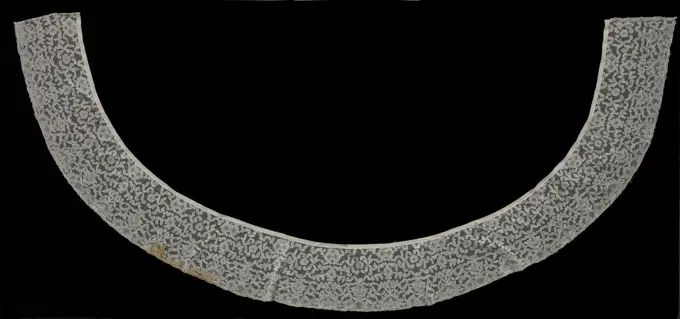
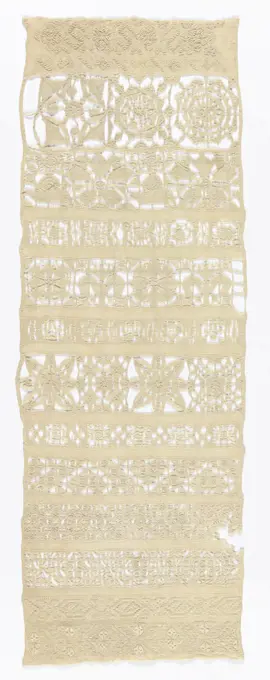
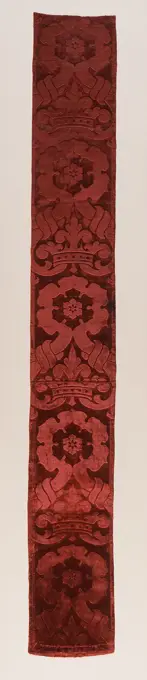
Historical lace pieces featuring intricate patterns, showcasing Flemish and Italian designs from the 17th and 18th centuries.

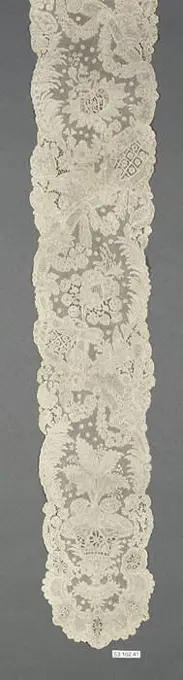
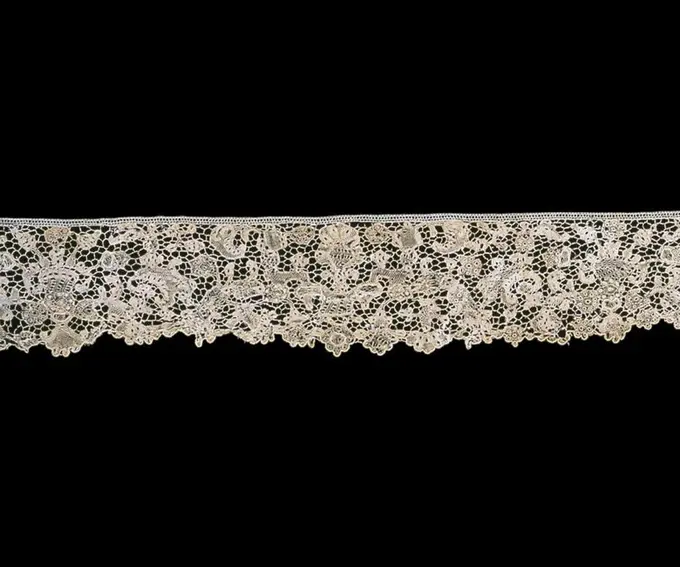
Border, Medium: linen Technique: bobbin lace, Mechlin style, N. Europe, late 18th century, lace, Border
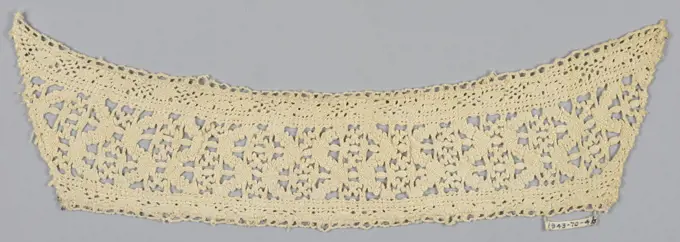
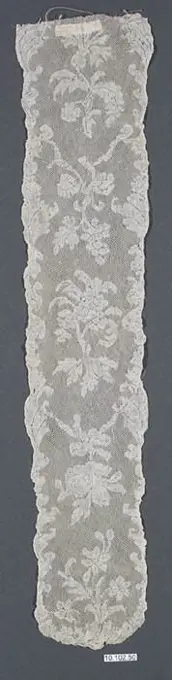
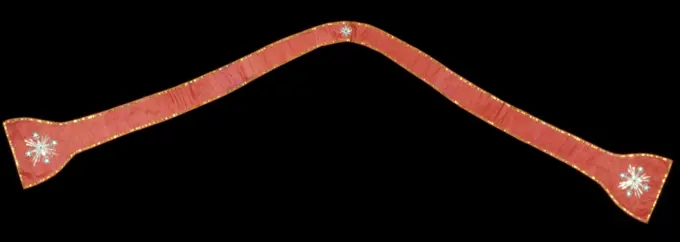
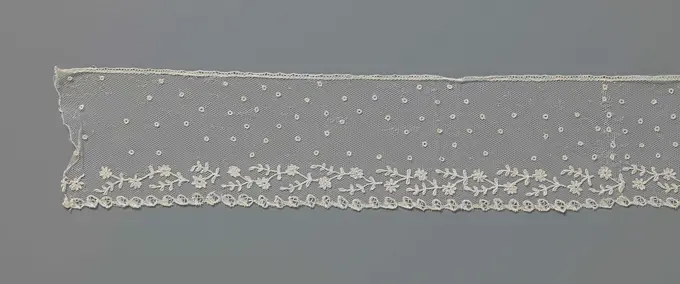
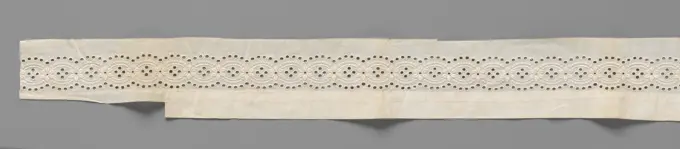
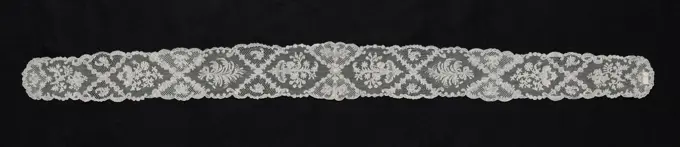
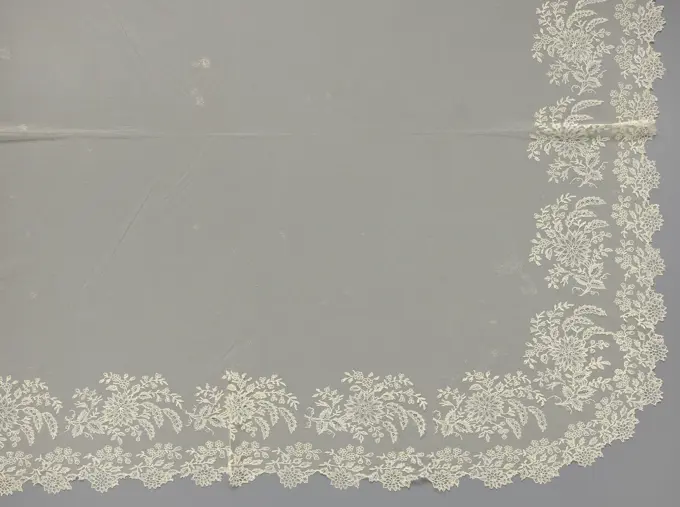
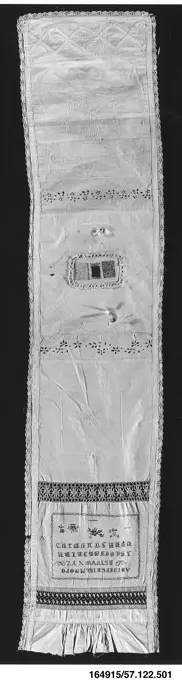
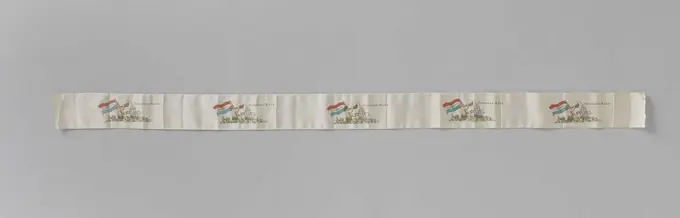
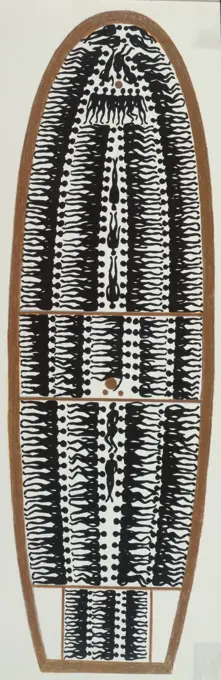
Pair of lappets 18th century Flemish, Brussels. Pair of lappets 227688Band, Medium: linen Technique: bobbin lace, continuous braid-like, Design of horizontal bands of two geometric patterns used alternately and set between narrow borders., ca. 1880, lace, BandMangle-board. Culture: Dutch. Dimensions: 29 1/2 × 4 3/4 in. (74.9 × 12.1 cm). Date: 18th century. Museum: Metropolitan Museum of Art, New York, USA.Border Made 301 CE-500 CE Egypt. Wool and linen, tapestry weave .Spread piece of crocheted side imitation coarse Venetian needle side imitates, anonymous, c. 1890 - c. 1909 V-shaped support piece of natural-colored Irish crocheted side, imitation coarse Venetian needle side. The long sides of the V are finished with a potented bow edge. The short side is not finished. Ireland cotton (textile) V-shaped support piece of natural-colored Irish crocheted side, imitation coarse Venetian needle side. The long sides of the V are finished with a potented bow edge. The short side is not finished. Ireland cotton (textile)Galloon 18th century Italian. Galloon. Italian. 18th century. Textiles-TrimmingsBarbe (one of three pieces) 18th century French. Barbe (one of three pieces) 218799Border (France); block-printed and flocked on handmade paper; 65 x 5.5 cm (25 9/16 x 2 3/16 in.)Stole, 19th century, 82 x 8 1/4 in. (208.3 x 21.0 cm), Embroidered red silk, Colombia, 19th centuryBorder (Italy); linenBorder, Medium: linen Technique: bobbin lace, Mechlin style, N. Europe, 18th-19th century, lace, BorderSidewall (Holland); leather, stamped, silvered, paintedFragment, Medium: linen Technique: bobbin lace with needle ground, Border fragment with oval reserve areas filled with openwork stitches and tiny rosettes scattered on ground., Belgium, 18th century, lace, FragmentTrimming, Medium: silk, silver metallic thread Technique: woven, Design of vine leaves and grapes in white and metallic thread., France, 18th century, trimmings, TrimmingCap trimming early 18th century Flemish. Cap trimming 219933Strip of lace plunger with volute vines from flower bottom and leaf rosette, anonymous, c. 1740 - c. 1760 Strip natural -colored batist with lace plunge: Dresdener Kant or Point the Dinant. With a pattern of a flower bottom and a leaf rosette, from which volute vines come with composite flowers and a large fan -shaped chalice flower. The edge is faintly sculpted with smaller sculptures. The motifs are made in shadow work and the decorative filling of gridwork in work with extended threads and work with pulled threads together. Germany (possibly) linen (material) embroidering Strip natural -colored batist with lace plunge: Dresdener Kant or Point the Dinant. With a pattern of a flower bottom and a leaf rosette, from which volute vines come with composite flowers and a large fan -shaped chalice flower. The edge is faintly sculpted with smaller sculptures. The motifs are made in shadow work and the decorative filling of gridwork in work with extended threads and work with pulled threads tPiece 18th-19th century Japan. Piece 67257Strip bobbin with twigs and rows with three separate rosters, anonymous, c. 1795 - c. 1899 Strip of natural-colored bobbin, Valenciennes side. The thin, repeating pattern consists of a triple flower branch, which originates from the bottom edge and reaches half of the strip. Left and right the branch is flanked by a row with three separate rosters. Above the rosters are two loose twigs with oval leaves interspersed above the next row of rosettes by two loose twigs with heart -shaped leaves. The motifs are connected by a mesh ground, the diamond-shaped Valenciennes ground. The sparing fullwork in the thin pattern is made in linen battle with openwork edges. Top and bottom of the strip are straight finished, with the bottom with picots. The short sides are finished with a zoompje. Ieper (possibly) linen (material) Bobbi Lace / Valenciennes Lace Strip of natural-colored bobbin, Valenciennes side. The thin, repeating pattern consists of a triple flower branch, which originates from the botStrip with embroidery, anonymous, 1700 - 1725 Strip with golden embroidery on karmozijnrode, velvet soil. Put on window.  velvet (fabric weave). raam: wood (plant material) Strip with golden embroidery on karmozijnrode, velvet soil. Put on window.  velvet (fabric weave). raam: wood (plant material)Lace laceTrimming, Medium: silk, metallic thread Technique: tapestry weave, Gold trimming with occasional tapestry inserts of geometrical forms in silver, blue, red, pink and green. Slit tapestry separations., Russia, 19th century, trimmings, TrimmingTrimming, Medium: silk Technique: woven, Yellow trimming fragment in a design of sawtooth borders with broken diagonal lines in between., Spain, 17th century, trimmings, TrimmingStrook applicatiekant met rozetbloempjes aan liggende bladrank.Strip natural applicating office: Brussels climbing side applicated on slighten ground. This type of side is also known as the name: Point d'Angleterre. Spreading pattern with open moes. Under the spreading pattern a leaving leaf drink with rosette flowers. The rank is interrupted here and there. The fine sculpture along the bottom edge consists of small oval medallions with zigzag. Motives with clost relief contours, so-called ribs. One kind of open ornamental stitch. The top is trimmed with a border clamping side.Strip with embroidery, anonymous, 1700 - 1725 Strip with golden embroidery on karmozijnrode, velvet soil. With an edge of blue silk. Put on window.  velvet (fabric weave). Strip with golden embroidery on karmozijnrode, velvet soil. With an edge of blue silk. Put on window.  velvet (fabric weave).Shoulder cloth, anonymous, c. 1400 - c. 1950 Shoulder cloth with Semen and uncoloured diamond. Jogjakarta cotton (textile) Shoulder cloth with Semen and uncoloured diamond. Jogjakarta cotton (textile)Strip of cotton with a machine side with connected oval, anonymous, c. 1890 - c. 1899 Strip cotton with natural -colored machine side: Machine English embroidery. The pattern consists of one row of connected ovals. There is always a star -shaped flower at the intersections. There are four openwork circles in the ovals. A continuous 'pearl list' of openwork circles runs above and below the ovals. The list follows the contours of the ovals. Europe linen (material) Strip cotton with natural -colored machine side: Machine English embroidery. The pattern consists of one row of connected ovals. There is always a star -shaped flower at the intersections. There are four openwork circles in the ovals. A continuous 'pearl list' of openwork circles runs above and below the ovals. The list follows the contours of the ovals. Europe linen (material)Border, Medium: linen Technique: needle lace, Border with asymmetric floral shapes, freely spaced., France, late 18th-early 19th century, lace, BorderStrip of needle side with winding branch, anonymous, c. 1790 - c. 1799  Strip of natural-colored needle side: Alençon side. Pattern with a winding, continuous branch with small oval and round flowers on a fine hexagonal mesh ground with a few sprinkling flowers. The bottom of the pattern consists of two fan -shaped figures with a flower or an oval at the bottom. The fan and ovals are filled with different decorative stitches. The top is finished with a straight edge. The underside is finished with a scrap edge that comes from the pattern. unknown linen (material) Alençon LaceTrimming (France); silk and silver foil; 1907-30-8Bobbin Lace (Point d'Angleterre) Lappet, 18th century. Belgium, Brussels, 18th century. Lace, bobbin: linen; average: 107.3 x 10.2 cm (42 1/4 x 4 in.).Lappet 18th century Flemish. Lappet 222438Baptism of the needle side on Tulle (Application side), Anonymous, c. 1835 Baptismal veil of natural -colored application side: Needle side Applicated on machine tulle. Rectangular model in which two diagonally opposite corners are rounded ronder than the two other corners. Representative applications have been applied in two rows to the large unadorned midfield. The inner edge consists of a succession of the same bouquet. In the center of this bouquet there is a round flower with many pointed petals and around flower branches with smaller flowers, including plume flowers, a few rosette flowers and round chalice flowers. The outer edge consists of a succession of a horizontal flower branch with rosette flowers, chalice flowers and plum flowers with a similar round flower with pointed petals as in the bouquet, but slightly smaller. These round flowers provide the scrap edge along the outside of the veil. The motifs are equipped with contour threads and decorative stitches have been usedBorderTrimming, Medium: silk Technique: woven, Pink trimming fragment in a design of an ornamented zigzag band., France, 19th century, trimmings, TrimmingPair of lappets 18th century Flemish. Pair of lappets 218152Tie or hat of chips from Kloskant in the form of clockers, anonymous, c. 1860 - c. 1880 Das or hat slip of black bobbin: Chantilly side. An elongated centerpiece with fan flowers on both sides is terminated with a nodus and wide -ranging points. The contours of the latter are formed from symmetrical Akanthus leaves with a top palm with top. Belgium silk bobbin lace Das or hat slip of black bobbin: Chantilly side. An elongated centerpiece with fan flowers on both sides is terminated with a nodus and wide -ranging points. The contours of the latter are formed from symmetrical Akanthus leaves with a top palm with top. Belgium silk bobbin laceMedical Instrument with Spoon Finial. UnknownBorder, Medium: linen Technique: needle lace, Border with cartouches connected by floral and foliated sprays., France, early 18th century, lace, BorderBorder. Italy, Venice. Date: 1675-1700. Dimensions: 6 x 79.2 cm (2 3/8 x 31 1/8 in.)Heading height: .7 cm (1/4 in.)Lower border height: .55 cm (1/4 in.)Lower border repeat: 1.8 cm (3/4 in.). Linen, raised needle lace. Origin: Venice. Museum: The Chicago Art Institute, Chicago, USA.Sampler with darning stitches and lace 19th century German. Sampler with darning stitches and lace 228426Border 17th-18th century Italian. Border 226046Galloon 18th century French. Galloon. French. 18th century. Silk and metal thread. Textiles-TrimmingsTextile; silk, metallic yarnsFragment; linen, woolStrip bobbin with S-shaped twig and rosette, anonymous, c. 1875 - c. 1899 On a coarse and mushroom mesh stock (square Maas) is an S-shaped branch with a rosette and a large leaf always above a lobed shell. Valenciennes side. Sluis (Possible) linen (material) Bobbi Lace / Valenciennes Lace On a coarse and mushroom mesh stock (square Maas) is an S-shaped branch with a rosette and a large leaf always above a lobed shell. Valenciennes side. Sluis (Possible) linen (material) Bobbi Lace / Valenciennes LaceFragment of Ribbon Italian 13th-14th centuryMachine Lace Flounce, 19th century. Spain, 19th century. Lace; average: 23.5 x 281.9 cm (9 1/4 x 111 in.).Lace border with double-headed eagle 1620-30 Flemish. Lace border with double-headed eagle. Flemish. 1620-30. Bobbin lace. Textiles-LacesTextile, Medium: wool Technique: plain weave, Plain undyed cloth, formerly made in large amounts in New Mexican Spanish homes. Called sabanilla, meaning 'little sheet'. Often used to make large sacks, at least 6' , of two widths sewn together. Stuffed with raw wool and used as a bed at night, divan in daytime., New Mexico, USA, 19th century, woven textiles, TextileGolden grunge circle and brushes. Gold paints. Vector illustration.Galloon 17th-18th century Unknown. Galloon 213806Piece early 19th century French. Piece 214647Fragment late 16th century Italian. Fragment 230031Sampler, Medium: linen Technique: embroidered with satin, double running, buttonhole stitches over an arched cord and couching, Thirteen cross borders in cutwork with needlepoint stitches and embroidery in satin and curled stitches., England, 17th century, embroidery & stitching, SamplerStrip -Trimming (Italy); silk, metallic threadTubular Stone Bead before 16th century Mexican. Tubular Stone Bead. Mexican. before 16th century. Stone. Mexico, Mesoamerica. Beads-OrnamentsGalloon 17th century Spanish. Galloon. Spanish. 17th century. Metal thread. Textiles-TrimmingsBorder, Block printed and flocked paper, Printed architectural molding with gild edge bands at top and bottom edges, brown flocked center band., H# 177 (B), H# 179 (A), H# 180 (C), H# 181 (D), France, 1850-1900, Wallcoverings, BorderFragment early 19th century British, Buckinghamshire. Fragment. British, Buckinghamshire. early 19th century. Bobbin lace. Textiles-LacesDressing Table Cover Quilt 1700-1750 Dutch. Dressing Table Cover Quilt 14129Opzetstuk van bruin fluweel.Brown velvet attachment to capping the so-called Rosendaelbed Ligra. Right side. For the accompanying attachments, see BK-1958-20-A-7 and -8.Galloon Made 1701-1800 Italy. .Sampler 19th century German. Sampler 228630Spitsovaalvormige kousinzet van kloskant met rozentak en rozenslinger.Spiral-shaped stocking of black climbing side: Chantilly side. The pattern consists of a rose roof with three large roses, including a semi-relocated pendulum hangs with smaller roses and leaves, which hang down to the tip of the stocking. The motifs are connected by a fine Maas soil, a tulet. The motifs are made in a power base with thicker contour wires. Along the circumference of the stocking insert, a edge has been made in the inside, which is finished inside and outside with a thicker contour wire.Border (Greece); silk embroidery on linen foundationLuxury gold reel ribbon badge Royalty Free Vector ImageKrzyż procesyjny. nieznany snycerz etiopski, woodcarverPlaque; Manufactured by Sèvres Porcelain Manufactory (France); soft-paste porcelain with polychrome overglaze enamelingSenatorial Rank Badge (Stole). Italy, Venice, circa 1500. Jewelry and Adornments; badges. Silk, pile-on-pile velvet weavePiece 18th century French. Piece 214062Ribbon (USA); silk, cottonSash or Headband 7th century Nasca. Sash or Headband 307957Maniple, embroidered, white unknownFragment of a Band with Birds, Cross, and Head 5th-7th century This finely worked and richly colored band includes a cross among its varied pattern. While Egyptian textiles with religiously significant motifs are relatively rare, crosses may have been meant to associate the owners with their Christian faith. Large squares rimmed by smaller ones possibly represent jewels surrounded by pearls. Between them are a golden chalice (), a large green bird, a predominantly red cross with arms of equal length, and a human head.. Fragment of a Band with Birds, Cross, and Head 444126Border. France. Date: 1690-1710. Dimensions: 7.3 × 129.6 cm (2 7/8 × 51 in.). Linen, needle lace. Origin: France. Museum: The Chicago Art Institute, Chicago, USA.Border, Medium: wool Technique: cross-knit looping Label: wool cross-knit looping, Edging or border of three-dimensional birds and flowers rendered in cross-knit looping., Peru, 100 BC-100 AD, knotted, knitted and crocheted textiles, BorderBelt -Sampler. Mercy Mackett (English, active c. 1688); England. Date: 1688. Dimensions: 21.2 × 105.1 cm (8 3/8 × 41 3/8 in.). Linen, plain weave; with bands of cut and drawn thread work in back, buttonhole, darning, double hem, interlocking lace, overcast, and needle lace filling stitches; bands of linen, needle lace; and bands embroidered with silk in Algerian eye, Antwerp edge, back, cross, double hem, double running, long-armed cross, two-sided Italian cross, satin, squared ground, and a variety of buttonhole stitches. Origin: England. Museum: The Chicago Art Institute, Chicago, USA.White ribbon on which 5 times the same image: man with fish tail blowing on bazuin. In other hand the Dutch flag, in which the text: Zoutman. A ship in the background to the next to the text: Doggersbank.Border Made 1804-1814 France. Silk, warp-float faced satin weave self-patterned by areas of main warp and ground weft floats, and supplementary pile warps forming cut, voided velvet .Galloon 18th century French. Galloon 225029Border (England); block-printed, flocked; 82 x 5.5 cm (32 5/16 x 2 3/16 in.)BorderTrimming, Medium: silk Technique: cut supplementary warp pile on satin ground (velvet), Trimming fragment in a design of an angular stem with leaves in red cut velvet on a yellow satin ground., France, 19th century, trimmings, TrimmingNeedlepoint (Cutwork) Lace Insertion, late 16th-17th century. Italy, late 16th-17th century. Lace, needlepoint: linen; average: 6.7 x 56.6 cm (2 5/8 x 22 5/16 in.).Ribbon (France); silk and silver threadDesign of a Slave Boat Early 19th Century Artist Unknown Band (France); linenBand (Italy), 17th century; linenCollar 1700-1945 American or European. Collar. American or European. 1700-1945. linenBorder, Technique: bobbin lace, Bobbin lace border, blossom repeat; early 19th century Maline., early 19th century, lace, BorderTextile 19th century Japan. Textile 68069Border; 28.5 x 11.5 cm (11 1/4 x 4 1/2 in.)Border (From a Garment). Moche-Wari; Peru, Possibly Huarmey Valley, north-central coast. Date: 500 AD-1476. Dimensions: 17.8 x 186.7 cm (7 x 73 7/16 in.). Cotton and wool; slit tapestry weave. Origin: Peru. Museum: The Chicago Art Institute, Chicago, USA.Band (Italy); linen, silkDaisy border, c1445, (1843).Artist: Henry ShawStrook kloskant met hangende kelkbloempjes.Strip natural colosside: Lille side. Under a scattering pattern of square moes, it consists of a repeating pattern from a hanging chelish flower, to a curved stalk with three round leaves. The chali flowers are placed against each other and form the scallops along the bottom of the strip. The motifs are connected by a fine grille, a tulet. The FOOL in the Kelkbloem is made in linen stroke, with a cut-away center web and equipped with thicker and shiny contour wires. The stem and the leaves are made with contour wires where a decorative soil is used in the leaves. The Moeses are made in shape stroke. The top of the strip is straight finished. The scivels along the underside are finished with picots.Greek OrnamentTrimming (France); silk