Antique Textile Fragments

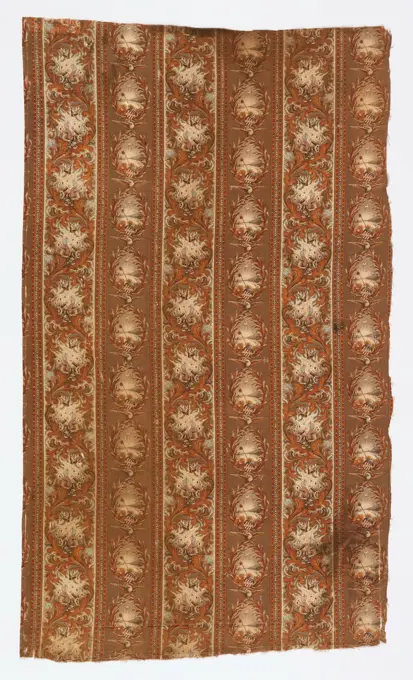
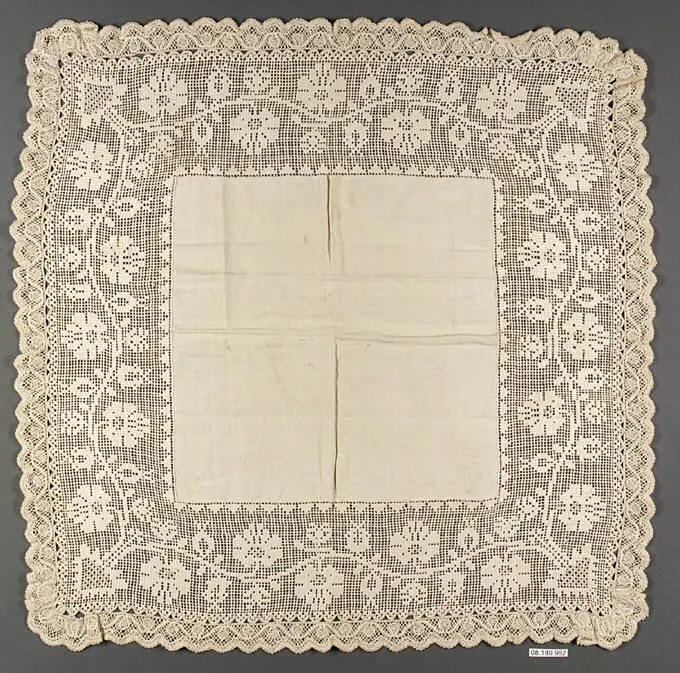
Intricately designed textile fragments from historical periods, highlighting various patterns and textiles from Turkey and China.

Kamben geringsing (ceremonial cloth), Medium: cotton Technique: tied resist patterning in warp and weft (double ikat) on plain weave Label: cotton with tied resist patterning in warp and weft (double ikat), Cotton textile created in the double ikat or 'geringsing' technique showing a 'kota-mesir' pattern (four-pointed star, notched internal pattern, divides piece into semi-circular segments). Semi-circles depict 'wayang patlikur isi' motif (geometric wayang figure) and other figures. Wide border at end with geometric pattern. Design in tan on black. Fringed., Tenganan, Bali, Indonesia, 19th century, printed, dyed & painted textiles, Kamben geringsing (ceremonial cloth)
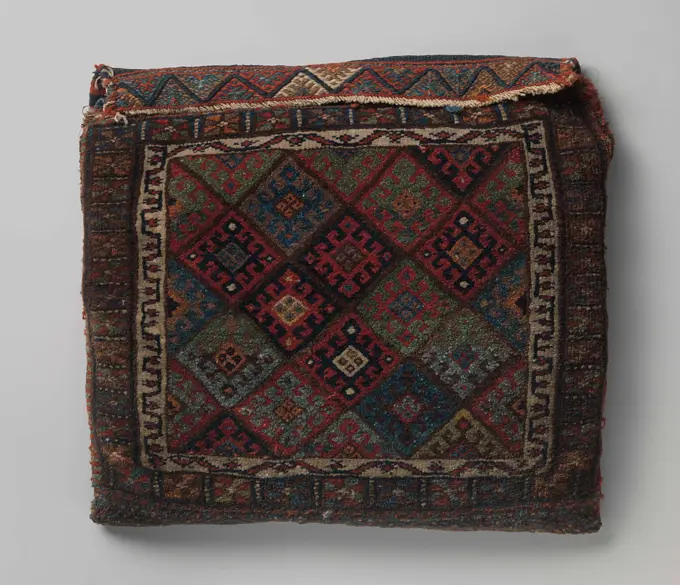
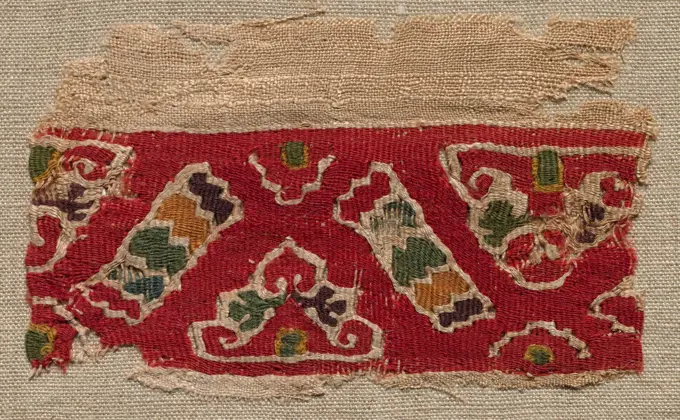
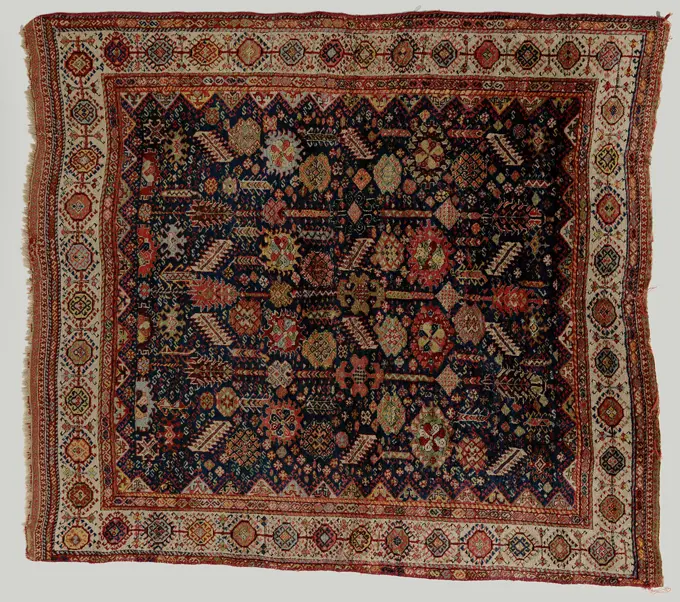
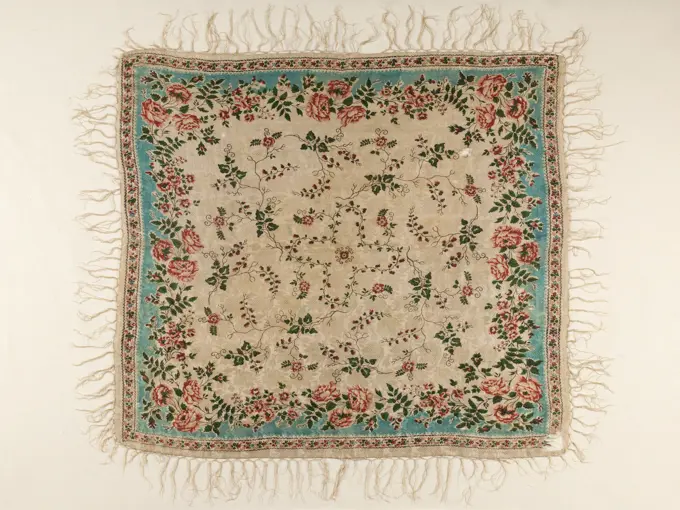
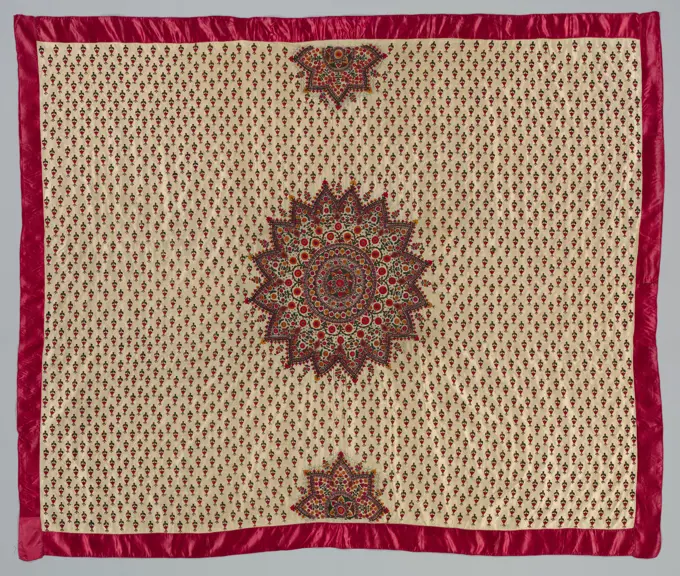
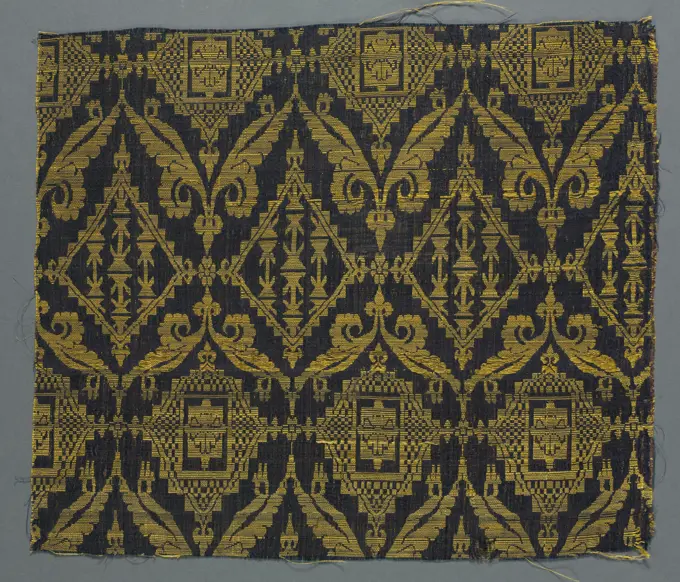
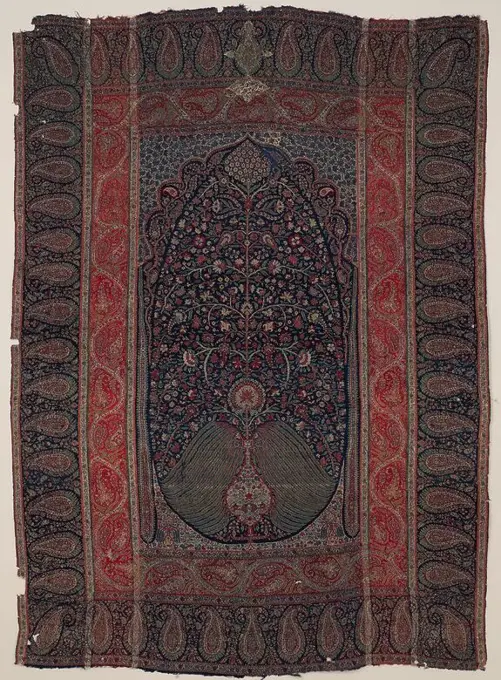
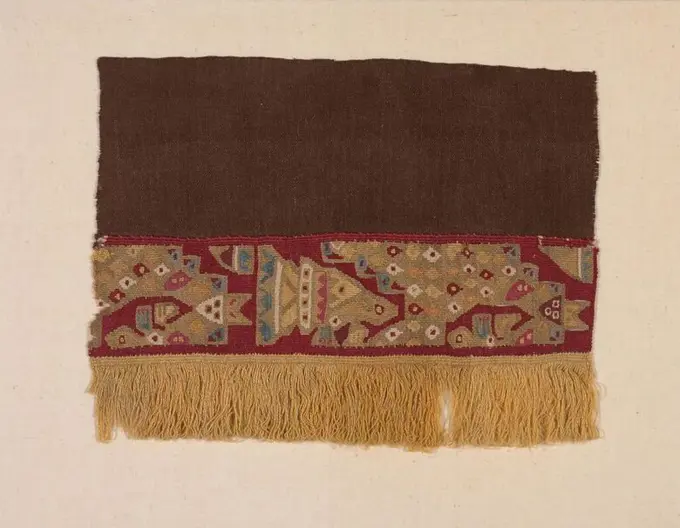
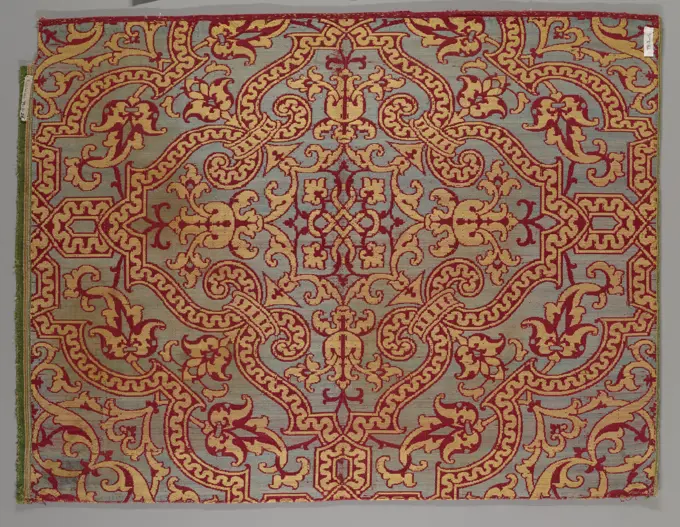
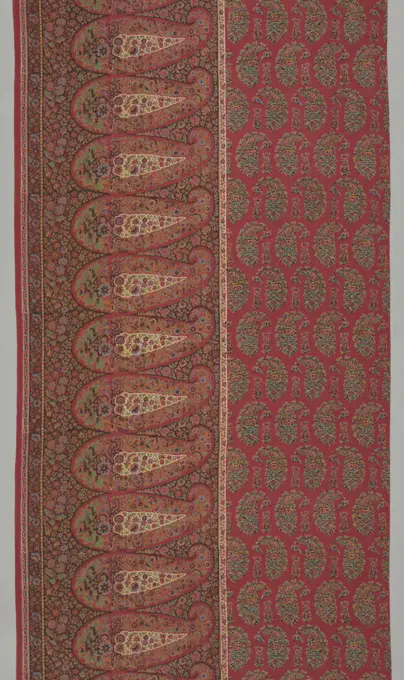
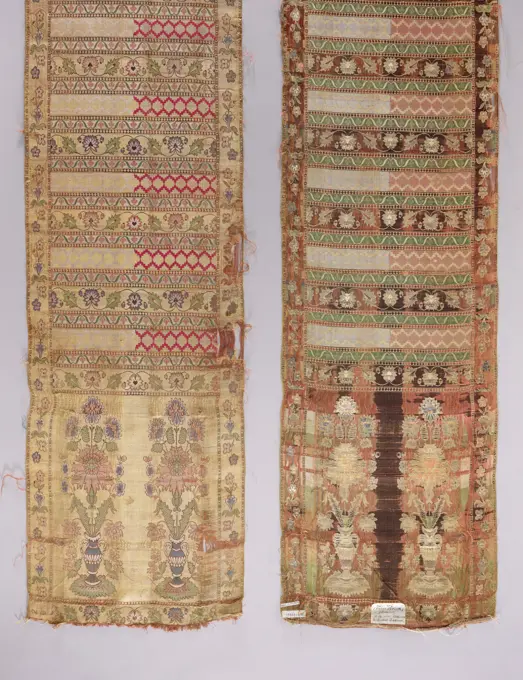
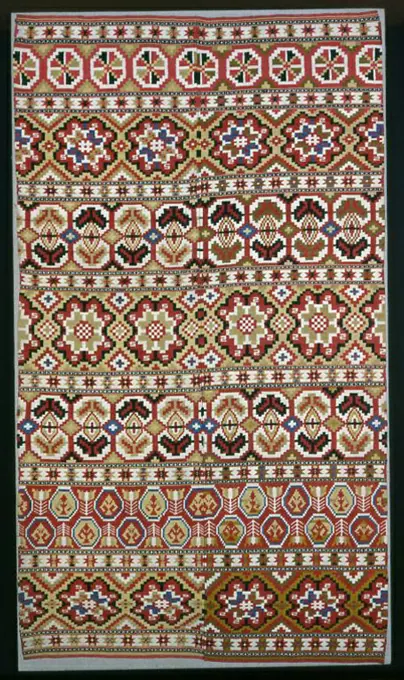
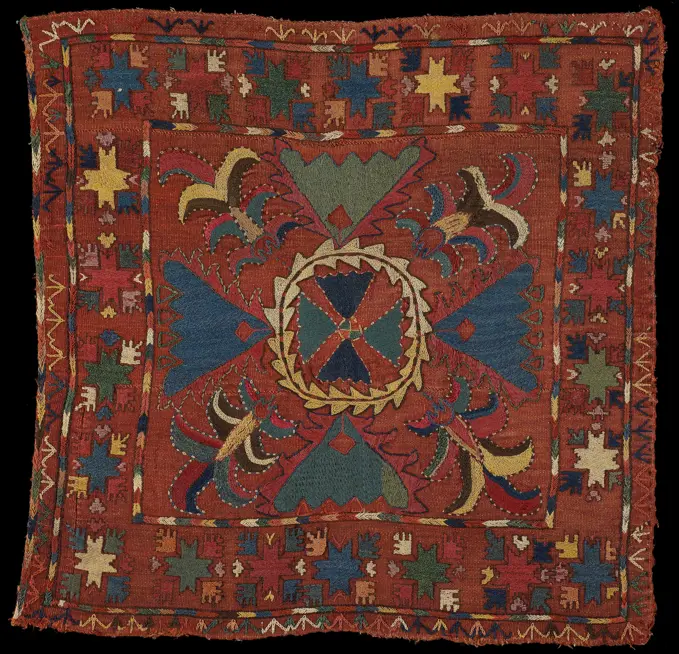
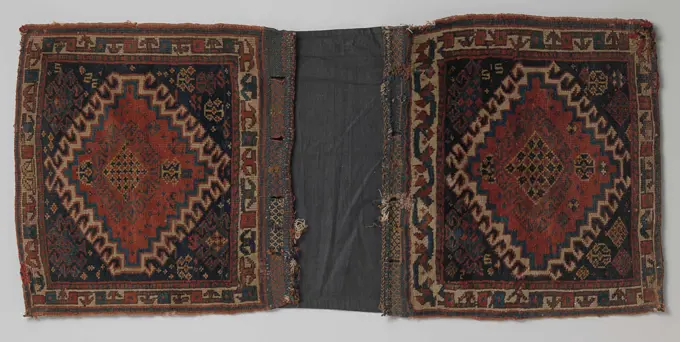
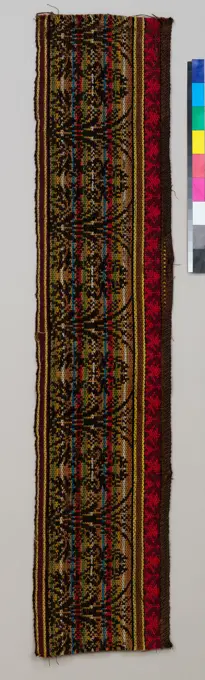
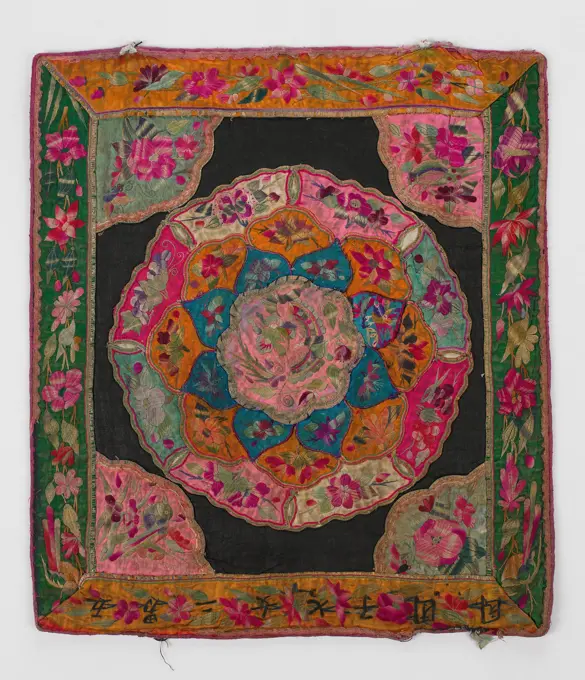
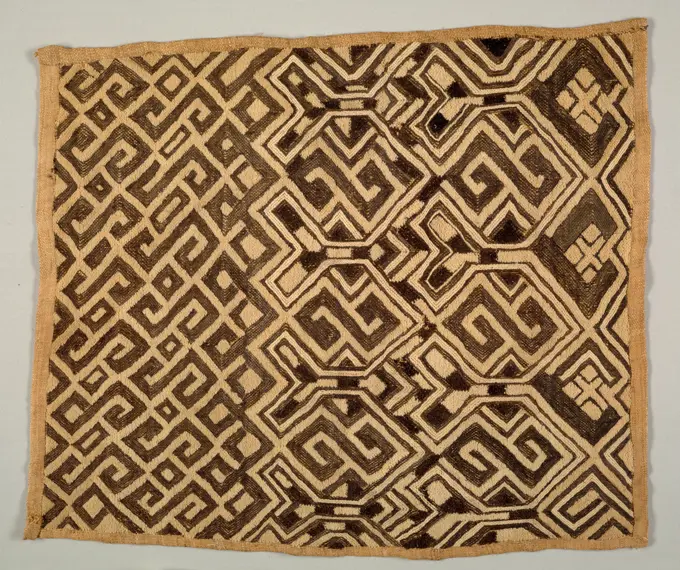
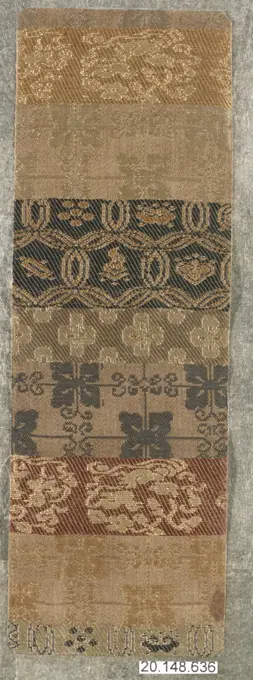
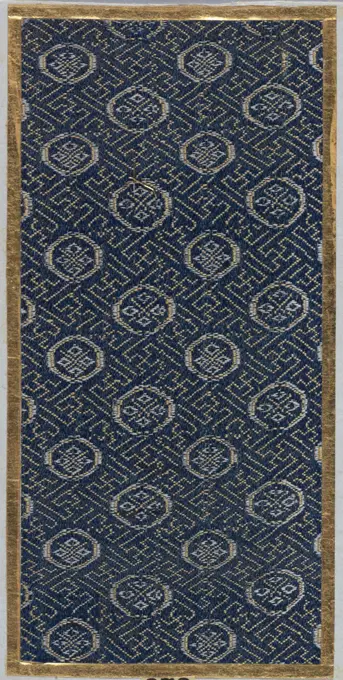
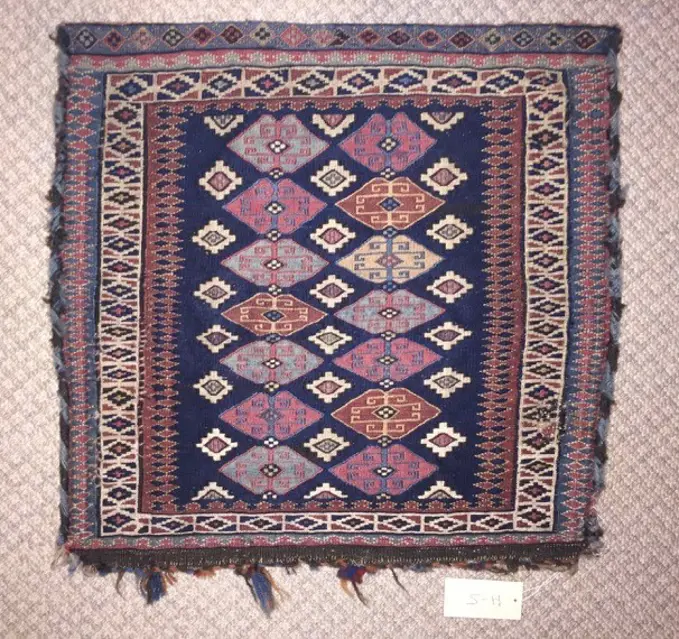
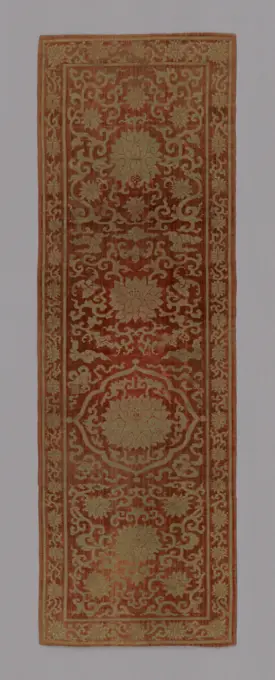
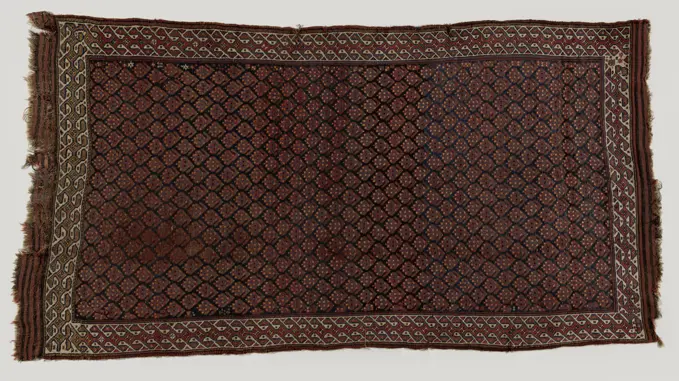
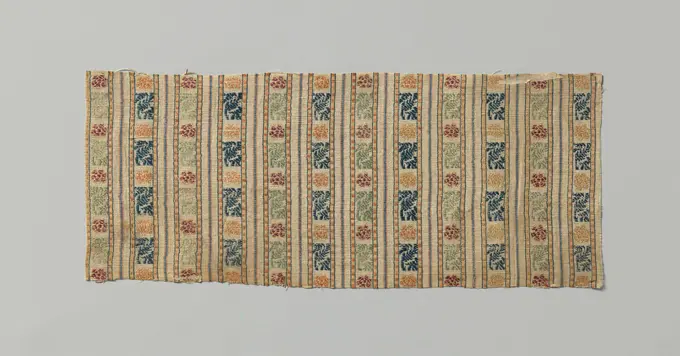
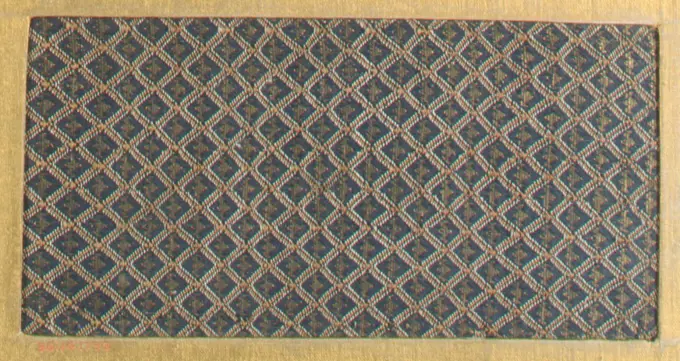
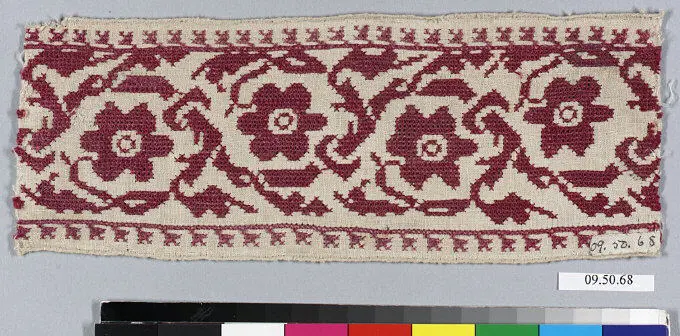
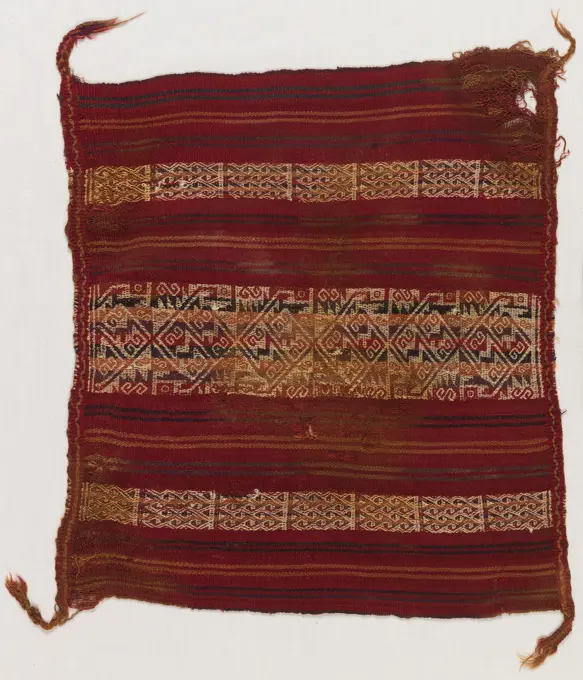
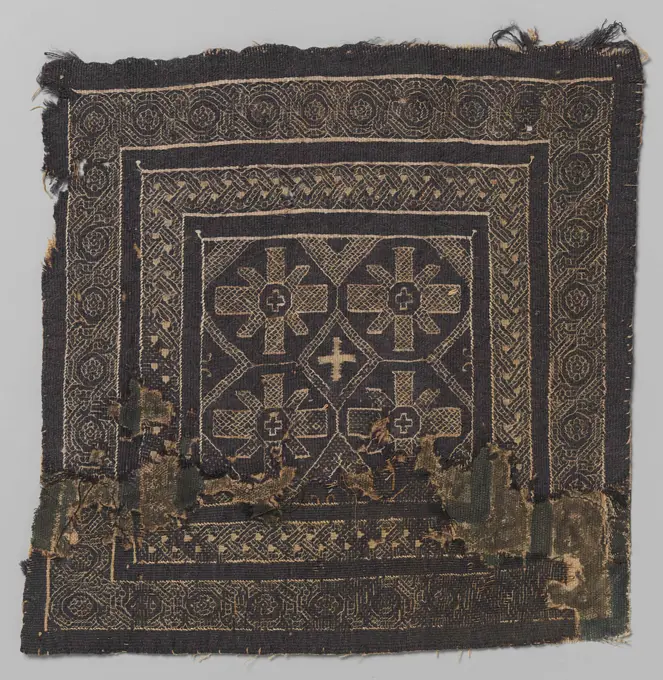
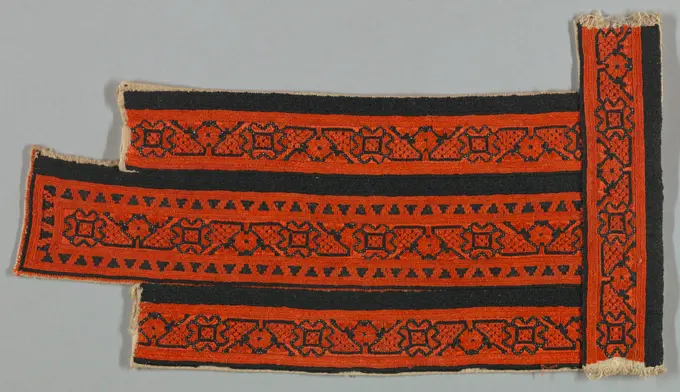
Wall  hanging, embroidered, white  motifs of floral bouquet and vase unknownFragment. Italy. Date: 1575-1600. Dimensions: 21.0 x 18.4 cm (8 1/4 x 7 1/4 in.). Silk, cut, and uncut velvet against satin weave ground. Origin: Italy. Museum: The Chicago Art Institute, Chicago, USA.Sidewall - Sample (USA); machine-printed; 72 x 49 cm (28 3/8 x 19 5/16 in.)Saddlebag, decorated with brown grid and hook circuit flowers. Saddle bag, Jaffi Kurdistan Mosul. The midfield is divided into diamonds through a brown grid, all filled with equal diamond-shaped and broken flowers. The middle edge is divided into rectangles with a flower. At the top of a split beard in different colors. Back side flat woven with stripes in different colors.Fragment, with Part of a Clavus, early 800s. Egypt, Abbasid period, early 9th century. Tabby weave, inwoven tapestry ornament; wool and linen; overall: 7.7 x 12.1 cm (3 1/16 x 4 3/4 in.).Carpet 19th century. Carpet 446956Baby Carrier, 32 1/2 x 26 1/4 in. (82.55 x 66.68 cm), Cotton; needlework, ChinaSilk Persian Little Person belt unknownFragment of the church cap;  1760-1766 (1760-00-00-1766-00-00);Oriental carpet. Oriental floral rug of knotted wool with palmets, rosettes, diamonds with hooks on a dark blue fond. Edge decorated with octos.Sarong (kain songket), Medium: silk, metallic threads Technique: plain weave with discontinuous supplementary weft patterning (brocade), Brocaded sarong (kain songket) with a maroon silk warp and purple silk weft, brocaded with an all-over repeating leaf pattern in gold thread. Geometric borders brocaded in gold and a wide center band heavily brocaded in gold in the stylized 'lawi ayam' or 'cockerel's tail feathers' motif., Indonesia, early 19th century, woven textiles, Sarong (kain songket)Shawl. Cream shaped and polychrome printed, fringes. Around 1860. Galliera, fashion museum of the city of Paris. Floral patterns. CARRE FRANGES, CARRE-FICHU, CHALE, CREME COLOR, FACONNEE, Multicolored print, Floral Pattern, Silk PinShawl, 1800s - early 1900s. India, Cutch, 19th - early 20th century. Embroidery, silk thread on silk ground; overall: 216.5 x 182.9 cm (85 1/4 x 72 in.).Silk Fragment, 1400s. Egypt or Syria, Mamluk period, 15th century. Lampas weave, silk; overall: 38 x 43.5 cm (14 15/16 x 17 1/8 in.).Kira, 20th century, 104 x 54 in. (264.16 x 137.2 cm), Cotton, silk, Bhutan, 20th centuryFragment Made 1625-1675 Italy. Plain compound cloth .Ikat from Timor, Indonesia, Southeast Asia, AsiaWoven Wall Hanging. Dimensions: Textile: L. 72 in. (182.9 cm)W. 51 3/4 in. (131.4 cm). Date: ca. 1820-30.Kashmir was famous for its beautiful woven shawls made of the fine goat's wool called pashmina, woven in the distinctive double-interlocking tapestry weave style. Hangings, cushion covers, and some articles of clothing were also made in this technique, in which the piece was woven with bobbins or spools, with the weft colors inserted as required by the pattern, interlocking where two adjoining colors meet. Floral motifs were the most common decoration on the Kashmiri woven textiles, the most distinctive being the bota, a conelike design of a flower or shrub with a curving tip. Museum: Metropolitan Museum of Art, New York, USA.Tent hanging, late 19th-early 20th century, 25 1/2 x 23 1/2 in. (64.77 x 59.69 cm), Wool; chain stitch, double chain stitch, detached chain stitch, running stitch, Kyrgyzstan, 19th-20th centuryLong Sarong (kain Panjang) (Indonesia); cottonTextile (Portugal); cottonTextile; linen, wool; A/ H x W: 26.5 × 9.5 cm (10 7/16 × 3 3/4 in.) B/ H x W: 9.5 × 24 cm (3 3/4 × 9 7/16 in.)Hanging with the coat of arms of Adam Mikołaj Sieniawski. unknown, authorSkirt 19th-early 20th century Cambodia, possibly. Skirt. Cambodia, possibly. 19th-early 20th century. Silk. Textiles-CostumesFragment. Possibly provincial Wari; Possibly central coast, Peru. Date: 800 AD-1100. Dimensions: 32.7 x 24.5 cm (12 7/8 x 9 5/8 in.). Cotton and wool (camelid), slit, dovetailed, and double interlocking tapestry weave with extended weft loop fringe. Origin: Peru. Museum: The Chicago Art Institute, Chicago, USA.Polish Carpet, Anonymous, c. 1600 - c. 1625 Carpet, a so-called polent carpet, knotted of silk and brochure with gold and silver wire. Thin tires divide the midfield of this carpet in catouches. Decorations of tendrils with leaf motifs, lotus flowers, rosettes interspersed with cloud tires. Wide decorated edge. Isfahan silk. silver thread Carpet, a so-called polent carpet, knotted of silk and brochure with gold and silver wire. Thin tires divide the midfield of this carpet in catouches. Decorations of tendrils with leaf motifs, lotus flowers, rosettes interspersed with cloud tires. Wide decorated edge. Isfahan silk. silver threadPiece 17th century Spanish. Piece 212260Africa, Tanzania, Zanzibar, Stone Town. Close-up of hand-made carpet.Table Carpet Made 1600-1610 Germany. Linen, plain weave; embroidered with wool, silk and gilt-metal-strip-wrapped silk in cross, half cross, plaited and tent stitches .Tea tablecloth of beige silk with square bets of light brown bobbin, J. Moorsel, c. 1923 Tea tablecloth from beige silk all around with light brown bobbin side and with twenty -five square bets of light brown bobbin side. Square model. The twenty -five bets are in five rows of five. The bets have a geometric pattern, there are five variants decorated with spiders, windows and rows of shape strokes between ornamental tires in netslag. The motifs are connected or not by a traly land: a twisted cross -stroke ground. The edge around the rug has a straw side pattern with windows in which a spider and a window alternately connected by a twisted cross -stroke ground. The scrap edge stems from the wavy band that runs under the windows and is made in Netslag. The scums are finished with point sculpts made with a continuous braid with picots. Netherlands whole: Silk Bobbi lace / lace cloth Tea tablecloth from beige silk all around with light brown bobbin side and with twenty -five square bets ofEastern carpet ,, 1600 - 1725 Oriental carpet, Ghiordes Bid rug. In midfield a Ceriserode Mihrab, in which carnations are located. Three -stern edge, of which the main edge in corn blue with rosette flowers. Button: Ghiordes Knoop. Klein-Azia (possibbly) Ladik (possibbly) ghiordes (possibbly) Romania (possibly) Necklace and impact: Wool Oriental carpet, Ghiordes Bid rug. In midfield a Ceriserode Mihrab, in which carnations are located. Three -stern edge, of which the main edge in corn blue with rosette flowers. Button: Ghiordes Knoop. Klein-Azia (possibbly) Ladik (possibbly) ghiordes (possibbly) Romania (possibly) Necklace and impact: WoolTextile, Medium: cotton Technique: plain weave block printed in lapis technique; three different sets of blocks were used; blocks for outer edge of paisley border: 7 1/2 x 10 in.; blocks for inner edge of paisley border: 9 3/4 x 10 in. Blocks for field: 9 3/4 x 7 1/2 in. Label: block printed on cotton plain weave, Length of fabric with a deep border of paisley shapes and a field of smaller paisley shapes. The fabric is three directional., Scotland, France or Switzerland, early 19th century, printed, dyed & painted textiles, TextileWomans Waist Wrapper (Sora Langi)Kontusz sash/belt. unknown, authorPerk rug, yuruk-noomadsdress. Perk dress, yuruk-nowares, also called "sultan". Midfield: Raspberry red field with three lying rectangles in red, halfway in dark blue. Inside every perk a octagon with cross and a second rectangle in red and dark blue with flowers in mauve, yellow, orange, light blue et al. Edge: triple. The main edge is orange with loose standing shown flowers inside speckled wreaths, also in meat colors. Inside and out-of-life is the same, with sloping S-SEN in light shades.Panel (Furnishing Fabric) Made 1801-1900 Sweden. Linen and wool, interlocking tapestry weave; with simple alternating float weave in weft stripes; two widths joined .Carpet late 16th century. Carpet 451488Uncut Handkerchiefs (USA); cottonPiece 18th century Japan. Piece 71913Ilgich, early 20th century, 25 3/4 x 25 1/2 in. (65.41 x 64.77 cm), Wool, cotton; chain stitch, checkered chain stitch, continuous-thread couching, outline, back, fishbone stitch, Uzbekistan, 20th centuryFragment. Italy. Date: 1601-1650. Dimensions: 26 x 20.3 cm (10 1/4 x 8 in.). Simple satin damask. Origin: Italy. Museum: The Chicago Art Institute, Chicago, USA.Baby Carrier, 30 1/2 x 28 3/4 in. (77.47 x 73.03 cm), Cotton, linen; needlework, ChinaMan's mantle. Date/Period: 50 - 100. Costumes. Wool plain weave, embroidered with wool. Height: 1,010 mm (39.76 in); Width: 2,443 mm (96.18 in). Author: UNKNOWN.Sampler (Germany); silk and metal thread embroidery, linen foundation; Warp x Weft: 34 x 41 cm (13 3/8 x 16 1/8 in.); Bequest of Mrs. Henry E. Coe; 1941-69-110Fragment of a shirt. Culture: Ukrainian. Dimensions: 57 1/2 x 11 in. (146.1 x 27.9 cm). Date: fourth quarter 18th century.This object is from the collection of Natalia de Shabelsky (1841-1905), a Russian noblewoman compelled to preserve what she perceived as the vanishing folk art traditions of her native country. Traveling extensively throughout Great Russia, she collected many fine examples of textile art of the wealthy peasant class. From the 1870s until moving to France in 1902, Shabelsky amassed a large collection of intricately embroidered hand-woven household textiles and opulent festival garments with rich decoration and elaborate motifs. The Brooklyn Museum holdings include many fine examples including the majority of the garments. Portions of Shabelsky's collection are also housed at the Museum of Fine Arts, Boston, the Cleveland Art Museum, and the Russian Museum of Ethnography in St. Petersburg. Museum: Metropolitan Museum of Art, New York, USA.Zadeltas, bestaande uit een aantal aan elkaar genaaide tassen.A pair of saddle bags, sewn to each other. Midfield is decorated with a medallion with hooks on a dark blue fond. There is a border with a rank of blocks and arrows. Painting upstairs and bottom.Ingrain carpet border piece ca. 1880 American. Ingrain carpet border piece. American. ca. 1880. WoolFragment, Medium: silk, metallic Technique: 4&1 satin patterned with plain weave, Background divided into shield shapes by broad bands of arabesques. Alternate shields enclose the arms of Castile., Spain, 15th century, woven textiles, FragmentSash (Bhutan); L x W: 244 × 25 cm (8 ft. 1/16 in. × 9 13/16 in.)Baby Carrier, 18 x 16 in. (45.72 x 40.64 cm), Cotton, linen, silk; needlework, ChinaShawl, Anonymous, 1900 - 1949 Cover with geometric, bird and hook motifs. Timor cotton (textile) ikat Cover with geometric, bird and hook motifs. Timor cotton (textile) ikatEmbroidered Raffia Pile Cloth, 1900s. Africa, Central Africa, Democratic Republic of Congo, Kuba peoples, 20th century. Raffia and dye; overall: 57.5 x 50.8 cm (22 5/8 x 20 in.); mounted: 64.5 x 56.5 cm (25 3/8 x 22 1/4 in.).Piece 18th century Japan. Piece 71631Fragment (Japan)Tiraz Fragment; linen, silkShahsevan Saddle Bag ca. 1850 While the term "carpet" evokes a heavy, large rectangular textile (either knotted pile or flat-woven tapestry, called kilim) that covers a floor, a vast array of rug genres and techniques can be found in the Islamic world, where they serve various functions in nomadic encampments, villages, cities, and palaces. Flat-woven and richly embroidered textiles, such as this one, belong to the kinds of smaller tribal weavings that were common in the Middle East from Anatolia to Iran; it was generously given to The Met by Inger G. and William B. Ginsberg of New York. Such textiles were woven by nomadic tribes as containers for everyday items. Some were designed specifically to transport or store bedding, flour, salt, and wooden spindles used to make the woolen yarns from which these works were woven. Others were of smaller size, comparable to cross-body women's handbags, or çanta, or also possibly used by children. Most notable is the ubiquitous double saddlebag, kShawl, 19th century, 76 1/2 x 74 1/2 in. (194.31 x 189.2 cm), Wool, India, 19th centuryFragment Made 1201-1400 Spain. Silk and gilt animal substrate wrapped silk, weft-faced three and four color complementary weft plain weave with inner warps and areas of detached plain weave of inner warps and complementary ground wefts (red) . IslamicFragment Made 1590-1610 Italy. Silk, warp-float faced satin weave with supplementary pile warps forming cut, uncut, and voided velvet .Fragment Made 1750-1800 Japan. Plain compound (or brocaded) satin, silk and gilt paper; 2 strips to m.m. .Sarong (kain Songket) (Indonesia); silk, metallic threadsFragment, Medium: silk, linen, metallic Technique: compound weft twill, Ogival lozenges containing paired birds alternate with plant forms., Spain, 13th century, woven textiles, FragmentShawl. Shawl with geometric motifs on white middlebaan.Coverlet fragment, Medium: wool, cotton Technique: plain weave with supplementary weft patterning (overshot), Fragment of traditional woven coverlet, with undyed cotton ground and bands of supplementary weft patterns in dark blue, sage green, and rust-red., USA, 19th century, woven textiles, Coverlet fragmentEastern carpet, Afshar (Possible), 1850 - 1900 Eastern carpet of knotted wool, of which midfield is decorated with rows of Botehs. Five edges with a simple geometric pattern. Probably woven by Afshar Nomaden. Fars wool Eastern carpet of knotted wool, of which midfield is decorated with rows of Botehs. Five edges with a simple geometric pattern. Probably woven by Afshar Nomaden. Fars woolMantle, Medium: wool, cotton Technique: complementary wefts, one continuous, two discontinuous, Bands with tapestry-woven borders. Bird motifs outlined in red. Red line between each group of birds., Peru, 1100, woven textiles, MantleCarpet 17th century. Carpet 451059Dress of brocheted and silvery-shaded silk dead. Dress of brocheted and silver thread shaded silkdamast.dessin: diamond pattern made up of floral drinks with leaf packages in silver, pink, yellow and red on a green fond with designs of flowers and leaves. Lined yellow silk. Pinned paper on which the letters ar. Stamped at the rear: 16408. The tissue is entertained to garment, composed of two recovered jobs. Condition: Color good: repairs.Fragment, 1700s. Iran, 19th c.. Silk taquete; overall: 59.7 x 62.9 cm (23 1/2 x 24 3/4 in.).Panel (Furnishing Fabric) Made 1875-1900 China. Cut velvet wall hanging . Han-ChineseTurban cover, 1700s-early 1800s. Turkey. Plain weave: silk; embroidery, double-running stitch: silk, gilt- and silver-metal thread; average: 109.3 x 109.3 cm (43 1/16 x 43 1/16 in.).Flower rug with rows of staggered MIR-I-Bota and triangular hooks in the edge, Anonymous, 1800-1900 Oriental carpet, flower rug, made of knotted wool of which the midfield is decorated with rows of left to the left or to the right MIR-i-Bota against a dark blue found. A border decorated with triangular hooks. Serabend (possibly) wool Oriental carpet, flower rug, made of knotted wool of which the midfield is decorated with rows of left to the left or to the right MIR-i-Bota against a dark blue found. A border decorated with triangular hooks. Serabend (possibly) woolFragment Oosterse textiel met een veelkleurig gestreept patroon.Fragment oriental textile with a multi-colored striped pattern. On a white soil, jobs in which blocks with stylized leaves interspersed by a flower.Textile (Spain); silk, metallic (gilded parchment wound around linen core); Warp x Weft: 42.5 x 33 cm (16 3/4 x 13 in.)Piece 18th-19th century Japan. Piece 67506Fragment 16th-17th century Italian or Greek. Fragment 215469Bliżej Kultury unknownFragment Made 1601-1700 Italy. Linen, plain weave; embroidered with wool and silk floss in flame stitch .Trimming, Medium: silk Technique: woven, Trimming fragment in a design of red and white open flowers between narrow borders decorated with triangles of red on a brown ground; picot edges., France, 19th century, trimmings, TrimmingCoverlet, 1844, Charles Wiand, American, c. 1818 - c. 1880, 75 x 93 1/2 in. (190.5 x 237.49 cm) (without fringe), Wool, United States, 19th century, Pennsylvania weaver Charles Wiand lived and worked in Allentown and Trexlertown during the mid-1800s.Kontusz sash/belt. unknown, authorPrinted Silk Turnover Shawl, 1835-1840. France, 19th century. Silk; woven and printed; overall: 179.1 x 179.1 cm (70 1/2 x 70 1/2 in.).Coca Bag (Peru); wool; Bequest of Marian Hague; 1971-50-498Baby Carrier, 28 3/4 x 51 11/16 in. (73.03 x 131.29 cm) (without ties), Cotton, ChinaTabula. Tabula in linen necklace and woolen wax. On purple ground centrally a square with a natural-colored cross in the middle around which four octos with composite crosses. Why two lists with braid work motif and a continuous circle motif. All this in flying wire technique. The Tabula is composed of two perpendicular composite fragments, possible from one object.Piece 18th century Japan. Piece 72023Bag, decorated with BOTEHS (front) and windows (rear) .. bag whose front is decorated with two bothes and the back with windows.Band; cotton, silk; a) H x W: 17.8 x 32.5 cm (7 x 12 13/16 in.) b) H x W: 6.8 x 18.8 cm (2 11/16 x 7 3/8 in.); 1936-26-4-a,bFragment of a cashmere scarf, anonymous, c. 1800 - c. 1820 Fragment cashmere scarf in silk and wool with stylized flower and leaf work and two paisleym motives. Fringe along bottom edge. Cashmir silk. wool twill Fragment cashmere scarf in silk and wool with stylized flower and leaf work and two paisleym motives. Fringe along bottom edge. Cashmir silk. wool twillBaby Carrier, 31 x 57 1/2 in. (78.74 x 146.05 cm), Cotton; needlework, ChinaCarpet 17th century. Carpet 447544Textile (USA); cotton; Warp x Weft (a): 100 x 75.5 cm (39 3/8 x 29 3/4 in.) Warp x Weft (b): 198 x 53 cm (6 ft. 5 15/16 in. x 20 7/8 in.) Repeat H x W: 18.4 x 19.1 cm (7 1/4 x 7 1/2 in.)Square Brazilian 19th centuryQuilt, 'Lady of the Lake'Polonaise Carpet 17th century. Polonaise Carpet 446960Conciliate belt; Manufaktura Karol Stanis Awa Radziwi A (S UCK; Pasów Factory; Ca 1767-1790), Madze Anski, Jan (fl. Ante 1757-Ca 1800); 1776-1780 (1776-00-00-1780-00-00);Radziwiłł, Karol Stanisław (Vilnius Voivodeship - 1734-1790), Zajkowski, Tadeusz Alfred (Fl. Ca 1960) - collection, bipartite heads, flower bushes (ornament), plant ornaments, bilateral belts, litea belts, Polish belts, Poland (Poland ( Culture), Szelążki (ornament), Polish clothing, purchase (provenance)Headdress 18th-19th century. Headdress 446665Shoulder cloth (pa biang), late 19th century, 75 x 16 3/16 in. (190.5 x 41.12 cm) (without fringe), Cotton, silk, Laos, 19th centurySampler (Spain); Embroidered by Maria Cobos; wool embroidery, linen foundation; Warp x Weft: 56 x 56 cm (22 1/16 x 22 1/16 in.); Bequest of Mrs. Henry E. Coe; 1941-69-120Plug of multicolored silk on cotton muslin .. stoppaper with embroidery. The embroidery consists of the initials CVG, the year 1766 and in the middle a square in which a flower.