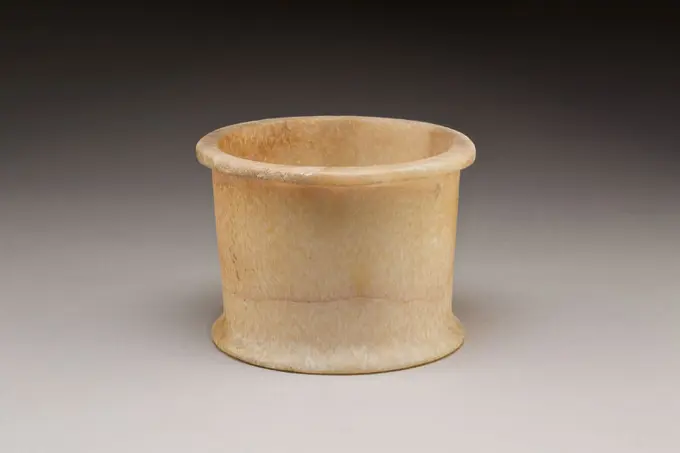
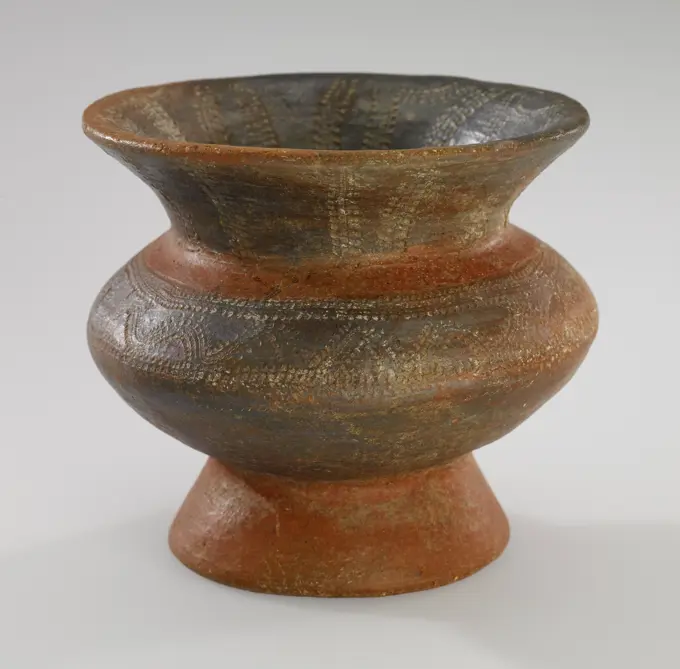
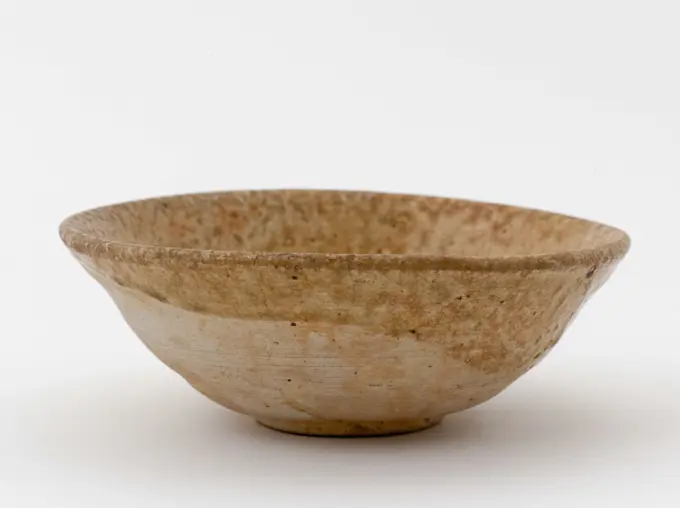
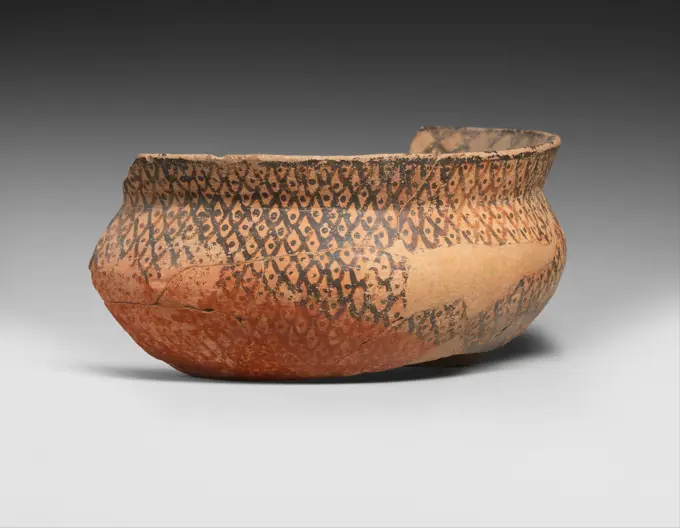
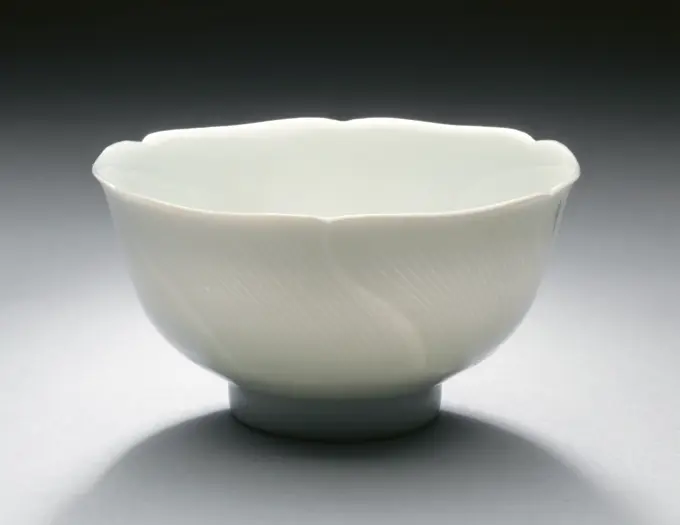
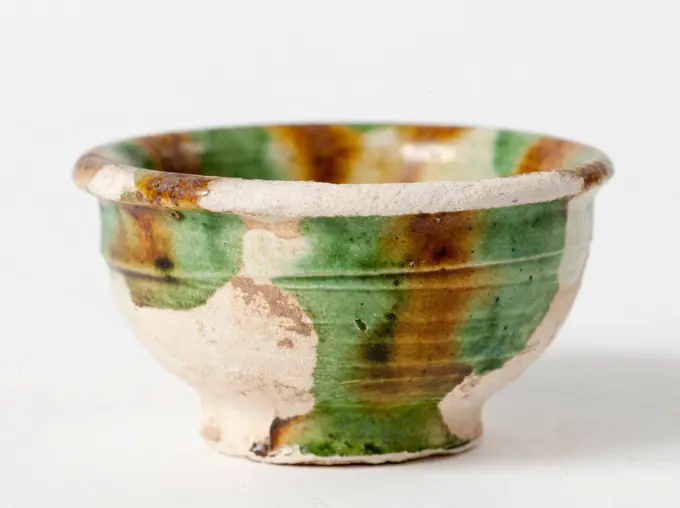
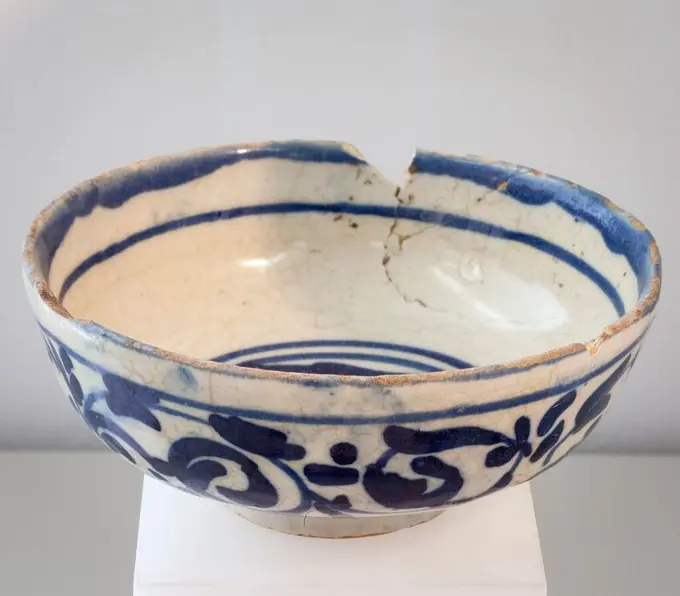
Artistic Bowls and Ceramics

A collection of uniquely designed bowls in various styles, featuring diverse glazes and artistic decorations from different cultures and periods.

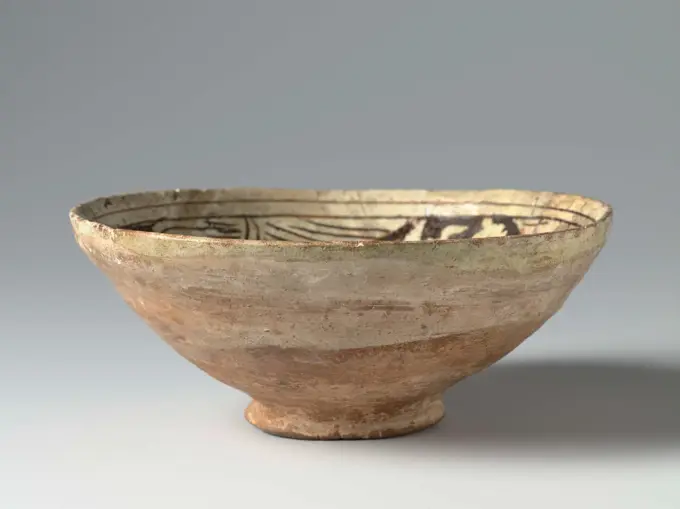
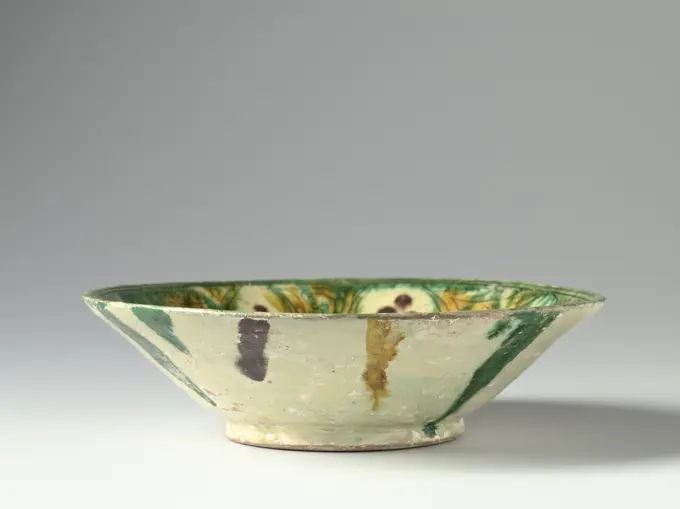
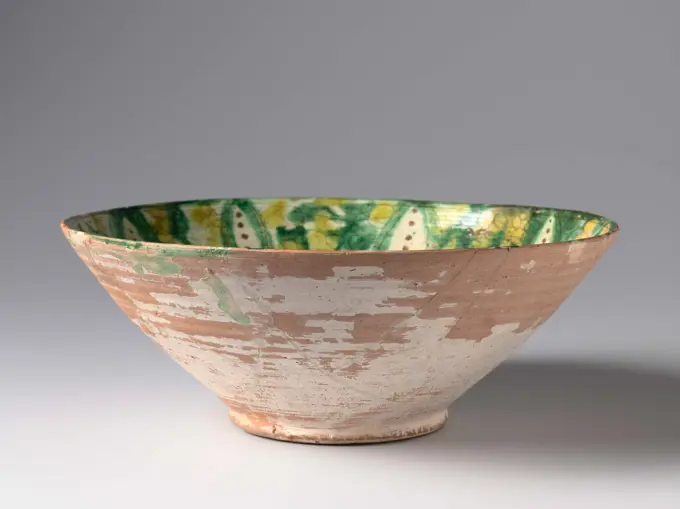
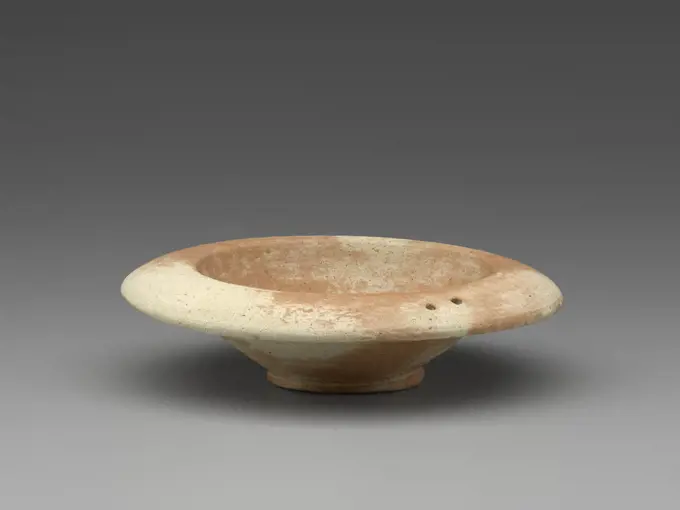
Bowl, anonymous, c. 1175 - c. 1224 White beige bowl of very fine earthenware (quartz fritry). Low, hollow foot. Right outstanding wall. A lead glaze layer is applied directly to the shard, which only leaves the foot uncovered. Decoration is applied in three ways; In the first place, a medallion with flower vines and a circle are engraved in the shard in two places on the inside. These drags are filled with enamel, causing them to stand dark against the background. In addition, gaps were drilled through the shard in the drags. Because these holes are filled with glaze, they are somewhat transparent. Finally, blue lead glaze is applied on the inside in three places, under the glaze. Iran earthenware. glaze. cobalt (mineral) engraving / painting / vitrification White beige bowl of very fine earthenware (quartz fritry). Low, hollow foot. Right outstanding wall. A lead glaze layer is applied directly to the shard, which only leaves the foot uncovered. Decoration is applied in three ways; In
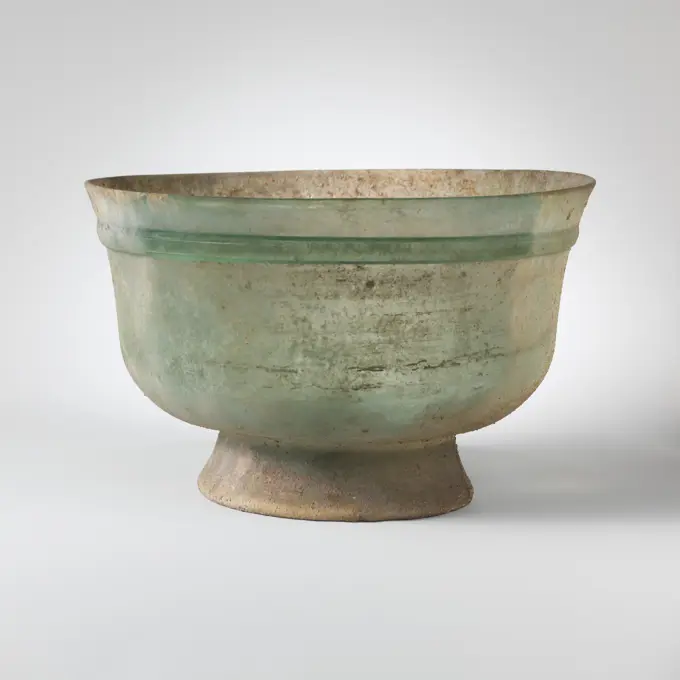
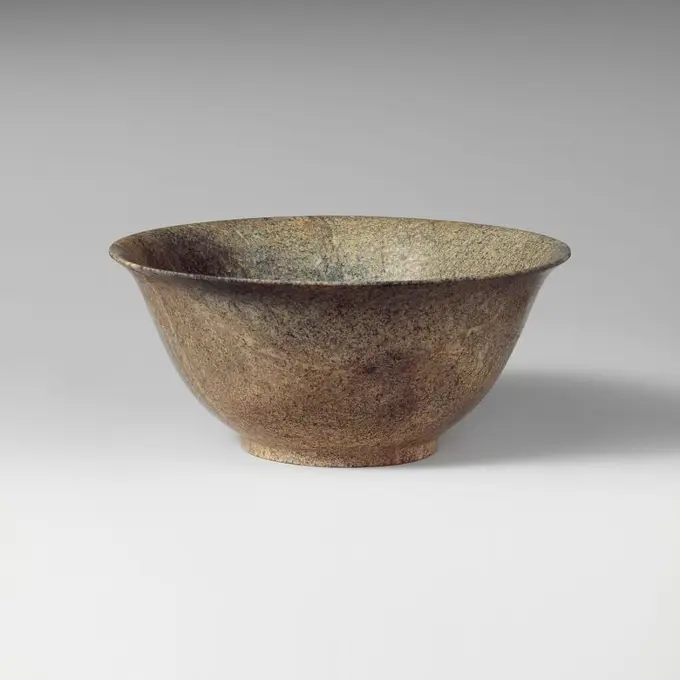
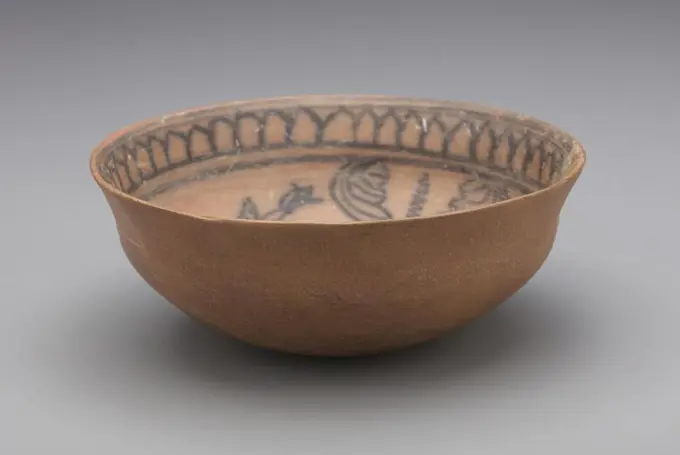
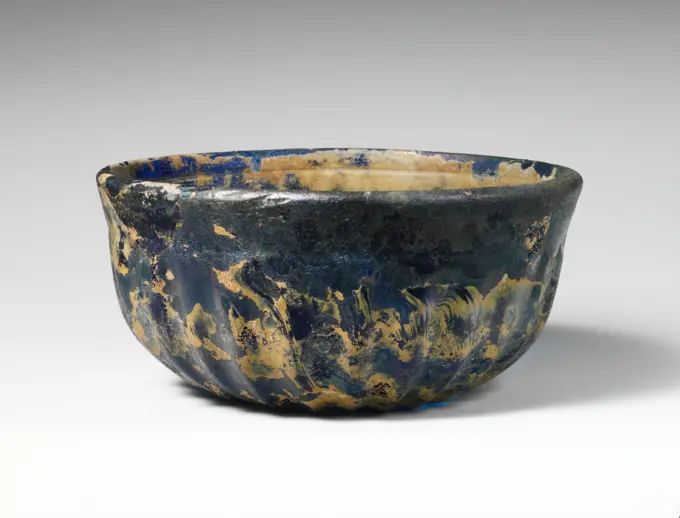
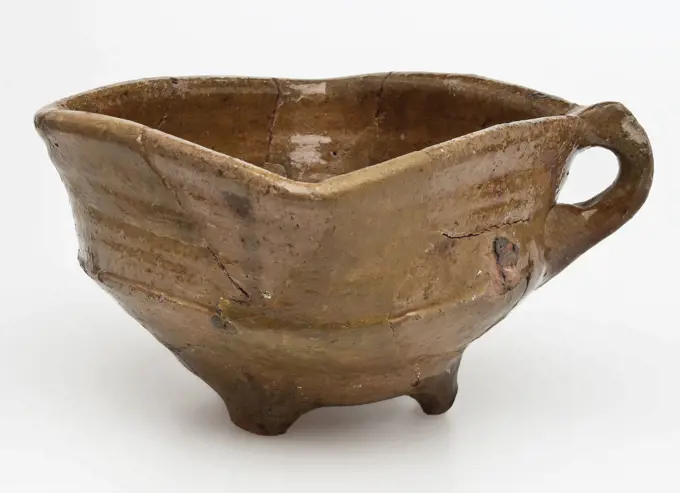
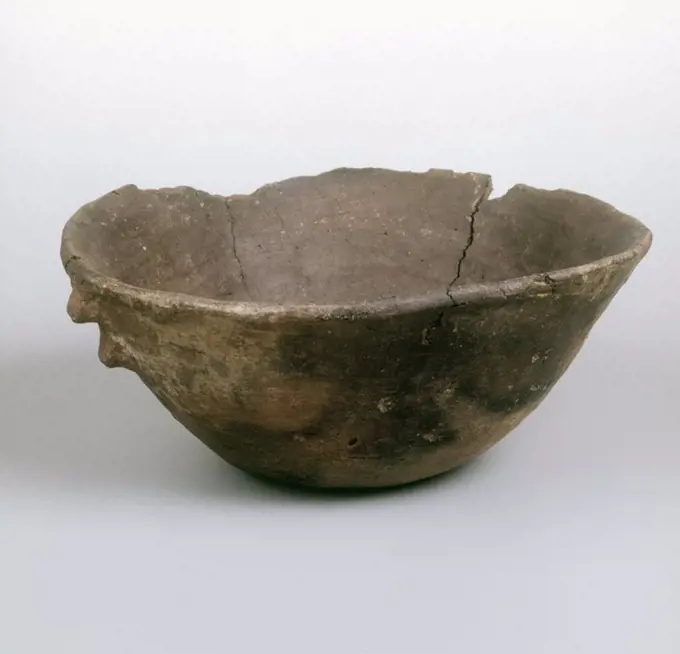
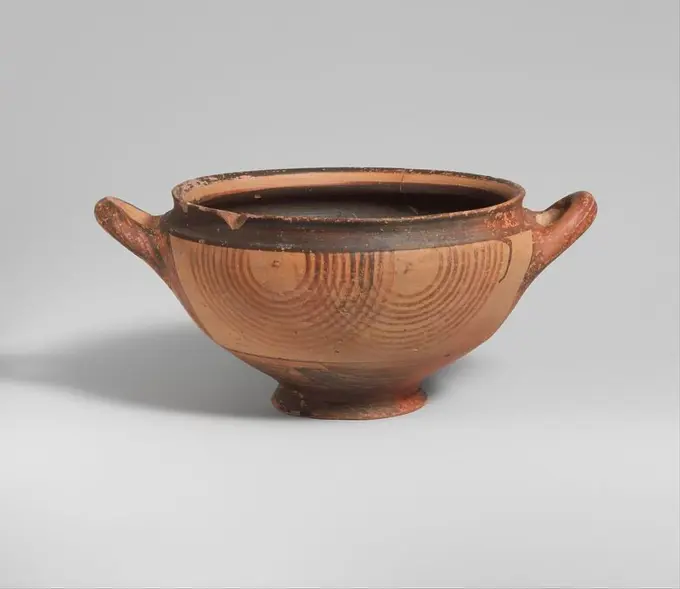
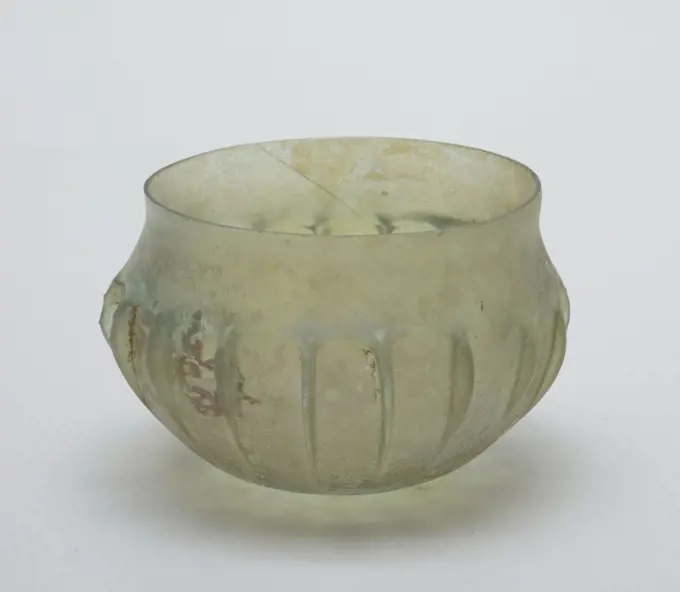
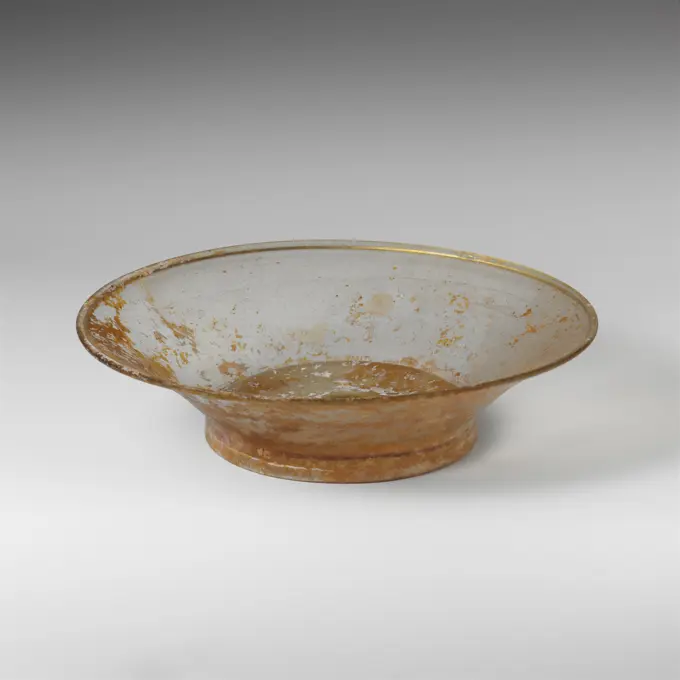
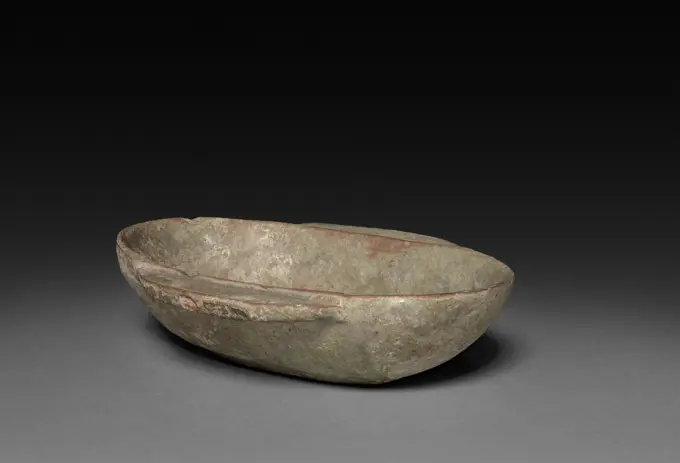
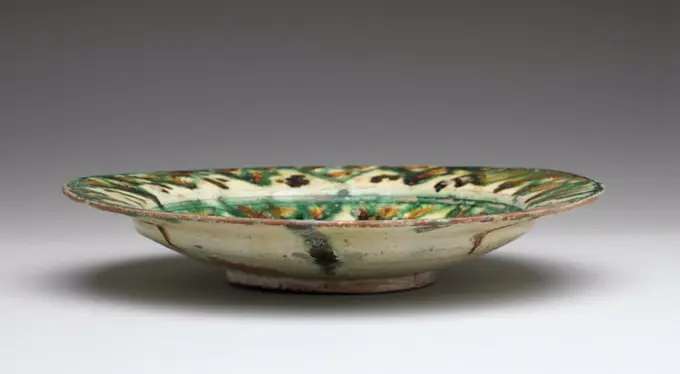
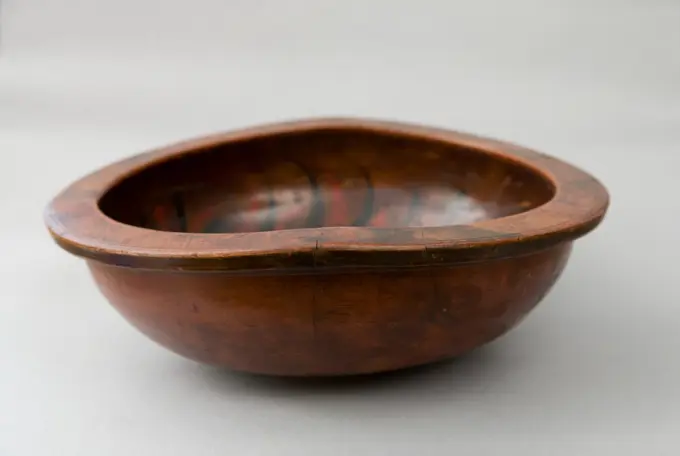
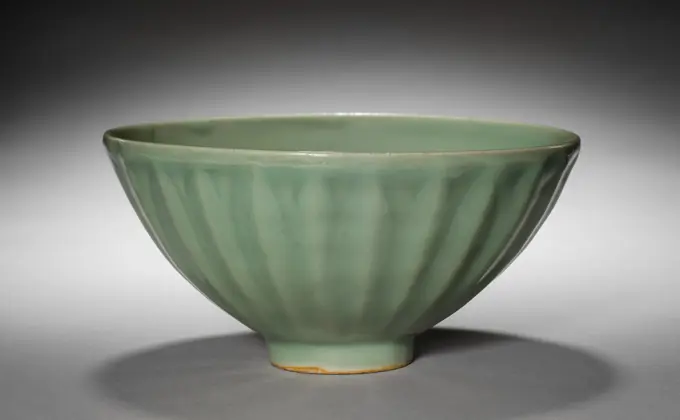
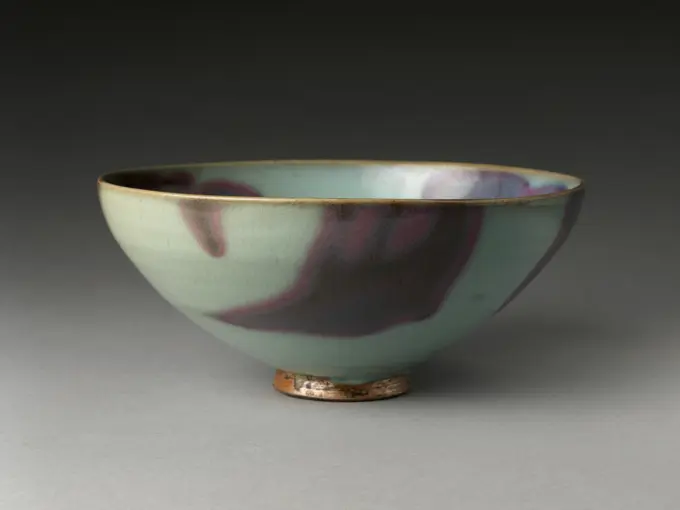
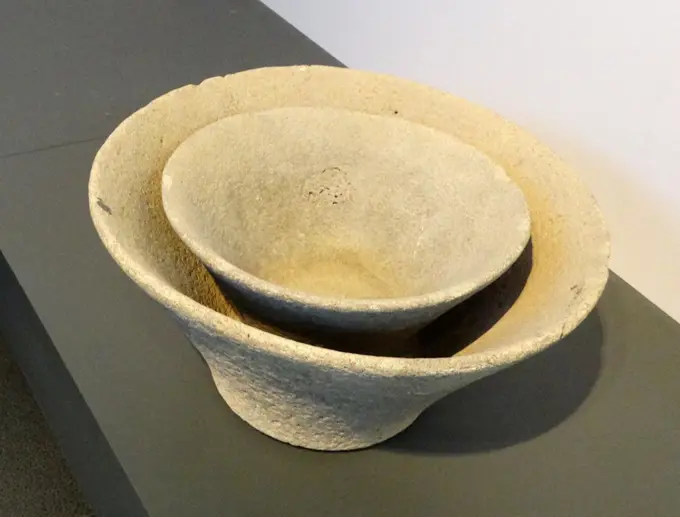
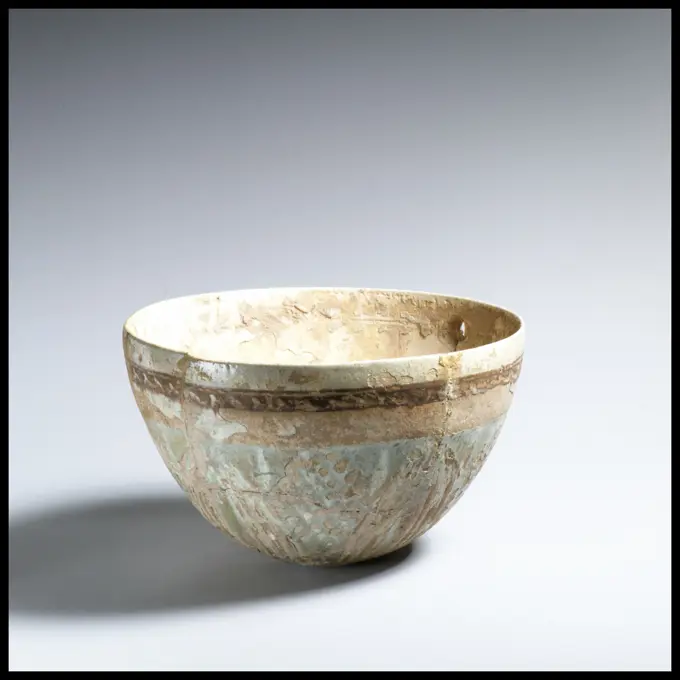
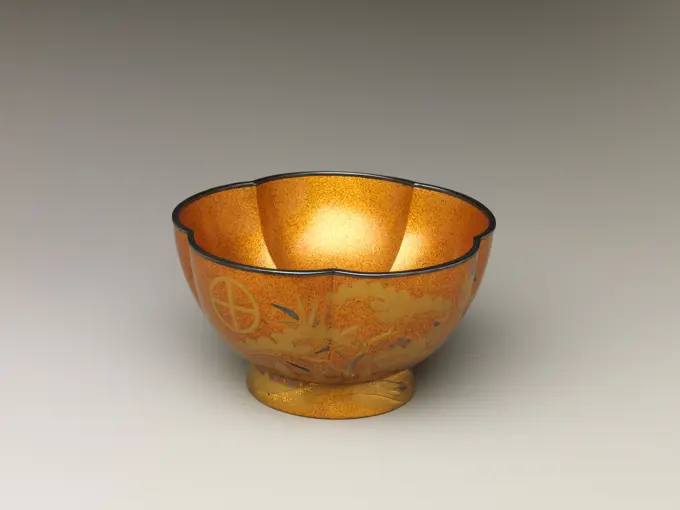
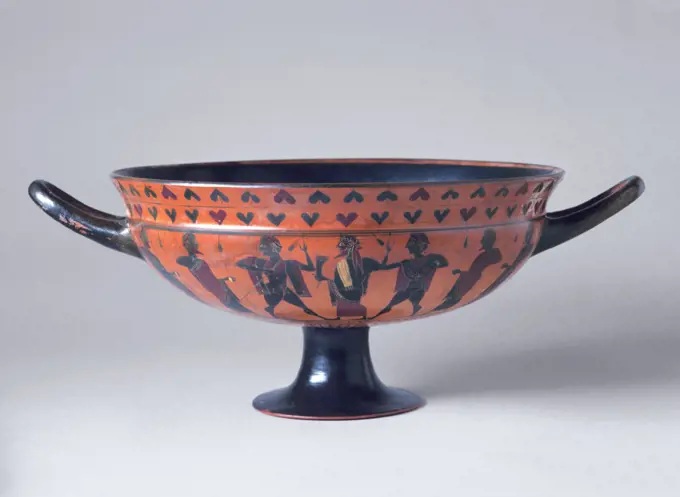
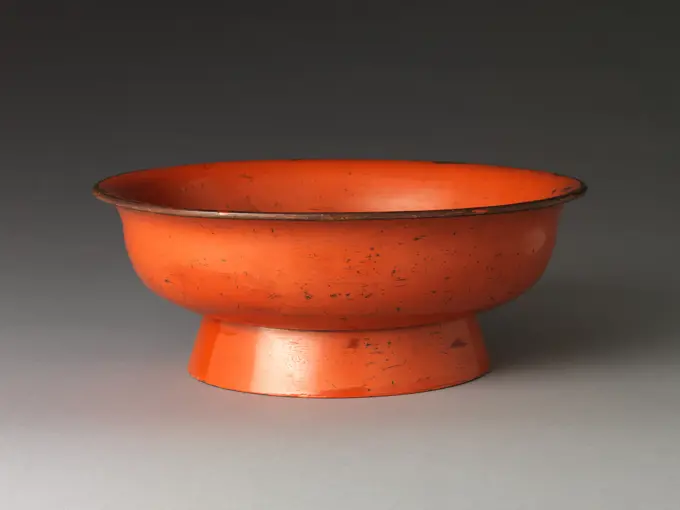
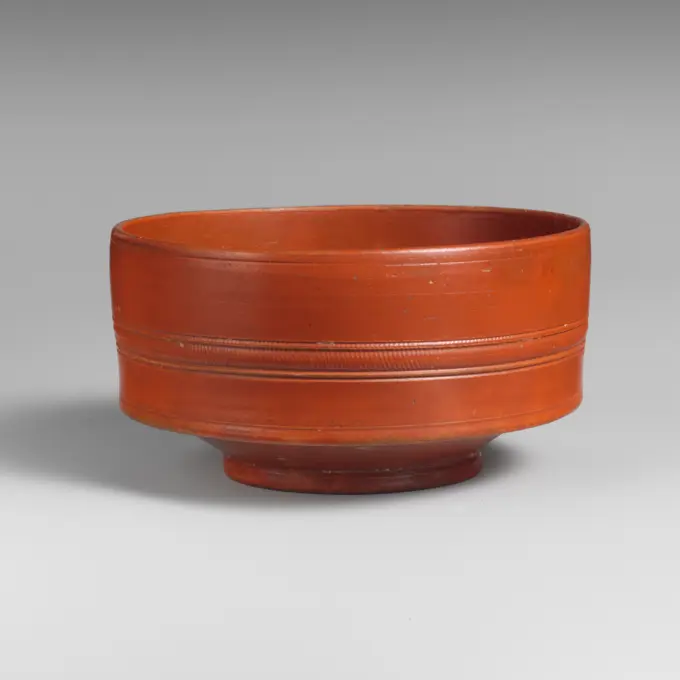
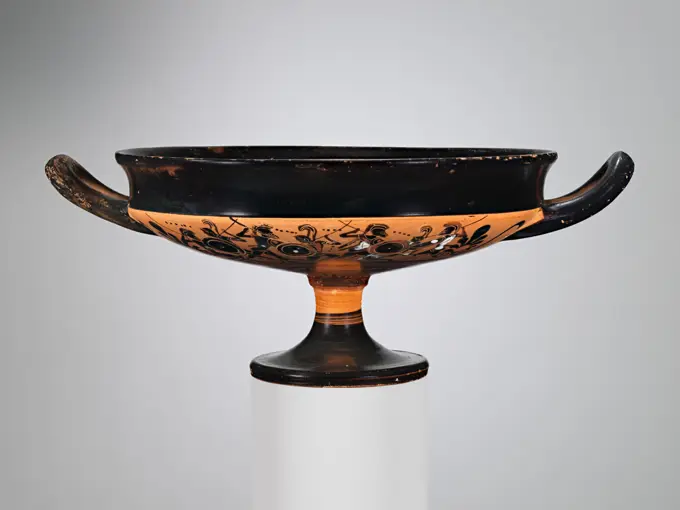
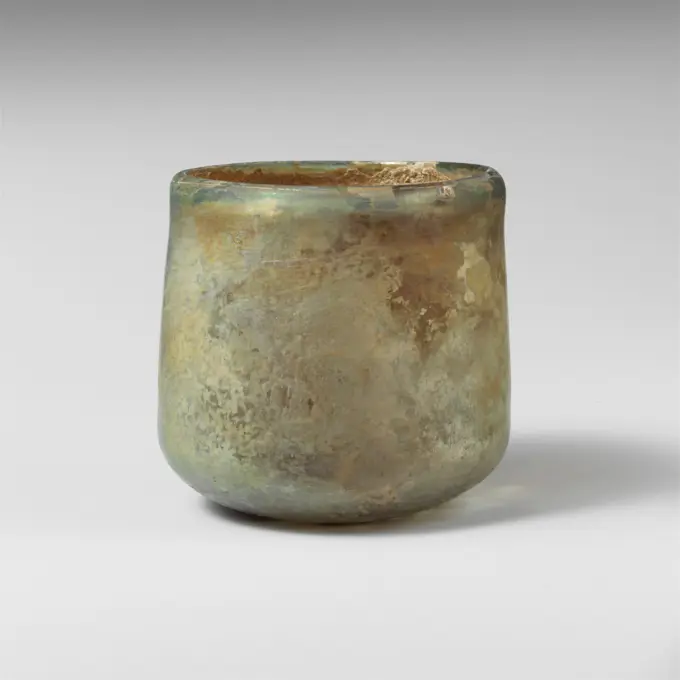
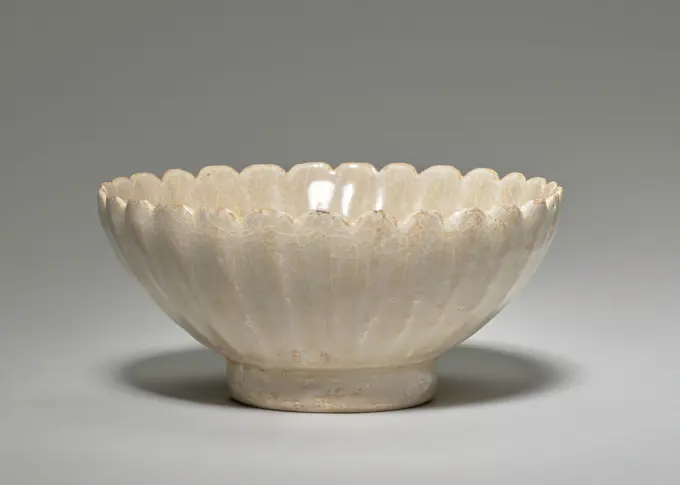
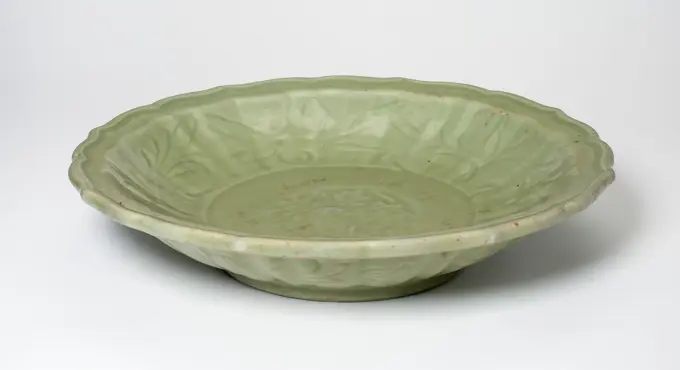
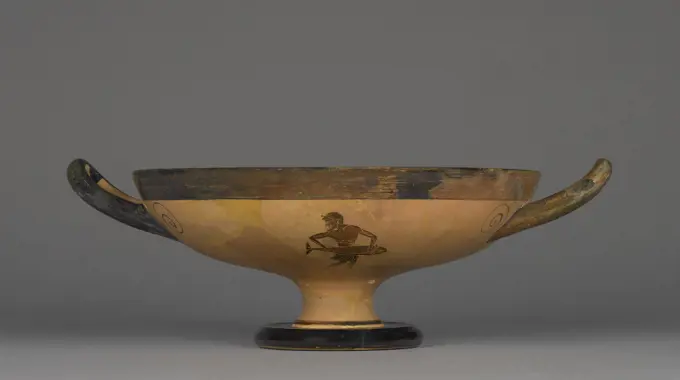
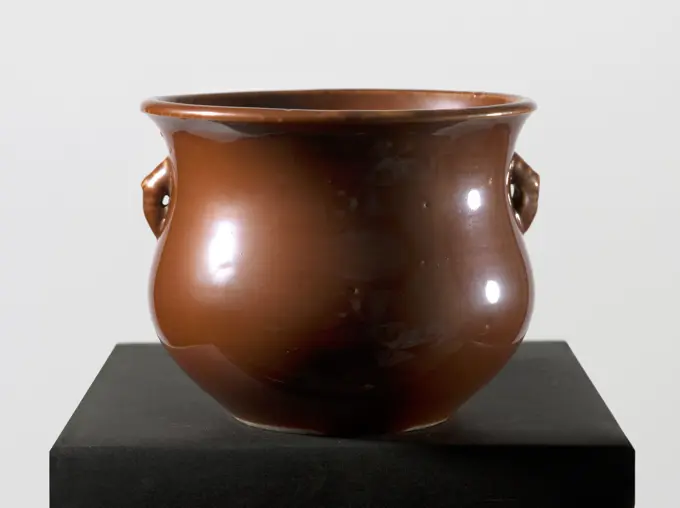
. Tea bowl of stoneware, partly covered with a gray-brown glaze. The center has been raised and the edge is in a golden metal band. The underside of the bowl is unglazed. Old label on the bottom with 'W020'. Jian.Bowl China. Bowl 52630Bowl, anonymous, c. 1175 - c. 1224 White beige bowl of very fine earthenware (quartz fritry). Low, hollow foot. Right outstanding wall. A lead glaze layer is applied directly to the shard, which only leaves the foot uncovered. Decoration is applied in three ways; In the first place, a medallion with flower vines and a circle are engraved in the shard in two places on the inside. These drags are filled with enamel, causing them to stand dark against the background. In addition, gaps were drilled through the shard in the drags. Because these holes are filled with glaze, they are somewhat transparent. Finally, blue lead glaze is applied on the inside in three places, under the glaze. Iran earthenware. glaze. cobalt (mineral) engraving / painting / vitrification White beige bowl of very fine earthenware (quartz fritry). Low, hollow foot. Right outstanding wall. A lead glaze layer is applied directly to the shard, which only leaves the foot uncovered. Decoration is applied in three ways; In. Come from quartz frying goods, decorated with sludge and colors under transparent alkali acid. On the bottom a stylized flower and on the inner edge four times the same kind of flower, separated by tendrils and curl.Teabowl with a red green glaze, anonymous, anonymous (attributed to), c. 1650 - c. 1749 Theekom van Steengoed, partially covered with a red -green glaze. The lower part of the bowl is unglazed. Gold paint repair in the edge and wall. Raku. Japan stoneware. glaze vitrification Theekom van Steengoed, partially covered with a red -green glaze. The lower part of the bowl is unglazed. Gold paint repair in the edge and wall. Raku. Japan stoneware. glaze vitrification. Come of pottery covered with a creme-colored sludge engine from which a tire with three stylized birds has been cut; Covered with a transparent alkalilation.Bowl - Inconnu / UnknownGlass bowl. Culture: Roman. Dimensions: Height: 2 in. (5.1 cm)Diam.: 3 7/8 x 2 5/8 in. (9.8 x 6.7 cm). Date: 2nd-3rd century A.D..Colorless with pale blue green tingeVertical, rounded, and thickened rim; vertical sides to body, then curving in to applied base ring; slightly uneven, flat base with central pontil scar and kick on interior.Broken and repaired, part of rim and upper side missing, and one hole in lower body; pinprick bubbles and blowing striations; pitting, dulling, and iridescent weathering covering entire surfaces. Museum: Metropolitan Museum of Art, New York, USA.Qingbai Ware Bowl, 1100s-1200s. South China, Southern Song dynasty (1127-1279). Porcelain with pale bluish-white glaze, Qingbai ware; silver mount; bowl: 8 x 14.7 cm (3 1/8 x 5 13/16 in.).Bowl with Incised Peony Designs. Thailand, Sawankhalok, Sri Satchanalai, 15th century. Furnishings; Serviceware. Stoneware with celadon glazeBol ". GRS covered olive. Paris, Muse Cernuschi. He was Asian art, extreme-East art, Vietnamese art, bowl, ceramic, gres, dishesRibbed saucer-dish with an incised decoration, anonymous, anonymous (rejected attribution), c. 1300 - c. 1500 Scale of stoneware with a ribbed wall, partially covered with a green glaze. The lower part is unglazed. Circles and a breached band with a wavy line on the front. Celadon. Sawankhalok stoneware. glaze engraving / vitrification Scale of stoneware with a ribbed wall, partially covered with a green glaze. The lower part is unglazed. Circles and a breached band with a wavy line on the front. Celadon. Sawankhalok stoneware. glaze engraving / vitrificationGlobular Bowl 600 CE-650 CE China. Glazed stoneware .Glass bowl 4th century A.D. Roman Translucent blue green.Rim slightly everted with rounded lip; below, broad tubular cordon made by folding; body tapering downwards with concave side, then curving in to tall, outsplayed tubular foot ring, made by folding; convex bottom with thick central dome and large pontil scar.Intact; some pinprick bubbles; much of surfaces covered with limy encrustation, dulling, and iridescent weathering.Large green bowl with foot and moulded rim; colored blown glass.. Glass bowl. Roman. 4th century A.D.. Glass; blown. Late Imperial. GlassMosaic Bowl; Eastern Mediterranean; end of 1st century B.C. - 1st century A.D; Glass; 3.8 x 9.5 cm (1 1,2 x 3 3,4 in.)Bol (common name), 1500. Covered sandstone. Cernuschi Museum, Asia Museum of Asia in the city of Paris.Dish ca. 550 B.C. Etruscan Shallow dish without foot; no decoration.. Dish. Etruscan. ca. 550 B.C.. Terracotta; bucchero. Archaic. VasesStone bowl. Culture: Roman. Dimensions: maximum diameter 4 7/8in. (12.4cm). Date: 1st century B.C.-1st century A.D..This bowl, made from granite, is a rare surviving example of the hard-stone vessels that were highly prized by wealthy Romans. Museum: Metropolitan Museum of Art, New York, USA.Andesite mortar or plate ca. 1600-1050 B.C. Cypriot The bowl has a ring foot and the edge is slightly nicked.. Andesite mortar or plate 243926Glass bowl 1st century B.C. Greek Translucent deep golden brown.Vertical rim with rounded edge; convex curving side tapering downwards to flat bottom within integral outsplayed, slightly oval base ring with thick rounded edge.Intact; some pinprick bubbles, a few larger bubbles and striations; dulling, pitting, and faint iridescence.Rotary grinding marks on interior and exterior.. Glass bowl 245286Bowl, 618-906. China, Tang dynasty (618-907). Glazed earthenware; diameter: 10.1 cm (4 in.).Burnt-énéns (common name). Celadon coverage sandstone. Cernuschi Museum, Asia Museum of Asia in the city of Paris.Hexagonal dish 19th century China. Hexagonal dish 46611Bowl with scrolls and a panel in reserve, anonymous, c. 1000 - c. 1199 Come of earthenware decorated in sgraffito (entered) lines and green lead glaze with an oval and circles on curls with a hourglass -shaped cartouche. On a Engobe of white sludge. Amol earthenware. glaze engraving / painting / vitrification Come of earthenware decorated in sgraffito (entered) lines and green lead glaze with an oval and circles on curls with a hourglass -shaped cartouche. On a Engobe of white sludge. Amol earthenware. glaze engraving / painting / vitrificationBowl - Portneuf pottery Inconnu / UnknownBowl, 1368-1644, 4 1/2 x 6 1/2 x 6 1/2 in. (11.43 x 16.51 x 16.51 cm), Pottery, China, 14th-17th centuryPainted Bowl with Fish and Lotus Design. Pakistan; Ancient region of Gandhara. Date: 401 AD-500 AD. Dimensions: 6.1 × 15.8 × 15.7 cm (2 3/8 × 6 3/16 × 6 3/16 in.). Terracotta with black pigment. Origin: Gandhara. Museum: The Chicago Art Institute, Chicago, USA.Glass ribbed bowl late 1st century B.C.-early 1st century A.D. Roman Translucent cobalt blue.Slightly outsplayed rounded rim; deep sides with plain band around top, curving in to slightly concave bottom.On interior, one wide horizontal groove below rim, and two narrow, close-set abraded grooves cut in a band around middle of body; on exterior, twenty-five long, shallow, vertical ribs, tapering downwards and extending to edge of bottom.Intact, but some internal cracks; pinprick bubbles; dulling, briiliant iridescence, and patches of thick creamy weathering.Rotary grinding marks on interior and on plain band around top of sides.. Glass ribbed bowl 249445. Tea bowl of stoneware, partly covered with a black glaze with golden brown stripes (hazel). The lower half of the bowl is unglazed. The edge is caught in a metal band. Jian.Bowl; wood, turned and paintedGlass bowl late 1st century B.C.-mid-1st century A.D. Roman Translucent yellow green.Upright rounded and slightly uneven rim of varying thickness; convex side, tapering downward; concave bottom.On interior, two widely-spaced horizontal grooves below rim.Intact; many bubbles; dulling and pitting, deeply weathered with some patches of thick creamy iridescent weathering; many surfaces scratches.. Glass bowl. Roman. late 1st century B.C.-mid-1st century A.D.. Glass; cast and cut. Early Imperial. GlassTest of red earthenware, square model with round bottom, on three legs, bandoor, test fire test heating floor finding ceramic earthenware glaze lead glaze, bottom 13.0 hand turned hand shaped glazed baked Fire test of red earthenware entirely with lead glaze covered quadrilateral with pinched ear on one corner three legs rotations archeology Valckensteyn Poortugaal Albrandswaard indigenous pottery kitchen fire footstep hand warmer foot warmer Soil discovery: canal at kitchen castle Valckensteyn at Poortugaal now Albrandswaard 1962.PIEZA DE AJUAR DE LA EDAD DEL BRONCE: CUENCO LISO CON MAMELON DE CERAMICA, PROCEDENTE DE LA CUEVA DE ESTREMERA (DEPOSITO: MUSEO ARQUEOLOGICO NACIONAL).Bowl with bosses and petals. Dimensions: H. 4.4 cm x Diam. 17.6 cm. Date: 4th century B.C..The heavy silver vessels 18.2.13-18.2.17 are in created in a decorative style widespread in the Greek world, and can be dated to the fourth century BC. They. are said to have been found together in the Egyptian Delta. Several of the vessels have small Demotic designations scored into the rim recording the weight of the silver, which correlated with the vessel's value. Museum: Metropolitan Museum of Art, New York, USA.Pan c 1825 Mantua. Blown glass . Mantua Glass WorksTerracotta skyphos (deep drinking cup). Culture: Greek, Euboean. Dimensions: H. 3 3/8 in. (8.6 cm). Date: 1st half of 8th century B.C..Known as "pendant semicircle skyphoi," these vases have been found throughout the Greek world and the Levant wherever the far-flung Euboean trade and colonization extended. For all their artistic simplicity, their wide distribution makes them important chronological and cultural markers. Museum: Metropolitan Museum of Art, New York, USA.Bowl ca. 550-450 B.C. Italic-Native, South Italian (Daunian). Bowl 255217 Italic-Native, South Italian (Daunian), Bowl, ca. 550450 B.C., Terracotta, H. 8.51 cm. Diameter 15.49 cm.. The Metropolitan Museum of Art, New York. Rogers Fund, 1966 (66.11.7)Bowl Made 1760-1769 Staffordshire. Lead-glazed earthenware (creamware) . Staffordshire PotteriesBowl 4th-7th century Coptic. Bowl 478866Bowl, Mold-pressed and tooled glass, Rounded body of greenish glass with iridescence. Vessel has contracting concave neck, continued in eighteen vertical ribs at the center of the vessel's body. Design shows derivation of Lotus-petal design., Eastern Mediterranean, 1st century A.D., glasswares, Decorative Arts, BowlBowl with incised flower and scrolls, anonymous, c. 900 - c. 999 Come from earthenware decorated with sgraffito and spa pigment in the colors yellow, green and manganese brown on a white sludge engobe. On the bottom and the inner wall a floured flower with ranks between the leaves. On the outer wall lines in color. Nishapur earthenware. glaze painting / engraving / vitrification Come from earthenware decorated with sgraffito and spa pigment in the colors yellow, green and manganese brown on a white sludge engobe. On the bottom and the inner wall a floured flower with ranks between the leaves. On the outer wall lines in color. Nishapur earthenware. glaze painting / engraving / vitrificationGlass dish 4th century A.D. Roman Colorless with very pale green tinge.Rounded rim folded out and down; straight side to body, tapering downwards then curving slightly outward; tall, integral, tubular foot ring, made by folding with deep creease on interior; almost flat bottom with thickened dome and pontil scar at center.Intact; pinprick and some elongated horizontally bubbles; dulling, pitting, iridescence, and yellowish brown weathering on exterior, with some whitish iridescent weathering on interior.Thick yellowish shallow blown glass bowl with base.. Glass dish. Roman. 4th century A.D.. Glass; blown. Late Imperial. GlassBowl. Culture: Coptic. Dimensions: H: 2 3/16in. (5.6cm); Diameter: 4 15/16in. (12.5cm). Date: 4th-7th century. Museum: Metropolitan Museum of Art, New York, USA."Ear Cup" (Erbei) for Wine, 206 BC - AD 220. China, Han dynasty (202 BC-AD 220). Lead glazed earthenware; overall: 10.8 cm (4 1/4 in.).Imitation Splashware Dish. Dimensions: Diam. at rim 13 9/16 in. (34.5 cm)Diam. at base 5 1/4 in. (13.4 cm)H. 2 3/8 in. (6 cm). Date: 10th century.This dish's decoration of concentric bands and gridded central roundel are typical of Nishapur splashware, and several other examples like this one were found during the excavations. Unusual, however, is the purplish-black glaze, which has disintegrated in some areas, leaving blank spots on the surface of the dish. Museum: Metropolitan Museum of Art, New York, USA.Misa unknownBowl with scrolls, anonymous, c. 1170 - c. 1199 Come from quartz-fritgoed covered with a white Tin-Lood-Alkiliglaze on which a decoration of ranks in Luster. is the earthenware. glaze. luster (textile) painting / vitrification Come from quartz-fritgoed covered with a white Tin-Lood-Alkiliglaze on which a decoration of ranks in Luster. is the earthenware. glaze. luster (textile) painting / vitrificationsmall Cylindrical Jar. Dimensions: H. 8 cm (3 1/8 in.); Diam. of rim 10.9 cm (4 5/16 in.); diam. of base 10.2 cm (4 in.). Dynasty: Dynasty 18, early. Reign: reign of Thutmose I-early sole Thutmose III. Date: ca. 1504-1447 B.C.. Museum: Metropolitan Museum of Art, New York, USA.Bronze beaker. Culture: Greek. Dimensions: H. 15.0 cm.diameter 15.5 cm.. Date: 5th-4th century B.C..Beaker that widens from the foot upwards. Undecorated band at the lip. The body is enveloped by overlapping lotus petals that rise from the plain band at the base. Museum: Metropolitan Museum of Art, New York, USA.Jar, c. 5th-2nd century BCE, 4-9/16 x 4-15/16 x 4-15/16 in. (11.6 x 12.5 x 12.5 cm), Pottery, pigment, Vietnam, 6th-1st century BCELotus Bowl, 1200s. China, Zhejiang province, Longquan region, Southern Song dynasty (1127-1279). Green-glazed porcelaneous stoneware, Longquan ware; diameter: 21.6 cm (8 1/2 in.); overall: 10.5 cm (4 1/8 in.).Lobed Lotus-Petal Bowl with Foliate Handles 1701-1800 India. Jade . MughalGlass bowl decorated with geometric patterns. Culture: Roman. Dimensions: H. 1 13/16 in. (4.6 cm)diameter 4 7/16 in. (11.2 cm). Date: 4th century A.D..Colorless with a greenish tinge.Vertical ground rim; hemispherical body; small, slightly pushed-in bottom.Six registers of cut decoration on exterior, each within horizontal grooves: (1) below rim, fine herringbone pattern facing to left; (2) lattice pattern of 22 rectangles, flanked to either side by two vertical grooves, and within each, four smaller rectangles, each with a diagonal cross, forming a larger diamond in each larger rectangle; (3) a broad band covering much of side, with three main designs: a latticed lozenge, a rosette with eight petals within two overlapping squares forming an eight-pointed star, and a large rosette (one with 13 petals, the other with 16), each repeated twice, enclosed by two intersecting continuous garlands, and in spandrels above and below the garlands, smaller stars or rosettes; (4) a narrow band Earthenware bowl or cooking pot on three legs, one lying and one standing ear, glazed, cooking pot crockery holder kitchen utensils earthenware ceramics earthenware glaze lead glaze, hand turned set glazed baked Kebab of red earthenware in- and outside light brown glaze one pinched flat ear one pinched upright ear restoration in gypsum three legs cover edge rings. Half-round bottom short side wall and wide outstanding top edge archeology Valckensteyn Poortugaal Albrandswaard indigenous pottery kitchen cooking nutrition food food Soil discovery: canal at kitchen castle Valckensteyn at Poortugaal now Albrandswaard 1961.Bol ". GRS covered transparent green reflections. Paris, Muse Cernuschi. He was Asian art, extreme-East art, Vietnamese art, bowl, ceramic, gres, dishesGlobular pot with small flared collar ". Terracotta. Vietnam-Xe-Xive s. Paris, Cernuschi museum. 72186-22 Vietnamese object, Small Evase Col, Globular Pot, TerracottaSaucer: Ding ware, 1100s-1200s. China, Jin dynasty (1115-1234) - Yuan dynasty (1271-1368). Porcelain; diameter: 14.6 cm (5 3/4 in.).Bowl (one of a pair) 12th-13th century China Like this piece, most Jun wares were fired twice to get the effect of the thick, soft blue glaze. Purple splashes are produced by adding copper oxide to the glaze.. Bowl (one of a pair). China. 12th-13th century. Stoneware with splashed glaze (Jun ware). Jin dynasty (1115-1234). CeramicsMedium-sized Dish from Dining Set with Plum Blossoms and Cracked-Ice, c. 1875-78. Seifū Yohei II (Japanese, 1844-1878). Porcelain with molded designs; overall: 3.2 x 16.4 cm (1 1/4 x 6 7/16 in.).Chalcolithic period vessels Teleilat el-Ghassul; Jericho; Palestine circa 3000 BCEMiniature Flared Bowl Depicting Abstract Peppers with Decorative Motifs Made 180 BCE-500 CE Peru. Ceramic and pigment . NazcaFaience bowl 2nd-1st century B.C. Greek, Ptolemaic The decorative scheme of this bowl, large petals separated by triangular zones of stacked ferns or pine cones, illustrates the close correspondance between faience and Megarian wares, two types of kiln fired objects ornamented with designs normally associated with silver vessels.While Megarian bowls were made in many places within the Mediterranean basin, faience seems to have been produced solely in Egypt, most likely Alexandria, its artistic and commercial center during the Hellenistic period.The broad appeal of faience bowls, therefore, is attested by their diverse geographical find-spots, such as; the Greek island of Rhodes, Asia Minor (Turkey), Palastine and, Apulia in Southern Italy.. Faience bowl 250534 Greek, Ptolemaic, Faience bowl, 2nd1st century B.C., faience, h. 4 1/10 in. (10.5 cm); d. 6 4/5 in. (17.2 cm). . The Metropolitan Museum of Art, New York. Gift of J. Pierpont Morgan, 1917 (17.194.2536)Bowl with with Design of Pine, Bamboo, and Cherry Blossom 19th century Japan. Bowl with with Design of Pine, Bamboo, and Cherry Blossom 57872Bowl. Culture: Coptic. Dimensions: Overall: 1 7/8 x 4 3/4 in. (4.8 x 12.1 cm). Date: 4th-7th century. Museum: Metropolitan Museum of Art, New York, USA.Glass bowl. Culture: Roman. Dimensions: 1 3/8 x 5 13/16in. (3.5 x 14.8cm). Date: 4th century A.D..Colorless.Broad horizontal rim with rounded lip and folded tubular bulge; convex side, tapering downwards to bottom with deep kick and central circular pontil mark; tubular base ring at junction of side and bottom.Intact; pinprick bubbles; most of surface covered with brown weathering, pitting, and iridescence. Museum: Metropolitan Museum of Art, New York, USA.. Bowl of pottery, decorated with ingrangled decorations and covered with white sludge and green, yellow manganese in transparent lead glaze in green and yellow. On the inside a large inguity flower with curlwork and tendrils between the leaves.Ribbed Bowl. Unknown. Come of pottery decorated with polychrome decoration of green and yellow lead glazes and manganese brown sludge next to Sgraffito leaf motifs and curlwork on Engobe of white sludge.Gray bowl on small standing surface, curved upper edge, Roman, bowl crockery holder soil find ceramic pottery, hand-turned frying Deep bowl on small standing surface Curved side wall Inward facing top edge Two rotations along the outside. Standing surface with subtraction traces Coarse gray earthenware. Roman archeology Valckensteyn Poortugaal Albrandswaard indigenous pottery import rubbing grinding food preparation cooking Soil discovery Poortugaal Castle Valckensteyn.Kylix, Black-figured earthenware, Wide shallow bowl on flaring foot, two loop handles oriented horizontally. Exterior decorated with two groups of young men armed with spears, facing central figure of Dionysus who holds drinking horn. Above, a double ivy wreath border; below, meander and rays. Interior centered with confronting cloaked figures holding spears. Red and black on red ground., Greece, 6th century BC, ceramics, Decorative Arts, KylixDish from Dishes with Ivy, c. 1893-1914. Seifū Yohei III (Japanese, 1851-1914). One from a set of five dishes; porcelain with green glaze and molded designs; overall: 3.5 x 11 cm (1 3/8 x 4 5/16 in.).Glass beaker 2nd-3rd century A.D. Roman Translucent pale blue green.Rounded, thickened rim, folded slightly inwards; flaring mouth; indented body with slightly bulbous sides, tapering downwards; squarish, pushed-in bottom.Cylindrical body has four large indentations extending from below mouth to rounded edge of bottom, giving body horizontal cross section that appears to be square with prominent rounded corners.Intact; some pinprick bubbles; dulling and creamy brown weathering on exterior; some soil encrustation and limy weathering on interior.. Glass beaker 244693Vessel. Egypt, Predynastic Period (5500 - 3100 BCE). Furnishings; Serviceware. CalciteGlass ribbed bowl 1st century A.D. Roman Translucent pale blue green.Vertical rim with rounded top edge; plain, almost vertical band around top of sides, then bulging outward before curving in sharply to flat bottom.On interior, three concentric grooves around outer edge of bottom and small, broader circle at center; on exterior, eighty-five vertical ribs of slightly varying length and width, with tops ground off, arranged around bulging middle section of body.Intact; a few pinprick bubbles; deep pitting, dulling, and brilliant iridescence with patches of thick creamy weathering.Rotary grinding marks on plain band around top of sides.Greenish ribbed bowl.. Glass ribbed bowl 244620Incised Painted Bowl. Culture: Paracas. Dimensions: diameter 5-1/2 in.. Date: 5th-2nd century B.C.. Museum: Metropolitan Museum of Art, New York, USA.Bowl, A.D.150-250, Ceramic, 8.89 × 21.59 cm (3 1/2 × 8 1/2in.), Tunisian,Roman, Roman, Containers -CeramicsRibbed Bowl. UnknownBurial Urn with Stamped Design, 500s-600s. Korea, Unified Silla period (676-935). Stoneware with stamped designs under olive-green glaze; diameter: 11.2 cm (4 7/16 in.); average: 8.2 cm (3 1/4 in.). After the introduction of Buddhism, cremation became a common practice in Korea. This jar, which once contained the remains of the dead, may have nested in a larger stone container. The repetitive patterns that appear on the lid and the container was done with a stamping technique.Bowl with LotusPetalsFooted Cup. China. Date: 550 AD-577 AD. Dimensions: H. 11.3 cm (4 7/16 in.); diam. 12.2 cm (4 13/16 in.). Earthenware with brown and lead green glazes. Origin: China. Museum: The Chicago Art Institute, Chicago, USA.. Come of pottery decorated with black sludge on Engobe of white sludge. With greenish transparent lead glaze. The inner wall is divided into four compartments, separated by decorative tires. In the boxes a medallion.Bowl. Culture: Coptic. Dimensions: Overall: 2 1/16 x 4 3/16 in. (5.2 x 10.7 cm). Date: 4th-7th century. Museum: Metropolitan Museum of Art, New York, USA.Footed Bowl late 16th-early 17th century Japan Objects of this type, covered with black and red lacquer, are known as Negoro ware after an eponymous temple in Wakayama where such works were often produced.. Footed Bowl. Japan. late 16th-early 17th century. Negoro ware; red lacquer over black lacquer. Momoyama period (1573-1615). LacquerTerracotta bowl 1st half of 1st century A.D. Roman Red-glazed cup with base and incised band; potter's stamp; terra sigillata.. Terracotta bowl. Roman. 1st half of 1st century A.D.. Terracotta; Arretine ware. Early Imperial, Julio-Claudian. VasesTerracotta kylix (drinking cup) ca. 540 B.C. Attributed to the Group of Rhodes 12264 Battle of Greeks and Amazons (Amazonomachy). Terracotta kylix (drinking cup). Greek, Attic. ca. 540 B.C.. Terracotta; black-figure. Archaic. VasesGlass cup 2nd-3rd century A.D. Roman Translucent pale blue green.Thickened, rounded, vertical rim with inner lip; straight sides expanding slightly downwards, then turned in at sharp angle to bottom with pointed kick at center.Intact; some pinprick and a few larger bubbles and blowing striations; dulling and iridescence on exterior; limy encrustation and creamy weathering on interior.. Glass cup 244615Wine Cup, 14th-15th century, 1 13/16 x 4 in. (4.6 x 10.16 cm), Stoneware and celadon glaze, Vietnam, 14th-15th centuryBowl with Peony Scrolls, Thunderbolt (Vajra) Symbol, and Characters Shufu (Privy Council). China. Date: 1301-1350. Dimensions: H. 9.7 cm (3 13/16 in.); diam. 20.8 cm (8 3/16 in.). Luanbai (eggshell white) ware; porcelain with underglaze molded decoration and inscription in raised slip. Origin: China. Museum: The Chicago Art Institute, Chicago, USA.Dish with Flowers and Foliate Rim 1368-1644 China. Celadon-glazed porcelain with underglaze molded decoration .Pot. Terre to which. Vietnam. Paris, Muse Cernuschi. Pot Asian art, art of extreme orient, art of Vietnam, Vietnamese art, terracotta, dishesBowl fragment ca. 5600-5000 B.C. Halaf This bowl has been pieced together from seventeen sherds. Approximately half of the rim is preserved with the exterior and inner side decorated with brown paint on a buff background typical of pottery belonging to the Halaf culture. A lozenge pattern with central dots decorates the exterior and lozenges and striations adorn the inner rim. Halaf pottery is remarkable for the quality of its production and, as a result, often survives at sites dating to this period.. Bowl fragment. Halaf. ca. 5600-5000 B.C.. Ceramic. Halaf. From Syria, Tell Halaf (ancient Guzana)Dish with Inlaid Chrysanthemum Design, 1200s. Korea, Goryeo period (918-1392). diameter of mouth: 13.4 cm (5 1/4 in.). Celadons wares used for everyday such as this dish were among the most common burial objects in tombs during the Goryeo period (918-1392). Furnishing tombs with an elaborate assemblage of objects was believed to honor and comfort the newly dead. Generally, Goryeo tombs were left untouched until the late 19th century. During the colonial period (1910-45), however, Japanese archaeologists competitively excavated the tombs located in Kaeseong, the former capital of the Goryeo period, and these wares soon became available for Japanese and Western collectors.Small Bowl (Wan) in the Form of a Gardenia. China, Jiangxi Province, Jingdezhen, Chinese, Middle Qing dynasty, about 1700-1800, but with Ming dynasty Chenghua mark, 1465-87. Furnishings; Serviceware. Wheel-thrown porcelain with incised decoration and clear glazeConical Bowl 1101-1150 China. Cizhou type ware; stoneware with brownish-black glaze .Cup ". Terracotta, brown, green and white glaze (Sancai). China, Tang dynasty (618-907). Paris, Cernuschi museum. Chinese art, Chinese ceramic, container, cup, tang dynasty, container, terracottaAnonymous / "Escudilla", Second half of the 17th century, Ceramics (Fine painted porcelain), 5 x 11.4 cm.Wine Cup with a Fishmonger; Attributed to an artist close to the Theseus Painter (Greek (Attic), active about 510 - about 490 B.C.); Athens, Greece; about 525 - 500 B.C; Terracotta; 8.5 × 26.7 cm (3 3,8 × 10 1,2 in.)Jar, c. 1000 BCE, 8 7/8 x 9 7/16 in. (22.5 x 23.97 cm), Earthenware with impressed designs, Thailand, 11th-10th century BCEIncense burner. Red -cut brown covered porcelain. Paris, Cernuschi museum. 78838-22 Asian art, Chinese art, porcelainBowl (see also 1975.1.1750) 19th century Chinese. Bowl (see also 1975.1.1750) 461507