My Boards
View Pictures
  • My Boards
← Science

Botanical Illustrations of Plants

Intricate black and white botanical drawings of various plants, highlighting structures, flowers, and roots, emphasizing their natural beauty and complexity.

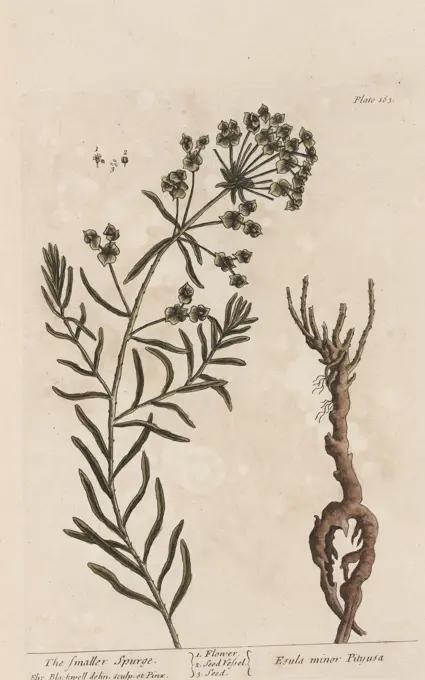
The Smaller Spurge, 1751. Published in London by John Nourse. Botany, Medical
248 assets in this story
6145-59691960
Part of the human body with a deviation, Isaac Weissenbruch, 1836 - 1912 print  Netherlands paper  anatomy (non-medical). diseases
6145-59354513
Chondrus mamillosus, Anna Atkins, c. 1843 - c. 1853 photograph  United Kingdom photographic support cyanotype algae, seaweed
6145-52339688
Le Velar, ou la Tortelle.. Regnault, Nicolas-François, 1746-1810. Prints, Scientific illustrations, Botanical illustrations. 1774. General Research Division. Plants, Botany
6145-52339525
Le Mille-Pertuis.. Regnault, Nicolas-François, 1746-1810. Prints, Scientific illustrations, Botanical illustrations. 1774. General Research Division. Plants, Botany
4443-73153117
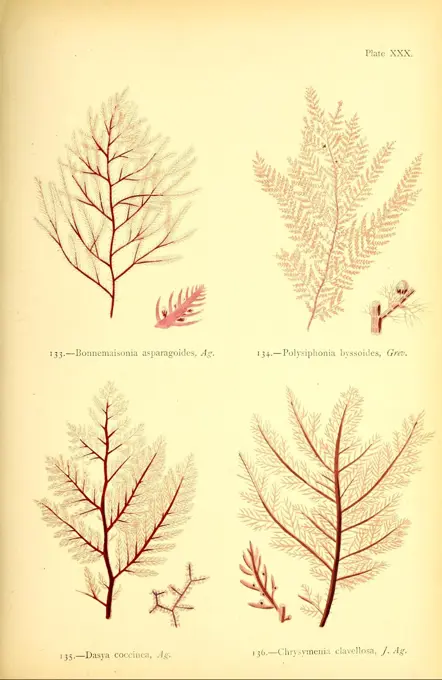
British sea-weeds London, Bell and Daldy, 1872. algae Great Britain marine algae, This illustration features a collection of various marine algae, each meticulously detailed to showcase their unique structures. In the top left corner, *Bonnemaisonia hamifera* displays its delicate, branching fronds, indicating its graceful form. Adjacent to it, *Polysiphonia lyassolica* is presented, characterized by its intricate, filamentous branches that reveal the complexity of its growth. The lower section features *Dasya coccinea*, which exhibits a bushy appearance with a vibrant, fan-like structure, while *Chondrus crispus* showcases its finely divided, curled fronds. Each specimen is labeled, highlighting the scientific interest in these diverse seaweeds and their
4409-17357923
Extinct scale tree, Lepidodendron of the Carboniferous era. Illustration from Wilhelm Bolsches Das Leben der Urwelt, Prehistoric Life, Georg Dollheimer, Leipzig, 1932.
4443-73153179
Flora Berolinensis Berlin Die Schule 1757-1758 Ageratum conyzoides Berlin Botany Germany Nature prints Pictorial works Plants Specimens Botany libraries, The illustration features a delicate botanical study of a leafy stem, showcasing intricate details of the leaves and their arrangement along the slender stem. The leaves display a naturalistic depiction, with varying shades and textures enhancing their organic appearance. Additionally, there is a decorative red stamp at the top right corner, encircled by an ornate border, indicating perhaps a title or classification relevant to the specimen. The page is adorned with minor annotations, suggesting its scholarly or historical significance in the study of plants.
4443-73156777
Flora Brasiliensis Enumeratio plantarum in Brasilia hactenus detectarum Monachii et Lipsiae Munich & Leipzig, R. Oldenbourg, 1840-1906 Brazil Germany Engraving Botany 1840 Uncolored Botanists Pictorial works Graphic media, The illustration showcases a detailed botanical study of the Elleanthus species, specifically Elleanthus Brasilensis, as identified by H. van Hooker. At the center, a slender stem emerges with elongated, lance-shaped leaves extending upwards. Surrounding the main plant feature are various smaller illustrations depicting the anatomical details of the flower's structure, including close-ups of individual petals, reproductive parts, and other floral characteristics. Each element is meticulously labeled, highlighting the intricacies of the plant, which serves as both an educational tool for botanical studies and an artistic representation of natural beauty.
4409-48150911
Selaginella jungermannioides fern. Lycopodium jungermannioides, Lycopodio a foglie di jungermannia. Handcoloured copperplate stipple engraving from Antoine Laurent de Jussieu's Dizionario delle Scienze Naturali, Dictionary of Natural Science, Florence, Italy, 1837. Illustration engraved by Stanghi, drawn and directed by Pierre Jean-Francois Turpin, and published by Batelli e Figli. Turpin (1775-1840) is considered one of the greatest French botanical illustrators of the 19th century.
6145-52339492
Le Lin commun.. Regnault, Nicolas-François, 1746-1810. Prints, Scientific illustrations, Botanical illustrations. 1774. General Research Division. Plants, Botany
1525-27953095
Caribbean corals and seas of America, vintage engraved illustration. Magasin Pittoresque 1878.
4409-71015
Chive garlic, Allium schoenoprasum. Handcoloured copperplate engraving from a drawing by James Sowerby for Smith's "English Botany," London, 1813. Sowerby was a tireless illustrator of natural history books and illustrated books on botany, mycology, conchology and geology.
6145-29260750
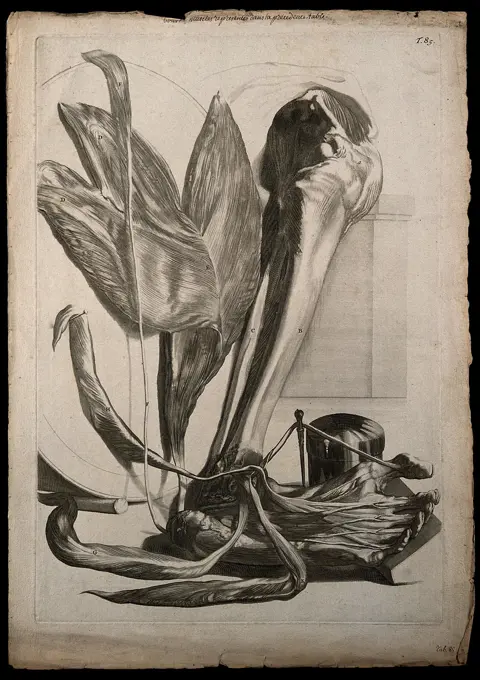
The muscles of the lower leg and the sole of the foot, dissected and separated, with the tibia and fibula exposed. Engraving after G. de Lairesse, 1739.
4443-73157415
Flora Brasiliensis, enumeratio plantarum in Brasilia hactenus detectarum, Monachii et Lipsiae Munich & Leipzig, R. Oldenbourg, 1840-1906, Brazil, Germany, engraving, botany, 1840, uncolored, botanists, pictorial works, graphic media, This illustration showcases the Govenia gardneri, a member of the orchid family. The artwork features the plants distinct elongated leaves, characterized by prominent ribbing that adds texture. To the right, clusters of delicate flowers emerge from a central spike, each one depicting intricate petal structures. Below the main drawing are smaller depictions of flower parts, including individual petals and reproductive structures, providing a detailed reference for botanical study. The overall composition highlights the unique features of the species, ideal for educational and identification purposes in the field of botany.
6145-50628590
Fossil plant specimen. Hymenophyllite or Trichomanites, circa 1864, by John Buchanan.
4409-66068
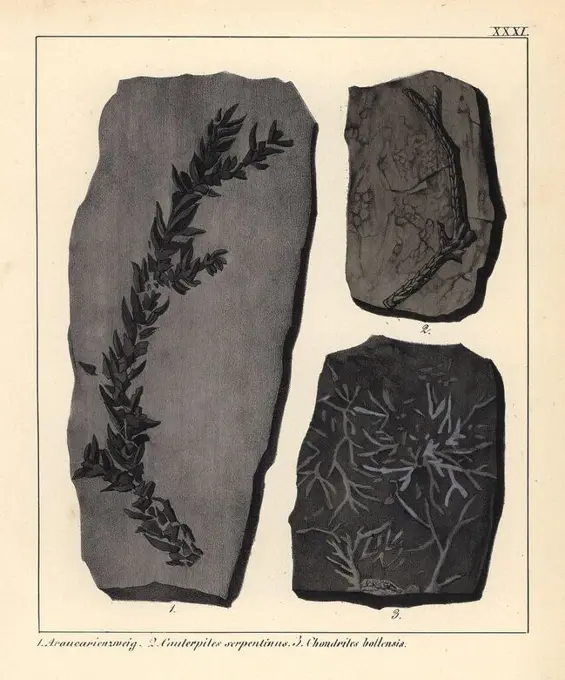
Extinct fossil plants: Araucaria, Cauterpites serpentinus and Chondrites bollensis. Handcoloured lithograph by an unknown artist from Dr. F.A. Schmidt's "Petrefactenbuch," published in Stuttgart, Germany, 1855 by Verlag von Krais & Hoffmann. Dr. Schmidt's "Book of Petrification" introduced fossils and palaeontology to both the specialist and general reader.
6145-29269174
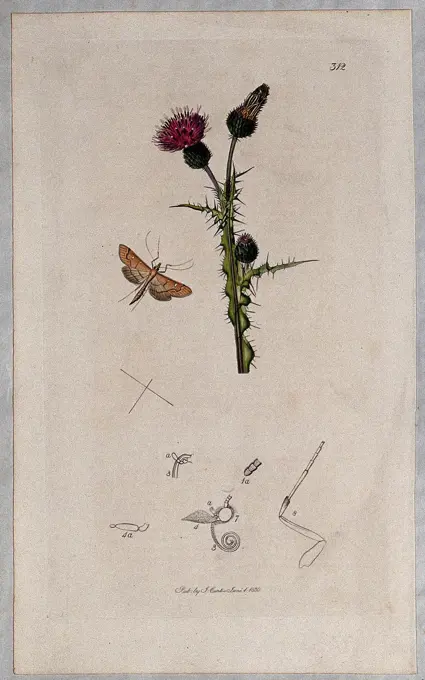
A blessed thistle (Cnicus palustris) with an associated insect and its anatomical segments. Coloured etching, c. 1830.
4443-73164247
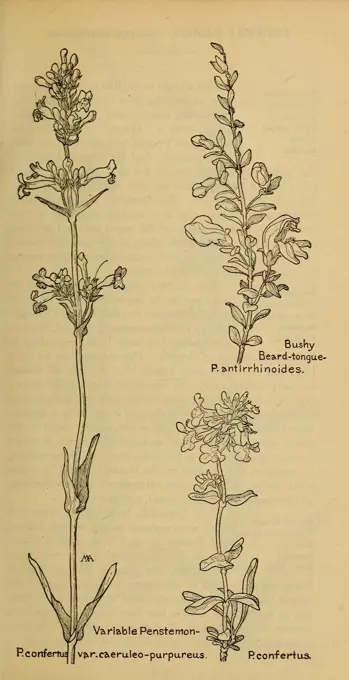
Field book of western wild flowers New York Putnam 1915 identification West US wildflowers Margaret Neilson Armstrong Margaret Neilson Armstrong Penstemon Antirrhinoides bushy beardtongue Penstemon Confertus var Caeruleo Purpureus yellow penstemon Penstemon Confertus variable penstemon women in science, This illustration features two distinct varieties of flowering plants. The left side depicts the Variable Penstemon (Penstemon confertus var. caeruleo-purpureus), characterized by its slender stem and elongated, bell-shaped flowers, which exhibit a transition of colors from blue to purple. The right side showcases the Bushy Beard-tongue (Penstemon anthrinoides), notable for its more robust appearance and dense cluster of tubular flowers that are typically arranged along the upper part of its stem. Each plant is labeled for easy identification, highlighting their botanical features and contributing to a greater understanding of plant diversity.
1848-50246384
Sugar cane (Saccharum officinarum), Historical, digitally restored reproduction of an original from the 19th century, exact original date unknown
4409-48155194
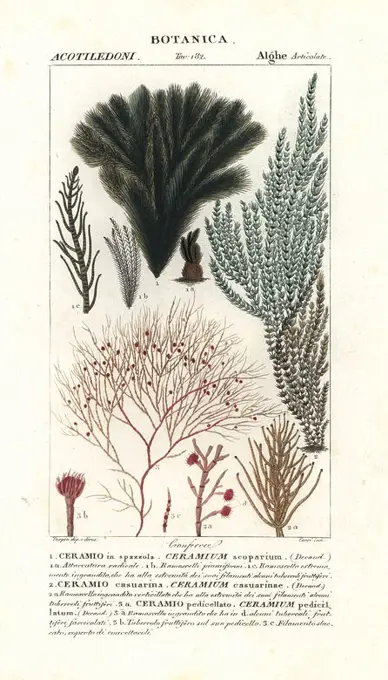
Red algae species Halopteris scoparia 1, Ceramium casuarinae 2, and Ceramium pedicellatum 3. Handcoloured copperplate stipple engraving from Jussieu's Dizionario delle Scienze Naturali, Dictionary of Natural Science, Florence, Italy, 1837. Illustration engraved by Corsi, drawn and directed by Pierre Jean-Francois Turpin, and published by Batelli e Figli. Turpin (1775-1840) is considered one of the greatest French botanical illustrators of the 19th century.
6145-59422649
Numbered anatomy of the arm, hand and shoulder, Jacob van der Schley, after Petrus Camper, 1762 print   paper etching / engraving parts of the human body (skeleton excepted). arms. hand
6145-52339589
La Pulmonaire de Chêne.. Regnault, Nicolas-François, 1746-1810. Prints, Scientific illustrations, Botanical illustrations. 1774. General Research Division. Plants, Botany
6145-52339447
La Gratiole, ou l'Herbe a Pauvre homme.. Regnault, Nicolas-François, 1746-1810. Prints, Scientific illustrations, Botanical illustrations. 1774. General Research Division. Plants, Botany
6145-59052917
Flower pale "; Wyspiały, Stanis Aw (1869-1907); 28.4.1897 (1897-00-00-1897-00-00); was downloaded from the Muse of the National Museum in Warsaw; drawing / O system tubes; products from W Laws / paper; Figure: height 20.9 cm, width 16.9 cm, passe-partout: height 50.0 cm, width 35.0 cm; manus 924/45 MNW; All rights reserved.National Culture Fund Józef Piłsudski (1928-1939) - collection, partage plus, flowers, herb
4443-73158796
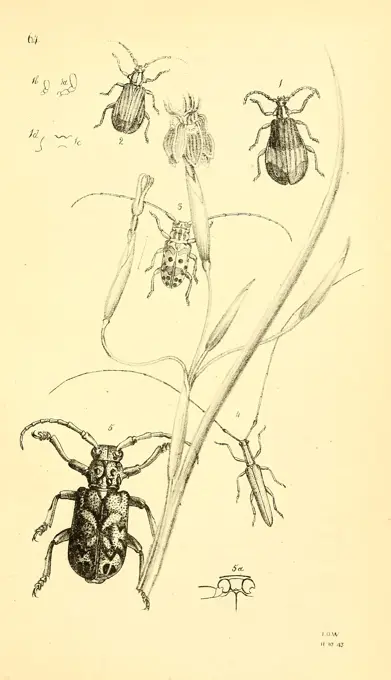
Arcana entomologica, or Illustrations of new, rare, and interesting insects, London, William Smith, 1845 i.e. 1841-1845, insects, arthropoda, entomology, classification, pictorial works, arthropod, The illustration showcases a variety of beetles, each intricately detailed to highlight their unique characteristics. At the center, a prominent beetle with a patterned shell is depicted in a larger size, showcasing its distinctive features, including long antennae and marked body texture. Surrounding it are smaller representations of additional beetles, each with different shapes and markings, nestled among slender grass-like plants. The illustration serves as a study of entomological diversity, emphasizing both the anatomical structure and natural habitat of these insects. Each beetle is numbered for reference, contributing to a scientific exploration of their classification.
6145-46461923
HALIDRYS MILIQUOSA, Β Minor; Toworch. .
4409-20990735
Cytinus hypocistis. Handcoloured copperplate engraving after an illustration by Richard Duppa from his The Classes and Orders of the Linnaean System of Botany, Longman, Hurst, London, 1816.
6145-52893395
Alpine Catchfly (Lychnis alpina) herbarium sheet, 1870.. Changing Planet Exhibition, Thinktank 2021
4443-73160542
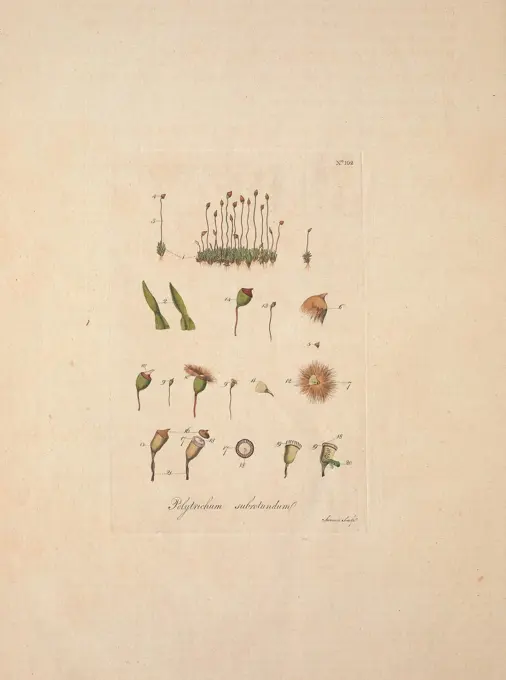
Nova Genera et Species Plantarum, Antverpiae, Ex Officina Christophori Plantini, 1576, botany, classification, pictorial works, plants, scientific expeditions, South America, The illustration features a delicate plant known as 'Linnea borealis,' characterized by its slender stem and small, rounded leaves that sprout from numerous branches. The plant stands upright with a detailed root system visible below. Surrounding the main depiction are various labeled illustrations of different parts of the plant, including flowers at different stages of development, leaf structures, and seeds, showcasing the botanical intricacies. Each section is meticulously rendered, emphasizing the unique characteristics of this plant variety. The overall composition highlights the beauty of botanical studies, combining scientific accuracy with artistic presentation.
4443-73159582
Field book of western wild flowers, New York, 1915, identification, west US, wildflowers, Margaret Neilson Armstrong, women in science, The illustration showcases two botanical specimens. At the top, Chylisma scapoidea var. claviformis is depicted, characterized by its slender stems and distinctive flowers that exhibit a delicate arrangement. Below, Sphero stigmat tortuosa is illustrated with a more intricate floral structure, featuring tightly clustered blooms and a unique leaf formation that gives it a distinctive appearance. The detailed lines capture the essence of each plant, highlighting their unique features for botanical study and appreciation.
4409-20935457
Thick gorgonia, Gorgonia crassa (Candelabra coral, Plexaura flexuosa). Illustration drawn and engraved by Richard Polydore Nodder. Handcoloured copperplate engraving from George Shaw and Frederick Nodder's The Naturalist's Miscellany, London, 1804.
6145-54373677
Tree Identification - Bumela. Photographs Relating to National Forests, Resource Management Practices, Personnel, and Cultural and Economic History
6176-59912055
The sylva americana; or, A description of the forest trees indigenous to the United States, practically and botanically considered . ulus canadensis. This species, like theVirginian poplar, has longbeen known in Europe. Itwas probably introduced intoFrance from Canada; suchat least is its origin indicatedby the name of CanadianPoplar. This tree growsin the upper part of the stateof New York on the banksof the river Genessee whichempties into Lake Ontario,in some parts of Virginiaand on several islands of theOhio. It is generally foundon the margin of rivers in afat, unctuous soil, exposedto in
4409-20993340
Common sugarcane, Saccharum officinarum. Handcoloured copperplate engraving after an illustration by Richard Duppa from his The Classes and Orders of the Linnaean System of Botany, Longman, Hurst, London, 1816.
6145-29247777
A thistle (Carduus arvensis) with an associated moth and its abdominal segments. Coloured etching, c. 1830.
6145-51420299
Calademia Specimens, 1917-1928, by Henry Matthews.
6145-55183571
Arachnanthe clarkei.. Moon, H. G. Sander, F. (Frederick), 1847-1920. Prints. 1888 - 1894. General Research Division. Botany, Orchids
4443-73157680
British, entomology, London, Printed for the author 1823-1840 i.e. 1840, botany, Great Britain, insects, pictorial works, The illustration features a detailed depiction of an insect, specifically a mosquito, shown in a naturalistic style at the top. Below the mosquito, there are botanical elements, possibly plants or flowers, which serve as a habitat or food source for the insect. Further along the page, there are labeled drawings of various anatomical features of the mosquito, including parts of its wings, legs, and head, showcasing the intricacies of its biology. Each labeled section provides educational insights into the insects structure, making it a valuable resource for entomological study.
6145-45990942
Kaempferia Galanga; Kæmpferia. Hort. Cliff. p. 2 sp. 1. At the top right labeled: Tab: III.
6145-54380185
Nurseries: Planting Stock - Minnesota. Photographs Relating to National Forests, Resource Management Practices, Personnel, and Cultural and Economic History
6145-48835444
Fossil of a trilobite. William Hart (British, active Birmingham, England 1860s)
4443-73156891
Flora Londinensis, or Plates and descriptions of such plants as grow wild in the environs of London London, Printed for and sold by the author and B. White, 1777. 18th century, botanical illustration, botany, England, engravings, herbals, London, plants, leaves, stems, flowers, The illustration showcases a detailed botanical study featuring various stages of the life cycle of a specific plant species, identified as 'Blysmus compressus.' It presents an array of labeled components, including seeds, germinated plants, and mature specimens. Each stage highlights distinct features such as leaf structure, stem growth, and reproductive elements. The meticulous rendering emphasizes the intricacies of the plant's anatomy, providing a clear reference for botanical identification and study. The layout is organized methodically, allowing for easy comparison and analysis of the different morphological characteristics of the species.
4443-73164148
Field Book of Western Wild Flowers, New York, 1915, identification, west US, wildflowers, Margaret Neilson Armstrong, Margaret Neilson Armstrong, Veronica americana, American Brooklime, Veronica wormskjoldii, Alpine Speedwell, Veronica tournefortii, Veronica officinalis var tournefortii, Hairy Speedwell, Common Gypsyweed, Taxonomy: Family = Plantaginaceae, Women in Science, The illustration features three botanical drawings of different species of speedwell plants. At the top left, the Hairy Speedwell (Veronica Tournefortii) is depicted with delicate flowers and slender leaves. Below it is the Alpine Speedwell (Veronica Wormskjoldii), showcasing its unique floral structure and growth pattern. The bottom right displays the American Brooklime (Veronica Americana), highlighted with its characteristic leaves and blossoms. Each plant is labeled with its scientific name, providing a clear reference for identification. The intricate details emphasize the beauty and variety found within these
4443-73164585
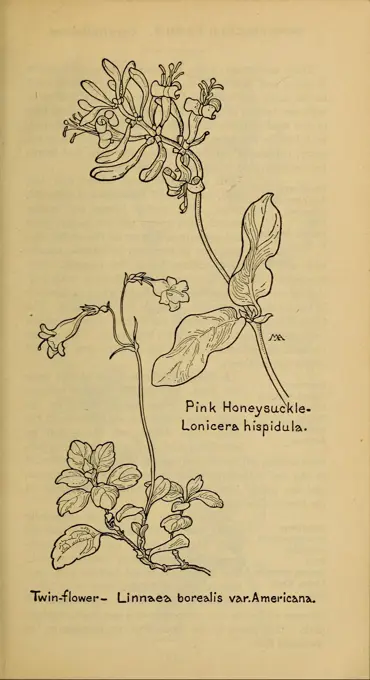
Field book of western wild flowers New York Putnam 1915 Identification West US Wildflowers Margaret Neilson Armstrong Margaret Neilson Armstrong Lonicera hispidula Pink honeysuckle Linnaea borealis var americana Twinflower Women in science, The illustration features two botanical representations. The upper section depicts the Pink Honeysuckle, scientifically known as Lonicera hispidula, characterized by its delicate blossoms and slender, climbing stems. Below it, the Twin-flower, identified as Linnaea borealis var. Americana, showcases its paired blossoms and characteristic trailing leaves. Both plants are presented with detailed annotations of their features, emphasizing their unique floral structures and the natural elegance of their forms.
4443-73149392
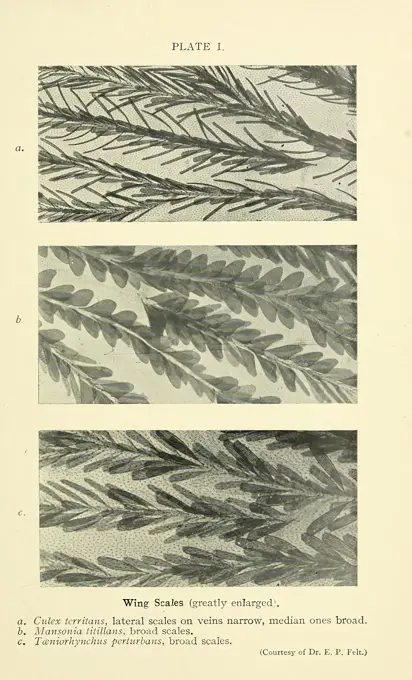
Mosquito Life New York G. P. Putnams sons 1907 mosquito insects Culex territans Mansonia titillans Aedes taeniorhynchus wings scales, The image presents a detailed illustration of insect wing scales, showcasing the intricate structures and patterns associated with different species. The first section, labeled 'a,' features the narrow lateral scales found on the veins of the wings of *Cules territis*. The second section, marked 'b,' highlights the broader scales of *Mansonia titillans*, illustrating the variation in scale width and texture. Lastly, the section labeled 'c' presents the scales of *Tavolrichus peturbass*, further emphasizing the diversity and complexity of wing scale morphology in these insects. Each section provides valuable insights into the unique characteristics of these species' wings.
1746-29952471
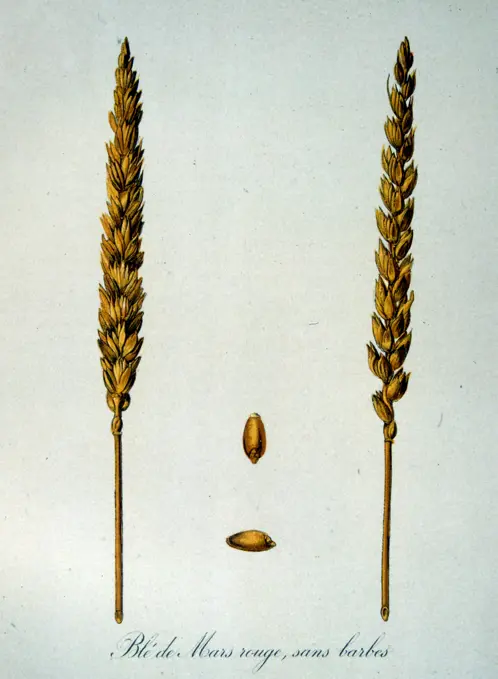
Les meilleurs bles. Description of types and cultivation of crops of corn, wheat oats, barley and other field crops. Published in 1880. chromolithograph by Eugene Graff
4443-73151607
Field book of western wild flowers, New York, 1915, identification, west US, wildflowers, Margaret Neilson Armstrong, Margaret Neilson Armstrong, women in science, A botanical illustration showcasing the twining Brodiaea, specifically Brodiaea volubilis. The artwork features a slender, winding stem adorned with delicate, bell-shaped flowers that cluster at the top. The intricate details of the petals and the graceful curvature of the stem emphasize the plant's natural elegance. The illustration is accompanied by the scientific name and indicates its twining habit, highlighting its growth pattern and botanical characteristics.
4409-164250
Eggs of the housefly, Musca domestica, magnified x75. Chromolithograph after an illustration by E.T.D., lithographed by Vincent Brooks, from "Graphic Microscopy" plates to illustrate "Hardwicke's Science Gossip," London, 1865-1885.
PREVIOUS
of 3
NEXT
2401 S. Ervay, Suite 206
Dallas, Texas 75215
United States
Get Started
Free ResearchMy BoardsMy Cart
For Creators
How To License Your ContentContributor PortalFrame of Mind
Resources
API accessPricing
Contact
+1 866 236 0087help@viewpictures.co.uk Contact form
©2026 View Pictures. All Rights Reserved. -A
This site is protected by reCAPTCHA and Google Privacy Policy and Terms of Service apply.