Colorful Textile Patterns

Vibrant and detailed fabric fragments featuring florals and intricate designs, highlighting texture and historical significance.
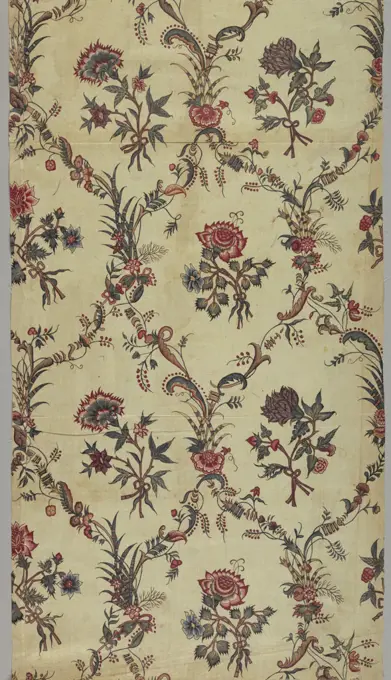
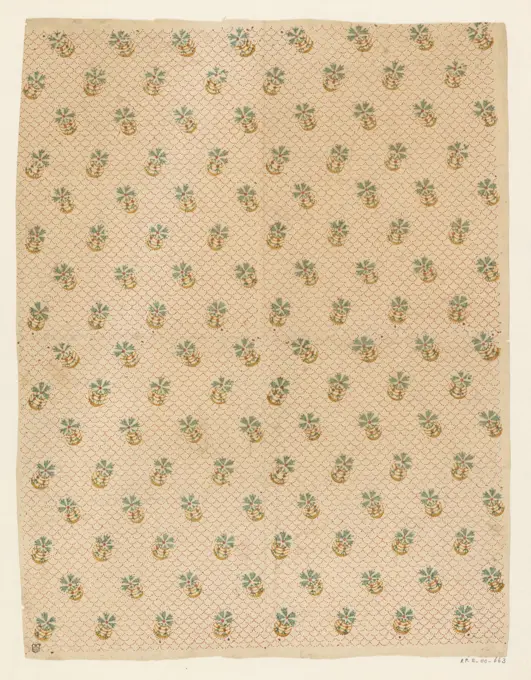
Chintz fragment, Medium: cotton Technique: mordants (2 reds, black, purple and brown) and dye (yellow) applied by brush or pen; blue brushed over resist; chintz on plain weave, Diamond lattice enclosing floral forms. Horizontal line at bottom. Faint pencil line at right where fabric was cut., India, 1750-1800, printed, dyed & painted textiles, Chintz fragment
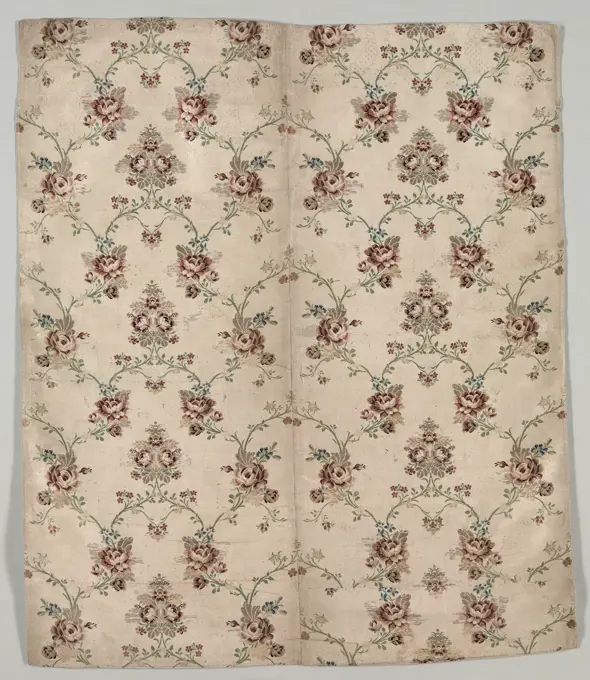
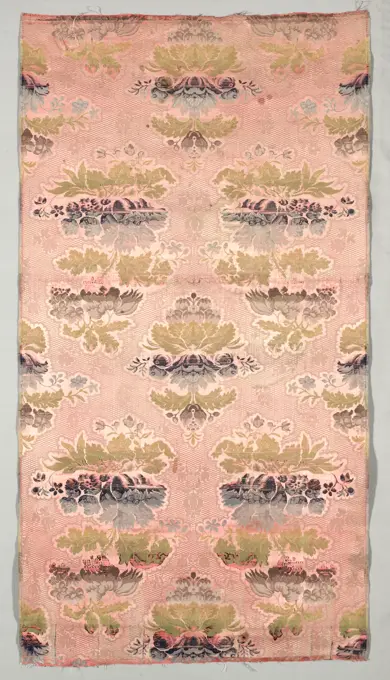
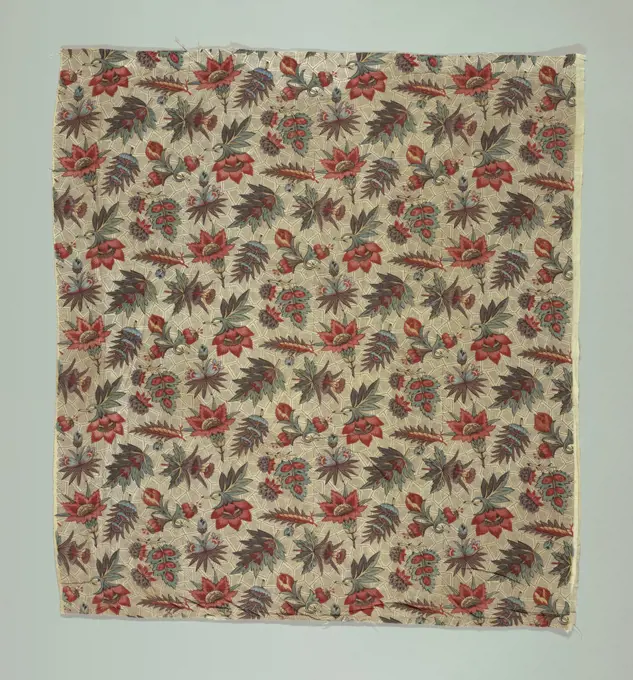
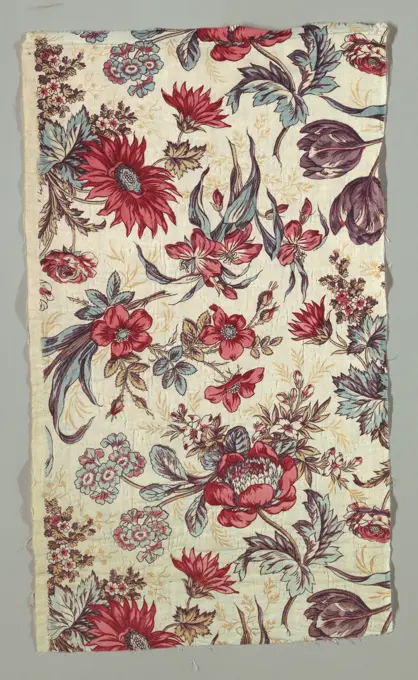
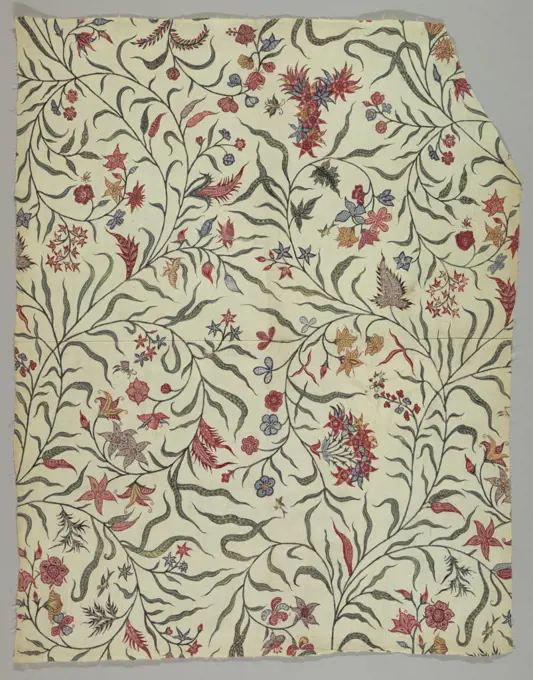
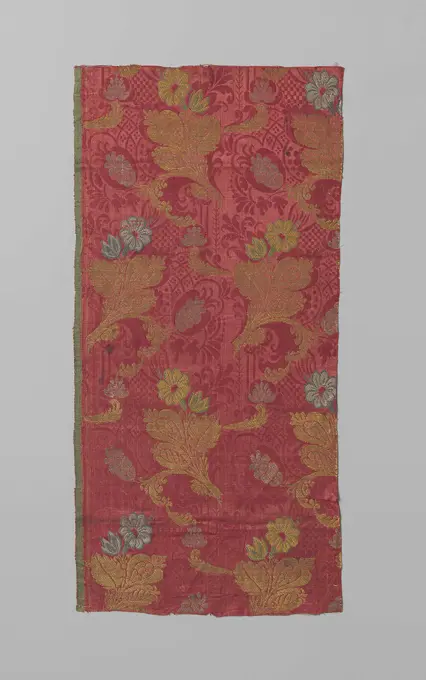
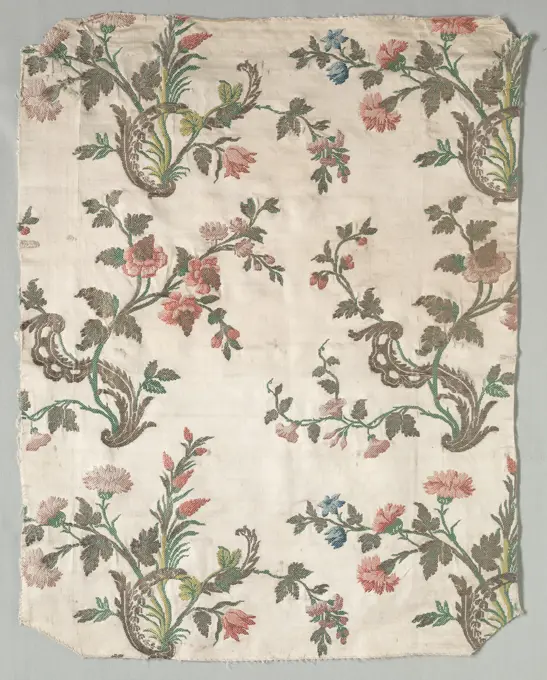
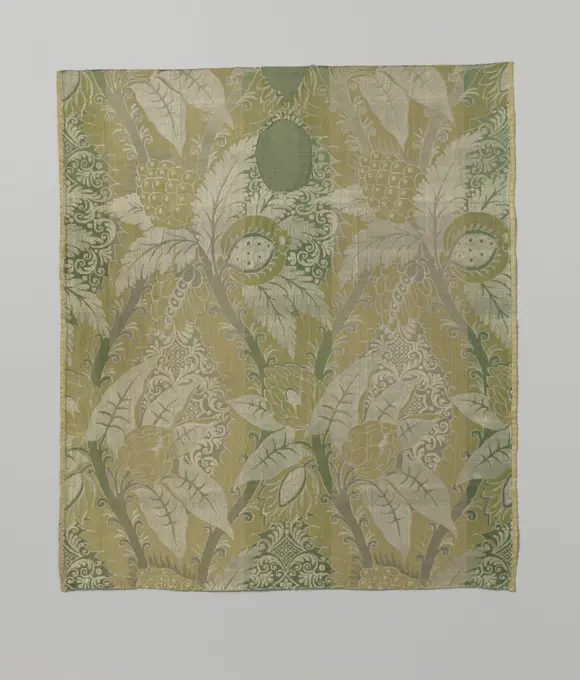
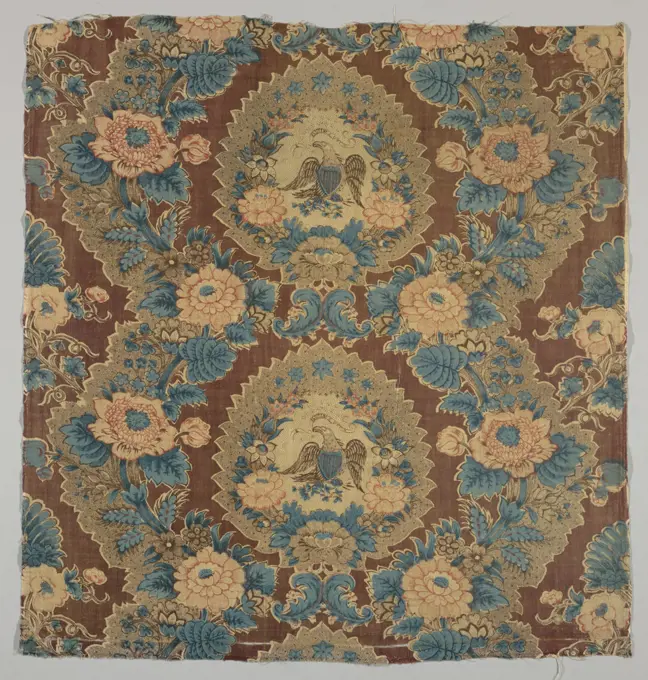
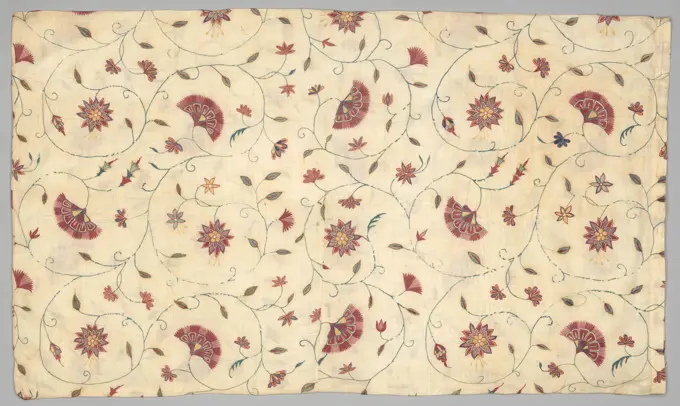
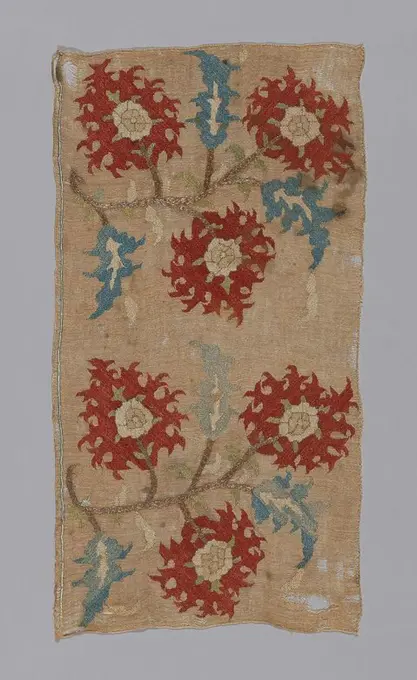
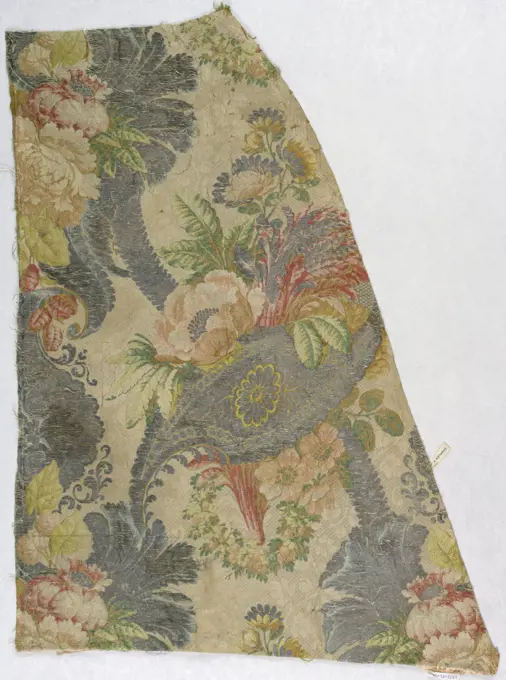
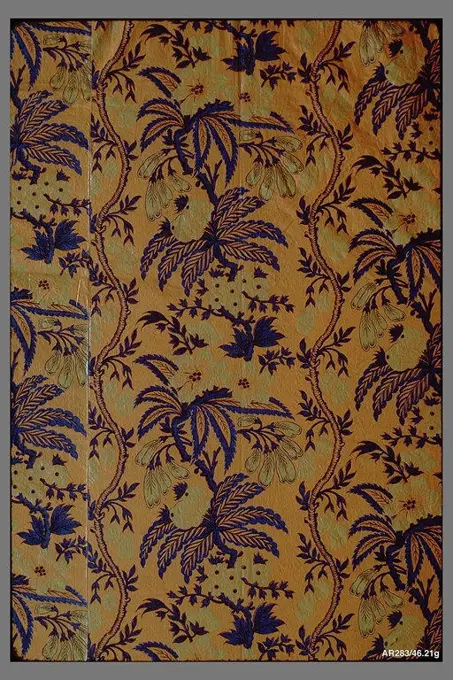
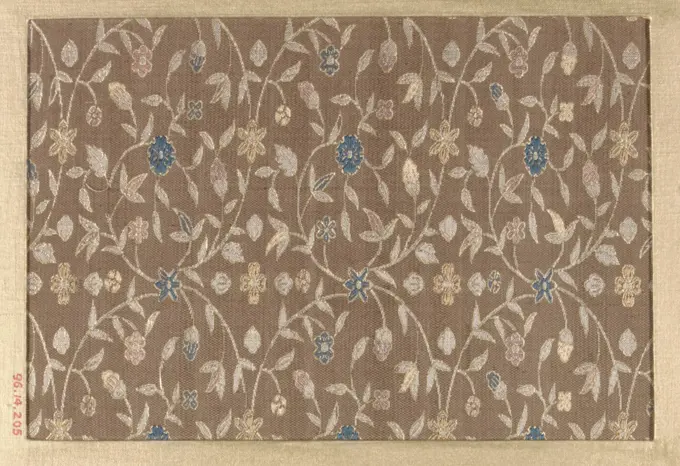
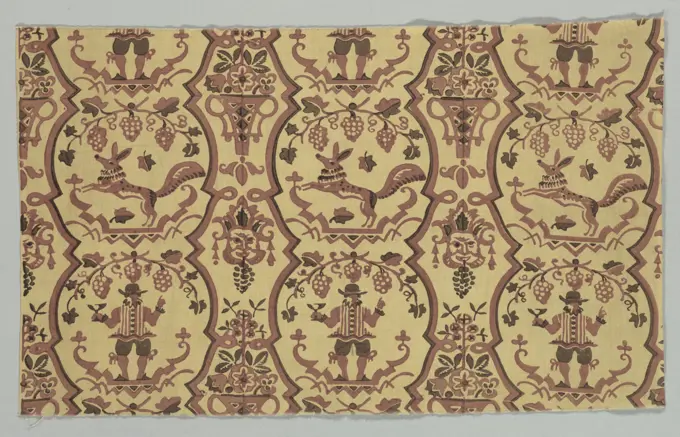
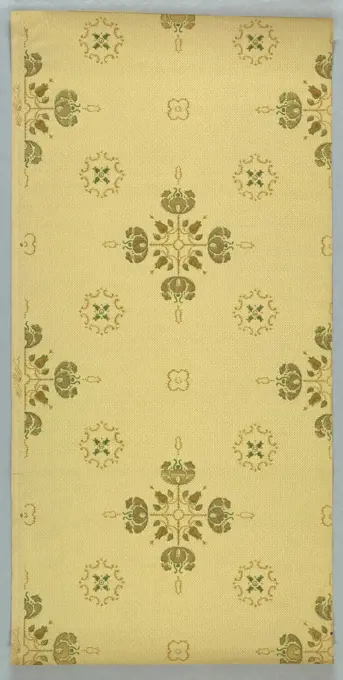
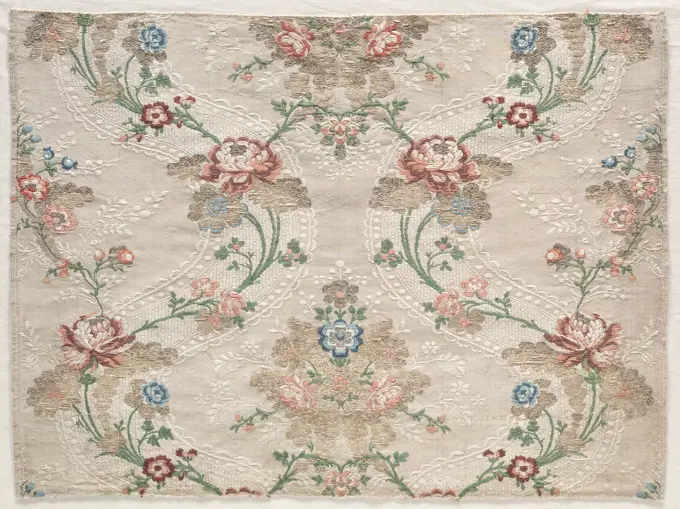
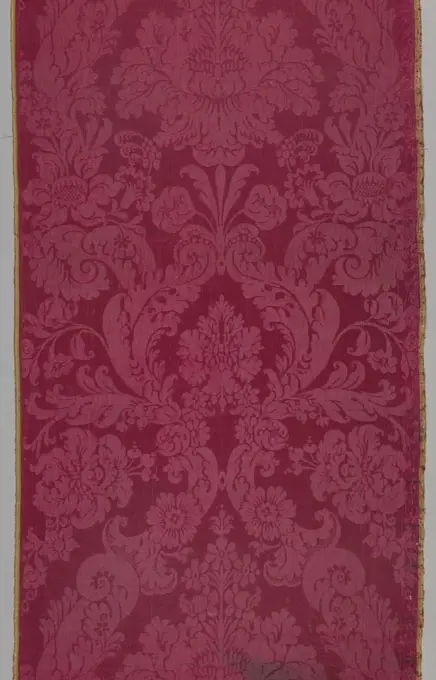
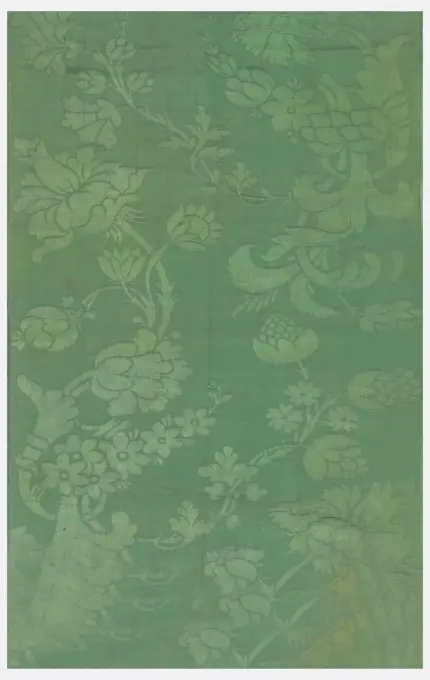
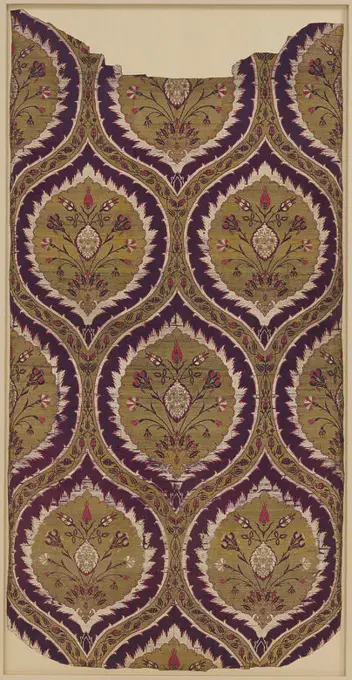
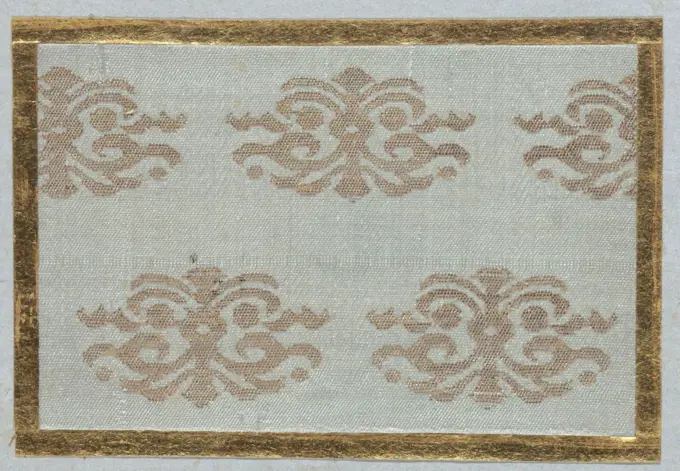
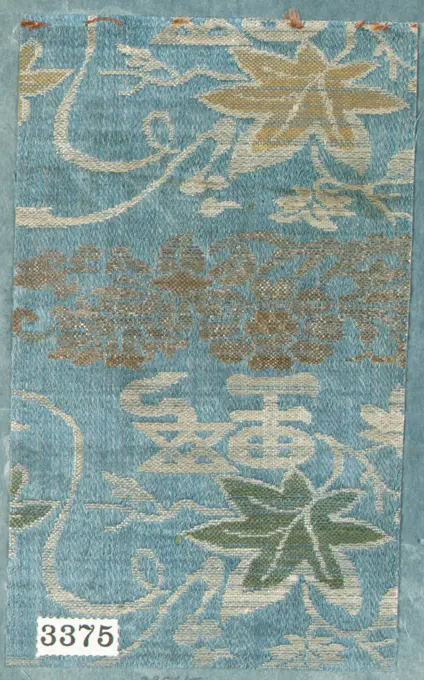
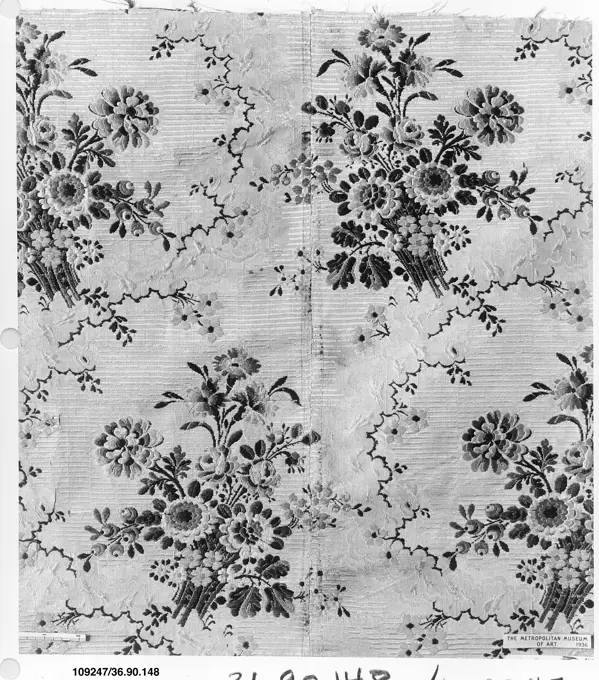
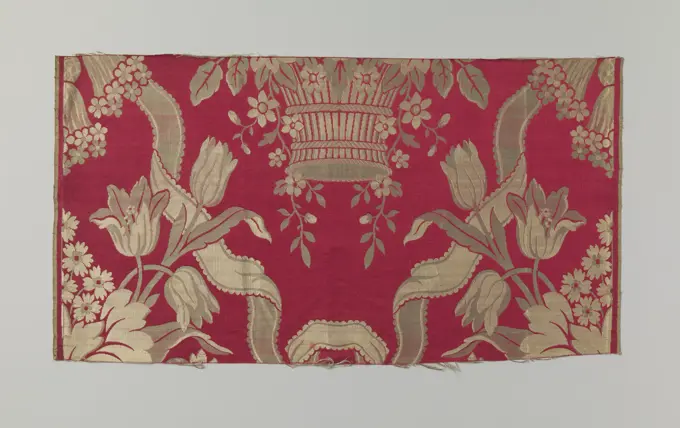
Textile; silk; 1951-52-3-a/eChintz fragment, Medium: cotton Technique: mordants (2 reds, black, purple and brown) and dye (yellow) applied by brush or pen; blue brushed over resist; chintz on plain weave, Diamond lattice enclosing floral forms. Horizontal line at bottom. Faint pencil line at right where fabric was cut., India, 1750-1800, printed, dyed & painted textiles, Chintz fragmentFragment, mid 1700s. France, mid-18th century, Period of Louis XV (1723-1774). Brocade on tabby; silk; overall: 121.4 x 103.5 cm (47 13/16 x 40 3/4 in.).Piece 17th century Japan. Piece 71143Sidewall (USA); Manufactured by Robert S. Hobbs & Co.; machine-printed; 70.5 x 51 cm (27 3/4 x 20 1/16 in.); 1973-42-37-a/cTextile, Medium: cotton Technique: block printed on plain weave, Birds rest on branches that extend from basket or vase full of flowers. Above birds are ribbon-like swags that form half-circles. Half-drop repeat printed in red, blue and black. Four minimum units across the width of fabric., England, late 18th century, printed, dyed & painted textiles, TextileFragment, 1800s. India, 19th century. Brocade, "kimkhwab"; overall: 14 x 10.2 cm (5 1/2 x 4 in.).Sidewall (USA); Manufactured by Robert S. Hobbs & Co.; machine-printed; 69 x 51 cm (27 3/16 x 20 1/16 in.)Fragment. Date/Period: Ca. 1700. Fragment. Medium: silk, metallic threads. Technique: 4&1 satin damask with brocaded wefts. Author: UNKNOWN.Fragment (China); silk; temperaCeiling paper, Maxwell & Co., S.A., Chicago, Illinois, USA, Machine-printed paper, liquid mica, Quatrefoil motif composed of foliate scrolls and floral sprigs, connected to other quatrefoil motifs at four points. Motif of floral sprig enclosed within four acanthus scrolls fills each void. Printed on off-white ground., USA, 1905-1915, Wallcoverings, Ceiling paperLength of Silk, 1700s. Italy, 18th century. Lampas weave, silk; average: 102.9 x 55.3 cm (40 1/2 x 21 3/4 in.).Textile; silk, metallic yarns, parchmentTextile; silk, metal; A/ H x W: 46.3 × 45 cm (18 1/4 × 17 11/16 in.) B/ H x W: 46 × 11 cm (18 1/8 × 4 5/16 in.); 1971-91-4-a,bTextile, Oberkampf & Cie., (Jouy-en-Josas, France, 1759-1815), Medium: cotton Technique: block printed on plain weave, Scattered exotic blossoms on a cracked ice background. Two reds, blue, yellow, (overprinted for green) mulberry and black., Jouy, France, 1770-90, printed, dyed & painted textiles, TextileLane silk tissue with bizarre pattern, anonymous, c. 1710 - c. 1720 Baan silk tissue of browned and launched Lampas Liséré. Design: bizarre pattern of spring -like leaves filled with geometric motifs and fruit forms (pomegranates) In écru (ground tissue), green (liséré), Écru (launch), écru (launch), pink (launch) and gold wire (gold -colored lamb around silk core ) on green soil. Lyon silk lampas (textile material) Baan silk tissue of browned and launched Lampas Liséré. Design: bizarre pattern of spring -like leaves filled with geometric motifs and fruit forms (pomegranates) In écru (ground tissue), green (liséré), Écru (launch), écru (launch), pink (launch) and gold wire (gold -colored lamb around silk core ) on green soil. Lyon silk lampas (textile material)Textile (France); cottonExcerpt yellow and blue colored silk tissue, anonymous, 1600 - 1699 Two fragments put together. The pattern of blue is a symmetrical Renaissance ornament, stylized tendrils, flowers and sheets in a stock of flotty yellow silk threads. Note: The flotty yellow threads are almost completely worn out in one fragment. Italy silk. cotton (textile) lampas (textile material) Two fragments put together. The pattern of blue is a symmetrical Renaissance ornament, stylized tendrils, flowers and sheets in a stock of flotty yellow silk threads. Note: The flotty yellow threads are almost completely worn out in one fragment. Italy silk. cotton (textile) lampas (textile material)Chintz. Dated: c. 1939. Dimensions: overall: 41.8 x 50.3 cm (16 7/16 x 19 13/16 in.) Original IAD Object: 14" long; 14" wide. Medium: watercolor and graphite on paper. Museum: National Gallery of Art, Washington DC. Author: Sylvia De Zon.Leaf with spreading pattern of flower pattern on a point stock, Anonymous, 1750 - 1900  Leaf with spreading pattern of flower pattern on a stock of scales in points.  paper. block printing (relief printing process) ornament derived from plant formsChintz, Medium: cotton Technique: mordants (black, 2 reds, brown & purple) and dye applied by brush; blue painted over a resist; chintz on plain weave, Elaborate curving vine from which flowers spring. Small birds and insects., India, 18th century, printed, dyed & painted textiles, ChintzFragment multicolored sides Mexicaine, Anonymous, 1765 - 1770 Fragment multicolored silk tissue. Part of the fragment has a green striped soil on which pink flowers thrown. The other part has a brown soil on which flower bouquets in red, purple and green, tied with a blue ribbon and connected. France (possibly) silk Fragment multicolored silk tissue. Part of the fragment has a green striped soil on which pink flowers thrown. The other part has a brown soil on which flower bouquets in red, purple and green, tied with a blue ribbon and connected. France (possibly) silkLeaf with spreading pattern of flowers, anonymous, c. 1700 - c. 1850  Leaf with spreading pattern of flowers over a continuous vertical lines. Half of a cover.  paper. block printing (relief printing process) ornament derived from plant formsPiece 18th century Japan. Piece 71292Fragment zijdedamast.A fragment of a silk tissue. Wine red damasked fond, with gold and silver, blue-edged gray and greenery yellow. Note: Self side; 0.7 cm (2 edged wires), twill (deviating color).Fragment silk tissue with lace pattern and flower vines. Fragment of two pieces-sewn pieces with opposite pattern of vertically wavy band work (side) between which floral drinks interspersed with two entangled flower branches.Fragment of Satin Brocade, mid 1700s. France, 18th century, Period of Louis XV (1723-1774). Brocaded satin; overall: 53.9 x 41.9 cm (21 1/4 x 16 1/2 in.).Fragment with Sempervivum tectorum motif 1475-1525 Italian, Milan The stylized floral design of this textile is delineated by fine lines of green silk velvet; the rest of the surface is covered with gold metal-wrapped threads, lying flat in the background and forming loops in the plant forms. The large flowering plant in the center and the vine that surrounds it can be identified as Sempervivum tectorum (now commonly known as "hens and chicks"), a species of hardy succulent that has the ability to thrive in extreme mountainous conditions. Recent research has revealed that this plant motif was associated with the Sforza family of Milan starting in the mid-fifteenth century. Variations on this pattern were also produced as monochrome pile-on-pile silk velvets and the Museum has red and green examples.. Fragment with Sempervivum tectorum motif 227554Fragment with pattern of branches of to each other with leaves and fruits on fine -oriented stock, James Leman (Possible), c. 1700 - c. 1750 Fragment silk tissue in green, white and gray. Pattern in white from to each other -boosted branches with leaves and fruits to finely ornamented stock. designer: Netherlands (possibly)England (possibly) silk lampas (textile material) / twill Fragment silk tissue in green, white and gray. Pattern in white from to each other -boosted branches with leaves and fruits to finely ornamented stock. designer: Netherlands (possibly)England (possibly) silk lampas (textile material) / twillLength of Textile, mid 1700s. France, mid 18th century, period of Louis XV (1723-1774). Lampas weave, silk; overall: 101 x 54.6 cm (39 3/4 x 21 1/2 in.).Textile (probably England); cottonFragments, Medium: silk Technique: supplementary warp forming cut and uncut raised pile in plain weave foundation (velvet), Vertical stripes of small scale pattern; brown green and blue on ivory., 17th century, woven textiles, FragmentsPiece 16th-17th century Italian. Piece 223384Piece 18th-19th century Japan. Piece 65903Textile (France); Produced by Oberkampf & Cie. (France); cottonTextile, Medium: cotton Technique: block and roller printed, Palmette cartouche containing American Eagle., USA, 1876, printed, dyed & painted textiles, TextileDemolition of clapping white cotton with embroidered flowers, anonymous, c. 1700 - c. 1725 Cotton demolition, with embroidery in tambooereertechniek. The pattern has fine spiral ranks, placed in straight rows, with rosette and fan-shaped flowers. Persia (possibly) cotton (textile) embroidering Cotton demolition, with embroidery in tambooereertechniek. The pattern has fine spiral ranks, placed in straight rows, with rosette and fan-shaped flowers. Persia (possibly) cotton (textile) embroideringFragment. Turkey. Date: 1601-1700. Dimensions: 52.8 x 28 cm (20 3/4 x 11 in.). Embroidered. Origin: Turkey. Museum: The Chicago Art Institute, Chicago, USA.Textile (France); Company: Gorgerat Frères et Cie.; cotton; Warp:127 cm (50in.). Weft: 95.5cm (37 1/2in.). Selvedge at left. Pattern: Height of repeat (and plate); 40 inches.Leaf with winding leaf vines, anonymous, c. 1700 - c. 1850  Leaf with pattern of winding leaf vines with flowers. Half of a cover. At the top left a label with '219'.  paper. block printing (relief printing process) ornament derived from plant formsFragments, Medium: silk, metallic yarns Technique: printed on compound weave with discontinuous supplementary weft patterning (brocade), Two fragments of woven fabric showing a continuous vertical floral pattern in polychrome with metallic yarns on a cream ground., France, early 18th century, woven textiles, FragmentsPiece ca. 1830 British. Piece 18309Textile, Medium: cotton Technique: printed by engraved roller on plain weave, Floral print with exotic flowers; large scale pattern repeat. Colors: lavender faded to brown., mid-19th century, printed, dyed & painted textiles, TextileSilk broccate with an 'lace pattern'. Silk broccate with an 'lace pattern'. Natural and light brown silk and silver colored metal wire (partly Frisé). Put on linen.Piece 18th-19th century Japan. Piece 65930Length of Brocaded Silk, 1700s. France or Italy, 18th century. Damask, brocaded; silk and metal; average: 93 x 52 cm (36 5/8 x 20 1/2 in.).Fox and Grapes, 20th century. Germany, Munich, 20th century. Plain weave cotton, printed; overall: 50.8 x 83.8 cm (20 x 33 in.).Fragment; silkTextile; silk; Bequest of Richard Cranch Greenleaf in memory of his mother, Adeline Emma Greenleaf; 1962-56-75Piece 18th century French. Piece 230853Panel. France, probably Jouy-en-Josas. Date: 1780-1789. Dimensions: 170.5 × 76.5 cm (67 1/8 × 30 1/8 in.)Repeat: 30.4 × 50.2-50.7 cm (12 × 19 3/4-20 in.). Linen and cotton, plain weave; block printed. Origin: France. Museum: The Chicago Art Institute, Chicago, USA.Slashing bedspread with colored flowers and palmets. Bedspread with red, dark purple and yellow palmets and red flowers with blue hearts on a white, yellow tinted background. The bedspread is lined with stitched cotton and printed with small red flowers, black outlined on a white background. Oriental textile.Piece 18th century Japan. Piece 71946Fragment; silkCeiling paper, Standard Wall-Paper Company, Standard Wall-Paper Company, Sandy Hill, New York, Machine-printed paper, Large medallions feature line-work crosses with stylized blossoms at finials and intersections. These larger medallions alternate with quatrefoil blossoms as well as smaller, octagonal medallions outlined by c-scrolls. Medallions and blossoms are printed on top of an allover diaper pattern. The simple outlines of the medallions and textured look of the diapered background make the pattern resemble an embroidered sampler. Pattern is printed in gold, green and tan on a khaki ground., Sandy Hill, New York, USA, 1905-1915, Wallcoverings, Ceiling paperFragment, silk woven, Slender curving green stems so interlacing and crosing as to divide the ground into four-sided areas. Each stem terminates in three fantastic blossoms ., 1750-1800, woven textiles, FragmentSampler (Mexico); silk and metal-wrapped silk embroidery on cotton foundationTextile; printedCoverlet first half 18th century British. Coverlet 236137Taffeta Fragment, c. 1730. France, 18th century, Period of Louis XVI (1774-1793). Taffeta, warp-patterned and brocaded; silk; overall: 52.7 x 40 cm (20 3/4 x 15 3/4 in.).Fragment. France. Date: 1601-1625. Dimensions: 50.4 x 58.3 cm (19 3/4 x 23 in.). Silk, satin weave self-patterned by reversing of faces. Origin: France. Museum: The Chicago Art Institute, Chicago, USA.Fragment of Eastern embroidery. unknownSidewall - Sample, Queen Anne; Designed by William Morris (British, 1834-1896); Manufactured by Jeffrey & Company (United Kingdom); Made for Morris & Co. (United Kingdom); block-printed paperTextile; Manufactured by F. Schumacher & Co. (United States); silkCeiling Paper (USA); Manufactured by Maxwell & Co., S.A. (United States); machine-printed paper, liquid mica; 89.5 x 49 cm (35 1/4 x 19 5/16 in.)Textile; cottonCretine of printed cretonne with swans and Lissen, Michiel Duco Crop, c. 1900 Real curtain of printed cretonne with swans and llissen. Lined and provided with a passion with metal rings. Helmond linen (material) printing Real curtain of printed cretonne with swans and llissen. Lined and provided with a passion with metal rings. Helmond linen (material) printingFragment, Medium: silk Technique: 5-harness satin damask, Short length of red damask in a symmetrical arrangement of flowers and leafy scrolls., France, 17th-18th century, woven textiles, FragmentSidewall, Block-printed on handmade paper, Foliate diaper pattern with inset floral bouquets. Printed in shades of yellow on ocher ground., France, 1815-35, Wallcoverings, SidewallFragment (England); silk; a) Warp x Weft: 87 x 56 cm (34 1/4 x 22 1/16 in.) b) Warp x Weft: 79.5 x 56 cm (31 5/16 x 22 1/16 in.) c) Warp x Weft: 31.5 x 56 cm (12 3/8 x 22 1/16 in.) Repeat H: 93.5 cm (36 13/16 in.); Purchase, General Funds; 1984-85-5-a/cFragments, Medium: cotton Technique: roller and block printed on plain weave; glazed, Fragment of glazed chintz showing multicolored flowers on a tan ground., England, late 18th century, printed, dyed & painted textiles, FragmentsTextile, Medium: silk Technique: 2 and 1 twill reversing to 1 and 2 twill with continuous and discontinuous supplementary metal wefts, Densely packed organic plant forms in green silk with gold and silver metal., possibly Italy, 17th century, woven textiles, TextileFragmentary Loom Width with Ogival Pattern. Dimensions: Textile: L. 75 in. (190.5 cm) W. 26 in. (66 cm)Mount: L. 56 3/8 in. (143.2 cm)  W. 30 3/4 in. (78.1 cm) D. 1 in. (2.5 cm)Wt. 36 lbs. (16.3 kg). Date: ca. 1570-80.With its unusual eggplant-purple background, gold medallions, and crisp, stencil-like drawing, this textile is an exceptionally fine example of the luxurious Ottoman silk fabrics referred to as kemha. Employing bold patterns, such as this ogival lattice design, these textiles were highly valued throughout the Mediterranean and beyond. Many datable fragments survive in the form of religious vestments of various Christian communities from Sweden to Moscow. Considering its overall shape, this fragment probably once served as part of a chasuble--a garment worn by Christian clergy. Museum: Metropolitan Museum of Art, New York, USA.Piece 18th-19th century Japan. Piece 66798Fragment (Japan)Napkin with lace pattern and flowers, anonymous, 1725 - 1730 White Linnamasten napkin with a 'lace' pattern and leaf motif in the corners. In the middle, completely detached, an ornament with moazic filling and with leaves, flowers and fruits. Around a wide scalloped bond with various mosaic fillings and with leaf volits and flowers. A fan -shaped ornament in the corners. Lying and running edges: ornaments with mosaic fillings, volutes, branches with flowers and berries. In the corners a diagonally -wise leaf ornament. Brand in brown cross stitch: HA 12. Flanders (Possible) linen (material) White Linnamasten napkin with a 'lace' pattern and leaf motif in the corners. In the middle, completely detached, an ornament with moazic filling and with leaves, flowers and fruits. Around a wide scalloped bond with various mosaic fillings and with leaf volits and flowers. A fan -shaped ornament in the corners. Lying and running edges: ornaments with mosaic fillings, volutes, branches with flowers Piece 17th century Japan. Piece 71587Textile (Spain); linen, wool; Warp x Weft: 42.5 x 37.5 cm (16 3/4 x 14 3/4 in.); 1972-36-6Piece mid-19th century British. Piece. British. mid-19th century. Cotton. Textiles-PrintedSample (USA); Manufactured by Orinoka Mills (United States); 1989-80-59Fragments, Medium: cotton Technique: mordant painted and dyed and resists dyed (chintz) on plain weave (black outline printed; reds, purples and blues filled in by brush), Ornate diagonal grid in blue containing floral motifs., probably India, mid-late 18th century, printed, dyed & painted textiles, FragmentsEmbroidery from a chasuble unknownBedspread. Dated: c. 1936. Dimensions: overall: 30.5 x 22.8 cm (12 x 9 in.). Medium: colored pencil and watercolor on paper. Museum: National Gallery of Art, Washington DC. Author: Henry Meyers.Fabric, late 1800s-early 1900s. Japan, late 19th-early 20th century. Brocaded silk with metal thread weft; average: 71.1 x 66.7 cm (28 x 26 1/4 in.).Fragment Made 1601-1625 Europe. Silk and linen, compound weave .Textile 19th century Japan. Textile 68009Stitched sitsen bedspread, c. 1600 - c. 1980 Sticked sitsen bedspread. India cotton (textile) chintz Sticked sitsen bedspread. India cotton (textile) chintzPiece 1750-60 French. Piece 223249Fragment. Italy or Spain. Date: 1625-1675. Dimensions: 28.4 x 40.3 cm (11 1/8 x 15 7/8 in.). Linen and wool, plain weave; tied and free double cloth. Origin: Italy. Museum: The Chicago Art Institute, Chicago, USA.Fragment, Medium: Technique: printed, 19th century, printed, dyed & painted textiles, FragmentTextile (India); cotton; Warp x Weft: 50.2 x 41.6 cm (19 3/4 x 16 3/8 in.) Repeat: 39.4 x 25.4 cm (15 1/2 x 10 in.)Excerpt red silk tissue with flowers in blue and white, anonymous, 1770 A fragment of red silk tissue, on which a basket with flowers surrounded by ribbons, flower bouquets and tulips. Netherlands silk lampas (textile material) A fragment of red silk tissue, on which a basket with flowers surrounded by ribbons, flower bouquets and tulips. Netherlands silk lampas (textile material)Border (USA); Manufactured by Cresswell & Washburn Ltd; machine-printed paper; 91.5 x 49 cm (36 x 19 5/16 in.)Piece 16th-17th century Italian. Piece. Italian. 16th-17th century. Silk. Textiles-VelvetsFragment, Medium: silk Technique: 5-harness satin damask, Medium-scale allover pattern of decorated palmettes in ogival framework of checkered bands clasped by crowns., Italy, 16th-17th century, woven textiles, FragmentCurtain with flower design on yellow distance, le mirepère et fils, 1850 - 1860 Curtain with flower design on yellow stock from the small dance hall of Noordeinde Palace. manufacturer: LyonThe Hague silk. lampas (textile material) Curtain with flower design on yellow stock from the small dance hall of Noordeinde Palace. manufacturer: LyonThe Hague silk. lampas (textile material)Ceiling Paper (USA); Manufactured by William H. Mairs and Company; machine-printed paper, liquid mica; 92 x 47 cm (36 1/4 x 18 1/2 in.)Fragment, Medium: silk Technique: 4&1 satin plus 14 twill, Floral forms which face in alternate directions in red and yellow., Spain, 17th century, woven textiles, FragmentFragment, Medium: silk Technique: plain weave, Fragments of a continuous pattern in the bizarre style showing three scrolling vines placed side by side, vertically. The main form of the scroll is ivory on top of which twists florals in blue, violet, green and yellow, on a rose ground. Both selvages present., possibly Spain, possibly Italy, possibly France, late 17th-early 18th century, woven textiles, FragmentTextile (France); cotton