Decorative Boxes and Chests

A collection of ornate boxes and chests, featuring intricate designs, materials like lacquer and leather, and themes of nature, showcasing craftsmanship from various centuries.
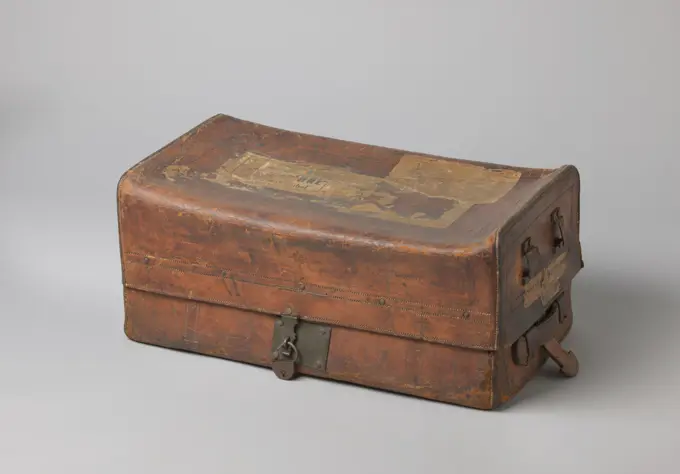
Leather travel suitcase from Johan Rudolf Thorbecke ,, 1810 - 1850  High square leather with wooden frame and fabrics and paper interior. The leather is sober edited. The lid is hinged and lockable with a lock. There are two leather handles on both sides of which the upper has always been worn away. Everywhere, especially on the lid, there are remains of address and shipping stickers. In the middle is somewhere 'minister Thorbecke' in handwriting. Probably used by him on his travels through Germany in the period 1822-1833 and on later travels. Netherlands leather. wood (plant material). textile materials. paper   Germany. Netherlands
Leather travel suitcase from Johan Rudolf Thorbecke ,, 1810 - 1850 High square leather with wooden frame and fabrics and paper interior. The leather is sober edited. The lid is hinged and lockable with a lock. There are two leather handles on both sides of which the upper has always been worn away. Everywhere, especially on the lid, there are remains of address and shipping stickers. In the middle is somewhere 'minister Thorbecke' in handwriting. Probably used by him on his travels through Germany in the period 1822-1833 and on later travels. Netherlands leather. wood (plant material). textile materials. paper Germany. Netherlands
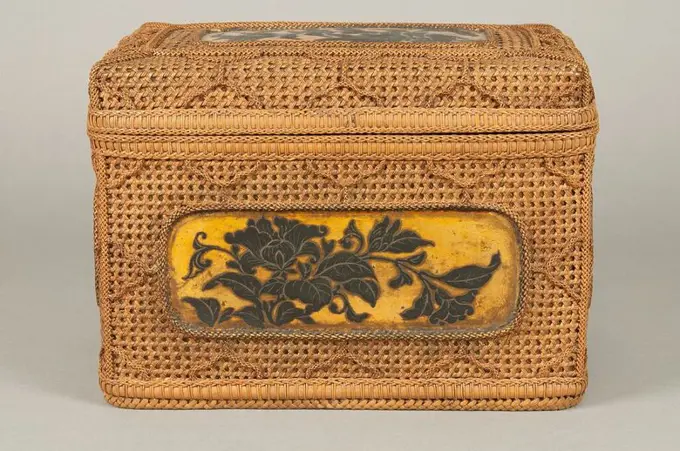
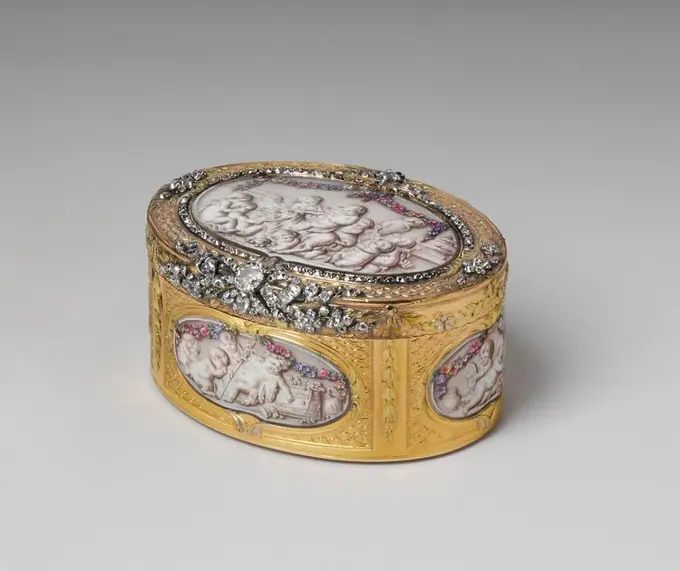
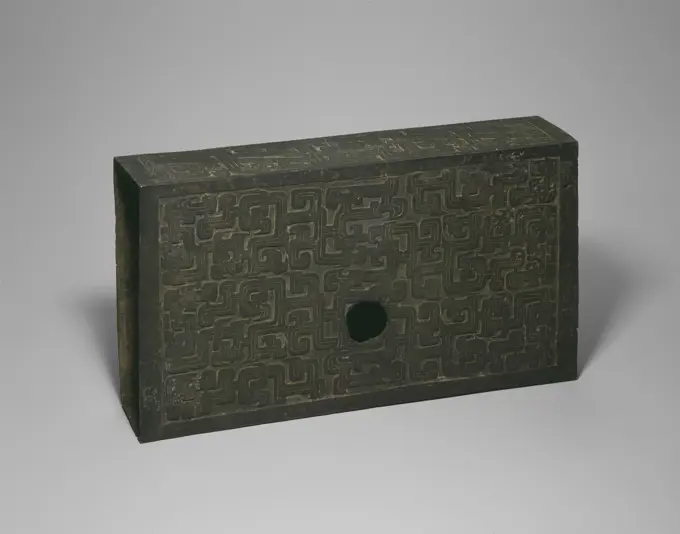
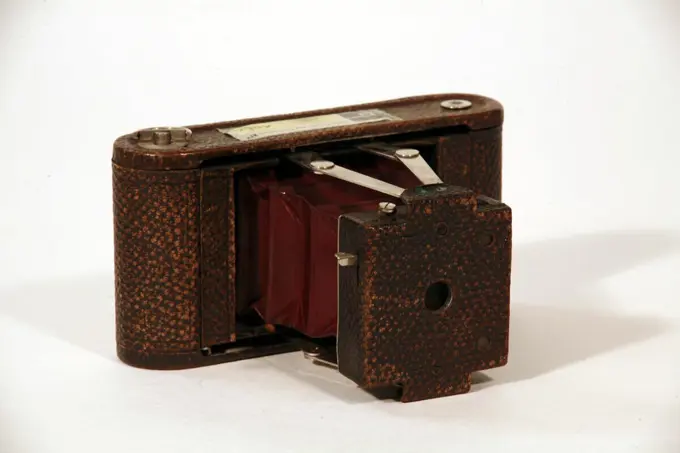
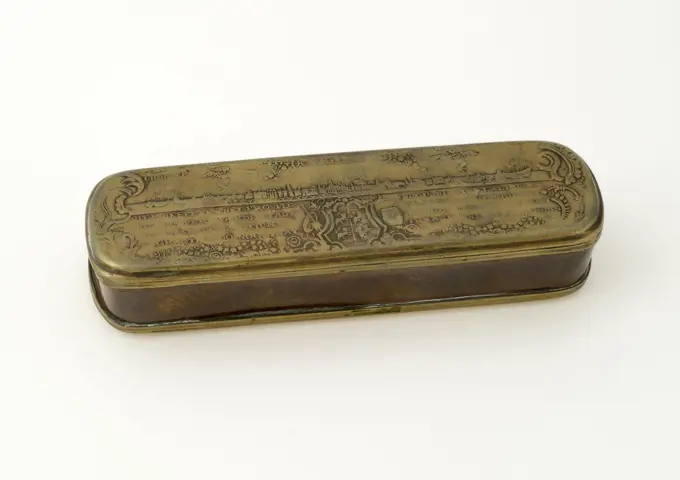
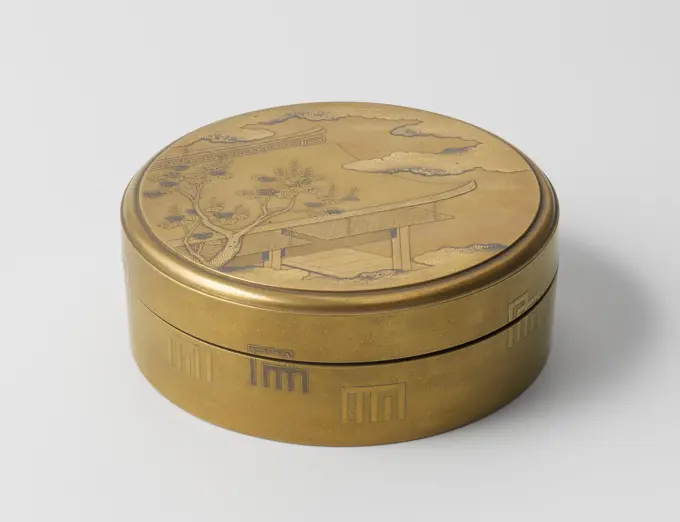
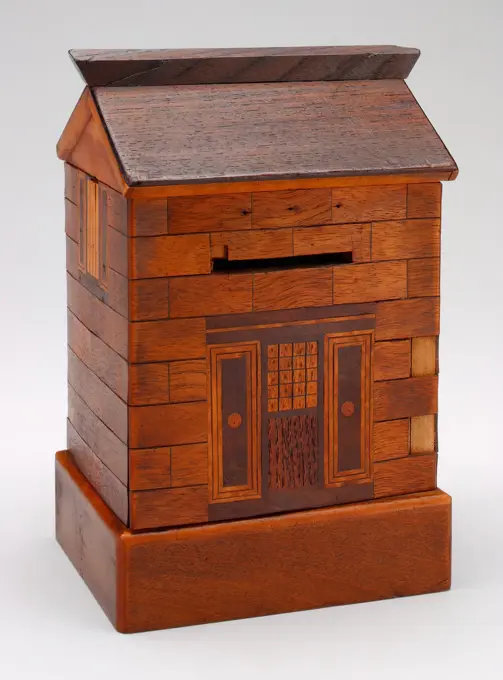
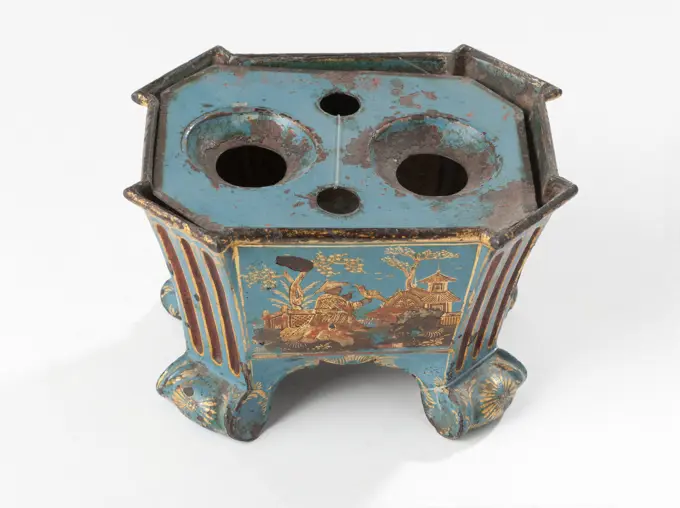
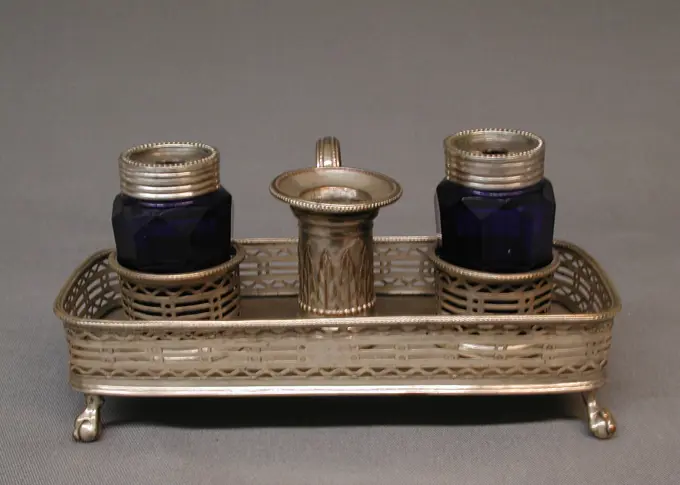
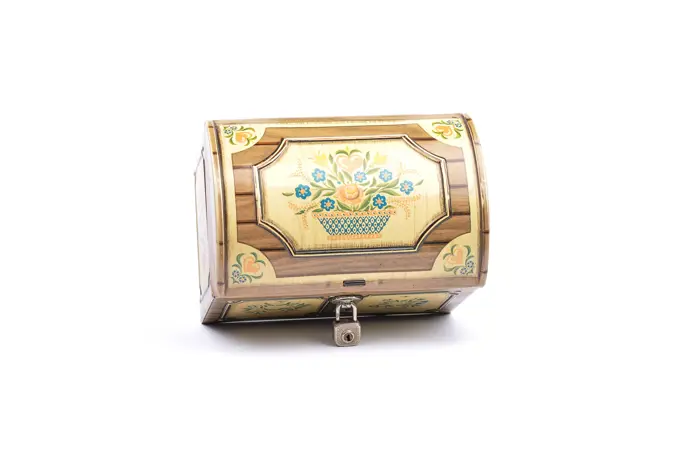
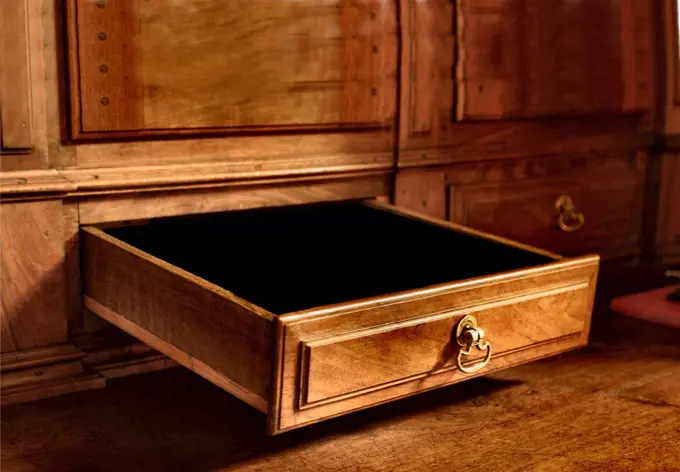
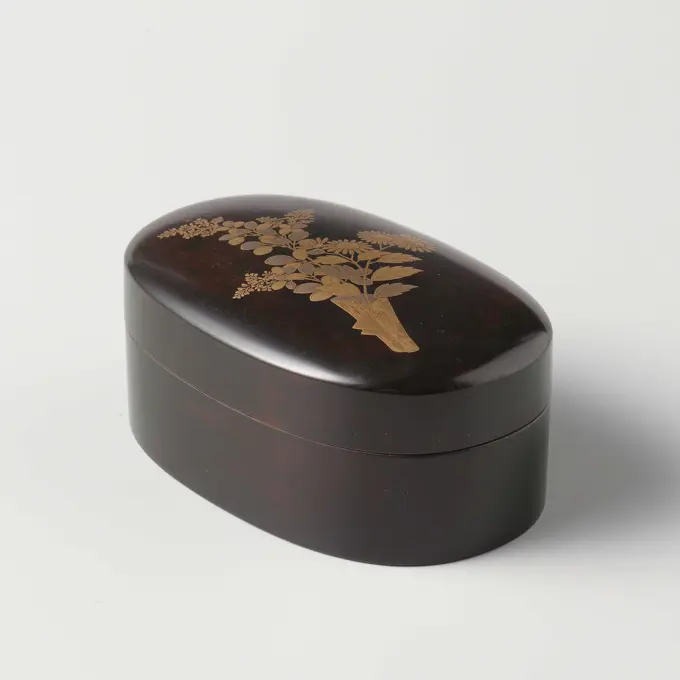
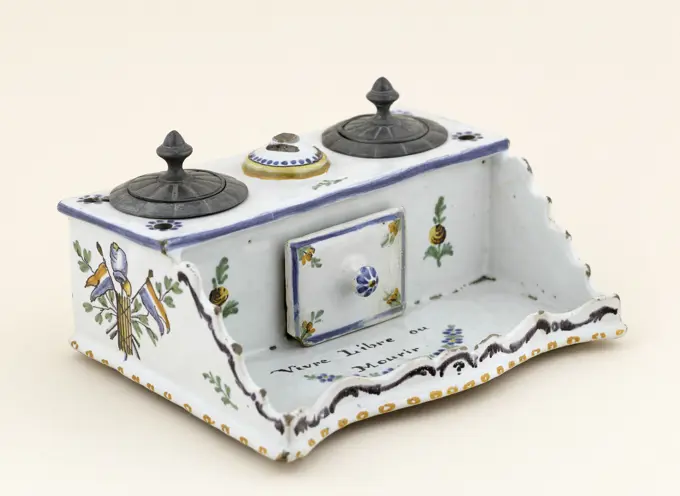
Flask, c. 1849-1858, Attributed to Lyman Fenton & Co., Bennington, Vermont, 1849-1858, 5 3/4 x 4 1/4 x 2 1/8 in. (14.6 x 10.8 x 5.4 cm), Glazed earthenware, United States, 19th century, This amusing novelty is a flask shaped like a book. The book's title, Departed Spirits, is a play on words that reinforces the function of the object.BoxBox -Basketwork Box with Peonies on Inset. Culture: Japan. Dimensions: H. 6 in. (15.2 cm); W. 8 1/2 in. (21.6 cm); D. 6 1/4 in. (15.9 cm). Date: second half of the 19th century. Museum: Metropolitan Museum of Art, New York, USA.Square tiered box with floral scrolls, anonymous, anonymous, c. 1775 - c. 1824 Square stile box of stoneware consisting of three layers with openwork walls and lid, painted on the glaze in blue, green and gold. Leaf motifs (bamboo) on the walls. The edge of the lid with a strap with flower vines. Kyoyaki. Japan stoneware. glaze. gold (metal) gilding / vitrification Square stile box of stoneware consisting of three layers with openwork walls and lid, painted on the glaze in blue, green and gold. Leaf motifs (bamboo) on the walls. The edge of the lid with a strap with flower vines. Kyoyaki. Japan stoneware. glaze. gold (metal) gilding / vitrificationWooden Writing Tablets. Culture: Coptic. Dimensions: Overall (with mount): 10 1/2 x 11 7/8 x 5 1/2 in. (26.7 x 30.2 x 14 cm)Overall (together): 9 5/16 x 5 7/8 x 2 1/4 in. (23.7 x 14.9 x 5.7 cm)Overall (each leaf): 9 5/16 x 5 7/8 x 7/16 in. (23.7 x 14.9 x 1.1 cm). Date: 500-700.The recessed areas of these tablets were filled with wax and employed for writing and record keeping. A stylus, or pointed wooden pen, would have been used to write in the wax. Joined pairs of tablets such as these were made in many materials, including ivory. Museum: Metropolitan Museum of Art, New York, USA.Glass lidded container with silver mounts, Fujita Kyōhei, c. 1980 - c. 2000 Hexagonal litter box with rounded corners of black glass with a decoration of white and red spots on scattered cracked rectangles of gold and silver foil, the edges of box and lid with a silver frame. Signature on the bottom box 'Kyohei Fujita'. Japan glass. silver (metal). gold (metal) vitrification Hexagonal litter box with rounded corners of black glass with a decoration of white and red spots on scattered cracked rectangles of gold and silver foil, the edges of box and lid with a silver frame. Signature on the bottom box 'Kyohei Fujita'. Japan glass. silver (metal). gold (metal) vitrificationInkstand ca. 1770 Attributed to Philippe Claude Montigny French This inkstand appears to be identical to the one depicted in Gérard's portrait of Charles Maurice de Tallyrand (see 2012.348).. Inkstand 239267. Round box (incense box or kogo) of stoneware, covered with a cream-colored glaze and painted in underglaze blue and iron brown. A group of blooming plants on the lid. Goudaakrestaurations on the edge and outside of the box. Kyoyaki.Snuffbox with six scenes of putti at play. Artist: Miniatures by Mademoiselle Duplessis (French, active ca. 1753-60). Culture: French, Paris. Dimensions: Box: 1 3/4 x 3 3/8 x 2 5/8 in. (4.4 x 8.6 x 6.7 cm)Dimensions of miniatures (not sight measurements): On cover, H. 1 11/16, W. 2 9/16 in. (4.3 x 6.5 cm.); On bottom, H. 1 5/8, W. 2-1/2 in. (4.1 x 6.4 cm.); On front, H. 15/16, W. 1 7/8 in. (2.4 x 4.8 cm.); On back, H. 7/8, W. 1 7/8 in. (2.2 x 4.8 cm.); On left side, H. 13/16, W. 1 7/16 in. (2.1 x 3.7 cm.); On right side, H. 13/16, 1 7/16 in. (2.1 x 3.7 cm.).. Maker: Jean Georges (or George) (master 1752, died 1765). Date: ca. 1761-62.This box in the emerging Neoclassical style is distinguished by the quality of both the goldsmith's work and the enameled decoration. The latter includes ovals painted in brown monochrome with putti who frolic beneath garlands of polychrome flowers across the top of each oval. They are framed with molded gold borders and set against rectangular panels emKasetkaArchitectural Fitting (Gong) Made 770 BCE-481 BCE China. This is one of sixteen hollow bronze fittings in the museumís collection that together comprise rectangular, L-shaped, and cylindrical pieces. In 1973, fittings of similar shape and design were excavated from the site of a palace of the 7th century B.C. in modern-day Fengxiang, Shaanxi province in north China. Most show tightly interlaced surface patterns like those cast in this piece. Archaeologists have conjectured that these fittings, some of which preserve traces of wood, originally served as collars and sleeves that had been socketed over a framework of timber columns and tie beams embedded into the earthen walls. Some of these pieces may originally have been stuffed with silk to tighten them.. Bronze .Roll film spreading camera by Eastman Kodak Co., Rochester, 6.4 x 8.9 cm, metal body, produced around 1901 for early roll-film photography.Box -Copper tobacco box with face on Rotterdam and HIER HEEFT MEN HET PROSPEC VAN DEN VERMAARDE STADT ALLWAAR T NEGOTIUM IN GROOTE FLOO NOG STAAT, tobacco box holder metal copper brass, stamp technique inserted Narrow box with flat hinged lid round corners upright sides of red copper top: heraldry cityscape topography Rotterdam Maas trade negotie Erasmus tobacco smoking store snuffboxDoctor's Instrument Case, 1820-30. This pocket instrument case is made of walnut and was possibly used for carrying scarifiers for vaccinations, or for dental instruments. It dates from the Regency period... Purchased from Edward H Pinto, 1965... .Model of a Paddle Shaft Support, anonymous, c. 1830 - c. 1845 demonstration model Model of a part of the ship's skin with an outdoor question for the Rader axis. The cushion block for the ash rests on a platform, which is supported by three knees. Two triangular side panels protect the block against splashing water. The cushion block consists of a sled, kegge and the ash lining. Scale 1:10 (derived). Netherlands wood (plant material)Pen and Inkwork Tea Caddy, 1810-20. This fine quality pen and ink hand painted tea caddy is believed to have been made by G. Meekison of Montrose. The design and manufacture has been carried out with such precision that it makes the integral wood hinge appear invisible... Purchased from Edward H Pinto, 1965... .Round box containing eight small round boxes, anonymous, 1800 - 1900 Round box with eight small round boxes in it. On the lid a representation of a temple building with trees and clouds in gold and silver. Between the lid and box a separate leaf with a bank landscape. Japan wood (plant material). lacquer (coating) Round box with eight small round boxes in it. On the lid a representation of a temple building with trees and clouds in gold and silver. Between the lid and box a separate leaf with a bank landscape. Japan wood (plant material). lacquer (coating)Puzzle Bank' still bank, 20th century, 5 1/2 x 3 1/2 x 2 13/16 in. (13.97 x 8.89 x 7.07 cm), Wood, pigment, 20th centuryTerracotta pyxis (cosmetic box) 6th century B.C. Greek, Boeotian The pattern on the box of the pyxis is reminiscent of an organic material such as rush, grass, possibly even wood. Small lidded containers were certainly made of perishable materials that have now entirely disappeared.. Terracotta pyxis (cosmetic box) 244825Ink stand met heart shapes and leaves, anonymous, c. 1750 - c. 1799 Ink set of stoneware with a pen box and two holders for the ink jar and the sand spreader. Partly covered with cobalt blue. On the holder a relief decoration of printed and imposed heart shapes and leaves. The edges with small flowers or stars. At the top on each corner a modeled 'Klinknagel'. Two sand spreaders instead of a spreader and an ink jar. Westerwald. Westerwald stoneware. glaze. cobalt (mineral) vitrification Ink set of stoneware with a pen box and two holders for the ink jar and the sand spreader. Partly covered with cobalt blue. On the holder a relief decoration of printed and imposed heart shapes and leaves. The edges with small flowers or stars. At the top on each corner a modeled 'Klinknagel'. Two sand spreaders instead of a spreader and an ink jar. Westerwald. Westerwald stoneware. glaze. cobalt (mineral) vitrificationWooden casket isolated on a white backgroundAnonymous. "Bouquetière of quadrangular shape". Painted sheet. 1701-1800. Paris, Carnavalet museum. 101433-25Chinese Rectangular Cinnabar Lacquer Basket on Stand,  Qing Dynasty, Qianlong Period, 1736 - 1795Drom, old model of the arches. Groom of the militia. The brass boiler is provided with a veal sheet on both sides, held by a hoop and tense by means of a tensioner with tractors and screws. Both hoops are decorated with a motif of triangles in the colors red, white and blue. With engraved numbers: 1839-41.ancient treasure chest with incrustation ancient treasure chest with incrustation isolated on white background Copyright: xZoonar.com/ValeryxVoennyyx 5526719Content measure of 1/2 deciliter, c. 1825 - c. 1826  Spans contents of 1/2 deciliter. Netherlands wood (plant material)   NetherlandsTobacco box late 18th century British. Tobacco box. British. late 18th century. Brass. Metalwork-BrassSnuffbox 1768-69 Louis Roucel French Dürer's print of a rhinoceros, popular from the moment it was issued in 1515, appears here on a black shell ground inlaid (piqué) with hair-thin strips of gold and silver that stimulate the lines of the original woodcut.. Snuffbox. French, Paris. 1768-69. Gold, shell. Metalwork-Gold and PlatinumTrunk with Five-Clawed DragonGrain size of 2 deciliter, anonymous, 1808  Chips grain size of 2 deciliters, v.z.v. Labels. Wide chips under tire (width 28 mm), also a foot edge Netherlands wood (plant material)   NetherlandsFood Storage Box, 1611. Pinto Collection - Purchased from Edward H Pinto, 1965.. Made in Friesland or Netherlands / Holland This octagonal box was used to store food or possibly salt. It is hollowed out of the solid and decorated with chip-carved geometric and floral designs. An interesting feature is the carved 'X' on either side of the tulip. This marks the only spot where the lid will fit accurately.. .Square Food Box (Fang He) on High Foot. China, Chinese, late Ming dynasty, about 1550-1644. Furnishings; Accessories. Black lacquer with red-stained and gold-trimmed wickerwork panelsDrum, 1847 musical instrument. percussion instrument. drum Trom of the militia. The brass kettle is equipped with a veal sheet on both sides, held by a hoop and tense by means of a tension with tractors and screws. Both hoops are decorated with a motif of triangles in the colors red, white and blue. With engraved numbers: 1847-42. Netherlands Kettle: Brass (Alloy). Hoop: Wood (Plant Material). Team resorts: RopeSuzuribako  casket for calligraphy accessories unknownStereoscoop. .Old book isolated on white background Bandbox, Block-printed on handmade paper, pasteboard support, Blue field. Napolean and French soldier being challenged by a soldier with a musket. Printed in dull pink and olive, with white decoration., USA, ca. 1831-40, Wallcoverings, BandboxOlga Boznańska PaletteWooden grain size., Anonymous, 1650 - 1823  Wooden round object with flat bottom. The outside is laid and cramed. On the outside, next to the seam, the stamp (standing lion) is applied. The soil is mounted in the object with nails. Netherlands wood (plant material). metal   NetherlandsEarly American Chest. Dated: c. 1939. Dimensions: overall: 36.9 x 44.4 cm (14 1/2 x 17 1/2 in.) Original IAD Object: none given. Medium: watercolor, colored pencil, and graphite on paper. Museum: National Gallery of Art, Washington DC. Author: Al Curry.Wooden box Retro wooden box isolated with clipping path included Copyright: xZoonar.com/MarkoxBericx 14242751CDK unknownWooden box Decorative wooden box isolated with clipping path included Copyright: xZoonar.com/Baloncicix 7174210Folding Fork (France); Made by Gavet Coutelier (France); silver, wood, steel; L x W: 21.7 x 2.4 cm (8 9/16 x 15/16 in.); The Robert L. Metzenberg Collection, gift of Eleanor L. Metzenberg; 1985-103-281-fCasket with Romance Scenes 14th century French Romantic love is the principal subject of this casket. The front is bracketed by scenes of young men kneeling before their maidens, a classic image of courtship. Some are rewarded, and others rebuffed. On the far left, amorous advances are rewarded with a wreath. On the right, a young man kneels and extends a ring to his beloved. Personal items like jewelry would have been kept in these kinds containers.. Casket with Romance Scenes 464046Wallet. Farm. 1867. GAL1989.105.21Wooden box Vintage wooden box isolated included clipping path Copyright: xZoonar.com/Baloncicix 8008772Snuffbox. France, circa 1740. Tools and Equipment; boxes. Agate, gold mountingBox and game pieces, Marten de Vos, Flemish, 1532-1603, Julius Goltzius, Dutch, died ca. 1595, Engraved and stained ivory, Game-counter box, rectangular, with red- and green-stained hinged cover showing female figure representing Asia, with censer and turban, seated on a camel-drawn chariot, with attendant in backgound. Inside, game counters. One of a set of four boxes (1960-1-13-1a/v / 4a/v)., Probably France, late 17th century, toys & games, Decorative Arts, Box and game piecesWriting Box with Gourd 1886 School of Shibata Zeshin Japanese One of the first Japanese lacquer artists to become popular in the West, Shibata Zeshin was noted for his technical skills, imaginative compositions, invention of painted lacquer techniques, and experimentation with new colors and inlays of different materials. The brownish-red gourd that dominates the composition of this lacquer writing box is one of the motifs he used most often. The gourd, which is associated with spring, is shown here surrounded by seasonal flowers and grasses such as the dandelion.. Writing Box with Gourd. School of Shibata Zeshin (Japanese, 1807-1891). Japan. 1886. Black lacquer with gold and silver hiramaki-e, colored lacquer application. Meiji period (1868-1912). LacquerBoxCoffret. Culture: European. Dimensions: Overall: 4 x 4 13/16 x 3 11/16 in. (10.2 x 12.2 x 9.4 cm). Date: 15th-16th century.Throughout the Middle Ages, household goods of all types were stored in boxes and coffrets which both protected the goods in the home and provided traveling cases on journeys. The great number of these of all sizes, shapes, and materials that have survived from the medieval period testify to this method of storage.This small container may have been intended to hold rings, ring brooches, and other jewels or trinkets. The leather coffret, with a domed lid, has the inscription EINSE MOY, which might be translated as "follow me" or "do as i do," probably a personal motto. Unfortunately, this inscription does not provide a clue to the specific use for which the container was intended. Museum: Metropolitan Museum of Art, New York, USA.Plateau; scagliola150 Plaster Seal Impressions; wood, plasterCajonera de cuero. Colección privada, Vic. Siglo XV.Close-up of a stone carved with Chinese scriptLluis Ventós / "Moai", 2007, Sculpture, 45 x 33 x 29 cm.Book flask ca. 1740-50 British, Staffordshire. Book flask. British, Staffordshire. ca. 1740-50. Salt-glazed stoneware. Ceramics-Potterytattered book isolated on white backgroundInkstand ca. 1780-85 Richard Morton and Co.. Inkstand 191270Log Cabin pattern covered dish c 1875 Wheeling. Pressed glass . Central Glass Company (Manufacturer)Bottle with cover 1874-75 F. P., London. Bottle with cover. British, London. 1874-75. Silver gilt, glass. Metalwork-SilverInrō, Ojime, and Netsuke. Kanshōsai (Japan, active late 18th-early 19th century). Japan, late 18th-early 19th century. Costumes; Accessories. Inrō: lacquer on substrate, sprinkled gold flecks and carbon; Ojime: metal; Netsuke: woodBox Containing Twelve Samples of Wood from North America, August Elize Tromp, 1825 sample Rectangular wooden box with twelve wood samples, all with label: Skef (quercus spec., 3 samples), regular oak (quercus spec.), Bastaard acasia (presumably Robinia pseudoacacia, 2 samples), pine (pinus spec.), Red cedar (Thuja Plicata), White Esdoorn (Acer Spec.), Sassfras (Sassafras Spec.), Moerbezie (Morus Rubra), Essen (Fraxinus Pennsylvanica). United States of America wood (plant material)   United States of AmericaBandbox And Lid, Gallipoli; USA; block-printed on handmade paper, pasteboard support; 30 x 26.5 x 22.5 cm (11 13/16 x 10 7/16 x 8 7/8 in.)Jewish Museum of Florida.  Old Tefillin also called phylacteries. Set of small black leather boxes with leather straps containing scrolls of parchment inscribed with verses from the Torah.Decanter with stopper, from a cordial set, c. 1870, 8 3/16 x 2 3/4 x 2 3/4 in. (20.8 x 6.99 x 6.99 cm), Glass, England, 19th centuryNamban art chest, 16th century, lacquered wood, mother-of-pearl and gilded copper inlays, Japan, Vitoria, María Inmaculada Cathedral, Álava, Spain.Sword Hilt with Fishing Boats and Water Birds, Shakudo, gold, In the shape of a sword hilt, dark brown, with sloping sides, oval shaped lid with small lozenge shaped, gold framed openings on front and back; larger oval shaped base with flat bottom, slightly broader than central box body and deliniated by seam that runs from front to back; body features inlaid gold decoration with fishermen, riverboats, cormorants and bamboo foliage; top of lid features raised gold and shakudo decoration of cormorant in flight; base features raised gold and shakudo decoration of wading bird and foliage. Lid hinged on side. Striker on bottom., Japan, late 19th century, containers, Decorative Arts, Matchsafe, MatchsafeA couple of cobako - cosmetic studs, decorated on the lid with the coat of arms of the Tokugawa and Wici family RINN;  around 1840-1860 (1840-00-00-1860-00-00);gift (provenance), Japanese (culture), cobako, Japanese artGlass bottle, one of eight, c. 1745, Glass bottle with gold stopper and top, Germany, 18th century, The box is decorated with scenes from the life of St. Nicholas of Myra. This fourth century Greek bishop, who was the patron saint of children, sailors and travelers and the guardian of young women, was the forerunner of St. Nicholas or Father Christmas.Glass bottle, one of eight, c. 1745, Glass bottle with gold stopper and top, Germany, 18th century, The box is decorated with scenes from the life of St. Nicholas of Myra. This fourth century Greek bishop, who was the patron saint of children, sailors and travelers and the guardian of young women, was the forerunner of St. Nicholas or Father Christmas.Bandbox, Block-printed paper, pasteboard support, Tall cardboard bandbox covered in wallpaper of geometrical salmon and blue pattern, with brown. Squared, large diamond shapes with seaweed-like fill and symmetrical flower or leaf forms. Inside rim, fragments of two different wallpaper patterns, one salmon on light blue, one blue on yellow. Two wooden bracing strips across bottom., USA, 1835-38, Wallcoverings, BandboxOak box with mementos of Jan van Speijk, anonymous, after 1831 - after 1832  Pick hair together by a blue string. Antwerp ropeDrom, old model of the arches. Groom of the militia. The brass boiler is provided with a veal sheet on both sides, held by a hoop and tense by means of a tensioner with tractors and screws. Both hoops are decorated with a motif of triangles in the colors red, white and blue. With engraved numbers: 1832-3-6.K Kästchen - Open casket Copyright: xZoonar.com/lantapixx 5722063J.M. Prigent. Campaign Képi of the Haÿs Brigadier General. Fabric, plastic material, metal, leather, embroidered cannetilla, mechanical seams., Around 1969. General Leclerc Museum of Hauteclocque and the Liberation of Paris, Jean Moulin Museum.Case ,, 1375 - 1400 A suitcase with iron batter, round lid, standing on four legs. Gothic. France iron (metal) A suitcase with iron batter, round lid, standing on four legs. Gothic. France iron (metal)Open Drawer. Drum, 1800 - before 1865 musical instrument. percussion instrument. drum Trom of the militia. The brass kettle is equipped with a veal sheet on both sides, held by a hoop and tense by means of a tension with tractors and screws. Both hoops are decorated with a motif of triangles in the colors red, white and blue. With engraved numbers: 1846-34. Netherlands Kettle: Brass (Alloy). Hoop: Wood (Plant Material). Team resort: RopeCovered box, 19th century, Unknown Japanese, 2 1/4 x 2 1/4 x 2 1/4in. (5.7 x 5.7 x 5.7cm), Lacquer, Japan, 19th centuryClose-up of a cabinet with chemical bottles, England. Oval box with a slightly convex lid. Decorated on the lid with a vase with flowers in gold-takamakie on a black surface.Anonymous. Writer with mobile central drawer "Live free or die. Earthenware. Around 1791. Paris, Musée Carnavalet. 72429-57 Writer, faience, die, revolutionary period, French revolution, Mobile central drawer, LIVE LIVEPicture block - Map Block PuzzlePrinting block - No Title John Henry Walker (1831-1899)Model of a Porch and Garden ca. 1981-1975 B.C. Middle Kingdom This model of a garden and portico was discovered in a hidden chamber at the side of the passage leading into the rock cut tomb of the royal chief steward Meketre, who began his career under King Nebhepetre Mentuhotep II of Dynasty 11 and continued to serve successive kings into the early years of Dynasty 12.In the center of the garden is a pond surrounded by sycamore fig trees with red fruit growing from the trunks and branches. The pond is lined with copper and could have been filled with water. Facing the garden is the porch of a house. Two rows of columns support the roof made of palm trunks split into halves. The rear columns have capitals in the form of papyrus stalks bound together, the capitals of the front columns imitate bundles of lotus. Rainfall is rare in Upper Egypt, but such an eventuality is provided for in three projecting spouts. At the back of the portico are two doors and a latticed window. These are depiCoffee Beans in a BagHelmet 18th-19th century Indian. Helmet 32051Luxury Inlaid Container, c. 1250-1350. Northern Iraq, Ayyubid period. Sheet brass, inlaid with silver and gold; diameter: 11.4 cm (4 1/2 in.); overall: 12 cm (4 3/4 in.); diameter of box: 10.1 cm (4 in.); box: 9.7 cm (3 13/16 in.).. Coffin of iron, decorated at the front with two gold-plated copper plaques with roe deer against a background of spruce, with blue, green, white and red email. The lid knob is made in the shape of a dog.Brass and copper design fitting antique wooden photo frames, Jodhpur, Rajasthan, India Copyright: xSafatxAli/DinodiaxPhotoxAnonymous French. Studies. Martin varnish. 18th century. Paris, Cognacq-Jay museum. 56641-14 Etui, Martin varnishSail Boats, Mt. Fuji and Cranes, Lacquered metal, gilding, silvering, Rectangular, rounded corners, dark brown, lacquered metal body, featuring 2 gilded sail boats in lower right foreground, a gilded Mt. Fuji with silvered peak in upper left background, 2 gilded, flying cranes on upper right side of lid. Reverse features 2 gilded, flying cranes on body, single, gilded, flying crane on upper right of lid. Lid hinged on side and delineated from body by a continuous gold band that wraps from front to back. Striker on bottom., Japan, late 19th century, containers, Decorative Arts, Matchsafe, MatchsafeA collection of vintage books is displayed on a wooden table, accompanied by an old-fashioned notebook. The cozy dim lighting enhances the inviting ambiance, perfect for reading or writingAncient compass on a wooden case isolated on white backgroundShoe buckles 1791-98 British. Shoe buckles 121947Birch Bark Sewing Basket. Dated: 1938. Dimensions: overall: 23 x 28.1 cm (9 1/16 x 11 1/16 in.) Original IAD Object: 7 1/2" long; 5" wide; 5" deep. Medium: watercolor and graphite on paperboard. Museum: National Gallery of Art, Washington DC. Author: John Cooke.