Decorative Ceramics

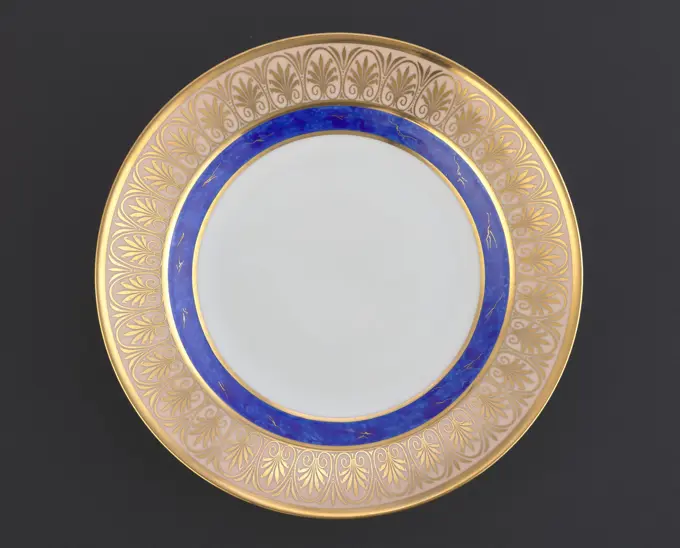
Fine porcelain and faience pieces displaying intricate designs and vibrant colors, showcasing the artistry of ceramic craftsmanship.
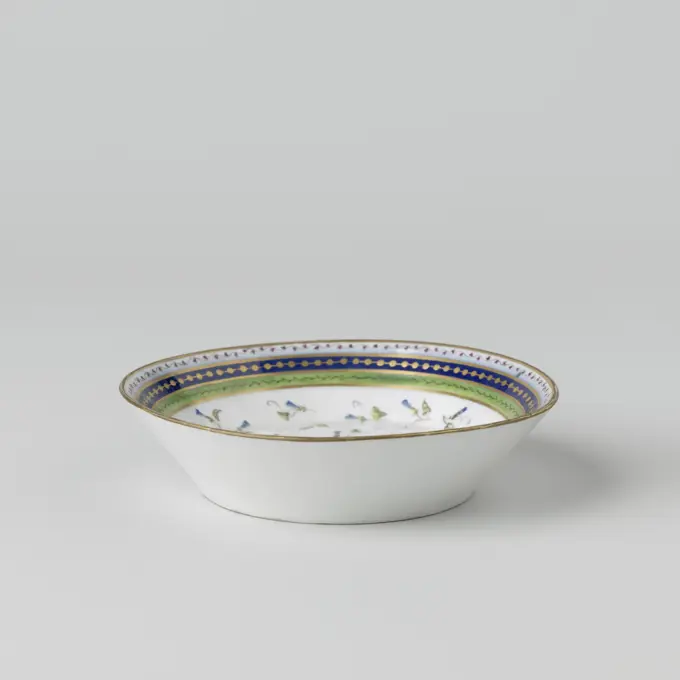
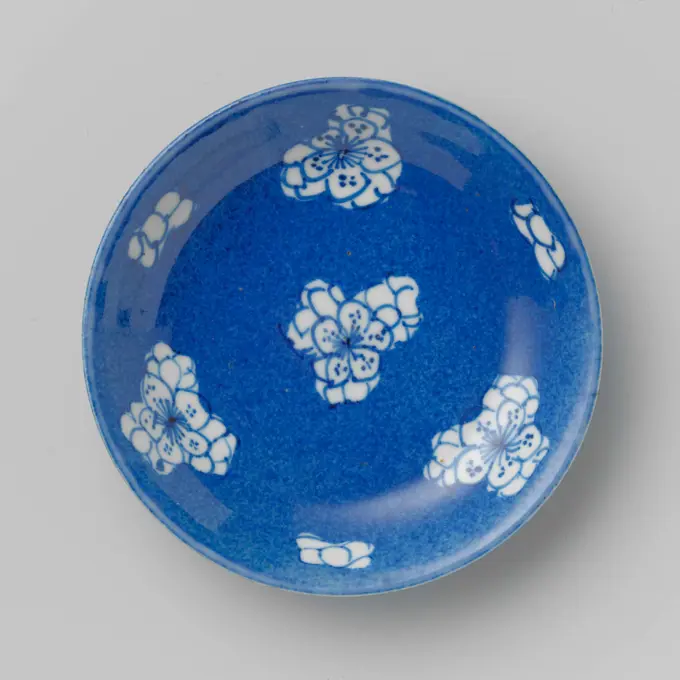
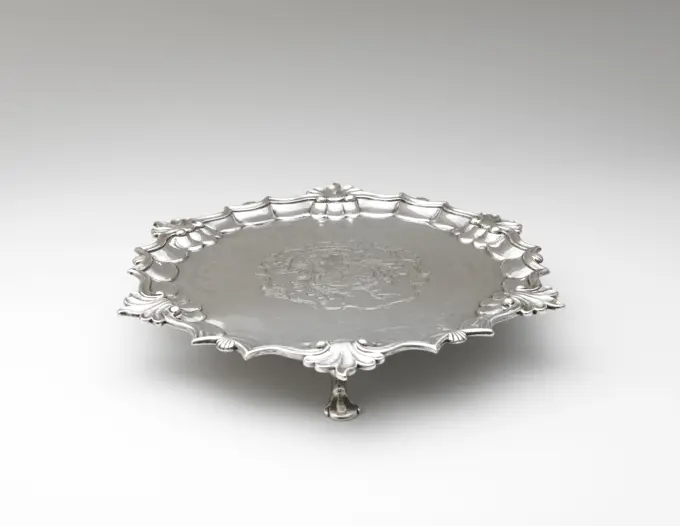
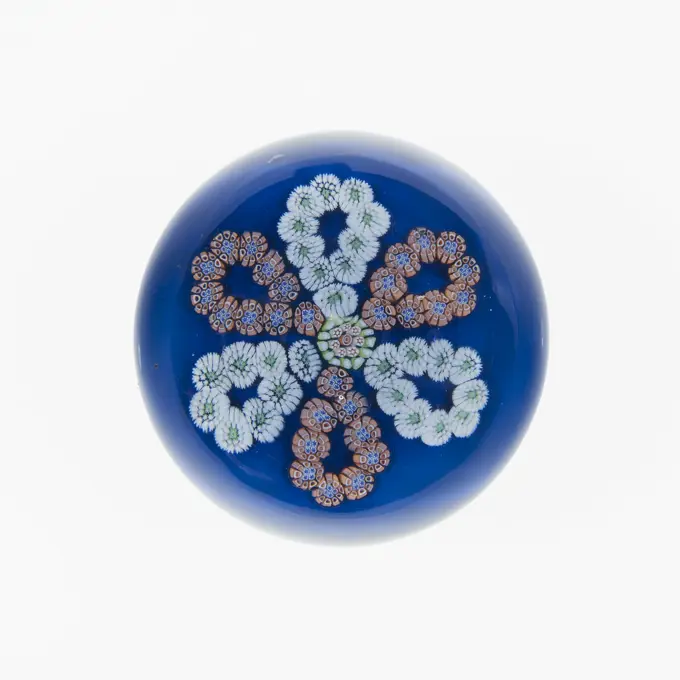
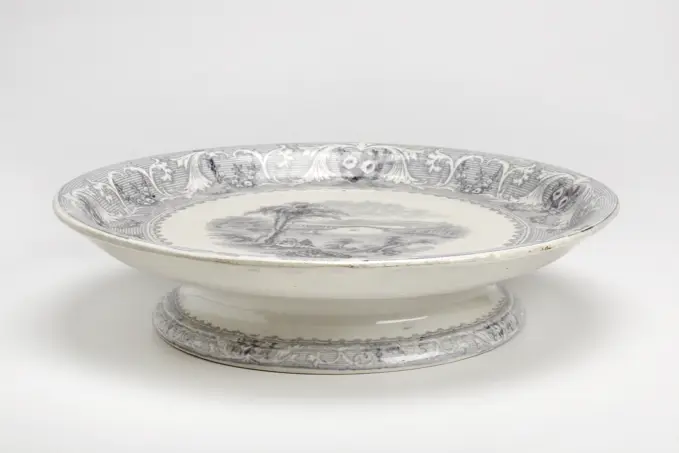
Saucer with a medallion among flowers, Manufacture de Sèvres, c. 1777 - c. 1788  Porcelain saucer with a straight wall, painted in underlaze blue and on the glaze in blue, pink, green, yellow, black and gold. On the flat a medallion with a flower branch surrounded by sprinkling flowers. The wall with a decorative tire with a black leaf vank against a green background, a golden band with dots on underly glaze blue and a flower vank. Marked on the underside with the double L with the annual letters KK and Y. Sèvres porcelain. glaze. cobalt (mineral). gold (metal) painting / gilding / vitrification
Saucer with a medallion among flowers, Manufacture de Sèvres, c. 1777 - c. 1788 Porcelain saucer with a straight wall, painted in underlaze blue and on the glaze in blue, pink, green, yellow, black and gold. On the flat a medallion with a flower branch surrounded by sprinkling flowers. The wall with a decorative tire with a black leaf vank against a green background, a golden band with dots on underly glaze blue and a flower vank. Marked on the underside with the double L with the annual letters KK and Y. Sèvres porcelain. glaze. cobalt (mineral). gold (metal) painting / gilding / vitrification
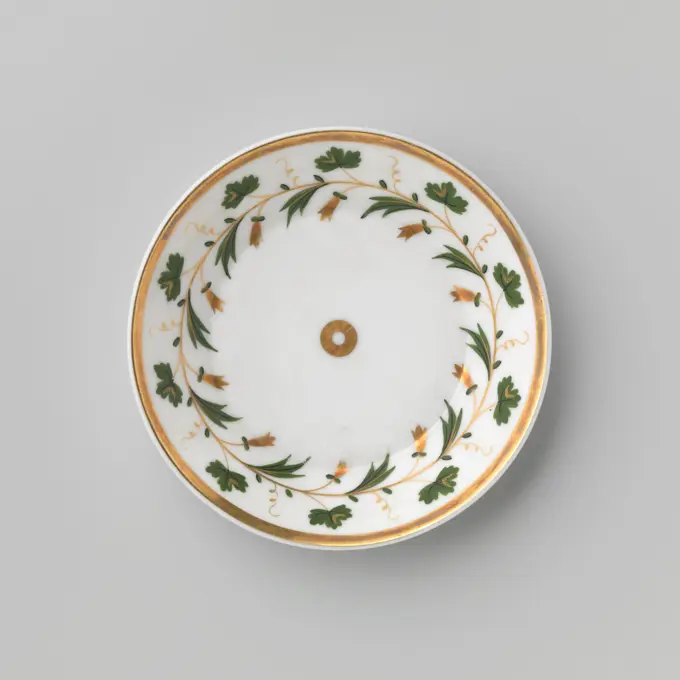
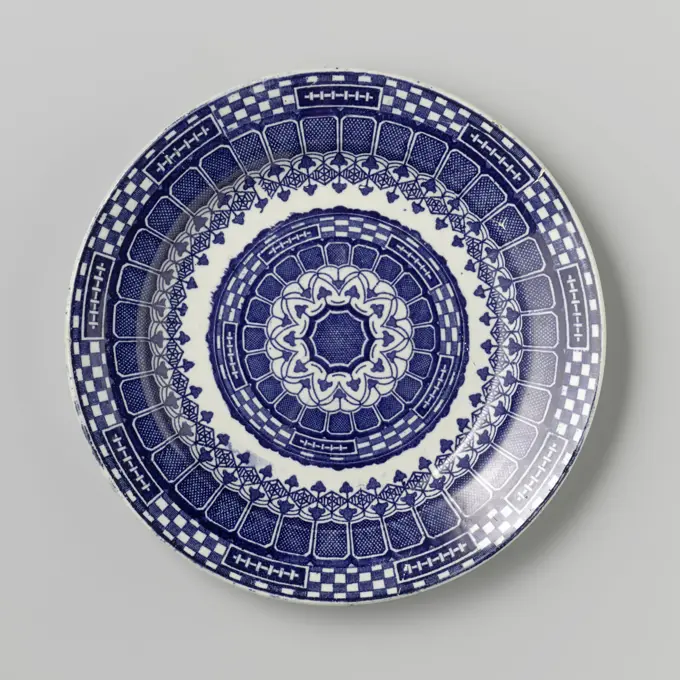
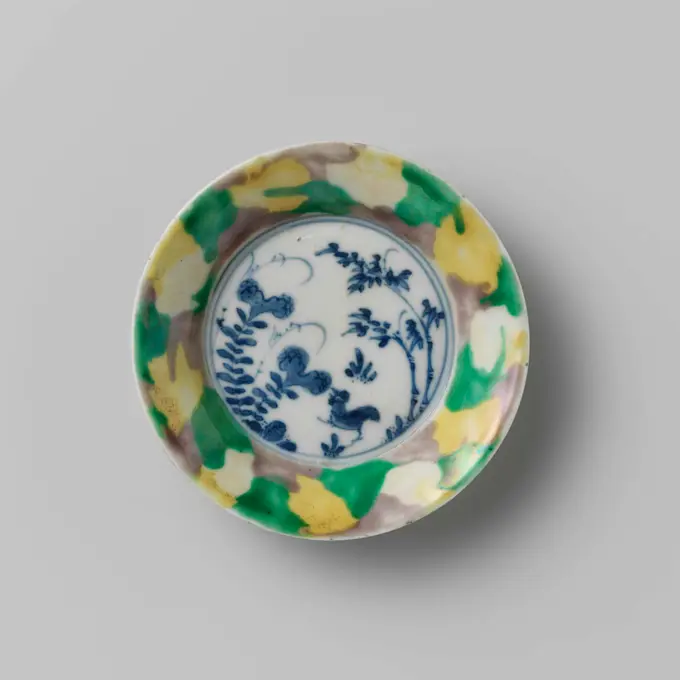
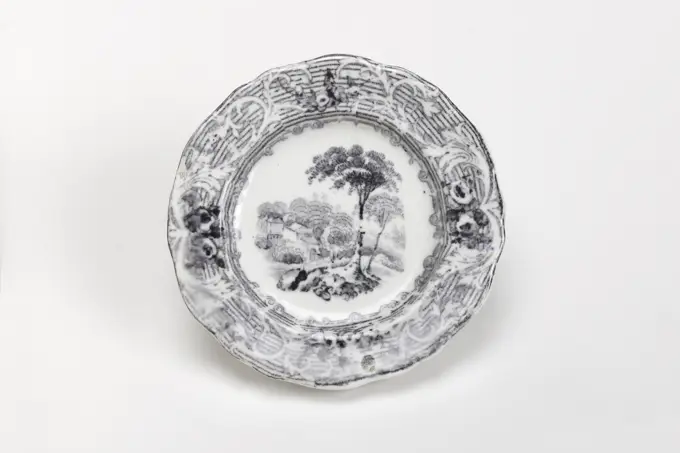
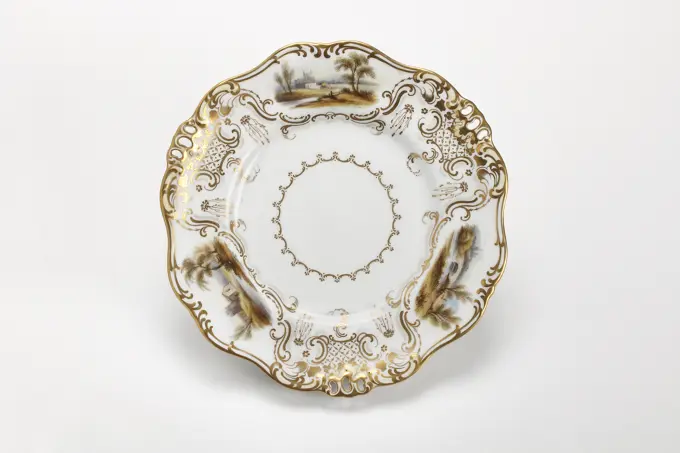
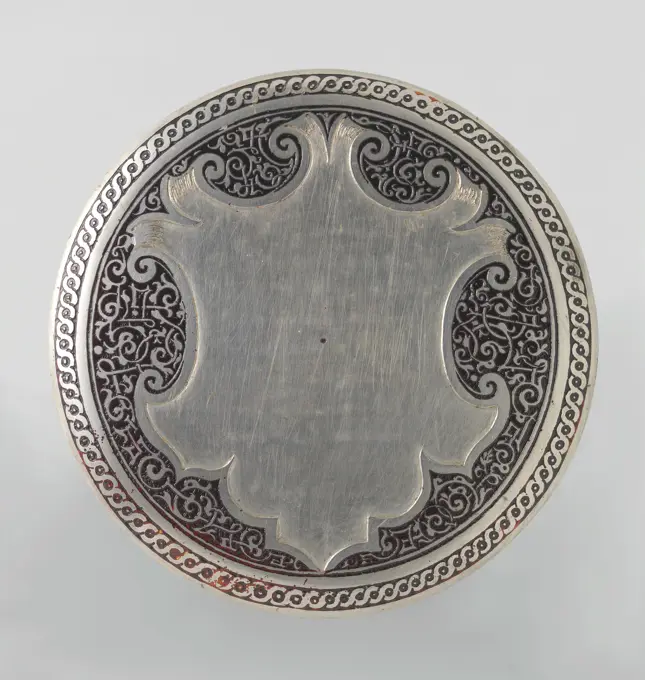
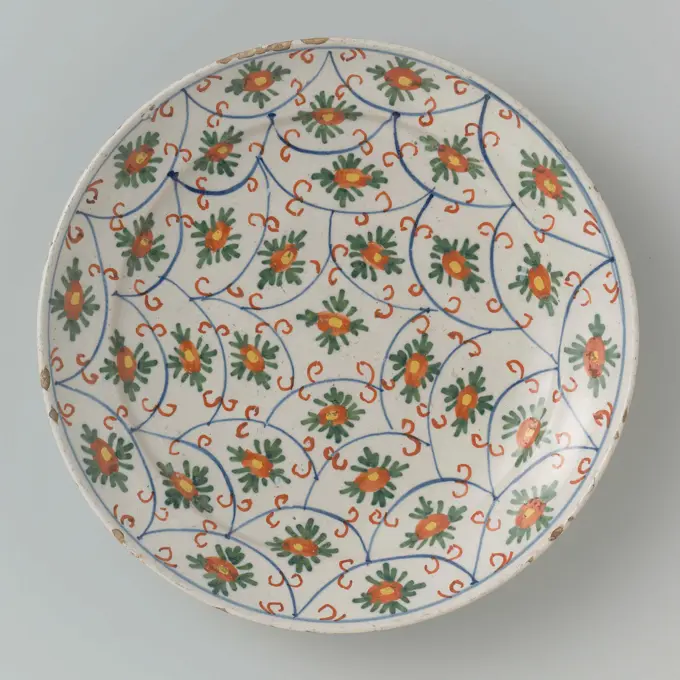
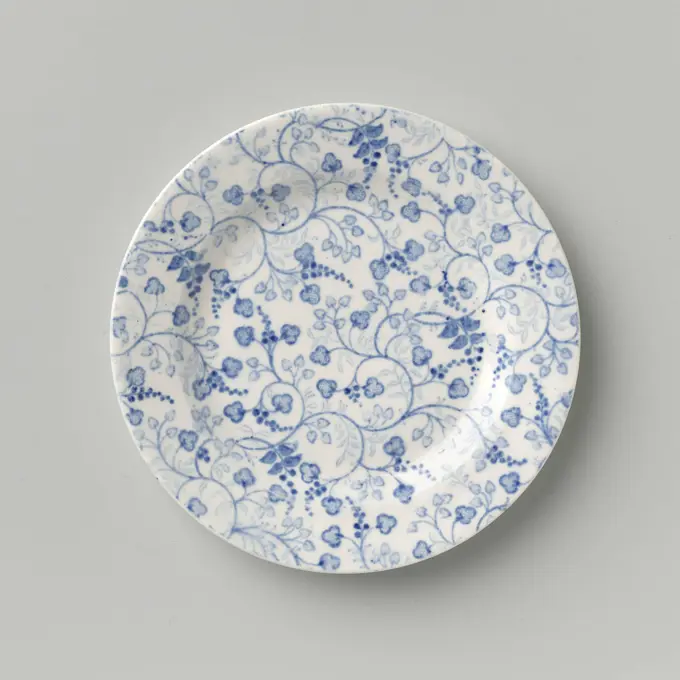
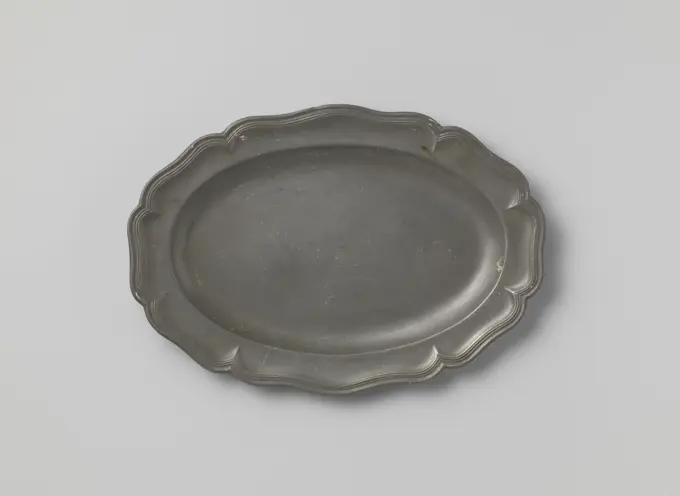
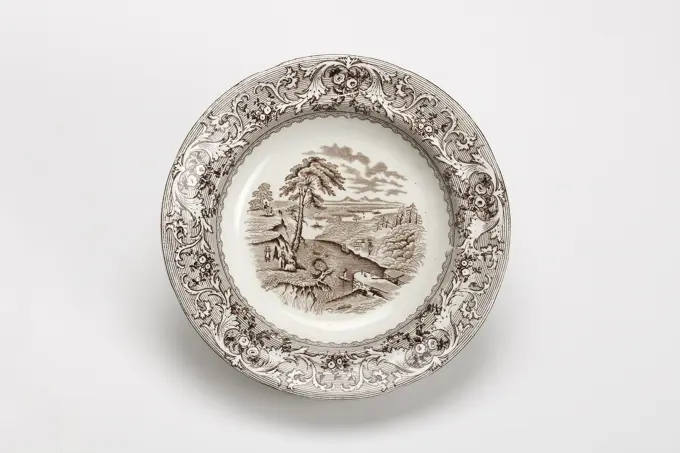
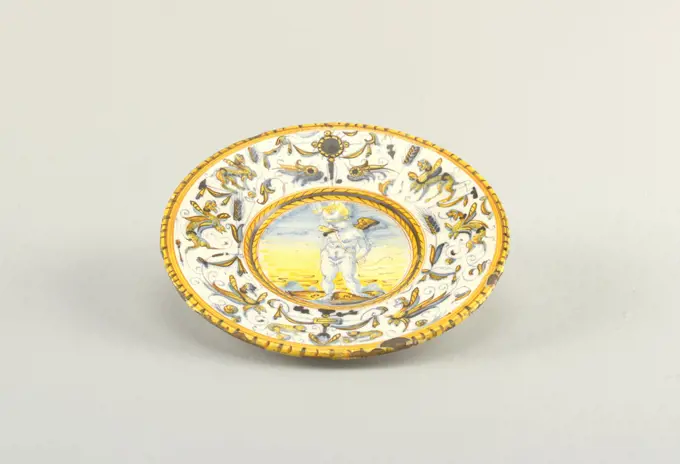
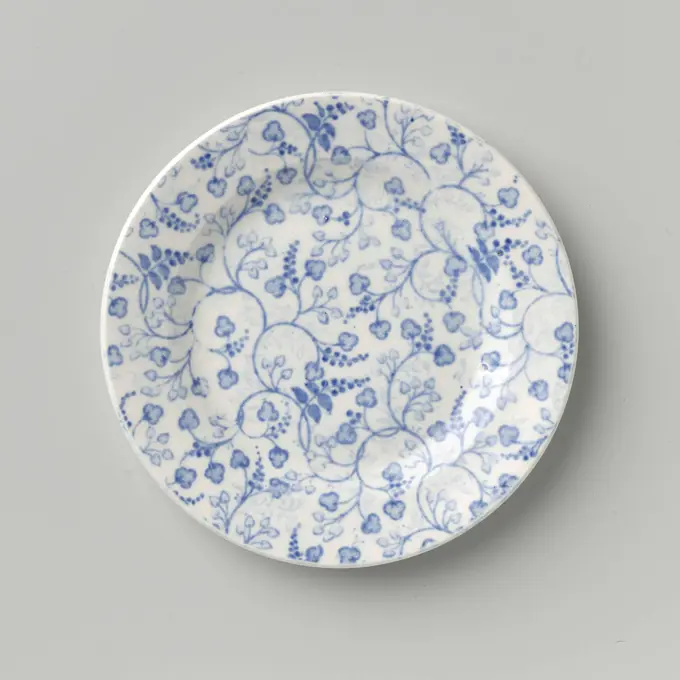
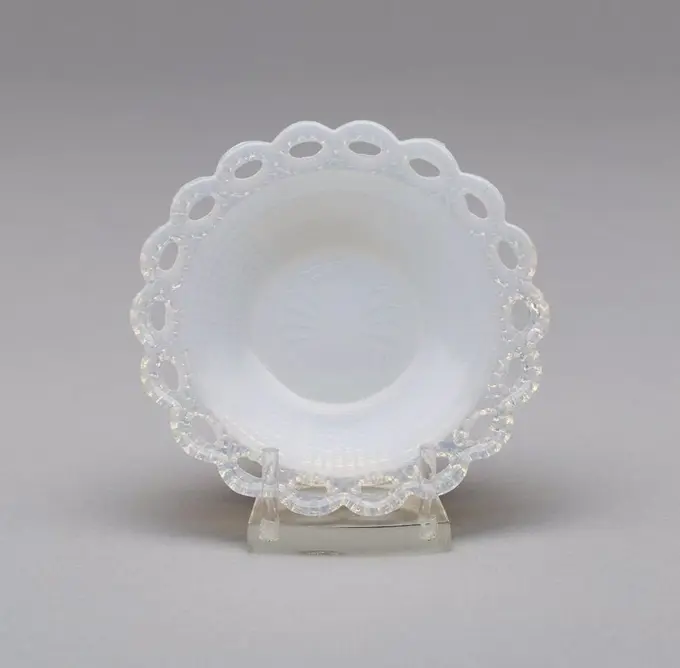
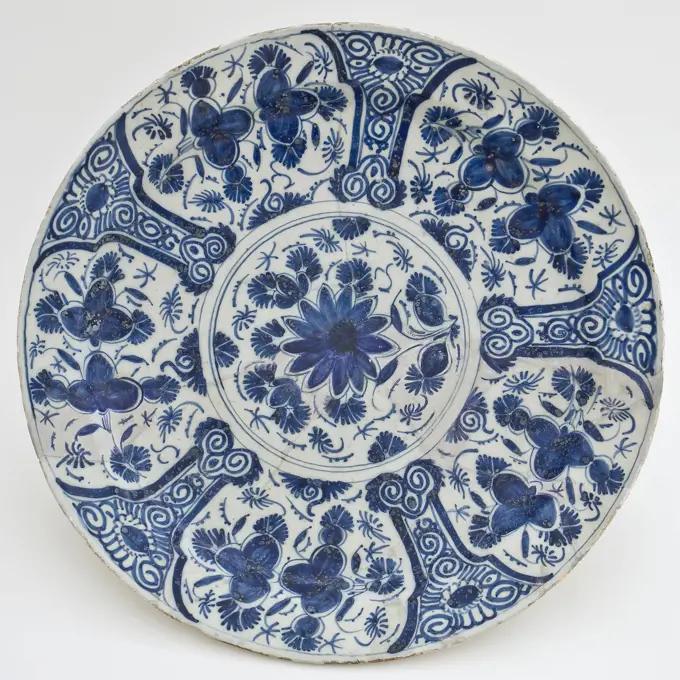
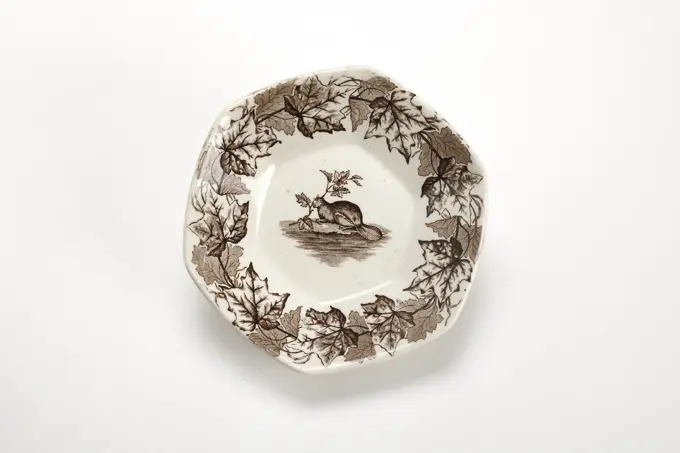
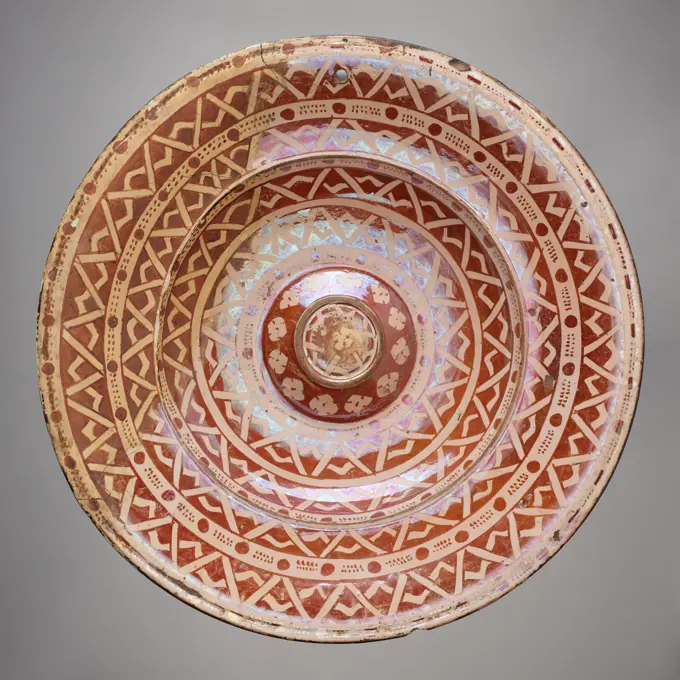
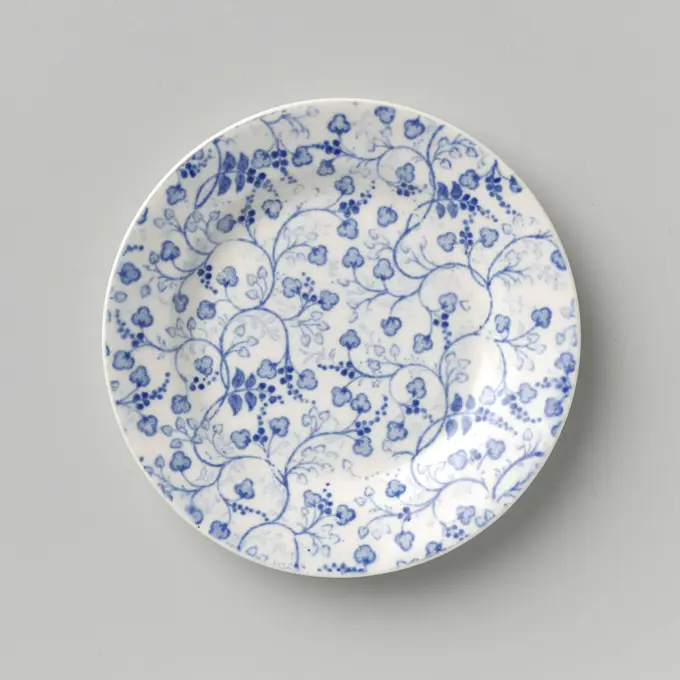
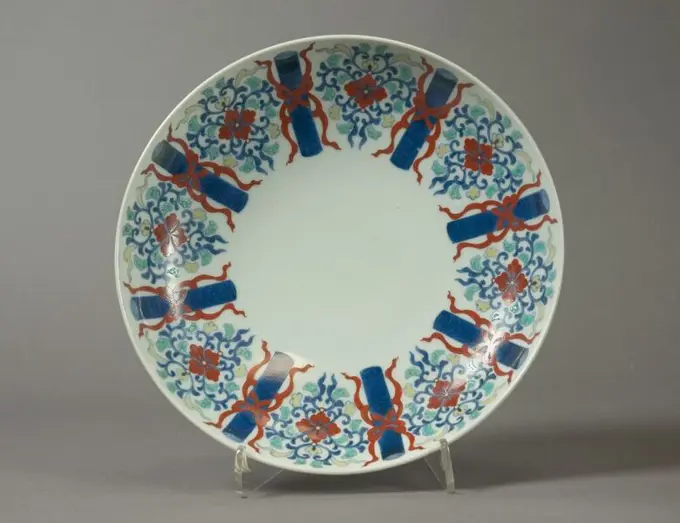
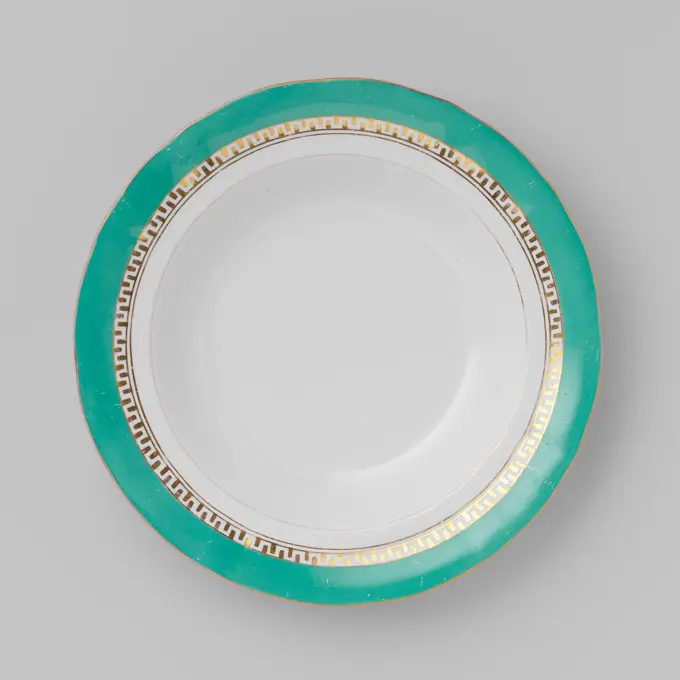
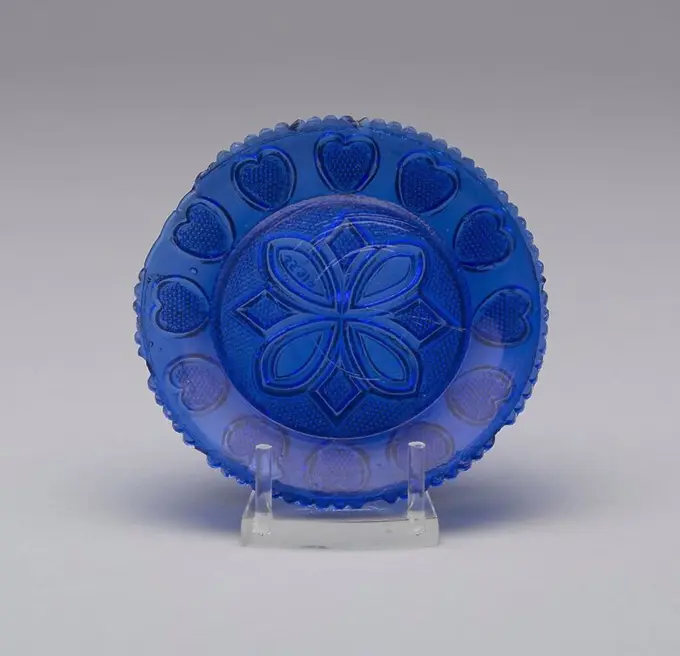
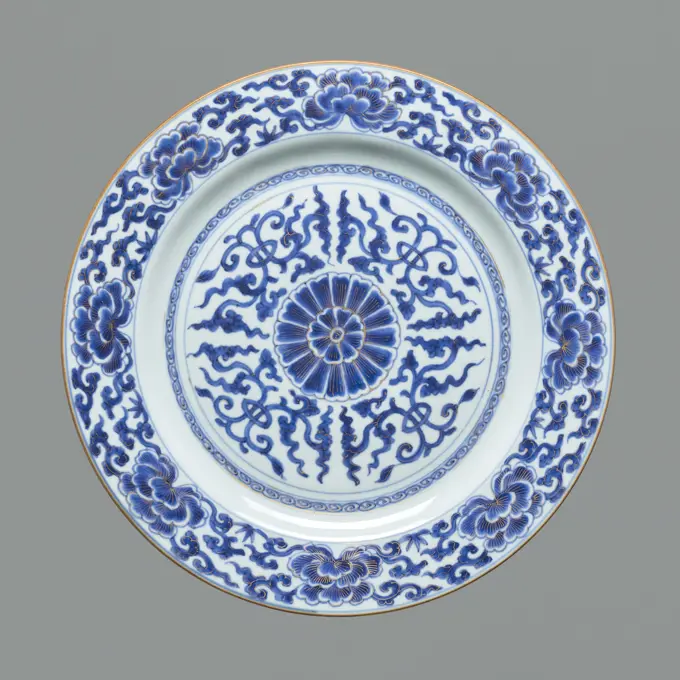
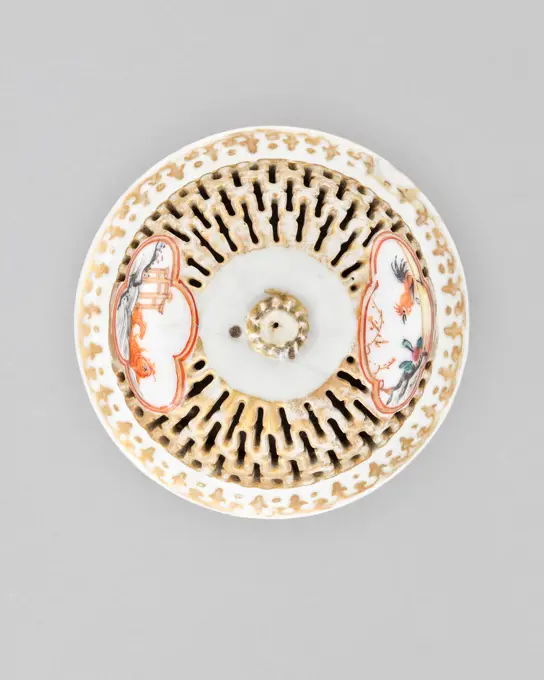
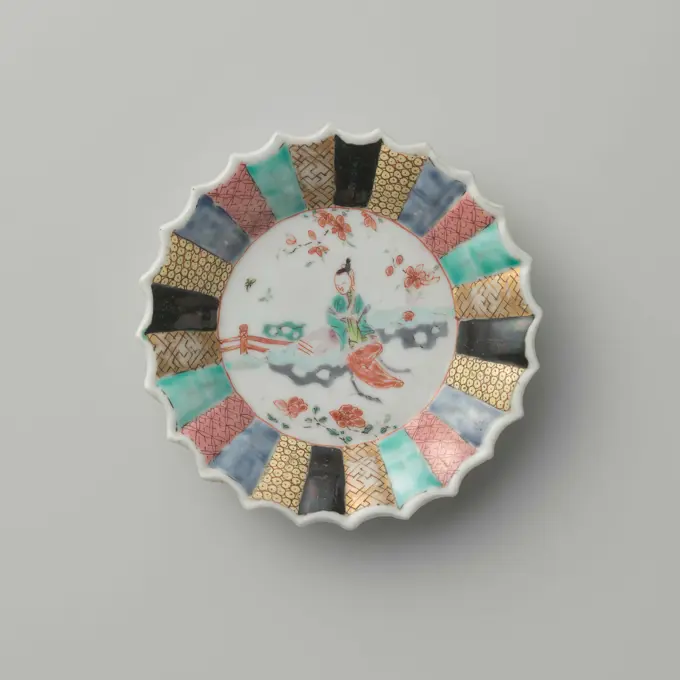
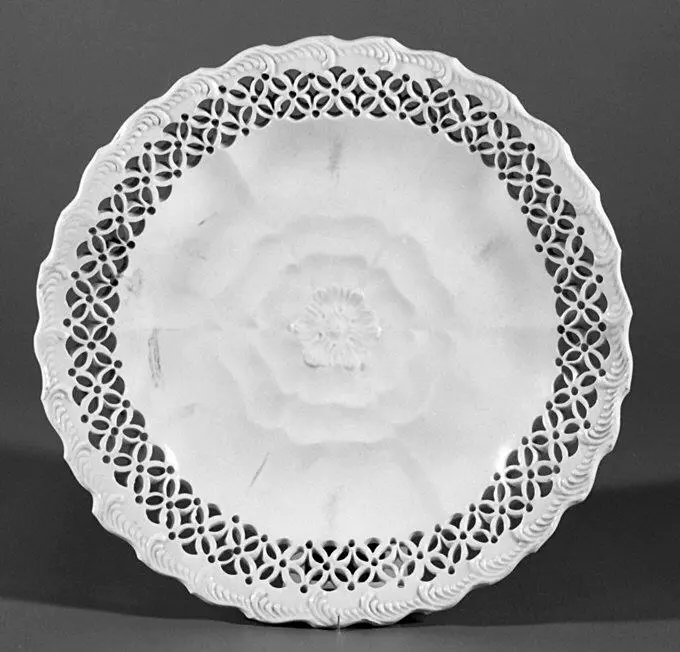
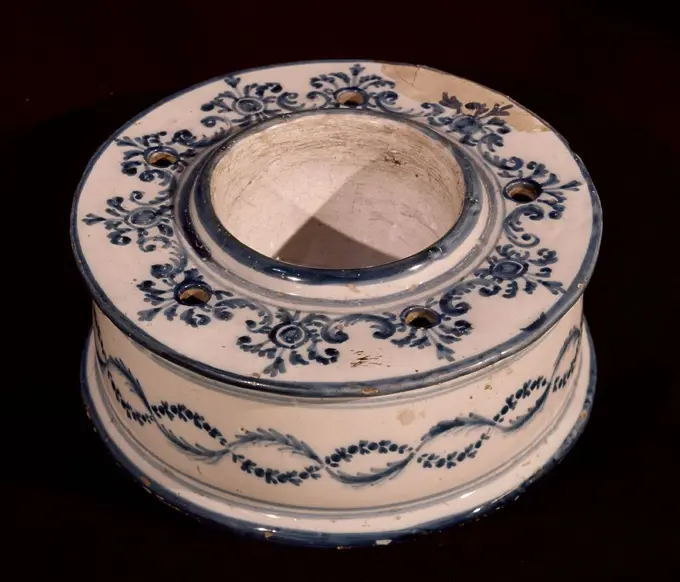
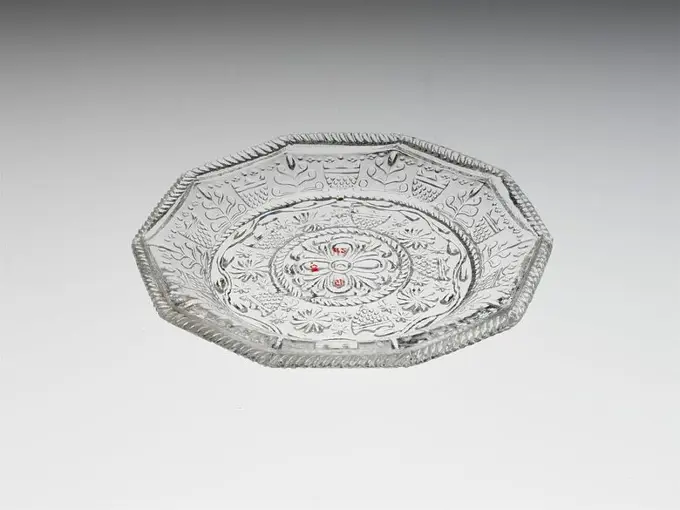
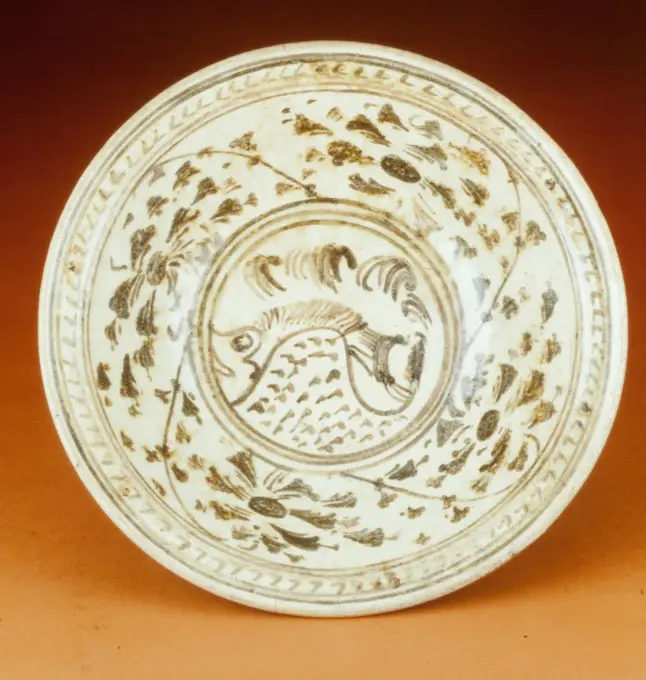
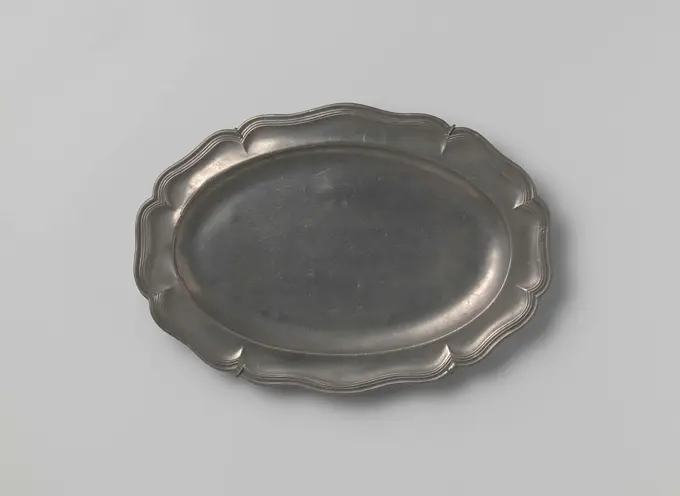
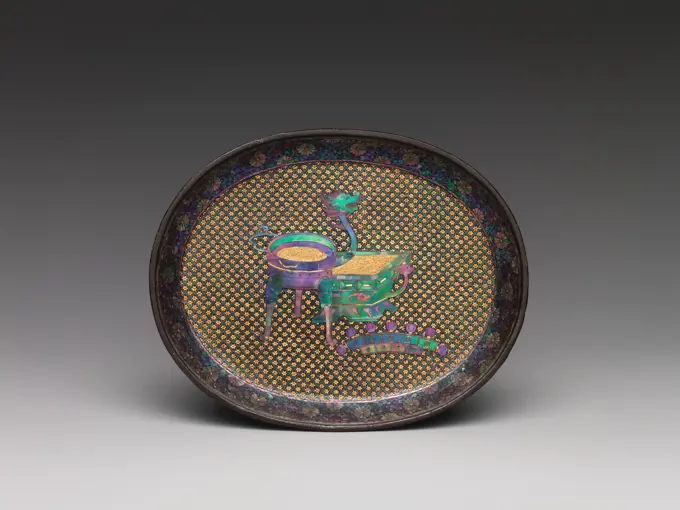
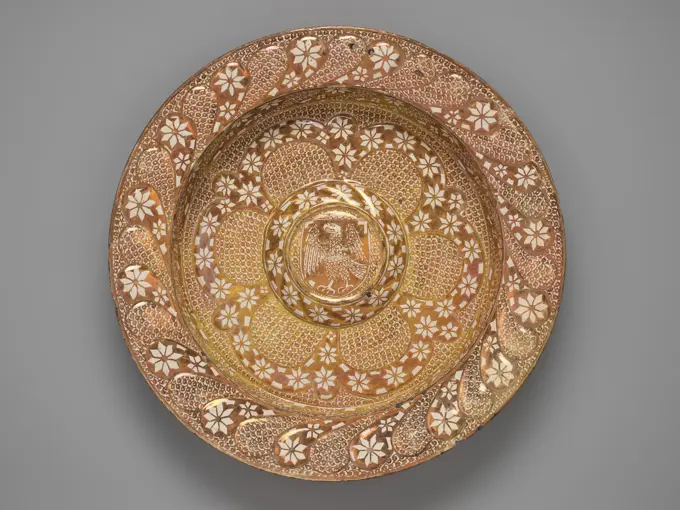
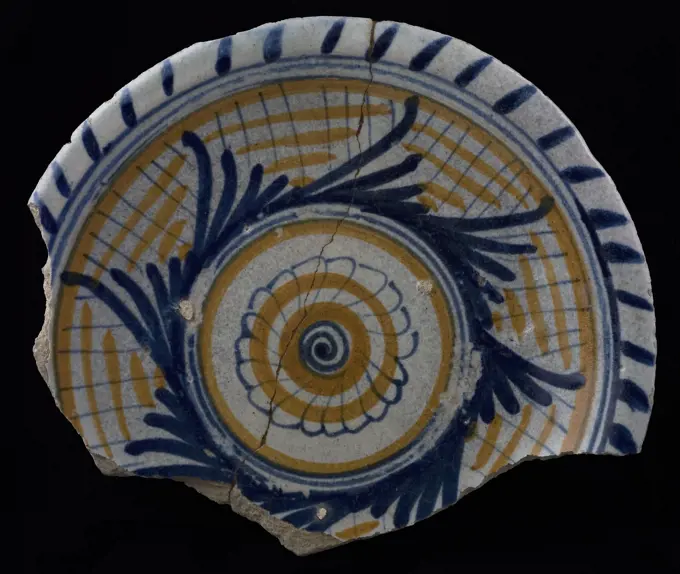
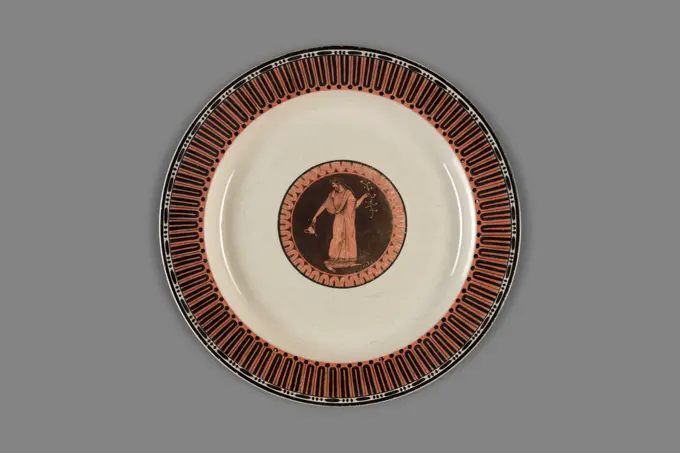
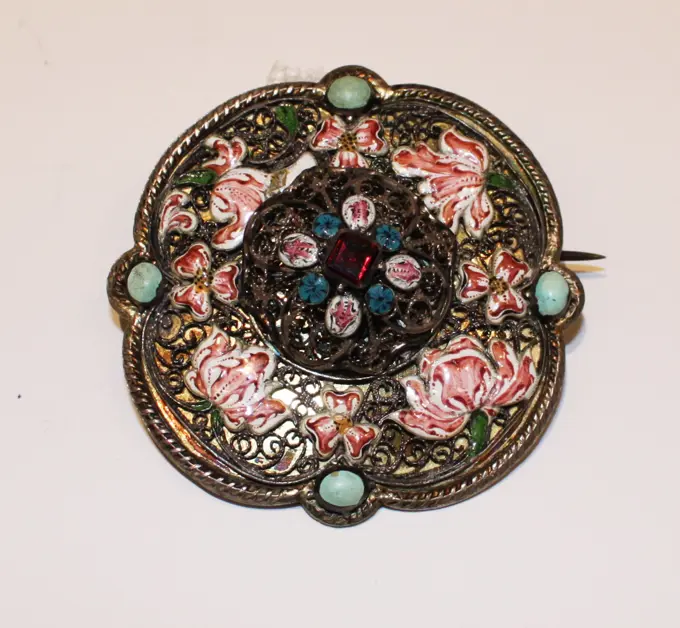
Bell-shaped cup and saucer with bouquets and floral scrolls on a diaper-patters ground, anonymous, c. 1775 - c. 1799 Cock -shaped lid head of porcelain, painted on the glaze in red, pink, green, black and gold. On the wall a bouquet with different flowers, surrounded by four smaller bouquets; The edge with flower vines in elongated cartouches saved in a background of servetwork. Famle Rose. China porcelain. glaze. gold (metal) painting / gilding / vitrification Cock -shaped lid head of porcelain, painted on the glaze in red, pink, green, black and gold. On the wall a bouquet with different flowers, surrounded by four smaller bouquets; The edge with flower vines in elongated cartouches saved in a background of servetwork. Famle Rose. China porcelain. glaze. gold (metal) painting / gilding / vitrification. Plate of faience. Painted blue.Saucer with a border of grapevines and flowers, La Courtille Parijs, c. 1800 - c. 1824 Porcelain dish with a straight wall, painted on the glaze in green, black and gold. A golden circle in the center. On the wall a band with vines on one side and flowers and leaves on the other. Golden Rand. Marked on the underside with the crossed arrows. Paris porcelain. glaze. gold (metal) painting / gilding / vitrification Porcelain dish with a straight wall, painted on the glaze in green, black and gold. A golden circle in the center. On the wall a band with vines on one side and flowers and leaves on the other. Golden Rand. Marked on the underside with the crossed arrows. Paris porcelain. glaze. gold (metal) painting / gilding / vitrificationArita (Ceramic Production Center), saucer or bowl cover with imari decor (usage name). Ceramics, porcelain, polychrome enamels: cobalt blue under cover, red on covered, gilding. Petit Palais, Museum of Fine Arts of the City of Paris.Bake with lobed edge, painted with leaf and flower branches., Anonymous, c. 1650 - c. 1670 Baking of blue painted faience, with a lobed edge. The container is painted with leaf and flower branches and it is a bottom find. Delft earthenware. tin glaze. Baking of blue painted faience, with a lobed edge. The container is painted with leaf and flower branches and it is a bottom find. Delft earthenware. tin glaze.Plate with a stylized flower surrounded by a band with blue and white surfaces, anonymous, c. 1400 - c. 1950 Plate of earthenware with flow -blue transfer decor. The flat with a kind of stylized flower surrounded by a band with compartments and blue and white blocks. The edge of the plate with compartments and blue and white blocks.  earthenware Plate of earthenware with flow -blue transfer decor. The flat with a kind of stylized flower surrounded by a band with compartments and blue and white blocks. The edge of the plate with compartments and blue and white blocks.  earthenwareSaucer with a medallion among flowers, Manufacture de Sèvres, c. 1777 - c. 1788  Porcelain saucer with a straight wall, painted in underlaze blue and on the glaze in blue, pink, green, yellow, black and gold. On the flat a medallion with a flower branch surrounded by sprinkling flowers. The wall with a decorative tire with a black leaf vank against a green background, a golden band with dots on underly glaze blue and a flower vank. Marked on the underside with the double L with the annual letters KK and Y. Sèvres porcelain. glaze. cobalt (mineral). gold (metal) painting / gilding / vitrificationSoup plate - Acadia Inconnu / UnknownDish (one of a pair). Culture: French, Rennes. Dimensions: Overall: 1 1/4 × 9 1/2 in. (3.2 × 24.1 cm). Maker: Jérôme Rebillé (1685-1740, master 1717). Date: ca. 1720-26. Museum: Metropolitan Museum of Art, New York, USA.Saucer with 'Egg and Spinach' Pattern and Cock Among Plants. Deep dish of porcelain, painted in underglaze blue and on the glaze green, yellow and eggplant. On the flat a rooster next to bamboo and a blooming plant; The wall on the inside and outside covered with an 'egg and spinach' pattern. Marked on the underside with a mushroom (Lingzhi). Famille Verte.Toy dessert plate - Georgeville D'après Francis Morley, 1845-1850Plate with fluted sides and continuous flower pattern, anonymous, c. 1700 - c. 1724 Plate of porcelain with ribbed wall and scalloped edge, painted in underlaze blue. On the flat flower vines in a medallion with a tire archive work; the wall with flower vines and a band with shadowing; The back with four lotus plants. Marked on the bottom with a window in a double circle. Two chips in the edge. Blue White. China porcelain. glaze. cobalt (mineral) painting / vitrification Plate of porcelain with ribbed wall and scalloped edge, painted in underlaze blue. On the flat flower vines in a medallion with a tire archive work; the wall with flower vines and a band with shadowing; The back with four lotus plants. Marked on the bottom with a window in a double circle. Two chips in the edge. Blue White. China porcelain. glaze. cobalt (mineral) painting / vitrificationDessert plate - William Davenport & Company, 1835-1881 William Davenport & Company, 1835-1881Plaquette van de Merkelsche table attachment, Wenzel Jamnitzer, 1549 Plaquette that has been mounted under the table piece. There used to be a text on this plaque, which has been removed again. Nuremberg silver (metal) casting / etching Plaquette that has been mounted under the table piece. There used to be a text on this plaque, which has been removed again. Nuremberg silver (metal) casting / etching. Plate of faience. Painted multi-colored.Plate. Pottery plate, with blue continuous floral decor, belonging to a children's service.Plate; Koenigliche Porzellan Manufaktur (KPM; Berlin; 1763-1918); 1870-82 (1823-00-00-1832-00-00);Dish, decorated with floral wreath and stars. Dish of porcelain, with multicolored floral wreath along the edge and garnished with regular stars placed in gold. With a corresponding head (A).Oval dish with scalloped edge, c. 1770 - 1795 Oval dish from Tin. The edge is sculpted and profiled. Roermond tin (metal) Oval dish from Tin. The edge is sculpted and profiled. Roermond tin (metal)Soup plate - D'après George L. Ashworth & Brothers, 1862-1968Shaving basin, anonymous, c. 1740 - c. 1770 Faïence shaving basin. Multicolored painted with a shepherd scene. Delft . Faïence shaving basin. Multicolored painted with a shepherd scene. Delft .Saucer with musical instruments, anonymous, c. 1800  Porcelain dish on a high foot ring, painted in blue and gold. In the center a medallion and on the wall a band with gold, on which blue has been installed. There is a musical instrument three times. Gold tires on the edge. France porcelain. glaze. gold (metal) painting / gilding / vitrificationAmorino, Tin-glazed earthenware (maiolica), Plate with image of blindfolded Cupid at center. Rim decorated with grotesques. Yellow dash border., possibly Urbino, Italy, possibly ca. 1600, ceramics, Decorative Arts, Plate, PlatePlate. unknown, craftsmanSaucer with flower sprays, anonymous, c. 1860 Porcelain dish, painted on the glaze in blue, red, pink, green, yellow, brown and gold. On the flat a double golden circle with around it and on the inner wall a tire of flower branches. Golden Rand. Three prenes on the bottom. France (possibly) porcelain. glaze. gold (metal) painting / gilding / vitrification Porcelain dish, painted on the glaze in blue, red, pink, green, yellow, brown and gold. On the flat a double golden circle with around it and on the inner wall a tire of flower branches. Golden Rand. Three prenes on the bottom. France (possibly) porcelain. glaze. gold (metal) painting / gilding / vitrificationPlate. Pottery plate, with blue continuous floral decor, belonging to a children's service.Dish 18th-19th century. Dish 447240Platter from a heraldic dinner set. Patanazzi Alfonso, workshopCup plate. American. Date: 1830-1835. Dimensions: diam. 8.3 cm (3 1/4 in.). Pressed glass. Origin: United States. Museum: The Chicago Art Institute, Chicago, USA.Plate;  around 1720-1740 (1720-00-00-1740-00-00);Faience plate on wide stand ring with blue-white decor, flower rosette and five fields along the edge, dish crockery holder soil find ceramic earthenware glaze tin glaze, hand-turned baked decorated glazed fried Large faience dish with upstanding angled flag. Wide stand ring. Yellow shard entirely covered with tin glaze. Blue decor on white fond In the mirror in double circle blue rosette surrounded by floral motifs The entire border is divided into five compartments in which flower and leaf motifs Cooked archeology Valckensteyn Poortugaal Albrandswaard native earthenware decorate serving food Soil discovery Valugaal Castle Valckensteyn.Dessert plate -Plate 1794 Imperial Porcelain Manufactory. Plate 187796 Factory: Imperial Porcelain Manufactory , Vienna, 17441864, Dinner plate, 1794, Hard-paste porcelain, Diameter: 9 1/2 in. (24.1 cm). The Metropolitan Museum of Art, New York. Gift of Henry G. Marquand, 1894 (94.4.241)Plate. Culture: China. Dimensions: H. 1 3/4 in. (4.4 cm); Diam. 11 in. (27.9 cm). Museum: Metropolitan Museum of Art, New York, USA.Dish, painted with a blue and white diamond pattern surrounded by concentric circles within which a zigzag motif, anonymous, c. 1600 - c. 1620 Round deep dish of blue painted majolica. The dish is painted with a blue and white diamond pattern. Concentric circles are painted in this pattern within which two-circles are a ZIG-Zag line. The dish has a narrow bent edge on which stripes are painted. Holland earthenware. tin glaze. lead glaze majolica Round deep dish of blue painted majolica. The dish is painted with a blue and white diamond pattern. Concentric circles are painted in this pattern within which two-circles are a ZIG-Zag line. The dish has a narrow bent edge on which stripes are painted. Holland earthenware. tin glaze. lead glaze majolicaBowl - Maple Thomas Furnival & Sons Thomas Furnival & SonsMeissen Manufacture. Plate. Hard porcelain, polychrome enamels. 3rd quarter of the 18th century. Museum of Fine Arts of the City of Paris, Petit Palais. Faience, table service, dishes, 18th 18th 18th 18th 18th 18th 18 century, platePrussian penny; Zygmunt I Stary (King of Poland; 1506-1548); 1530 (1530-00-00-1530-00-00);For a long time; Manises (ceramic family; Ca 1400-); 16th century (1501-00-00-1600-00-00);Plate of sides; Koenigliche Porzellan Manufaktur (KPM; Berlin; 1763-1918); 1803-10 (1823-00-00-1832-00-00);Plate. Pottery plate, with blue continuous floral decor, belonging to a children's service.Saucer with an ornamental border, anonymous, c. 1800 - c. 1824 Porcelain dish with a straight wall, painted on the glaze in gold. On the flat a gold medallion with a flower branch. The inner wall is with a pendulum of stars, half moon shapes with dots and triangles and a golden edge. Marked on the bottom with g. Empire. France porcelain. glaze. gold (metal) painting / gilding / vitrification Porcelain dish with a straight wall, painted on the glaze in gold. On the flat a gold medallion with a flower branch. The inner wall is with a pendulum of stars, half moon shapes with dots and triangles and a golden edge. Marked on the bottom with g. Empire. France porcelain. glaze. gold (metal) painting / gilding / vitrificationDish, anonymous, c. 1700 - c. 1724 Scale of porcelain, decorated in under -glaze blue. The bowl is covered at the front with bleu poudré (powder blue) with two saved, fan -shaped compartments with a river landscape with mountains, rocks and a pine. The outer wall with a flower branch three times. Marked on the underside with a mushroom (lingzhi) in a double circle. Bleu Poudré with blue and white. China porcelain. glaze. cobalt (mineral) painting Scale of porcelain, decorated in under -glaze blue. The bowl is covered at the front with bleu poudré (powder blue) with two saved, fan -shaped compartments with a river landscape with mountains, rocks and a pine. The outer wall with a flower branch three times. Marked on the underside with a mushroom (lingzhi) in a double circle. Bleu Poudré with blue and white. China porcelain. glaze. cobalt (mineral) paintingCover for a Qingbai Ware Bowl, 1100s-1200s. South China, Southern Song dynasty (1127-1279). Porcelain with pale bluish-white glaze, Qingbai ware; lid: 4 x 15.3 cm (1 9/16 x 6 in.).Dish. Culture: Japan. Dimensions: H. 2 1/4 in. (5.7 cm); Diam. 8 in. (20.3 cm). Date: early 18th century. Museum: Metropolitan Museum of Art, New York, USA.Dish (without image). Dish (without image)Terracotta dish ca. 330-300 B.C. Greek, South Italian, Campanian, Teano Shallow dish with ring base, decorated with ivy vine and stamped pattern.. Terracotta dish 248190Plate; Koenigliche Porzellan Manufaktur (KPM; Berlin; 1763-1918); 1870-82 (1823-00-00-1832-00-00);Belt Plaque 16th century China. Belt Plaque. China. 16th century. Jade (nephrite). Ming dynasty (1368-1644). JadeDessert plate - Davenport DavenportTerracotta lekanis (dish). Culture: Greek, South Italian, Apulian. Dimensions: H. 5 1/2 in. (14 cm)diameter 18 in. (45.7 cm). Date: ca. 365-350 B.C..On the handles, griffinsReverse, one side, nude youths and women; other side, women, Eros, and youthInterior: wine wreath around a rosette. On each handle platform: griffin. Exterior: A: woman seated on a rock feeding a bird perched on her left knee while Eros flies toward her with a phiale and a wreath. To the left, a woman with a fan and a fillet. To the right, a nude youth with a branch. B: two couples: at the left, a nude youth with a branch follows a woman holding a wreath and a fan. At the right, a woman is seated holding a tendril. Her companion offers a mirror and a bunch of grapes. Museum: Metropolitan Museum of Art, New York, USA.Blackboard with green edge and golden Greek tie. Plate of pottery, scalloped, with green border and golden Greek tie.Plate; Koenigliche Porzellan Manufaktur (KPM; Berlin; 1763-1918); 1870-82 (1823-00-00-1832-00-00);Cup plate. American; Sandwich, Massachusetts. Date: 1835-1840. Dimensions: diam. 8.4 cm (3 5/16 in.). Pressed glass. Origin: Sandwich. Museum: The Chicago Art Institute, Chicago, USA.Dessert plate - Davenport DavenportSoepbord, Tag Met Het wing pattern decor, Meissener porcelain manufactory, 1901 Plate of painted porcelain. The board is painted in green and blue with the Flügelmuster. The board belongs to a service (BK-1976-65-1 to BK-1976-65-34) and is marked. Float porcelain Plate of painted porcelain. The board is painted in green and blue with the Flügelmuster. The board belongs to a service (BK-1976-65-1 to BK-1976-65-34) and is marked. Float porcelainDish 18th century. Dish 444450Paperweight 1801-1900 Clichy. This paperweight uses a traditional glass-making technique called millefiori to great effect. Italian for ìone thousand flowers,î millefiori was first developed in fifteenth-century Venice. In the nineteenth century, French glassmakers revived the technique with a cultural twist. Arranged to evoke traditional French gardens such as the Tuileries in Paris, paperweights like this example brought a little of this landscaping magic indoors.From the late 1840s to early 1860s, French manufacturers of fine glass and crystalósuch as Baccarat (Alsace), Clichy (Paris), and Saint-Louis (Lorraine)ócatered to the vast public enthusiasm for beautiful yet functional desk accessories. Paperweights, which were designed to secure loose papers against drafts, were among their most popular products.. Glass . Clichy GlasshouseDish. unknown, craftsmanUnknown (n. - d.), Teapot cover (common name). Ceramics, porcelain, polychrome enamels. Petit Palais, Museum of Fine Arts of the City of Paris.Saucer (part of a service) 1790-1800 Chinese, probably for British market. Saucer (part of a service) 201087Saucer with a Chinese Lady in A Garden and Diaper Patterns on Various Colored Grounds. Dish of porcelain with ribbed wall and scalloped edge, painted on the glaze in blue, red, pink, green, yellow, black and gold. On the platter of the dish a Chinese lady (long lice) sitting on a rock in a fenced garden with flowering plants; The edge divided into narrow courses with napkin on different colored backgrounds. Family Rose.Struggle Gives Birth to Heroes Plate; Designed by Sergei Vasilievich Chekhonin (Russian, 1878 - 1936); Manufactured by State Porcelain Factory (Russia); porcelain, enamel; Diameter: 23.5 cm (9 1/4 in.); The Henry and Ludmilla Shapiro Collection; Partial gift and partial purchase through the Decorative Arts Association Acquisition and Smithsonian Collections Acquisition Program Funds; 1989-41-8ivy, ornaments, purchase (provenance), gildingDessert dish (one of a pair) 18th century British, Leeds. Dessert dish (one of a pair) 205372TINTERO DECORADO CON FLORES Y VIDRIADO. Location: MUSEO RUIZ DE LUNA. TALAVERA DE LA REINA. Toledo. SPAIN.Tray (England); silverDish Made 1750-1759 Staffordshire. Salt-glazed stoneware .Manufacture of Sèvres, saucer (main title). Tender porcelain, gilding, polychrome enamels. Petit Palais, Museum of Fine Arts of the City of Paris.Dish, purple red fond with golden piping. Dish of porcelain, part of a coffee set, with purple red fond and golden piping along the edge a wide golden trim in which a engraved leaf drink. No brand.Saucer-Dish With Powder Blue and Flower Heads in reserve. Dish with round wall of porcelain, painted in underglaze blue. The dish is covered with bleu poudré (powder blue) with a flower seven times in this. Marked on the underside with a seal mark in a double circle. Three chips in the edge. Bleu poudré with blue and white.Two fragments of bottom, foot and part wall of smooth cup, drinking cup drinking utensil holder soil find glass, hand-blown glass application Two fragments of part bottom foot and small part wall of smooth cup in clear colorless and blue glass Continuous continuous serrated glass wire in blue glass as stand ring of which approx. 1.0 cm is missing. Under raised bottom (2.0 cm) pontilemark Four small incursions to almost horizontal ascending wall archeology Rotterdam rail tunnel drinking beer Soil discovery: rail tunnel Rotterdam.Bowl with Mandarin Ducks among Leaves and Cattails 1000-1099 China. Ding ware; porcelain with underglaze carved and incised decoration; metal rim .Plate; Koenigliche Porzellan Manufaktur (KPM; Berlin; 1763-1918); 1870-82 (1823-00-00-1832-00-00);Plate with a group with dog in a landscape, Peter Regout, c. 1850 - c. 1875 Plate of earthenware with red transfer decor, round, decorated it flat with a group with dog in a landscape. To the show two red piping. The edge with a floral decor in relief. Maastricht . Plate of earthenware with red transfer decor, round, decorated it flat with a group with dog in a landscape. To the show two red piping. The edge with a floral decor in relief. Maastricht .Salver ca. 1756 Nathaniel Hurd American. Salver 20525Dishwarm of earthenware with multi -celled drawing of flowers and a decorative edge, anonymous, 1500 - 1799   earthenware. glaze   earthenware. glazePaperweight 1801-1900 Clichy. This paperweight uses a traditional glass-making technique called millefiori to great effect. Italian for ìone thousand flowers,î millefiori was first developed in fifteenth-century Venice. In the nineteenth century, French glassmakers revived the technique with a cultural twist. Arranged to evoke traditional French gardens such as the Tuileries in Paris, paperweights like this example brought a little of this landscaping magic indoors.From the late 1840s to early 1860s, French manufacturers of fine glass and crystalósuch as Baccarat (Alsace), Clichy (Paris), and Saint-Louis (Lorraine)ócatered to the vast public enthusiasm for beautiful yet functional desk accessories. Paperweights, which were designed to secure loose papers against drafts, were among their most popular products.. Glass . Clichy GlasshouseCake stand - The Chaudire Bridge (near Quebec) D'aprs Possiblement  $eognl:#state.prefix  Ridgway, Morley, Wear & CompanyToy plate - Inconnu / UnknownCup Plate. Culture: American. Dimensions: Dimensions unavailable. Maker: Possibly New England Glass Company (American, East Cambridge, Massachusetts, 1818-1888). Date: 1835-45. Museum: Metropolitan Museum of Art, New York, USA.Tazza on high diaboloid feet; Part of a crockery. Tazza on high diaboloid feet; Part of a crockery, painted in sepia with landscapes or topographical faces. Marked in sepia in the foot: a.t.v.; Release the letter N. Note: Piece from edge and small crack in edge.Plate ca. 1730-40 After a composition by Pierre Brebiette French Faience, or tin-glazed and enameled earthenware, first emerged in France during the sixteenth century, reaching widespread usage among elite patrons during the seventeenth and early eighteenth centuries, prior to the establishment of soft-paste porcelain factories. Although characterized as more provincial in style than porcelain, French faience was used at the court of Louis XIV as part of elaborate meals and displays, with large-scale vessels incorporated into the Baroque garden designs of Versailles. Earlier examples of French faience attest to the strong influence of maiolica artists from Italy. Later works demonstrate the ways in which cities such as Nevers, Rouen, Lyon, Moustiers, and Marseille developed innovative vessel shapes and decorative motifs prized among collectors throughout Europe. While faience can be created from a wide mixture of clays, it is foremost distinguished by the milky opaque white color achiePaperweight 1840-1860 Saint-Louis. Glass . Compagnie de Saint LouisSukhothai Plate, 15th century, 2 5/8 x 9 5/8 x 9 5/8 in. (6.67 x 24.45 x 24.45 cm), Earthenware, Thailand, 15th centuryDish, Anonymous, 1781 Oval dish with scalloped edge. Rocaille elements, leaves and flowers are engraved in the edge. The dish is marked: stk. = Amsterdam, Jrl. = W (1781) and an unknown Mastert sign. Amsterdam silver (metal) Oval dish with scalloped edge. Rocaille elements, leaves and flowers are engraved in the edge. The dish is marked: stk. = Amsterdam, Jrl. = W (1781) and an unknown Mastert sign. Amsterdam silver (metal)Oval dish with scalloped edge. Oval dish of tin. The edge is scalloped and profiled.Octagonal Saucer With Lotus Scrolls. Octagonal dish of porcelain, painted in underglaze blue. On the flat a lotus in a double medallion; to them eight radiating compartments with lotus drinks; The edge with a bond with leaf raft. The outside with eight compartments with a lotus branch. Two chips in the edge. Blue White.Shallow Bowl, 15th century, 2 1/8 x 9 7/8 in. (5.4 x 25.08 cm), Kalong ware Stoneware with underglaze brown decor, Thailand, 15th centuryTile, J. & J. G. Low Art Tile Works, 1877 - 1883, Glazed stoneware, Square molded tile made of white clay. Tile back has design of raised concentric circles framing inscription: 'J. & J.G. Low, Patent Art Tile Works, Chelsea Mass. U.S.A., copyright 1881 by J. & J.G. Low'. Face of tile has central rosette framed by plain narrow border. Tile is painted mustard-green crackle glaze., Chelsea, Massachusetts, USA, late 19th century, tiles, Decorative Arts, TileDish with Antiquities mid-17th-early 18th century China The phrase inlaid into the bottom of this small dish reads for the delectation of the jade hall” (yuntang jiawan), indicating that it was a private commission. This inscription alludes to the collection of the infamous Ming-dynasty Prime Minister Yan Song (1480-1566). Because of his greed and lack of scruples, Yan was able to amass an astonishing collection of antiquities. In an ironic transformation, he instead became known as an icon of good taste in later ages.. Dish with Antiquities. China. mid-17th-early 18th century. Black lacquer with mother-of-pearl inlay. Qing dynasty (1644-1911). LacquerDish ca. 1500 Spanish, Valencia On the front, Manises lusterware braseros were decorated with radial designs and filled with dense, regularized vegetal motifs and other patterns, all organized around a central device. On the back, they were also luster-painted, usually with larger-scale designs and often with more exuberance. Puncture holes in the rims indicate that such dishes were sometimes displayed on walls when not in use.. Dish. Spanish, Valencia. ca. 1500. Tin-glazed and luster-painted earthenware. Ceramics-PotteryFragment majolica dish, orange and blue on white, rosette in the middle, cable edge, plate crockery holder soil find ceramic earthenware glaze, baked underside covered with blue-gray lead glaze. Polychrome. Italian Dutch decor. Rosette and rotating plumes archeology Rotterdam Italy food decorate Rotterdam 1940.Dinner plate with Etruscan decoration. Wedgwood, Josiah (1730-1795), factory owner, Etruria Factory (Staffordshire ; wytwórnia ceramiki ; 1769-1950), factorySaucer with a man, woman and two panels with characters, anonymous, c. 1825 - c. 1874 Porcelain dish with straight wall, painted on the glaze in blue, red, pink, green, yellow, black and gold. On the flat of the dish a man and woman and two cartouches with Chinese characters; a fan -shaped cartouche with a band of 'crackled ice' and a book -shaped cartouche; The head also with a man and woman (in other clothing) and two cartouches with characters; The fan -shaped with 'crackled ice' and a cartouche formed by a bamboo branch. A chip from the dish. Famle Rose. China porcelain. glaze. gold (metal) painting / gilding / vitrification Porcelain dish with straight wall, painted on the glaze in blue, red, pink, green, yellow, black and gold. On the flat of the dish a man and woman and two cartouches with Chinese characters; a fan -shaped cartouche with a band of 'crackled ice' and a book -shaped cartouche; The head also with a man and woman (in other clothing) and two cartouches with characterClasp 18th-19th century. Clasp. 18th-19th century. Silver. Attributed to Iran. JewelrySheet of copper, oval with scalloped corners, on four legs and decorated with flower raft. Sheet, tray of copper with canton email, with scalloped corners and four legs. The edge is decorated with graces, interspersed by half rosettes, both embossed. The entire leaf is very rich and much color painted: the graces with boom drinks, saved in a blue, pink or green fond, half the rosettes in pink; The fond of this edge is yellow with green outer edge; On the wide edge between the grinding edge and the flat is a large continuous flower and leaf rank painted between two edges, a green leaf edge and a pink border in which a flower and leaf edge has been saved; The flat is completely covered with flower and leaf refines around a central rosette in pink, yellow and blue. Between a flat and edge a band of flower and leaf raft saved in a blue fond. Four flower reflections on the edge and a large flower drink with fruits in the middleRound rug with a border bobbin with horns of abundance, anonymous, c. 1920 Round rug with a natural linen centerpiece, with a smooth rimed border, rosaline. Walking pattern of volute leaves and stems that come from horns of abundance. The horns form the inside circle. The flat scoops along the outer edge come from the pattern. Fullwork made with curved straps in linen stroke with small recesses, filled with a decorative soil of diamond -shaped meshes. Very sparing use of braids to connect motifs. Belgium linen (material) bobbin lace / rosaline lace (bobbin lace) Round rug with a natural linen centerpiece, with a smooth rimed border, rosaline. Walking pattern of volute leaves and stems that come from horns of abundance. The horns form the inside circle. The flat scoops along the outer edge come from the pattern. Fullwork made with curved straps in linen stroke with small recesses, filled with a decorative soil of diamond -shaped meshes. Very sparing use of braids to connect motifs. BelgStemless Kylix (Drinking Cup) 460 BCE-450 BCE Cales. During the course of the 5th and 4th centuries B.C., black vessels like this one (commonly called black-glaze vessels) were made with increasing frequency in both Greece and South Italy. Many of them replicate the shape of metal vessels, while others have detailing that is molded or incised. Regardless, they would have been less expensive than vessels decorated in other contemporary techniques, for example, in red-figure.. terracotta with incised decoration, decorated in the black-glaze technique . Ancient GreekSnuffter;  19th/20th century (1890-00-00-1920-00-00);