Decorative Ceramics

Fine porcelain and faience pieces displaying intricate designs and vibrant colors, showcasing the artistry of ceramic craftsmanship.
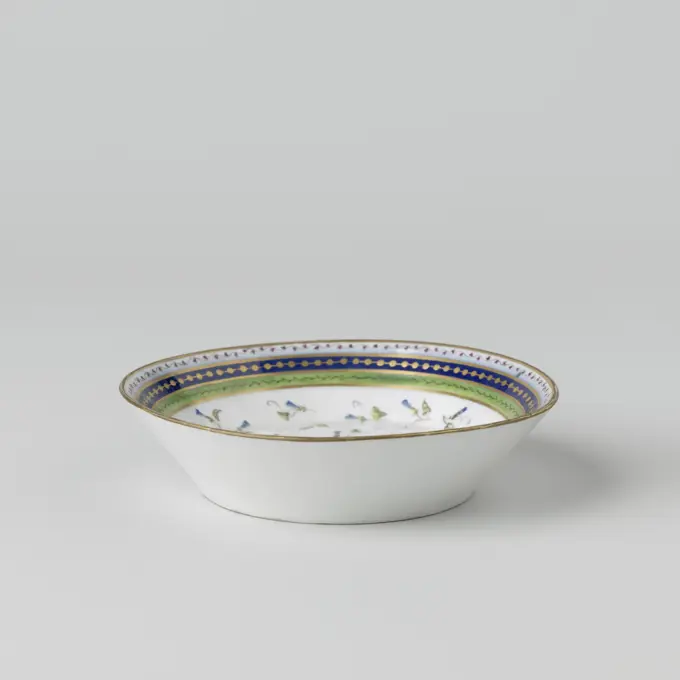
Saucer with a medallion among flowers, Manufacture de Sèvres, c. 1777 - c. 1788  Porcelain saucer with a straight wall, painted in underlaze blue and on the glaze in blue, pink, green, yellow, black and gold. On the flat a medallion with a flower branch surrounded by sprinkling flowers. The wall with a decorative tire with a black leaf vank against a green background, a golden band with dots on underly glaze blue and a flower vank. Marked on the underside with the double L with the annual letters KK and Y. Sèvres porcelain. glaze. cobalt (mineral). gold (metal) painting / gilding / vitrification
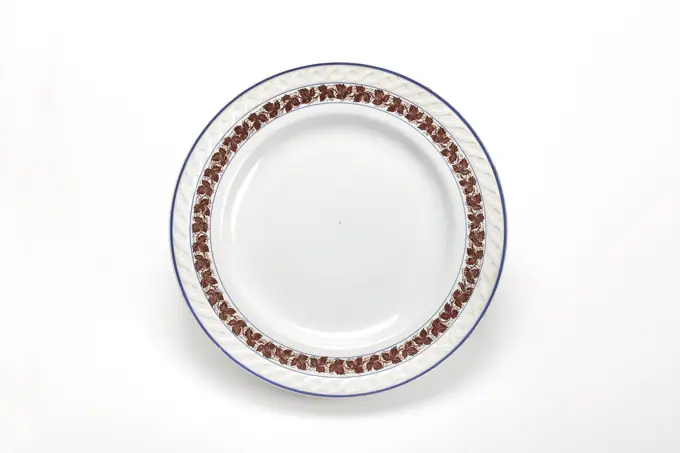
Saucer with a medallion among flowers, Manufacture de Sèvres, c. 1777 - c. 1788 Porcelain saucer with a straight wall, painted in underlaze blue and on the glaze in blue, pink, green, yellow, black and gold. On the flat a medallion with a flower branch surrounded by sprinkling flowers. The wall with a decorative tire with a black leaf vank against a green background, a golden band with dots on underly glaze blue and a flower vank. Marked on the underside with the double L with the annual letters KK and Y. Sèvres porcelain. glaze. cobalt (mineral). gold (metal) painting / gilding / vitrification
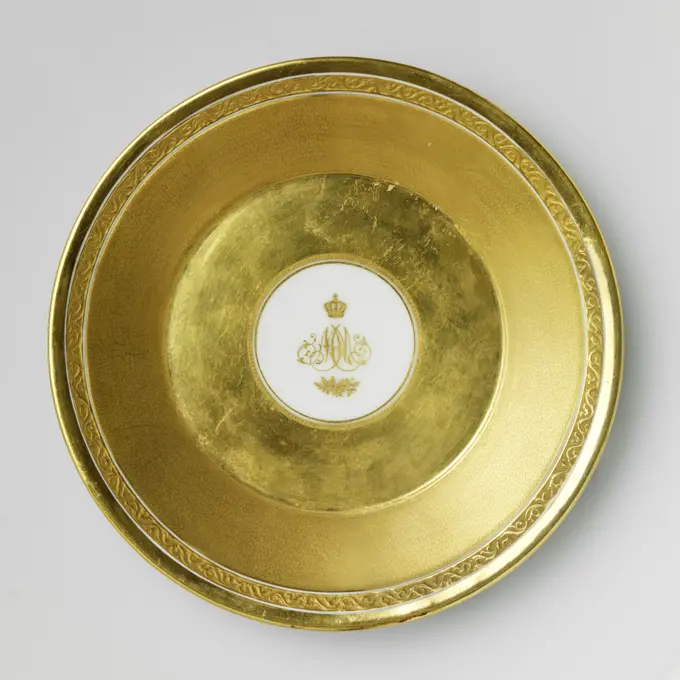
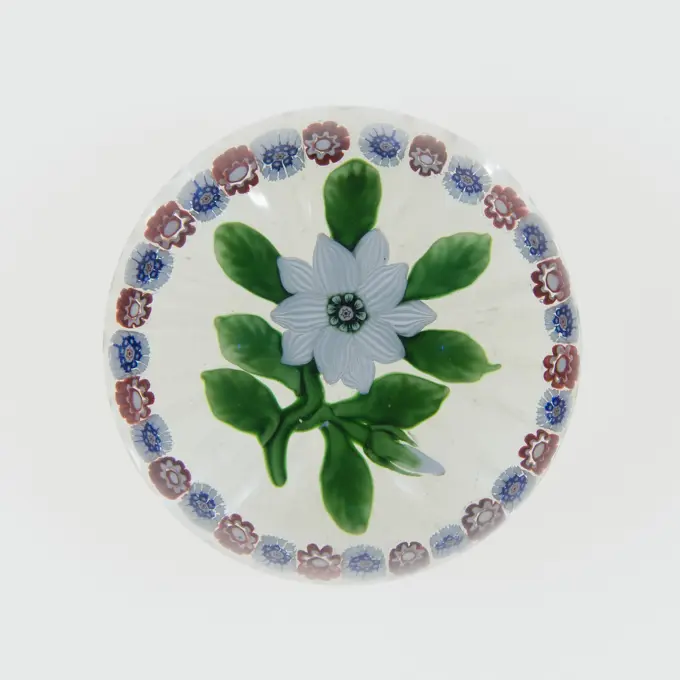
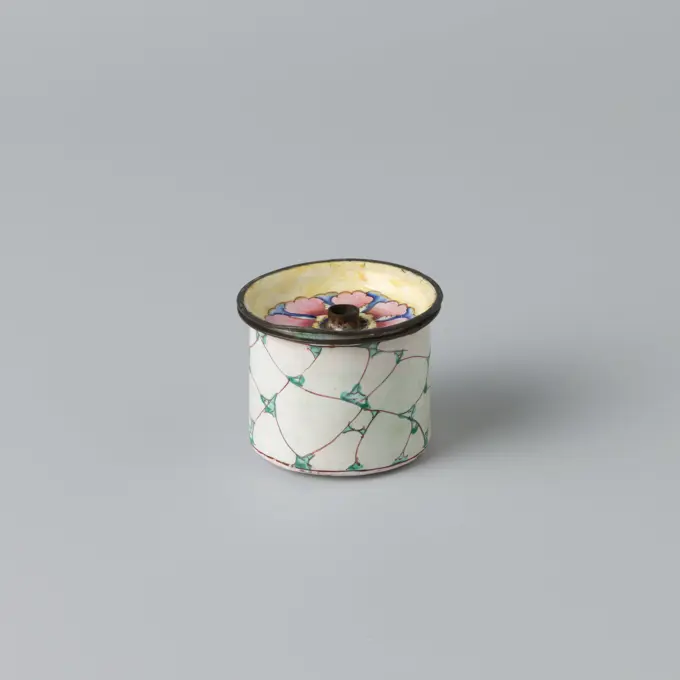
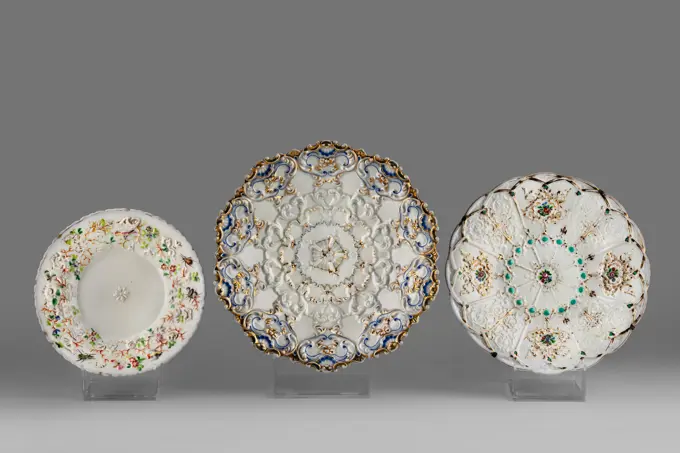
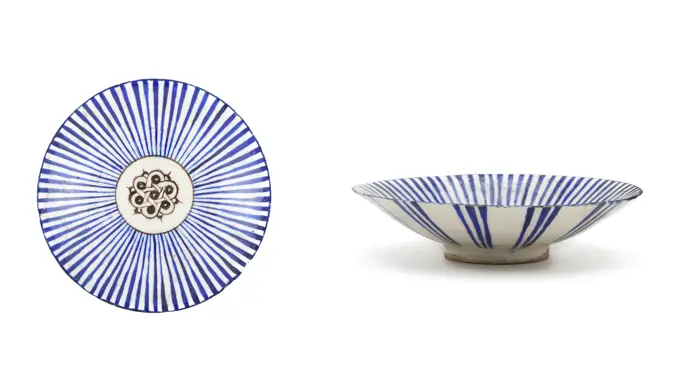
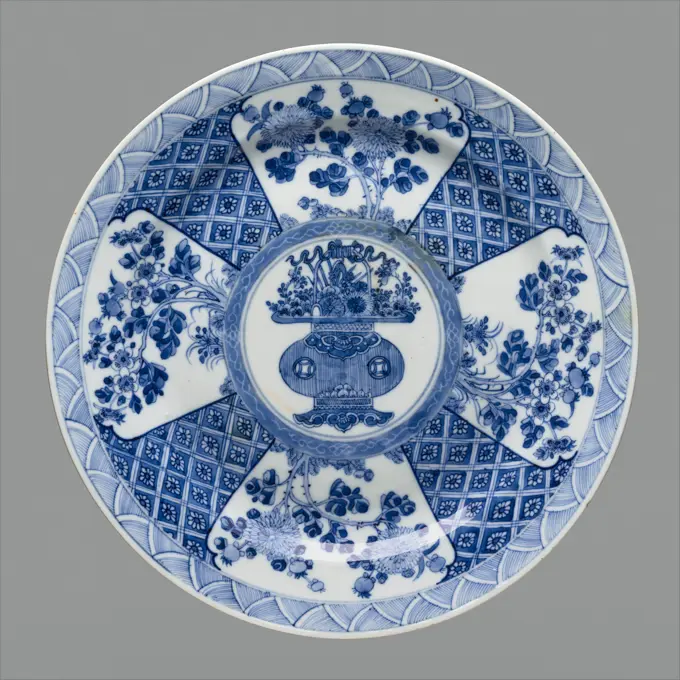
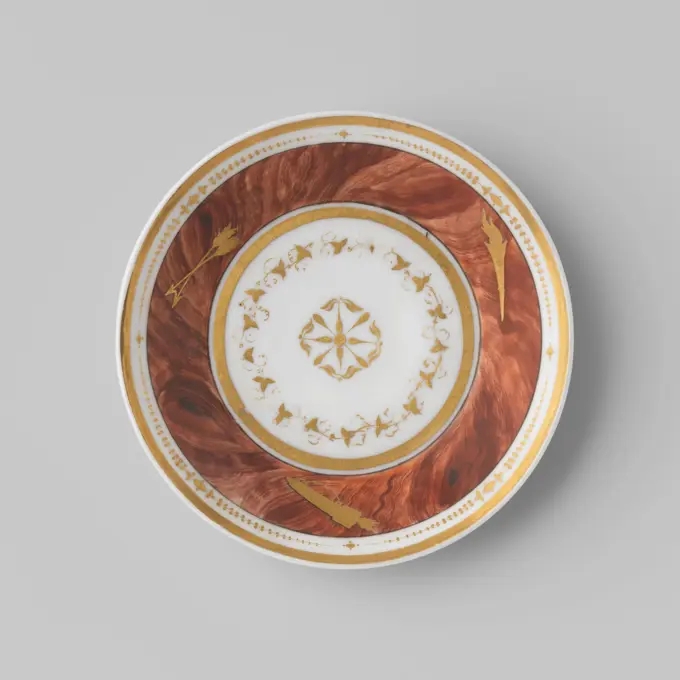
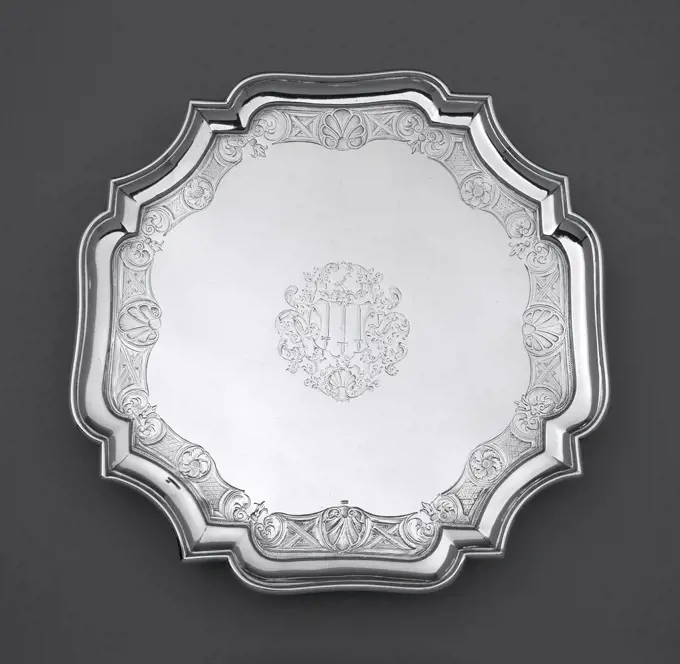
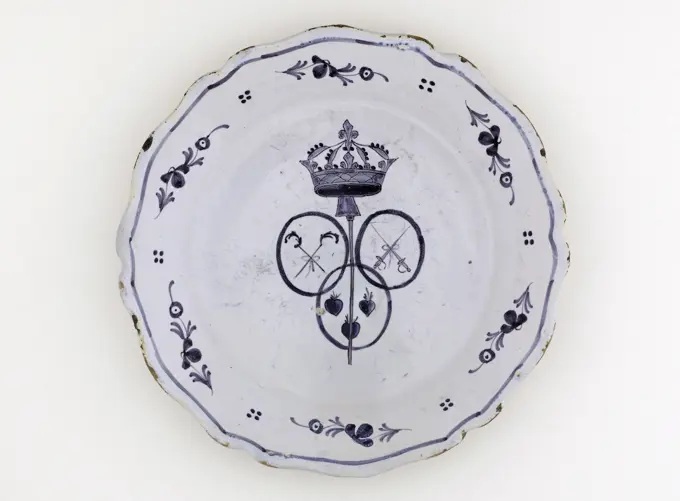
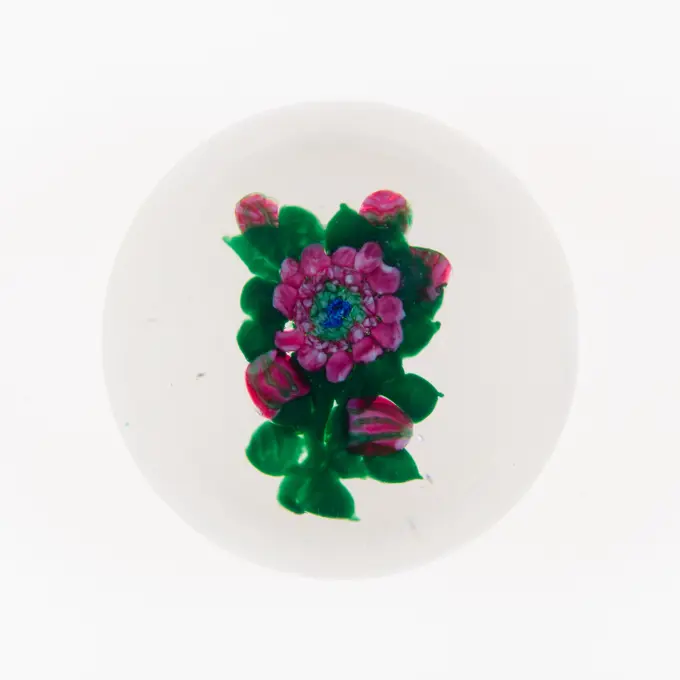
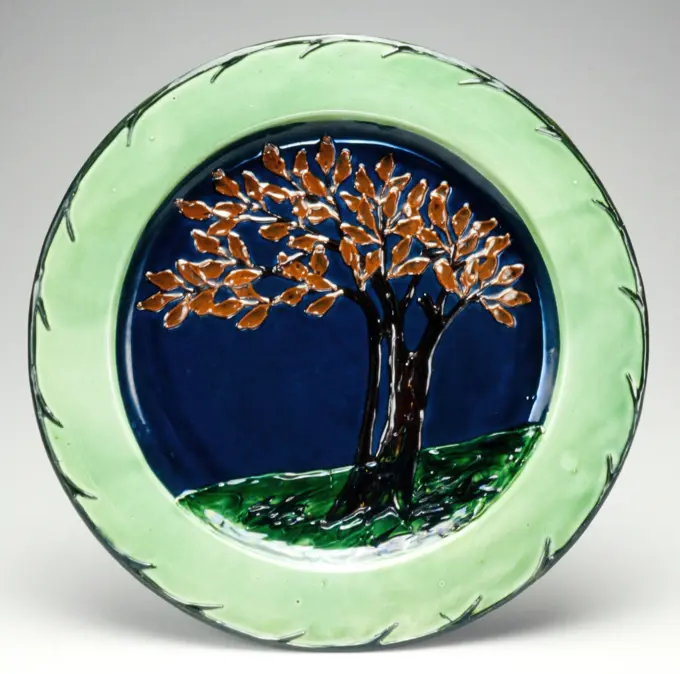
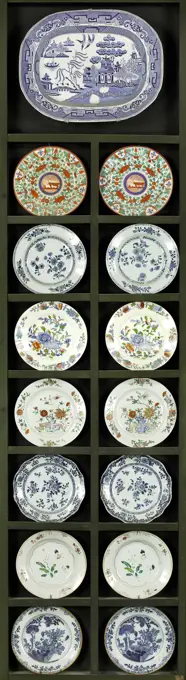
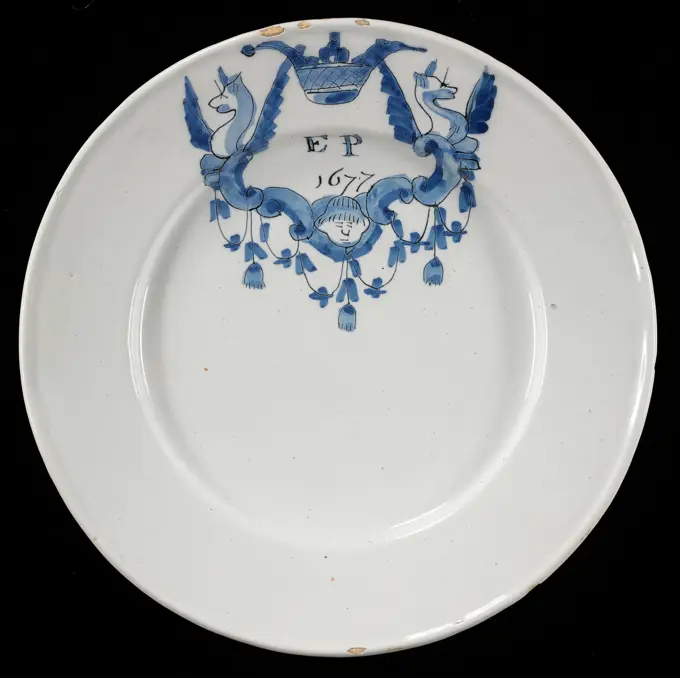
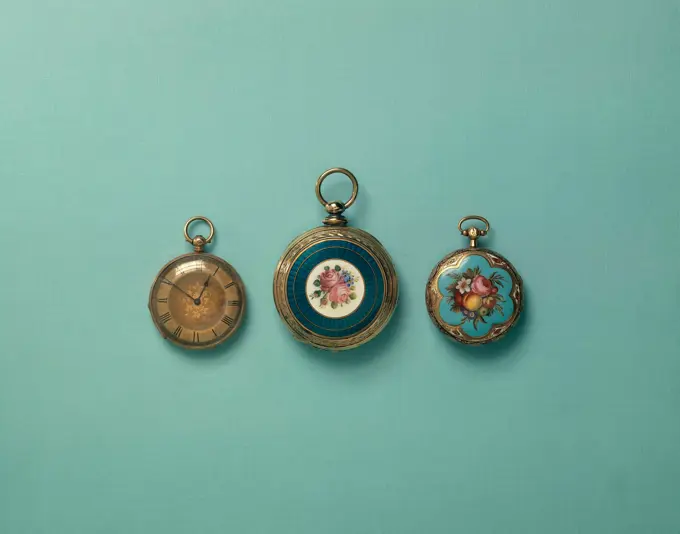
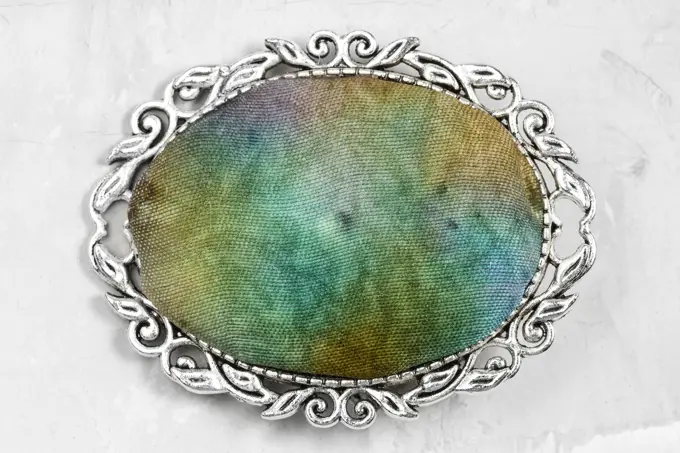
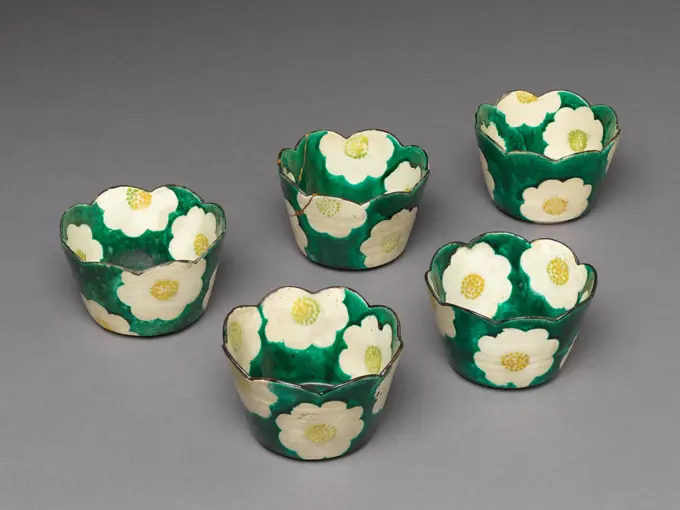
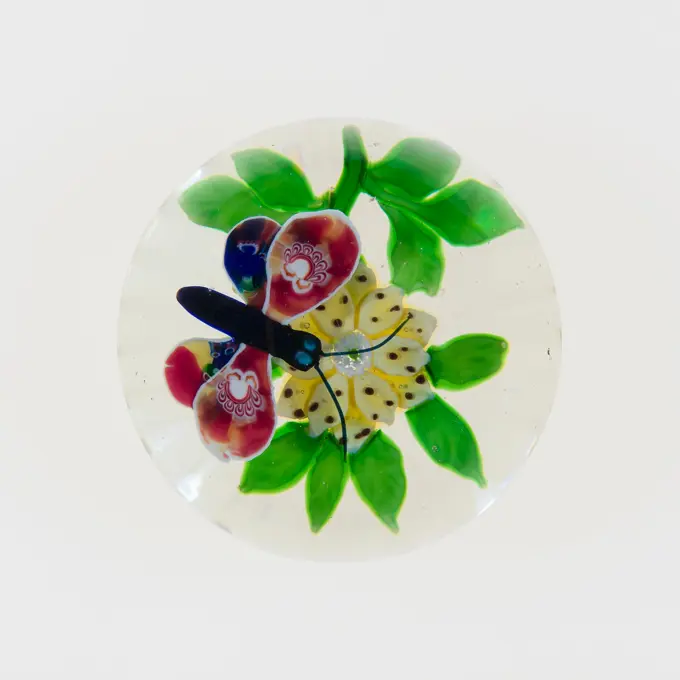
Paperweight 1843-1860 Lunéville. Glass . Baccarat GlassworksSaucer with gilded chinoiseries. Augsburg (miasto), atelier, Koenigliche Porcellain Fabrique, Meissen (1710-1763), factorySaucer with the monogram of Maria van Hohenzollern-Sigmaringen, c. 1867 Porcelain dish, painted on the glaze in gold. The front is covered with gold with a saved medallion on the flat with the crowned monogram by Maria van Hohenzollern-Sigmaringen in the form of a mirrored M.H . On the wall a decoration in the gold and the edge with a tire leaf vines in relief. Marked on the underside with the scepter including a medallion with the eagle, a scepter and a globe in his claws. The edge script reads' Koenigl. Porzellan Manufaktur '. In addition, the letter M. Berlin porcelain. glaze. gold (metal) painting / gilding / vitrification Porcelain dish, painted on the glaze in gold. The front is covered with gold with a saved medallion on the flat with the crowned monogram by Maria van Hohenzollern-Sigmaringen in the form of a mirrored M.H . On the wall a decoration in the gold and the edge with a tire leaf vines in relief. Marked on the underside with the scepter including a medallion with the ePaperweight 1843-1860 Lunéville. Technological improvements to optical scientific instruments in the mid-nineteenth century spurred a veritable obsession across Europe with identifying and classifying the natural world. Amateur botanists were eager to collect and preserve floral specimens, which they intently researched and catalogued. In response to this broad appeal, French glassmakers made paperweights that portrayed the very botanical subjects that were so enthusiastically sought. Many weights represented specimens with horticultural correctness, but others were entirely fanciful creations. Paperweights like this example speak to the periodís fascination with taxonomic systems.From the late 1840s to early 1860s, French manufacturers of fine glass and crystalósuch as Baccarat (Alsace), Clichy (Paris), and Saint-Louis (Lorraine)ócatered to the vast public enthusiasm for beautiful yet functional desk accessories. Paperweights, which were designed to secure loose papers against drafts,Glass plate 4th century A.D. or later Roman Translucent blue green.Broad, slightly upturned, tubular rim, folded down and in; side almost horizontal but with solid flange on exterior towards rim; outsplayed tubular foot ring, made by folding; slightly convex bottom with central rounded projecting boss and pontil mark, dome at center on interior.Intact; bubbles, blowing striations, and a few gritty inclusions; some pitting and brilliant iridescent weathering.. Glass plate 248859Comfoor oil reservoir, painted email on copper, anonymous, 1740 - 1760 An oil reservoir with lid (marbled) falls in the comfoor. China copper (metal). An oil reservoir with lid (marbled) falls in the comfoor. China copper (metal).Plate with a relief and painting decoration. Koenigliche Porzellanmanufaktur, Meissen (1807/14-1918), manufactureBowl. unknown, craftsmanNappy - Inconnu / UnknownPaperweight 1840-1865 France. Glass . Compagnie de Saint LouisBowl with Pagodas and Landscape Elements 18th century Objects like this bowl were typically displayed in open niches in reception rooms of upper-class Syrian residences during the Ottoman period. Bowl with Pagodas and Landscape Elements 446699Plate (part of a service) late 18th-early 19th century Chinese, for American market. Plate (part of a service) 201120Lazio Roma Rome SS. Giovanni e Paolo, Museum35. Hutzel, Max 1960-1990 Medieval: Ceramic fragments, sculptural fragments, fresco fragments, inscribed tomb markers. Houses one of the best collections of Malagan medieval ceramics for casting wall monuments, copies of which are housed in campanile. Specific Location: Museum Antiquities: Ceramic fragments, sculptural fragments, architectural fragments Object Notes: Basilica has separate record and is filed separately. German-born photographer and scholar Max Hutzel (1911-1988) photographed in Italy from the early 1960s until his death. The result of this project, referred to by Hutzel as Foto Arte Minore, is thorough documentation of art historical development in Italy up to the 18th century, including objects of the Etruscans and the Romans, as well as early Medieval, Romanesque, Gothic, Renaissance and Baroque monuments. Images are organized by geographic region in Italy, then by province, city, site complex and monument.Dish, 1673. WW (British). Silver; overall: 5.9 x 36.7 cm (2 5/16 x 14 7/16 in.). Silver fulfilled a prominent role in projecting wealth, status, power, and ritual in British life during the 1600s and 1700s. Elaborate forms such this shallow dish not only represented wealth in its sheer silver weight but also provided royal and aristocratic owners a surface for displaying engraved coats of arms. For example, this dish is engraved with the arms of Sir Charles Holte (1648-1722), the 3rd Baronet of Warwickshire, and his wife Anne Clobery (1664-c. 1738) of Bradstone, Hampshire, along the southern coast of England.Plate with green edge and golden Greek band, Petrus Regout, c. 1865 Plate of earthenware, scalloped, with green edge and golden Greek band. Maastricht earthenware Plate of earthenware, scalloped, with green edge and golden Greek band. Maastricht earthenwareBowl. Iran, Kashan, 12th or 13th century. Ceramics. Fritware, underglaze-paintedPaperweight 1843-1860 Birmingham. Glass . George Bacchus & SonsDish with a Boy and a Butterfly in a Landscape. Dish of porcelain, painted on the glaze in red, black and gold. On the platter of the dish a medallion with a boy and a butterfly in a landscape; to the medallion eight flower leaf-shaped boxes with alternating the boy in the landscape and a tree; between the curlwork boxes; On the edge a band with napkin interspersed with a flower in a cartouche. Encre the chine.Plate;  18th century (1701-00-00-1722-00-00);Paperweight 1843-1860 Lunéville. Technological improvements to optical scientific instruments in the mid-nineteenth century spurred a veritable obsession across Europe with identifying and classifying the natural world. Amateur botanists were eager to collect and preserve floral specimens, which they intently researched and catalogued. In response to this broad appeal, French glassmakers made paperweights that portrayed the very botanical subjects that were so enthusiastically sought. Many weights represented specimens with horticultural correctness, but others were entirely fanciful creations. Paperweights like this example speak to the periodís fascination with taxonomic systems.From the late 1840s to early 1860s, French manufacturers of fine glass and crystalósuch as Baccarat (Alsace), Clichy (Paris), and Saint-Louis (Lorraine)ócatered to the vast public enthusiasm for beautiful yet functional desk accessories. Paperweights, which were designed to secure loose papers against drafts,Toy serving plate - Inconnu / UnknownDish, anonymous, c. 1600 - c. 1624 Porcelain saucer, painted in under -glaze blue. On the flat a scalloped cartouche with two birds in a river landscape. To the cartouche a band with servetwork and a Swastika pattern. The edge is alternately divided into wide and narrow courses. In the wide courses a flower branch or lucky symbols (Artemisia leaf, roll) and in the narrow compartments of servetwork and pearls. The back is divided into courses with circles. Crack porcelain in blue and white. China porcelain. glaze. cobalt (mineral) painting / vitrification Porcelain saucer, painted in under -glaze blue. On the flat a scalloped cartouche with two birds in a river landscape. To the cartouche a band with servetwork and a Swastika pattern. The edge is alternately divided into wide and narrow courses. In the wide courses a flower branch or lucky symbols (Artemisia leaf, roll) and in the narrow compartments of servetwork and pearls. The back is divided into courses with circles. Crack porcelaiDish 1765-66 Jean Antoine Bourguet French. Dish 200220Round plate of hard baked pottery; Wedgwood Creamware., Wedgwood, c. 1780 - c. 1800 plate (dishes) Round plate of hard baked pottery; Creamware. The edge has a striped edge in black and red. The board is marked: Wedgwood. Burst earthenwareDrapery Tieback. Dimensions: Diam. 4 3/4 in. (12.1 cm). Date: 1810-60. Museum: Metropolitan Museum of Art, New York, USA.Oval dish with scalloped edge. Oval dish of tin. The edge is scalloped.Toy bread plate - Georgeville D'après Francis Morley, 1845-1850Paperweight 1840-1865 France. Technological improvements to optical scientific instruments in the mid-nineteenth century spurred a veritable obsession across Europe with identifying and classifying the natural world. Amateur botanists were eager to collect and preserve floral specimens, which they intently researched and catalogued. In response to this broad appeal, French glassmakers made paperweights that portrayed the very botanical subjects that were so enthusiastically sought. Many weights represented specimens with horticultural correctness, but others were entirely fanciful creations. Paperweights like this example speak to the periodís fascination with taxonomic systems.From the late 1840s to early 1860s, French manufacturers of fine glass and crystalósuch as Baccarat (Alsace), Clichy (Paris), and Saint-Louis (Lorraine)ócatered to the vast public enthusiasm for beautiful yet functional desk accessories. Paperweights, which were designed to secure loose papers against drafts, weSaucer with arrows and a torch on an imitation wooden ground, anonymous, c. 1790 - c. 1800  Porcelain saucer with a straight wall, painted on the glaze in red -brown and gold. On the flat a gold medallion with a rosette surrounded by a leaf vank. The wall with arrows, a tube and a torch on an imitation wood background. On the edge a decorative and a golden band. France porcelain. glaze. gold (metal) painting / gilding / vitrificationMaker: Jacob Hurd, American, 1702-1758, Salver, ca.1740-50, Silver, 1 13/16 in. (4.6 cm), Made in Boston, Massachusetts, American, 18thcentury, Containers -MetalsCoffee cup and saucer with floral design on red backgroundBowl with quails near flowering plants, Worcester, c. 1750 - c. 1774 Come from Soft-Paste Porcelain (Pâte Tendre) with lobed edge and open work, painted on the glaze in blue, red, green, black and gold. Two quail on the soil with flowering plants. The inner and outer wall with a few butterflies and flowers. The inner edge with a tire of flower vines. The bowl is in the style of Japanese Kakiemon porcelain. Worcester porcelain. soft-paste porcelain. glaze. gold (metal) painting / gilding / vitrification Come from Soft-Paste Porcelain (Pâte Tendre) with lobed edge and open work, painted on the glaze in blue, red, green, black and gold. Two quail on the soil with flowering plants. The inner and outer wall with a few butterflies and flowers. The inner edge with a tire of flower vines. The bowl is in the style of Japanese Kakiemon porcelain. Worcester porcelain. soft-paste porcelain. glaze. gold (metal) painting / gilding / vitrificationAnonymous. Plate. Earthenware. Around 1789. Paris, Carnavalet museum. 70955-24 Weapon, Heart, Crown, Epee, Faience, Decorative Pattern, Revolutionary Periode, Pic, Crockery, PlateDrapery Tieback 1810-60. Drapery Tieback. 1810-60. Opalescent glassDish; glassSilver openwork baldricfastenerDinner plate - Mintons MintonsDinner plate - Inconnu / UnknownCasket. unknown, authorRound tribal ornament. Pattern shown on the ceramic plate. Vector illustration. Demolition of white cotton with ajour embroidered edges and intermediate sinks, marked AW in red randed white., C. 1890 Demolition of white cotton with ajour embroidered edges and intermediate sinks, marked AW in red randed white. Netherlands cotton (textile) Demolition of white cotton with ajour embroidered edges and intermediate sinks, marked AW in red randed white. Netherlands cotton (textile)Paperweight 1840-1865 Baccarat. This paperweight uses a traditional glass-making technique called millefiori to great effect. Italian for ìone thousand flowers,î millefiori was first developed in fifteenth-century Venice. In the nineteenth century, French glassmakers revived the technique with a cultural twist. Arranged to evoke traditional French gardens such as the Tuileries in Paris, paperweights like this example brought a little of this landscaping magic indoors.From the late 1840s to early 1860s, French manufacturers of fine glass and crystalósuch as Baccarat (Alsace), Clichy (Paris), and Saint-Louis (Lorraine)ócatered to the vast public enthusiasm for beautiful yet functional desk accessories. Paperweights, which were designed to secure loose papers against drafts, were among their most popular products.. Glass . Baccarat GlassworksTraditional Hungarian round decorative element, isolated vectorover white background.Thimble; Fenton, James (Birmingham; company Z Otnicz; Fl. 1852-1954); 1893/94 (1893-00-00-1894-00-00);Abstract vector ornamental nature color vintage frame. Modern volumetric floral elements. Trendy craft style illustration. Abstract vector ornamental nature color vintage frame.Paperweight, 19th century, Saint Louis Glass Works, 1 3/4 x 2 5/8 x 2 5/8 in. (4.45 x 6.67 x 6.67 cm), Glass, France, 19th centuryEdward Aldridge I and John Stamper, Salver, 1758/59, silver.Saucer ca. 1810 Chinese, for Spanish market. Saucer 201288Tondo with Putt's performanceGreace fair of gray blue velvet embroidered with silver wire, adorned on the bottom with unidentified alliance weapon in gold and silver brocade and multicolored silk. Greace fair of gray blue velvet embroidered with silver wire, adorned on the bottom with unidentified alliance weapon in gold and silver brocade and multicolored silk. Model: flat round bottom where a wavy raised edge has a wavy edge with holes, which originally pulled a cord of braided silk. The cord is missing. Lined with goat leather. Decoration: The 22 protrusions or 'ribs' are decorated with stacked leaf standing and leaf-covered French lilies of silver wire in relief. A horizontal line of silver thread runs above the holes. Along the top it was originally offset by a bond of silver wire, now largely perished. The bottom is circled with a double edge within which a zigzag line of silver wire. Here a lambrequin of gold brookaat with two oval coats shelves on which a pink-red twill on gold and on the right a green treFlower Pot; glazed earthenware (creamware) with overglaze decoration; 9.4 x 10.5 cm (3 11/16 x 4 1/8 in.); Bequest of Erskine Hewitt; 1938-57-421-bBlue and white porcelain charger from the Qing Dynasty, depicting a dragon. Dated 1875Islamic art. Silver ornamental tray from Bali, Indonesia. early 20th CenturyButton (France); mother-of-pearlPaperweight 1841-1860 Lunéville. The colorful geometric clusters embedded in this paperweight reflect the nineteenth-century European fascination with optical effects. Sir David Brewster invented the kaleidoscope in 1815, and its colorful and changing patterns brought great visual entertainment. Paperweights such as this example reformed this childlike pastime for a sophisticated adult audience. Depicted in glass were tiny glittering flowers, small black and blue cameos of figures, and even miniature bottlecaps. These were delicately arranged within the orb for the observant eye to discover.From the late 1840s to early 1860s, French manufacturers of fine glass and crystalósuch as Baccarat (Alsace), Clichy (Paris), and Saint-Louis (Lorraine)ócatered to the vast public enthusiasm for beautiful yet functional desk accessories. Paperweights, which were designed to secure loose papers against drafts, were among their most popular products.. Glass . Baccarat GlassworksPaperweight 1801-1900 France. Technological improvements to optical scientific instruments in the mid-nineteenth century spurred a veritable obsession across Europe with identifying and classifying the natural world. Amateur botanists were eager to collect and preserve floral specimens, which they intently researched and catalogued. In response to this broad appeal, French glassmakers made paperweights that portrayed the very botanical subjects that were so enthusiastically sought. Many weights represented specimens with horticultural correctness, but others were entirely fanciful creations. Paperweights like this example speak to the periodís fascination with taxonomic systems.From the late 1840s to early 1860s, French manufacturers of fine glass and crystalósuch as Baccarat (Alsace), Clichy (Paris), and Saint-Louis (Lorraine)ócatered to the vast public enthusiasm for beautiful yet functional desk accessories. Paperweights, which were designed to secure loose papers against drafts, wePaperweight 1801-1900 France. Technological improvements to optical scientific instruments in the mid-nineteenth century spurred a veritable obsession across Europe with identifying and classifying the natural world. Amateur botanists were eager to collect and preserve floral specimens, which they intently researched and catalogued. In response to this broad appeal, French glassmakers made paperweights that portrayed the very botanical subjects that were so enthusiastically sought. Many weights represented specimens with horticultural correctness, but others were entirely fanciful creations. Paperweights like this example speak to the periodís fascination with taxonomic systems.From the late 1840s to early 1860s, French manufacturers of fine glass and crystalósuch as Baccarat (Alsace), Clichy (Paris), and Saint-Louis (Lorraine)ócatered to the vast public enthusiasm for beautiful yet functional desk accessories. Paperweights, which were designed to secure loose papers against drafts, weLuncheon plate - Inconnu / UnknownButton, Steel, Flat, circular button with beveled edges; in the center, a facetted steel boss; surrounded by ivy leaves, in steel, against, a yellow ground., Component -b is on card 2, France, ca. 1801-50, costume & accessories, Decorative Arts, ButtonDish, Anonymous, c. 1770 - c. 1810  Round dish with upright edge of multicolored painted faience fines. The dish is painted with purple, thin branches with green leaves. The wall is thickened and ribbed under the edge. The dish belongs to three other dishes (BK-NM-14097-A, BK-NM-14097-B and BK-NM-14097-D) in two flower pots (BK-NM-14097-E and BK-NM-14097- f). France earthenware. tin glaze.Charger, c. 1900-1905, Max Laeuger, German, 1864-1952, 1 x 15 1/4 in. (2.54 x 38.74 cm), Glazed earthenware with slip decoration, Germany, 19th-20th century, This charger, richly decorated with slip (liquid clay) and depicting a fiery-leaved tree, was intended to be hung on a wall to beautify a home rather than be used at the dinner table. The asymmetry, bold autumnal color palette, and thick 'brushstrokes' exemplify Laeugers unique approach to depicting nature—he used the ceramic surface as his painters canvas. His swaying tree is echoed in the curving arcs along the plates outer edge.Victor Hugo (1802-1885). Chinese decor from Juliette Drouet's house in Guernsey, West Wall. Green wooden record containing plates and dishes, composed of fourteen compartments (right side of the fireplace). Painted wood. 1857-1864. Paris, house of Victor Hugo. 78171-20 Asian art, decorative arts, painted wood, Chinese cabinet, chinoiserie, compartment, decor, earthenware, storage, Chinese living room, dishes, 19th 19th 19th 19th 19th 19th century, plate, dishVictor Hugo (1802-1885). Chinese decor from Juliette Drouet's house in Guernsey, West Wall. Green wooden record containing plates and dishes, composed of fourteen compartments (right side of the fireplace). Painted wood. 1857-1864. Paris, house of Victor Hugo. 78171-20 Asian art, decorative arts, painted wood, Chinese cabinet, chinoiserie, compartment, decor, earthenware, storage, Chinese living room, dishes, 19th 19th 19th 19th 19th 19th century, plate, dishPaperweight 1840-1865 France. Technological improvements to optical scientific instruments in the mid-nineteenth century spurred a veritable obsession across Europe with identifying and classifying the natural world. Amateur botanists were eager to collect and preserve floral specimens, which they intently researched and catalogued. In response to this broad appeal, French glassmakers made paperweights that portrayed the very botanical subjects that were so enthusiastically sought. Many weights represented specimens with horticultural correctness, but others were entirely fanciful creations. Paperweights like this example speak to the periodís fascination with taxonomic systems.From the late 1840s to early 1860s, French manufacturers of fine glass and crystalósuch as Baccarat (Alsace), Clichy (Paris), and Saint-Louis (Lorraine)ócatered to the vast public enthusiasm for beautiful yet functional desk accessories. Paperweights, which were designed to secure loose papers against drafts, weCapitalBowl; Compagnia di Venezia e Murano (Italian, active 1866 - 1909); Venice (possibly), Italy; 1880s; Glass; 4.4 x 15.7 cm (1 3,4 x 6 3,16 in.)Plate, 1677, 1 1/4 x 8 3/4 x 8 3/4 in. (3.18 x 22.23 x 22.23 cm), Glazed ceramic, England, 17th centuryPlate, white, painted in blue. Two plates of milk glass with blue email paint painting; Double layer, cave inside.Brooch with Greek Cross. Culture: Italian, Rome. Dimensions: Overall (confirmed): 1 1/4 x 1 1/4 x 3/16 in. (3.2 x 3.2 x 0.4 cm). Maker: Firm of Castellani. Date: ca. 1860.This object and the group to which it belongs (see also 2014.713.1-.10) reflect the keen interest in historical styles in nineteenth-century Europe. Artists and designers looked to various artistic periods for forms and motifs. There was also an interest in reproducing works of art from earlier epochs with historical accuracy--an approach that is particularly evident in the taste for so-called archaeological jewelry (jewelry based on excavated examples from antiquity), which reached its zenith in the middle of the century.The jewelry made during this period encompassed Etruscan, ancient Roman, early Christian, Byzantine, and medieval styles. The firm of Castellani in Rome both pioneered and dominated the production of archaeological jewelry. Founded by Fortunato Pio Castellani in 1814, the company was run by three gen. Gold watch with engraved golden dial. Detergent from the cabinet with engraving works, between Email.Hornet’s nest on white backgroundPlate - Wesleyan Methodist Church, Hamilton Thomas & Richard Boote Thomas & Richard Bootesilver brooch with hand-colored silk batik on gray oval silver brooch with batik hand-colored silk insert on gray concrete board Copyright: xZoonar.com/ValeryxVoennyyx 18225782Jewelled pillow Decorative pillow isolated with clipping path included Copyright: xZoonar.com/Baloncicix 7079577Lid of hard-baked pottery with transfer decoration. Lid of hard-baked pottery, with a transfer decoration. The lid is round and has a button. The lid is colored yellow and has two images of a landscape in which a landscape figure.Morocco, Fes. An indoor fountain filled with rose petals.Bangles  India Copyright: xMohammedxSharif/DinodiaxPhotoxAnonymous. Plate. Earthenware. 1789. Paris, Carnavalet museum. 70955-7 Weapon, Crown, Epee, Faience, Flower, Force, Decorative Pattern, Revolutionary Periode, French Revolution, Union, Crockery, PutchSet of Five Camellia-Shaped Side Dishes (Mukzuke) with Camellia Patterns 18th century Workshop of Ogata Kenzan These vividly colored small side dishes (mukzuke) were created to enhance the beauty of the food served in them. The entire surface of each vessel was coated in white slip, covered in transparent glaze, and fired. Stencil paper in the shape of camellia flowers was then laid on the surface of each dish to keep the blossoms white while green enamel was brushed on. This application technique derived from stencil dyeing used in textile art.. Set of Five Camellia-Shaped Side Dishes (Mukzuke) with Camellia Patterns. Workshop of Ogata Kenzan (Japanese, 1663-1743). Japan. 18th century. Stoneware with white slip and polychrome overglaze enamels (Kenzan ware). Edo period (1615-1868). CeramicsBrush back, painted with tendrils and floral motifs, the initials ah and the year 1757. Bushrush of faience, painted in blue with tendrils and floral motifs, the initials ah and the year 1757.Mobilization 1914-1915 - Fort at Vuren A permanent Burght, Petrus Regout & Co., 1915 - 1920  Memorial board with wide, sloping edge on which, among other things, sea green stylized scrap leaves and purple-red berries, cannon trays and axes. In the field: Fort behind which a sun with rays. Before a staircase, a fence and bullets. Maastricht earthenware. glaze vitrification  FireEaster decorationMonteith or jardiniere with Acanthus foliage reliefs. Chromolithograph by W. Griggs from Frederick Rathbone's Old Wedgwood, the Decorative or Artistic Ceramic Work Produced by Josiah Wedgwood, Quaritch, London, 1898.Still life of medicines in a round white plate.