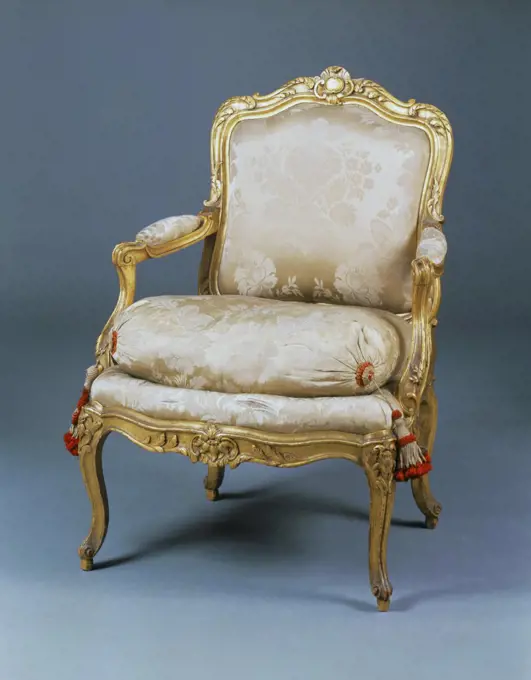
Decorative Chairs

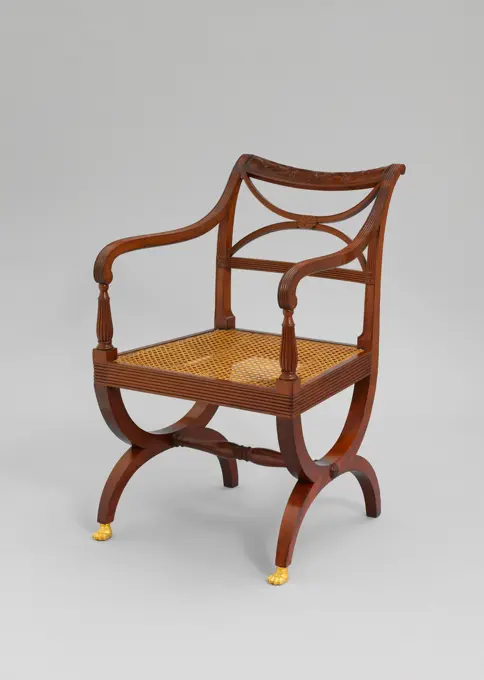
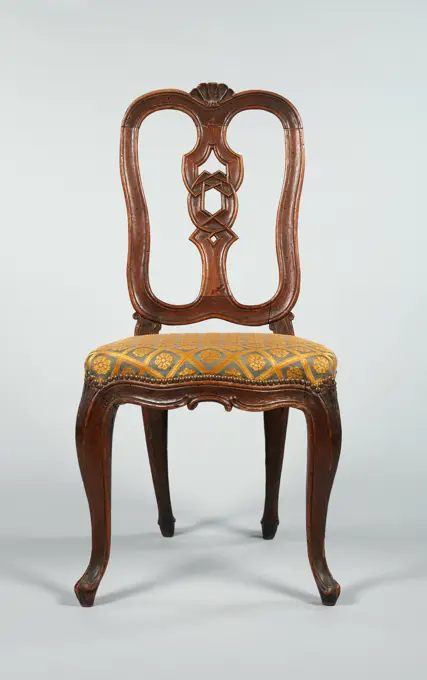
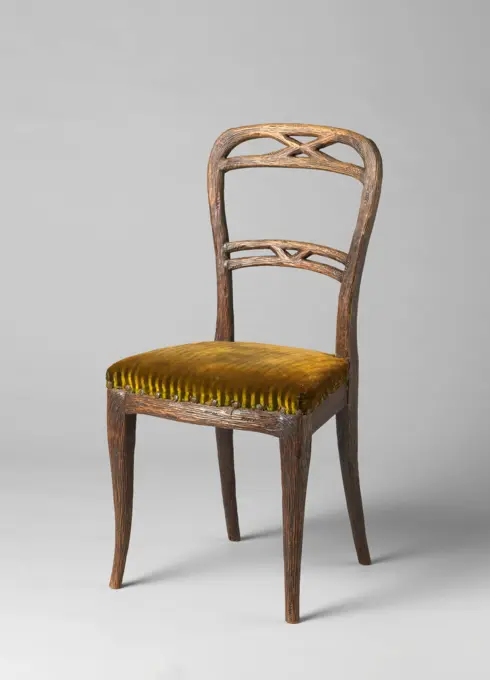
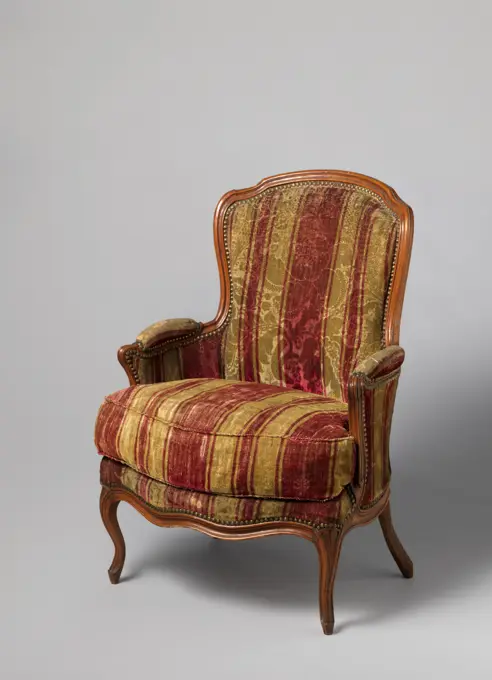
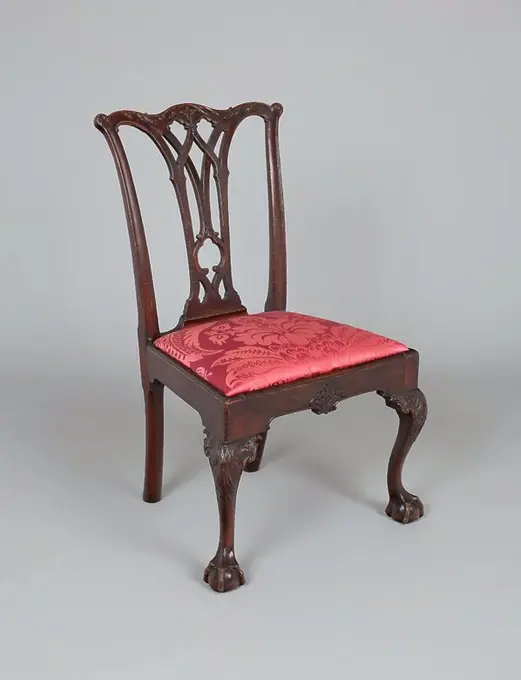
An assortment of traditional chairs, highlighting craftsmanship and design from various historical periods and styles.

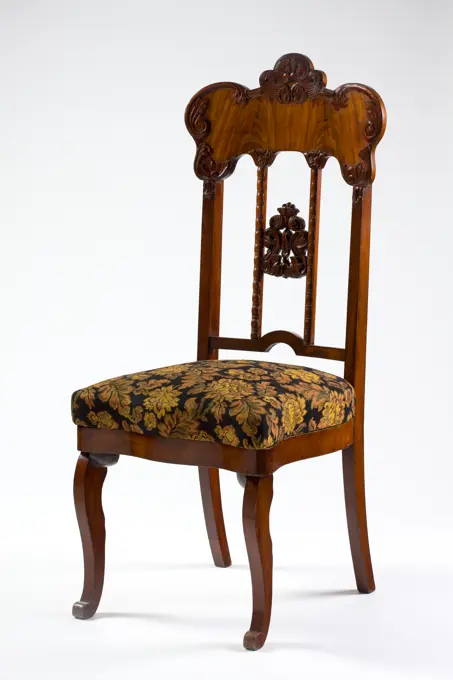
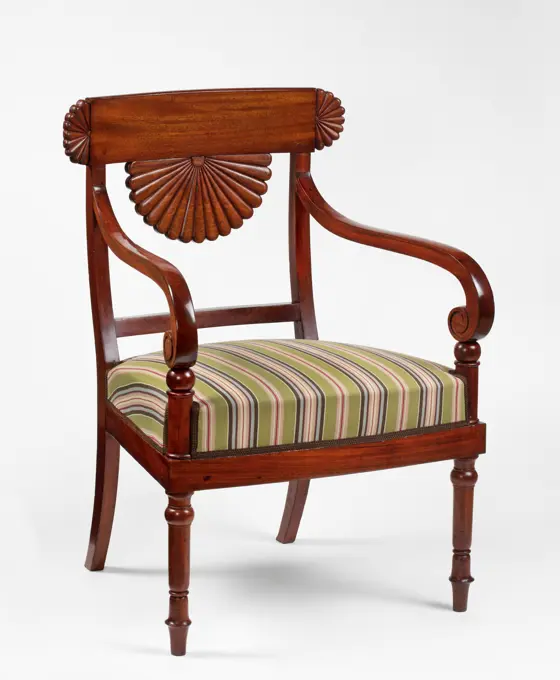
Chair of mahogany, decorated with marquetery of ash wood, the line and back sports have stylized leaf and floral motifs, anonymous, c. 1820 Chair of mahogany (A, B), decorated with marqueterie van Esdoornhout. The round front legs have a twisted section above and below; The part in between shows piping. The hind legs turn backwards and form one whole with the backstyles, which are connected halfway through a sport, and which are crowned by a hold wide, overhanging backrest. The chair rule and the back sports are decorated with stylized leaf and floral motifs; The upper sport ends in rosettes. Loose covered seat. Northern Netherlands (possibly) wood (plant material). mahogany (wood). maple (wood). cotton (textile). ash (wood) Chair of mahogany (A, B), decorated with marqueterie van Esdoornhout. The round front legs have a twisted section above and below; The part in between shows piping. The hind legs turn backwards and form one whole with the backstyles, which are connected halfway thr
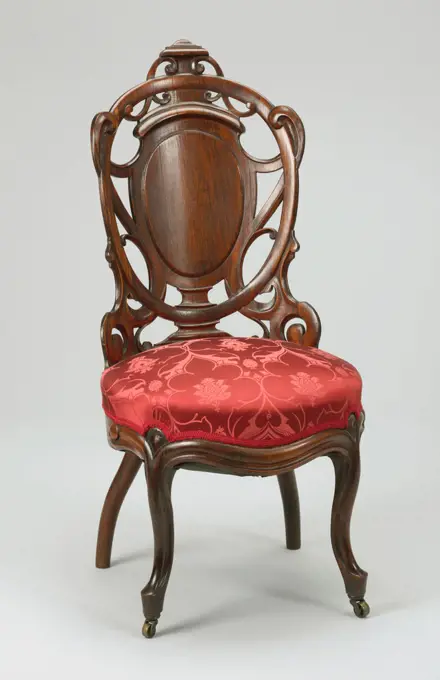
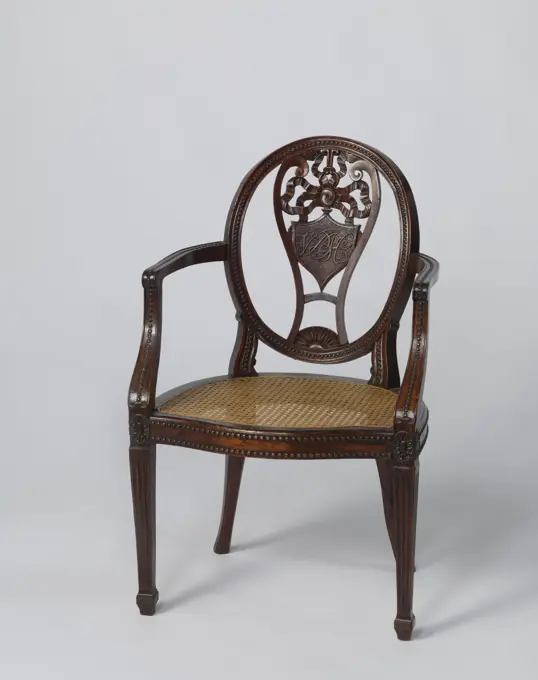
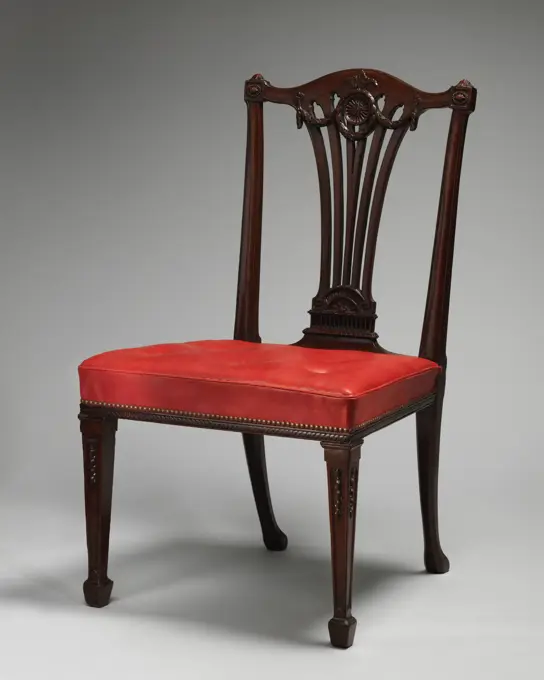
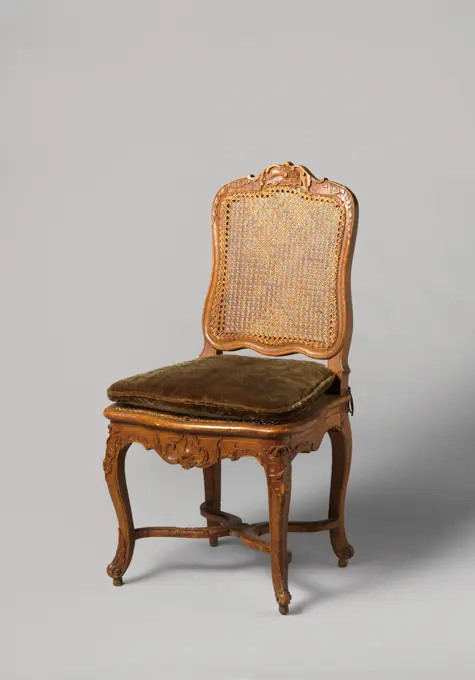
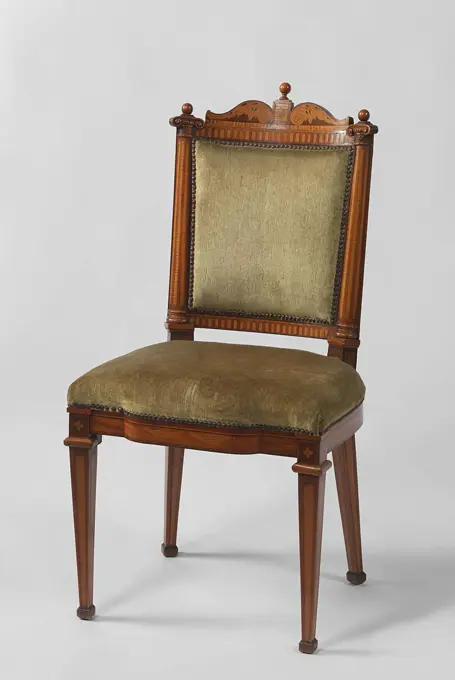
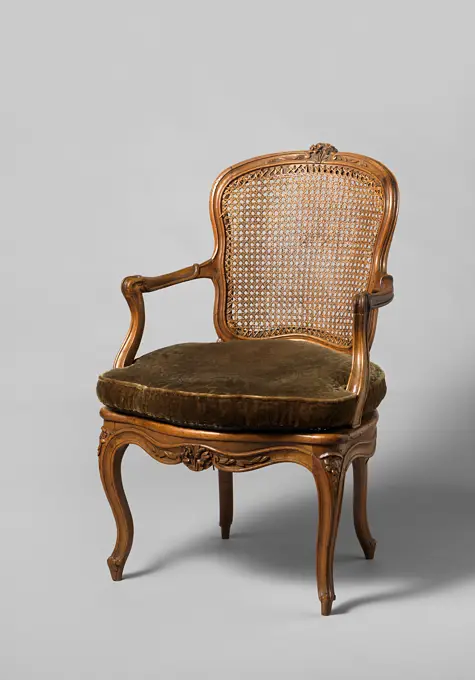
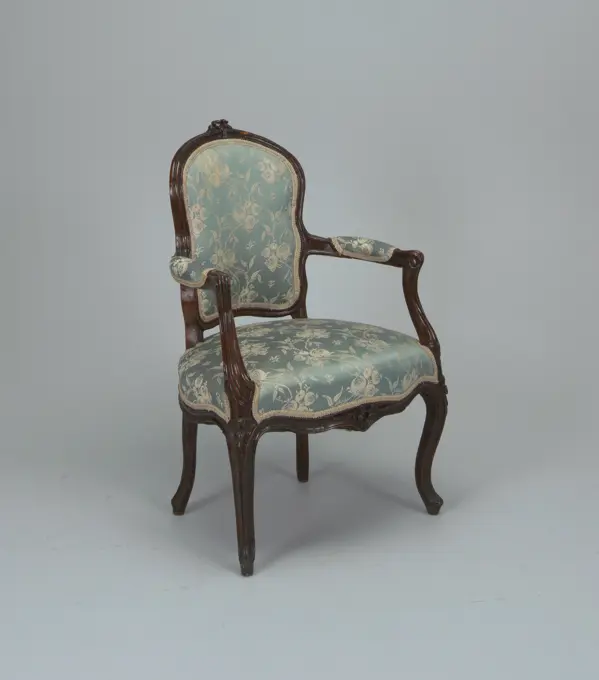
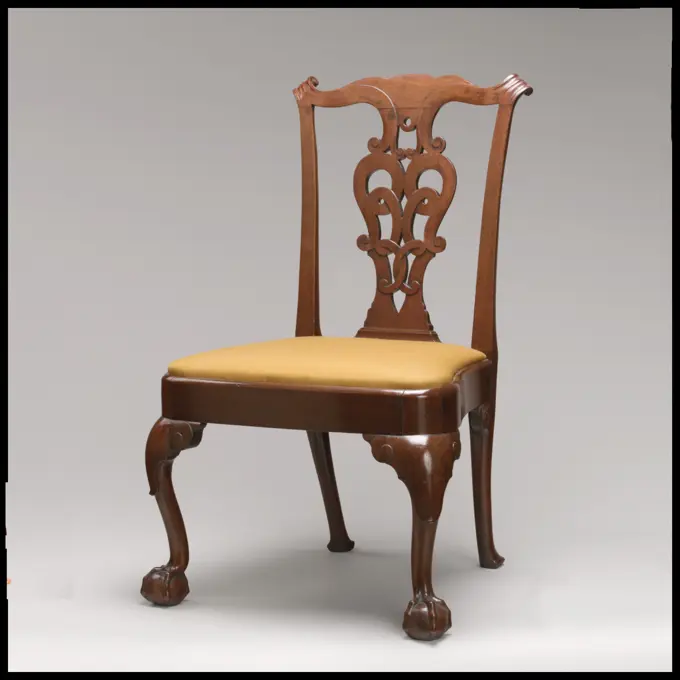
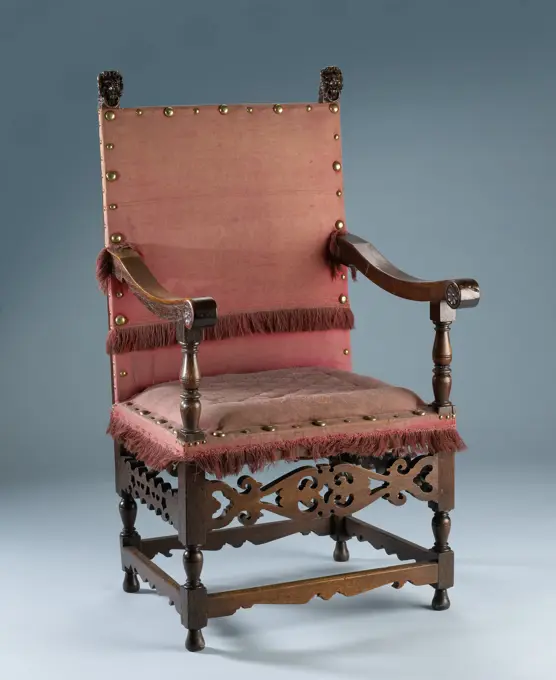
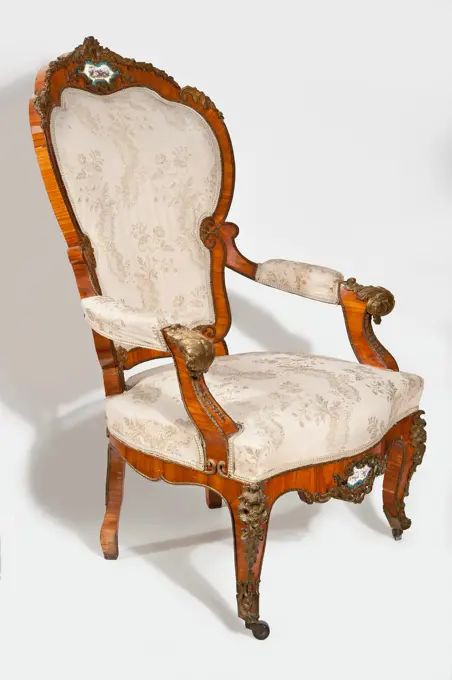
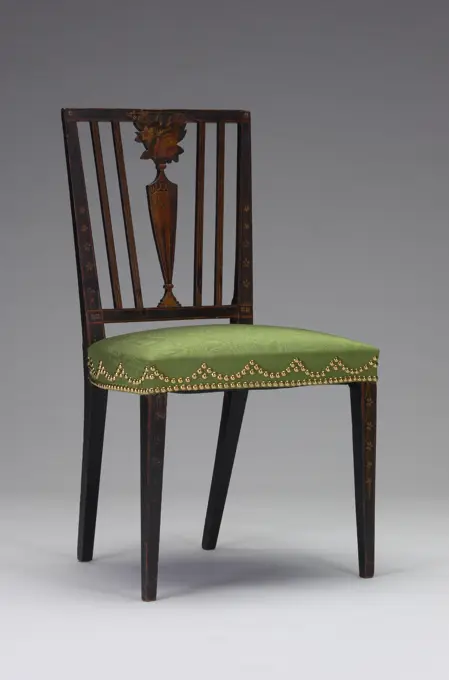
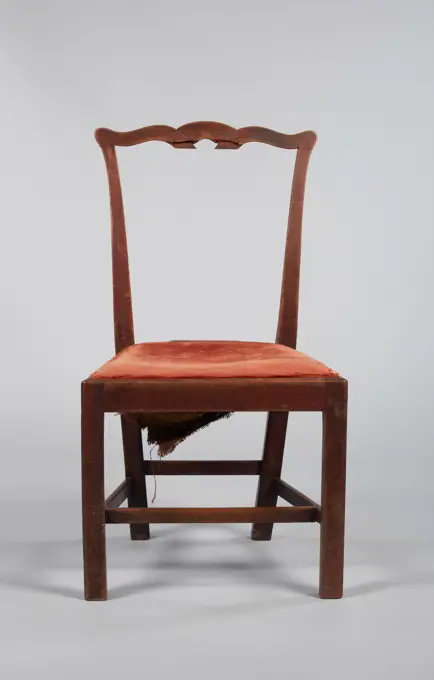
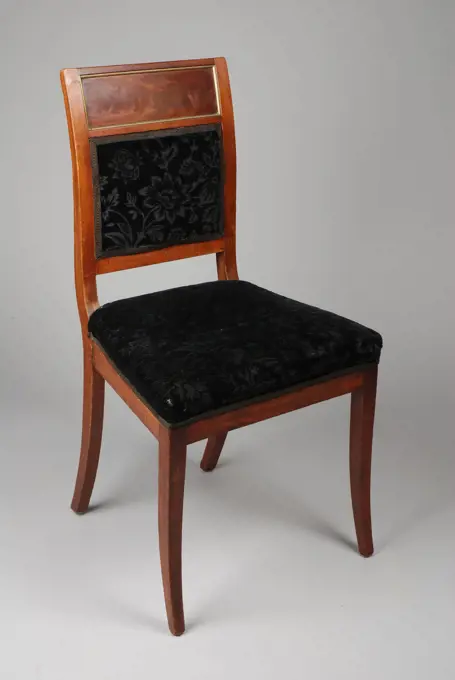
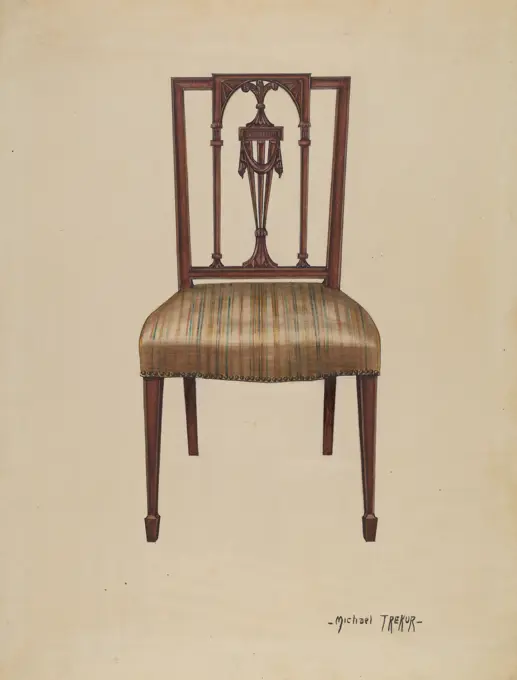
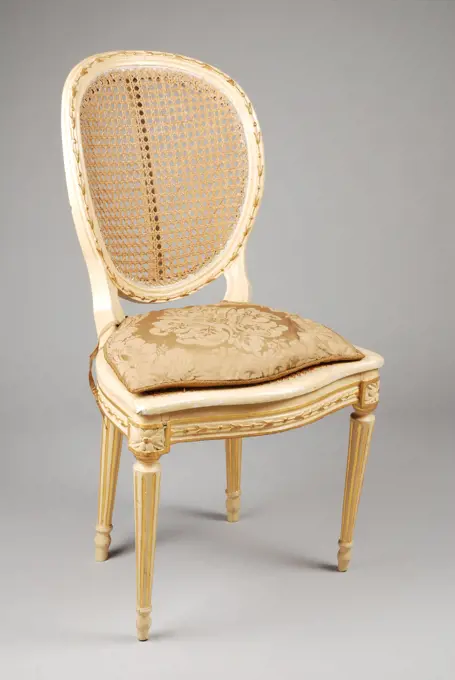
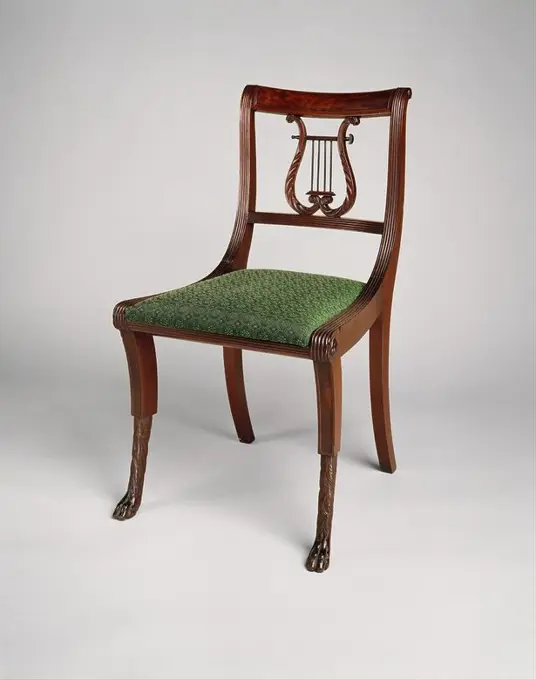
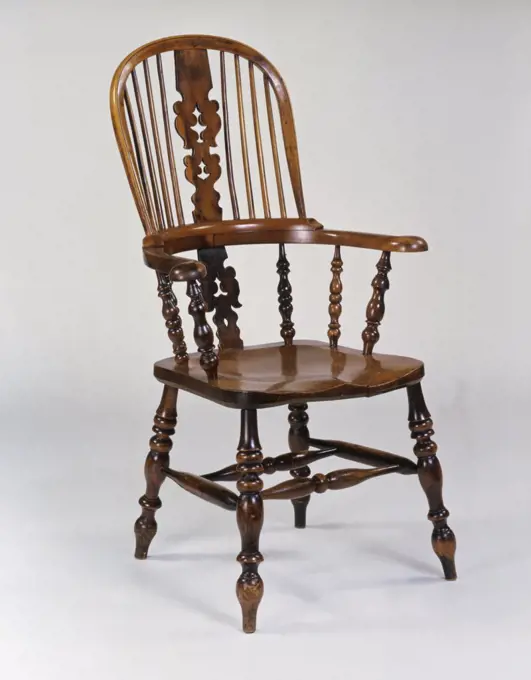
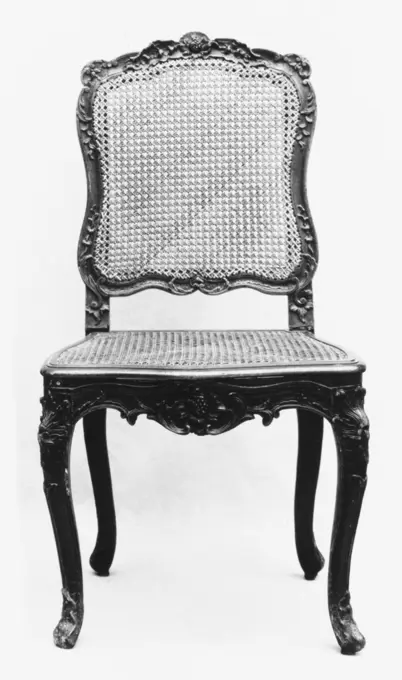
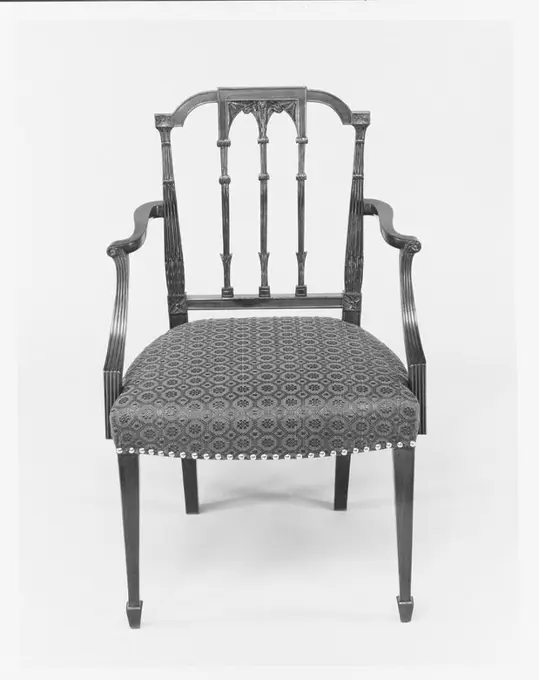
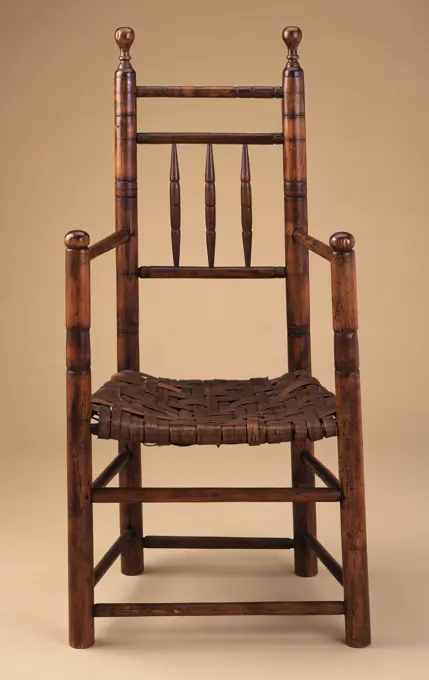
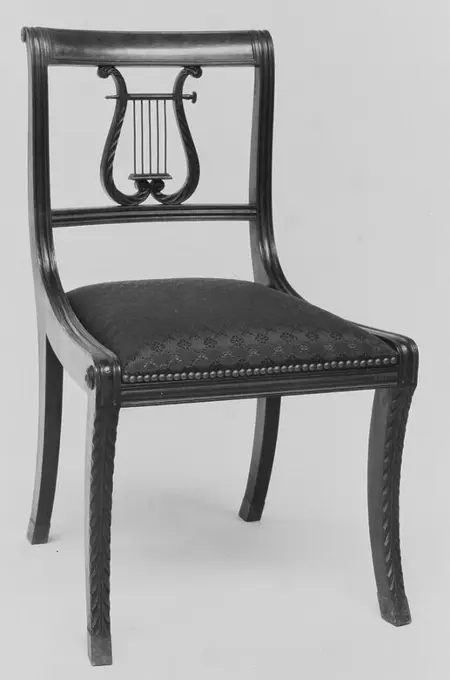
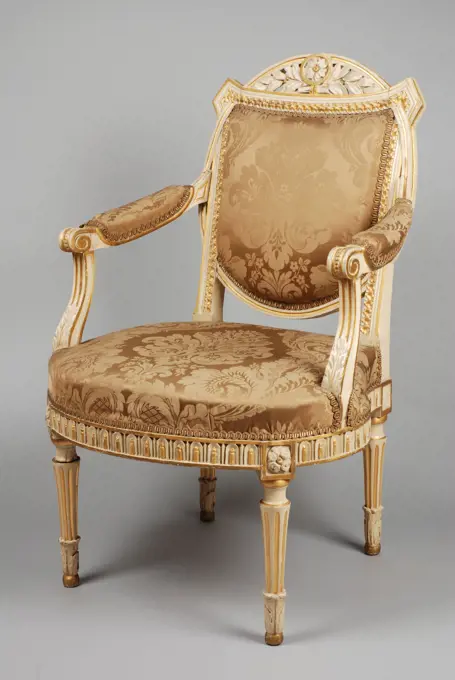
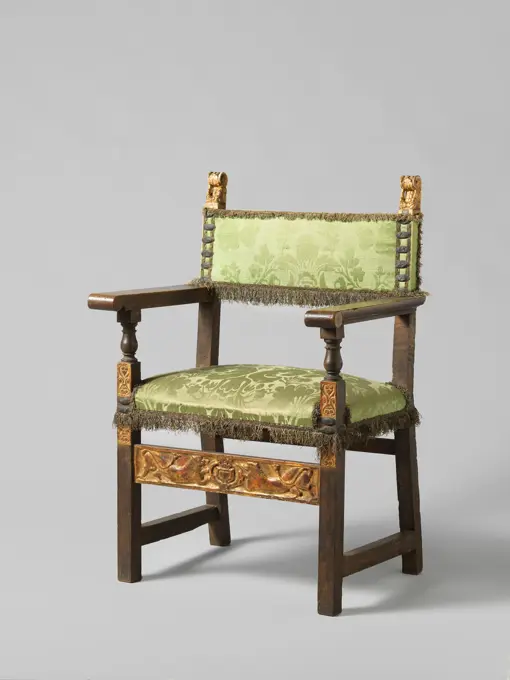
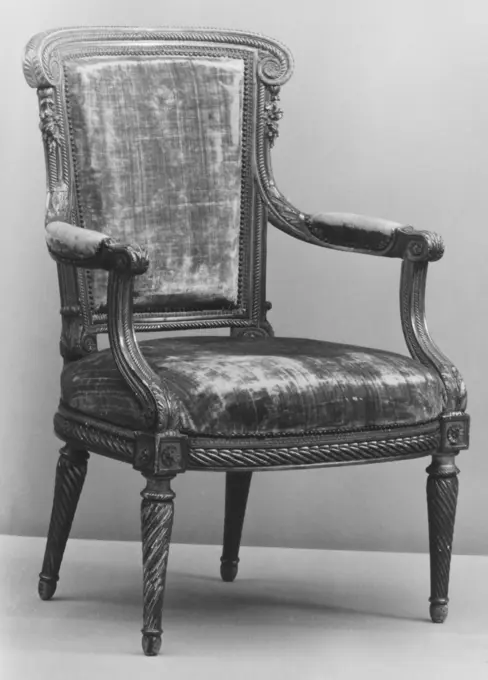
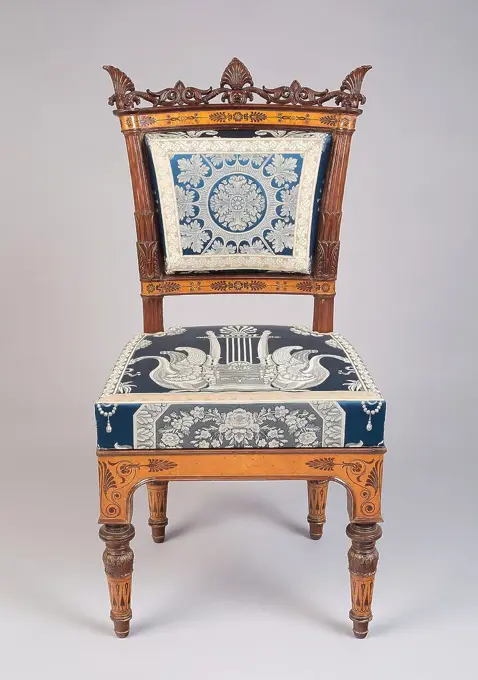
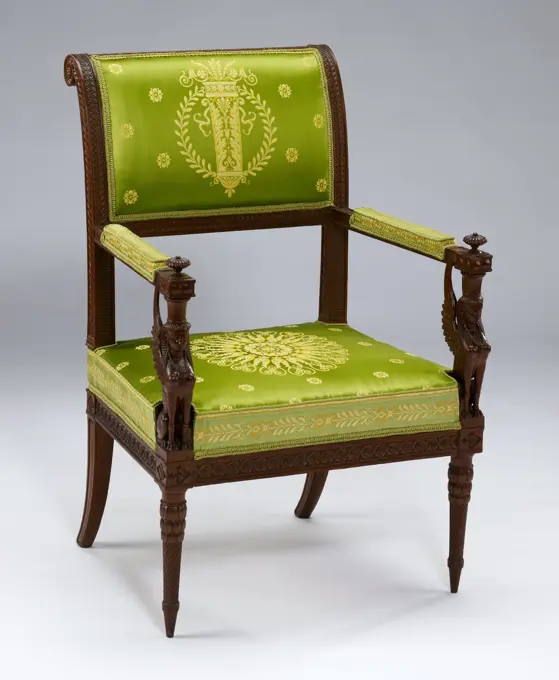
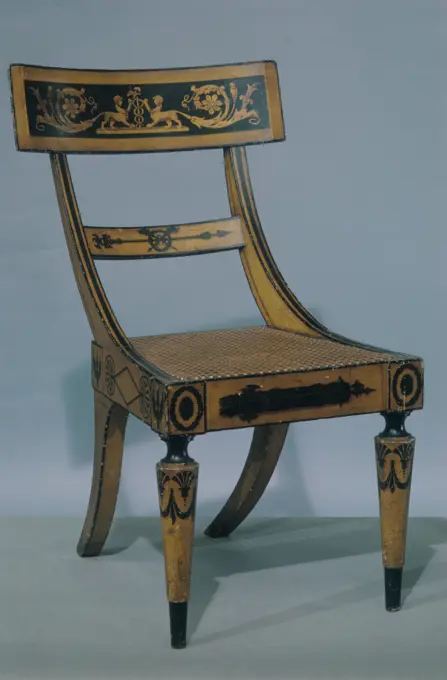
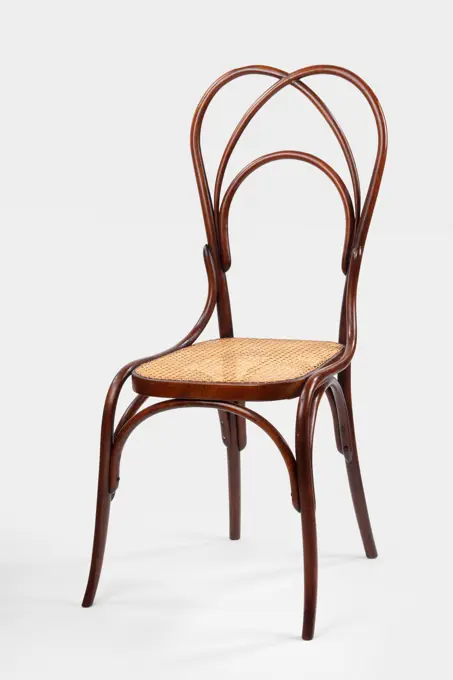
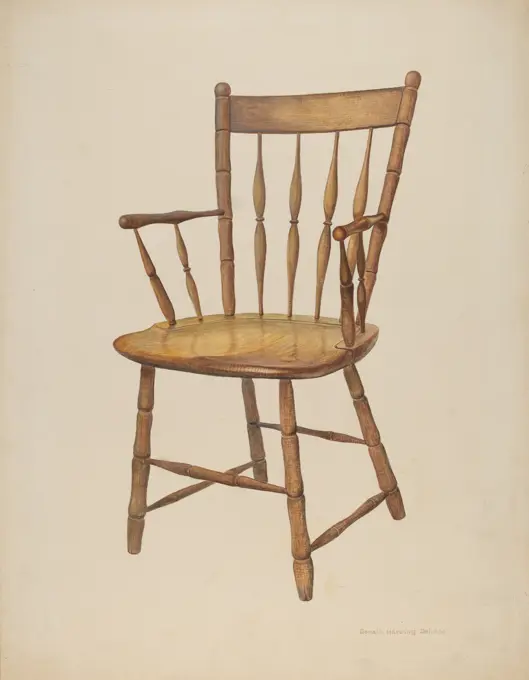
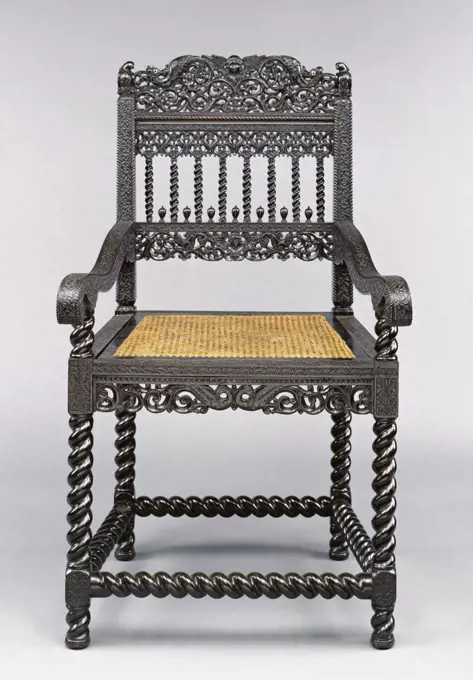
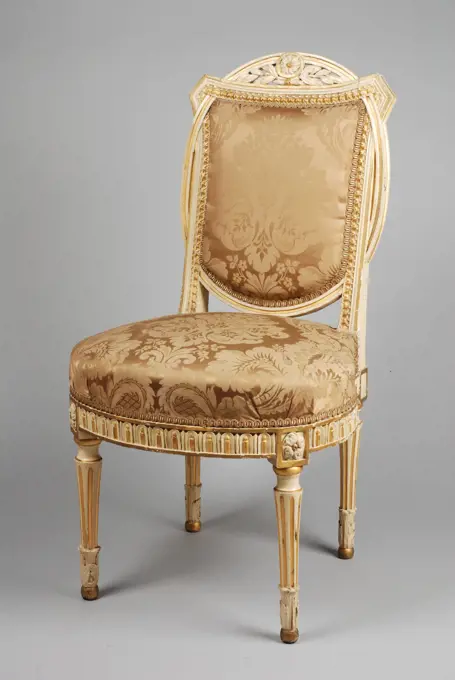
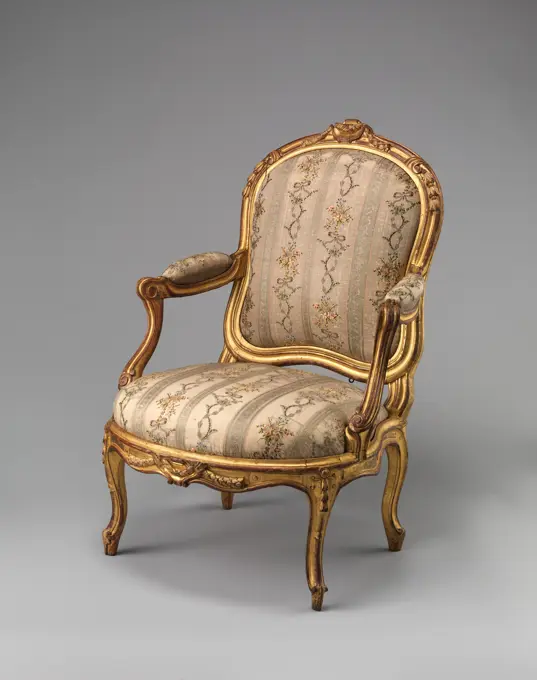
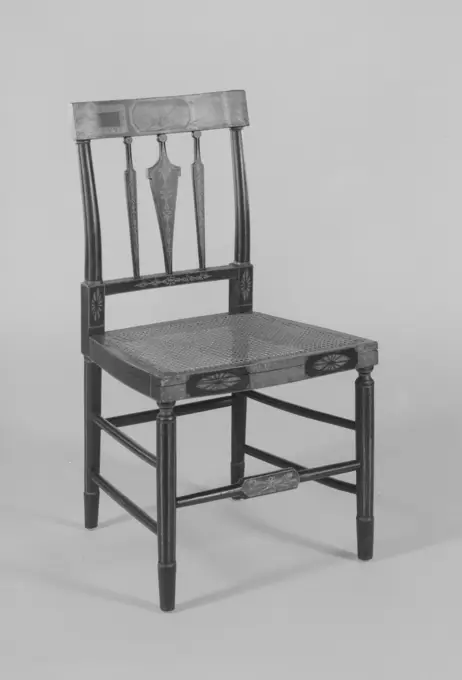
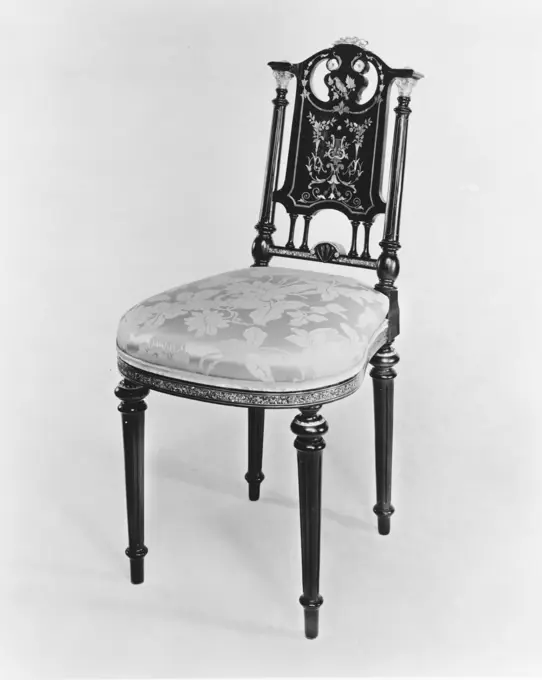
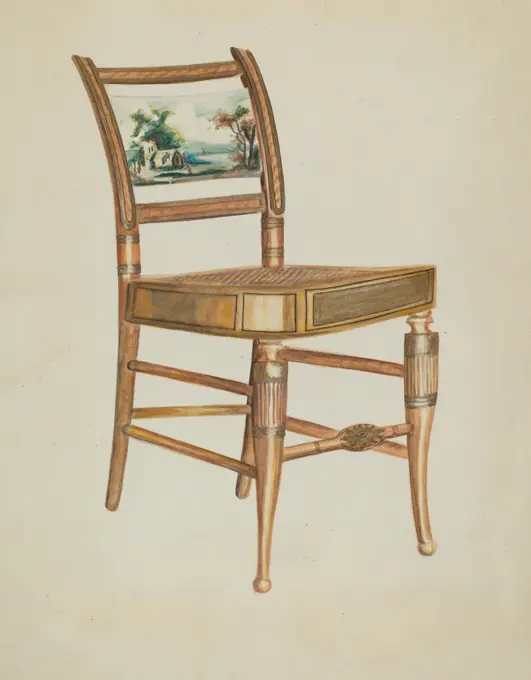
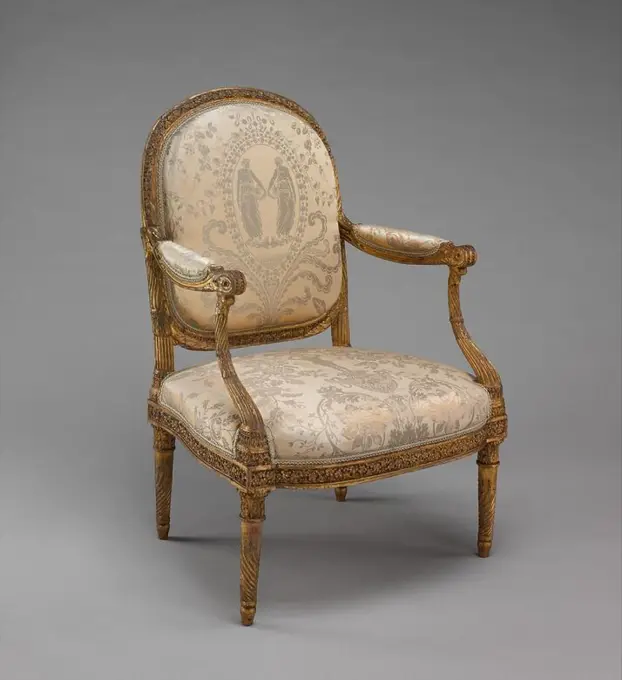
Side chair 1810-20 American. Side chair 20330Side chair, Laminated rosewood and oak, Shaped back, curved in plan, with ovoid escutcheon surrounded by openwork design of laminated wood in scrolls; cabriole legs, the front pair fitted with castors. Upholstered in comtemporaneous machine-woven fancy compound satin. Pressed, steamed, laminated in layers, then glued together at right angles; with an applied crest., New York, USA, 1860-65, furniture, Decorative Arts, Side chairArm chair, 1795 Arm chair with an oval curved backrest and a mats seat. The middle board is opened in the form of a winch with a coat of arms in which the letters VBH (Van Braam Houckgeest) are applied in relief. A pearl edge on the backrest, the armrests and the arms; Cannaarded front legs and rosettes above the legs. China teak (wood). rattan lacquering  Canton Arm chair with an oval curved backrest and a mats seat. The middle board is opened in the form of a winch with a coat of arms in which the letters VBH (Van Braam Houckgeest) are applied in relief. A pearl edge on the backrest, the armrests and the arms; Cannaarded front legs and rosettes above the legs. China teak (wood). rattan lacquering  CantonSide chair (one of a set of fourteen) ca. 1772 Robert Adam Chippendale executed this set of Neoclassical mahogany dining chairs for Goldsborough Hall, in Yorkshire, which belonged to Daniel Lascelles, younger brother of Chippendale's most extravagant patron, Edwin Lascelles, of nearby Harewood House. The set, which originally included fifteen chairs, remained at Goldsborough until 1929, when it was removed to Harewood House, from whence it was sold in 1976. The chairs represent one of Chippendale's most elegant designs: their tapering backs have arched top rails and molded sides headed by beaded paterae and leaf finials; fan-shaped splats with a central patera are encircled and flanked by pendent bellflower swags; and the square, tapering paneled legs are decorated with pendent husks. He produced several sets of these chairs with minor variations, including one, which has not survived, for Lansdowne House, in London. The present set, which has been reupholstered as it was originally wiChair of nut and beech wood with S-shaped overhoeks placed legs; X-shaped cross with rosette; Cut flower and leaf work, Reed back and seat, with loose pillow, anonymous, 1750 Chair of Note and Beukehout (ameblement) with s-shaped overhoeks placed legs, connected by a flung X-shaped cross with rosette. Rules and sills and legs are decorated with cut flower and leaf motifs. Back and seat of braided reeds. Loose pillow of green Shaved Trijp (Modern). See also: BK-16852-E T/M P. France wood (plant material). walnut (hardwood). beech (wood). Chair of Note and Beukehout (ameblement) with s-shaped overhoeks placed legs, connected by a flung X-shaped cross with rosette. Rules and sills and legs are decorated with cut flower and leaf motifs. Back and seat of braided reeds. Loose pillow of green Shaved Trijp (Modern). See also: BK-16852-E T/M P. France wood (plant material). walnut (hardwood). beech (wood).Chair of mahogany, decorated with marquetery of ash wood, the line and back sports have stylized leaf and floral motifs, anonymous, c. 1820 Chair of mahogany (A, B), decorated with marqueterie van Esdoornhout. The round front legs have a twisted section above and below; The part in between shows piping. The hind legs turn backwards and form one whole with the backstyles, which are connected halfway through a sport, and which are crowned by a hold wide, overhanging backrest. The chair rule and the back sports are decorated with stylized leaf and floral motifs; The upper sport ends in rosettes. Loose covered seat. Northern Netherlands (possibly) wood (plant material). mahogany (wood). maple (wood). cotton (textile). ash (wood) Chair of mahogany (A, B), decorated with marqueterie van Esdoornhout. The round front legs have a twisted section above and below; The part in between shows piping. The hind legs turn backwards and form one whole with the backstyles, which are connected halfway thrArmchair 1791-1818 Attributed to Duncan Phyfe Scottish. Armchair 268Side Chair. Culture: American. Dimensions: 39 1/4 x 21 3/8 x 21 1/4 in. (99.7 x 54.3 x 54 cm). Date: 1755-90. Museum: Metropolitan Museum of Art, New York, USA.Four chairs. The shape of these chairs was common in the Neo-classical period in the Netherlands. At that time, it was usual for the decoration to be carved on the chair. In the case of these four chairs, however, the decora-tion is carried out in marquetry. This suggests that they were not made by a chairmaker, but rather by a cabinetmaker, who usually made cabinets, com-modes and other such furniture.Armchair from the prison cell of Johan van Oldenbarnevelt. In 1618 Grand Pensionary Johan van Oldenbarnevelt was imprisoned and tried in The Hague, where he was eventually condemned to death for treason. His political supporters regarded him as a martyr to their cause. According to tradition, he sat on this chair during his final days in prison.Armchair;  1835-1845 (1835-00-00-1845-00-00);SidechairChippendal chair (lined seat) (dummy title). Carved and textile wood. House of Victor Hugo - Hauteville House.Chair and convertible, covered with green trijp, horrix brothers, c. 1860 - c. 1880 Chair and Cabriolet of Beuke- en Notenhout, covered with green trijp. The hind legs areas backwards; The curved front legs rejuvenate downwards and run into the curved and vaulted pre -line. Trapezoidal seat. Decorative nails have been installed along all edges, mostly in the form of a rosette. The vaulted back has bent backstyles, which turn into the hind legs and top sill. The back shows two curved sports, between which a V-shape and a straight sport under the top sill with X-shape. The Hague wood (plant material). beech (wood). walnut (hardwood). metal. Chair and Cabriolet of Beuke- en Notenhout, covered with green trijp. The hind legs areas backwards; The curved front legs rejuvenate downwards and run into the curved and vaulted pre -line. Trapezoidal seat. Decorative nails have been installed along all edges, mostly in the form of a rosette. The vaulted back has bent backstyles, which turn into theArmchairArmchair of walnut with s-shaped overhoeks. Paws set with carving of flowers and leaves. Back and seat of braided reeds. With loose cushion .. Nut wood (Ameublement) with back and seat of braided reeds. The stretched S-shaped overhoeks places set with profiling are transferred into the seating room without imprinting and are decorated with stabbed flowers. Scalloped front seat with flower and leaf work. Backwards placed armrest tricks S-shaped; Holded armrests ending in Volutes. Upper rule window with volutes. With loose cushion. See also BK-16851-A T / M H.Armchair with an intermediate rule in the back consisting of two swan hales. Armchair from a set of ten seats and four armchairs of partially solid and partly glued mahogany on moors wood core. Loose coated seats. The square hind legs deviate backwards. Nine chairs and an armchair have square, slightly rounded, front legs; The rest has round turned front legs like this. The stretched S-shaped backs have a sculpted intermediate rule with a palmet flanked by two degrees, with the biods of doubling swans. The flat filler-shaped armrests run high in the back.Armchair (France); carved walnutArmchair 1800-1830 Canadian. Armchair 255Side Chair 1760-90 American These chairs, from an original set of twelve, along with a settee (39.184.2) and a card table (39.184.12), descended en suite in the Verplanck family. Queen Anne featuresthe heavy walnut frame, balloon-shaped seat, and absence of Rococo carvingsuggest that the set was made for Samuel Verplanck shortly after his return from Holland in 1763 with his bride, Judith Crommelin.. Side Chair. American. 1760-90. Walnut, white oak, white pine. Probably made in New York, New York, United StatesArmchair ca. 1740 British. Armchair. British. ca. 1740. Mahogany. Woodwork-FurnitureArmchair for dollhouse. Poppen arm chair covered with red silk. With jokes. Louis XV style.Anonymous, low carved wooden chair. Wood, silk. House of Victor Hugo - Hauteville House.Arm chair with lagging styles that end in lion masks with rings in the mouth, anonymous, 1600 - 1650 Arm chair of rosewood. The furniture is covered. The four underports are accolade -shaped scumpled, the four wide, flat medium sports show openwork rolling work. The armrest stars have a double section; The armrests are slightly walked and end in a volute with rosettes aside. The lags have lion masks with rings in the mouth. Northern Netherlands wood (plant material). rosewood (wood). textile materials. velvet (fabric weave) Arm chair of rosewood. The furniture is covered. The four underports are accolade -shaped scumpled, the four wide, flat medium sports show openwork rolling work. The armrest stars have a double section; The armrests are slightly walked and end in a volute with rosettes aside. The lags have lion masks with rings in the mouth. Northern Netherlands wood (plant material). rosewood (wood). textile materials. velvet (fabric weave)Chair, the back with vase -shaped center leaf, the seat with burgundy velvet, anonymous, c. 1800 - c. 1899 Chair of mahogany. The back is open with a vase -shaped center leaf. The chair has a trapezium-shaped open sitting window with a loose seat with burgundy velvet. Amsterdam (possibly) mahogany (wood). velvet (fabric weave) Chair of mahogany. The back is open with a vase -shaped center leaf. The chair has a trapezium-shaped open sitting window with a loose seat with burgundy velvet. Amsterdam (possibly) mahogany (wood). velvet (fabric weave)Chair in neo-rococo style of djatihout, sitting and back tensioned with reeds. Chair in Neo-Rococo style of Djatihout and trenched seat and back. S-shaped curved front legs and scalloped rule, all carved with leaf motifs. Weathered back frame with scalloped and upper sill that rests on full-shaped struts and whose crowning is sliced with flower and leaf motifs.Armchair. unknown, authorChair of mahogany, covered with tripe with a continuous pattern of tuning hanging ovals in which flour on stripe pattern. Chair of mahogany, covered with tripe with a continuous pattern of beans hanging ovals in which a flower on a striped soil. The square legs are channeled. The front seat is decorated in the middle with a laurel wreath and a pendulum. The back window is parallelogrammed and rolled. The upper shell is decorated with a straight vase and laurel garland. The coating is attached with gold-plated heads. The chair belongs to an amele (inv.no. BK-16145-A to -G).. Armchair of iron wood with rattan sitting. The legs and back styles show houses with rosettes and cherted parts. The H-shaped cross consists of chanted rules. Dworked rules between the legs on the front and sides. Seat rules with rosettes. The back has an oval field with cane, caught between openwork styles and lines with leafwork; In the arcuate upper line an open-work glory. The curved armrests end in elephant-like cups; Struts with leafwork. See: BK-1970-107-BArmchair, anonymous, c. 1750 - c. 1760 Arm chair of painted Indonesian wood with thatched diamond-shaped seat, resting on angle-placed S-shaped legs, connected by an X-shaped cross and ending in Balomvattemde claws. A standing acanthus leaf above the swelling. The chair rule is decorated with Acanthus vranks. The corner styles, backstyle and the cross have turned sections with houses. A wide sawn -out center lane is installed between the styles of the back, decorated with rocaille motifs and a crown. See: BK-16025-A. Batavia wood (plant material). teak (wood). paint (coating). Arm chair of painted Indonesian wood with thatched diamond-shaped seat, resting on angle-placed S-shaped legs, connected by an X-shaped cross and ending in Balomvattemde claws. A standing acanthus leaf above the swelling. The chair rule is decorated with Acanthus vranks. The corner styles, backstyle and the cross have turned sections with houses. A wide sawn -out center lane is installed between the styles of theSideChairArmchair 1750-80 American. Armchair 191Side Chair 1740-80 American. Side Chair 1594Rockingchair. Maker, possibly by: Nathaniel Dominy V, American, 1770-1852Anonymous, chippendal chair (lined seat) (dummy title). Sculpted wood, seat covered with tapestry. House of Victor Hugo - Hauteville House.Rolland Livingstone, Writing Armchair, 1940 Writing ArmchairMahogany straight Empire chair, straight-seat chair furniture furniture interior design wood mahogany oak brass velvet, veneered panel in the back rimmed with brass profiled frame black velvet upholstery EmpireMichael Trekur, Side Chair, 1936 Side ChairArmchair, American black walnut; slip seat frame of pine of the Taeda group, 40 1/8 × 18 1/16 × 17 5/8 in. (101.9 × 45.9 × 44.8 cm), Made in Philadelphia, Pennsylvania, North America, American, 18thcentury, FurnitureArmchair. Chair of walnut. The piece of furniture has a seated upholstery arranged on a loose window and on the back. Resting on overhoeks, S-shaped legs; The front legs are decorated on the swelling with a shell and a clock. The back window has been rolled horizontally and has stretched S-shaped corner styles in the upper part. The upper spray shows broken c-volutes on either side of a cut-away center piece with a shell pattern above a lampbear line and bells.Cream-white Louis Seize medallion chair, medallion chair straight_chair chair furniture furniture interior design wood elm wood paint gold paint rattan silk dam 95,5, golden details rattan seat and back in lines and back carving edge with chalice motif silk damask cushion Louis XVI Louis XVI Louis Seize Kralingen-Crooswijk Rubroek Rotterdam Van Rijckevorsel From the estate Rubroec (Rubroek) of the Van Rijckevorsel family.Chair with open backrest with middle style, the seat with green velvet, anonymous, c. 1750 Chair of mahogany, round open backrests with middle style; Straight pre-line, backward hind legs and overhoeks placed S-shaped front legs; Seat covered with green velvet with filling on board paper. Amsterdam (possibly) mahogany (wood). velvet (fabric weave) Chair of mahogany, round open backrests with middle style; Straight pre-line, backward hind legs and overhoeks placed S-shaped front legs; Seat covered with green velvet with filling on board paper. Amsterdam (possibly) mahogany (wood). velvet (fabric weave)Side Chair. Culture: American. Dimensions: 32 1/4 x 21 3/4 x 18 3/8 in. (81.9 x 55.2 x 46.7 cm). Date: 1810-20. Museum: Metropolitan Museum of Art, New York, USA.. Armchair from white with gold painted beech wood. The conical legs are decorated with semi-filled cannelures; Above square houses with rosettes, where the backs of the square armrest struts rest. The armrests with cushions end in a volute and go into the rounded back-inslaced window in the round, at the hallplace. The seat rules, armrest tricks and the back window have a straight braid. The chair is covered and has a loose pillow. Round, lightly bent, sitting room.Chair, Neo-Boulle with Dutch weapon on the hood, Anonymous, c. 1850  Ebbenfineer chair, in Neo-Boulle with a Dutch weapon on the hood. France brass (alloy). ebony (wood). pine (wood) damask. Church chair from Palisanderhout. The seat is foldable, has a coated seat and rest on side scrutiny, connected by sports. The decorated back has an upper sport that rests on sliced Tuscan colonnets from ebony. The upper sport is decorated at the front with the judgment of Solomon and at the rear with figures in a landscape with trees and a mill. Three ebony balls serve as a crowning. Lions as shield farmers, sat on ionic capitals crown the side crosses.SideChairYorkshire Yew-Wood Windsor Armchair Antiques-Furniture Chrisitie's Images, London, EnglandChair with mats seat, slightly hold back and curved upper sill, anonymous, 1785 - 1800 Chair of elm, beech and cherry wood with a mats seat. The front legs, the H-shaped cross and the four sports are turned; The front legs have a fled and flattened foot. The back is slightly rolled, the upper sill bent, the center track is equipped with rectangular breaks. Northern Netherlands (possibly)Netherlands (possibly) wood (plant material). elm (wood). beech (wood). cherry (wood) Chair of elm, beech and cherry wood with a mats seat. The front legs, the H-shaped cross and the four sports are turned; The front legs have a fled and flattened foot. The back is slightly rolled, the upper sill bent, the center track is equipped with rectangular breaks. Northern Netherlands (possibly)Netherlands (possibly) wood (plant material). elm (wood). beech (wood). cherry (wood)Chair of walnut. Chair of walnut. The furniture is covered and has killed legs, connected by four flattened musities. The rear styles, between sitting and back, are coated and crowned by two loosely stabbed lions, without basement.Armchair (chaise à bras, pair with 1975.1.2001). Culture: French, Italian or Spanish. Dimensions: H. 102 cm, W. 58 cm, D. 56 cm; seat: 40 x 60 cm. back: 26.5 x 62 cm (including fringe). Date: 16th century, second half (woodwork), 16th or 17th century (textiles). Museum: Metropolitan Museum of Art, New York, USA.Chair;  around 1900 (1890-00-00-1910-00-00);Swivel armchair;  beginning of the 20th century (1901-00-00-1915-00-00);anglomaniaChair;  1850-1860 (1850-00-00-1860-00-00);Chair, mahogany, covered with velor d'Utrecht, on which a pressed sunflower motif, anonymous, c. 1760 - c. 1775 Chair lined with velor d'Utrecht, on which a pressed large sunflower motif. The S-shaped front legs end in a bird claw with ball and are extra profiled over the Welfing. The hind legs neighborhoods in spread stand. The seating rules and the back rules and sills are vaulted. The upper sill of the covered back window is crowned by a small floral pattern. The upholstery is nailed. The hollow bent back window rests on canaly vaulted struts. Netherlands wood (plant material). mahogany (wood). wool Chair lined with velor d'Utrecht, on which a pressed large sunflower motif. The S-shaped front legs end in a bird claw with ball and are extra profiled over the Welfing. The hind legs neighborhoods in spread stand. The seating rules and the back rules and sills are vaulted. The upper sill of the covered back window is crowned by a small floral pattern. The upholstery is nailed. The holloSide chair ca. 1740 French. Side chair 189327 French, Side chair, ca. 1740, Carved and stained beechwood; caning, Overall: 37 7/8  19 3/4  17 7/8 in. (96.2  50.2  45.4 cm). The Metropolitan Museum of Art, New York. Gift of J. Pierpont Morgan, 1906 (07.225.38)Armchair. Culture: American. Dimensions: 36 3/4 x 23 x 18 in. (93.3 x 58.4 x 45.7 cm). Date: 1795-1810. Museum: Metropolitan Museum of Art, New York, USA.Chair. Chair of walnut. The furniture is stretched with cane and rests on S-shaped front legs and articulated hind legs, connected by an H-shaped cross. The front legs beared at the top of acanthus sheet. The seat rules are decorated at the top and on the front and sides with stabels. The detached back styles exhibit sections and are awarded by vases. The upper sprin has two putti in the middle, which carry a flower corform. The houses have floral motifs at the front.Armchair. Armchair of walnut, lined with blue velvet. The furniture rests on baluster-shaped legs that are connected by a thrilled X-shaped cross. The sides are closed, the armrests curl out. The high back is semi-circular and cheeks that emerged from the armrests. The coating is attached with nails with gold-plated heads, which exhibit a spiral motif on the front of the armrests.Arm chair of walnut with petit-point upholstery, anonymous, c. 1700 - c. 1725 Arm chair of walnut with petit-point upholstery and oak backstyles and hind legs. The seats rest on overhoeks placed S-shaped legs. The front legs have a volute with a leaf motif at the bottom and a shell motif above the swelling. The armrest stars turn into hold armrests, ending in Acanthus volute. The upholstery shows motifs of flower vases and bouquets. Part of an ameblement of six arm chairs (inv.no. BK-16024-A to -F), from Castle Eerde (O.). Northern Netherlands wood (plant material). walnut (hardwood) embroidering Arm chair of walnut with petit-point upholstery and oak backstyles and hind legs. The seats rest on overhoeks placed S-shaped legs. The front legs have a volute with a leaf motif at the bottom and a shell motif above the swelling. The armrest stars turn into hold armrests, ending in Acanthus volute. The upholstery shows motifs of flower vases and bouquets. Part of an ameblement of six arm chaiWhite painted, partly gilded Louis Seize chair, chair furniture furniture interior design wood beech lacquer gold leaf silk damask, Oval backrest rimmed by rectangular frame brown silk damask cover with passement on seat and back crest with laurel branches and rosette Louis XVI Louis XVI Louis Seize Kralingen-Crooswijk Rubroek Rotterdam Van Rijckevorsel From the estate Rubroec (Rubroek) of the Van Rijckevorsel family.Side Chair. Dated: 1937. Dimensions: overall: 34.9 x 24.2 cm (13 3/4 x 9 1/2 in.) Original IAD Object: 33 1/2"high, 18 1/4"wide, 16 3/4"deep. Medium: watercolor, colored pencil, and graphite on paperboard. Museum: National Gallery of Art, Washington DC. Author: Nicholas Gorid.Couch covered with gobelin and resting on two conical and two horn -shaped legs on a claw, including wheels., Anonymous, 1840 Mahoniehouten Bank covered with gobelin and resting on two conical side legs and on two side legs in the form of a horn, on a claw. Wheels are applied under the legs. The rectangular sitting window is completed on one side. The front line, which shows an elongated field above the legs, runs over in the side railing, ending in a volute. The back has a large volute shape, on the one hand resting on the side railing; Strut on the other on an inside. See: BK-19959-113-B. Northern Netherlands (possibly) wood (plant material). mahogany (wood). pine (wood). elm (wood). textile materials Mahoniehouten Bank covered with gobelin and resting on two conical side legs and on two side legs in the form of a horn, on a claw. Wheels are applied under the legs. The rectangular sitting window is completed on one side. The front line, which shows an elongated field above the legs, SidechairTurned Great Chair with Splint SeatSide Chair. Culture: American. Dimensions: 32 3/4 x 19 1/2 x 17 1/2 in. (83.2 x 49.5 x 44.5 cm). Date: 1805-15. Museum: Metropolitan Museum of Art, New York, USA.White painted, partly gilded Louis Seize armchair, armchair seat upholstered furniture interior design wood lacquer gold leaf silk damask, Oval backrest rimmed by rectangular frame brown silk damask upholstery with passement on seat and back crest with laurel branches and rosette Louis XVI Louis XVI Louis Seize Kralingen-Crooswijk Rubroek Rotterdam Van Rijckevorsel From the estate Rubroec (Rubroek) of the Van Rijckevorsel family.Armchair. Armchair from walnut. The legs are rectangular from cross-section; The hind legs are placed backwards. The front legs are connected by a flat sport, which relies in relief two lions with stretched lives; The lions carry a cartouche within which a coat of arms. The armrest tricks show vase-shaped sections; The armrests are flat. The back styles of the rectangular back window are crowned by garlands. The back and seat are lined with green floral damask. See: BK-16845-A.. Armchair resting on S-shaped legs on Hoeven, in motion ending in a liquute in the seating rules, which in the middle shelled a shellfish with leaf volutes against a checkered background. They are, as well as the X-shaped cross, the S-shaped armrest tricks, the rack struts and the volutes of the further straight armrests with carving, predominantly with leaf motifs. The armrests, seat and the rectangular back window are coated with tapestry, with vases with fruits and flowers.Bergère van Beukenhout, Anonymous, c. 1750 Bergère van Beukenhout, covered, with a loose high pillow and resting on the cornered S-shaped legs, which turn into the scalloped seating rules. Front legs decorated with triangular leaf motif. The semicircular sitting window is sculpted at the front. The armrests with cushions make out and are connected to the hold back window with its stretched S-shaped styles and scalloped upper sill. The armrest pits run back, come out of the sitting window and cross the layers in the layers. France wood (plant material). beech (wood). textile materials Bergère van Beukenhout, covered, with a loose high pillow and resting on the cornered S-shaped legs, which turn into the scalloped seating rules. Front legs decorated with triangular leaf motif. The semicircular sitting window is sculpted at the front. The armrests with cushions make out and are connected to the hold back window with its stretched S-shaped styles and scalloped upper sill. The armrest pits Furniture, Anonymous, 1800 Elm wood chair with square, downwards, rejuvenating legs. The back is open with two arches; The center track shows rectangular interruptions. The chair wears a loose pillow of red trijp. Northern Netherlands elm (wood). Elm wood chair with square, downwards, rejuvenating legs. The back is open with two arches; The center track shows rectangular interruptions. The chair wears a loose pillow of red trijp. Northern Netherlands elm (wood).Side Chair. American; Philadelphia, Pennsylvania. Date: 1755-1775. Dimensions: 95.9 × 56.5 × 43.8 cm (37 3/4 × 22 1/4 × 17 1/4 in.). Mahogany, yellow pine, white pine and Atlantic white cedar. Origin: Philadelphia. Museum: The Chicago Art Institute, Chicago, USA.Chair. unknown, creatorArmchair. Armchair from walnut. The legs are rectangular from cross-section; The hind legs are placed backwards. The front legs are connected by a flat sport, which relies in relief two lions with stretched lives; The lions carry a cartouche within which a coat of arms. The armrest tricks show vase-shaped sections; The armrests are flat. The back styles of the rectangular back window are crowned by garlands. The back and seat are lined with green floral damask. See: BK-16845-b.Chair with Swans, Anonymous, 1830 Chair from a set of ten chairs and four arm chairs of partly solid and partly glued mahogany on elm core. Loose covered seats. The square hind legs areas backwards. Nine chairs and an armchair have square, slightly rounded at the front, front legs; The rest has round articulated front legs. The stretched S-shaped backs have a sculpted intermediate rule with a palmet flanked by two swans bending back with the necks. The flat volute -shaped armrests run high in the back. Northern NetherlandsNetherlands wood (plant material). mahogany (wood). elm (wood). textile materials Chair from a set of ten chairs and four arm chairs of partly solid and partly glued mahogany on elm core. Loose covered seats. The square hind legs areas backwards. Nine chairs and an armchair have square, slightly rounded at the front, front legs; The rest has round articulated front legs. The stretched S-shaped backs have a sculpted intermediate rule with a palmet flanked by two swans Armchair (part of a set) ca. 1780-90 Georges Jacob French Part of a larger set of seat furniture, these elegant armchairs with a concave back, are so-called fauteuils en cabriolet. Their frames are stamped on the underside I-B, which is believed to be an alternate mark for Georges Jacob (master 1765-1814), one of the most successful chair makers of eighteenth-century France, who supplied beds and seat furniture to the crown.Epitomizing neoclassicism, the chairs have tapering and spirally fluted legs, and frames carved with rosettes, acanthus leaves, and twisted rope ornament. The unusual scrolled top rail of the back makes a reference to the capital of the Ionic order, one of the three canonic orders of classical architecture.. Armchair (part of a set) 236123Side Chair. Italy, Turin; Designed by Filippo Pelagio Palagi (Italian, 1775-1860); Made by Moncalvo (Gabrielle Cappello) and Carlo Chivasse. Date: 1830-1840. Dimensions: 100 × 52.7 × 55.3 cm (39 3/8 × 20 7/8 × 21 3/4 in.). Mahogany, maple, and modern reproduction upholstery. Origin: Italy. Museum: The Chicago Art Institute, USA.Armchair, c. 1796, Charles Percier; Designer: Pierre François Léonard Fontaine; Maker: Georges Jacob, French, 1739-1814, 37 3/8 x 24 1/4 x 23 1/2 in. (94.93 x 61.6 x 59.69 cm), Mahogany (modern upholstery), France, 18th-19th century, This chair came from a suite of furniture created for the royal Palace of Fontainebleau south of Paris. It is based on a pattern by the French architects and designers Charles Percier and Pierre François Léonard Fontaine, and executed by the master wood-carver and joiner Georges Jacob of Paris.Side chair, Wood (mahogany), fabric, The chair back with reeded posts; panelled top rail and reeded lower rail, enclosing the figure of a harp; out-curved front legs, lower half carved to depict fur-covered animals legs and paw feet; trapezoidal, dark blue slip seat in readed frame., USA, ca. 1815, furniture, Decorative Arts, Side chairArmchair ca. 1875-80 American. Armchair. American. ca. 1875-80. Ebony and ivoryDining Room Chair. Dated: c. 1939. Dimensions: overall: 35 x 24.7 cm (13 3/4 x 9 3/4 in.) Original IAD Object: 32 5/8"high, 16 3/4" at widest pt., 16 1/2" deep, seat. See d.s. for dets.. Medium: watercolor, gouache, colored pencil, graphite, andpen and ink on paperboard. Museum: National Gallery of Art, Washington DC. Author: Ralph Morton.Side Chair 1815-20 Attributed to John Finlay This brilliantly conceived and handsomely executed chair derives its broad, deeply curved crest tablet from the ancient Greek klismos form, and its turned front legs from Roman prototypes. During the James Madison administration (1809-17), the architect Benjamin Latrobe designed a suite of painted furniture for the White House in the latest Grecian style. Although the suite was destroyed in a fire in 1814, drawings for it bearing Latrobes instructions to the Baltimore fancy chair makers John and Hugh Finlay still exist and provide the basis for this chair's attribution. Originally part of a larger set, this chair was once used by Arunah S. Abell, founder of the "Baltimore Sun," in his country house "Wood bourne." The Metropolitan owns four chairs (65.167.5, .6, .8, .9) from the set. Others are in the collections of the High Museum, Atlanta; the Baltimore Museum of Art; and the Munson Williams Proctor Institute, Utica, New York.. Side Chair Wash Stand 1810-30 United Society of Believers in Christs Second Appearing (“Shakers”), Mount Lebanon, New York. Wash Stand 9734Chair. Wojciechów - Fabryka Mebli Giętych (Wojciechów ; fabryka mebli giętych ; 1870-1939), bentwood furniture factorySide Chair 1830-1840 Italy. In 1832 the painter Filippo Pelagio Palagi was appointed director of the Academy of Design in Turin, Italy, by Carlo Alberto, King of Sardinia, who also commissioned Palagi to redecorate a royal residence, Palazzo Racconigi. Palagi was responsible for the interior design, including the walls, ceilings, mantels and doorways, and also for the palace furniture, including a suite of six side chairs, four armchairs, and two sofas. The Art Instituteís side chair comes from this set.Palagi used late-Neoclassical motifs in original ways on this furniture. The crest of the chair rail is adorned with three-dimensional carving of palmettes and lotuses, inspired by natural forms but arranged in such a way as to give an almost military rigor to the design. The inlaid friezes below repeat the palmette motif and also incorporate sinuous vines and tendrils. Thanks to the survival of the original dark blue and white upholstery on several of the pieces and the discovery of a Donald Harding, Windsor Armchair, c 1940 Windsor ArmchairWhite painted straight rococo chair, chair furniture furniture interior design wood elm paint leaf gold rattan damask, Rattan seat and back cawio legs carving gilded with loose gray damask cushion rococoSet of twelve chairs (5 armchairs, 7 side chairs); Unknown; India, Asia; about 1680 - 1720; Ebony, ebonized hardwood, ivory, ebonized walnut inner-seat frame with cane; Various, see extensionsWhite painted, partly gilded Louis Seize chair, chair furniture furniture interior design wood beech lacquer gold leaf silk damask, Oval backrest rimmed by rectangular frame brown silk damask cover with passement on seat and back crest with laurel branches and rosette Louis XVI Louis XVI Louis Seize Kralingen-Crooswijk Rubroek Rotterdam Van Rijckevorsel From the estate Rubroec (Rubroek) of the Van Rijckevorsel family.John Cutting, Ladder Back Chair, c 1939 Ladder Back ChairArmchair (fauteuil) ca. 1765 Louis Delanois French This type of armchair is known in French as a "fauteuil à la reine" because of its straight back and "à chassis" because the seat, back, and armpads can easily be removed to change the upholstery. Stamped by Louis Delanois (1731-1792), a Parisian menuisier who specialized in seat furniture in the late Rococo and neoclassical taste, this chair is in a transitional style and reflects the transition between the Louis XV and Louis XVI styles. The cabriole legs and curving arm supports, which are not yet placed directly above the legs but are set back, are still expressions of the Rococo. The laurel garlands and husk motifs on the seat rail, at the knees, and on the back rail show influence of neoclassicism. At least one other chair of this model is known which may have been part of the same set of seat furniture. This armchair was part of the model collection of woodwork, paneling and seat furniture of Maison Leys, a successful decorating Side Chair 1800-1810 Hugh Finlay. Side Chair. American. 1800-1810. Mahogany, maple, tulip poplar, cane. Made in Baltimore, Maryland, United StatesSide Chair 1860-70 Attributed to Léon Marcotte French. Side Chair. American. 1860-70. Maple, brass, mother-of-pearl. Made in New York, New York, United StatesElla Josephine Sterling, Chair  with Hudson River Scenes, 1935 1942 Chair - with Hudson River ScenesArmchair (fauteuil à la reine). Culture: French, Paris. Designer: Jacques Gondouin (1737-1818). Dimensions: Overall: 39 × 25 1/2 × 19 3/4 in. (99.1 × 64.8 × 50.2 cm). Maker: François II Foliot (1748-1839, master 1773, retired 1786); carved by the workshop of Madame Pierre-Edme Babel; gilded by the workshop Marie-Catherine Renon; upholstered by Claude-François Capin (died 1789). Date: 1779.Although intended to furnish Marie-Antoinette's grand cabinet intérieur at the chteau de Versailles during the winter months, the chair and the rest of the set were removed in 1783, when the grand cabinet intérieur was redecorated and placed in the queen's billiard room on the floor above. Sold during the French Revolution, the entire set of furniture was acquired by the American statesman Gouverneur Morris, who served as minister of the United States in France from 1792 to 1794. The pieces were subsequently sent to Morrisania, Morris's country estate in the Bronx. Museum: Metropolitan Museum of ArGiltwood Fauteuil Antiques Christie's, London . Stadmithing chair from walnut, gold-plated and lined with green velvet with silver passing. The chair rests on overhoeks placed S-shaped legs, which proceed in the seating window without interruption. At the foot they are decorated with acanthus leaf, above the swelling with flower branches, as well as the scalloped rules. The armrests have cushions, neighborhoods outward and end in volutes. The armrest tricks have been placed backwards, come from the sitting window and go to the armrests S-shaped. The back window is scalloped to four sides and decorated with flower and leaf branches. Profile lists by small vultuts interrupted border the furniture in its contour. At the chair hear a loose, green velvet cushion with silver passing, and a footstool (BK-AM-25-A-2).Armstoel, anonymous, 1600 Armchair of walnut. The square legs run into the back in the backstyles and in front of the armrest stars. The front legs are connected by a processed flat pre -line; The hind legs through a flat, above and below sawn, rule. The front and hind legs are again connected by low-placed rules that are accolade-shaped from below. The stretched S-shaped armrests end in volutes. The leather upholstery of the back and seat is nailed with copper nails. See: BK-16879-A. Spain wood (plant material). walnut (hardwood). leather. copper (metal) Armchair of walnut. The square legs run into the back in the backstyles and in front of the armrest stars. The front legs are connected by a processed flat pre -line; The hind legs through a flat, above and below sawn, rule. The front and hind legs are again connected by low-placed rules that are accolade-shaped from below. The stretched S-shaped armrests end in volutes. The leather upholstery of the back and seat is nailed with coppeRocking Chair ca. 1823 Hudson and Brooks. Rocking Chair 223