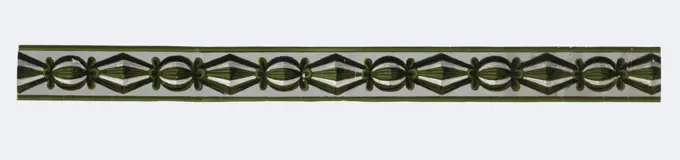
Decorative Lace Strips

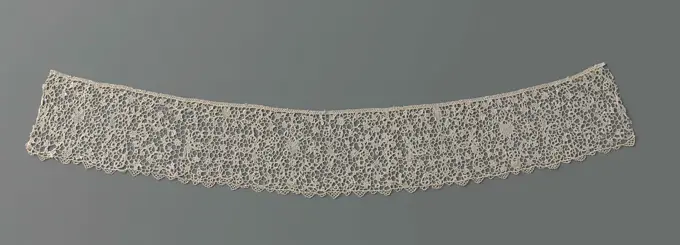
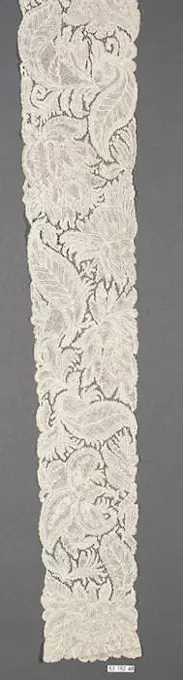
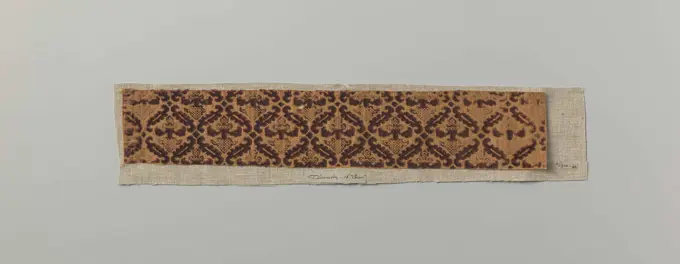
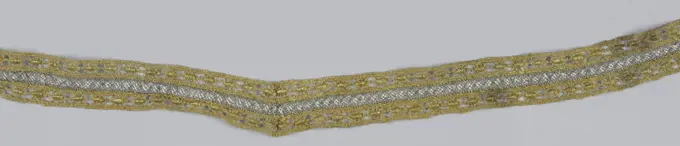
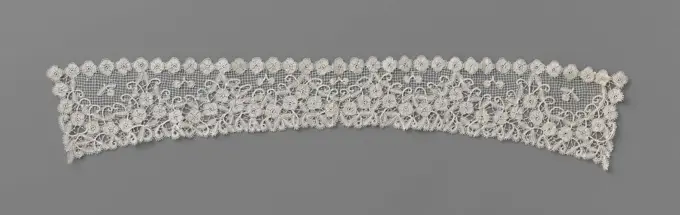
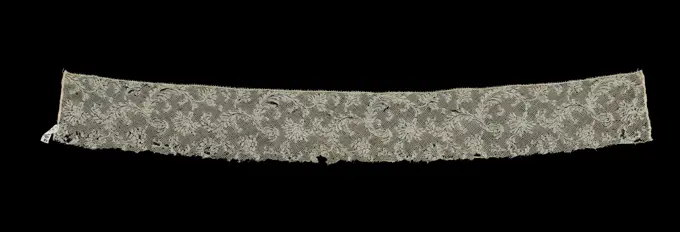
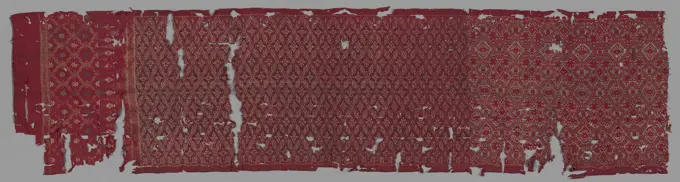
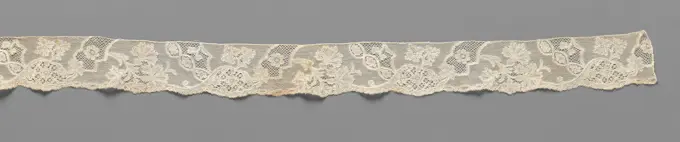
A variety of intricate lace strips, featuring delicate floral patterns and detailed craftsmanship. These ornamental textiles reflect historical design elements.

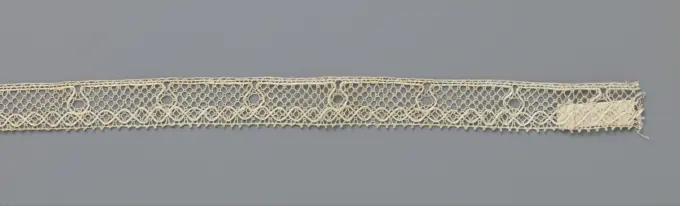
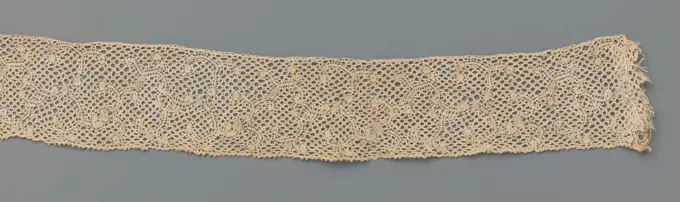
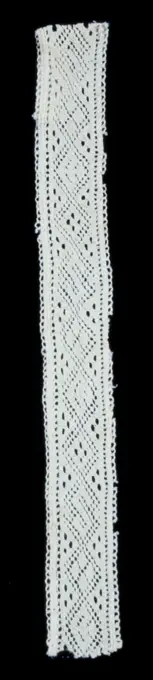
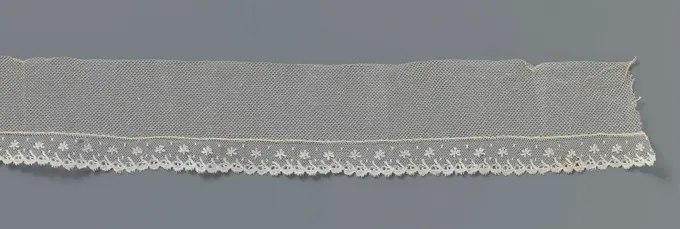
Kloskant intermediate base with tormented straps, 's-Gravenmoersche Kantvereniging, c. 1920 - c. 1929 Piles of natural-colored bobbin, Valenciennes side. Two tormented straps are running in the middle against a background. 's Gravenmoer linen (material) Bobbi Lace / Valenciennes Lace Piles of natural-colored bobbin, Valenciennes side. Two tormented straps are running in the middle against a background. 's Gravenmoer linen (material) Bobbi Lace / Valenciennes Lace
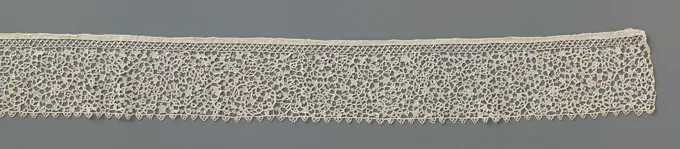
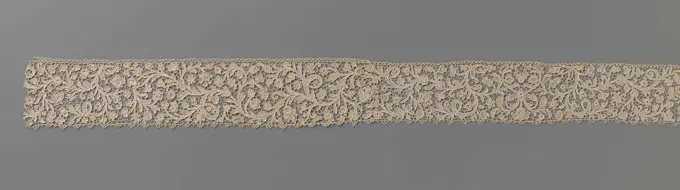
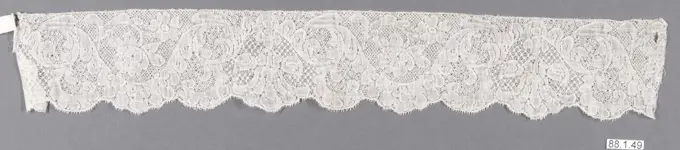
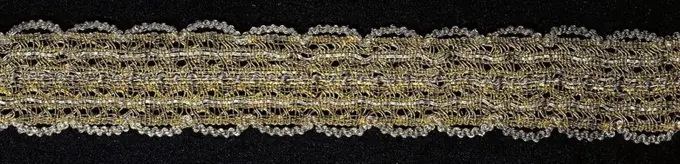
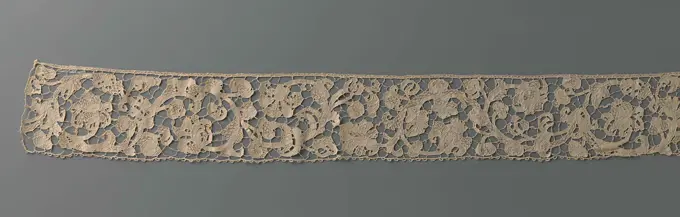
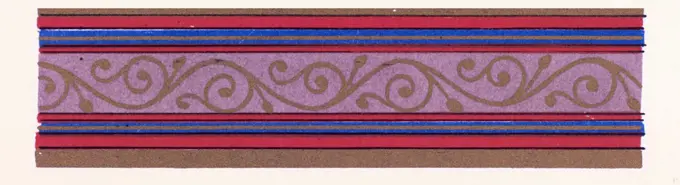
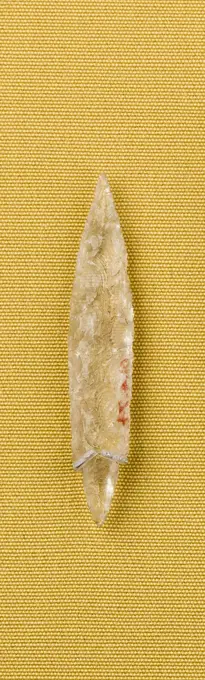
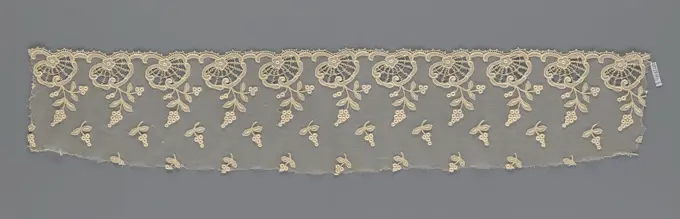
Strip bobbin with V-shaped composition and carnations, anonymous, c. 1735 - c. 1765 Strip of natural -colored bobbin: Mechelse side. The repeating pattern consists of a V-shaped composition formed by two slanted cartouches, which connect from the top of the strip to a rocaillic cartouche along the bottom of the strip. Halfway through the right cartouche, a curved branch hangs down with four carnations that fill almost the entire width of the strip. The motifs are made in linen battle with recesses and equipped with thicker and shiny contour threads. The motifs are connected by a fine grid, the Mechelen soil. Ornamental grounds, mainly rose grounds, are used in the cartouches and between the carnations, among other things. The silly scrap edge is finished with picots. The top is straight. Southern Netherlands linen (material) bobbin lace / Mechlin (lace) Strip of natural -colored bobbin: Mechelse side. The repeating pattern consists of a V-shaped composition formed by two slanted cartouBorder; linenStrook naaldkant met serpentines.Strip natural needle side: Flat Venetian side. Irregular open bars soil from short, with cogs-picots occupied bars. Thin intersecting spiral ranks forming a running pattern of serpentines. Straight outline of equal triangles.Strook naaldkant met gepluimde ranken.Strip natural needle side: Venetian rosion side. On a bars soil with six-sided meshes there are rich branched, left and right swiveling tendrils, sometimes drew, sometimes walking. Veeloertige, carefully detailed knob-shaped flowers grow. Here and there the top of a rank has grown through an opening in the branch. Straight finish of alternation an eye and a triangle.Strook naaldkant met gepluimde ranken.Strip natural needle side: Venetian rosion side. On a bars soil with six-sided meshes there are rich branched, left and right swiveling tendrils, sometimes drew, sometimes walking. Veeloertige, carefully detailed knob-shaped flowers grow. Here and there the top of a rank has grown through an opening in the branch. Straight finish of alternation an eye and a triangle.Kloskant intermediate base with tormented straps, 's-Gravenmoersche Kantvereniging, c. 1920 - c. 1929 Piles of natural-colored bobbin, Valenciennes side. Two tormented straps are running in the middle against a background. 's Gravenmoer linen (material) Bobbi Lace / Valenciennes Lace Piles of natural-colored bobbin, Valenciennes side. Two tormented straps are running in the middle against a background. 's Gravenmoer linen (material) Bobbi Lace / Valenciennes LaceFlounce (Italy); linenRibbon early 19th century possibly French. Ribbon 220672Galloon 18th century French. Galloon 214001Insertion ca. 1700 Flemish. Insertion 212878Strip bobbin with chalice and feathered leaves, anonymous, c. 1740 - c. 1760  Strip of natural-colored bobbin: Valenciennes side. The repeating pattern consists of a slanted and mirrored S-shaped feathered leaf. Under the leaf hangs a bunch with seven rosette flowers in ovals. Next to the leaf are two chalice -shaped flowers twisted together with some smaller flowers and a plume -shaped leaf that lies along the underside of the strip. The motifs are made in linen battle with openwork edges and recesses. The motifs are connected by a nice round Valenciennes ground. The top of the strip is straight finished. The regular scrap edge forms around the pattern and is finished with picots. Southern Netherlands linen (material) Bobbi Lace / Valenciennes LaceEdge; linen; 1931-53-5Textile, Medium: wool Technique: 2/2 diamond twill, Check of alternating dark blue and warm tan stripes in both the warp and weft, with off-white accents. Diamond or birds-eye twill effect in woven pattern., USA, 19th century, woven textiles, TextileStrip bobbin with oval formed by contour thread, anonymous, c. 1915 Strip of natural -colored bobbin: tie. The repeating and symmetrical pattern consists along the underside of the strip of a succession of pointed dovals that are formed by two winding contour threads that have been worked in a closed pin stroke ground. At a regular distance, a larger oval forms from the Spitsovals that up to the top of the strip, where the threads on the top of the strip run in a straight line along the top to the next large oval. The traly land is open in the center of each large oval. Top and bottom of the strip are straight finished with the bottom with picots. 's Gravenmoer linen (material) Bobbi lace / lace cloth Strip of natural -colored bobbin: tie. The repeating and symmetrical pattern consists along the underside of the strip of a succession of pointed dovals that are formed by two winding contour threads that have been worked in a closed pin stroke ground. At a regular distance, a larger ovalStrip bobbin with winding wire along the underside, anonymous, c. 1850 - c. 1870 Strip of natural -colored bobbin, Lille side. The repeating and continuous pattern consists of a winding line between two straight lines along the bottom. The strip consists of a fine diamond -shaped Maas soil, the tuler land. The upper straight line and the winding line are made with thicker and shiny threads. The lower straight line is very narrow and made in linen and fitted with picots. The top is straight. Lille (possibly) linen (material) bobbin lace / Lille lace Strip of natural -colored bobbin, Lille side. The repeating and continuous pattern consists of a winding line between two straight lines along the bottom. The strip consists of a fine diamond -shaped Maas soil, the tuler land. The upper straight line and the winding line are made with thicker and shiny threads. The lower straight line is very narrow and made in linen and fitted with picots. The top is straight. Lille (possibly) linen (materiBand, Medium: linen Technique: bobbin lace (provincial-style), Band in a wavy ribbon-like design of a tulip alternating with crowned double-headed eagle. Straight edge and round mesh., Russia, 19th century, lace, BandStrip bobbin with two berries on short twig, anonymous, c. 1850 - c. 1870 Strip of natural -colored bobbin, Lille side. The repeating pattern consists of a short loose twig on the center line with two berries on it. Along the underside are very narrow, elongated ovals, which are connected to each other with a flower or leaf. The motifs are connected by a fine Maas soil, a tuler land. A decorative land has been used in the very small motifs, which is almost impossible to see because of the thicker glimizing contour threads that have been used. The top is straight. The very silly, elongated scoops along the bottom are finished with picots. Belgium (possibly) linen (material) bobbin lace / Lille lace Strip of natural -colored bobbin, Lille side. The repeating pattern consists of a short loose twig on the center line with two berries on it. Along the underside are very narrow, elongated ovals, which are connected to each other with a flower or leaf. The motifs are connected by a fine Maas Band, Medium: linen Technique: bobbin lace, peasant style, Italy, 19th century, lace, BandStrip 18th century Flemish. Strip 212745Piece early 18th century Flemish. Piece 212525Band, Medium: linen Technique: embroidered, Long ochre-colored band with a scrolling pattern of a double-headed serpent., Spain, 16th or 17th century, embroidery & stitching, BandStrip 18th century French. Strip 218290Border (Netherlands); linen; Repeat: 17 inches; Bequest of Marian Hague; 1971-50-428Needle -sided Engageante with a row of leaf branches and a bottom edge of connected medallions from which leaf branches spring, anonymous, c. 1775 - c. 1799 Engageante of natural-colored needle side: Alençon side. Leaf branches placed under one row, a repeating pattern of connected medallions, in two alternating variants, runs along the underside of the strip. In one medallion, a fine Maas soil has been used as a decorative land and in the other a coarser diamond -shaped grid soil. From the medallions with the grid soils, one leaf branch always originates. The motifs are connected by an Alençon ground with wallpaper meshes. The top is straight finished with a messing strap. The very flat scrap edge is finished with picots. France linen (material) Alençon Lace Engageante of natural-colored needle side: Alençon side. Leaf branches placed under one row, a repeating pattern of connected medallions, in two alternating variants, runs along the underside of the strip. In one medallion, a fineStrip bobbin with rocailles, anonymous, c. 1880 On the traly land, a Mechelen soil (also known as ice soil), is a running pattern of large rocailles with grid filling, which are connected to a double branch, which is decorated in the same way, connected to a double branch. Wingerd leaves grow on the standing side branch, roses and carnations grow on the horizontal. Mechelen side. Belgium linen (material) bobbin lace / Mechlin (lace) On the traly land, a Mechelen soil (also known as ice soil), is a running pattern of large rocailles with grid filling, which are connected to a double branch, which is decorated in the same way, connected to a double branch. Wingerd leaves grow on the standing side branch, roses and carnations grow on the horizontal. Mechelen side. Belgium linen (material) bobbin lace / Mechlin (lace)Band; silk, painted silk, metallic thread, metal pailettesBand (Italy), 17th-18th century; silk embroidery, linen foundationFragment late 18th century French, Lille or Arras. Fragment 212875Edge, Medium: linen Technique: needle lace with ground of loop & twist with twist return, Band of Point d'Alençon worked with scattered sprays of flowers. Irregular edge of rococo design., France, 18th century, lace, EdgeFragment 17th century Italian, Genoa. Fragment. Italian, Genoa. 17th century. Bobbin lace. Textiles-LacesBorder, Medium: linen Technique: Brussels style bobbin lace, Border of open C-scrolls with border showing alternating leaf and flower., Belgium, late 19th century, lace, BorderStrook naaldkant met drie medaillonmotieven en ranken.Strip natural needle side: point de france. In an apparent jumble of volutes and flower buds, various symmetrical compositions can be distinguished, including volutes that pose cartouches and surround a rosette flower or further on a heart with a rosette flower underneath. The motifs are made with feston stitches and decorative stitches. Very light relief has been realized by the way a part of the volutes was made and around the flat-spotted motifs. The motifs are interconnected by picoted bars that form an irregular hexagonal bars. The top of the strip is straight finished with a narrow splitting strap. The underside is finished with a bow edge.Strook kloskant met moesjes en rozetrand.Strip natural colosside, Brussels side. Under two rows of opened mates, it consists of a repeating pattern along the underside of the strip from a concatenation of rosette flowers with open-worked flower hearts. The motifs are connected by a fine Maas soil, a slighten ground. The motifs are made in linen stroke with thicker, and shiny contour wires. In the flower hearts, couples are concerned for a decorative effect. The top of the strip is straight finished. The tubs on the underside are finished with picots.Cap from the needle side, anonymous, c. 1780 - c. 1790 Capslip consisting of two-sewn hats from Alençon side with round ends. The side has a pattern of winding flower and leaf vines. A wavy flower and leaf vank also runs along the edges. The edges are trimmed with a leaf edge with picots. Brussels . Alençon Lace Capslip consisting of two-sewn hats from Alençon side with round ends. The side has a pattern of winding flower and leaf vines. A wavy flower and leaf vank also runs along the edges. The edges are trimmed with a leaf edge with picots. Brussels . Alençon LaceLappet early 18th century Flemish, Brussels. Lappet 227695Strook kloskant met zeer ijle rank met c-vormige afsplitsingen en knopjes.Natural collate strip, old lace. The repetitive and continuous pattern consists of a very thin rank with very many C-shaped clips and with small oval buttons or berries at the ends. The rank is made in a grille, a five-grade ground. The very sparingly applied fireworks is made in linen stroke, where the openwork edges are approximately as wide as it is full. The top of the strip is straight finished. The underside is rightly finished with picots.Strip bobbin with mosjes and roose edge, anonymous, c. 1800 Strip of natural -colored bobbin, Brussels side. Under two rows of openwork Mosjes, the repeating pattern along the underside of the strip consists of a succession of rosette flowers with openwork flower hearts. The motifs are connected by a fine Maas soil, a drachel soil. The motifs are made in linen stroke with thicker and shiny contour threads. In the Bloemharten, couples crossed a decorative effect. The top of the strip is straight finished. The scums on the bottom are finished with picots. Brussels linen (material) bobbin lace / Brussels bobbin lace Strip of natural -colored bobbin, Brussels side. Under two rows of openwork Mosjes, the repeating pattern along the underside of the strip consists of a succession of rosette flowers with openwork flower hearts. The motifs are connected by a fine Maas soil, a drachel soil. The motifs are made in linen stroke with thicker and shiny contour threads. In the Bloemharten, couples cFragment, Medium: silk Technique: supplementary warp forming cut and uncut raised pile in plain weave foundation (velvet), Foliate shapes in a grid in mauve on green., 16th-17th century, woven textiles, FragmentDress trimming, Medium: silk Technique: woven, White trimming in a design of scallops with knotted and fringed ornaments., France, 19th century, trimmings, Dress trimmingFragment paarse en gele zijdefluweel met uitsparingen.Fragment silk velvet with on yellow soil in purple paragraph ornaments that form windows in which a palm with. Italy, 16th century. Self side green.Fragment, Medium: linen Technique: bobbin lace, Binche style with no ground, Binche style with areas of snowballs., Belgium, 18th century, lace, FragmentBorder, Medium: linen Technique: Brussels style bobbin lace, Floral border showing alternating motifs of vases and birds., Belgium, early 18th century, lace, BorderTrimming, Medium: silk, metal foil, metallic thread Technique: woven, Loosely woven in a design of lozenges set between borders formed by flat strips., Italy, 17th century, trimmings, TrimmingBorder; linenKloskant intermediate mate with eight -pointed flower in an oval, anonymous, c. 1600 - c. 1649 Intermediate edge for a sheet of natural -colored bobbin side. The pattern consists of a repeating and symmetrical motif of an eight -pointed flower within an oval, which is placed between two vertical lines. The vertical lines run from top to bottom over the width of the strip. Top and bottom of the strip are straight. Italy (possibly) linen (material) bobbin lace Intermediate edge for a sheet of natural -colored bobbin side. The pattern consists of a repeating and symmetrical motif of an eight -pointed flower within an oval, which is placed between two vertical lines. The vertical lines run from top to bottom over the width of the strip. Top and bottom of the strip are straight. Italy (possibly) linen (material) bobbin laceBands, Medium: metallic Technique: machine lace, 'a,b' are machine metallic lace and 'c,d' are metallic trimmings, Europe, 18th century, lace, BandsLace, 1800s , maker unknown. Gift of Miss MM Withers, 1963.Galloon early 19th century French. Galloon 213822Strook kloskant met rocailles.Strip natural colosside: Lille side. Neo-Rokoko pattern of seed beads or cartouches formed by whimsical feathered leaves and some flowers. The seed beads and cartouches lie together and fill most of the strip, they are filled with various ornamental grounds, including rosary and coarser grid work fillings, including a grid work filled with shape strokes. The stacked motifs are connected to each other by a toel at the top of the strip. The top of the strip is straight finished. The slight sloping edge along the underside is finished with picots.Galloon 17th-18th century Unknown. Galloon. Unknown. 17th-18th century. Metal thread. Textiles-TrimmingsGuimpe van kloskant met boterbloempjes.Flumpy of natural colosside: Duchesse-Kant. Rectangular model with slightly widened ends. The background, half ground ground, half braid soil, is divided by a bow list. On the ground ground, some loose sprays are sprinkled with berries and a border of 'buttercups' to stindle.Border, Medium: linen Technique: bobbin lace, Mechlin style, Straight border of Mechlin lace with a design of buds sprinkled over the field, and a border of conventionalized ornament., Belgium, early 19th century, lace, BorderFragment early 18th century Flemish or Italian. Fragment 218825Fringe European 19th centuryMlle de la Valliere, Medium: cotton Technique: printed by engraved plate on plain weave, Fragment printed in red., Nantes, France, 1815, printed, dyed & painted textiles, Fragment, FragmentGalloon 17th-18th century Unknown. Galloon 213790Border, Medium: linen Technique: needle lace, 6-sided reworked ground, Border with an elaborate scalloped border filled by floral sprays. Remaining area powdered by sprays., France, early 19th century, lace, BorderInsertion 16th-17th century Italian, Genoa. Insertion. Italian, Genoa. 16th-17th century. Bobbin lace. Textiles-LacesPiece 18th-19th century Japan. Piece 66766Strip Passement with gold thread, 1800 - 1900 Strip passement of gold thread.  . Strip passement of gold thread.  .Collar of climbing side with pendulum tape in shape stroke. Natural collar collar: Cluny side. Slightly curved strip-shaped model with sharp points to the widened ends. Pattern with a wavy band shaped by double ribbons splitting in linen stroke. In each golf valley a branch with leaves hanging in shape stroke. At the ends, the winding ribbons are connected to each other by wheels made with braids and leafs in shape stroke.Fragment of lace. unknown, authorFragment 17th century Flemish. Fragment. Flemish. 17th century. Bobbin lace. Textiles-LacesBobbin Lace Insertion, 18th century. Belgium, Binche, 18th century. Lace, bobbin; average: 7.6 x 55.3 cm (3 x 21 3/4 in.).Shoulder Cloth(Limar)Needlepoint (Venetian Raised Point) Lace Flounce, 17th century. Italy, Venice, 17th century. Lace, needlepoint; average: 12.1 x 165.1 cm (4 3/4 x 65 in.).Piece 18th or 19th century Japan. Piece. Japan. 18th or 19th century. Silk / Compound weave. Textiles-WovenPiece 18th-19th century Japan. Piece 67163Braid. France. Date: 1651-1700. Dimensions: 3.4 × 49.1 cm (1 3/8 × 19 3/8 in.)Width repeat: 1.8 cm (3/4 in.). Gold-gilted-silver strip-wrapped silk and gold-gilted-silver strips, bobbin straight lace. Origin: France. Museum: The Chicago Art Institute, Chicago, USA.Trimming, Medium: silk, metallic thread Technique: woven, Design of diagonal lines with three-petaled flowers placed alternately up and down., Italy, 17th century, trimmings, TrimmingPiece 18th century possibly French. Piece 225087Needlepoint Lace Lappet, 1715-1774. France, Argentan, 18th century (Louis XV Period, 1715-1774). Lace, needlepoint: linen; overall: 236.5 x 9.2 cm (93 1/8 x 3 5/8 in.).Sleeve bands, Medium: silk Technique: satin stitch embroidery, Pale green patterned silk is embroidered in a multicolored design of butterflies and flowers., China, 19th century, embroidery & stitching, Sleeve bandsFragment early 19th century British, Buckinghamshire. Fragment 219451Doek, Anonymous, 1900 - 1949 Cloth with animal figures and geometric motifs. Laos cotton (textile). silk Cloth with animal figures and geometric motifs. Laos cotton (textile). silkEdging, Medium: linen Technique: bobbin lace (Lille style), Edging lace with a pattern of leaves and flowers with parts in fancy stitches., Belgium, 19th century, lace, EdgingStrook naaldkant met exotische bloemen aan een golvende rank.Strip natural needle side: Flat Venetian side. Pattern of exotic flowers and curly leaves to wide wavy and curling tendrils. The motifs are made with feston stitches and most (flour) leaves are fully or partially made with decorative stitches. A light relief has been applied to emphasize the contours. The motifs are connected by an irregular open bars soil with picots. The top of the strip is finished with a splitting strap. The straight bottom of the strip is finished with a simple bow edge.Fragment, Medium: linen Technique: bobbin lace, Mechlin style with five hole ground, Belgium, 18th century, lace, FragmentBorder, Medium: natural linen Technique: grid of laid cords with needle lace, reticella style; edge of punto in aria, Narrow border with alternating geometrical forms and wheel-shapes., Italy, 16th-17th century, lace, BorderBand, 16th-17th century, 6 1/4 x 3/4 in. (15.88 x 1.91 cm), Linen; needle lace, England, 16th-17th centuryBorder (France); block-printed and flocked on machine made paper; 89 x 16.5 cm (35 1/16 x 6 1/2 in.)Fragment, Medium: silk, cotton, linen, metallic thread Technique: bobbin lace () probably machine, Straight border with an allover design of small diamonds within zigzags. Scaled and with wide slits in silver on a yellow silk ground., 19th century, trimmings, FragmentFragment, Medium: silk, metallic, 17th century, woven textiles, FragmentLace, 1800s , maker unknown. Gift of M Thorpe, 1984.Cap streamers, Medium: linen Technique: bobbin lace, Brussels style, Cap streamers with a design of plumed leaves and pomegranate motifs., Belgium, 1700-1750, lace, Cap streamersTussenzetsel van machinale kant met keten van spitsovalen en moesjes.Natural machining interlock: Machine Valenciennes-Side. The repeating pattern consists of a concatenation of alternating a spindle and a mole. They are made in linselag with openwork edges. The motif is made in a ground ground, a machine square valenciennes ground. Upper and bottom of the strip are straight finished. The strip is wrapped on a blue card with a price indication. On a blue card with a price indication.Textile; cottonBorder (Italy); linenGalloon 17th-18th century Unknown. Galloon 213840Sampler 1867 German. Sampler 227896Onvoltooid fragment borduurwerk met een repeterend motief van veelkleurige zijde op naturelkleurige wollen kamgaren.Unfinished fragment embroidery, possibly a test flap, with a repeating motif of multicolored silk on natural-colored woolen comb yarn. The embroidery on the elongated fragment has been cut down the long sides and partially cut away. From the lower, short end, a point is cut while at the top, which has remained unfinished, a piece of partially unprocessed, woolen fabric of approx. 4 cm. Here is part of the signature with ink () Visible. Ornament: between two checked edges is a repeating motif of pointed medallions alternating filled with symmetrical leaf and floral motifs or a peacock with upholstery springs (), Interspersed with floral motifs on either side of the points. The embroidery is made of the colors golden yellow, silver white, ice blue, wine red and navy blue.Border, Medium: linen Technique: bobbin lace (early Valenciennes ground), Cap lace with Valenciennes ground. Scroll pattern with chrysanthemum motif and straight edge., Netherlands, 17th century, lace, BorderStrook machinale tule met daaraan een strook kloskant met rozetjes.Strip Machine tulle to which a narrower strip is sewn from natural colosside: Lille side. The pattern consists of a row of rosettes on the center line, interspersed by two square meadows placed above each other. The scivels along the underside are formed by connected ovals, between which there is always one shaking places and unilaterally dirty stalk. The sparing motifs are connected by a fine grille, a toel. The energy-saving fireworks is made in linen stroke, with thicker and shiny contour wires. The mates and the center of each oval consist of cubes made in shape stroke. The top is straight finished and the scivels along the underside are finished with picots.Medieval ornamentGalloon late 18th-early 19th century European. Galloon 224950Length of Lace. Probably Italy, early 17th century. Textiles; textile lengths. Gilded silver on silk core thread needle laceProjectile Point ca. 3100-2900 B.C. Early Dynastic Period. Projectile Point. ca. 3100-2900 B.C.. Quartz crystal. Early Dynastic Period. From Egypt, Northern Upper Egypt, Abydos, Umm el-Qaab, Tomb of Djer, Egypt Exploration Fund excavations. Dynasty 1Fringe, Medium: silk Technique: woven, Red and yellow fringe with a decorative heading and skirts threads arranged to form stripes., Italy, 16th century, trimmings, FringeFragment of the lace;  2. PO. 19th century (1851-00-00-1900-00-00);Border, Block-printed and flocked on handmade paper, The design of this narrow border is edged by flocked stripes and consists of a modelled 'chain' of wrapped candy-like shapes (spheres alternating with lozenges). Flocking of olive, light green, dark green and black over a gray ground with white shades of gray highlighting., H# 300, France, 1810-30, Wallcoverings, Border