Decorative Plates

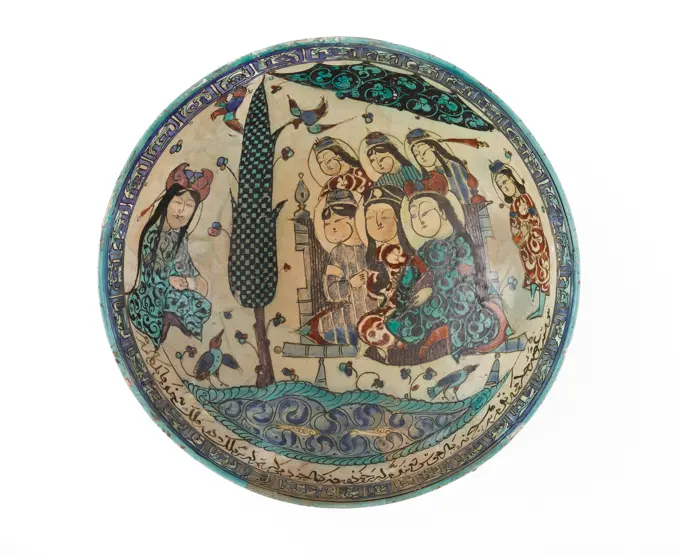
An array of exquisitely decorated porcelain dishes featuring intricate floral patterns and vibrant colors, representing fine craftsmanship.
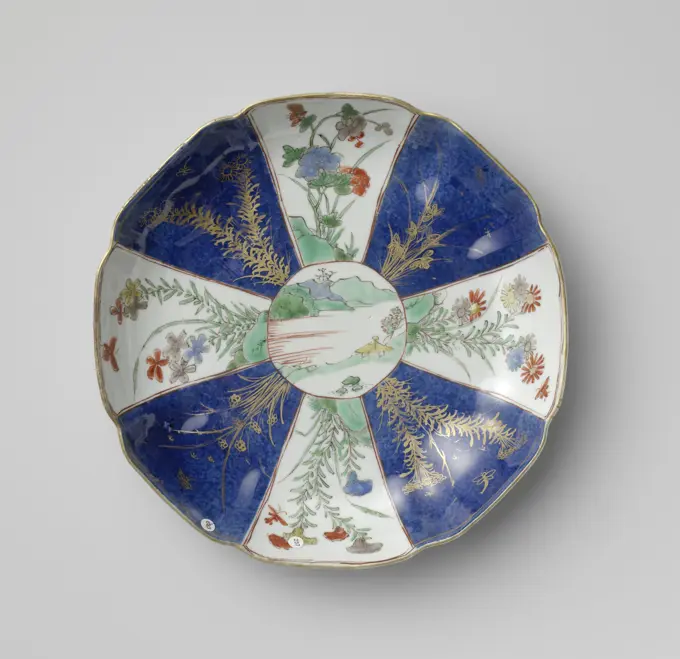
Saucer-dish in the shape of a flower with bleu poudré and panel decoration, anonymous, c. 1700 - c. 1724 Porcelain saucer with round, lobed wall and scalloped edge in the shape of a flower, painted in underly glaze blue and on the glaze blue, red, green, yellow, eggplant, black and gold with a professional decoration. On the flat a medallion with river landscape with pavilion, rocks and trees; The wall is modeled in eight petals alternately filled with a flower branch and butterfly in gold on a bleu poudré (powder blue) soil and a flower branch on a rock with butterfly on one white soil. Bleu Poudré with Famle Verte. China porcelain. glaze. cobalt (mineral). gold (metal) painting / gilding / vitrification Porcelain saucer with round, lobed wall and scalloped edge in the shape of a flower, painted in underly glaze blue and on the glaze blue, red, green, yellow, eggplant, black and gold with a professional decoration. On the flat a medallion with river landscape with pavilion, rocks and
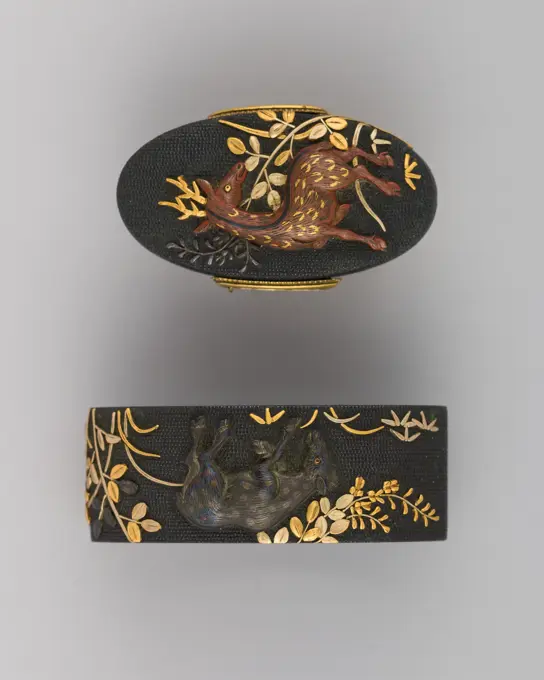
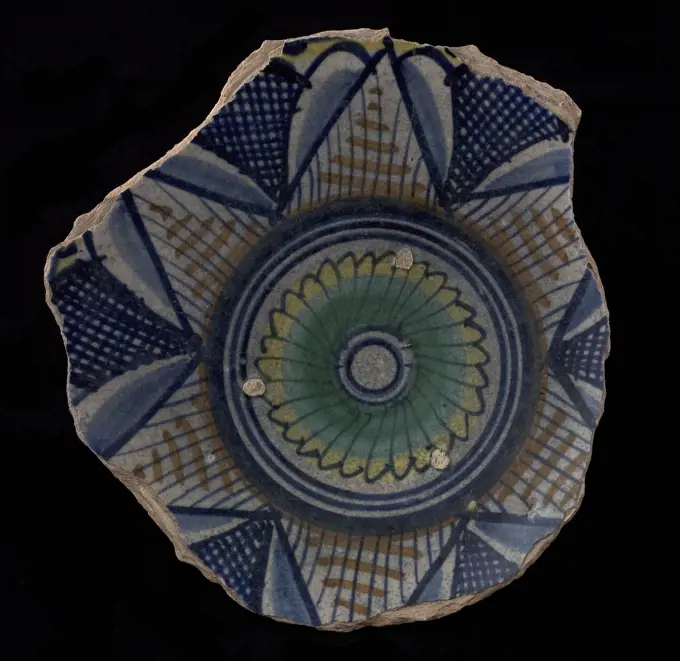
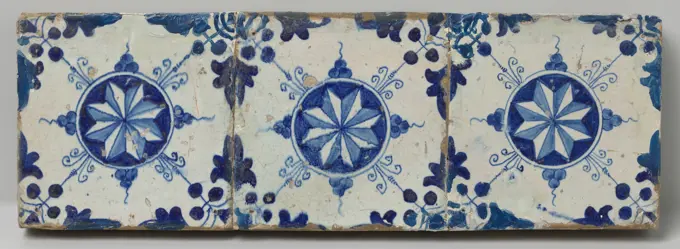
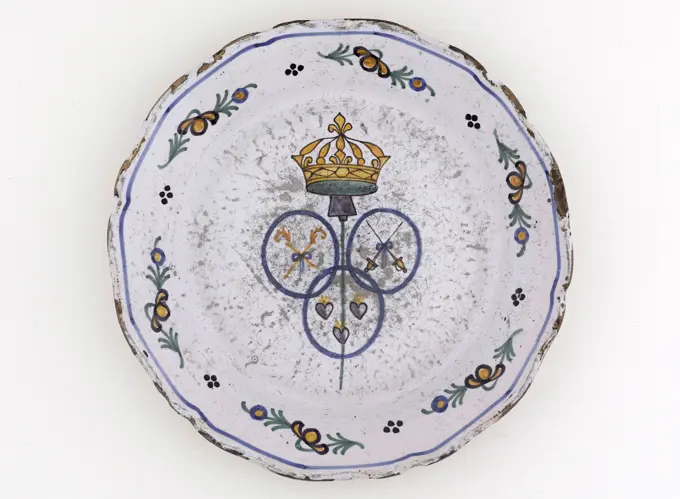
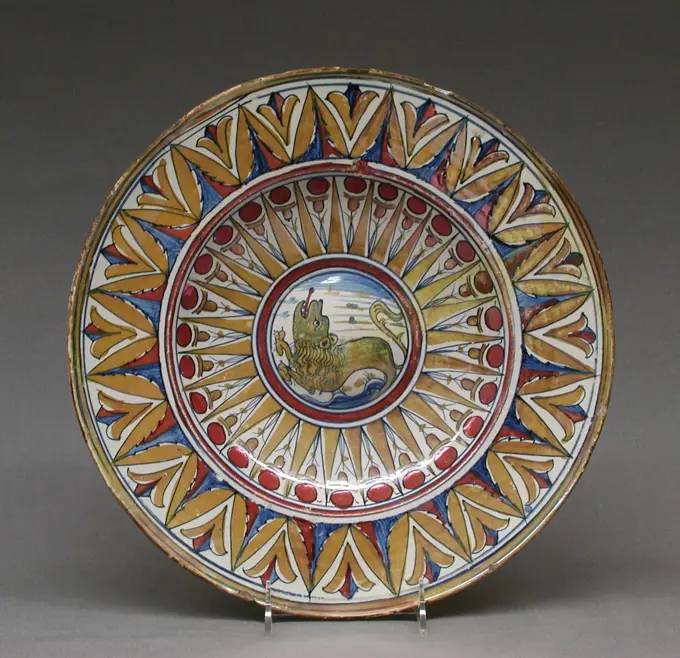
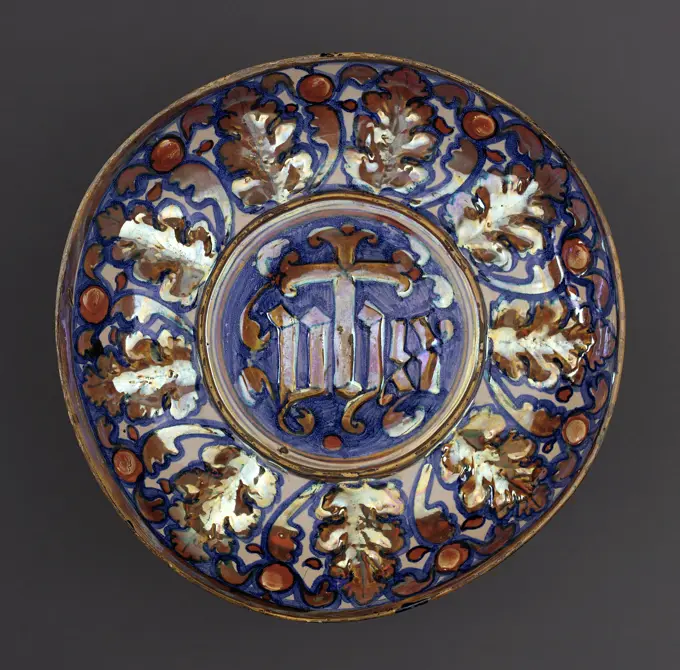
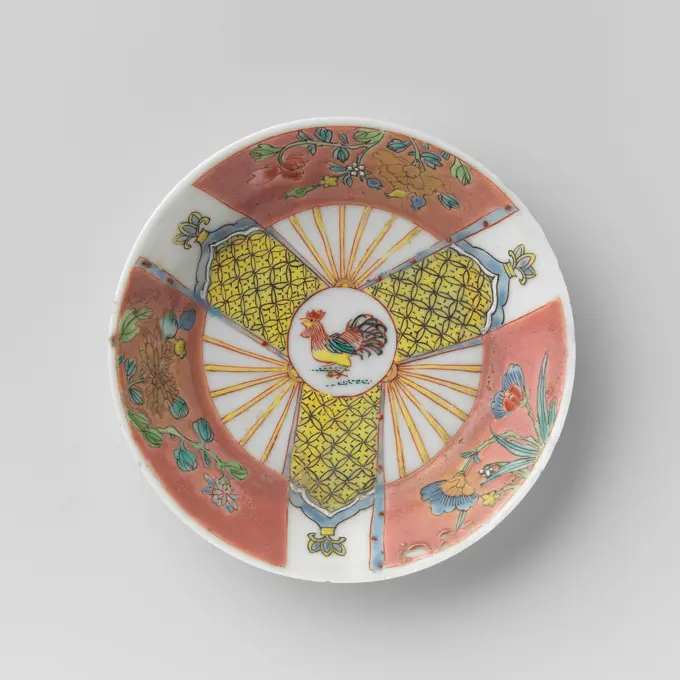
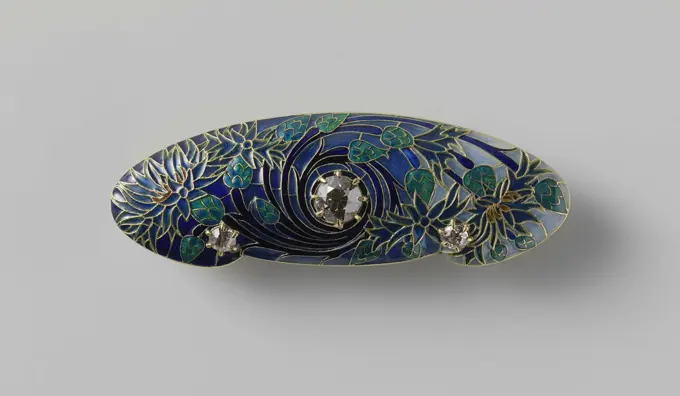
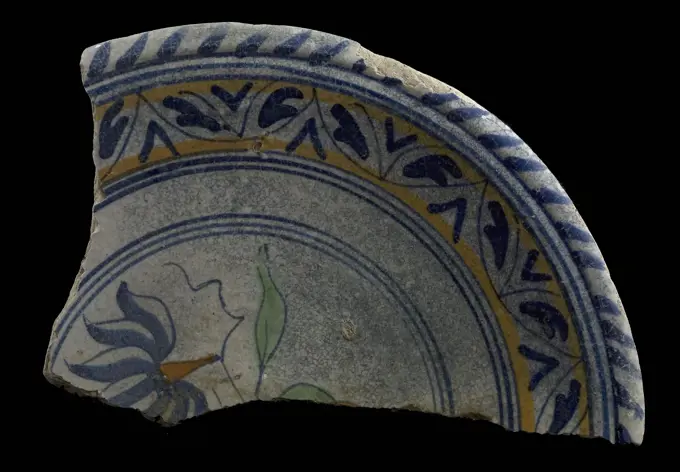
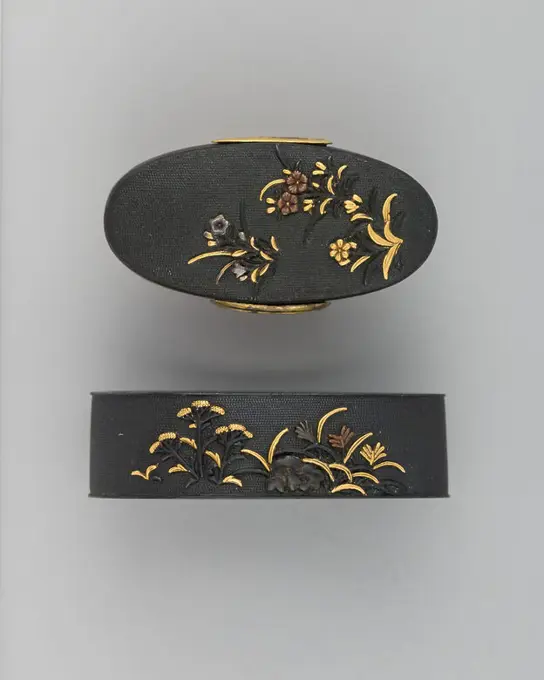
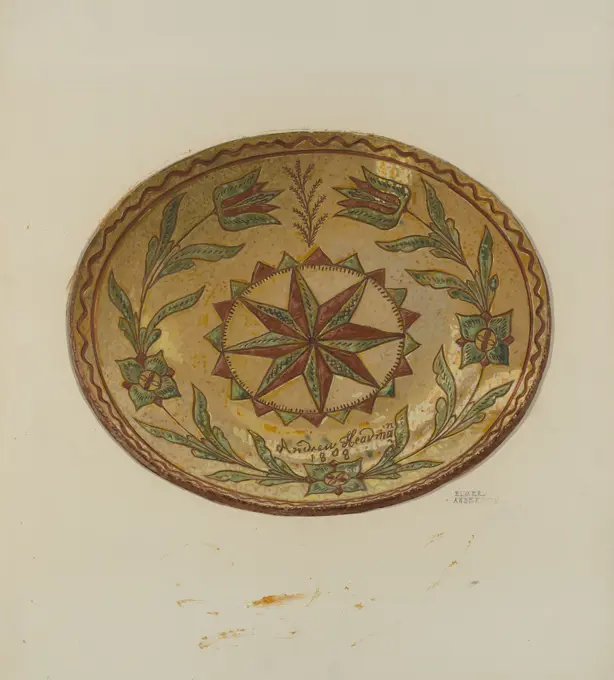
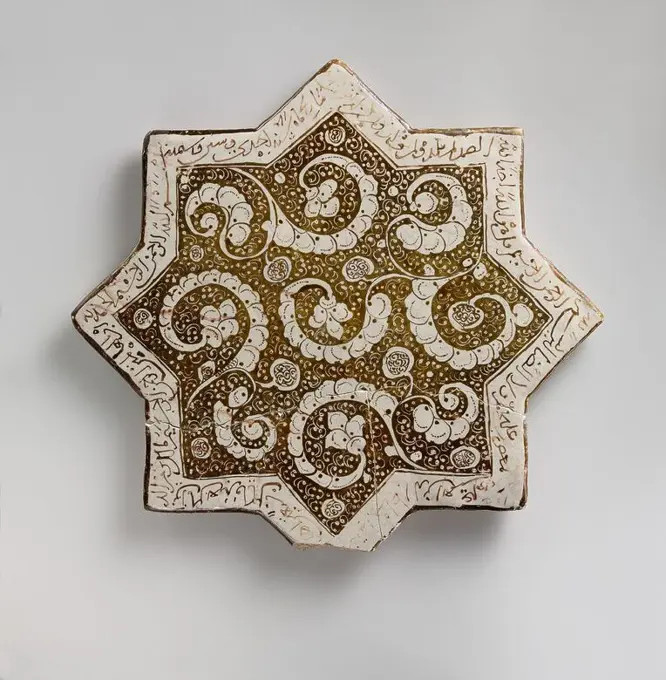
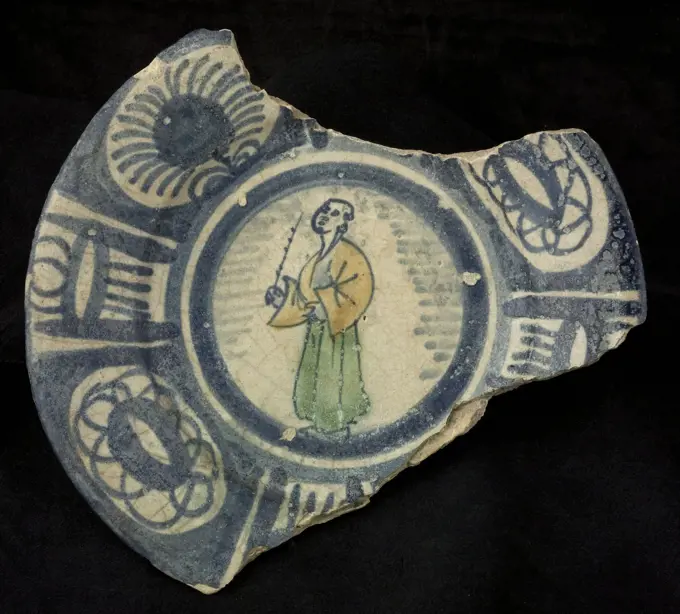
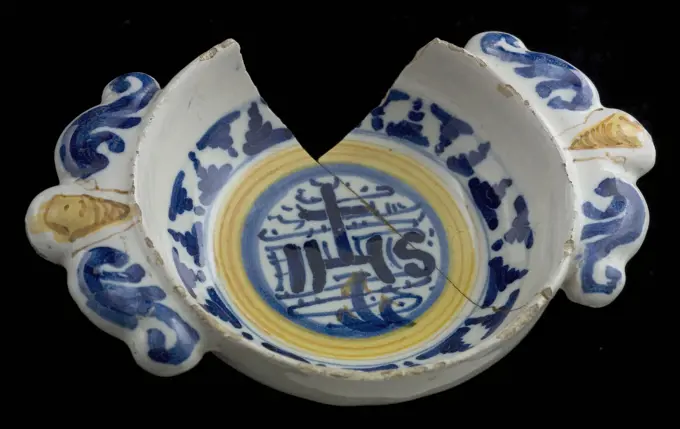
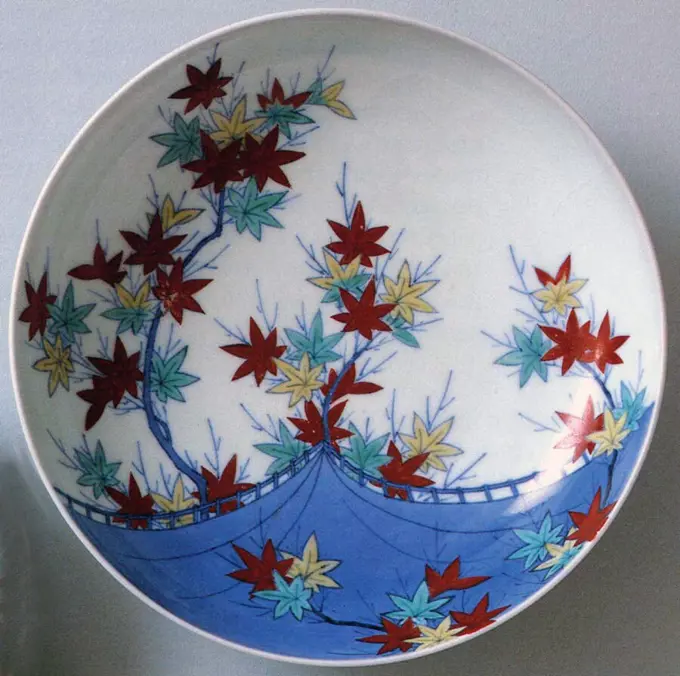
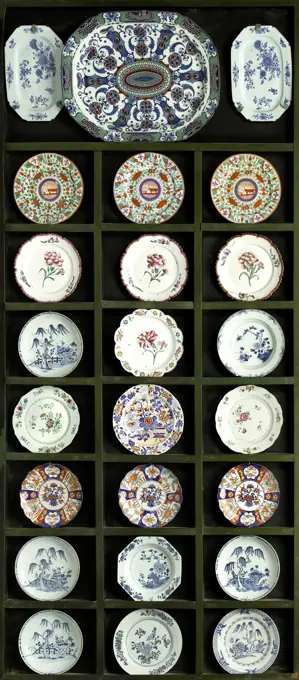
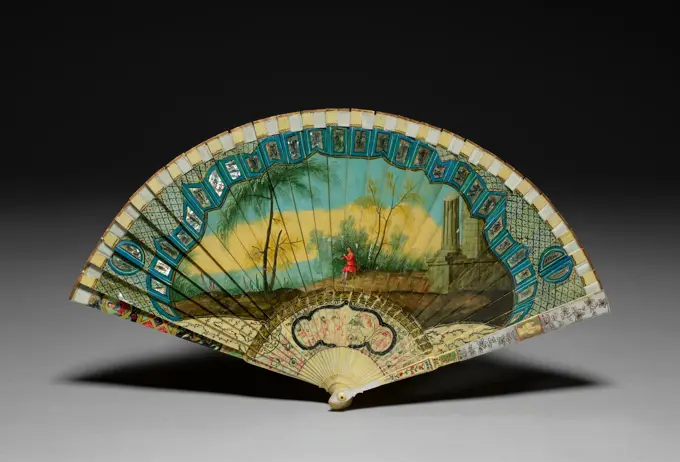
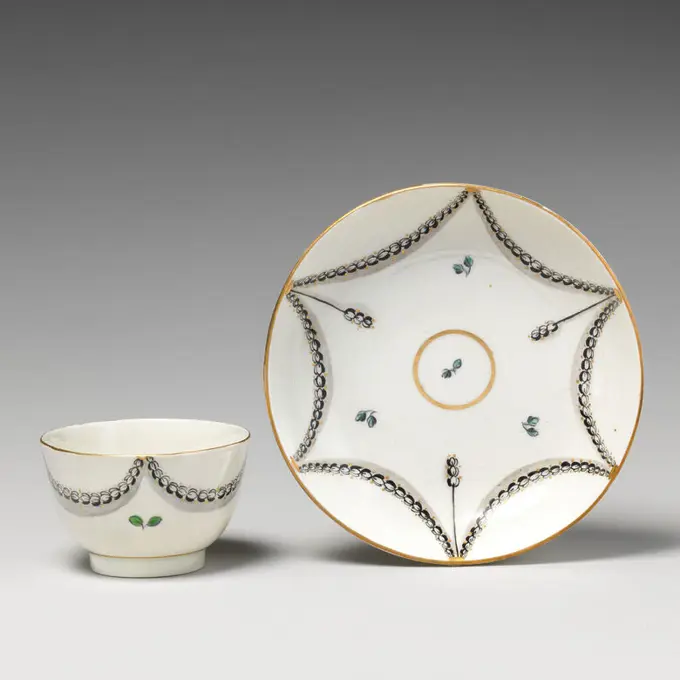
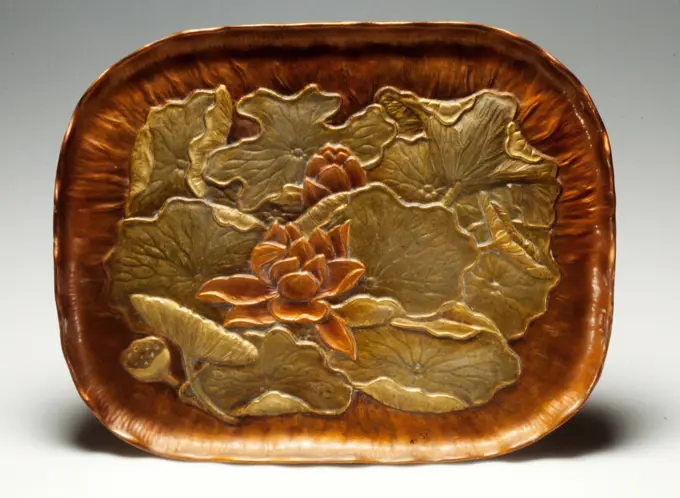
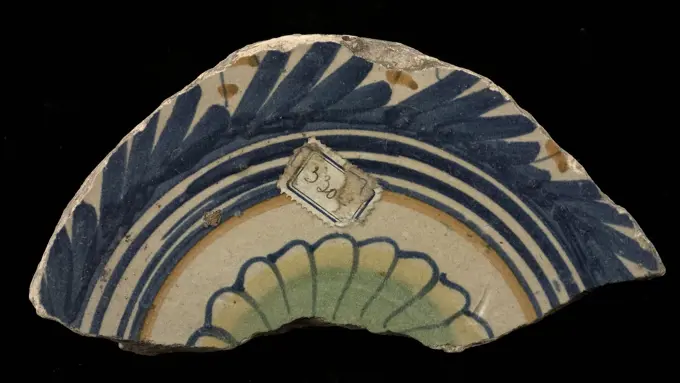
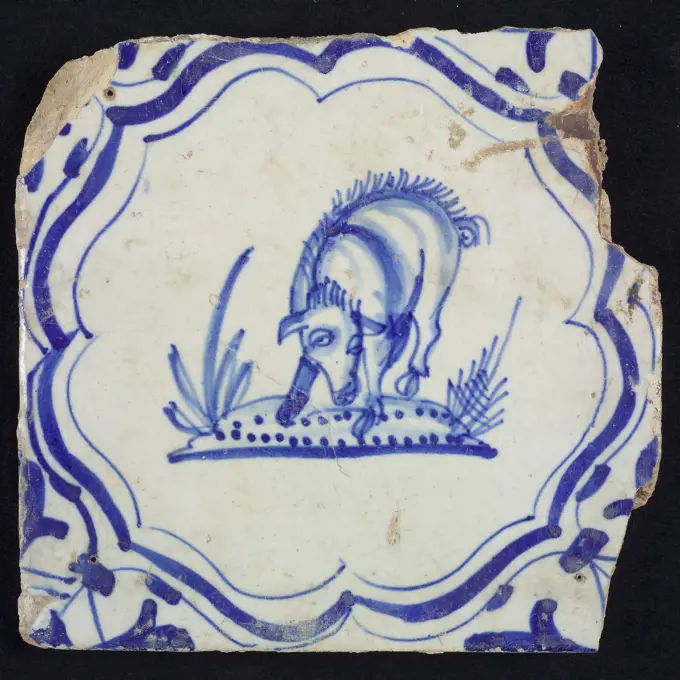
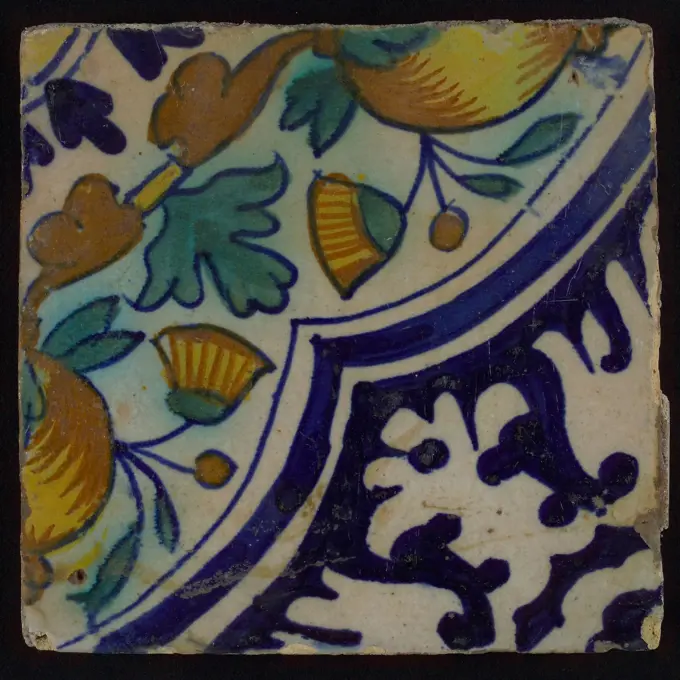
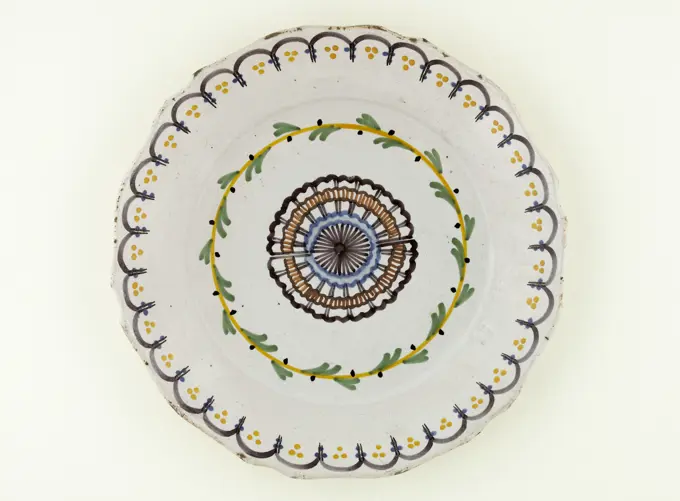
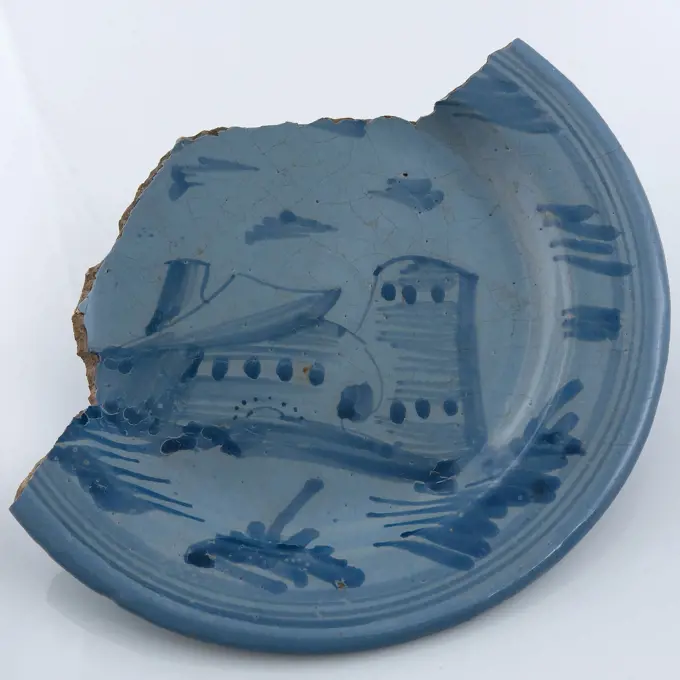
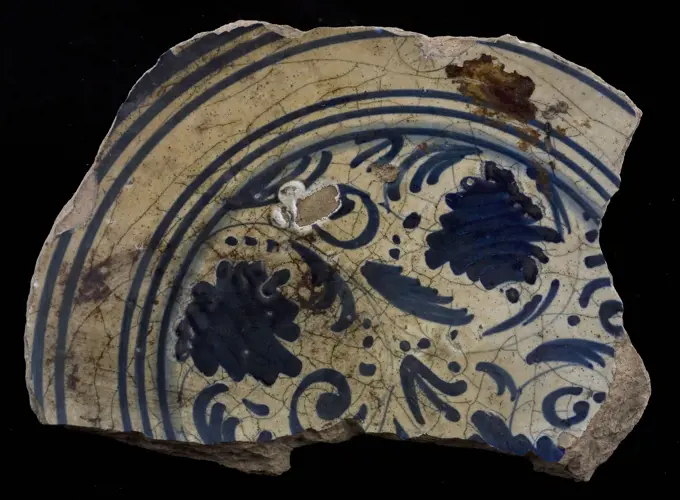
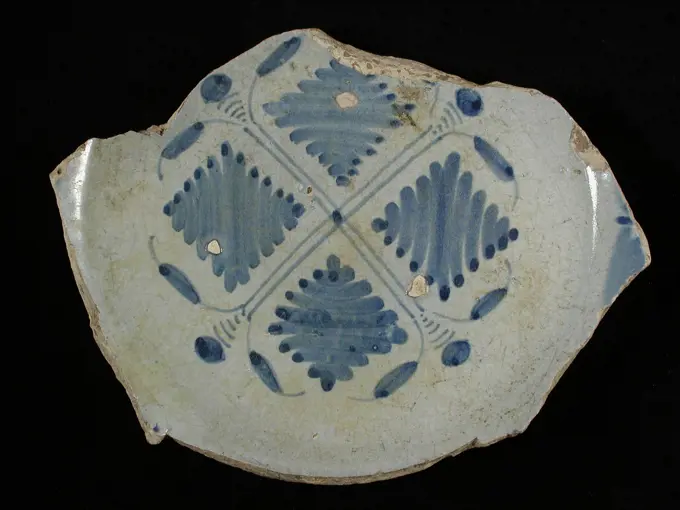
S, Fragment majolica dish, blue on white, highly simplified four-leaved motif, signed, plate crockery holder soil find ceramic earthenware glaze, baked underside covered with lead glaze. Polychrome. Signed. signature on bottom: S probably incomplete signature archeology decorate serving foodSword-Hilt Collar and Pommel (Fuchigashira) 18th century Japanese A fuchigashira is a pair of matching sword fittings comprising the fuchi (collar at the base of the grip of the sword hilt) and kashira (pommel cap at the end of a sword hilt).. Sword-Hilt Collar and Pommel (Fuchigashira). Japanese. 18th century. Copper-gold alloy (shakud), copper, gold, copper-silver alloy (shibuichi). Sword Furniture-Fuchi-KashiraSaucer with flowers, foliate scrolls and garlands, Manufacture de Sèvres, c. 1775 - c. 1779  Porcelain dish with a straight wall, painted on the glaze in blue, pink, green, purple and gold. On the flat a rosette in a medallion. The wall is decorated with three tires. In the middle medallions with a flower or rosette flanked by leaf vines against a green background. Above a leaf vank with blue dots, interrupted by a box with a flower or rosette. The lower band shows Golden garlands with a stylized flower pattern. Golden Rand. The outer edge with a band of half gold bulbs. Marked on the underside with the double L and DC. Sèvres porcelain. glaze. gold (metal) painting / gilding / vitrificationPlateFragment majolica dish, polychrome, rosette and star in the middle, plate crockery holder soil find ceramic earthenware glaze, baked underside covered with clear lead glaze. Italian Dutch decor. Poorly mixed pottery with many red veins archeology Italy decorate serving foodGlued fragment majolica dish, with orange apple in the mirror, dish plate crockery holder soil find ceramic earthenware glaze tin glaze lead glaze, hand-turned baked 2x majolica glazed Majolica plate. imprints in the performance. Pierced stand ring. Polychrome decor orange apple or pomegranate surrounded by green leaves and orange-brown spheres Along the flag 'Rotterdam decor'; zigzag line with padded triangles in which stacked thick stripes. Slightly flowed due to too high baking temperature. underside covered with greenish tinted lead glaze Shredded earthenware archeology Rotterdam City triangle Schielandshuis indigenous pottery food serving table serving decorate Soil discovery: Schielandshuis during restoration.Paperweight 1875-1900 United States. Glass . Boston and Sandwich Glass CompanyArab culture plate, Mojfia, Morocco, 1900-1950, clay, varnish and pigments, Anthropology National Museum, Madrid, SpainPumpAdour tile with rosette surrounded by pomegranates. PumpAdour tile with a multicolored (blue, orange, green and yellow) painted rosette surrounded by pomegranates and marigolds within a four-pass. In the corners, filling technology ornament.Veld van drie tegels met achtpuntige sterren.Field of three tiles (1 x 3) each with a blue-painted eight-pointed star within a circle with a three-tip in the corners.. Faïence brush backTile, Anonymous, 1600 - 1699 Majolica-Tegel, painted in ocher, yellow and blue. In the middle a hexagonal linear decor, in the corners of leaves. SevillaTiana earthenware. tin glaze majolica Majolica-Tegel, painted in ocher, yellow and blue. In the middle a hexagonal linear decor, in the corners of leaves. SevillaTiana earthenware. tin glaze majolicaAnonymous. Plate. Earthenware. Around 1789. Paris, Carnavalet museum. 70955-22 Weapon, Heart, Crown, Epee, Faience, Decorative Pattern, Revolutionary Periode, Crockery, PlateDish probably 19th century Italian. Dish. Italian. probably 19th century. Maiolica (tin-glazed earthenware), lustered. Ceramics-PotteryFooted Bowl with the Sacred Monogram (IHS)Saucer With Cock and Three Fans With Flower Sprays. Dish of porcelain with sloping wall, painted on the glaze in blue, red, pink, green, yellow, black and gold. A medallion with a rooster shown on the platter of the dish; to medallion three fans with flowering plants against a pink soil; Three elongated compartments with napkin work between the ranges. Family Rose.Spoon TRAY WITH FLOWER Sprays, Diaper Pattern and Flower Scrolls. Pattipan of porcelain, rectangular and hexagonal, with lobed wall, painted on the glaze in blue, red, black and gold. On the flat flower branches (peony, aster, orchid et al.) In a medallion, on either side of the medallion a cartouche with a flower branch, to medallion a swastika pattern; The inner edge with napkin interspersed with flower drinks in a cartouche. Bottom unglazed. European forms with encre de chine.Bowl 12th-13th century. Bowl. 12th-13th century. Stonepaste; underglaze and luster-painted. Attributed to Iran, Rayy. CeramicsStrip of bobbin with pink and gold -colored flowers and leaves, anonymous, c. 1740 - c. 1760 Strip of natural-colored bobbin, binche side, where the pattern is painted light pink, with dark pink contour lines and gold-colored dots. The pattern consists of two curved branches along the top edge. A fan -shaped flower hangs down on one branch, up to the lower edge. Two palm leaves or palm flowers hang down on the other. The motifs are largely connected by a decorative soil, a snowflake land and partly with a wastage ground, a five -part ground. The fullwork is largely made in linen battle with openwork edges. One (flour) leaf is made in netslag and a mains filling is used around the branch with the fan -shaped flour. The scums along the bottom follow the shape of the pattern and are finished with picots. The top is straight. Southern Netherlands linen (material) Bobbi Lace / Binche Lace Strip of natural-colored bobbin, binche side, where the pattern is painted light pink, with dark pink cLarge Plate, late 1600s. Nevers Factory (French). Faience; diameter: 44.2 cm (17 3/8 in.).Large shallow dish Made 1700-1813 Bukhara. Reddish stoneware decorated in manganese, green, and cobalt blue enamel on white opaque glaze .Hexagonal tiles painted with underglaze, from Syria. Dated 15th CenturyFecundity dish, c. 1650-1660, 2 5/8 x 20 x 16 1/4 in. (6.7 x 50.8 x 41.3 cm), Tin glazed earthenware, England, 17th centuryFaience Inlay ca. 1184-1153 B.C. New Kingdom, Ramesside This decorative tile may be associated with the ceramic art of the reign of Ramesses III. It was probably used to form a horizontal pattern of alternating lily buds, leaves, and open blossoms.. Faience Inlay. ca. 1184-1153 B.C.. Faience. New Kingdom, Ramesside. From Egypt. Dynasty 20Dish, with three men on the flat for a moored ship. Dish of Pottery with Black Transfer Decor. On the flat three men for a moored ship. The edge with six bouquets, above which a tire with shells.Saucer with a man, woman and two panels with characters, anonymous, c. 1825 - c. 1874 Porcelain dish with straight wall, painted on the glaze in blue, red, pink, green, yellow, black and gold. On the flat of the dish a man and woman and two cartouches with Chinese characters; a fan -shaped cartouche with a band of 'crackled ice' and a book -shaped cartouche; The head also with a man and woman (in other clothing) and two cartouches with characters; The fan -shaped with 'crackled ice' and a cartouche formed by a bamboo branch. Famle Rose. China porcelain. glaze. gold (metal) painting / gilding / vitrification Porcelain dish with straight wall, painted on the glaze in blue, red, pink, green, yellow, black and gold. On the flat of the dish a man and woman and two cartouches with Chinese characters; a fan -shaped cartouche with a band of 'crackled ice' and a book -shaped cartouche; The head also with a man and woman (in other clothing) and two cartouches with characters; The fan -shaped witBowl. Iran, Nishapur, 10th century. Ceramics. Earthenware, underglaze slip-paintedCharger. Bristol, England. Date: 1700-1750. Dimensions: 34.3 × 7 cm (13 1/2 × 2 3/4 in.). Tin-glazed earthenware. Origin: Bristol. Museum: The Chicago Art Institute, Chicago, USA.Plato azul, siglo XVII. Colección privada.Brooch of gold, diamonds and window email. Cornflowers around central diamond.Flat. Porcelain with polychrome enamels, Qing dynasty (1644-1912). Provenance: China. Paris, Cernuschi museum. 78842-5 Asian art, Chinese art, living art, table arts, ceramic, fine ceramic, ching dynasty, Qing dynasty, tsing dynasty, porcelain, dishFragments majolica dish, polychrome, flower on the ground and cable edge, plate crockery holder soil find ceramic earthenware glaze, baked underside covered with lead glaze. Polychrome In the edge band with curved lines and brush strokes in Italian style archeology Italy adorn serving foodStaffordshire Plate (Birds and Butterflies), 19th century, 7/8 x 9 in. (2.2 x 22.86 cm), Glazed and painted porcelain, England, 19th centuryDish with Duck AmidCloudsOrnament tile, diagonal ornament in quatrefoil with bows in which orange-apples and flowers, palm corner, corner pattern rosette, wall tile tile sculpture ceramic earthenware glaze, baked 2x glazed painted Yellow and reddish shard square two and four nail holes. Multicolored: brown blue green yellow on white ground (variation in light and dark). Saving technique in blue on white.Peony-Shaped Dish with Butterflies ca. 1840-60 Japan. Peony-Shaped Dish with Butterflies 52505Sword-Hilt Collar and Pommel (Fuchigashira). Culture: Japanese. Dimensions: Fuchi (a); H. 1 1/2 in. (3.8 cm); Wt. 0.7 oz. (19.8 g); kashira (b); H. 1 3/8 in. (3.5 cm); Wt. 0.4 oz. (11.3 g). Date: mid-19th century. Museum: Metropolitan Museum of Art, New York, USA.Elmer G Anderson, Pennsylvania German Pie Plate, 1935 1942 Pennsylvania German Pie PlateStar-Shaped Tile. Dimensions: Max. H. (point to point) 12 9/16 in. (31.9 cm)W. 11/16 in. (1.7 cm). Date: dated A.H. 661/A.D. 1262-63. Museum: Metropolitan Museum of Art, New York, USA.Dish (Tabaq) with Scale Pattern and Serrated Leaves. Turkey; Iznik. Date: 1550-1599. Dimensions: 6 × 30.7 cm (2 3/8 × 12 1/16 in.). Fritware with underglaze painting in blue, turquoise, red, and black. Origin: Turkey. Museum: The Chicago Art Institute, Chicago, USA. Author: Islamic.Dish (part of a service) ca. 1737 Chinese, for Scottish market The arms on this dish are those of James, fifth duke of Hamilton (1702/3-1743), and it is possible that this dish is part of a large service created for him at the time of his marriage to his third wife in 1737.. Dish (part of a service). Chinese, for Scottish market. ca. 1737. Hard-paste porcelain. Ceramics-Porcelain-ExportSoul of majolica dish with blue flowers in Chinese style, wall dish dish crockery holder soil find ceramic earthenware glaze lead glaze tinglage, ring 12.2 majolica glazed baked 2x painted Mirror fragment. en new work with very small prints. Hanging hole in stand. Yellow shard of scraped earthenware Back of cream-colored lead-glaze Monochrome blue decor Large container with Chinese-style flowers To the left of the middle, large indistinct arc is probably sign of the painter's drawing. Part of the dark blue glaze is sintered due to high baking temperature archeology Rotterdam City Triangle decorate domestic Schielandshuis serve serve food China Soil discovery: Schielandshuis during restoration.Three plates with the coats of arms of European noblemen, De Grieksche A, c. 1702 - c. 1722 Fowence board. Multicolored painted with the weapon of Frederik I, Elector of Brandenburg and King of Prussia. Delft . Fowence board. Multicolored painted with the weapon of Frederik I, Elector of Brandenburg and King of Prussia. Delft .Fontainebleau (Atelier de, dit d'Avon). Flat. Persée and Andromède. "Verni" land, transparent lead glaze, polychrome enamels, molded decor in slight relief. 1st half of the 17th century. Museum of Fine Arts of the City of Paris, Petit Palais. Faience, table service, dishes, XVIIth 17th XVII 17th 17th 17th century, dishPolychrome majolica plate with Chinese and rim in Wanli style, plate crockery holder soil find ceramic earthenware glaze tin glaze lead glaze, majolica baked 2x glazed painted Blue green and orange brown on white fond Chinese with wanli edge archeology decorate home interior serve serve foodFaience dish, polychrome with IHS in the mirror, worked ears, pap bowl bowl crockery holder soil find ceramics pottery glaze, hand turned in shape made baked baked glazed painted baked Papkom. Polychrome Two lying ears solid some curly shape Standring Pretty low model Text in the mirror. Yellowish shard in the mirror: IHS archeology Rotterdam devotion religion bible Jesus Christ porridge porridge eating food Soil discovery Rotterdam 1940.Plate, white, painted in blue. Two plates of milk glass with blue email paint painting; Double layer, cave inside.Shards of a sign from V.O.C. ship De 'Witte Leeuw', Anonymous, Before 1613 plate (dishes) Shards of a sign from V.O.C. ship De 'Witte Leeuw', 55 present. Jingdezhen bone china (material)   Sint-HelenaPlato de Manises, siglo XV. Colección privada.Plate of multicolor hard-baked pottery; Staffordshire .. Plate of multicolored hard-baked pottery. The edge is embossed with grille, interspersed with two adjacent symmetrical floral motifs. The scalloped edge is decorated with volutes and leaf motifs on the inside. The plate is covered with a spotted lead glaze in manganese, green, gray and yellow. The back is dotted in manganese and has a foot edge. The sign belongs to five signs (BK-1987-39-A to BK-1987-39-F).Ornament tile, diagonally across the tile white braid band motif, corner motif quarter rosette, wall tile tile sculpture ceramic earthenware glaze, baked 2x glazed painted Light yellow shard with fine red dots and square strings. Multicolored: blue (ocher to lemon) yellow and orange on white. Savings technique MoorsPaperweight 1840-1865 France. Technological improvements to optical scientific instruments in the mid-nineteenth century spurred a veritable obsession across Europe with identifying and classifying the natural world. Amateur botanists were eager to collect and preserve floral specimens, which they intently researched and catalogued. In response to this broad appeal, French glassmakers made paperweights that portrayed the very botanical subjects that were so enthusiastically sought. Many weights represented specimens with horticultural correctness, but others were entirely fanciful creations. Paperweights like this example speak to the periodís fascination with taxonomic systems.From the late 1840s to early 1860s, French manufacturers of fine glass and crystalósuch as Baccarat (Alsace), Clichy (Paris), and Saint-Louis (Lorraine)ócatered to the vast public enthusiasm for beautiful yet functional desk accessories. Paperweights, which were designed to secure loose papers against drafts, weTile, orange, brown, green, and blue on white, flowerpot in square, corner pattern palm, wall tile tile sculpture ceramic earthenware glaze, baked 2x glazed paintedFlat soul of majolica dish with monochrome decor, two Chinese in landscape, dish plate crockery holder earth discovery ceramic earthenware glaze tin glaze lead glaze, majolica baked 2x glazed painted Shard only mirror blue on white fond. Two seated Chinese women in landscape archeology decorate home interior serving serve foodPair of cups and saucers. The drinking of tea was increasingly adopted in the West by the end of the 17th century. China had been closed for decades as the result of a civil war. When it ended, VOC merchants could once again buy porcelain from China, and the supply of tea and of teacups grew enormously.The hexagonal form of these cups is exceptional, just as is the crane in flight, set against a richly variegated blue background.Field of four tiles. Field of 4 tiles (2 x 2) each with a multi-colored (blue, yellow, red-orange and green) painted open pomegranate, placed diagonally. In the corners, a French lily.Tiles. Turkey, Iznik, Ottoman, last quarter of 16th century. Ceramics. Fritware, underglaze painted in red, blue, green and blackBox;  1929 (1901-00-00-2000-00-00);Dish with Design of Maple Leaves 1700-1730s Japan. Dish with Design of Maple Leaves. Japan. 1700-1730s. Porcelain with underglaze blue and overglaze enamels (Hizen ware, Nabeshima type). Edo period (1615-1868). CeramicsPaperweight 1840-1860 Saint-Louis. This paperweight uses a traditional glass-making technique called millefiori to great effect. Italian for ìone thousand flowers,î millefiori was first developed in fifteenth-century Venice. In the nineteenth century, French glassmakers revived the technique with a cultural twist. Arranged to evoke traditional French gardens such as the Tuileries in Paris, paperweights like this example brought a little of this landscaping magic indoors.From the late 1840s to early 1860s, French manufacturers of fine glass and crystalósuch as Baccarat (Alsace), Clichy (Paris), and Saint-Louis (Lorraine)ócatered to the vast public enthusiasm for beautiful yet functional desk accessories. Paperweights, which were designed to secure loose papers against drafts, were among their most popular products.. Glass . Compagnie de Saint LouisVictor Hugo (1802-1885). Chinese decor from Juliette Drouet's house in Guernsey, West Wall. Green wooden locker containing plates and dishes, composed of twenty-seven compartments (left side near South Wall). Painted wood. 1857-1864. Paris, house of Victor Hugo. 78171-19 Asian art, decorative arts, painted wood, Chinese cabinet, chinoiserie, compartment, decor, earthenware, storage, Chinese living room, dishes, 19th 19th 19th 19th 19th 19th century, plate, dishOrnament tile, diagonal ornament in quatrefoil with bows in which orange-apples and flowers, palm corner, corner pattern rosette, wall tile tile sculpture ceramics pottery glaze, baked 2x glazed painted Yellow and reddish shard square two and four nail holes. Multicolored: brown blue green yellow on white ground (variation in light and dark). Saving technique in blue on white.Speelbeurs van Wijnrood velvet, embroidered with silver wire and blue side, with the weapon of the Dauphin of France or the province of Viennois later known as the Dauphiné, Anonymous, c. 1680 - c. 1720 Speelbeurs van Wijnrood velvet, embroidered with silver wire and blue side, with the coat of arms of the Dauphin of France or the province of Viennois later known as the Dauphiné. Model: flat round bottom around which a wavy raised edge with holes, which originally drawn a cord. Trekoord is missing. Lined with goat leather. Decoration: The 20 bulges or 'ribs' are decorated with alternating stacked ornaments in relief of silver wire with a shiny silver lover. A horizontal line of silver thread runs on three -quarters. Along the top the whole is trimmed with an edge of silver thread, including the fringes of the velvet here and there. The bottom is circled with a double edge within which a zigzag line of silver thread. Herein the coat of arms of the Dauphin or the province of Viennois, laSoup plate ca. 1750-70 Style of Whieldon type. Soup plate. British, Staffordshire. ca. 1750-70. Lead-glazed earthenware. Ceramics-PotteryBowl 11th-12th century View more. Bowl. 11th-12th century. Earthenware; slip painted. Attributed to Iran. CeramicsTray 19th century Japan. Tray 59686Dish 17th century. Dish 446917Fan, 1800s. France (), 19th century (). Bone, mother-of-pearl, ivory washer, silk ribbon, oil paint; radius: 20 cm (7 7/8 in.); spread: 38.5 cm (15 3/16 in.).Candyer with lid; Wedgwood, Josiah (1730-1795); around 1788 (1783-00-00-1793-00-00);Teabowl (part of a service). Culture: British, Caughley. Dimensions: Diameter (each): 2 1/8 in. (5.4 cm). Factory: Caughley Factory (British, ca. 1772-1799). Date: ca. 1780-90. Museum: Metropolitan Museum of Art, New York, USA.oriental ottoman design twenty-fiveLinthorpe Pottery Tray, c. 1879-1882, Christopher Dresser, Scottish, 1834-1904, 1 1/4 x 13 1/8 x 10 1/4 in. (3.18 x 33.34 x 26.04 cm), Earthenware with glaze, England, 19th centuryTile, orange, brown, green, and blue on white, flowerpot in square, corner pattern palm, wall tile tile sculpture ceramic earthenware glaze, baked 2x glazed paintedDish early 15th century Italian Development of this type of European ceramic was to some degree spurred by the introduction of glazed wares from the Islamic world, which, in turn, echoed the colored glazes of China. Until the introduction of Chinese porcelain in the early sixteenth century and the subsequent development of porcelain in the early eighteenth, earthenwares with tin glazes were the most widely produced ceramics in Europe.. Dish 468163. Star-shaped tile with a stylized flowering plant (lotus) and floral motifs in gold on a cobalt blue surface. Ladjvardina.Fragment majolica dish, polychrome, concentric circles with rosette in it, plate crockery holder soil find ceramic earthenware glaze, baked underside covered with milky lead glaze. Polychrome archeology Rotterdam decorating food archaeological find in the soil Rotterdam 1940.Leaf, belonging to a six-part tête-à-tête, painted with dust pattern in gold, white and blue. Leaf, belonging to a six-part tête-à-tête, painted with a dust pattern consisting of alternating a white band, in which a golden leaf garrier is winding around a blue trim and a wider gold band with lace pattern with flower and leaf garlands. Marked with the crowned monogram CT including 7 in underglazing blue.Soba cup 19th century Japan. Soba cup 45490Plate of pottery with parsemé decor. Pottery plate, decorated with a parsemé decor in underglazing blue transfer pressure.Animal tile, standing boar from the front on piece of land, inside frame of braces, in blue on white, corner motif, wall tile tile footage ceramic earthenware glaze, baked 2x glazed painted Rotterdam Hillegersberg-Schiebroek Hillegersberg Zuid Clay road Bellevue Originating from Huize Bellevue, which stood on the Kleiweg.Ornament tile, diagonal ornament in quatrefoil with bows in which orange-apples and flowers, palm corner, corner pattern rosette, wall tile tile sculpture ceramic earthenware glaze, baked 2x glazed painted Yellow and reddish shard square two and four nail holes. Multicolored: brown blue green yellow on white ground (variation in light and dark). Saving technique in blue on white.Plate China. Plate 52961Anonymous. Tricolor cockade plate. Earthenware. Paris, Carnavalet museum. 71684-54 Clay, ceramic, cockade, decoration, earthenware, painting, revolutionary period, French revolution, plateFragment berettino dish, blue on light blue background, landscape with house and tower, plate dish crockery holder soil find ceramic earthenware glaze, total, hand-turned glazed decorated baked Low dish with flat dish rim on narrow stand ring. Dark blue decor on light blue background Decoration consists of stylized landscape with house and tower circles and brush strokes over the flag arch decor at the bottom Yellow shard fully glazed In tube baked archeology indigenous pottery import decorate serving serving tableBasket and Stand 1825-1875 Staffordshire. Earthenware with blue transfer-printed decoration .Fragment majolica dish, blue on white, Italian-looking tendrils, plate crockery holder earth discovery ceramics pottery glaze, majolica Cooked on princes The decor is derived from Italian faience archeology Italy Rotterdam City triangle Leuvehaven decorate food Soil discovery Leuvehaven 1956.Woman's Shoe 19th-20th century China. Woman's Shoe 69984Plate of multicolor hard-baked pottery; Staffordshire .. Plate of multicolored hard-baked pottery. The edge is embossed with grille, interspersed with two adjacent symmetrical floral motifs. The scalloped edge is decorated with volutes and leaf motifs on the inside. The plate is covered with a spotted lead glaze in manganese, green, gray and yellow. The back is dotted in manganese and has a foot edge. The sign belongs to five signs (BK-1987-39-A to BK-1987-39-F).FUENTE VIDRIADA Y DECORADA EN AZUL CON FLOR Y PAJARO-ARTE POPULAR S XX. Location: ALFARERIA. FAJALAUZA. GRANADA. SPAIN.Plate; Koenigliche Porzellan Manufaktur (KPM; Berlin; 1763-1918); 1870-82 (1823-00-00-1832-00-00);David Ellinger, Pa German Plate, c 1937 Pa. German PlateOrnament tile, diagonal ornament in quatrefoil with bows in which orange-apples and flowers, palm corner, corner pattern rosette, wall tile tile sculpture ceramic earthenware glaze, baked 2x glazed painted Yellow and reddish shard square two and four nail holes. Multicolored: brown blue green yellow on white ground (variation in light and dark). Saving technique in blue on white.Bowl. Iran, Kashan, 1187/Muharram, 583 A.H.. Ceramics. Fritware, inglaze- and overglaze-painted (mina'i)One of a Pair of Wine Cups (Sakazuki) with Mices Wedding 19th century Japan. One of a Pair of Wine Cups (Sakazuki) with Mices Wedding 57748Flask China. Flask 49363Sign from V.O.C.-ship De 'Witte Leeuw', Anonymous, Before 1613 plate (dishes) Plate, one of which consisting of two glued fragments, from V.O.C. ship De 'Witte Leeuw', 35 present. Jingdezhen bone china (material)   Sint-HelenaFish Plate 350 BCE-330 BCE Campania. Decorated tableware enlivened festive meals. This red-figured plate was used, as its decoration suggests, for serving seafood, a staple of the Mediterranean diet. Tasty juices pooled in the central concavity, which may also have contained sauces.. terracotta, decorated in the red-figure technique . Ancient GreekTile 16th century Spanish. Tile 467581Plate, 618-906, Di.11-1/2 in., Sancai ware Stoneware with three-color glaze, China, 7th-10th centuryFUENTE VIDRIADA CON DECORACION VEGETAL-CERAMICA POPULAR. Location: ALFARERIA. GRANADA. SPAIN.