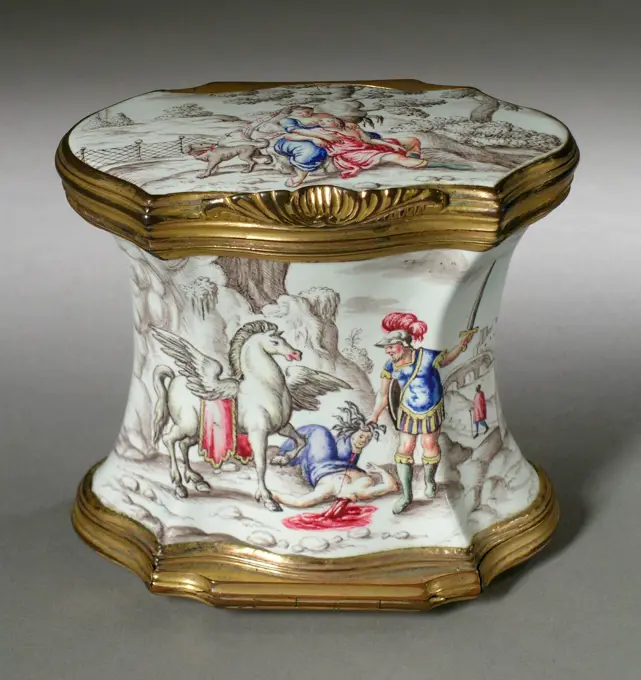
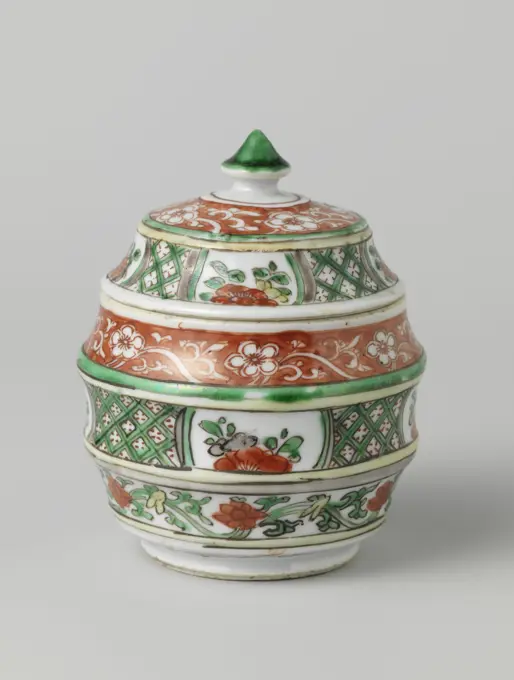
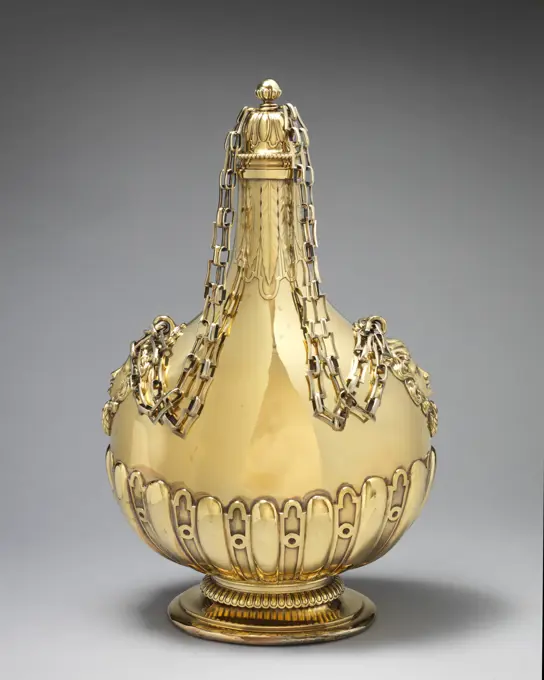
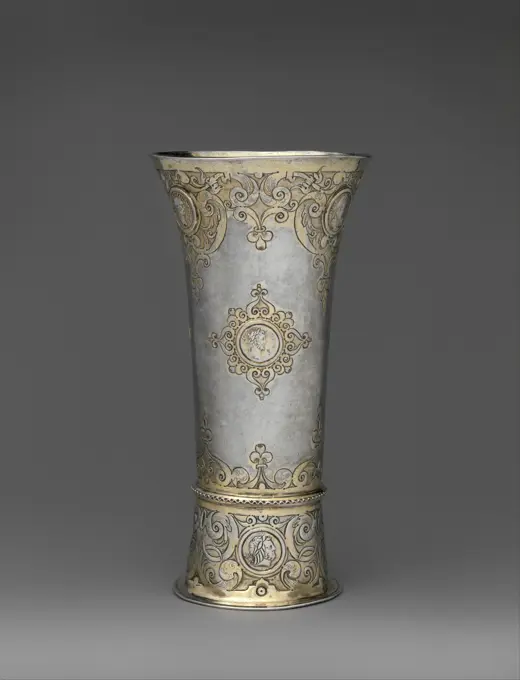
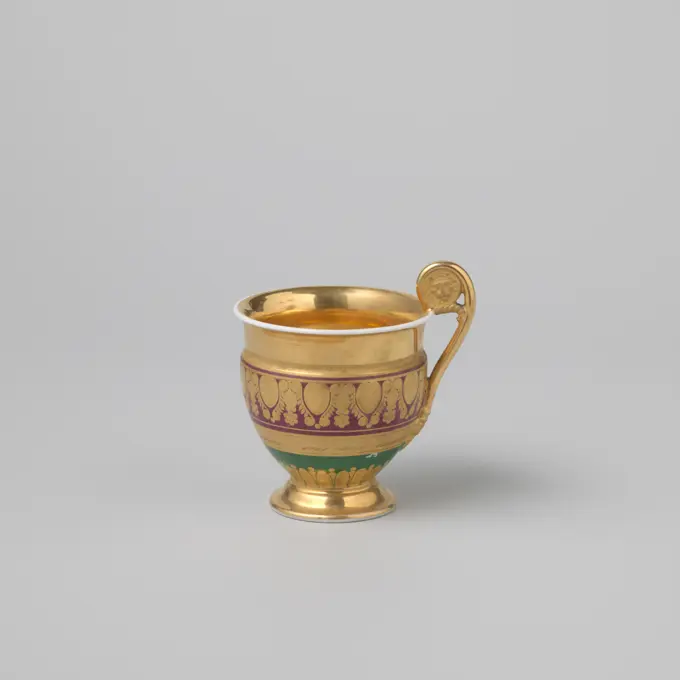
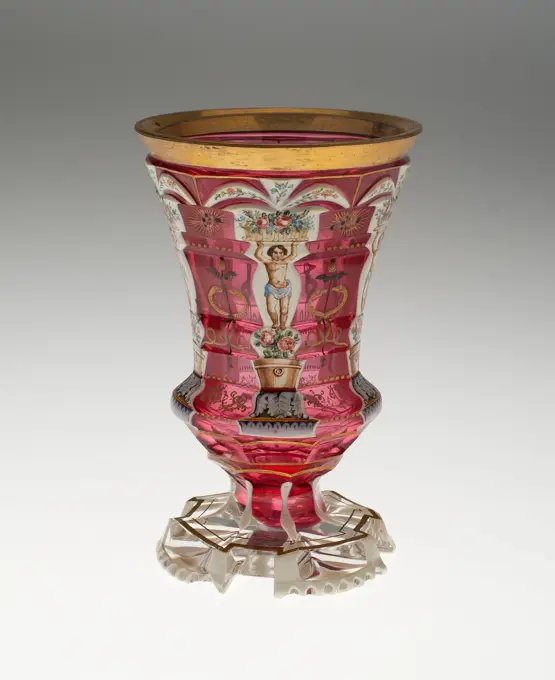
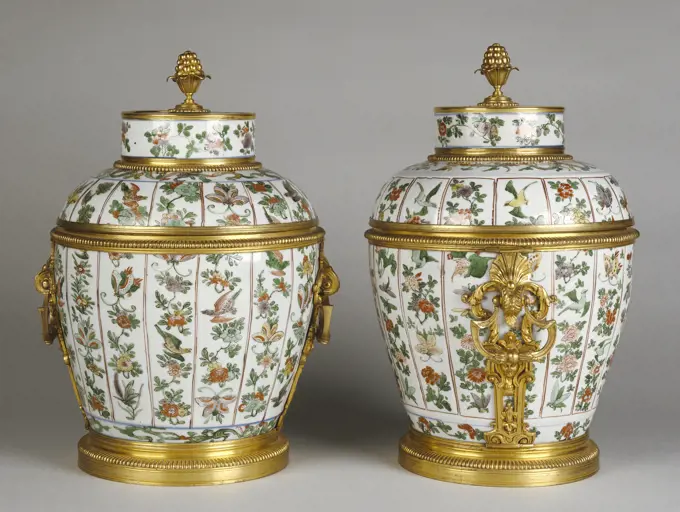
Decorative Porcelain

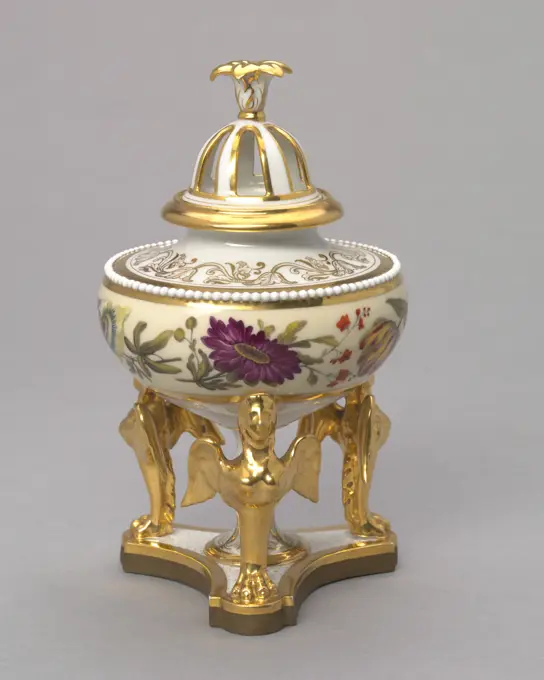
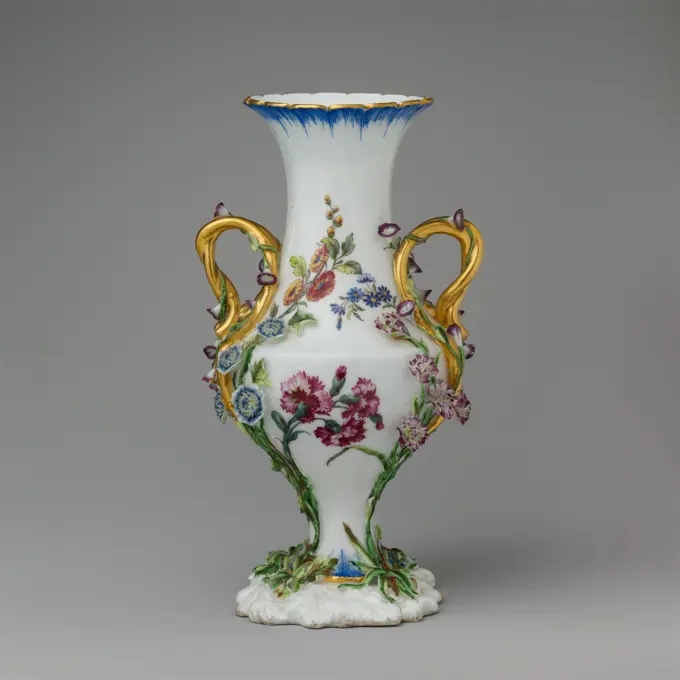
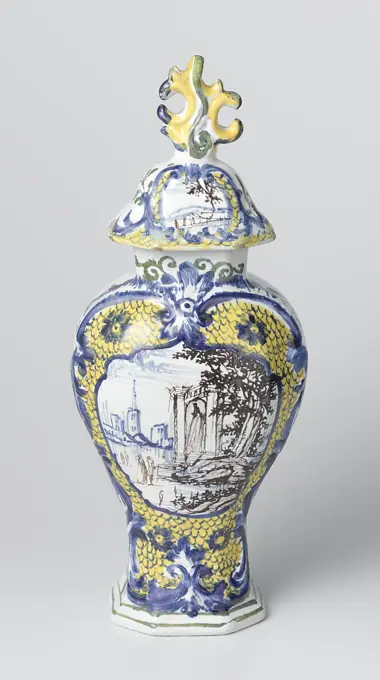
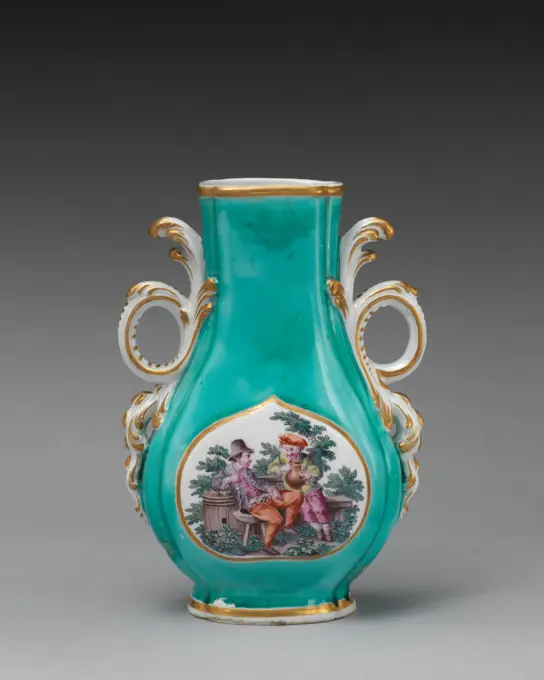
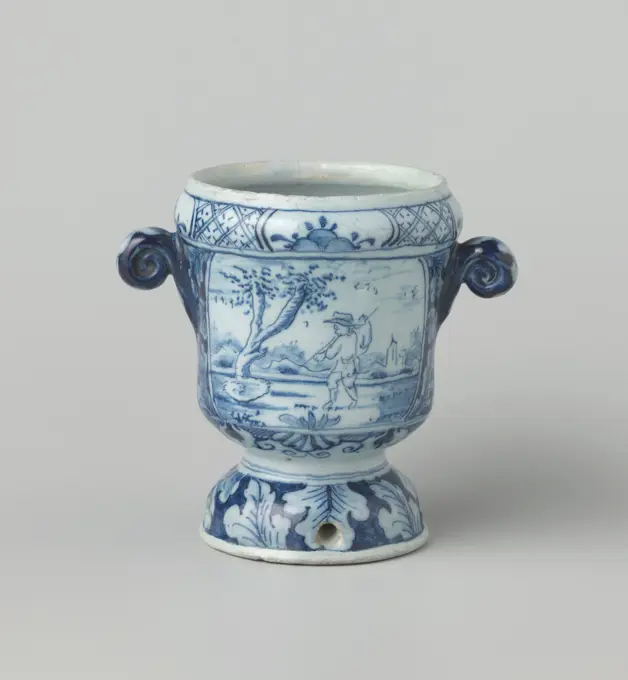
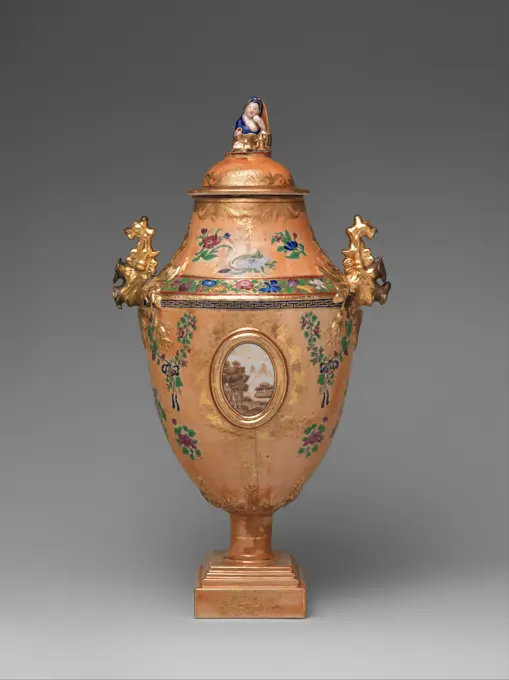
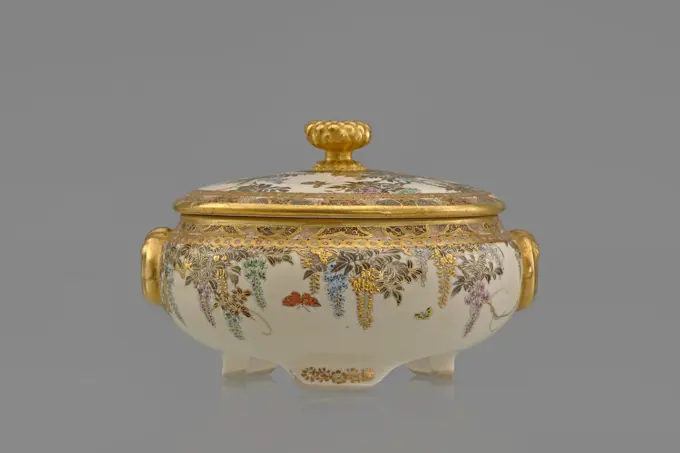
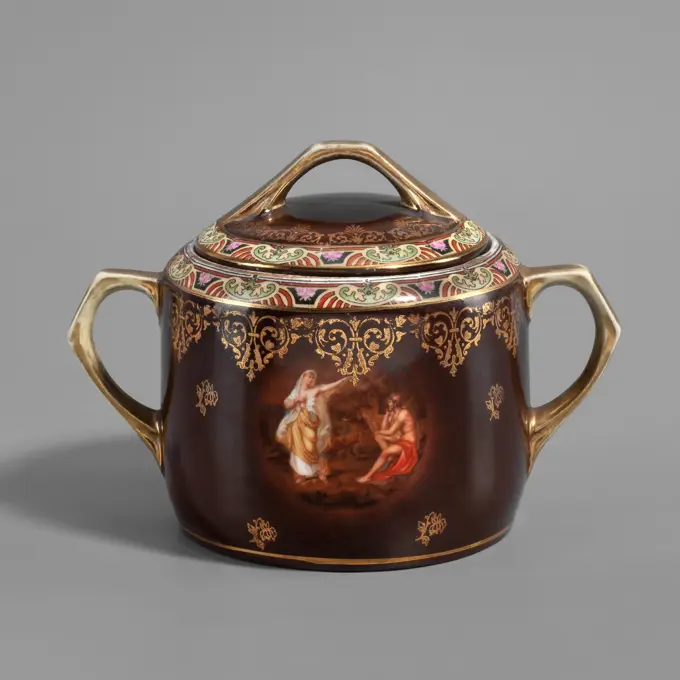
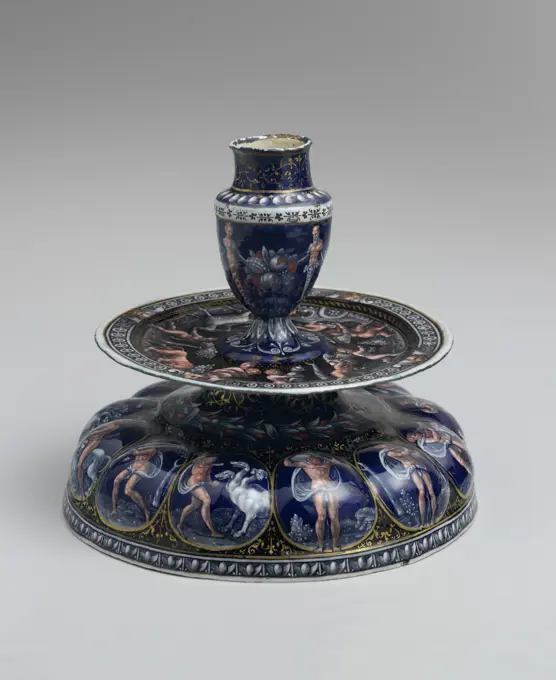
Elegant porcelain items including tea caddies and vases with intricate floral designs and gilded accents, showcasing craftsmanship and artistic detail.

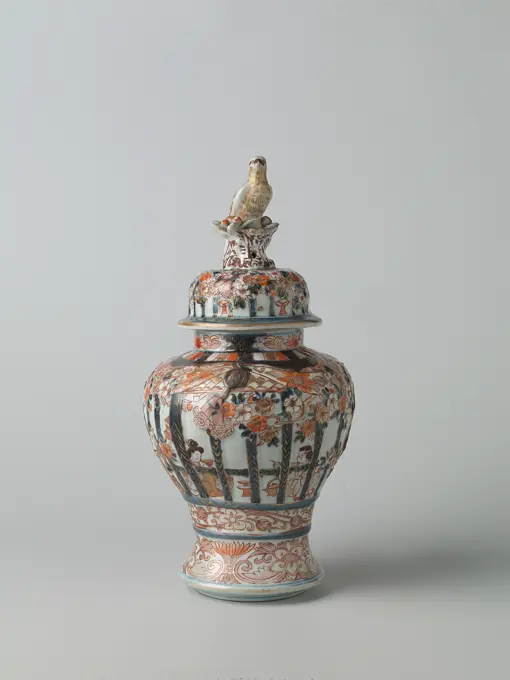
Covered baluster jar with figures in an interior behind framework, prunus trees and floral scrolls, anonymous, c. 1650 - c. 1699 Balus -shaped porcelain lid jar with a spreading base, painted in underly glaze blue and on the glaze red, black and gold. On the wall twice two people sitting in an interior behind modeled and painted grille work. This grille is decorated with modeled and decorated prunus trees and tires with flower vines. Under the grille work a band with flower vines. Around the foot a bond with lotus drinks. On the neck three cartouches with lotus vines. Imari. Japan porcelain. glaze. cobalt (mineral). gold (metal) painting / gilding / vitrification Balus -shaped porcelain lid jar with a spreading base, painted in underly glaze blue and on the glaze red, black and gold. On the wall twice two people sitting in an interior behind modeled and painted grille work. This grille is decorated with modeled and decorated prunus trees and tires with flower vines. Under the grille wo
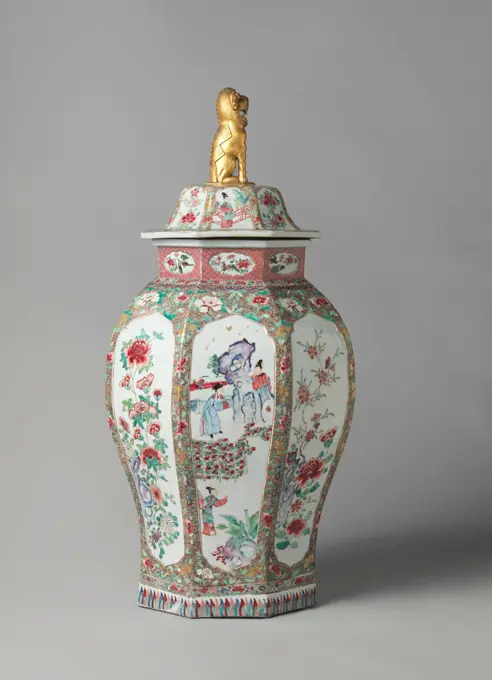
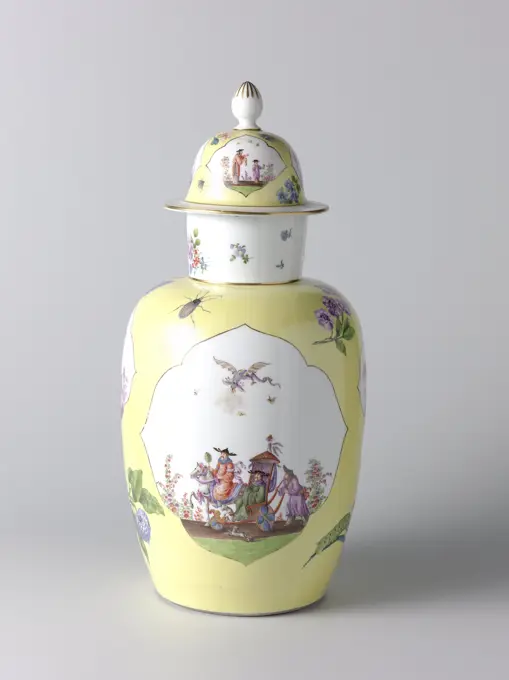
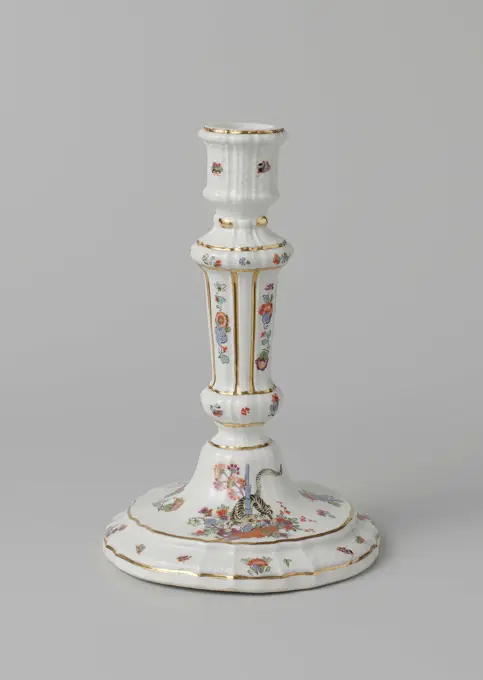
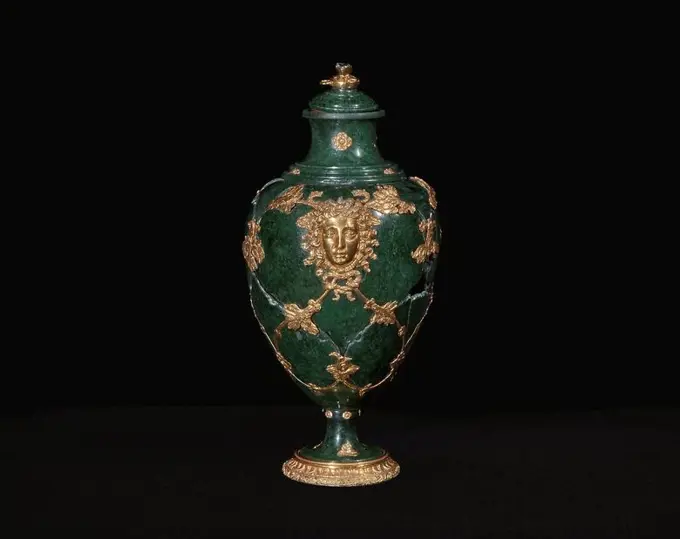
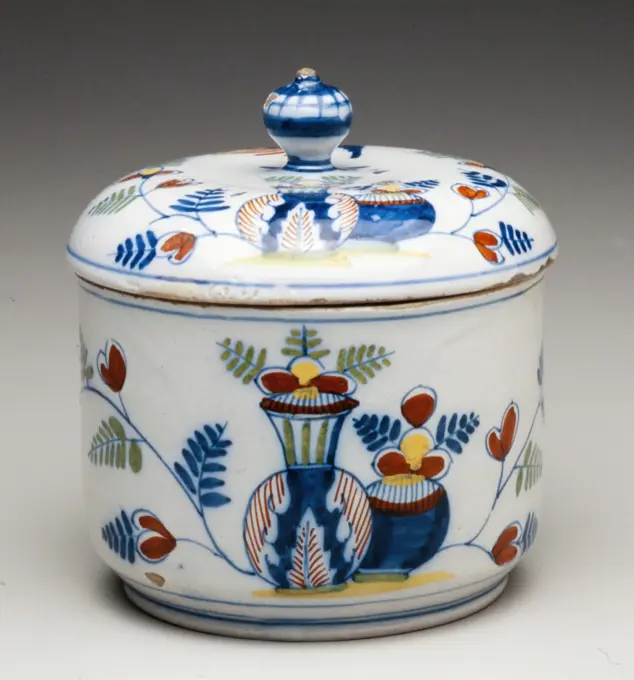
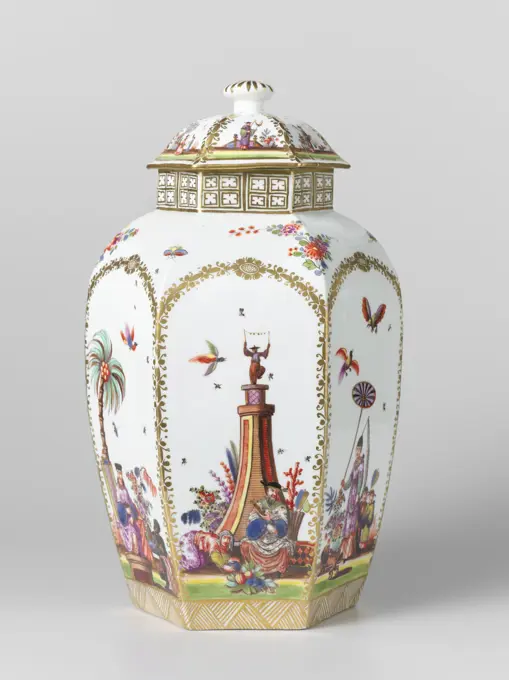
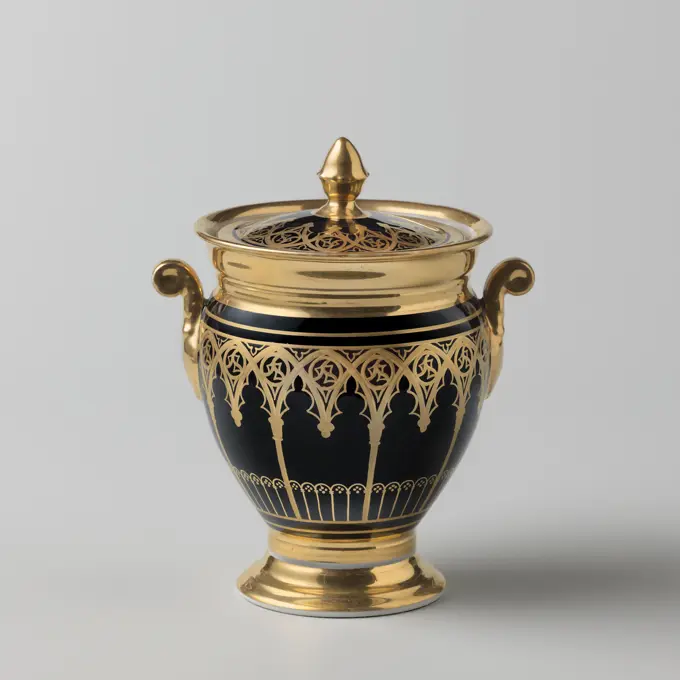
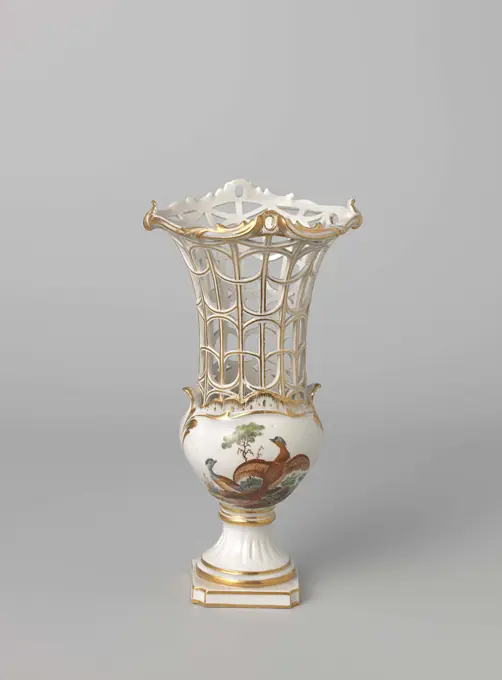
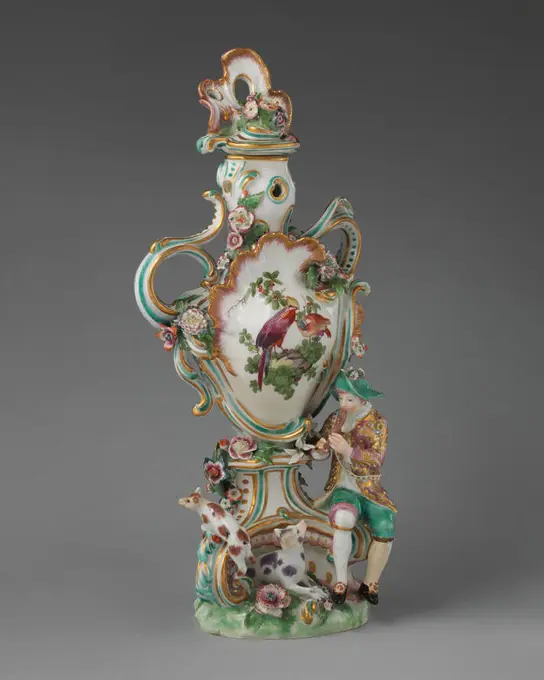
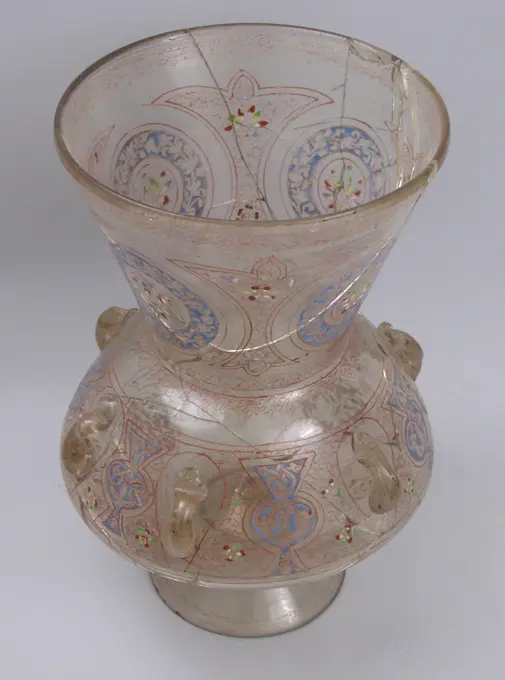
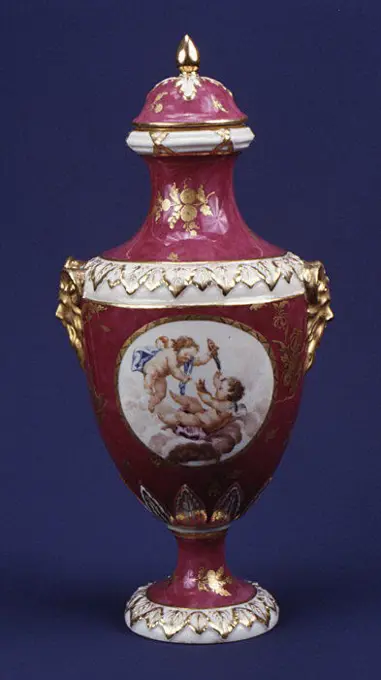
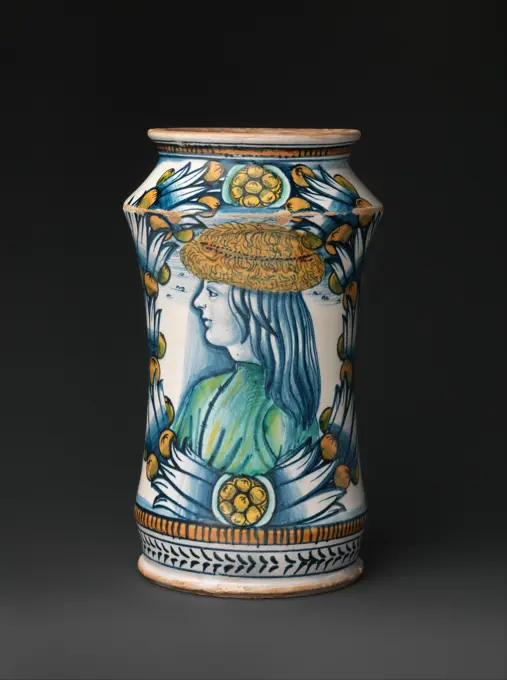
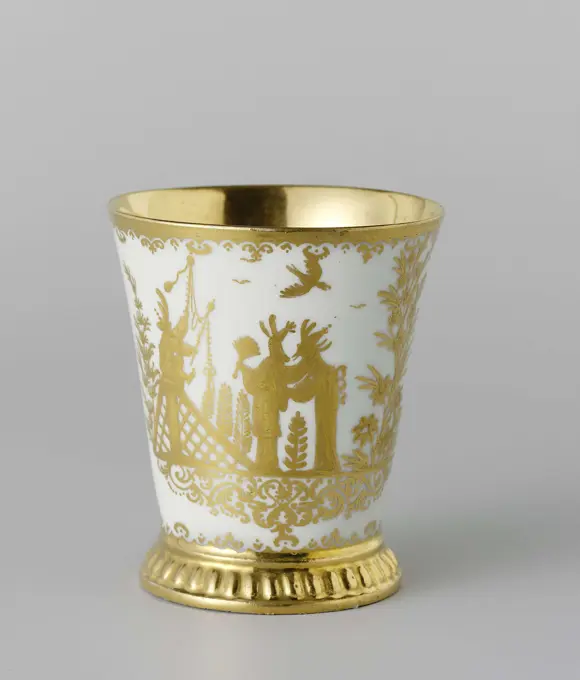
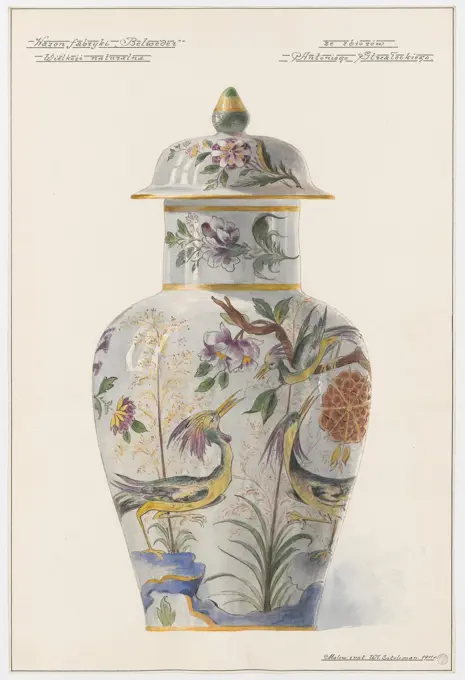
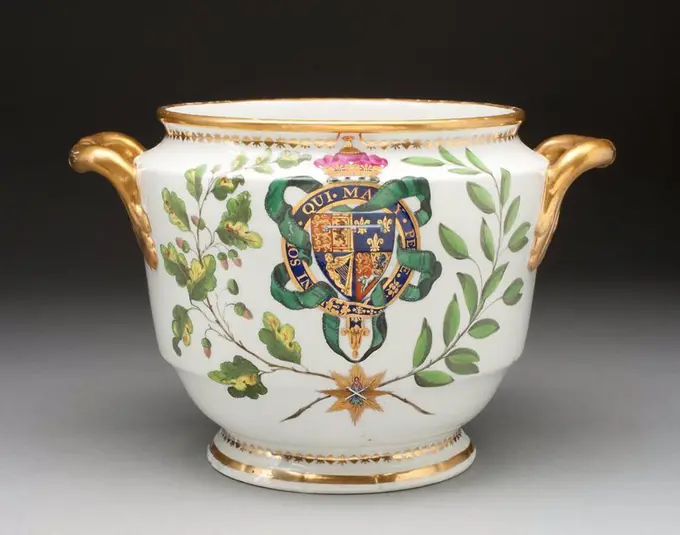
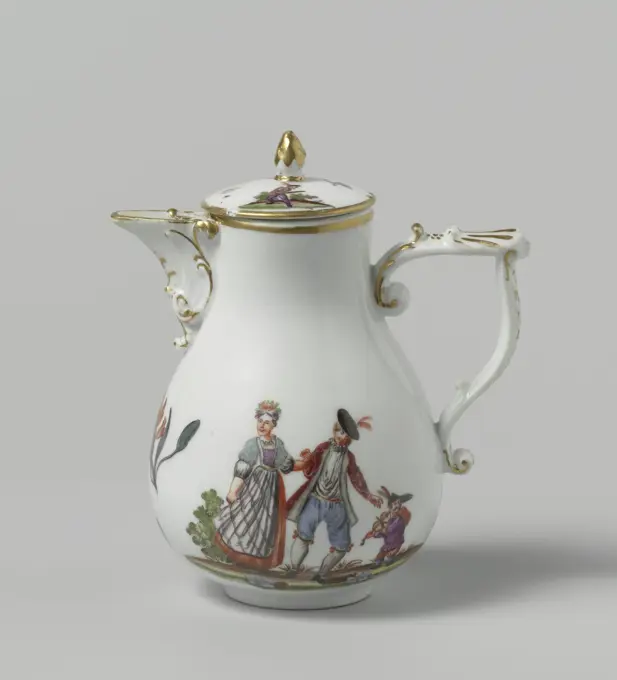
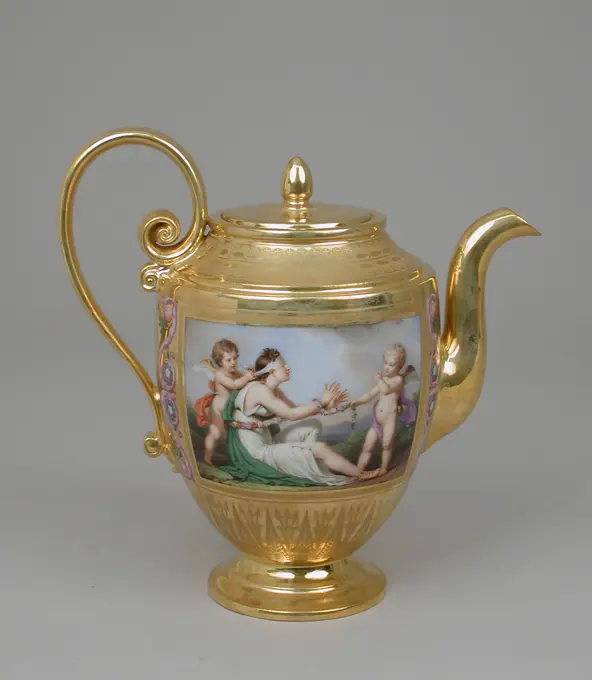
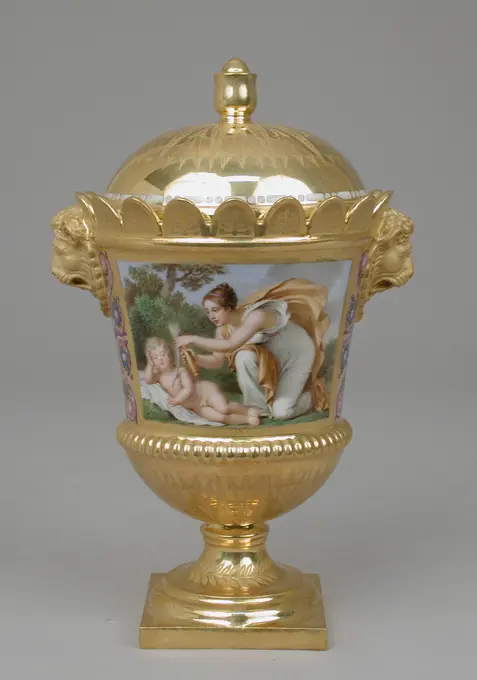
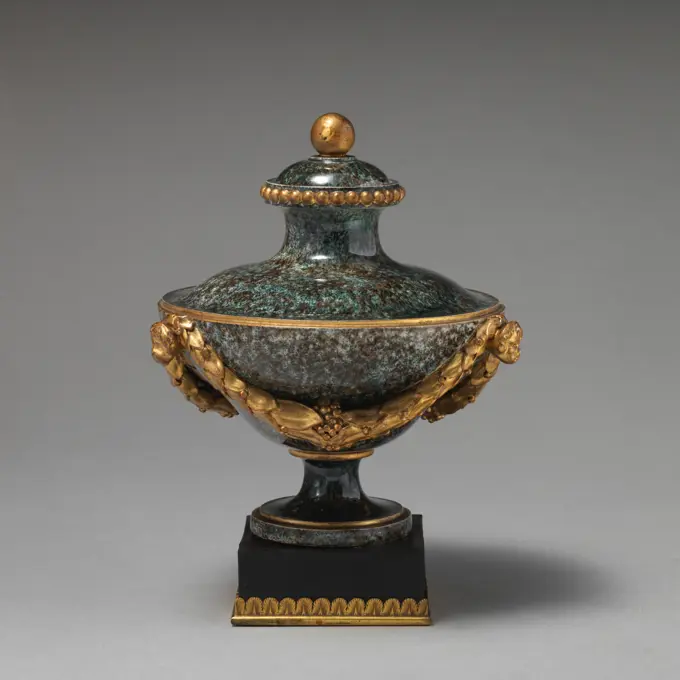
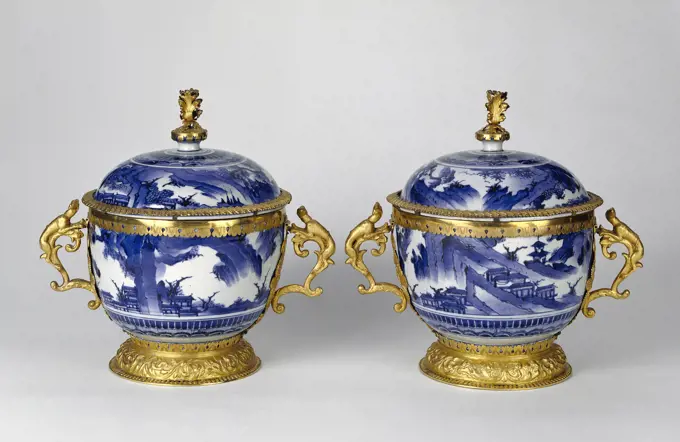
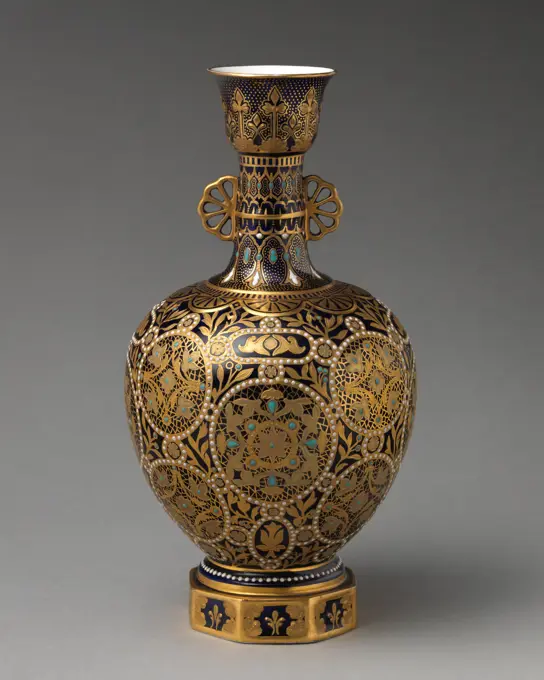
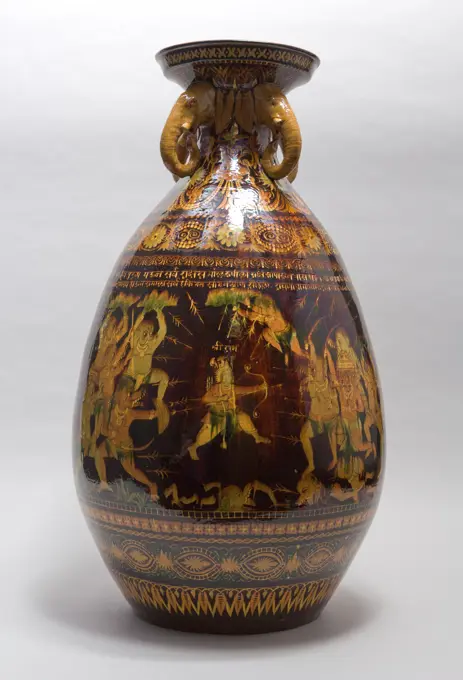
Ovoid tea caddy with handle from the 'Swellengrebel service' with a double crowned monogram and a border with floral scrolls, c. 1740 Porcelain tea leopard with egg -shaped body, painted on the glaze in blue, red, pink, green, yellow, black and gold. On the belly twice a crowned, double mirror monogram with 'mva' and 'thtd' surrounded by shell motifs, curls and flower branches; A lottery branch between the monograms. On the shoulder with a band with flower vines; Around the foot a band with curl in relief. The lid with two lotus vines and around the button a band with flower vines. European performance in email colors. China porcelain. glaze. gold (metal) painting / gilding / vitrification Porcelain tea leopard with egg -shaped body, painted on the glaze in blue, red, pink, green, yellow, black and gold. On the belly twice a crowned, double mirror monogram with 'mva' and 'thtd' surrounded by shell motifs, curls and flower branches; A lottery branch between the monograms. On the shouldeVase (part of a pair) 1765-1775 Worcester. Soft-paste porcelain, underglaze blue, polychrome enamels and gilding . Worcester Royal Porcelain Company (Manufacturer)Ovoid Tea Caddy With Handle From The 'SwellenGrebel Service' With a Double Crowned Monogram and A Border With Floral Scrolls. Porcelain tea bus with egg-shaped body, painted on the glaze in blue, red, pink, green, yellow, black and gold. On the abdomen twice a crowned, double mirror monogram with 'mva' and 'hecked' surrounded by shell motifs, curlwork and flower branches; A lotus branch between the monograms. On the shoulder with a bond with flower drinks; Around the foot a bond with curl works in relief. The lid with two lotus drinks and around the button a bond with flower drinks. European performance in email colors.Covered Baluster Jar With Figures in An Interior Behind Framework, Prunus Trees and Floral scrolls. Baluster-shaped lid pot of porcelain with a spreading foot, painted in underglaze blue and on the glaze red, black and gold. On the wall twice two people sitting in an interior behind landscaped and painted railing. This railing is decorated with landscaped and decorated prunus trees and tires with floral drinks. Among the railing a bond with flower drinks. A relationship with lotus drinks around the foot. Three cartouches with lotus drinks on the neck. Imari.Pair of Urns, c. 1815. Flight, Barr and Barr (British). Artificial porcelain; part 1: 19.2 x 11.5 cm (7 9/16 x 4 1/2 in.); part 2: 18.6 x 11.4 cm (7 5/16 x 4 1/2 in.).Worcester Porcelain Manufactory, Sugar Bowl and Cover, c. 1770-80, soft-paste porcelain.Vase. Worcester Porcelain Factory; Worcester, England, founded 1751. Date: 1765-1775. Dimensions: H. 26.5 cm (10 7/16 in.). Soft-paste porcelain, underglaze blue, polychrome enamels and gilding. Origin: Worcester. Museum: The Chicago Art Institute, Chicago, USA. Author: Worcester Royal Porcelain Company.Covered baluster jar with figures in an interior behind framework, prunus trees and floral scrolls, anonymous, c. 1650 - c. 1699 Balus -shaped porcelain lid jar with a spreading base, painted in underly glaze blue and on the glaze red, black and gold. On the wall twice two people sitting in an interior behind modeled and painted grille work. This grille is decorated with modeled and decorated prunus trees and tires with flower vines. Under the grille work a band with flower vines. Around the foot a bond with lotus drinks. On the neck three cartouches with lotus vines. Imari. Japan porcelain. glaze. cobalt (mineral). gold (metal) painting / gilding / vitrification Balus -shaped porcelain lid jar with a spreading base, painted in underly glaze blue and on the glaze red, black and gold. On the wall twice two people sitting in an interior behind modeled and painted grille work. This grille is decorated with modeled and decorated prunus trees and tires with flower vines. Under the grille woLid of multicolored painted faïence, anonymous, c. 1730 - c. 1770 Faïence lid, multi -colored painted. Delft . Faïence lid, multi -colored painted. Delft .Vase (urne Duplessis) (one of a group of three) ca. 1752 Vincennes Manufactory French Many of the features of Vincennes porcelain that made the factorys products so highly valued and sought after during the eighteenth century are evident in this vase. The extreme whiteness of the soft- paste porcelain, the sculptural sophistication, the rich enamel colors, and the interrelationship of the painted decoration to the form reflect a porcelain factory operating at a high level of production despite its short period of operation prior to this vase being made. The history of the factory has been well documented.[1 Established on an experimental basis in 1740, the operation began in the Chteau de Vincennes, located to the southeast of Paris, and within a year the factory had secured the backing and active participation of an influential intendant des ?nances (superintendent of finance), Jean- Henri- Louis Orry (1703-1751), comte de Fulvy. Orry de Fulvys knowledge of porcelain, gained in paPot, the gilt Blompot, 1780 - 1820  Powence pot. Multicolored painted. The pot is marked: B-p. Delft .Covered Baluster Jar With Figures in An Interior Behind Framework, Prunus Trees and Floral scrolls. Baluster-shaped lid of porcelain, painted in underglaze blue and on the glaze red, black and gold. Grille painted on the wall, decorated with landscaped and decorated prunus trees and tires with floral drinks. Among the railing a bond with flower drinks. A relationship with lotus drinks around the foot. Cover knob in the shape of a bird on a stump. Imari.Vase ca. 1760-65 Chelsea Porcelain Manufactory. Vase. British, Chelsea. ca. 1760-65. Soft-paste porcelain. Chelsea Porcelain Manufactory (British, 1744-1784). Ceramics-PorcelainMusic Box Swiss ca. 1840 Gold, light blue and red enamel music box in the form of a Turkish coffee cup (zarf), decorated with rose diamond foliate sprays. Later silver gilt liner. View more. Music Box. Swiss. ca. 1840. Various materials. Switzerland. IdiophoneFlowerpot, c. 1760 - c. 1780 Flowerpot van Faience, painted in blue in the glaze with a water landscape with a sailing ship and a moken, a landscape with a walker with a knapsack respectively. The bottom of the pot is open on four sides. Delft . Flowerpot van Faience, painted in blue in the glaze with a water landscape with a sailing ship and a moken, a landscape with a walker with a knapsack respectively. The bottom of the pot is open on four sides. Delft .Octagonal, Ovoid Covered Jar With Flowering Plants And Figures in a Fenced Garden in panels. Octagonal, egg-shaped lid pot of porcelain, painted on the glaze in blue, red, pink, green, purple, black and gold. The belly is covered with piping branches against a background of a spiral pattern. On each of the eight sides a saved, scalloped cartouche with varied flower branches (peony, chrysanthemum, aster, prunus) at a rock or one or more people on a terrace or in a fenced garden in blooming plants and rocks. The neck with napkin interspersed with lobby cartouches with deer or birds at a peony plant. A decorative band around the foot. The lid with the same decoration; The lid knob is in the shape of a shishi (lion dog). Lid knob is not original. Lid pot is part of cabinet set AK-NM-11497. Family Rose.Vase with lid, multicolored painted with chinoiseries, Meissener Porzellan Manufaktur, c. 1730 - c. 1735 Hexagonal vase with lid, made of painted porcelain. The neck is decorated with symmetrical leaf vines in gold, the ribs with a piping with a lace ornament. On the shoulders Indianic Blumen. On the six sides, major Höroldt chinoiseries were painted with, among others. A man and a woman with a child at a palm tree. The chinoiseries are on consoles of leaf and network in gold, which in which saved four passes in which a landscape. The vase is marked. Float porcelain Hexagonal vase with lid, made of painted porcelain. The neck is decorated with symmetrical leaf vines in gold, the ribs with a piping with a lace ornament. On the shoulders Indianic Blumen. On the six sides, major Höroldt chinoiseries were painted with, among others. A man and a woman with a child at a palm tree. The chinoiseries are on consoles of leaf and network in gold, which in which saved four passes in which a landscLidded Vase, Meissener porcelain manufactory, c. 1740 - c. 1745 Vase of painted porcelain. The vase is almost completely covered with a yellow stock in which saved two large and two small and four small four-passes on the lid in which Höroldt chinoiseries. Flower branches and insects are painted between the saved fields. Within a large four pass, four figures are painted by a fence and within the other a rider and a man pushed into a car. The vase is marked. Float porcelain Vase of painted porcelain. The vase is almost completely covered with a yellow stock in which saved two large and two small and four small four-passes on the lid in which Höroldt chinoiseries. Flower branches and insects are painted between the saved fields. Within a large four pass, four figures are painted by a fence and within the other a rider and a man pushed into a car. The vase is marked. Float porcelainAnonymous, green celadon vase and bronze frame (common name), 1701. Crakel green celadon and chiseled and gilded bronze. Carnavalet museum, history of Paris.Candlestick, painted multi-colored with a kakiemon decor. Candlestick of painted porcelain. The candlestick has a round, scalloped foot with a profiled strain with two nodi. The 'Altbrandenstein' pattern has been painted on the candle holder and the foot edge. A tiger is painted on the foot to a bamboo stalk in flowers. The candlestick is noticed.Anonymous; Giovanni Ambrogio Miseroni / 'Flask with tracery and a head of Medusa in gold'. 1530 - 1540. Diamond, Gold, Omphacite. Museum: Museo del Prado, Madrid, España.Covered sugar pot, c. 1740, 5 1/4 x 4 15/16 in. (13.34 x 12.54 cm), Tin-glazed earthenware (delftware), England, 18th centuryVase. Culture: American. Dimensions: H. 17 1/2 in. (44.5 cm). Maker: Faience Manufacturing Company (American, New York, 1881-1892). Date: 1886-90. Museum: Metropolitan Museum of Art, New York, USA.Lidded Vase, Meissener porcelain manufactory, c. 1730 - c. 1735 Hexagonal vase with lid, made of painted porcelain. Along the foot, a band with shaded triangles runs in gold. On the ribs of vase and lid, leaf vines are painted in gold that run on the belly and come together on the shoulder in a rosette. On the six sides, major Höroldt chinoiseries were painted with, among others. A black servant who brings a bowl of dishes to a lady sitting under a palm tree. The vase is marked. Float porcelain Hexagonal vase with lid, made of painted porcelain. Along the foot, a band with shaded triangles runs in gold. On the ribs of vase and lid, leaf vines are painted in gold that run on the belly and come together on the shoulder in a rosette. On the six sides, major Höroldt chinoiseries were painted with, among others. A black servant who brings a bowl of dishes to a lady sitting under a palm tree. The vase is marked. Float porcelainSugar bowl with a gothic arcade decoration, Perche, c. 1800 - c. 1899 Porcelain sugar bowl on spreading base, with an egg -shaped body and two handles, painted in underlaze blue and on the glaze gold. The outer wall with a gothic arch decoration against a blue background. The foot, neck and handles are covered with gold. Saint-Yrieix-la-Perche porcelain. glaze. cobalt (mineral). gold (metal) painting / gilding / vitrification Porcelain sugar bowl on spreading base, with an egg -shaped body and two handles, painted in underlaze blue and on the glaze gold. The outer wall with a gothic arch decoration against a blue background. The foot, neck and handles are covered with gold. Saint-Yrieix-la-Perche porcelain. glaze. cobalt (mineral). gold (metal) painting / gilding / vitrificationVase. Vase of porcelain. On the square basement, the high, round foot resting that the spherical vase bears. Here on a chop-shaped upper part that is completely open. Painted with pheasants and flowers.Pearshaped milk jug stand with a woman playing a piano, anonymous, c. 1780 Pear-shaped milk can of porcelain with C-shaped ear and small, triangular spout, painted on the glaze in blue, red, pink, green, yellow, purple, brown, black and gold. On the belly a woman in an interior playing on a keyboard in a medallion; The edge with a tire flower vines. Ear with a modeled decoration. Lid is missing. European form and representation in email colors. China porcelain. glaze. gold (metal) painting / gilding / painting Pear-shaped milk can of porcelain with C-shaped ear and small, triangular spout, painted on the glaze in blue, red, pink, green, yellow, purple, brown, black and gold. On the belly a woman in an interior playing on a keyboard in a medallion; The edge with a tire flower vines. Ear with a modeled decoration. Lid is missing. European form and representation in email colors. China porcelain. glaze. gold (metal) painting / gilding / paintingVase with a IId  flagellum, figural scenes unknownCup with lid, porcelain. The head has two ears, and is painted around with a landscape with two figures on both sides. Golden piping along the edges and ears. On the lid three multi-colored cultured growing roses. Marked with m.o.l. And star in underglaze blue.oval ardiniera with handles in the form of winged female figures; Manufaktura M.P.Radziwi  A in Nieborów; 1881-1886 (1881-00-00-1886-00-00);Vase (one of a pair). Culture: British, Chelsea. Dimensions: Height: 13 3/16 in. (33.5 cm). Factory: Chelsea Porcelain Manufactory (British, 1745-1784, Gold Anchor Period, 1759-69). Date: ca. 1760. Museum: Metropolitan Museum of Art, New York, USA.Mosque Lamp first half 14th century The decoration of this object is unusual for the presence of stylized mosque lamps depicted between the handles. The peonies inside the three medallions around its neck are instead more conventional. Designs of lamps were sometimes carved on tombstones to represent God's light in the afterworld. Therefore, it is possible that this lamp was once suspended in the mausoleum of an anonymous Mamluk emir.. Mosque Lamp 444714. Faience boiler. The boiler is on a corresponding command (BK-1955-65-B).Covered Vase 1736-95 Chinese. Covered Vase. Chinese. 1736-95. Porcelain. Made in ChinaPoodle Kinkôzan, Sôbei VII (1867-1927), Kinkôzan; End of the 19th century (1880-00-00-1890-00-00);Covered Jar With Hoo-Birds in panels on a ground of Lotus and Floral scrolls. Porcelain lid pot, painted in underglaze blue and on the glaze red, black and gold. On the outer wall flower drinks with a lotus drink and a cartouche with a hay-bird alternately. A tire with pointed leaf motifs around the foot. Imari.Candyer with lidconfectioners, gift (provenance), mythology, imitation, gildingVase 1780-1800 Le Nove Porcelain Manufactory. Vase 189026 Factory: Le Nove Porcelain Factory, Vase, 17801800, Hard-paste porcelain, Overall (confirmed): 8 1/4  5 9/16  3 7/8 in. (21  14.1  9.8 cm). The Metropolitan Museum of Art, New York. Rogers Fund, 1906 (06.387a, b)Candlestick (one of a pair) ca. 1560-70 Master I. C. (probably Jean Court or Jean de Court) The processions of infants on the drip pans were taken from engravings by the anonymous Italian Master of the Die (active ca. 1532). The labors of Hercules depicted on the repoussé medallions around the base of one of the candlesticks are after engravings by the German Heinrich Aldegrever (1502-after 1555); gods of classical antiquity fill the medallions on the other example.. Candlestick (one of a pair) 198392Vase with cover ca. 1770 Chelsea Porcelain Manufactory. Vase with cover 192844Storage Jar (Albarello) ca. 1505-10 Italian, Deruta Storage vessels were among the most frequently produced maiolica wares in late medieval and Renaissance Italy. Made in fairly standard shapes, they were designed to fit with dozens of others on a shelf, often in a pharmacy or shop. Their handles therefore tend to fit within the vessels profile, and the cylindrical albarello type is generally narrower at the middle than at the top or bottom, making it easy to grip. Other common features include inscriptions indicating contents and flanged lips to help secure cloth or paper seals. The decoration, usually more elaborate on one side than the other, can sometimes link pieces to a known dispensary or specific workshop or artist.. Storage Jar (Albarello) 199745Lidded Vase, Meissener porcelain manufactory, c. 1740 - c. 1745 Vase of painted porcelain. The vase is almost completely covered with a yellow stock in which saved two large and two small and four small four-passes on the lid in which Höroldt chinoiseries. Flower branches and insects are painted between the saved fields. Three figures and a child were painted by a fence within a large four pass. The vase is marked. Float porcelain Vase of painted porcelain. The vase is almost completely covered with a yellow stock in which saved two large and two small and four small four-passes on the lid in which Höroldt chinoiseries. Flower branches and insects are painted between the saved fields. Three figures and a child were painted by a fence within a large four pass. The vase is marked. Float porcelainBeaker ca. 1820-30 Bohemian. Beaker 207912Dish on foot with bouquets and flower sprays, Fabriek Dominique Denuelle, c. 1839 Scale (fruit bowl) on a high base of porcelain with a lobed edge, painted on the glaze in blue, red, pink, green, yellow, purple, black and gold. The lower part of the wall is open and the round foot continues in a square pedestal. Decorated with bouquets of different flowers, sprinkling flowers and golden lines. The scale with from the lobed, golden rim, modeled leaf vines on the outer wall, with gold. Paris porcelain. glaze. gold (metal) painting / gilding / vitrification Scale (fruit bowl) on a high base of porcelain with a lobed edge, painted on the glaze in blue, red, pink, green, yellow, purple, black and gold. The lower part of the wall is open and the round foot continues in a square pedestal. Decorated with bouquets of different flowers, sprinkling flowers and golden lines. The scale with from the lobed, golden rim, modeled leaf vines on the outer wall, with gold. Paris porcelain. glaze. gold (meCovered vase with birds on a branch and bouquets, Fürstenberg, c. 1785 - c. 1790 Porcelain lid vase on a spreading foot ending in a square pedestal and with a cylindrical body with a round shoulder and narrowing to the foot. Spreading neck with a flat edge and high, angular ears. Painted on the glaze in blue, red, pink, green, yellow, purple, black and gold. On the belly two birds on a branch in a landscape and a bouquet of different flowers. In between sprinkling flowers and insects. The narrowing part to the foot with a band with modeled raised leaf motifs in relief. The shoulder and the foot with the same decoration as on the abdomen with a bond with leaf vines in relief. A flower or insect on the corners of the pedestal. The sides with a curly motif in Bas-relief. Golden Rand. The lid with flowers and insects and on the edge modeled leaf vines; Lid button in the form of a pine cone with a modeled rosette as the basis. Marked on the bottom with the F and A.F. Fürstenberg porcelain. Beaker, Meissener porcelain manufactory, c. 1730 - c. 1735 Cup of painted porcelain. The cup is painted on both sides in gold with scenes with Chinese style figures on a console. The cup is not marked. porcelain company: MeissenAugsburg porcelain Cup of painted porcelain. The cup is painted on both sides in gold with scenes with Chinese style figures on a console. The cup is not marked. porcelain company: MeissenAugsburg porcelainCup with lid Franck, Christian (ca 1638 1704). Cup of painted porcelain. The cup is painted on both sides in gold with a chinoiserie on a console. The cup has not been marked.Vase and cover decorated in far-eastern style, from the collection of Antoni Strzałecki ; drawing for the publication: `CERAMIKA POLSKA ZEBRANA STARANIEM DOMINIKA WITKE JEŻEWSKIEGO, MALOWAŁ WŁ. SZTOLCMAN` Polish ceramics collected by the effort of Domini???????????????????. Sztolcman, Władysław Roman (1873-1950), painterCovered Jars, Mennecy Porcelain Manufactory, French, active 1735 - 1773, soft paste porcelain, vitreous enamel, Inverted acorn shaped with cavetto neck and domed cover with floral knob. Cylindrical foot; side broken by four vertical grooves alternating with four ridges. Floral festoons in relief on shoulders, flowers in relief upon covers, which have silver rims., France, 1740-1750, ceramics, Decorative Arts, jars, jarsCoffee, multi -colored painted with Chinese in saved four passes in a violet stock, Meissener Porzellan Manufaktur, c. 1730 - c. 1735 Coffee pan of painted porcelain. The KAR has a four -lobby shape and is almost completely covered with a violet stock. On the body of the Kan in the distance, two large four -passes and a smaller saved, in which a Chinese figure is always painted in a garden. The jug is marked. Float porcelain Coffee pan of painted porcelain. The KAR has a four -lobby shape and is almost completely covered with a violet stock. On the body of the Kan in the distance, two large four -passes and a smaller saved, in which a Chinese figure is always painted in a garden. The jug is marked. Float porcelainMilk jug with painting in gold on royal blue fond with arcade location with gothic traces. Porcelain milk jug, part of a crockery, painted in gold on a royal blue fond with a arcade-downtown with gothic traces. The entire surface is plated outside this decor. Brands: See General Record.Vase for a Garniture Set, 1736-1770. Chinese hard-paste porcelain, gilt bronze, enameled metal; overall: 34.4 x 22 x 15.2 cm (13 9/16 x 8 11/16 x 6 in.). The fascination with Chinese porcelain among aristocratic circles increased during the reign of Louis XV. In reaction to the perceived excesses of elaborate naturalistic ornament of the 1750s, mount makers increasingly turned to neoclassical designs, known as Goût Grec (Greek taste) in the 1760s and 1770s. These beautifully chased gilt-bronze mounts feature classical Greco-Roman motifs such as lion masks, acanthus and laurel leaves, and pilasters.Tankard with flowers and ornamental borders, anonymous, c. 1720 - c. 1770  Beer mug of stoneware with a cylindrical body and C-shaped ear. Profiles under the edge and above the foot. Partly covered with cobalt blue. On the belly a wide band with three large, stylized flowers consisting of small, imposed pearls. Above and under a printed and imposed decorative bond in relief with medallions and windows. The pul is caught in a pewter frame with lid and spreading foot. On the lid the brand 'E.L.B' and on the inside three small brands with twice 'i.z.f. 1701 013 ', and one with' S.S. '. Altenburg. Altenburg Stoneware. Glaze. Cobalt (Mineral). frame: tin (metal) vitrificationSugar-bowl with a lid. Wierbiłki/k Moskwy (fabryka porcelany; 1766- ), manufactureInk set of multicolored painted faïence, anonymous, c. 1750 - c. 1775 Elongated ink set with bowl between two candle holders and a lid with a lying man. The multi -colored painting consists of lambrequins and flower branches. Delft . Elongated ink set with bowl between two candle holders and a lid with a lying man. The multi -colored painting consists of lambrequins and flower branches. Delft .Vase for a thin;  19th century (1801-00-00-1900-00-00);German anonymous. Small shaped drageoir song in Saxony porcelain, mounted in gold. Chinoiseries in the taste of Johan-Gregor-Höroldt. 1725-1735. Paris, Cognacq-Jay museum. 56057-6 Box, Chinoiserie, Chantournee shape, gold, goldsmith, small drageoir, Saxony porcelainDouble Snuff Box. Germany, Dresden, circa 1750. Tools and Equipment; boxes. Painted enamel on copper, gilt-copper mountingTazza Designer Augustus Welby Northmore Pugin British Manufacturer Minton(s) British ca. 1850 This boat-shaped tazza reflects the remarkably inventive collaboration between Pugin and Herbert Minton, who propelled the Minton firm to the forefront of ceramic production in England in the nineteenth century. Both Pugin and Minton were interested in new technologies, and this tazza is decorated with a then-new form of multi-color transfer printing. The polychrome decoration on the tazza is reminiscent of Pugins use of color and pattern for wall treatments, and this transfer printing technology eliminated the need for hand coloring the printed designs.The tiles produced by Minton after designs by Pugin are the best known aspect of their collaboration, but the table wares that they produced together are also an important category of Pugins work in ceramics. The resulting dinner services fused Pugins design aesthetics with Mintons superior earthenware ceramic body, thus making high quality funBarrel-shaped covered jar with flower scrolls and geometric patterns, anonymous, c. 1700 - c. 1724 Lid with a button of porcelain pot, painted on the glaze in red, green, yellow, eggplant and black with flower vines and geometric motifs. Decorated with a layer of geometric motifs interrupted by cartouches with a flower branch, and above it a layer with flower vines saved in a red soil, green button. Famle Verte. China porcelain. glaze. painting / vitrification Lid with a button of porcelain pot, painted on the glaze in red, green, yellow, eggplant and black with flower vines and geometric motifs. Decorated with a layer of geometric motifs interrupted by cartouches with a flower branch, and above it a layer with flower vines saved in a red soil, green button. Famle Verte. China porcelain. glaze. painting / vitrificationPilgrim Bottle (one of a pair) 1869 Robert Garrard II This impressive pair of Victorian pilgrim bottles look back at a form derived from seventeenth-century wine bottles; these examples were only intended to be used as part of a grand display in the dining room. Garrard was one of the most important jewelers in London; in fact, Queen Victoria appointed Garrard the very first Crown Jeweler only a few years after his firm produced these bottles.. Pilgrim Bottle (one of a pair). British, London. 1869. Gilded silver. Metalwork-SilverCarafe with a medallion with a women's portrait, anonymous, c. 1850 - c. 1900 Matt glass carafe with small gold -plated medallion in which a bust portrait of a girl. A golden rosette on the opposite side. The stop ends in a point. Along the four -part lobed spout and along the base golden edges. France (possibly) glass glassblowing / gilding Matt glass carafe with small gold -plated medallion in which a bust portrait of a girl. A golden rosette on the opposite side. The stop ends in a point. Along the four -part lobed spout and along the base golden edges. France (possibly) glass glassblowing / gildingFooted beaker ca. 1650 Petrus Schnell II An interest in antiquarianism spread throughout Europe during the Renaissance. Ancient coins, mostly archaeological finds but some outright copies, were highly sought after and were often used to decorate objects. The base of this beaker has three embossed medallions with heads in profile in imitation of classical styles. The coins on the tapering sides could be casts after ancient Roman coins or they might be poorly minted originals.LiteratureElemér Kőszeghy. Magyarországi ötvösjegyek a középkortól 1867-ig / Merkzeichen der Goldschmiede Ungarns vom Mittelalter bis 1867. Budapest, 1936, nos. 1384a, 1403 maker’s marks.Fine English, Continental and American Silver.. Objects of Vertu. Sale cat., Christie’s, New York, November 2, 1977, p. 44, no. 113.Judit H. Kolba. Hungarian Silver: The Nicolas M. Salgo Collection. London, 1996, p. 58, no. 36.ExhibitedErdély régi művészeti emlékeinek kiállítása az Iparművészeti múzeumban / Ausstellung alten KunstWine Cooler from the Duke of Clarence Service. Worcester Porcelain Factory (Flight Period); Worcester, England, founded 1751. Date: 1789-1790. Dimensions: 16.7 x 24.9 cm (6 9/16 x 9 13/16 in.). Soft-paste porcelain, polychrome enamels and gilding. Origin: Worcester. Museum: The Chicago Art Institute, Chicago, USA. Author: Worcester Royal Porcelain Company.Vase Made 1785-1795 Yorkshire .Milk Jug, Meissener Porzellan Manufaktur, c. 1740 - c. 1745 Pear -shaped can with a SNEB, a angled ear and a lid with a button. The SNEB and the ear are decorated in relief. The KAN is painted with two performances: a young dancing couple, accompanied by a violin-playing little person (caricature) and a small people couple (caricature) With a small person playing on the left. On the lid is twice an Asian person Painted with drawn sword between green bushes. The jug is marked. Float porcelain Pear -shaped can with a SNEB, a angled ear and a lid with a button. The SNEB and the ear are decorated in relief. The KAN is painted with two performances: a young dancing couple, accompanied by a violin-playing little person (caricature) and a small people couple (caricature) With a small person playing on the left. On the lid is twice an Asian person Painted with drawn sword between green bushes. The jug is marked. Float porcelainVase with cover ca. 1775 Derby Porcelain Manufactory. Vase with cover 192810Cup ca. 1840 Mexican. Cup. Mexican. ca. 1840. Tin-glazed earthenware. Made in MexicoTeapot (théière Asselin), part of Breakfast Service (déjeuner) 1813 Sèvres Manufactory French This breakfast service (56.29.1-.8) was presented by Napoleon I to Princess Auguste-Amélie, wife of his stepson Eugène Beauharnais, on New Year's Day of 1814. The overall theme of the decoration was described in the factory records as the "loves of amors and nymphs," and the title given to the scene on the tray was "Accused Nymphs Appearing before the Tribunal of Love.". Teapot (théière Asselin), part of Breakfast Service (déjeuner). French, Sèvres. 1813. Hard-paste porcelain. Ceramics-PorcelainWall Fountain; earthenwareThe past of the future unknownSugar bowl with vertical borders, 1773 Teapot of porcelain with an oval body, painted on the glaze in blue, red, pink, green, yellow, black and gold. The belly is divided into vertical tires alternately filled with flower vines, each other cutting leaves in which a rosette and narrow tires with golden flower branches. The neck and the foot with a leaf shelf. Dots on the ear and spout and a flower pattern. The lid with the same decoration; Lid button in the form of a fruit branch (apple). Marked on the underside with IP I, a shield with m and a g. Porcelain Company: Höchstschrezheim porcelain. glaze. gold (metal) painting / gilding / vitrification Teapot of porcelain with an oval body, painted on the glaze in blue, red, pink, green, yellow, black and gold. The belly is divided into vertical tires alternately filled with flower vines, each other cutting leaves in which a rosette and narrow tires with golden flower branches. The neck and the foot with a leaf shelf. Dots on the ear and spoGoblet and cover. Nieokreślona huta, factorySnuff Bottle, 19th century, 3 1/8 x 1in. (7.9 x 2.5cm), Ivory, China, 19th centurySugar bowl with cover, part of Breakfast Service (déjeuner) 1813 Sèvres Manufactory French This breakfast service (56.29.1-.8) was presented by Napoleon I to Princess Auguste-Amélie, wife of his stepson Eugène Beauharnais, on New Year's Day of 1814. The overall theme of the decoration was described in the factory records as the "loves of amors and nymphs," and the title given to the scene on the tray was "Accused Nymphs Appearing before the Tribunal of Love.". Sugar bowl with cover, part of Breakfast Service (déjeuner). French, Sèvres. 1813. Hard-paste porcelain. Ceramics-PorcelainContinental footed porcelain cup, Delaware 1878-89 Joseph S. Potter. Continental footed porcelain cup, Delaware 21464. A confidante of the Russian empress commissioned this 140-piece service, several items of which are displayed here. Silversmith Odiot, the painter Prudhon and the architect Cavelier proudly presented the new models at the 1819 French national exhibition of decorative art. Notable are the kneeling angels supporting the soup tureen, which are characteristic of the late Empire style.Jar 1849 Bennington. Earthenware . Bennington PotteryFooted Bowl, 1850-1899. Italy, Venice, 19th century. Glass decorated with polychrome enamel and gilt; overall: 15.9 x 19.4 cm (6 1/4 x 7 5/8 in.).Bonbonnière And Lid (England); Manufactured by Moorcroft; gilt and glazed earthenwareApothecary jar (albarello). Calamelli, Virgiliotto, manufacturerSugar bowl with cover (part of a service) late 18th century Royal Porcelain Manufactory, Naples. Sugar bowl with cover (part of a service) 187762 Factory: Naples Royal Porcelain Manufactory, Ferdinand IV period, ca. 1771ca.1807, Sugar bowl with cover (part of a service), late 18th century, Soft-paste porcelain, Height: 5 1/4 in. (13.3 cm). The Metropolitan Museum of Art, New York. Gift of Henry G. Marquand, 1894 (94.4.139a, b)Three children in a group. Culture: British, London. Dimensions: 5 1/4 × 1 1/4 in. (13.3 × 3.2 cm). Maker: Saint James's Factory (British, ca. 1748/49-1760). Date: ca. 1750-55. Museum: Metropolitan Museum of Art, New York, USA.. Candlestick of faience, blue painted in the glaze.Vase with cover 1769-80 Wedgwood and Bentley. Vase with cover. British, Etruria, Staffordshire. 1769-80. Porphyry ware. Wedgwood and Bentley (British, Etruria, Staffordshire, 1769-1780). Ceramics-PotteryPair of Lidded Bowls; Mounts attributed to Wolfgang Howzer (Swiss, active 1660 - about 1688); Arita, Japan; porcelain about 1650 - 1680; mounts about 1680; Hard-paste porcelain, underglaze blue decoration with gilt-metal mounts;Box, 1788. Austria, Vienna, 18th century. Porcelain mounted in silver; overall: 4.2 x 8 cm (1 5/8 x 3 1/8 in.).. Beer mug from painted porcelain. De Bierpul is painted with the coat of arms of the Saxon family of Zobel, which is held by two figures. They stand on a richly decorated console with a heather chinoiserie consisting of two figures. The beer pulley has been marked.Urn On Pedestal; Manufactured by Mennecy Porcelain Manufactory (France); soft-paste porcelain, over-glaze decorationVase with hexagonal foot (one of a pair) 1885 Crown Derby The history of the Derby porcelain manufactory can generally be divided into two periods. The old Derby porcelain was produced from 1750 to 1848, and was foremost distinguished by the ownership of William Duesbury I and II. When the original factory closed in 1848, a number of former workers established a separate smaller factory at King Street, Derby, using Crown Derbys original molds and patterns and oftentimes incorporating the factory marks on its wares. Around 1876, a separate company established a factory at Osmaston Road under the name Derby Crown Porcelain Company (and eventually bought the King Street factory in 1935), although the firm did not being producing commercial pieces until two years later. In 1890, the factory was granted the privilege of using the title "Royal Crown Derby Porcelain Company." Although the new Crown Derby continued to produce the firms old eighteenth-century Japan patterns, it became known fCovered Vase, one of a pair, 18th century, 11 3/8 x 4 in. (28.9 x 10.16 cm), Porcelain, China, 18th centuryFlower vase (Mahon bowl), Manufacture de Sèvres, c. 1761 Oval jardiniere of multicolored painted porcelain, with a blue -green stock. The Jardiniere has a scalloped edge and short sides bent in. The four legs have the shape of leaves in rocaille form and are partly gilded. On both long sides, a medallion is painted one with a Teniers scene: four men and a woman around a table in front of a house and in the other flowers and fruits. Sèvres porcelain. gilding (material). Oval jardiniere of multicolored painted porcelain, with a blue -green stock. The Jardiniere has a scalloped edge and short sides bent in. The four legs have the shape of leaves in rocaille form and are partly gilded. On both long sides, a medallion is painted one with a Teniers scene: four men and a woman around a table in front of a house and in the other flowers and fruits. Sèvres porcelain. gilding (material).Cup with decor in gold, red and green. Cup with porcelain ear with decor in gold, red and green. Above the gold-plated foot a golden egg list on a green ground; A shiny leaf edge on DOF golden ground forms the transition to a purple edge with golden palmets. The lip edge and bottom of the cup are not gilded. Note: Probably the dish does not belong to the head.Beaker 1835-1855 Bohemia. Glass; blown, cut, stained, enamelled and gilded .Exhibition Vase with Scenes from the Ramayana ca. 1880s India, Bombay School Drawn from the third book (Aranya Kanda”) of the Ramayana, the elaborate narrative on this vessel depicts key scenes in the Dandaka forest. Created by the Bombay School of Art in an effort to preserve Indian craft, the object features many embellishing motifs drawn from the Buddhist murals of Ajanta. These features include the lotus and pearl band running around the shoulder and the monster faces (kirtimukha), set between the addorsed elephant heads, that spit out a garland of jewels. Although the vase is grounded in the Indian tradition, British neoclassical taste clearly underlies its shape and some of its geometric motifs. Given the scale and inscribed multiscene narrative, this vase may have been produced for the London Colonial and Indian Exhibition of 1886.On the other side of the object, the narrative begins with Rama firing arrows at a horde of demons who hurl rocks. Short inscriptions identify the poPair of Mounted Lidded Vases; porcelain about 1700 - 1720; mounts about 1710 - 1715; Hard-paste porcelain, polycrhome enamel decoration, gilt bronze mounts;Bowl 16th century Italian, Venice. Bowl. Italian, Venice. 16th century. Bronze. Sculpture-BronzeBeaker with cover 1700-1730 German, Dresden. Beaker with cover 195806Manufacture of Sèvres, lapis blue bottom planter. Ceramics, tender dough porcelain, polychrome enamels, gilding. Petit Palais, Museum of Fine Arts of the City of Paris.