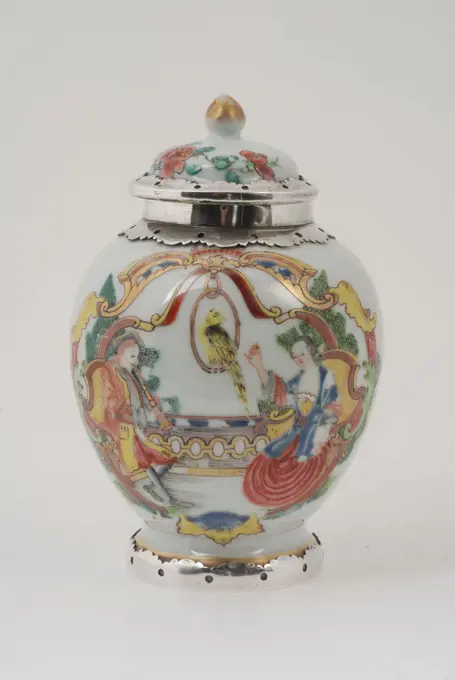
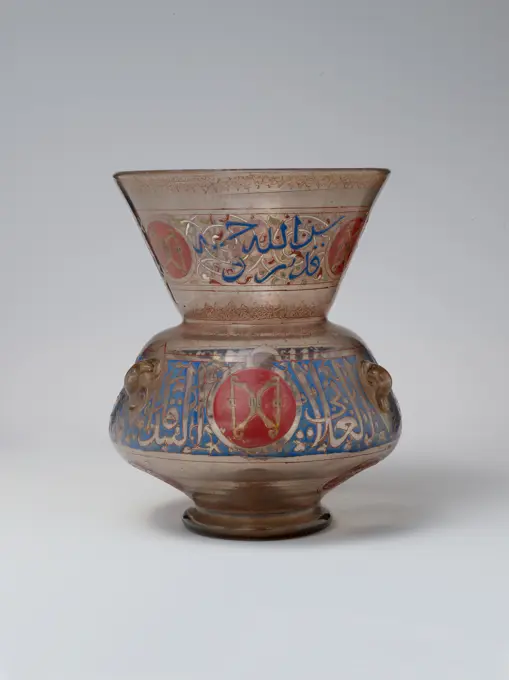
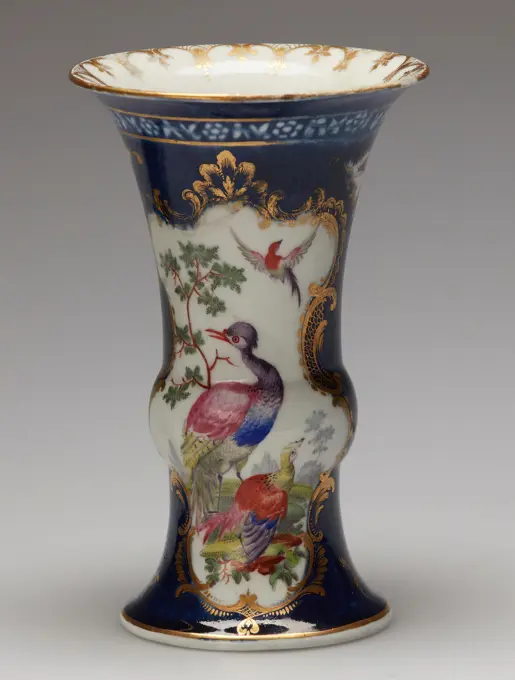
Decorative Porcelain Vases

A selection of ornate vases made from porcelain and faience, featuring intricate designs and vibrant colors reflective of cultural heritage.
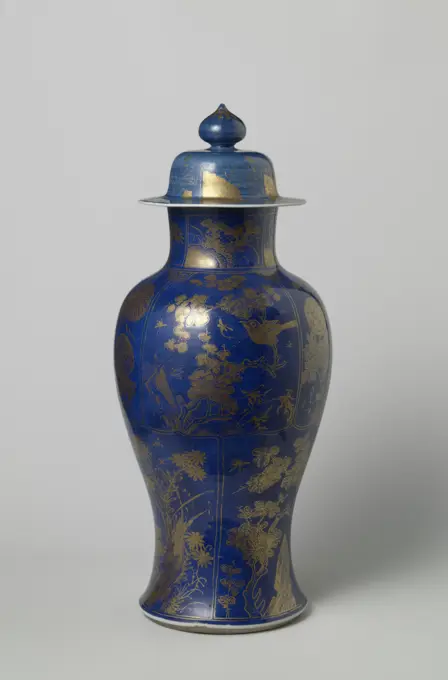
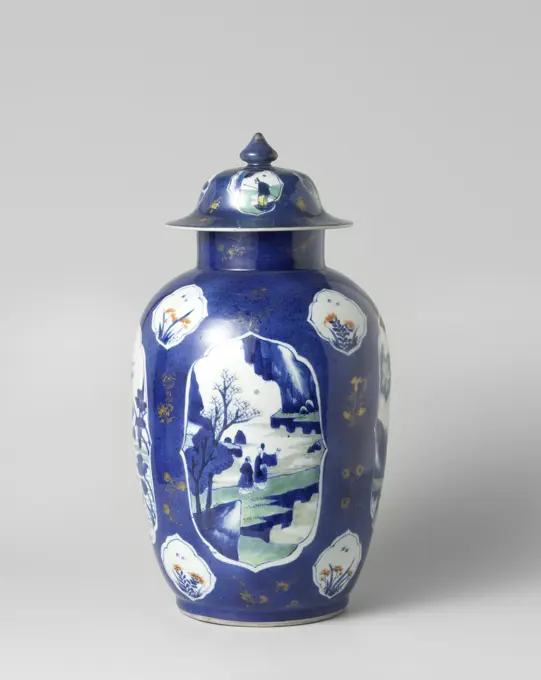
Baluster covered jar with powder blue and flowering plants and animals in panel decoration, anonymous, c. 1700 - c. 1724 Balus -shaped lid jar with long, spreading neck, painted in underly glaze blue and on the glaze gold. The pot is covered with bleu poudré (powder blue) and decorated with three rows of compartments: the bottom row has a different flowering plant or tree in each section with a rock with insects; The second row is also with four different flowering plants (Lotus, chrysanthemum, prunus, peony) with birds and/or butterflies. Around the neck four compartments with different flower areas and butterflies; A double circle on the bottom. The lid with worn decoration of four compartments with flowering plants on a rock and decorative edge. Lid has been restored. Bleu Poudré with gold. China porcelain. glaze. cobalt (mineral). gold (metal) painting / vitrification Balus -shaped lid jar with long, spreading neck, painted in underly glaze blue and on the glaze gold. The pot is co
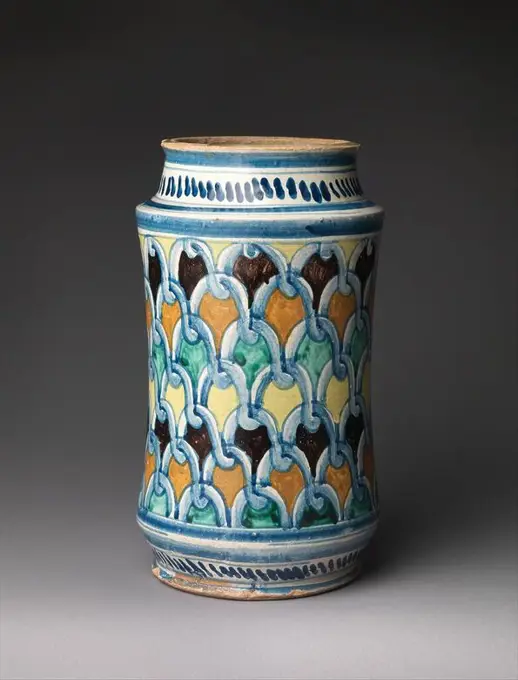
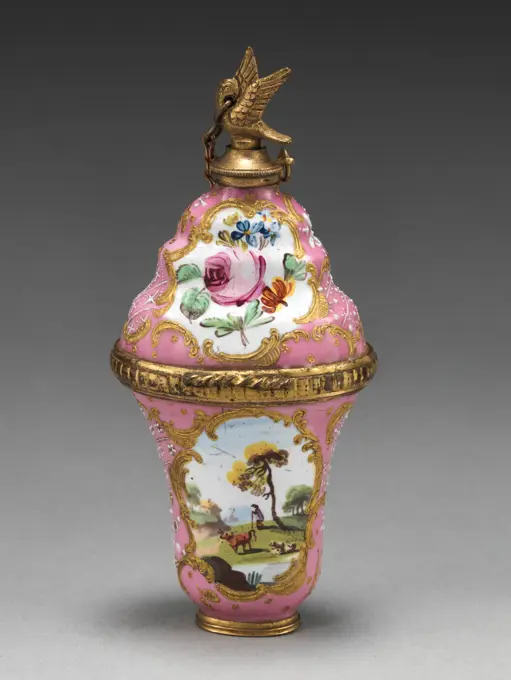
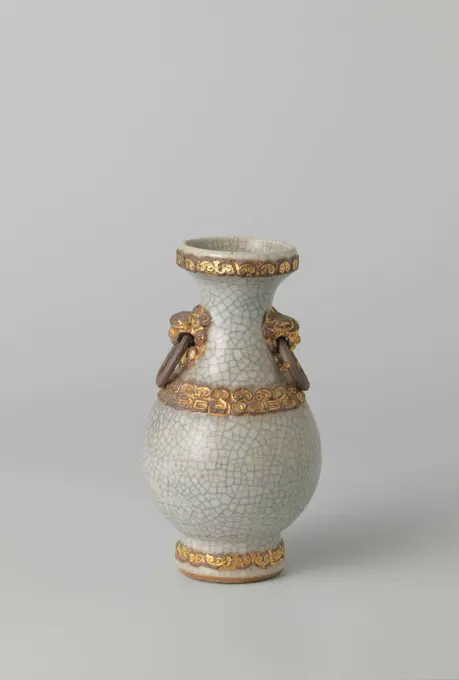
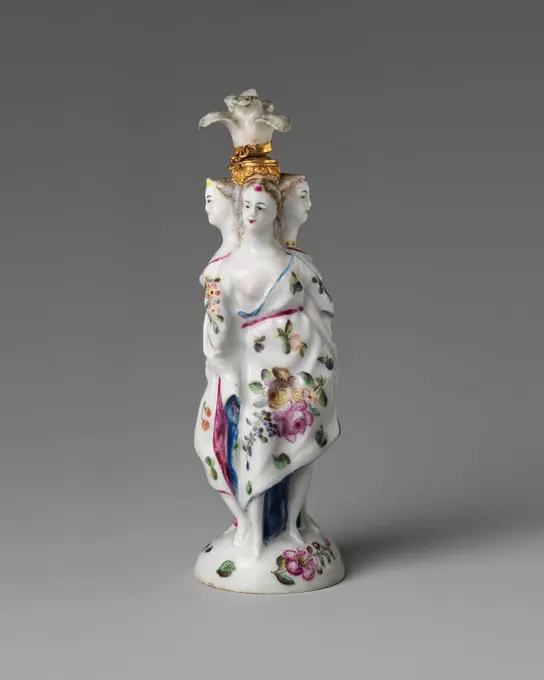
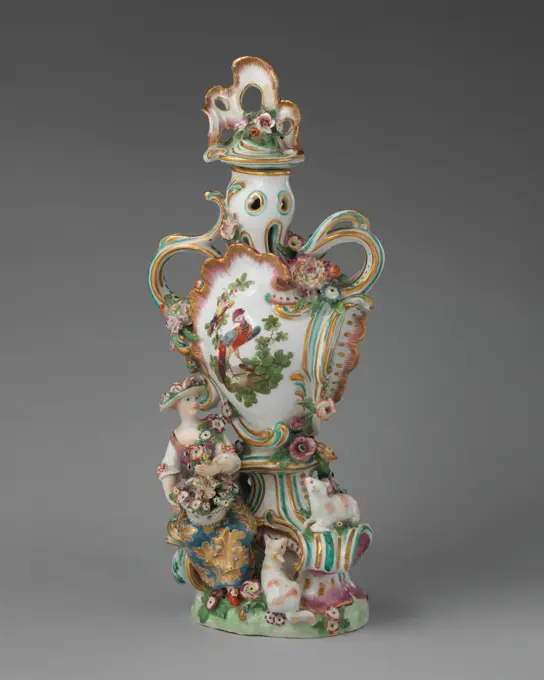
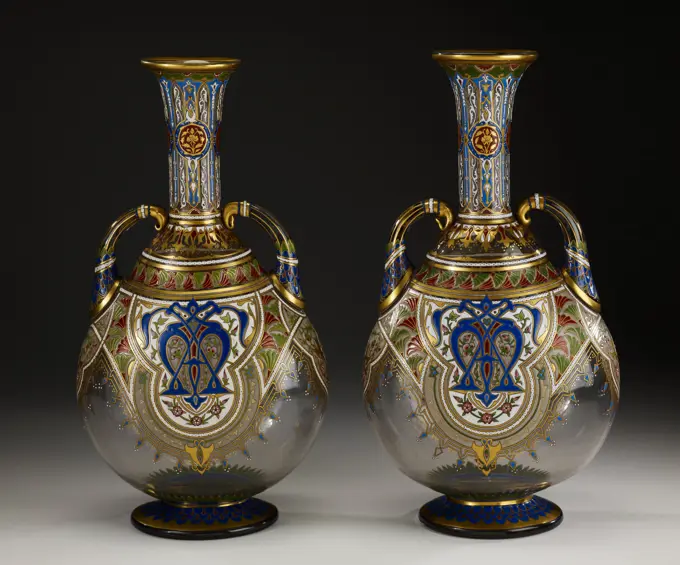
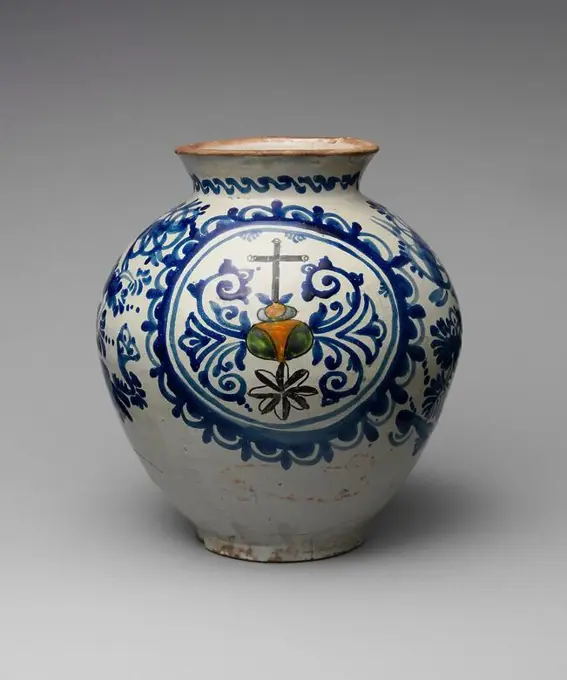
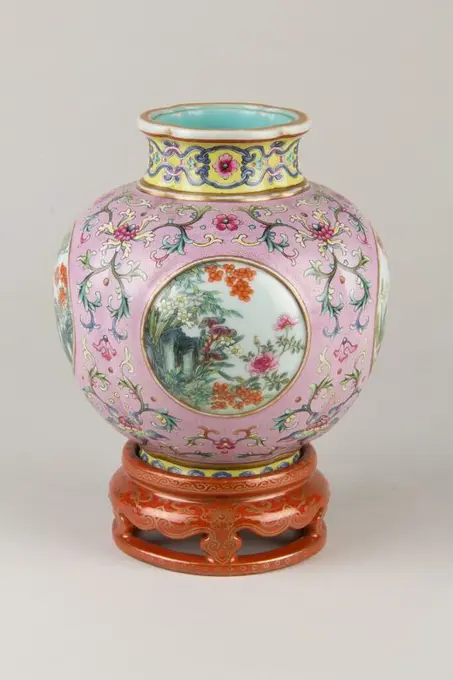
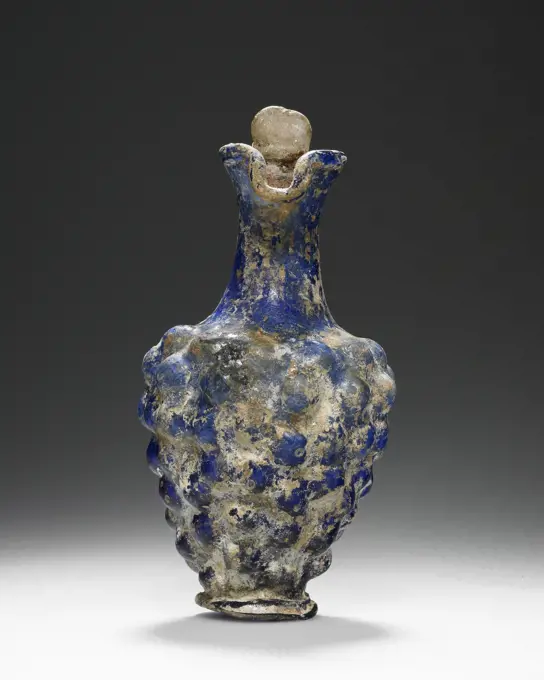
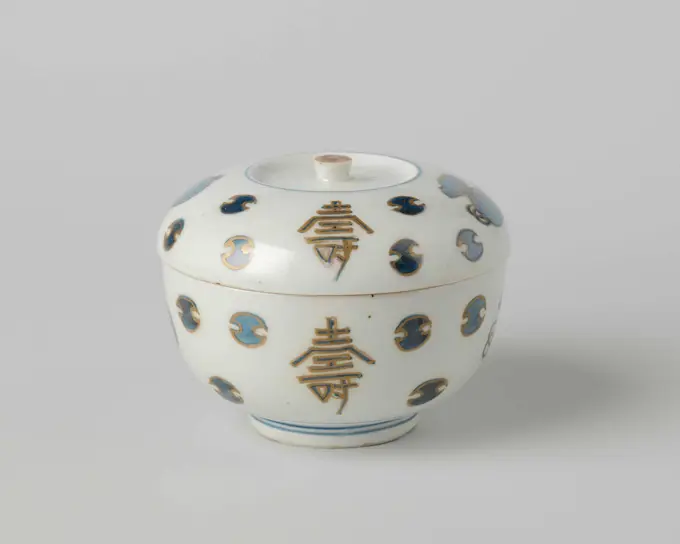
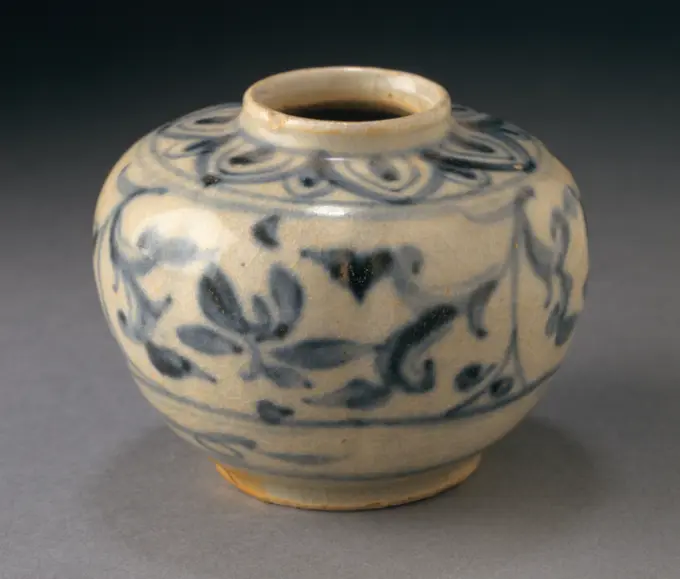
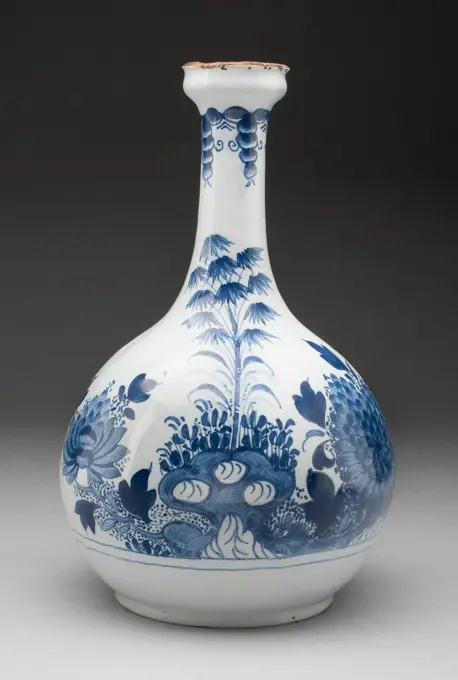
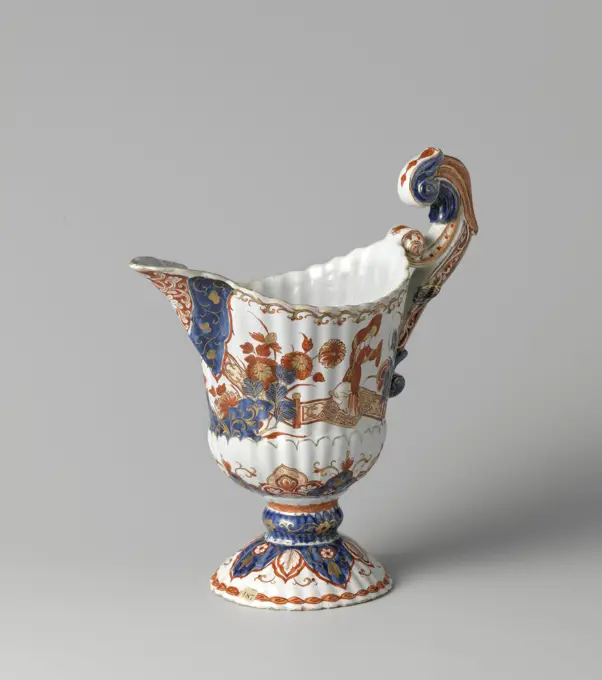
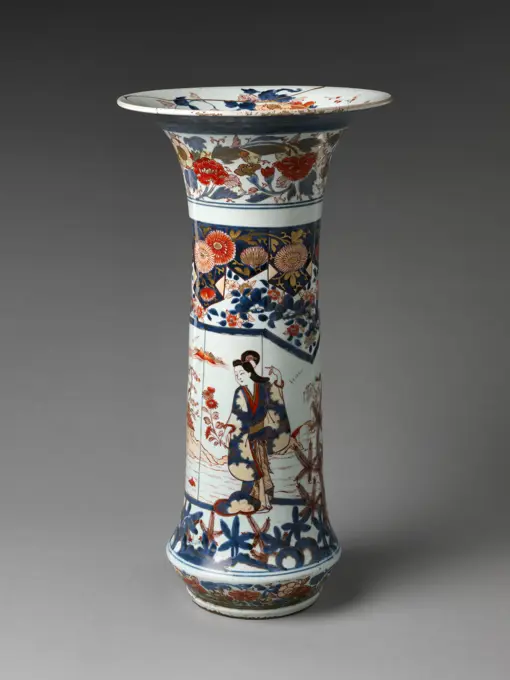
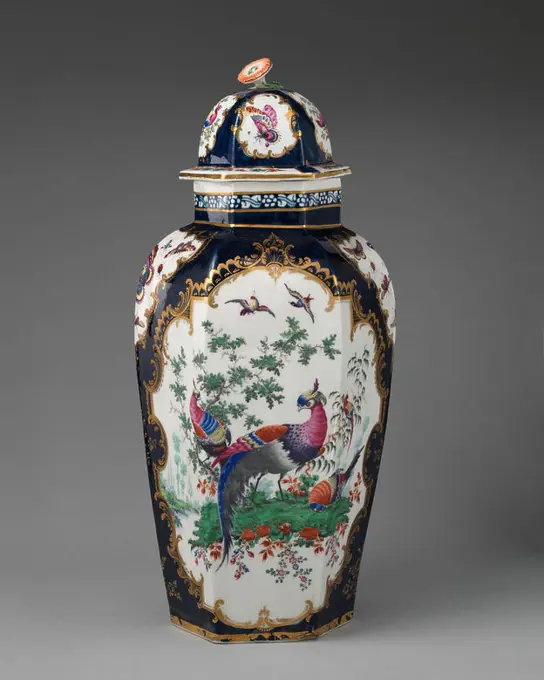
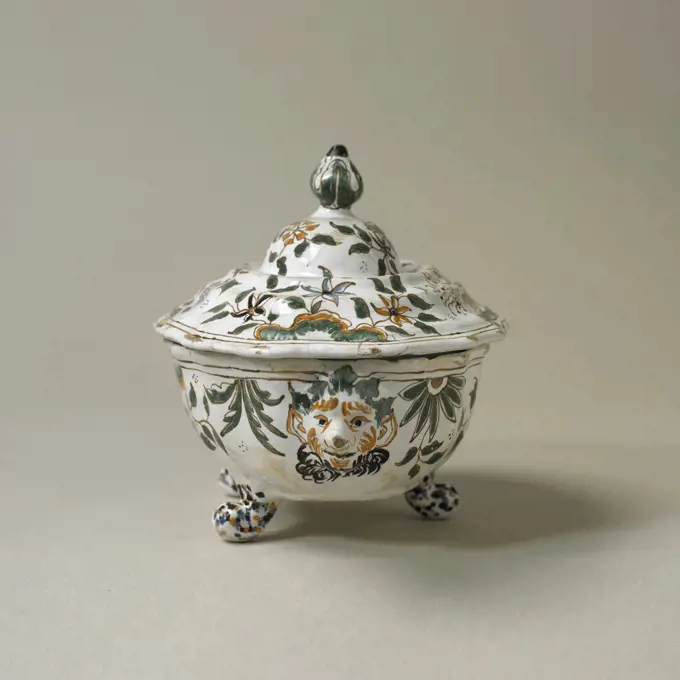
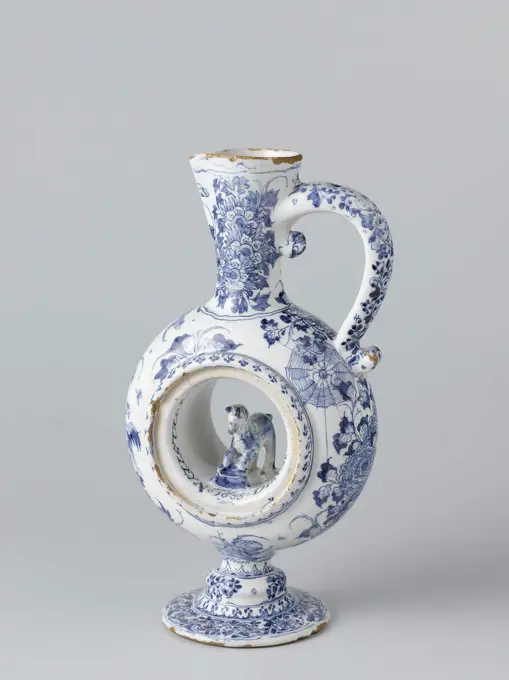
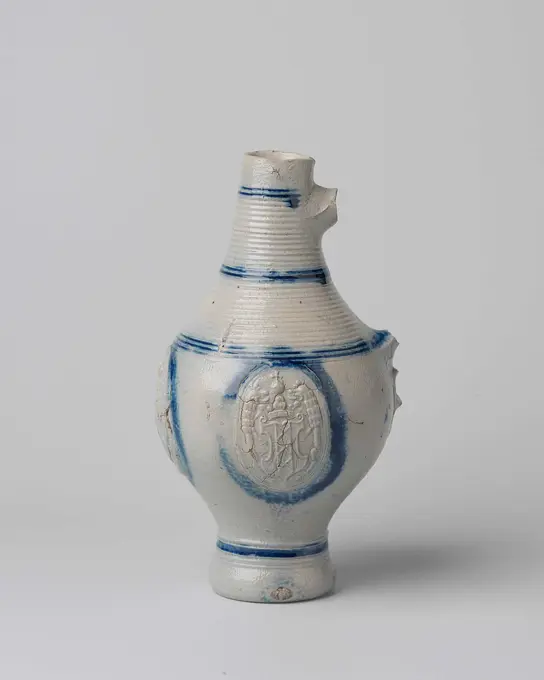
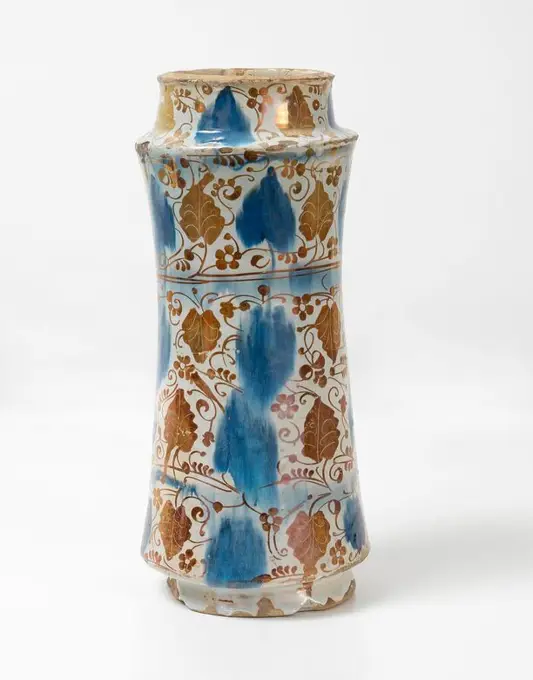
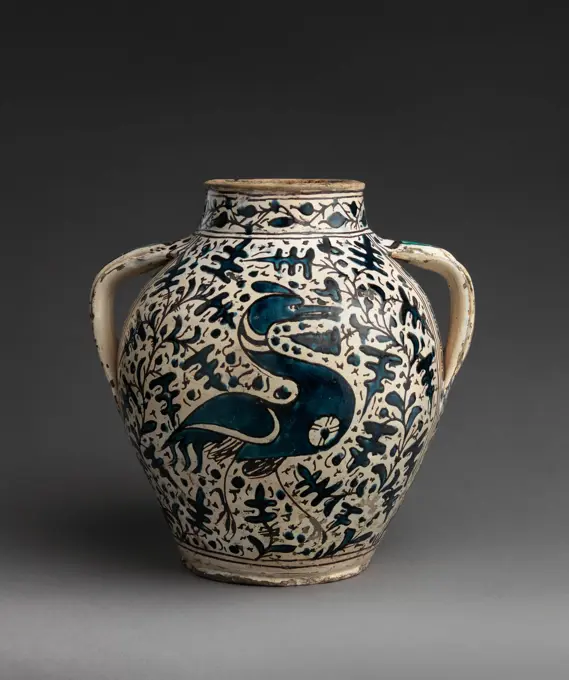
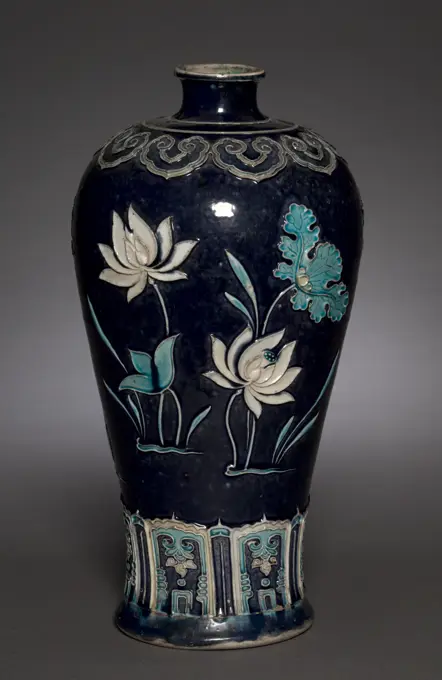
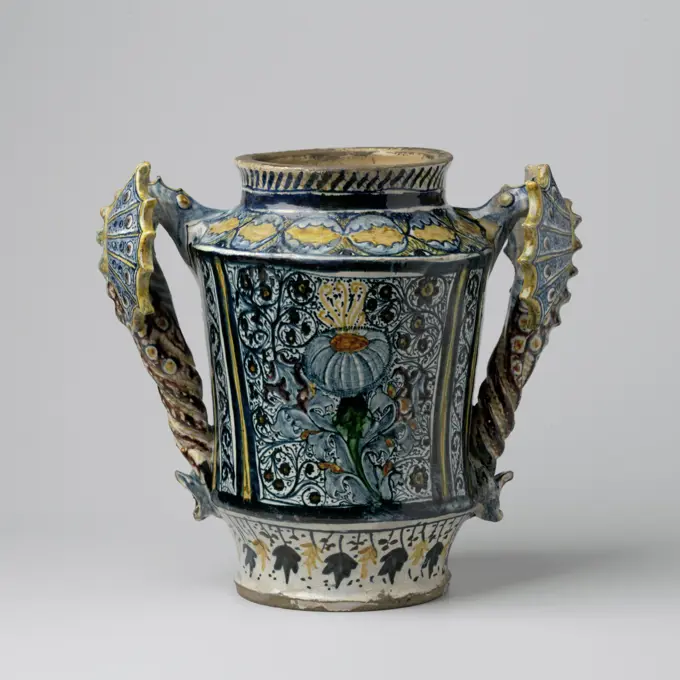
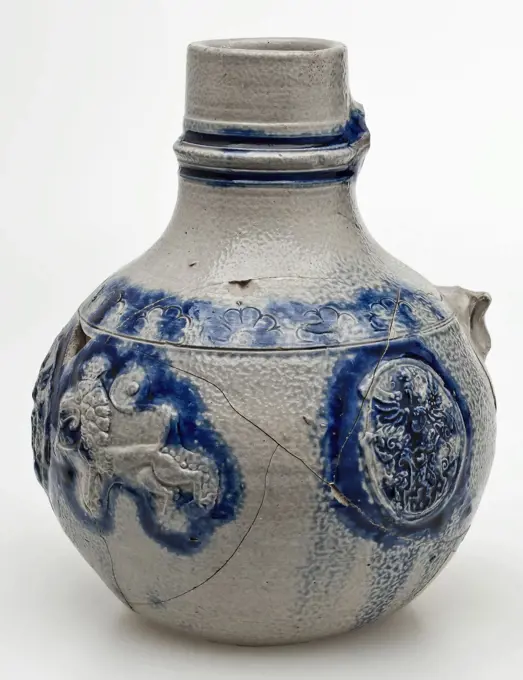
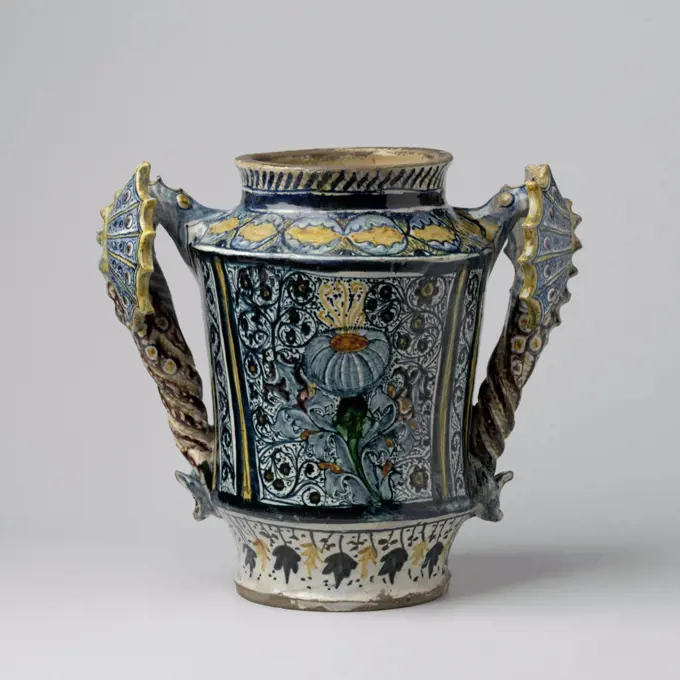
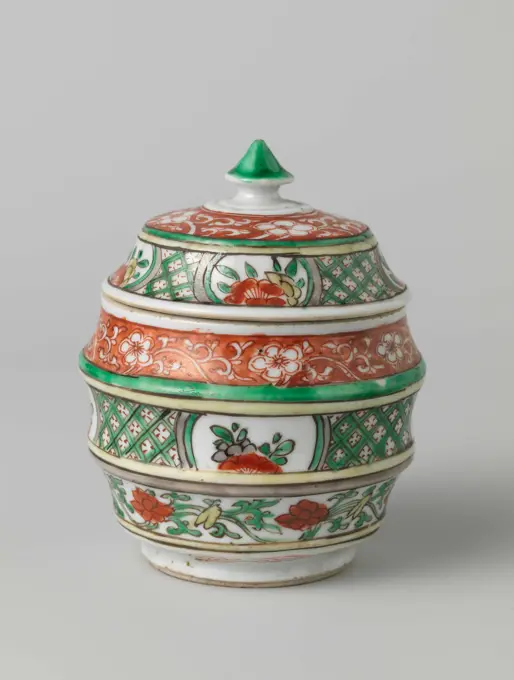
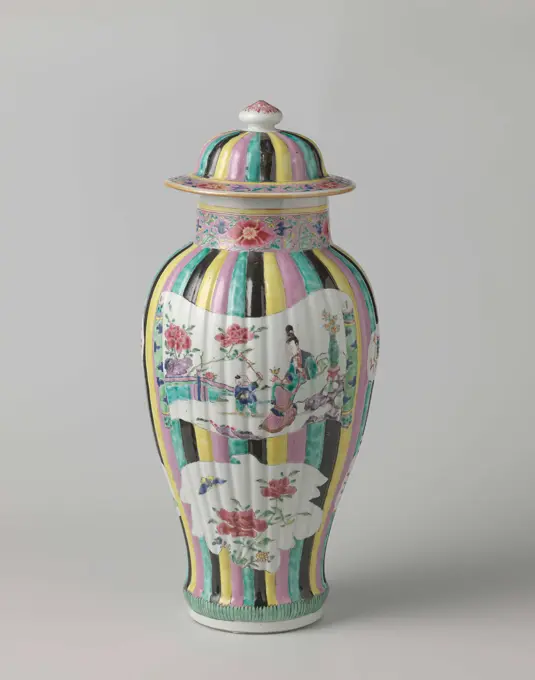
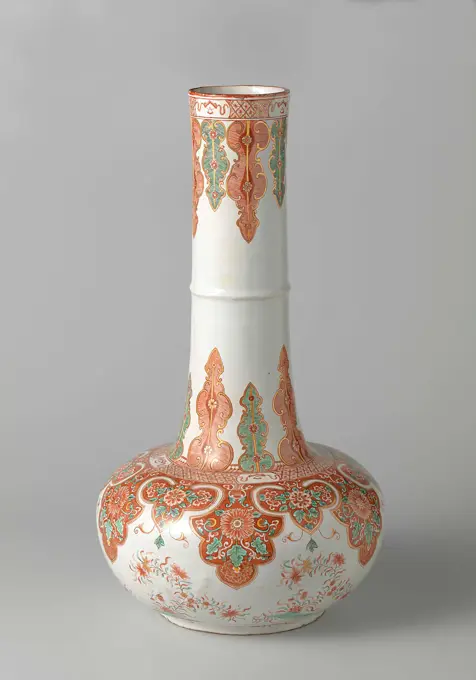
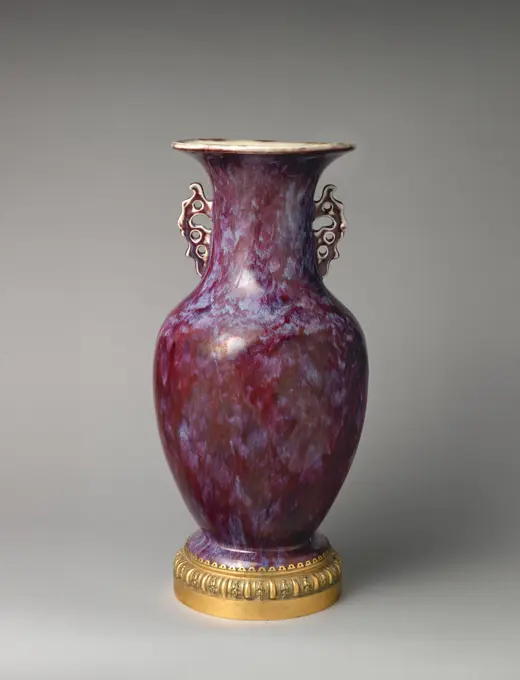
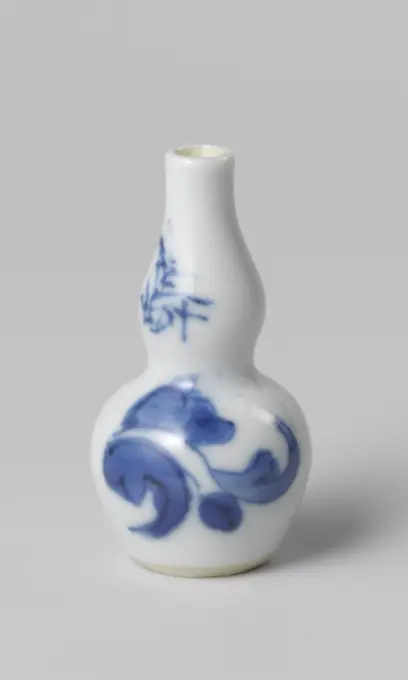
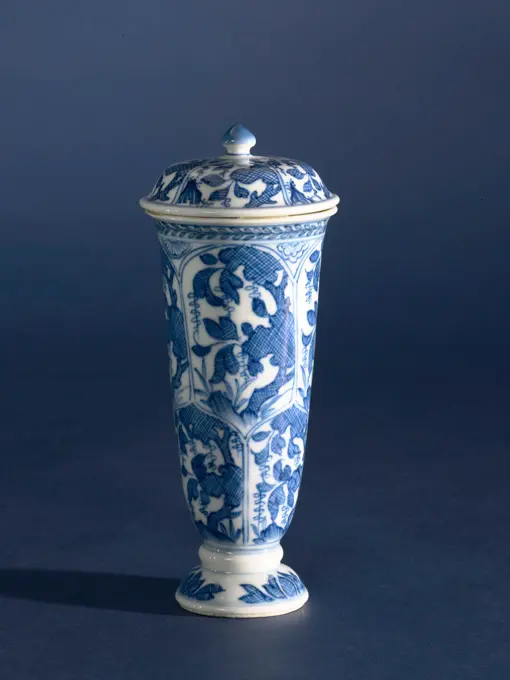
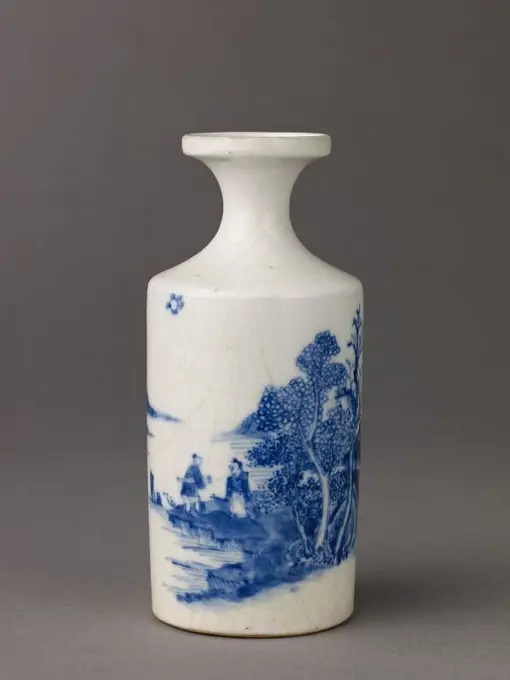
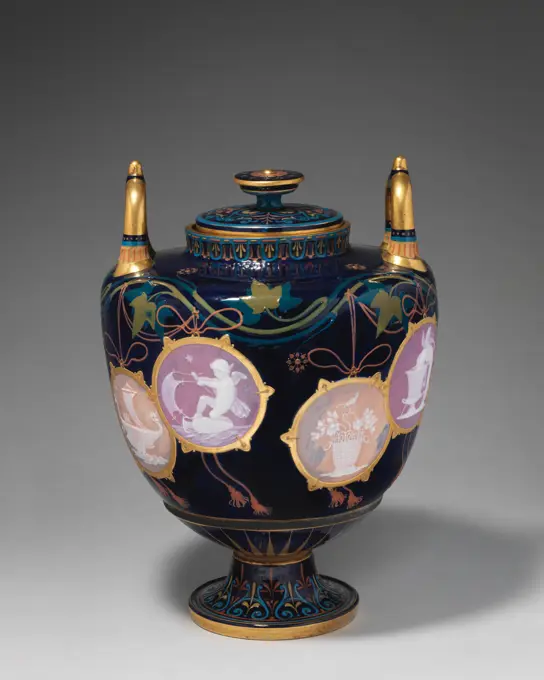
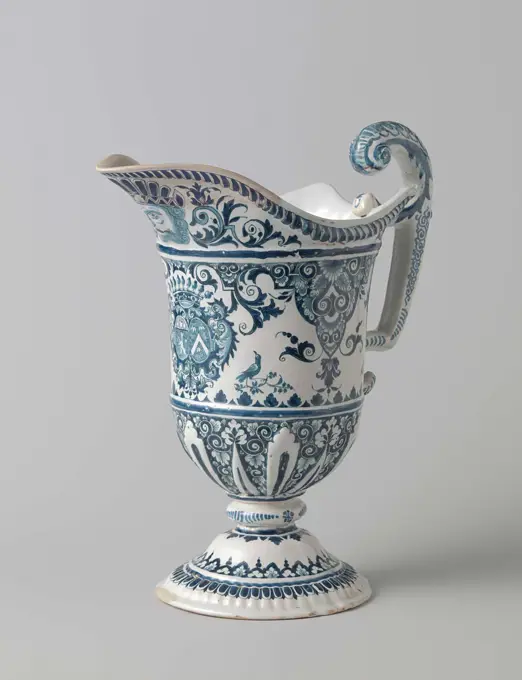
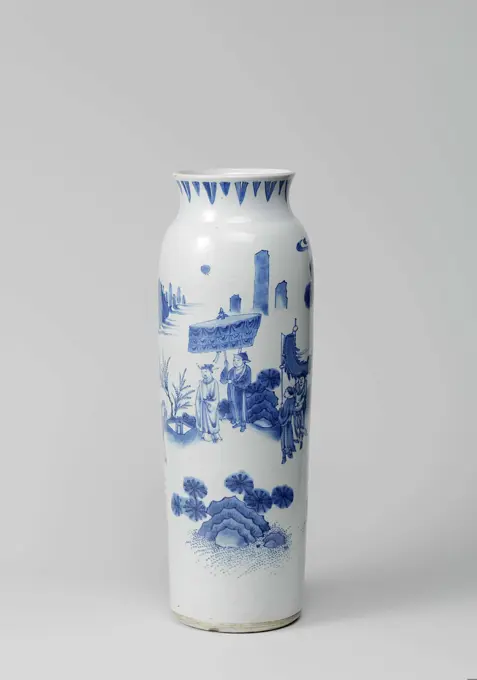
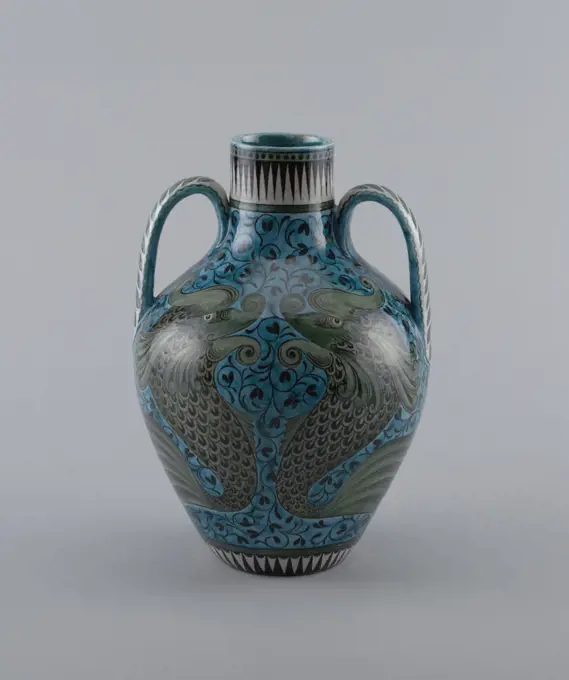
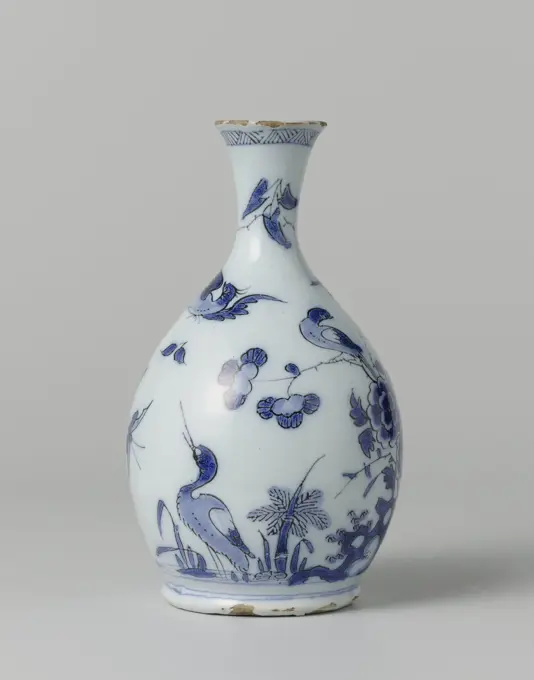
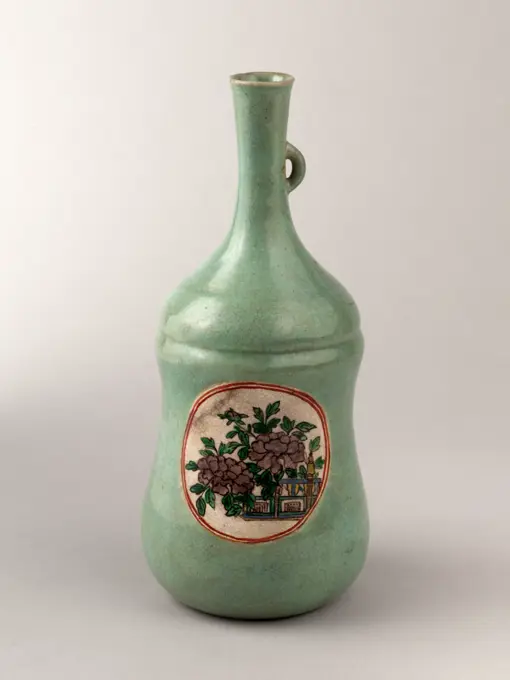
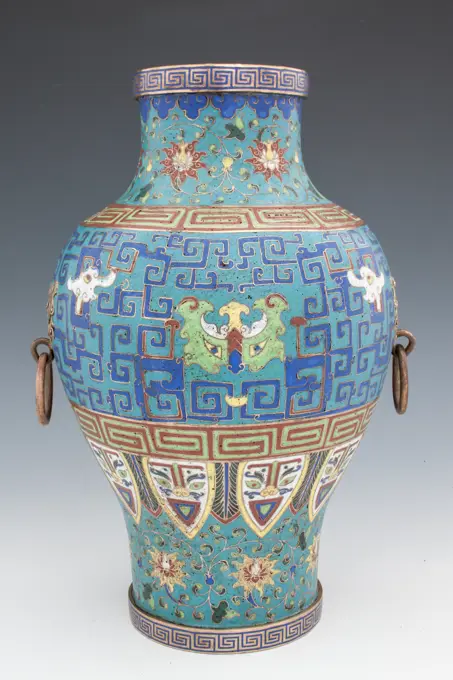
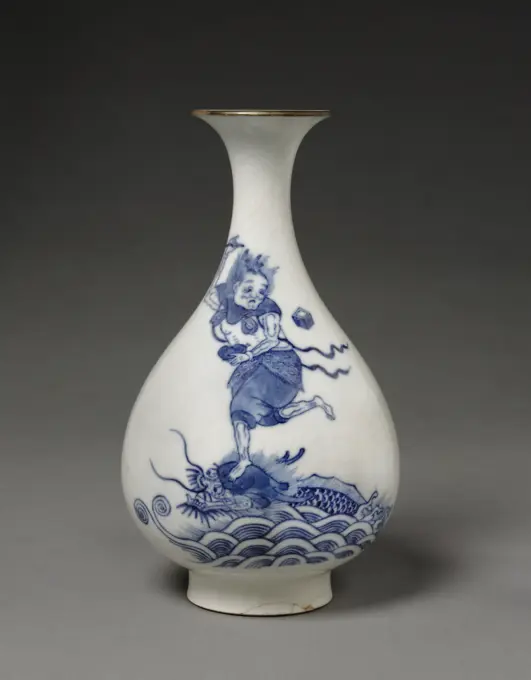
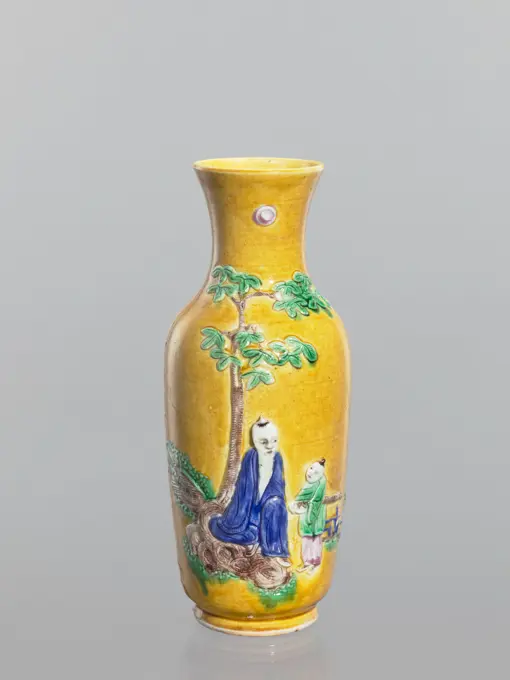
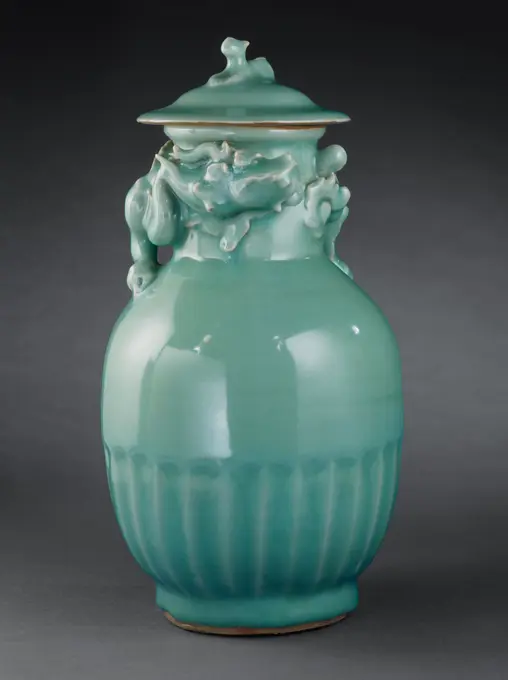
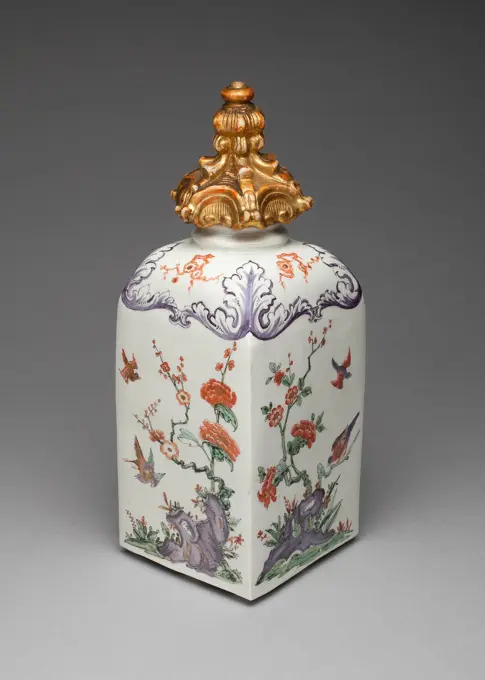
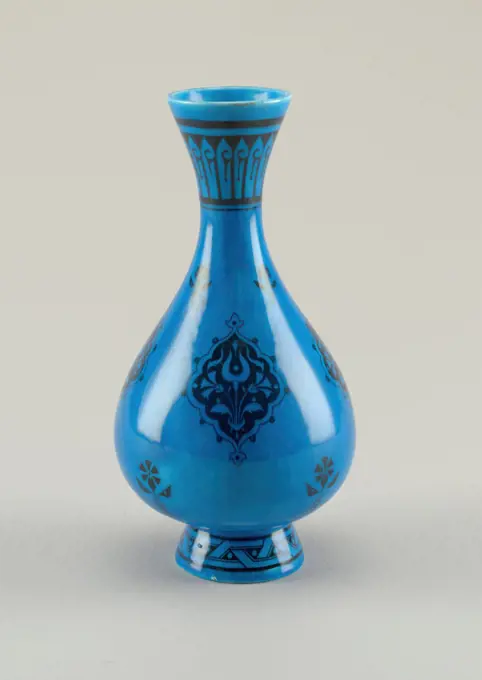
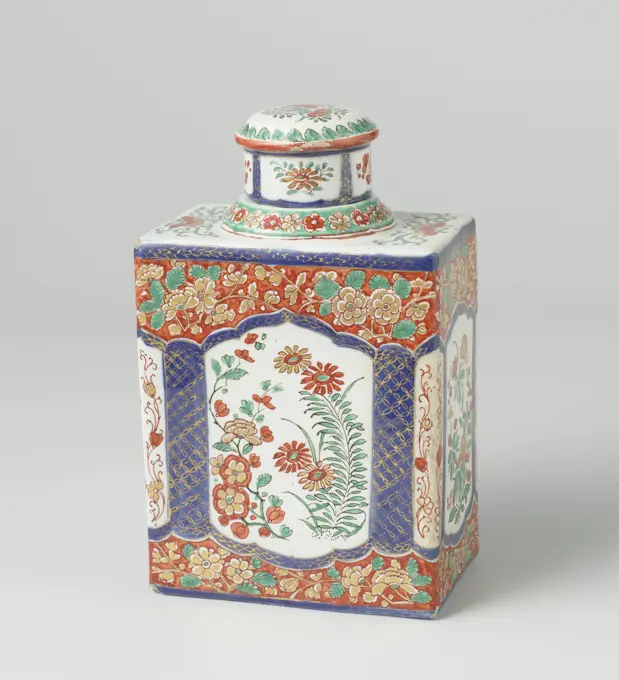
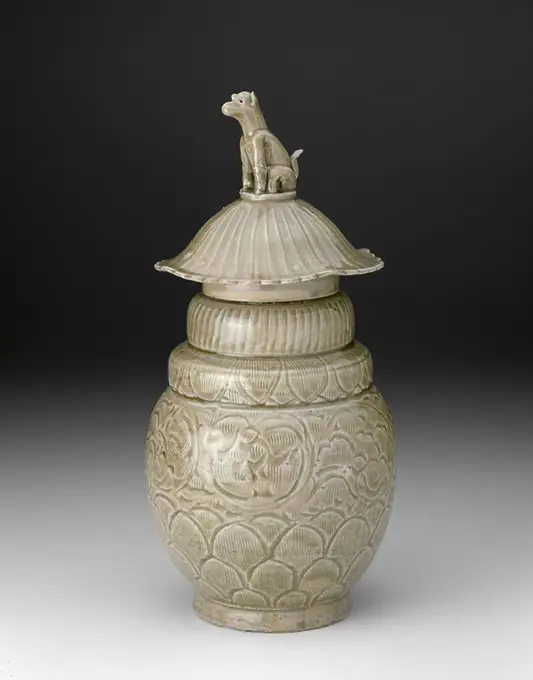
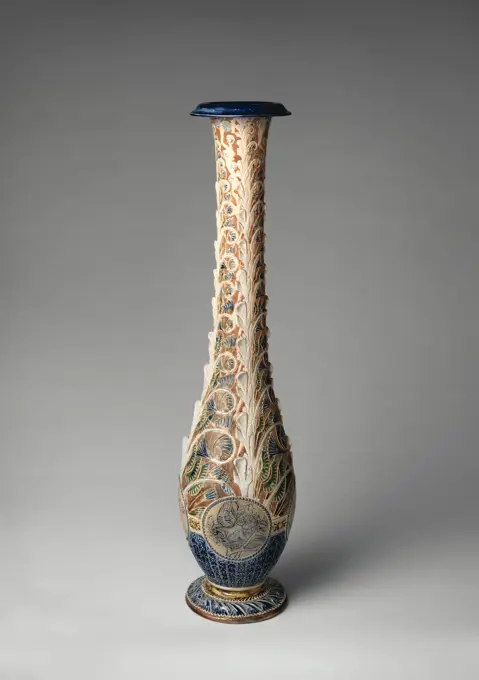
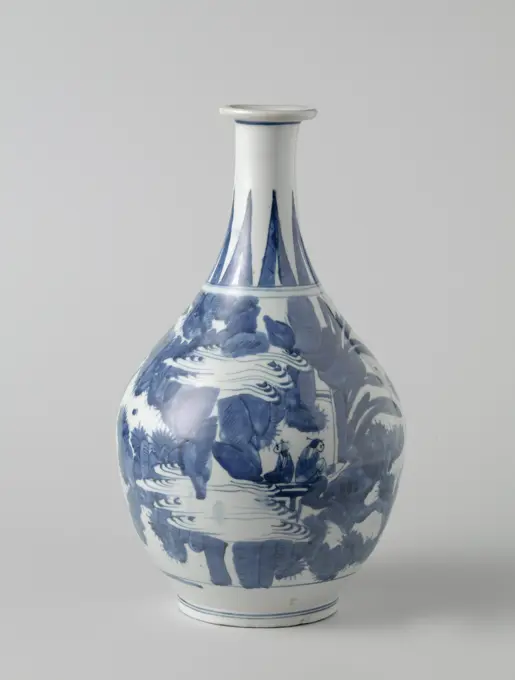
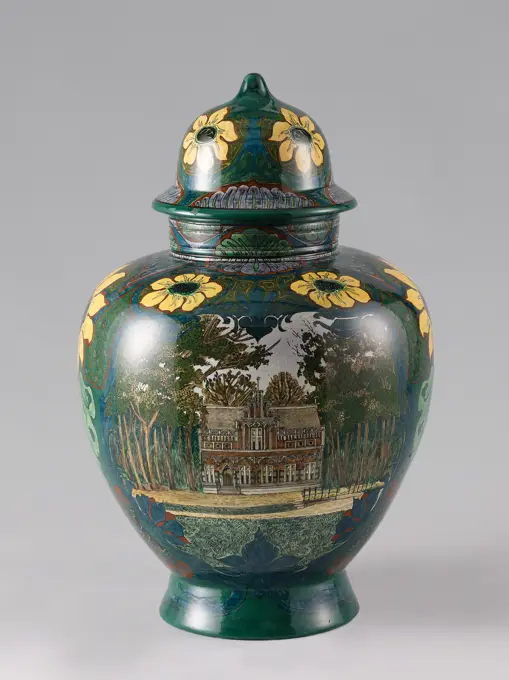
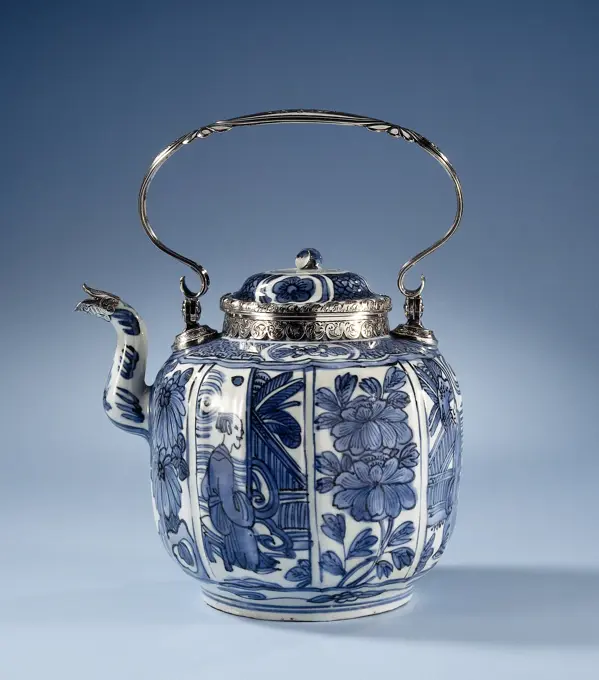
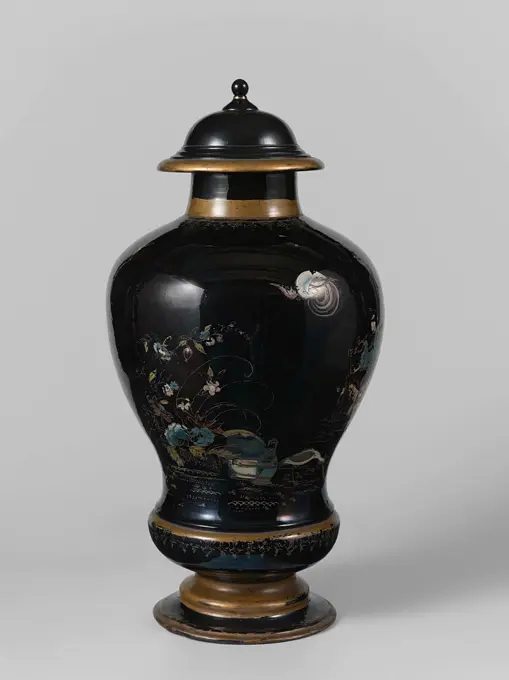
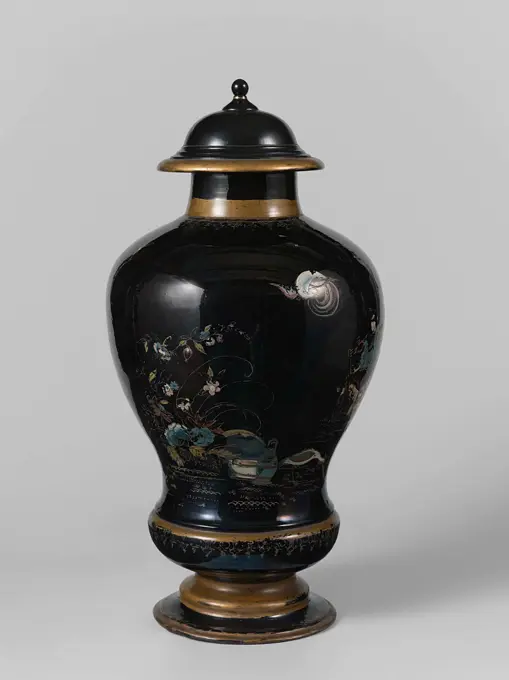
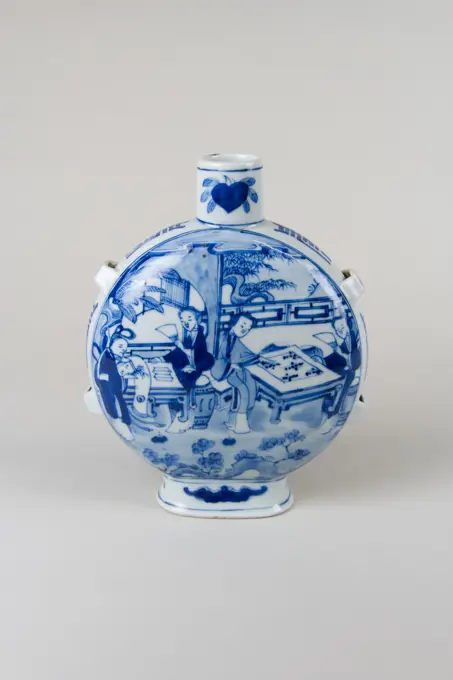
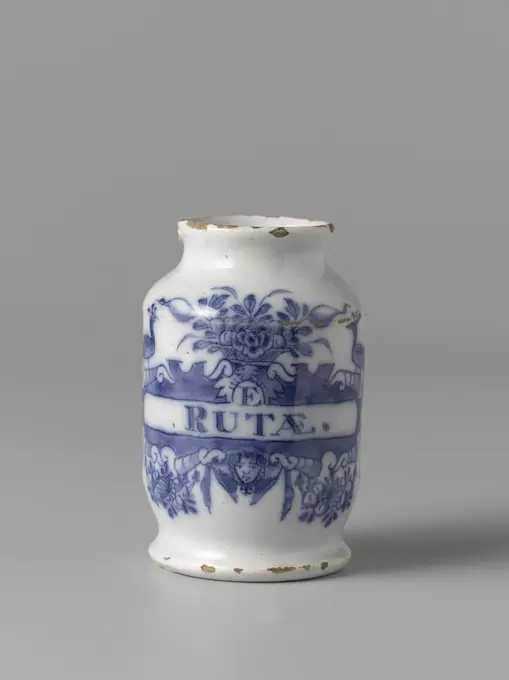
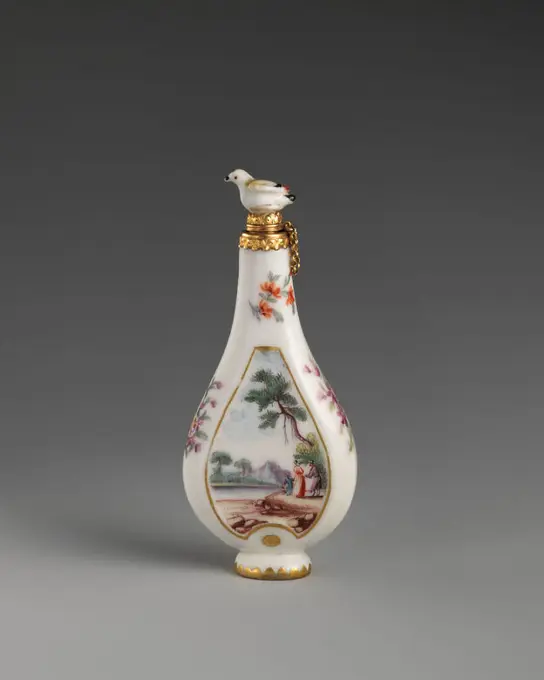
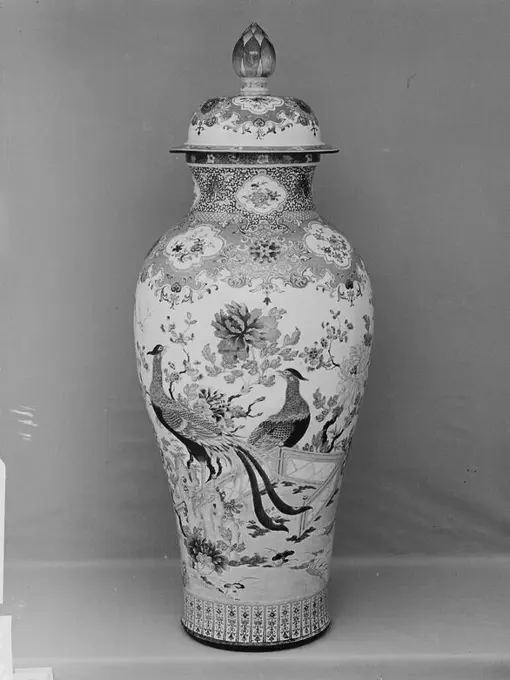
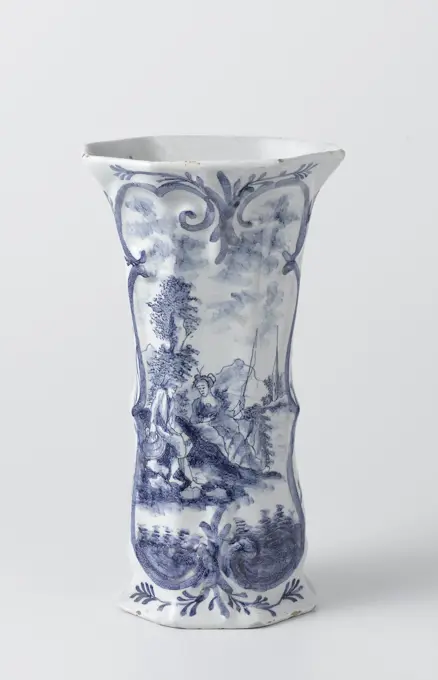
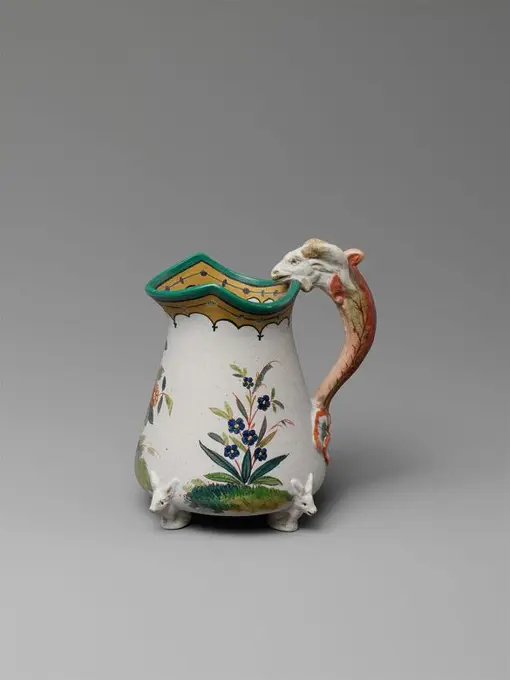
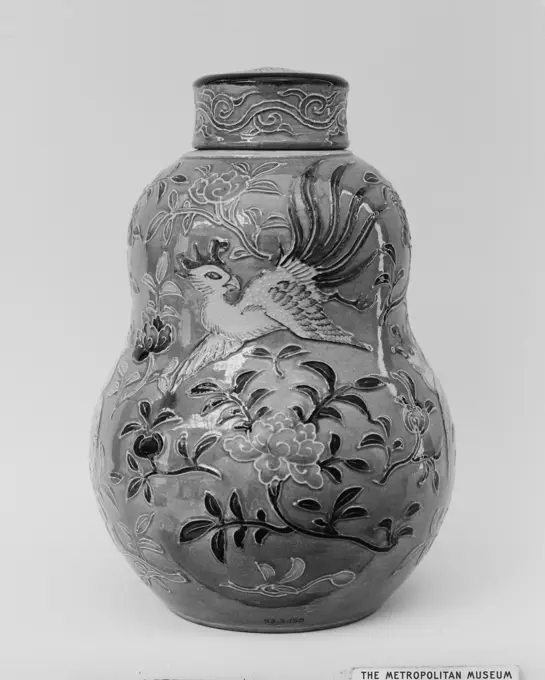
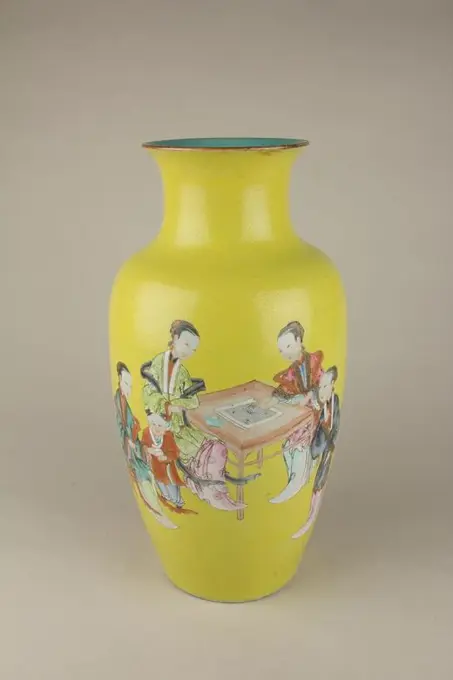
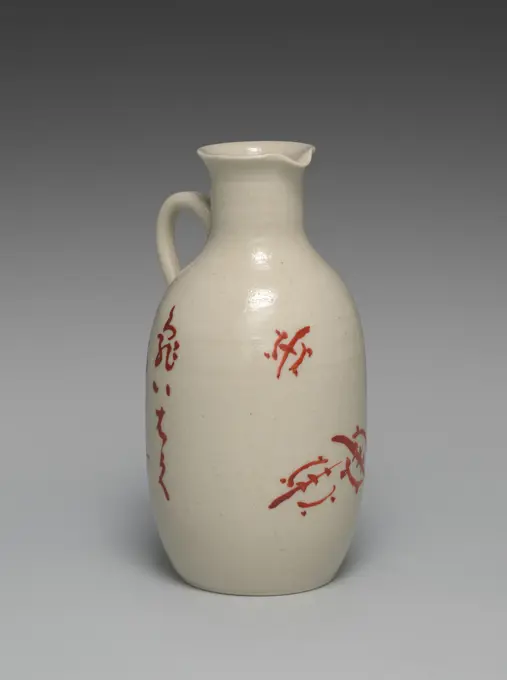
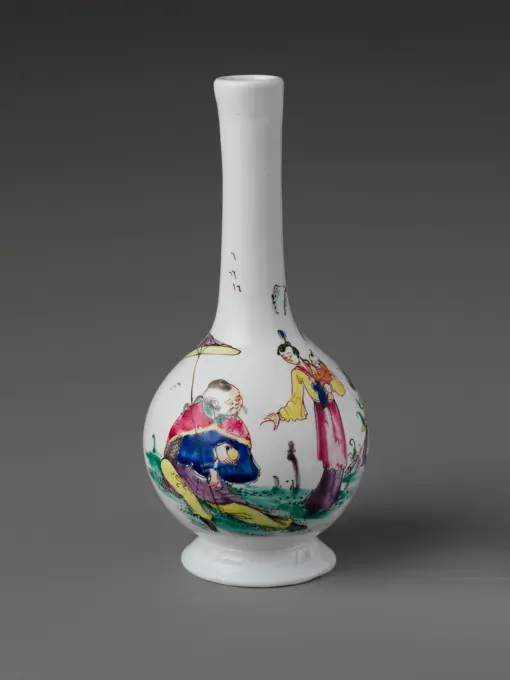
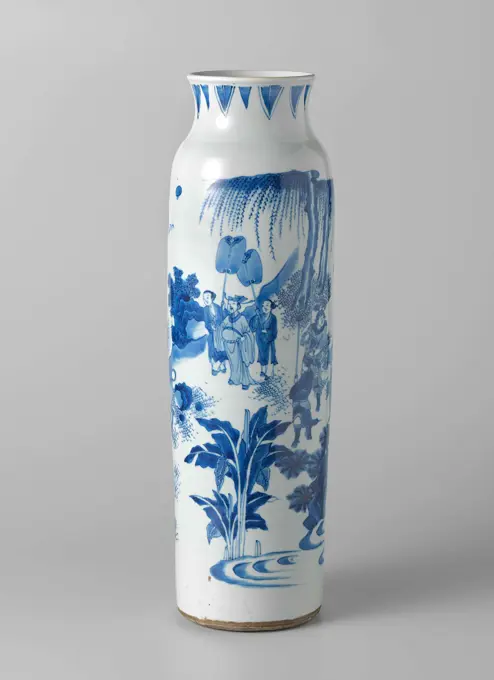
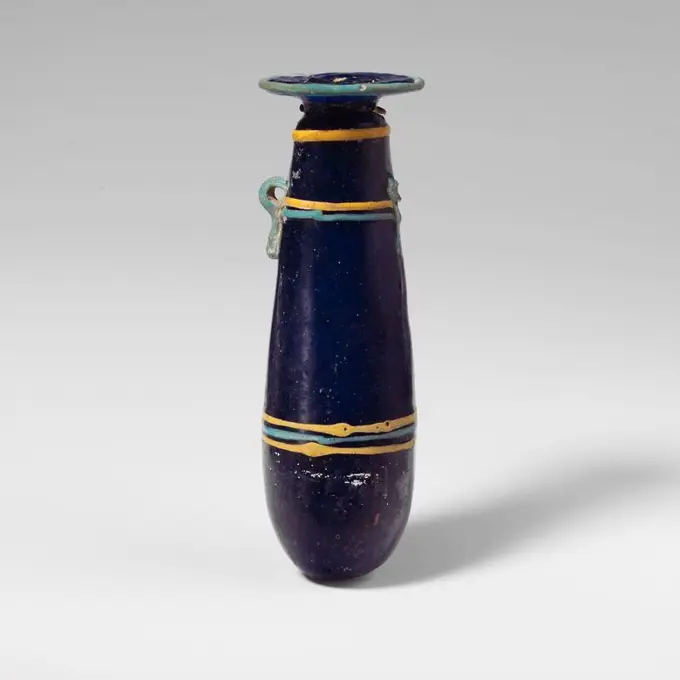
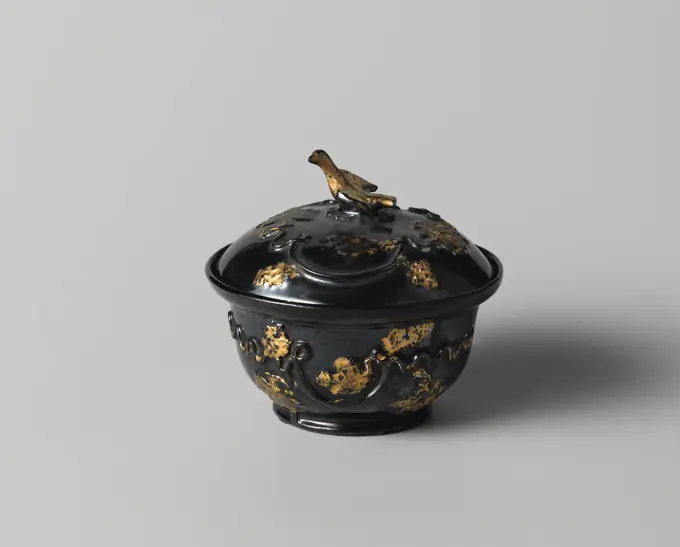
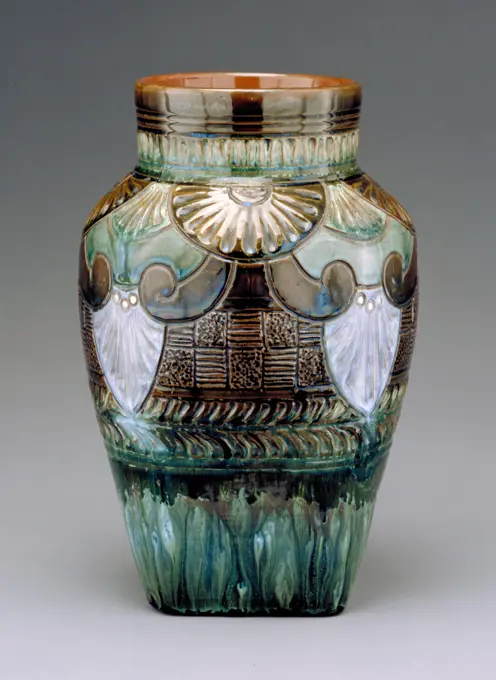
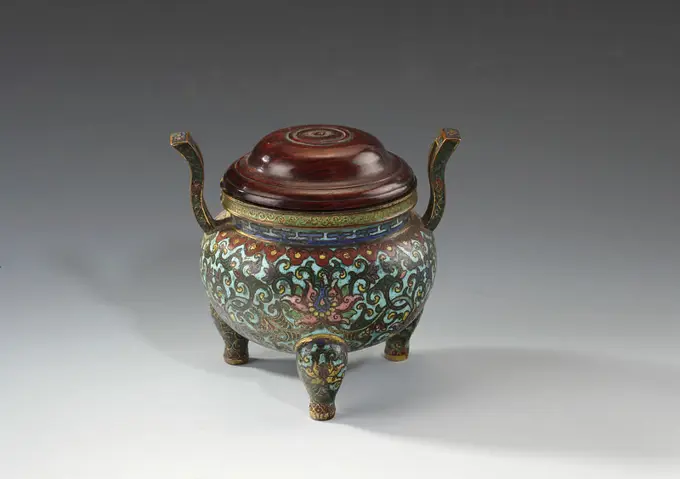
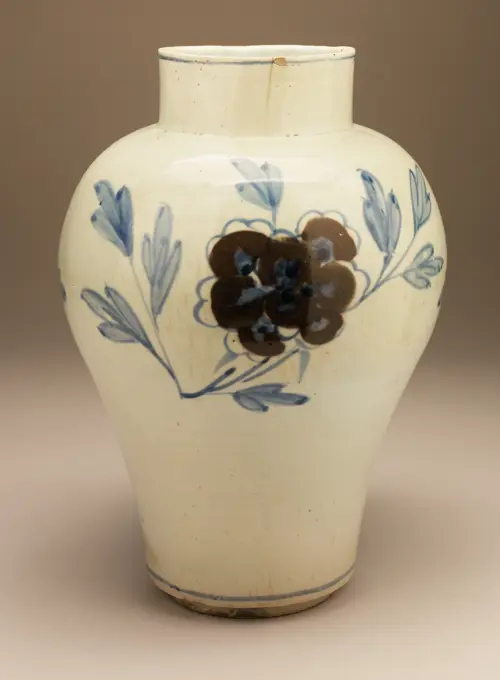
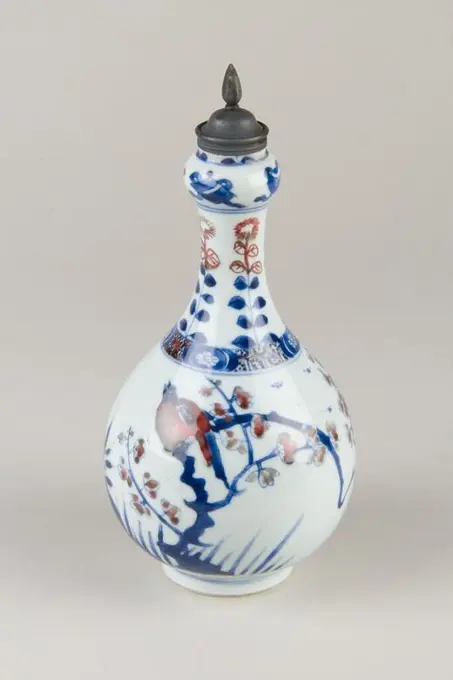
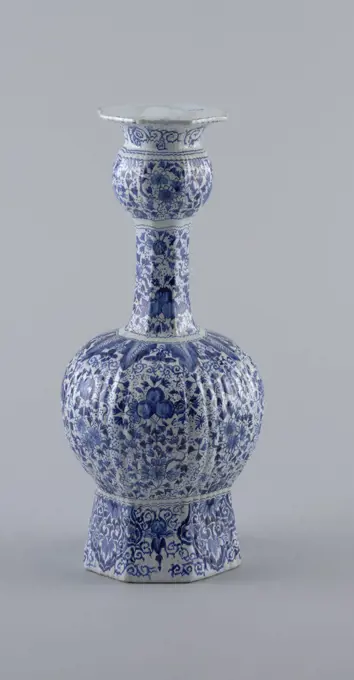
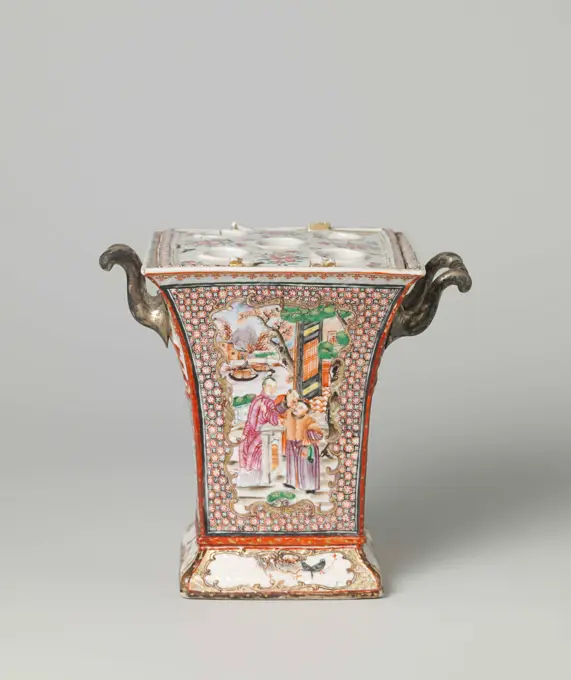
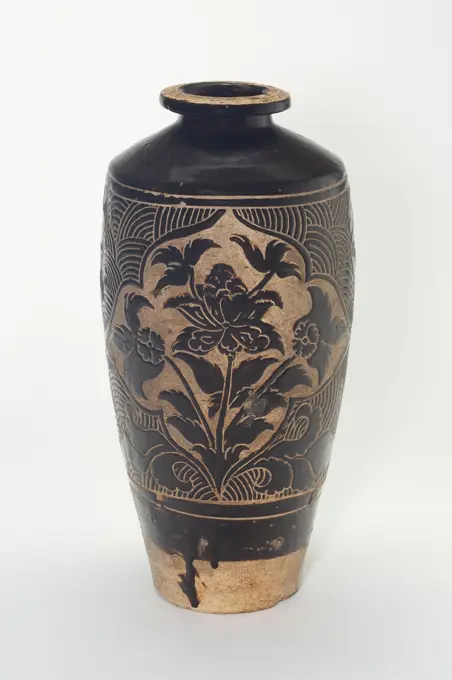
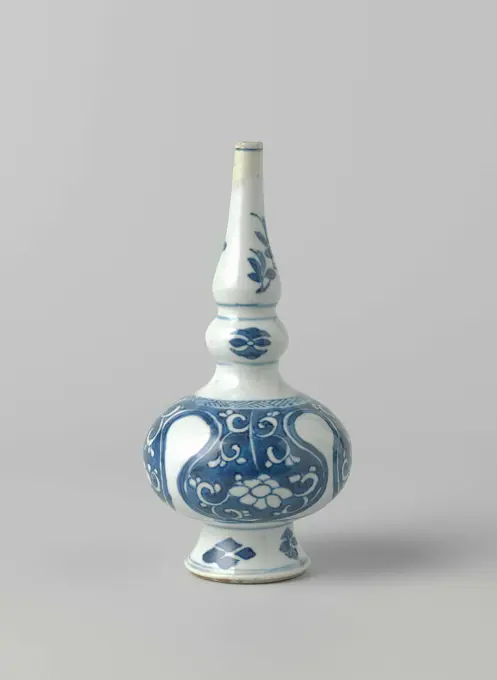
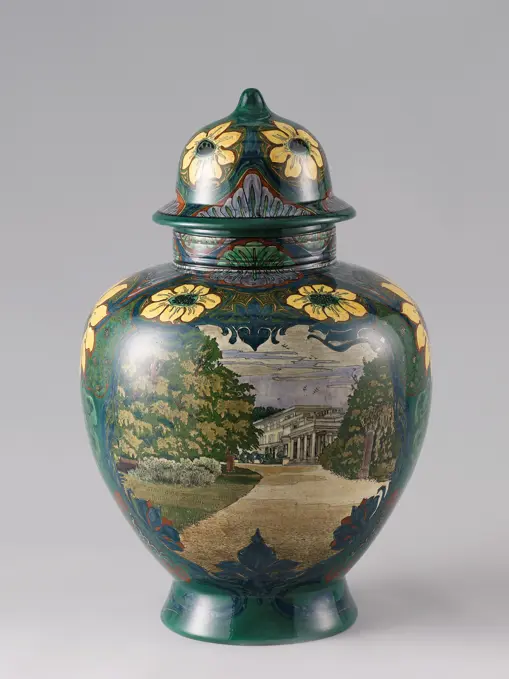
Vaas cover with De Paauw house, N.V. Haagsche Plateel Factory Rozenburg, 1896 Cover of earthenware lid, belonging to a couple of three polychrome painted with sunflowers and topographical representations. Four sunflowers are painted on the lid. The Hague earthenware Cover of earthenware lid, belonging to a couple of three polychrome painted with sunflowers and topographical representations. Four sunflowers are painted on the lid. The Hague earthenwareVase of earthenware, painted with butterfly -like motifs, palmets etc., Plateelbakkerij Arnhem, c. 1910 - c. 1915 Vase of earthenware, flattened spherical body with long neck and two ears. Painted in blue, yellow, green and orange with butterfly -like motifs, palmets etc. on matte yellowish soil. Arnhem earthenware Vase of earthenware, flattened spherical body with long neck and two ears. Painted in blue, yellow, green and orange with butterfly -like motifs, palmets etc. on matte yellowish soil. Arnhem earthenwareJar. Culture: Mexican. Dimensions: H. 10 3/8 in. (26.4 cm); Diam. 4 3/8 in. (11.1 cm). Date: ca. 1775-1800. Museum: Metropolitan Museum of Art, New York, USA.Vase. Culture: China. Dimensions: H. with stand: 8 in. (20.3 cm); Diam. 6 in. (15.2 cm); Diam. of rim 3 1/16 in. (7.8 cm); Diam. of foot 4 in. (10.2 cm). Museum: Metropolitan Museum of Art, New York, USA.Blue Grape-Cluster Pitcher; Eastern Mediterranean; about 1st - 2nd century; Glass; 12 cm (4 3,4 in.)Box with carachters and auspicious Symbols. Box of porcelain with lid, painted in underglaze blue and on the glaze eggplant, turquoise, black and gold. The outer wall of the box with lucky symbols (hammer, pouch, coins) and two characters (happiness and prosperity, long life). On the bottom shells. The lid with the same decoration; Established medallion in the center with the lid knob in it.Teapot (part of a service) ca. 1750-55 Doccia Porcelain Manufactory Italian. Teapot (part of a service). Manner of Jacques Stella (French, Lyons 1596-1657 Paris). Italian, Florence. ca. 1750-55. Hard-paste porcelain. Ceramics-PorcelainJarlet in the Form of a Melon with Floral Scroll and Petals. Vietnam, 1450-1550. Furnishings; Serviceware. Wheel-thrown stoneware with cream slip, underglaze blue painted decoration, and clear glazeBottle Made 1745-1755 Liverpool .Ewer and Basin, the Greek A, c. 1701 - c. 1722 Can from Faïence. Multicolored painted with figures in a garden and lambrequinrand. Delft . Can from Faïence. Multicolored painted with figures in a garden and lambrequinrand. Delft .Vase in Trumpet Shape 1700 Japan. Vase in Trumpet Shape. Japan. 1700. Porcelain decorated in polychrome enamels and gold (Arita ware, Imari type). Edo period (1615-1868). CeramicsVase with cover. Culture: British, Worcester. Dimensions: Height: 16 1/4 in. (41.3 cm). Factory: Worcester factory (British, 1751-2008). Date: ca. 1770-75. Museum: Metropolitan Museum of Art, New York, USA.Sauce tureen and lid, Tin-glazed earthenware, Shaped ovoid tureen on three feet; stepped, domed cover with central knop; green and ochre decoration of birds, flowers and foliage., Moustiers-Sainte Marie, France, 1760s-80s, ceramics, Decorative Arts, Sauce tureen and lid. Can of faïence with hollow belly, in which a projected horse. In the cavity the inscription: Dirck Janse from YSeltsteyn Anno 1658.Jug. Gray with blue jug of stoneware. Decorated with the arms of Amsterdam.Pharmacy pot, Third quarter of the 15th century, Ceramics (earthenware decorated in blue and metallic reflections), of Manises or Paterna, Valencia, Height: 30 cm. Museum: Museo Fundación Francisco Godia, Barcelona, Cataluña, España.Apothecary jar (orciuolo) probably 1431 perhaps workshop of Giunta di Tugio It is likely that this large and impressive apothecary jar, decorated with a crane against a ground of oak leaf foliage, belonged to the pharmacy of the Arcispedale Santa Maria Nuova, Florence's oldest and most distinguished hospital. Its likely maker, Giunta di Tugio, delivered many maiolica wares to the hospital, especially in the year 1431. The existence of other apothecary jars in the same style, also bearing the hospital's emblem, a crutch, suggests that they all form part of an extensive commission of maiolica wares executed by Giunta after Hispano-Moresque prototypes.. Apothecary jar (orciuolo). perhaps workshop of Giunta di Tugio (Italian (Florence), active ca. 1430-1466). probably 1431. Maiolica (tin-glazed earthenware). Ceramics-PotteryPot of multicolored painted faïence. Pot of Faïence. Multicolor painted with flower decorations. The pot is part of a cabinet set.Prunus Vase (Meiping) with Blossoming Lotus, late 1400s. China, Jiangxi province, Jingdezhen kilns, Ming dynasty (1368-1644). Porcelain with polychrome glazes, Fahua ware; diameter: 19 cm (7 1/2 in.); overall: 37.5 cm (14 3/4 in.).Albarello, multi -colored painted with flower vines and oval coat of arms, anonymous, c. 1480 - c. 1500 Albarello of multicolored painted Majolica. The vase has a sloping base and shoulder and a low cylindrical neck. The two ears are winged samples. The Albarello is painted on both sides with fine flower vines between which a flower (Anjelier) on one side and an oval coat of arms on the other. Faenza earthenware. tin glaze. lead glaze majolica Albarello of multicolored painted Majolica. The vase has a sloping base and shoulder and a low cylindrical neck. The two ears are winged samples. The Albarello is painted on both sides with fine flower vines between which a flower (Anjelier) on one side and an oval coat of arms on the other. Faenza earthenware. tin glaze. lead glaze majolicaVase;  XVIII/19th century (1790-00-00-1810-00-00);Cantonese vase. unknown, craftsman. Pot of faience with a decoration to the Chinese porcelain from the transition period.Unknown (n. - d.), Vase (main title). Ceramics, porcelain, moufle fire enamels. Petit Palais, Museum of Fine Arts of the City of Paris.Vase third quarter 18th century British mount and Korean ceramic. Vase 205694Ovoid jar and domed cover with bleu poudré and panels in reserve with landscapes and antiquities, anonymous, c. 1700 - c. 1724 Egg -shaped pot of porcelain, painted in underly glaze blue and red and on the glaze green, yellow, eggplant and gold. The pot is covered with bleu poudré (powder blue) with four elongated cartouches in reserve with scalloped edge filled with a crane and a deer in a landscape, antiques (vas, books, tanning burner), valuables (Artemisiablad, books) and an attribute of the de de attribute Eight immortal (castagnets), a pond with lotus plants and two cranes, two people in a river landscape; Between the large cartouches two small cartouches with flower branches; On the blue flower branches in gold. A double circle on the bottom. Bleu Poudré with Famle Verte. China porcelain. glaze. cobalt (mineral). gold (metal) painting / gilding / vitrification Egg -shaped pot of porcelain, painted in underly glaze blue and red and on the glaze green, yellow, eggplant and gold. T. Baluster-shaped, square lid pot of porcelain with beveled corners and wide ingressed neck, painted on the glaze in blue, red, green, yellow, eggplant and black with a trade decoration. The wall is divided into two layers, the bottom layer with two compartments with peony or lotus branches with butterflies and two compartments with persons in a river landscape, the corners with floral drinks; the shoulder with varied flower branches with butterflies and valuables, the corners with a flower branch; a tire with flowers against a green speckled soil above; the neck with flower branches; Around the foot circles with flour saved in a green 'frogs' ground. Flower branches and valuables alternately on the lid; Gold-plated brass button in the shape of a flower. Round, smooth hole in the soil; Five chips in the lid; Chip in the foot ring. Lid glued. Famille Verte.Fragment Westerwald jug, stoneware with oval cartouches and lions, glazed, jug crockery holder fragment earthenware ceramic stoneware cobalt oxide glaze salt glaze, foot 8.0 hand turned molding glazed fried jug-fragment gray stoneware with blue decoration: rosettes and oval applique with standing lion with crown with eagle above. Bullet jar on stand with soul. Profile rings around the neck archeology Valckensteyn Poortugaal Albrandswaard indigenous pottery serve serve drink drink kitchen import Soil discovery: castle Valckensteyn in Poortugaal now Albrandswaard 1961-1962.Lid of tea bus. Lid of tea bus from Faïence. Multicolor painted with floral decorations.Vase ca. 1760 British. Vase. British. ca. 1760. Opaque glass with enamel decoration. Probably made in Bristol, Bristol, EnglandAlbarello, multicolor painted with flower sprays and oval escutcheon, Anonymous, c. 1480 - c. 1500Barrel-Shaped Covered Jar With Flower Scrolls And Geometric Patterns. Lid with button of porcelain pot, painted on the glaze in red, green, yellow, eggplant and black with flower drinks and geometric motifs. Decorated with a layer of geometric motifs interrupted by cartouches with a flower branch, and above it a layer with flower reflections saved in a red soil, green button. Famille Verte.Covered Jar With Figures, Flower Sprays And Auspicious Symbols in Shaped Panels on a Multi-Colored Ground. Porcelain lid of porcelain lid with baluster-shaped body and ribbed wall, painted on the glaze in blue, red, pink, green, yellow, purple, black and gold. On the wall cartouches against a common background of vertical tires (harlequin pattern); Two cartouches in the shape of open rolls with a lady (long lijs) with boy (ocean) in a fenced garden with flowering plants, including two leaf-shaped cartouches with ponda branch and butterfly, on either side of the large courses a smaller pomegranate and finger lemon-shaped box with lucky symbols; On the neck a bond with flower drinks. The lid with the same decoration. On the bottom an old label with 's.k. 21 'and one with' 17100/91 ... 003/5 '. Belonging to a five-part cabinet set. Family Rose.Vase. Vase, spherical with long cylindrical neck halfway interrupted by a ring, painted multi-colored with dependent lambrequins. Signature.Vase ca. 1891 Ernest Chaplet French Creating a marbled glaze required an extensive knowledge of chemical reactions and firing temperatures. Chaplets exhaustive experiments in the kiln would cost him dearly—a firing accident led to his eventual blindness, ending his career as a potter. In despair, he destroyed all his notebooks containing his secret techniques.. Vase. French, Choisy-le-Roi. ca. 1891. Porcelain, brass. Ceramics-PorcelainStorage jar (albarello). Culture: Italian, perhaps Naples or environs. Dimensions: Overall (confirmed): 12 3/16 × 6 7/8 × 6 7/8 in. (31 × 17.5 × 17.5 cm). Date: ca. 1500.Storage vessels were among the most frequently produced maiolica wares in late medieval and Renaissance Italy. Made in fairly standard shapes, they were designed to fit with dozens of others on a shelf, often in a pharmacy or shop. Their handles therefore tend to fit within the vessel's profile, and the cylindrical albarello type is generally narrower at the middle than at the top or bottom, making it easy to grip. Other common features include inscriptions indicating contents and flanged lips to help secure cloth or paper seals. The decoration, usually more elaborate on one side than the other, can sometimes link pieces to a known dispensary or specific workshop or artist. Museum: Metropolitan Museum of Art, New York, USA.Scent bottle ca. 1760-80 British, Staffordshire. Scent bottle. British, Staffordshire. ca. 1760-80. Copper, enamel. Enamels-PaintedPear-Shaped Vase With Monster Heads And Gilded Bands With Ruyi Motif. Pear-shaped vase of porcelain with flared neck and raised edge, covered with a monochrome cracked gray glaze and on biscuit gold. On either side on the shoulder a sample head with ring; Around the foot, shoulder and neck a band with Ruyi motif, decoration in gold-plated biscuit. Flaging flakes. Monochromes.Miniature double gourd-shaped vase with foliate scrolls, anonymous, c. 1675 - c. 1724 Miniature gourd -shaped vase made of porcelain, painted in underlaze blue. On the wall leaf vines and twigs. Blue White. China porcelain. glaze. cobalt (mineral) painting Miniature gourd -shaped vase made of porcelain, painted in underlaze blue. On the wall leaf vines and twigs. Blue White. China porcelain. glaze. cobalt (mineral) painting. High, bell-shaped cup counter with lid of porcelain with high, spreading foot, painted in underglaze blue. Two rows with flower leaf-shaped compartments on the wall with plants blooming in it with arrearing; a half flower between the courses on the top row; the edge with a continuous leaf rank; A stylized flower on the foot three times. The lid with the same decoration. Lid is glued. Blue White.Small bottle-shaped vase. Artist: Chinese , Qing Dynasty. Culture: Chinese. Dimensions: Height: 4 7/8 in. (12.3 cm.). Date: probably 18th century. Museum: Metropolitan Museum of Art, New York, USA."Pompeian" vase with cover (one of a pair) ca. 1874 Minton(s) This vase demonstrates the wealth of ornamental motifs available to designers at industrial manufactories such as Mintons, where Solon worked for much of his career. The results were at times startlingly eclectic. On this pair of Pompeiian vases,” the asymmetrically hung medallions evoke Japanese designs, while the delicate pink hue of the ornaments and Solon’s cameo decoration call to mind a neo-Rococo aesthetic.. "Pompeian" vase with cover (one of a pair). British, Stoke-on-Trent, Staffordshire. ca. 1874. Pte-sur-pte with gilding and enamel decoration. Ceramics-PotteryCan, painted with lambrequins and family crest. Schenkkan painted in blue with lambrequins, leaf ornament and an unknown family crest.. Cylindrical vase (wheel wagon) of porcelain with a wide, spreading neck, painted in underglaze blue. On the wall a continuous landscape with mountains, trees and rocks. Herein a dignity and his consequence. He receives an oxshearder with his OS. On the edge a tire with depending, pointed leaf motifs. Transition porcelain in blue and white.Vase with lid. unknown, craftsmanVase;  around 1900 (1890-00-00-1900-00-00);Jar, William Frend De Morgan, British, 1839-1917, Sands End Pottery, British, 1888 - 1907, William Frend De Morgan, British, 1839-1917, Glazed earthenware, Two high handles rising from the shoulders. Blue Hispano-Moresque decoration with dolphins., Fulham, England, ca. 1888-97, ceramics, Decorative Arts, JarVase, Het Porian, after Rochus Jacobsz. Hoppesteijn, c. 1685 - c. 1690 Vase van Faience with flowers inspired by the Chinese porcelain. Delft pottery, marked rs. Delft . Vase van Faience with flowers inspired by the Chinese porcelain. Delft pottery, marked rs. Delft .Vase with cobalt blue überfang with cut decoration. Square, gold-plated bronze foot and trunk in neolaissance style with gray damaged marble spacer. Trumpet-shaped chalice of bright colorless glass with a cobalt blue überfang, cut away in windows, fish blowing and circles. Scalloped upper edge.Ko-Banko bottle. Gourd. Ceramic. Paris, Cernuschi museum. 55305-11 Ko-Banko bottle, ceramic, gourdHU vessel vase with archaic motifs unknownPear-Shaped Vase, 1723-35. China, Jiangxi province, Jingdezhen kilns, Qing dynasty (1644-1911), Yongzheng reign (1723-35). Porcelain with underglaze blue decoration; overall: 16 cm (6 5/16 in.).Vase;  XVIII/19th century (1791-00-00-1810-00-00);Lidded Funerary Urn (Lunghu Ping) with Dog and Dragon. China, Zhejiang Province, Longquan County, Southern Song dynasty, 1127-1279. Furnishings; Accessories. Longquan ware, wheel-thrown stoneware with carved, modeled, and applied decoration and green glazeSquare-Sectioned Bottle 1720-1730 Vienna. Hard-paste porcelain, polychrome enamels, gilding, and gilt wood stopper . Du Paquier Porcelain Manufactory (Manufacturer)Bottle-Shaped Vase, Minton Ceramics Manufactory, English, established 1796, hard paste porcelain, vitreous enamel, gold, Circular mouth tapering into slender neck flaring to oval body on slightly flaring circular foot. Glazed deep turquoise with black arabesque decoration., 1870s, ceramics, Decorative Arts, vase, vaseTea Canister, De Greek A (Attributed to), c. 1710 - c. 1725 Teabus from Faïence. Multicolored painted with floral decorations. Delft . Teabus from Faïence. Multicolored painted with floral decorations. Delft .Tea bus from faience with lid of tin. Tea bus from faience with pewter lid. Painted multi-colored.Flagon. Culture: British, Chelsea. Dimensions: 3 1/4 × 1 5/8 in. (8.3 × 4.1 cm). Factory: Chelsea Porcelain Manufactory (British, 1745-1784, Gold Anchor Period, 1759-69). Date: ca. 1765. Museum: Metropolitan Museum of Art, New York, USA.Covered Jar with a Seated Dog. China. Date: 950 AD-1050. Dimensions: H. 31.7 cm (12 1/2 in.); diam. 15.1 cm (5 15/16 in.). Longquan ware; stoneware with underglaze mold-impressed and carved decoration. Origin: China. Museum: The Chicago Art Institute, Chicago, USA.Tall vase with four roundels 1876 R. W. Martin and Brothers British Determined that pottery vessels should be regarded as true works of art, avant-garde ceramicists in France in the last decades of the nineteenth century transformed their craft into an intellectual and emotional endeavor. The pioneers of this revival were Jean Carriès, Ernest Chaplet, Théodore Deck, and Auguste Delaherche. These revolutionary artist-potters embraced artisanal traditions while pursuing lost techniques through exhaustive experimentation. Reacting to what they viewed as an excessive and improper use of ornament, they celebrated the simplicity and sincerity of their medium, following the tenets of the Art Nouveau style taking place in Europe. Based on the principles of the British Arts and Crafts movement, Art Nouveau artists sought to reform the decorative arts by emphasizing uniqueness and a return to craftsmanship. Artist-potters found inspiration in Asian ceramics, particularly Japanese stoneware (a haOvoid bottle with figures in a water landscape, anonymous, c. 1650 - c. 1699 Egg -shaped bottle of porcelain with a flat edge, painted in underlaze blue. On the belly a continuous river landscape with sitting people by a pond surrounded by rocks, plants and banana trees. On the neck a tire with pointed leaf motifs. Arita, Blauw-Wit. Japan porcelain. glaze. cobalt (mineral) painting / vitrification Egg -shaped bottle of porcelain with a flat edge, painted in underlaze blue. On the belly a continuous river landscape with sitting people by a pond surrounded by rocks, plants and banana trees. On the neck a tire with pointed leaf motifs. Arita, Blauw-Wit. Japan porcelain. glaze. cobalt (mineral) painting / vitrification. Vase of earthenware, belonging to a couple of three, polychrome painted with sunflowers and topographic representations. On one side, the house in Horst is painted at Voorschoten, on the other hand a pavilion in the garden of Huis de Paauw. Sunflowers have been painted between and above the performances.Teapot with panel decoration with flowering plants, figures and silver mounts, anonymous, c. 1610 - c. 1630 Porcelain teapot with a ribbed, spherical body and s-shaped spout, painted in underlaze blue. The wall is divided into courses with alternating a flowering plant (chrysanthemum, peony) and a person sitting on a fenced terrace; the shoulder with a tire servetwork interspersed with a flower in a cartouche; The lid with a tire servetwork interspersed with a flower in a cartouche. Equipped with a 19th-century silver frame and handle by Arnoldi & Wielick, Amsterdam 1850. Kraakporcelain. Chinasilversmith: Amsterdam Porcelain. Glaze. Cobalt (Mineral). frame: Silver (Metal) painting / vitrification Porcelain teapot with a ribbed, spherical body and s-shaped spout, painted in underlaze blue. The wall is divided into courses with alternating a flowering plant (chrysanthemum, peony) and a person sitting on a fenced terrace; the shoulder with a tire servetwork interspersed with a flower in aMoon flask. Flat, round bottle of porcelain with two small ears between the shoulder and neck, painted in underglaze red. On the wall prunus branches and bamboo with two birds; around the foot and shoulder a stylized cloud motif; the neck with bamboo leaves; The ears with decorative motif. Marked on the underside with the seal brand of Emperor Qianlong. Edge damaged. On the bottom a Bluett & Sons London label. Undergilate copper red.Lid of vase, painted with chinoiseries on a black fond. Lid of baluster-shaped vase of red Böttger-StonewareVase, painted with chinoiseries on a black fond. Baluster-shaped vase of red Böttger-Stoneware. The vase has a thrilled, profiled foot and a short neck. The lid is a copy in wood. The original lid is missing. The vase, with the exception of the inside, is covered with black glaze, on which in multicolored cold lacquer and gold images are painted: on a side of Chinese figures, sitting on chairs at a table, on the other side a fence for which a handle with flowers with flowers . On the sides a tree with Chinese figures and a dog and a plant, bowl, vase and crane. Between the foot and body, between the shoulder and neck and on the flat foot edge, a gold band runs with dependent side-like ornaments. The coiled part of the foot is completely golded. Some small restorations at the foot and the mouth edge. The painting is rather damaged.Covered jar with landscape scenes late 18th century China. Covered jar with landscape scenes 49364Pilgrim Bottle first half of the 19th century China. Pilgrim Bottle 48467Cup. Culture: Mexican. Dimensions: H. 4 7/8 in. (12.4 cm). Date: ca. 1830. Museum: Metropolitan Museum of Art, New York, USA.Apothekerspot van faience, anonymous, c. 1700 - c. 1775 Pharmacist's pharmacy. Blue painted with inscription: E/Rutae. Delft . Pharmacist's pharmacy. Blue painted with inscription: E/Rutae. Delft .Octagonal beaker decorated with bird and trees 1726 Attributed to followers of the Glasshouse of Bernard Perrot, Verrerie Royale d'Orléans This beaker, attributed to followers of the Italian-born glassmaker Bernard Perrot, was for drinking therapeutic waters at a spa.. Octagonal beaker decorated with bird and trees 207288Flagon. Culture: British, Chelsea. Dimensions: 3 3/8 × 1 1/2 in. (8.6 × 3.8 cm). Factory: Chelsea Porcelain Manufactory (British, 1745-1784, Red Anchor Period, ca. 1753-58). Date: ca. 1750-53. Museum: Metropolitan Museum of Art, New York, USA.Large Vase with Cover and Design of Peacocks. Culture: China. Dimensions: H. 52 1/4 in. (132.7 cm); Diam. 20 1/2 in. (52.1 cm); Diam. of rim 11 3/8 in. (28.9 cm); Diam. of base 13 1/4 in. (33.7 cm). Museum: Metropolitan Museum of Art, New York, USA.Two beaker vases and a vase, part of a garniture, De Porceleyne Byl, c. 1750 - c. 1800 Vase of Faience. Blue painted with a landscape. Delft . Vase of Faience. Blue painted with a landscape. Delft .Creamer. Culture: American. Designer: Designed by Karl L. H. Müller (ca. 1820-1887). Dimensions: H. 3 7/8 in. (9.8 cm); Diam. 3 1/4 in. (8.3 cm). Manufacturer: Manufactured by Union Porcelain Works (1863-ca. 1922). Date: ca. 1876.This creamer is part of a tea set (69.194.7-.14) designed for the 1876 Centennial celebration. The set's design is marked by rococo whimseys that can be seen in this creamer, including four rabbits that project outward, serving as feet, and the handle in the shape of a cornucopia. Museum: Metropolitan Museum of Art, New York, USA.Bottle for Sweets 1790 Eiraku Hozen. Bottle for Sweets. Eiraku Hozen (Japanese, 1795-1854). Japan. 1790. Paste decorated with polychrome and transparent enamels (Kyoto ware). Edo period (1615-1868). CeramicsVase. Culture: China. Dimensions: H. 15 3/4 in. (40 cm). Museum: Metropolitan Museum of Art, New York, USA.Tortoises Sake Pourer from Sake Pourers with Crane and Tortoises, c. 1893-1914. Seifū Yohei III (Japanese, 1851-1914). One of a pair of sake flasks; porcelain with overglaze color enamel; overall: 13.7 cm (5 3/8 in.).Small Jar with Floral Appliqué Japan. Small Jar with Floral Appliqué 52252Bottle ca. 1760 British. Bottle 637Sleeve Vase. Cylindrical vase (wheel wagon) of porcelain with a wide, spreading neck, painted in underglaze blue. On the wall a continuous landscape with mountains, trees (willow, banana plant) and rocks. Herein a dignity and his consequence. He receives an oxsheer or boy on an OS. On the edge a tire with depending, pointed leaf motifs. Transition porcelain in blue and white.Glass alabastron (perfume bottle). Culture: Greek, Eastern Mediterranean. Dimensions: 4 9/16 × 1 3/8 in. (11.5 × 3.6 cm)Diam. of rim: 1 7/16 in. (3.7 cm). Date: late 6th-5th century B.C..Translucent cobalt blue, with handles in opaque turquoise blue; trails in opaque yellow and opaque turquoise blue.Broad horizontal rim-disk, with radiating tooling marks on upper surface; short cylindrical neck; rounded shoulder; elongated ovoid body, tapering upward to pointed bottom, with maximum diameter below the middle; convex bottom; two vertical ring handles with knobbed tails, applied over trail decoration.Turquoise blue trail attached at edge of rim-disk; a yellow trail wound horizontally around top of body; a band comprising a yellow and a turquoise blue trail wound horizontally around body underneath handles, and a second band comprising two yellow trails flanking a turquoise blue trail wound horizontally around body at point of greatest diameter.Intact, except for most of one handle; sSugar bowl with lid of pottery with black covering glaze. Spherical sugar bowl of pottery with black covering glaze. The pot has a wide, curved edge and a vaulted lid. The button of the lid has the shape of a bird with spread wings. The pot and the lid are embossed decorated with a winger drink and leafwork, which is plated in a few places on the glaze.Sugar bowl of pottery with black covering glaze. Spherical sugar bowl of pottery with black covering glaze. The pot has a wide, curved edge. The pot is embossed decorated with a winger drink and leafwork, which is plated in a few places on the glaze.Vase, c. 1884, Linthorpe Pottery; Maker: Linthorp Factory, 10 1/2 x 7 1/8 in. (26.67 x 18.1 cm), Lead-glazed earthenware, England, 19th centuryDing-type censer on three legs with a profiled lid. unknown, craftsmanJar with Peonies. Korea, Korean, Joseon dynasty (1392-1910), 18th century. Furnishings; Serviceware. Wheel-thrown porcelain with blue painted decoration under clear glazeBottle. Culture: China. Dimensions: H. 8 1/4 in. (21 cm). Date: late 17th-early 18th century. Museum: Metropolitan Museum of Art, New York, USA.Vase, Tin-glazed earthenware, Tall, reeded, eight-sided vase, straight-sided base swells to bulbous body, long thin neck, bulbous section top, flaring mouth; painted in underglaze blue on white with overall floral pattern, lambrequin border base, leaf border top bulbous section of body., Delft, Netherlands, 1875-1900, ceramics, Decorative Arts, VaseSquare Bough Pot With Figures on a Terrace, Birds and Flower Sprays. Lid of square flowerpot or vase of porcelain, painted on the glaze in blue, red, pink, green, yellow, purple, black and gold. Lid has been broken and restored to four places with iron wire. European forms with famille rose / mandarin.Bottle Vase (Meiping) with Flowers 1100-1227 China. Cizhou-type cut-glaze ware; stoneware with dark iron brown glaze and cut and incised decoration .RoseWater Sprinkler or Bottle Vase With Floral Scrolls in Spare in Lambrequins. Rose water dropper or point bottle on high, spreading foot and two thickenings in the neck, painted in underglaze blue. On the abdomen a band with a zigzag pattern with a bond with drafted flower drinks in Lambrequins. Alternating a stylized flower and a window alternately. On the neck a band with stylized flowers; Above flower branches. Blue White.Porcelain tea caddy, tea caddy holder ceramic porcelain glaze silver , , baked glazed painted enamelled, ovoid on foot chine the commande galante scene parrot servingVase. Culture: American. Dimensions: 7 3/4 in. (19.7 cm). Maker: Tiffany Studios (1902-32). Date: ca. 1904-09.Louis Comfort Tiffany employed the motif of Queen Anne's lace, also known as "wild carrot," in his pottery, glass, and jewelry designs. Here, the bracts (stems on the underside of the blossoms) curl upward to form the organic shape of the vase. Queen Anne's lace was also the inspiration for the design of a cameo-cut glass vase (1997.409) and a hair ornament also in the Museum's collection (2001.249). Museum: Metropolitan Museum of Art, New York, USA.Scent bottle. Culture: British, London. Dimensions: Height (with stopper): 4 1/16 in. (10.3 cm). Maker: Saint James's Factory (British, ca. 1748/49-1760). Date: ca. 1750-55. Museum: Metropolitan Museum of Art, New York, USA.Vase (one of a pair) ca. 1760 Chelsea Porcelain Manufactory. Vase (one of a pair). British, Chelsea. ca. 1760. Soft-paste porcelain. Chelsea Porcelain Manufactory (British, 1745-1784, Gold Anchor Period, 1759-69). Ceramics-PorcelainTwo-handled flask, one of a pair, 1872, Philippe-Joseph Brocard, French, active 1867-1896, 15 9/16 x 8 1/2 x 5 7/8in. (39.5 x 21.6 x 14.9cm), Glass, enamel, France, 19th century, This pair of flasks was designed for the English aesthete, scholar and collector, Alfred Morrison (1821-1897). During the early 1860s Morrison hired designer Owen Jones to decorate and furnish his estate in Wiltshire, Fonthill House and his house at 16 Carlton House Terrace in London. Morrison's London house has survived with much of the original Islamic decoration intact. These flasks were probably placed upon a mantelpiece in front of a mirror in the townhouse so that the decoration could be seen 'in the round.Mosque Lamp for the Mausoleum of Amir Aydakin al-'Ala'i al-Bunduqdar shortly after 1285 This lamps inscriptions reveal that it was ordered for Aydakins mausoleum (turba), a building still standing in Cairo. Mamluk amirs adopted emblems, often connected with their ceremonial roles at court, which decorated the objects and buildings they commissioned. Here, the motif of two gold crossbows against a red shield illustrates the office of bunduqdar (bow?keeper).. Mosque Lamp for the Mausoleum of Amir Aydakin al-'Ala'i al-Bunduqdar. shortly after 1285. Glass, brownish; blown, folded foot, applied handles; enameled and gilded. Made in Egypt, probably Cairo. GlassVase, one of a five-piece garniture, 19th century, H.6 x Di.3-7/8 in., Porcelain, England, 19th century