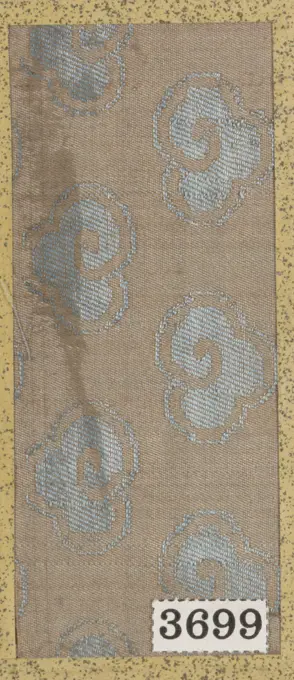
Decorative Textile Fragments

Historical fabric fragments and wallpapers featuring intricate patterns and textures, showcasing textile artistry from different eras.

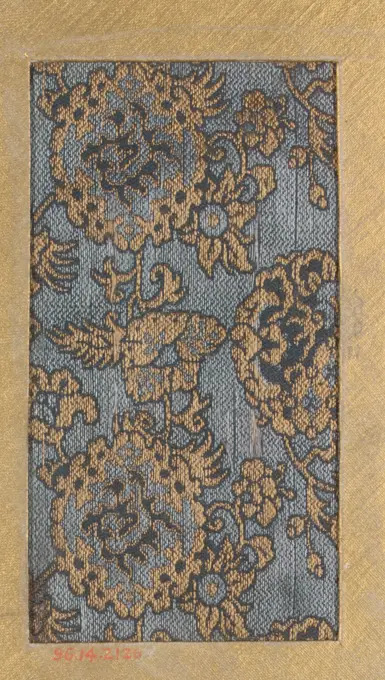
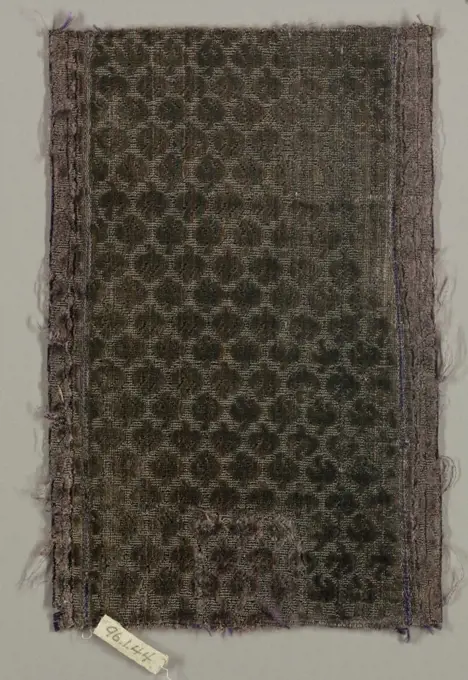
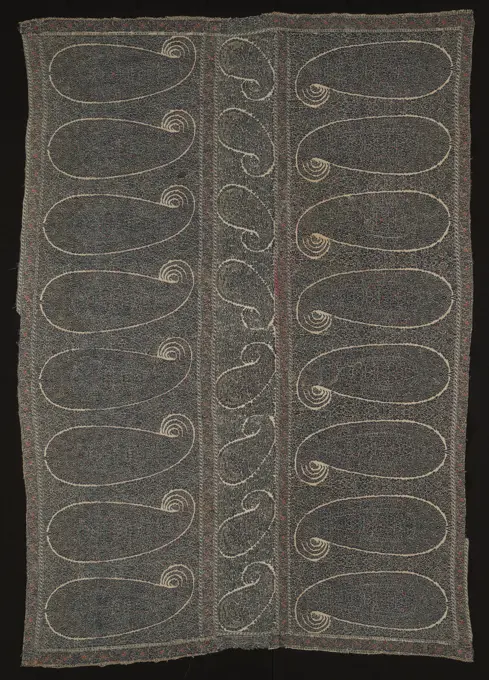
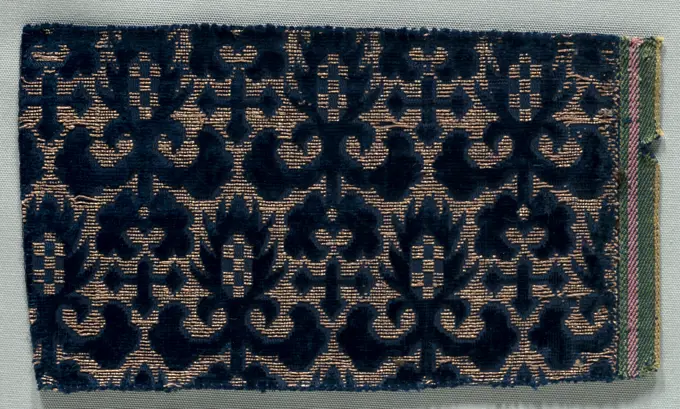
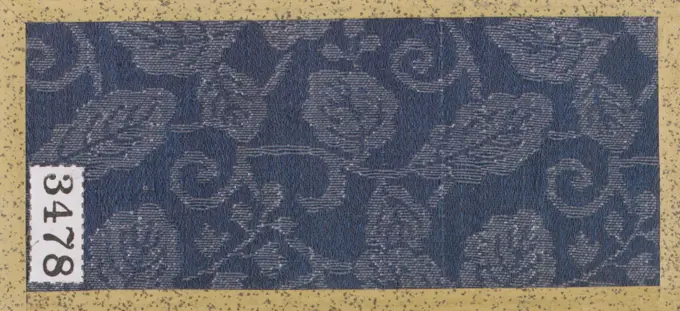
Fragment, Medium: silk, metallic thread Technique: woven, Stripes comprised of flower and leaf-like shapes on a dark blue background., India, 17th century, woven textiles, Fragment
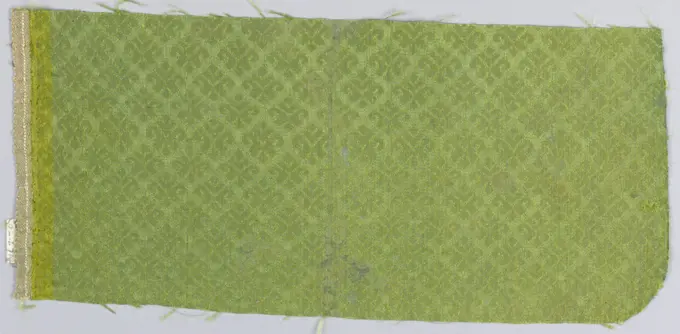
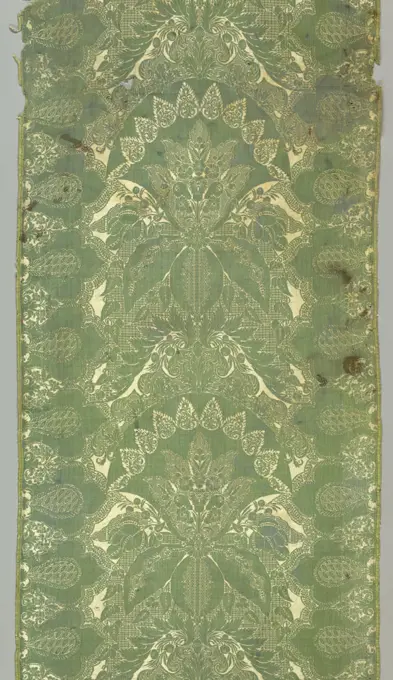
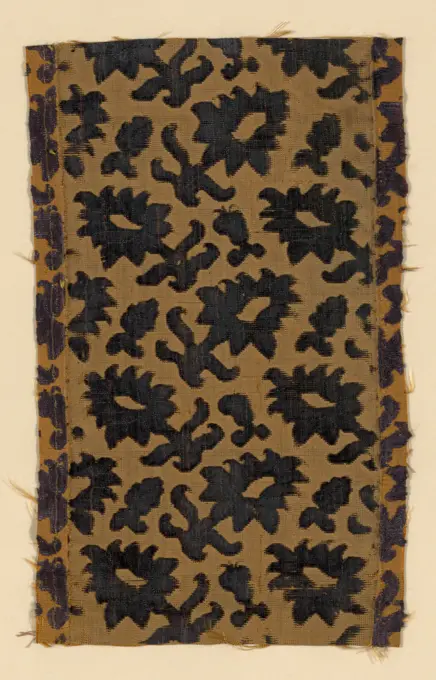
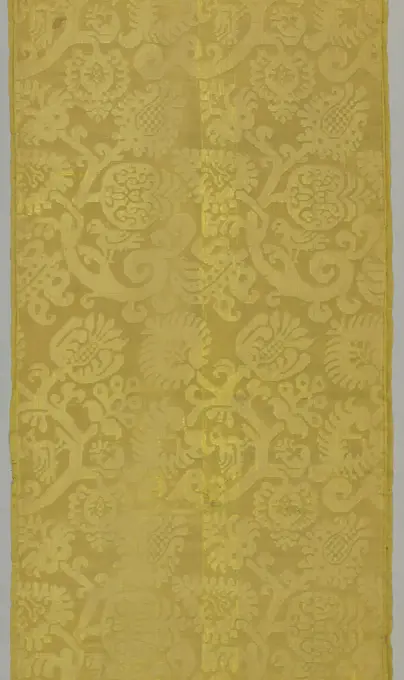
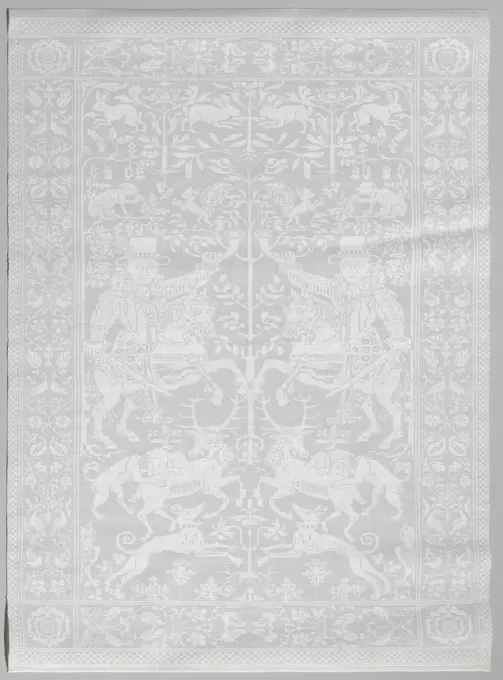
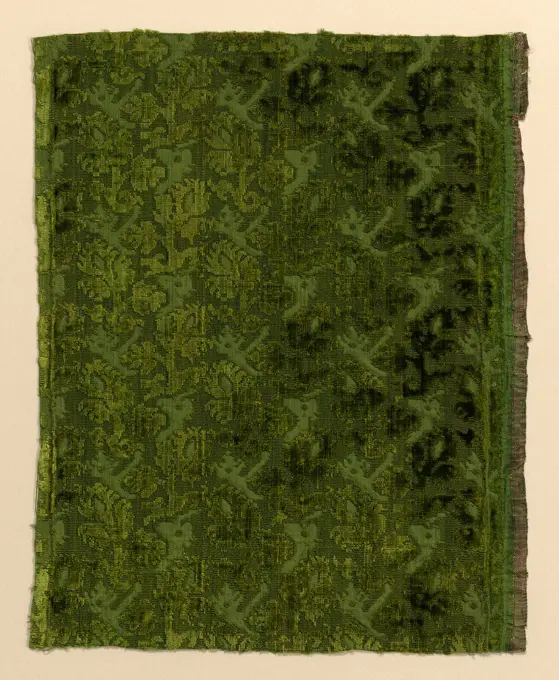
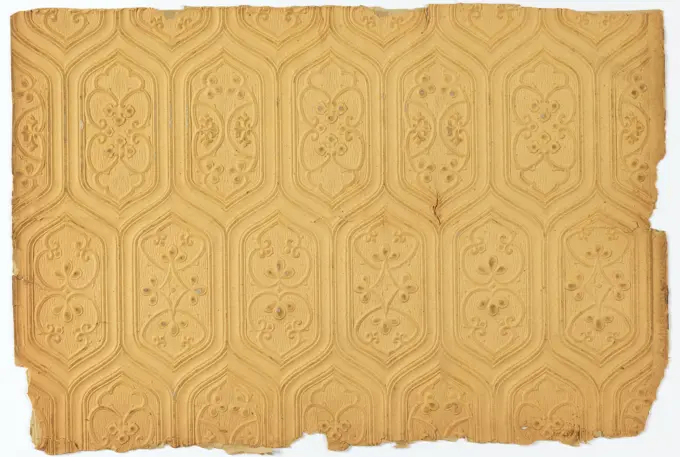
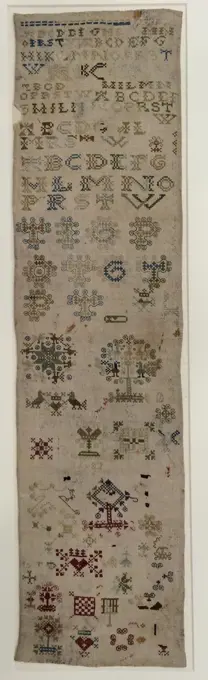
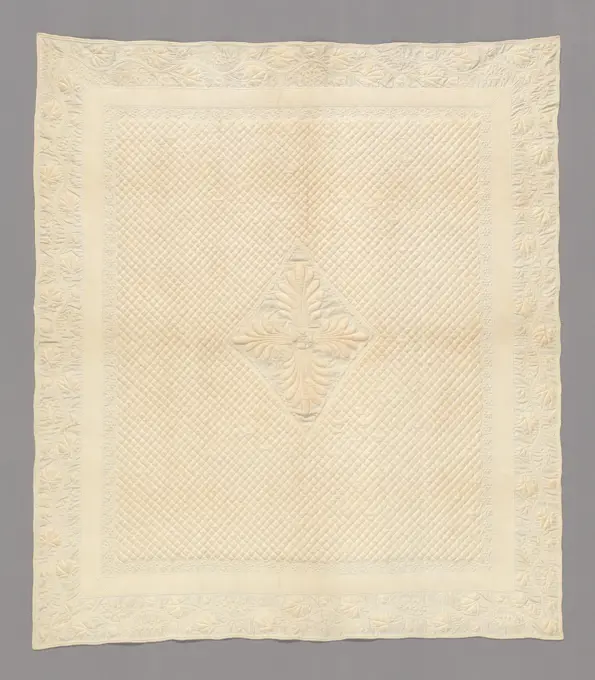
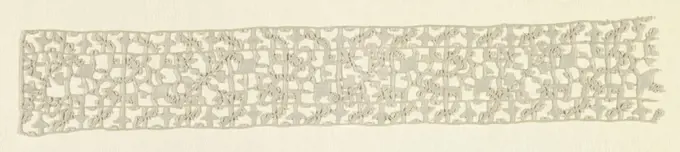
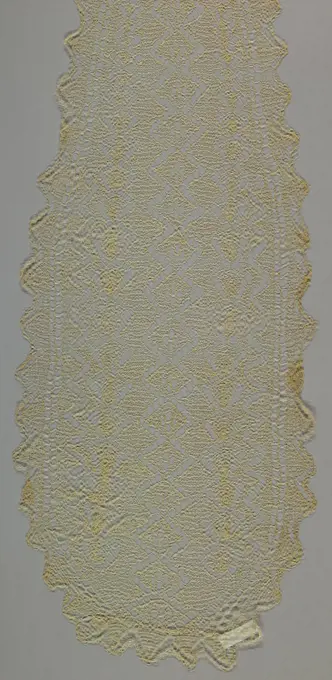
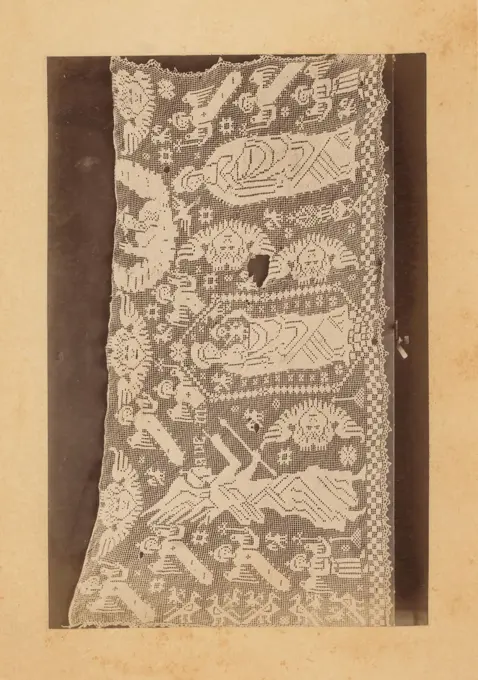
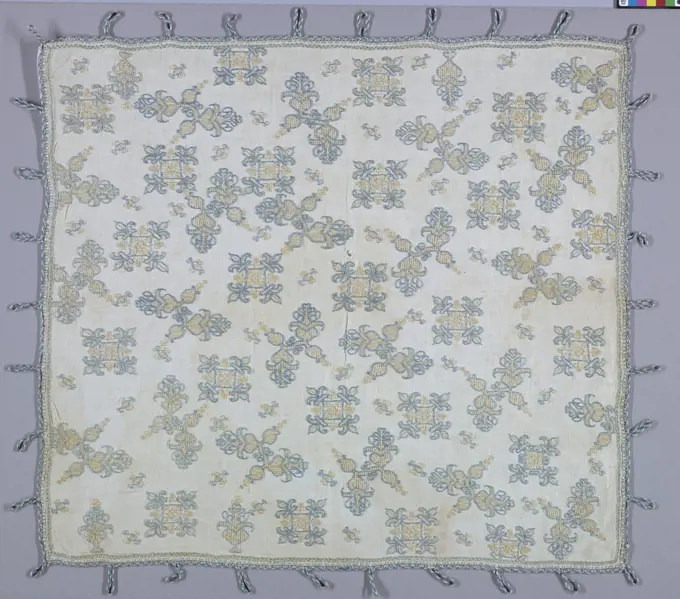
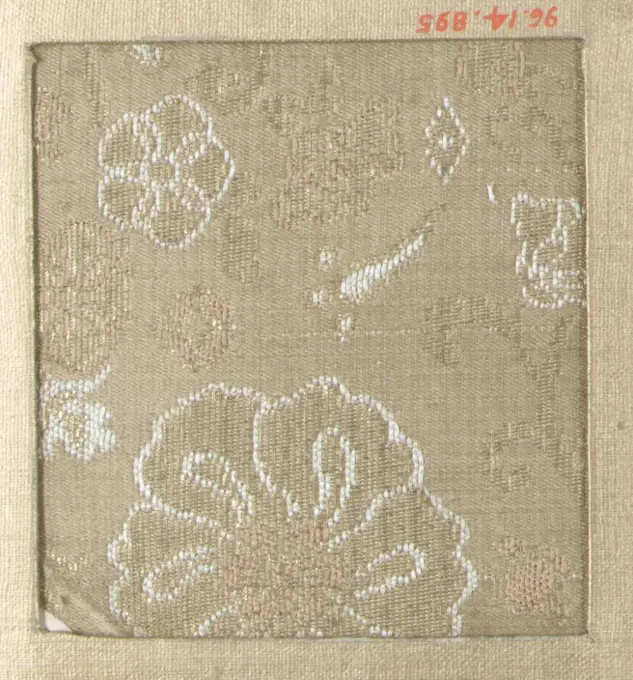
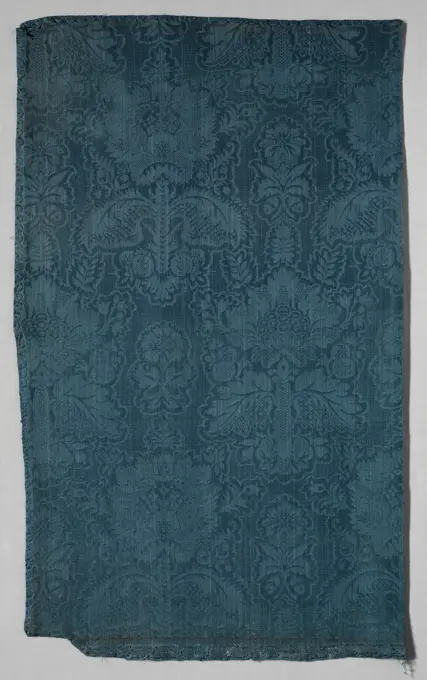
Fragment of Figured Silk for Upholstery, 1700-1750. France, first half of 18th century. Damask and cannelé, silk; overall: 75.6 x 47 cm (29 3/4 x 18 1/2 in.).Carpet Fragment (USA); wool on linenFragment, Medium: silk Technique: 4&1 satin damask, Small detached motifs in green., Selvage at one side., 17th century, woven textiles, FragmentPiece 18th century Japan. Piece 71698Leaf pattern of grape ventros between dotted lines, Anonymous, 1750 - 1900  Leaf with spreading pattern of grape ventros between dotted lines. Used as a cover, with incisions at the back.  paper. lacquer (coating) block printing (relief printing process) / lacquering ornament derived from plant formsPiece 18th-19th century Japan. Piece 67838Fragment, Medium: silk, metallic thread Technique: woven, Stripes comprised of flower and leaf-like shapes on a dark blue background., India, 17th century, woven textiles, FragmentPiece 18th-19th century Japan. Piece 66477Buffet runner of écru cotton, decorated with woven relief motifs with a bird on a stool and narrow stripes ...Piece 18th-19th century Japan. Piece 67098Textile, Medium: silk Technique: warp-faced plain weave with 3/1 twill, Length of woven silk in green and ivory with symmetrical pattern reversed along vertical axis. Design shows elaborate plant forms and pomegranate motifs crowned with foliate scrolls. Both selvages present., France, early 18th century, woven textiles, TextileFragment Made 1600-1650 Italy. cisele voided cloth velvet .Fragment. Japan. Date: 1700-1750. Dimensions: 24.2x 38.2 cm (9 1/2 x 15 in.). Fancy compound satin, silk and gilt paper; 2 1/2 strips to m.m. Origin: Japan. Museum: The Chicago Art Institute, Chicago, USA.Fragment Lampas trimmed with twill band ,, 1575 - 1600 Fragment with only a part of the pattern visible: tire work with the end of a wing. Fragment is trimmed with twill tire.  silk lampas (textile material) Fragment with only a part of the pattern visible: tire work with the end of a wing. Fragment is trimmed with twill tire.  silk lampas (textile material)Textile, Medium: silk Technique: twill weave, Ivory-colored silk with a monochrome pattern of S-meanders and stylized floral sprigs., France, England, mid- 18th century, woven textiles, TextileSilk Fragment, 16th century. Spain, 16th century. Damask: silk; average: 64.5 x 21 cm (25 3/8 x 8 1/4 in.).Towel fragment, Medium: cotton Technique: twill patterned with supplementary wefts, Band from a Perugia towel with a pattern of a fountain with confronted stags., Italy, 17th-18th century, woven textiles, Towel fragmentPiece 18th-19th century Japan. Piece. Japan. 18th-19th century. Silk. Textiles-WovenPiece 18th-19th century Japan. Piece. Japan. 18th-19th century. Silk. Edo (1615-1868). Textiles-WovenPiece 18th-19th century Japan. Piece 67454Textile 1700-1899 Russian. Textile 173401Textile Russian 1700-1899Fragment, Medium: bast fiber warp, cotton weft Technique: float weave, Small fragment of coarse material, said to have come from an abbey in France. Lozenge pattern formed by the manner in which twill is tied down. Warps are natural unbleached fibers, and wefts are coarsely spun., Europe, 13th century, woven textiles, FragmentPiece 18th-19th century Japan. Piece 67143Greek OrnamentFragment, Medium: silk, silver foil, silk core wrapped with silver foil Technique: compound twill, supplementary weft, Gold-colored silk ground with extra weft of flat silver strips. Symmetrical design of swinging acanthus branches enclosing palmettes which are brocaded in silver thread. White silk extra weft appears in acanthus foliage areas., Italy, 16th century, woven textiles, FragmentArt Nouveau Tablecloth, c. 1900, 47 x 68 in. (119.38 x 172.7 cm), cotton, 19th-20th centuryTextile, Brocade 15th century Italian. Textile, Brocade 468110Piece 18th-19th century Japan. Piece 66979Piece 18th-19th century Japan. Piece 66431Fragment, Medium: silk, velvet Technique: cut and uncut pile (velvet), Small floral pattern formed by cut and uncut pile., 17th century, woven textiles, FragmentFragments, Medium: silk Technique: 5-harness satin damask, Yellow damask with an allover design of a large scroll pattern. Selvages present., Spain, 17th century, woven textiles, FragmentsPiece French 19th century View more. Piece. French. 19th century. Textiles-WovenHandkerchief unknownCoverlet Made 1820-1840 Pennsylvania. Cotton and wool, plain weave with supplementary wefts in composite point twill weave (star, work, multiple shaft); two loom widths joined .Piece 17th century Japan. Piece 71471Piece 18th-19th century Japan. Piece 67705Fragment 16th century Italian. Fragment 230672Cover second half 16th century French or Italian. Cover 227561Napkin with a deer show, anonymous, c. 1600 - c. 1625 Napkin from white Linnamast with a deer show. Northern Netherlands (Possible) linen (material) damask Napkin from white Linnamast with a deer show. Northern Netherlands (Possible) linen (material) damaskFragment, Medium: silk Technique: cut and uncut supplementary warp pile (velvet) in a satin foundation, Fragment of dark red cut and uncut velvet in a design of flower sprigs and ribbon garland., France, 18th century, woven textiles, FragmentALFOMBRA DE ALCARAZ (ALBACETE) SEGUNDA MITAD DEL SIGLO XV. Location: MUSEO ARQUEOLOGICO NACIONAL-COLECCION. MADRID. SPAIN.Fragment late 18th century French. Fragment 214582Fragment late 16th century Italian or Turkish. Fragment 230144Piece 16th-17th century Italian. Piece 223440Napkin with pattern of rosettes and rose branches ,, c. 1780 - c. 1800 White Linnamasten napkin with a pattern of rosettes and rose branches, brand 100 and HW 30. Northern Netherlands (Possible) linen (material) damask White Linnamasten napkin with a pattern of rosettes and rose branches, brand 100 and HW 30. Northern Netherlands (Possible) linen (material) damaskCap crown, Medium: linen Technique: bobbin lace, Mechelin ground, Symetrical arrangement of central blossom surrounded by twisting leaves. Three separately made pieces joined together, Belgium, mid-18th century, lace, Cap crownBorders of a shawl of interlocked twilltapestryTextile, Medium: silk, metal Technique: fancy compound satin, White and gold. White satin ground. Two wefts: gold and white. Design of rose sprays with two full roses and four rosebuds and leaves, created by floats of white and gold wefts., 19th century, woven textiles, TextileKloskant's intermediate installation with windows formed by tire laid in U-shapes, anonymous, c. 1900 - c. 1924  Strip of natural -colored bobbin, straw side. The pattern consists of connected windows, which are formed by an U-forms placed in U-shapes. In the diamond -shaped field that is created in this way, there is a smaller window, with a rushed snowflake in the center. The fullwork is made in Linnenlag. The windows are connected by a grid, a five -part ground. A coarse snowflake ground has been used as a decorative soil, in large triangular fields along the outer edges of the pattern. The top and bottom of the strip are straight. Russia linen (material) Bobbi lace / lace clothPiece 18th century Japan. Piece 71700Panel, c. 1700, 62 1/2 x 26 1/2 in. (158.75 x 67.31 cm), Wool velvet, France, 17th-18th centuryFragment Made 1600-1650 Italy. cisele voided cloth velvet .Piece 18th-19th century Japan. Piece 67709Handdwaal van wit linnen.White linen damask hand vow with a pattern of scattered flowers and weapons of ommer and peacock, Brand Crown LP 12.Lincrusta Bedburg (England or United States); lincrusta; 51.5 x 34.5 cm (20 1/4 x 13 9/16 in.)Piece 18th-19th century Japan. Piece. Japan. 18th-19th century. Silk. Textiles-WovenFragment Made 1601-1625 Netherlands. Linen, plain compound cloth .Fragment blue velvet brocade with pomegranate moths, anonymous, c. 1420 - c. 1499 Fragment blue silk velvet brocade with a pattern of wavy tendrils, rose hottles and large pomegranates. For similar fragments, see B TM F. Italy silk. Fragment blue silk velvet brocade with a pattern of wavy tendrils, rose hottles and large pomegranates. For similar fragments, see B TM F. Italy silk.Veil 1830s American. Veil 117683Fragment Made 1575-1625 Italy. Silk; velvet cut, uncut, and voided; against plain weave foundation .Piece 18th century Japan. Piece 71821Velvet Fragment, 1600s. Italy, 17th century. Velvet; overall: 10.3 x 18 cm (4 1/16 x 7 1/16 in.).Fragment Made 1601-1650 Italy. Silk and gold gilt strips; plain weave with supplementary patterning wefts and supplementary pile warps forming cut, uncut, and voided velvet .Fragments, Medium: mohair wool Technique: supplementary warp pile (velvet) in plain weave foundation, embossed, Blue-green wool velvet, stamped with a repeating symmetrical pattern of plant forms., Flanders, 16th-17th century, woven textiles, FragmentsSamples, Orinoka Mills, (Philadelphia, Pennsylvania, USA), a: green ground with off-white and lighter floral, b: tan gound with green and gold color floral, USA, ca. 1910, woven textiles, SamplesPanel (Furnishing Fabric) Made 1695-1705 Flanders. Linen and wool, plain weave with supplementary pile warps forming cut solid velvet; stamped; of a type known as velours 'de trek .Fragment. Italy. Date: 1601-1635. Dimensions: 23.5 x 13.9 cm (9 1/4 x 5 1/4 in.). Silk, cut, uncut, and voided velvet against plain weave foundation. Origin: Italy. Museum: The Chicago Art Institute, Chicago, USA.Fragment, Medium: linen Technique: bobbin lace (Lille-style with heavy outlining thread), Fragment of Lille style bobbin lace with slightly scalloped edge., 19th century, lace, FragmentNeedle's jabot cargoing tifters, anonymous, c. 1870 - c. 1909 Jabot of natural Venetian needle side "Gros Point". Very open stock of bars decorated with cogs. From symmetrical C-volutes in the heart, broad-wavy volute vines, which are swelling and openings are provided to let cross-crossing tifles. In the middle, at the junctions and at the tops there are numerous palm with flowers in lobed shapes, which are only repeated in the two symmetrical halves. BURANO linen (material) Venetian gros point (heavy raised Venetian lace) Jabot of natural Venetian needle side "Gros Point". Very open stock of bars decorated with cogs. From symmetrical C-volutes in the heart, broad-wavy volute vines, which are swelling and openings are provided to let cross-crossing tifles. In the middle, at the junctions and at the tops there are numerous palm with flowers in lobed shapes, which are only repeated in the two symmetrical halves. BURANO linen (material) Venetian gros point (heavy raised Venetian lace)Embroidered sampler 1682 Dutch, Friesland Samplers from Friesland, in the northwest of the Netherlands, are characterized chiefly by many alphabets and a tree of life motif. This sampler also features pierced and crowned hearts (some with birds flanking them and some without), checkerboards, and sewing pillows, motifs typical of samplers from the Netherlands. The year 1682, which was stitched in now faded thread near the bottom of the sampler, is most likely the year in which the maker completed her work.. Embroidered sampler 228099Bedcover Made 1825-1875 France. Cotton, plain weave; quilted in a technique known as ìtrapuntoî .Runner, Medium: silk, metallic thread Technique: cut and uncut supplementary warp pile on a satin foundation (velvet), Runner with vertical stripes of dark blue cut pile that alternate with tan satin stripes together with a stylized interlocking floral design of vaguely Persian inspiration in dark rust and light tan cut and uncut pile. Plain weave selvages on long sides and twisted metallic fringe on a metal thread heading at the ends., France, 19th century, woven textiles, RunnerFragment; silkFragment of Kilim;  beginning of the 20th century (1901-00-00-1910-00-00);Flowers, Poland (culture), decorative fabrics, house and home equipmentPiece 19th century Japan. Piece 72128Ribbon (France); silkPiece 17th century Japan. Piece. Japan. 17th century. Silk / Compound weave. Textiles-WovenLinen Towel - Brown Border. Dated: c. 1937. Dimensions: overall: 35.5 x 28 cm (14 x 11 in.). Medium: watercolor, graphite, and gouache on paper. Museum: National Gallery of Art, Washington DC. Author: Eva Wilson.Fragment Made 1575-1600 Italy. cisele voided twill velvet .Textile 19th century Japan. Textile 68063Fragment late 16th century Italian. Fragment 230669Fragment, Medium: linen Technique: bobbin lace (Binche style with no ground but snowball pattern), Binche style of scrolling ribbon ilke design with snowballs and braided connections., Belgium, 17th century, lace, FragmentBand, Medium: linen Technique: grid of laid cords with needle lace (reticella style), Squares filled with floral shapes and bordered at either side by smaller squares., Italy or Spain, early 17th century, lace, BandPiece 18th-19th century Japan. Piece 67781Piece 17th century Japan. Piece 71320Fragment 17th century Italian. Fragment 230449Textile Swatches Onondaga Silk Company, Inc. (1925-1981). , 1948-1959. 55 acetate, 45 rayon, 40 1/2 x 17 in. (102.9 x 43.2 cm).    1948-1959Stole, Medium: agave (plant fiber) Technique: knitting; each half made separately and joined together in the middle, Shaped stole. Long and narrow with oval shapes at each end., Portugal, 19th century, knotted, knitted and crocheted textiles, StoleTextile with religious representation, photograph, photo, page, photos, photographically illustrated books, height 139 mm, width 97 mm, photographer, 1873 - 1878, photographic paper, photo paper, albumen print, albumine printFragment 16th century Italian. Fragment 230517Cushion cover, Medium: silk on linen Technique: counted stitch; double running and back stitch embriodery on plain weave, Two pieces of fabric with blue and yellow embroidery of floral shapes. Component 'a' has a length of blue and white linen five-strand braid attached which makes one inch loops at approximately one and a half inch intervals. The embroidered design is diagonal floral forms and ornamented squares. Component 'b' is trimmed with braided tape in the same manner as 'a.' At the end of each loop is a toggle covered with blue silk and white linen. When both pieces are placed over a cushion, the toggles from 'b' would button through the loops on 'a' leaving the pillow exposed on the sides. The embroidery on 'b' is limited to the edges of the cloth., Italy, early 17th century, embroidery & stitching, Cushion coverTextile Sample from Sample Book 19th century Japan. Textile Sample from Sample Book 68112Piece Japan 18th-19th centuryPiece 17th century Japan. Piece 71146Cover. Culture: Italian. Dimensions: 22 5/8 x 22 in. (57.8 x 55.9 cm) with metallic edging tape. Date: mid-15th century. Museum: Metropolitan Museum of Art, New York, USA.Textile Sample from Sample Book 19th century Japan. Textile Sample from Sample Book 68176Fragment 17th century Italian. Fragment 230176Piece 18th-19th century Japan. Piece. Japan. 18th-19th century. Silk. Textiles-WovenNapkin with prae-bizar pattern of stylized flower and leaf vines ,, 1685- 1700 Napkin from white Linnamast with prae-bizar pattern of stylized flower and leaf vines. Southern Netherlands (possibly) linen (material) damask Napkin from white Linnamast with prae-bizar pattern of stylized flower and leaf vines. Southern Netherlands (possibly) linen (material) damask