Decorative Textiles

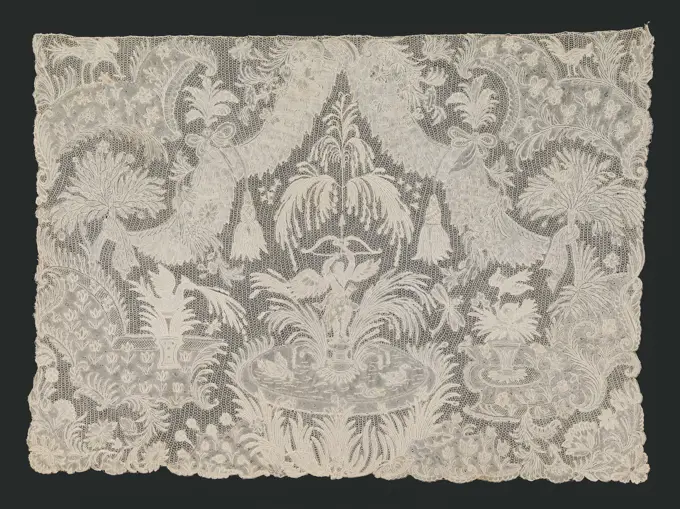
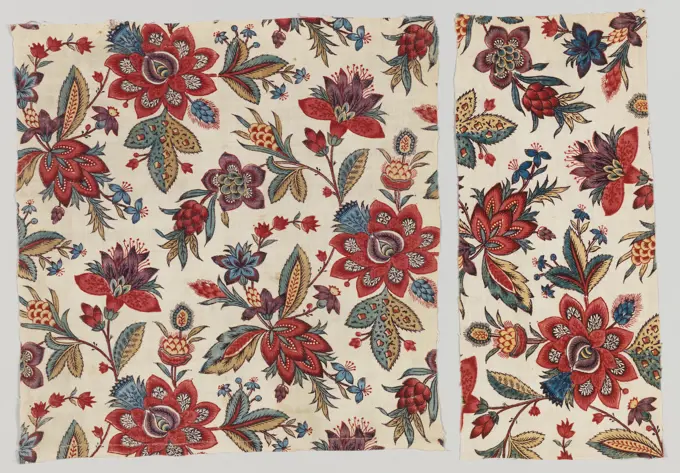
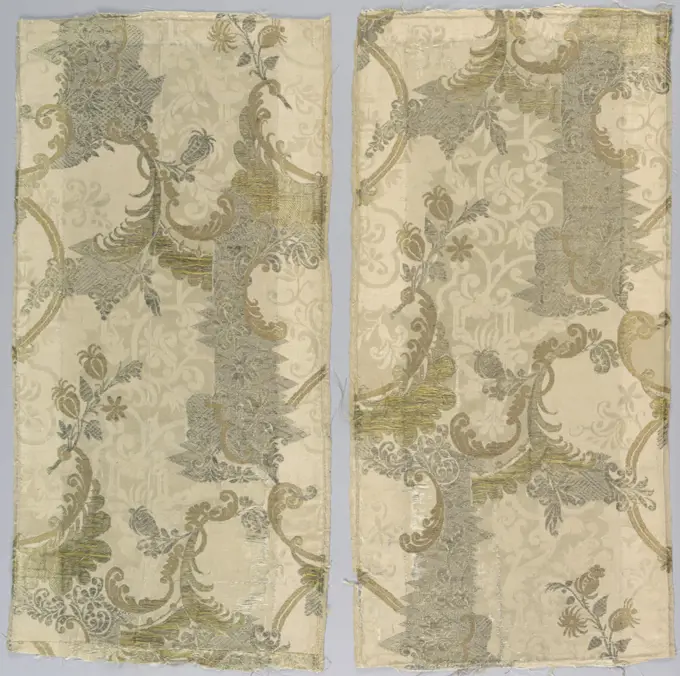
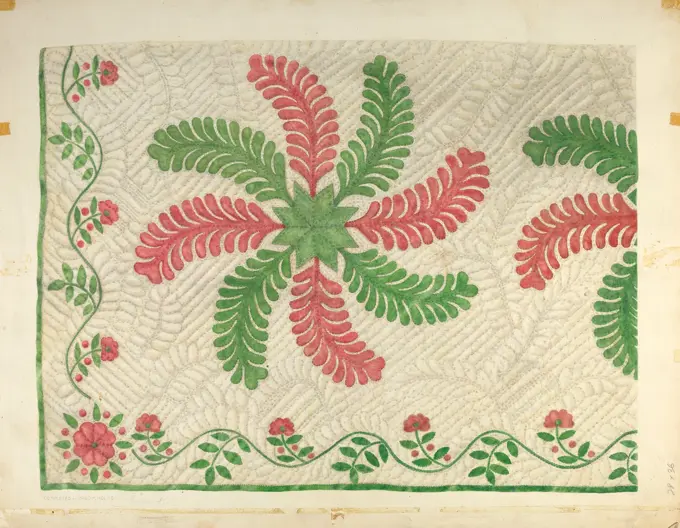
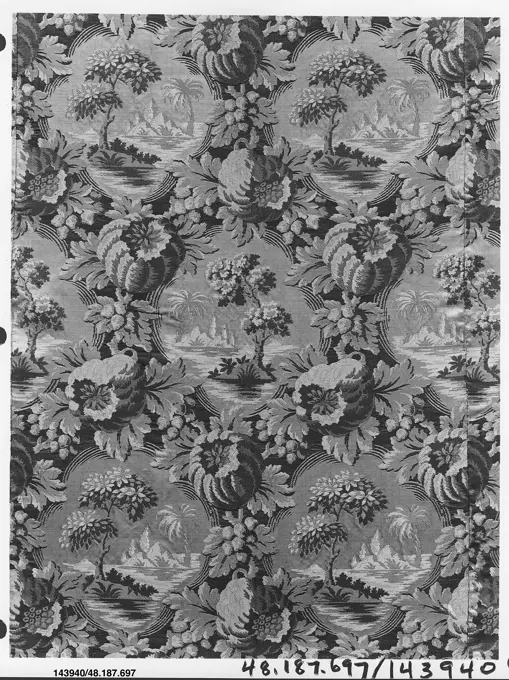
Fabric fragments showcasing floral patterns, brocade techniques, and varied color palettes, reflecting historical textile craftsmanship.
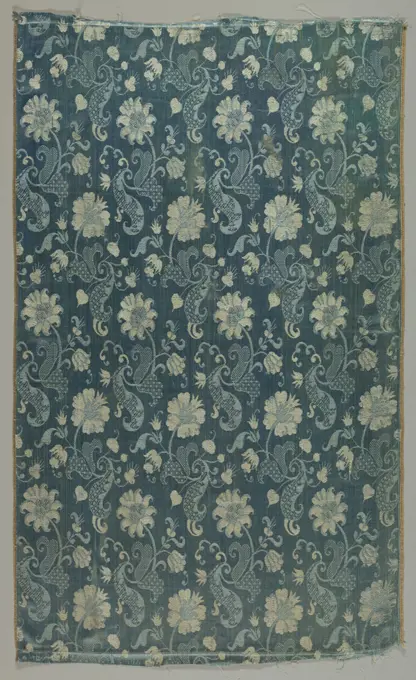
Textile, Medium: silk Technique: float patterned satin; 7&1 satin patterned by weft floats bound on the front as a 1&3 twill, Length of blue silk with a pattern of flowers, leaves and scrolls in pink and light blue. Leaves and scrolls have diaper patterns., probably Italy, 17th century, woven textiles, Textile
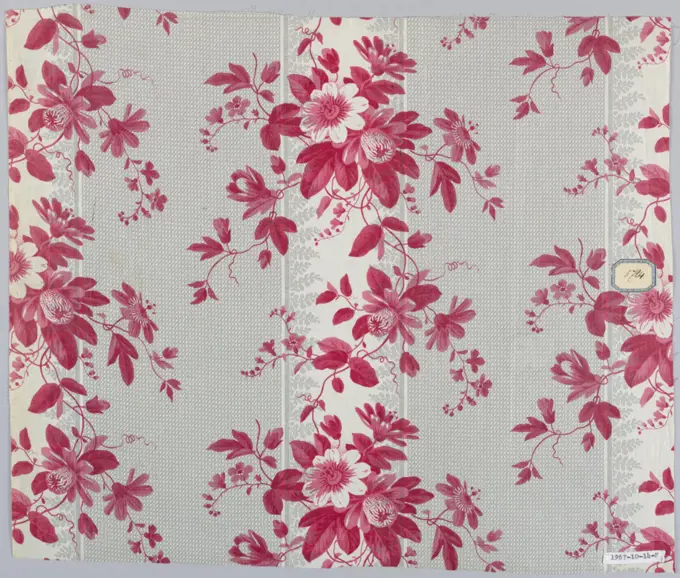
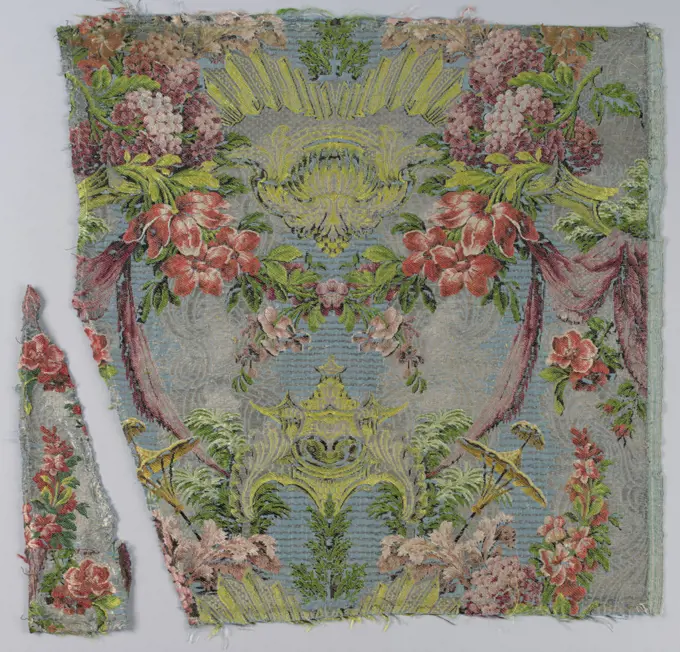
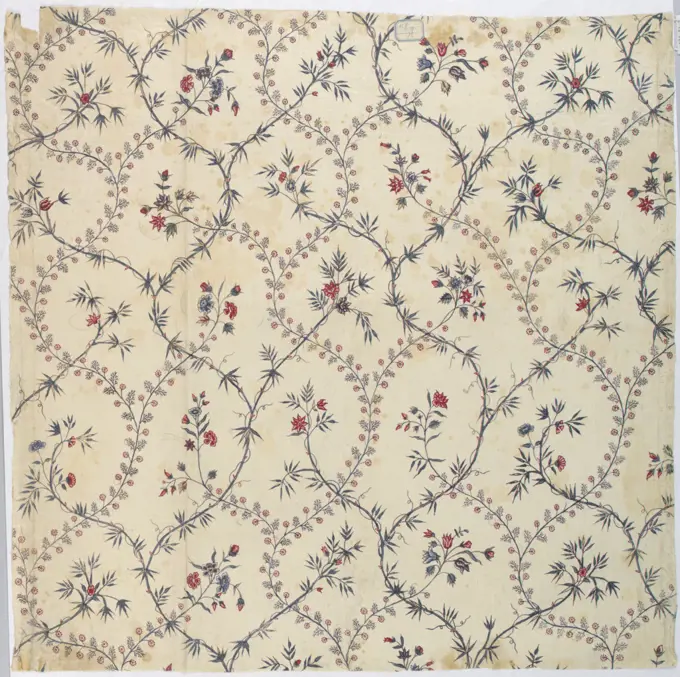
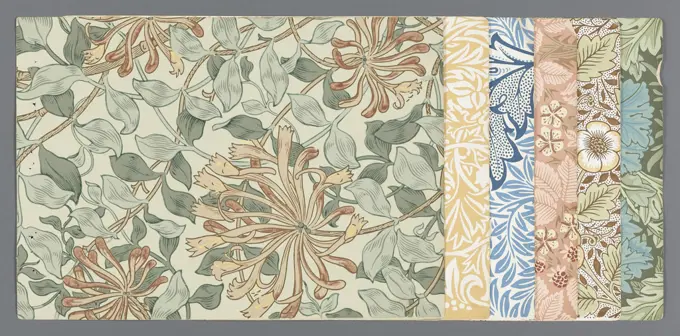
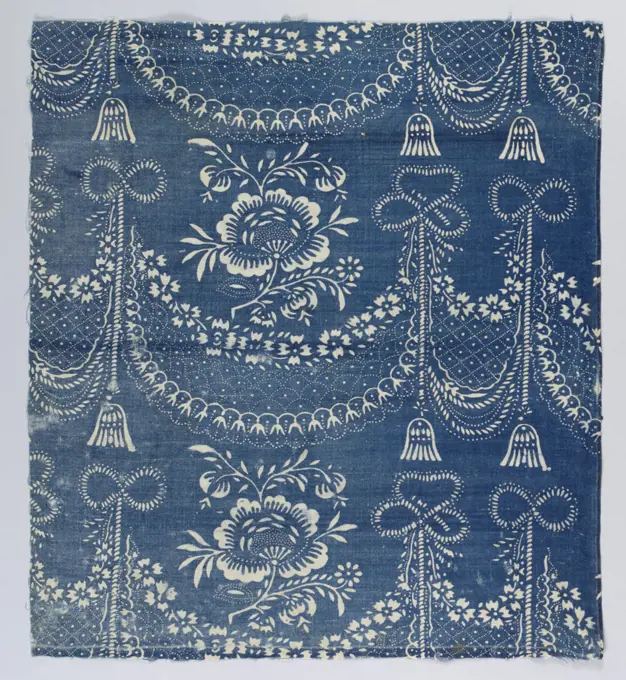
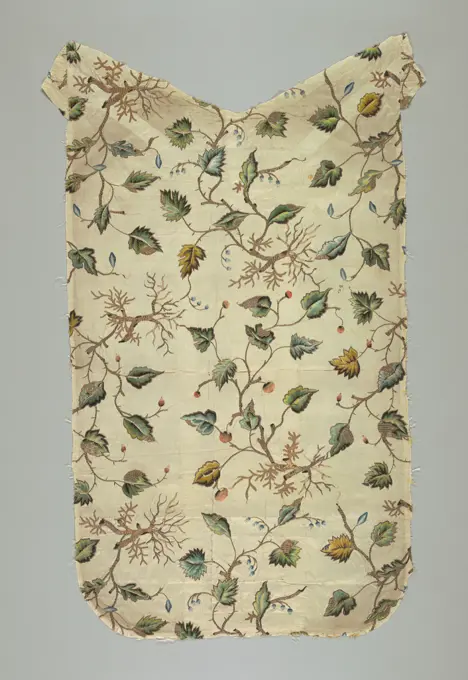
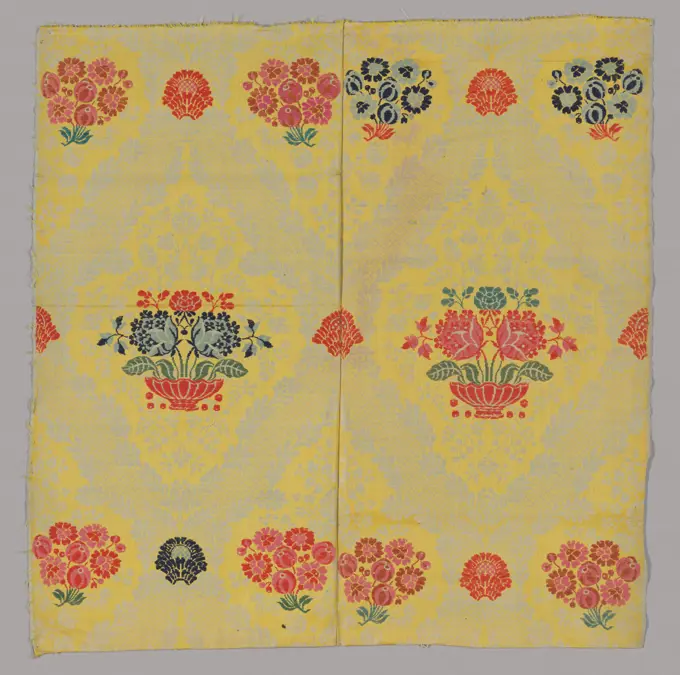
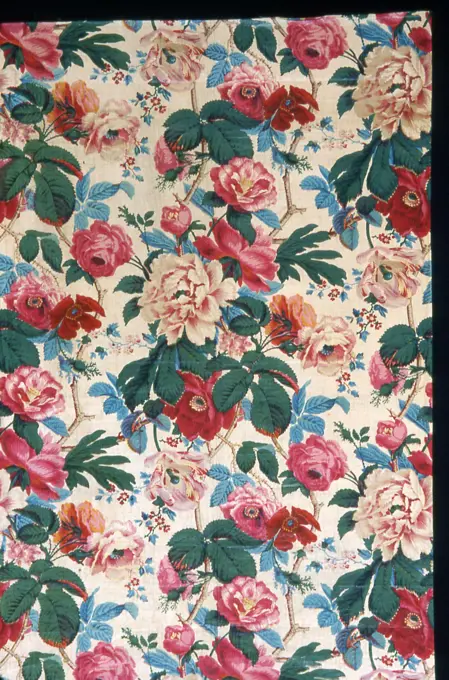
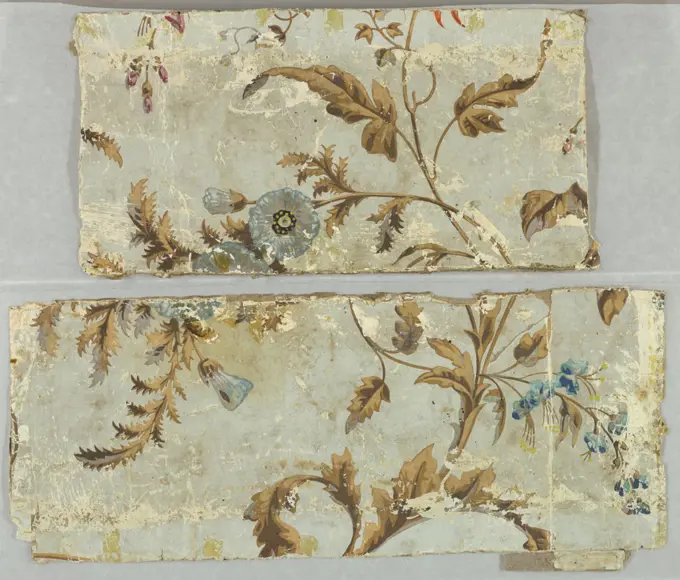
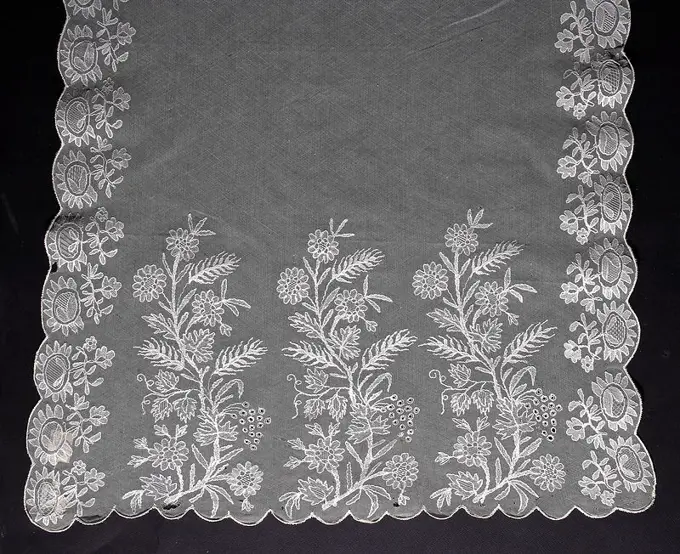
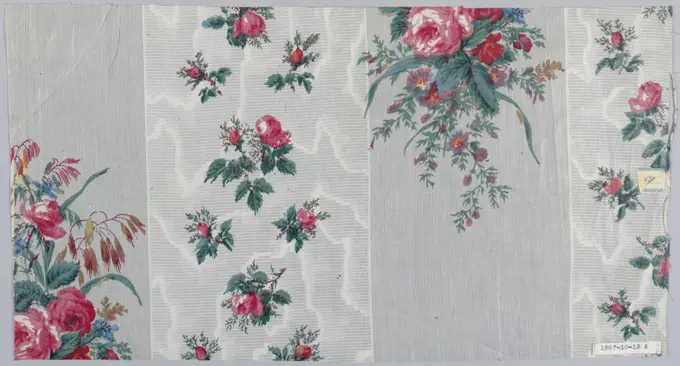
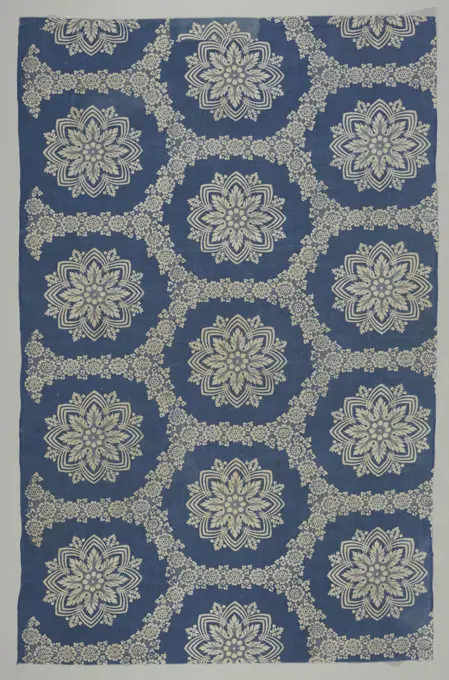
Fragment of a Bed Curtain, 1700s. Greece, Crete, 18th century. Embroidery: silk on linen tabby ground; overall: 36.5 x 40 cm (14 3/8 x 15 3/4 in.).Panel from a Skirt Made 1748-1760 Spitalfields. Silk, gilt-and-silvered-metal strip, and gilt-metal-strip-wrapped silk, plain weave with patterning and brocading wefts .Piece 18th century Japan. Piece 65787Sampler (England); Embroidered by S. H. (English); silk and linen embroidery on linen foundationPiece 18th-19th century Japan. Piece 66340Cravat End (Belgium); linenRug Fragment (USA); wool, juteOrphrey 1742 Italian or French. Orphrey. Italian or French. 1742. Silk and metal threadFragment silk tissue with bizarre pattern, anonymous, c. 1710 - c. 1720 Fragment silk tissue, consisting of two pieces sewn together. Broocered and launched Lampas Liséré. Desin: bizarre pattern of spring -like leaves filled with geometric motifs (pomegranates) In écru (ground tissue), green (liséré), écru (launch), pink (launch) and gold thread (gold -colored lamel around silk core) on green soil. Lyon silk lampas (textile material) Fragment silk tissue, consisting of two pieces sewn together. Broocered and launched Lampas Liséré. Desin: bizarre pattern of spring -like leaves filled with geometric motifs (pomegranates) In écru (ground tissue), green (liséré), écru (launch), pink (launch) and gold thread (gold -colored lamel around silk core) on green soil. Lyon silk lampas (textile material)Textile 1700-1899 Russian. Textile 173414Textile (France); silkTextile (France); Company: Oberkampf & Cie. (France); linen warp, cotton weft; Warp x Weft (a): 39 x 38.1 cm (15 3/8 x 15 in.) Warp x Weft (b): 17.1 x 40 cm (6 3/4 x 15 3/4 in.)Fragments, Medium: silk, metallic yarns Technique: compound of plain weave and 8-harness satin weave, with discontinuous supplementary wefts either free-floating or bound in 3/1 twill, Two fragments of an allover pattern of brackets, arches, scrolls and flowers. Metallic yarns on a cream damask ground., possibly France, late 17th-early 18th century, woven textiles, FragmentsCoverlet Fragment, c. 1760-1770. Philippe de Lasalle (French, 1723-1805). Embroidered satin and silk; overall: 21.6 x 56.5 cm (8 1/2 x 22 1/4 in.).Fragment, Medium: silk Technique: 4 and 1 satin damask, Plant forms with birds and dogs in purple and yellow., 17th century, woven textiles, FragmentTextile (England); cottonDress panels possibly 1775-78 probably British, London, Spitalfields. Dress panels 223045Fragment, Medium: linen Technique: block printed on plain weave, Fragment of heavy hand-woven linen in a dark cream color block printed in black. Design is mostly reserved in background color with details in black. Curving vine and stylized flowers forming an allover pattern. Block mark shows across center of piece., Russia, 18th century, printed, dyed & painted textiles, FragmentTextile, Medium: cotton Technique: roller (mule) printed on plain weave, England, 1825-35, printed, dyed & painted textiles, TextileFragment; silk and metallic thread; Warp x Weft: 23 x 10.2 cm (9 1/16 x 4 in.)Albesto smoke from the needle side with hearts and jars and canopies, anonymous, c. 1715 - c. 1725 Strip of natural -colored needle side: Point de France. It concerns half of an album. The rich pattern consists of two symmetrical main motifs, which are made up of C-Voluten. One is heart -shaped and is surrounded by playful curls. The other main motif has the shape of a vase or jar, with a French lily in the top. Flower and leaf motifs occur and also architectural elements, including canopies. The motifs are connected by a potente land with irregular hexagons. Fullwork with recesses and a rich variation of decorative land. Relief contour lines are mainly used to emphasize the C-volutes and also various rosette flowers and circles. The scalloped edge is formed by each other alternating deeply incised palmets and three or five -lobe motifs. The top is trimmed with a border bobbin. France (possibly) linen (material) Strip of natural -colored needle side: Point de France. It concerns half oPiece 18th century Japan. Piece 71257Maud M Holme, Quilt Applique Pattern, c 1939 Quilt Applique PatternFragment Made 1600-1650 Italy. Satin ground; pattern cut velvet outlined with uncut velvet .Textile (possibly USA); cottonTextile; silkPiece 18th-19th century Japan. Piece 66099Weave tissue, multicolored flowers on a yellow fond with a patoon of branches, leaves and flowers in white.Multicolored Flowers on a Yellow Wound with a Pattern of branches, Leaves and Flowers in White. Comb Yarn Broché, Wool.Length ca. 1750 British, London, Spitalfields. Length 229949Textile, Schwartz-Huguenin, Medium: cotton Technique: printed by engraved roller and possibly block printed on plain weave; highly glazed, Group having same ground, roller-printed, of a broad grey stripe formed of minute white dots alternating with white stripe edged with fancy foliage pattern. Different floral patterns printed over this ground, probably by block. A) Large Iris pattern, purple and green.B) Garden flowers. C) Sprays of blue flowers with grey-green foliage D) Small flower sprays, brown and green. E) Lillies of the Valley , pansies and roses in violet. F) Bright pink, all-over floral sprays. G) Same flower sprays as F in reds and browns. All highly glazed., 1851-63, printed, dyed & painted textiles, TextileHalf of a shawl with embroidered trimming unknownFragments, Medium: silk, metallic thread Technique: woven, Multicolored fragment in a continuous symmetrical pattern has a fan-like architectural motif and floral pendant suspended above drapery swags heavy with hanging flowers and leaves. Below is a pagoda-like architectural element with symmetrical parasols., France, 18th century, woven textiles, FragmentsTextile, Medium: cotton Technique: mordants for 2 reds and 2 purples applied by pen and brush; madder dyed; blue applied over resist; yellow applied by brush (chintz) on plain weave, Alternation of four S-curving vines (two bamboo-like; two seaweed-like). Each vine sends out shoots alternately left and right. Textile would have been used as a dress fabric and was probably inspired by a European woven silk., India, 1750-1800, printed, dyed & painted textiles, TextileSidewall - Sample, Apple, 1887; Designed by Morris & Co. (United Kingdom); Manufactured by Jeffrey & Company (United Kingdom); block-printed paperTextile (France); silk on silkHanging ca. 1750-75 American. Hanging. American. ca. 1750-75. Linen, resist-dyed, printed. Made in New York, United StatesTextile, Medium: cotton Technique: block printed using a resist medium on plain weave foundation; immersion dyed in blue, White pattern on blue background. Rows of swags held up by tassels with a flower in the dip of each swag., Sain-Bel, France, late 18th century, printed, dyed & painted textiles, TextilePiece Swiss after 1850Textile (France); Manufactured by Schwartz-Huguenin; cottonFragment 16th-17th century Italian. Fragment. Italian. 16th-17th century. Silk, metal thread. Textiles-VelvetsHenry Meyers, Bedspread, c 1936 BedspreadApron, 1700s. England, 18th century. Embroidery, silk and gold thread; overall: 62.2 x 89.5 cm (24 1/2 x 35 1/4 in.).Veil. unknown, authorTextile; silk and metallic; 1898-2-7Two Joined Panels of Brocaded Yellow Furnishing Wool c 1720-1729 England. Patterned woven wool fabrics were employed for both upholstery and clothing. The city of Norwich, in Norfolk, is commonly known as the primary center for weaving wool in the 18th century. Fine woolen textiles were the backbone of the English economy for hundreds of years, from the late middle ages until well into the 19th century. Britainís North American colonies provided a ready market for luxury goods like these patterned wool fabrics. In fact, a dress in the collection of Colonial Williamsburg is made of a very similar textile (inventory number 1988.223).. Wool, worsted, damask weave; brocaded .Piece 17th century Japan. Piece. Japan. 17th century. Silk / Compound weave. Textiles-WovenPanel Made 1801-1900 France. Cotton (glazed chintz), plain weave .Sample, Orinoka Mills, (Philadelphia, Pennsylvania, USA), Bright pink ground with green and light yellow floral pattern., USA, ca. 1910, woven textiles, SampleFragment striped silk tissue with flowers. Fragment silk tissue. A green with red striped ground has rows of flower branches in pink and white.Fragment (India); silk, gold tinsel on silk coreSidewall - fragment, Block-printed, Brown vine with two kinds of blue flowers and parts of bleeding heart on polished gray background. Mounted on heavy gray paper., England, 1800-1850, Wallcoverings, Sidewall - fragmentFrieze, Robert Graves Co., New York, New York, Machine-printed paper, mica flakes, Flitter frieze containing swags of roses hung from the vine-entwined ribbons with daisy chains linking the swags to a large ribbon of bows. There are stripes at the edge. Printed in pinks, greens, and yellow on a background that shades from deep to lighter green, New York, USA, 1905-1915, Wallcoverings, FriezePiece 17th century Japan. Piece 71682Trimming (France); silkPanel, 17th century, 22 x 26 in. (55.88 x 66.04 cm), Linen, silk; embroidery, 17th centuryFragment green lampas. Fragment with pattern of pair of purplies to each other donated birds surrounded by flowers and framed by sculpting, checkered band work.Linnamast finger cloth with a flower pattern, c. 1920 - c. 1930 Finger cloth from Linnamast with multicolored woven edges (cotton). In the middle rose branches in white, rose branches in the green, red and white rose branches against a yellow stock. Around Ajourzomen. In a corner a green -embroidered monogram pvr. The finger cloth belongs to five finger cloths (BK-1980-168-A to BK-1980-168-F) and a tablecloth (BK-1980-167). Germany (possibly) linen (material) damask Finger cloth from Linnamast with multicolored woven edges (cotton). In the middle rose branches in white, rose branches in the green, red and white rose branches against a yellow stock. Around Ajourzomen. In a corner a green -embroidered monogram pvr. The finger cloth belongs to five finger cloths (BK-1980-168-A to BK-1980-168-F) and a tablecloth (BK-1980-167). Germany (possibly) linen (material) damaskSamples, Orinoka Mills, (Philadelphia, Pennsylvania, USA), a. pink/tan ground with gold color arabesque motif with flowers and ribbons, b. the same as 'a', USA, ca. 1910, woven textiles, SamplesFrieze, Hobbs, Benton & Heath, Hoboken, New Jersey, Machine-printed paper, flowers in a vase alternating with ribbon tied bouquets, scalloped band at bottom. Printed two borders across the width., Hoboken, New Jersey, USA, 1905-1915, Wallcoverings, FriezePiece 18th-19th century China. Piece 67581Design for a Woven Fabric, Brush and gouache on blue paper, Small flower bunches alternate with strips composed of leaves and other flower bunches running vertically. Verso: stripes of floral meanders, leaves, or simply solid colors. Alternate horizontal rows decorate the ground stripes., France, 1775-1800, Drawing, DrawingTextile; silk; Warp x Weft (selvedge to selvedge): 62 x 56 cm (24 7/16 x 22 1/16 in.)Samples (USA); Manufactured by Orinoka Mills (United States); Warp x Weft (a): 20 × 63.5 cm (7 7/8 in. × 25 in.) Warp x Weft (b): 20.5 × 32 cm (8 1/16 × 12 5/8 in.)Piece 18th-19th century Japan. Piece 67600Embroidery Sample, 25 x 20 1/2 in. (63.5 x 52.07 cm), Cotton, metal; needlework, ChinaFragment Made 1698-1719 France. Silk, gilt-and-silvered-metal-strip-wrapped silk, warp-float faced 7 1 satin weave with supplementary brocading wefts and self-patterned by three-color complementary ground wefts .Sampler (Netherlands); silk embroidery on linen foundationSample, Orinoka Mills, (Philadelphia, Pennsylvania, USA), blue warp and pink weft making floral pattern, USA, ca. 1910, woven textiles, SampleTextile; cotton; Warp x Weft (a): 73 x 29.5 cm (28 3/4 x 11 5/8 in.) Warp x Weft (b): 73 x 42 cm (28 3/4 x 16 9/16 in.) Warp x Weft (c): 55.5 x 41 cm (21 7/8 x 16 1/8 in.) Repeat H: 44 cm (17 5/16 in.)Shawl. unknown, authorChintz Fragment; cottonField of six tiles, the flowerpot, c. 1725 - c. 1735 Field of six tiles (3 x 2) each with a blue painted pot maker on console. In the corners, a rainy motif. Rotterdam earthenware. tin glaze majolica Field of six tiles (3 x 2) each with a blue painted pot maker on console. In the corners, a rainy motif. Rotterdam earthenware. tin glaze majolicaPanel (Dress Fabric) Made 1625-1675 Iran. .Cushion Cover (Italy); silk on linen; Bequest of Marian Hague; 1971-50-101Textile (England); cottonTextile, Schwartz-Huguenin, Medium: cotton Technique: printed by engraved roller on plain weave, Three pieces, same ground design but different floral patterns. Ground printed , probably by Molette, in two wide stripes in grey, one in very narrow pin stripe, one in horizontal bars of minute dots with moire effect in white. A) Floral pattern in one stripe of rose cluster, small detached roses in other. B) Different rose cluster. C) Long spray of roses and cream-colored flowers and smaller clusters., 1851-63, printed, dyed & painted textiles, TextileTextile (England); cotton; Warp x Weft: 67.5 x 63.5 cm (26 9/16 x 25 in.) Repeat H x W: 30 x 21.5 cm (11 13/16 x 8 7/16 in.)Border, Medium: cotton Technique: discharge block printed on plain weave, White pattern on blue background of a floral stripe creating an hexagonal grid framing 8-pointed medallions. Printing goes over edge of fabric on one side., France, 1810-1820, printed, dyed & painted textiles, BorderHandkerchief (Switzerland); linenNeedlepoint (Reticella) and Bobbin Lace Pillow Case, 17th century. Italy, Genoa, 17th century. Lace, needlepoint and bobbin: linen; overall: 5.1 x 43.2 x 34.3 cm (2 x 17 x 13 1/2 in.).Hat of Vieux Bruxelles Kloskant, Anonymous, c. 1750 Hatsbol van Kloskant. The pattern has palmettes, tibaries with volutes and flowers on a tulle ground. The fillings are diverse. Brabant . Brussels bobbin lace Hatsbol van Kloskant. The pattern has palmettes, tibaries with volutes and flowers on a tulle ground. The fillings are diverse. Brabant . Brussels bobbin lacePiece. Culture: Italian. Dimensions: L. 32 1/2 x W. 21 1/2 inches (82.6 x 54.6 cm) (loom width). Date: ca. 1730 (). Museum: Metropolitan Museum of Art, New York, USA.Cover Made 1601-1700 Turkey. Square embroidered with crescent shape leaf enclosing smaller leaf, floral sprays and tache de timur design. .Fragment, Medium: silk Technique: plain weave patterned by floats of a supplementary warp and discontinuous supplementary wefts, Fragment of chartreuse green silk with brocaded design of conventionalized flowers and foliage in purples, yellow, green, pink, red and white. Cut for a chair seat. Probably after a design by Pillement., France, ca. 1760, woven textiles, FragmentHandkerchief 1860-80 Belgian, Brussels. Handkerchief 227257Piece 19th century Japan. Piece 65945Piece early 19th century Japan. Piece. Japan. early 19th century. Silk. Edo period (1615-1868). Textiles-WovenPiece second quarter 18th century Italian. Piece 227391Piece ca. 1785 French. Piece. French. ca. 1785. Cotton, linen warp. Textiles-PrintedFragment of silk fabric  lace pattern unknownCover for card case, Medium: silk, paper, paillettes Technique:, Cover is ornamented by bits of brocade showing three openings in paper, which has been cut out in floral and bird designs. Edges of cover are shaped and bound with gilt paper., Italy, 18th century, costume & accessories, Cover for card caseSidewall (USA); machine-printed paper, ribbed; 92 x 47.5 cm (36 1/4 x 18 11/16 in.)Fragment (Italy); silk, linen; Warp x Weft (right selvedge present): 61.4 x 21 cm (24 3/16 x 8 1/4 in.)Textile 19th century Japan. Textile 68068Sample (USA); Manufactured by Orinoka Mills (United States); 1989-80-65Valance with chef, Medium: plain weave cotton, lined with plain weave linen, trimmed with plain weave silk Technique: block printed on plain weave, Shaped window valance with sharply pointed outer corners. Fabric pattern is a polychrome design of flowers and fruit; roses, grapes, currants, pomegranates etc. in black, blue, three reds, two purples and brown. Valance is lined, interlined and bound with deep green ribbon., Vaucluse, Orange, France, 1790-99, printed, dyed & painted textiles, Valance with chefMerklap of linen canvas on which with silk in cross and double star stitch figures and flowers in pots are embroidered at the anno 1802 and TS, Anonymous, 1802 Layout: symmetrical, but not mirror image. Marked by maker TS under large crown. Later added letters HM and the year 1958 under the top crowns. The corner of the decorative edge in the bottom left differs from the other three. So -called second test. Groningen (province) (possibly) Lap: Linen (Material). Embroidery: Silk embroidering Layout: symmetrical, but not mirror image. Marked by maker TS under large crown. Later added letters HM and the year 1958 under the top crowns. The corner of the decorative edge in the bottom left differs from the other three. So -called second test. Groningen (province) (possibly) Lap: Linen (Material). Embroidery: Silk embroideringFragment, Medium: silk Technique: cut and uncut supplementary warp pile (velvet) in a satin foundation, Fragment of black figured velvet in an incomplete design of stripes and festoons., Spain, 1750-1800, woven textiles, FragmentPiece 18th-19th century Japan. Piece 66173Fragment of semi silk fabric  symmetrical motifs of flower stems unknown