Decorative Textiles

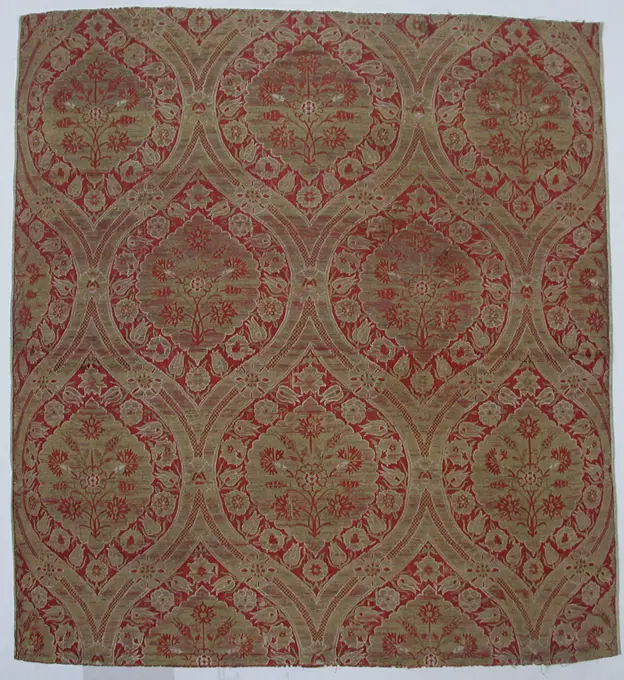
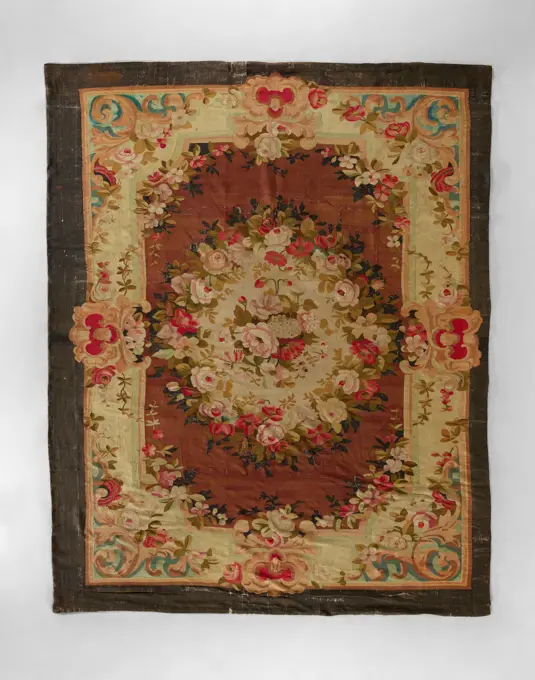
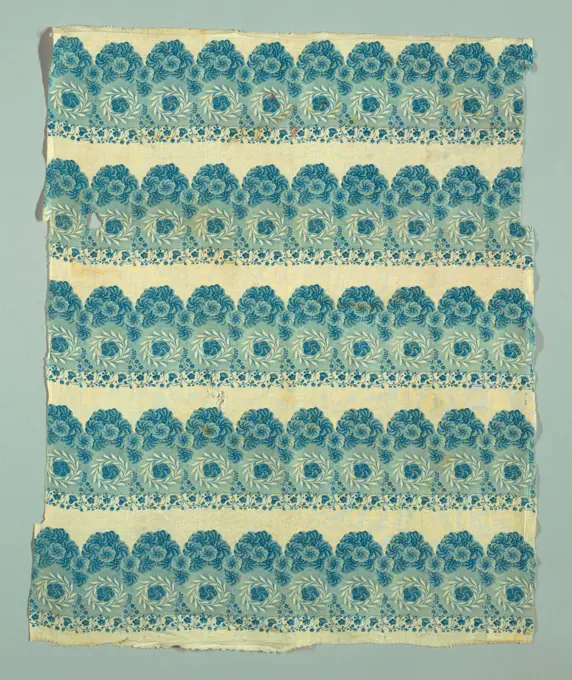
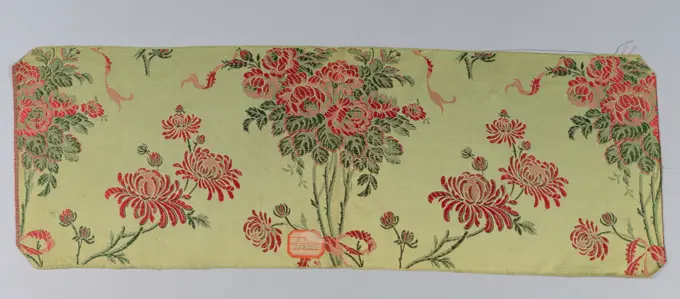
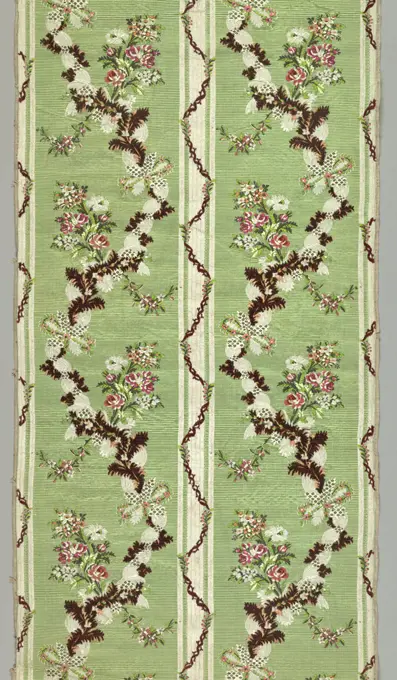
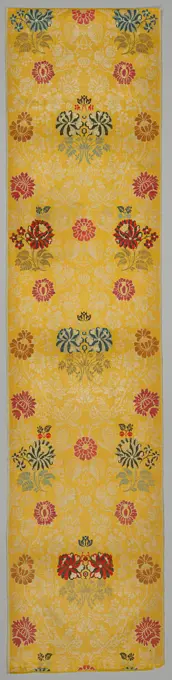
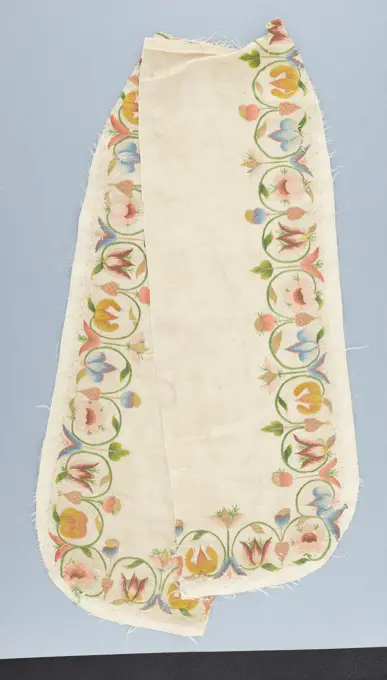
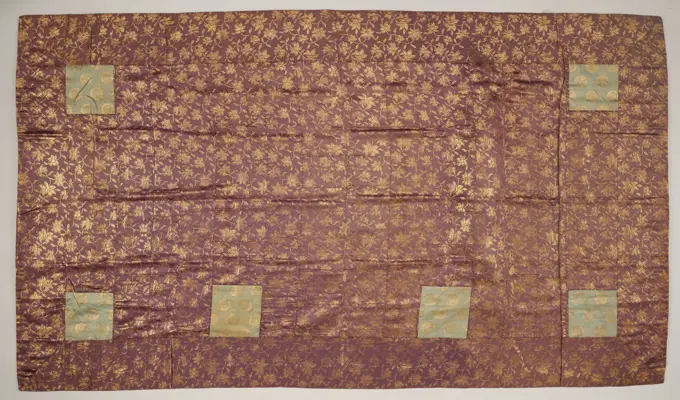
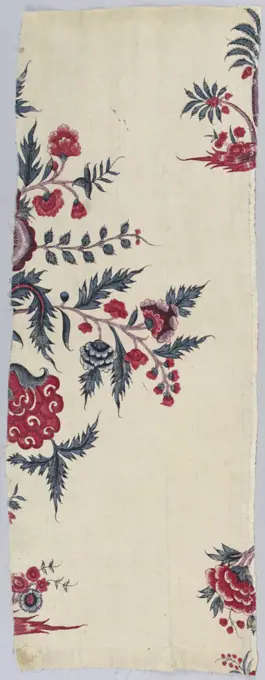
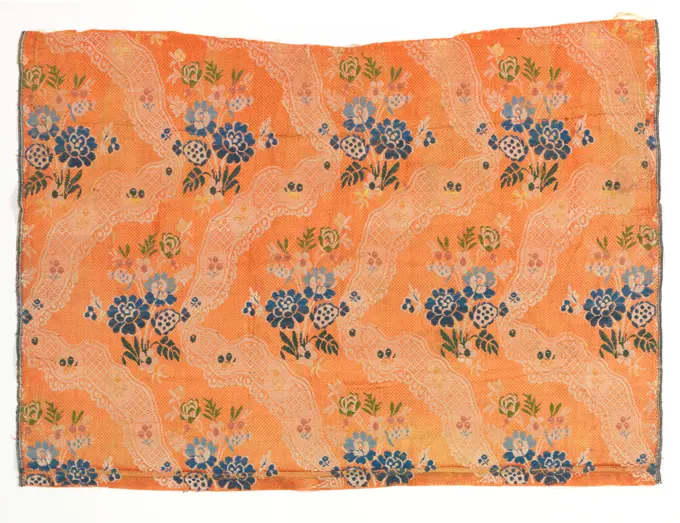
A collection of silk and cotton textiles with intricate floral patterns, showcasing various colors and textures, typical of historical European designs.
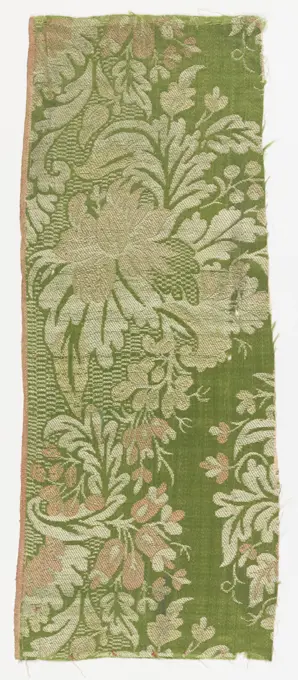
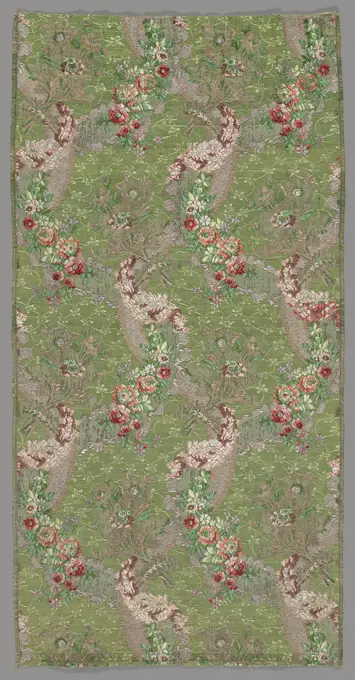
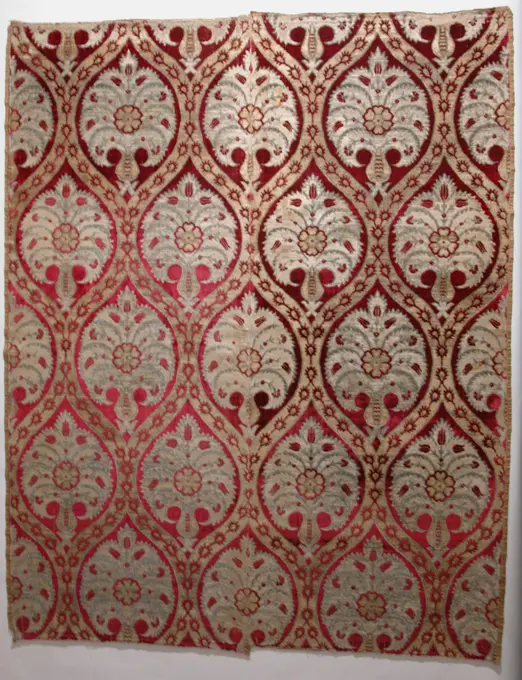
Fragment, Medium: silk Technique: lampas; combination of two structures 7&1 satin plus twill, Green silk weave, lampas, satin filed with leaf scrolls and details of checker motifs in twill weave. Large scale floral design., France or Spain, 17th century, woven textiles, Fragment
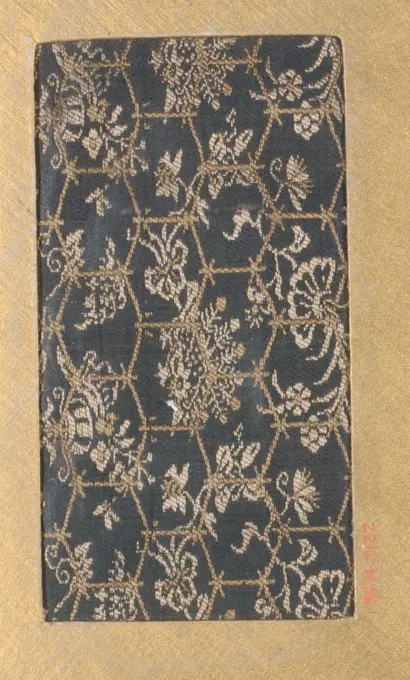
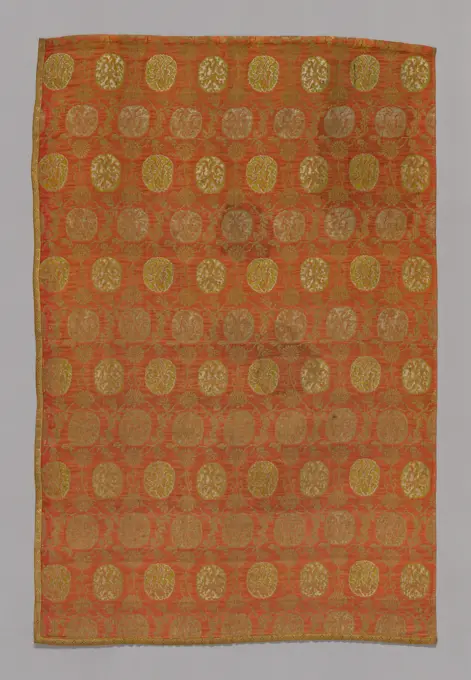
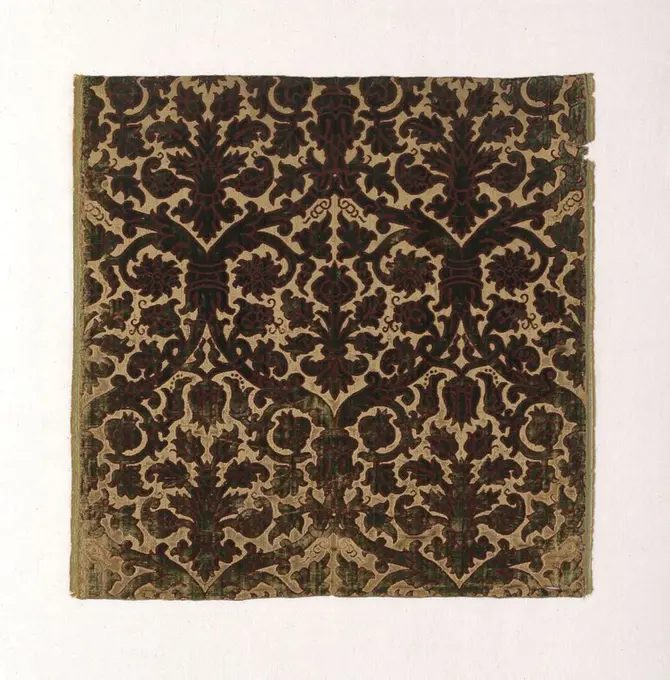
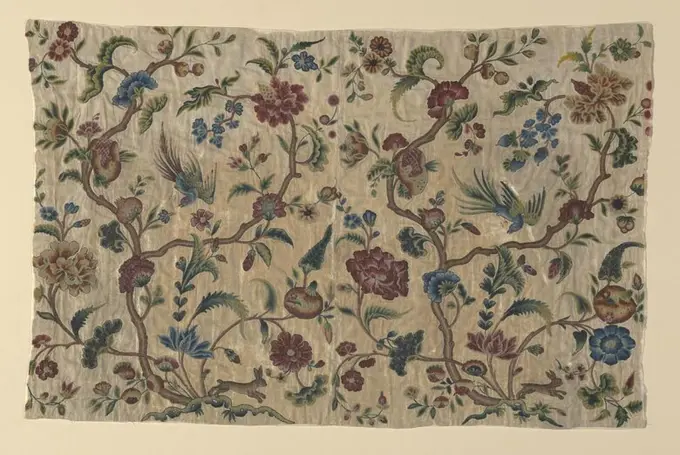
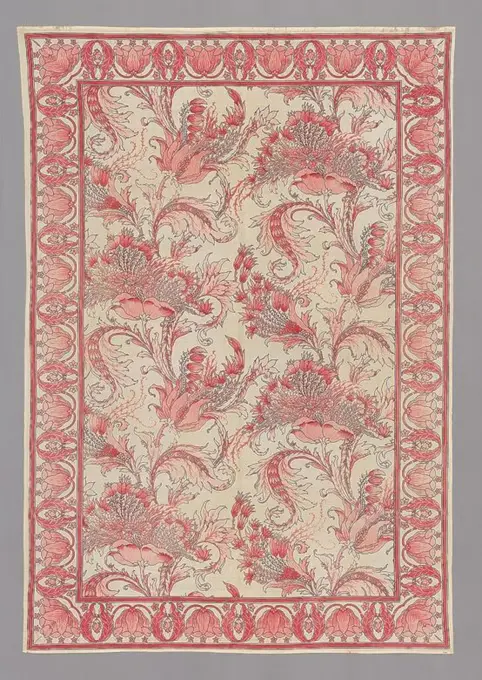
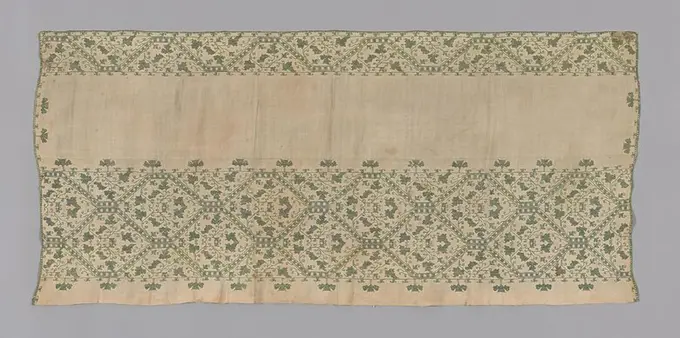
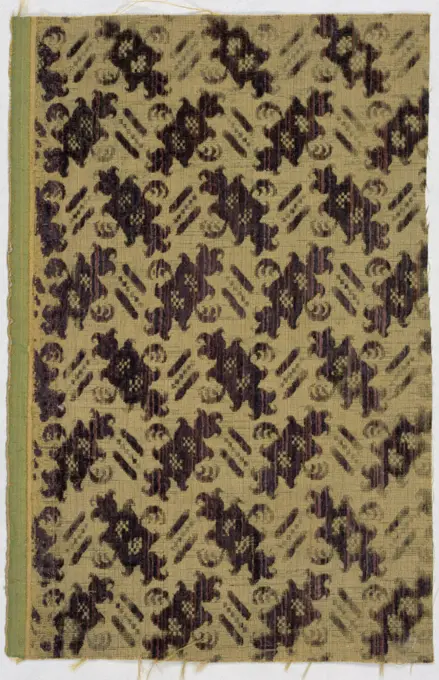
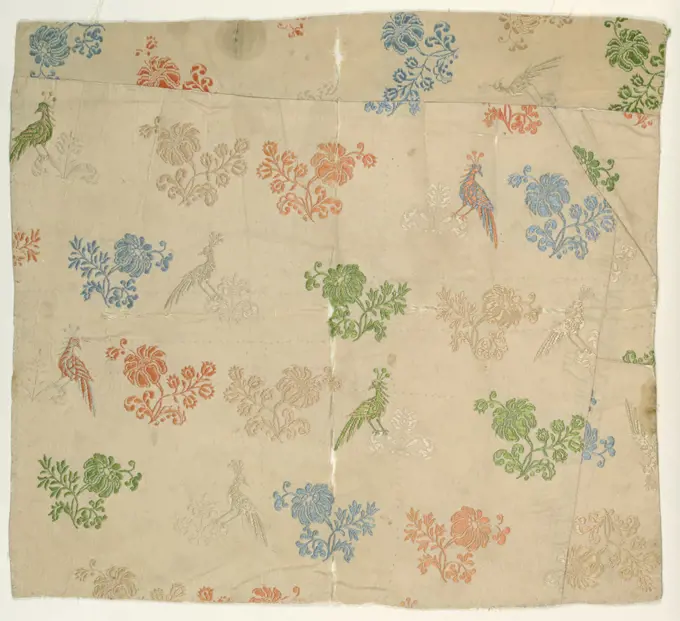
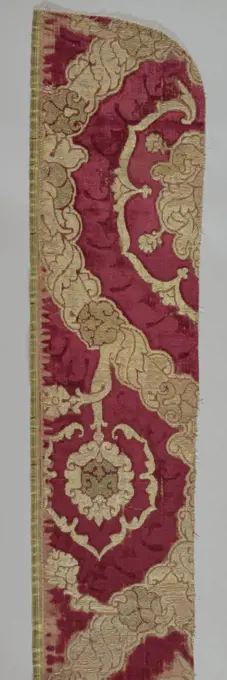
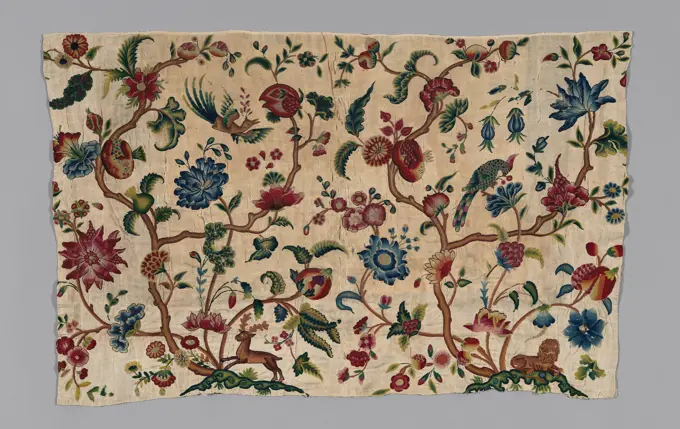
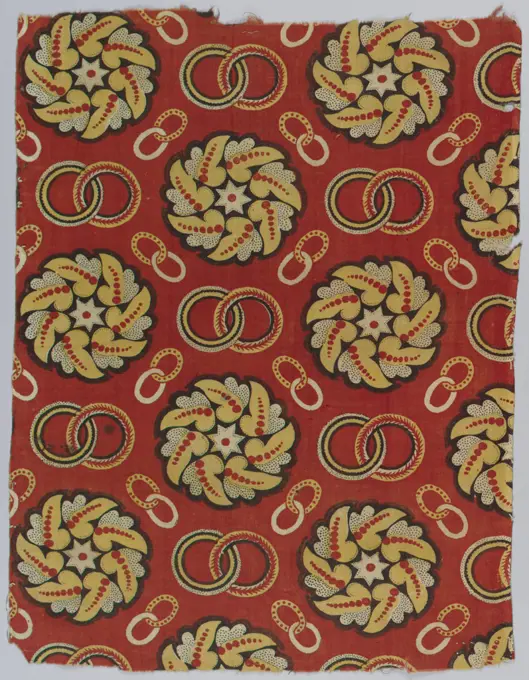
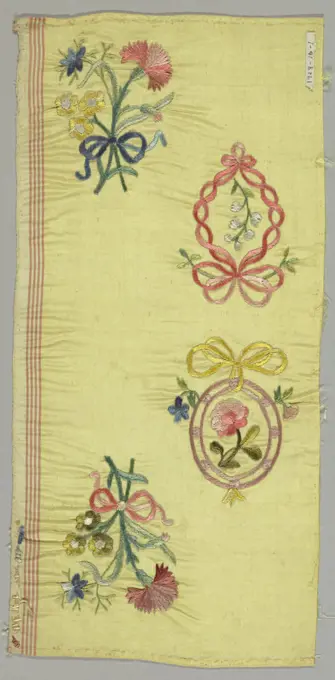
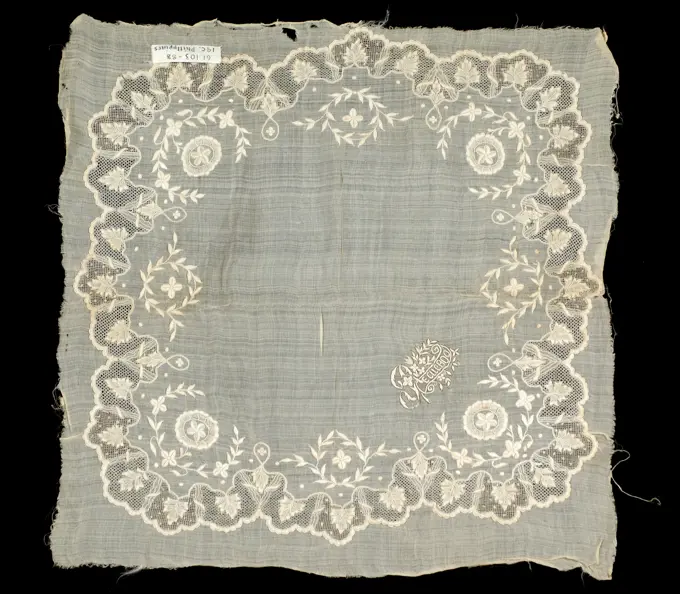
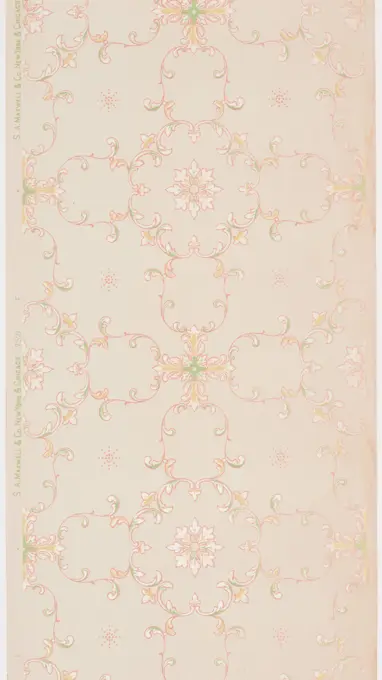
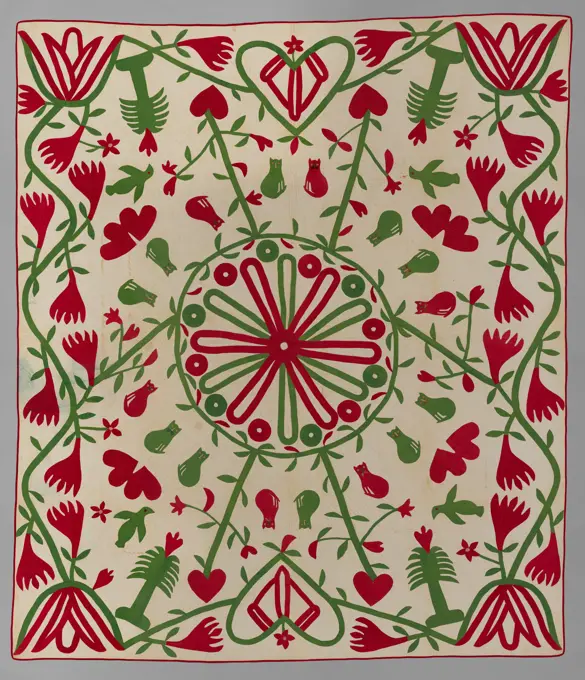
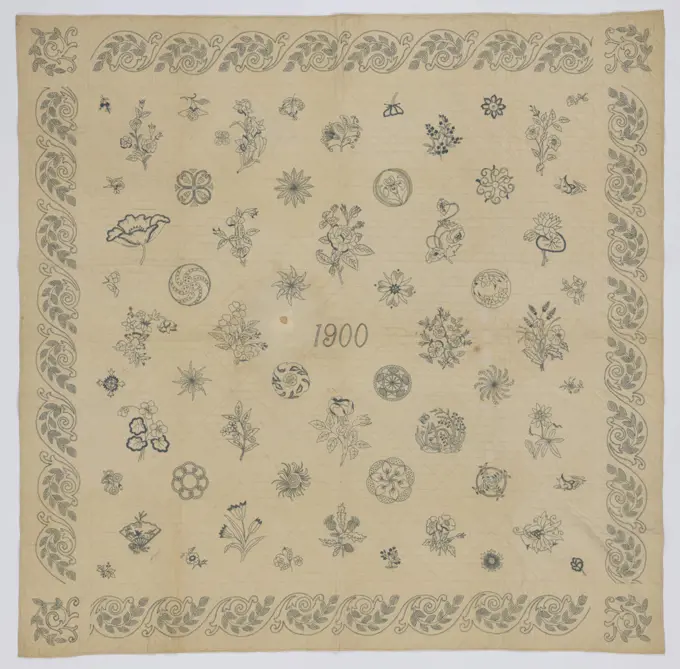
Fragment, 1100s - 1300s. India, 12th-14th century. Plain cloth, resist dyed; cotton; overall: 19.4 x 10.2 cm (7 5/8 x 4 in.).Fragment multicolor silk satin. Two fragments of multicolor silk tissue. The pattern has white leaf raft with heart-shaped leaves and multicolored flower branches.Piece 18th-19th century Japan. Piece 67834Piece 18th-19th century Japan. Piece 66196Panel Made 1890-1899 England. Cotton, silk, wild silk and gilt-metal-strip wrapped cotton, double faced weave of two sets of complimentary warp and weft forming detached layers of interlacing in areas of plain weave over weft-float faced 1 2 's' twill weave and weft-float faced 1 4 satin weave over plain weave and single layer areas of plain weave with paired warps and wefts and with supplementary patterning wefts bound in a weft-float faced 1 3 's' twill interlacings and self-patterned by ground weft floats; edged with cotton, silk and gilt-metal-strip wrapped cotton, plain weave with supplementary patterning wefts .Fragment. Italy. Date: 1501-1600. Dimensions: 56.8 x 56.6 cm (22 3/8 x 22 1/4 in.)Repeat: 36.7 x 27.4 cm (14 1/2 x 10 3/4 in.). Silk, satin weave with supplementary pile warps forming cut and uncut voided velvet. Origin: Italy. Museum: The Chicago Art Institute, Chicago, USA.Portion from a Valance. England. Date: 1701-1725. Dimensions: b: 56.1 × 86.8 cm (22 1/8 × 34 1/8 in.). Linen, plain weave over coarser and heavy plain weave linen, embroidered through both layers in wool yarns; in chain, long, short and feather stitches; French knots. Origin: England. Museum: The Chicago Art Institute, Chicago, USA.Fragment multicolored silk tissue, anonymous, 1750 - 1775 A fragment. Pink silk with lighter stripes, garlands of white flowers and colored bouquets. Note: The two corners are cut off. Note the regular errors with the blue bouquets (may indicate jacquardw). France silk A fragment. Pink silk with lighter stripes, garlands of white flowers and colored bouquets. Note: The two corners are cut off. Note the regular errors with the blue bouquets (may indicate jacquardw). France silkTextile Fragment 18th century. Textile Fragment 454486Textile (England); cottonFragment multicolored sides mexicaine, anonymous, c. 1700 - c. 1799 Fragment multicolored silk tissue. A white soil has striped tracks in brown, white and pink. The jobs are bordered with Zig Zag Lines and a leaf shelf runs in the track. The pattern has sprinkled flower bouquets between and on the lanes. Netherlands silk Fragment multicolored silk tissue. A white soil has striped tracks in brown, white and pink. The jobs are bordered with Zig Zag Lines and a leaf shelf runs in the track. The pattern has sprinkled flower bouquets between and on the lanes. Netherlands silkFragment multicolored brochure side. A fragment of white silk, soil with green tires, about flowers of purple green, black yellow silk, figures of gold thread. Note: Self side; Grove chain yarns (6).Cretine of printed cretonne with swans and Lissen, Michiel Duco Crop, c. 1900 Real curtain of printed cretonne with swans and llissen. Lined and equipped with passion and metal rings. Helmond linen (material) printing Real curtain of printed cretonne with swans and llissen. Lined and equipped with passion and metal rings. Helmond linen (material) printingExcerpt of an embroidered tissue, anonymous, 1700 - 1799 Piece of brown satin, on which with silk of various colors and with gold thread, fine flower vines are embroidered. Consists of two pieces sewn together. Street of Taiwan (Possible) silk. metal thread embroidering Piece of brown satin, on which with silk of various colors and with gold thread, fine flower vines are embroidered. Consists of two pieces sewn together. Street of Taiwan (Possible) silk. metal thread embroideringTextile Fragment. Dimensions: Textile: L. 14 in. (35.6 cm)W. 6 1/2 in. (16.5 cm)Mount: L. 18 1/4 in. (46.4 cm)W. 10 7/8 in. (27.6 cm)D. 7/8 in. (2.2 cm). Date: second half 13th-14th century.Opulent textiles woven of silk and gold threads, referred to as "cloth of gold" were treasured by the Mongol elite and rulers of the subsequent Ilkhanid dynasty (1256-1353). The most luxurious were gold-on-gold fabrics, where both pattern and background were woven in differing types of gold thread. This fragment, exhibiting a shimmering pattern against a blue satin ground, while slightly less opulent, still ranks among the most lavish textiles of its day. Museum: Metropolitan Museum of Art, New York, USA.Fragment; silk, metallicPiece 19th century Japan. Piece 71745Fragment blue silk damest. A fragment of blue silk tissue, with a pattern of checkered garlands with on the intersections and in the fields of flower branches.Tablecloth or Bedcover probably titled "Ragged Poppy". Designed by John Scarratt Rigby (English, 1833-1914); Produced by G.P. & J. Baker for Liberty & Co., founded 1875; England, London. Date: 1902. Dimensions: 265.8 x 185.1 cm (104 5/8 x 72 7/8 in.)Warp repeat: 104.1 cm (41 in.). Cotton, plain weave; block printed. Origin: London. Museum: The Chicago Art Institute, Chicago, USA.Batists handkerchief with embroidery and an edge of fils tirés, anonymous, c. 1800 - c. 1849  Batist handkerchief with embroidery including plumetis and shadow work and along the sides of lace plunger: work with extended wires. Square model. The embroidery has a pattern that consists of a graceful lines of wavy and curled thin tifs with many curling side branches. Large exotic flowers with whimsical carnation -like petals grow on the sities and always an excellent horn -shaped pestle per flour. The sparingly embroidered leaves on the tenders are small compared to the flowers. The work with extended threads has a pattern with different lines and on the corners a pattern with small diamonds in a square grid. Netherlands batiste embroideringFragment, Medium: silk Technique: 5-harness satin damask, Red and green damask in a small, allover design of plants, lion and birds., Italy, 16th-17th century, woven textiles, FragmentSpread of Eastern textile with embroidery, anonymous, c. 1875 - c. 1890 Multiculously embroidered bedspread, the middle and edges of which are decorated with branches with leaves and flowers. NOTE: MIGHTHING IN THE FAIKS. Eastern Europe (Possible) cotton (textile). wool embroidering Multiculously embroidered bedspread, the middle and edges of which are decorated with branches with leaves and flowers. NOTE: MIGHTHING IN THE FAIKS. Eastern Europe (Possible) cotton (textile). wool embroideringUpholstery or robbery of printed tripe with design "Toreador", Carel Adolph Lion Cachet, c. 1920 - c. 1925 Upholstery or spancing fabric, hand-printed Trijp, meandering pattern in violet and light green on beige stock. Design "toreador". Eindhoven Pool layer: mohair. Ground tissue: Cotton (textile) printing Upholstery or spancing fabric, hand-printed Trijp, meandering pattern in violet and light green on beige stock. Design "toreador". Eindhoven Pool layer: mohair. Ground tissue: Cotton (textile) printingTwo fragments of fabric;  beginning of the 18th century (1700-00-00-1720-00-00);ornaments, floral ornaments, plant ornaments, patterned fabrics, James Leman designsCover. Italy. Date: 1601-1700. Dimensions: 42.5 x 93.0 cm (16 3/4 x 36 5/8 in.). Linen, plain weave; embroided in Holbein stitch. Origin: Italy. Museum: The Chicago Art Institute, Chicago, USA.Piece 18th-19th century Japan. Piece 66239Fragment, Medium: silk, metallic thread Technique: supplementary warp pile (velvet) in a woven foundation, Fragment of dark brown velvet on a tan-colored ground in a pattern of leafy medallions that alternate with double barrette shapes., Italy, 16th-17th century, woven textiles, FragmentFragment, Medium: silk Technique: plain weave with discontinuous supplementary wefts (brocading), Polychrome detached floral sprays and birds on cream ground, 17th century, woven textiles, Fragment. Some of the most technically complex woven textiles include not only silk and metal-wrapped thread but also employ two colors of metalógold and silveróto add variety to the textures that reflect the light in subtly different ways. During the 1760s, meandering floral ribbon patterns dominated the market.. Silk, plain weave foundation with supplementary patterning warps and supplementary patterning and brocading wefts of silk, gilt- and silvered-metal strips, wrapped and flat .Textile Fragment 16th century. Textile Fragment 448174Textile, Medium: silk, metallic yarns Technique: supplementary warp forming raised pile (velvet) in a 4&1 satin foundation, with discontinuous supplementary wefts (brocading), Large-scale pomegranate design within an ogival framework, in red velvet with two pile heights, gold brocading, and some gold in raised loops. May have been part of a chasuble., Venice, Italy, late 15th century, woven textiles, TextileFragments; silk, cottonArras. unknown, authorTextile Fragment early 17th century While fragmentary, this textile comprises two full loom widths that have been joined in the center. The ogival design was one of the most popular in Ottoman textiles, and seems to have been a favorite choice for velvets. This example is particularly opulent, utilizing golden metal-wrapped threads that glitter against the dark red velvet ground. Flowering vines fill the bands, framing elaborate floral forms containing carnations and tulips, executed in silver, blue, and red.. Textile Fragment 446871Textile (England); cotton; 1949-26-13Textile (France); cotton; Warp: 57cm (22 1/2in. ). Weft: (selvage to selvage), 100cm (39 1/4 in. ).; Bequest of Elinor Merrell; 1995-50-277Samples (USA); Manufactured by Orinoka Mills (United States); Warp x Weft (a): 22 × 64 cm (8 11/16 × 25 3/16 in.) Warp x Weft (b): 11 × 66 cm (4 5/16 in. × 26 in.) Warp x Weft (c): 21.5 × 28 cm (8 7/16 in. × 11 in.)Fragments of a dress, Medium: silk Technique: brocaded with silk and chenille thread, Parts of a dress. Pannier skirt with fronts of bodice; also a piece of the train. Compound fancy cloth ground of white taffeta with extra warp of apple green which appears in broad vertical stripes of horizontal ribbing. Brocaded designs of serpentine ribbons, in the white ground, and twining feathers, brown lines at their back are bouquets of realistically drawn flowers in red, green, rose and white silk, and rose chenille., probably France, 18th century, woven textiles, Fragments of a dressTextile, Medium: silk, paper Technique: compound satin, Horizontal rows of rust, brown, blue, and peach colored flowers each in combination with white on a cream ground (originally light yellow)., Japan, 19th century, woven textiles, TextileTextile (England); cottonFragment Made 1590-1610 Italy. Silk, warp-float faced satin weave with supplementary pile warps forming cut and uncut, voided velvet .Textile, Medium: silk Technique: plain compound satin, Large scale vase with flowers framed by stylized stems and flowers, fruits, and birds. The pattern in polychrome silks on a white satin ground., Sicily, Italy, 18th century, woven textiles, TextileRug fragment, Medium: wool, jute Technique: worsted and machine-made cut tapestry pile, Dyed worsted yarn woven over a surface weft. There is a bottom weft and two filler warps held together by 'chains.' Design consists of all-over repeat of informal polychrome floral and leaf designs with red and green predominating and open areas of the light brown ground., USA, 1850-99, woven textiles, Rug fragmentPiece 18th century Japan. Piece 71533Textile, Medium: cotton Technique: printed by engraved roller and block printed; glazed, Ground grey with areas of moire in white. Large diamond shaped frame in blue with zigzag edge. Naturalistic rose sprays printed at points of crossing of blue bars, - glazed., 1851-63, printed, dyed & painted textiles, TextileWeave tissue, multicolored flowers on a yellow fond with a patoon of branches, leaves and flowers in white.Multicolored Flowers on a Yellow Wound with a Pattern of branches, Leaves and Flowers in White. Comb Yarn Broché, Wool.Fragment multicolored brochure side. Three fragments white silk tissue with a pattern of multicolored flowers.Textile, Schwartz-Huguenin, Medium: cotton Technique: printed by engraved roller on plain weave, Seven pieces, same design, different colors. A) Ground printed by 'molette' in diamond-shaped design of stripes composed of minute dots in pale blue. Flower clusters in rose and dull greens, printed over background. B) Grey ground and flowers, strong green leaves. C) Grey ground, flowers old rose with green foliage. D) Grey ground, blue flowers, grey foliage. E) grey ground, grey flowers, blue-green foliage. F) lighter grey ground, flowers with strong green foliage. G) Greey ground, blue flowers, green foliage., 1851-63, printed, dyed & painted textiles, TextileTextile (England); cottonPortion from a Valance Made 1701-1725 England. Linen, plain weave over coarser and heavy plain weave linen, embroidered through both layers in wool yarns; in chain, long, short and feather stitches; French knots .Fragment, Medium: silk, metallic thread Technique: brocaded damask, Incomplete design of large scale pomegranates and interlaced strapwork., 17th century, woven textiles, FragmentFragment Lampas with double eagle and flowers, 1575 - 1600 Fragment Lampas with tire voltues between which double -headed eagle and flowers, furthermore a green rosette. unknown silk lampas (textile material) Fragment Lampas with tire voltues between which double -headed eagle and flowers, furthermore a green rosette. unknown silk lampas (textile material)Coverlet (India); cotton, tussah silk; Warp x Weft: 200 x 136.5 cm (6 ft. 6 3/4 in. x 53 3/4 in.); 1951-22-1Fragment. Netherlands. Date: 1601-1625. Dimensions: 18.5 × 17.5 cm (7 1/4 × 6 7/8 in.). Linen and wool, plain weave; tied and free double cloth. Origin: Europe. Museum: The Chicago Art Institute, Chicago, USA.Piece 17th century Japan. Piece 71393Blanket with floral motifs, crossed in diamond pattern. A stitched stitched spreads; Top cotton with floral motifs (white, pink, red, purple, blue-green on a yellow-brown surface); underside of light green silk; Intermediate layer of roughened wool in diamond pattern crossed with pink silk thread.Coverlet. Dated: c. 1940. Dimensions: overall: 50.9 x 35.8 cm (20 1/16 x 14 1/8 in.) Original IAD Object: 81" wide; 110" long. Medium: watercolor, graphite, and gouache on paperboard. Museum: National Gallery of Art, Washington DC. Author: Betty Jacob.Chair seat covers (set of four) 18th century French. Chair seat covers (set of four) 230926Textile, Herman A. Elsberg, (American, 1869-1938), Medium: silk Technique: compound plain woven, Minute diaper pattern with flowers in burgundy, black and grey., Lyon, France, ca. 1929, woven textiles, TextileRibbon Lattice with Pinecone (). Dimensions: Textiles: Ht. 9 3/4 in. (24.8 cm)W. 9 3/8 in. (23.8 cm)Mount: Ht. 13 in. (33 cm) W. 13 1/2 in. (34.3 cm) D. 1 3/4 in. (4.4 cm). Date: 7th-9th century. Museum: Metropolitan Museum of Art, New York, USA.Textile, Medium: cotton Technique: block printed on plain weave, Colored ground showing a design of non-directional medallions of leaf shapes revolving around a star and interlocking ring. Red, black and yellow., England, 1815-25, printed, dyed & painted textiles, TextilePiece ca. 1735 French. Piece 220142Piece ca. 1785 French. Piece 221927Fragments of embroidery unknownTextile, Medium: silk Technique: embroidered on taffeta, Rectangular piece of yellow taffeta embroidered in colored silks has two bouquets of flowers tied with a ribbon and two floral sprigs, each within a frame that is tied with a ribbon. Selvedge on one edge has brown and white stripes., France, 19th century, embroidery & stitching, TextileFragment of silk fabric  pattern made of flower bunches and a river” unknownFragment; silk and linen; Warp x Weft: 45.1 x 38.7 cm (17 3/4 x 15 1/4 in.)Sampler Made 1676 England. Linen, plain weave; bands of cut and drawn thread work in interlocking lace and Romanian stitches; bands of linen, needle lace of a type known as Reticello ; and embroidered with silk in Algerian eye, hem, Montenegrin cross, running, double running, and satin stitches; buttonhole couching . Katherine VerenHandkerchief fourth quarter 19th century Philippine. Handkerchief 169424Piece 18th century Japan. Piece. Japan. 18th century. Silk / Compound weave. Edo period (1615-1868). Textiles-WovenCeiling Paper (USA); Manufactured by Maxwell & Co., S.A. (United States); machine-printed paper, liquid mica; 93.5 x 49 cm (36 13/16 x 19 5/16 in.)Textile (France); silkPiece 18th century Japan. Piece 71671Piece 18th-19th century Japan. Piece 66656Piece French 19th centuryFragment (Japan)Band (Italy); linen; Bequest of Richard Cranch Greenleaf in memory of his mother, Adeline Emma Greenleaf; 1962-52-7Fragment, Medium: silk Technique: plain compound satin with brocade, Dragon and arabesques in blue, green, dark brown, yellow and light blue on a gray ground., China, 19th century, woven textiles, FragmentSutra Cover Made 1590-1599 China. Silk, plain weave, double cloth .Fragment of velvet upholstery unknownFragment of silk fabric  satin stripes with colourful branches unknownFragments; silk, linenTextile, Medium: cotton Technique: printed on plain weave, glazed, Two columns of multicolored bouquets in baskets on an off-white ground., England, late 19th century, printed, dyed & painted textiles, TextileMary Berner, Patchwork and Applique Quilt, 1935 1942 Patchwork and Applique QuiltCeiling paper, Benton, Heath & Co., Hoboken, New Jersey, 1875 - 1917, Machine-printed paper, liquid mica, Floral medallions with pink roses connected by foliate scrolls with pendants. Printed in blue, green, light pink liquid mica and white liquid mica on cream ground. Printed in selvedge 'Benton, Heath & Co. Hoboken. N.J.' pattern number '1775' 'WA'., Hoboken, New Jersey, USA, 1905-1915, Wallcoverings, Ceiling paperSidewall (USA); Manufactured by Robert Graves Co. (United States); machine-printed paper, liquid mica; 84 x 49 cm (33 1/16 x 19 5/16 in.)Fragment, 1800s. China, 19th century. Silk; overall: 51.5 x 27.3 cm (20 1/4 x 10 3/4 in.).Fragment multicolored silk, anonymous, c. 1700 - c. 1750 Fragment multicolored silk tissue with on a green soil a symmetrical pattern of large flower branches that form medallions in which a basket with flowers. Spain silk twill Fragment multicolored silk tissue with on a green soil a symmetrical pattern of large flower branches that form medallions in which a basket with flowers. Spain silk twillFragment Made 1801-1900 Russia. Linen, plain weave; painted .Cat quilt ca. 1850 Unknown This quilt is a charming example of the outstanding creativity of some nineteenth-century American quilt makers. Following her own design aesthetic, the unknown maker created a unique quilt, featuring what we must assume were some of her favorite thingscats, plants, and love. Overall, it is a vibrant design, full of movement, from the inner spoked wheel that spins off vines in every direction, to the interplay and balance of the red and green designs. Bold and engaging pictorial quilts like this one are rare among mid-nineteenth century quilts, which are often follow more regimented patterns. Many of the motifs, such as the cats, hearts, trees, birds, and flowers were cut following paper templates, a technique that is commonly found in quilts made in New York State. For related, but far less fanciful New York quilts using the same paper template technique, see 1988.24.2 and 52.103.. Cat quilt. American. ca. 1850. CottonFragment of silk fabric  flower vase motif unknownTextile (France); silk; 1958-102-1Embroidered doily unknownQuilt, Medium: cotton Technique: patchwork with embroidery using stem, buttonhole, satin and long and short stitches on plain weave cotton, quilted, Patches embroidered with flowers and 'japonaise' patterns all in the same grey/blue thread on muslin foundation. The date 1900 is embroidered in the center and there is a repeating border around the edges. The outline the embroidery patterns is visible under the motifs. Backed with white cotton, quilted in straight lines., USA, 1900, embroidery & stitching, QuiltTextile (France); cottonBatist's handkerchief with openwork hems and completed around with a strip of needle side. Batist's handkerchief with openwork hems and completed around with a strip of needle side. Along the edges of the handkerchief is a triple straight frame with three narrow lines open sewing: work with pulled out wires. The strip needle side has a pattern of flowers side by side with different shapes, including flowers with two large and two small lobes and flowers with a central flower leaf in the shape of a nightcap. The flower hearts of all flowers are made with a circular Cordon. The flower leaves are made with feston stitches and equipped with contour lines. The flowers are connected by picoted bars. Cut-outs and ornamental grounds are applied in the flower leaves. The straight outs are finished with radar picots.Bliżej Kultury unknownBuddhist priest's robe (kesa), 18th century, Unknown Japanese, 46 x 80 in. (116.84 x 203.2 cm), Brocade, woven fabric, Japan, 18th centuryChintz fragments, Medium: cotton Technique: mordants for black, 2 reds and 2 purples applied over resist by brush and pen; madder dyed; blue applied by brush over resist; yellow applied by brush; chintz on plain weave, Two fragments which show the mirror image of a flowering tree motif., India, 18th century, printed, dyed & painted textiles, Chintz fragmentsFragment; silk