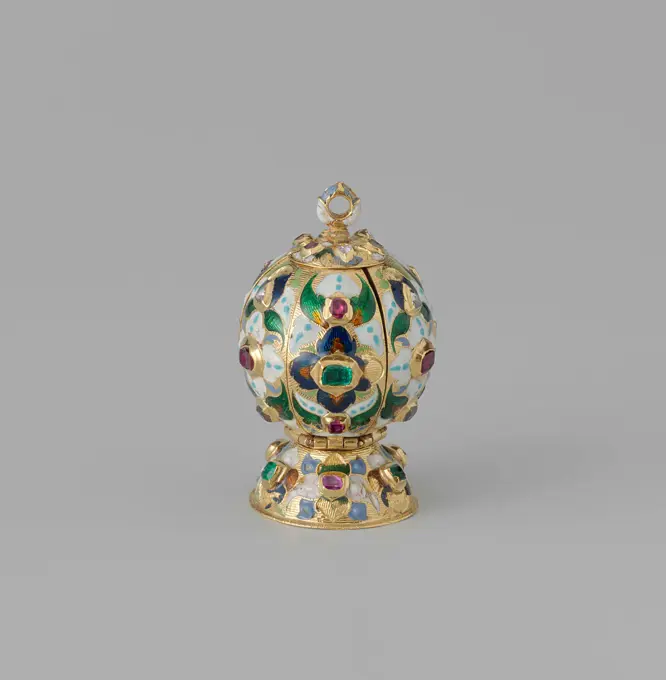
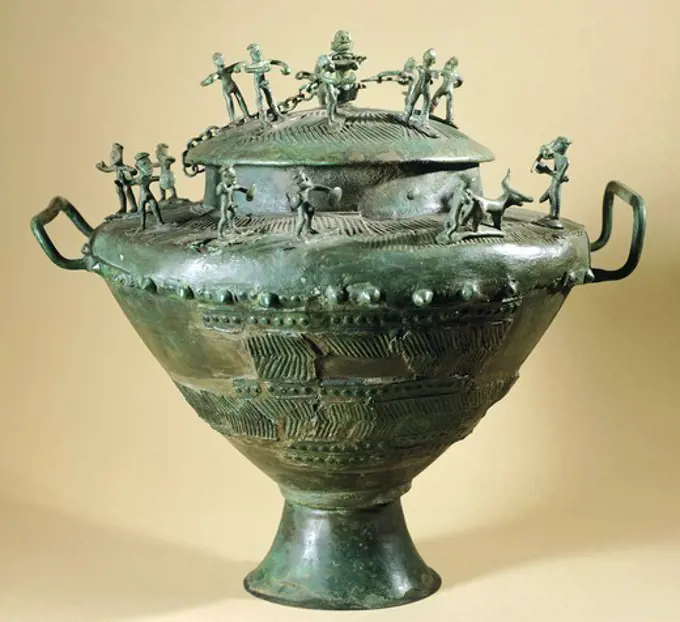
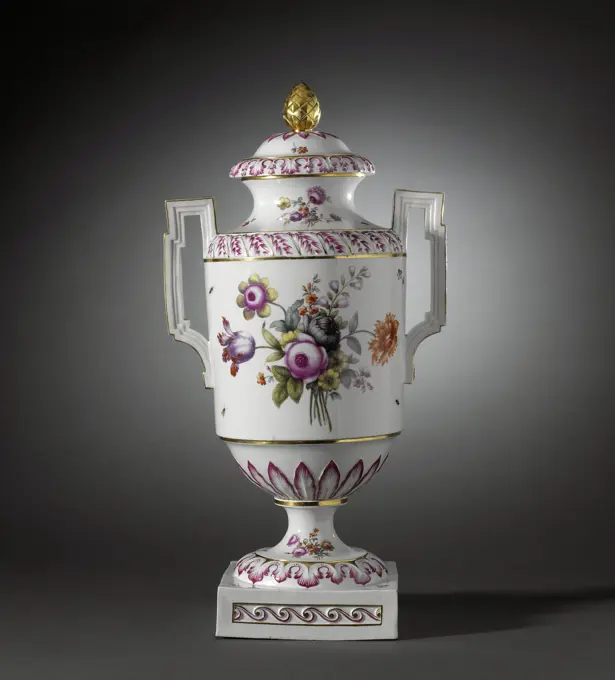
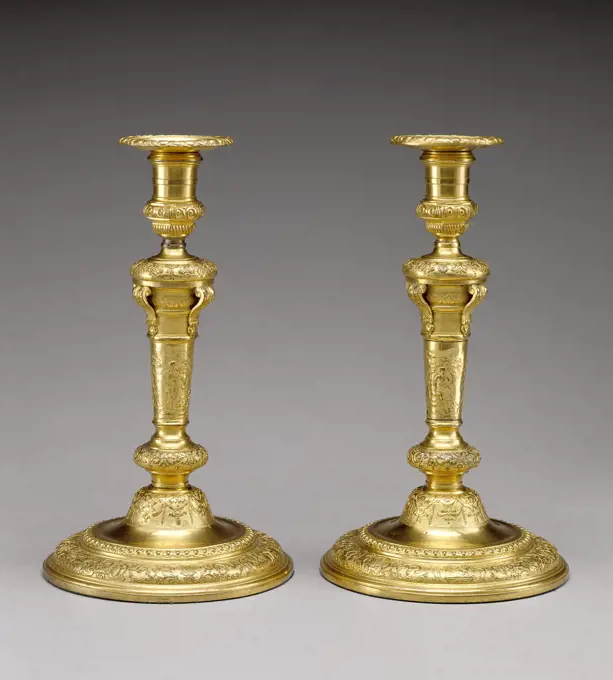
Decorative Vessels and Cups

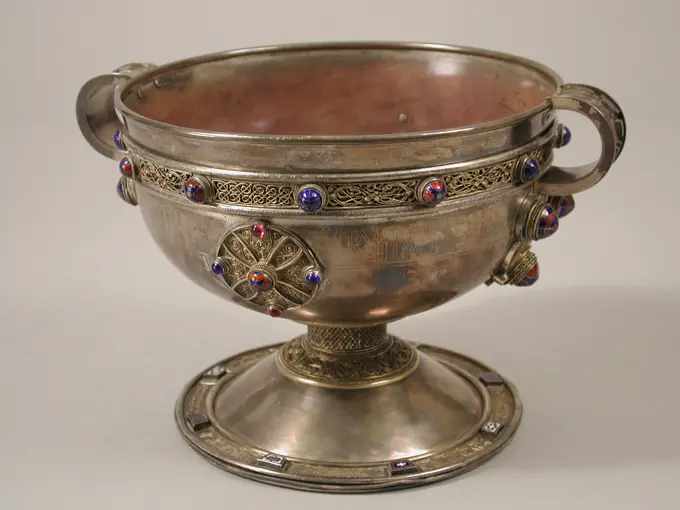
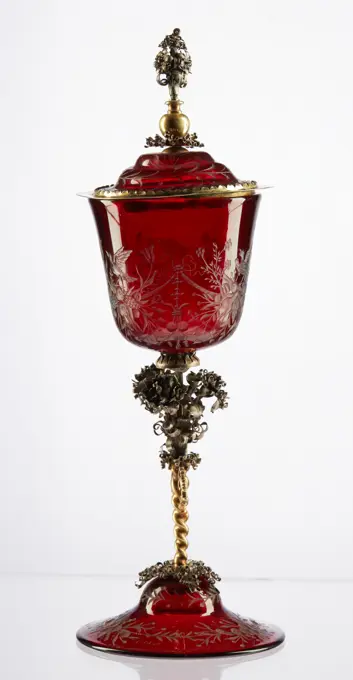
Ornate containers, including a Persian cup, Sèvres vase, and jeweled coupe lids featuring fine craftsmanship and intricate designs.
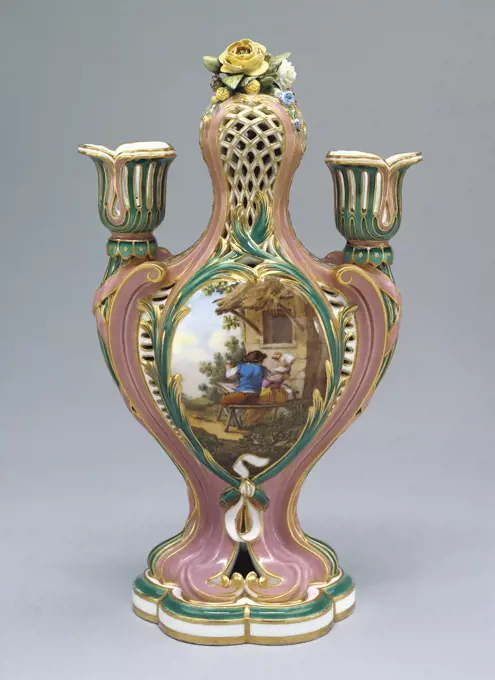
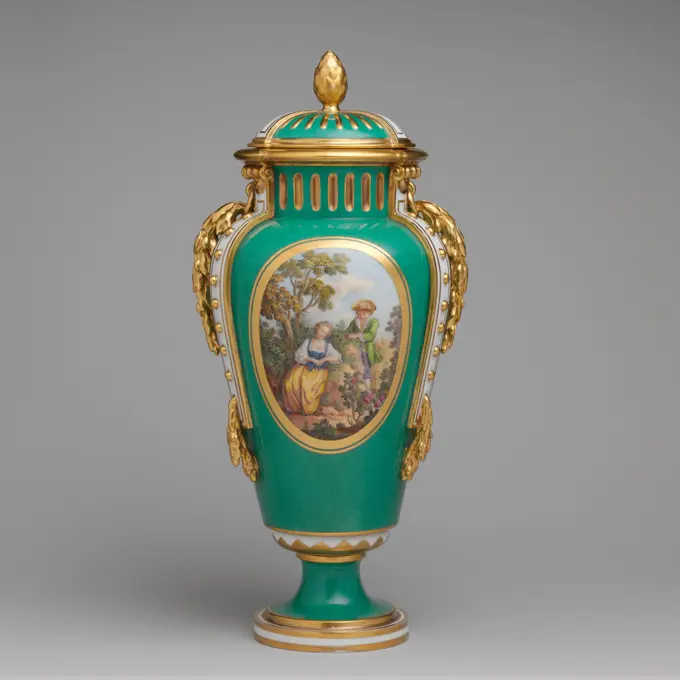
Vase; Painted by Charles-Nicolas Dodin (French, 1734 - 1803); Sèvres, France; 1759; Soft paste porcelain, pink and green ground colors, colored enamel decoration and gilding; 24.9 x 14.4 x 9.4 cm (9 13,16 x 5 11,16 x 3 11,16 in.)
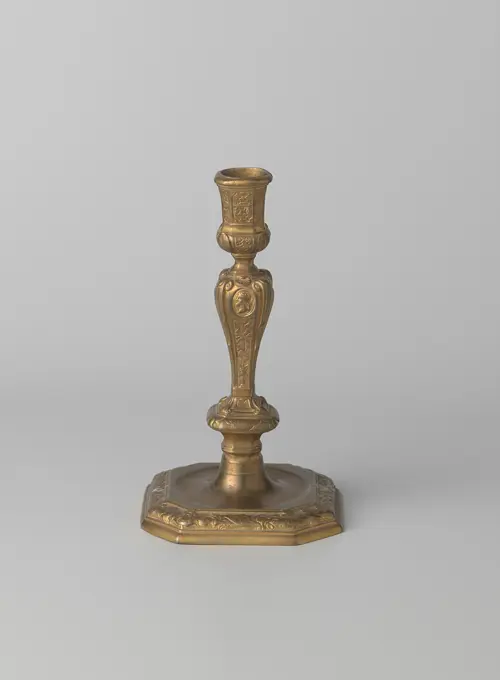
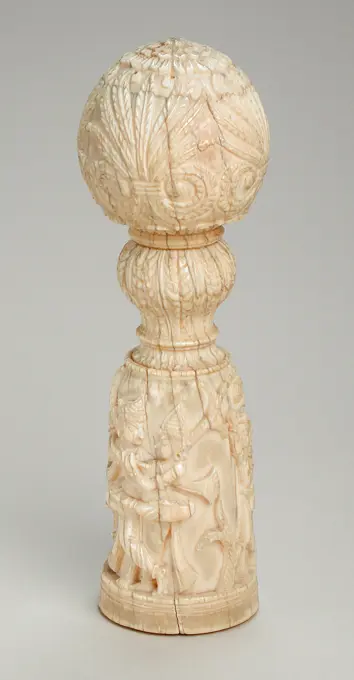
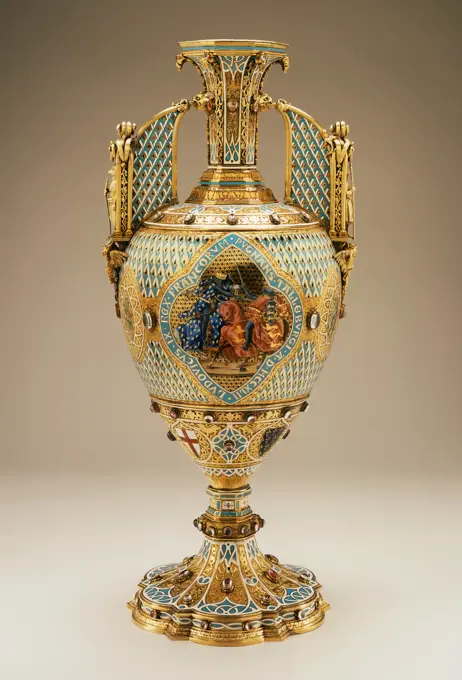
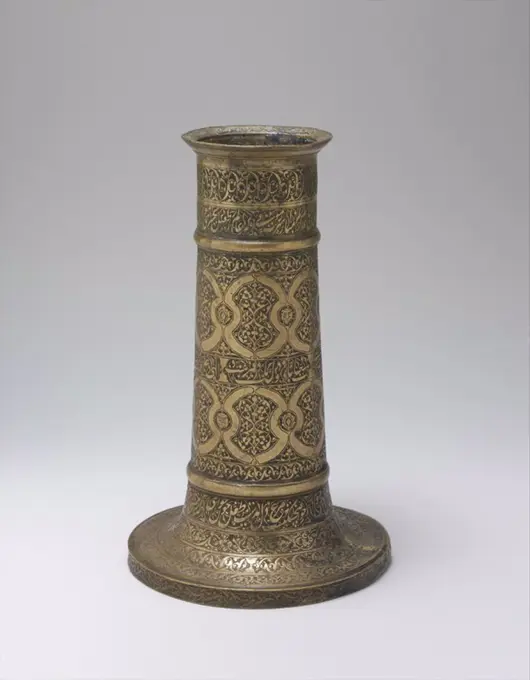
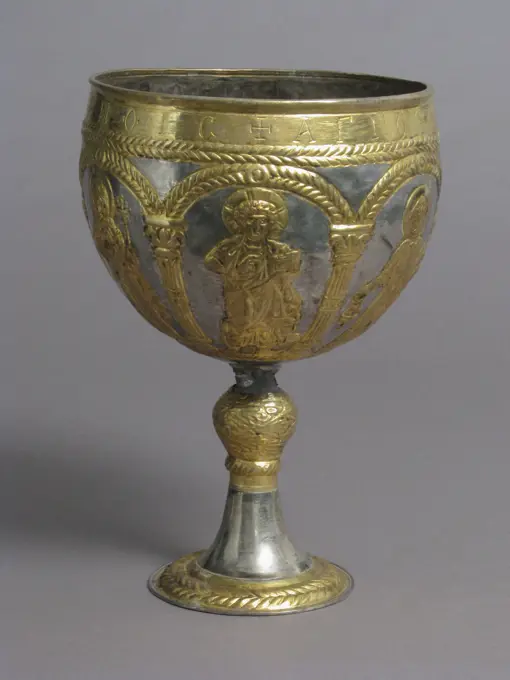
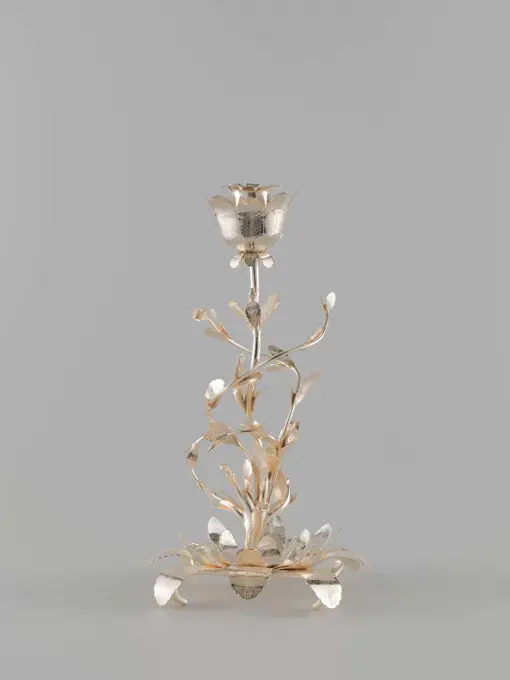
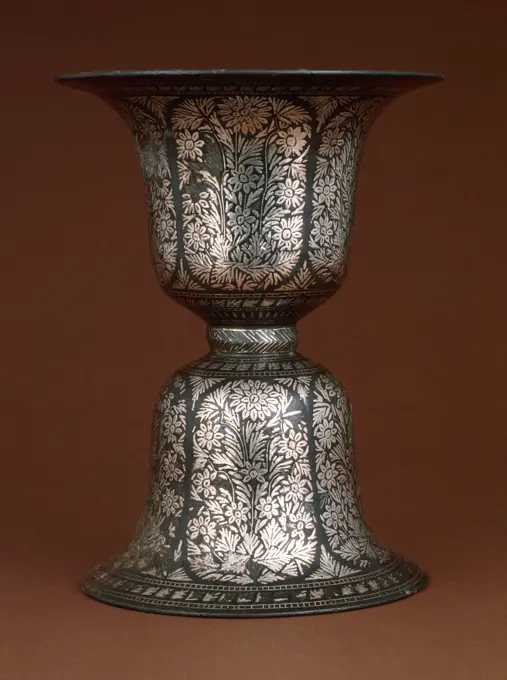
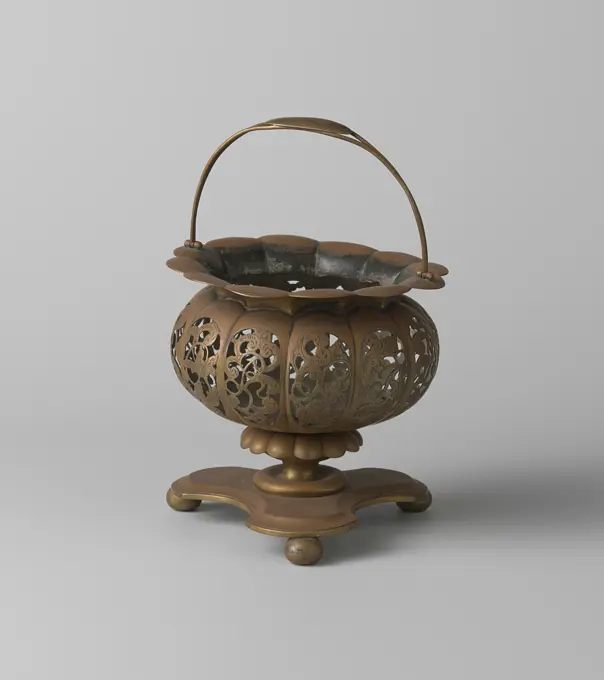
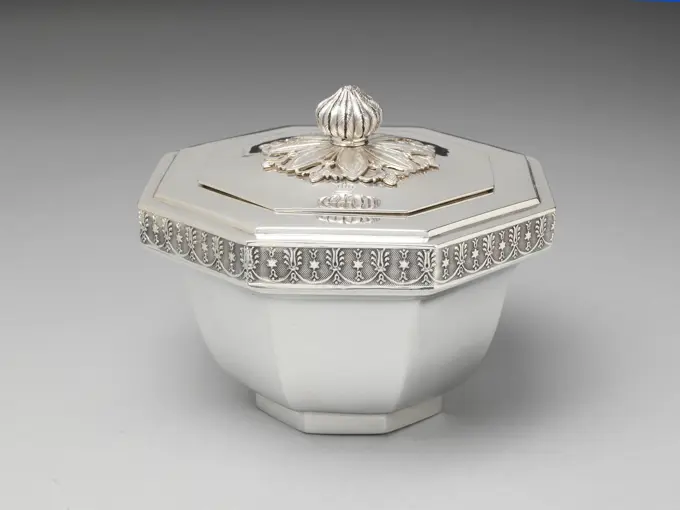
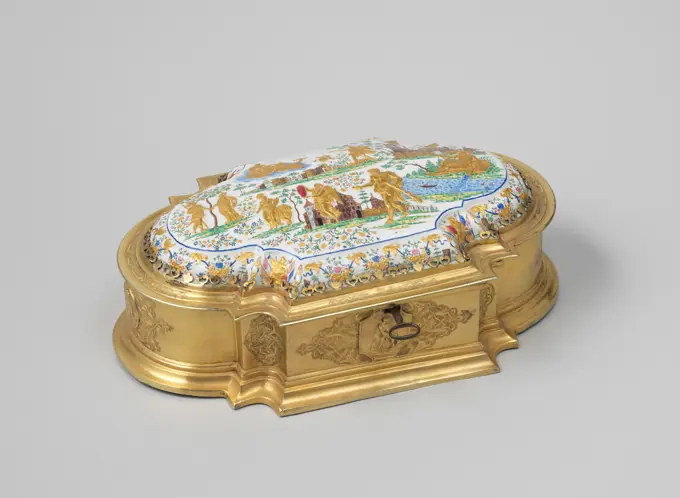
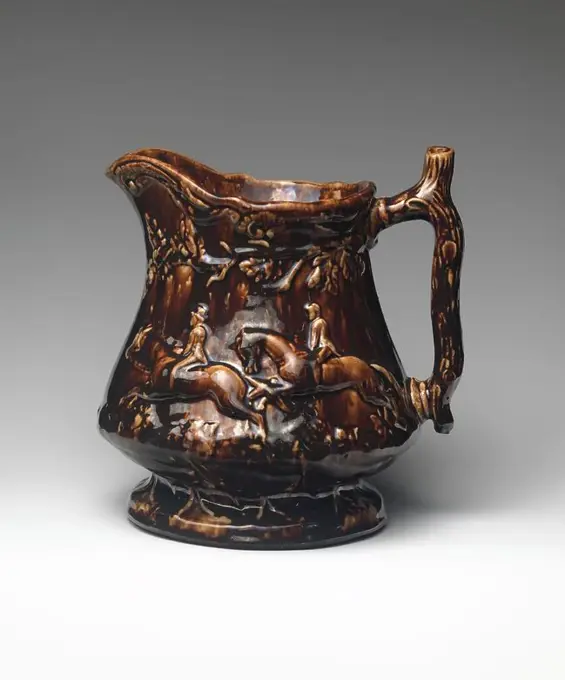
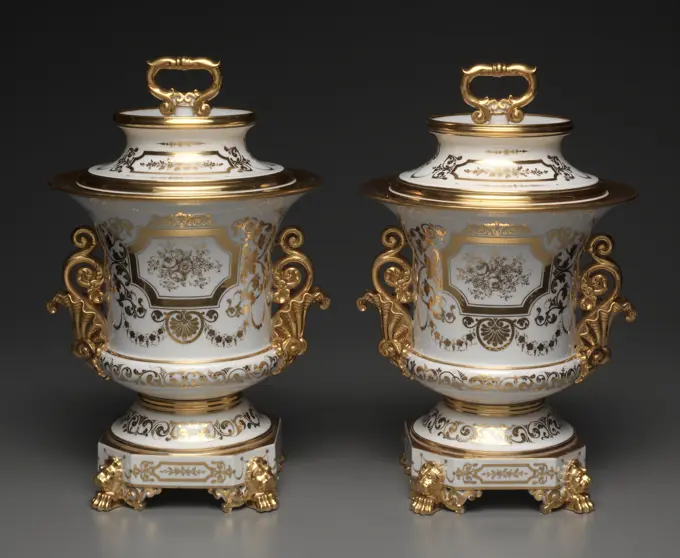
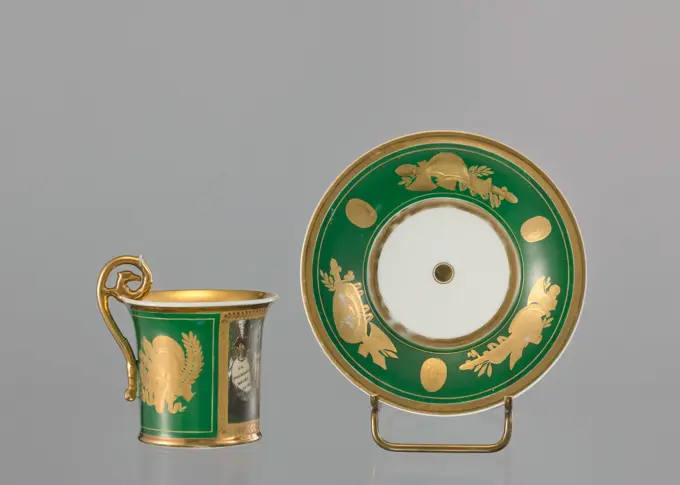
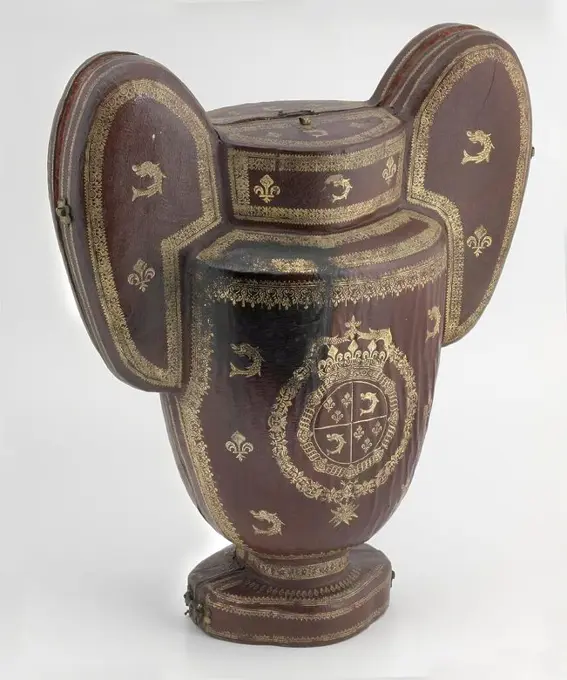
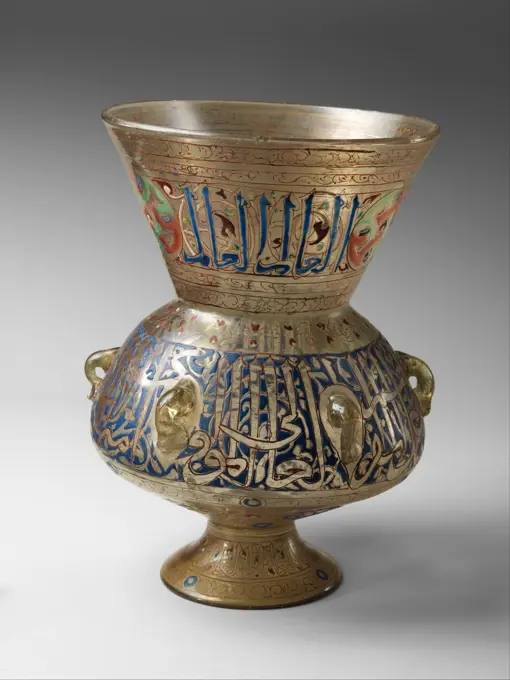
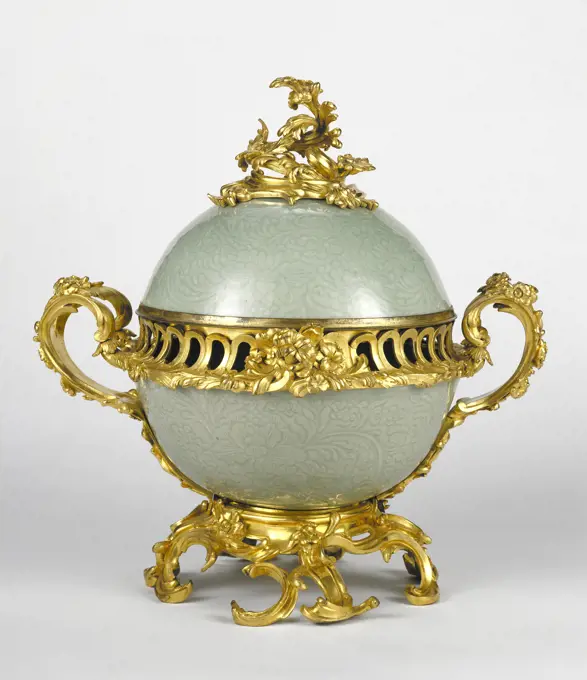
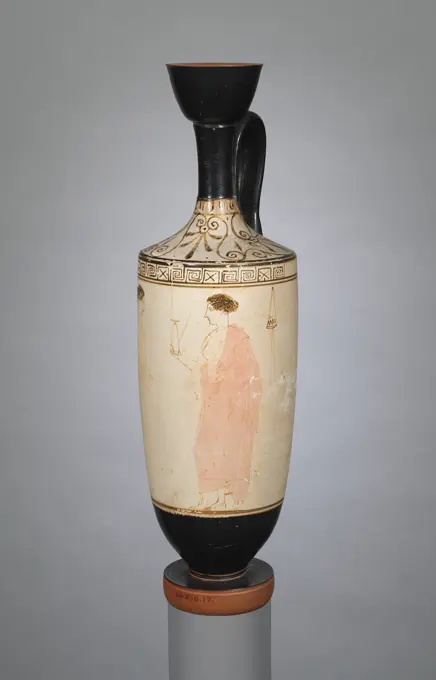
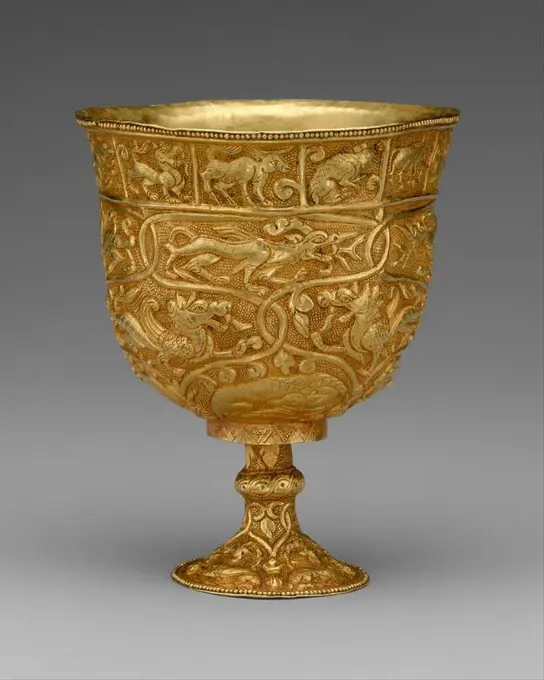
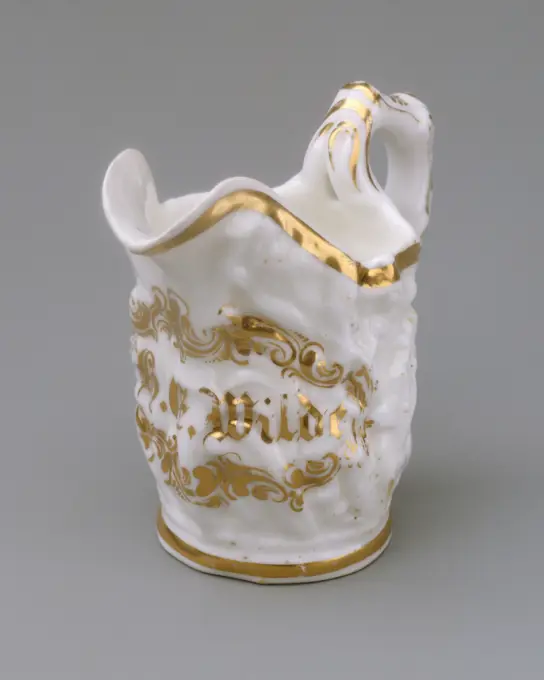
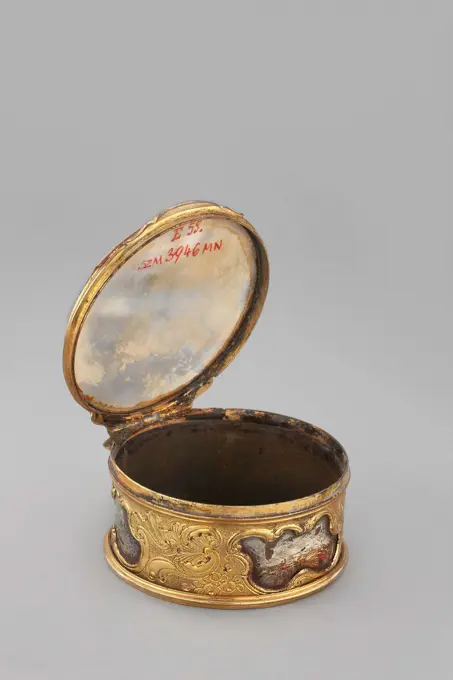
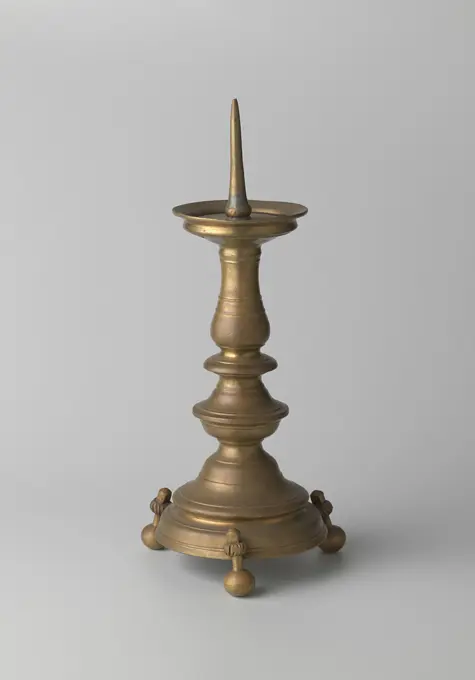
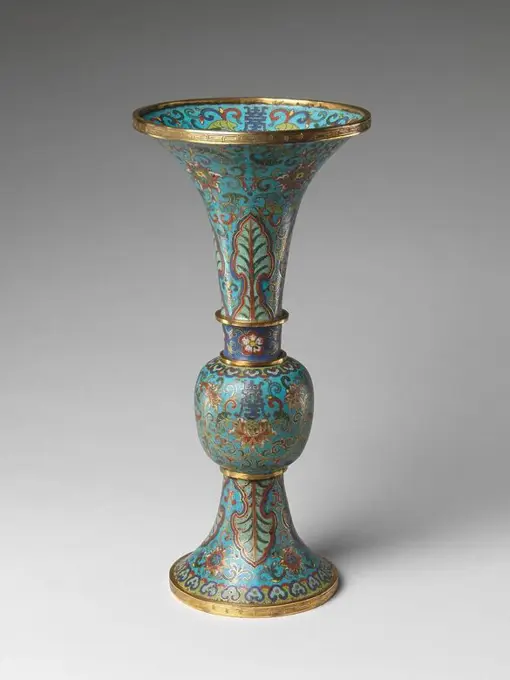
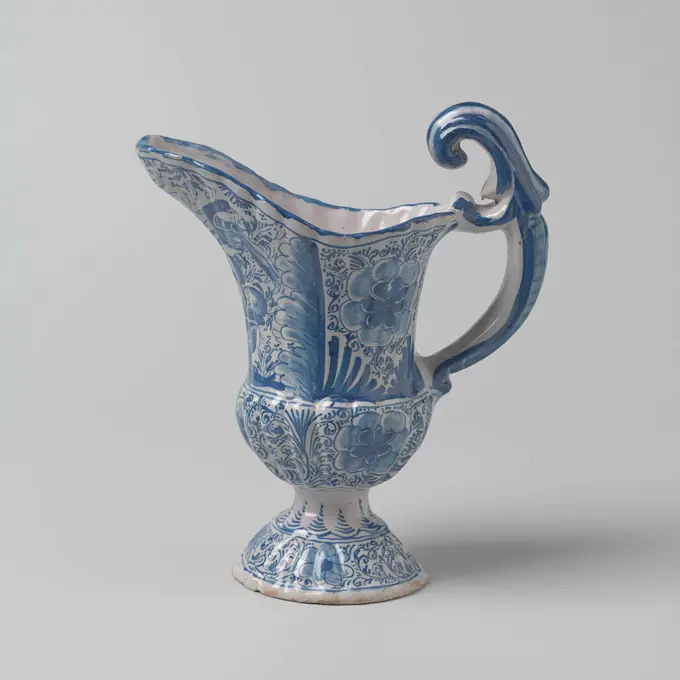
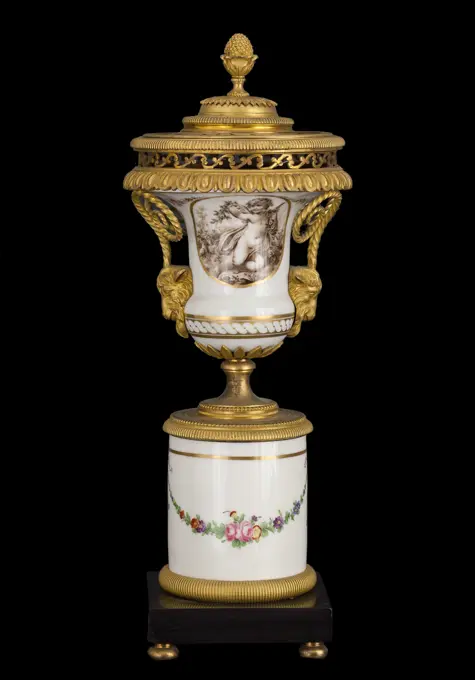
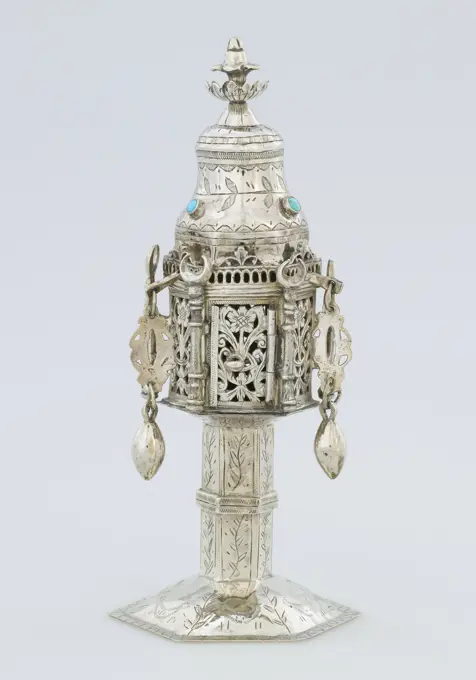
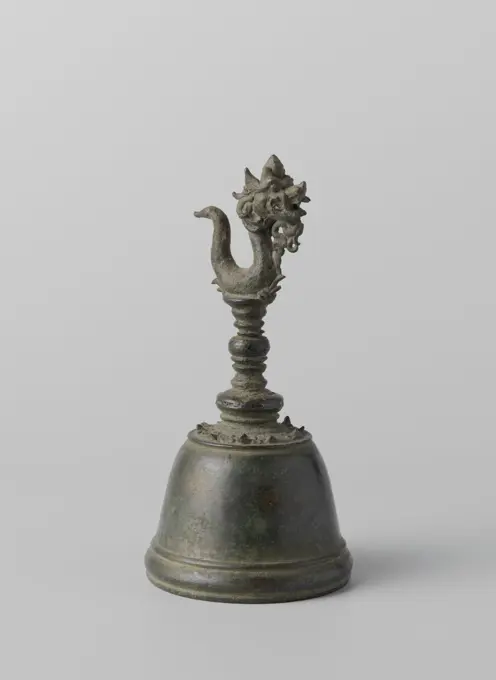
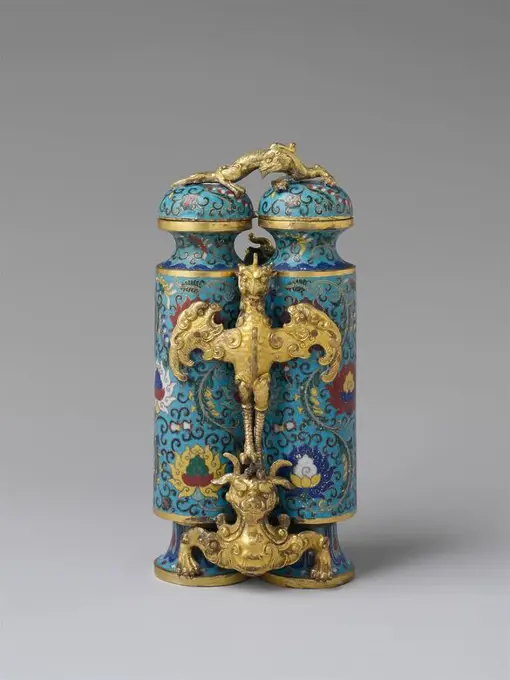
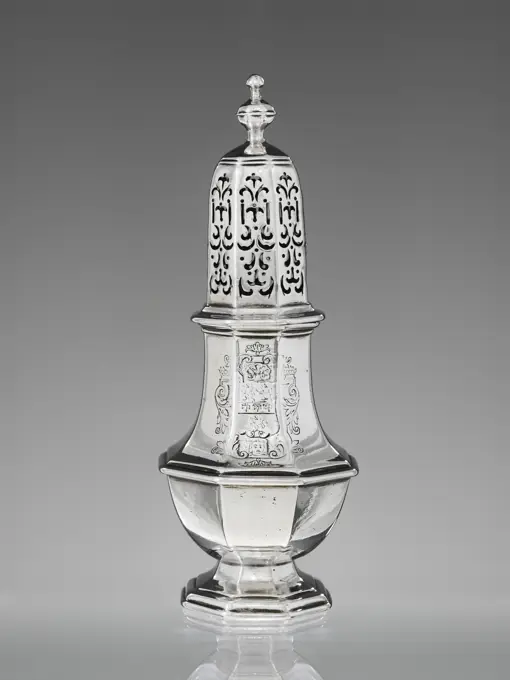
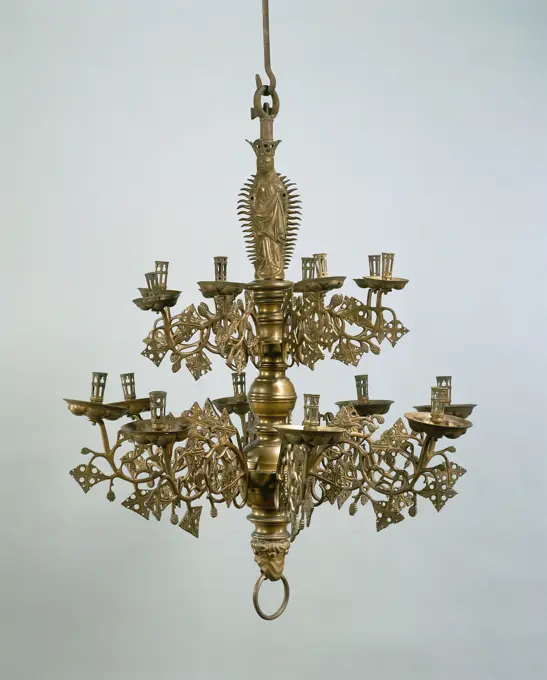
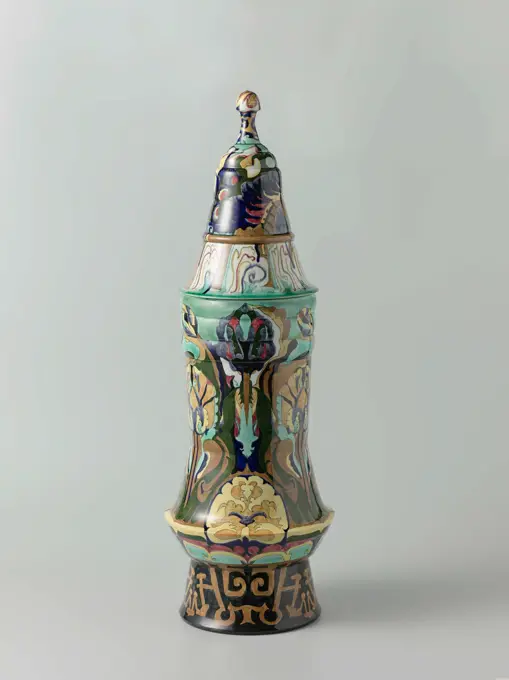
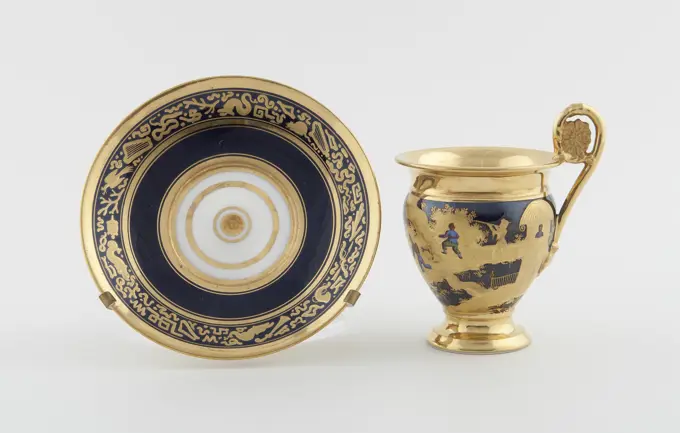
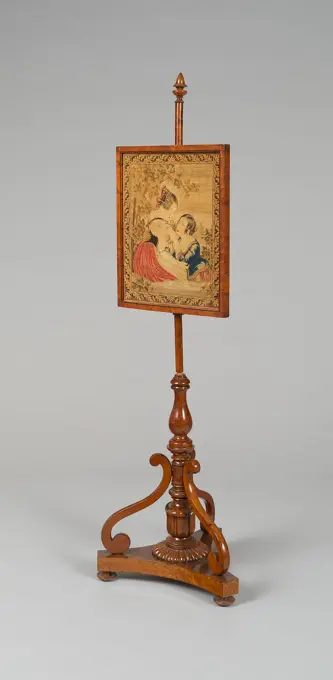
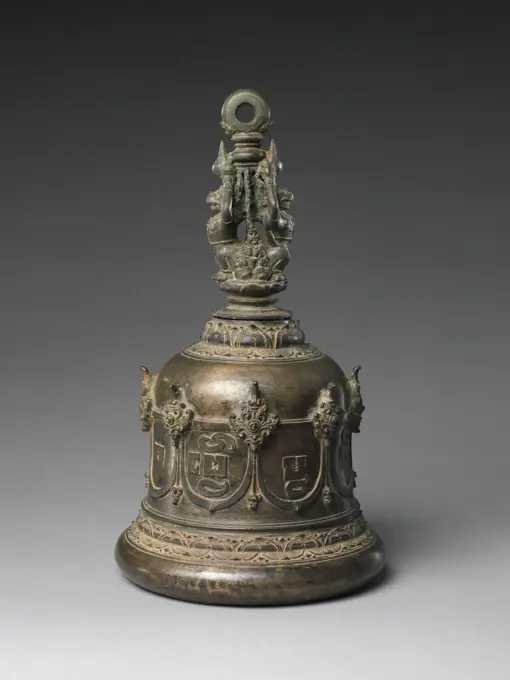
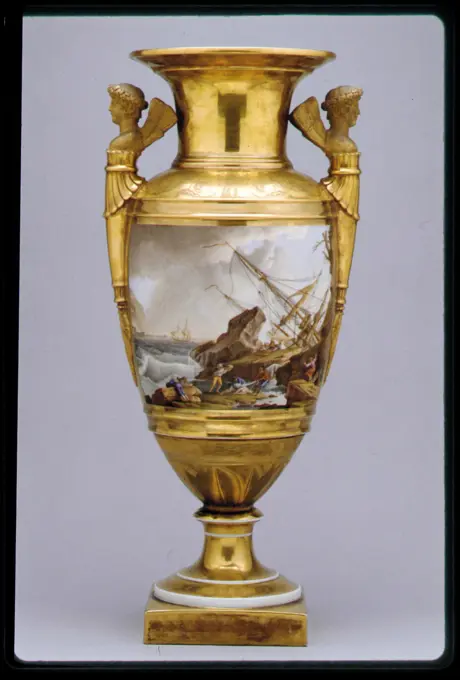
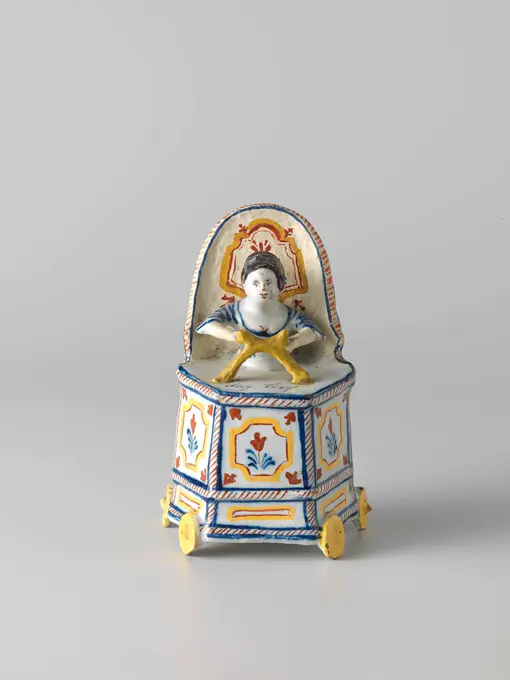
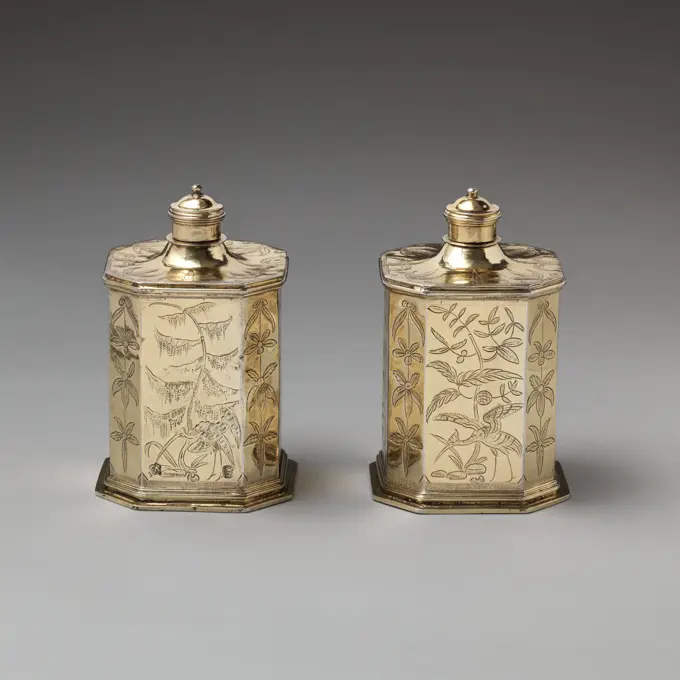
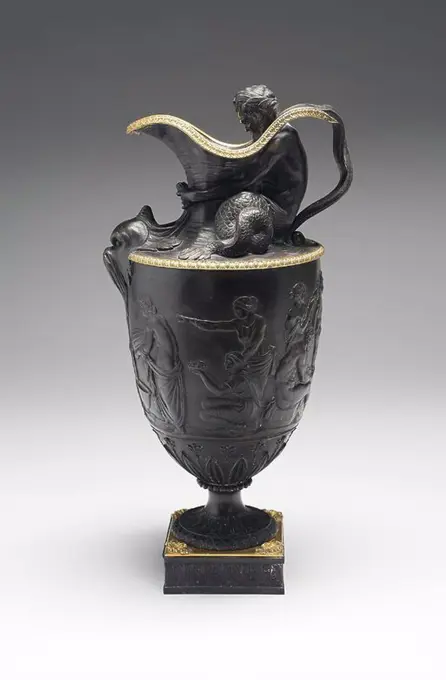
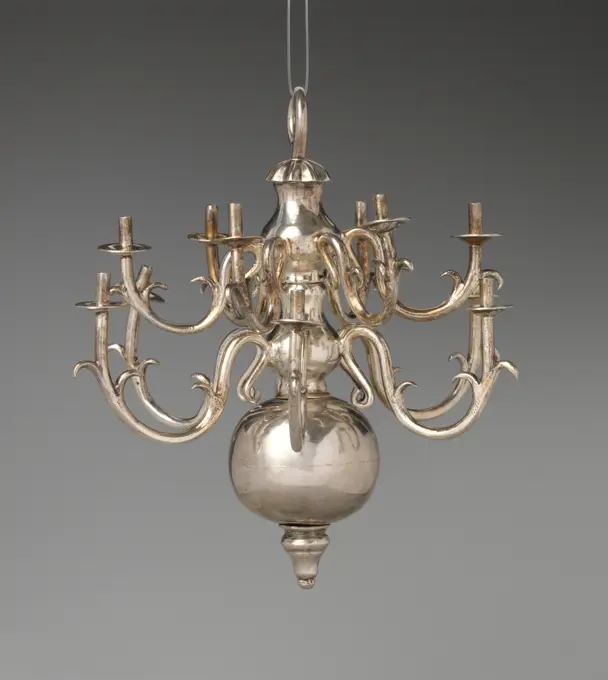
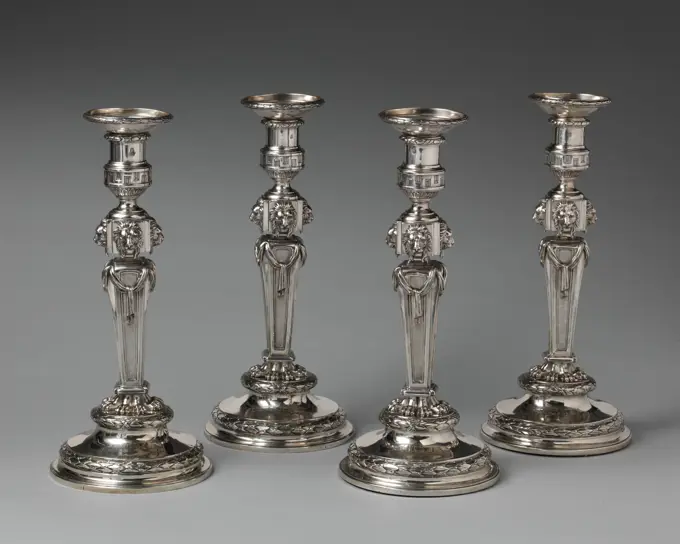
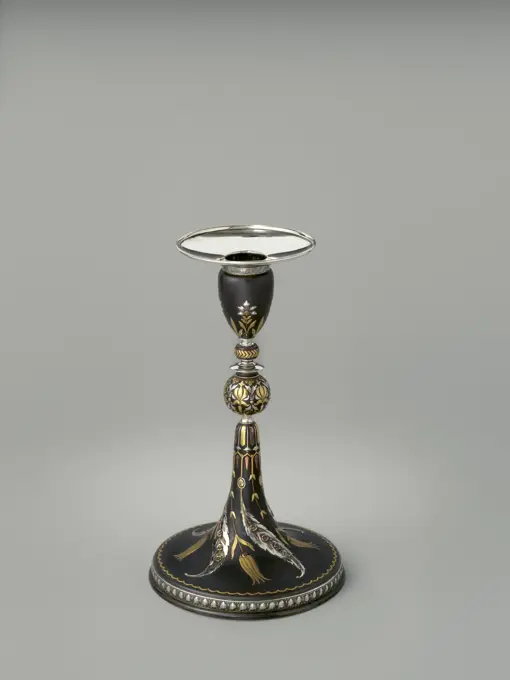
Candlestick 1878 Tiffany & Co. These candlesticks exemplify the innovative designs and technical virtuosity that characterized Tiffany & Co.s work during the 1870s and 1880s. Exhibited at the 1878 Paris Exposition Universelle (Worlds Fair), the candlesticks evidence a sophisticated engagement with Islamic decorative vocabulary and design. Edward C. Moore, the director of Tiffanys silver division during most of the second half of the nineteenth century, was a passionate and discerning collector of metalwork, glass, ceramics, and textiles from the Islamic world. His collections informed his creative vision, and these candlesticks reflect the fresh and original ways in which he and his designers and craftsmen responded to these sources of inspiration. A surviving diary of one of Tiffanys leading designers, Charles Grosjean, documents the candlesticks as the first works he selected for inclusion in the firms display in Paris. Particularly striking and unusual for their use of iron, thTeapot 1695-1705 Augsburg. Silver-gilt, cast, embossed, and chased and enamels on copper . Matthäus Baur, IITwo-poor candlestick with the Holy Christophorus and the Christ child, Anonymous, c. 1825 - c. 1875 The candlestick is composed of the following parts: the foot, the trunk with the Holy Christophorus, the two fat catchers and the two candle holders. The low round, with grooved rings decorated, ends in a stand ring. This has a raised edge at the top, so that the horizontal plane of the foot can serve as a fat catcher. The foot increases to the center and has a hole surrounded by a round edge, in which the trunk is sloped. This is hexagonal at the bottom and equipped with a base and a capital. On this, the barracks is going on H. Christophorus, who carries the Christ child on the shoulders. The pedestal on which the H. Christophorus is placed has a protrusion in which the tree is stabbed, which is screwed to the right arm of the saint. The tree has two branches, in which the candle holders are screwed to the fat catchers at the ends. The saint wears a mantle reaching up to the knees, theCup, anonymous, c. 1600 - c. 1625 Fraise bandagate coupe. Cover and base of rock crystal with decorations of gold and enamel. As a shaft a gold and enamel musketier in Spanish costume, occupied with rubies. On the foot and lid engraved terrs. According to Dr. Holzhauwer his foot and lid of later date. Palm gold (metal). Fraise bandagate coupe. Cover and base of rock crystal with decorations of gold and enamel. As a shaft a gold and enamel musketier in Spanish costume, occupied with rubies. On the foot and lid engraved terrs. According to Dr. Holzhauwer his foot and lid of later date. Palm gold (metal).Candlestick from bronze at square foot with O.A. trophies, weapons and musical instruments. Polished bronze, scilated and engraved candlestick on square foot with beveled corners. The strain is four-sided baluster-shaped, equipped with a four-sided, several times profiled nodes and adorned on the flat sides with shell ornament, heads in medallions and trophies of weapons and musical instruments. The square candle holder is beveled on the corners. See also: BK-NM-12421-A.. Meissen porcelain manufactory ice cream, c. 1735-1740Hard Paste Porcelain, Silver applies, EbonyCandle Holder, 17th century, 11 3/4 x 7in. (29.8 x 17.8cm), Brass with silver inlay, Iran, 17th century, Of typical Safavid (1502-1722) shape, this cylindrical, brass candlestick is embellished with geometric ground patterns, arabesques, and bands of poetic nasta'liq script in silver inlay. While the surface decoration of Safavid metalwork owes much to earlier Timurud (c. 1375-1500) styles, the shape of this tall, cylindrical candlestick was a Safavid development. Candleholders of this size were commonly used in mosques. Although they produced functional objects, the technical virtuosity and refined aesthetics of the Persian metalworkers have transformed the most useful items into works of art.Bedpost with Krishna and Radha. India, Odisha (Orissa), circa 1800. Furnishings; Furniture. IvoryEquestrian statue of silver, presumably Emperor Ferdinand III or Matthias, Anonymous, 1625 - 1650 Equestrian statue of silver, partially gilded and standing on a pedestal of ebony. De Ruiter probably presents Emperor Ferdinand III or Matthias. Germany (possibly) silver (metal). gilding (material). ebony (wood) gilding  Austria. Hungary. Germany Equestrian statue of silver, partially gilded and standing on a pedestal of ebony. De Ruiter probably presents Emperor Ferdinand III or Matthias. Germany (possibly) silver (metal). gilding (material). ebony (wood) gilding  Austria. Hungary. GermanySalt cellar with Aesop Fables. Salt cellars with this round, slender shape were designed in the course of the 1550s. The scenes in the frieze represent the fables written by the Greek storyteller Aesop.Caudle Cup, Manufactuur Oud-Loosdrecht, c. 1774 - c. 1778 Porcelain channel head. Scalloped foot. The front is multi -colored painted with a boy and a girl on a ground, a bush on the back. Gold pisses around the profiled foot and on the Nodus. Loosdrecht porcelain Porcelain channel head. Scalloped foot. The front is multi -colored painted with a boy and a girl on a ground, a bush on the back. Gold pisses around the profiled foot and on the Nodus. Loosdrecht porcelainVase with Scenes from the Life of Saint Louis. Karl Wagner (Germany, active France, Paris after 1830, 1799-1841)Frederic-Jules Rudolphi (Denmark, Copenhagen, active France, Paris 1841-1867, 1808-circa 1872). France, circa 1839-1844. Furnishings; Accessories. Silver gilt, enamel, paste gemstonesEngraved Lamp Stand with Interlocking Circles. Dimensions: H. 11 7/8 in. (30.1 cm)Diam. of base: 7 1/4 in. (18.4 cm)Diam. of rim: 4 in. (10.2 cm). Date: probably 16th century.The verses inscribed around this lamp stand embody spiritual metaphors comparing the beloved to a candle and the lover to a moth attracted to its light. The verse by an unidentified poet encircling the middle portion of the stand reads:I said to the candle: "What is this moth around your face"It said: "I am the sultan of beauty--what is the desire of the moth". Museum: Metropolitan Museum of Art, New York, USA.Tea and Coffee Service Made 1815-1825 Paris. The early 19th century is often considered the golden age of Paris-made porcelain. Numerous firms were established in and around the city. Privately supported rather than state subsidized, these firms varied in size and success, with some undergoing several changes in ownership and name over relatively short periods. What eventually became the Denuelle Porcelain Manufactory had originally been established by an Englishman on the Rue de Crussol in 1792. After changing hands more than once, the factory was acquired in 1818 by the chemist Benjamin Cadet de Vaux and the porcelain maker and painter Auguste Dominique Denuelle, who became the sole proprietor in 1820. Although the factory survived only until 1829, it produced some outstanding work and enjoyed the special protection of the Duchesse de Berry, daughter-in-law of the French king.This remarkable tea and coffee service dates from around 1820, when the Denuelle factory was at its artistic The Attarouthi Treasure - Chalice 500-650 Byzantine With a youthful Christ with a cruciform halo, a deacon saint with censer (probably Saint Stephen), a youthful saint with staff, the Virgin Mary in orant pose, a military saint in armor killing a dragon (Saint George ), and a long-haired Saint John the Forerunner, under arcadesInscribed in Greek: Of Saint Stephen of the village of Attaroutha Listen to experts illuminate this artwork's story Listen Play or pause #2710. The Attarouthi Treasure - Chalice Supported by Bloomberg Philanthropies We're sorry, the transcript for this audio track is not available at this time. We are working to make it available as soon as possible.. The Attarouthi Treasure - Chalice. Byzantine. 500-650. Silver and gilded silver. Made in Attarouthi, Syria. Metalwork-SilverSalt 1575-1600 Netherlands. An allegorical female nude in a landscape appears on each of the four sides of this work, while a frieze of putti and fantastic sea creatures runs around the base. Such imagery was intended to evoke the interaction between sea and land that produces salt. This elaborately decorated salt holder would have graced the tables at lavish banquets during the Renaissance and, at the same time, served a useful function. Indeed, this work is a proper tribute to the precious commodity of salt, which served to make perishable food more palatable and was also a sign of great wealth.. Silver gilt .Salt barrel, resting on three dolphins. Salt barrel of porcelain, resting on three dolphins, decorated in marbled salmon color and gold and with multicolored feathers. Signature: Chamberlains Worcester.Candlestick of silver with stem in the shape of a winding trunk with three swinging branches with oval leaf and candle holder in flower wreath. Candlestick of silver. A winding trunk rises from a leaf rosette, which divides into three winding branches with oval leaves. The candle holder is caught in a flower wreath.Nutmeg Grater 1775-ca. 1800 American. Nutmeg Grater 5413Wall arm of gilded bronze with a bust of a Chinese, Anonymous, c. 1750 - c. 1760 Gilded bronze wall arm, each with two arms. The trunk is formed by a bust of a Chinese man or woman, surrounded by C-shaped rocaillem motifs. The arms show C and S-shaped leaf motifs. Paris bronze (metal) gilding Gilded bronze wall arm, each with two arms. The trunk is formed by a bust of a Chinese man or woman, surrounded by C-shaped rocaillem motifs. The arms show C and S-shaped leaf motifs. Paris bronze (metal) gildingFate Josef Schreiber & NephewSpittoon (ugaldan). India, Andhra Pradesh, Hyderabad or Karnataka, Bidar, circa 1850. Tools and Equipment; containers. Bidri ware (tarkashi and tehnishan techniques)Footed Bowl and Plate. Dimensions: Bowl - H. 4 3/4 in. (12.1 cm)W. 8 in. (20.3 cm)Dish - Diam. 10 in. (25.4 cm). Date: first half 18th century.Of all the varieties of Mughal glass known, this milky white color constitutes the rarest type. The painted decoration in gold and silver (now darkened) displays flowering shrubs enclosed in oval compartments, laid out in a radiating pattern, a classic Mughal decorative scheme that is also seen in contemporary metalwork. Museum: Metropolitan Museum of Art, New York, USA.. Gold-plated bronze wall arm, each with two arms. The trunk is formed by a bust of a Chinese man or woman, surrounded by C-shaped seedill motifs. The poor exhibit C and S-shaped leaf motifs.Cup, 1700 - 1800  Cup-shaped cup on gilded foot ring, outside black cut, inside (fire) gilt suassa. Upper edge slightly sculpted with twelve shells/dents. Two cartouches on the outside. Gilded ears on both sides, consisting of stylized flower branches, excellent above the edge of the cup. Tonkin . casting  Vietnam. CantonCup early 20th century (original dated late 14th century) British. Cup 463502Komfoor with openwork, bol round bin in twelve sections. The komphead composed of a number of parts is on a three-leg pedestal, has a nodus and a bol round bin, which is divided into twelve sections. These have an engraved and cutout ornament, with the name L.n.S. Van Voorst. The outbound edge, to which the handle is attached, has four lips for the missing lattice on the inside.Willkomm of an Unknown GuildBox ca. 1800 Johann Christian Sick German (Stuttgart) These silver boxes are part of larger silver service. The set was presumably used to keep sweets and other delicacies as the handy form and tightly closing lids suggest. The ciphers below closed crowns belong to Charlotte Augusta Mathilde, Queen of Wurttemberg (1766-1828). The form mirrors the neoclassical principles of German silver design towards a formal reduction of the shape and geometry as a refection of the language of the Enlightenment. The daring juxtaposition of plain polished areas with matted ornamental applications has an astonishingly modern aesthetic.. Box 231242Anonymous; Giovanni Battista Metellino (Workshop of) / 'Case for boat-shaped tazza with a filigree foot'. 1650 - 1689. Leather, Wood, Metal, Cloth. Museum: Museo del Prado, Madrid, España.Miniature kettle with stand. Culture: British. Dimensions: 4 1/2 × 3 in. (11.4 × 7.6 cm). Date: 18th century. Museum: Metropolitan Museum of Art, New York, USA.Candlestick with a vase-shaped strain. The candlestick is composed of four parts: foot, strain, fat catcher and candle pin. The foot is coarse profiled. The trunk is below vase. The trunk has rinded in the foot.Toilet box made of gold-plated silver, oval, with vertical and hollow sections on the corners and convex tips and a flat front and back. Vaulted lid with representation of Oalmmpic gods in émail. Box of gold-plated silver with an enamelled lid. The box is oval with vertical, hollow sections on the corners and convex tips and a flat front and back. The vaulted lid is fully enamelled with golden Olympic gods in relief. Signature. With key.Pitcher. Culture: American. Dimensions: H. 8 1/2 in. (21.6 cm). Date: 1830-70. Museum: Metropolitan Museum of Art, New York, USA.Pair of candlesticks ca. 1745 Attributed to Juste Aurèle Meissonnier French A 1728 design for a candlestick by Juste-Aurèle Meissonnier (1695-1750) incorporated a pair of entwined children in its spirally twisted stem. The three drawings for this model were engraved by Louis Desplaces (1682-1739) and published in Deuxième livre de loeuvre de J.A. Meissonnier, Chandeliers de sculpture en argent in 1734. This highly sculptural model proved to be very fashionable and was executed with variations both in gilt bronze and in porcelain (an example from the famous Meissen swan service for Count Brühl of 1739 is on view in the German and Austrian Galleries).. Pair of candlesticks 205778Swing cradle made of gold -painted walnut, anonymous, 1600 Swing cradle made of gold -painted walnut. On the Hobbelschenen, a coat of arms with a helmet sign, in the midst of flower branches, has been applied in relief. Internally, the cradle is covered with zinc to serve as a flower box. Italy wood (plant material). walnut (hardwood). gilding (material). zinc gilding Swing cradle made of gold -painted walnut. On the Hobbelschenen, a coat of arms with a helmet sign, in the midst of flower branches, has been applied in relief. Internally, the cradle is covered with zinc to serve as a flower box. Italy wood (plant material). walnut (hardwood). gilding (material). zinc gildingPair of Covered Ice Cream Pails, c. 1840. Factory of Jacob-Petit (French, 1830-1865). Gilt porcelain; overall: 42.5 x 27.3 x 27 cm (16 3/4 x 10 3/4 x 10 5/8 in.).Saucer. Desprez, Rue de Recollets, factory, Paryż, factoryVase (vase à panneaux or à perles) ca. 1779 Sèvres Manufactory French. Vase (vase à panneaux or à perles) 202184Bottle. unknown, craftsmanAnonymous / 'Case for rock crystal vase with handles in the form of fantastical creatures'. 1650 - 1711. Leather, Wood, Metal, Cloth. Museum: Museo del Prado, Madrid, España.Flower Vase 1759 Sèvres. Soft-paste porcelain, polychrome enamels and gilding . Manufacture nationale de Sèvres (Manufacturer)Two-armed candlestick with the Holy Christophorus and the Christ child. The candlestick is composed of the following parts: the foot, the trunk with the H. Christophorus, the two fat catchers and the two candle holders. The low round, with grooved rings decorated foot, runs out in a stand ring. This has a standing edge at the top, so that the horizontal surface of the foot can serve as a fat catcher. The foot increases to the middle and has a hole surrounded by a round edge, in which the trunk has been shot. This is hexagonal and equipped with a base and a capital. This is the Barrevoets going on H. Christophorus, who carries the Christ child on the shoulders. The pedestal on which the H. Christophorus has been placed has a protrusion in which the tree has been stabbed to the right arm of the saint. The tree has two branches, in which the candle holders on the fat catchers are screwed at the ends. The saint carries a clock reaching to the knees, the borders of which are granulated, andSkyfos;  III-IV century AD (290-00-00-310-00-00);Mosque Lamp 14th century One of the conventions of Mamluk mosque lamp decoration was to execute one inscription band in blue and the other in reserve against a blue ground. On this lamp, the neck and foot repeat the phrase al'alim ("The Wise"), punctuated by an as yet unassigned emblem, while the body bears a formulaic dedicatory inscription but no name.. Mosque Lamp. 14th century. Glass, colorless with yellow tinge; blown, applied blown foot, enameled and gilded. Attributed to Egypt or Syria. GlassAlbarello pharmacy vessel; Calamelli, Virgiliotto; 1550-1570 (1550-00-00-1550-00-00);The Ardagh Chalice early 20th century (original dated ca. 750) Irish. The Ardagh Chalice. Irish. early 20th century (original dated ca. 750). Silver, cooper alloy, enamel, glass. Reproductions-MetalworkVase with cover (vase à bandes) (one of a pair). Artist: After engravings by Louis Crépy (French); Based on a composition by Antoine Watteau (French, Valenciennes 1684-1721 Nogent-sur-Marne). Culture: French, Sèvres. Decorator: Gilded by Henry-Martin Prévost (French, active 1757-97); Figures by Charles Nicolas Dodin (French, Versailles 1734-1803 Sèvres). Dimensions: Height: 13 1/16 in. (33.2 cm). Factory: Sèvres Manufactory (French, 1740-present). Date: ca. 1770-75.The bucolic scenes on the front of these vases (see also 58.75.69a, b) are after compositions by the French painter Jean-Antoine Watteau (1684-1721). Engraved together on one copper plate by Louis Crépy in 1729, L'heureux moment (the happy moment) and Le berger content (the content shepherd) were, as a result, printed on the same sheet of paper and often used as a pair.Jeffrey H. Munger, 2006. Museum: Metropolitan Museum of Art, New York, USA.Vase with cover (vase à bandes) (one of a pair) ca. 1770-75 Sèvres Manufactory French The bucolic scenes on the front of these vases (see also 58.75.69a, b) are after compositions by the French painter Jean-Antoine Watteau (1684-1721). Engraved together on one copper plate by Louis Crépy in 1729, L'heureux moment (the happy moment) and Le berger content (the content shepherd) were, as a result, printed on the same sheet of paper and often used as a pair.Jeffrey H. Munger, 2006. Vase with cover (vase à bandes) (one of a pair) 202172Paduan 16th Century, A Lamp, early 16th century A LampThe Ardagh Chalice. 8th-9th cent. Ireland.Przeszo Przyszoci unknownPair of toilet boxes 1692 Peter Harache I. Pair of toilet boxes. British, London. 1692. Silver gilt. Metalwork-SilverMounted Lidded Bowl; China; porcelain about 1720; mounts about 1745 - 1749; Hard-paste porcelain; colored enamel decoration; gilt bronze mounts; 40 x 38.1 cm (15 3,4 x 15 in.)Terracotta lekythos (oil flask) ca. 440 B.C. Attributed to the Achilles Painter Two womenThe two sakkoi (snoods) and the mirror hanging on the wall indicate that the ladies are indoors. The pigment that originally rendered the clothing of the one at the left is lost, and the artist's preparatory drawing is visible. She is tying the belt that allows the upper part of her chiton (undergarment) to fall like a blouse. Her companion holds up an alabastron (perfume vase).. Terracotta lekythos (oil flask). Greek, Attic. ca. 440 B.C.. Terracotta; white-ground. Classical. VasesStem Cup. Culture: China (Xinjiang Autonomous Region, Central Asia). Dimensions: H. 3 1/2 in. (8.9 cm); Diam. of mouth 2 3/4 in. (7 cm). Date: 7th-9th century.The intertwined vine with its curled leaves is reminiscent of Sogdian imagery and motifs found in Gandharan Dionysian reliefs. The twelve animals of the Chinese zodiac are placed in rectangular frames beneath the cup rim. Museum: Metropolitan Museum of Art, New York, USA.Miniature pitcher 1848-56 Charles Cartlidge and Company. Miniature pitcher. American. 1848-56. Porcelain. Made in Brooklyn, New York, United StatesSnuffbox. unknown, authorPair of casters, Dirk Evert Grave (attributed to), 1778 The round spreading bus rests on a square, straight -walled plinth. The vaulted, slightly tackled foot is closed on the underside by a wide laurel -bound laurel. A pearl edge runs along the body on the body. The high bowl -shaped body is crowned by another laurel wreath bound with ribbons, with a wide straight band on which three equal bay leaves are nailed. A border of horizontally placed Godrons runs over the top edge of the body, which, when the bus is closed, occurs like a pearl edge. The Concave Dop, which is open between Canelures with points, commas and clocks, has a bell -shaped crown of grille. An edge of phaces has been applied to the separation between the two parts. This is bound on three points with ribbons, including a leaf garland on the lid and above which a large acanthus leaf has been imposed on the crown. A pine cone serves as a lid button. Amsterdam silver (metal) The round spreading bus rests on a square, straCandlestick of brass on three bolts. Foot, trunk and fat catcher are poured from one piece. The three legs, the candle pin and the bottom of the fat catcher have been clenched. The profiled conical foot is over in a profiled strain, which has the shape of an urn, a knot and a baluster, and then in a profiled fat catcher with sloping edge. The balpots, which are, as well as the other components have ring profiles, at the top of decorated protrusions, with which they have riveted on the outside of the foot. The edge of the foot is turned on the inside. The pin has been restored. The fat catcher has been restored in one place by the watering can that has made the object.Vase from a Set of Five-Piece Altar Set (Wugong). Culture: China. Dimensions: H. 13 in. (33 cm); Diam. of rim 6 1/8 in. (15.6 cm); Diam. of foot 4 5/8 in. (11.7 cm). Date: 18th century.Cloisonné is the technique of creating designs on metal vessels with colored glass paste placed within enclosures made of copper or bronze wires, which have been bent or hammered into the desired patterns. Known as cloisons (French for "partitions"), the enclosures are generally either glued or soldered onto the metal body. The glass paste, or enamel--which gets its color from metallic oxides--is painted into the contained areas of the design. The vessel is usually fired at a relatively low temperature, about 800 degrees Celsius. Enamels tend to shrink during firing, and the process is repeated several times to fill in the design. Once this process is completed, the surface of the vessel is rubbed until the edges of the cloisons are visible. Museum: Metropolitan Museum of Art, New York, USA.Can be on convex, cited foot, with long shiny and painted in blue. Can be paid on a convex, stretched foot with long ditch in blue with birds, flower and leaf refines on a pink fond.Covered Goblet with Silhouette Bust of King Frederich the Great 1790-1800 Germany. Glass . Johann Sigismund Menzel (Decorator)Paris production. Vase mounted. Porcelain, gilded bronze, 1785-1790. Paris, Cognacq-Jay museum. 78926-29 Angel, angle, bronze gilded, gilding, flower, porcelain, Parisian production, vase risesTwo-handled cup, silver, 1855, metalwork, Decorative Arts, Two-handled cupTeacup with a view of the castle in Ujazd. Baranówka (manufaktura porcelany ; 1804-post 1900 ), factorySilversmith's Art, Italy 19th century. Pair of silver saltcellars with two sections.John Denziloe, Tea Canister, 1781/82, silver.Spice container, Early 20th century, possibly Unknown Turkish, 7 x 3-1/16 x 2-11/16 in. (17.8 x 7.8 x 6.8 cm), Silver, turquoise, Turkey, 19th-20th century, Each Saturday, friends and family are invited into each other's homes to celebrate the Sabbath. As evening falls on Saturday the festival mood is replaced with sadness. During the special ceremony called havdalah (separation) the family says a blessing over a cup of wine, lights a special candle created from several twisted wicks, and inhales from a container of fragrant spices. The sweet fragrance of the spices carries the sweetness of the Sabbath into the week ahead.Handbell, anonymous, 930 - 1600 Priesterschel with Naga figure as a masterpiece. Indonesia bronze (metal) Priesterschel with Naga figure as a masterpiece. Indonesia bronze (metal)Champion Vase. Culture: China. Dimensions: H. 8 1/2 in. (21.6 cm); W. 3 7/8 in. (9.8 cm); D. 3 1/4 in. (8.3 cm). Date: 18th century.The term "champion vase," which appears only in Western writings, refers to vessels that have two narrow vertical compartments connected by a carving of a mythical bird. It may be a loose translation of yingxiong bei, or hero's cup, referring to the bird (ying) and the bear (xiong) upon which it stands. Champion vases were popular during the middle and late eighteenth century, and were manufactured in different media, including jade, cloisonné enamel, and rhinoceros horn. Museum: Metropolitan Museum of Art, New York, USA.Caster.   Maker: Simeon Soumaine, American, born England, baptized 1685-ca. 1750. Large arm of candle wreath.. Large arm of candle wreath.Watch ca. 1665 Watchmaker: Henry Jones. Watch. British, London. ca. 1665. Metal case, silver lining. HorologyVase, Meissener porcelain manufactory, c. 1735 Vase of painted porcelain. The vase has a spherical body and a funnel -shaped neck, which is articulated halfway by a gilded ring. The vase is covered with a violet stock in which two saved accolade -shaped four -passes. Harbor scenes with Chinese merchants at Balen on the bank are painted in the four passes. The vase is marked. Float porcelain Vase of painted porcelain. The vase has a spherical body and a funnel -shaped neck, which is articulated halfway by a gilded ring. The vase is covered with a violet stock in which two saved accolade -shaped four -passes. Harbor scenes with Chinese merchants at Balen on the bank are painted in the four passes. The vase is marked. Float porcelainPitcher (England); Designed by H. Baggeley (United Kingdom); porcelain, overglaze enameling and gilding. Theo Colenbrander was the artistic mastermind of the Rozenburg earthenware factory in The Hague. His designs exhibit great freedom in both form and decoration. The slender, ribbed shape of these vases recalls bamboo. The ornamentation is modern: abstractly rendered floral and plant motifs in bright colours. Their shapes, however, are quite old-fashioned. It is a garniture (set) of five vases for display atop a cabinet.ACETRE DE PLATA LABRADA S XVIII. Location: MUSEE D'ARTS DECORATIFS. MADRID. SPAIN.Cooling vessel with a white coat of arms surrounded by four godrons, anonymous, c. 1600 - c. 1650 With the exception of the two rings -made rings, the object consists of the following parts driven by plate: the container that makes the impression of being made from one plate; The two Leeuwekoppen, the Viet Poten, to which four plates are brased against the bottom. The container has a passionate decor with a white coat of arms on the long sides in the middle to which stylized turds, and left and right surrounded by four godrons. The raised edge has a cord edge and a hollow egg list. The upper excellent board of the barrel has a decor with studs and punched star motifs. The edge reinforced with iron wire is decorated as a cord. The wall is soldered here and there with lead or tin. On both short sides there are three closed holes on both short sides. Netherlands brass (alloy) soldering With the exception of the two rings -made rings, the object consists of the following parts driven by plCup and Saucer Made 1815-1825 Paris. Hard-paste porcelain, dark blue ground, polychrome enamels, and gilding . Denuelle Porcelain Manufactory (Manufacturer)Pomander. This pomander is shaped like a pomegranate, which was a symbol of vitality in the 16th century. The spherical part is made up of six sections, each one consisting of a little box, whose lid can be lifted. The boxes contained aromatic balms, which could serve as perfume as well as medicine. Pomanders were hung from a chain or a belt.Vase ca. 1760 Chelsea Porcelain Manufactory. Vase. British, Chelsea. ca. 1760. Soft-paste porcelain. Chelsea Porcelain Manufactory (British, 1745-1784, Gold Anchor Period, 1759-69). Ceramics-PorcelainWaza to the punch Monteith; Wellby, Daniel & John, Ltd (London; company Z Otnicz; Fl. 1863-1973/74); 1892/93 (1892-00-00-1893-00-00);Sauceboat on stand. Jean-Baptiste-François Chéret (French, 1728 - after 1791, master 1759)Vase (cuvette à tombeau, première grandeur).Bronzed amphora with lid with figures, detail. Artefact from the Olmo Bello Necropolis in Campi Bisenzio (Tuscany). Etruscan civilization, ca 710 BC.Covered vase with birds on a branch and bouquets, Fürstenberg, c. 1785 - c. 1790 Porcelain lid vase on a spreading foot ending in a square pedestal and with a cylindrical body with a round shoulder and narrowing to the foot. Spreading neck with a flat edge and high, angular ears. Painted on the glaze in blue, red, pink, green, yellow, purple, black and gold. On the belly two birds on a branch in a landscape and a bouquet of different flowers. In between sprinkling flowers and insects. The narrowing part to the foot with a band with modeled raised leaf motifs in relief. The shoulder and the foot with the same decoration as on the abdomen with a bond with leaf vines in relief. A flower or insect on the corners of the pedestal. The sides with a curly motif in Bas-relief. Golden Rand. The lid with flowers and insects and on the edge modeled leaf vines; Lid button in the form of a pine cone with a modeled rosette as the basis. Marked on the bottom with the F and A.F. Fürstenberg porcelain. Pair of Candlesticks; about 1680 - 1690; Gilt bronze;Fire Screen c 1821-1840 Boston. Bird's eye maple and New England white pine . Artist unknownTemple Bell ca. 11th-12th century Indonesia (Java). Temple Bell. Indonesia (Java). ca. 11th-12th century. Bronze. Eastern Javanese period. MetalworkBox with lid and openwork decoration. Box with lid, openwork decoration consisting of floral motifs, dragons, etc.Urn 1831-35 Philippe Freund. Urn 9172High chair from Faience. Children's chair from Faience. Painted multi-colored.Pair of scent bottles (part of a toilet service) 1687-88 D., London These objects are from a toilet set that also included a looking glass, a pair of candle snuffers, various small boxes and covered bowls, and two salvers.. Pair of scent bottles (part of a toilet service). British, London. 1687-88. Silver gilt. Metalwork-SilverWater Ewer. Wedgwood Manufactory; England, founded 1759; Etruria, Staffordshire, England. Date: 1780-1785. Dimensions: 40.5 × 19.7 cm (15 7/8 × 7 3/4 in.). Stoneware (basaltware). Origin: Burslem. Museum: The Chicago Art Institute, Chicago, USA.Miniature chandelier ca. 1720 Dutch, Amsterdam. Miniature chandelier. Dutch, Amsterdam. ca. 1720. Silver. Metalwork-Silver-MiniatureSet of four candlesticks 1771-73 Thomas Heming. Set of four candlesticks. British, London. 1771-73. Silver. Metalwork-SilverCáliz, siglo XIV. Museo parroquial de Traiguera.Vase, 1873. Worcester Porcelain Factory (British, established 1751), probably by James Hadley (British). Ceramic; diameter: 13.5 cm (5 5/16 in.); overall: 25.6 cm (10 1/16 in.).