Decorative Vintage Plates

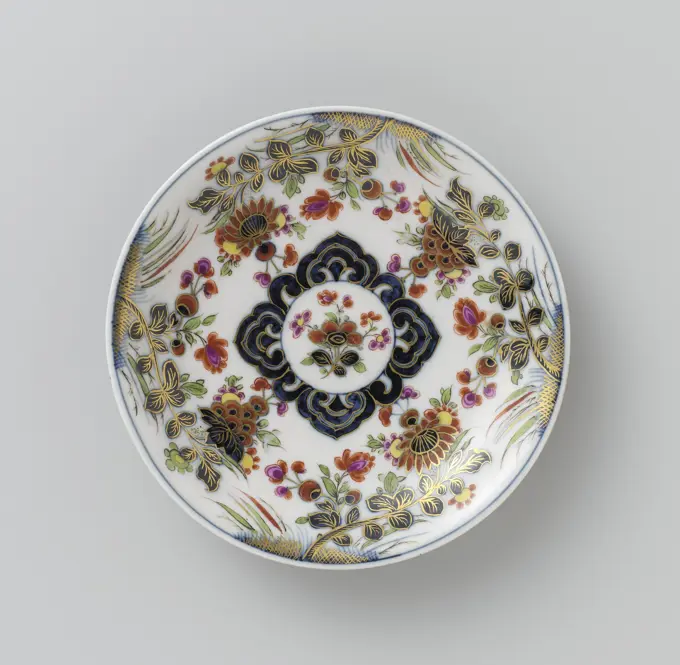
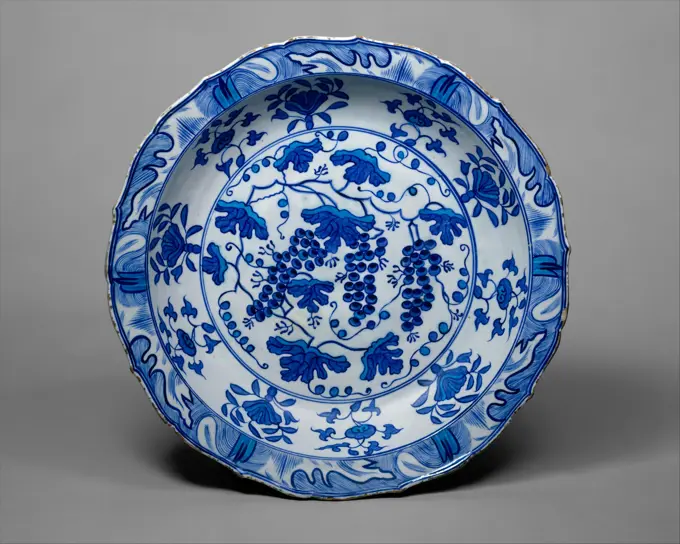
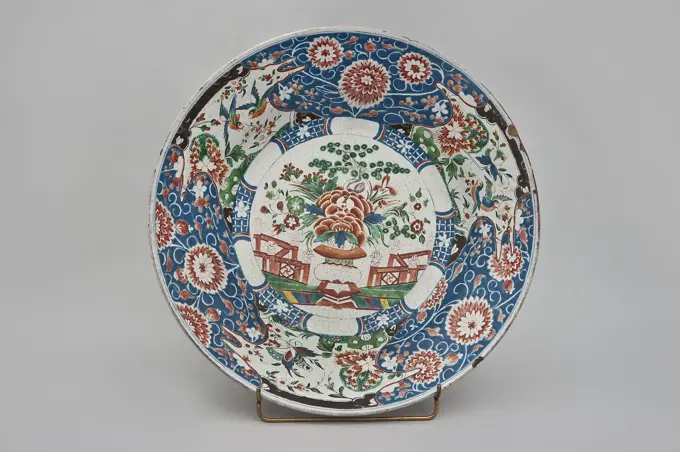
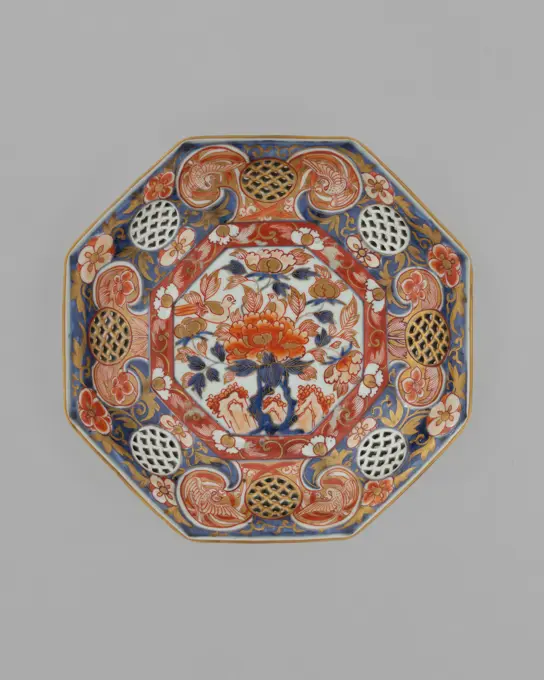
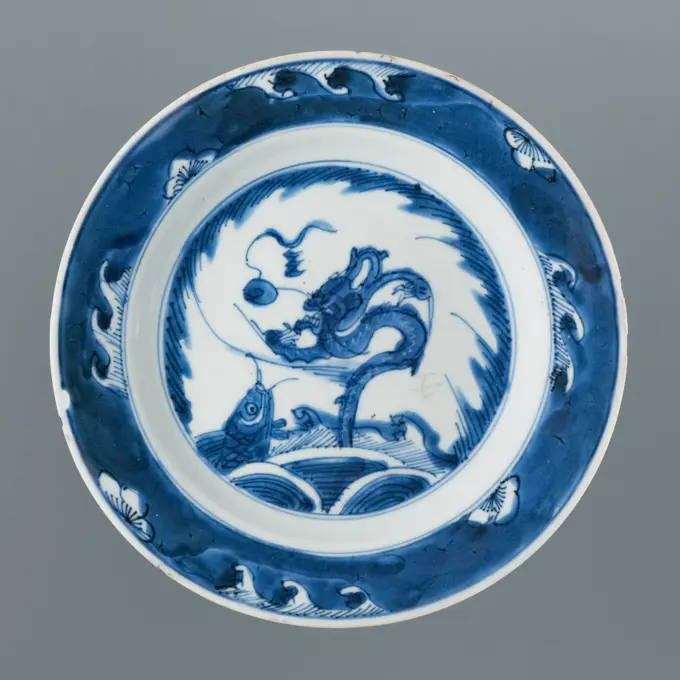
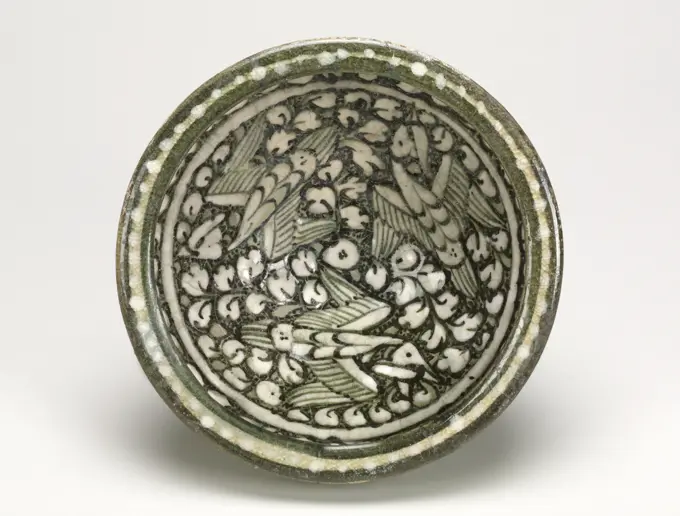
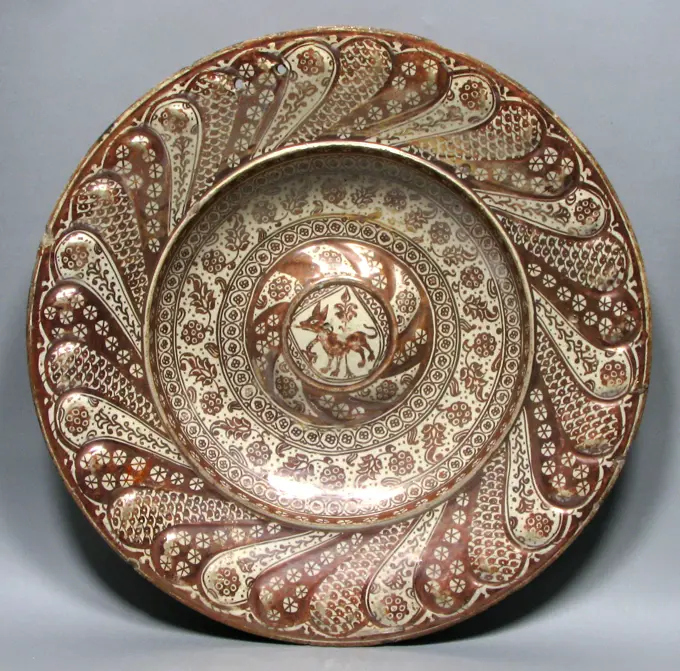
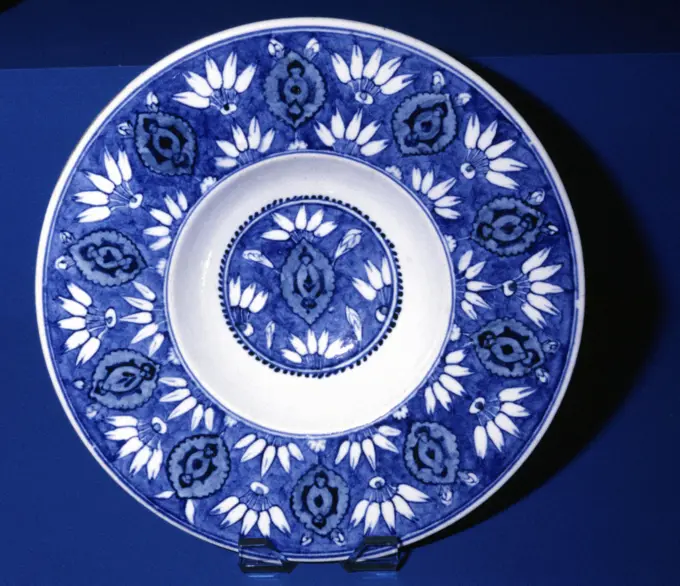
A collection of vintage plates showcasing intricate floral and landscape designs, featuring vibrant colors and historical craftsmanship.
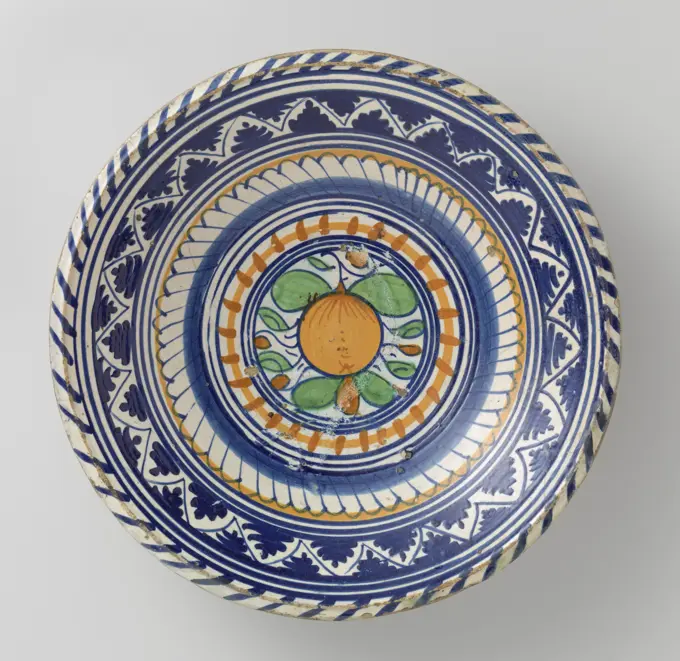
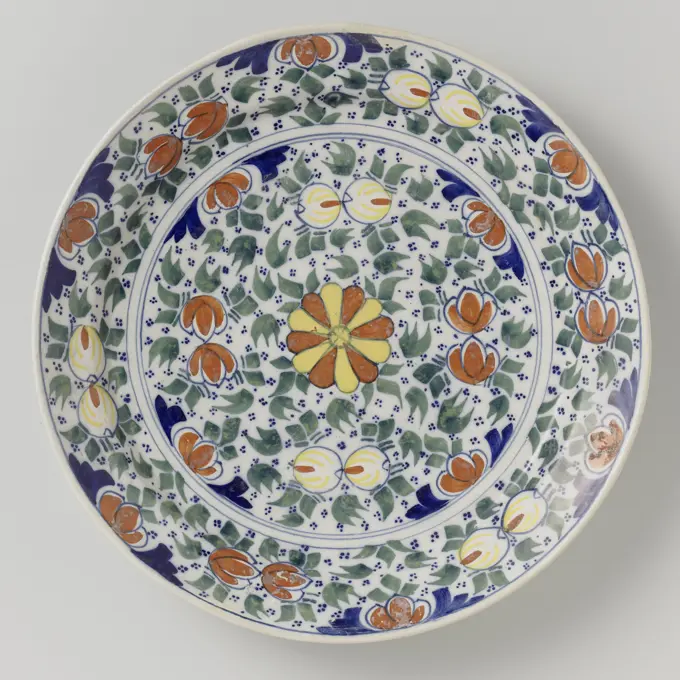
Saucer, multicolored painted with a southern fruit inside concentric circles, yellow piping and orange stripes, frieze with leaves, zigzag line and stripes on the outer edge., Anonymous, c. 1590 - c. 1610 Round dish of multi -colored painted majolica. In the middle, a southern fruit with leaves is painted inside concentric circles. A yellow piping with orange stripes is painted around the circles, around concentric circles, a frieze with blue leaves, concentric circles, a blue band with a zig-saw line between which stylized leaves, concentric circles and small stripes on the outer edge. Holland earthenware. tin glaze. lead glaze majolica Round dish of multi -colored painted majolica. In the middle, a southern fruit with leaves is painted inside concentric circles. A yellow piping with orange stripes is painted around the circles, around concentric circles, a frieze with blue leaves, concentric circles, a blue band with a zig-saw line between which stylized leaves, concentric circles an
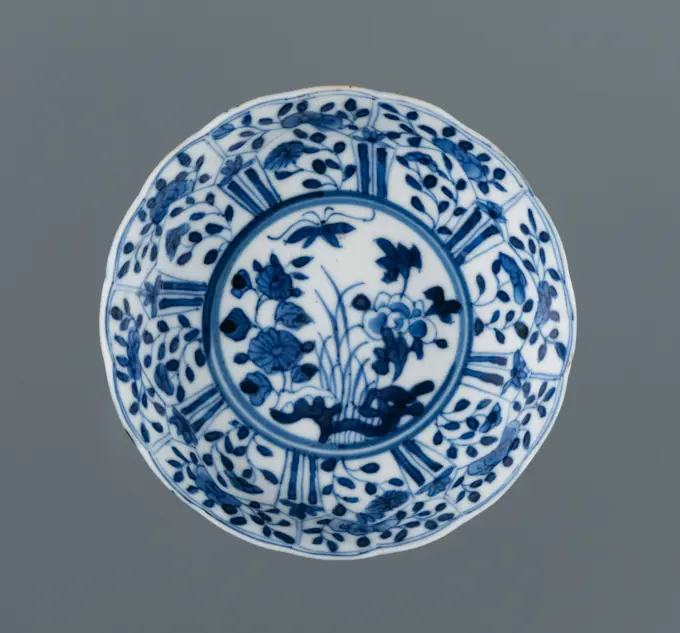
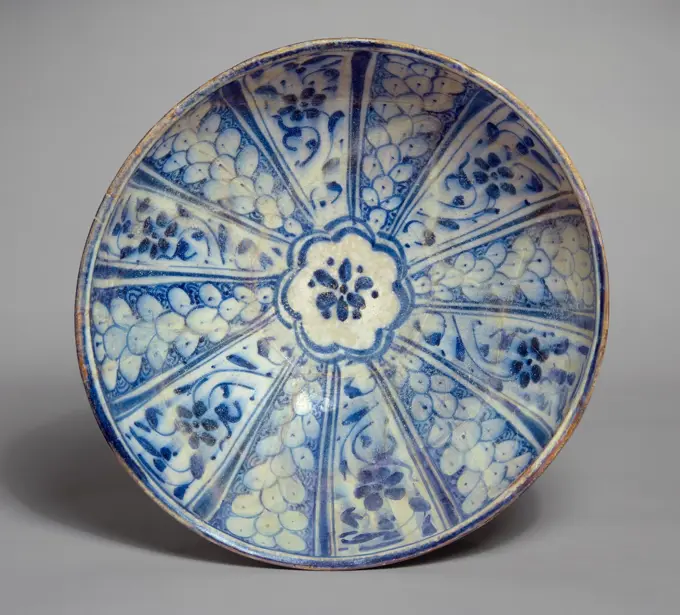
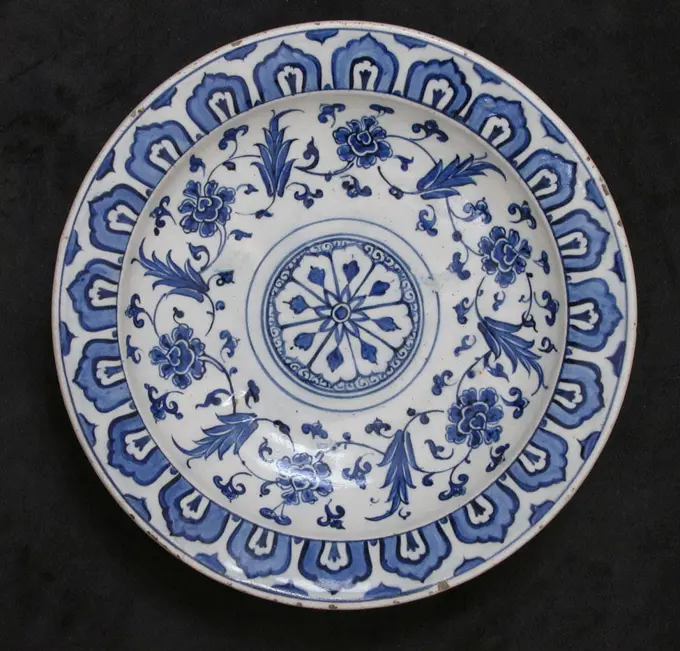
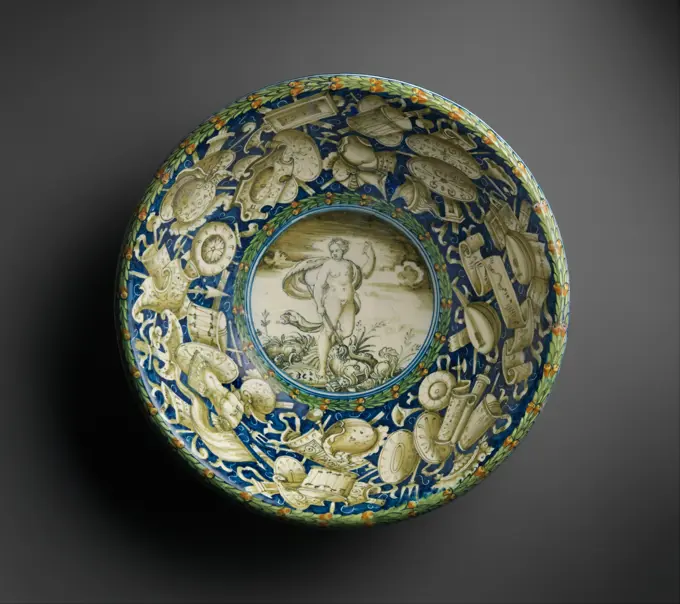
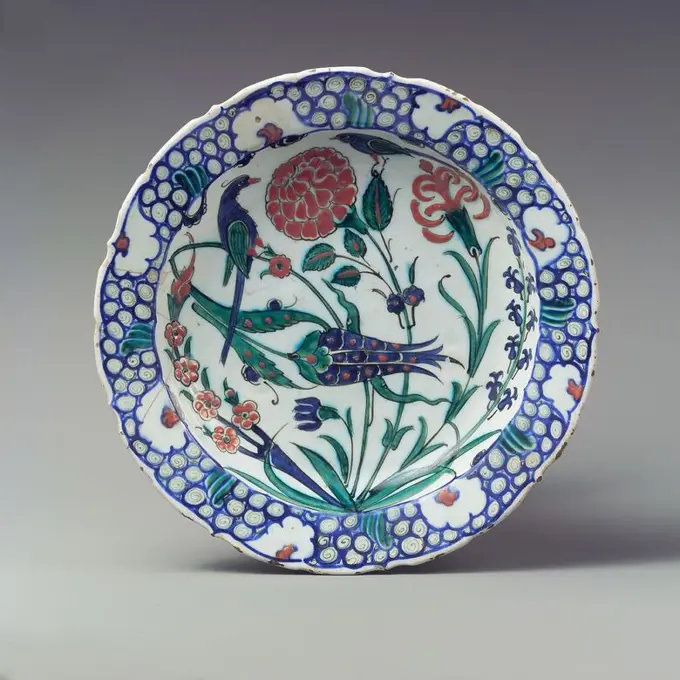
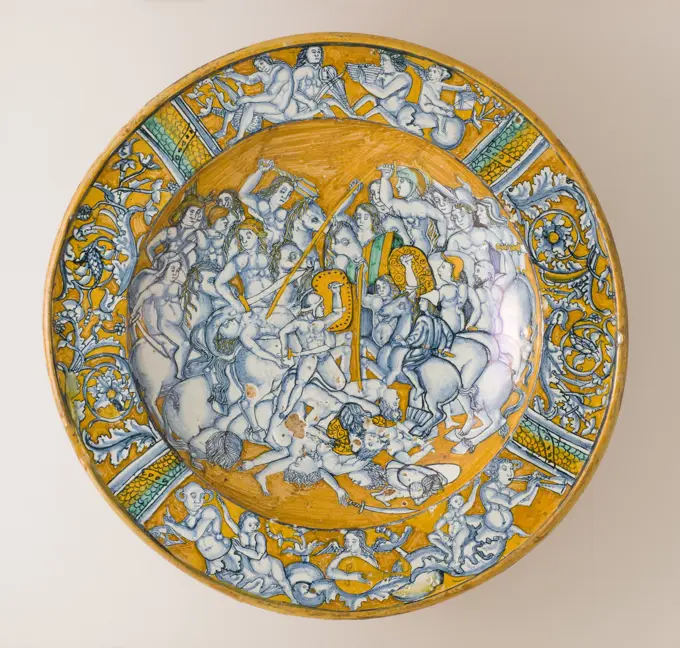
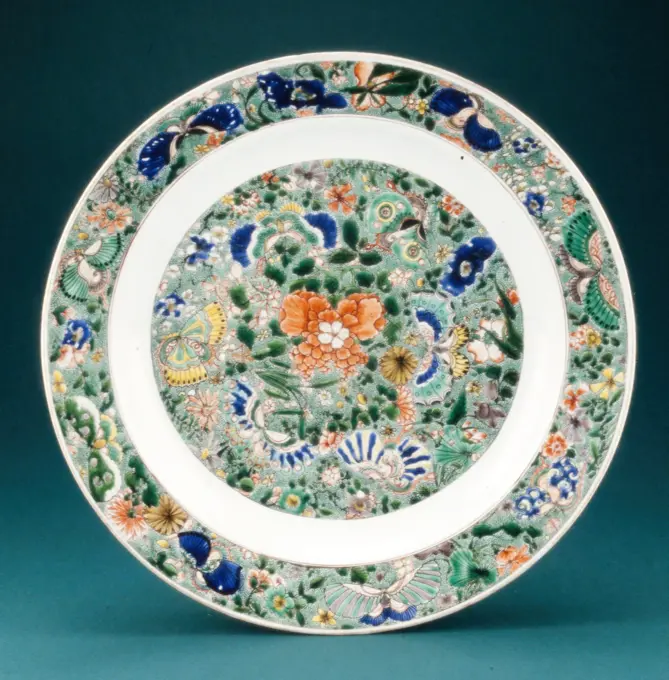
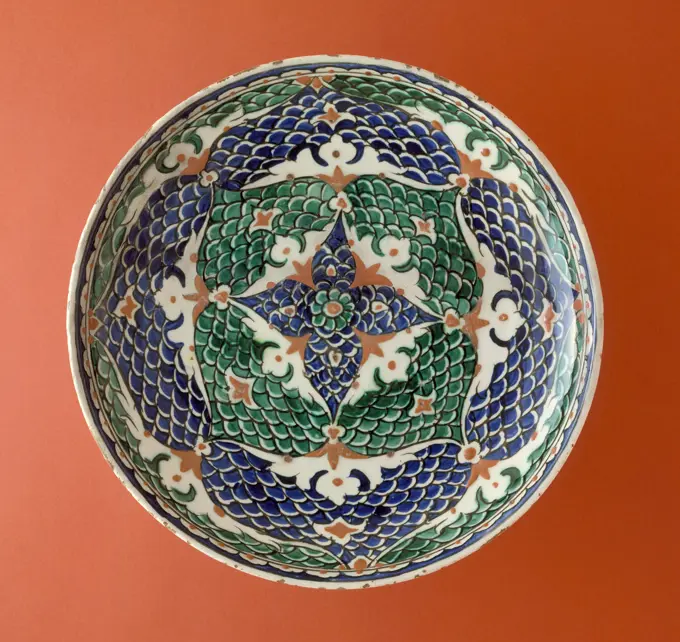
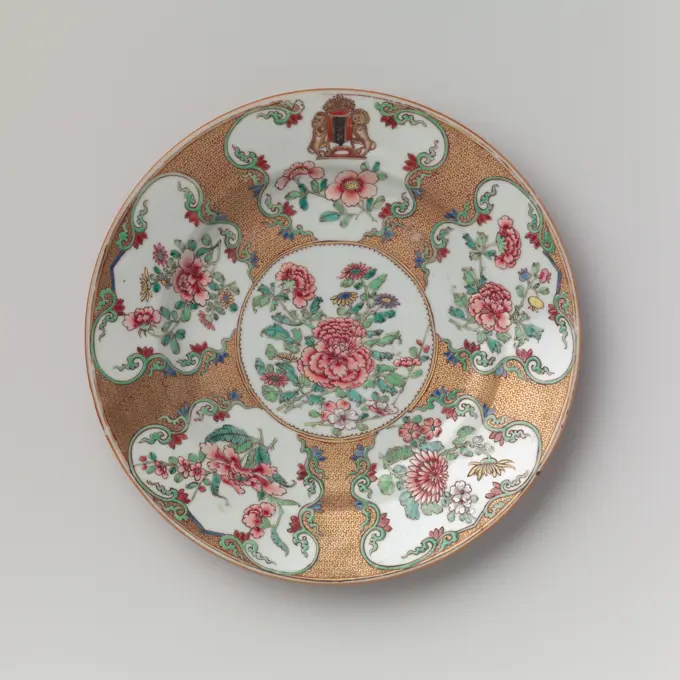
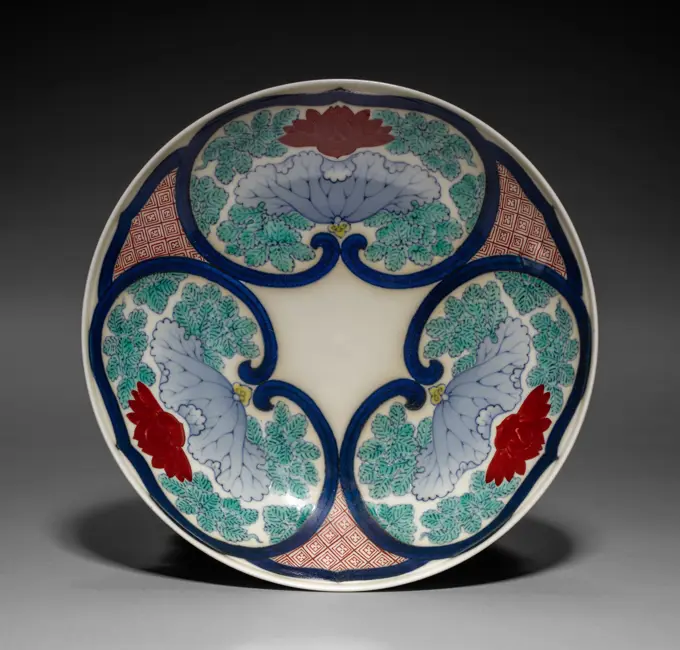
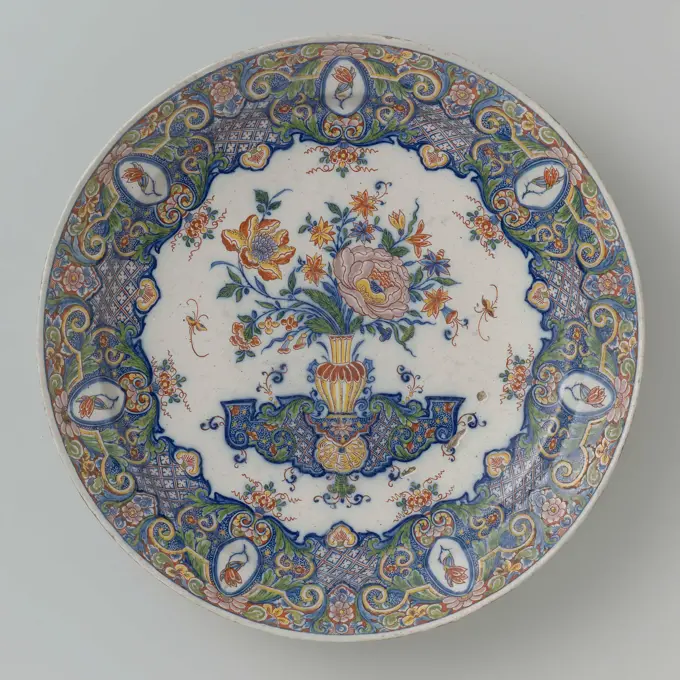
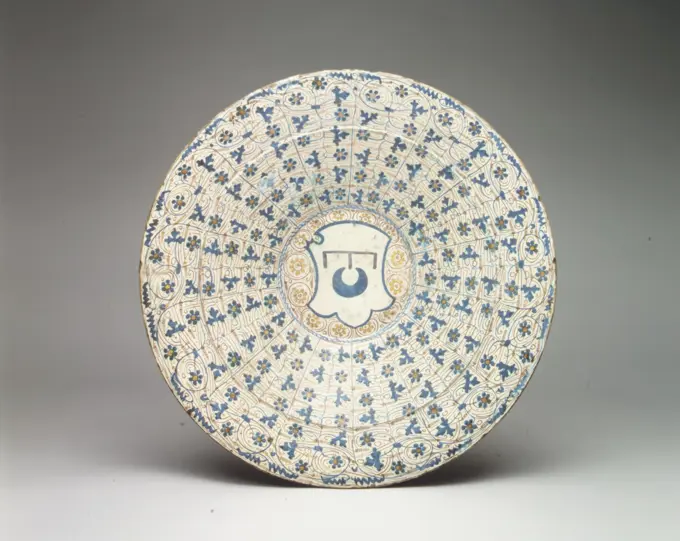
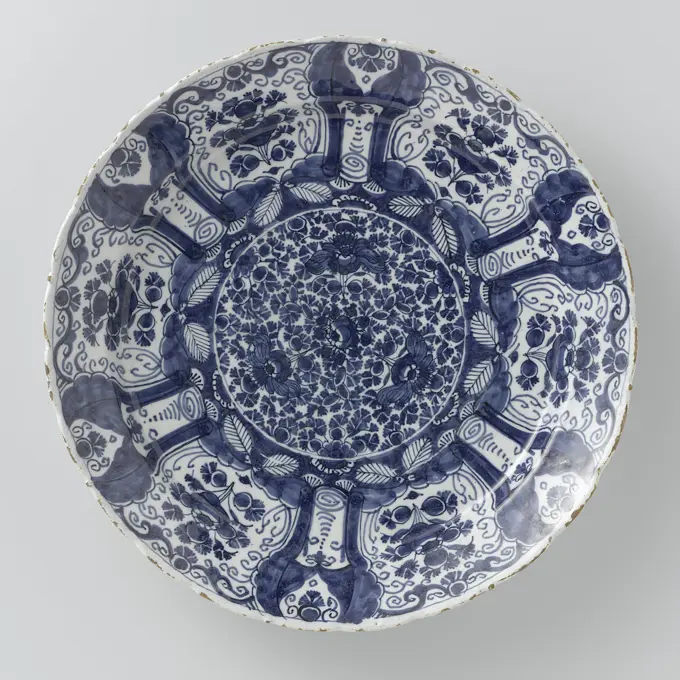
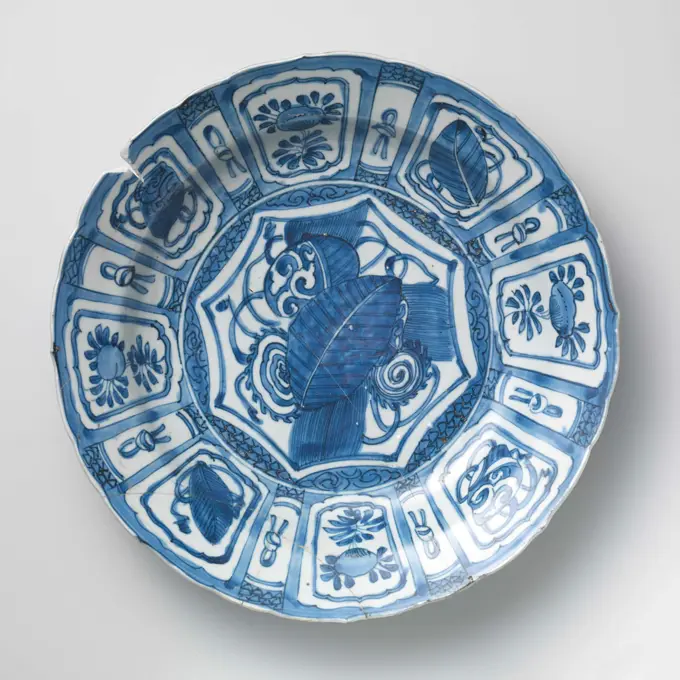
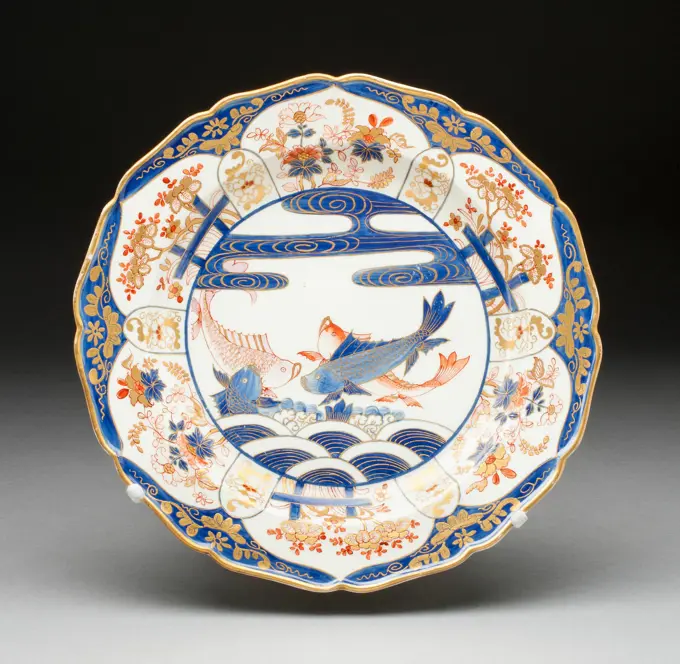
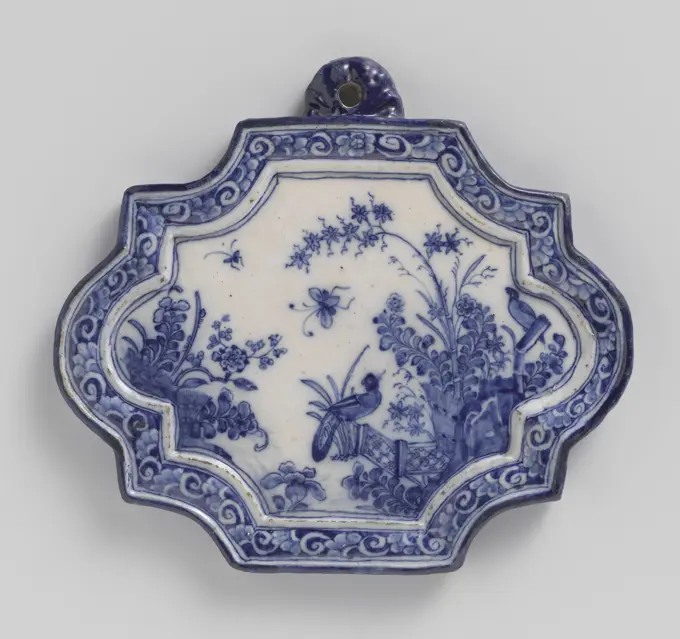
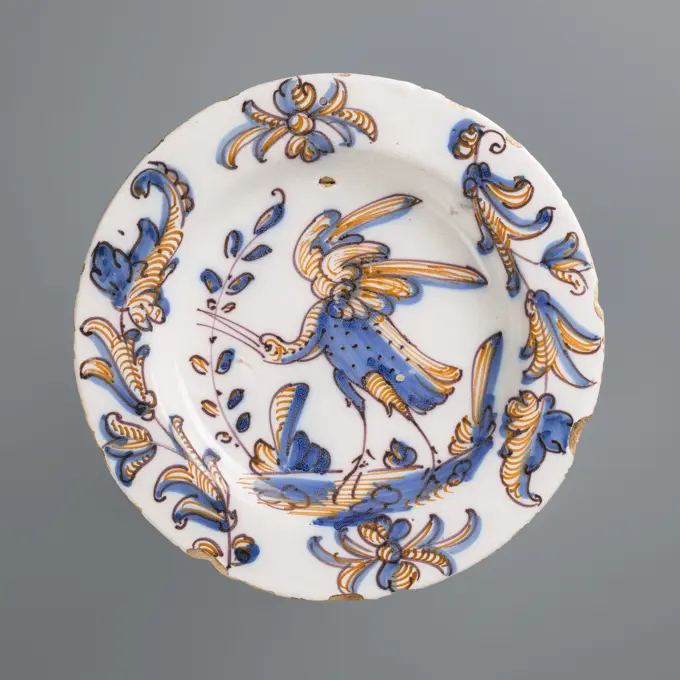
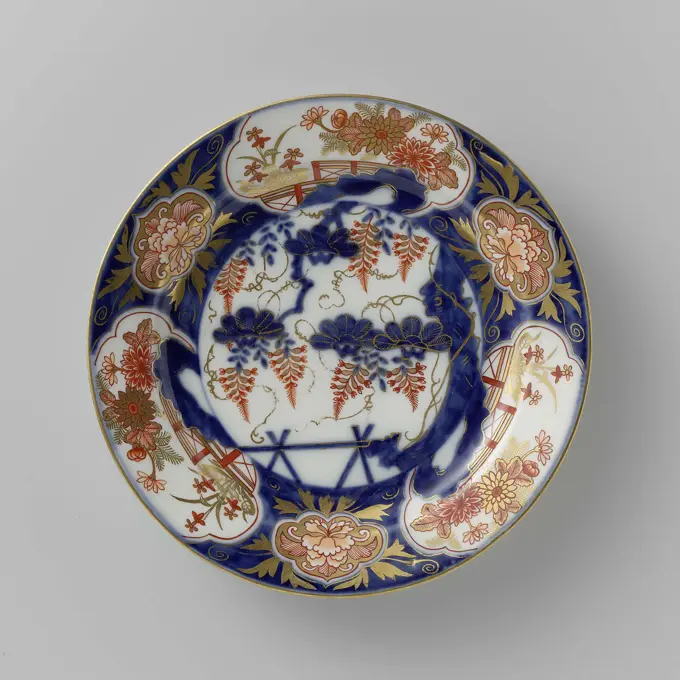
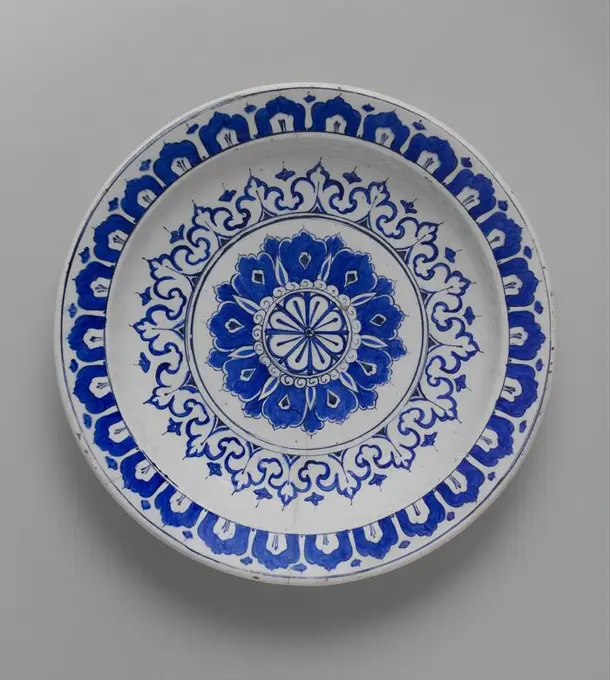
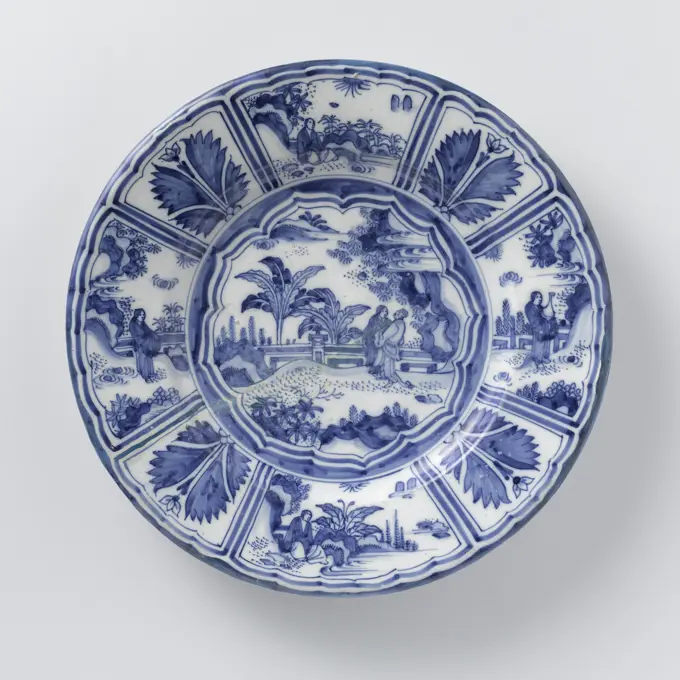
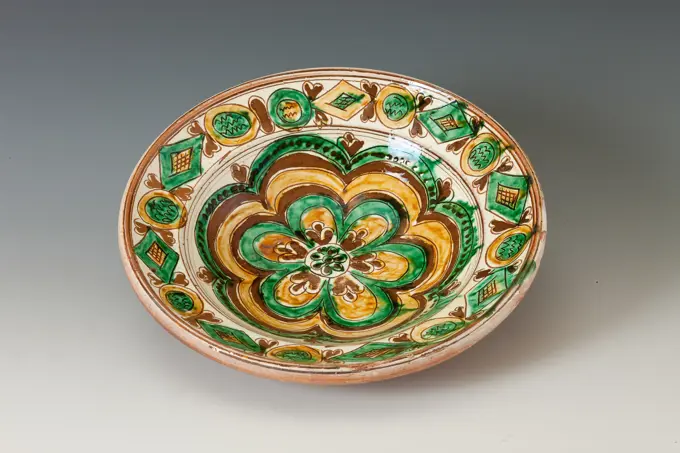
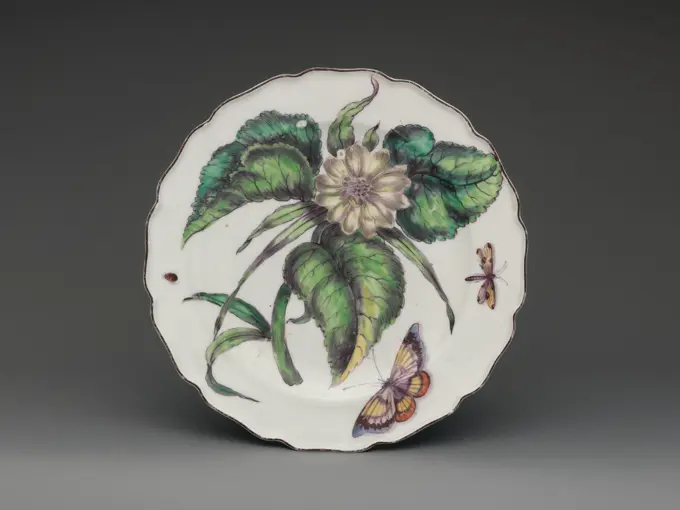
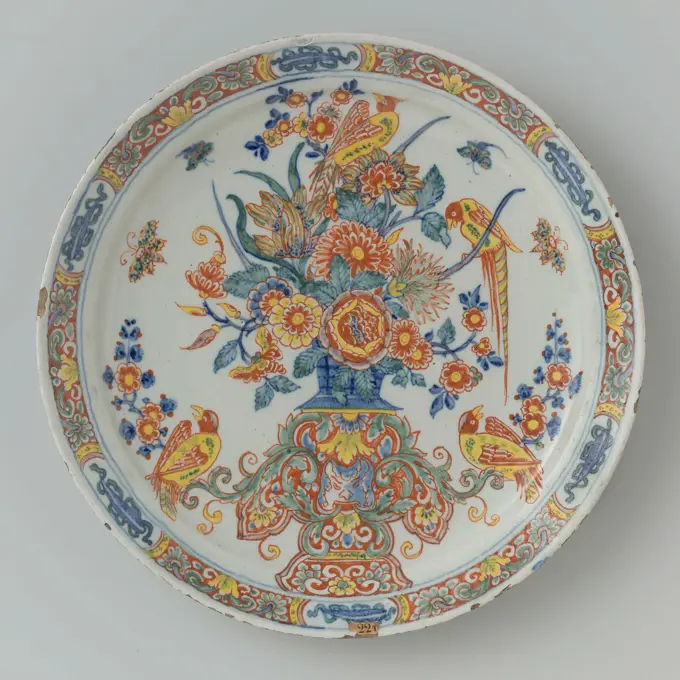
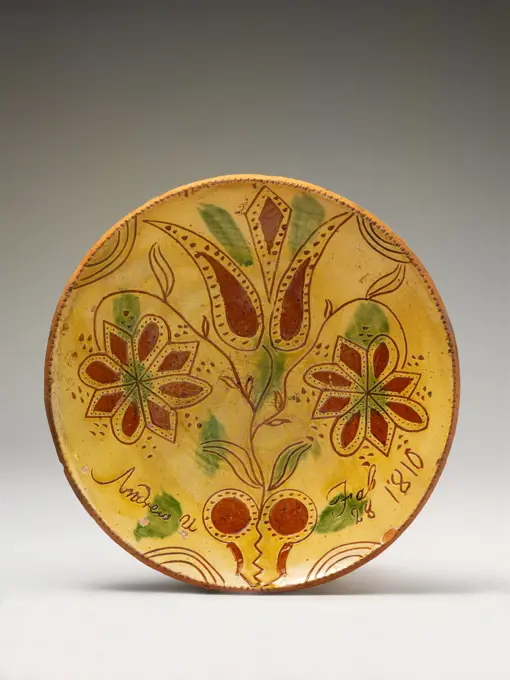
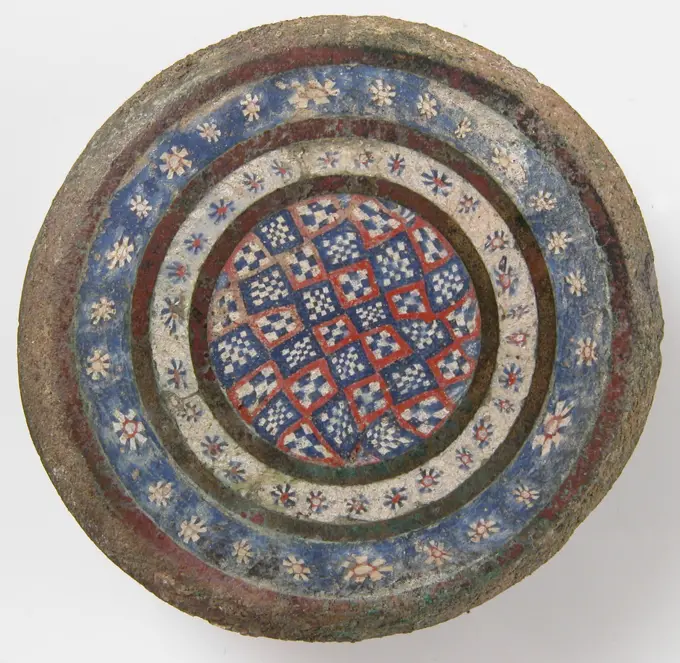
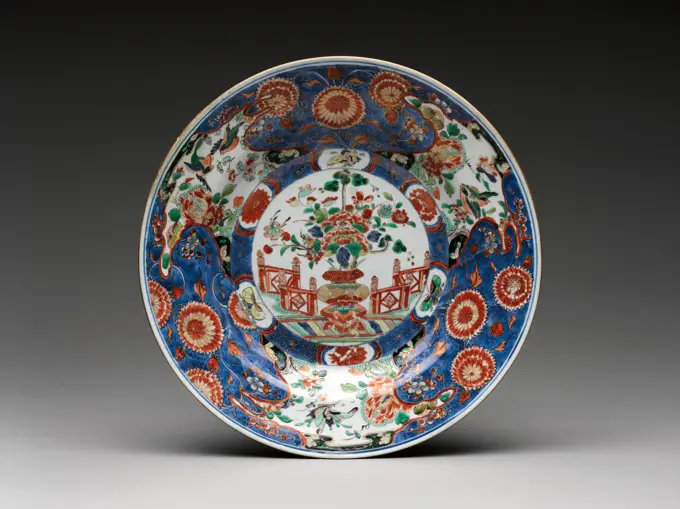
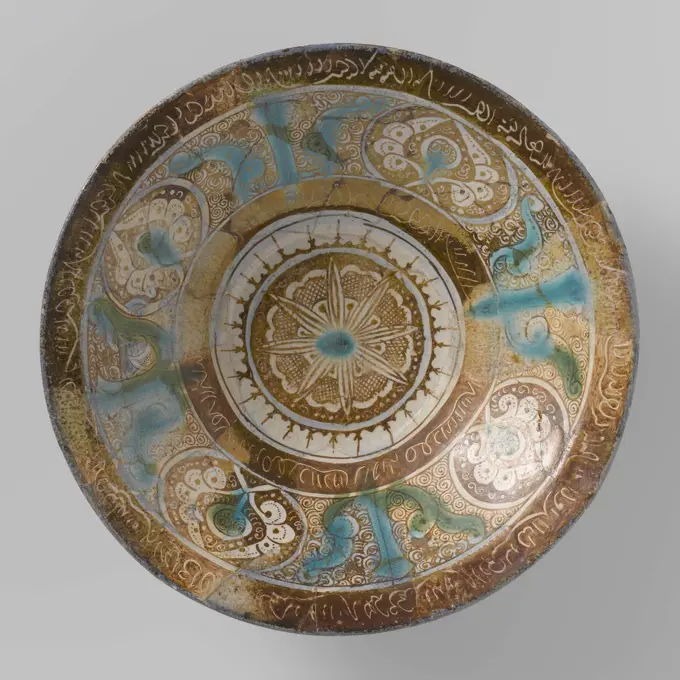
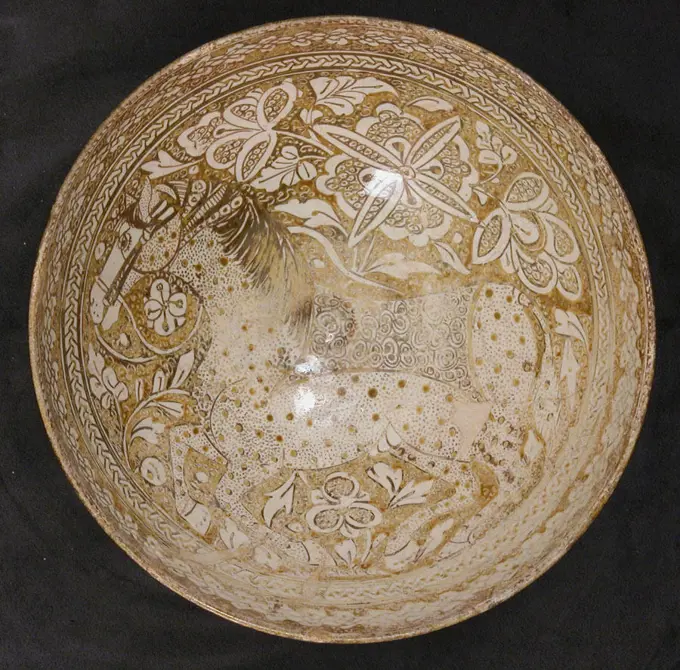
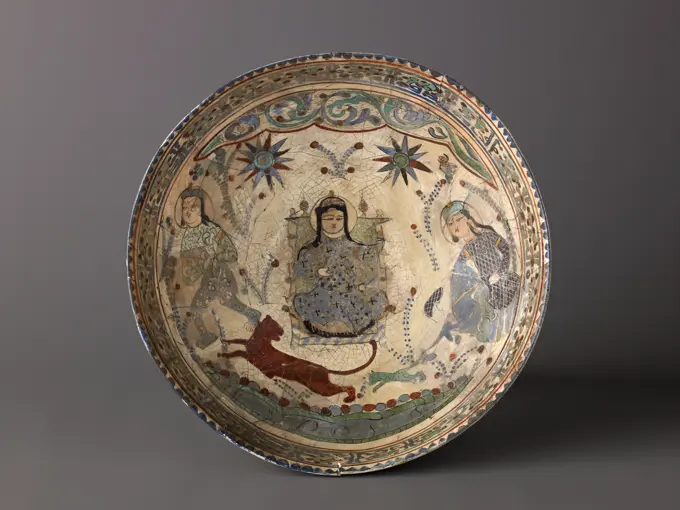
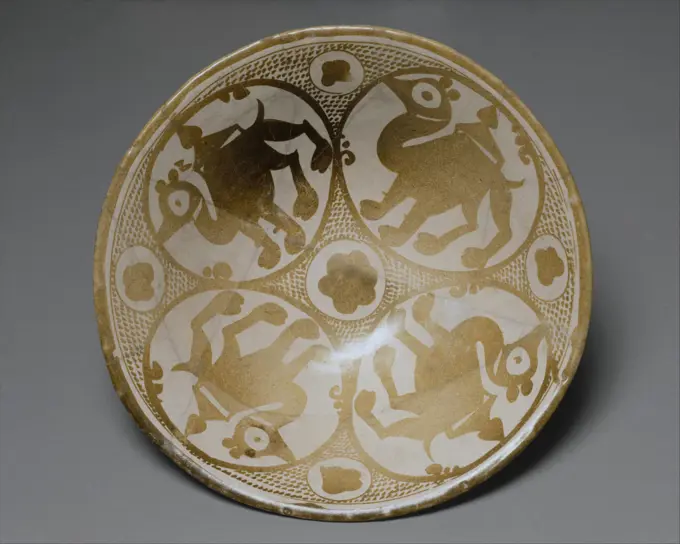
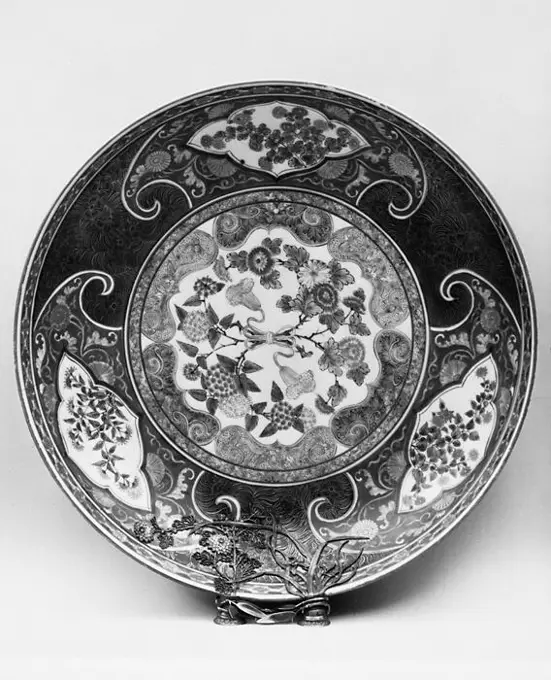
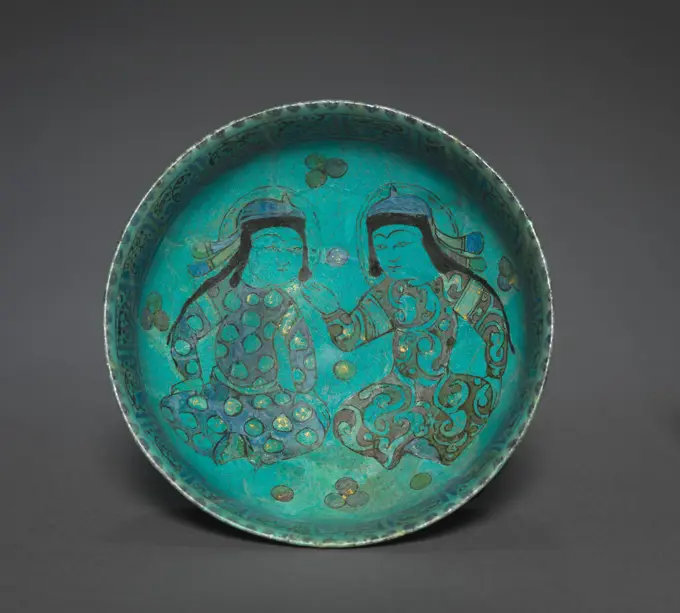
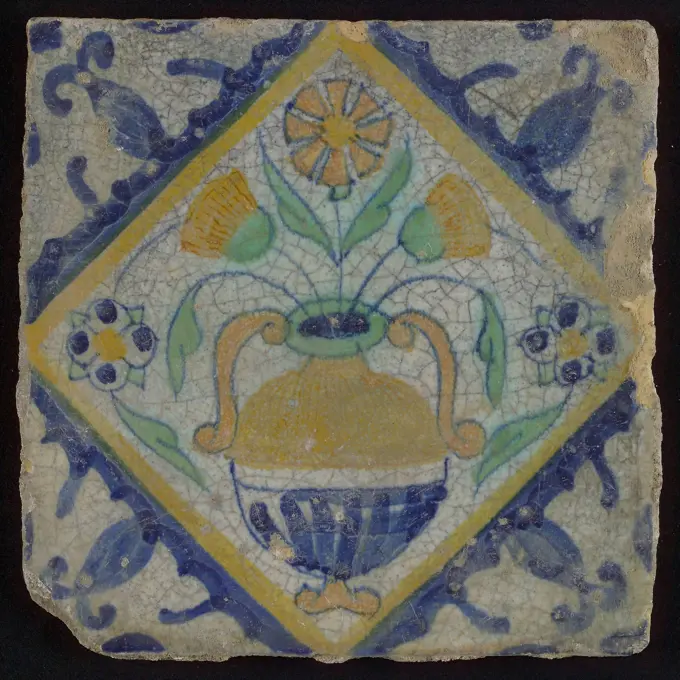
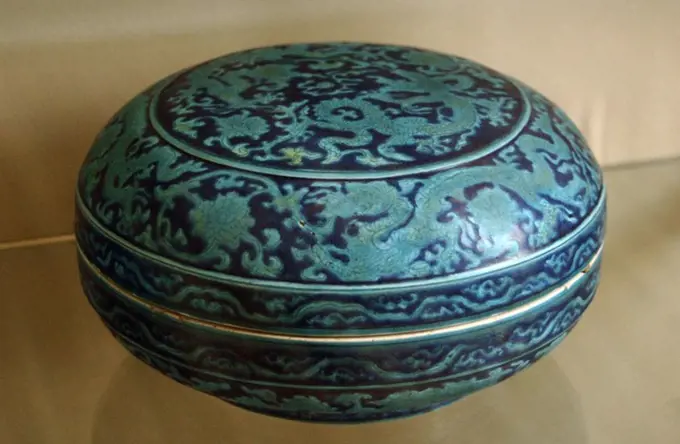
Plate;  1520-1525 (1520-00-00-1520-00-00);Plate, painted with flowers and 'lightning motif', the three porceleyne flessions, c. 1720 - c. 1740 Fowence board. Multicolored painted with flower decorations and supposedly lightning motif. Delft . Fowence board. Multicolored painted with flower decorations and supposedly lightning motif. Delft .Plate of multi -colored Faïence, Anonymous, c. 1700 - c. 1725 Faïence board. Multicolored painted with a Chinese water landscape and lambrequins, in Imari colors. Delft . Faïence board. Multicolored painted with a Chinese water landscape and lambrequins, in Imari colors. Delft .Cup with grooved edge. unknown, craftsman. Dish of pottery, painted with a symmetrically stylized decor in green, yellow, blue, manganese and pink.Bowl. Egypt or Syria, 15th century. Ceramics. Fritware, underglaze paintedDish 16th century. Dish 452208Saucer, multicolored painted with a southern fruit inside concentric circles, yellow piping and orange stripes, frieze with leaves, zigzag line and stripes on the outer edge., Anonymous, c. 1590 - c. 1610 Round dish of multi -colored painted majolica. In the middle, a southern fruit with leaves is painted inside concentric circles. A yellow piping with orange stripes is painted around the circles, around concentric circles, a frieze with blue leaves, concentric circles, a blue band with a zig-saw line between which stylized leaves, concentric circles and small stripes on the outer edge. Holland earthenware. tin glaze. lead glaze majolica Round dish of multi -colored painted majolica. In the middle, a southern fruit with leaves is painted inside concentric circles. A yellow piping with orange stripes is painted around the circles, around concentric circles, a frieze with blue leaves, concentric circles, a blue band with a zig-saw line between which stylized leaves, concentric circles anBowl with Allegory of Peace 1561 Italian, Venice or Duchy of Urbino (possibly Pesaro). Bowl with Allegory of Peace 208863Dish Depicting Two Birds among Flowering Plants. Dimensions: H. 2 3/8 in. Diam. of rim: 11 3/16 in. (28.4 cm). Date: ca. 1575-90.Hidden within the tangle of carnation, tulip, and hyacinth stems on this colorful plate perch two small birds. Such flowers, sometimes in combination with birds, were pervasive decorative elements on Iznik pottery of the sixteenth and seventeenth centuries. Museum: Metropolitan Museum of Art, New York, USA.Dish. unknown, craftsmanPlate, Porcelinfabriek aan den Amstel, c. 1784 - c. 1809 Plate with a multi -colored Imari decor with a vase with flowers on a table on the flat. Along the edge three cartouches filled with flower branches. Marked: Amstel in underlaze blue and inggrift L 6. Ouder-Amstel porcelain Plate with a multi -colored Imari decor with a vase with flowers on a table on the flat. Along the edge three cartouches filled with flower branches. Marked: Amstel in underlaze blue and inggrift L 6. Ouder-Amstel porcelainDish, Anonymous, c. 1740 - c. 1770 Round dish of multicolored painted faience, with a star -shaped ornament in yellow and red on the flat with blue, green, yellow and red sprinkling flowers. On the back the board is marked with a corrugated line. Delft earthenware. tin glaze. Round dish of multicolored painted faience, with a star -shaped ornament in yellow and red on the flat with blue, green, yellow and red sprinkling flowers. On the back the board is marked with a corrugated line. Delft earthenware. tin glaze.. Round plate of multi-colored padded faience, with a medallion in the middle with a flower and leaves in the colors green and red. There are five white boxes on a blue background in which flower and leaf decorations. Two identical signs with the Invnrs are part of the board. BK-KOG-2432-A and BK-KOG-2432-B.Dish first half 17th century. Dish 446940Charger with Battle Scene. Italy, Deruta, circa 1500. Furnishings; Serviceware. Tin-glazed earthenware (maiolica)Sign from V.O.C.-ship De 'Witte Leeuw', Anonymous, Before 1613 plate (dishes) Sign from V.O.C. ship De 'Witte Leeuw', 100 present. The glaze is milky white, crawl and has pinholes and small baking cracks. The underlaze is light blue. The bottom is glazed. The foot ring is trapezoidal and faceted. No oven sand was found. The lip edge is unpacked. Swatow porcelain. glaze   Sint-HelenaCrespina plate;  around 1530 (1525-00-00-1535-00-00);Bowl 13th century. Bowl 451668Plate, Kangxi period (1662-1722), 14 1/4 in. (36.2 cm), Porcelain, famille verte, China, 17th-18th century, Unlike the monochrome tradition, this finely executed plate represents a less restrained aspect of Qing ceramic taste. Nevertheless, a technical virtuosity is apparent in the overglaze enamels which create a richly varied design of butterflies and flowers on a green stipple ground. A work such as this, eggshell thin and of flawless brushwork, is the reward of 2,500 years of constant effort by the Chinese to create faultless ceramics. It is natural that such exquisite objects often functioned as purely decorative pieces.Plate. Turkey, Iznik, 1580-1590. Ceramics. Fritware, underglaze-paintedSaucer-Dish With Two Pheasants On A Prunus Tree On a Ground Of Flowers And Swastikas. Scale of porcelain with lobed edge, painted in underglaze blue. On the flat a pheasant on a prunus tree at a rock; A second pheasant flies above the tree. The background with a grid cartridge alternately filled with swastikas and stylized flowers. An inscription of four characters next to the tree. The inner wall with a ruyi-motifs band. The outer wall with a continuous edge with birds. Marked on the underside with 'fuku' in a square inside a double circle. Bak sand at the foot ring. Arita, blue-white.Saucer. Blerzy et Sauvage (Paryż ; malarnia ; ca 1812-1830), companyPair of plates bearing the arms of Amsterdam, anonymous, c. 1730 - c. 1740 Porcelain plate, painted on the glaze in blue, red, pink, green, yellow, black and gold. On the flat a medallion with flowering plants (Prunus, peony, aster); Around the service continuously on the wall and edge, interspersed with five lobed cartouches with flowering plants; a cartouche with the weapon of Amsterdam; The outer wall is covered with a pink glaze. Old label on the bottom with '4A 1449/ Oriental Plate from the Duke of Buckingham Collection'. Two chips in the edge. Weapon porcelain in Famle Rose with a Ruby Back. China porcelain. glaze. gold (metal) painting / gilding / vitrification Porcelain plate, painted on the glaze in blue, red, pink, green, yellow, black and gold. On the flat a medallion with flowering plants (Prunus, peony, aster); Around the service continuously on the wall and edge, interspersed with five lobed cartouches with flowering plants; a cartouche with the weapon of Amsterdam; The oPlate third quarter 16th century The design here is similar to that of no. 17.120.19, blossoms and leaves in reserve on a cobalt blue background growing from a single point, but the style is much less esoteric and experimental. Plate. third quarter 16th century. Stonepaste; painted and glazed. Attributed to Turkey, Iznik. Ceramics. Round dish of multicolored faience painted. On a ground a fence, flowers and leaves are painted on a ground and eight floral motifs on the edge.Saucer with fluted sides, covered all over with flower sprays, anonymous, c. 1680 - c. 1720 Porcelain saucer with ribbed wall and scalloped edge, painted in underlaze blue. The front of the dish is covered with a continuous motif from flower branches, the flat and the wall separated by a band with zigzag work; Zigzag work on the edge; The rear with three flowering plants. Marked on the bottom with 'yù', Jade, in a double circle. Three chips in the edge; A crack in the edge. Blue White. China porcelain. glaze. cobalt (mineral) painting / vitrification Porcelain saucer with ribbed wall and scalloped edge, painted in underlaze blue. The front of the dish is covered with a continuous motif from flower branches, the flat and the wall separated by a band with zigzag work; Zigzag work on the edge; The rear with three flowering plants. Marked on the bottom with 'yù', Jade, in a double circle. Three chips in the edge; A crack in the edge. Blue White. China porcelain. glaze. cobalt (mineral) paiDish with Lotus in Rui-Head-Shaped Cartouches, mid-1800s. Japan, Edo period (1615-1868). Porcelain with underglaze blue and overglaze enamel (Hizen ware, Nabeshima type); diameter: 20.4 cm (8 1/16 in.); overall: 5.6 cm (2 3/16 in.).Dish. unknown, craftsmanMajolica dish, with simple floral pattern in blue on white ground, dish plate crockery holder soil find ceramic earthenware glaze tin glaze lead glaze, hand-turned baked 2x majolica glazed Majolica plate. imprints in the performance. Decorated with simple leaf and flower motif in the middle Along the edge single blue double cross underside of lead glaze. Standring Schotel has shoulder flag slightly inwardly and externally arched upwards archeology Rotterdam Stadscentrum Stadsdriehoek Schielandshuis indigenous pottery food serving table serving garnish Soil discovery: Schielandshuis during restoration.Schotel van Fazence, de porceleyne was, c. 1750 - c. 1790  Dish of Faience. Blue painted with a bird and flowers. Delft .Hexagonal Tile 15th century The design of this tile was strongly influenced by Chinese models, in both composition and color. The Egyptian taste for blue-and-white botanical designs was filtered through Iranian versions from the Ilkhanid period (1256-1353). It is known that Iranian artists moved westward at the beginning of the fifteenth century.. Hexagonal Tile. 15th century. Stonepaste; underglaze painted. Attributed to Egypt. Ceramics-TilesPlate. Culture: Mexican. Dimensions: Diam. 8 1/4 in. (21 cm). Date: ca. 1825. Museum: Metropolitan Museum of Art, New York, USA.PPF, Fragment majolica dish, blue on white, bird in Chinese garden, signed, dish crockery holder soil find ceramic earthenware glaze, baked underside covered with lead glaze. Monochrome waised soul of the pancake dish or salad dish Possible signature on the back: PPF archeology Rotterdam decorate serving food China archaeological find in the soil Rotterdam 1940.. Dish of Faïence. Multicolored painted with a flower vase. Edge decorated with lambrequins.Platter 1695-1725 Rouen. Tin-glazed earthenware (faience) . Rouen Potteries (Manufacturer)Fragment majolica dish, blue on white, Chinese garden with birds, dish crockery holder earth discovery ceramics pottery glaze, Wines baked Strong veined shard poorly mixed pottery archeology food serve decorate ChinaDish 1430-1460 Spanish. Dish 471763Bag 1830-60 Mexican. Bag 170250Dish, De Metale Pot, 1720 - 1740  Dish of Faience. Blue painted with a flower decoration. Delft .Plate from v.O.c.-ship the 'white lion'. Plate from v.o.c.-ship the 'white lion', 99%% present; A particle of the wall is missing. The shard is white. The glaze is colorless and has pinholes and frying tears. The bottom is glazed. Plate with a flat edge and a scalloped lip, decorated in underglaze blue. In the flat lucky symbols surrounded by a star-shaped border filled with geometric motifs. On the wall and the edge alternately wide and narrow fields with lucky symbols and flowering plants.Arita (ceramic production center), hollow dish, Imari decor (username). Ceramics, porcelain, polychrome enamels: cobalt blue under cover, iron and green on covered, gilding. Petit Palais, Museum of Fine Arts of the City of Paris.Dish second half 16th century. Dish 451063. Soft-paste porcelain, polychrome enamels and gildingBengal Tiger' pattern plate, c. 1810, 1 1/8 x 9 5/8 in. (2.9 x 24.45 cm), Porcelain, China, 19th centuryCup and saucer, Meissener porcelain manufactory, c. 1725 - c. 1747 Dish of multicolored, gold and underlaze blue painted porcelain. The dish is glazed on the outer wall and painted with Chinese style figures. The inner wall is painted with four land with Indianic blums on the edge and four large JUI motifs, which enclose a field in the middle, in which a branch with flowers encloses. The dish is marked. porcelain company: MeissenAugsburg porcelain Dish of multicolored, gold and underlaze blue painted porcelain. The dish is glazed on the outer wall and painted with Chinese style figures. The inner wall is painted with four land with Indianic blums on the edge and four large JUI motifs, which enclose a field in the middle, in which a branch with flowers encloses. The dish is marked. porcelain company: MeissenAugsburg porcelainDish second quarter 16th century Here the central design of a trio of grape clusters is a direct translation from Chinese blue-and-white porcelain of the Ming dynasty, which began to appear in Ottoman collections in the early sixteenth century. Curiously, even though the floral sprays on the cavetto were also borrowed from Ming porcelain, the feathery motif on the rim of the dishsometimes known as the "wave and rock" patternwas taken fom an earlier Yuan-dynasty porcelain model, which demonstrates that Iznik potters often combined several design sources of the same piece.. Dish 451841Platter. Belweder (manufaktura fajansu ; 1770-1780), factoryArita (ceramic production center), hollow dish, Imari decor (username). Ceramics, porcelain, polychrome enamels: cobalt blue under cover, red on covered, gilding. Petit Palais, Museum of Fine Arts of the City of Paris.Saucer With Stylized Flowers and Precious Objects. Dish of porcelain with lobby edge, painted in underglaze blue. On the flat a rosette with a flower in a circle in the center, from the flower four lines with a flower in reserve at the end, on the circle branches in reserve; Changed with three lines on the edge styled flower drinks; The back with three valuables (pearl, diamond, artemisia leaf) and a lucky symbol (shell). Marked on the underside with the four-character mark of Emperor Yongzheng () In a double circle. A crack in the edge. Blue White.Plaque, anonymous, c. 1725 - c. 1750 FaiMence plate with a chinoiserie decoration Delft . FaiMence plate with a chinoiserie decoration Delft .Plate. Talavera de la Reina, factorySharf of a plate of white -baking earthenware, with white glaze on the front with a drawing of flower shapes in blue, c. 1500 - c. 1899 fragment   earthenware. glazeFragment Come from V.O.C. ship De 'Witte Leeuw', Anonymous, Before 1613 bowl Fragment Come from V.O.C. ship De 'Witte Leeuw', 35 present. Jingdezhen porcelain   Sint-Helena. Porcelain factory on the Amsteloper-Amstel, c. 1784-1809Hard-Paste PorcelainDish with 'Kaleidoscope' Design. Dimensions: H. 2 11/16 in. (6.8 cm)Diam. of rim: 13 3/4 in. (34.9 cm). Date: ca. 1580-85.This dynamically decorated sixteenth-century dish in cobalt blue was produced at the famous kilns at Iznik, in western Anatolia. Stylized variations of lotus petals, ultimately of Chinese inspiration but geometrically patterned into a radiating sunburst of powerful Islamic design, bear witness to one of the most fruitful cultural exchanges in history: the mutual influences flourishing for centuries between the artists, especially potters, of eastern and western Asia. Chinese influences on Islamic art peaked in the thirteenth and fourteenth centuries, when nearly all Asia came under the sway of the Great Khans, the Mongol overlords ruling from Beijing. The Ilkhanids who governed the Near East from their capital at Tabriz, in modern northwestern Iran, imported precious Chinese wares, commanding local Muslim artists to study Chinese technique and design. The sixteentPlate. Culture: Mexican. Dimensions: Diam. 14 3/8 in. (36.5 cm). Date: ca. 1820. Museum: Metropolitan Museum of Art, New York, USA.Dish of Faience, Anonymous, c. 1650 - c. 1670 Round dish of blue painted faience. A landscape with two figures is painted on the flat. The edge is divided into four large compartments and four small compartments. In two large compartments, a standing figure is painted in a landscape and a sitting figure in the other two courses. A stylized flower with four leaves is painted in the small compartments. The board is marked. Delft earthenware. tin glaze. Round dish of blue painted faience. A landscape with two figures is painted on the flat. The edge is divided into four large compartments and four small compartments. In two large compartments, a standing figure is painted in a landscape and a sitting figure in the other two courses. A stylized flower with four leaves is painted in the small compartments. The board is marked. Delft earthenware. tin glaze.. Dish of Faience. Blue painted with flower decorations.Shard of ross -baking earthenware, with blue glaze at the top with decoration of a scene with one tulip between leaves, which is in the earth in brown, white, yellow, orange and green, and a few circles in brown, yellow and blue around it, Anonymous, 1600 - 1650  Northern Netherlands earthenware. glaze majolica  Northern Netherlands earthenware. glaze majolicaBowl Bachmi Ski, Alexander (1820 1882)Botanical dish with white sunflower ca. 1755 Chelsea Porcelain Manufactory These botanical plates (2016.217-.226) were produced by the Chelsea factory around 1755 and are often referred to as Chelsea "Hans Sloane" wares, in reference to the royal physician, traveler, and natural historian who helped transform the Chelsea Physik Garden into a center of botanical knowledge during the British Enlightenment. Several subjects depicted on these plates were taken from botanical illustrations published by Philip Miller, curator of Chelsea Physik Garden. Although flowers and fruits could typically be found on earlier porcelain wares from Meissen, the lively naturalism of the Chelsea botanical plates reflects a broadening public interest in the natural world, and evidence the forms of global commerce that brought exotic species from the Caribbean, the Americas, and Asia to England.. Botanical dish with white sunflower. British, Chelsea. ca. 1755. Soft-paste porcelain. Ceramics-PorcelainPlate with flowering plants near a rock and pierced rim, anonymous, c. 1725 - c. 1749 Porcelain plate with partially openwork edge, painted in underlaze blue. On the flat a medallion with large, flowering plants (peony) in a rock. Between the openwork parts on the edge sculpted cartouches with flowering plants (orchid, Prunus, Lotus, Aster); Above a bond with shadowing. The outer wall with a continuous flower branch; The outer edge with a stylized flower branch four times. Marked on the underside with a Ruyi-Scepter in a double circle. Blue White. China porcelain. glaze. cobalt (mineral) painting / vitrification Porcelain plate with partially openwork edge, painted in underlaze blue. On the flat a medallion with large, flowering plants (peony) in a rock. Between the openwork parts on the edge sculpted cartouches with flowering plants (orchid, Prunus, Lotus, Aster); Above a bond with shadowing. The outer wall with a continuous flower branch; The outer edge with a stylized flower branch Tile with a multi -colored pattern in blue, orange, yellow and green of a flower pot framed by an accolade with meanders in corners, c. 1620 - c. 1640 Tile with a multicolored (blue, orange, yellow and green) flower pot framed by an accolade. In the corners, a meander. Netherlands earthenware. tin glaze majolica Tile with a multicolored (blue, orange, yellow and green) flower pot framed by an accolade. In the corners, a meander. Netherlands earthenware. tin glaze majolica. Plate of Faïence. Painted multi-colored with a basket with flowers. Edge with tendrils and Chinese motifsA plate;  XVII century (1601-00-00-1700-00-00);. Elongated, octagonal plate of blue painted faience. The top edge has a triangular frontone with a wearing eye. Flowers, plants, birds and butterflies are painted in the middle. Flowers are painted on the edge.Blue and white Delft pottery, decorated with plants and birds and a growling wolf or fox in the middleBowl with Flying Birds, 1280-1400. Iran, probably Kashan, Ilkhanid period (1256-1353). Fritware with underglaze-painted design, Sultanabad ware; overall: 11.2 x 22 cm (4 7/16 x 8 11/16 in.).Sign from V.O.C.-ship De 'Witte Leeuw', Anonymous, Before 1613 plate (dishes) Sign from V.O.C. ship De 'Witte Leeuw', 85  present. Jingdezhen bone china (material)   Sint-HelenaDish late 15th century Spanish. Dish. Spanish. late 15th century. Tin-glazed earthenware. Made in probably Manises, Valencia, Spain. CeramicsOttoman dish, c. 1540, Tulip design, Turkey.Cup and saucer with fish between water plants, anonymous, c. 1700 - c. 1724 Porcelain's head and saucer with ribbed wall and lobed edge, painted in underly glaze blue and on the glaze blue, red, green, yellow, eggplant, black and gold. The outside of the head with four fish between aquatic plants, the edge with a band Ruyi motif; On the bottom a fish and the inside with four fish in iron red, the edge with a band Ruyi motif. The flat of the dish with a larger fish between aquatic plants, otherwise the same decoration as on the head. Both marked on the bottom with 'yù', Jade, in a double circle. Famle Verte. China porcelain. glaze. cobalt (mineral). gold (metal) painting / gilding / vitrification Porcelain's head and saucer with ribbed wall and lobed edge, painted in underly glaze blue and on the glaze blue, red, green, yellow, eggplant, black and gold. The outside of the head with four fish between aquatic plants, the edge with a band Ruyi motif; On the bottom a fish and the inside witShards of a sign from V.O.C. ship De 'Witte Leeuw', Anonymous, Before 1613 plate (dishes) Shards of a sign from V.O.C. ship De 'Witte Leeuw', 80 present. Jingdezhen bone china (material)   Sint-HelenaPlate 1810 Attributed to Andrew Uhler. Plate 5957. Dish of Faïence. On the flat dinner in blue. A multicolored flower edge around it.Disk Brooch 2nd-3rd century Roman Millefiore enameling was widely popular in Gaul, where it was often used to decorate disk brooches and vessels. In this technique, the artist fuses together glass rods of different colors. The multicolored rods are then cut into cross sections, which are placed in a metal base and heated sufficiently for them to adhere. The result is an intricate pattern of flowers and checkerboards.. Disk Brooch. Roman. 2nd-3rd century. Millefiore enamel, bronze. Made in Gaul (France). Enamels-ChamplevéDish with a vase of flowers 1725-30 Chinese, for the Continental European market The extensive use of gilding and the dark blue and red enamels illustrate the Chinese adoption of the Japanese Imari style. This style became popular in Europe in the mid-seventeenth century, when warfare in China disrupted the kilns at Jingdezhen. Once work there resumed, Chinese potters incorporated the Imari style in their repertory in order to appeal to the lucrative European market.. Dish with a vase of flowers. Chinese, for the Continental European market. 1725-30. Hard-paste porcelain painted with colored enamels over transparent glaze and gilded (Jingdezhen ware). Ceramics-Porcelain-ExportDish with arms of the Vitelli family ca. 1520-30 Possibly Nicola Francioli, called Co. Dish with arms of the Vitelli family 195753. Come from Quartz Fritgoed decorated with a inscription, flower rosette, palmettes and tendrils on curl work in brown luster, turquoise and green on the surface of white glaze.Bowl ca. 1300 Piebald (spotted) Mongolian horses were not infrequent in Ilkhanid herds and they are often illustrated in this way, creating an engaging fusion of "realism" and decorative intention. Here the stallion is the unquestionable protagonist of the composition, galloping free amid symbolic Chinese-inspired oversize vegetation, yet tame and ideally close to its rider, since it wears bridles, curb bit, and saddle blanket. The curly pattern of the fabric provides a lively contrast to the horse's hide. The way the cover is tightly tied across the horse's body, pointing decidly toward its flanks, was certainly drawn from real observation, as were the straps, perhaps decorated with metal bosses, which partially cover its mane.. Bowl 450948Bowl, Minai'i ("enameled") ware late 12th-early 13th century Iranian. Bowl, Minai'i ("enameled") ware 460722Bowl with Image of Four Camels 10th century Luster-painted bowls made in Abbasid Iraq often featured representations of birds, mythical beasts, human beings, and vegetal patterns. This examples playful depiction of camels is a rare departure from the typical iconographic repertory. The medallion layout and the repeating design of the camels with palanquins on their backs lend a sense of dynamism to the piece, almost as if the artist wanted to show the beasts proceeding in a caravan.. Bowl with Image of Four Camels 451768Saucer with powder blue and cranes, c. 1700 - c. 1724 Porcelain saucer, painted in under -glaze blue. With accompanying tea head (AK-RBK-15855-B-1). Bleu Poudré. China porcelain. glaze. cobalt (mineral) painting / vitrification Porcelain saucer, painted in under -glaze blue. With accompanying tea head (AK-RBK-15855-B-1). Bleu Poudré. China porcelain. glaze. cobalt (mineral) painting / vitrificationSaucer With Petal-Shaped Panel Around A Central Medallion, Filled With Flower Sprays. Dish of porcelain, painted in underglaze blue and on the glaze red and gold. On the platter a medallion with flour, a medallion six petal-shaped boxes filled with flower branches; Between the boxes a flower drink; Three loose flowers on the back. A crack in the dish. Chinese Imari.Large Dish ca. 1750 Japan. Large Dish 52419Plate ca. 1860-66 Chinese, for American market. Plate. Chinese, for American market. ca. 1860-66. Porcelain. Made in ChinaDeep Dish late 15th-early 16th century Spanish. Deep Dish 471750Tile/tile Fragment; glazed earthenwareBowl, 1150-1220. Iran, probably Kashan, 12th-13th century. Fritware with overglaze-painted design (minai ware); overall: 6.3 x 12.3 cm (2 1/2 x 4 13/16 in.).Tile with fruit bowl on foot, anonymous, c. 1640 - c. 1660 Tile with a multicolored (blue, green, yellow and orange) fruit bowl on foot and a lily in the corners. Netherlands earthenware. tin glaze majolica Tile with a multicolored (blue, green, yellow and orange) fruit bowl on foot and a lily in the corners. Netherlands earthenware. tin glaze majolicaPlate late 17th-early 18th century China. Plate 40756Deep Dish. Culture: Spanish. Dimensions: Overall: 18 3/4 in. (47.6 cm). Date: 1430-1460.This dish (or brasero) comes from a lavish ensemble of tableware created for the delle Agli family of Florence. The family's arms, featuring a rampant wolf, appears at the center. (The purplish color is as close as the potters could get to the prescribed red.) The arms are ringed by garlic, a playful reference to the consonance between the family name and the Italian word for garlic (aglio). The scrolling vine pattern of the border is recognizable as bryony. Museum: Metropolitan Museum of Art, New York, USA.Dish early 18th century Japan. Dish. Japan. early 18th century. Porcelain painted with polychrome enamels (Nabeshima ware). Edo period (1615-1868). CeramicsPlate;  18th century (1701-00-00-1800-00-00);Bowl 12th century. Bowl 451354Dish (Pan) with Scholar and Attendants under a TreeTile, orange, brown, green, and blue on white, flowerpot in square, corner pattern palm, wall tile tile sculpture ceramic earthenware glaze, baked 2x glazed paintedDish 17th century. Dish. 17th century. Stonepaste; underglaze painted in black, blue, and green with red and yellow slips. Attributed to Iran. CeramicsChina. Cover box, porcelain. Decorted with turquoise and blue dragon. Ming dynasty, Chenghua period (1465-87 AD). British Museum. London. England. United Kingdom.