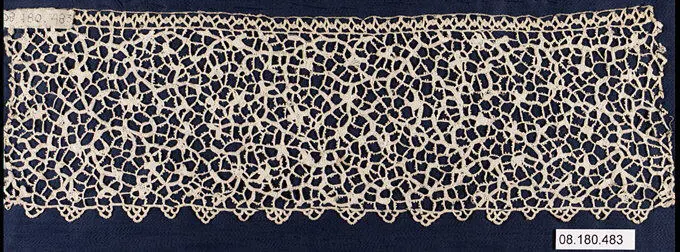
Delicate Lace Fragments

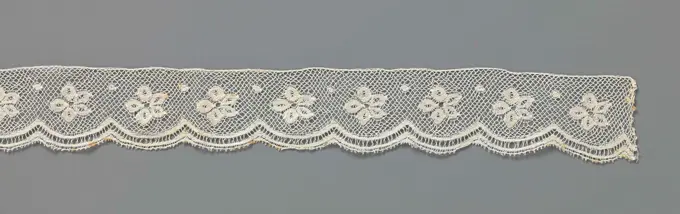
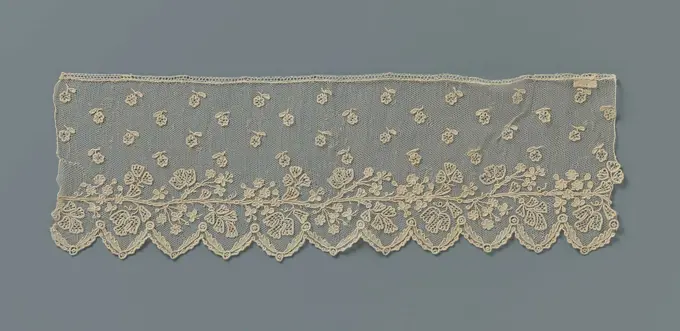
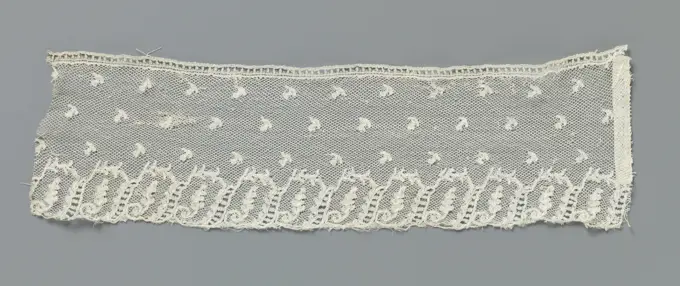
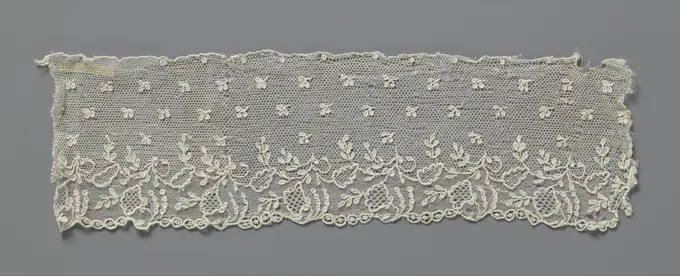
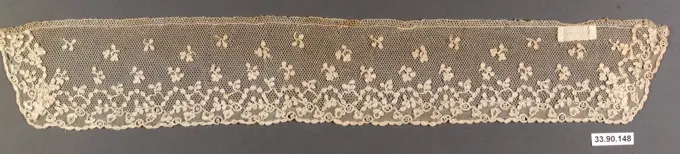
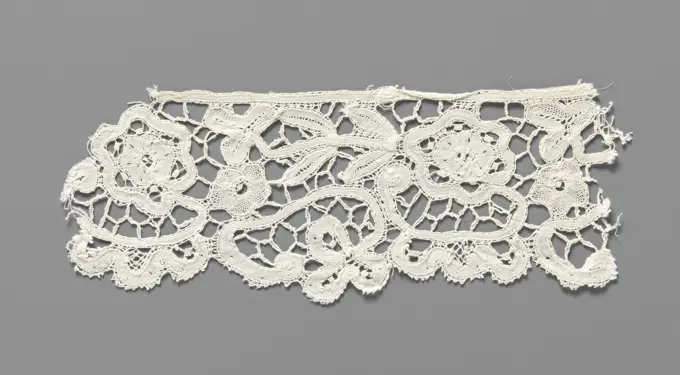
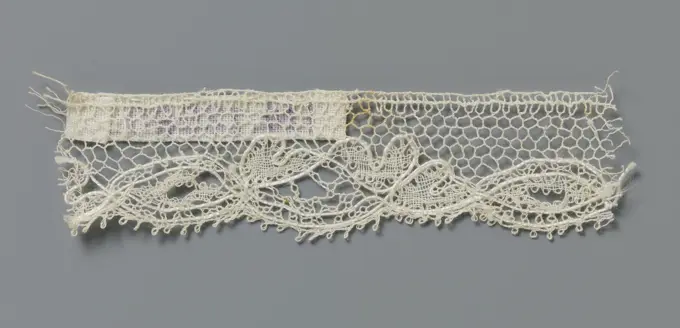
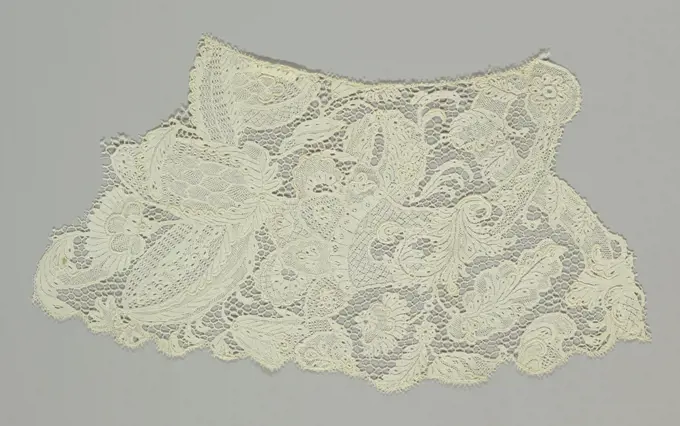
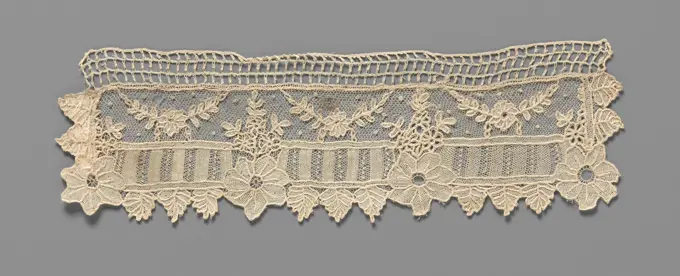
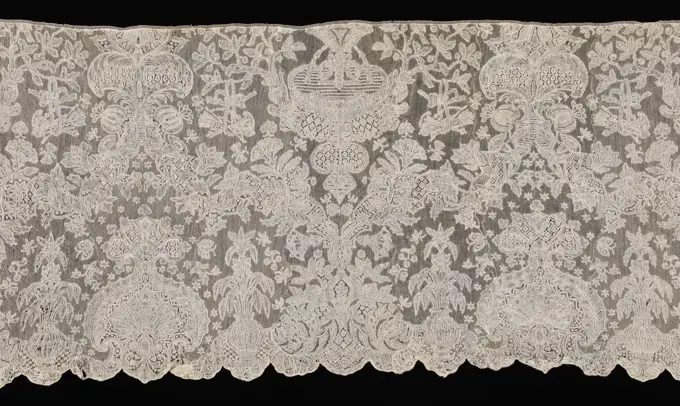
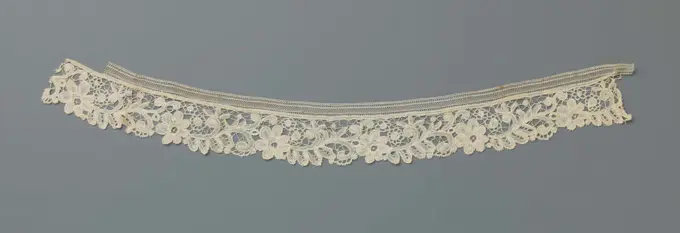
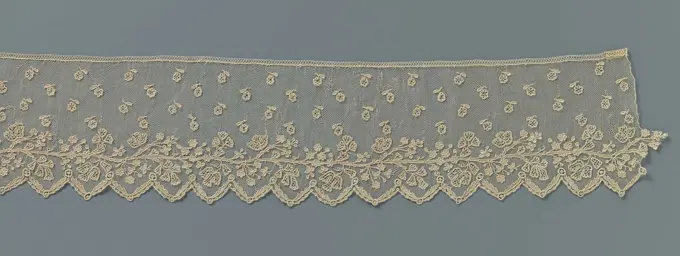
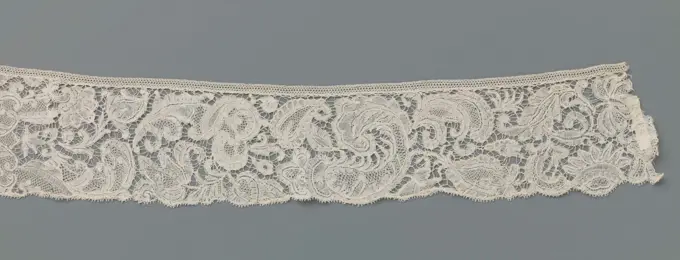
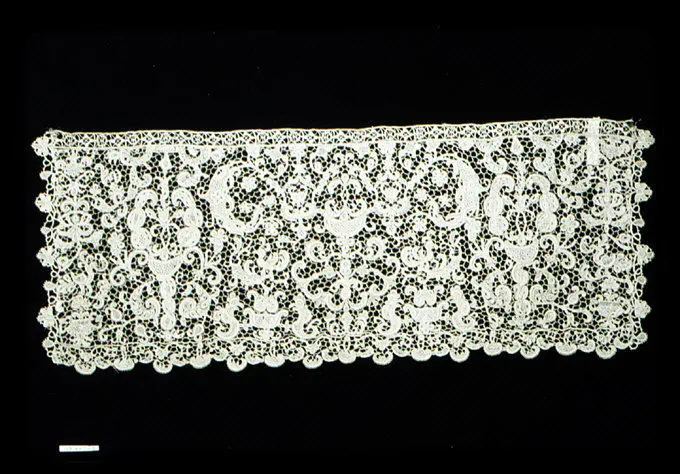
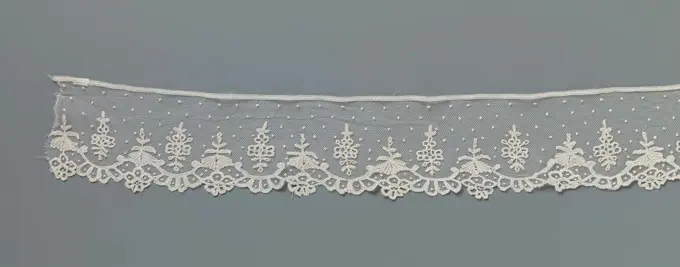
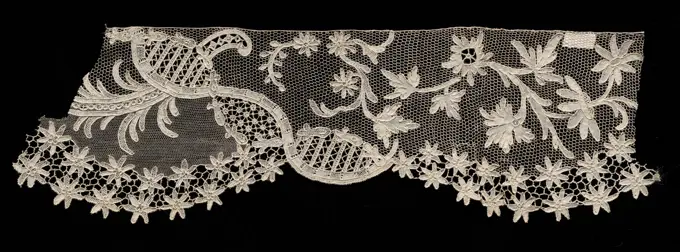
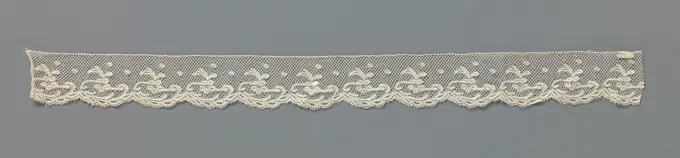
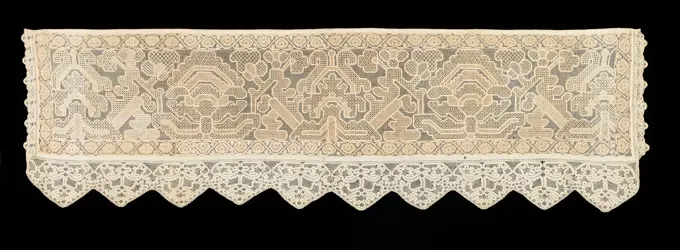
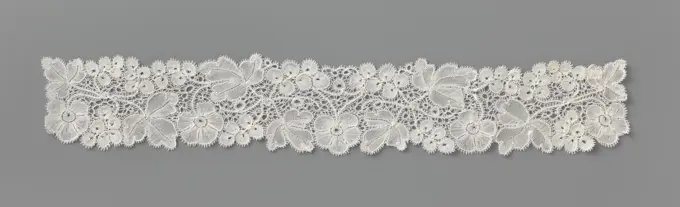
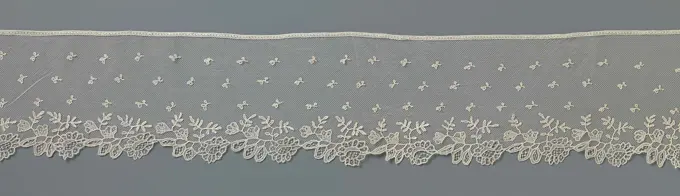
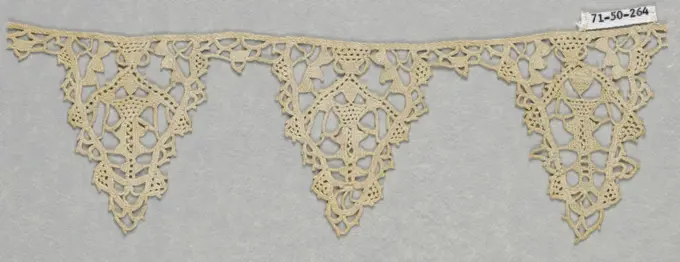
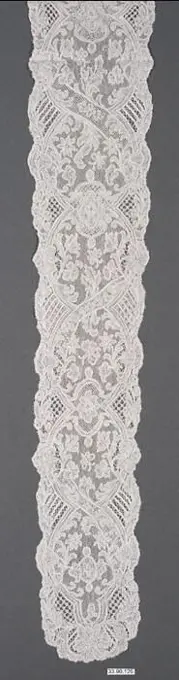
18th-century intricate lace strips featuring floral and arch patterns, displaying fine craftsmanship and historical textile artistry.

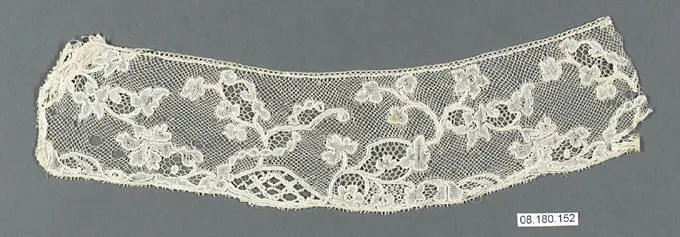
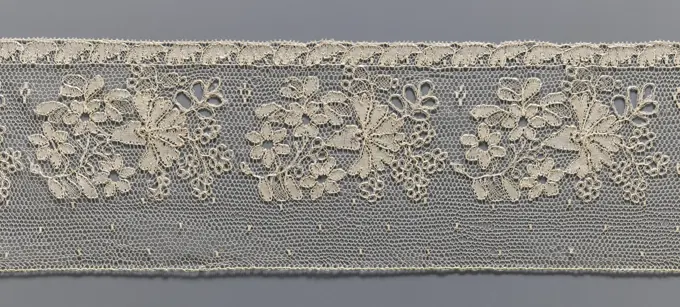
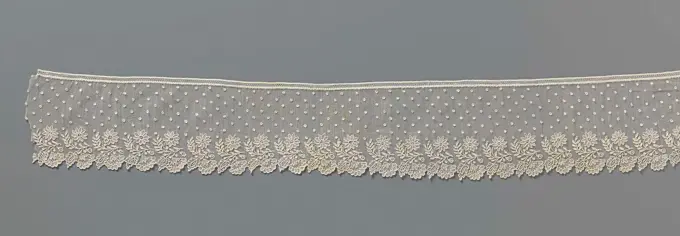
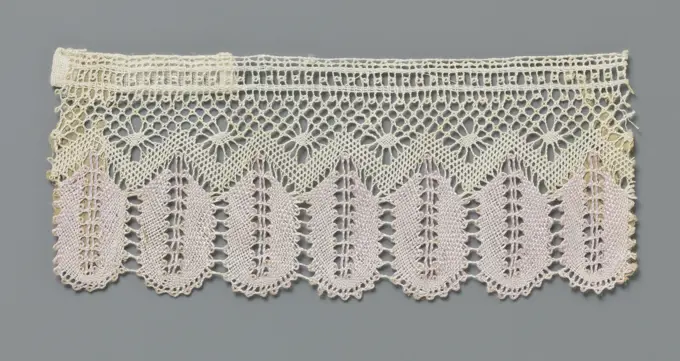
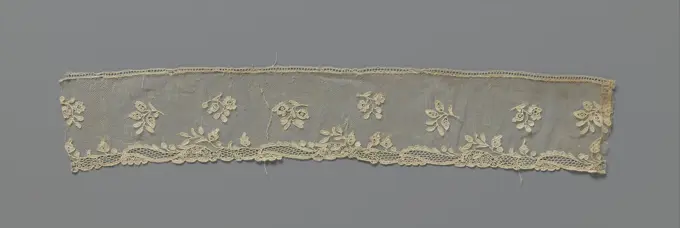
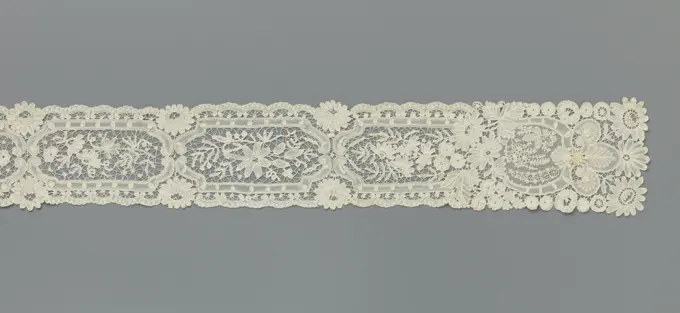
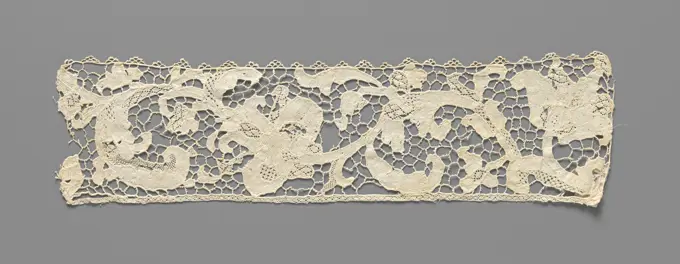
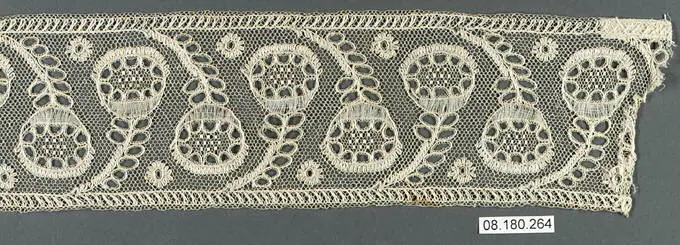
Fragment, Medium: Technique: bobbin lace (late Valenciennes ground), Flowering band above border of ovals separated by leaf ornament., 19th century, lace, Fragment
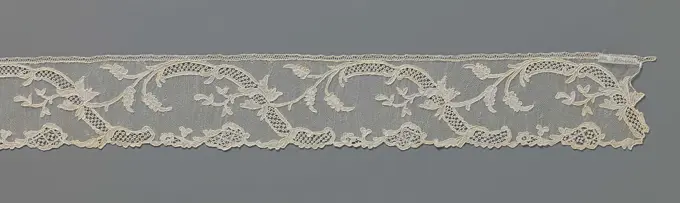
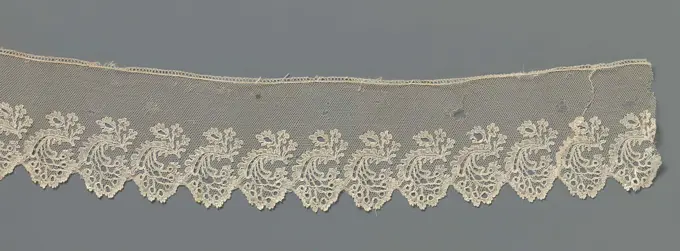
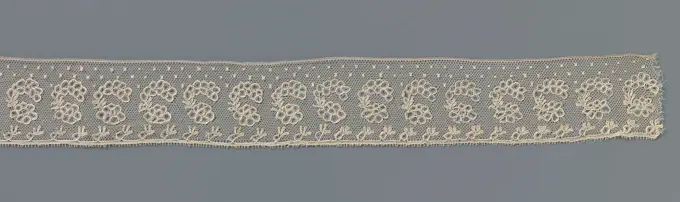
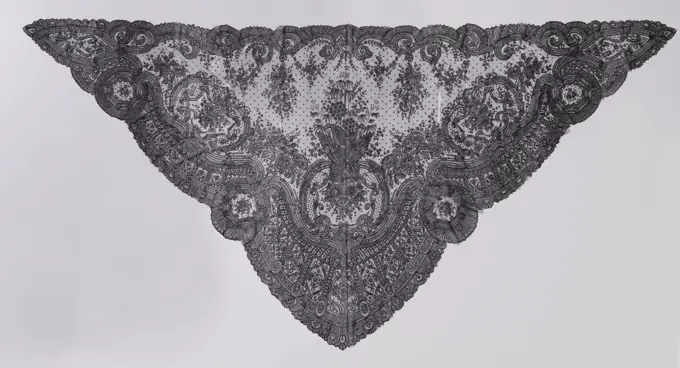
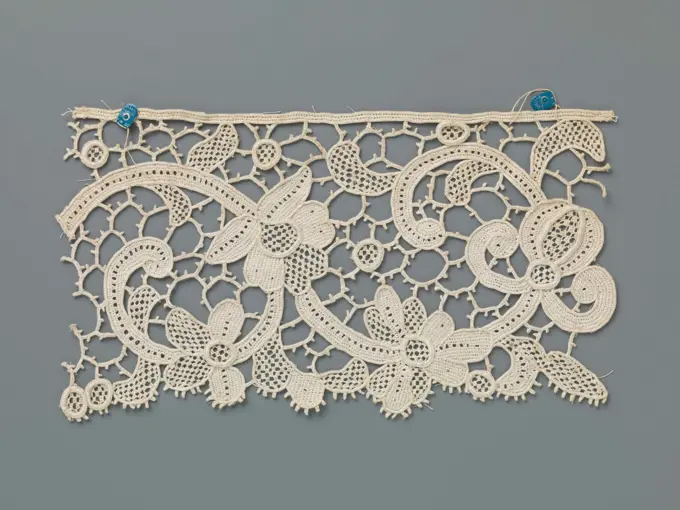
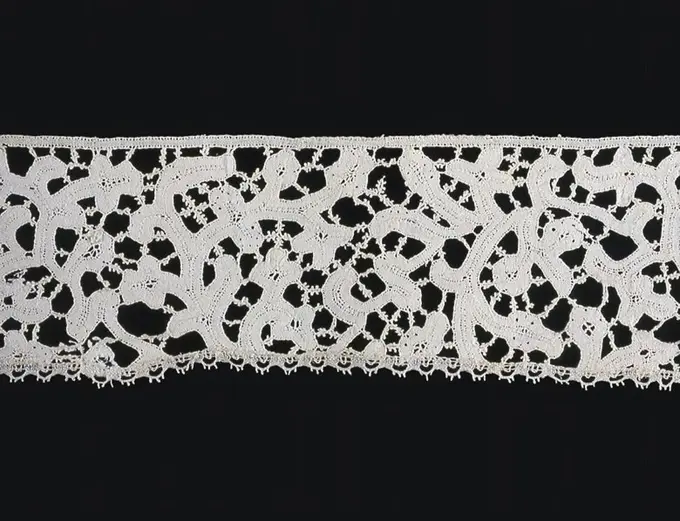
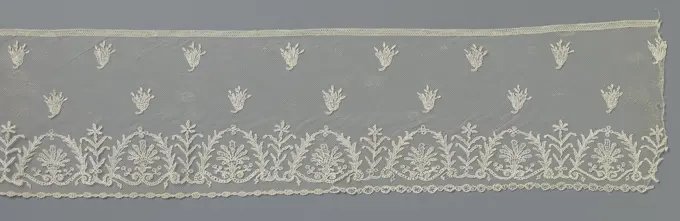
Piece 18th century Flemish, Mechlin. Piece 214507Strip application side with two rows of connected arches, anonymous, c. 1790 - c. 1799 Strip of natural -colored Brussels Application side: Needle side Applicated on Drochelgrond. The repeating pattern consists of two rows of open work, which are connected to each other with thin ranks with oval leaves. The top row of arches are lying down with the convex side, the bottom row of arches are with the convex side up. Between the arcs are sprinkled flowers and there are winding twigs attached to the arches. The sparing fullwork is enclosed by wide -founded wire bundles. The top is finished with a separate strap. The virtually straightforward underside is equipped with very fine picots. Brussels linen (material) Brussels Applied Strip of natural -colored Brussels Application side: Needle side Applicated on Drochelgrond. The repeating pattern consists of two rows of open work, which are connected to each other with thin ranks with oval leaves. The top row of arches are lying down with the coFragment of the lace;  2. PO. 18th century (1751-00-00-1800-00-00);Capslip from the needle side with flower litter pattern and rush -hour, anonymous, c. 1775 - c. 1799 Capslip of natural -colored needle side, argent tank. Strooi pattern of twigs that alternately have a small or larger flower, leaves and/or berries. Ground with meshes that are closed with buttonholes. The pattern along the lower edge consists of two pointed to each other, in between, between which a flower or berry branch rises. The oval pairs are connected by an arc of leaves and/or berries and hearts. Under these arcs along the lower edge a flat, lying oval. The oval -shaped figures in the pattern are filled with a fine hexagonal Maas soil (alençong round). Different decorative grounds in the flowers. Volwerk without recesses in flowers, leaves and berries. Schulpenrand on the underside by a succession of heart -shaped leaves, regularly interrupted by a rosette flower and the flat oval. The top is finished with a straight edge. Argentan linen (material) Argentan Lace Capslip of naturStrook naaldkant met hangende klokjesbloem.Strip natural-colored coniferous lace: Brussels gauze side. Stiffened large bells flowers alternate with pure semi-round winds with a single rosette.Strook naaldkant met s-vormige sierband en iris.Strip natural-colored coniferous lace: Alençon side. The repeating pattern consists of a flat S-shaped decorative tire in mirror image. The band continues at the top in a wavy branch of pointed and feathered leaves and with an iris that lies over the next ornamental band. The tires touch the top of the strip and run diagonally with a slight S-shaped curve to end along the underside of the strip. The motifs are made up of feston stitches where sparingly very fine recesses are used for decoration. The motifs are equipped with relief contours and are interconnected by a fine hexagonal Maas soil, an alençon ground. Ornamental grounds with radar picots are used in decorative tires, seed beads and flower hearts. The flat sloping edge is finished with picots. The top of the strip is finished with a splitting strap.Strip bobbin with hanging pomegranate, anonymous, c. 1825 - c. 1880 Strip of natural -colored bobbin: Mechelse side. The repeating pattern consists of a hanging pomegranate, in which a large incised leaf hangs straight down, three smaller leaves on top form the typing crown of chalice and flower residues for the granted cone. The successive pomegranates are connected by a circle. At the top of the strip is a row of circles, always one circle between two pomegranates. The motifs are connected by a fine Maas soil, a Mechelen soil. The motifs are made in linen battle with recesses and thicker and shiny contour threads. A decorative land has been used in the pomegranates and the incised leaves, with Moesjes made in the center in the center. A decorative soil with coarser diamond -shaped meshes is used in the space under the apples, up to the incised leaves. The top of the strip is straight finished. The scrap edge along the underside waves along the incised leaves along and is finished witFragment of the lace;  XVIII-XIX century (1701-00-00-1900-00-00);Strook kloskant met waaiervormige tros bloemen onder een gebogen blad.Strip natural colosside, Lille side. The repeating pattern exists under the center line of the strip from a curved sheet, including a fan-shaped bunch of flowers. Each bunch forms one shell with whimsical edges. The consecutive bunches are placed against each other. The motifs are connected by a Maas soil, a tulet. The motifs are made in linen stroke with recesses and with thicker and shiny contour wires. The top of the strip is finished with a separate splitting strap. The short sides are finished with a soil.Fragment, Medium: Technique: bobbin lace (late Valenciennes ground), Flowering band above border of ovals separated by leaf ornament., 19th century, lace, FragmentStrook kloskant met c-vormig motief gemaakt met cirkeltjes.Strip natural colosside: Lille side. Sprinkle pattern of square moes with below, on the center line, a repeating pattern of a one-sided targeted C-shaped motif of openwork circles or so-called 'pins'. Along the bottom of the strip are circles or berries, awarded three narrow leaves. All circles are made with thicker and shiny contour wires, along which an ornamental ground has been applied. Hardly any full work has been applied, only the three narrow leaves from the berries and some narrow leaves in the C-shaped motif are made in linen stroke. Upper and bottom of the strip are straight finished, the underside with picots.Fragment of the lace;  after. 19th century (1840-00-00-1860-00-00);Manchet van kloskant met hangende tulp.Cuff of natural colosside: Valenciennes side. On a coarse grille (square grating), strewn with 'sequins', is an ongoing pattern. Single-sided pending tulips are separate from a garland from a firm berry apart from a garland.Strook kloskant met rozetbloem en stip.Natural collate strip: Valenciennes side. Repetitive motif with rosette flower and dot on a square valenciennes ground. Among the flowers a regular slip edge. The top is finished with a straight edge.Strip bobbin with aster, anonymous, c. 1900 - c. 1924 Strip of natural-colored bobbin: Duchesse side. On an open braid ground is a unilaterally oriented running slender, which ends in a wide spiral drink and out in one and profil. Netherlands (possibly) linen (material) bobbin lace Strip of natural-colored bobbin: Duchesse side. On an open braid ground is a unilaterally oriented running slender, which ends in a wide spiral drink and out in one and profil. Netherlands (possibly) linen (material) bobbin laceFragment early 19th century French. Fragment 214664Strip bobbin with a wavy line and three -lobe leaves, anonymous, c. 1800 - c. 1899 Strip of natural-colored bobbin, Buckingham side. The repeating and continuous pattern consists of a regular wavy line on the center line. A three -lobe leaf rises from every golf valley and every wave top that protrudes slightly above or below the waves. The waves and leaves are made in linen stroke and are provided with thick and shiny contour threads on all sides. The strip also consists of a Maas soil, a tuler land. Top and bottom of the strip are straight. Buckingham cotton (textile) bobbin lace / Bucks point (lace) Strip of natural-colored bobbin, Buckingham side. The repeating and continuous pattern consists of a regular wavy line on the center line. A three -lobe leaf rises from every golf valley and every wave top that protrudes slightly above or below the waves. The waves and leaves are made in linen stroke and are provided with thick and shiny contour threads on all sides. The strip also consiStrook naaldkant met zigzagschulpen.On a sleek, lying branch growing to the right-directed side branches, to which forgetion ties and three types of chali flowers, the sharp zigzag tubes exhibit a double contour, consisting of a leaf and a pearl edge, while a 'seeping' is applied to each point. In the field there is a scattering pattern of the hanging daisies. Alençon side.Strip bobbin with connected rectangles, anonymous, c. 1875 - c. 1899  Strip of natural -colored bobbin: Mechelse side. Under a spreading pattern of hanging round flowers with one leaf is a decorative band along the underside of the strip, which is built with connected and slightly bragged rectangles. The edges of the rounded rectangles are thin branches with whimsical leaves. The lower edge forms a curl inwards, from which a branch with round leaves originates and fills the center of the rectangle. Between the successive rectangles, a narrow open edge is filled with ovals in linen battle, without contour threads. The motifs are connected by a fine Maas soil, a Mechelen soil. The sparing fullwork is made in linen battle with thicker and shiny contour threads. The top of the strip is finished with a separate strap. The underside is probably finished and provided with picots, but this is no longer clearly visible due to limited damage. Mechelen cotton (textile) bobbin lace / Mechlin (laceStrip of needle side with clover leaves and fan -shaped flowers, anonymous, c. 1775 - c. 1799 Strip of natural-colored needle side: men's-Aalençon. Spread motif with clover leaves on a fine hexagonal Maas soil. Along the top edge a row of mosjes. The pattern on the underside of the strip consists of a succession of leaf branches with plumes. Among them fan -shaped flowers that spring from the bottom edge, filled with a decorative land. The underside is finished with scalloped edge of potented circles with a Raderpicot. The top is finished with a straight edge. Alençon linen (material) Alençon Lace Strip of natural-colored needle side: men's-Aalençon. Spread motif with clover leaves on a fine hexagonal Maas soil. Along the top edge a row of mosjes. The pattern on the underside of the strip consists of a succession of leaf branches with plumes. Among them fan -shaped flowers that spring from the bottom edge, filled with a decorative land. The underside is finished with scalloped edge of Edging late 18th century French. Edging. French. late 18th century. Needle lace, point dAlençon. Textiles-LacesStrip bobbin with three curling branches with different flowers on a wavy slender, anonymous, c. 1800 - c. 1899  Strip of natural -colored bobbin. The repeating and continuous pattern consists of a wavy slender, with three curling side branches with a different flower each. In addition to the flowers, there are some rounded blunt leaves or side branches on the slender and some similar, but slightly longer and curling leaves. The motifs are made in separate linen battle with double contour threads and are connected by a diamond -shaped wasting ground: a tie. The top of the strip is straight finished. The scrap edge along the bottom comes from the pattern and is finished with picots. Southern Netherlands linen (material) bobbin laceStrook naaldkant met rijen moesjes en bloemtak met drie bloemen.Strip natural-colored coniferous lace: Alençon side. Pattern with seven rows of meadows on a fine hexagonal maas soil. At the bottom a repetitive motif of a horizontal flower branch with three flowers. One rosette-shaped flower is directed upwards, a plumy and a fan-shaped flower are directed downwards. The flowers are filled with various ornamental grounds. The bottom is finished with a picoted sloping edge that results in the two facing flowers. The top is trimmed with a border clamping side.Strip bobbin with mirrored S-Voluten between which a flower branch hangs, anonymous, c. 1740 - c. 1760 Strip of natural -colored Brussels bobbin. The repeating pattern consists of slanted and mirrored S-Voluten, between which a flower branch hangs down. The openwork volutes are varied wide and narrow and there are four variations in flower branches. The pattern along the underside consists of garlands of flowers with pointed leaves and some spring -shaped leaves. The motifs are connected by a fine Maas soil - a drachel soil - and under the wide volutes with a coarser hexagonal Maas soil. The fullwork is largely made in linen battle with recesses and openwork edges and partly in Omslag. Most motives are provided with burst relief contours. Different decorative lands have been applied, including picoted braids, a snowflake ground and a decorative soil with a diamond -shaped pattern. The top is finished with a separate strap. The irregularly scalloped underside stems from the pattern withStrook naaldkant versierd met een blad- en bloemrand en moesjes.Strip natural-colored coniferous lace: Men's alençon, possibly partially machine (see note in technology). Spreading dotty with moes on a fine hexagonal maas soil. The pattern on the bottom of the strip consists of sloping twigs with a lobbed leaf on either side. These leaf pairs are filled with ornamental ground. The underside consists of a row of screen flowers with seven separate flowers, filled with an ornamental ground. There is no separate pattern for the bottom edge, the sloping edge forms from the lower floral motif. The top is trimmed with a border clamping side.Side pledger cloth with a bowl of fruit supported by two cupidos, anonymous, c. 1900 - c. 1924 Natural -colored lace -in cloth: fillet side. Elongated model. In midfield a symmetrical pattern of a bowl with fruit supported by two putti, leaf voltuits and roslingers. Rim of volutes with fruits and leaves. The motifs are embroidered in the transition technique, on a knotted network with square meshes. The sides are right finished with the exception of the scrap edge on the bottom.  linen (material) embroidering Natural -colored lace -in cloth: fillet side. Elongated model. In midfield a symmetrical pattern of a bowl with fruit supported by two putti, leaf voltuits and roslingers. Rim of volutes with fruits and leaves. The motifs are embroidered in the transition technique, on a knotted network with square meshes. The sides are right finished with the exception of the scrap edge on the bottom.  linen (material) embroideringBorder Made 1725-1750 Hungary. Linen, bobbin part lace .Insertion Made 1590-1610 Italy. Linen, bobbin part lace; glass beads .Cuff of a strip of bobbin with a rosette flower on a C-shaped stem under which three lobes hang, anonymous, c. 1900 Strip of natural -colored bobbin: fine bridge flower arrangements. The strip was probably used as a cuff, the short sides are not finished but cut. The repeating pattern consists of a rosette flower with a C-shaped stem under which three lobes hang. The rosette flower is flanked by two horizontal stems with a smaller rosette flower and underneath by a stem bent twice with a three -piece leaf. The three-part leaves and the three lobes under the C-shaped stems form the scrap edge, which is finished with picots. The motifs are largely made in linen battle with openwork edges, recesses and contour threads. The smaller rosette flowers and some other parts are made in netslag. In the flowers and some leaves, cubes for decoration are made, made in form. In the three lobes a sparing ornamental soil in Vetergat-Tralie. The other long side is straight finished, with a straight narrCuff unknownStrip bobbin with a succession of different oval shapes, anonymous, c. 1800 - c. 1899 Strip of natural-colored bobbin, Buckingham side. The continuous pattern consists of a succession of different oval shapes and some heart -shaped leaves along the underside of the strip. The motifs are connected to each other at the top by a Maas soil, a tuler land. The motifs are made in linen battle with thick and shiny contour threads. A rose soil has been applied as a decorative land. The top of the strip is straight finished. The scrap edge along the bottom is finished with picots. Buckingham cotton (textile) bobbin lace / Bucks point (lace) Strip of natural-colored bobbin, Buckingham side. The continuous pattern consists of a succession of different oval shapes and some heart -shaped leaves along the underside of the strip. The motifs are connected to each other at the top by a Maas soil, a tuler land. The motifs are made in linen battle with thick and shiny contour threads. A rose soil has beenNeedlepoint (Reticella) Lace Band, 18th-19th century. Italy, 18th-19th century. Lace, needlepoint: linen; average: 9.3 x 35.6 cm (3 11/16 x 14 in.).Fragment, Medium: linen Technigue: needle lace, late 17th to early 19th C., Fragment with 'bizarre-style' patterning including a cornucopia overflowing with large exotic floral forms. Variations on the buttonhole stitch create discrete pattern areas. Various parts of the design have a raised cordonnet, and pattern areas are connected by a hexagonal mesh with picots., France, late 17th-early 18th century, lace, FragmentManchet van naaldkant met een rechte sierband met verticale strepen en drie eenvoudige bloemslingers van blaadjes en op het laagste punt steeds één rozetbloempje.Cuff from natural needle side: Brussels gauze side. Rectangular model with a scalloped leaf edge and a straight splitting strap with a square grid along the top. Symmetrical pattern with a straight ornamental band with vertical stripes above which three simple flower garlands side by side, with leaves and at the lowest point always one rosette flower. The decorative tire with stripes is overcurated on the corners and in the middle by a total of four rosette flowers, the bottom of which forms a part of the slip edge. These rosette flowers are crowned at the top by three rosette flowers and a few leaf branches that pierce between the successive flower garlands to the top edge. The motifs are made with feston stitches and equipped with relief contours of widely scented thread bundles. The flower garlands are connected to each othFlounce (Belgium); linenStrook kloskant met voluutranken en rozetjes.Natural collate strip: Duchesse-Side. On a braid soil there is an ongoing pattern of branched voluntaries with incised leaves and rosettes, which form the slot.Strook naaldkant met zigzagschulpen.On a sleek, lying branch growing to the right-directed side branches, to which forgetion ties and three types of chali flowers, the sharp zigzag tubes exhibit a double contour, consisting of a leaf and a pearl edge, while a 'seeping' is applied to each point. In the field there is a scattering pattern of the hanging daisies. Alençon side.Border; linenStrook kloskant met rijke symmetrische bloemencomposities.Strip natural colored Brussels climbing side. The pattern consists of various symmetrical compositions with large flowers, leaves and volutes. There is a great wealth of leaf and flower shapes. The motifs are connected by picoted braids. The motifs are made in linbroof with recesses and openwork edges and with power stuffs. Different motifs are equipped with clost relief contours. Various ornamental grounds have been applied, including fine snowflakes, rose soils and fine mesh soils decorated with squares made in shape stroke. The top is finished with a separate clust strap. The irregular scalloped underside comes from the pattern and is finished with picots..Border (Italy); linen; Bequest of Marian Hague; 1971-50-289Cravat end late 17th century French. Cravat end 218101Strook applicatiekant met recht neerhangende bloemen.Strip natural colored application side, climbing side applicated on machine tulle. Stiff symmetrical design on a fond with monkeys. Between Schulpen with Campanes, the closing pieces are formed by hanging twigs, which are decorated in size increasing leaves and a rosette flower. Separate above the slot is a straight sprig, including three flowers.Bobbin Lace (Needlepoint Design) Edging with Points, early 17th century. Italy, Venice or Genoa, early 17th century. Lace, bobbin; average: 3.9 x 18.1 cm (1 9/16 x 7 1/8 in.).Black bobbin scarf with a central medallion of C-Voluten and a border with round medallions with hexagonal heart, anonymous, c. 1860 Black bobbin scarf. Triangular model. The central motive is a standing oval medallion of C-volutes containing three roses. The medallion is awarded by a large rising bouquet with ferns, lilacs, forget-me-not and exotic flowers. On the left and right next to the medallion is on the edge of the scarf a slightly smaller hexagonal list with three leaves and berries. A circular outside list has been realized around the hexagonal list. This round motif with hexagonal heart repeats once at the edge, towards the points at the top of the scarf. Left and right next to the medallion in midfield, two lying oval medallions of C-Voluten are placed with three roses each. Other motifs are wide decorative frames, curlinged feathered leaves, bouquets and leaf -garlands. The motifs are made in netslag and are provided with contour threads. The motifs are connected by a tralStrip of lila -white bobbin with hanging corners, anonymous, 1850 - 1900  Strip colored - lila -white - bobbin: straw side. The repeating pattern consists of stylized hanging corners in linen battle with an open -worked center. The ears of corn are lilac in color and hang straight down, they are placed against each other and form a sculpy edge along the underside of the strip. At the top of the strip, the ears start from a reversed V-shaped motif made in mains. They are connected to each other at the top of the strip by a grid, a tough grid, in which one pointed in Linenlag is always incorporated into a linen battle between the Korenaren. The top of the strip is straight finished. The scrap edge is finished with picots. Russia (possibly) linen (material) Bobbi lace / lace clothBobbin Lace Edging, 18th century. Belgium, Mechelen, 18th century (Louis XV period). Lace, bobbin: linen; average: 9.6 x 48.9 cm (3 3/4 x 19 1/4 in.).Strook gemengde kant met s-voluten.Strip natural-colored mixed side: Brussels climbing side in combination with a needle lace ground, a fine mesh side ground. This type of side is also known as the name: Point d'Angleterre. The running pattern is a rough drawing and consists of matching C and S volutes. Large roses, and face and and profil, shapes with a leaf and a c-volute deep slip. Fine leaf branches are turned to the inside.Strip application side with wine range, anonymous, c. 1800 - c. 1815 Strip of natural -colored Brussels Application side: Needle side Applicated on Drochelgrond. Under a spray pattern of wine leaves, a continuous slender runs along the lower edge, from which branches sprout to two sides with wine leaves and grape bunches. The very flat scrap edge is formed by straight upright wine leaves, interspersed by wreaths with pearl edges and filled with decorative stitches. Motives are constructed with feston stitches and are accentuated by relief contours of wide -ranging wire bundles. The top is straight finished with a messing strap. Brussels linen (material) Brussels Applied Strip of natural -colored Brussels Application side: Needle side Applicated on Drochelgrond. Under a spray pattern of wine leaves, a continuous slender runs along the lower edge, from which branches sprout to two sides with wine leaves and grape bunches. The very flat scrap edge is formed by straight upright wine leavesStrip needle side with two curling tendrils and excellent flowers. Strip natural needle side: Venetian needle side "Gros Point". Four flowers carving two curling and interconnecting tendrils. The motifs are made with feston stitches with one row of recesses in the rank and ornamental soils with cubes in the (flour) leaves. The motifs are accentuated by relief contours, especially the flower hearts have an extra thick cordon. Grove scented bars ground with picots. The top of the strip is straight finished and equipped with two blue colored metal stamps on which 'Dentelle' and 'Véritable', which makes it translate as 'real side'. The flowers and leaves form the slip edge along the bottom, which is finished with picots.Accessory set ca. 1875 Italian. Accessory set 168484Strook naaldkant met strooipatroon van verschillende bloemtakjes.Strip natural needle side: Argentan side. The strip is equipped with a scattering pattern of different flower branches. The flat sculpture along the bottom edge consists of a concatenation of elongated oval filled with a row of riderpicots, over each oval is always a half oval-shaped bow. The motifs are on a hexagonal mesh of hexagonal mesh, which are close to feston stitches. The folder is made with feston stitches without recesses and the motifs are equipped with relief contour lines, here and there provided with picots. As ornamental soil is used under the arcs in the edge pattern and a very fine maas soil in a few flower hearts. Except in the edge pattern, radar picots also occur in most flower hearts. The sides are finished with a straight edge, one side is slightly sloping away. The top is finished with a border clamping side.Fragment (Border). Northern Italy. Date: 1701-1725. Dimensions: 8.9 x 33.8 cm (3 1/2 x 13 3/8 in.). Linen, bobbin straight lace. Origin: Italy. Museum: The Chicago Art Institute, Chicago, USA.Interesting climbing side with two zigzag jobs. Strip natural colosside: straw side. The repeating pattern consists of two parallel running zigzag courts with a center line of co-switched fine diamonds made in shape stroke. A nozzle ground is applied to the top and bottom of the Zigzag tracks and a twisted crossbeat soil has been used between the zigzag courts. Spood releases are in the grounds. Upper and bottom of the strip are straight finished.Needlepoint Lace (Argentan Type) Edging, 20th century. France, Argentan, 20th century. Lace, needlepoint: linen; average: 11.5 x 38.1 cm (4 1/2 x 15 in.).Strook kloskant met voluten.Strip natural colosside, possibly Flemish guipure. Symmetrical pattern with volutes to which three, four and five-leaf flowers spring. Around the motifs different braided bars with picots. Within the motifs a honeycomb ground. The top is finished with a straight edge. The bottom is finished with triangles built from arcs.Strook kloskant met rozetbloem bekroond door blaadjes.Natural collate strip: Valenciennes side. The repeating pattern consists of bells in which a more or less oval form is created by curved twigs and a rosette flower crowned by leaves. Above it is a spreading dottle of two mesjes diagonally above the leaves. A concatenation of elongated ovals runs along the sloping edge. The motifs are made in linen stroke with openwork edges and are connected by a square valenciennes ground. The top is finished with a straight edge.Strip of needle side with thrown flower branches, anonymous, c. 1750 - c. 1774  Strip Ecuklig Needle side with a repetitive pattern of stripped short flower branches on a fine hexagonal mesh ground. The top is trimmed with a border bobbin. A wavy line from which leaves spring forms the boundary between the Maas soil and the scalloped bottom edge. The underside of the strip consists of a wavy line from which leaves and a scalloped bottom edge. The waves are filled with different mesh grounds, decorated with, among other things, rader picots. Alençon side. France linen (material) Alençon LaceBed curtain border early 19th century Russian This object is from the collection of Natalia de Shabelsky (1841-1905), a Russian noblewoman compelled to preserve what she perceived as the vanishing folk art traditions of her native country. Traveling extensively throughout Great Russia, she collected many fine examples of textile art of the wealthy peasant class. From the 1870s until moving to France in 1902, Shabelsky amassed a large collection of intricately embroidered hand-woven household textiles and opulent festival garments with rich decoration and elaborate motifs. The Brooklyn Museum holdings include many fine examples including the majority of the garments. Portions of Shabelsky's collection are also housed at the Museum of Fine Arts, Boston, the Cleveland Art Museum, and the Russian Museum of Ethnography in St. Petersburg.Russian bed curtains and towels were not only used for decorative purposes, but also provided an important role in ceremony. Bed curtains often adorned sleiEdging 16th century Italian. Edging 220995Fragment of bobbin lace unknownFragment of bobbin lace unknownFragment, Medium: linen Technique: bobbin lace, continuous braid-like, Band fragment with two lobed oval tabs has scrolling lines set in a grid-like framework that supports the lower half of the tabs., Italy, early 17th century, lace, FragmentStrook kloskant met aaneengeschakelde ronde pioenrozen.Strip natural colosside: Flanders side. The repetitive and symmetrical pattern consists of a concatenation of more or less round and stylized peonies. There are always two chali flowers around each switch point of the consecutive flowers, each mirrored to a short thick stem and relative to the length axis. The motifs are made in linselag with openwork edges and some fine recesses. The motifs are placed close together and are connected to each other by short braids, which seem to form the start of a grille. Upper and bottom of the strip are straight finished and a strip of linen has been attached along both sides with a narrow strip of work with merged wires. The side is probably manufactured in the Southern Netherlands, the demolition probably in the northern Netherlands.Fragment 18th century Italian, Milan. Fragment 215047Das or Cravat made of mixed side with horseshoe -shaped reserve, anonymous, c. 1870 - c. 1890 Das or Cravat of natural -colored mixed side - bobbin in combination with needle side - Brussels Duchesse. A long rectangle is divided into six stretched panels with fine profile frames and a regularly scalloped border, which is interrupted by large roses. The panel fillings consist of three types of flower branches, standing against an open braiding ground. At each end there is a horseshoe-shaped medallion with fine mesh network (needle side), on which, among other things, a golden rain branch (needle side). Symmetrical termination of two roses, a palmet and a three -leaf, on which a loose rosette. Belgium (possibly) linen (material) mixed lace / mixed Brussels Das or Cravat of natural -colored mixed side - bobbin in combination with needle side - Brussels Duchesse. A long rectangle is divided into six stretched panels with fine profile frames and a regularly scalloped border, which is interrCuff of needle side with large palm flower, anonymous, c. 1800 - c. 1899 Cuff of natural -colored needle side: Venetian relief side. On a bar of land, some richly branched feathered leaves and a very large palm flower are grouped together. Bayeux (possibly) linen (material) Venetian raised work Cuff of natural -colored needle side: Venetian relief side. On a bar of land, some richly branched feathered leaves and a very large palm flower are grouped together. Bayeux (possibly) linen (material) Venetian raised workSleeve of the needle side with stripes and moesjes, anonymous, c. 1800 Short and straight coupe, narrow gathering to the lower edge. Stripes, formed by a swinging twig with fine buttons alternate with intermediate strips, strewn with mushes. A double edge of standing ovals runs on the lower side, the lower also forms the shells. Alençon side. France linen (material) Alençon Lace Short and straight coupe, narrow gathering to the lower edge. Stripes, formed by a swinging twig with fine buttons alternate with intermediate strips, strewn with mushes. A double edge of standing ovals runs on the lower side, the lower also forms the shells. Alençon side. France linen (material) Alençon LaceStrip of needle side with snail house, anonymous, c. 1875 - c. 1909 Strip of natural -colored needle side: Venetian relief side. Despite repairs, an axis of symmetry can be recognized, on the sides of which two large extending arabesk leaves have been twisted together. With some branches, they spring on two snail -oriented small volutes, which have been cut and encounter the straight inside. Moreover, two tenders spring from the same junction, which run into two overhoeks placed irises. Venice linen (material) Venetian raised work Strip of natural -colored needle side: Venetian relief side. Despite repairs, an axis of symmetry can be recognized, on the sides of which two large extending arabesk leaves have been twisted together. With some branches, they spring on two snail -oriented small volutes, which have been cut and encounter the straight inside. Moreover, two tenders spring from the same junction, which run into two overhoeks placed irises. Venice linen (material) Venetian raisedJapon strip of application side with pointed Boogrand and clocks, Anonymous, c. 1800 - c. 1809 Japon strip Natural -colored Brussels Application side: Needle side Applicated on Machine Tulle. This type of lace is also known under the name: Point d'Angleterre. The outer, ornamental edge consists of palms, under pointed arches, interspersed with a standing twig. The outside is right by an eye list. A spray pattern of hanging bell flowers fills the stock above the edges. Brussels linen (material). Brussels Applied Japon strip Natural -colored Brussels Application side: Needle side Applicated on Machine Tulle. This type of lace is also known under the name: Point d'Angleterre. The outer, ornamental edge consists of palms, under pointed arches, interspersed with a standing twig. The outside is right by an eye list. A spray pattern of hanging bell flowers fills the stock above the edges. Brussels linen (material). Brussels AppliedFragment 18th century Spanish. Fragment 215125Kloskant board with berry tricks and occhiolini lussies, anonymous, c. 1900 - c. 1949 Board of natural-colored bobbin: Duchesse side. Rectangular model. Symmetrical pattern with two groups of berry trunks and leaves on stems on either side of a flower, which spring from a central point. The motifs are connected by rings or loops made from fine ribbon side (Occhiolini technology). Netherlands (possibly) linen (material) bobbin lace Board of natural-colored bobbin: Duchesse side. Rectangular model. Symmetrical pattern with two groups of berry trunks and leaves on stems on either side of a flower, which spring from a central point. The motifs are connected by rings or loops made from fine ribbon side (Occhiolini technology). Netherlands (possibly) linen (material) bobbin lacePiece 17th century Italian, Genoa. Piece 218020Strip bobbin with stylized hanging corners, anonymous, c. 1850 - c. 1899  Strip of natural -colored bobbin: sling. The repeating pattern consists of stylized hanging corners. The corners are hanging straight down, they are placed against each other and form a edge of scales along the underside of the strip. At the top of the strip, the ears start from a reversed V-shaped motif made in netslag, with a window in linen battle on the top. These motifs are connected to each other at the top of the strip by a grid, a tie, in which one block is always processed in shape between the Korenaren. The top of the strip is straight finished. Russia (possibly) linen (material) Bobbi lace / lace clothStrip bobbin with symmetrical composition with butterfly-shaped motif in the center and surrounded by occhiolini loops, anonymous, c. 1880 - c. 1899 Strip of natural -colored bobbin, Eastern European side. The repeating pattern consists of a more or less symmetrical composition in which the contours of the motifs are made with winding ribbons, which vary at least in width. The composition consists of a butterfly -shaped motif in the center with a kind of canopy above which the same curling of motifs hang down on both sides. The motifs are connected by a loop pattern such as Occhiolini. The ribbons are partly made in netslag and largely in linen battle with openwork edges. The top of the strip is straight finished. An ongoing and winding ribbon provides a sculpy edge along the underside of the strip. Eastern Europe linen (material) bobbin lace / tape lace (bobbin lace) / East European lace Strip of natural -colored bobbin, Eastern European side. The repeating pattern consists of a more Collar 1700-1939 American. Collar 119123Needlepoint (Cutwork) Lace Band, mid 16th century. Italy, Venice, mid 16th century. Lace, needlepoint: linen; average: 6.1 x 24.2 cm (2 3/8 x 9 1/2 in.).Fragment early 19th century French. Fragment 215320Fragment of lace. unknown, authorBobbin Lace Edging, 18th century. Italy, Abruzzi, Pescocostanzo, 18th century. Lace, bobbin; average: 11.5 x 31.8 cm (4 1/2 x 12 1/2 in.).Strip bobbin with tree between zigzag line, anonymous, c. 1850 - c. 1899 Strip of natural -colored bobbin. The repeating pattern consists of a zigzag line that forms trapezoidal fields. The fields fill the entire width of the strip and stands in each field or hang one tree, with a thin trunk and a more or less oval -shaped crown. Along the underside of the strip runs a succession of clovers four and checks. The motifs are connected by a mesh soil, a lace-hole strike-grid. The sparse and loose work is made in linen and mains with large recesses in particular in the tree and with thicker contour threads. The top and bottom of the strip are straight finished, with the bottom with picots. Germany (possibly) linen (material) bobbin lace Strip of natural -colored bobbin. The repeating pattern consists of a zigzag line that forms trapezoidal fields. The fields fill the entire width of the strip and stands in each field or hang one tree, with a thin trunk and a more or less oval -shaped crown.Border. Belgium, Flanders. Date: 1675-1700. Dimensions: 6.3 × 226 cm (2 1/2 × 89 1/8 in.)Width repeat: 11.1 cm (4 3/4 in.). Linen, bobbin part lace. Origin: Flanders. Museum: The Chicago Art Institute, Chicago, USA.Fragment of white lace unknownBorder (Belgium); linenAlb Flounce. Italy, 18th century. Costumes; ecclesiastical. Linen bobbin laceStrip of needle side with iris and lily, anonymous, c. 1690 - c. 1709 Strip of white needle side with a pattern of running volute bines with large iris and lily-shaped flowers. Open soil with irregularly potented bars. The top is trimmed with a border bobbin. The bottom is finished with a picot edge with triangles. Venise flat. Venice linen (material) flat Venetian (needle point) Strip of white needle side with a pattern of running volute bines with large iris and lily-shaped flowers. Open soil with irregularly potented bars. The top is trimmed with a border bobbin. The bottom is finished with a picot edge with triangles. Venise flat. Venice linen (material) flat Venetian (needle point)Strook applicatiekant met à-jour bloem- en bladtak.Strip natural-colored application side: needle side applicated on machine tulle. This type of side is also known as the name: Point d'Angleterre. A three-row leaves sprinkled in the inside portion is closed by uneven tubes formed by connected thin branches with à jour (open) floral and three leaves.Fragment; linenScarf mid-18th century French. Scarf 222840Scarf late 19th century Belgian. Scarf 102689Insertion 16th century Italian, Venice. Insertion 221066Fragment, Medium: linen Technique: needlework on hand knotted net, Fragment of a border with a curving vine and flower pattern., Italy or Spain, 17th century, lace, FragmentSleeve Ruffle (Engageante) and Lappets (Joined) Made 1740-1749 France. Linen, needle lace .Border, Medium: linen Technique: punto in aria (needle lace), Border fragment with triangular tabs., Italy or Spain, 16th-17th century, lace, BorderPair of joined lappets 1700-1750 Flemish. Pair of joined lappets 222813Insertion 18th century possibly French. Insertion 214618Strip of needle side with symmetrical pattern of S-shaped decorative tires and irises, anonymous, c. 1760 - c. 1770 Strip of natural-colored needle side: Alençon side. Symmetrical pattern with an arc formed in the middle by two mirrored and against each other on false S-shaped decorative tires. The S-shaped decorative tires are parallel to either side of the arc. Each decorative band continues at the top in a wavy branch of pointed and feathered leaves and with an iris that lies over the next decorative band. The tires touch the top of the strip and run slanted down with a faint S-shaped curve to finish along the underside of the strip, next to a rocaille motif that lies between leaves and rosette flowers. The motifs are made up of feston stitches where very fine cut -outs are used sparingly for decoration. The motives are provided with relief contours and are connected by a fine hexagonal Maas soil, an alençon ground. Ornamental grounds with radar picots are used in the decorative tirFlounce (Incomplete) Made 1850-1875 England. Silk, warp frame machine lace .Strook kloskant met driehoekige mazen.Stretch natural-colored genuese clamping side. The pattern consists of eight rows connected triangles made with flat braids. At each corner point the triangles are connected to each other by a cut-away circle. Along the top of the strip an edge with square meshes runs. The bottom is cut and not finished.Fragment 17th century Italian, Venice. Fragment 214834