Delicate Lace Textiles

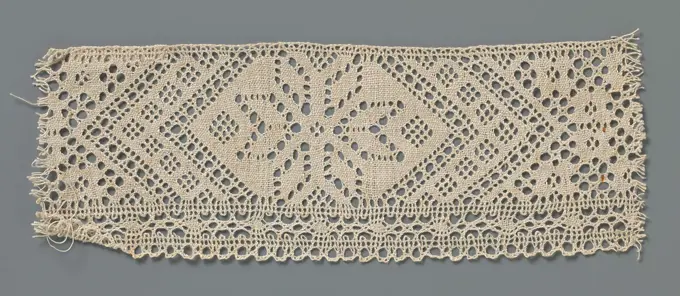
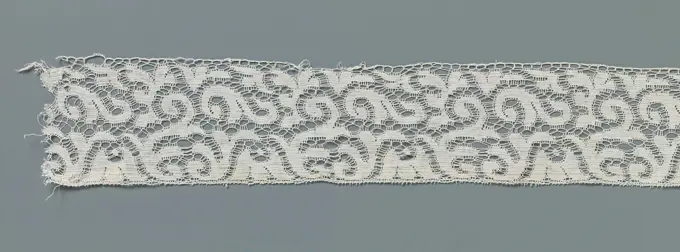
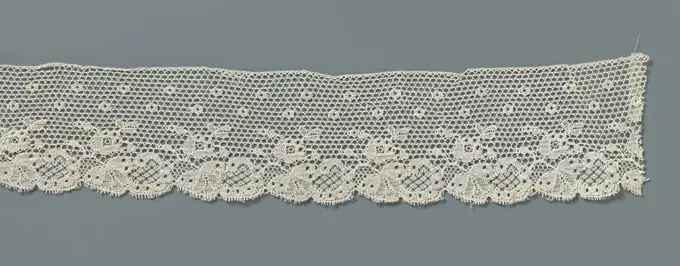
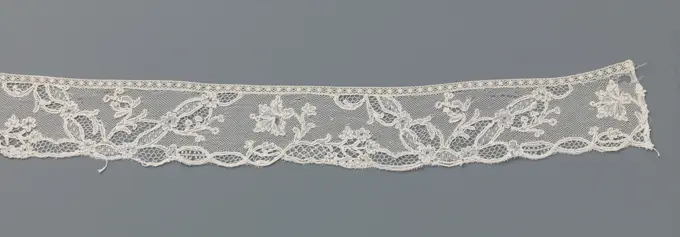
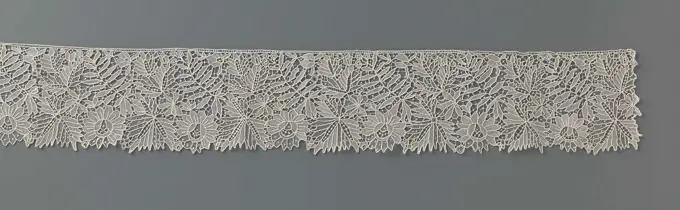
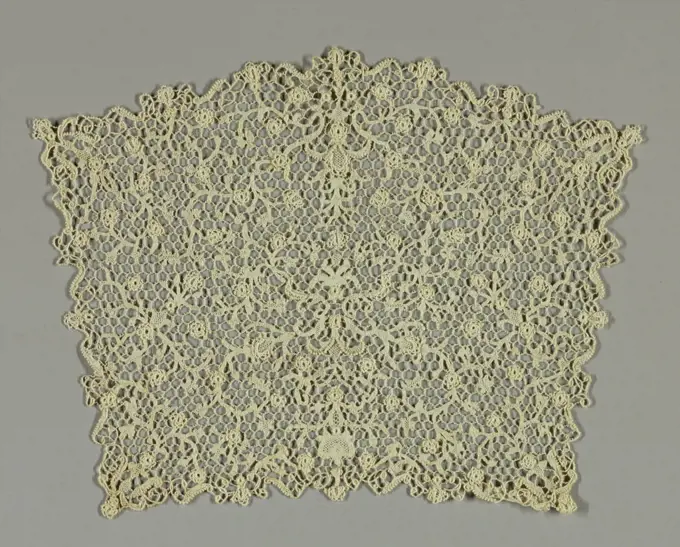
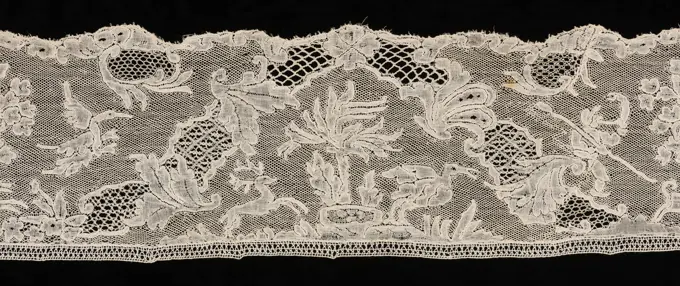
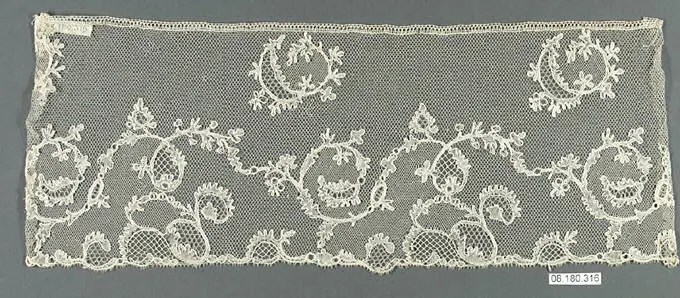
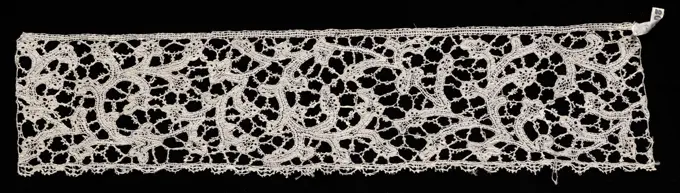
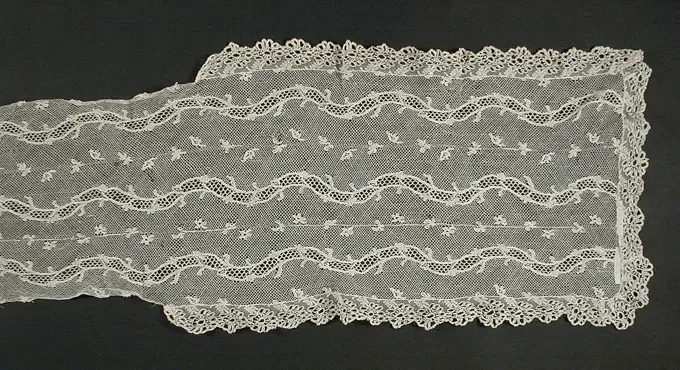
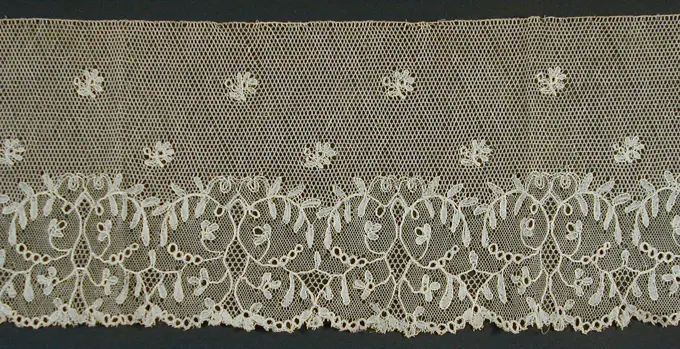
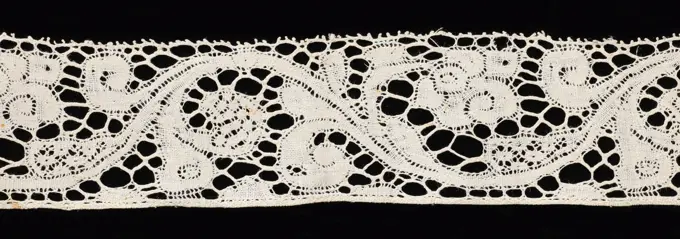
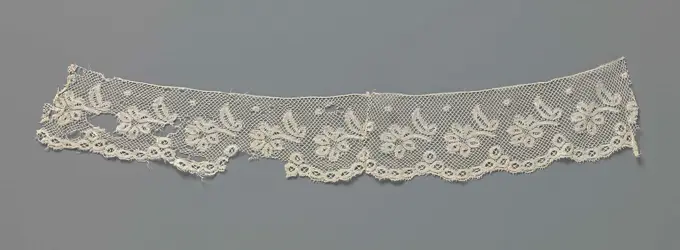
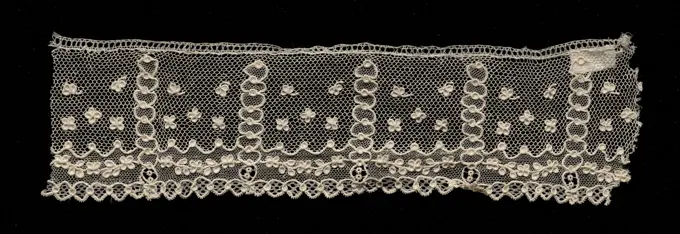
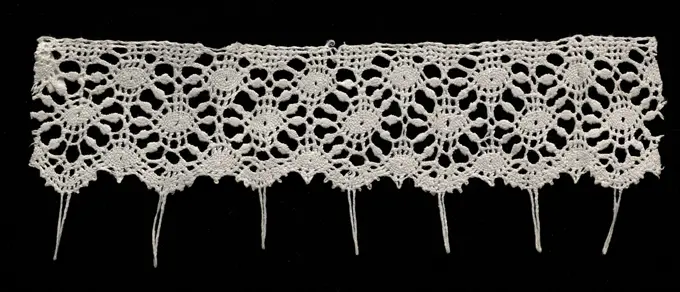
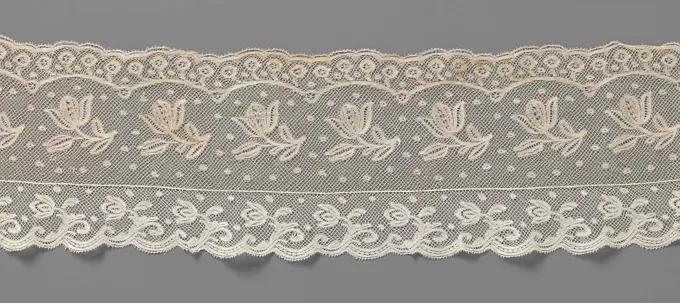
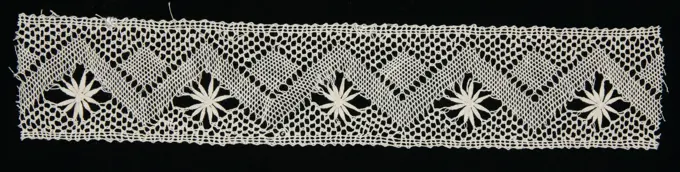
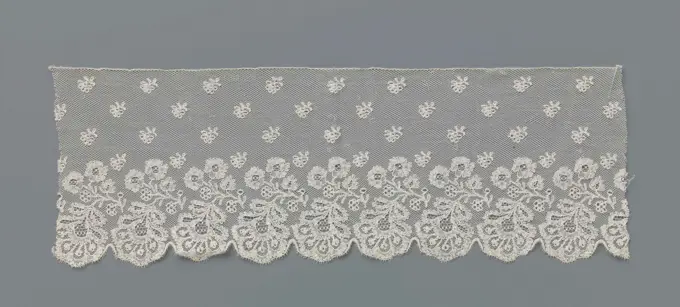
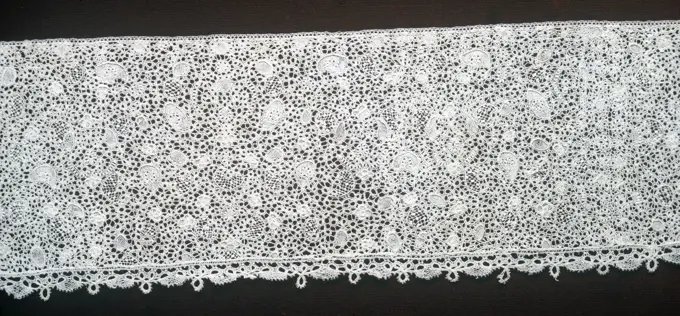
A selection of intricate lace strips showcasing various patterns, including floral and geometric designs, ideal for fashion or home decor applications.

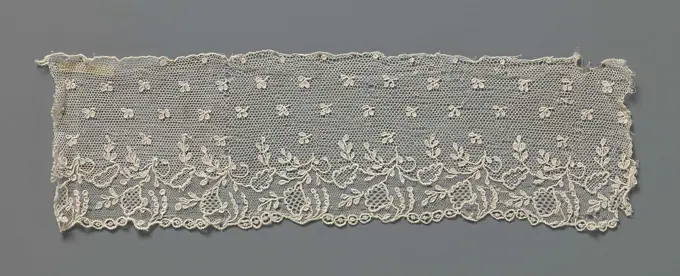
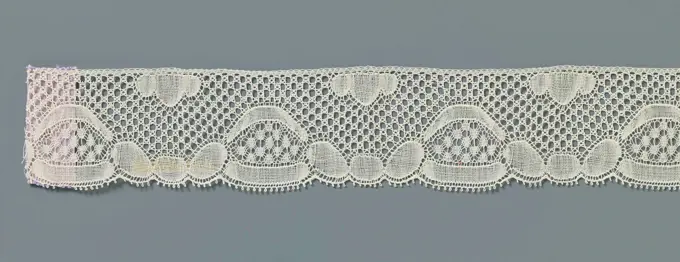
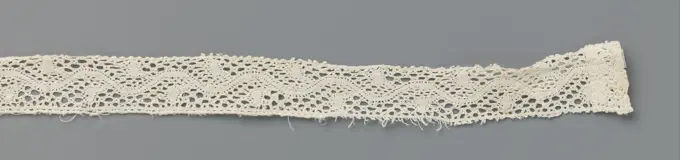
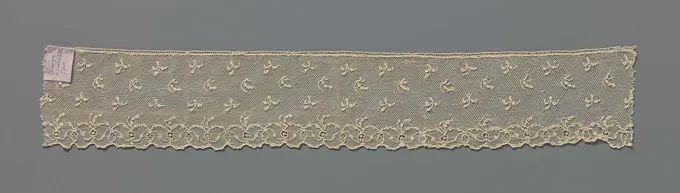
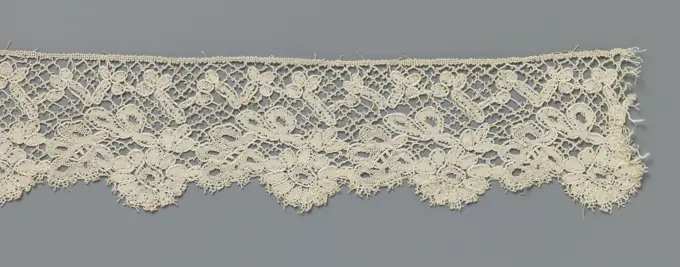
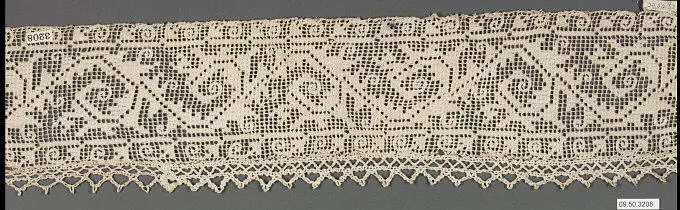
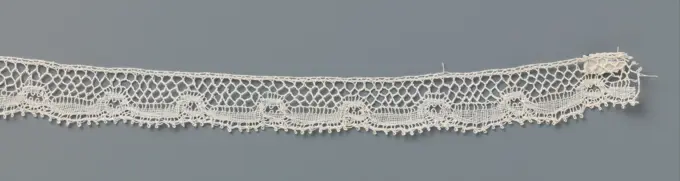
Strip bobbin with heart spreading pattern and pine jar motif under thin zigzag line, anonymous, c. 1800 Strip of natural -colored bobbin: Mechelse side. A thin zigzag line runs under a spreading pattern of four rows of hearts, with a pine cone-shaped motif under each zigzag valley that hangs down to the bottom of the strip. Between the pine jar motifs is an open decorative border along the underside of the strip, decorated with cubes made in form. The motifs are connected by a fine Maas soil, a Mechelen soil. The sparing fullwork is made in linen battle with thicker and shiny contour threads. The top and bottom of the strip are straight finished, with the bottom with picots. Mechelen linen (material) bobbin lace / Mechlin (lace) Strip of natural -colored bobbin: Mechelse side. A thin zigzag line runs under a spreading pattern of four rows of hearts, with a pine cone-shaped motif under each zigzag valley that hangs down to the bottom of the strip. Between the pine jar motifs is an open
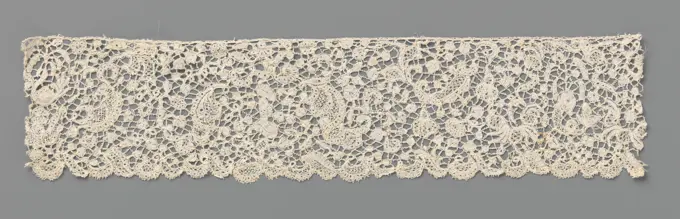
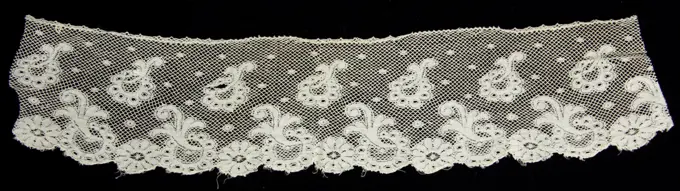
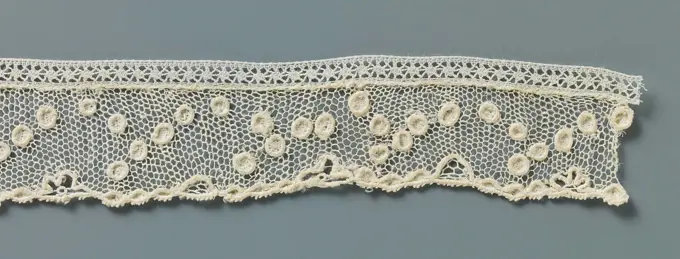
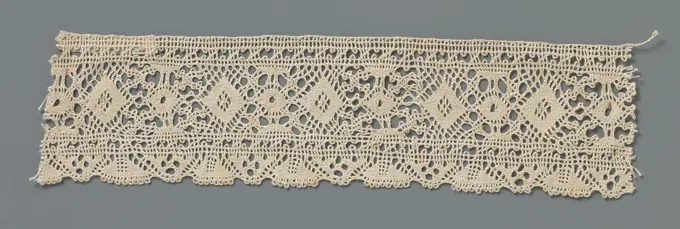
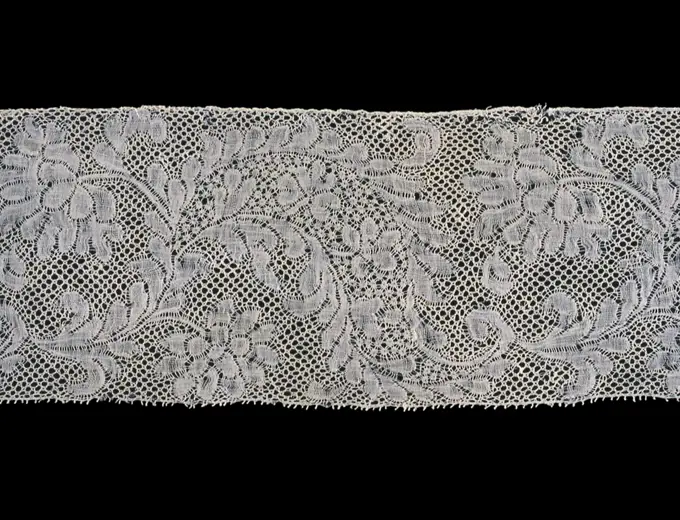
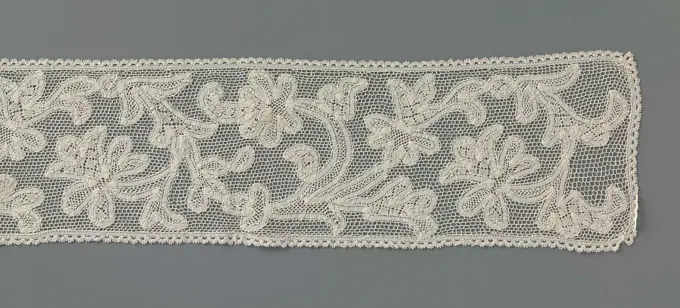
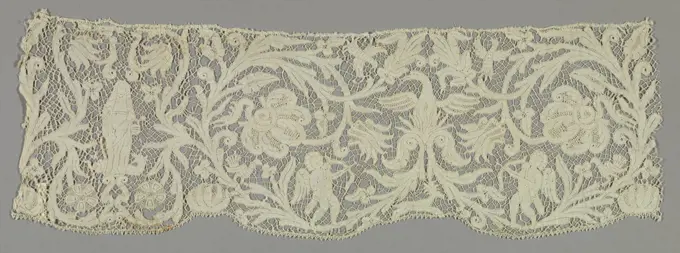
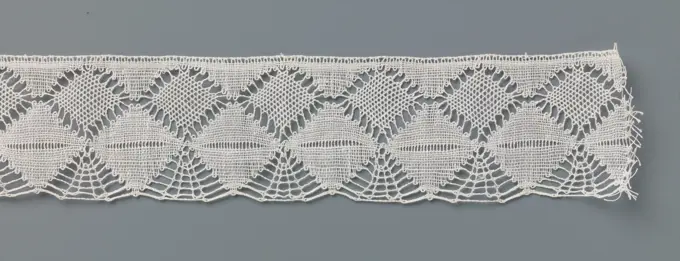
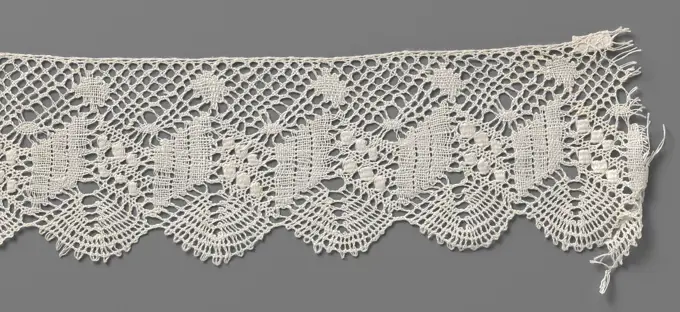
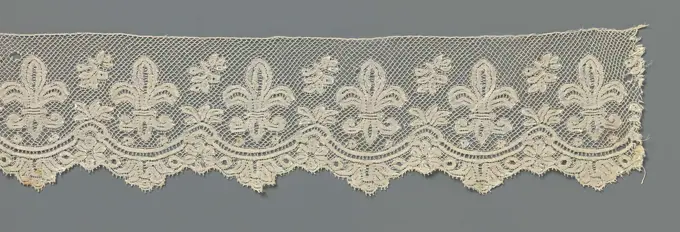
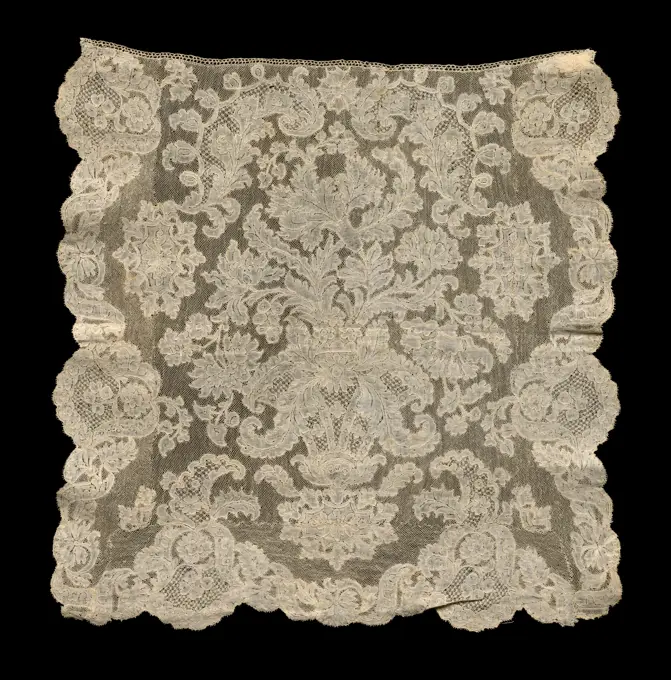
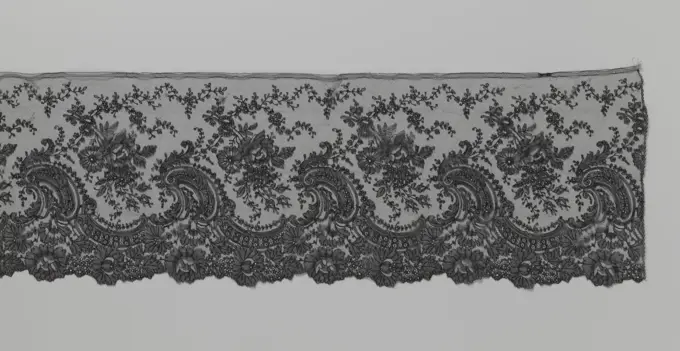
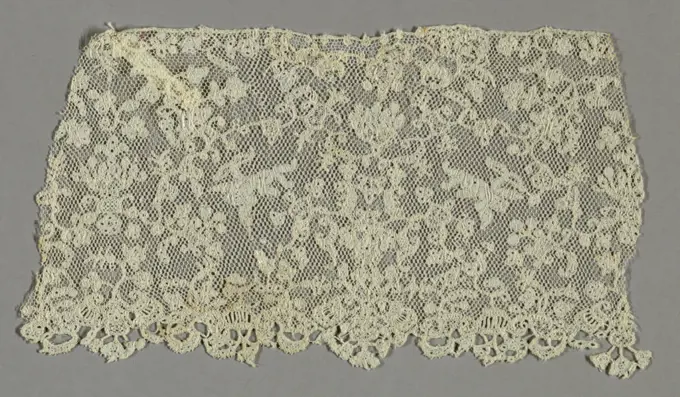
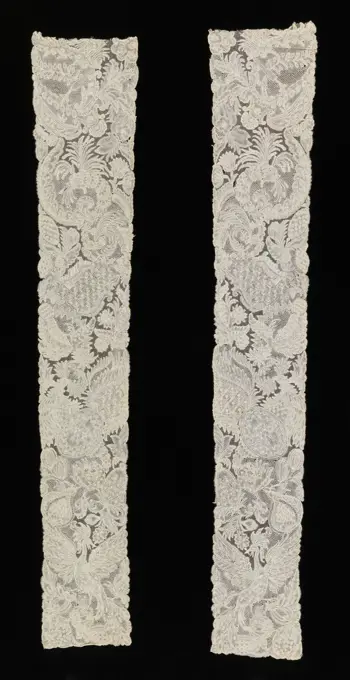
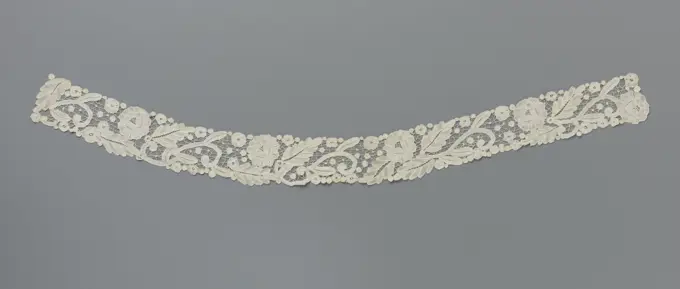
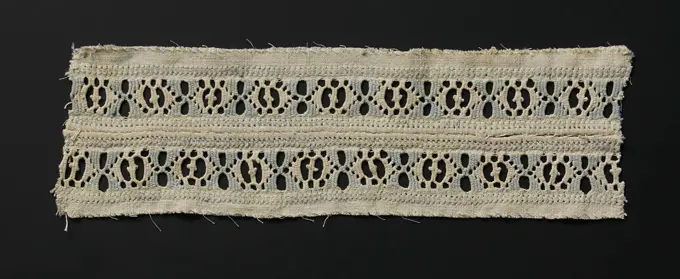
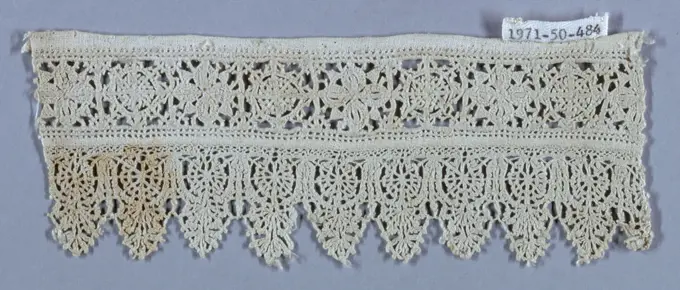
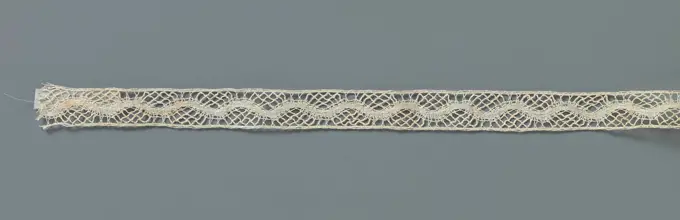
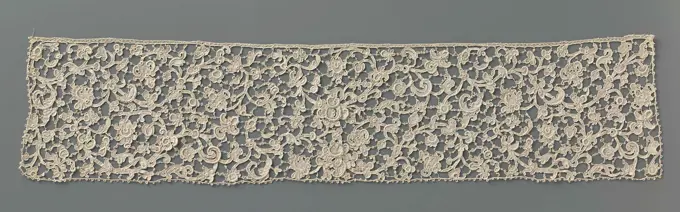
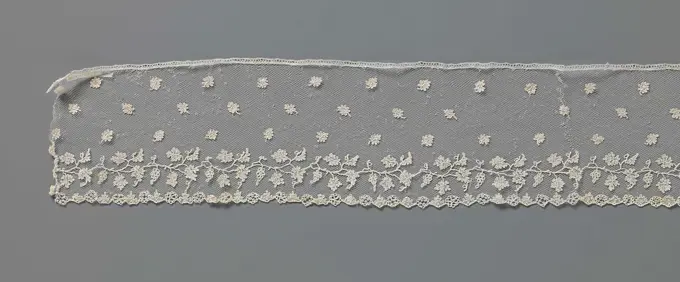
Strook naaldkant met klaverblaadjes en waaiervormige bloemen.Natural coniferous strip: Men-Alençon. Spreading dot with clover leaves on a fine hexagonal maas soil. Along the top edge a row of mashes. The pattern on the underside of the strip consists of a concatenation of leaf branches with plumes. Including fan-shaped flowers that spring from the lower edge filled with an ornamental ground. The underside is finished with scalloped edge of picoted circles containing a rider poic. The top is finished with a straight edge.Strip bobbin with female breast image and dolphin, anonymous, c. 1680 - c. 1720 Strip of natural -colored Brussels bobbin. The pattern consists of many small motifs, in which the women's breast sculpture, slightly to the right of the middle, and the water -spit dolphin, on the left side of the strip, stand out the most. Along the bottom are often C-shaped motifs connected to a border with shells. The motifs are connected by a braid of soil, with potented braids. The motifs are made in linen battle with recesses, partly with openwork edges and partly with cracked relief contours. Different decorative lands have been applied in the motifs, including a decorative land with squares made in shape. The top is straight. The shells along the bottom are finished with picots. Southern Netherlands linen (material) bobbin lace / Brussels bobbin lace Strip of natural -colored Brussels bobbin. The pattern consists of many small motifs, in which the women's breast sculpture, slightly to the right of Strip bobbin with heart spreading pattern and pine jar motif under thin zigzag line, anonymous, c. 1800 Strip of natural -colored bobbin: Mechelse side. A thin zigzag line runs under a spreading pattern of four rows of hearts, with a pine cone-shaped motif under each zigzag valley that hangs down to the bottom of the strip. Between the pine jar motifs is an open decorative border along the underside of the strip, decorated with cubes made in form. The motifs are connected by a fine Maas soil, a Mechelen soil. The sparing fullwork is made in linen battle with thicker and shiny contour threads. The top and bottom of the strip are straight finished, with the bottom with picots. Mechelen linen (material) bobbin lace / Mechlin (lace) Strip of natural -colored bobbin: Mechelse side. A thin zigzag line runs under a spreading pattern of four rows of hearts, with a pine cone-shaped motif under each zigzag valley that hangs down to the bottom of the strip. Between the pine jar motifs is an open Fragment late 17th-early 18th century Flemish. Fragment. Flemish. late 17th-early 18th century. Bobbin lace. Textiles-LacesEdging 18th century Spanish. Edging 218777Edging 18th century Flemish. Edging. Flemish. 18th century. Bobbin lace. Textiles-LacesCuff from crocheted side with brushed leaves, anonymous, c. 1890 - c. 1909 Cuff made of natural Irish crocheted side. Pattern of flower stalks with brush -like leaves, put together with picoted bars. Raised circular flower hearts and a layered edge along the stem where the leaves spring. Finished on all sides with a border shells in the form of double arches. Ireland cotton (textile) Cuff made of natural Irish crocheted side. Pattern of flower stalks with brush -like leaves, put together with picoted bars. Raised circular flower hearts and a layered edge along the stem where the leaves spring. Finished on all sides with a border shells in the form of double arches. Ireland cotton (textile)Lace laceStrook naaldkant met moesjesmotieven.The strip of sters from Moesjes. It has a border of small medallions. AlençonFragment 18th century French, Cluny. Fragment. French, Cluny. 18th century. Bobbin lace. Textiles-LacesFragment, Medium: linen Technique: Brussels-style bobbin lace, Band with a loose floral vine, commonly called 'Rosaline'., Belgium, 19th century, lace, FragmentStrip mixed side for a superplie with volute bines, anonymous, c. 1640 - c. 1660 Strip of natural -colored mixed side: mezzo punto. The strip is intended for a Superplie and has a symmetrical pattern of volutes, with rosette flowers, fan -shaped flowers and acanthus leaves on a hexagonal mesh ground (needle side). The contours of the pattern are formed by a messing ribbon with holes. Within the contours different needle side decorative land. Strip with three seams. The top is finished with a straight edge. The underside and sides are trimmed with a straight border bobbin with picoted arches. Venice linen (material) mixed lace / tape lace (mixed lace) Strip of natural -colored mixed side: mezzo punto. The strip is intended for a Superplie and has a symmetrical pattern of volutes, with rosette flowers, fan -shaped flowers and acanthus leaves on a hexagonal mesh ground (needle side). The contours of the pattern are formed by a messing ribbon with holes. Within the contours different needlPiece 18th century Dutch. Piece 212958Fragment of bobbin lace unknownStrook kloskant met ruiten en spitsovalen en een rand met driehoekjes.Natural collate strip, Swedish side. The strip is attached with pins on a light blue carton, with seven other strips. At the top of the cardboard is "Laces from Skåne. Sweden." Written and under the strip is "From Toesterup". Tosterup is a castle in Skåne, which lies in the south of Sweden. The repeating pattern consists of a window interspersed by a spindle. Along the underside triangles form a decorative tire. The motifs are made in linen stroke with recesses. The top of the strip is straight finished. The straight bottom is finished with alternating a series of eight and a series of three picots with a small interruption in between.Strook kloskant met stervormige bloem uitgespaard in een afgeplat zeshoekig veld.Natural collate strip, Swedish side. The strip is attached with pins on a light blue carton, with seven other strips. At the top of the cardboard is "Laces from Skåne. Sweden." And under the strip is written on the cardboard "From Toesterup". Tosterup is a castle in Skåne, which lies in the south of Sweden. The symmetrical pattern consists of a slightly flattened hexagonal field in poetry linen stroke, in which a star-shaped flower is made with recesses. Left and right of the hexagon are decorative tires with recesses in linen work, with a border with Parisian mesh on both sides. The top of the strip is straight finished. The round meshes on the bottom of the strip form a sloping edge with small scallops.Interest of climbing side with a regular wavy line. Natural Collaboration Interest: Punk. The repeating pattern consists of a regularly wavy line in linen stroke. The waves form U-shaped fields. Under the golf top are two lowered diamonds in a slot stroke, the wave top touches the straight ornamental band along the top of the strip. An ornamental ground is applied in the golf valleys that forms square cubes. Upper and bottom of the strip are straight finished, both with a collapsed decorative tire with a square grid.Border, Medium: linen Technique: needle lace with ground of loop and twist with twist return, Fragment with a scrolling vine and flower design. Some scrolling lines have a stiff quality., Italy, 1700-1750, lace, BorderStrook machinale kant met hangende kelkbloem tussen losse s-voluten.Stretch natural-colored side: machining fir heater. The repeating pattern exists along the lower half of the strip from a hanging chalis flour, flanked and crowned by loose S volutes. There are openworked edges around the closed motifs. The motifs are connected by a machining soil that suggests a braid soil. Upper and bottom of the strip are straight finished, the underside with picots.Strook machinale kant met c-vormig blad en waaiervormige bloem.Machine strip. Under two rows of mashes, it consists of a repeating pattern along the underside of the strip from a curved stalk with a downright bending impeller-shaped flower, where a C-shaped leaf is opposite. A rigid chali flower rises to the curved steal. The motifs seem to be made in a cut-off and linen stroke with a few round recesses and are equipped with contour wires. They are connected by a machining paris soil. As ornamental soil, a machining soil soil has been applied in the space surrounded by the C-shaped leaf. The top of the strip is straight finished. The sloping edge along the underside stems from the pattern with the flowers and leaves and is finished with picots.Strip bobbin with anjer between V-shaped fields, anonymous, c. 1780 Strip of natural -colored bobbin: Mechelse side. The pattern consists of a double narrow pendulum, which forms and forms a concatenation of pointed-shaped cartouches along the underside at a regular distance with sloping lines to the top of the strip of V-shaped fields. A large carnation of a curved stem originates from the pendulum along the bottom edge and is always in the room between two consecutive V-shaped fields. The motifs are connected by a fine Maas soil. The motifs are made in linen battle with very thick contour threads. Different decorative lands have been used in the cartouches and in residual spaces. The faintly scalloped underside stems from the pattern with the double pendulum and is finished with picots. The top is finished with a separate stretch of strap. Southern Netherlands linen (material) bobbin lace / Mechlin (lace) Strip of natural -colored bobbin: Mechelse side. The pattern consists of a doubFragment, Medium: linen Technique: knitted lace, Fragment with a pattern of hearts and spots within diamonds., France, 19th century, knotted, knitted and crocheted textiles, FragmentBobbin Lace Insertion, mid 16th century. Italy, Venice, mid 16th century. Lace, bobbin; average: 7.7 x 40.7 cm (3 1/16 x 16 in.).Border Made 1725-1750 France. Linen, bobbin straight lace of a type known as Valenciennes with a five hole mesh ground .Strook gemengde kant met brede spiraalrank.Strip natural-colored mixed side - Mezzo Punto - with a splitting or woven ribbon and a needle lace ground. On a Maas soil (needle side) is a pattern that consists of wide curly stems with exotic flowers. The contours of the flowers and stems consist of closted or woven ribbons. Different ornamental grounds (needle side) have been applied within the contours. A split bow rim serves as a finish along the outside.Fragment of border, Medium: linen Technique: bobbin lace of discontinuous tape, Part of a wide border, cupids aiming at birds, Saint Margaret standing on a dragon amid plants and flowers., Belgium, 17th century, lace, Fragment of borderMutsenslip van kloskant met rivières.Hatslip of natural colosside: Mechelen side. Rivière with two leaf and flower stems as a limit, while a grape droos on the intermediate fields. The shelters are flat and exhibit with grid work filled medallions. In the event of mistake, this Mechelen slip has been put to a Brussels hats slip (BK-BR-J-175-A), while the matching second Brussels hats slip (BK-BR-J-177) remained separately.Strip of needle side with heart -shaped mosies and connected ovals along the underside, anonymous, c. 1900 - c. 1915 Strip of natural-colored needle side: Alençon side. Pattern with seven rows of heart -shaped mosies and connected oval cartouches along the bottom. The ovals are each crowned by an openly worked oval and with rader picots in it. Such the same open worked oval is also located in the center of every oval cartouche and always originates with a stalk from the right. The semicircular underside of the cartouches are formed by a row of connected and worked ovals. The motives are made with feston stitches and equipped with relief contours. The motifs are connected by a fine Maas soil. The top of the strip is straight finished. The scrap edge with semicircular sculptes stems from the pattern and is finished with picots. BURANO cotton (textile) Alençon Lace Strip of natural-colored needle side: Alençon side. Pattern with seven rows of heart -shaped mosies and connected oval cartouFragment French 19th centuryAntependium strip Van Kloskant with wide Rivière, Anonymous, c. 1750 - c. 1760 Antepensium strip of natural -colored Brussels bobbin. Four different loose branches of ecclesiastical flowers (lily, pomegranate, grapesros) fill triangular and shield-shaped fields, which are bordered by a rivière of wide C-Voluten. The triangles are alternately high and narrow and short and thick and show a fine grid, while the shield -shaped fields are filled with a rough grid. Along the scalloped edge, a mountain and valley line runs again from C-Voluten, which are cut over by a fine closed flowerguirle, which repeats itself at the top of the strip. The C-Voluten are filled with gridwork and wound with a fine flower garland or cut by a feathered leaf. Brussels linen (material) bobbin lace / Brussels bobbin lace Antepensium strip of natural -colored Brussels bobbin. Four different loose branches of ecclesiastical flowers (lily, pomegranate, grapesros) fill triangular and shield-shaped fields, which are bStrip of needle side with iris on s-shaped stem with button, anonymous, c. 1890 - c. 1910 Strip of natural needle side: Burano side. The repeating and continuous pattern consists of connected S-shaped stems with a slanted iris, which is cut by a stem with much smaller rosette flowers. In the S-shaped stem there appears to be a knot in every wave top, from which a double stem then emerges. In the field next to every iris and between the wave tops an acanthus leaf. The motifs are made up of feston stitches, with or without recesses. They are accentuated by relief contours, which consist of the loosely wire bundles characteristic of Burano side. The motifs are connected by a fine Maas soil with wrapped meshes made in transfers, a Burano soil. Various decorative stitches have been used and coarse bars of bars with picots as a decorative soil. The top of the strip is straight finished with a tie. The irregular scrap edge stems from the pattern and is finished with picots. BURANO linen (mateBand (Belgium); linen; 1933-1-36-b,cStrook machinale kant met wolkjes langs de bovenzijde en trapeziumvormige cartouches langs de onderzijde.Stretch natural-colored side: machining fir heater. The repeating pattern consists of a cloud along the top of the strip and a trapezoidal cartridge diagonally underneath the bottom of the strip. The successive cartouches are connected by three connected thick ovals. The motifs are made in linen stroke and provided with openwork edges with contour wires, where the contour wires are within the open edges. They are connected by a machine five holes. A coarsely machined snowflakes soil has been applied in the cartouches. The top of the strip is straight finished. The slight sloping edge along the underside comes from the pattern and is finished with picots.Strook kloskant met grote tulp.Strip natural colosside, binche side. On a ground ground, a five-grade ground, there is an ongoing pattern of a large tulip rank, a petal of which has an indoor drawing of a flower branch. The rank is interrupted by large, lobed and halved transverse with rosettes and pearl edge. The motifs are made in linen stroke with openwork edges and in a cut-off. A snowflaking soil has been applied if ornamental ground. De Schulpen are uneven and stretched. The finish of the slot is largely damaged.Strip mixed side with a basket from which a three -lobe palm leaf originates, anonymous, c. 1900 - c. 1924  Strip of natural -colored mixed side: Milanese ribbon side. The repeating and symmetrical pattern consists of a basket with a four -lobe rosette flower in the center from which a three -lobe palmet leaf rises that stands out above the basket. The basket is alternately along the bottom or hangs down from the top of the strip. The rounded corners of the successive baskets touch each other. The motifs have been hit in linen battle with openwork edges, recesses and contour threads. The motifs are connected by a needle -sided soil, a mesh soil. A founded bar of land has been used in the baskets. The top and bottom of the strip are straight and one side has two blue-colored metal stamps stating 'Dentelle' and 'Véritable', which can be translated as 'real side'. Belgium cotton (textile) mixed lace / tape lace (mixed lace) / Milanese tape lace (mixed lace) / needle lace groundKloskant intermediate base with wavy center line and loose ovals, anonymous, c. 1600 - c. 1624 Piles of natural -colored bobbin side. The pattern consists of a regularly wavy narrow center line with a loose oval under each wave top and in any golf valley. The motifs made in linen battle with openwork edges. They are connected to each other by a traly land, a five -part ground. Top and bottom of the strip are straight finished, with the bottom with picots. The intermediate facility comes from or intended for bedding. Friesland (possibly) linen (material) bobbin lace Piles of natural -colored bobbin side. The pattern consists of a regularly wavy narrow center line with a loose oval under each wave top and in any golf valley. The motifs made in linen battle with openwork edges. They are connected to each other by a traly land, a five -part ground. Top and bottom of the strip are straight finished, with the bottom with picots. The intermediate facility comes from or intended for bedding. FLace, 1800s, maker unknown.Strip bobbin with Spinneweb, M. Schutten-Putters, c. 1920 - c. 1929 Strip of natural-colored bobbin: Cluny side. Pattern with rows of matching windows, which are connected by a soil of long braids. Weakly scalloped edge of long spinneweb-spijlen. Hoorn (North Holland) Hellevoetsluis linen (material) bobbin lace / Cluny lace Strip of natural-colored bobbin: Cluny side. Pattern with rows of matching windows, which are connected by a soil of long braids. Weakly scalloped edge of long spinneweb-spijlen. Hoorn (North Holland) Hellevoetsluis linen (material) bobbin lace / Cluny laceStrook kloskant met zigzag en waaierschulpen.Strip natural colosside, sling. Symmetrical and carried out in coarse wire. Short and wide zigzags, half matt and semi-checked, are filled to butien with impeller shelters and spin the inside with a harmful feet, which are spinning and cubes.Strook kloskant met Franse lelie.Natural collate strip, Valenciennes side. A wavy richly decorated garland forms schulls along the bottom of the strip. There is a French lily on the middle web. The motifs are connected by a mesh soil, a diamond-shaped valenciennes ground. The motifs are made in linen battle with recesses and open editors. Staring couples decorate, among other things, the openworking ribbon and the recesses in the French lily. The top of the strip is straight finished. The shelters along the underside are finished with picots.Strook naaldkant met ingesneden blad.Running pattern of incised leaves above a rose and a three-leaf, which together form the sharply toothed outside line. Cross-shaped bars with button (soil of long X-shaped bars with a spider). The REMPLIS consists of buttonhole stitches and a Fond Gazé. German side: 'Carlsbead points'.Cape early 18th century French. Cape 222825Strip of needle side with tied bouquet and snowballs, anonymous, c. 1870 - c. 1890 Strip of natural -colored needle side: Brussels mesh side. Strooi pattern of mosjes on a mesh ground. A repeating pattern that consists of a lying and strict bouquet consists of this. The bouquet consists of large branches with large roses and snowballs that bend up and down. In line with the horizontal bouquet, a very large and richly processed C-Volut has been placed, from which the top also spring flower branches. The pattern is rarely rarely, with smaller motifs and consists of wavy flower ringers. Fullwork with recesses, relief contours with partly highly thickened cordons and a variety of decorative land and decorative stitches. The scalloped edge stems from the pattern. The top is trimmed with a border bobbin. The sides are finished with a zoompje, in which the shape of the motifs is followed. Brussels linen (material) Brussels Gaze Point Strip of natural -colored needle side: Brussels mesh side. Collar and cuffs, Medium: linen Technique: needle lace, Set of Bertha collar and two cuffs., Italy, 17th century, lace, Collar and cuffsBorder (France); linen; Bequest of Marian Hague; 1971-50-431Strip bobbin with tilted ovals under spray pattern of twigs, anonymous, c. 1785 - c. 1799  Strip of natural -colored bobbin: Mechelse side. The repeating and continuous pattern consists along the bottom edge of a succession of rush -hour and drop shapes, which are always tilted in relation to each other. Under the oval, a short pendulum of circles runs through, from which a leaf branch originates above the drop shape. Above this pattern is a stray pattern of two rows of loose twigs. The motifs are connected by a fine Maas soil, the Mechelen soil. The sparing fullwork is made in linen battle, which almost disappears here and there because of the thicker and shiny contour threads. Two different but very similar decorative lands, with coarse meshes, are used in the ovals and drop shapes. The straight underside is finished with picots. The top is finished with a separate strap. Mechelen linen (material) bobbin lace / Mechlin (lace)Fragment (Italy); metallic on silkStrip of needle side with a running slender with two whimsical flowers, anonymous, c. 1800 - c. 1899 Strip of natural needle side. Pattern of a running slender with two whimsical flowers and a few leaves. The pattern parts are connected to each other in a single place. The contours of the pattern are formed by a round -curled lace. Within the contours and also within the individual flowers different decorative land through recesses in the fullwork. Fullwork with twisted feston stitches. The top is trimmed with a border bobbin. The underside and left are finished with a straight picotrand. Venice cotton (textile) Strip of natural needle side. Pattern of a running slender with two whimsical flowers and a few leaves. The pattern parts are connected to each other in a single place. The contours of the pattern are formed by a round -curled lace. Within the contours and also within the individual flowers different decorative land through recesses in the fullwork. Fullwork with twisted festonEngageante van Kloskant with wavy decorative band and rocailles, anonymous, c. 1760 - c. 1770 Engageante of natural -colored Brussels bobbin. The pattern has a wavy decorative band that is symmetrical filled with alternately a wavy flower branch and a berries branch on a coarser straly round than the surrounding fields. This wavy line forms compartments, in which a flower branch each time. A leaf ornament runs along the flat scrap edge, which broadens itself under each wave to two rocailles. The motifs are made in linen battle with fine recesses and chatter relief contours. The motifs are connected by a fine grid, a drachel soil. The top is straight finished with a separate strap. The very flat scrap edge is finished with picots. Brussels linen (material) bobbin lace / Brussels bobbin lace Engageante of natural -colored Brussels bobbin. The pattern has a wavy decorative band that is symmetrical filled with alternately a wavy flower branch and a berries branch on a coarser straly round Fragment late 18th century French, Chantilly. Fragment 214669Strip bobbin with S-Ranken, Anonymous, c. 1875 - c. 1899 Strip of natural-colored bobbin: Duchesse side. There is an ongoing pattern on a braid ground. S-ranks with three daisies and a border of Campanes form the scallops and end in a volute with single rose. Netherlands (possibly) linen (material) bobbin lace Strip of natural-colored bobbin: Duchesse side. There is an ongoing pattern on a braid ground. S-ranks with three daisies and a border of Campanes form the scallops and end in a volute with single rose. Netherlands (possibly) linen (material) bobbin laceEdging French, Craponne 19th centuryStrook naaldkant met bessentakjes strooimotief.Strip natural-colored coniferous lace: Alençon side. Spreading dotty of berry branches on a fine hexagonal maas soil. The top is trimmed with a border clamping side. The pattern at the bottom consists of circles, which are filled with even finer mesh soil. The circles overlap partly. The oval forms that are created as a result have been filled with a ornamental grounds and one rider poic. Candied bow rim at the bottom.Edging 18th century Italian, Abruzzi (Pescocostanzo). Edging 221143Bobbin Lace (Bride Ground) Insertion, 16th-17th century. Italy, Milan, 16th-17th century. Lace, bobbin; average: 8.3 x 36.6 cm (3 1/4 x 14 7/16 in.).Length of Lace. Belgium, mid-19th century. Textiles; textile lengths. Cotton Mechlin bobbin laceScarf. probably France, 19th century. Costumes; Accessories. Linen bobbin laceBorder 17th century Italian Punto in arialiterally, "stitches in the air"is one of the earliest styles of needle lace, which is itself developed from cutwork of primarily geometric design. When lacemakers transitioned to using a foundation of threads laid out according to a pattern drawn on parchment, they were able to incorporate more fluid lines and curves into their designs.. Border 222714Strip bobbin with a flowerpot with one rosette flower on a long handle, anonymous, c. 1740 - c. 1760 Strip of natural -colored Brussels bobbin. The repeating pattern consists of a wide variety of flowers and leaves with some flying insects and a flower pot with one rosette flower on a long handle. The motifs are connected by a fine Maas soil, a drachel soil. The motifs are made in linen battle with openwork edges, some recesses and mains fillings. Most of the motifs have bursts of relief contours. Various snowflake grounds were used as ornamental grounds and potented braids. The top is finished with a separate strap. The scalloped underside is finished with picots. Brussels linen (material) bobbin lace / Brussels bobbin lace Strip of natural -colored Brussels bobbin. The repeating pattern consists of a wide variety of flowers and leaves with some flying insects and a flower pot with one rosette flower on a long handle. The motifs are connected by a fine Maas soil, a drachel soil. The mLace Flounce. Possibly France, mid-19th century. Costumes. Cotton on silk point de Paris needle laceKloskant's intermediate facility with wavy flower stems, anonymous, c. 1750 - c. 1799 Strip of natural -colored bobbin, Old Flemish side. The repeating pattern consists of flower stems that are connected and form waves. Towards the golf valley there is a small four -lobe flower and towards the wave top a larger lobed flower. The motifs are connected by a grid, a five -part ground. The motifs are made in netslag and linen battle with openwork edges. Top and bottom of the strip are straight. Flanders linen (material) bobbin lace / old Flemish lace Strip of natural -colored bobbin, Old Flemish side. The repeating pattern consists of flower stems that are connected and form waves. Towards the golf valley there is a small four -lobe flower and towards the wave top a larger lobed flower. The motifs are connected by a grid, a five -part ground. The motifs are made in netslag and linen battle with openwork edges. Top and bottom of the strip are straight. Flanders linen (material) bobbin lace /Piece 18th century German, Saxony. Piece 214722Strip bobbin with clovers three, anonymous, c. 1800 - c. 1899 Strip of natural-colored bobbin, Buckingham side. The repeating pattern consists of row -connected clovers three, hanging straight down on a stalk. A very narrow lane is made above the clovers with a Maas soil, a tuler floor. Below that, the strip consists of a decorative land, a rose ground in which the clovers are made with thick and shiny contour threads. A very narrow strap is wavy, a semi -circular shell under each clover, which is finished with picots. The top of the strip is straight finished. Buckingham cotton (textile) bobbin lace / Bucks point (lace) Strip of natural-colored bobbin, Buckingham side. The repeating pattern consists of row -connected clovers three, hanging straight down on a stalk. A very narrow lane is made above the clovers with a Maas soil, a tuler floor. Below that, the strip consists of a decorative land, a rose ground in which the clovers are made with thick and shiny contour threads. A very narBand (Italy); linenStrook kloskant met margrietjes.A coarse mesh stock (square mesh) with marbriefs above beads of pearls. Valenciennes side.Fragment of a Band with Floral Motif, 17th-18th century. Spain, 17th-18th century. Needle lace (knotted ground and darned in two directions); bleached linen (est.); overall: 7.6 x 20.7 cm (3 x 8 1/8 in.). Though this fragment of lace is completed in the filet/lacis technique, the floral motif imitates a form of needle lace particular to Spain known as Ruedas or Sol Lace, due to its radial patterns.Bobbin Lace Edging, 18th-19th century. Italy, Abruzzi, 18th-19th century. Lace, bobbin; average: 12.8 x 56.6 cm (5 1/16 x 22 5/16 in.).Needlepoint Lace Edging, 18th century. France, Alençon, 18th century. Lace, needlepoint: linen; average: 5.8 x 21.4 cm (2 5/16 x 8 7/16 in.).Bobbin Lace (Needlepoint Design) Edging with Loops, 17th century. Italy, Genoa, 17th century. Lace, bobbin; average: 9 x 26.1 cm (3 9/16 x 10 1/4 in.).Strip of bobbin with a scales of a rosette flower and a five -lobe leaf, anonymous, c. 1800 - c. 1899  Strip of natural-colored bobbin, cluny side. The repeating pattern consists of a rosette flower and a sloping five -lobe leaf along the underside of strip. The successive flowers and leaves are placed against each other and together form a scrap edge. Above the center line a kind of zigzag line has been created with elongated motifs placed diagonally together, each crowned by three oval motifs. The motifs are made in separate linen battle with double contour threads. They are connected by a diamond -shaped Maas soil, formed by potented braids. In the center of the Vijf -Lobbig leaf are cubes made in shape. The top of the strip is straight finished. The scrap edge along the bottom comes from the pattern and is finished with small arches made with braids, with picots. France (possibly) silk bobbin lace / Cluny laceStrook kloskant met hangende tulp.Strip natural colosside: Valenciennes-side. On a coarse grille (square grating), strewn with 'sequins', is an ongoing pattern. Single-sided pending tulips are separate from a garland from a firm berry apart from a garland. The strip has doubled, along the straight top is a narrower strip with a similar pattern sewn (BK-BR-J-321-C).Strook kloskant met waaiervormige bladeren tussen golvende lijnen.Strip natural colosside. The repeating and continuous pattern consists of two wavy lines, which together form rounded diamond-shaped fields. A fan-shaped sheet is hanging in every wave top and in each golf valley. The motifs are connected by a diamond-shaped maas soil. The motifs are made in linen stroke with recesses. Along the underside of the strip, a slip edge of coated fan motifts is under a straight edge in linen stroke. The top is finished with simple straight decorative edge. One of the short sides is finished with a soil.Length of lace, 1800s, Indonesia, maker unknown. Gift of Mrs G. Acland Allen, 1955.Bobbin lace border with scallops 1630-40 Italian. Bobbin lace border with scallops 212776Strook kloskant met hangende bloemen in schulpenrand.Strip natural colosside: Mechelen side. Under a scattering pattern of flowers, a row is one-sided-facing flower branches, with five small flowers and one large flower. The largest flowers face down and the tube edge form the bottom of the strip long. The motifs are connected by a grille, a Mechelen soil. The motifs are made in linen stroke and the motifs run thicker contour wires. Two types of ornamental grounds are used and decorations in square molded stroke. The top and one side are finished with a straight edge, the other side is not finished. The top and one side are finished with a straight edge, the other side is not finished.Border 18th century German. Border 217798Kloskant handkerchief strip with stretched shells, 's-Gravenmoersche Kantvereniging, c. 1920 - c. 1929 Handkerchief strip of natural-colored bobbin, Valenciennes side. A border of stretched shells runs along a malie stock, which are formed by a band with loops. Valenciennes. 's Gravenmoer linen (material) Bobbi Lace / Valenciennes Lace Handkerchief strip of natural-colored bobbin, Valenciennes side. A border of stretched shells runs along a malie stock, which are formed by a band with loops. Valenciennes. 's Gravenmoer linen (material) Bobbi Lace / Valenciennes LaceStrip of needle side with hanging bell flower, anonymous, c. 1850 - c. 1875 Strip of natural -colored needle side: Brussels mesh side. Stiffly hanging large clock flowers alternate with pure semi -rounds with a single rosette. Brussels linen (material) Brussels Gaze Point Strip of natural -colored needle side: Brussels mesh side. Stiffly hanging large clock flowers alternate with pure semi -rounds with a single rosette. Brussels linen (material) Brussels Gaze PointBobbin Lace Jabot, early 18th century. Belgium, Mechelen, early 18th century (Louis XIV period). Lace, bobbin: linen; average: 30.2 x 29.9 cm (11 7/8 x 11 3/4 in.).Tussenzetsel van kloskant met golvende middenlijn en losse ovaaltjes.Interesting of natural colosside. The pattern consists of a regularly wavy narrow middle line with a loose oval under each wave top and in each golf valley. The motifs are connected by Maas soil. The motifs are made in linen stroke with openwork edges. Upper and bottom of the strip are straight finished, in which the underside was originally equipped with picots, but these are no longer visible by the ragged edges. The intermediate site comes from or intended for bedding.Length of Lace. Italy, probably Genoa, late 16th to early 17th century. Textiles; textile lengths. Linen Genoese bobbin laceBlack bobbin jelly strip with breaking waves, Leon Sacré, c. 1893 Black bobbin jelly strip: Chantilly side. On an empty Mazenfond is a running pattern of à-Jour band work of lying and standing C-Voluten, which form a breaking golf line. From the crested peaks, turning backward -facing winding blossom branches, which are intersected by a large, hanging dash of rose, Margriet and blossoms. Below the waves, a closed scallop of a 'poppy' runs between blossoms and a rose under three hanging carnations. Brussels silk bobbin lace Black bobbin jelly strip: Chantilly side. On an empty Mazenfond is a running pattern of à-Jour band work of lying and standing C-Voluten, which form a breaking golf line. From the crested peaks, turning backward -facing winding blossom branches, which are intersected by a large, hanging dash of rose, Margriet and blossoms. Below the waves, a closed scallop of a 'poppy' runs between blossoms and a rose under three hanging carnations. Brussels silk bobbin laceCuff of crocheted side with loose stems and layered rosette flowers. Cuff made from two strips of natural-colored Irish crochet side to a strip of white cotton. The pattern of the strip used as intermediates consists of two loose stems to which a three-piece blade, interspersed by a loose stem with a layered rosette flower. The pattern of the other strip consists of a loose stem with three-piece leaves interspersed by a loose stalk with a layered rosette flower on either side. The regular semicircular slot on the underside are trimmed with picoted arcs. The ground with square meshes in both strips reminiscent of the knotted network of a filet side.Strip bobbin with triangular meshes, anonymous, c. 1875 - c. 1899  Strip of natural -colored Genoese bobbin. The pattern consists of eight rows of connected triangles made with flat braids. The triangles are connected to each other at each corner point by an openwork circle. Along the top of the strip runs a border with square meshes. The bottom is cut and not finished. Italy linen (material) bobbin lace / Genoese pillow laceBorder fragment, Medium: linen Technique: bobbin made continuous tape with net added, Fragment with small scale pattern of cupids, floral shapes and crowns., France, late 17th-early 18th century, lace, Border fragmentFragment, Medium: linen Technique: bobbin lace, Mechlin style, Belgium, 18th century, lace, FragmentCap Streamers (Belgium); linenSiercraft for an evening mantle of mixed side with rose hedge, Martha Berkers, 1915 Ornamental piece for an evening mantle of natural -colored mixed side - bobbin in combination with needle side - Brussels Duchesse. There are roses on a wide -spread braid that usually support on two leaves. An intermediate ornament consists of single and double volutes and many small flowers. Lock linen (material) mixed lace / mixed Brussels Ornamental piece for an evening mantle of natural -colored mixed side - bobbin in combination with needle side - Brussels Duchesse. There are roses on a wide -spread braid that usually support on two leaves. An intermediate ornament consists of single and double volutes and many small flowers. Lock linen (material) mixed lace / mixed BrusselsStrook linnen met blauw en wit kantborduurwerk met uitgetrokken draden.Strip natural colored linen with edge embroidery with pulled out wires. Linen wires are set at equal distance in the full width. The remaining wires are then grouped in bundles and surrounded with light blue and white wires in a plug stitch, the weave stitch. Two strips are consistent to this strip.Band, Medium: linen Technique: grid of withdrawn element, reticella, needle lace; border is continuous braid-like bobbin lace, Band of withdrawn element with pointed lace edge attached., Italy, 17th century, lace, BandTussenzetsel van machinale kant met golvende lijn.Natural machining interlock: Machine Valenciennes-Side. The repetitive and continuous pattern consists of a wavy line, which runs in the middle of the length line of the narrow strip. The line is made in linen stroke with edges open on either side and is connected to a machine square valenciennes ground, from which the rest of the strip exists. Upper and bottom of the strip are straight finished.Bobbin Lace Edging, 18th-19th century. Flanders, 18th-19th century. Lace, bobbin: linen; average: 7.4 x 37.5 cm (2 15/16 x 14 3/4 in.).Jabot van naaldkant met dunne spiraalranken.Jabot of natural needle side: Venetian relief side. The side is composed of two double, striking above each other. On a very open barfond with picots, in the form of cogs, there are running spiral drinks with small flowers and volutes. Drediously finished with a single eye list.Fragment; medium:; 1941-48-1Bobbin Lace Edging, 17th century. Flanders, 17th century. Lace, bobbin: linen; average: 17.8 x 39.4 cm (7 x 15 1/2 in.).Border, Medium: linen Technique: bobbin lace, discontinuous tape, Pattern of scrolling leaves and flowers worked in ornamental stitches., Italy, 1650-1700, lace, BorderFragment, Medium: linen Technique: bobbin lace (discontinuous tape), Border fragment with a ribbon-like scrolling vine pattern; round mesh., Italy, 17th century, lace, FragmentStrook applicatiekant met wijnrank.Strip natural colored Brussels application side: needle side applicated on slighten ground. Under a spreading pattern of vine leaves, a continuous rank runs along the bottom edge, showing twigs with wine leaves and grape fees to two sides. The very flat sloping edge is formed by straight upholstered wine leaves, interspersed by wreaths with pearl edges and filled with decorative stitches. Motives are made up with feston stitches and are accentuated by relief contours of widely scented thread bundles. The top is straight finished with a splitting strap.Band (Belgium); linen; Bequest of Marian Hague; 1971-50-407Carrickmacrossskant, Anonymous, c. 1850 - c. 1900 Collar or Fichu from Application side, Batist on Tulle, 'Carrickmacross'. The pattern consists of rosettes and rocaille vines. The edge is scalloped. West-Europa whole:. Applications: Batiste Collar or Fichu from Application side, Batist on Tulle, 'Carrickmacross'. The pattern consists of rosettes and rocaille vines. The edge is scalloped. West-Europa whole:. Applications: Batiste