Delicate Lace Trimmings

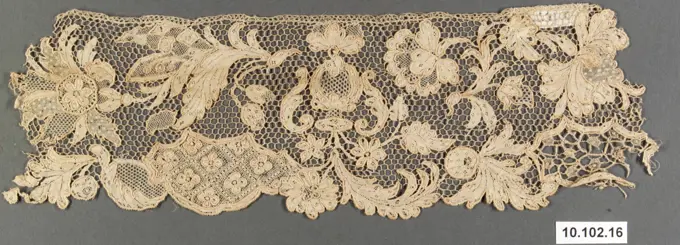
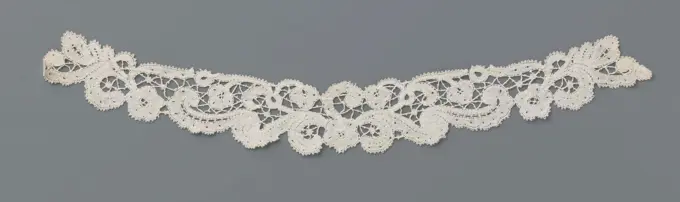
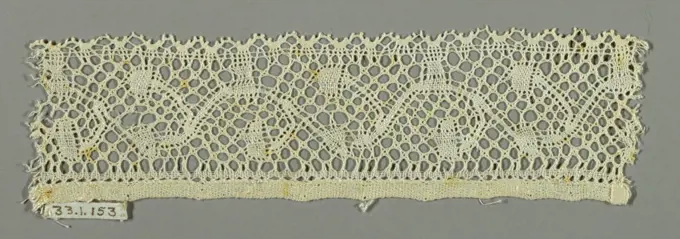
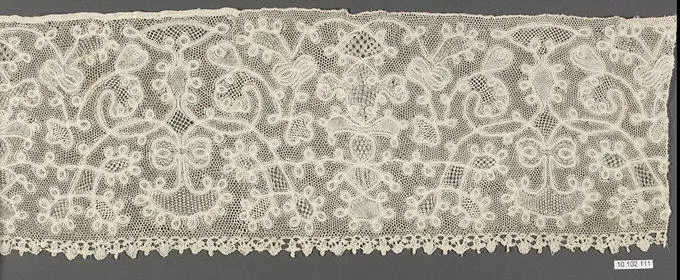
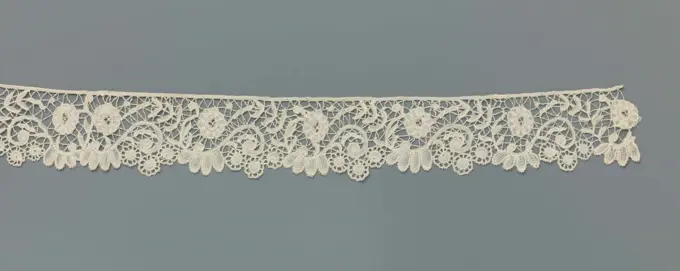
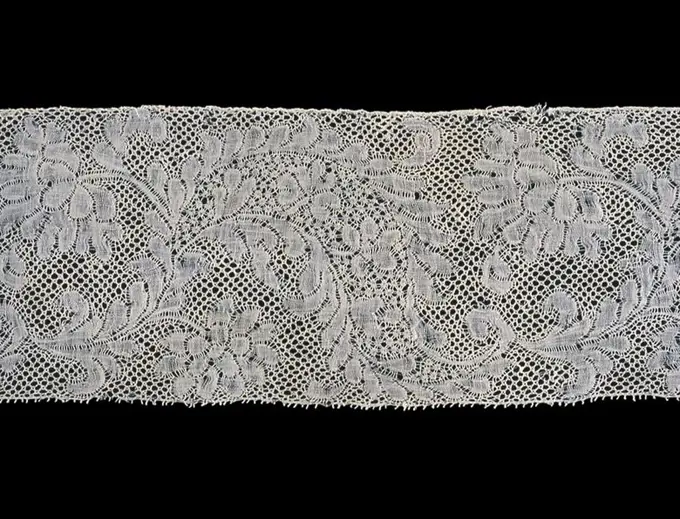
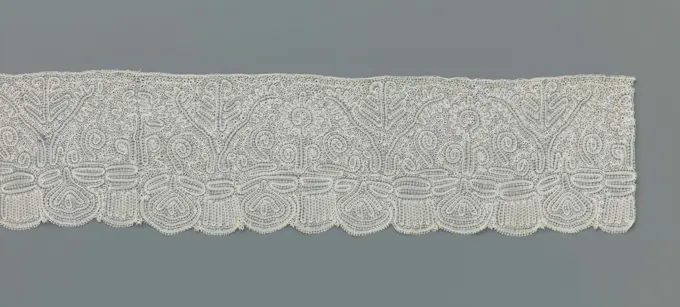
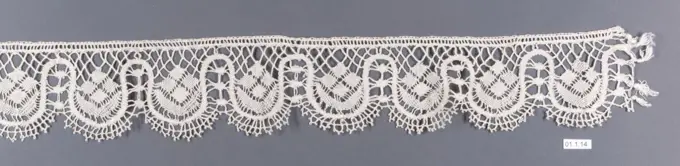
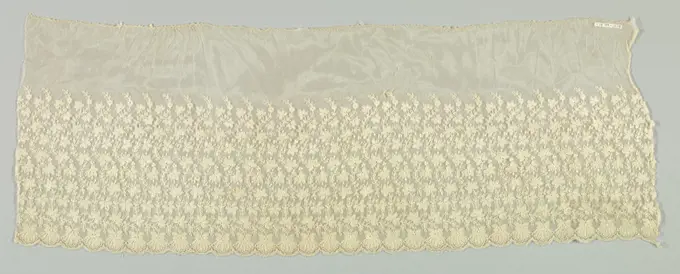
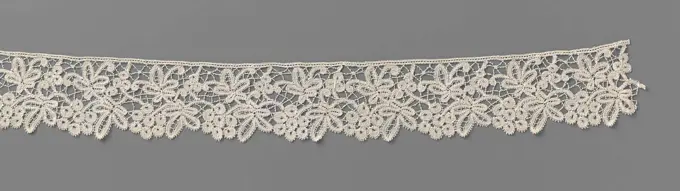
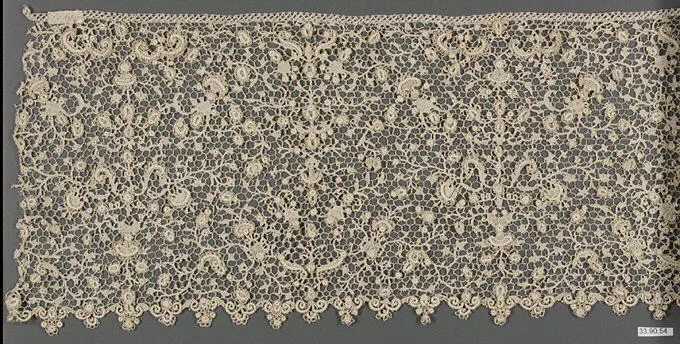
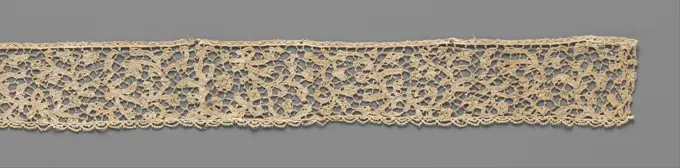
A collection of intricate lace strips featuring floral and leaf patterns, showcasing historic lace-making techniques in natural hues.

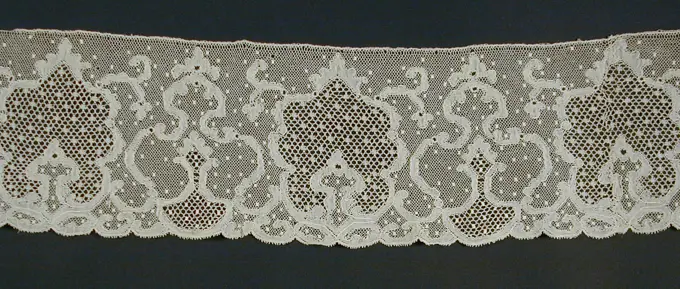
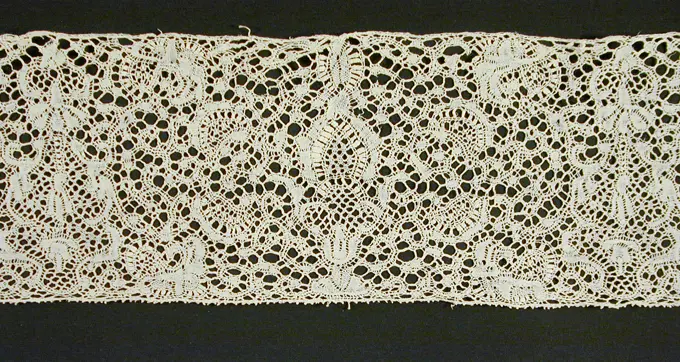
Strip bobbin with two volute leaves in vase, anonymous, c. 1850 - c. 1899  Strip of natural -colored bobbin: Beverse side. The repeating and symmetrical pattern consists of a flower pot with, to the left and right, a long lateral branch with two flowers and above it a cone -shaped motif between two large volute leaves. Between the successive pots there is a small flower pot with five rosette flowers along the top and right underneath an oval covered with leaves. The motifs are connected by a fine grid, a tuler land. The motifs are made in linen battle, with thicker and shiny contour threads. A rose soil has been used as a decorative soil and a decoration has been realized with crossing couples in the volute leaves. The top and bottom of the strip are straight finished, with the bottom with picots. Lille cotton (textile) bobbin lace
Strip bobbin with two volute leaves in vase, anonymous, c. 1850 - c. 1899 Strip of natural -colored bobbin: Beverse side. The repeating and symmetrical pattern consists of a flower pot with, to the left and right, a long lateral branch with two flowers and above it a cone -shaped motif between two large volute leaves. Between the successive pots there is a small flower pot with five rosette flowers along the top and right underneath an oval covered with leaves. The motifs are connected by a fine grid, a tuler land. The motifs are made in linen battle, with thicker and shiny contour threads. A rose soil has been used as a decorative soil and a decoration has been realized with crossing couples in the volute leaves. The top and bottom of the strip are straight finished, with the bottom with picots. Lille cotton (textile) bobbin lace
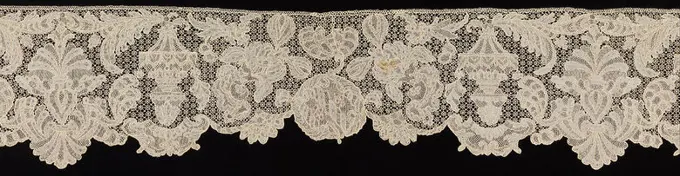
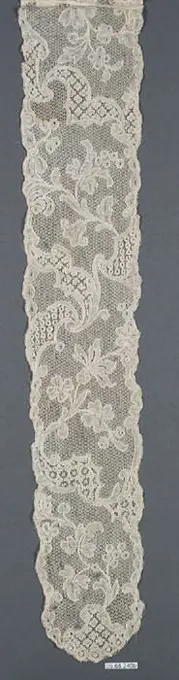
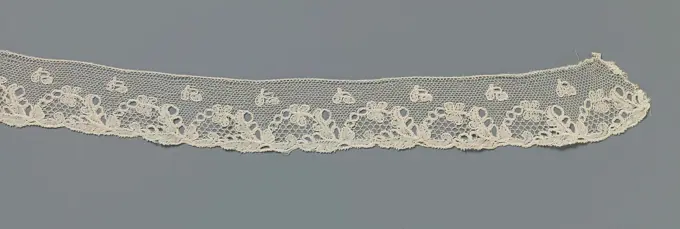
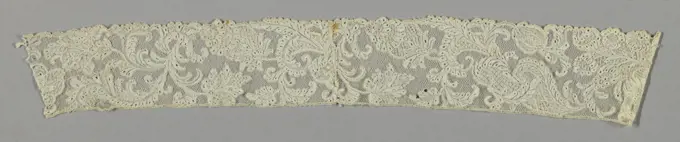
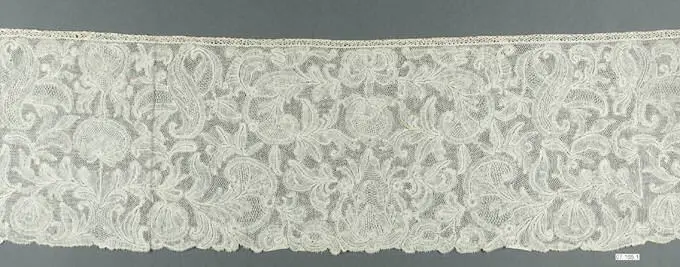
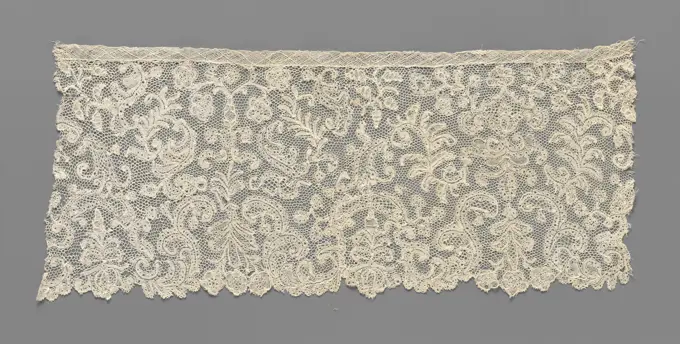
Strip of bobbin with composition of candelabers and mirrored S-shaped leaf fluffs, anonymous, c. 1700 - c. 1715 Strip of natural -colored Brussels bobbin. The pattern consists partly of symmetrical compositions of candelabers and mirrored S-shaped leaf volutes, among others. The motifs are largely made in linen battle with openwork edges and recesses. Part of the motifs is made in netslag with burst relief contours. The motifs are connected to each other by different but similar tralions. A rose soil has been applied as a decorative land. The top of the strip is straight finished with a separate struggle in netslag, in which shiny threads are strung that form a windscreen pattern. The irregular scrap edge stems from the pattern and is finished with picots. Brussels linen (material) bobbin lace / Brussels bobbin lace Strip of natural -colored Brussels bobbin. The pattern consists partly of symmetrical compositions of candelabers and mirrored S-shaped leaf volutes, among others. The motiStrip of needle side with clover leaves and fan -shaped flowers, anonymous, c. 1775 - c. 1799 Strip of natural-colored needle side: men's-Aalençon. Spread motif with clover leaves on a fine hexagonal Maas soil. Along the top edge a row of mosjes. The pattern on the underside of the strip consists of a succession of leaf branches with plumes. Among them fan -shaped flowers that spring from the bottom edge, filled with a decorative land. The underside is finished with scalloped edge of potented circles with a Raderpicot. The top is finished with a straight edge. Alençon linen (material) Alençon Lace Strip of natural-colored needle side: men's-Aalençon. Spread motif with clover leaves on a fine hexagonal Maas soil. Along the top edge a row of mosjes. The pattern on the underside of the strip consists of a succession of leaf branches with plumes. Among them fan -shaped flowers that spring from the bottom edge, filled with a decorative land. The underside is finished with scalloped edge of Strip of needle side with incised leaves, anonymous, c. 1900 Walking pattern of incised leaves above a rose and a three -leaf, which together form the sharply toothed outside line. Cross-shaped bars with button (soil of long X-shaped bars with a spider). The Remplis consists of buttonholes and a long distance gazé. German side: 'Carlsbader Points'. Karlsbad (Germany) (possibly) linen (material) Walking pattern of incised leaves above a rose and a three -leaf, which together form the sharply toothed outside line. Cross-shaped bars with button (soil of long X-shaped bars with a spider). The Remplis consists of buttonholes and a long distance gazé. German side: 'Carlsbader Points'. Karlsbad (Germany) (possibly) linen (material)Strip bobbin with heart-shaped cartouches, anonymous, c. 1850 Strip of natural -colored bobbin: Lille side. The repeating pattern consists of more or less heart-shaped cartouches that lie on the top of the strip and are formed by mirrored question marks with a sea-lobby flower at the bottom. The cartouches hang in a scalloped semi -circular field. These fields are formed by arches of connected cartouches and leaf voltues. The motifs are made in linen battle, with thicker and shiny contour threads. The motifs are connected by a fine grid, a tuler land. In the cartouches, decorative lands have been used including a rose ground. The top is straight. The very faintly scalloped underside is finished with picots. Buckingham (possibly) linen (material) bobbin lace / Lille lace Strip of natural -colored bobbin: Lille side. The repeating pattern consists of more or less heart-shaped cartouches that lie on the top of the strip and are formed by mirrored question marks with a sea-lobby flower at Strip bobbin with fan -shaped bunch of flowers under a curved leaf, anonymous, c. 1800 - c. 1899 Strip of natural -colored bobbin, Lille side. The repeating pattern consists of a curved leaf under the center line of the strip under which a fan -shaped bunch of flowers hangs. Each bunch forms one shell with whimsical edges. The successive bunches are placed against each other. The motifs are connected by a Maas soil, a tuler land. The motifs are made in linen battle with recesses and with thicker and shiny contour threads. The top of the strip is finished with a separate strap. The short sides are finished with a zoompje. Southern Netherlands cotton (textile) bobbin lace / Lille lace Strip of natural -colored bobbin, Lille side. The repeating pattern consists of a curved leaf under the center line of the strip under which a fan -shaped bunch of flowers hangs. Each bunch forms one shell with whimsical edges. The successive bunches are placed against each other. The motifs are connected bStrip bastard with branches of branches from triangular cartouche, anonymous, c. 1750 - c. 1770 Strip of natural -colored bobbin: Mechelse side. The pattern consists of an arc formed by two branches from a triangular cartouche along the top of the strip. In the middle of the arc lies along the underside of the strip, a rush -in -shaped cartouche. This composition is interspersed with a compound flower adjacent to the top with a trapezoidal cartouche placed on top of the underside. The motifs are connected by a fine Maas soil. The motifs are made in linen battle with thicker and shiny contour threads. A few different decorative lands have been used in the cartouches and between the flower branches. Up and bottom are straight finished with picots along the bottom. One short side is finished with a zoompje. Southern Netherlands linen (material) bobbin lace / Mechlin (lace) Strip of natural -colored bobbin: Mechelse side. The pattern consists of an arc formed by two branches from a trianguBorder. Date/Period: Early 18th century. Border. Medium: linen. Technique: needle lace. Author: UNKNOWN.Insertion 17th-18th century Flemish. Insertion 227690Strip bobbin with two volute leaves in vase, anonymous, c. 1850 - c. 1899  Strip of natural -colored bobbin: Beverse side. The repeating and symmetrical pattern consists of a flower pot with, to the left and right, a long lateral branch with two flowers and above it a cone -shaped motif between two large volute leaves. Between the successive pots there is a small flower pot with five rosette flowers along the top and right underneath an oval covered with leaves. The motifs are connected by a fine grid, a tuler land. The motifs are made in linen battle, with thicker and shiny contour threads. A rose soil has been used as a decorative soil and a decoration has been realized with crossing couples in the volute leaves. The top and bottom of the strip are straight finished, with the bottom with picots. Lille cotton (textile) bobbin laceLength of Lace. England, mid-19th century. Textiles; textile lengths. Cotton Bucks bobbin laceValance (Incomplete) Made 1860-1869 England. Cotton, bobbin part lace of a type known as Honiton with a plaited bar ground .Strip bobbin with two varied diamond -shaped compositions, anonymous, c. 1850 - c. 1899  Strip of natural -colored bobbin. Grove wire has been worked. In a Maas soil, a Paris soil with coarse meshes, a repeating pattern has been made in linen battle two varied diamond -shaped compositions. A narrow lane along the top of the strip is made in Netslag, this is also the finish of this long side. A wider band runs along the sculptes, made in netslag. The short sides have been cut.  linen (material) bobbin laceStrip of needle side with symmetrical composition of bell -shaped fields formed by acanthus leaves and large flowers, anonymous, c. 1750 - c. 1760 Strip of natural needle side: Argentan side. The largely symmetrical composition consists of bell -shaped fields formed by acanthus leaves and interspersed by various large flowers, which hang down from the top of the strip. Always one large flower or a flower branch with three large flowers between the bell -shaped fields. The motifs are made up of feston stitches with recesses and equipped with relief contours. They are connected by a hexagonal soil with fested meshes, an Argentan ground. Various decorative lands have been used in the bell -shaped fields, from coarse double hexagonal soils to extremely finely worked decorative soils decorated with mosies that can also be seen in the flower hearts. The flat irregular scrap edge is finished with picots. The top of the strip is straight finished with a tie. France linen (material) Argentan LaStrip Kloskant with fans and windows and hearts, Anonymous, 1917 Strip of natural -colored bobbin: tie. The repeating pattern consists of a scum of fans above which a row of large windows is interspersed with smaller and a row of hearts above it. Zigzag lanes with spiders run around the windows. The windows are made in linen battle, the hearts in netslag. At the top of the strip, the hearts are connected by a litter. A label is sewn on the strip on which the handwritten text: 'Side work course Fort de Kock 15/2-15/6-1917 Lian Fort v/d Capellen Kant no. 4'. Fort those chef linen (material) Bobbi lace / lace cloth Strip of natural -colored bobbin: tie. The repeating pattern consists of a scum of fans above which a row of large windows is interspersed with smaller and a row of hearts above it. Zigzag lanes with spiders run around the windows. The windows are made in linen battle, the hearts in netslag. At the top of the strip, the hearts are connected by a litter. A label is sewn on the sFragment 17th century Italian, Venice. Fragment 213002Strip early 18th century Flemish. Strip 214511Strip bobbin with connected flower stems, anonymous, c. 1650 - c. 1699 Intermediate base of natural -colored bobbin: Old Flemish bobbin with braid soil. The repeating pattern consists of a succession of the same bent flower stem, which starts at the bottom of the strip and runs along the top with an arc and ends in a large rosette flower. The motifs are partly made in linen battle with openwork edges and recesses. A few (flour) leaves are made in lace -hole and other leaves are formed by a snowflake ground or spider ground. The flower hearts of the large rosette flowers are equipped with a six -pointed star made in form. The motifs are connected by a braid ground with long braids. Top and bottom of the strip are straight finished with the bottom with picots. Southern Netherlands linen (material) bobbin lace / Flemish lace with plaited ground Intermediate base of natural -colored bobbin: Old Flemish bobbin with braid soil. The repeating pattern consists of a succession of the same bent Strip of needle side with flower branches and star -shaped flowers, anonymous, c. 1775 - c. 1799 Strip of natural-colored needle side: Argentan side and Alençon side. Repetitive motif with two different flower branches, each flanked by two star -shaped flowers placed one above the other, on a ground with meshes that are closed with button hole stitches (argent tankant). The flower branches bend alternately to each other. Along the underside under a wavy line including a pattern of flowers and berries on a fine hexagonal Maas soil (Alençon side). Ornamental soil with road picots in the larger flowers and the circles along the lower edge. Fullwork with minimal recesses within the contours of the other motives. Schulpenrand on the bottom due to a succession of circles, interrupted at a regular distance by a rosette flower. The top is trimmed with a border bobbin. Argentan linen (material) Argentan Lace / Alençon Lace Strip of natural-colored needle side: Argentan side and Alençon side. ReBorder 17th century Italian, Venice. Border 222731Manchet van naaldkant met acanthusvoluten.Cuff of natural needle side: Venetian relief side. Narrow rectangular model. Wanknig and branched acanthus volutes and always varied palm-free floods stitch off against open bars. A straight pearl list runs along three sides. The top is straight finished with a splitting strap.Strip bobbin with slanted spring -shaped leaves, Anonymous, Before 1840 - Before 1850 Strip of natural -colored bobbin: Lille side. The repeating pattern consists on the center line from a slanted spring -shaped leaves with a row underneath a connected circular moths, which form openwork shells. The motifs are connected by a fine grid, a tuler land. The sparing fullwork is made in linen battle, with thicker and shiny contour threads. The top is straight. The shells along the bottom are finished with picots. Lille linen (material) bobbin lace / Lille lace Strip of natural -colored bobbin: Lille side. The repeating pattern consists on the center line from a slanted spring -shaped leaves with a row underneath a connected circular moths, which form openwork shells. The motifs are connected by a fine grid, a tuler land. The sparing fullwork is made in linen battle, with thicker and shiny contour threads. The top is straight. The shells along the bottom are finished with picots. Lille linen Lappet (one of a pair) early 18th century Flemish, Mechlin. Lappet (one of a pair) 218179Fragment early 19th century French, Lille or Arras. Fragment 214586Strook kloskant met halve cirkels langs onderzijde.Strip natural colosside: Lille side or buckingham side. The repeating and connected pattern exists along the underside of the strip of a semicircle, framed by openwork ovals and different leaves, including a four-leaf clover and along the underside a lancet sheet. The successive half circles are against each other. Above a row hanging oval flower with two leaves. The motifs are connected by a fine Maas soil, a tulet. The motifs are made in linen stroke with thicker and shiny contour wires. In the circles, a ornamental grounds have been applied, a rose ground. The top of the strip is straight finished. The very bland scaled underside is finished with picots.Band, Medium: linen Technique: needle lace with ground of loop and twist with twist return, Band with floral scrolls., Italy, mid- 18th century, lace, BandFragment, Medium: linen Technique: needle lace with ground of loop & twist with loop & twist return, Technique commonly called Point de Gaza, Belgium, 19th century, lace, FragmentFragment, Medium: linen Technique: bobbin lace, Fragment of Valenciennes lace has a widely swinging serpentine of alternating leaf and five-petal blossom. Border added later. Round mesh., France, late 18th century, lace, FragmentFragment 18th century French. Fragment. French. 18th century. Needle lace, point d'Argentan. Textiles-LacesGuimpe van kloskant met symmetrisch voluten patroon.Flumpy of natural colosside: Flemish Guipure. Symmetrical pattern of s vultuts and c-voluten between which in total three round-shaped flowers or fruits and three rosette flowers. Braiding ground. Finish on all sides with uneven slot, which arise from the pattern. The guimpe is bent rectangular.Border; linenFragment, Medium: linen Technique: bobbin lace, Binche style with Binche ground, 18th-19th century, lace, FragmentStrip bobbin with three hanging bell flowers, anonymous, c. 1875 - c. 1899 Strip of natural-colored bobbin, Duchesse side. On a bars stock there is a closed pattern of a thin volute drink, on which a Margriet and an anemone and three hanging clock flowers hanging in the sculpting. Sluis (Possible) linen (material) bobbin lace Strip of natural-colored bobbin, Duchesse side. On a bars stock there is a closed pattern of a thin volute drink, on which a Margriet and an anemone and three hanging clock flowers hanging in the sculpting. Sluis (Possible) linen (material) bobbin laceStrip bobbin with feathered leaves in large arches from five -lobbig center, anonymous, c. 1715 - c. 1725 Strip of natural-colored bobbin: binche side. The repeating pattern consists of feathered leaves, moving over the strip over the strip from a five -lobbig center. Between the leaves, the pattern is partly filled with sloping stripes and partly with diamonds on the other side of the center. The motives are against each other and partially overlap each other. Where they don't touch each other, they are connected to each other by a fine decorative soil, a snowflake ground. The motifs are made in linen battle and mains with openwork edges and with loose snowflakes. The top of the strip is straight finished, but ragged due to damage. The bottom is straight finished and provided with picots. Southern Netherlands linen (material) bobbin lace / Binche lace / snowflake filling Strip of natural-colored bobbin: binche side. The repeating pattern consists of feathered leaves, moving over the sFlounce early 18th century Italian. Flounce 218859Strook kloskant met s-ranken.Natural collate strip: Duchesse-Side. There is an ongoing pattern on a braid soil. S-tanks with three daisies and an edge of Campanes form the slot and end in a simple rose.Scarf 1790-1810 French Of note here are the varieties of grounds executed in the border motifs.. Scarf 157630Border Made 1701-1750 Italy. Linen, bobbin straight lace .Border. France, Valenciennes. Date: 1725-1750. Dimensions: 6.9 × 48.2 cm (2 3/4 × 19 in.)Width repeat: 10.9-11.1 cm (4 1/4-4 3/8 in.). Linen, bobbin straight lace of a type known as "Valenciennes" with a five hole mesh ground. Origin: France. Museum: The Chicago Art Institute, Chicago, USA.Piece early 18th century Flemish. Piece 214492Volant van kloskant met zonnebloemen.Volant of natural colosside, Russian or Eastern European side. Ground of short, irregular braids. Symmetrical pattern. A row of sunflowers, faced between V-shaped branches, is above a ribbon sculpture of folded 'ribbons', in which fan-shaped and straight ranking alternate.Lace, 1800s, maker unknown. Gift of Elizabeth Serkin, date unknown.Edging Maltese 19th centuryEdging 17th century probably French. Edging 229987Strip of needle side with flower litter pattern and rush -hour, anonymous, c. 1775 - c. 1799 Strip of natural needle side, argent tank side. Strooi pattern of twigs that alternately have a small or larger flower, leaves and/or berries. Ground with meshes that are closed with buttonholes. The pattern along the lower edge consists of two pointed to each other, in between, between which a flower or berry branch rises. The oval pairs are connected by an arc of leaves and/or berries and hearts. Under these arcs along the lower edge a flat, lying oval. The oval -shaped figures in the pattern are filled with a fine hexagonal Maas soil (alençong round). Different decorative grounds in the flowers. Volwerk without recesses in flowers, leaves and berries. Schulpenrand on the underside by a succession of heart -shaped leaves, regularly interrupted by a rosette flower and the flat oval. The top is finished with a straight edge. Argentan linen (material) Argentan Lace Strip of natural needle side, Strip bobbin with diamond -shaped fields and candelabar motifs, anonymous, c. 1690 - c. 1710 Strip of natural-colored bobbin, binche side. The repeating and thin pattern consists of diamond -shaped fields, formed by feathered leaves and connected to each other on the center line by a symmetrical candle pattern. A narrower Kandelaber motif is in the diamond -shaped field. The motifs are made in linen battle with openwork edges and in netslag. They are connected to each other by a traly land, a five -part ground. Some snowflakes are used as part of the motifs. The top and bottom of the strip are straight finished, with the bottom with picots. Southern Netherlands linen (material) Bobbi Lace / Binche Lace Strip of natural-colored bobbin, binche side. The repeating and thin pattern consists of diamond -shaped fields, formed by feathered leaves and connected to each other on the center line by a symmetrical candle pattern. A narrower Kandelaber motif is in the diamond -shaped field. The motStrook van kloskant met insect aan weerszijden van een achthoekige cartouche.Strip natural colored Brussels climbing side. The strip is curved in shape. The pattern consists of an octagonal cartouche with a flying insect on either side and then a long flower branch, where the left branch wears other flowers than the branch on the right side of the cartouche. The motifs are connected by a fine Maas soil, a slighten ground. The full work is largely made in linen battle with openwork edges, single recesses and with power stuffs. Different motifs have closted relief contours. Several ornamental grounds have been applied, including snowflakes soil and picoted braid forces. The top is finished with a separate clust strap. The scalloped underside is finished with picots.Strip bobbin with oval flowers and drop shapes between volutes, anonymous, c. 1725 - c. 1749 Strip of natural -colored bobbin: old Brabant side. The pattern has two varied and merging symmetrical compositions. One composition consists of an oval flower crowned by a heart-shaped flower between two S-Voluten. The other composition consists of a drop-shaped motif, above which a reverse oval flower hangs between two C-volutes. The motifs are connected by a grid, a round Valenciennes ground. The fullwork is largely made in linen battle with recesses and openwork edges and partly in Omslag. A wide variety of decorative land has been used in the motifs. The top is straight. The irregular scrap edge on the underside stems from the pattern and is finished with picots. One short side is finished with a separate strap. Southern Netherlands linen (material) bobbin lace / old Brabant lace Strip of natural -colored bobbin: old Brabant side. The pattern has two varied and merging symmetrical compositStrip mid-19th century French. Strip 220132Strip bobbin with three longitudinal stripes, anonymous, c. 1800 - c. 1809 Strip of natural -colored bobbin: Lille side. The continuous pattern starts under the center line and consists of two rows of circles, with a horizontal slender with small leaves on both side. A wavy line runs along the bottom row of circles that forms shells, with one circle in each shell. The motifs are connected by a fine grid, a tuler land. The sparing fullwork is made in linen battle, with thicker and shiny contour threads. The top of the strip is straight finished. The shells along the bottom are finished with picots. Lille linen (material) bobbin lace / Lille lace Strip of natural -colored bobbin: Lille side. The continuous pattern starts under the center line and consists of two rows of circles, with a horizontal slender with small leaves on both side. A wavy line runs along the bottom row of circles that forms shells, with one circle in each shell. The motifs are connected by a fine grid, a tuler land. Strook kloskant met takje met sterbloempjes en dik takje met zijtakjes.Strip natural colosside: Lille side. Between scattered moes, the repeating pattern consists of two different thin twigs, which spring from the bottom of the strip. On one branch are some star-shaped flowers, the other branch has a thick base with thin short twigs on both sides. The motifs are connected by a fine grille, a tulet. And they are made in linen stroke, where the thicker and shiny contour wires dominate. The thicker branch is filled with stacked cubes made in shape stroke. Upper and bottom of the strip are straight finished, the underside with picots.Collar. Italy, 17th century; altered 19th century. Costumes; Accessories. Linen needle laceBorder late 17th century French. Border 227585Bef of needle side with arabesk leaves, anonymous, c. 1875 - c. 1909 BEF of natural -colored needle side: Venetian relief side. There are very large spiral vines on an open bar of land, including here and there with a ring closed. Vlezig arabesk leaves and various flowers show a moderate relief. A (new) bow edge runs on three sides. Burano (possibly) linen (material) Venetian raised work BEF of natural -colored needle side: Venetian relief side. There are very large spiral vines on an open bar of land, including here and there with a ring closed. Vlezig arabesk leaves and various flowers show a moderate relief. A (new) bow edge runs on three sides. Burano (possibly) linen (material) Venetian raised workBorder of Needle Lace.Two techniques are combined in this band. Reticella (bottom half) is early lace with geometrical motifs. Punto in aria, literally stitch in air’, is a freer technique. The motifs are airier and looser.Bobbin Lace Edging of Points, late 16th century. Italy, Venice, late 16th century. Lace, bobbin; average: 3.5 x 17.2 cm (1 3/8 x 6 3/4 in.).Fragment (France); medium:; 1946-42-36Strip bobbin with ovals that form deep pointed sculptes, anonymous, c. 1825 - c. 1849 Strip of natural -colored bobbin: blonde. The color tends vague to blue. The repeating pattern consists of an oval with one pointed point that hangs down and forms a deep shell. The successive scallops are connected by an openwork circle, in which an X-shaped motif is made in form. The ovals are formed by a decorative soil, a rose ground, around which a wide open work runs from contour threads between which are blocks made in shape. An extra decorative band runs around the lower part of the ovals, which is formed by a succession of openwork and fine picots finished. The contour threads consist of a combination of a bundle of floss threads and a twisted wire. At the top, the motifs are connected by a traly land, a tuler floor. The top is straight. Belgium (possibly) silk bobbin lace / blonde (lace) Strip of natural -colored bobbin: blonde. The color tends vague to blue. The repeating pattern consists oFragment; linen; 1897-8-201Strip or needle side with semi -circular fields and triangular fields, anonymous, c. 1750 - c. 1770 Strip or collar of natural needle side: Argentan side. Curved strip -shaped model. The pattern consists of flower garlands that form half -circular fields with the curve down, which are intersected by striped ribbons that form triangular fields. From the top of the strip there are flower branches down in the fields and along the underside of the strip are smaller flowers and leaves and a rocaill-shaped cartouches in which decorative stitches are used at a regular distance. The motifs are made up of feston stitches with recesses and equipped with relief contours. In the fields, coarse and fine soils have been used: a coarse hexagonal soil with founded meshes - an Argentan ground - and a fine hexagonal Maas soil, an alençong round. The top of the strip is straight finished with a tie. The silly scrap edge along the bottom is finished with picots. The short sides are also finished. France lFragment, Medium: linen Technique: bobbin lace (continuous tape with Valenciennes round style net), Fragment of continuous tape bobbin lace., 17th century, lace, FragmentManchet van applicatiekant met een bloementak en sierlijst.Cuff of natural brussels application side: mixed side - climbing side with a coniferous side ornamental ground - applicated on machine tulle. Strip-shaped model with a widening in the middle. Symmetrical pattern of a closted branch with flowers and leaves and a rose in the middle, appliqued on machining tulle. The motifs are made in linbroof with sparingly applied recesses and with thin, shiny contour wires. Thread bundles ensure relief contours with which petals and leaf veins are accentuated. Along the short side and underside this pattern is framed by a wide piece of decorative. From the inside to the outside, this list consists of a slightly wavy chain of jointed ovals, applicated on the machine tulle. Then a double clooted frame between which a diamond-shaped ornamental land of needle side, with dots and rover picots at the intersections. The outer, clost, list consists of connected half rings with the elongated oval, whicStrook van kloskant met holle en bolle dubbele lijsten.Strip of black climbing side: Chantilly side. A ground ground shows an empty top and a downwardly severely symmetrical design. Hollow and convex double tables, cascading, follow the slot, which exist for turns from half rosettes and a bow of leaves.Fragment of the lace;  18th century (1701-00-00-1800-00-00);Fragment, Medium: linen Technique: bobbin lace, Mechlin style, Mechlin ground with snowball ground., N. Europe, 18th century, lace, FragmentFlounce, Medium: linen, cotton Technique: cotton embroidery on linen net, Net embroidered in running stitch in pattern of curving stem with flowers and leaves., England, 19th century, lace, FlounceStrip bobbin with coarse three -leaf, anonymous, c. 1875 - c. 1899 Strip of natural-colored bobbin: Duchesse side. On a very open braiding soil there are one-sided, targeted serpentine branches with an anemone and a large Drieblad, which alternately form the unequal sculpts. Netherlands cotton (textile) bobbin lace Strip of natural-colored bobbin: Duchesse side. On a very open braiding soil there are one-sided, targeted serpentine branches with an anemone and a large Drieblad, which alternately form the unequal sculpts. Netherlands cotton (textile) bobbin laceBorder; linenBobbin Lace (Punto di Milano) Cuff, 17th century. Italy, Milan, 17th century. Lace, bobbin; average: 28 x 16.5 cm (11 x 6 1/2 in.).Strook gehaakte kant met bloemen en druiventros.Spire tapering strip natural colored Irish crochet side. Pattern with flowers and grape fees and a crochet irregular maase with picots. The long sides are straight finished and deposited on one side with picoted arcs.Semi -circular scarf from Application side with garlands and rays -placed bouquets, anonymous, c. 1860 - c. 1870 Scarf of natural application side: bobbin side with a few needle lace pier stitches (mixed side) applicated on mechanical tuler land. Half -circle -shaped model. The large scallops of the edge are alternately filled with chalumps, hanging on festons and large leaves and a flower. Large bouquets emerge from symmetrical tifles interspersed by thin branches, including small bouquets between the tifles. Under the neck, the pattern has five garlands, including five larger garlands hanging on bouquets and small chalets along the neck. The tulle is strewn between the motifs with ring -shaped moes. The motifs are made in loose -clasped linen battle and mains and are equipped with contour threads and wire bundles form the relief contours. Needle side of decorative stitches have been used in many flower hearts. The sculpting edges are finished with picots. Brussels cotton (textile) BrJaponstrook applicatiekant met palmboom.Natural colored application side juic strip, climbing side with some details in needle side applicated on machinery tulle. The fond is evenly filled with a running pattern of palm trees, which tilted to the left and start with a strain and a fan-shaped crown, then split into several strains and smaller crowns. From the latter, multi-facing branches, including with arrow-shaped leaves, hanging down left and right, while garlands are hung here and there in their fulluity. A low flowering plant is always growing between two strains, which starts with a fine leaf rosette. The shelters are formed by winding edge strips and feathered leaves.Piece 18th century Italian, Abruzzi. Piece 215372Fragment early 18th century Italian. Fragment 212836Strip of needle side with muse motifs, anonymous, c. 1790 - c. 1799 The strip shows clover leaves above arches of moesjes. It has an edge of small medallions. Alençon France linen (material) Alençon Lace The strip shows clover leaves above arches of moesjes. It has an edge of small medallions. Alençon France linen (material) Alençon LaceStrook kloskant met de druiventrossen.Natural collate strip: Duchesse-Side. On an open braid soil there is an ongoing pattern of a short branch with two winger leaves and a grape tray. For turns a leaf and the bunch form the uneven slip.Cardigan with grieved rank. Cardigan of natural needle side: Venetian relief side. There are irregular tide on a bargain soil with medium-sized flowers and leaf volutes. Large triangles form the finish along a part of the circumference with a straight list. In one of the parts, a narrow strip can be found from a finer tendrilder game, in which a rank is three times tested.Cuff of crocheted side with loose stems and layered rosette flowers. Cuff made from two strips of natural-colored Irish crochet side to a strip of white cotton. The pattern of the strip used as intermediates consists of two loose stems to which a three-piece blade, interspersed by a loose stem with a layered rosette flower. The pattern of the other strip consists of a loose stem with three-piece leaves interspersed by a loose stalk with a layered rosette flower on either side. The regular semicircular slot on the underside are trimmed with picoted arcs. The ground with square meshes in both strips reminiscent of the knotted network of a filet side.Fragment; linenFlounce early 18th century Italian, Venice. Flounce 222744Strip of needle side with flower vendors, anonymous, c. 1690 - c. 1699 Strip of natural needle side with flower vines. Irregular bar with picots. The top is trimmed with a straight border bobbin. The underside is trimmed with a cracked edge with double arches. Venise flat. Venice linen (material) flat Venetian (needle point) Strip of natural needle side with flower vines. Irregular bar with picots. The top is trimmed with a straight border bobbin. The underside is trimmed with a cracked edge with double arches. Venise flat. Venice linen (material) flat Venetian (needle point)Engageante of Batist with embroidery, anonymous, c. 1740 - c. 1770 Engageante of natural batist with embroidery. The pattern has a volute flower wavy flower in a rocailleschulp that forms the middle between volute vines, which with symmetrical fan-shaped and always varied flowers in every shell, the edges of which consist of grid-work-rocailles. The embroidery consists of shadow work, work with extended threads and tambouring work. Dresden whole: Cotton (textile). whole: Batiste embroidering Engageante of natural batist with embroidery. The pattern has a volute flower wavy flower in a rocailleschulp that forms the middle between volute vines, which with symmetrical fan-shaped and always varied flowers in every shell, the edges of which consist of grid-work-rocailles. The embroidery consists of shadow work, work with extended threads and tambouring work. Dresden whole: Cotton (textile). whole: Batiste embroideringBorder 18th century Flemish. Border 226116Strip bobbin with candle -sloring motifs for a rochet, anonymous, c. 1685 - c. 1799 Strip of natural -colored bobbin: Flemish guipure side. The strip is used or intended for a rochet. The repeating pattern is formed by ribbons made in linen stroke and consists of two varied symmetrical candle -sloring motifs, which fill the entire width. The ribbons are connected by an irregular braiding ground. A few decorative stitches have been applied. The scrap edge is turned on. Southern Netherlands linen (material) bobbin lace / tape lace (bobbin lace) / Flemish guipure lace Strip of natural -colored bobbin: Flemish guipure side. The strip is used or intended for a rochet. The repeating pattern is formed by ribbons made in linen stroke and consists of two varied symmetrical candle -sloring motifs, which fill the entire width. The ribbons are connected by an irregular braiding ground. A few decorative stitches have been applied. The scrap edge is turned on. Southern Netherlands linen (material) bFlounce, Medium: linen Technique: bobbin lace made in Lille style with heavy outlining thread, Lille-style bobbin lace flounce with an allover symmetrical design on a net ground in a design of angular curves, garlands and swags. Flounce has been set into a silk tape at top., Belgium, 19th century, lace, FlounceFragment 17th century Italian, Venice. Fragment 220620Strook gehaakte kant met waaiervormige bloemen.Strip natural-colored Irish crochet side. Pattern with impeller-shaped flowers with stems and a crocheted irregular maase ground with picots. The top is finished with a straight edge. The semi-circular shelter on the lower edge are deposited with picoted arcs.Strip bobbin with rose branch from decorative band with horn of abundance, anonymous, c. 1850 Strip of natural -colored bobbin, Mechelse side. The lower half of the strip consists of a decorative band, which is formed by a bending horn of abundance and a lying elongated S-Volute, which are linked together like a sort of skipping waves. A rose branch originates from the decorative band, above the S-Volute. Above the rose branches, a narrow lane up to the top of the strip is filled with a spray pattern of a V-shaped twig with two berries or flowers on it. The motifs are connected by a fine Maas soil, a Mechelen soil. The motifs are made in linen and mains, with thicker and shiny contour threads. Various decorative lands have been applied in the Horn of Abundance, the S-Volut and Bloemharten, whether or not decorated with square mouses made in shape. The top of the strip is straight finished. The underside of the strip is very faint scalloped and provided with picots. Mechelen (Possible) Strip bobbin with triangular medallions, anonymous, c. 1725 - c. 1749 Strip of natural -colored Old Flemish bobbin. On a grid, a five -part ground, there is a symmetrical pattern of halved diamond shapes along the inside and a triangular medailon contained in arabesken with gridwork along the fine scallops. Southern Netherlands linen (material) bobbin lace / old Flemish lace Strip of natural -colored Old Flemish bobbin. On a grid, a five -part ground, there is a symmetrical pattern of halved diamond shapes along the inside and a triangular medailon contained in arabesken with gridwork along the fine scallops. Southern Netherlands linen (material) bobbin lace / old Flemish laceBorder Made 1690-1710 France. Linen, needle lace .Piece 18th century Flemish. Piece 213244Strip of bobbin with star -shaped flower saved in a flattened hexagonal field, anonymous, c. 1800 - c. 1899 Strip of natural -colored bobbin, Swedish side. The strip is attached to a light blue cardboard with pins, with seven other strips. At the top of the cardboard is "Laces from Skåne. Sweden." And under the strip is written on the cardboard "From Terstup". Testerup is a castle in Skåne that lies in the south of Sweden. The symmetrical pattern consists of a slightly flattened hexagonal field in closed linen battle, in which a star -shaped flower has been made with recesses. Left and right of the hexagon were made with recesses in linen work decorative tires, with a border with Paris mesh on both sides. The top of the strip is straight finished. The round meshes on the underside of the strip form a wife of scales with small scoops. Skåne linen (material) bobbin lace / Swedish lace Strip of natural -colored bobbin, Swedish side. The strip is attached to a light blue cardboard with pinStrip application side with a spray pattern and rosettes in ovals along the bottom, anonymous, c. 1790 - c. 1799 Strip of natural -colored Brussels Application side: Needle side Applicated on Drochelgrond. The repeating pattern consists of a stray pattern of twigs and various rosette flowers with or without a stalk and along the underside of the strip from ovals formed by a strongly curled branch with a rosette at the end. The motifs are mainly made of widely founded wire bundles. A coarse hexagonal Maas soil has been used in the ovals in the ovals. The top is finished with a separate strap. The very faintly scalloped underside is finished with very fine picots. Brussels linen (material) Brussels Applied Strip of natural -colored Brussels Application side: Needle side Applicated on Drochelgrond. The repeating pattern consists of a stray pattern of twigs and various rosette flowers with or without a stalk and along the underside of the strip from ovals formed by a strongly curled branchLengths of Lace. Belgium, early 18th century. Textiles; textile lengths. Linen binche bobbin laceStrip bobbin with stylized insects and moes in a corner, anonymous, c. 1800 - c. 1899 Strip of natural-colored bobbin, Buckingham side. The repeating pattern forms a broad job over the center line of the strip. It consists of five square of mulets, which are placed in a corner under each other, interspersed with a stylized insect with a circular body with double wings that make the same angle as the square mulets. The Mosjes are made in form. Each circular body of the insects is made in linen stroke. A thick and shiny contour thread runs around the circle, which runs into the Maas soil and forms the wings. The Maas soil is a tuler land. Top and bottom of the strip are straight. Buckingham cotton (textile) bobbin lace / Bucks point (lace) Strip of natural-colored bobbin, Buckingham side. The repeating pattern forms a broad job over the center line of the strip. It consists of five square of mulets, which are placed in a corner under each other, interspersed with a stylized insect with aLace laceFragment ca. 1600 Italian, Venice. Fragment 212731Strip bobbin with braided pointed sculptures, Berliner Spitzenschule, c. 1900 - c. 1924 Strip of natural -colored Genoese bobbin, cloated on an example of side from the first half of the 17th century. The repeating pattern consists of a straight track in which a wavy line runs. Under the straight track a scrap edge with braided pointed sculptes. With the exception of the wavy line that has been cost in linen battle, the pattern is almost entirely made up of braids. The strip includes a text: "Nach Vorlage Einer Alten Venetianic and Guipurenspitse Aus dem 17 Jahrhundert Auf Order Klöppelt in Der Berliner Spitzenschule, Genthinerstrasse No. 7. Berlin linen (material) bobbin lace / plaited-lace / Genoese pillow lace Strip of natural -colored Genoese bobbin, cloated on an example of side from the first half of the 17th century. The repeating pattern consists of a straight track in which a wavy line runs. Under the straight track a scrap edge with braided pointed sculptes. With the exceptioBobbin Lace Flounce, 17th century. Belgium, Brussels, 17th century. Lace, bobbin: linen; average: 36.2 x 125.7 cm (14 1/4 x 49 1/2 in.).Strook kloskant met aaneengeschakelde drielobbige bladeren.Strip natural colosside, Buckingham side. The repeating and continuous pattern forms a wide job over the center line of the strip. It consists of a concatenation of lying triple leaves with a circle of the base. The lobes are made in linen stroke, each circle consists of a decorative mast. A thick and shiny contour wire runs both lobse and circles. Above and below the circle is a loose square mole, made in shape stroke. The motifs are connected by a Maas soil, a tulet. Upper and bottom of the strip are straight finished.Border 1650-1700 Italian, Venice. Border 222730