Delicate Lace Trimmings

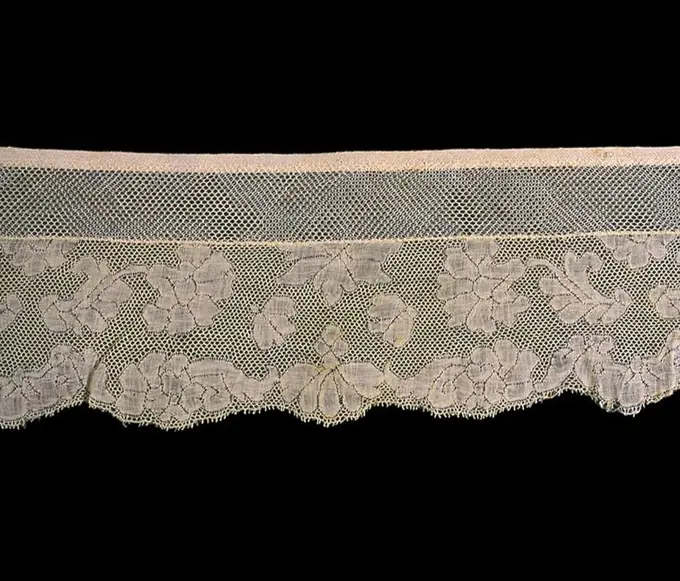
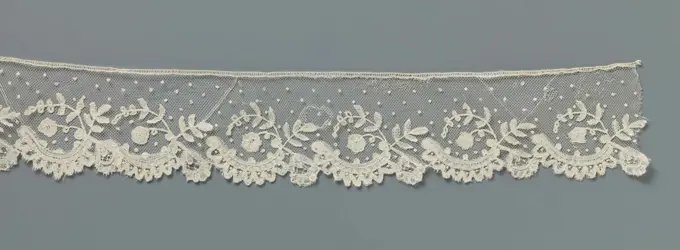
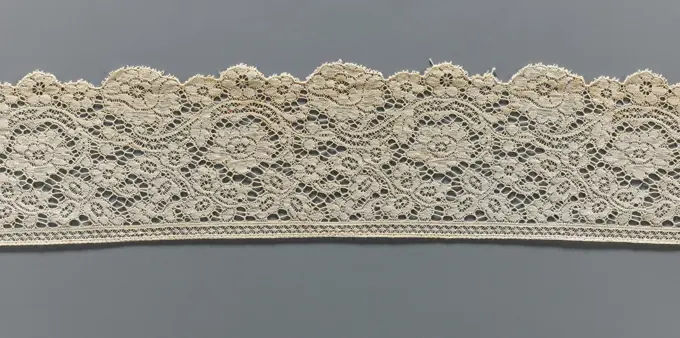
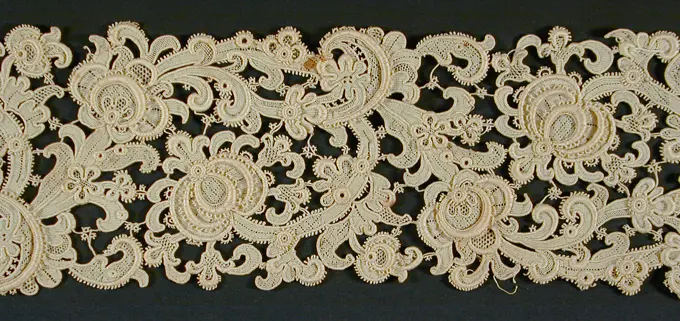
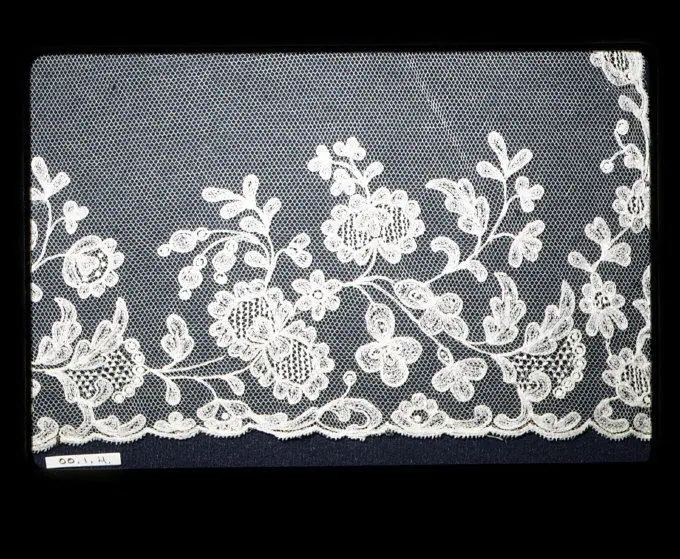
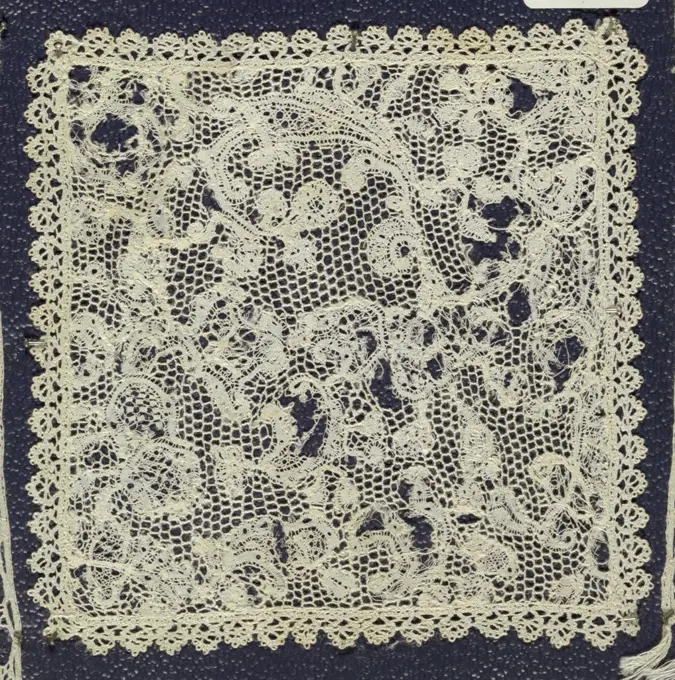
A collection of intricate lace strips featuring floral and leaf patterns, showcasing historic lace-making techniques in natural hues.

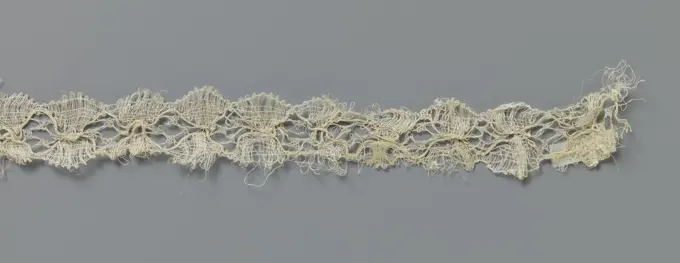
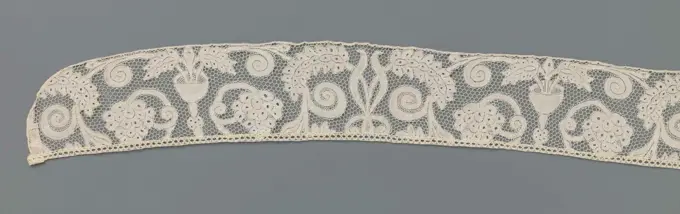
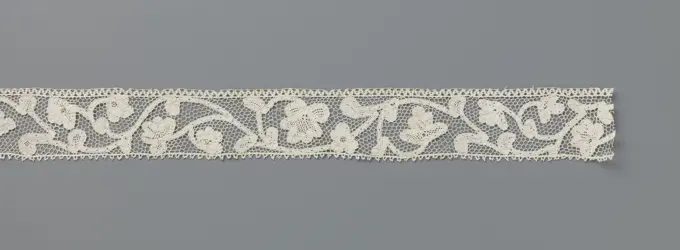
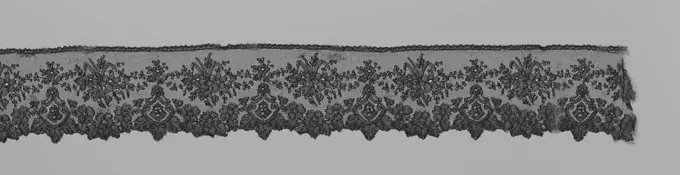
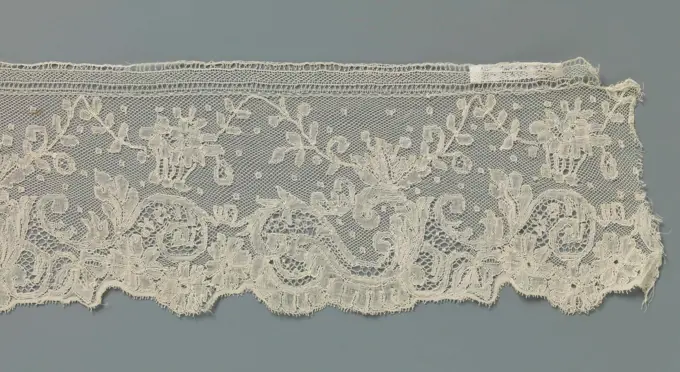
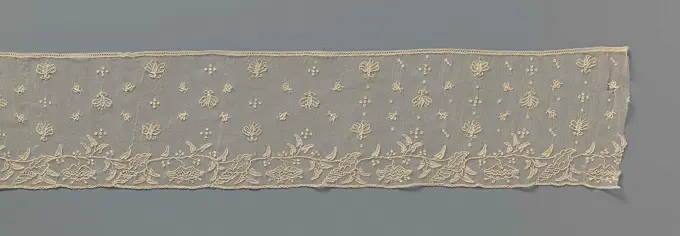
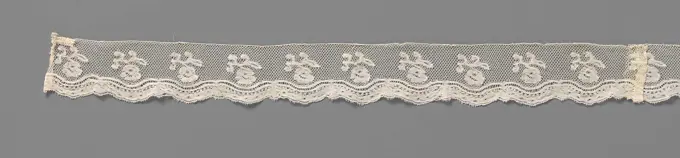
Strip bobbin with two volute leaves in vase, anonymous, c. 1850 - c. 1899  Strip of natural -colored bobbin: Beverse side. The repeating and symmetrical pattern consists of a flower pot with, to the left and right, a long lateral branch with two flowers and above it a cone -shaped motif between two large volute leaves. Between the successive pots there is a small flower pot with five rosette flowers along the top and right underneath an oval covered with leaves. The motifs are connected by a fine grid, a tuler land. The motifs are made in linen battle, with thicker and shiny contour threads. A rose soil has been used as a decorative soil and a decoration has been realized with crossing couples in the volute leaves. The top and bottom of the strip are straight finished, with the bottom with picots. Lille cotton (textile) bobbin lace
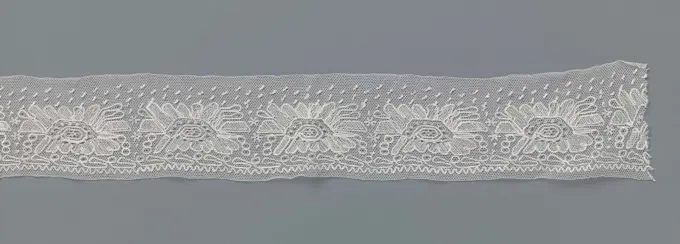
Strip bobbin with two volute leaves in vase, anonymous, c. 1850 - c. 1899 Strip of natural -colored bobbin: Beverse side. The repeating and symmetrical pattern consists of a flower pot with, to the left and right, a long lateral branch with two flowers and above it a cone -shaped motif between two large volute leaves. Between the successive pots there is a small flower pot with five rosette flowers along the top and right underneath an oval covered with leaves. The motifs are connected by a fine grid, a tuler land. The motifs are made in linen battle, with thicker and shiny contour threads. A rose soil has been used as a decorative soil and a decoration has been realized with crossing couples in the volute leaves. The top and bottom of the strip are straight finished, with the bottom with picots. Lille cotton (textile) bobbin lace
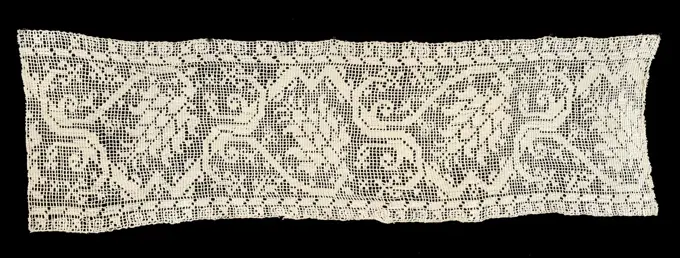
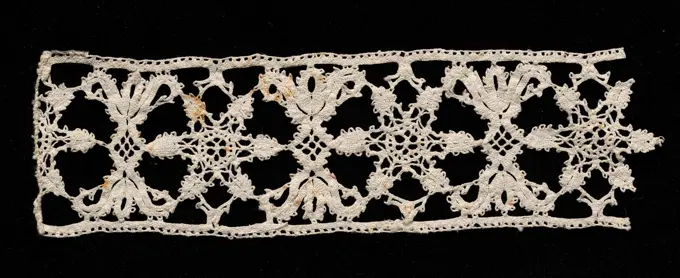
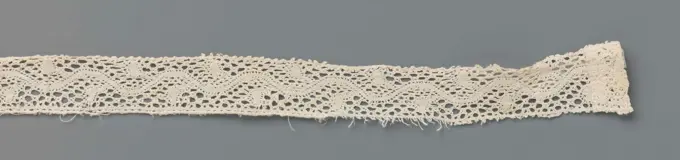
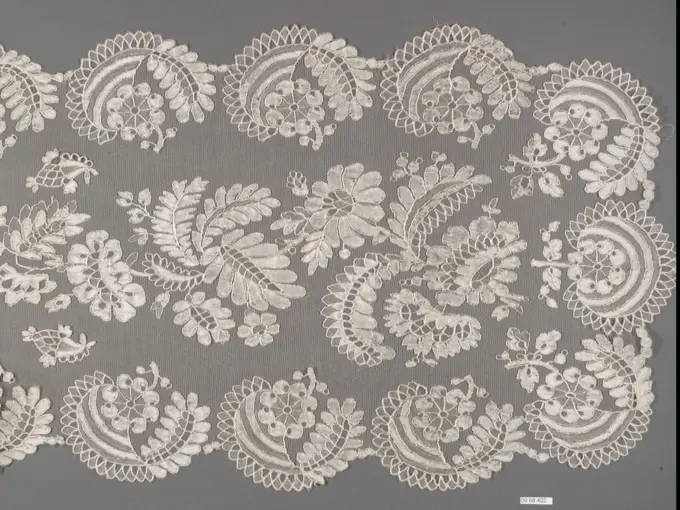
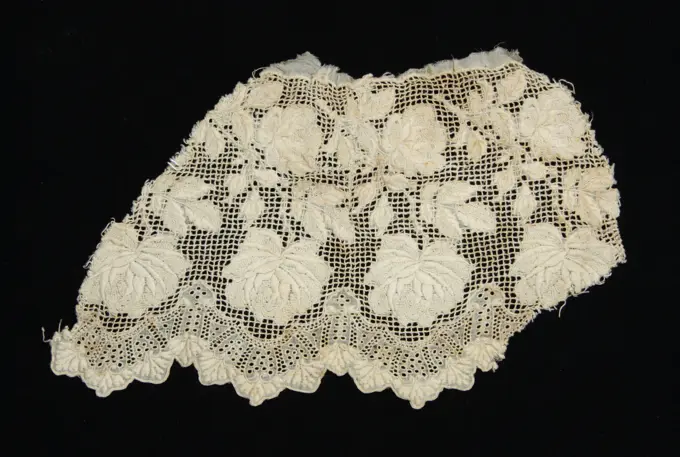
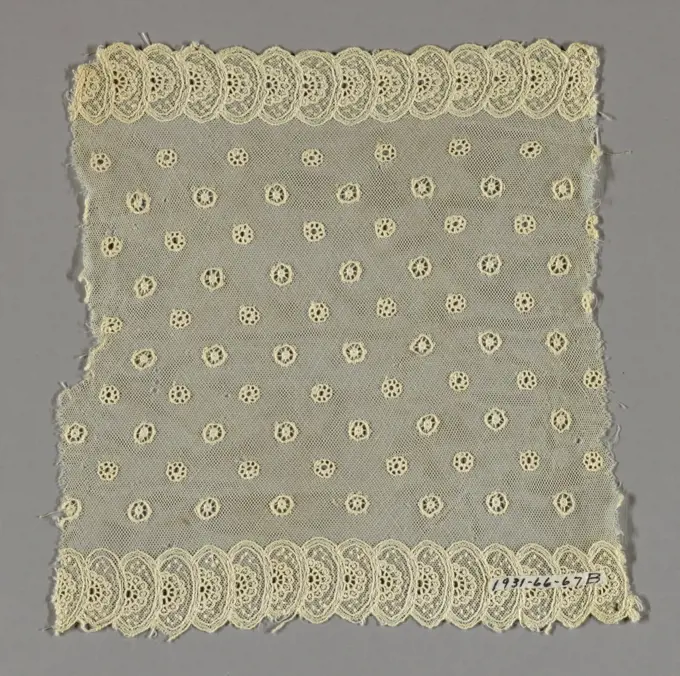
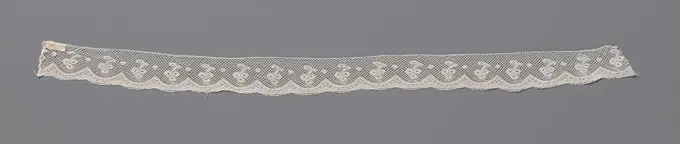
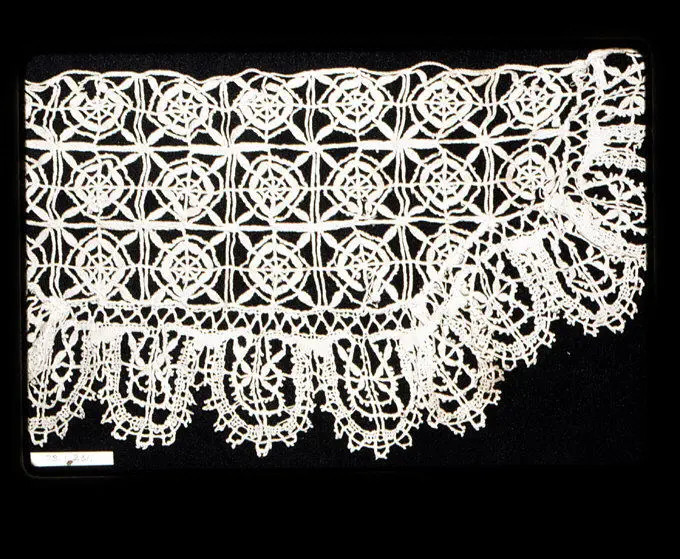
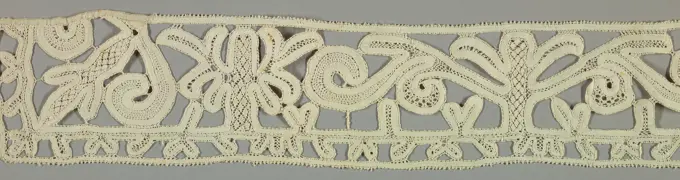
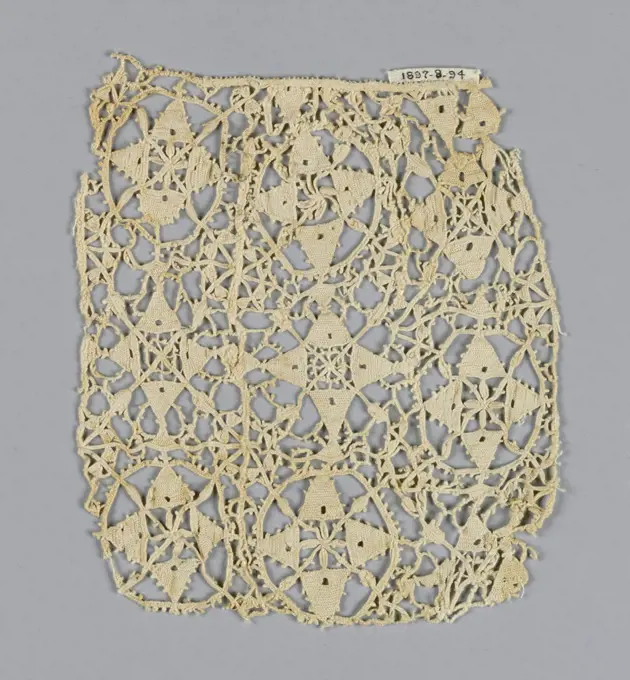
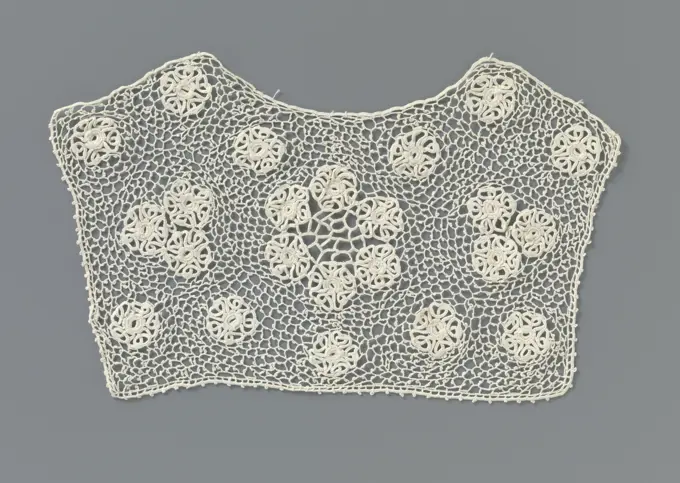
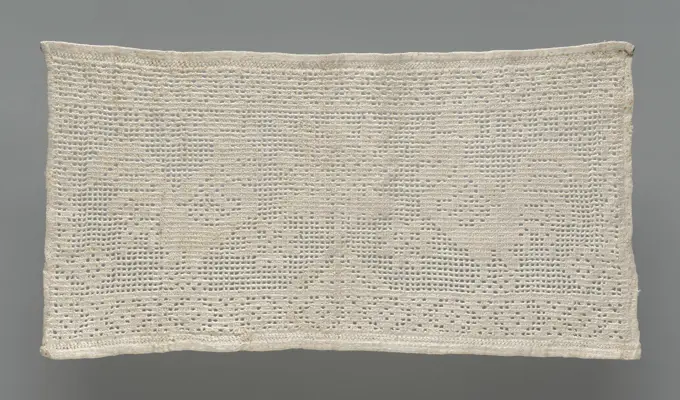
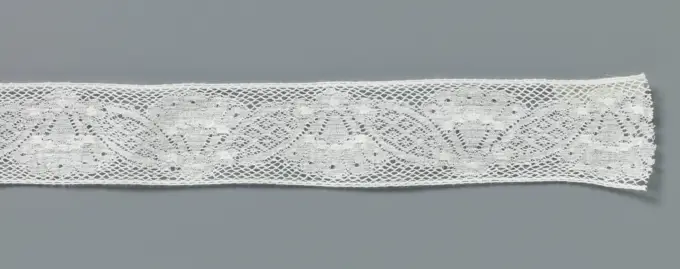
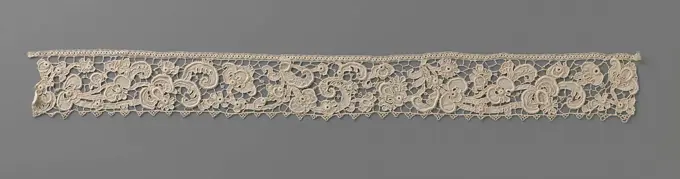
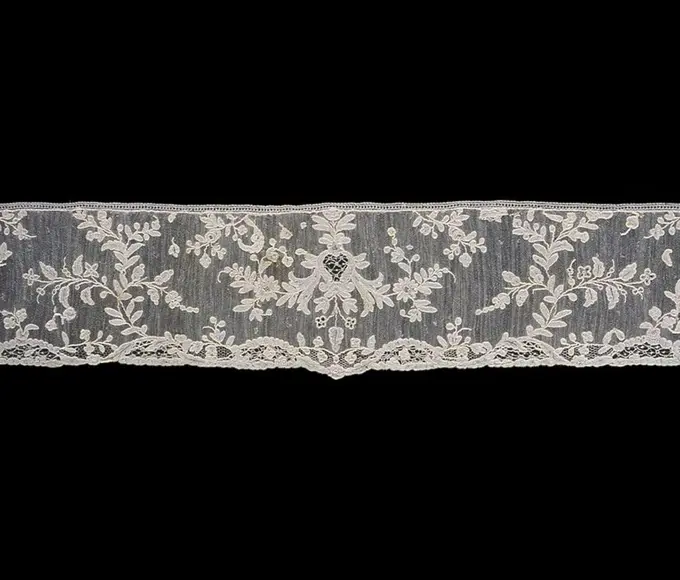
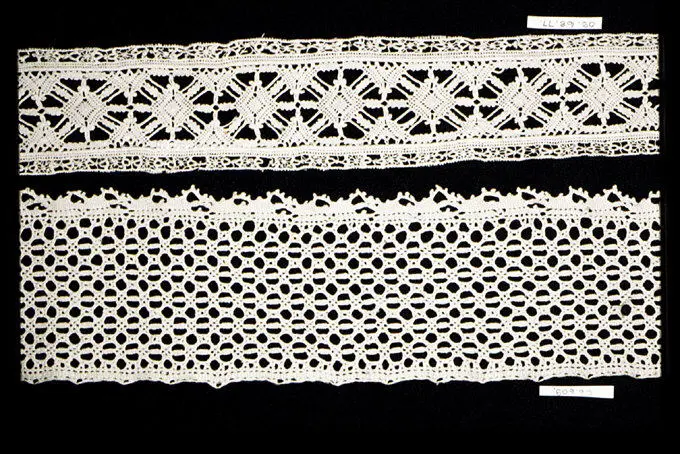
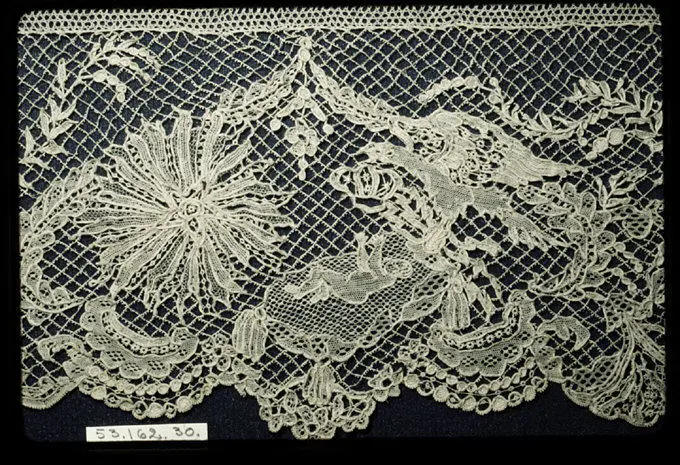
Fragment of a Band with Branching Vegetation, 17th century. Spain, 17th century. Needle lace, filet/lacis (knotted ground and darned in two directions); bleached linen (est.); overall: 17.6 x 23 cm (6 15/16 x 9 1/16 in.). Budding vegetation or a tendril motif is a recurring pattern in needle lace. The frequent use of the motif, adapted in lace from different centuries and regions, suggests that it was found in a pattern book.Border. France, Valenciennes. Date: 1765-1775. Dimensions: 7.6 x 266.2 cm (3 x 10⁴ 7/8 in.)Width repeat: 14.8 cm (5 7/8 in.). Linen, bobbin straight lace of a type known as "Valenciennes" with a round Valenciennes mesh ground. Origin: Valenciennes. Museum: The Chicago Art Institute, Chicago, USA.Band, 16th-17th century, 27 1/2 x 8 3/4 in. (69.85 x 22.23 cm), Linen; embroidery on woven net (buratto); lace, Italy, 16th-17th centuryLace, 1900s , maker unknown. Gift of Heather Lloyd, 1990.Band 17th century Italian, Siena. Band 214814Insertion early 16th century Italian, Genoa. Insertion 215494Strip needle side with asymmetrical acanthus leaves. Strip natural needle side, Venetian relief side. Pattern with asymmetrical acanthus leaves in S and C vultuts running out in palmmet flowers. Irregular bars soil with picots. The top edge is right with a zigzag line of picoted bars. A scalloped edge at the bottom.Border; medium:Strook applicatiekant met campanes.Strip natural-colored application side: dick side applicated on machining tulle. On a soil stewed with mashed soil, semicircular shelters with a border of Campanes, a bellflower to the right and a brightened twig to the right.Fragment of the lace;  End of the 19th century (1891-00-00-1900-00-00);Strip machining with cartouches formed by curly thin branches. Strip natural-colored mechanical side: Machine Malinois. The strip is cut from a wider piece, making the pattern incomplete along the top. Under the incomplete pattern, it is a repeating and rich pattern from curly thin branches with different shapes leaves and some rosette flowers. On the center line, these branches always form a drop-shaped cartouche and along the underside of the strip always a more or less half oval-shaped cartouche. The motifs are equipped with contour wires and they are connected by a very fine machine tulet, strewn with very fine meadows in groups of four. Coarse ornamental flows have been applied in the cartouches. The top of the strip is sloppy cut and finished with a messy wide zoom. The sloping edge along the bottom of the strip stems from the rich pattern of branches with different leaves and a single flower.Strip bobbin with diamond -shaped field between mirrored fans, anonymous, c. 1840 - c. 1860 Strip of natural -colored bobbin, blonde. The repeating pattern consists of a fan mirrored over the length axis, which forms on the upper and bottom of the strip. In between the mirrored fans, an open -shaped field is formed in which a decorative land is used. The windows are equipped with continuous contour threads that cross each other on the length axis. unknown silk bobbin lace / blonde (lace) Strip of natural -colored bobbin, blonde. The repeating pattern consists of a fan mirrored over the length axis, which forms on the upper and bottom of the strip. In between the mirrored fans, an open -shaped field is formed in which a decorative land is used. The windows are equipped with continuous contour threads that cross each other on the length axis. unknown silk bobbin lace / blonde (lace)Bobbin Lace Insertion, late 16th century. Italy, Venice, late 16th century. Lace, bobbin; average: 3.9 x 13.1 cm (1 9/16 x 5 3/16 in.).Border Made 1865-1885 Belgium. Cotton, bobbin straight lace of a type known as Valenciennes with a square Valenciennes mesh ground .Lappet 18th century French. Lappet 213005Strip bobbin with V-shaped motifs above Spitsoval, Anonymous, c. 1850 - c. 1899 Strip of natural -colored bobbin. The repeating and partly continuous pattern consists of two wavy lines that cross each other and thus form rushes along the bottom half of the strip. Every second wave top is crowned by a V-shaped motif, which reaches up to the top of the strip. The motifs are connected by a mesh soil, a lace-hole strike-grid. The motifs are made in netslag, with thicker contour threads. The top of the strip is straight finished. The silly outskirts along the underside stems from the wavy lines and is finished with picots. Germany (possibly) linen (material) bobbin lace Strip of natural -colored bobbin. The repeating and partly continuous pattern consists of two wavy lines that cross each other and thus form rushes along the bottom half of the strip. Every second wave top is crowned by a V-shaped motif, which reaches up to the top of the strip. The motifs are connected by a mesh soil, a lacStrip bobbin with thistles in flowerpot, anonymous, c. 1625 - c. 1649 Strip of natural -colored bobbin, Old Flemish side. The sculptures from which the strip is built are half -round with whimsically formed edges. The sculptures arise from a repeating symmetrical motif of a flowerpot that includes thistles. The flowerpot hangs on the head compared to the straight upper edge. The motifs are made in linen battle with leaves made in different places in different places. Southern Netherlands linen (material) bobbin lace / old Flemish lace Strip of natural -colored bobbin, Old Flemish side. The sculptures from which the strip is built are half -round with whimsically formed edges. The sculptures arise from a repeating symmetrical motif of a flowerpot that includes thistles. The flowerpot hangs on the head compared to the straight upper edge. The motifs are made in linen battle with leaves made in different places in different places. Southern Netherlands linen (material) bobbin lace / old FBorder (Belgium); linenTussenzetsel van kloskant met golvende middenlijn en losse ovaaltjes.Interesting of natural colosside. The pattern consists of a regularly wavy narrow middle line with a loose oval under each wave top and in each golf valley. The motifs made in linen stroke with open editors. They are connected by a grille, a five-grain soil. Upper and bottom of the strip are straight finished, the underside with picots. The intermediate site comes from or intended for bedding.Silk bobbin lace scarf early 19th century Spanish. Silk bobbin lace scarf 218349Fragment (Ireland); cottonBerthe van kloskant met druiventrossen en korenaren.Berthe of natural colosside: Valenciennes side. The repetitive and symmetrical pattern consists of a chalice on a stem, in which a right and to the left is bending ear. A long curling rank walks past both ears of corn walks that ends on both sides of the chalice in a grinding tray. Between the successive cartridges with the chalice are connected by two much larger curved corners connected to each other with a ribbon. The motifs are connected by a round table ground: the round valenciennes ground. The motifs are made in linen stroke with openwork edges and with large recesses in the grape food and in the corners. The bottom is straight finished. The top edge is finished with a separate clusted strap with many coarser yarn. The short sides are rounded and finished with a soil.Lace laceCap Streamers (Belgium); linenFragment, Medium: cotton Technique: machine made, Machine net ornamented with small embroidered wheels scattered over field between two borders of overlapping ovals containing wheels., possibly France, ca. 1890, lace, FragmentStrook kloskant met drie besjes aan een takje.On a fond of square meshes are above a wide and closed schulchand stiff twigs, to which three berries grow. A moot is placed between each sprig. Valenciennes side.Fragment Of Lace; 1898-4-5Fragment; linen; 1933-1-73Strip bobbin with wheels and five -lobe sculptes, anonymous, c. 1620 - c. 1630 Strip of natural -colored bobbin: Old Flemish side. In the semicircular scallops there is a repeating and symmetrical motif of two wheels placed one above each other, surrounded by five lobes along the bottom. The pattern is made up of a winding ribbon made in linen battle, mainly kept in shape by braids. Southern Netherlands (possibly) linen (material) bobbin lace / tape lace (bobbin lace) / old Flemish lace Strip of natural -colored bobbin: Old Flemish side. In the semicircular scallops there is a repeating and symmetrical motif of two wheels placed one above each other, surrounded by five lobes along the bottom. The pattern is made up of a winding ribbon made in linen battle, mainly kept in shape by braids. Southern Netherlands (possibly) linen (material) bobbin lace / tape lace (bobbin lace) / old Flemish laceBorder 18th century Flemish. Border 218122Strip bobbin with hanging three -lobe flour between two oval leaves, anonymous, c. 1840 - c. 1860 Strip of blue with natural -colored bobbin, blonde van caen. The repeating and connected pattern consists of a hanging three -lobe blue flower between two oval natural -colored leaves along the underside of the strip. The successive flowers form the scrap edge. Along the top of the strip the motifs are connected to each other by a blue Maas soil, a closed pin stroke ground. The flowers are made in netslag with and the leaves in linen battle and a silver thread runs around the fullwork as a cross wire. The top of the strip is straight finished. The scrap edge along the bottom is finished with picots. Caen (possibly) silk bobbin lace / Caen blonde Strip of blue with natural -colored bobbin, blonde van caen. The repeating and connected pattern consists of a hanging three -lobe blue flower between two oval natural -colored leaves along the underside of the strip. The successive flowers form thBobbin Lace Edging, 17th century. Flanders, 17th century. Lace, bobbin: linen; average: 41.6 x 11.5 cm (16 3/8 x 4 1/2 in.).Strip of needle side with suns and corn sheaves, anonymous, c. 1700 - c. 1799 Strip of natural-colored solar side (needle side): Tenerife side. The repeating pattern consists of a square field with a 'sun' in it: a circular center from which bundled wires form the rays of sunshine. There are concentric ornamental frames around the center. Halfway a thickened line stands out, around which narrow elongated motifs bend, reminiscent of Korenaren. With staggering on both sides, always elongated narrow motifs. The outer decorative frame consists of a succession of circles in which a sun with a dot at the end of each sunbeam and a semi -circular motif on a handle, possibly a corn sheaf. This corn sheaf motif is also in every corner of the square field, in the residual room around the circle. The top of the strip is finished with a linen strap, with an openwork edge. The outer decorative frame with circles is at the top, with this linen strap, partly disturbed (truncated). The strip shows semiPiece 17th century Italian, Rome. Piece 214869Strip lace, white with rosettes in the middle and a row of spiders along both edges, c. 1920 Strip lace, white with rosettes in the middle and a row of spiders along both edges. NijmegenBelgium (possibly) . Strip lace, white with rosettes in the middle and a row of spiders along both edges. NijmegenBelgium (possibly) .Strook kantborduurwerk op machinale tule met bloemen met trapeziumvormige bloemharten.Strip natural-colored edge embroidery, tuled stitch on machine tulle. A repeating pattern of a flower with a trapezoidal flower heart with an oval in the center. There are always two fine star-shaped flowers in vertical line between the consecutive flowers. Straw pole of stretch-shaped moes above the pattern with the flowers. Under the flower row, a narrow, through and again swinging wire is walking with a small wave line as well.Flounce (Belgium); linenStrip of mechanical side with cartouches formed by curly thin branches, anonymous, c. 1900 Strip of natural -colored machine side: Machinal Mechelen side. The strip is cut off from a wider piece so that the pattern is incomplete along the top. Under the incomplete pattern, the repeating and rich pattern consists of curly thin branches with different shapes leaves and some rosette flowers. On the center line, these branches always form a drop -shaped cartouche and on the underside of the strip a more or less half oval cartouche. The motifs are provided with contour threads and they are connected by a very fine machining tuler land, strewn with very fine moes in groups of four. Curious decorative lands have been used in the cartouches. The top of the strip is sloppy cut and finished with a messy wide hem. The scrap edge along the underside of the strip stems from the rich pattern of branches with different leaves and a single flower. Europe cotton (textile) Strip of natural -colored machStrip mixed side with palm flowers on running slender, anonymous, c. 1600 - c. 1699  Strip of natural -colored mixed side: Venetian ribbon side. Pattern over the full width of the strip with a running slender on which different palm flowers on a square Maas soil (needle side). The contours of the pattern are formed by a woven ribbon with holes. A few different decorative lands within the contours. The top is trimmed with a border bobbin. The underside is finished with a straight picot edge with arcs. Burano (possibly) linen (material) mixed lace / tape lace (mixed lace) / Venetian tape lace (mixed lace)Bed curtain border 1780-1820 Russian. Bed curtain border 175598Three Borders Made 1875-1900 Belgium. Cotton, needle lace of a type known as Point de Gaze .Strip bobbin with standing three -lobe leaf and hanging fan flower, anonymous, c. 1875 - c. 1899  Strip of black bobbin, cluny side. The repeating pattern consists of two symmetrical motifs that merge: the space between two consecutive three -lobe leaves forms the two leaves between which a fan -shaped flour hangs down. The hanging flowers form the scrap edge along the underside of the strip, with pointed scoops as petals on the bottom. The circumference of the leaves is made in linen battle. The three -lobe leaves and flower hearts are decorated with artificial stewards. The motifs are connected by a braid ground, decorated with picots. In the leaves next to the flower, a coarse tuler land has been applied like a decorative soil. The top of the strip is straight finished. Cluny silk bobbin lace / Cluny laceFragment 16th century Italian. Fragment 215384Japonstrook van kloskant met de schildvormige medaillons.Japon strip from black climbing side: Chantilly side. Closed motifs are closed on an open mesh fond. Three symmetrical turmbled medallions rise on the nodes of the slippers, which are caught in two pairs of C volutes. Above the slot a large, above the medallions, a small flower tough occurs, with tagged flower leaves as a crowning. The inner edge is decorated with a chain of heart-shaped leaves.Manchet van applicatiekant met ronde cartouches.Cuff of natural colored application office: Batist applicated on machining tulle. The repeating pattern exists along the bottom edge from two C vultuts that form a more or less around cartouche. There is a three-leaf motif in every cartouche. The cartouches are interconnected by one pair of winds of openwork cables. Above is a stroke pattern of mates and small flowers or leaves. The top is finished with a soil. The tube edge at the bottom runs through in both short sides is finished with picots. The cuff can be closed by means of two brackets.Fragment of lace 17th century Flemish. Fragment of lace 212437Strip bobbin with hanging leaf branch, anonymous, c. 1820 - c. 1830 Strip of natural -colored bobbin: Mechelen side. Under a spreading pattern of one -sided targeted twigs with one round flower, the repeating pattern of the scrap edge consists of a curved branch. A large composite flower hangs down between two leaf fillets on this twig. The flower consists of a drop -shaped flower heart with half a wreath of five rosette flowers around it. Every successive flower forms a semicircular shell in this way. The motifs are made in linen stroke and equipped with thicker and shiny contour threads. The motifs are connected by a fine grid, a Mechelen soil. In the drop -shaped flower hearts, a coarser ornamental soil has been used with cubes made in shape. The scrap edge is finished with picots, but the edge is slightly damaged, causing many picots to be lost. The top of the strip is straight finished. One short side is finished with a zoompje. Southern Netherlands linen (material) bobbin lace / Fragment silk satin brokat, anonymous, 1750 - 1800 Fragment of satin brocade. The pattern is made of gold to the blue side (green faded) and has a pattern of alternating a job in which geometric shapes, a job within which flower bouquets and a job within which flower garlands. The pattern is identical to BK-NM-1232. France silk. Fragment of satin brocade. The pattern is made of gold to the blue side (green faded) and has a pattern of alternating a job in which geometric shapes, a job within which flower bouquets and a job within which flower garlands. The pattern is identical to BK-NM-1232. France silk.Jewish breastplateStrip crochet side with reticella motifs. Strip natural colored Irish crochet side, imitation reticella. The broad strip has been built up from two narrower strips, whereby picoted bow edges are set to each other. The top is finished with a straight edge. The underside is finished with a picoted bow edge. In the upper strip a seam runs from top to bottom.Strook naaldkant met paddenstoeltjes.Strip natural-colored coniferous lace: Alençon side. Under a scattering pattern of three rows hanging flower branches consists of a repeating and ongoing pattern along the underside of the strip from mushrooms, interspersed with a thin out with a circle of a circle of a circle in the center by a standing oval. The sloping edge is formed by fan-shaped motifs, one under each mushroom one. The ranges are connected to each other by a pendulum of three circles with raderpicots in it. The motifs are connected by a fine hexagonal Maas soil, an Alençon-soil with retrieved feston stitches. The sparse full work is made with feston stitches, the motifs are equipped with relief contours. Some different fine ornamental grounds are applied in the motifs in the pattern on the bottom of the strip. The top of the strip is finished with a separate splitting strap. The shelters along the underside are finished with picots.Border mid-19th century Belgian. Border 227426Mount, Cast and gilt bronze, Lotus rosette surrounded by palmette motifs., France, ca. 1810, metalwork, Decorative Arts, MountBorder 16th century Italian. Border. Italian. 16th century. Embroidered net, punto à rammendo, punto à tela. Textiles-LacesBand (Italy); linenFragment, Medium: linen Technique: withdrawn element, Border fragment has a design of rounded points enclosing conventionalizezd floral motifs. Edge of tiny scallops. Both ends rounded., Italy, 16th century, lace, FragmentCap 19th century European. Cap 98353Fragment, Medium: linen Technique: bobbin made continuous tape with net added, Scrolling tape pattern with pomegranate motif., 18th century, lace, FragmentTop of a children's body of crocheted side with rod wreath, anonymous, c. 1890 - c. 1909 Top of a children's body made of natural Irish crocheted side. In the middle a wreath of six rosette flowers with a symmetrical spreading pattern of loose rosette flowers and on the left and right next to the wreath a group of three rosette flowers together. Irregular crocheted Maas soil with picots. In the wreath a coarser irregular mesh soil without picots. The top is straight, with picots along the side and undersides. Ireland cotton (textile) Top of a children's body made of natural Irish crocheted side. In the middle a wreath of six rosette flowers with a symmetrical spreading pattern of loose rosette flowers and on the left and right next to the wreath a group of three rosette flowers together. Irregular crocheted Maas soil with picots. In the wreath a coarser irregular mesh soil without picots. The top is straight, with picots along the side and undersides. Ireland cotton (textile)Border 17th century Italian. Border 220959Strook kloskant met zigzag-slinger boven een rand met s-voluten.Strip natural colosside: Mechelen side. The pattern along the upper half of the strip consists of a somewhat irregularly zigzagging slew garland, with leaves on either side. The zizagden are varied overcrowded by a loose floral basket with a rosette flower between leaves or by a large leaf that rises from the pattern that fills the lower half of the strip. This pattern consists of two different lying s vultuts with incised leaves, spring leaves and clusters of three rosette flowers. The S volutes are linked to each other and alternate around each other. The motifs are connected by a fine Maas soil, a Mechelen soil. The folder is largely made in linen stroke and very limited in scroll, with thicker and shiny contour wires. Ornamental grounds include the S vultuts applied, including a snowflakes soil and a soil decorated with meadows made in shape stroke. The top of the strip is finished with a separate splitting strap. The Embroidered Handkerchief, 19th century. Switzerland, 19th century. Embroidery; cotton on linen; average: 41.3 x 41.3 cm (16 1/4 x 16 1/4 in.).Collar 19th century Belgian, Brussels. Collar. Belgian, Brussels. 19th century. Needle lace. Textiles-LacesFragment (From an Altar Frontal) Made 1801 Italy. .Fragment; linenStrook naaldkant met gevleugde insecten.Strip natural-colored coniferous lace: Alençon side. Spreading dotty with a well-defined symmetrical pattern of larger and smaller wedded insects and five-fold moes. The scatter photograph is on a fine hexagonal maas. The pattern on the underside of the strip consists of a continuous rosary roof that is always a horn shell. Different ornamental grounds in the wings of the insects, the rose leaves and the shells. The underside is finished with a straight edge of scented picots. The top is trimmed with a border clamping side.Bobbin Lace (Needlepoint Design) Edging of Points, second half of 16th century. Italy, Genoa, second half of 16th century. Lace, bobbin; average: 3.5 x 17.2 cm (1 3/8 x 6 3/4 in.).Lappet (one of a pair) 18th century French. Lappet (one of a pair) 218116Strip machine side with sunflower and candelaber motif with feathered leaf curls. Machine side strip: Machine binche-side. The symmetrical pattern is formed by a hanging sunflower or daisy next to a candelabar-like motif that is made up of curly feathered leaves, with a crown in the top. The motifs are provided with open editors and are connected to each other by a machining ground. Different machining snow flakes have been applied if ornamental soil. Upper and bottom of the strip are straight finished, the underside with picots.Bobbin Lace (Needlepoint Design) Insertion, second half of 16th century. Italy, Genoa, second half of 16th century. Lace, bobbin; average: 4.5 x 22.3 cm (1 3/4 x 8 3/4 in.).Edging 17th century Italian Punto in arialiterally, "stitches in the air"is one of the earliest styles of needle lace, which is itself developed from cutwork of primarily geometric design. When lacemakers transitioned to using a foundation of threads laid out according to a pattern drawn on parchment, they were able to incorporate more fluid lines and curves into their designs.. Edging 222712Kloskant's intermediate creature with three rows of squares, c. 1900  Piles of natural spot of torway side: sling. The repeating and geometric pattern consists of three rows of squares in linen battle with openwork edges. Top and bottom of the strip are straight. Russia linen (material) Bobbi lace / lace clothBatist handkerchief with an edge and embroidery, Mrs. De Lange, c. 1860 Batist handkerchief with embroidery - Whitework - and all around a wide peripheral bleed: tuledoor stop work. Square model with around Batist middle piece. Sixteen rectangular sculptes have been cut to the Batist, which are finished with a narrow open -edged edge of work with extended threads. The batist is embroidered along the edge and ending in the rectangular sculpts with a flower branch with two large round flowers and finer chalice flower or rose hips interspersed by four wingerd leaves in the subsequent sculpt. The flower branches and wingerd leaves are always connected to each other with a thin pendulum with one arch and one forget-me-not. The lace pattern is equal and symmetrical on each side. The mechanical tulle is tucked on on each corner with a symmetrical palmet motif between two large drop -shaped leaves. On both sides, this motif is flanked by a large flower, possibly a peony, between a few large cuBobbin Lace Insertion, 18th century. Italy, Abruzzi, 18th century. Lace, bobbin; average: 5.1 x 17.8 cm (2 x 7 in.).Machinial side with chalice flower between two rushed leaves, anonymous, c. 1900 - c. 1915 Piles of natural -colored machine side. The repeating and connected pattern consists of a chalice flower between two rushed leaves. The flower has five lobes at the top and is alternately up or down, where the leaves are shared together. The motifs seem to have been made in linen battle with openwork edges and with some recesses. A row of block -shaped thickening for decoration is installed in the flower. The motifs are connected by a mechanical square Valenciennes ground. In the leaves, a diamond -shaped grid is used as a mechanical snowflake soil as a decorative soil. Top and bottom of the strip are straight. Europe cotton (textile) Piles of natural -colored machine side. The repeating and connected pattern consists of a chalice flower between two rushed leaves. The flower has five lobes at the top and is alternately up or down, where the leaves are shared together. The motifs seem to have beenMaltese lace handkerchief, circa 1900, Malta, maker unknown. Gift of Margaret Hunt, 2010.Cap Streamers (Belgium); linenCollar 17th century British or Flemish. Collar. British or Flemish. 17th century. Bobbin and needle lace. Textiles-LacesBand (France); linen, hairStrook naaldkant met dubbele ranken.Strip natural needle side: Venetian relief side. Loose scattered, small and medium-sized palm-to-thick flowers grow on thick, doubled stems, which steal abruptly on the straight inside. An open bar soil forms the substrate. Edge with triangles.Borders. Italy, Burano. Date: 1760-1769. Dimensions: 8.7 × 275.8 cm (3 3/8 × 108 5/8 in.)8.7 × 275.8 cm (3 3/8 × 108 5/8 in.)Width repeat: 43.5 cm (17 1/8 in.). Linen, needle lace. Origin: Burano. Museum: The Chicago Art Institute, Chicago, USA.Fragment 17th century Greek. Fragment. Greek. 17th century. Bobbin lace. Textiles-LacesStrip bobbin with a row of circles under a row of clovers three, anonymous, c. 1800 - c. 1899 Strip of natural-colored bobbin, Buckingham side. The repeating pattern consists of row -connected clovers three, hanging straight down on a stalk. There is a row of circles under the clovers. A narrow lane is made above the clovers with a mesh ground, a tuler floor. Below that, the strip consists of a decorative land, a rose ground in which the clovers are made with thick and shiny contour threads. The circles are made in linen battle, with a small recess in the middle and without contour threads. The very narrow strap that runs along the underside of the strip is also made in Linnenlag and is accentuated by a shiny contour wire. The strap is wavy, a semi -circular shell under each circle, which is finished with picots. The top of the strip is straight finished. Buckingham cotton (textile) bobbin lace / Bucks point (lace) Strip of natural-colored bobbin, Buckingham side. The repeating patternFragment (Belgium); linenCap Crown (Belgium); linenStrook kloskant met hangende bloem aan tak.Strip natural colosside: Valenciennes-side. Above a scalloped edge with tape work a row hanging flower branches on a square Valenciennes ground.Mutsenbol in wording van kantborduurwerk op machinale tule.Rectangular piece of machine tulle with natural-colored edge embroidery, tuled stones. It is probably meant to finally make a hats globe. The symmetrical pattern consists of two semicircular bows made with a continuous volunteer rank with rosette flowers. Below you have a spreading pattern of star-shaped flowers. From the bottom of the scattering pattern, a large upright chalis flour rises under each bow, placed in a bowl of two composite leaves with a right below a hanging flower. The Skelk flowers are flanked by smaller heart-shaped flowers or fruits. All motifs, with the exception of the star-shaped flowers in the scattering pattern, have dotted contour lines.Strip of needle side with ribbon and flower garland, anonymous, c. 1740 - c. 1760  Strip of natural-colored needle side: Alençon side. Pattern with a repetitive motif of a swinging ribbon with a few flowers, which is crossed by a winding flower garland. The space between ribbon and flower garland has been filled with a relatively coarse pattern of hexagonal potented bars, compared to the other, fine hexagonal Maas soil. Two vertical flower branches always separate the repeating pattern of ribbon and flower garland. The top is trimmed with a border bobbin. The underside is finished with a scrap edge that comes from the pattern. England linen (material) Alençon LaceZakdoek van batist met plumetis borduurwerk met viooltjes en vergeet-mij-nietjes en een rand kloskant met driedelige bladeren.Handkerchief of Batist with embroidery - whiteware with plusis and sand stitches - and around a border climbing side: Valenciennes-side. Square model with rounded corners, to which the strip side has been wrinkled. The embroidery is located along the edge of the batist in the corners, from which it spread towards the center of each side. The pattern is equal and virtually symmetrical in every angle. It consists of four violets surrounded by forget-me-staples and wingerd leaves and berries. Along the outside of the batist, a cut-away decorative belt with needle side sign is between embroidered maple leaves. The side strip has a repeating pattern of a mates with a hanging throated leaf on a bent stalk diagonally below. The motifs are made in linbroof with openwork edges and recesses such as leaf growers. The motifs are connected by a grille: a square valenciennes Border French 19th centuryFragment of Lace. Possibly Switzerland, late 19th century. Textiles; fragments. Mercerized cotton machine lace embroideryHandkerchief lace ca. 1860 Belgian. Handkerchief lace 212659Fragment of the lace;  XVIII/19th century (1751-00-00-1850-00-00);Band, Medium: linen Technique: bobbin lace, Binche style with Binche ground, Fragment of a narrow band with a loose scrolling pattern., Belgium, late 17th century, lace, BandSquare, Technique: bobbin lace, Bobbin lace square, scrolling floral; 18th century Bruges., Belgium, 18th century, lace, SquareLaces, 20th century. Venice stitch (Punto Venezia) lace mat.Steel needle side with two openwork squares, anonymous, c. 1800 - c. 1824 sample Steel natural -colored knotted needle side: ivory side. Imitution of Reticella with a geometric motif of two open worked squares in a rectangular piece of linen. In both squares a four -pointed star, crossed by two diagonal lines. Curved lines, at the corner points and the circumference of the star. Northwest Italy (Possible) linen (material) ivory pointFragment of reticella lace unknownAccessory set 1895 Belgian The complexity and lyrical quality of the design, the variety of intricate fillings, and the superb execution establish this set of point de gaze lace as a prime example of its kind made in the late 19th century. When it was purchased it was, according to the donor, "the finest that could be found in Brussels in 1895.". Accessory set. Belgian. 1895. linenFragment ca. 1600 Italian. Fragment 212368