Delicate Lace Trimmings

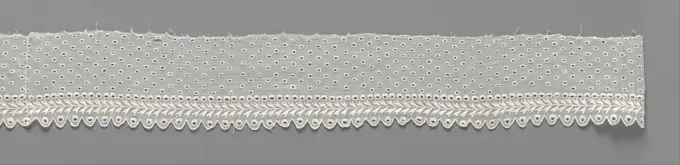
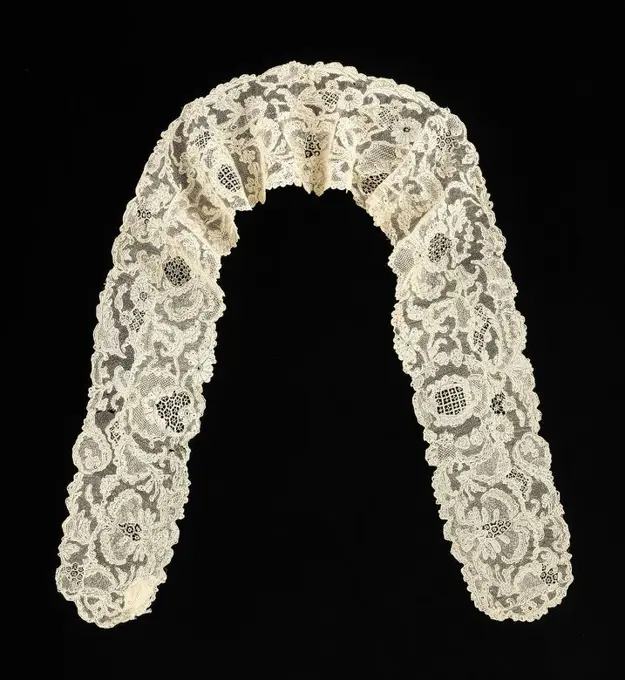
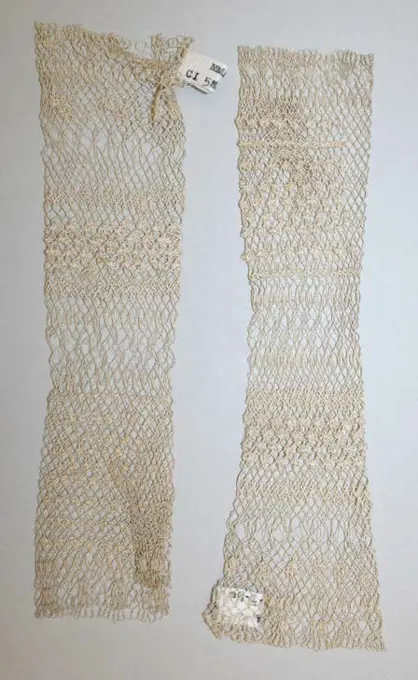
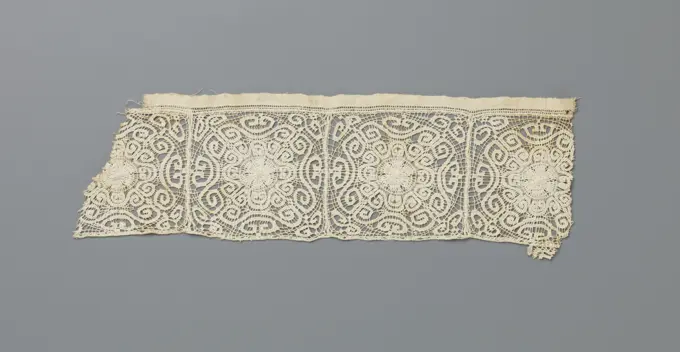
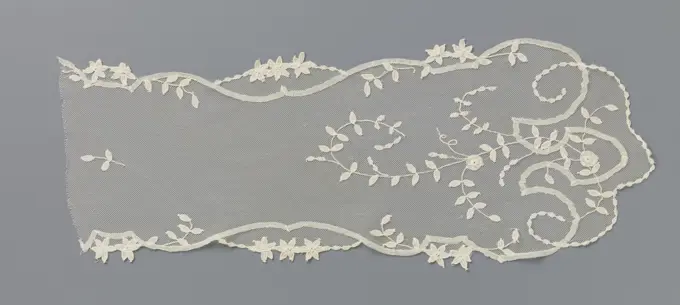
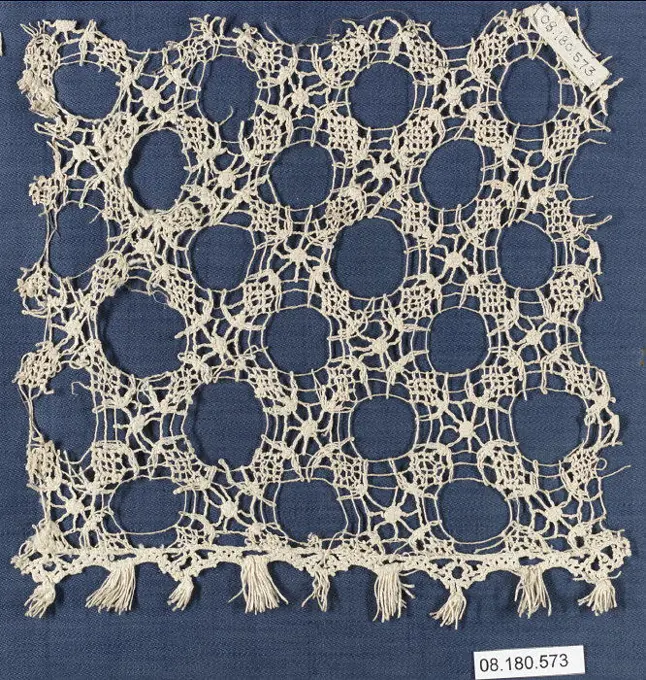
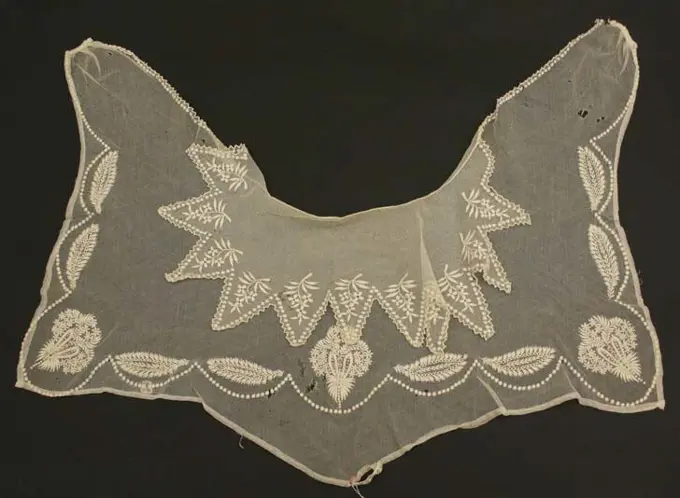
A collection of intricate lace strips featuring floral and leaf patterns, showcasing historic lace-making techniques in natural hues.

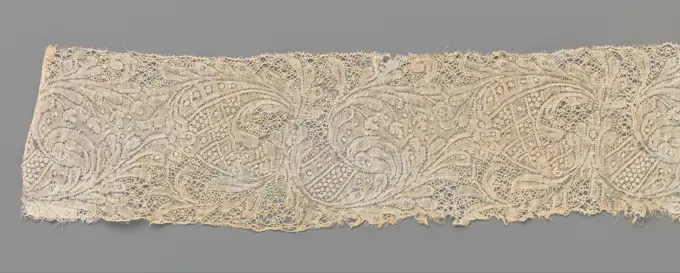
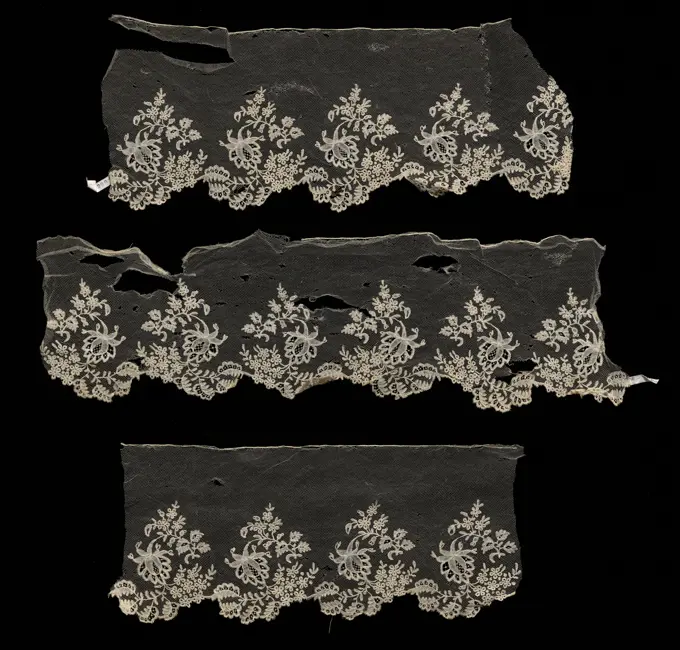
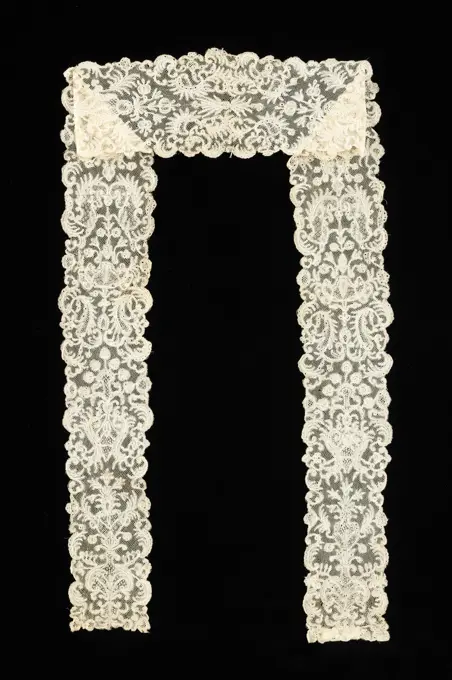
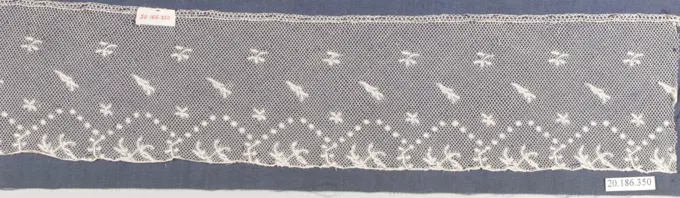
Strip bobbin with two volute leaves in vase, anonymous, c. 1850 - c. 1899  Strip of natural -colored bobbin: Beverse side. The repeating and symmetrical pattern consists of a flower pot with, to the left and right, a long lateral branch with two flowers and above it a cone -shaped motif between two large volute leaves. Between the successive pots there is a small flower pot with five rosette flowers along the top and right underneath an oval covered with leaves. The motifs are connected by a fine grid, a tuler land. The motifs are made in linen battle, with thicker and shiny contour threads. A rose soil has been used as a decorative soil and a decoration has been realized with crossing couples in the volute leaves. The top and bottom of the strip are straight finished, with the bottom with picots. Lille cotton (textile) bobbin lace
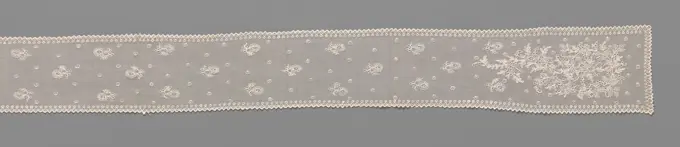
Strip bobbin with two volute leaves in vase, anonymous, c. 1850 - c. 1899 Strip of natural -colored bobbin: Beverse side. The repeating and symmetrical pattern consists of a flower pot with, to the left and right, a long lateral branch with two flowers and above it a cone -shaped motif between two large volute leaves. Between the successive pots there is a small flower pot with five rosette flowers along the top and right underneath an oval covered with leaves. The motifs are connected by a fine grid, a tuler land. The motifs are made in linen battle, with thicker and shiny contour threads. A rose soil has been used as a decorative soil and a decoration has been realized with crossing couples in the volute leaves. The top and bottom of the strip are straight finished, with the bottom with picots. Lille cotton (textile) bobbin lace
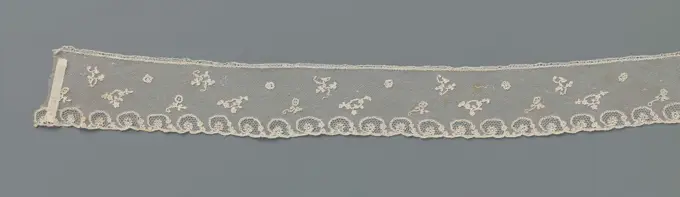
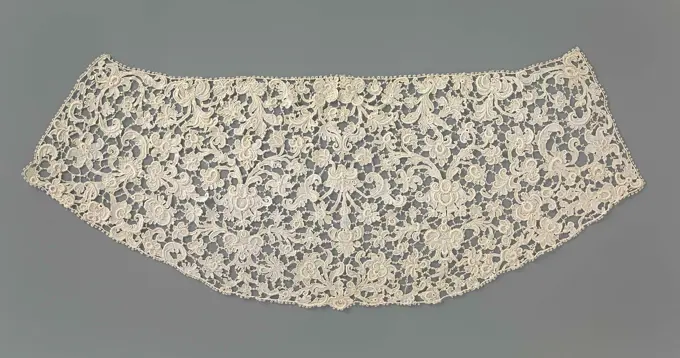
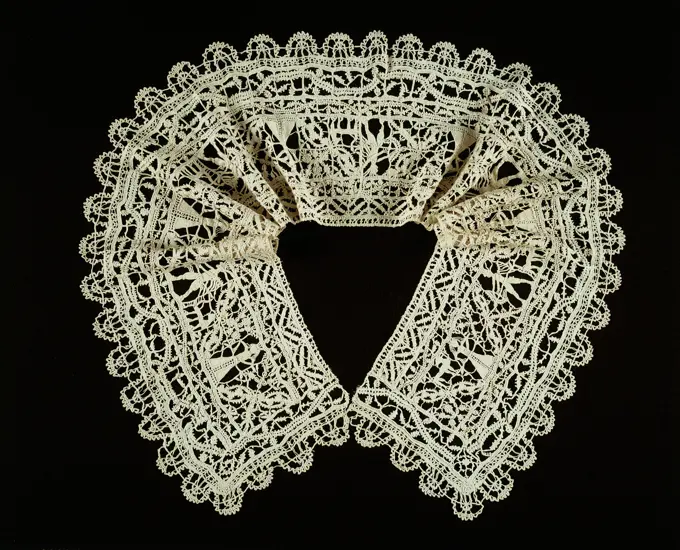
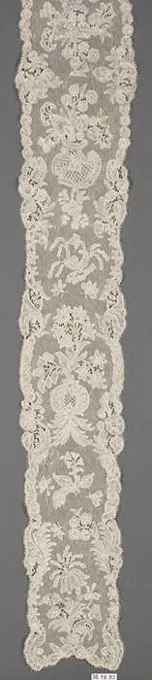
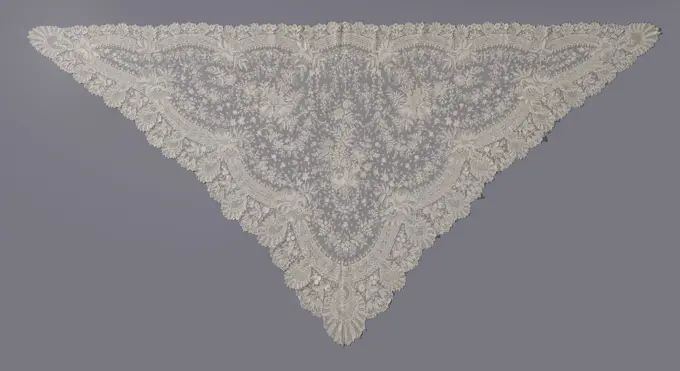
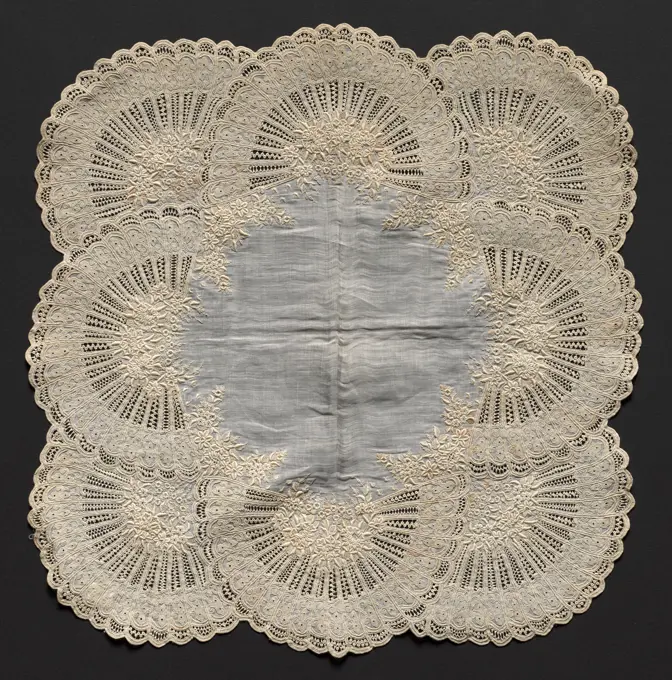
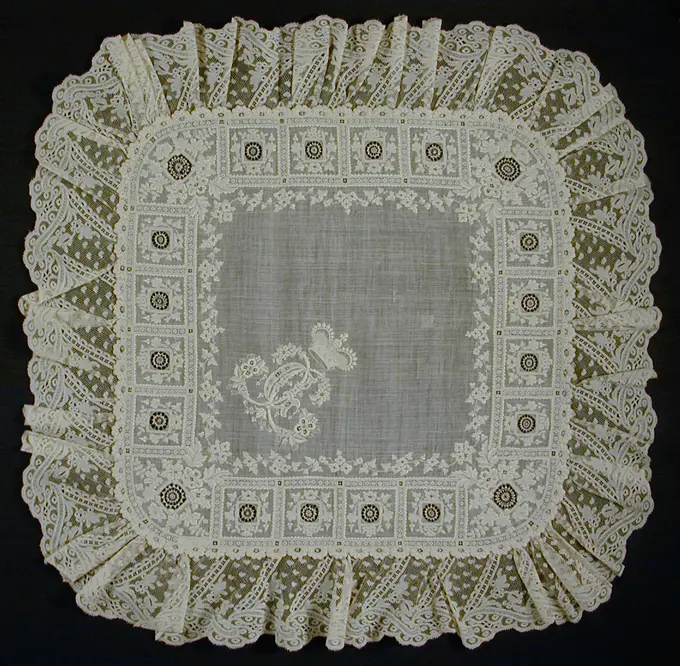
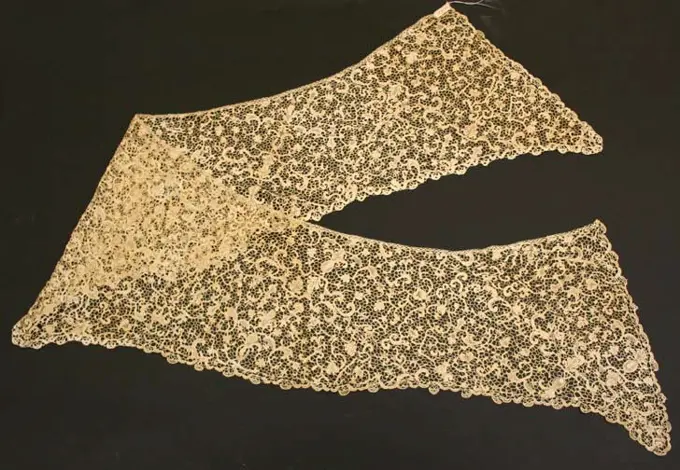
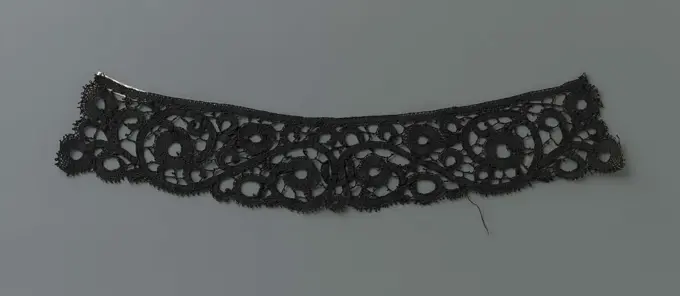
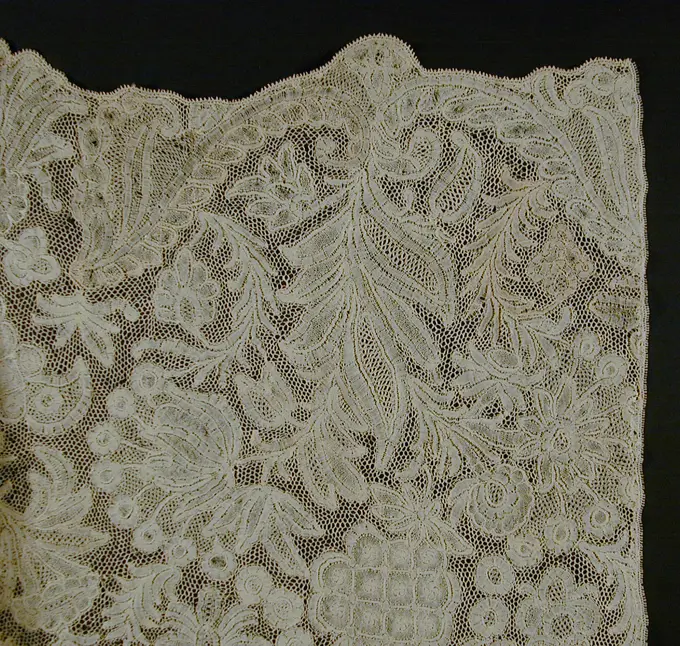
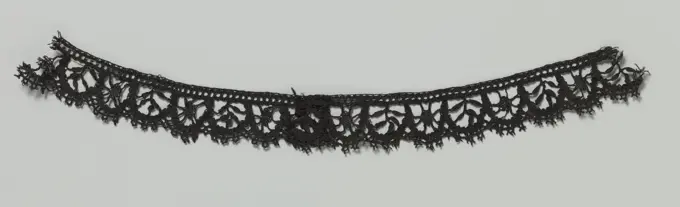
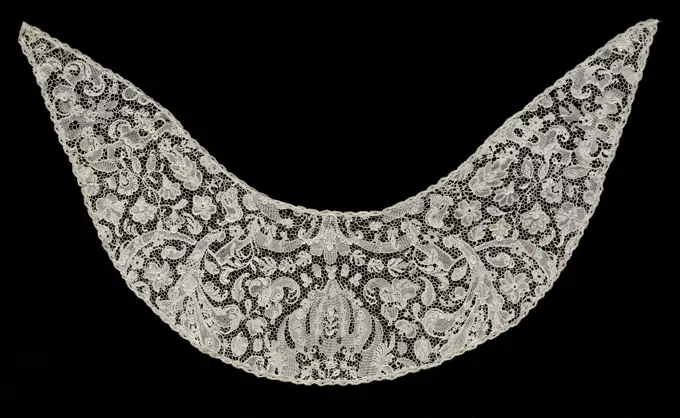
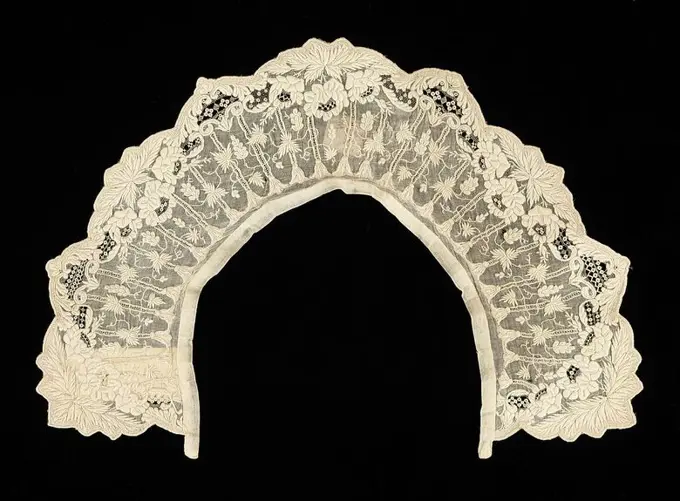
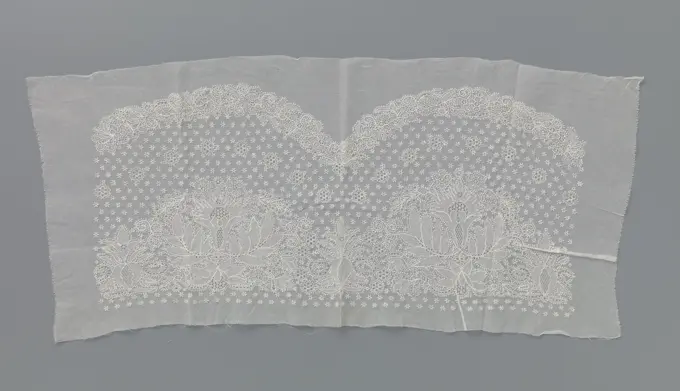
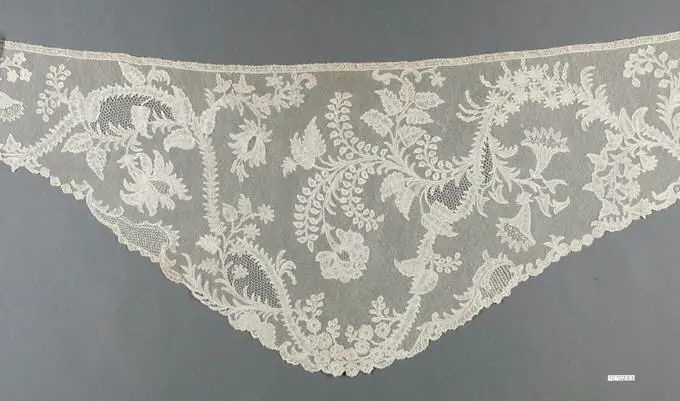
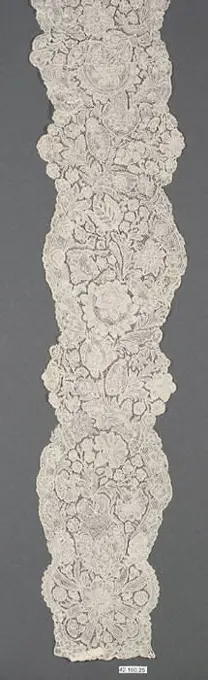
Strip bobbin with feathered leaves in large arches from five -lobbig center, anonymous, c. 1715 - c. 1725 Strip of natural-colored bobbin: binche side. The repeating pattern consists of feathered leaves, moving over the strip over the strip from a five -lobbig center. Between the leaves, the pattern is partly filled with sloping stripes and partly with diamonds on the other side of the center. The motives are against each other and partially overlap each other. Where they don't touch each other, they are connected to each other by a fine decorative soil, a snowflake ground. The motifs are made in linen battle with recesses and openwork edges and in netslag. The top of the strip is straight finished, but ragged due to damage. The bottom is straight finished and provided with picots. Binche linen (material) bobbin lace / Binche lace / snowflake filling Strip of natural-colored bobbin: binche side. The repeating pattern consists of feathered leaves, moving over the strip over the strip frStrook applicatiekant met strooipatroon en rozetjes in ovaaltjes langs de onderzijde.Strip natural colored Brussels application side: needle side applicated on slighten ground. The repeating pattern consists of a scattering pattern of twigs and various rosette flowers with or without stem and along the underside of the strip of oval formed by a strong curled twig with a rosette at the end. The motifts are mainly made of widely spotted thread bundles. As ornamental ground, a coarse hexagonal maas soil has been applied in the ovals. The top is finished with a separate clust strap. The very bland scaled underside is finished with very fine picots.Fragment (Belgium); linen; Bequest of Marian Hague; 1971-50-402Jabot van naaldkant met waaiervormige palmetten.Jabot of natural needle side: Venetian relief side. Fan-shaped. Standing seams are visible in the middle and seams. In the large middle pieces, with a generally symmetrical pattern, impeller-shaped palmets are above two hanging tendrils with flowers, under a smaller varied palmet. The pattern of the tendrils and star-shaped flowers is carried out very detailed and lights clearly against an open bar soil.Valance, Medium: linen Technique: withdrawn element with embroidery, Symmetrical design of horse drawn coach in profile on either side of tripartite domed building. Many incidental human and plant forms. White on white with squared mesh ground. Symmetrical vermicular design in big shallow lobes of bobbin lace border., Russia, 19th century, embroidery & stitching, ValanceGalloon 17th-18th century French. Galloon 213914Band; linen; Bequest of Marian Hague; 1971-50-363Edge, Medium: linen Technique: bobbin lace (Valenciennes ground), Conventionalized flower motif in square field., 17th century, lace, EdgeWoman's Fichu. Belgium, lace made 1750-1800; constructed circa 1780-1790. Costumes; Accessories. Linen, linen Brussels bobbin lace trimCollar (Made from Border) Made 1575-1625 Italy. Linen, three bands of needle lace worked on a plain weave; cut and drawn work grid; edged with bobbin straight lace .Collar, Technique: applique, bobbin lace, Bobbin lace applique collar, floral scalloped; mid-19th century, mid-19th century, lace, CollarStrip of needle side with birds and lions and dogs, anonymous, c. 1625 - c. 1649 Strip of natural -colored needle side: Punto in Aria. Spread between a few flowers on a partly wavy and partly winding slender, various animals can be discovered including birds, lions and dogs. A large flower originates at a great distance from the top and bottom, always different in shape. The motifs are made with feston stitches and partly with decorative stitches. Light relief contours have been installed along various motifs. Only a few bars have been used to connect the motifs (better). Some animals have extra stitches with which a dot pattern is made. Top and bottom of the strip are straight finished with the bottom with a row of roadpicots. Italy linen (material) Strip of natural -colored needle side: Punto in Aria. Spread between a few flowers on a partly wavy and partly winding slender, various animals can be discovered including birds, lions and dogs. A large flower originates at a great distancHandkerchief Made 1870-1900 France. .Fragment 17th-18th century Italian or German. Fragment 217765Band, Medium: linen Technique: grid of laid cord with needle lace (reticella style), Spain, late 16th-early 17th century, lace, BandBobbin (Point Plat Applique) and Machine Lace Flounce, 19th century. Belgium, Brussels, 19th century. Lace, bobbin; average: 15.9 x 38.1 cm (6 1/4 x 15 in.).Cover; linenLappet 18th century Flemish or French. Lappet 226299Fragment, Medium: linen Technique: bobbin lace, Binche style with no ground, Fragment of a band with flowers on a vine., Belgium, late 17th century, lace, FragmentBatist cuff, decorated with whitework, anonymous, c. 1800 - c. 1825 Batist cuff, decorated with whitework in the form of moes, feathers and leaves. The scoops have been fested. West-Europa batiste Batist cuff, decorated with whitework in the form of moes, feathers and leaves. The scoops have been fested. West-Europa batisteNeedle's slip with a symmetrical pattern of thin curls with multifaceted flowers, anonymous, c. 1685 - c. 1699 Slip of natural -colored needle side: flat Venetian side. The symmetrical pattern consists of thin terres that move winding from the middle and end with many curling branches in numerous flower species. The slip is finished with a straight edge, along which two types of potented arches. The motifs are connected by bars with picots. Venice linen (material) flat Venetian (needle point) Slip of natural -colored needle side: flat Venetian side. The symmetrical pattern consists of thin terres that move winding from the middle and end with many curling branches in numerous flower species. The slip is finished with a straight edge, along which two types of potented arches. The motifs are connected by bars with picots. Venice linen (material) flat Venetian (needle point)Trianganic Shawl of coniferous side with lilies and papers, Maison Sacré, 1894 Scarf of natural -colored mixed side: Brussels side. Triangular model. Along the three sides runs a wide, wavy list, surrounded by an edge of alternately chalice flowers and asymmetrical medallions of C-Voluten; The latter increases in size to the tip of the back piece. The list consists of five jobs, the middle of which is set with large wheels. On the wave tops there are bouquets of a very large lily and a poppy. In the field there are three bouquets, the middle one, largest, is composed of poppies, screen flowers and Spirea, the outer ones contain a poppy and lilacs. The stock is littered with fine swingers (bobbin), which limits a border part strewn with mushes. Numerous arguments and leaves are divided by the grain into a bright white and a blurred stock. Point the Gaze de Bruxelles. Brussels linen (material) mixed lace / Brussels point de gaze Scarf of natural -colored mixed side: Brussels side. TriangFragment; linenCover, Medium: linen Technique: cutwork with embroidery (center), bobbin lace of continuous braid like work (edge), Small square cloth with entire surface divided into lozenges with each lozenge subdivided into four small lozenges with crosses of reticella. Border of pointed triangular tabs of bobbin lace., Italy, 16th century, lace, CoverFragment (Italy); linen; Bequest of Marian Hague; 1971-50-355Handkerchief third quarter 19th century French. Handkerchief. French. third quarter 19th century. flax, cottonChalice cover, Medium: linen Technique: needle lace, In the center is a medallion containing the initials 'IHS' surrounded by highly stylized floral forms with an outer border., Italy, late 16th-early 17th century, lace, Chalice coverCollar 19th century American. Collar 98047Strip made of scalloped cloth with white embroidery and ajour work, anonymous, c. 1840 - c. 1860 Strip made of scalloped cloth with white embroidery and ajour work Netherlands (possibly) buckram embroidering Strip made of scalloped cloth with white embroidery and ajour work Netherlands (possibly) buckram embroideringLappet. Culture: French. Date: 1740-60. Museum: Metropolitan Museum of Art, New York, USA.Show Towel 1794 American. Show Towel. American. 1794. Linen embroidered with silk. Made in Pennsylvania, United StatesMitts ca. 1882 French. Mitts 104205Lace unknownStrip of needle side with à-Jour medallions, anonymous, c. 1770 Stretched scales are formed by leaves with an openwork Middle Need, a round flower and medallions with coarse grid. The soil in the middle part has been renewed. Alençon side. France linen (material) Alençon Lace Stretched scales are formed by leaves with an openwork Middle Need, a round flower and medallions with coarse grid. The soil in the middle part has been renewed. Alençon side. France linen (material) Alençon LaceFragment 16th century possibly Greek. Fragment. possibly Greek. 16th century. Bobbin lace. Textiles-LacesBand, Medium: linen Technique: appliqué on net; bobbin lace, Lace border with a fine net ground with designs in bobbin lace applied by hand. Medallions frame alternately birds with extended wings and quivers with arrows; with sprays of flowers in between. Surrounded by scrolling lines, scalloped edge top and bottom., late 18th century, lace, BandFanchon or tie from edge embroidery on tulle with a curly leaf branch with berry branches and two clusters of three rosette flowers at both ends. Fanchon or tie of natural-colored edge embroidery on tulle: tuledo strop. Elongated rectangular model. At the ends, the pattern consists of a curling branch with incised leaves, leaf packs, berry branches and two clusters of three rosette flowers. The field is filled with a spreading pattern of flour branches with a single rosette flower, an incised leaf and berries on it and between scattered 'moes' made with a thread that forms a double circle. The tie or fanchon is finished with a fine slip border with triangular scallops along which a list is embroidered with a double zigzag line with circles on the tops. A type of ornamental soil has been created between the Zigzag lines with an additional wire with which larger openings are made in the tulle.Pair of lappets first half 18th century Flemish, Brussels. Pair of lappets 226949Bertha 19th century French. Bertha 102592Collar (Belgium); linen; 1933-1-189Fragment 17th century Italian. Fragment 214908Linen Batist handkerchief with a border bobbin and plumetis embroidery, anonymous, c. 1840 - c. 1849 Linen Batist handkerchief with a border bobbin - Lille side - and plumetis embroidery. The side is smoothed along the sides and wrinkled in the corners. It has a flatly potented scales along the outer edge, which comes from a running pattern with a simple flower branch and half -oval cartouches filled with decorative soil. Fine Maas soil with fullwork in linen stroke and contour lines with a thicker wire. The plumetis pattern consists of a fine slender that runs around the handkerchief and a bouquet in every corner. Netherlands (possibly) linen (material). bobbin lace / Lille lace / embroidering Linen Batist handkerchief with a border bobbin - Lille side - and plumetis embroidery. The side is smoothed along the sides and wrinkled in the corners. It has a flatly potented scales along the outer edge, which comes from a running pattern with a simple flower branch and half -oval cartouches Collarette 18th century Flemish, Brussels. Collarette 218850Fragment; linenStrip of needle side with volute straps that form a sun, anonymous, c. 1700 - c. 1799 Strip of natural-colored solar side (needle side): Tenerife side. In four next to each other, a square fields is a repeating and symmetrical pattern of a 'sun' that is made up of narrow volute bands. In the center of the square field there is a round flower around which the volute straps form a four -lobe motif. Other volute straps form a circle around the four -lobby motif. In the corners of the square field, which is filled almost entirely by the sun, there is a branched S-Volute. The top of the strip is finished with a narrow edge of linen with a simple openwork edge. The first and the last square field were partly cut, one of which is slipped diagonally. Spain linen (material) sun lace / Tenerife lace Strip of natural-colored solar side (needle side): Tenerife side. In four next to each other, a square fields is a repeating and symmetrical pattern of a 'sun' that is made up of narrow volute bands.Embroidered Handkerchief, second half of 1800s. Switzerland. Embroidery: linen; average: 34 x 34 cm (13 3/8 x 13 3/8 in.).Border; 1974-52-39Collar 1830s British. Collar 118929Fragment (France); linenBorder. Date/Period: 1600-1650. Border. Medium: linen. Technique: bobbin lace, discontinuous tape. Author: UNKNOWN.Bobbin Lace Insertion without Selvage, mid 16th century. Italy, Venice, mid 16th century. Lace, bobbin; average: 6.7 x 23.6 cm (2 5/8 x 9 5/16 in.).Strip of a climbing side with windows and dark blue fan shutpen. Strip colored dick edge: sloping side. The colors used are natural and dark blue, the natural color dominated. The repeating pattern exists along the underside of the strip from dark blue impeller-shaped slot off against each other. One window is always placed above the slip edge in the space between the fans. There are two variations in windows that alternate each other. One window is made in a cut-off and has a Spitsuale in the openwork center. The other diamond is made up with four corner points in linen stroke, which are interconnected by crossing couples and in the center through a contemporary Flanders battle. On the top of the strip, the windows are connected by a grille: a nozzle ground. The ground is decorated with dark blue meadows made in shape stroke. There are always four meadows in diamond-shaped configuration between the windows. The top of the strip is straight finished.Handkerchief. 1800 - 1899. Costumes; AccessoriesBertha early 18th century French. Bertha 102617Collar or edge of black climbing side with a symmetrical spiral drinks with oval flowers with open flower heart. Collar of Blacklock Edge: Venetian Clamping Side or Cantu Side. Symmetrical Pattern with Spiral Drinks and Oval Flowers with Open Flower HeartPiece 17th century Italian, Venice. Piece 214879Lappet first quarter 18th century Flemish The variations of vase forms and the overall fanciful quality of the design are the notable features of this piece and are expressive of the design vocabluary used in the decorative arts and textile design of the early eighteenth century.. Lappet. Flemish. first quarter 18th century. linenCollar, Medium: linen Technique: bobbin motifs with needle lace ground (the needle lace ground is loop & twist with loop & twist return), Lace made of bobbin motifs on needlepoint ground. Design shows floral swags (roses, buds and leaves) above a scalloped edge formed by oval and circular medallions., mid- 19th century, lace, CollarBobbin Lace Edging of Points, mid 16th century. Italy, Venice, mid 16th century. Lace, bobbin; average: 3.9 x 16.5 cm (1 9/16 x 6 1/2 in.).Fragment of Alb Flounce. Belgium, Brussels or Brabant, 1700-1750. Costumes; ecclesiastical. Linen bobbin laceDecoration for an evening casing of mixed side with rosen hedge. Decorative piece for an evening casing of natural-colored mixed side - climbing side in combination with coniferous lace - Brussels Duchesse. In a widely spread braid soil there are roses that usually support two leaves. An intermediate ornament consists of a few and double voluntaries and many small flowers.Fichu. Culture: American. Date: ca. 1835. Museum: Metropolitan Museum of Art, New York, USA.Batist strip decorated with English embroidery, c. 1875 - c. 1925 Cotton batist strip decorated with English embroidery in the form of flowers. The strip is trimmed with a founded Schulprand. West-Europa whole: Cotton (textile) Cotton batist strip decorated with English embroidery in the form of flowers. The strip is trimmed with a founded Schulprand. West-Europa whole: Cotton (textile)Insertion ca. 1600 Italian, Siena. Insertion 218016Hoedensluier of voile van naaldkant met ruitvormige medaillons.Hat veil of natural needle side: a combination of Argentan-side and Alençon side. Rectangular elongated model. The veil has a pattern of diamond-shaped medallions in which a loose flower branch. Double-pulled slotted slots along the edges.Border; linen; 1933-1-174Carpet fragment, William Morris, (British, 1834-1896), Medium: wool Technique: plain weave, Small fragment of wool tabby showing pattern of a lily in shades of pink, yellow, and light blue against a darker blue background., England, 1877, woven textiles, Carpet fragmentEdging early 19th century French or Flemish. Edging 221161Fragment early 19th century Dutch, Turnhout or Sint-Truiden (Saint Trond). Fragment 214752Fragment; linenPastel lace ribbon isolated shot Delicate pastel color lace ribbon isolated shot ,model released, Symbolfoto Copyright: xZoonar.com/AndreyxGuryanovx 14343633 ,model released, Symbolfoto ,property releasedStrip bobbin with bow edge in which alternately stand a leaf branch and a round between spokes, anonymous, c. 1900 Strip of black bobbin, cluny side. The repeating pattern consists of an arc edge, where the bows are the sculpts. In each arch there is alternating a branch with five leaves and a round between spokes. The straps that form the arches are made in linen battle. The circles in it are made in mains and the leaves on the twigs are made in shape. The motifs are connected by a braid ground. Along the bottom hang three lobes on each bow, made with braids and finished with a few picots. The top of the strip is straight finished. France (possibly) silk bobbin lace / Cluny lace Strip of black bobbin, cluny side. The repeating pattern consists of an arc edge, where the bows are the sculpts. In each arch there is alternating a branch with five leaves and a round between spokes. The straps that form the arches are made in linen battle. The circles in it are made in mains and the leaves Needlepoint (Point de France) Lace Collar, late 17th-early 18th century. France, late 17th-early 18th century. Lace, needlepoint: linen; overall: 38 x 63 cm (14 15/16 x 24 13/16 in.).Collar. Culture: European. Date: 1830-50.This collar has a particularly detailed and unusual design motif. The complex embroidery and the lotus form taken from the Egyptian design vocabulary sets it apart from the usual. Museum: Metropolitan Museum of Art, New York, USA.Heat ball in the making of lace plaque on mechanical tulle, anonymous, c. 1850 Rectangular piece of machine tulle with natural -colored lace -up work, tuledoor stop work. It is probably meant to eventually turn it into a hat ball. The symmetrical pattern consists of two semicircular arches made with a continuous volute drink with rosette flowers. Below that a spray pattern of star -shaped flowers. From the bottom of the spreading pattern, a large raised chalice flour rises under each arch, placed in a bowl of two composite leaves with a hanging flower under it. The chalumps are flanked by smaller heart -shaped flowers or fruits. All motifs, with the exception of the star -shaped flowers in the spreading pattern, have dotting contour lines. West-Friesland  embroidering Rectangular piece of machine tulle with natural -colored lace -up work, tuledoor stop work. It is probably meant to eventually turn it into a hat ball. The symmetrical pattern consists of two semicircular arches made withCap 1829-40 French. Cap 102546Strook naaldkant met spinnen in vierkanten en een zigzagrand.Strip natural-colored coniferous side, carved work. Pattern with squares that are varied cross-sections with diagonals or horizontal lines, creating stars or fine square grid work. Spiders are hanging in other squares. A zigzag edge at the bottom. The top is finished with narrow row of contiguous and openwork small squares. At the top, a piece of cotton is sewn to two-thirds of the length.Piece 18th century French. Piece 214180Fichu 18th century Flemish. Fichu 218812Stomacher Made 1801-1900 France. Cotton, plain weave; embroidered .Fragment; linen; 1933-1-106Collar composed of different pieces of needle side with flowers and exotic fruits, anonymous, c. 1870 - c. 1899 Collar composed of one or more pieces of natural-colored needle side: Argentan side. Curved strip -shaped model. Pattern with flowers, leaves and fruits. A symmetrical motif in the middle consists of a semi -circular arch crowned by a rosette. Four long feathered leaves spring from the rosette above each other and bend over the arch. Under the arch a five -lobe flower, possibly a French lily. The rest of the pattern is not entirely symmetrical and consists of flowers (carnations, rosette flowers), exotic fruits including a pomegranate pottery motif and volutes. It is reminiscent of patterns of the silk fabrics of ca. 1715-1725, which in turn could be inspired by lace patterns. The motifs are made with feston stitches with recesses, decorative stitches and cordons with and without picots around Bloemharten, among others. The motifs are connected by a hexagonal Maas soil. The mHat of Vieux Bruxelles Kloskant, Anonymous, c. 1740 - c. 1750 Hatsbol van Kloskant. The pattern consists of a vase motif in which three flower branches. There are leaf and flower vases around the vase in which potented bars are incorporated. Brussels . Brussels bobbin lace Hatsbol van Kloskant. The pattern consists of a vase motif in which three flower branches. There are leaf and flower vases around the vase in which potented bars are incorporated. Brussels . Brussels bobbin laceFragment, Medium: linen Technique: bobbin lace (continuous tape with net added), Fragment of a continuous tape lace with a Valencienne-like braided ground., 17th century, lace, FragmentLace, 1800-1850, Brussels, maker unknown. Gift of Mrs G. Acland Allen, 1955.Passementerie, Linen; bobbin lace, DenmarkFragment 17th century or probably later Swedish. Fragment 215367Cuff of linen with open worked crown with irregularly serrated edge and trimmed with scalloped bobbin, anonymous, c. 1910 - c. 1920 Cuff of linen with openwork crown with irregularly serrated edge and trimmed with scalloped strip of bobbin. Equipped with button closure with three buttons and fested button holes. The left copy.  linen (material) embroidering / bobbin lace Cuff of linen with openwork crown with irregularly serrated edge and trimmed with scalloped strip of bobbin. Equipped with button closure with three buttons and fested button holes. The left copy.  linen (material) embroidering / bobbin laceLace Edging, early 19th century. Spain, early 19th century. Knitting; average: 11.5 x 24.2 cm (4 1/2 x 9 1/2 in.).Strip of a climbing side with star in heart-shaped scallop and circle. Strip natural colosside, cluny side. The original strip has been used or intended for furniture, there is a short piece that is mercy to see a part of the pattern. The upper half of this pattern consists of a circle in which a diamond-shaped contour with a rounded corners stands, with a star in the center. Under the circle, the contour is made of a heart, the curves of which are circulating in sloping C volutes. There is also a star in the center of the heart, made with braids. Along the bottom of the heart and the C-Volutes, a wide bond is made, which forms the edge of the large lobby and heart-shaped glule. As well as the band of the circle, this band is made with varied linen stroke. The narrower straps with which, among other things, the window, the heart and the C volutes are formed, are made in linen stroke with openwork edges. The motifs are connected by a braid of double and picoted braids. The top of the stSlip of mechanical ribbon side with tire work, anonymous, c. 1920 Slip of natural -colored machine ribbon side, belonging to an Echarpe. The slip has a lobed end and an unfinished start. An open, symmetical pattern of thin spiral vines, with widely spread leaves and florets, is framed by a flat scalley, formed by a smooth list and star flower. Belgium linen (material). cotton (textile) Slip of natural -colored machine ribbon side, belonging to an Echarpe. The slip has a lobed end and an unfinished start. An open, symmetical pattern of thin spiral vines, with widely spread leaves and florets, is framed by a flat scalley, formed by a smooth list and star flower. Belgium linen (material). cotton (textile)Bobbin Lace Insertion, late 16th century. Italy, Venice, late 16th century. Lace, bobbin; average: 4.2 x 46.4 cm (1 5/8 x 18 1/4 in.).Sampler, Medium: linen Technique: withdrawn element work with needle lace fillings, satin, cross, back, and double running stitches on plain weave, Cross borders in withdrawn element work and embroidery., England, 1657, embroidery & stitching, SamplerFragment 17th century Italian. Fragment 214923Collar ca. 1860 American. Collar 170231Collar Made 1880-1899 Belgium. Cotton, needle lace of a type known as Point de Gaze .Bobbin Lace Edging, 18th century. Belgium, Mechelen, 18th century. Lace, bobbin: linen; average: 4.5 x 59.7 cm (1 3/4 x 23 1/2 in.).Cuff early 19th century Swedish. Cuff 222075Collar ca. 1855 American. Collar 170430Fichu 1700-1938 European. Fichu 119084