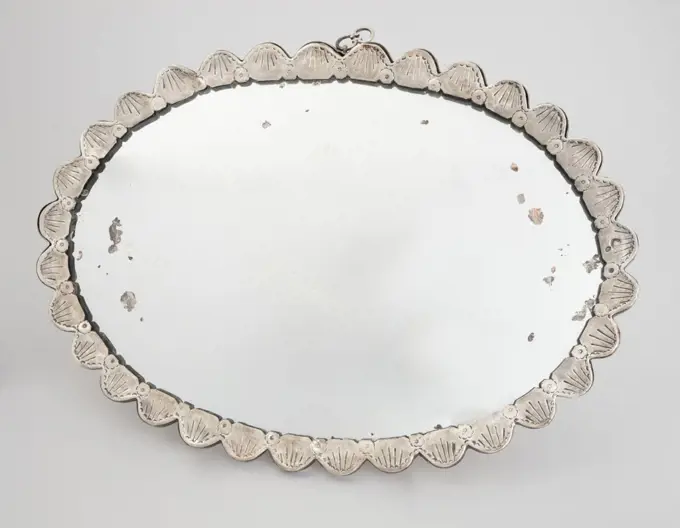
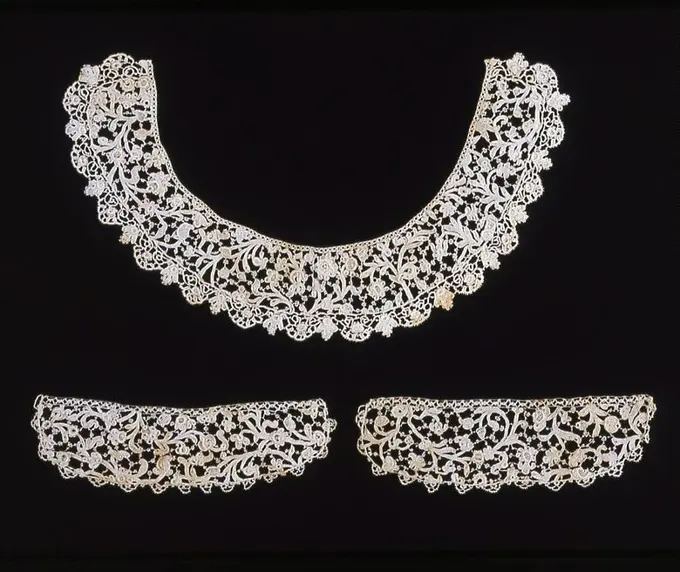
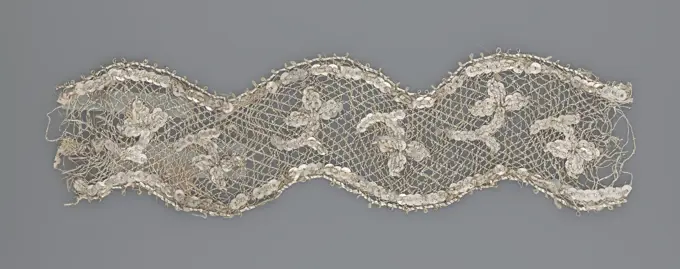
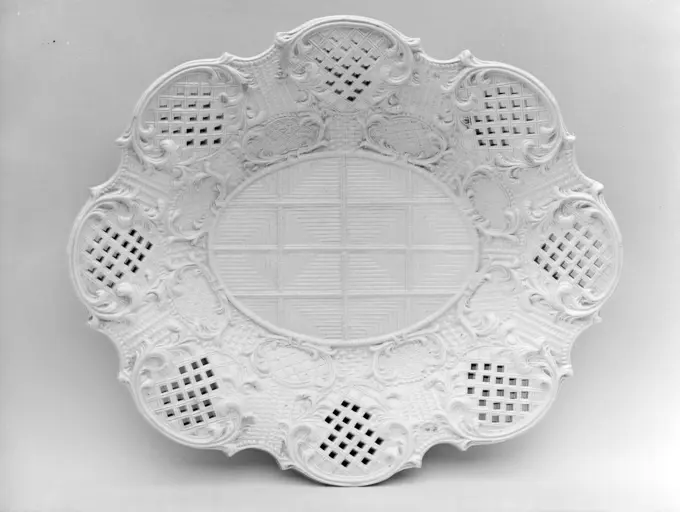
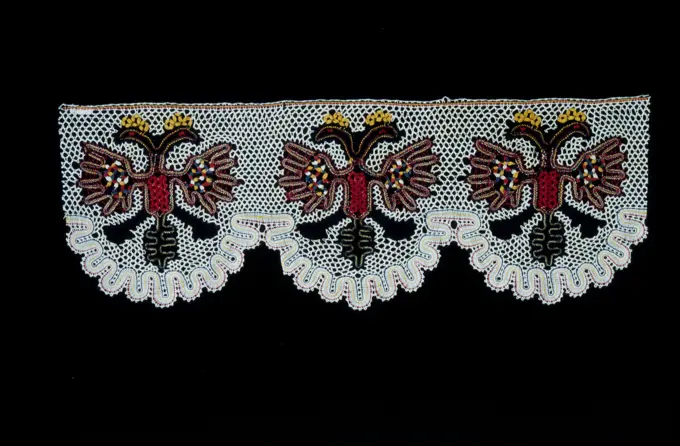
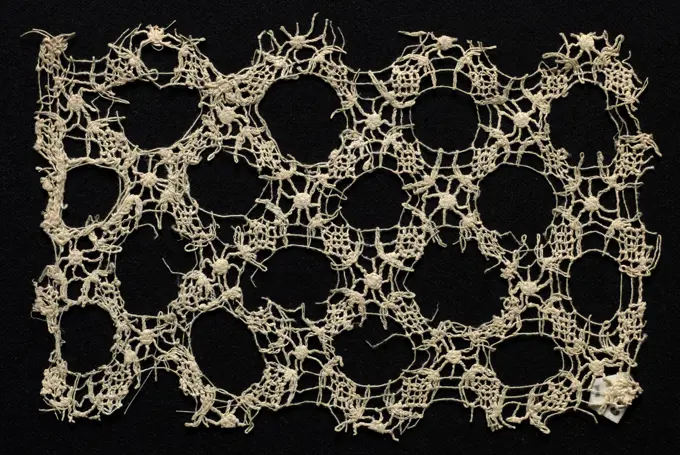
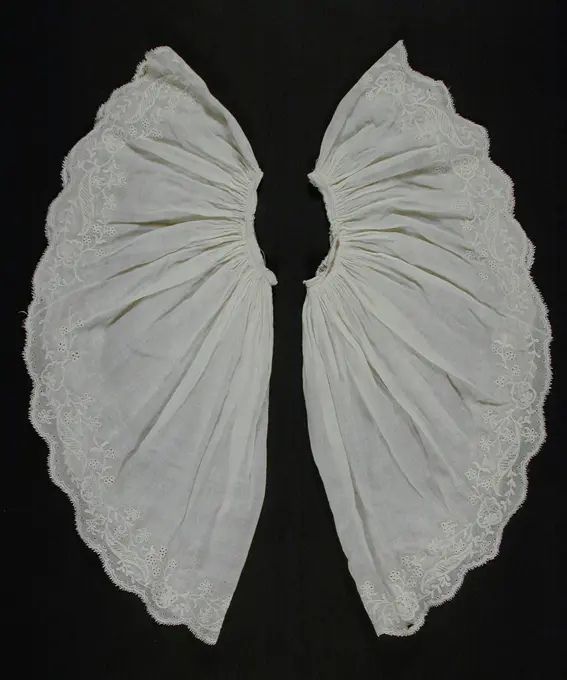
Delicate Lace Trimmings

A collection of intricate lace strips featuring floral and leaf patterns, showcasing historic lace-making techniques in natural hues.

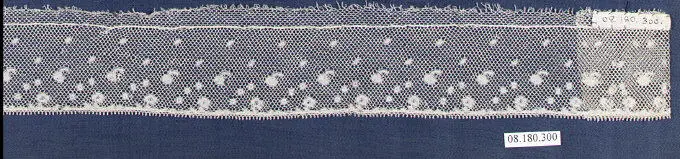
Strip bobbin with two volute leaves in vase, anonymous, c. 1850 - c. 1899  Strip of natural -colored bobbin: Beverse side. The repeating and symmetrical pattern consists of a flower pot with, to the left and right, a long lateral branch with two flowers and above it a cone -shaped motif between two large volute leaves. Between the successive pots there is a small flower pot with five rosette flowers along the top and right underneath an oval covered with leaves. The motifs are connected by a fine grid, a tuler land. The motifs are made in linen battle, with thicker and shiny contour threads. A rose soil has been used as a decorative soil and a decoration has been realized with crossing couples in the volute leaves. The top and bottom of the strip are straight finished, with the bottom with picots. Lille cotton (textile) bobbin lace
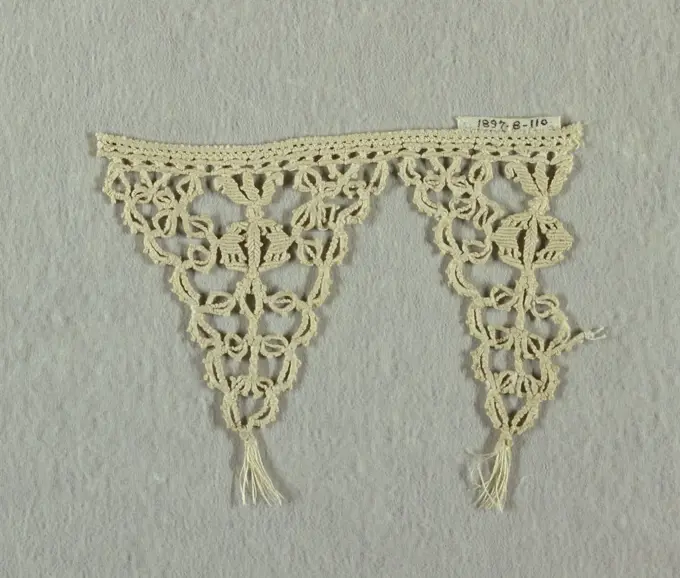
Strip bobbin with two volute leaves in vase, anonymous, c. 1850 - c. 1899 Strip of natural -colored bobbin: Beverse side. The repeating and symmetrical pattern consists of a flower pot with, to the left and right, a long lateral branch with two flowers and above it a cone -shaped motif between two large volute leaves. Between the successive pots there is a small flower pot with five rosette flowers along the top and right underneath an oval covered with leaves. The motifs are connected by a fine grid, a tuler land. The motifs are made in linen battle, with thicker and shiny contour threads. A rose soil has been used as a decorative soil and a decoration has been realized with crossing couples in the volute leaves. The top and bottom of the strip are straight finished, with the bottom with picots. Lille cotton (textile) bobbin lace
Batist intermediate mate with whitework from forget-me-not and stars, anonymous, c. 1850 - c. 1860 Piles of natural batist with whitework. Within openwork lists there is an ongoing pattern of forget-me-not with stems in the longitudinal direction, to which three forget-me-not. There are eleven stars between each branch. The long sides are not finished. Netherlands (possibly) linen (material). batiste. buckram Piles of natural batist with whitework. Within openwork lists there is an ongoing pattern of forget-me-not with stems in the longitudinal direction, to which three forget-me-not. There are eleven stars between each branch. The long sides are not finished. Netherlands (possibly) linen (material). batiste. buckramPiece early 19th century French. Piece 214653Handmade Dream catcher with feathers and pearl rope hang on a white background handmade dream catcher with feathers and pearl rope hang on a white background copyright: xzoonar.com/fedorovaxdariax 22940488Strip bobbin with alternating a hanging flower and an S-Volute, Anonymous, c. 1740 - c. 1760 Strip of natural -colored bobbin: old Brabant side. The repeating pattern consists alternately of a hanging flower on a curved stem and a C-volute or a slight S-Volut. The flower shapes are alternating pear -shaped, three -lobe and oval -shaped. The motifs are placed close to each other and connected by a fine grid, the Mechelen soil. The motifs are made in linen and mains, with burst relief contours. Snow flake grounds are used as a decorative soil and, very limited, potented braids. The top is finished with a separate strap. The irregular scallops along the underside are alternately formed by a hanging flower and a volute and are finished with picots. Southern Netherlands linen (material) bobbin lace / old Brabant lace Strip of natural -colored bobbin: old Brabant side. The repeating pattern consists alternately of a hanging flower on a curved stem and a C-volute or a slight S-Volut. The flowStrook machinale kant met golvende bladerranken.Strip natural-colored machining. Spreading dot with dots on a fine hexagonal grille. Above the center runs a wavy band that consists of two thin tanks with small and larger leaves between which a dotted line. This band repeated under the middle, where it adds into the pattern of the scallop underside. This pattern consists of hanging rosette flowers that are connected to each other with dotted arcs with two circles. The top is cut and not finished. The short sides of the strip are sewn together.Plate ca. 1837-40 American or British. Plate. American or British. ca. 1837-40. Lacy pressed glass. Possibly made in England; Possibly made in United StatesUndersleeves 1850-65 British. Undersleeves 120027Kinderpolsmof van Kloskant lined with cream -colored silk, anonymous, c. 1700 - c. 1750 Kinderpolsmof of natural -colored bobbin side - Mechelen side - with a lining of cream -colored silk. Rectangular model with rounded end along which a wrinkled strip of Mechelse side is sewn. Mechelen Side: Linen (Material). Lining: Silk bobbin lace / Mechlin (lace) Kinderpolsmof of natural -colored bobbin side - Mechelen side - with a lining of cream -colored silk. Rectangular model with rounded end along which a wrinkled strip of Mechelse side is sewn. Mechelen Side: Linen (Material). Lining: Silk bobbin lace / Mechlin (lace)BorderBorders Made 1850-1869 Belgium. Cotton, needle lace of a type known as Point de Gaze .Collar Swedish, Skane 19th century View more. Collar. Swedish, Skane. 19th century. Bobbin lace. Textiles-LacesKloskant cuff with sickle-shaped leaf and flower branches, anonymous, c. 1830 - c. 1865 Cuff made of natural tulle with a border bobbin underneath: Mechelen side. The tulle is unadorned and slightly darker than the Mechelen side that is sewn on the tulle. Trapezium -shaped clocking model. The repeating pattern of the Mechelen side consists of semicircular scallops, formed by fine leaves on the outside of a curved rocaille motif. Long leaves feathered on the inside and a group of six rosette flowers or forget-me-nots. On the field above it blossoms. The motifs are made in linen battle and are accentuated by thicker shiny contour threads. The motifs are connected by a Mechelen soil. In the leaves there is a decoration with dots made in shape. The side is made in Belgium, the cuffs are made in the Netherlands. AmsterdamBelgium Unprocessed tulle: Silk. Unprocessed tulle:. Mechelen side: Linen (Material) bobbin lace / Mechlin (lace) Cuff made of natural tulle with a border bobbin underneathDiseño de joyas del siglo XVII. Colegio de argenters de Reus. Museum: Diseño de joyas del siglo XVII. Colegio de argenters de Reus.Fragment; linenMirror, Repoussé and chased silver, mirrored plate glass, Scalloped oval silver frame, engraved with radiating lines, holding mirror glass. Back repousse with scrolled wreath around flowers in frames radiating from center, which is covered by a separate piece of oval repousse silver. Suspension ring on one long side., Turkey, late 19th century, metalwork, Decorative Arts, MirrorEdging 16th century Italian, Venice. Edging 221097MelonCollar and Cuffs (From a Border). Italy, Venice. Date: 1675-1700. Dimensions: Collar measurements: a: 17.8 x 30.1 cm (7 x 11 7/8 in.)Lace width 5.9 cm (2 3/8 in.)b: 5.8 x 18.3 cm (2 1/4 x 7 1/4 in.)c: 5.4 x 18.6 cm (2 1/8 x 7 1/4 in.)Heading height: .5 cm (1/4 in.). Linen, raised needle lace. Origin: Venice. Museum: The Chicago Art Institute, Chicago, USA.Fragment of the lace;  18th century (1701-00-00-1800-00-00);Fan 1860-79 probably French. Fan 169517Pelerine quotation from Kloskant, Anonymous, c. 1840 Pelerine grain of natural -colored machine tulle decorated with strips of bobbin - Lille side - and lace plunge: tuledoor stop work. Half -circle -shaped model. The Pelerine is finished along the short sides and continuously along the neckline with a thicker fierce thread laid in loops, a flooded thread that is also called 'Laiton'. Closure with a button of pearl and festunned loop. LilleBelgium (possibly) Linen (Material). Wall -up Sierdraad:. Button: Mother of Pearl. bobbin lace / Lille lace Pelerine grain of natural -colored machine tulle decorated with strips of bobbin - Lille side - and lace plunge: tuledoor stop work. Half -circle -shaped model. The Pelerine is finished along the short sides and continuously along the neckline with a thicker fierce thread laid in loops, a flooded thread that is also called 'Laiton'. Closure with a button of pearl and festunned loop. LilleBelgium (possibly) Linen (Material). Wall -up Sierdraad:.Edge (Malta); silk; 1942-7-11Cap 19th century American. Cap 100197Plate 1740-60 British (American market). Plate. British (American market). 1740-60. Stoneware. Made in Staffordshire, EnglandBorder. Northern Italy. Date: 1701-1725. Dimensions: 19 x 311.7 cm (7 1/2 x 122 3/4 in.)Width repeat: 27-27.8 cm (10 5/8-11 in.). Linen, bobbin part lace of continuous clothwork tapestex. Origin: Italy. Museum: The Chicago Art Institute, Chicago, USA.Collar (Paraguay); cottonTextile, laceFontaneldoek van Linen with a strip of Mechelse side, with wavy border and open berries on a branch, anonymous, c. 1700 - c. 1800 Fontaneldoek van Linen with a strip of Mechelse side, with wavy border and open berries on a branch. Europe linen (material). Mechlin (lace) Fontaneldoek van Linen with a strip of Mechelse side, with wavy border and open berries on a branch. Europe linen (material). Mechlin (lace)Fragments, Medium: silk Technique: cut loops of a supplementary warp in a plain weave-like foundation (velvet) with a stamped pattern, Two shaped fragments of a stamped deep red cut velvet. Rows of offset flowers enclosed in detached 'S' and 'Z' curves which form a diagonal square grid., Italy, 16th century, woven textiles, FragmentsFragment with Wide Circular Pattern, 16th-17th century. Italy, 16th-17th century. Needle lace, mezza mandolina; bleached linen (est.); overall: 11.4 x 17.5 cm (4 1/2 x 6 7/8 in.). The mezza mandolina technique produces an irregular mesh netting, as opposed to the uniform knotted netting of filet/lacis needle lace. This piece gains the overall effect of the mesh netting through the lace makers use of large and small circular patterns.crocheted easter decoration in egg shape showing a bunnyFragment (Italy); linenPair of Engageantes. Probably France, circa 1750. Costumes; Accessories. Cotton embroidery and pulled work on cotton with bobbin lace edgingFragment, Medium: linen Technique: bobbin lace (continuous tape with connections), Fragment with a small-scale, wavy, ribbon-like, symmetrical foliate design., Belgium, 17th century, lace, FragmentCollar 1890s American or European. Collar 118963Basket 18th century Meissen Manufactory German. Basket 204624Fragment, Medium: linen Technique: knotting macramé, Two triangular pendant tabs ending in a small tassel., Italy, 17th century, knotted, knitted and crocheted textiles, FragmentEdging, Technique: bobbin lace, Bobbin lace sample joined, floral forms; early 18th century Pottikant Flemish, early 18th century, lace, Edging