Delicate Vintage Lace Strips

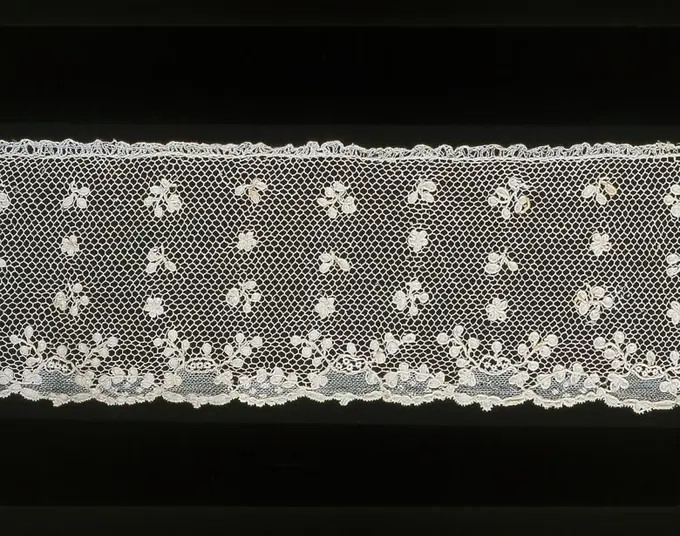
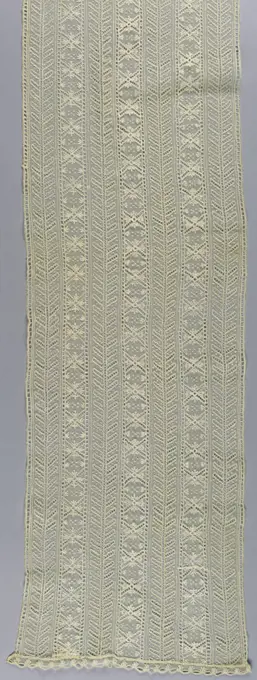
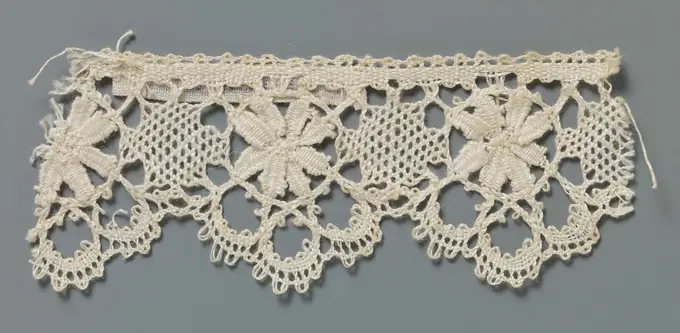
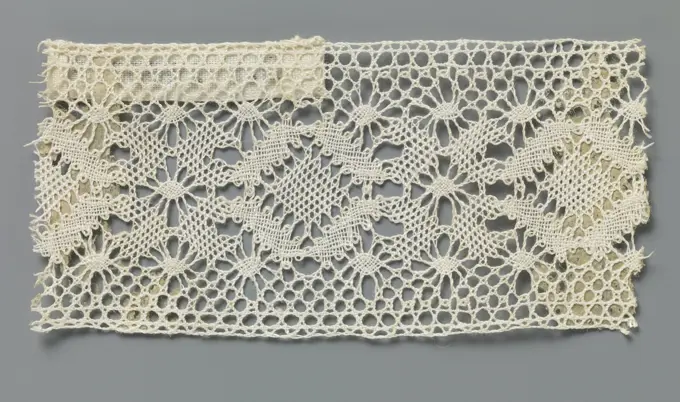
Intricate lace strips featuring floral patterns and historical designs. The natural colors and detailed craftsmanship exude elegance and vintage charm.

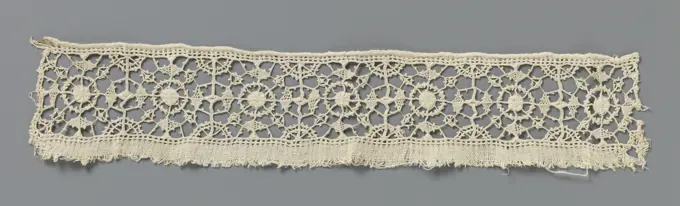
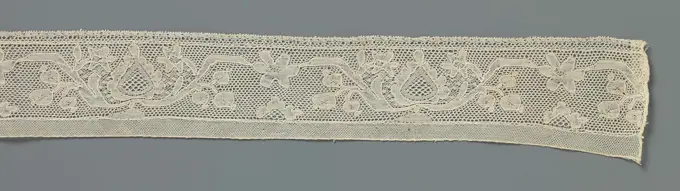
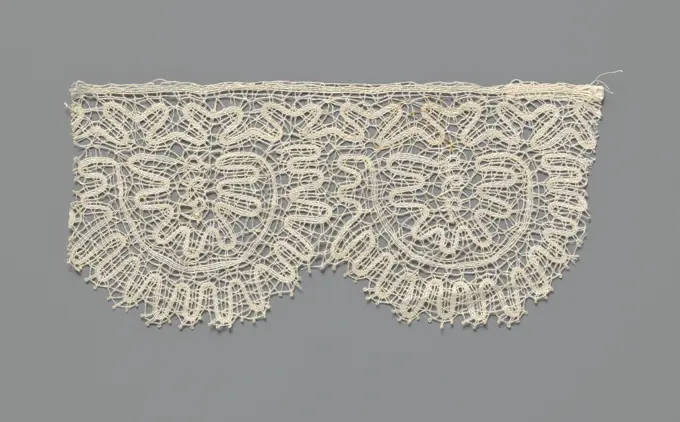
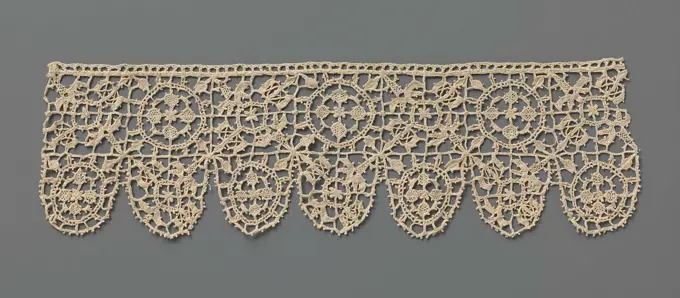
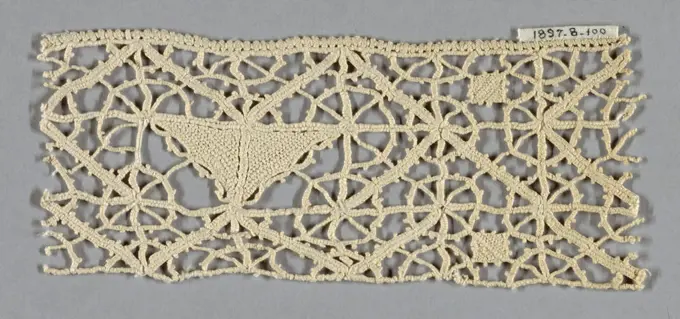
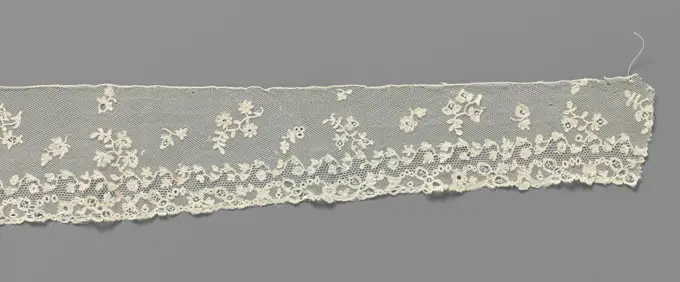
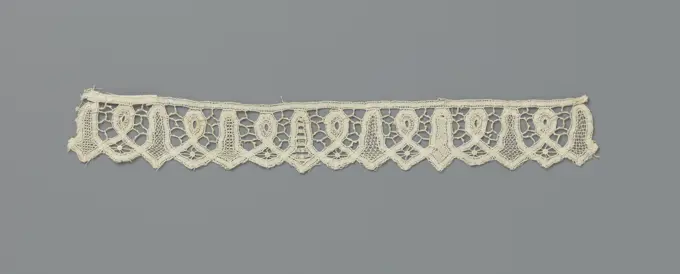
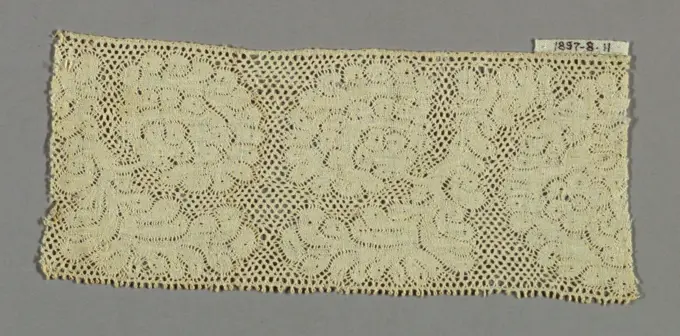
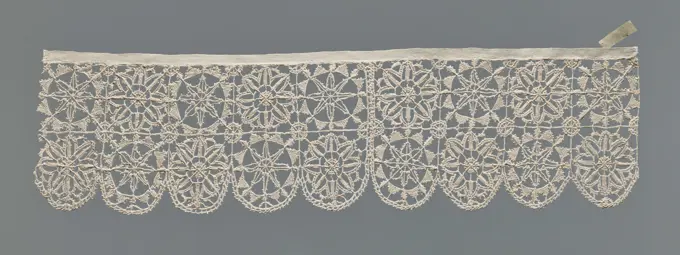
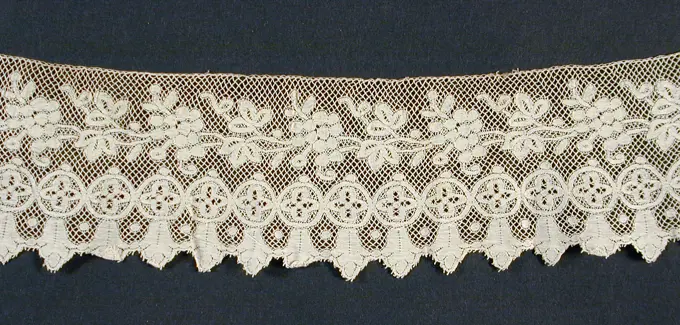
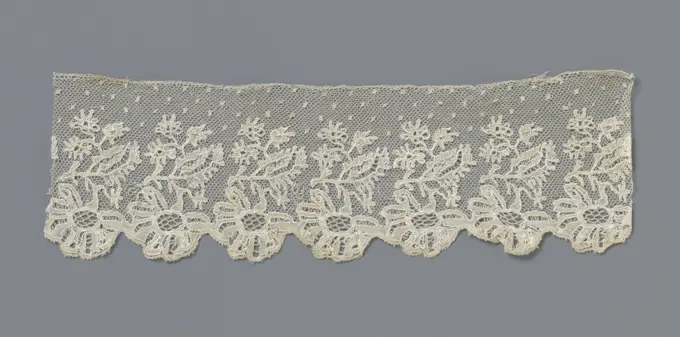
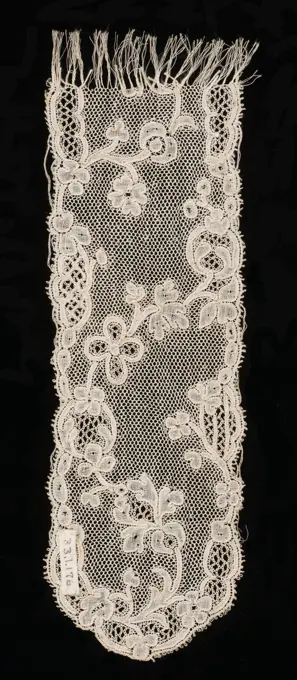
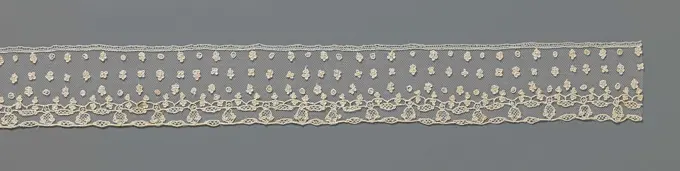
Strip made of linen with a wax edge and lace plunge with a row of open -worked drop shapes, anonymous, c. 1820 Japon strip made of natural linen with lace border: English embroidery. Pattern with a row of drop shapes formed by openwork ovals and spire. Above the drops of open work and rosette flowers. The scrap edge follows the shape of the bottom of the drops and is accentuated by a double continuous list of openwork circles. Each shell is finished with twelve embroidered lobes. Along the top of the strip is a narrow strip of linen sewn with vertical lanes whitework. Netherlands (possibly) linen (material) Japon strip made of natural linen with lace border: English embroidery. Pattern with a row of drop shapes formed by openwork ovals and spire. Above the drops of open work and rosette flowers. The scrap edge follows the shape of the bottom of the drops and is accentuated by a double continuous list of openwork circles. Each shell is finished with twelve embroidered lobes. Along the t
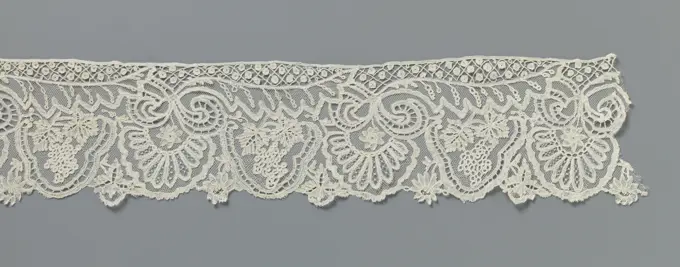
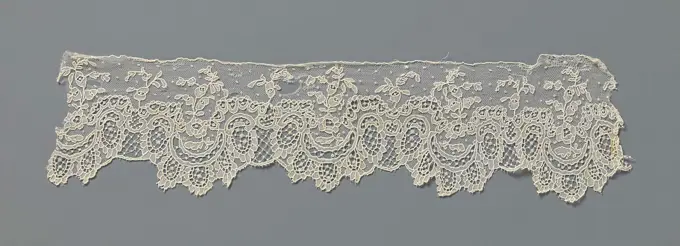
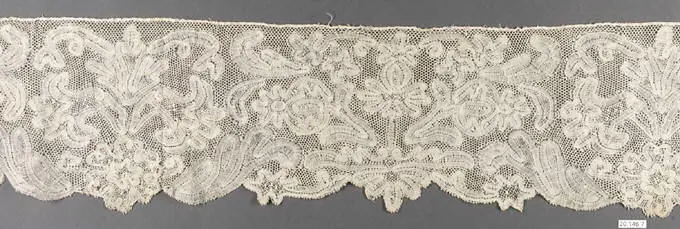
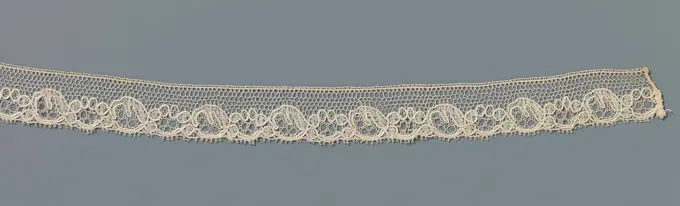
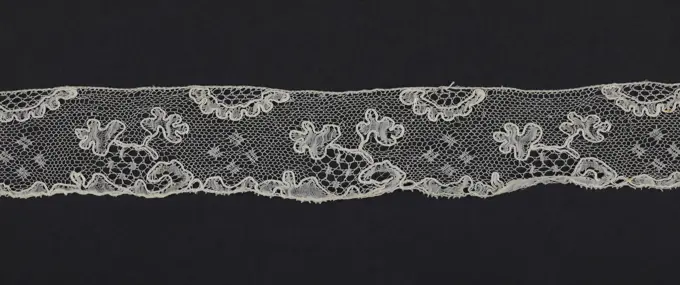
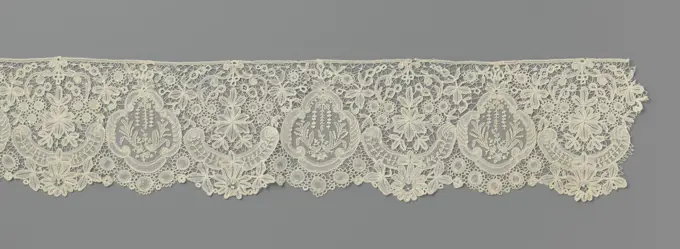
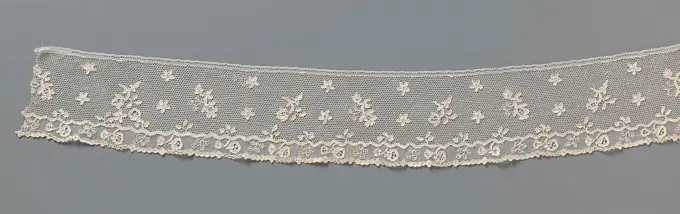
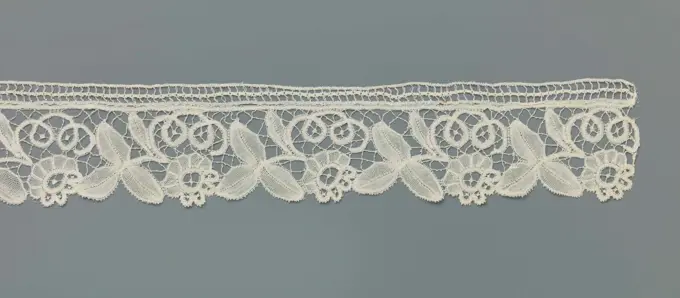
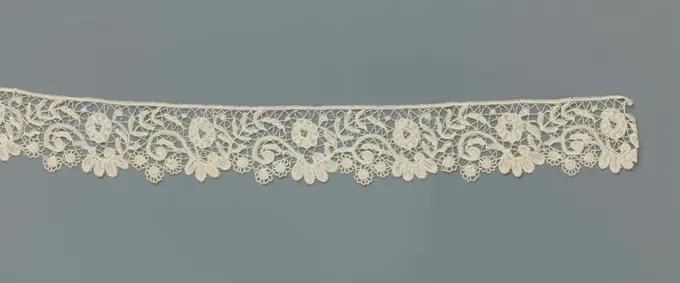
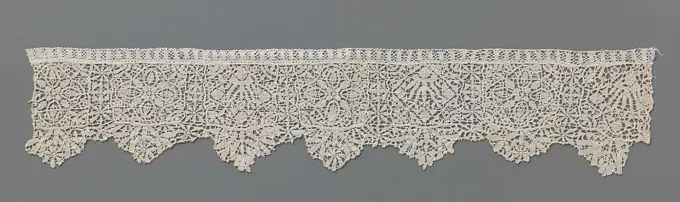
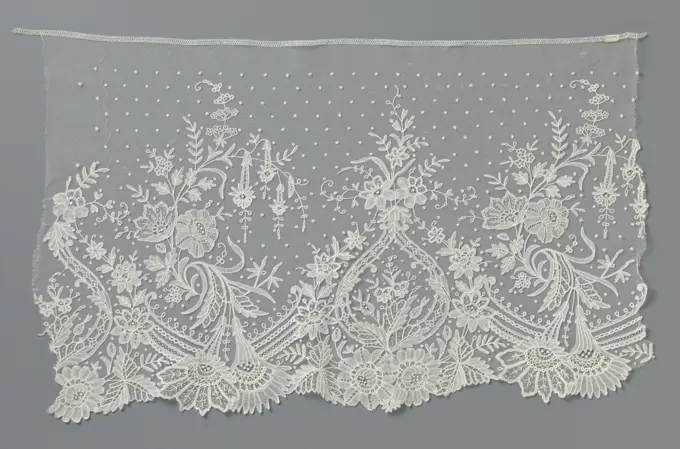
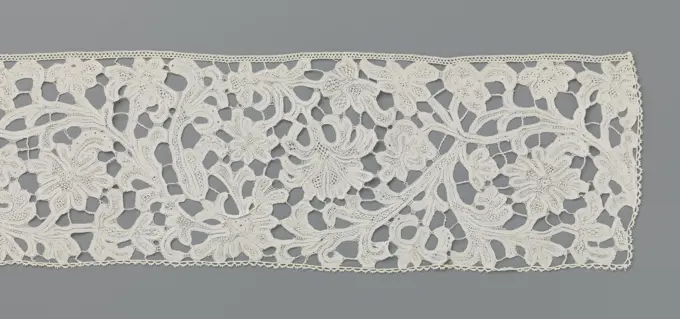
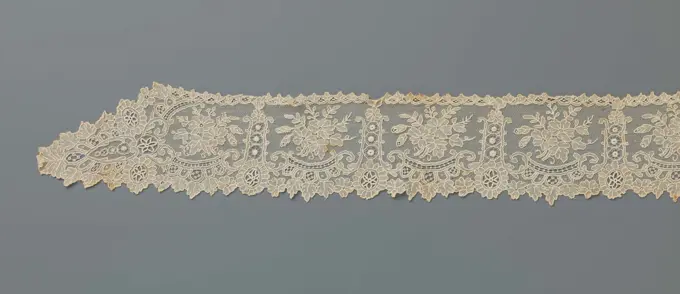
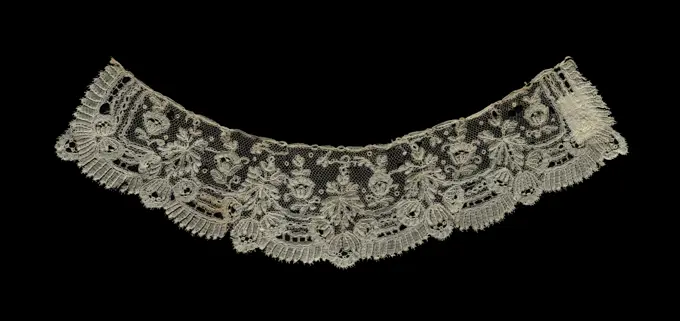
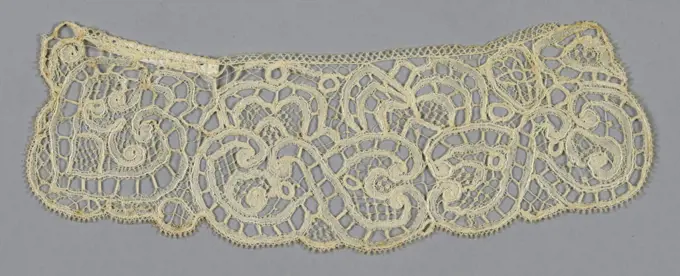
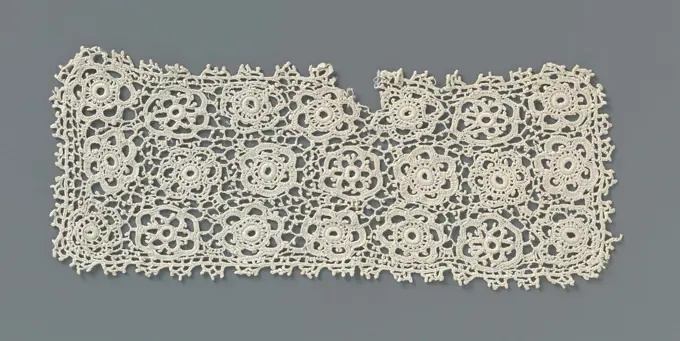
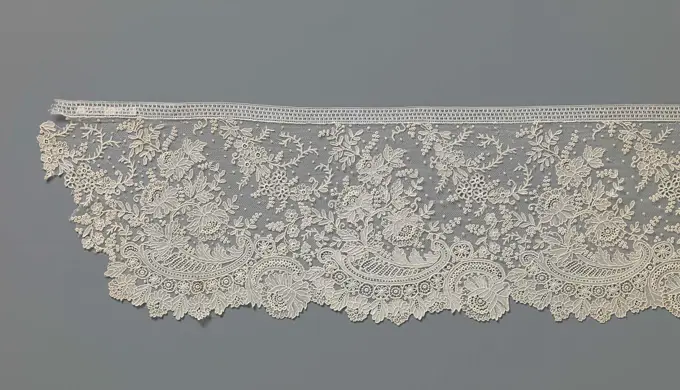
Strip Application side with grape bunches and halved leaves, anonymous, c. 1850 - c. 1890 Strip of natural -colored application side, bobbin lacquered on mechanical tulle. A narrow part, along the inside, shows a running pattern of halved, lobed leaves, which also accompanies a halved medallion with grid filling. On a wide part with a tulle surface are symmetrical, deep sculptures, which are alternately filled with a grape vice and a fan plant. Belgium (possibly) linen (material) Strip of natural -colored application side, bobbin lacquered on mechanical tulle. A narrow part, along the inside, shows a running pattern of halved, lobed leaves, which also accompanies a halved medallion with grid filling. On a wide part with a tulle surface are symmetrical, deep sculptures, which are alternately filled with a grape vice and a fan plant. Belgium (possibly) linen (material)Strip Application side with grape bunches and halved leaves, anonymous, c. 1850 - c. 1890 Strip of natural -colored application side, bobbin lacquered on mechanical tulle. A narrow part, along the inside, shows a running pattern of halved, lobed leaves, which also accompanies a halved medallion with grid filling. On a wide part with a tulle surface are symmetrical, deep sculptures, which are alternately filled with a grape vice and a fan plant. Belgium (possibly) linen (material) Strip of natural -colored application side, bobbin lacquered on mechanical tulle. A narrow part, along the inside, shows a running pattern of halved, lobed leaves, which also accompanies a halved medallion with grid filling. On a wide part with a tulle surface are symmetrical, deep sculptures, which are alternately filled with a grape vice and a fan plant. Belgium (possibly) linen (material)Strook kloskant zogenaamde pottekant.On a coarse grille (a Malinois or ice soil) there is a symmetrical pattern of two distant, hanging towers, which, in purpose, now above a low flower pot, then touch the straight outer edge and emboss a grid work medallion. There are two types of halved cross flowers on the inside. Both the tendrils and the cross flowers surround some parties filled with grid work. Mechelen side.Strip bobbin cartouches between slanted twisted tires, anonymous, c. 1760 - c. 1770 Strip of natural -colored Brussels bobbin. The pattern consists of three arches of slanted twisted tires crowned by a lobed cartouche and connected to each other on the bottom by a clock -shaped cartouche. After the three arches, the twisted tires turn into connected ovals that also form an arc and are cut by flowers and leaves from the Outijdevan de strip. A flower branch hangs down from the cartouche in each bow. Three loose flower branches hang between the arches. The motifs are largely made in linen battle with openwork edges, but otherwise with few recesses. Some flower hearts and petals and the like are made in mains. Most motives are provided with burst relief contours. The motifs are connected by a fine grid, a drachel soil. As a decorative land, fine snowflake grounds have been used in the twisted tires and braids in the cartouches and branches between the flower branches. The top is straight. Strip of needle side with wide U-shaped field around hanging heart-shaped flower vase and acanthus leaves, anonymous, c. 1730 - c. 1750 Strip of natural-colored needle side: Argentan side. Pattern with almost symmetrical compositions including an oval cartouche in which a flower hangs down. And a wide U-shaped field in which a flower hangs down in a heart-shaped flowerpot. Both the cartouche and the U-shaped field are formed by decorative tires and flower vines with various large and a few smaller flowers between acanthus leaves and leaf fillets. Rocaille-like motifs are located along the underside. The motifs are made up of feston stitches with recesses and equipped with relief contours. The motifs are connected by a founded hexagonal soil. Various coarser and finer decorative lands have been applied, including a coarse hexagonal mesh ground with dense hexagonal motifs in each mesh. The irregular scrap edge is finished with Pictos. The top of the strip is straight finished with a tie.Strip made of linen with a wax edge and lace plunge with a row of open -worked drop shapes, anonymous, c. 1820 Japon strip made of natural linen with lace border: English embroidery. Pattern with a row of drop shapes formed by openwork ovals and spire. Above the drops of open work and rosette flowers. The scrap edge follows the shape of the bottom of the drops and is accentuated by a double continuous list of openwork circles. Each shell is finished with twelve embroidered lobes. Along the top of the strip is a narrow strip of linen sewn with vertical lanes whitework. Netherlands (possibly) linen (material) Japon strip made of natural linen with lace border: English embroidery. Pattern with a row of drop shapes formed by openwork ovals and spire. Above the drops of open work and rosette flowers. The scrap edge follows the shape of the bottom of the drops and is accentuated by a double continuous list of openwork circles. Each shell is finished with twelve embroidered lobes. Along the tBed curtain border 1800-1850 Russian. Bed curtain border 173368Strook machinale kant met golvende rank met twee verschillende bloemen en besjes.Natural-colored Machine Side Strip: Machine Valenciennes. The repeating pattern consists of a continuous wavy rank, which is formed by two different flowers to curved stalks. From every, escorring flour, two short stalks stick with three berries. In addition to the always downrighting flower, two loose berries are. The motifs are provided with open editors and small recesses and are connected by a machining valenciennes ground with square mesh. A machine snowflake has been applied in the flower hearts. Along the bottom of the strip, a regular slip edge is formed with lying arcs, the mesh soil passing into a narrow strap. The top of the strip is straight finished. The slight sloping edge along the underside is finished with picots.Lace laceStrip of needle side with zigzagschulpen, anonymous, c. 1810 On a sleek, lying branch, to the right-oriented side branches, on which forget my mitaries and three types of chalid florets, the sharp zigzagschulpen show a double contour, consisting of a leaf and pearl edge, while a 'lover' has been applied to each point. In the field is a spray pattern of hanging daisies. Alençon side. France linen (material) Alençon Lace On a sleek, lying branch, to the right-oriented side branches, on which forget my mitaries and three types of chalid florets, the sharp zigzagschulpen show a double contour, consisting of a leaf and pearl edge, while a 'lover' has been applied to each point. In the field is a spray pattern of hanging daisies. Alençon side. France linen (material) Alençon LaceStrook naaldkant met liggende c-voluut met vijf lobben.Strip natural-colored coniferous lace, point the gaze the bruxelles. Repetitive motif of a lying c-volute with five lobes on a fine soil with single-turned meshes, strewn with moes. In the cavity of the volute always a rose from which a flower branch is up. A concatenation of flowers wicks along the pattern with the lobes across the centerline of the strip. Many different ornamental grounds fill the lobes, flower leaves and spaces. The shelter along the underside are formed by the pattern with lobes. The top is finished with a straight edge.Piece 18th century () Flemish. Piece 220795Strook kloskant met parelsnoertjes en ovaaltjes.Strip natural colosside: Lille side. The repeating pattern along the lower half of the strip consists of a concatenation of oval, alternately formed by a pearl corean and a stylized incised leaf. The upper half of the strip consists of a fine grille, a tulet. The energy-saving fireworks is made in linen stroke, with thicker and shiny contour wires. One type of ornamental ground is used in the ovals that forms circles, so-called 'pins'. Upper and bottom are straight finished, with the underside with picots.Strip bobbin with stylized round flour between two thick C-volutes, anonymous, c. 1850 - c. 1899 Strip of natural -colored bobbin: Beverse side. The strip is finished on one long and two short sides with a narrower strip of Lillese side. The repeating and symmetrical pattern of the wide strip consists of a stylized round flower between two thick C-volutes, such as with a candle slicer with three arms. The repeating pattern of the narrow strip consists of a one -sided bent stem with a fan -shaped flower. The motifs are connected by a fine grid, a tuler floor, which is littered with square mosies. The motifs are made in linen battle with mostly large recesses and thicker and shiny contour threads. Different decorative lands have been applied, including so -called leather or 'ladders' made in form, in the round flower and in the volutes. The Mosjes are also made in form. The tops of both strips are straight. The shells along the underside of the narrow strip are finished with picots. BeveStrip of needle side with concentric circles to work closed, anonymous, c. 1900 - c. 1949 Strip natural-colored lace-up work: Reticella in open sewing technique. Geometric pattern with squares that are made up of four small squares. Two concentric circles in the large square around a closed dot. The festonated inner circle is set with picots. Different triangles along the outer circle. The top is straight. At the bottom you can still see an edge of the non -finished linen tissue. unknown linen (material) Strip natural-colored lace-up work: Reticella in open sewing technique. Geometric pattern with squares that are made up of four small squares. Two concentric circles in the large square around a closed dot. The festonated inner circle is set with picots. Different triangles along the outer circle. The top is straight. At the bottom you can still see an edge of the non -finished linen tissue. unknown linen (material)Flounce (Belgium); linenStrook kloskant met pot of schaal met dennenappel.Strip natural colosside, Paris side. The repetitive and symmetrical pattern consists of a pot or bowl of a low foot, in which a large pine cone or drip-shaped motif is located. The edges of the pots are decorated with a few flowers, papumers and leaves. The successive pots are connected by a rosette flower. The motifs are connected by a Maas soil, a Paris soil. The full work is largely made in linen stroke with few recesses and with thicker contour wires. The center of the pine cone is partly made in slurbase. Different ornamental grounds have been applied including a snowflakes soil. The top and bottom of the strip are finished with separate clost straps. The short sides are finished with a soil.Strook naaldkant met irissen aan voluutranken.Strip natural-colored mixed side: Venetian ribbon side. Converted pattern, with different iris-like flowers on an irregular, open bars soil. The bars are made separately and sewn as a connection between the tendrils and flowers. The contours of the pattern are formed by a sloping woven and thereby stretchable ribbon. Within the contours and also within the individual flowers, different ornamental grounds by recesses in the full. The top is trimmed with a border clamping side. The underside is finished with a straight picro edge.Strip bobbin with cartouche with three rosette flowers along the underside and a fan -shaped flower in the top, anonymous, c. 1700 - c. 1899 Strip of natural-colored bobbin, binche side. The pattern consists of two symmetrical compositions, each crowned by a large halved flower along the top, flanked by a curved branch with three different flowers on it. In one composition, there are two stacked flowers among two leaves with a short -filled leaf at the end. In the other composition it is a cartouche with three rosette flowers along the underside and a fan -shaped flower in the top. The motifs are connected by a grid, a five -part ground. The motifs are made in linen battle with recesses and openwork edges. In the cartouches, between the flower stalks and in the flowers, decorative lands have been used, especially snowflake grounds. The top and bottom of the strip are straight finished, with the bottom with picots. One of the short sides is finished with a linen strap, with which a zoomStrip 18th century Flemish, Brussels. Strip 218164Strip bobbin with drops between a zigzag line and a wavy line, anonymous, c. 1800 - c. 1899 Strip of natural-colored bobbin, Buckingham side. The repeating and continuous pattern consists of a zigzag line that runs almost at the top of the strip and a wavy line on the bottom of the strip. Between these lines a concatenation of drop -shaped motifs arises. Above the zigzag line, the strip consists of a mesh ground, a tuler land. Under the zigzag line, in the drops, a decorative land has been used, a rose soil. The motifs are made in linen battle with thick and shiny contour threads. The top of the strip is straight finished. The scrap edge along the bottom is finished with picots. Buckingham cotton (textile) bobbin lace / Bucks point (lace) Strip of natural-colored bobbin, Buckingham side. The repeating and continuous pattern consists of a zigzag line that runs almost at the top of the strip and a wavy line on the bottom of the strip. Between these lines a concatenation of drop -shaped mSleeve piece (one of a pair) early 18th century French. Sleeve piece (one of a pair) 227676Strip bobbin with a sprig with star flower and thick twig with side branches, anonymous, c. 1840 - c. 1850 Strip of natural -colored bobbin: Lille side. Between stripped Mosjes, the repeating pattern consists of two different thin branches, which spring on the underside of the strip. There are a few star -shaped flowers on one branch, the other branch has a thick base with thin short branches on either side. The motifs are connected by a fine grid, a tuler land. And they are made in linen battle, with the thicker and shiny contour threads dominating. The thicker branch is filled with stacked cubes made in shape. Top and bottom of the strip are straight finished, with the bottom with picots. Lille linen (material) bobbin lace / Lille lace Strip of natural -colored bobbin: Lille side. Between stripped Mosjes, the repeating pattern consists of two different thin branches, which spring on the underside of the strip. There are a few star -shaped flowers on one branch, the other branch has aFragment of bobbin lace unknownStrip bobbin with two semicircular scales with a stylized half flower with a pine cone-shaped flower heart, c. 1900 - c. 1909  Strip of natural -colored bobbin: Eastern European side. The strip consists of two semicircular scallops. The repeating pattern consists of a stylized half flower in which the petals are formed by a strongly winding narrow ribbon. In the Bloemhart there is a pine cone-shaped motif that is formed by the continuous winding ribbon. The top of the strip is straight finished, the scrap edge is finished with picots. Eastern Europe linen (material) bobbin lace / tape lace (bobbin lace) / East European laceCravat End (Belgium); linenStrip of needle side with high and wide flared flower branches, anonymous, c. 1750 - c. 1775 Strip of natural-colored needle side: Alençon side. Pattern with high and wide flared split flower branches on a fine hexagonal mesh ground. One of the three branches always forms half an oval along the lower edge, which is filled with alternating decorative land. The underside is finished with a picoted edge of scales, which comes from a pattern of lying leaves and flowers and a few small spaces filled with decorative land. The top is finished with a border bobbin. Alençon linen (material) Alençon Lace Strip of natural-colored needle side: Alençon side. Pattern with high and wide flared split flower branches on a fine hexagonal mesh ground. One of the three branches always forms half an oval along the lower edge, which is filled with alternating decorative land. The underside is finished with a picoted edge of scales, which comes from a pattern of lying leaves and flowers and a few small spaceJapon strip of mixed side with lobed medallions, anonymous, c. 1875 - c. 1899 Japonstrook made of mixed side - bobbin in combination with needle side - Brussels Duchesse. Standing lobed oval medallions with fine Maas soil and, among other things, weeping willow leaves (needle side) are connected by lying C-Voluten, a Margriet of which depends. The remaining land is an irregular braid land and is filled with five and three-lobe leaves and 'daisies' (bobbin). Belgium (possibly) linen (material) mixed lace / mixed Brussels Japonstrook made of mixed side - bobbin in combination with needle side - Brussels Duchesse. Standing lobed oval medallions with fine Maas soil and, among other things, weeping willow leaves (needle side) are connected by lying C-Voluten, a Margriet of which depends. The remaining land is an irregular braid land and is filled with five and three-lobe leaves and 'daisies' (bobbin). Belgium (possibly) linen (material) mixed lace / mixed BrusselsStrip of needle side with double roses, anonymous, c. 1810 - c. 1820 A fine Maas soil (single Maas) is almost over the entire width filled with a row of unilaterally directed twigs with rose buttons and two double roses, which form the shells. Alençon Alençon linen (material) Alençon Lace A fine Maas soil (single Maas) is almost over the entire width filled with a row of unilaterally directed twigs with rose buttons and two double roses, which form the shells. Alençon Alençon linen (material) Alençon LaceBorder Made 1875-1900 France. Linen, bobbin part lace .Border (France); linen; Repeat: 17.1 cm (6 3/4 in.); Bequest of Marian Hague; 1971-50-434Needle's Engageante with an ashymmetrical flower branch in a symmetrical frame, anonymous, c. 1775 Engageante of natural-colored needle side: Argentan side. The pattern consists of an as-symmetrical flower branch in a symmetrical frame. Under the flower branch two long branches that form a V. On either side of the list is an oval medallion with a flower in the center. With the exception of one larger flower in the central flower branch, the other motifs consist of thinly occupied branches, with small leaves, flowers, bunches of berries and 'cords' of openwork and potented circles. The motifs are made up of feston stitches and equipped with relief contours. The motifs are connected by a soil with meshes that are close to Feston stitches, an Argentan ground. Decorative grounds and decorative stitches are used in different leaves, circles and in the flower leaves of the central flower. Along the edges are connected elongated fields filled with a finer Maas soil, the fields are defined by Strook naaldkant met bloemtakken en stervormige bloemen.Strip natural needle side: Argentan-lace and alnezon-side. Repetitive motif with two different flower branches, each flanked by two star-shaped flowers placed above each other, on a ground with meshes that are close to naid with buttonhole stitches (Argentankant). The flower branches bend to and to each other. Along the bottom under a wavy line including a pattern of flowers and berries on a fine hexagonal Maas soil (Alençon side). Decorative ground with rover picots in the larger flowers and the circles along the bottom edge. Full work with minimum recesses within the contours of the other motifs. Slip edge on the underside through a concatenation of circles, regularly interrupted by a rosette flower. The top is trimmed with a border clamping side.Strook kloskant met grof drieblad.Natural collate strip: Duchesse-Side. On a very open braid soil, one-sided specifically directed serpentine branches with an anemone and a large three-three leaf, which alternately form the unequal shelter.Strook naaldkant met twee soorten rozetten in vierkanten.Strip natural needle side: Reticella. The top of the pattern consists of squares, which are made up of four small squares. There are a small and a large circle alternately in the squares. Around the small circle are in the corners of flowers. Around the large circle are in the corners of leaves. This pattern jumps and repeats itself in the underside of the strip, the squares are here on side and bottom rounded to a slip edge with semi-circular deep slip. The top of the strip is finished with a narrow straight edge with squares.Strook kloskant met s-ranken.Natural collate strip: Duchesse-Side. There is an ongoing pattern on a braid soil. S-tanks with three daisies and an edge of Campanes form the slot and end in a simple rose.Strook naaldkant met afwisselend een rozet en een ruit in geometrisch verdeelde vlakken.Strip natural needle side: Punto in Aria. The pattern consists alternately from a rosette and a diamond in a square made up of sixteen small squares. Between the large squares is always a column of three squares with a rosette in each. Under each large square, a three-lawy shell, which is connected to each other at the height of the column with rosettes by a fourth rosette. The top is finished with a splitting strap. The sloping edge is finished with picots.Fragment, Medium: linen Technique: grid of withdrawn element with needle lace (reticella style), Panel in a design of crossing diagonal lines with circles at the intersection., Italy, 16th century, lace, FragmentScarf French 19th centuryStrook gehaakte kant met reticella motieven.Strip natural colored Irish crochet side, imitation reticella. The top is finished with a straight edge. The underside is finished with a picoted bow edge.Strip of needle side with falling blossom, anonymous, c. 1780 - c. 1790 On the field there are circular circular flowers with a downtock in sloping rows. Standing arches, based on round medallions form a border together with a triple arc garland. Alençon France linen (material) Alençon Lace On the field there are circular circular flowers with a downtock in sloping rows. Standing arches, based on round medallions form a border together with a triple arc garland. Alençon France linen (material) Alençon LaceFragment, Medium: linen Technique: bobbin lace, Binche style with Binche ground, Belgium, 18th century, lace, FragmentStrip bobbin with rush-hour zigzag band, anonymous, c. 1800 - c. 1899 Strip of natural -colored bobbin, straw side. The repeating and continuous pattern consists of an openwork zigzag band in which Spitsovaaljes are made between crossing couples. The triangular fields that occur along the top and bottom of the zigzag band are made in linen battle. Top and bottom of the strip are straight finished, both with picots. Buckingham cotton (textile) Bobbi lace / lace cloth Strip of natural -colored bobbin, straw side. The repeating and continuous pattern consists of an openwork zigzag band in which Spitsovaaljes are made between crossing couples. The triangular fields that occur along the top and bottom of the zigzag band are made in linen battle. Top and bottom of the strip are straight finished, both with picots. Buckingham cotton (textile) Bobbi lace / lace clothNeedlepoint and Bobbin Lace Cuff, 20th century. Belgium, Brussels, 20th century. Lace, needlepoint and bobbin: linen; average: 12.1 x 27.1 cm (4 3/4 x 10 11/16 in.).Border Made 1760-1769 Italy. Linen, needle lace .Bobbin Lace (Needlepoint Design) Edging of Bell Points, 17th-18th century. Italy, Genoa, 17th-18th century. Lace, bobbin; average: 2.6 x 24.2 cm (1 x 9 1/2 in.).Engageante from application side with a symmetrical spread pattern of flowers and flower branches, anonymous, c. 1770 - c. 1790 Engageante of natural -colored application side: Brussels Kloskant Applicated on Drochelgrond. Symmetrical spreading pattern of flowers and flower branches above a border with two different garlands between which a coarser strel then runs in the rest of the side. The motifs are made in linen battle with openwork edges and burst of relief contours. In ovals in the lower pendulum and in Bloemharten, small decorating elements are used, including cubes in shape. The top is straight. The very flat scrap edge is finished with picots. Brussels linen (material) Brussels bobbin lace Engageante of natural -colored application side: Brussels Kloskant Applicated on Drochelgrond. Symmetrical spreading pattern of flowers and flower branches above a border with two different garlands between which a coarser strel then runs in the rest of the side. The motifs are made in lineStrip mixed side with loop interspersed by clock -shaped motif, anonymous, c. 1875 - c. 1899  Strip of natural ribbon side (mixed side): a messed up ribbon in combination with needle lace fillings and a bar of land (needle side). The ribbon is made in linen battle with openwork edges and alternately forms a loop with a horizontal window underneath and an elongated clock -shaped motif. Within the contours that the ribbon forms, various needle side fillings, decorative lands, are applied. The motifs are connected by a potente soil. The top of the strip is finished with a straight ribbon. The toothed scrap edge along the underside stems from the pattern. France linen (material) mixed lace / tape lace (mixed lace)Strip of cotton with lace plunger with wavy double garlands of 'pearls' and hanging flower branches, C.I. Bosch Reitz-Teding van Berkhout, c. 1860 - c. 1880 Strip of natural cotton with lace bobbins: English embroidery. The pattern has strongly wavy double 'pearls' slingers of openwork circles. On every wave top is a Margriet on which a drop -shaped 'pearl necklace' hangs down with a Margriet again in the center. In each golf valley, a sliding loose flower branch with three daisies and different leaves and leaf branches hangs sloping down. The scrap edge follows the pattern where the shell under the drop -shaped cord is slightly narrower than the shell under the golf valley with the hanging flower branch. Amsterdam cotton (textile) Strip of natural cotton with lace bobbins: English embroidery. The pattern has strongly wavy double 'pearls' slingers of openwork circles. On every wave top is a Margriet on which a drop -shaped 'pearl necklace' hangs down with a Margriet again in the centerFragment; linenLace laceFragment of lace. unknown, authorStrip bobbin with half -circular lobed flower on bent stalk, anonymous, c. 1900 - c. 1924 Strip of natural-colored bobbin: Valenciennes side. We worked with coarse threads. The short sides are sewn together. The strip may be intended for or used on a tablecloth. The repeating pattern consists of a lying up bent stalk on the center line with a semi -circular lobed flower on it. The flower is crowned by two curling leaves, between which a smaller oval flower rises from a short handle. Along the bottom runs a regular wavy band with alternately skipping and recovering waves. Between the successive flowers there are always three mushes and at the bottom, above the Gulf line, a stylized French lily. The motifs are made in linen battle with openwork edges and here and there a single large recess or a few little ones such as leaf grilles. The motifs are connected by a square Valenciennes ground. A decorative land has been used in the flower heart of the large flowers, a snowflake land. The topLength of Lace. Belgium, Western Flanders, 1850-1900. Textiles; textile lengths. Linen Valenciennes d'ypres laceFragment Swedish (Rättvik) (Dalarna) 19th centuryFragment, Medium: linen Technique: needle lace, Fragment of a band with fantastic floral shapes., France, late 17th-early 18th century, lace, FragmentLappet (one of a pair) 18th century French. Lappet (one of a pair) 223018Strip bobbin with a scales of Margrieten, Anonymous, c. 1840 - c. 1850 Strip of natural -colored bobbin: Lille side. Under a narrow field with thrown mousjes, it exists close to each other and the repeating pattern from a hanging flower branch, where one large Margriet-like flower always forms one shell. The motifs are connected by a fine grid, a tuler land. The motifs are made in linen battle, with thicker and shiny contour threads. A decorative land has been applied in the flower hearts of the large flower, among other things. The top of the strip is straight finished. The scums along the bottom are finished with picots. Lille linen (material) bobbin lace / Lille lace Strip of natural -colored bobbin: Lille side. Under a narrow field with thrown mousjes, it exists close to each other and the repeating pattern from a hanging flower branch, where one large Margriet-like flower always forms one shell. The motifs are connected by a fine grid, a tuler land. The motifs are made in linen baStrip mixed side with heart -shaped leaves, anonymous, c. 1790 - c. 1799 Strip of natural-colored mixed side, with tuler land on a mechanically manufactured a needle side as in Argentan side. The Maliën Fond of the field is strewn with flowers and small rosettes; A nice mesh stock fills the edge. A wavy branch with heart -shaped leaves and flowers serves as a separation. The outer edge is almost straight and composed of rosettes, leaves and a chain of circles. France linen (material) mixed lace Strip of natural-colored mixed side, with tuler land on a mechanically manufactured a needle side as in Argentan side. The Maliën Fond of the field is strewn with flowers and small rosettes; A nice mesh stock fills the edge. A wavy branch with heart -shaped leaves and flowers serves as a separation. The outer edge is almost straight and composed of rosettes, leaves and a chain of circles. France linen (material) mixed laceSample End Of Lappet; linen; 1933-1-176Border. Switzerland or Germany. Date: 1890-1899. Dimensions: 104.1 x 10.2 cm (41 x 4 in.)Height repeat: 20.5 cm (8 1/8 in.). Cotton, burn-out lace with machine net insets. Origin: Switzerland. Museum: The Chicago Art Institute, Chicago, USA.Lace, 1750-1850, Mechelen, maker unknown. Gift of Mrs G. Acland Allen, 1955.Japon strip with rose bouquet in an oval and in a clock -shaped cartouche, anonymous, c. 1860 - c. 1870 Japon strip of natural needle side: Brussels mesh side. The repeating and partly symmetrical pattern consists alternately of an oval cartouche and a clock -shaped cartouche, both with a bouquet in the center. The oval cartouche consists of three C-volutes on the underside, filled with circles in which densely founded relief circles form rosettes. These circles also come back in an edge under the bell -shaped cartouche. In the bell -shaped cartouche there is one rose between leaves and twigs with berries. In the oval cartouche there is an asmetrical bouquet with two roses and fuchsias. The motifs are made up of Feston stitches and are equipped with relief contours of wide -ranged wire bundles. The roses and some leaves are double -layer or triedubel layer. The motifs are connected by a mesh cincloth strewn with moesjes. The top of the strip is straight finished with a cloated or mechaBorder. France. Date: 1775-1800. Dimensions: 8 × 330.8 cm (3 1/8 × 209 in.)width repeat: 4.8 cm (1 7/8 in.). Linen, needle lace of a type known as "Point d'Argentan" with buttonholed mesh ground. Origin: France. Museum: The Chicago Art Institute, Chicago, USA.Flounce, Medium: linen Technique: bobbin lace made in Lille style with heavy outlining thread, 19th century, lace, FlounceStrook kloskant met bloem met acht bloemblaadjes in drielobbige schulp.Strip natural colosside, cluny side. The repeating pattern consists alternately from a flower with eight petals made in shape stroke and a lobbed circular motif in linen stroke. The motifs are connected by a braid soil, with some braids with a single picot. Every consecutive flower is in the center above an open-worked triple shell, made with a band in linselag with a cleaning edge and finished with picots. Along the top of the strip, such a strap runs, but then right, without lobing.Two Lengths of Lace. Belgium, mid-19th century. Textiles; textile lengths. Machine-made Heathcoat lace with bobbin lace appliqueKloskant's intermediate base with a row of windows surrounded by Spitsovaaltjes, Anonymous, c. 1900 - c. 1924  Strip of natural -colored bobbin: sling. The repeating pattern consists of a row of diamonds surrounded by Spitsovalsjes. The diamonds are made in mains with a line in linen stroke on each side with an interruption at the points. The motifs are connected to each other along the bottom and the top of the strip by a tape. Top and bottom of the strip are straight. Russia linen (material) Bobbi lace / lace clothStrip bobbin with horn with abundance closed by an acanthus leaf, anonymous, c. 1740 - c. 1749 Strip of natural-colored bobbin: binche side. The repeating pattern consists of a horn of abundance, which is closed by an acanthus leaf. Apparently from the edge of the horn a pest glaard from the edge of the horn, which hangs a three -lobby flower from the edge of the horn. These flowers, possibly carnations, form scallops along the underside of the strip. The scrap edge along the underside of the strip is formed between the 'flower abuse' by a leaf that lies under the horn of abundance. The motifs are made in linen battle with openwork edges and recesses. The motifs are connected by a grid, a five -part ground. A few different decorative lands have been applied, including a snowflake land in the horn of abundance and in the field above the hanging flower. The top of the strip is straight finished. The scrap edge is finished with picots. France (possibly) linen (material) bobbin lace / BincJapon strip of application side with ribbons in bows and a wavy decorative frame by oval hoops. Japon strip of Brussels application office: Brussels Duchesse (mixed side: dick edge in combination with coniferous lace) applicated on machine tulle. The repeating pattern consists at the top of the strip from a hanging flower branch with large flowers (a bunch of lilacs, a rose and a sprig with two bottom flowers) with pacifiering ribbons (needle side) with a bow on either side of the hanging flower branch. The pattern on the underside consists of a wavy decorative frame that moves through overlapping oval medallions or 'hoops'. The hoops provide a semi-circular slip edge. Around every golf top a break in the sequence of hoops where a flower arrangement with, among other things, a tulip, a daisy, a rose and forget-me-staples. Under each wave top a wider semicircular shell has been realized with a curved decorative frame with a broken meander (needle side) and below it pending chali flowersStrip bobbin with loose flower vessels with reserve, anonymous, c. 1640 - c. 1660 Strip of natural -colored bobbin, Flanders side. The repeating pattern consists of two curved flower stems, which are connected with a leaf -shaped motif. The motifs are made in linen battle with few recesses, but with openwork edges. They are connected to each other by a traly land, a five -part ground. In one of the flowers and in the reserve, a snowflake land was used as a decorative land. The top and bottom are straight. Southern Netherlands linen (material) bobbin lace / Flanders lace Strip of natural -colored bobbin, Flanders side. The repeating pattern consists of two curved flower stems, which are connected with a leaf -shaped motif. The motifs are made in linen battle with few recesses, but with openwork edges. They are connected to each other by a traly land, a five -part ground. In one of the flowers and in the reserve, a snowflake land was used as a decorative land. The top and bottom are straStrook naaldkant met drie rijen takjes, bloemen en raderpicots.Strip natural-colored coniferous lace: Alençon side. Spreading dotty with three rows of a twig interspersed with a four-leaf flower or with a rider poic in a circular cordon. The scatter photograph is on a fine hexagonal maas. The pattern on the underside of the strip consists of arcs with triple leaves on both sides. Bellythous and standing ovals, filled with ornamental grounds. The underside is finished with a virtually straight edge with ragfine picots. The top is trimmed with a border clamping side.Japon strip of application side with the pear -shaped medallions, anonymous, c. 1850 Japon strip of natural -colored application side, bobbin and needle side Applicated on mechanical tulle. Against a background, which is widely littered with moesjes, closed -worked Schulpen in turn filled with a pear -shaped medallion with violets and a circle arch with a flower branch. The pear shape is surrounded by a flower wreath with a flower branch in the top. The branch above the circle arc is C-shaped and shows two large hanging chalice, a dune rose and an anemone (both of the needle side) and hanging bells. Brussels linen (material) Japon strip of natural -colored application side, bobbin and needle side Applicated on mechanical tulle. Against a background, which is widely littered with moesjes, closed -worked Schulpen in turn filled with a pear -shaped medallion with violets and a circle arch with a flower branch. The pear shape is surrounded by a flower wreath with a flower branch in the topStrip of needle side with volutes and peonies, anonymous, c. 1850 - c. 1899 Strip of natural needle side: Brussels mesh side. The repeating pattern consists of slanted flower branches and asymmetrical C-volutes on a fine soil with single twisted meshes: a mesh cantar, which is strewn with mosies. A flower branch with a few large flowers alternates with a flower branch with many small florets and berries. Along the underside, the pattern consists of an elongated C-Volute under each branch with the large flowers, with a decorative frame of connected circles with different rosettes in decorative stitches at the bottom. Made full work with feston stitches with nuances where the denser filling is made with dust mark (a Festonsteek variant). Relief contours of widded wire bundles (cordonnets) wide apart. Many coordonated rings decorate the side. The scrap edge is formed by connected flowers under each horizontal C-Volute and smaller tilted C-Voluten in between, under which one big peony is aStrip bobbin with V-shaped leaves and one-sided oriented flowers, anonymous, c. 1840 - c. 1849 Strip of natural -colored bobbin: Lille side. Under the center line, with a row of V-shaped leaves, the repeating pattern consists of a one-sided-oriented twig that rises on the underside of the strip. Each branch sits one flower with an openly circular heart and a whimsical edge. The motifs are connected by a fine grid, a tuler land. The sparing fullwork is made in linen battle, with thicker and shiny contour threads. One type of decorative land has been applied under the curved flower stem. At the top and bottom are straight finished, with the bottom with picots. Lille linen (material) bobbin lace / Lille lace Strip of natural -colored bobbin: Lille side. Under the center line, with a row of V-shaped leaves, the repeating pattern consists of a one-sided-oriented twig that rises on the underside of the strip. Each branch sits one flower with an openly circular heart and a whimsical edge. TheTie. Belgium, 1870-1890s. Costumes. Cotton point de gaze needle laceFragment 17th century Flemish. Fragment 214469Strip for a superplie from Kloskant with wavy volute vines, anonymous, c. 1660 - c. 1670 Strip of natural -colored bobbin, Old Flemish side. The pattern consists of wavy volute bines with multifaceted flowers including palm flowers, irises and lilies. There are large openings between the motifs, which are connected to each other with very little but long and double braids. The contours are made with cloudy ribbons in linen. Different decorative lands have been used between the contours and work has been done in linen battle with many recesses. The top is trimmed with a border bobbin. The underside and sides are trimmed with a straight border bobbin with picoted arches. Flanders linen (material) bobbin lace / old Flemish lace Strip of natural -colored bobbin, Old Flemish side. The pattern consists of wavy volute bines with multifaceted flowers including palm flowers, irises and lilies. There are large openings between the motifs, which are connected to each other with very little but loEdging 17th century Italian, Genoa. Edging 221006Strip mixed side for a priest's rug, anonymous, c. 1600 - c. 1699 Strip of natural -colored mixed side: Venetian ribbon side. Pattern of Volute Franks, with whimsically shaped flowers and acanthus leaves on a coarse hexagonal Maas soil with many times rotated feston stitches. The contours of the pattern are formed by a woven ribbon. Within the contours spacious surfaces with different open decorative land. The top is trimmed with a straight edge. The underside is finished with a straight picot edge with arcs. Venice (possibly) linen (material) mixed lace / Venetian tape lace (mixed lace) Strip of natural -colored mixed side: Venetian ribbon side. Pattern of Volute Franks, with whimsically shaped flowers and acanthus leaves on a coarse hexagonal Maas soil with many times rotated feston stitches. The contours of the pattern are formed by a woven ribbon. Within the contours spacious surfaces with different open decorative land. The top is trimmed with a straight edge. The underside is finBridal veil or baptism veil of mesh tissue with tambouring work, anonymous, c. 1825 - c. 1835 Bridal veil or baptism veil of natural -colored lace -ups, tambooering. The Bloemharten are from work with pulled threads. Diagonal lines are embroidered on the mesh, alternately with flatter and a deeper waves. The downstairs edge has large horizontal ovals, which are asymmetrical composed of flowers and flower areas that radiate to the left, above and right. The side edges have smaller, lighter standing ovals, matching the larger ones. On three sides, the veil is bordered with a fine puntrand. Netherlands (possibly)  embroidering Bridal veil or baptism veil of natural -colored lace -ups, tambooering. The Bloemharten are from work with pulled threads. Diagonal lines are embroidered on the mesh, alternately with flatter and a deeper waves. The downstairs edge has large horizontal ovals, which are asymmetrical composed of flowers and flower areas that radiate to the left, above and right. The sKraag van naaldkant met bloemtak in u-vormig cartouche.Collar of natural needle side: Brussels mesh edge. The repeating pattern consists of a U-shaped cartouche with a flower branch with two rosette flowers and two chali flowers. The 'legs' of the you are formed by two straight pillars, awarded by a rosette flower and triple leaf. Under every pillar, an oval medallion hangs with a rosette flower in the center. Between the pillars and consecutive medallions, a triple frame with five lobes hangs and there a garland of three leaves between two rosette flowers. The medallions together with this pendulum for the sloping edge along the bottom of the strip. The motifs are equipped with contour wires, the three circles in the pillars and the rosette flower in each medallion are equipped with relief contours. The motifs are connected by a fine Maas soil, a mesh side ground.Fragment, Medium: linen Technique: needle lace, Alençon-style fragment with minute powdered floral design. Ground of brides tortillées., France, late 18th century, lace, FragmentBobbin Lace Insertion, 17th-18th century. Italy, Umbria, 17th-18th century. Lace, bobbin; average: 8 x 21.4 cm (3 1/8 x 8 7/16 in.).Strip bobbin with each other overcuting motifs including leaves, anonymous, c. 1750 - c. 1770 Strip of natural -colored bobbin: Mechelse side. The pattern exists apart overcuting motifs in the form of larger and smaller leaves, leaf branches, curved lines and remote spaces filled with decorative grounds. The motifs are connected by a fine Maas soil. The motifs are made in linen battle with thicker and shiny contour threads. The faintly scalloped underside stems from the pattern and is finished with picots. The top is straight. The short sides are finished with a zoompje. Southern Netherlands linen (material) bobbin lace / Mechlin (lace) Strip of natural -colored bobbin: Mechelse side. The pattern exists apart overcuting motifs in the form of larger and smaller leaves, leaf branches, curved lines and remote spaces filled with decorative grounds. The motifs are connected by a fine Maas soil. The motifs are made in linen battle with thicker and shiny contour threads. The faintly scallopedBobbin Lace Cuff, early 19th century. Belgium, Brussels , early 19th century. Lace, bobbin; overall: 7.5 x 18 cm (2 15/16 x 7 1/16 in.).Cuffs, Medium: linen Technique: bobbin lace with needle connections, Bobbin-made tape arranged in a ornamental pattern with details in needle-made connections., Honiton, England, 19th century, lace, CuffsStrook kloskant met schuin geplaatste vierdubbele cartouche en bessentak.Strip natural colosside, Lille side. The repeating pattern consists of an oblique oval cartouche, a smaller triangular cartouche and a curved branch with berries. These motifs are all on the bottom of the strip. In the slanted cartouche is a smaller oval cartouche and it is awarded by a more or less triangular cartouche and again a smaller oval cartouche. Two different loose berries are diagonally above the berry branch. The motifs are connected by a fine Maas soil, a tulet. The motifs are made in linen stroke with thicker and shiny contour wires. Different ornamental grounds have been applied in the cartouches and berries, including a rose ground in the largest oval and an ornamental ground with ladder in shape stroke. The top of the strip is straight finished. The very bland scaled underside is finished with picots.Border late 17th-early 18th century Italian, Venice. Border 212928Fragment (Insertion). Italy, possibly Milan. Date: 1701-1750. Dimensions: 19.6 x 41.6 cm (7 3/4 x 16 3/8 in.). Linen, bobbin part lace. Origin: Italy. Museum: The Chicago Art Institute, Chicago, USA.Strip bobbin with connected round peonies, anonymous, c. 1740 - c. 1760 Strip of natural -colored bobbin: Flanders side. The repeating and symmetrical pattern consists of a succession of more or less round and stylized peonies. Around each switching point of the successive flowers there are always two chalice flowers, each mirrored to a short thick stem and mirrored compared to the length axis. The motifs are made in linen battle with openwork edges and some fine cut -outs. The motifs are placed close together and are connected by short braids, which seem to form the beginning of a grid. Top and bottom of the strip are straight finished and a strip of linen is attached along both sides containing a narrow strip of work with pulled threads. The side is probably made in the Southern Netherlands, the demolition probably in the Northern Netherlands. AntwerpNorthern Netherlands whole: Linen (Material) bobbin lace / Flanders lace Strip of natural -colored bobbin: Flanders side. The repeatingManchet van gehaakte kant met drie rijen platte rozetbloemen.Cuff of natural colored Irish crochet side. Pattern with three rows flat rosette flowers and a crochet irregular maase with picots. Along all sides finished with three-piece arcs with picots.Fragment; linen; 1933-1-104Table runner, Medium: linen Technique: withdrawn element with embroidery, needle made fillings, Large symmetrical stylized floral forms with supplementary flower heads on thick curving stems. In various fancy surface stitches in white linen thread on a white linen cloth with heavy embroidered outlines on a square-meshed ground., Russia, 19th century, embroidery & stitching, Table runnerStrook naaldkant met voluten en pioenrozen.Strip natural-colored coniferous lace: Brussels mesh side. The repeating pattern consists of obliquely placed flower branches and asymmetrical C volutes on a fine soil with single-turned meshes: a mesh edge soil, strewn with moes. A flower branch with a few large flowers alternates with a flower branch with many small roses and berries. Along the underside, the pattern under each branch with the large flowers consists of an elongated lying C-voltage, with a decorative table of connected circles with different rosettes in decorative stitches at the bottom. Full work made with feston stitches with nuances where the denser filling is made with dust stitches (a feston stitch variant). Relief contours of widespread wire bundles (Cordonnets). Many scented rings decorate the side. The slump edge is formed by connected flowers under every lying C-voltage and smaller tilted C-Voting between which is always one large peony. The top edge is trimmed with Pair of Lappets (Joined). France. Date: 1880-1889. Dimensions: 169.2 × 11.2 cm (66 5/8 × 4 3/8 in.)Height repeat: 2.5 cm (1 in.). Linen, needle lace of a type known as "Point d'Argentan" with a whipped mesh ground. Origin: France. Museum: The Chicago Art Institute, Chicago, USA.Strip of needle side with exotic flowers on a wavy slender, anonymous, c. 1650 - c. 1674 Strip of natural -colored needle side: flat Venetian side. Pattern of exotic flowers and curling leaves on wide wavy and curling tendrils. The motifs are made with feston stitches and most (flower) leaves are made in whole or in part with decorative stitches. A slight relief has been applied to emphasize the contours. The motives are connected by an irregular open bar with picots. The top of the strip is finished with a tie. The straight underside of the strip is finished with a simple bow edge. Italy linen (material) flat Venetian (needle point) Strip of natural -colored needle side: flat Venetian side. Pattern of exotic flowers and curling leaves on wide wavy and curling tendrils. The motifs are made with feston stitches and most (flower) leaves are made in whole or in part with decorative stitches. A slight relief has been applied to emphasize the contours. The motives are connected by an irreguStrook naaldkant met schuingestelde vazen.Strip natural-colored coniferous lace - Reticella - with a strip of a strip at the bottom with point shellars. Needle side: The repeating pattern consists of squares in which a shaking vase, turn turned to the left and to the right. The vase is connected to small dogs and bowes on the sides of the square and at the top and bottom through a list of stuffed squares. The motifs are made with feston stitches, decorated with recesses and with closed picots. The motifs are connected to each other by reflected bars and bars with feston stitches. The horizontal continuous lines are made with a lace band. Along the underside of the Reticella strip is a sloping edge sewn from doll edge with a pattern of rectangles and windows with the elongated triangular shelter that are finished with open picots.Fragment 18th century Italian. Fragment 218834Lace with edges stapled together;  1st half 20th century (1901-00-00-1950-00-00);Magdalena, Witwińska, Dar (provenance), lace, block lace, cotton fabrics