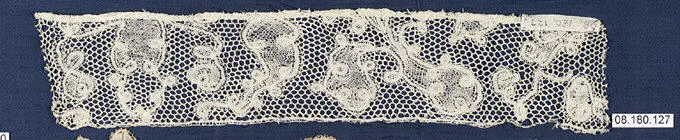
Delicate Vintage Lace Strips

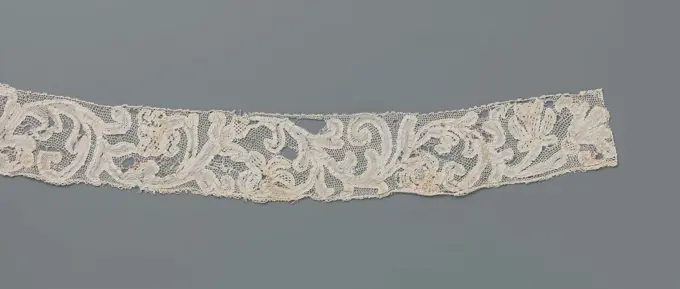
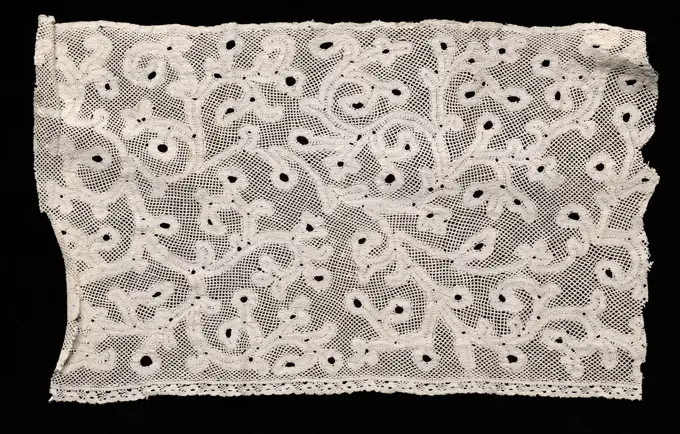
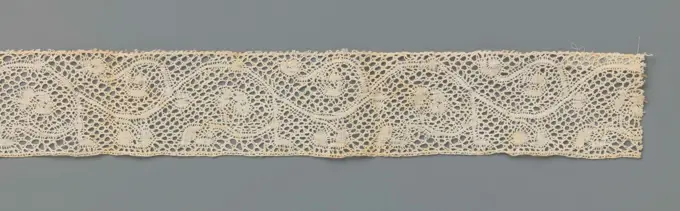
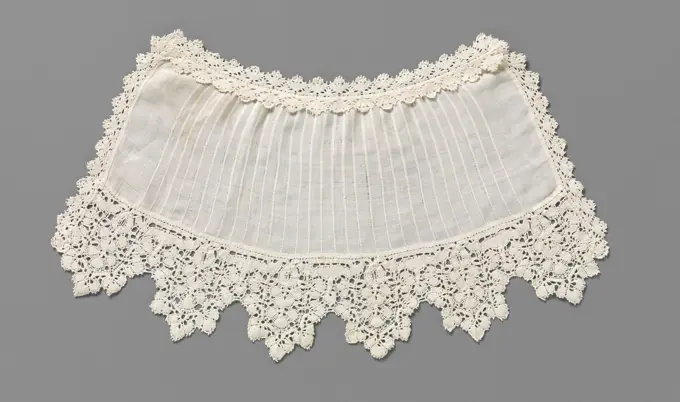
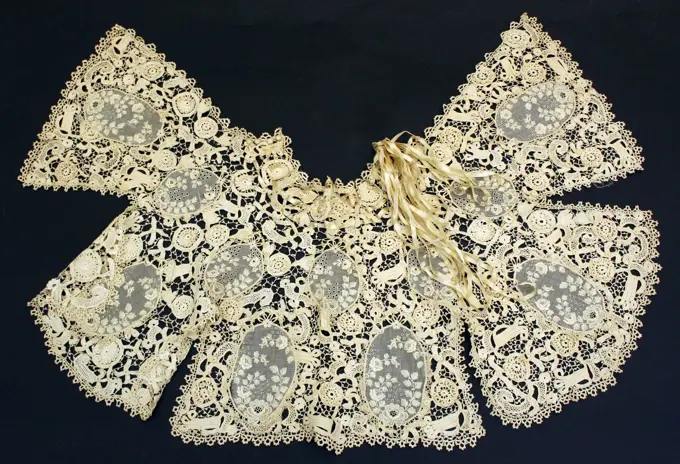
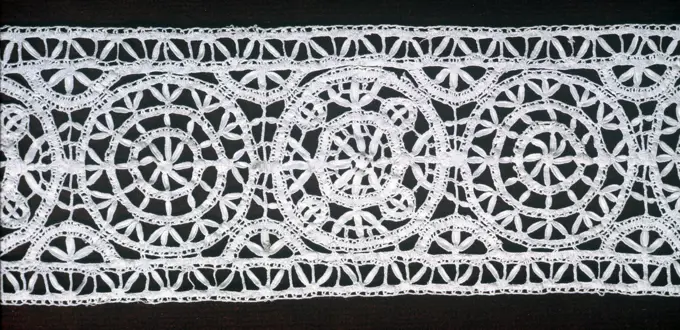
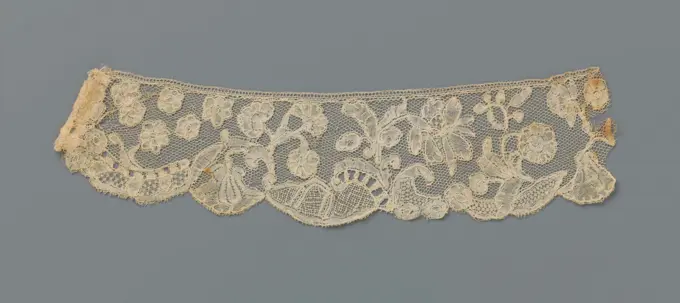
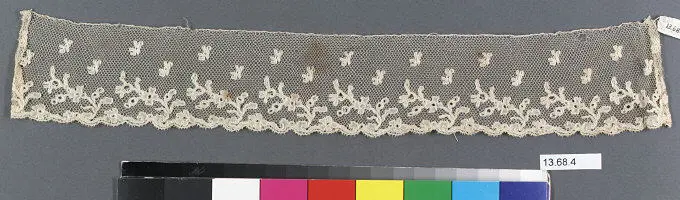
Intricate lace strips featuring floral patterns and historical designs. The natural colors and detailed craftsmanship exude elegance and vintage charm.

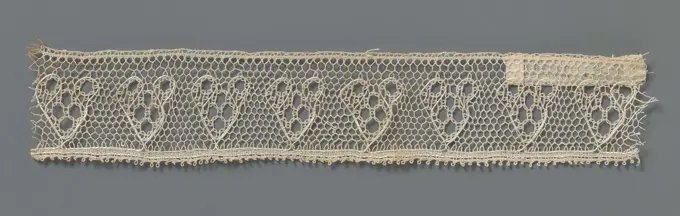
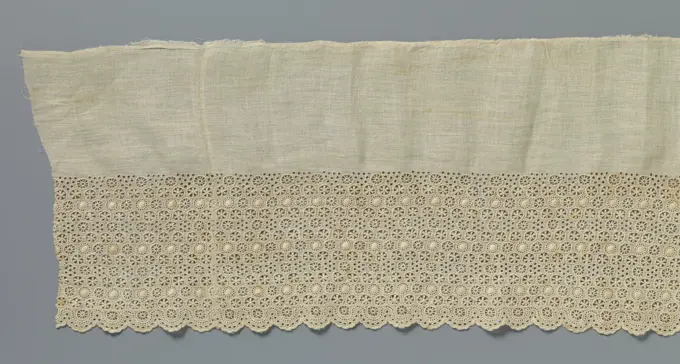
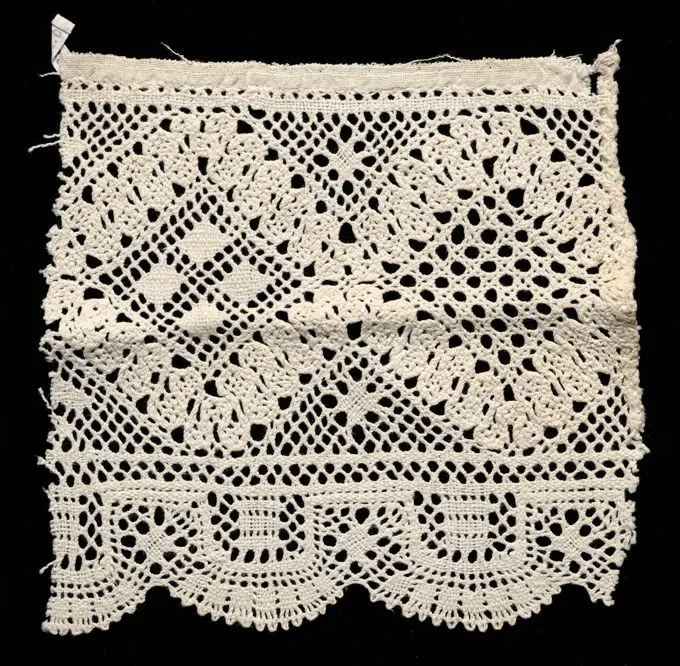
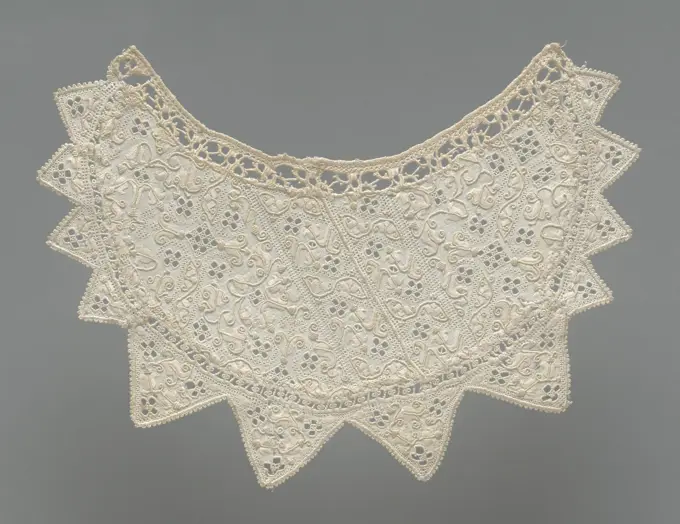
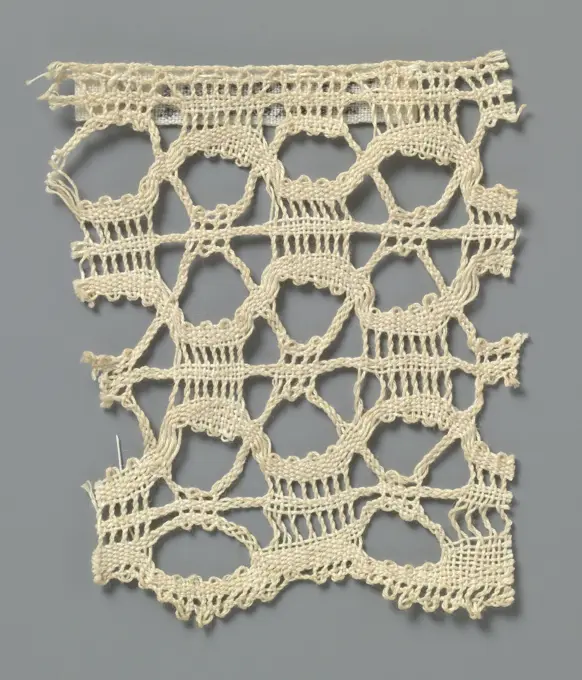
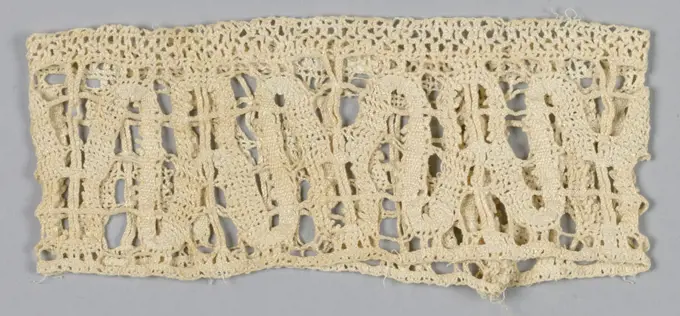
Strip made of linen with a wax edge and lace plunge with a row of open -worked drop shapes, anonymous, c. 1820 Japon strip made of natural linen with lace border: English embroidery. Pattern with a row of drop shapes formed by openwork ovals and spire. Above the drops of open work and rosette flowers. The scrap edge follows the shape of the bottom of the drops and is accentuated by a double continuous list of openwork circles. Each shell is finished with twelve embroidered lobes. Along the top of the strip is a narrow strip of linen sewn with vertical lanes whitework. Netherlands (possibly) linen (material) Japon strip made of natural linen with lace border: English embroidery. Pattern with a row of drop shapes formed by openwork ovals and spire. Above the drops of open work and rosette flowers. The scrap edge follows the shape of the bottom of the drops and is accentuated by a double continuous list of openwork circles. Each shell is finished with twelve embroidered lobes. Along the t
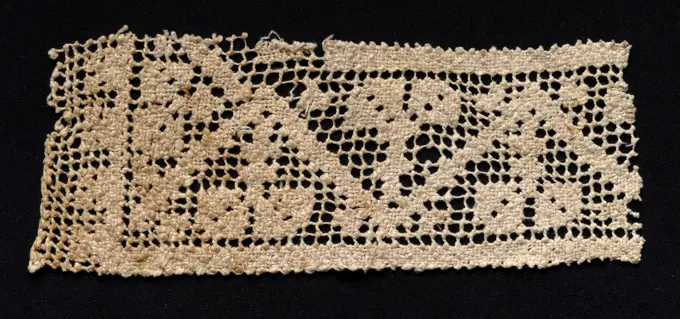
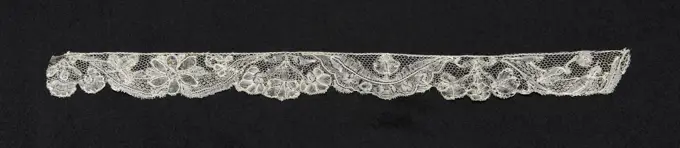
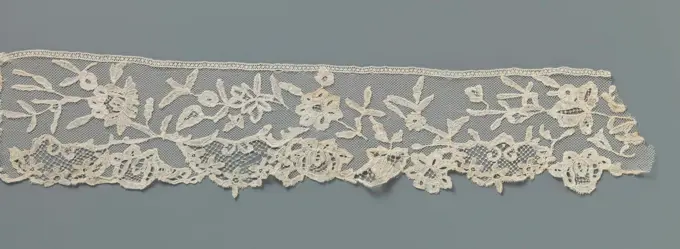
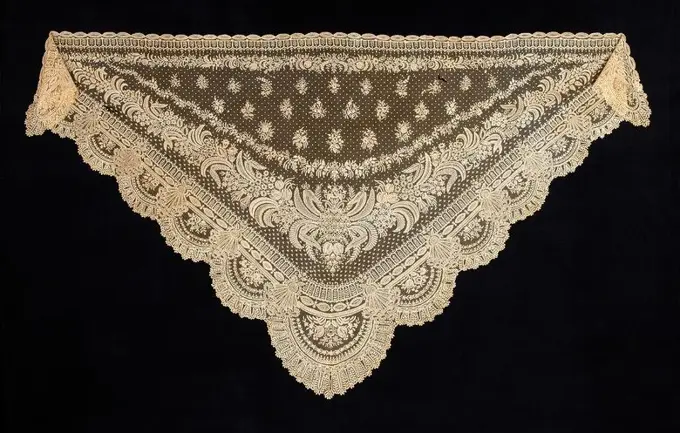
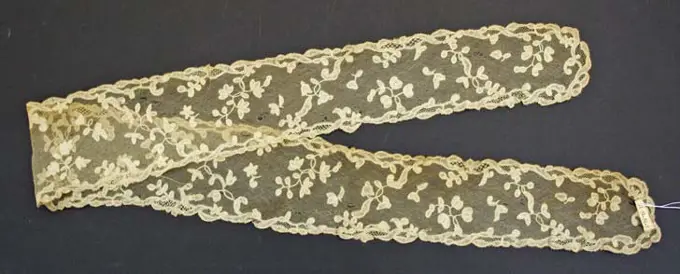
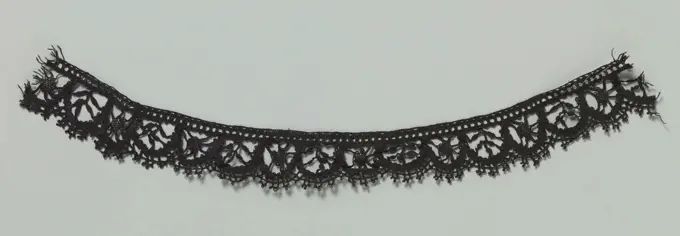
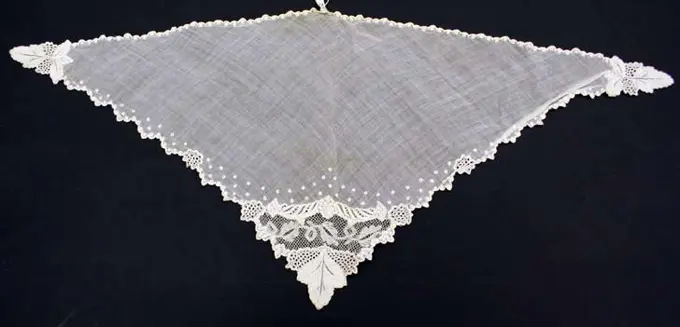
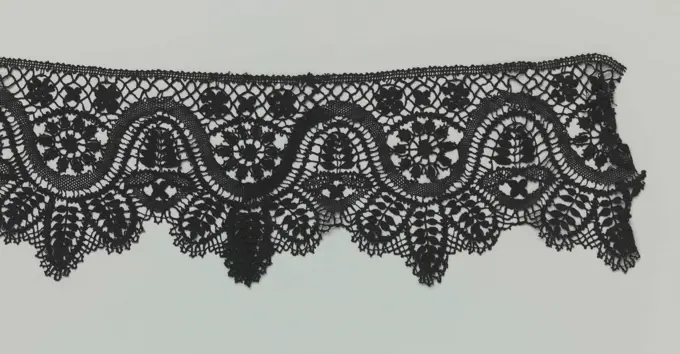
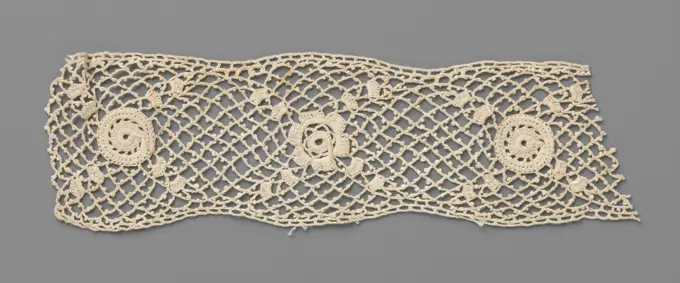
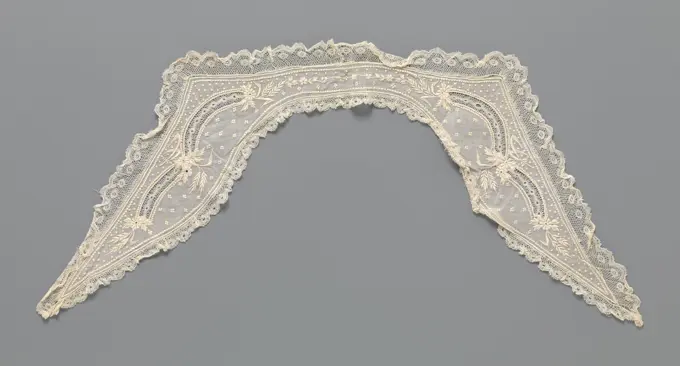
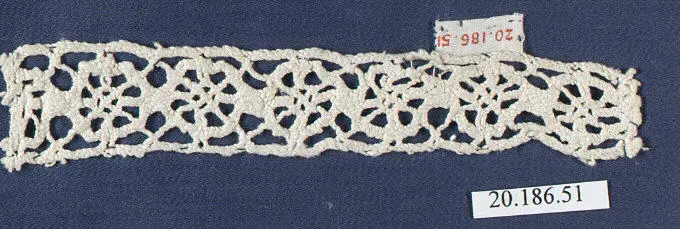
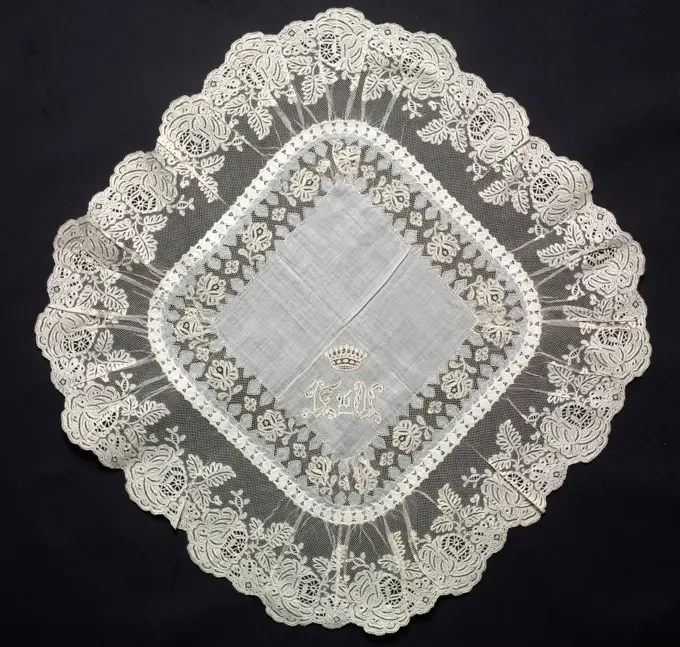
Flounce (Belgium); linenStrook kloskant met hartjes gemaakt met cirkeltjes.Strip natural colosside, Lille side. The repeating pattern consists of a heart made of a circle of ornamental land, a rose ground. The hearts are on the straight strap that runs along the bottom. The motifs are connected by a Maas soil, a tulet. The contours of the hearts are made with thicker and shiny wires. Also along the band, made in linen stroke, contour wires, where the upper goes through in the hearts. The top and bottom of the strip are straight finished, the underside with picots.Fragment of a Band with Abstract Pattern, 17th-18th century. Spain, 17th-18th century. Needle lace, filet/lacis (knotted ground and darned in two directions); bleached linen (est.); overall: 8.2 x 21.6 cm (3 1/4 x 8 1/2 in.). The thick and graphic darning, or area of woven pattern, depicts triangular and circular geometric motifs. In addition to the knotting of the thread (filet/lacis technique), the lace maker used thicker thread to create the bold and heavy pattern.Length of Lace. Italy, circa 1600-1620. Textiles; textile lengths. Linen Buratto needle lace with bobbin lace edgingBobbin Lace (Point d'Angleterre) Edging, mid 18th century. Belgium, Brussels, mid 18th century. Lace, bobbin; average: 3.2 x 37.5 cm (1 1/4 x 14 3/4 in.).Japonstrook van applicatiekant met symmetrische reserves langs de onderrand.Japon strip of natural colored application side, dick edge and needle side applicated on machine tulle. Symmetrical pattern along the bottom edge with two reserves with grid work filling, crowned with volutes and with five flowers at the bottom. Between the two reserves a rosette flower and two large flowers on the outside. Uprived curved branches with large flowers from the decorated bottom edge. The strip consists of three pieces sewn together and is attached to BK-BR-J-191.Shawl. Culture: Belgian. Date: 1860-70.Particularly refined and detailed design, this shawl was donated to the British War Relief Committee during WWI by a member of the royal family. Museum: Metropolitan Museum of Art, New York, USA.Fragment of lace 17th century Italian. Fragment of lace 214863Fichu of clusters side with garden gate. Fichu from natural colosside: Valenciennes side. Model: A triangular backpiece is pretty suddenly in narrow ends. On a fine ground ground, a square valenciennes ground, a continuous and with the wavy contour is a 'garden gate' with crossed bars and regularly interrupted by a sheet palm with. Exterior edge of a row of large, single and consecutive roses. In the middle a branch growing from the right with a dependent rose. A winding branch with fine sprouts and some roses and leaves run from one end to the other.Fragment of lace. unknown, authorPair of Cuffs Made 1801-1900 Europe. Linen, two layers of plain weave; cut and drawn work fillings of diagonal drawn filling, four sided, hem, herringbone, interlocking lace, overcast, wave, and woven hem stitches; embroidered in buttonhole, buttonhole wheels, hem, overcast, and satin stitches through one or both layers; edged with linen, bobbin straight lace .Barbe 18th century Flemish. Barbe. Flemish. 18th century. cottonBorder; linenBorder 18th century German. Border 215241Echarpe van Kloskant with lightning bolts, anonymous, c. 1875 - c. 1899 Echarpe of natural -colored bobbin, Russian or Eastern European side. Rectangular model with rounded corners. The coarse pattern stands on a fine braid ground and shows long, curved edges and spirals, which, one or two-sided, accompanied by a lightning bolt edge. Eastern Europe linen (material) bobbin lace / Russian lace / East European lace Echarpe of natural -colored bobbin, Russian or Eastern European side. Rectangular model with rounded corners. The coarse pattern stands on a fine braid ground and shows long, curved edges and spirals, which, one or two-sided, accompanied by a lightning bolt edge. Eastern Europe linen (material) bobbin lace / Russian lace / East European laceStrook kloskant met boogjesrand waarin afwisselend een bladertakje en een rondje tussen spaken staan.Strip of black climbing side, Cluny side. The repeating pattern consists of a bow border, where the bow bitches form the slot. A branch with five leaves and a round of spokes alternately stands in each arc. The straps that form the arcs are made in linen stroke. The laps in it are made in slurbase and the leaves on the twigs are made in shape stroke. The motifs are connected by a braid ground. Along the bottom hanging three lobes, made with braids and finished with a few picots. The top of the strip is straight finished.Strip linen with openwork circles with suns and stars, anonymous, c. 1920 Strip of natural linen with openwork circles: English embroidery. The lower half of the strip has been edited. The pattern consists of thirteen rows of openwork circles with embroidered edges. In the center the circles are decorated with alternating suns, stars and cogs. There are also roses in a few rows, which are made with a smaller open -sized circle around which six other circles are like petals. Between the successive circles in the upper row, ten of these small circles of triangles have always been built up. The scrap edge along the underside of the strip is finished with a wavy line of these small circles, around which small lobes are made by shell. The strip is probably intended or used for confirmation to a dress. East Indonesia (Possible) linen (material) embroidering Strip of natural linen with openwork circles: English embroidery. The lower half of the strip has been edited. The pattern consists of tFragment, Medium: linen Technique: grid of laid cord with needle lace, reticella style, Spain, ca. 1600, lace, FragmentStrip bobbin with heart-shaped and triangular flour between zigzag line of circles, anonymous (Possibly), c. 1900 - In or Before 1920 Strip of natural -colored bobbin: Stropkant with motifs in sloping mains, also called 's Gravenmoerse side. The repeating and symmetrical pattern consists alternately of a heart -shaped flower in netslag and a triangular flower in linen battle. A thicker contour thread runs around the motifs that also forms the stalk of each flower and the zigzag line of circles that forms between the flowers, one flower under each point. The motifs are connected by a reinforced closed pin stroke ground. Top and bottom of the strip are straight finished with the bottom with picots. 's Gravenmoer linen (material) bobbin lace / torchon lace / 's Gravenmoer lace Strip of natural -colored bobbin: Stropkant with motifs in sloping mains, also called 's Gravenmoerse side. The repeating and symmetrical pattern consists alternately of a heart -shaped flower in netslag and a trianStrook naaldkant met kronkelende bloemslinger.Strip natural-colored coniferous lace: Alençon side. Pattern with a winding garland with flowers and leaves, on a fine hexagonal maas soil. The top is trimmed with a border clamping side. The bottom is scalloped.Japon strip from dick side with thin flowerguirland. Juice black climbing lane: Chantilly-side. On a coarse meshing is a pattern with a thin flowerguirland.Kerchief 19th century American or European. Kerchief 119427Bobbin Lace Fragment of Flounce, 19th century. Spain, 19th century. Lace, bobbin; average: 19.1 x 20.4 cm (7 1/2 x 8 1/16 in.).Bobbin Lace (Needlepoint Design) Point, second half of 16th century. Italy, Genoa, second half of 16th century. Lace, bobbin; average: 6.7 x 7.3 cm (2 5/8 x 2 7/8 in.).Border 16th century Italian. Border 214808Strook kloskant met diepe golflijn.Strip of black climbing side, Cluny side. The repetitive and symmetrical pattern consists of a deep wave line. There is a rosette in each golf valley with two smaller rosettes and a four-pointing asterisk in between. Each wave top comprises a composite, standing leaf, with five leaves on either side. Under the leaf is a four-pointed asterisk framed. The sloping edge along the bottom of the strip is formed by three radiating lovers under each golf valley. A composite leaf hangs down in each of these lobes. The lobes are finished with arcs made with picotted braids. The wave lines and picture frames are made in a slur in and linen, the rosette leaves, composite leaves and stars in shape stroke. They are connected by a braid soil, which forms a coarse square grain on the top of the strip. The top of the strip is straight finished.Border, Medium: linen Technique: bobbin lace, Mechlin style, Border with a repeated design of a bird perched on a branch with a turned head. Design interspersed with elaborate diagonal scroll work., Northern Europe, mid-18th century, lace, BorderStrip of needle side with double tibs, anonymous, c. 1875 - c. 1909 Strip of natural -colored needle side: Venetian relief side. Spread, small and medium -sized palm flowers grow on thick, doubled stems, which spring abruptly on the straight inside. An open bar of land forms the surface. Edge with triangles. BURANO linen (material) Venetian raised work Strip of natural -colored needle side: Venetian relief side. Spread, small and medium -sized palm flowers grow on thick, doubled stems, which spring abruptly on the straight inside. An open bar of land forms the surface. Edge with triangles. BURANO linen (material) Venetian raised workFragment 18th century possibly French. Fragment 214629Edging 17th century Italian, Genoa. Edging 220973Strip crocheted side with rosette between two circles, c. 1900 Strip natural -colored crocheted side: Irish crochet. Pattern with rosette between two circles and a diamond -shaped soil with picots. Lightly wavy top and bottom of the strip. West-Europa cotton (textile) Strip natural -colored crocheted side: Irish crochet. Pattern with rosette between two circles and a diamond -shaped soil with picots. Lightly wavy top and bottom of the strip. West-Europa cotton (textile)Halfovaalvormig fragment van kloskant met strooipatroon en bladerenrand.Semi-relocal fragment of black climbing side: Chantilly side. Sprinkle pattern with dots on a fine hexagonal grille. A scalloped edge of large leaves runs along the curved side. Above the large leaves a flower branch with round leaf flowers around and interspersed with a flower branch with flowers with heart-shaped petals. The other sides have been cut and not finished. The side may be a fragment of a hat veil.Edging 16th-17th century Italian, Venice. Edging. Italian, Venice. 16th-17th century. Bobbin lace. Textiles-LacesBorderStrip needle side with asymmetrical acanthus leaves. Strip natural needle side, Venetian relief side. Pattern with asymmetrical acanthus leaves in S and C vultuts running out in palmmet flowers. Irregular bars soil with picots. The top edge is right with a zigzag line of picoted bars. A scalloped edge at the bottom.Cuffs 19th century Belgian. Cuffs 79079Fragment (Italy); linenBorder Made 1775-1800 Flanders. Linen, bobbin straight lace .Fragment, Medium: linen Technique: bobbin lace, Fragment of Valenciennes lace has scrolls enclosing oval areas with a 'fond de neige' or snowy ground. Round mesh., France, 18th century, lace, FragmentFragment 18th century Italian. Fragment 218668Fragment; linenRound collar of Mechelse side, Anonymous, c. 1850 - c. 1870 Round collar of Mechelse side, which may have been worn with one or two other. Decorated with a mountain-and-valley, above which rose branches in a running pattern. Mechelen . Mechlin (lace) Round collar of Mechelse side, which may have been worn with one or two other. Decorated with a mountain-and-valley, above which rose branches in a running pattern. Mechelen . Mechlin (lace)Collar, Medium: linen, cotton Technique: deflected element work, Collar in a pattern of medallions containing roses set in a scalloped border., France, 19th century, lace, CollarCollar late 19th century Irish. Collar 169612Dasslip van naaldkant met symmetrisch patroon van vele ranken met kleine bladeren en bloemen.Natural Carriage Dasslip: Flat Venetian side. Apparently trigger but symmetrical pattern with a vertical axis in the middle from which many curling flower and leaf refines move. The motifs are made with feston stitches, where simple patterns have been realized with recesses in different flowers and leaves. The motifs are connected by a picoted bars soil. The top of the strip is finished with a splitting strap. The underside and two short sides are finished with a bow edge.Needlepoint Lace Collar, 18th century. France, Argentan, 18th century. Lace, needlepoint: linen; overall: 36.5 x 68.5 cm (14 3/8 x 26 15/16 in.).Shaped Sleeve Ruffle (Engageanté). Italy, Burano. Date: 1770-1789. Dimensions: 17.6 × 94.6 cm (6 7/8 × 37 1/4 in.)Heading height: .35 cm (1/8 in.). Linen, needle lace. Origin: Burano. Museum: The Chicago Art Institute, Chicago, USA.Sleeve ruffle, Medium: linen Technique: needle lace with bobbin lace ground, Sleeve ruffle in a pattern showing freely-placed floral sprays and cartouche., 18th century, lace, Sleeve ruffleFlounce (Furnishing) Made 1750-1775 Flanders. Linen, bobbin part lace of a type known as Brussels with an imitation of needle made mesh, Point d'AlenÁon, ground .Fragment (France); linenCap Streamers (France); linenStrook naaldkant met veelsoortige bloemen.Strip natural-colored mixed side: Venetian ribbon side. Pattern with a plot rank over the full width of the strip, on a square mesh soil (coniferous side) with twisted feston stitches. On the rank leaves and large flowers, including rosette flowers, palmet flowers and cheries in a repeating pattern. The contours of the pattern are formed by a woven ribbon. Different ornamental grounds are used with feston stitches within the contours. The finish on the top is a straight edge to which groups of some very small thickenings made with single stitches. The underside is finished with a straight edge climbing side with arcs.Bobbin Lace Edging, 18th-19th century. Italy, Sicily , 18th-19th century. Lace, bobbin: linen; average: 20.7 x 34.3 cm (8 1/8 x 13 1/2 in.).Borders (Italy); linenKloskant dress strip with ferns, anonymous, c. 1850 - c. 1855 Black bobbin jelly strip: Chantilly side. On an empty mesh stock there is a closed edge with scoops, filled with a garland of flowers and leaves. On the intersections there is a small shell with a hanging rose, above which a striker bouquet rises from four large fern leaves and a flower branch, which extends to the top edge. Here a horizontal climbing window with hanging twigs runs, while on the field above the large shell of this climbing crank a large bouquet depends, among other things with a tulip. France (possibly) silk bobbin lace Black bobbin jelly strip: Chantilly side. On an empty mesh stock there is a closed edge with scoops, filled with a garland of flowers and leaves. On the intersections there is a small shell with a hanging rose, above which a striker bouquet rises from four large fern leaves and a flower branch, which extends to the top edge. Here a horizontal climbing window with hanging twigs runs, while on Cooper Union Museum Lace Study Card, Medium: linen Technique: needle lace, Lace fragment in a conventionalized floral pattern with parts in relief. One straight edge, the other with ornament. Fragment is mounted on a fabric-covered board and framed behind glass. Frame is natural wood., Italy, 19th century, lace, Fragment, FragmentStrook kloskant krullende ijle ranken met gestileerde bloemen en bladeren.Strip natural colosside, Flanders side. The pattern consists of a curly thin rank with stylized flowers and leaves. The motifs are made in linen stroke with openwork edges. They are connected by a grille, a five-grain soil. The top and bottom are immediately finished with picots on one side.Manchet voor een dame of heer van batist en rondom afgewerkt met kloskant.Cuff for a lady or gentleman, made from Batist and finished with natural colosside around: Old Flemish side. Model: Rectangular linen laid with fine pleats in a curved shape. On one long side, the cuff has a wide strip of clamping and a narrower strip on the other sides. Along the long side with the narrower strip side, a mirrored narrow strip side is also sewn, which falls over the linen. The repetitive and symmetrical pattern of the wide strip with a total of five tubes consists of a flower pot surrounded by seven triple leaves by a glider. The pattern of the narrow strips consists of jointed triple flowers that simultaneously form tubs.Lappet late 19th century Belgian. Lappet 169857BorderStrip bobbin with four leaves around Bloemhart, Anonymous, c. 1875 - c. 1899  Strip or intermediate creature made of black bobbin, Cluny side. The repeating pattern consists of a flower heart on the center line to which petals are attached to four sides. The successive flower hearts are connected to each other with a horizontal picoted braid and with double-crossing pairs on the top and bottom of the strip. The flower hearts are made in linen battle. The petals are made in shape. Top and bottom of the strip are straight finished with an open zigzag edge. Russia silk bobbin lace / Cluny lacePair of Cuffs Made 1525-1550 Italy. Linen, plain weave; cut and drawn work in interlocking lace and overcast stitches; darned and overcast bars; buttonhole ring picots; embroidered in bullion, buttonhole, double faggot, double hem, overcast back, overcast and satin stitches; attached edge of plain weave; cut and drawn work in double hem, darning and overcast stitches; buttonhole and overcast bars; bullion picots .Kloskant dress strip with ferns, anonymous, c. 1850 - c. 1855 Black bobbin jelly strip: Chantilly side. On an empty mesh stock there is a closed edge with scoops, filled with a garland of flowers and leaves. On the intersections there is a small shell with a hanging rose, above which a striker bouquet rises from four large fern leaves and a flower branch, which extends to the top edge. Here a horizontal climbing window with hanging twigs runs, while on the field above the large shell of this climbing crank a large bouquet depends, among other things with a tulip. France (possibly) silk bobbin lace Black bobbin jelly strip: Chantilly side. On an empty mesh stock there is a closed edge with scoops, filled with a garland of flowers and leaves. On the intersections there is a small shell with a hanging rose, above which a striker bouquet rises from four large fern leaves and a flower branch, which extends to the top edge. Here a horizontal climbing window with hanging twigs runs, while on Batist handkerchief around finished with dick side with a through ribbon that forms a drop in every corner and cheries flowers in between. Natural batist handkerchief rounded with natural colosside: Oosteuropean side. The symmetrical pattern is formed by a continuous ribbon that forms the contours of an elongated drop in the corners. Along the sides, the ribbon runs through the drops and it forms the contours of three skals flowers set with three flower leaves. In the space between the flowers, the ribbon forms the contours of a more or less mushroom-like motif. The ribbon is made in linen stroke with highly openwork edges. With picoted double braids, stars are made in the motifs.Canvas finger decorated with lace unknownFragment, Medium: linen Technique: bobbin lace, continuous braid-like, Border fragment of two rounded pendants., Genoa, Italy, 17th century, lace, FragmentStrip 16th-17th century Italian, Tuscany. Strip 220909Sleeve ruffle, Medium: linen Technique: bobbin lace, Brussels style, Sleeve ruffle shape with detached flowering sprays and leaf ornaments., Belgium, late 18th century, lace, Sleeve ruffleFragment, Medium: linen Technique: bobbin lace, Binche-style fragment showing an open design of a curving ribbon-like ornament., Belgium, 18th century, lace, FragmentCollar early 19th century Belgian, Brussels. Collar 218609Strip bobbin with rows of standing ovals with a cross, anonymous, c. 1800 - c. 1899 Strip of natural -colored bobbin. The pattern consists of three rows of oval with a cross in it, interspersed with striped cubes. The ovals are formed by wavy ribbons between horizontal lines. The top of the strip is straight finished. The scums along the underside are formed by the lower wavy ribbon, which is fitted with picots at the bottom. Brazil linen (material) bobbin lace Strip of natural -colored bobbin. The pattern consists of three rows of oval with a cross in it, interspersed with striped cubes. The ovals are formed by wavy ribbons between horizontal lines. The top of the strip is straight finished. The scums along the underside are formed by the lower wavy ribbon, which is fitted with picots at the bottom. Brazil linen (material) bobbin laceStrip bobbin with S-shaped cartouche and pear-shaped flour, anonymous, c. 1725 - c. 1749 Strip of natural-colored bobbin, binche side. The repeating and continuous pattern consists of an S-shaped cartouche, formed by two long feathered leaves. Halfway through the top, a feathered leaf splits and runs with a large bow, in the opposite direction, so that a circular shape is formed and the large pear -shaped flour at the end touches the bottom of the strip. The motifs run into each other and, where they do not touch each other, are connected by decorative land, different snowflake grounds. The motifs are made in linen battle with openwork edges. Cover fillings are decorated with snowflakes. Top and bottom of the strip are straight finished, with the bottom with picots. Three seams run across the width of the strip. Southern Netherlands linen (material) Bobbi Lace / Binche Lace Strip of natural-colored bobbin, binche side. The repeating and continuous pattern consists of an S-shaped cartouNeedlepoint (Punto Avorio or Ivory Stitch) Lace Point, 17th century. Italy, 17th century. Lace, needlepoint; average: 4.8 x 8 cm (1 7/8 x 3 1/8 in.).Collar late 19th century French. Collar 118911Japonstrook van applicatiekant met golvende rank en klokjesbloemtakken.Japon strip of Brussels application side, dick edge with coniferous sketch decorative stitches, confirmed on machine tulle. The strip is made as middle strip of three strips for a crinoline juice. On the strip is a continuous pattern with a wavy and opened leaf drink to the left. Three rosette flowers and a large to the right reveal branch with bells flowers. Under one wave there are two richly decorated garlands, which form the deep slots. The motifs are made in linen stroke and the motifs are largely equipped with relief contours made with a thicker thread and here and provided with clost relief contours (ribs). One type of ornamental ground (needle side), with thickened knots decorated meshes, fills part of the motifs. The top edge is finished with a soil.Strip late 18th century Flemish. Strip 218194Band (Italy); linenSjerp van machinale kant met bloemen en bladeren.Sash of natural-colored machining: machine blonde. The slot edges along the long sides of the sash are formed by the repeating pattern of a horizontal flower. The flowers are connected to a slightly curved stem with an elongated leaf, whereby the flower points its head with an arc in the stem sloping down. The leaf and the flower form the slot. In midfield between the sloping edges, loose smaller flower branches, which are connected at the beginning and end of the sash with a larger flower between large leaves. These large motifs ensure the slot edge on the short sides. The motifs are equipped with shiny contour wires and are connected by a machining. In most flower hearts and at the ends of the sash are decorative soils, mainly machining rose grounds. The sloping edges are finished with picots, but these are largely damaged.Collar 1700-1942 American. Collar 119213Strip of bobbin with diamond -shaped rosette flowers on wavy rank, anonymous, c. 1850 - c. 1899 Strip of natural -colored bobbin. The repeating pattern consists of a wavy slender, which is interrupted on the tops and in the valleys by a diamond -shaped rosette flower with openly worked flower heart. Halfway through each wave there is a curved leaf on either side of the slank. The silly edge of the scaffold along the underside of the strip is formed by a succession of smaller rosette flowers with an open worked flower heart. The motifs are connected by a diamond-shaped Maas soil, a lace-hole stroke grid. The motifs are made in linen battle, with thicker contour threads. The top of the strip is straight finished. Germany (possibly) linen (material) bobbin lace Strip of natural -colored bobbin. The repeating pattern consists of a wavy slender, which is interrupted on the tops and in the valleys by a diamond -shaped rosette flower with openly worked flower heart. Halfway through each wave Collar 1850-69 Belgian. Collar 118943Strook kloskant met drie verschillende bloemtakken.Strip natural colored Brussels climbing side. The pattern consists of rosette flowers and three different bending flower branches and on both cut shorts of a flower branch of a flower branch. The motifs are connected by a fine Maas soil, a slighten ground. The motifs are made in a cut-off and linselag with openwork edges and recesses. Most motifs have closted relief contours. Specifically in fields along the underside, various ornamental grounds are used, including snowflakes and a fatty cattle ground soil decorated with squares made in shape stroke. The top is finished with a separate clust strap. The scalloped underside is finished with picots.Handkerchief with a trench edge with a three-leaf. Handkerchief with an edge of natural colosside: fine bridges. Flower work. Around a quadruped linen cloth is turned on an edge that overcures the lobes in the middle of the sides with a flour and a leaf. The side has a two-sided symmetrical pattern on a braid soil. In the corners, overhoek is an oval, from which four curved stems sprout, including with a three-leaf and blossoms.Cap Crown (Italy); linenFragment, Medium: silk Technique: machine made, Black lace with deeply scalloped edge with upright flowers and leaves., France, 1850-99, lace, FragmentNeedlepoint (Punto in aria) Lace Collar, late 16th century. Italy, Genoa, late 16th century. Lace, needlepoint; average: 12.5 x 33.1 cm (4 15/16 x 13 1/16 in.).Fragment early 19th century British, Buckinghamshire. Fragment 219444Bands, Medium: linen Technique: bobbin lace, continuous tape with bars added, Bands for cuffs and collars with deep curving lines held together by connecting brides., Italy, 17th century, lace, BandsBobbin Lace (Needlepoint Design) Insertion without Selvage, second half of 16th century. Italy, Genoa, second half of 16th century. Lace, bobbin; average: 3.9 x 14 cm (1 9/16 x 5 1/2 in.).Scarf collar of batist with embroidery with grain and machinal incustations in the form of two flat arches in each point, anonymous, c. 1885 Scarf collar of natural-colored embroidered batist, finished all around with strips of machine side: machine Valenciennes side. Narrow trapezoidal model with pointed points. From the straight bottom towards the points, two Incrustations from Kant have been installed, two -connected flat arches on each side. At the junction and the ends of the arches there is embroidery - whitework with plumetis - with two corners, one or two rosette flowers and cracked grass blades. The batist is littered on the inside with flowers and fuller strewn with mosjes on the outside. The lace strips have a scrap of bows with an oval above each shell. Netherlands linen (material). batiste embroidering Scarf collar of natural-colored embroidered batist, finished all around with strips of machine side: machine Valenciennes side. Narrow trapezoidal model with pointed points.Fragment of lace unknown, national coronary schoolInsertion 16th century Italian. Insertion 220861Fragment; linen; 1933-1-206lace in shadow on towel white lace in shadow on towel Copyright: xZoonar.com/AndreyxGuryanovx 2102521Edging 17th century Italian, Genoa. Edging 220950Mouwstrook van kloskant met losse roosjes.On a fond of square mesh, above small smooth scoops, alternately loose roses and twigs in the form of question marks. Valenciennes side.Bobbin and Embroidery Lace, 19th century. France or Flanders, 19th century. Linen with Valenciennes lace insertion embroidered border and edging of Valenciennes lace; average: 53.4 x 54.7 cm (21 x 21 9/16 in.).Fragment 17th-18th century Flemish. Fragment 214482Ornament (one of a pair) 1600-1650 () possibly Spanish. Ornament (one of a pair) 222470Cuffs 18th century British. Cuffs 98182