Delicate Vintage Lace Strips

Intricate lace strips featuring floral patterns and historical designs. The natural colors and detailed craftsmanship exude elegance and vintage charm.

Strip made of linen with a wax edge and lace plunge with a row of open -worked drop shapes, anonymous, c. 1820 Japon strip made of natural linen with lace border: English embroidery. Pattern with a row of drop shapes formed by openwork ovals and spire. Above the drops of open work and rosette flowers. The scrap edge follows the shape of the bottom of the drops and is accentuated by a double continuous list of openwork circles. Each shell is finished with twelve embroidered lobes. Along the top of the strip is a narrow strip of linen sewn with vertical lanes whitework. Netherlands (possibly) linen (material) Japon strip made of natural linen with lace border: English embroidery. Pattern with a row of drop shapes formed by openwork ovals and spire. Above the drops of open work and rosette flowers. The scrap edge follows the shape of the bottom of the drops and is accentuated by a double continuous list of openwork circles. Each shell is finished with twelve embroidered lobes. Along the t
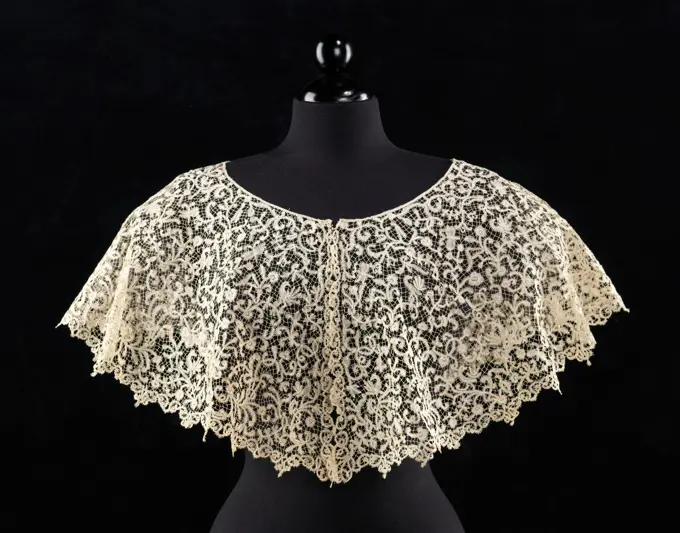
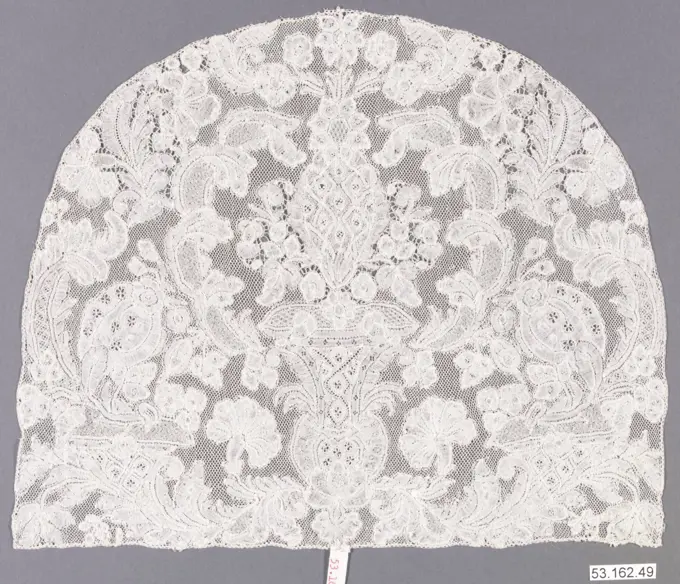
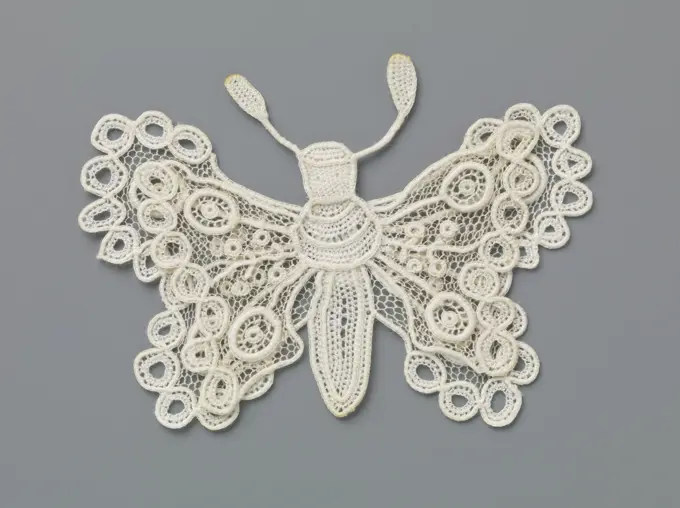
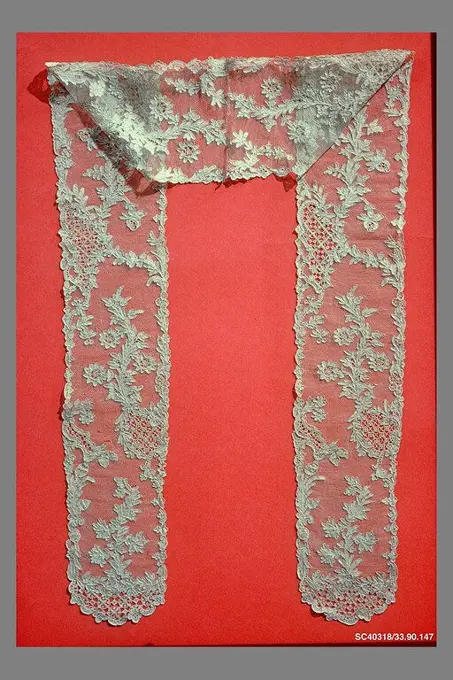
Lace applications for the dress;  around 1920 (1915-00-00-1925-00-00);Magdalena, Witwińska, Dar (provenance)Front with a mandarin collar National Corrhue SchoolHandkerchief with a middle piece of batist with embroidered initials EB all around with a border mixed side, anonymous, c. 1900 - c. 1910 Handkerchief with a square center of Batist, on which the initials are embroidered diagonally in a corner. The handkerchief is finished all around with a edge of natural ribbon side (mixed side): luxurious lace, with a messing ribbon and needle lace fillings. The symmetrical pattern consists of a heart -shaped motif on the corners and in the middle of each side of a sunflower, the contours of which are formed by a narrow ribbon. Between heart and sunflower a deeply incised and pointed leaf that ends diagonally from the corners to the outside near the sunflower. Within the contours with which the motifs are formed, decorative lands have been applied (needle side). The motifs are connected by a bar of land (needle side). The irregular and pointed edge of Schulpen stems from the pattern with the heart and the pointed leaves. West-Europa cotton (textile)Bobbin Lace (Needlepoint Design) Insertion with Fringe, second half of 16th century. Italy, Genoa, second half of 16th century. Lace, bobbin; average: 5.8 x 45.1 cm (2 5/16 x 17 3/4 in.).Bertha ca. 1890 Belgian. Bertha 156799Renaissance Fringe Made 1501-1600 Italy. Silk and gold and silver gilt strips wound around silk fiber cores, countered warp twining with extended weft loop fringe .Cap crown 18th century Flemish, Brussels. Cap crown 227696Cap 1830-50 Slovak. Cap 157510Strip bobbin with deep wave line, anonymous, c. 1880 - c. 1899 Strip of black bobbin, cluny side. The strip is cut, one report is just not completely complete anymore, the upper part of the subsequent report has been cut away along the Gulf line. The original, repeating and symmetrical pattern consists of a deep wave line. In each golf valley there is a rosette with two smaller rosettes and a four -pointed star in between. Each wave summit comprises a composite, standing leaf, with five leaves on either side. Under the leaf is a framed four -pointed star. The scrap edge along the underside of the strip is formed by three radiating lobes under each golf valley. A composite leaf hangs down in each of these lobes. The lobes are finished with arches made with potente braids. The golf lines and frames are made in netslag and linen battle, the rosette leaves, composite leaves and stars in shape. They are connected by a braid ground, which forms a coarse square grille on the top of the strip.Floral Ribbon, 18th-19th century, 15 x 5 in. (38.1 x 12.7 cm), Silk; passementerie, 18th-19th centuryApplication of Brussels needle side in the form of a butterfly, anonymous, c. 1900 - c. 1914 Application of natural -colored Brussels needle side, in the form of a butterfly. The body of the butterfly is closed, the double wings are trimmed with open circles and decorated with stylized flowers. The butterfly belongs to a series of a total of 4 objects in which the development to arrive at this end product are demonstrated. Belgium linen (material) Application of natural -colored Brussels needle side, in the form of a butterfly. The body of the butterfly is closed, the double wings are trimmed with open circles and decorated with stylized flowers. The butterfly belongs to a series of a total of 4 objects in which the development to arrive at this end product are demonstrated. Belgium linen (material)Collar third quarter 19th century Maltese. Collar 170392Border; natural linen; Bequest of Marian Hague; 1971-50-380Tassel, Medium: linen Technique: knotted, Circular tassel has fifteen arms terminating in tiny crosses., Italy, late 16th-early 17th century, trimmings, TasselValentine - Dearest, accept this offering (...)Close-up of embroidery on fabricSquare, Medium: cotton Technique: printed, Gray fringed square kerchief with an allover pattern of conventionalized flowers in red with a border of flowers in green and red., USA, 1850-1900, printed, dyed & painted textiles, SquarePair of lappets 18th century French. Pair of lappets 222834Women's string lace panties on a white background