Detailed Lace and Textile Strips

Exquisite lace strips with intricate patterns, featuring floral designs and historical craftsmanship, showcasing textile artistry from various periods.

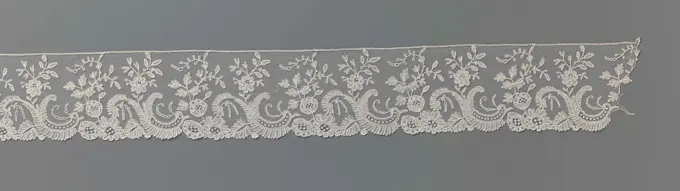
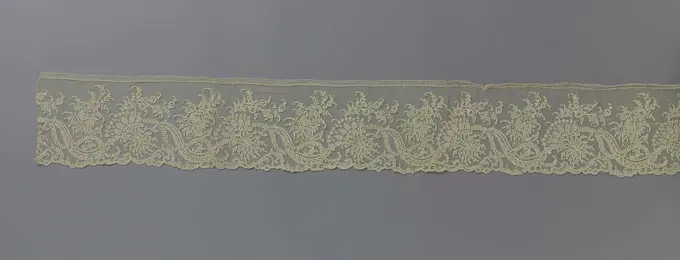
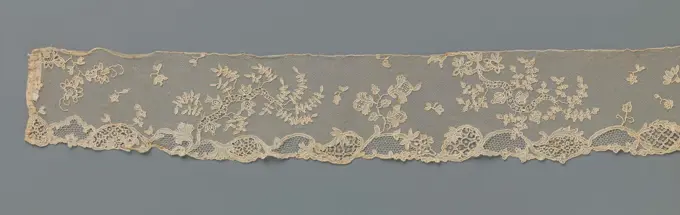
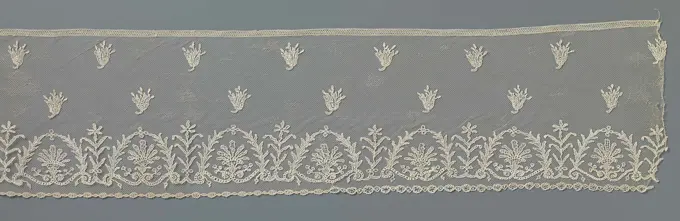
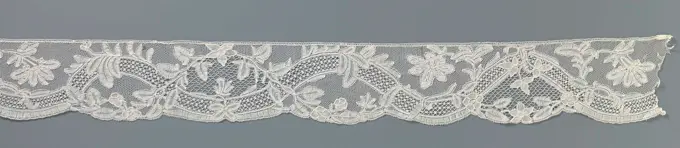
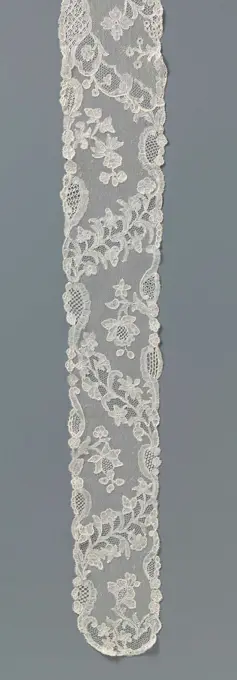
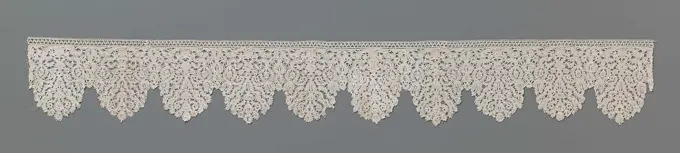
Strip of needle side with hanging rose branch in diamond, anonymous, c. 1725 - c. 1749 Strip of natural needle side: Argentella side. Pattern with an alternation of two large, composite main motifs on a ground with potente hexagonal meshes, which are close to the omenna with buttonholes. One of the main motifs is a diamond shape with a hanging rose branch. Under the window, where three deeply incised leaf fillets hang over it, three star -shaped flowers. Fullwork with recesses and many different decorative lands, including the double hexagonal diamond soil with the iatric eyes typical of the Argentella side. The top is trimmed with a border bobbin. Bottom edge with scalloped arches. Argentan linen (material) Argentella (point) Strip of natural needle side: Argentella side. Pattern with an alternation of two large, composite main motifs on a ground with potente hexagonal meshes, which are close to the omenna with buttonholes. One of the main motifs is a diamond shape with a hanging rose
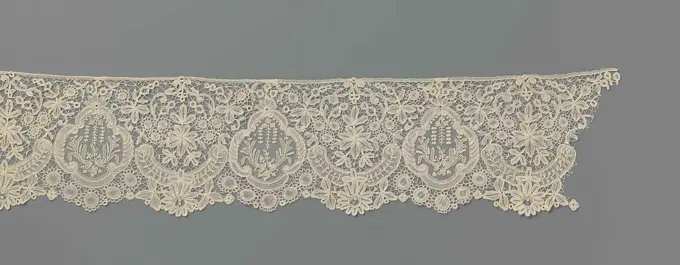
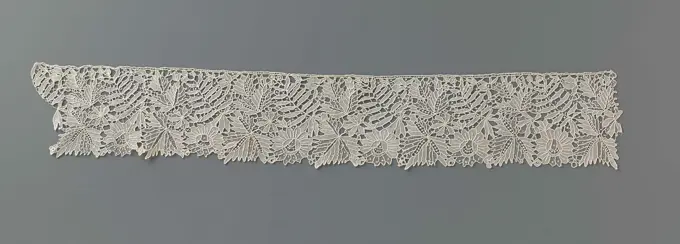
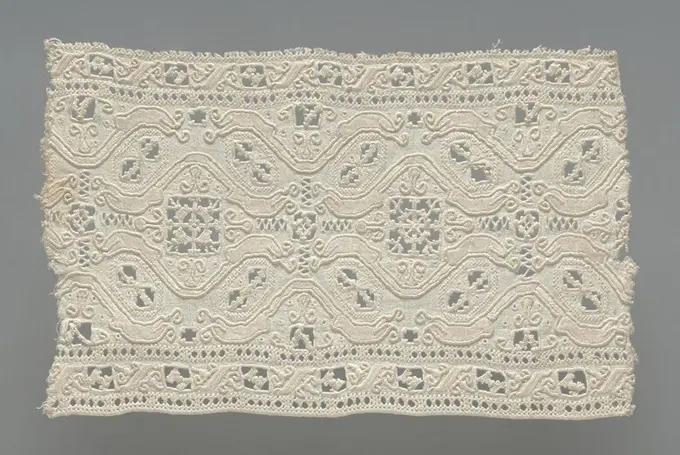
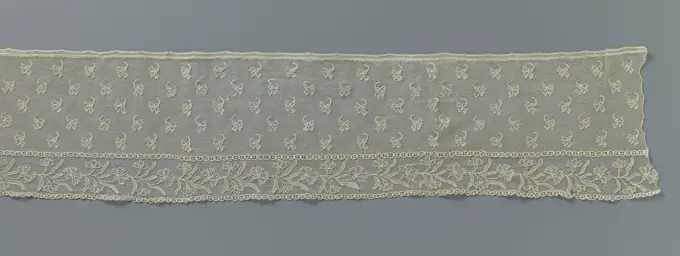
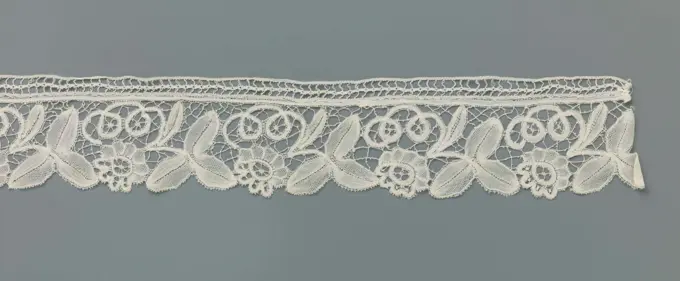
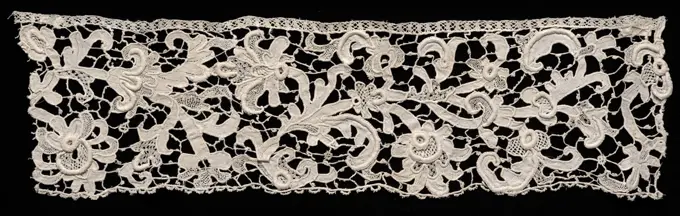
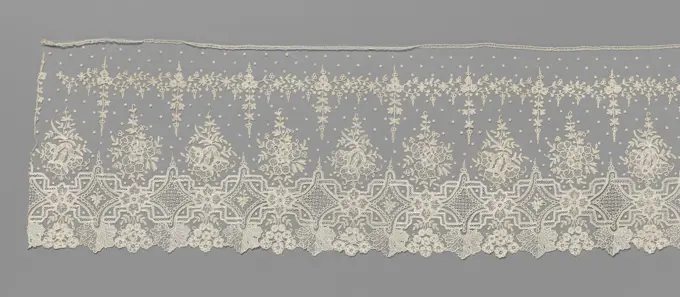
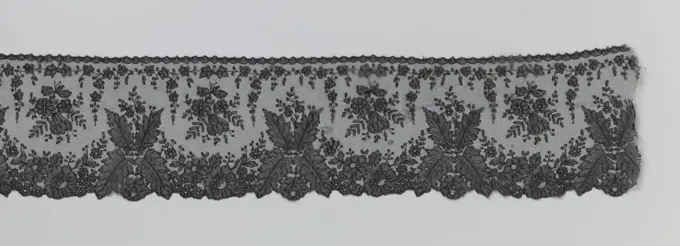
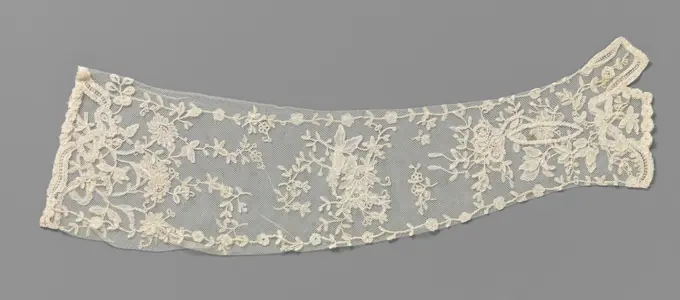
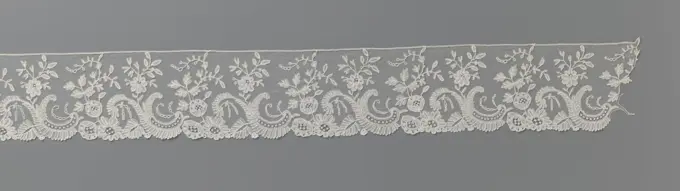
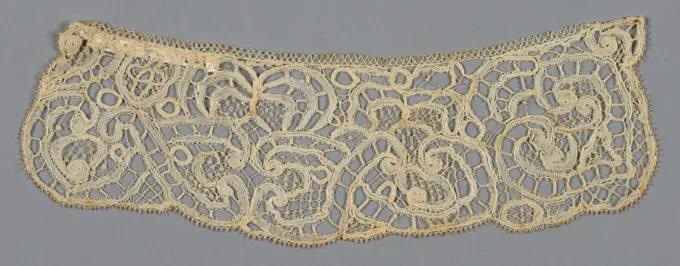
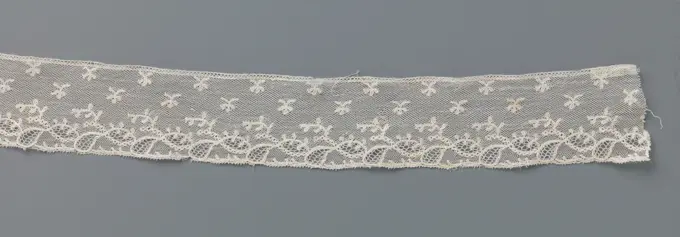
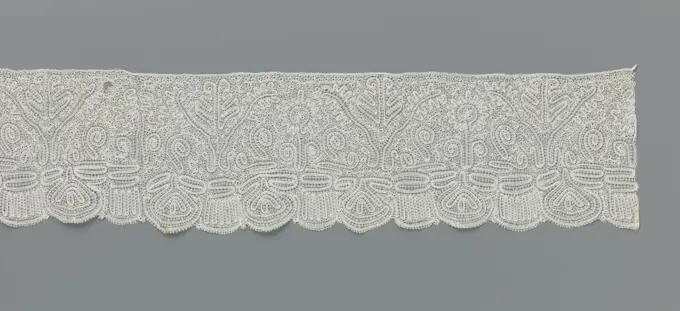
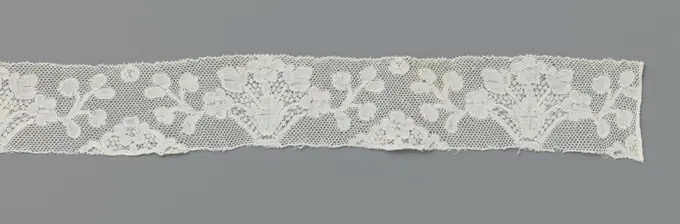
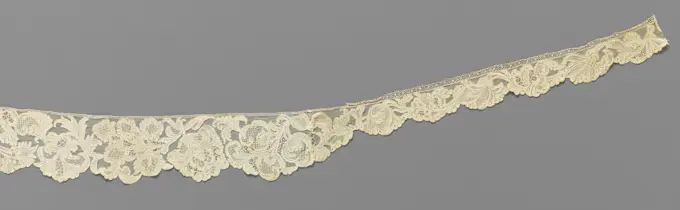
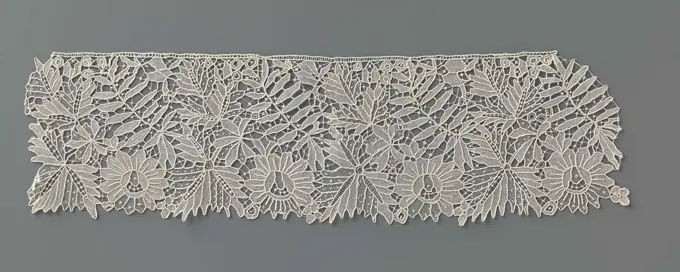
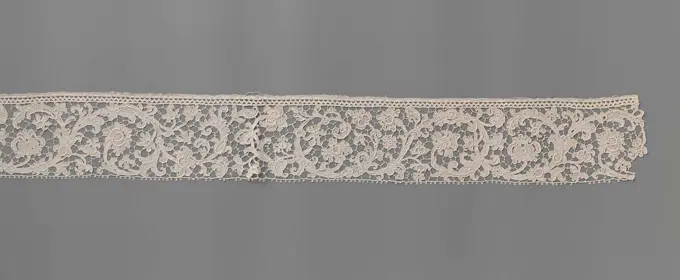
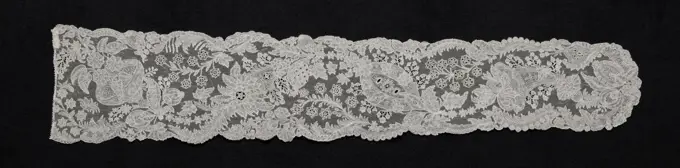
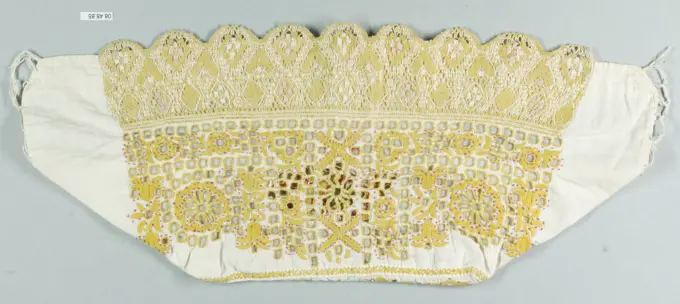
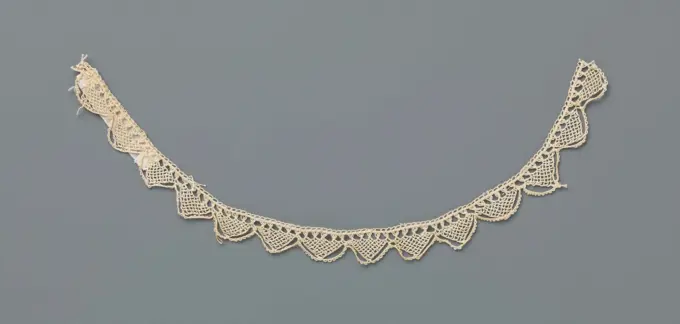
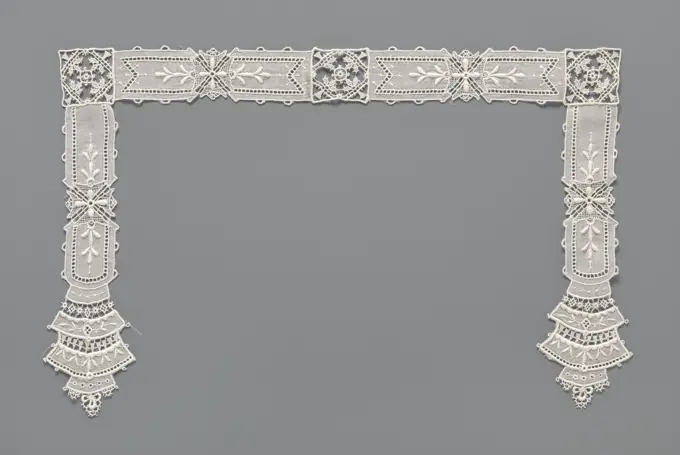
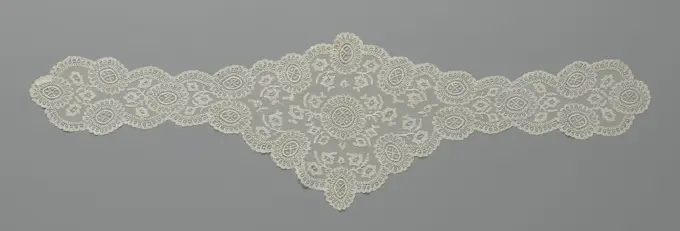
Strip Application side with grape bunches and halved leaves, anonymous, c. 1850 - c. 1890 Strip of natural -colored application side, bobbin lacquered on mechanical tulle. A narrow part, along the inside, shows a running pattern of halved, lobed leaves, which also accompanies a halved medallion with grid filling. On a wide part with a tulle surface are symmetrical, deep sculptures, which are alternately filled with a grape vice and a fan plant. Belgium (possibly) linen (material) Strip of natural -colored application side, bobbin lacquered on mechanical tulle. A narrow part, along the inside, shows a running pattern of halved, lobed leaves, which also accompanies a halved medallion with grid filling. On a wide part with a tulle surface are symmetrical, deep sculptures, which are alternately filled with a grape vice and a fan plant. Belgium (possibly) linen (material)Japonstrook van gemengde kant met gelobde medaillons.Japon strip of mixed side - climbing side in combination with needle lace - Brussels Duchesse. Standing lobby oval medallions with fine maasing soil and, among other things, treurwilgen leaves (coniferous lace) are connected by lying c-volutes, of which a daisy depends. The remaining land is an irregular braiding ground and is filled with five and three-lawy leaves and 'daisies' (docking side).Strip bobbin with S-Ranken, Anonymous, c. 1875 - c. 1899 Strip of natural-colored bobbin: Duchesse side. There is an ongoing pattern on a braid ground. S-ranks with three daisies and a border of Campanes form the scallops and end in a volute with single rose. Netherlands (possibly) linen (material) bobbin lace Strip of natural-colored bobbin: Duchesse side. There is an ongoing pattern on a braid ground. S-ranks with three daisies and a border of Campanes form the scallops and end in a volute with single rose. Netherlands (possibly) linen (material) bobbin laceCuff from coniferous side with depending dots of clust side. Cuff from natural colored Venetian needle side "Gros Point", deposited with a strip of ancient clam box. The needle side has a pattern of flowers and volutes. The motifs are equipped with contour wires and partly of thick cordons, decorated with pictos. Several decorative stitches have been used within each motif. The clamping edge is consisting of hanging skellar flowers, possibly tulips. The motifs are made in linen battle with openwork edges and recesses. The top of the cuff is finished with a bow rim (needle side). The closted slopes are finished with picots. And the short sides are finished with a splitting strap. The lump side of the climbing side is probably older than the needle side and is made in the Southern Netherlands. The needle side is manufactured in Italy. The sides have been put together to cuff in the 19th century.Strip of needle side with hanging rose branch in diamond, anonymous, c. 1725 - c. 1749 Strip of natural needle side: Argentella side. Pattern with an alternation of two large, composite main motifs on a ground with potente hexagonal meshes, which are close to the omenna with buttonholes. One of the main motifs is a diamond shape with a hanging rose branch. Under the window, where three deeply incised leaf fillets hang over it, three star -shaped flowers. Fullwork with recesses and many different decorative lands, including the double hexagonal diamond soil with the iatric eyes typical of the Argentella side. The top is trimmed with a border bobbin. Bottom edge with scalloped arches. Argentan linen (material) Argentella (point) Strip of natural needle side: Argentella side. Pattern with an alternation of two large, composite main motifs on a ground with potente hexagonal meshes, which are close to the omenna with buttonholes. One of the main motifs is a diamond shape with a hanging roseFragment, Medium: natural linen Technique: needle lace, 6-sided reworked ground, Fragment of a band with 'bizarre-style' scrolling forms., France, mid- 18th century, lace, FragmentStrip bobbin with aster, anonymous, c. 1900 - c. 1924 Strip of natural-colored bobbin: Duchesse side. On an open braid ground is a unilaterally oriented running slender, which ends in a wide spiral drink and out in one and profil. Netherlands (possibly) linen (material) bobbin lace Strip of natural-colored bobbin: Duchesse side. On an open braid ground is a unilaterally oriented running slender, which ends in a wide spiral drink and out in one and profil. Netherlands (possibly) linen (material) bobbin laceStrook naaldkant met ingesneden blad.Running pattern of incised leaves above a rose and a three-leaf, which together form the sharply toothed outside line. Cross-shaped bars with button (soil of long X-shaped bars with a spider). The REMPLIS consists of buttonhole stitches and a Fond Gazé. German side: 'Carlsbead points'.Strook kloskant met rozentak uit sierband met hoorn van overvloed.Strip natural colosside, Mechelen side. The lower half of the strip consists of a decorative tire that is formed by a downright-bending horn of abundance and a lying elongated s-volute, which are coupled to each other as a sort of skipping waves. A rose branch releases from the decorative tire, above the S-voltage. Above the rosary branches, a narrow path is filled up to the top of the strip with a scattering pattern of a V-shaped twig with two berries or flowers. The motifs are connected by a fine Maas soil, a Mechelen soil. The motifs are made in linen stroke and cut-off, with thicker and shiny contour wires. In, among other things, the horn of abundance, the S-full and flower hearts, various ornamental grounds have been applied, or not decorated with square meadows made in shape stroke. The top of the strip is straight finished. The bottom of the strip is very bland scaled and equipped with picots.Fragment (From a Border). Italy. Date: 1601-1650. Dimensions: 15.9 x 24.8 cm (6 1/4 x 9 3/4 in.)Weft repeat: 9.3 cm (3 5/8 in.). Linen, plain weave; embroidered in padded overcast and satin stitches; cut and drawn work embroidered in double hem, double faggot, hem, and overcast stitches; eyelet holes; needle lace fillings including buttonhole and double buttonhole bars decorated with buttonhole collar and bullion picots, darned and overcast bars. Origin: Italy. Museum: The Chicago Art Institute, Chicago, USA.Strip bobbin with halved flowers and arcs of flower brackets, anonymous, c. 1770 - c. 1790 Strip of natural -colored bobbin: Mechelse side. The repeating pattern consists of two different halved flowers, which lie on the top of the strip. From one of the flowers, an arc forms by two flower branches mirrored together that hang down to the bottom. Along the underside is a trapezoidal cartouche under each arch. The motifs are made in linen stroke and with thicker and shiny contour threads. The motifs are connected by a fine grid, the Mechelen soil. Decorative lands have been used in the halved flower hearts and in the cartouches. The barely scalloped underside is finished with picots. The top is straight. Southern Netherlands linen (material) bobbin lace / Mechlin (lace) Strip of natural -colored bobbin: Mechelse side. The repeating pattern consists of two different halved flowers, which lie on the top of the strip. From one of the flowers, an arc forms by two flower branches mirrored togJapon strip of mixed side with lobed medallions, anonymous, c. 1875 - c. 1899 Japonstrook made of mixed side - bobbin in combination with needle side - Brussels Duchesse. Standing lobed oval medallions with fine Maas soil and, among other things, weeping willow leaves (needle side) are connected by lying C-Voluten, a Margriet of which depends. The remaining land is an irregular braid land and is filled with five and three-lobe leaves and 'daisies' (bobbin). Belgium (possibly) linen (material) mixed lace / mixed Brussels Japonstrook made of mixed side - bobbin in combination with needle side - Brussels Duchesse. Standing lobed oval medallions with fine Maas soil and, among other things, weeping willow leaves (needle side) are connected by lying C-Voluten, a Margriet of which depends. The remaining land is an irregular braid land and is filled with five and three-lobe leaves and 'daisies' (bobbin). Belgium (possibly) linen (material) mixed lace / mixed BrusselsFragment of bobbin lace unknownStrip Application side with grape bunches and halved leaves, anonymous, c. 1850 - c. 1890 Strip of natural -colored application side, bobbin lacquered on mechanical tulle. A narrow part, along the inside, shows a running pattern of halved, lobed leaves, which also accompanies a halved medallion with grid filling. On a wide part with a tulle surface are symmetrical, deep sculptures, which are alternately filled with a grape vice and a fan plant. Belgium (possibly) linen (material) Strip of natural -colored application side, bobbin lacquered on mechanical tulle. A narrow part, along the inside, shows a running pattern of halved, lobed leaves, which also accompanies a halved medallion with grid filling. On a wide part with a tulle surface are symmetrical, deep sculptures, which are alternately filled with a grape vice and a fan plant. Belgium (possibly) linen (material)Strook kloskant met schuinstaande v-vormige bloemtak.Strip natural colosside: Lille side. The repeating pattern consists of a shaking apple v-shaped flower branch. On the lower branch two large flowers hang up to the bottom of the strip. There are two many smaller flowers and different buttons or berries on the upper branch. The shaking branches are close to each other and the hanging flowers form the tube edge. The motifs are made in linen stroke with thicker and shiny contour wires. They are connected by a tuland. In the flowers, a rose soil has been applied as ornamental ground. The top of the strip is straight finished. The slip edge along the underside is finished with picots.Strip bobbin with a striped flowerpot and V-shaped bouquet, anonymous, c. 1700 - c. 1899 Strip of natural -colored bobbin, stuck side. The repeating pattern consists of a trapezoidal flowerpot with large ears and vertical stripes. In the pot there is a symmetrical bouquet, with two flower branches, each with three flowers in side branches. A chalice flower rises from the lower flower on both sides, which protrudes from the bouquet. There is a V-shaped bouquet between the successive flower pots, with two hearts in it. The motifs are connected by a Maas soil. The motives are made in linen battle. Various snowflake grounds have been used as a decorative land. The top is finished with a separate strap. The bottom is straight finished and provided with picots. Southern Netherlands linen (material) bobbin lace / pot lace Strip of natural -colored bobbin, stuck side. The repeating pattern consists of a trapezoidal flowerpot with large ears and vertical stripes. In the pot there is a symmetricStrip of needle side with cornflowers, anonymous, c. 1800 - c. 1820 Two -thirds of the width is filled with a spreading pattern of falling cornflowers on a coarse soil (of flooded bars). A third of the width forms a right-winged outer edge (with a single Alençon-Fond), lined with two pearl lists, and decorated with a horizontal flank of stringed stalks, each with three cornflowers, which are always in the same direction. Alençon side. France linen (material) Alençon Lace Two -thirds of the width is filled with a spreading pattern of falling cornflowers on a coarse soil (of flooded bars). A third of the width forms a right-winged outer edge (with a single Alençon-Fond), lined with two pearl lists, and decorated with a horizontal flank of stringed stalks, each with three cornflowers, which are always in the same direction. Alençon side. France linen (material) Alençon LaceStrook gemengde kant met s-voluten.Strip natural-colored mixed side: Brussels climbing side in combination with a needle lace ground, a fine mesh side ground. This type of side is also known as the name: Point d'Angleterre. The running pattern is a rough drawing and consists of matching C and S volutes. Large roses, and face and and profil, shapes with a leaf and a c-volute deep slip. Fine leaf branches are turned to the inside.Strook kloskant met grof drieblad.Natural collate strip: Duchesse-Side. On a very open braid soil, one-sided specifically directed serpentine branches with an anemone and a large three-three leaf, which alternately form the unequal shelter.Needlepoint (Venetian Raised Point) Lace Edging, 17th century. Italy, Venice, 17th century. Lace, needlepoint: linen; average: 11.5 x 38.1 cm (4 1/2 x 15 in.).Fragment, Medium: linen Technique: bobbin lace made in Lille style with heavy outlining thread, Lille style, 19th century, lace, FragmentStrip of needle side with mushes around flower branches with oval leaves, anonymous, c. 1780 Strip of natural-colored needle side: Alençon side. Spread motif on a fine hexagonal Maas soil, with two different flower branches over the center line, on which many oval leaves. The flower branches are surrounded with a clear pattern of moes and twigs with three leaves. The pattern at the bottom of the strip consists of a succession of oval, a five -leaf flower and each other intersecting arches that end with heart -shaped leaves. Flower branches sprout from the oval -filled oval. The underside is finished with a slightly wavy border with delicate picots. The top is trimmed with a border bobbin. Alençon linen (material) Alençon Lace Strip of natural-colored needle side: Alençon side. Spread motif on a fine hexagonal Maas soil, with two different flower branches over the center line, on which many oval leaves. The flower branches are surrounded with a clear pattern of moes and twigs with threeJapon strip of application side with switching edge of geometric shapes and rosette flowers, anonymous, c. 1850 - c. 1880 Jelly strip of Brussels application side, bobbin and needle side -Brussels gauze side - Applicated on mechanical tulle. Spread pattern with mosjes and a pattern in density to the scallop side. Along the top runs an airy garland, which consists of a double, crossing wave line, which is always interrupted by three rosettes with a straight -hanging leaf vank. Below that a repeating pattern of a loose flower branch, alternating from three rosette flowers and three hanging flowers. At the bottom, a switching edge with geometric shapes, squares crossed through diamonds, that are connected by a large rosette flower. A wine leaf hangs under each window and a bunch of small rosette flowers under each large rosette flower. These wine leaves and roszet flowers form the shallow sculpts along the bottom edge. The top is finished with a border of bobbin. Brussels (possibly)  BrusBorder, Medium: linen Technique: bobbin made continuous tape with bars added, Wide border of branching rose sprays connnected by bars with picotées., Italy, early 18th century, lace, BorderSiercraft for an evening mantle of mixed side with rose hedge, Martha Berkers, 1915 Ornamental piece (cuff) for an evening mantle of natural -colored mixed side - bobbin in combination with needle side - Brussels Duchesse. There are roses on a wide -spread braid that usually support on two leaves. An intermediate ornament consists of single and double volutes and many small flowers. Lock linen (material) mixed lace / mixed Brussels Ornamental piece (cuff) for an evening mantle of natural -colored mixed side - bobbin in combination with needle side - Brussels Duchesse. There are roses on a wide -spread braid that usually support on two leaves. An intermediate ornament consists of single and double volutes and many small flowers. Lock linen (material) mixed lace / mixed BrusselsStrook naaldkant met boeket en dubbele slingers.Strip natural-colored coniferous lace: Alençon side. Repetitive motif of a bouquet, multi-part flower branches and double garlands on a fine hexagonal Maas soil. The tilted bouquet with standing and hanging flower branches is crowned by a branch with six hanging bell flowers. Many leaves, moes and rover picots on the garlands. Full work decorated with recesses and various ornamental grounds. At the bottom a slip edge that arises from a repetitive motif of voluntaries, rosette-shaped flowers and chalice flowers. The top is trimmed with a border clamping side.Strip mixed side with wavy stem and various large flowers and leaves, anonymous, anonymous, c. 1675 - c. 1699 Strip of natural -colored mixed side: old Milanese side or Old Flemish bobbin side in parts, where the chattered motifs are connected by a needle -lace soil of festonized bars with picots. The repeating pattern consists of a wavy stem with one wave top and one golf valley and several large flowers and leaves on curling side branches. There is an exotic flower between the successive wavy stems that is surrounded by different rosette flowers. The outlets of the motifs are largely made in linen battle with openwork edges and substantial recesses. A wide variety of decorative land has been used within the contours of the flowers and leaves. Up and bottom of the strip are finished with straight straps. The upper strap has been hit with a chain of openwork ovals. The lower band is straight and narrow and made in linen stroke with picots. Milan (possibly) linen (material) mixed lace /Border Belgian, Brussels 19th centuryCuff of needle side with large palm flower, anonymous, c. 1800 - c. 1899 Cuff of natural -colored needle side: Venetian relief side. On a bar of land, some richly branched feathered leaves and a very large palm flower are grouped together. Bayeux (possibly) linen (material) Venetian raised work Cuff of natural -colored needle side: Venetian relief side. On a bar of land, some richly branched feathered leaves and a very large palm flower are grouped together. Bayeux (possibly) linen (material) Venetian raised workStrook kloskant met symmetrisch patroon rond doorlopende geschulpte sierlijst onder de middenlijn van de strook.Strip natural colosside, Flanders side. The pattern on the upper half of the strip consists of two rows of loose motifs, always twice a configuration of four laps, interspersed by a flower with four Spitsovale flower leaves. Spacious under the center line of the strip, it consists of a repeating and symmetrical pattern from a continuous scalloped decorative frame, which forms a kind of cartouches along the bottom of the strip with the connected stylized leaves and flowers. A loose rosette flower is around the two cartouches. The motifs are connected above the decorative frame by a grille, a five-grade soil. Ornamental grounds are applied under the decorative frame. The motifs are made in linen stroke with recesses and thicker and shiny contour wires. The top of the strip is finished with a separate splitting strap. The sloping edge along the bottom of the strip is finished wiKloskant dress strip with ferns, anonymous, c. 1850 - c. 1855 Black bobbin jelly strip: Chantilly side. On an empty mesh stock there is a closed edge with scoops, filled with a garland of flowers and leaves. On the intersections there is a small shell with a hanging rose, above which a striker bouquet rises from four large fern leaves and a flower branch, which extends to the top edge. Here a horizontal climbing window with hanging twigs runs, while on the field above the large shell of this climbing crank a large bouquet depends, among other things with a tulip. France (possibly) silk bobbin lace Black bobbin jelly strip: Chantilly side. On an empty mesh stock there is a closed edge with scoops, filled with a garland of flowers and leaves. On the intersections there is a small shell with a hanging rose, above which a striker bouquet rises from four large fern leaves and a flower branch, which extends to the top edge. Here a horizontal climbing window with hanging twigs runs, while on Berthe Van Kloskant with grape bunches and corners, anonymous, c. 1650 Berthe of natural-colored bobbin: Valenciennes side. The repeating and symmetrical pattern consists of a chalice on a stem, in which there is a corner bending to the right and left. A long curling of slender runs behind both Korenaren that ends in a grapesross on both sides of the chalice. Between the successive patterns with the chalice are connected by two much larger curved corners who are connected to each other with a ribbon. The motifs are connected by a round grid: the round Valenciennes ground. The motifs are made in linen battle with openwork edges and with large cut -outs in the grapes and in the corners. The bottom is straight finished. The upper edge is finished with a separate struggle with lots of coarser yarn. The short sides are rounded and finished with a zoompje. Flanders linen (material) Bobbi Lace / Valenciennes Lace Berthe of natural-colored bobbin: Valenciennes side. The repeating and symmetricStrip bobbin with five rows of drop -shaped flowers on straight stalk with two leaves and overlapping at the bottom with decorative edge with arches, anonymous, c. 1785 - c. 1799 Strip of natural -colored bobbin: Mechelse side. With five rows of drop -shaped flowers on a straight stalk with two leaves. The bottom two rows of flowers are slightly smaller and overlap with the decorative edge with arcs. The motifs are made in linen stroke and equipped with thicker shiny contour threads. They are connected by a fine grid, a Mechelen soil. Two different coarser decorative lands have been used in the decorative edge, including a rose ground. The top of the strip is straight finished with a separate stretched strap, above which an extra strip (machine) Tulle is sewn. The very flat scrap edge is finished with picots. Mechelen linen (material) bobbin lace / Mechlin (lace) Strip of natural -colored bobbin: Mechelse side. With five rows of drop -shaped flowers on a straight stalk with two leaves.Band, Medium: linen Technique: needle lace, Needle lace with vertically symmetrical pattern with cornucopia and flowering vines. Edges of pattern outlined by buttonhole stitches over a cord., Italy, early 17th century, lace, BandCollar Irish, Carrickmacross late 19th centuryStrip bobbin with lotus flower, anonymous, c. 1750 Strip of natural -colored bobbin: Mechelse side. The repeating pattern consists of a lotus flower with lush volute leaf, which rises from a more or less diamond -shaped motif at the top of the strip. The volute leaf hangs down to the underside, while the flower is aiming up with a bend. The motifs are made in linen battle and mains with thicker and shiny contour threads. The motifs are connected by a grid, a five -part ground. A snowflake soil has been used as a decorative soil. The faintly scalloped underside stems from the pattern and is finished with picots. The top is straight. Mechelen linen (material) bobbin lace / Mechlin (lace) Strip of natural -colored bobbin: Mechelse side. The repeating pattern consists of a lotus flower with lush volute leaf, which rises from a more or less diamond -shaped motif at the top of the strip. The volute leaf hangs down to the underside, while the flower is aiming up with a bend. The motifs are maBorder (Belgium); linenMitaine van applicatiekant met rozen en margrieten en strikken.Mitaine of natural brussels application side: dick edge with needle lace standards appliqued on machine tulle. The model is like rounded sleeves, cave inside and sphere from outside. The pattern is equal to both sides and has brought together daisies and other flowers with a bow. In the middle it has a loose bouquet of flowers and scattered rose buds, framed by a thin garland with roses. The motifs are made in a cut-off and linselag with openwork edges and accented by relief contour lines in different places. Conifiers standards are applied in flower hearts and ribbons.Strip mixed side with S-Voluten, Anonymous, c. 1875 - c. 1899 Strip of natural -colored mixed side: Brussels bobbin side in combination with a needle -seal, a fine mesh side. This type of lace is also known under the name: Point d'Angleterre. The running pattern is thinning of drawing and consists of suitable C and S-Voluten. Large roses, and face and and profil, form deep scumples with a leaf and a C-Volute. Fine leaf branches have turned to the inside. Brussels linen (material) mixed lace / Brussels bobbin lace Strip of natural -colored mixed side: Brussels bobbin side in combination with a needle -seal, a fine mesh side. This type of lace is also known under the name: Point d'Angleterre. The running pattern is thinning of drawing and consists of suitable C and S-Voluten. Large roses, and face and and profil, form deep scumples with a leaf and a C-Volute. Fine leaf branches have turned to the inside. Brussels linen (material) mixed lace / Brussels bobbin laceCuffs (England); linenSleeve Ruffle; linenStrip of needle side with flower litter pattern and rush -hour, anonymous, c. 1775 - c. 1799 Strip of natural needle side, argent tank side. Strooi pattern of twigs that alternately have a small or larger flower, leaves and/or berries. Ground with meshes that are closed with buttonholes. The pattern along the lower edge consists of two pointed to each other, in between, between which a flower or berry branch rises. The oval pairs are connected by an arc of leaves and/or berries and hearts. Under these arcs along the lower edge a flat, lying oval. The oval -shaped figures in the pattern are filled with a fine hexagonal Maas soil (alençong round). Different decorative grounds in the flowers. Volwerk without recesses in flowers, leaves and berries. Schulpenrand on the bottom due to a succession of heart -shaped leaves, regularly interrupted by a rosette flower and the flat oval. The top is finished with a straight edge. Argentan linen (material) Argentan Lace Strip of natural needle side,Strip bobbin with tilted ovals under spray pattern of twigs, anonymous, c. 1785 - c. 1799  Strip of natural -colored bobbin: Mechelse side. The repeating and continuous pattern consists along the bottom edge of a succession of rush -hour and drop shapes, which are always tilted in relation to each other. Under the oval, a short pendulum of circles runs through, from which a leaf branch originates above the drop shape. Above this pattern is a stray pattern of two rows of loose twigs. The motifs are connected by a fine Maas soil, the Mechelen soil. The sparing fullwork is made in linen battle, which almost disappears here and there because of the thicker and shiny contour threads. Two different but very similar decorative lands, with coarse meshes, are used in the ovals and drop shapes. The straight underside is finished with picots. The top is finished with a separate strap. Mechelen linen (material) bobbin lace / Mechlin (lace)Volant Van Kloskant with sunflowers, anonymous, c. 1875 - c. 1899 Volant of natural -colored bobbin, Russian or Eastern European side. Ground of short, irregular braids. Symmetrical pattern. A row of sunflowers, set between V-shaped branches, stands above a sculpin of folded 'ribbons', in which fan-shaped and straight ranking alternate. Eastern Europe linen (material) bobbin lace / Russian lace / East European lace Volant of natural -colored bobbin, Russian or Eastern European side. Ground of short, irregular braids. Symmetrical pattern. A row of sunflowers, set between V-shaped branches, stands above a sculpin of folded 'ribbons', in which fan-shaped and straight ranking alternate. Eastern Europe linen (material) bobbin lace / Russian lace / East European laceStrook gemengde kant met tien verschillende ranken.Strip natural-colored mixed side: Venetian ribbon side. Pattern with a sequence of ten different shorter and longer towers. The tendrils don't touch each other, but they are connected by the irregular soil with picoted bars. To the tendrils flowers with a variety of forms. The contours of the pattern are formed by a round lace. Within the contours some ornamental grounds by recesses in the full. The top is trimmed with a border clamping side. The bottom and left side are finished with a straight picro edge with arcs.Japon strip of application side with ribbons in bows and a wavy decorative frame due to oval hoops, anonymous, c. 1860 - c. 1870 Japon strip of Brussels application side: Brussels duchesse (mixed side: bobbin in combination with needle side) applied on mechanical tulle. The repeating pattern consists on the top of the strip of a hanging flower branch with large flowers (a bunch of lilacs, a rose and a branch with two reminder) with winding ribbons (needle side) with a bow on either side of the hanging flower branch. The pattern on the underside consists of a wavy decorative frame that moves overlapping oval medallions or 'hoops'. The hoops ensure a half -circular scrap -shaped edge. Around each wave top a break in the succession of hoops where a flower arrangement with a tulip, a daisy, a rose and forget-me-nots is located. Under each wave top, a wider semi -circular shell has been realized with a curved decorative frame containing a broken meander (needle side) and underneath eight haLappet (one of a pair) 18th century French. Lappet (one of a pair) 227699Strip bobbin with fan -shaped flower pots and rosette flowers, anonymous, c. 1750 - c. 1799 Strip of natural -colored bobbin, Antwerp Pottekant. The repeating and symmetrical pattern consists of a fan -shaped flowerpot, which is flanked on the left and right by a loose circle along the top and right along the lower edge through a rosette flower -cut oval cartouche. The motifs are connected by a diamond -shaped Maas soil. The motifs are made in linen battle with few recesses and with thicker contour threads. As a decorative land, a snowflake land is used between the flowers in the pot, in the circle and in the cartouche. At the top and bottom are straight finished, with the bottom with picots. The short sides are finished with a zoompje. Antwerp linen (material) bobbin lace / Antwerp pot lace Strip of natural -colored bobbin, Antwerp Pottekant. The repeating and symmetrical pattern consists of a fan -shaped flowerpot, which is flanked on the left and right by a loose circle along the toFan Leaf; linenEngageante van naaldkant met een symmetrisch patroon met een bloemenvaas ranken waaraan gevederde bladeren en irissen.ENGINEANTE OF NATURAL CONNECTION SAID: Flat Venetian grid side side (). The pattern has a vase with symmetrically suitable flowers, flanked by two drew running tendrils, which large flowers with "house in house" work. The pattern also has an iris flanked by bunch of bunches. The motifs are made with unanimated feston stitches between which countless fine recesses are made. There is a slightly thicker, but equally fine contour wire used to accentuate pattern parts. The motifs are connected to each other by a fine Maas soil with overdewarage tours. In and around most flowers and leaves, very fine ornamental grounds are used in many variants, including ornamental grounds with diamonds, 'patrious eyes', cubes and zigzag lines. The tube edge comes from the pattern and is finished with picots. The top is straight and finished with a splitting strap. On the right, the engine Fragment 18th century Italian, Burano. Fragment 218848Strook applicatiekant met bloemtakken boven een rand ovaalvormige cartouches.Strip natural colored Brussels application side: needle side applicated on slighten ground. The pattern consists along the underside of the strip of oval-shaped cartouches, aboveing a flower branch with a few flowers and leaves and a larger winding branch with a few flowers and many side twigs with a few small leaves. Three variations occur from both flower sprayers and winding branches. The sparing top is enclosed by festived thread bundles. Different ornamental grounds are used in the ovals with coarser meshes, the finer drachelboat does not run behind this. The top is finished with a separate clust strap. The slight and irregular scalloped underside is finished with very fine picots.Volant van kloskant met ruitvormige medaillons.Volant of natural colosside: Parisian side. The ground has been shared in two in a paris soil with clover leaves at the top and a tulet below. In the last one is a symmetrical pattern of diamond-shaped openwork medallions with sidewalks crowned by a flower between two leaves. The leaves, the side drinks and a series of flowers and ranks in the sculpture are released in three closed garlands. The motifs are made in linen stroke and equipped with contour wires. A rose soil has been applied as ornamental ground. The top of the strip is finished with a separate splitting strap.Japonstrook van applicatiekant met spitsboogrand en klokjes.Japon strip natural colored Brussels application side: needle side applicated on machine tulle. This type of side is also known as the name: Point d'Angleterre. The outer, ornamental edge consists of palms, under pointed arches, interspersed with a standing twig. The outside is right ended by an eye list. A scattering pattern of hanging bells flowers fills the entire edges above the edges.Cuff from coniferous side with depending dots of clust side. Cuff from natural colored Venetian needle side "Gros Point", deposited with a strip of ancient clam box. The needle side has a pattern of flowers and volutes. The motifs are equipped with contour wires and partly of thick cordons, decorated with pictos. Several decorative stitches have been used within each motif. The clamping edge is consisting of hanging skellar flowers, possibly tulips. The motifs are made in linen battle with openwork edges and recesses. The top of the cuff is finished with a bow rim (needle side). The closted slopes are finished with picots. And the short sides are finished with a splitting strap. The lump side of the climbing side is probably older than the needle side and is made in the Southern Netherlands. The needle side is manufactured in Italy. The sides have been put together to cuff in the 19th century.Strook naaldkant met ingesneden blad.Running pattern of incised leaves above a rose and a three-leaf, which together form the sharply toothed outside line. Cross-shaped bars with button (soil of long X-shaped bars with a spider). The REMPLIS consists of buttonhole stitches and a Fond Gazé. German side: 'Carlsbead points'.Strook naaldkant met voluutranken.Strip natural needle side: Venetian relief side. On an open bars ground is an ongoing pattern of wide wavy, branched voluntaries. The volutes have been awarded with increasingly varied palmet flowers while the feathered baldering have doubled here and there as an arabesque.Bobbin and Needlepoint Lace Lappet, 1730s-1740s. Belgium, Brussels, 18th century. Lace, bobbin and needlepoint: linen; average: 59.7 x 12.7 cm (23 1/2 x 5 in.).Edging, Medium: linen Technique: bobbin lace, Brussels style, Duchesse-style lace with pattern of open flowers and leaves with côte and small scrolls., Belgium, 19th century, lace, EdgingAntependiumstrook van kloskant met brede rivière.Antependium strip from natural brussels climbing side. Four different loose branches of ecclesiastical flowers (lily, pomegranate, grape roos) fill triangular and shield-shaped fields, limited by a river of broad C-Volutes. The triangles are alternately high and narrow and short and thick and show a fine mesh net, while the shield-shaped fields are filled with a coarse-poor feet. Along the scalloped edge, a mountain and valley line runs from C-Volutes, which are overcurred by a fine closed flowerguirland, which repeats itself at the top of the strip. The C-voltages are filled with grid work and wound with a fine flower garland or overcures by a feeder.Collar, Medium: linen, silk Technique: bobbin lace (Lille-style with heavy outlining thread, Lille ground), Collar of bobbin-made lace (Lille style)., Denmark, late 19th century, lace, CollarBand (Italy); linenHeat slip from Brussels bobbin, Anonymous, c. 1715 - c. 1725 Cap from Brussels Kloskant. The pattern consists of flowers and flower branches on different grounds. The varied scalloped edge is equipped with picots and has a round end. Belgium linen (material) Brussels bobbin lace Cap from Brussels Kloskant. The pattern consists of flowers and flower branches on different grounds. The varied scalloped edge is equipped with picots and has a round end. Belgium linen (material) Brussels bobbin laceCap Hungarian-Slovak 19th centuryStrip bobbin with wide flower chalice and stylized double -headed eagle, anonymous, c. 1885 - c. 1899 Strip of natural -colored bobbin: Eastern European side (ribbon side). The pattern consists of two more or less symmetrical compositions in which the contours of the motifs are made with winding burst ribbons, which vary at least in width. One composition consists of a large and wide flower challenge, with a short handle and simple volute leaves separately. The other composition consists of a hanging flower with a much smaller and easily designed flower challenge, and lobed leaves such as wings of a bird, it may not be a flower but a stylized double -headed eagle. The motifs are connected by a grid, a round Valenciennes ground. The ribbons are made in linen battle with thicker and shiny contour threads on both sides of the ribbon. Decorative lands have been applied within the contours of ribbons, including a mains filling and a Mechelen soil decorated with mosques made in shape. The toBorder 18th century Austrian. Border 222869Strook geknoopte kant met driehoekige schulpjes waar boogjes omheen zitten.Strip natural-colored knotted side: Chebka. Triangers hang on a decorated thread like a sloping edge. A semi-circular bow made around each triangle with a wire with coated loops.Strip mixed side with two protruding branches with rosette flowers with a symmetrical motif with round shapes and hanging drip-shaped leaf. Strip natural-colored mixed side: Milanese ribbon side. The symmetrical pattern consists of two ascending branches with short curved twigs and a few rosette flowers. Between the branches is a symmetrical motif with two round parts at the top of the strip where a drop-shaped leaf hangs down. The motifs are largely split into linselag with recesses and partly equipped with clost relief contours. Small parts are split into a slot base. The motifs are connected by a needle side ground. The top of the strip is straight finished and provided with a two metal stamps on which 'Dentelle' and 'Véritable', which leaves itself as 'real side'. The slight sloping edge comes from the pattern and is finished with picots.Strip application side with mimosataks, anonymous, c. 1890 - c. 1909 Strip of natural -colored application side, bobbin lacquered on mechanical tulle. The pattern shows a row of mimosa branches to the right. Belgium (possibly) linen (material) Strip of natural -colored application side, bobbin lacquered on mechanical tulle. The pattern shows a row of mimosa branches to the right. Belgium (possibly) linen (material)Lace laceMutsenslip van kloskant met rivières.Hatslip of natural colored Brussels climbing side. A Rivier with a Meriënfond is crossed by a branched branch with flowers and lancet leaves, while on the fields with a fine mesh net, one twig is growing with a flower, whose open heart is pear-shaped. The schulls are flat and have many medallions filled with grid work. In the event of mistake, a Malinois and a Brussels hats slip have been worked on, while the matching second Brussels hats slip remained separately.Lace, 1700s, maker unknown. Gift of Mrs G. Acland Allen, 1955.Needlepoint (Point de Gaze) Cap, c. 1840-1860. Belgium, Brussels, 19th century. Lace, needlepoint; average: 17.9 x 58.5 cm (7 1/16 x 23 1/16 in.).Fichu 1840 European. Fichu 119085Kloskant stocking with peacock, anonymous, c. 1900 - c. 1914 Pine insert of natural-colored bobbin: Valenciennes side. Pointed -shaped. In the middle is a peacock, his tail hangs down and turns into three connected wreaths. A long flower branch runs up behind the peacock, up to the tip of the stocking. The motifs are made in linen battle with recesses and openwork edges. A decorative land has been used in the tail springs and the flower hearts. The motifs are connected by a grid, a diamond-shaped Valenciennes-ground, littered with moesjes. The sides are right finished. Belgium (possibly) linen (material) Bobbi Lace / Valenciennes Lace Pine insert of natural-colored bobbin: Valenciennes side. Pointed -shaped. In the middle is a peacock, his tail hangs down and turns into three connected wreaths. A long flower branch runs up behind the peacock, up to the tip of the stocking. The motifs are made in linen battle with recesses and openwork edges. A decorative land has been used in the tail Plastron of needle side with flower branch hanging on three rosettes and a ribbon, anonymous, c. 1900 Plastron of natural -colored needle side: Brussels mesh side. In the middle a branch with flowers and leaves hanging on three rosettes and a ribbon. Outlines with C-Voluten and flowers and a flower medallion at the bottom. Belgium (possibly) linen (material) Brussels Gaze Point Plastron of natural -colored needle side: Brussels mesh side. In the middle a branch with flowers and leaves hanging on three rosettes and a ribbon. Outlines with C-Voluten and flowers and a flower medallion at the bottom. Belgium (possibly) linen (material) Brussels Gaze PointStrip of needle side with winged insects, anonymous, c. 1805 - c. 1810 Strip of natural-colored needle side: Alençon side. Spread motif with a specific symmetrical pattern of larger and smaller winged insects and five -fold mushes. The spreading motif is on a fine hexagonal mesh ground. The pattern on the underside of the strip consists of a continuous rose branch over which there is always a horn shell. Different decorative grounds in the wings of the insects, the rose leaves and the shells. The underside is finished with a straight edge of founded picots. The top is trimmed with a border bobbin. France linen (material) Alençon Lace Strip of natural-colored needle side: Alençon side. Spread motif with a specific symmetrical pattern of larger and smaller winged insects and five -fold mushes. The spreading motif is on a fine hexagonal mesh ground. The pattern on the underside of the strip consists of a continuous rose branch over which there is always a horn shell. Different decorative Fragment early 19th century French. Fragment 218835Fragment, A .G. Jennings & Sons, American, Medium: cotton Technique: machine made lace, Running stitch pattern at intervals on net ground., USA, 1884, lace, FragmentFragment, Medium: linen Technique: bobbin lace, late 19th century, lace, FragmentHat of Vieux Bruxelles Kloskant, Anonymous, c. 1725 - c. 1750 Hatsbol van Kloskant. The pattern consists of flowers, palmets and feathered leaves. Brussels . Brussels bobbin lace Hatsbol van Kloskant. The pattern consists of flowers, palmets and feathered leaves. Brussels . Brussels bobbin lace. Linen, needle lace .Strook kloskant met distel in bloempot.Strip natural colosside: Old cravings. The schulls from which the strip is constructed are hemisphere with erraticly shaped edges. De Schulpen creates from a repeating symmetrical motif of a flowerpot with thistle. The flowerpot hangs on the head compared to the straight upper edge. The successive flower pots are separated by a small lobbed leaf. The motifs are made in linen stroke with openwork edges. In the recesses, spindle-shaped leaves are made in different places in shape stroke. The shelters are deposited with fine picots. The top is finished with a separate clust strap.Cap Streamers (Belgium); linenStrip of needle side with two types of flower branches, anonymous, c. 1775 - c. 1800 Strip of white needle side with a repetitive motif of two types of flower branches, which spring from the pattern of the lower edge. Between the flower branches there are a few sprinkling flowers on the fine hexagonal Maas soil. The top is trimmed with a border bobbin. The scalloped bottom edge is formed by two, floors running around each other. The space between these flowers has been filled with different, whether or not picoted mesh soils. Alençon side. France linen (material) Alençon Lace Strip of white needle side with a repetitive motif of two types of flower branches, which spring from the pattern of the lower edge. Between the flower branches there are a few sprinkling flowers on the fine hexagonal Maas soil. The top is trimmed with a border bobbin. The scalloped bottom edge is formed by two, floors running around each other. The space between these flowers has been filled with different, whethCollar 18th century Italian, Venice. Collar. Italian, Venice. 18th century. Needle lace. Textiles-LacesCollar;  the twenties of the 20th century (1920-00-00-1929-00-00);Magdalena, Witwińska, Dar (provenance)Sleeve, c. 1875- 1900. Philippines, late 19th century. Plain weave piña cloth with embroidery; overall: 48.3 x 101.6 cm (19 x 40 in.).Fragment ca. 1860 Belgian, Brussels. Fragment 212578Border; cotton; 1951-29-2Lappet (one of a pair) early 18th century French. Lappet (one of a pair) 222828Cuffs 19th century Belgian. Cuffs 82035Collar Belgian, Brussels 19th centuryTrimCollar, 1800s. Madeira , 19th century. Plain weave linen or cotton with embroidery; overall: 30 x 49.5 cm (11 13/16 x 19 1/2 in.).Handkerchief with a rim of needle side with eight ovals, anonymous, c. 1870 - c. 1890 Handkerchief with a border of natural -colored needle side, Brussels mesh side. Around a small, cross -shaped batists in the middle of a lace edge with eight deep scallops. These are separated by eight, standing in C-Voluten, standing ovals, in which, among other things, closed stars worked. The scales are formed by 'rail rails', outside of chalice and double, folded acanthe leaves. Under the ovals, a chalice flower hangs between two roses. There is always a rose with triple relief leaves in the corner scules. Small C-Voluten form the inner edge. Brussels linen (material) Brussels Gaze Point Handkerchief with a border of natural -colored needle side, Brussels mesh side. Around a small, cross -shaped batists in the middle of a lace edge with eight deep scallops. These are separated by eight, standing in C-Voluten, standing ovals, in which, among other things, closed stars worked. The scales are formed Children's hat of white tulle with white embroidery, which shows a scatter motif and on either side of the middle flower vines, anonymous Children's hat of white tulle with white embroidery, which shows a scatter motif and on either side of the middle flower vines.  . embroidering Children's hat of white tulle with white embroidery, which shows a scatter motif and on either side of the middle flower vines.  . embroideringCollar of Batist with machine embroidery and square intermediate sorts of mechanical side, anonymous, c. 1880 - c. 1890 Collar with natural -colored batist slips with machine embroidery and machine side. On a narrow straight strip, two straight slips hanging perpendicular to the corners that end in bell -shaped points. Between two machining side on the corners and one in the middle there are two strips of Batist twice with an open -up inside list between which a rectangular incustation of lace. The slips consist of two batist strips with lace incustation. Each slip line consists of shifting segments, which together forms a clock with clapper. Netherlands (possibly) cotton (textile). batiste Collar with natural -colored batist slips with machine embroidery and machine side. On a narrow straight strip, two straight slips hanging perpendicular to the corners that end in bell -shaped points. Between two machining side on the corners and one in the middle there are two strips of Batist twicFragment (France); linenFancchon of Coiffure (hat ball with slips from a whole) of bastard (Buckinghamshirekant), Anonymous, c. 1860 Fenschon Van Kloskant (Buckinghamshirekant), with a scalloped edge. The pattern has a round in the middle and oval rosette shapes along the edges. The pattern is further filled with small flower branches. France . Bucks point (lace) Fenschon Van Kloskant (Buckinghamshirekant), with a scalloped edge. The pattern has a round in the middle and oval rosette shapes along the edges. The pattern is further filled with small flower branches. France . Bucks point (lace)