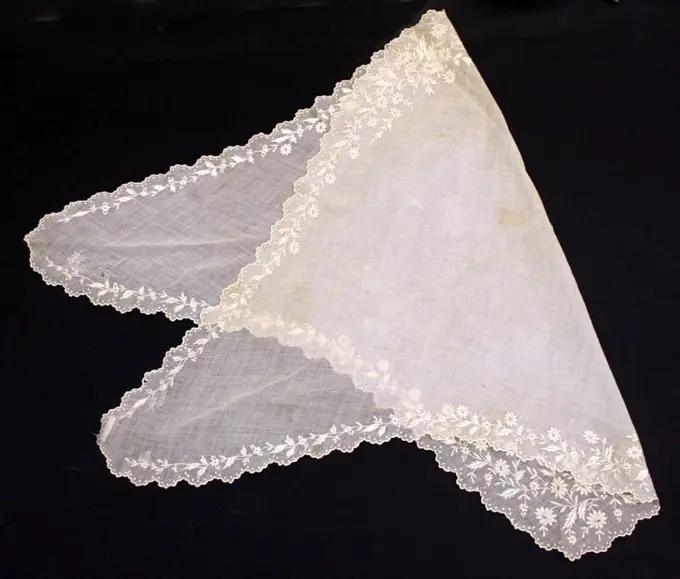
Detailed Lace and Textile Strips

Exquisite lace strips with intricate patterns, featuring floral designs and historical craftsmanship, showcasing textile artistry from various periods.

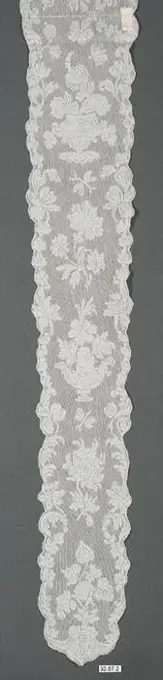
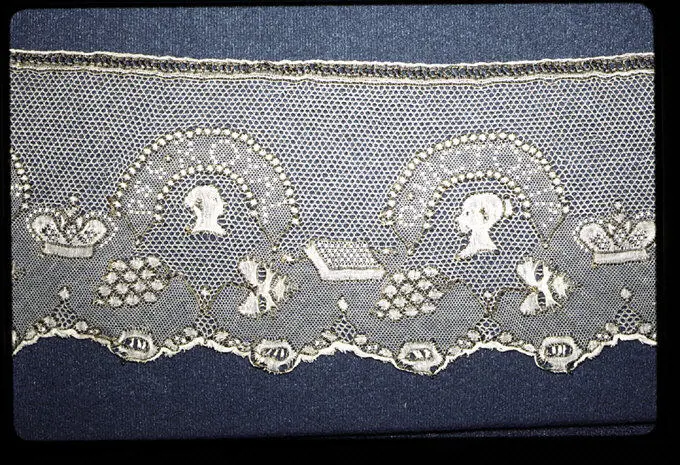
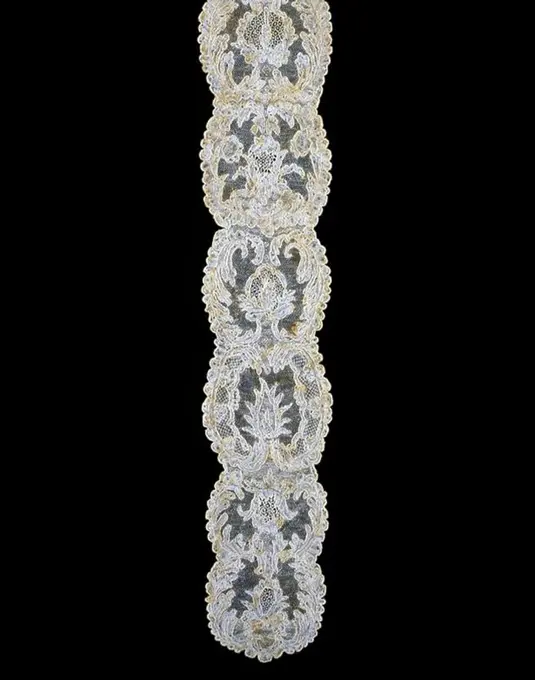
Strip of needle side with hanging rose branch in diamond, anonymous, c. 1725 - c. 1749 Strip of natural needle side: Argentella side. Pattern with an alternation of two large, composite main motifs on a ground with potente hexagonal meshes, which are close to the omenna with buttonholes. One of the main motifs is a diamond shape with a hanging rose branch. Under the window, where three deeply incised leaf fillets hang over it, three star -shaped flowers. Fullwork with recesses and many different decorative lands, including the double hexagonal diamond soil with the iatric eyes typical of the Argentella side. The top is trimmed with a border bobbin. Bottom edge with scalloped arches. Argentan linen (material) Argentella (point) Strip of natural needle side: Argentella side. Pattern with an alternation of two large, composite main motifs on a ground with potente hexagonal meshes, which are close to the omenna with buttonholes. One of the main motifs is a diamond shape with a hanging rose
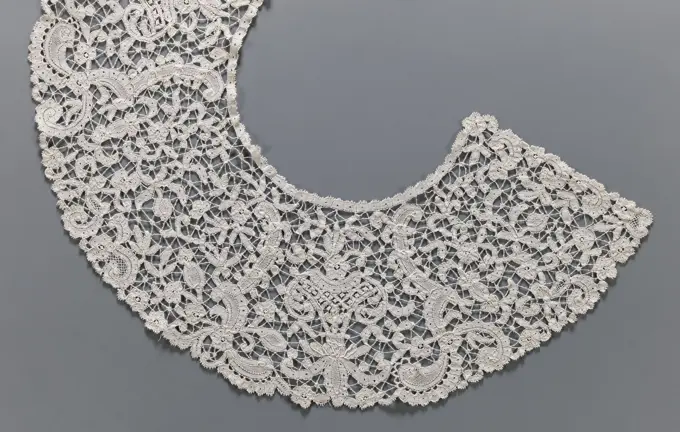
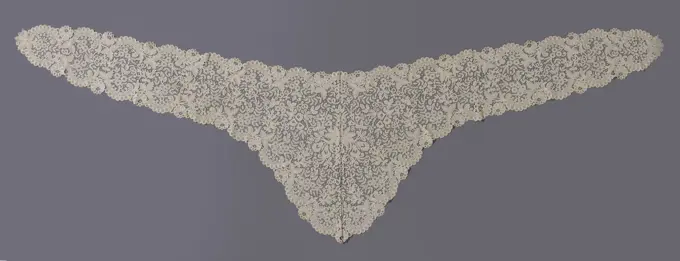
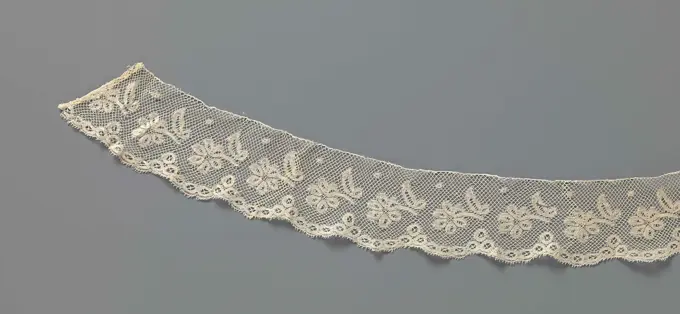
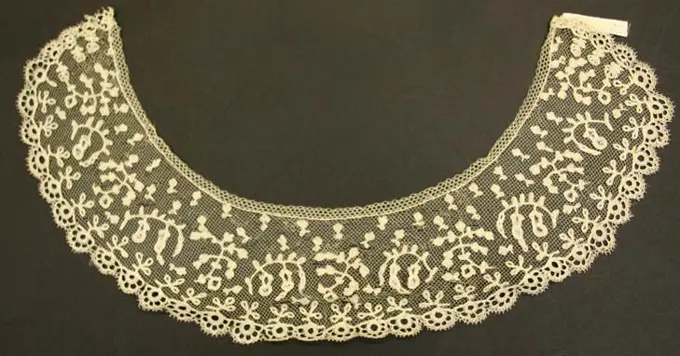
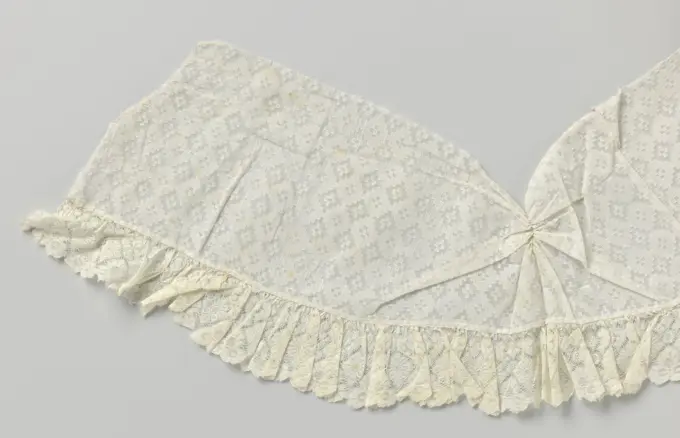
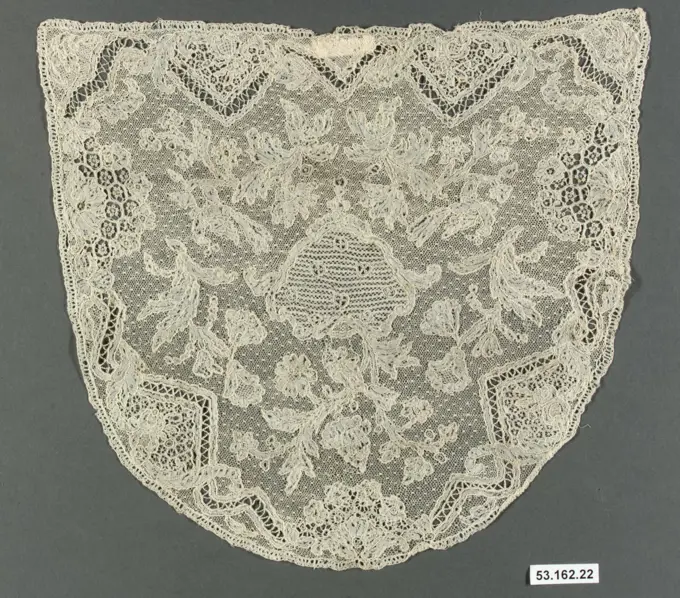
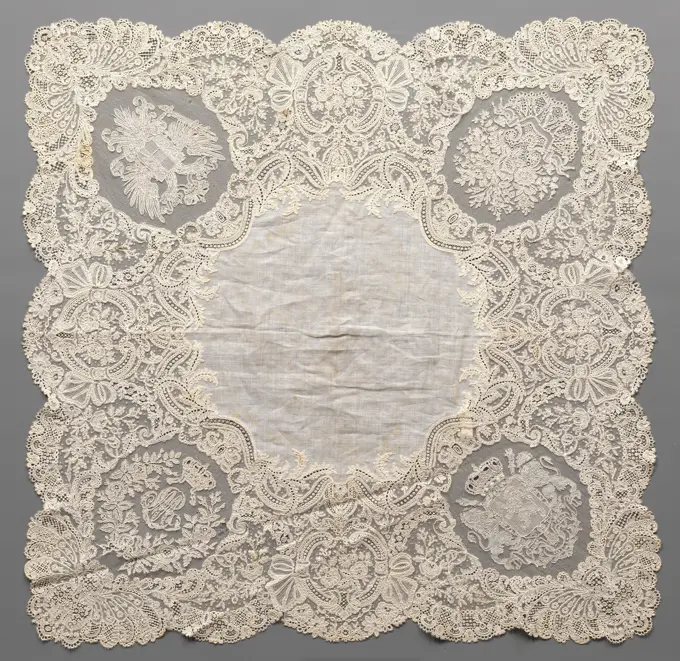
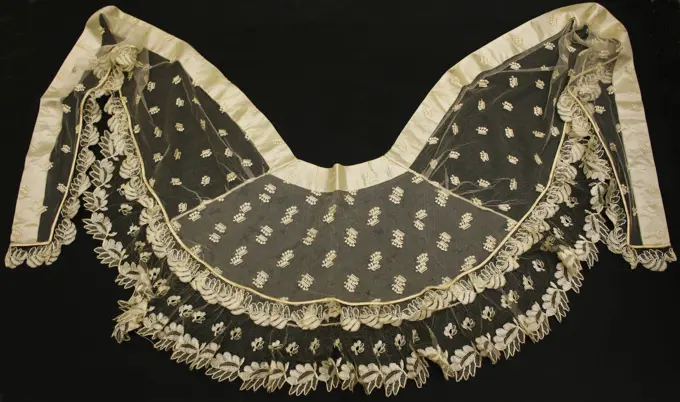
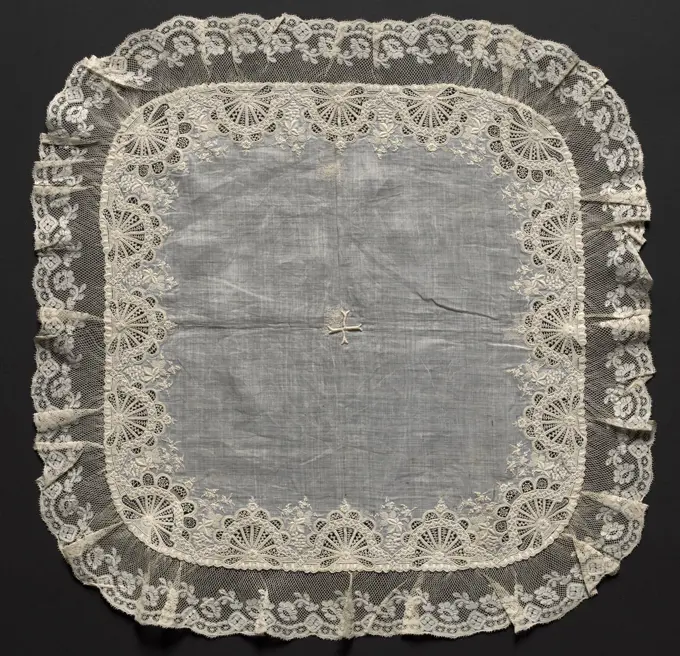
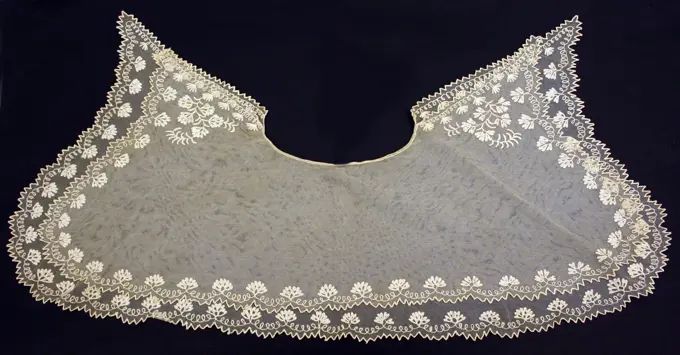
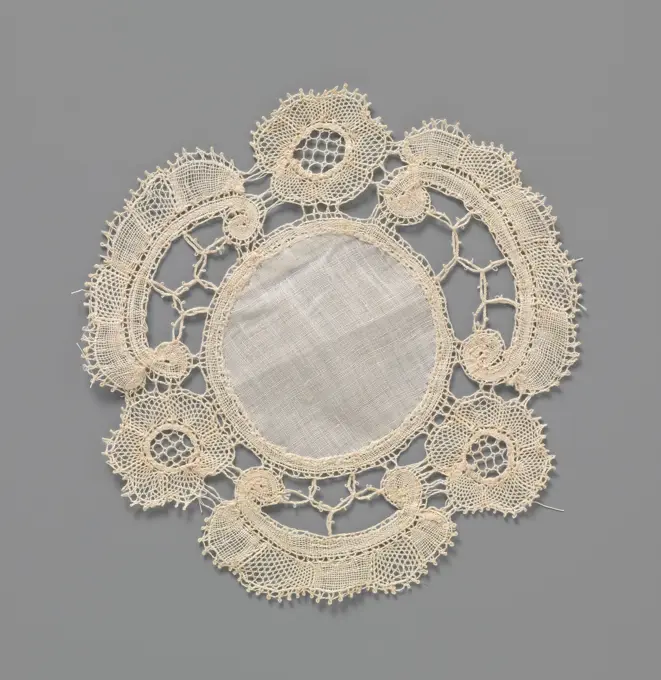
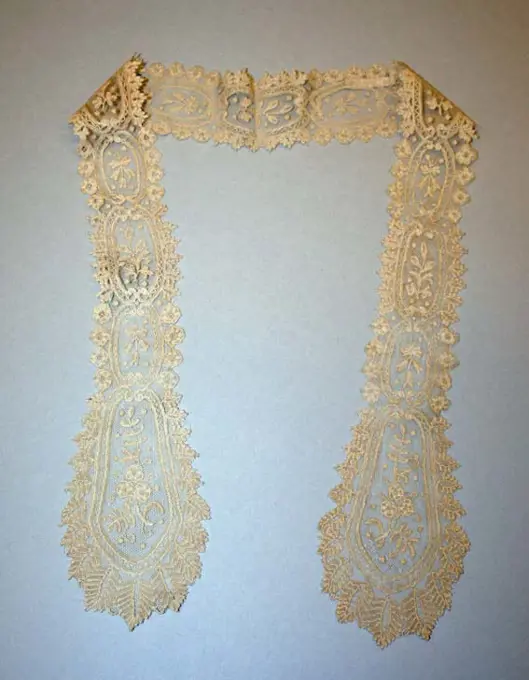
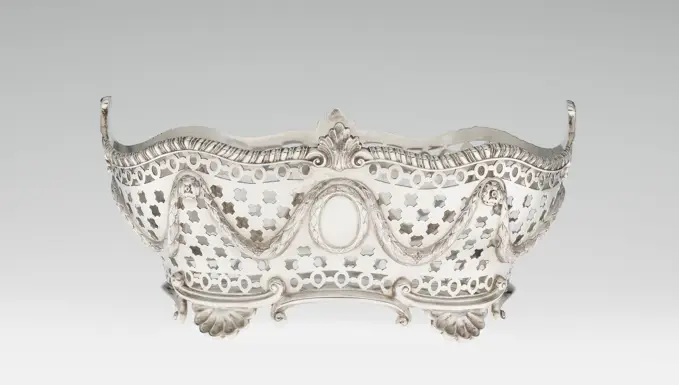
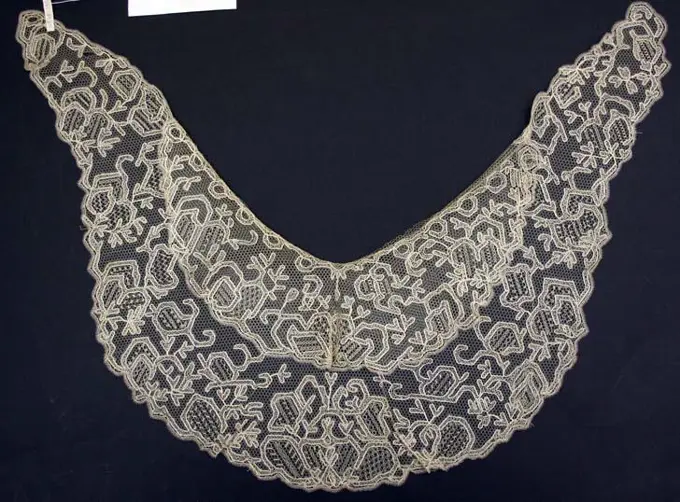
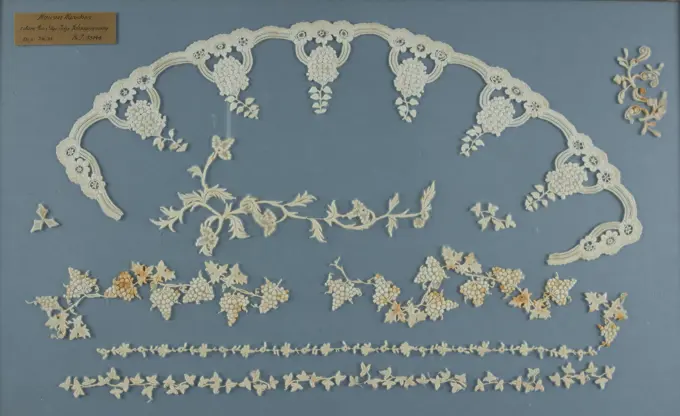
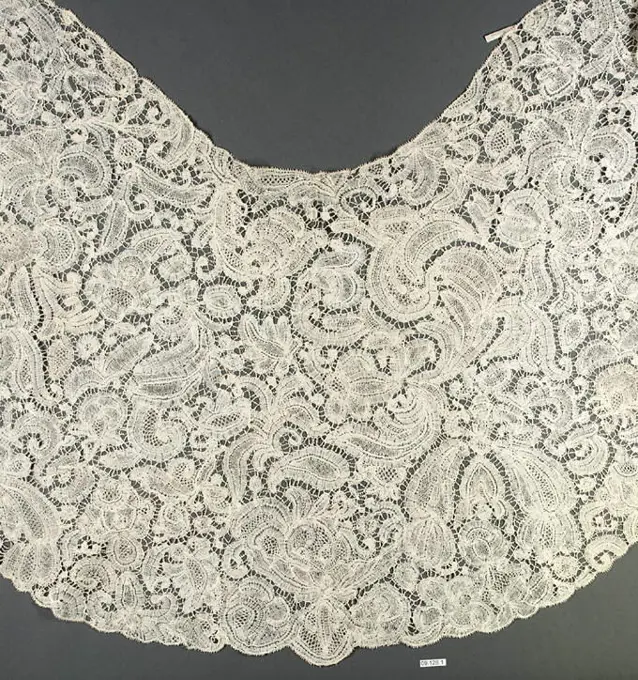
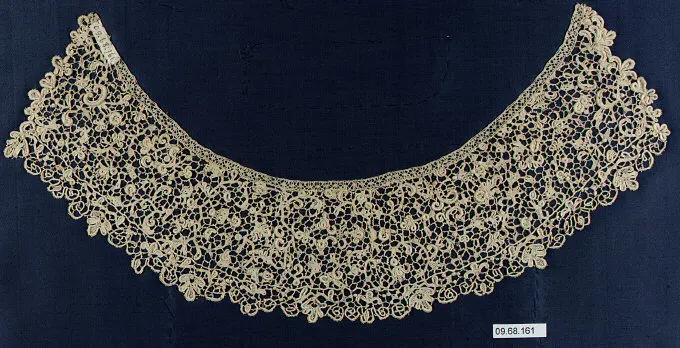
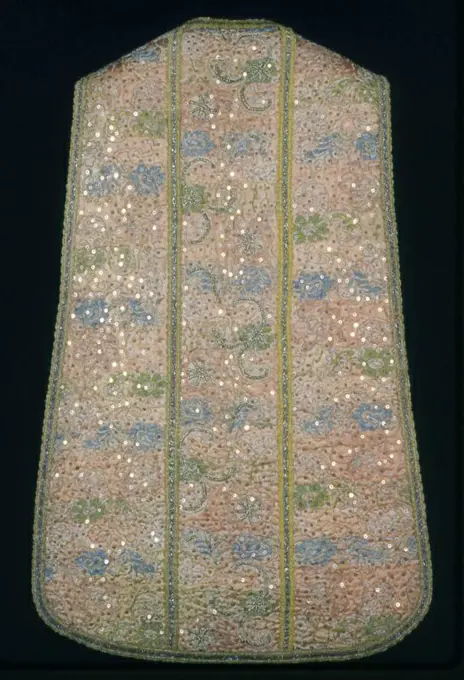
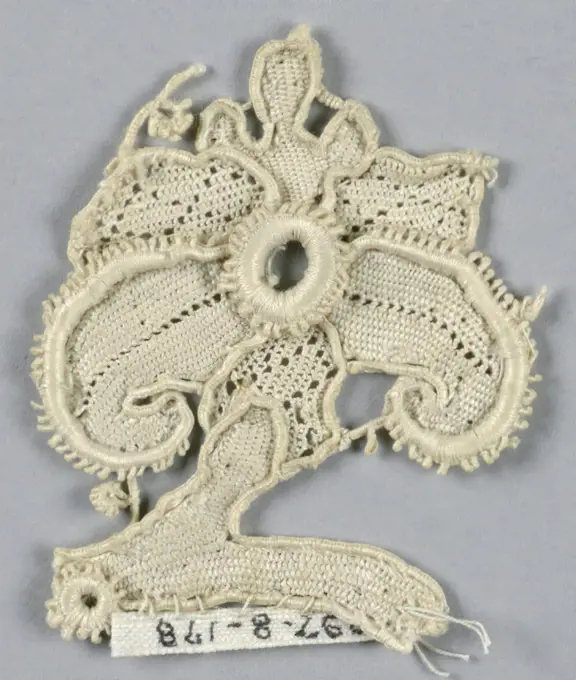
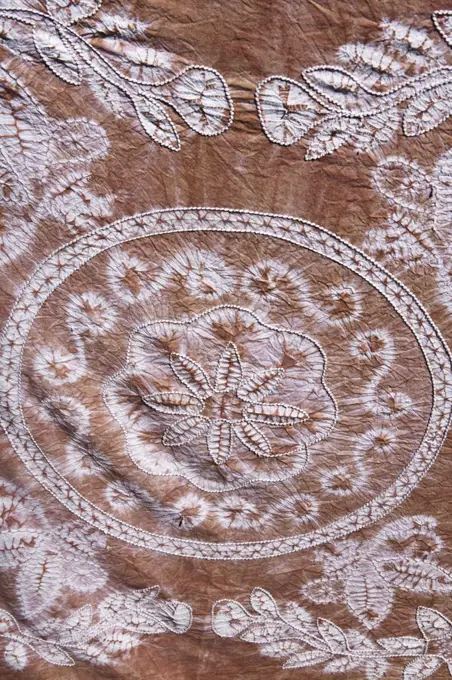
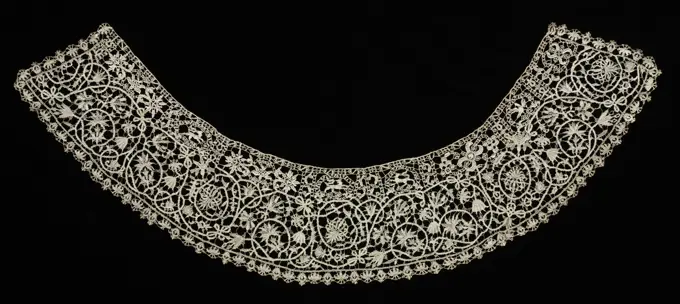
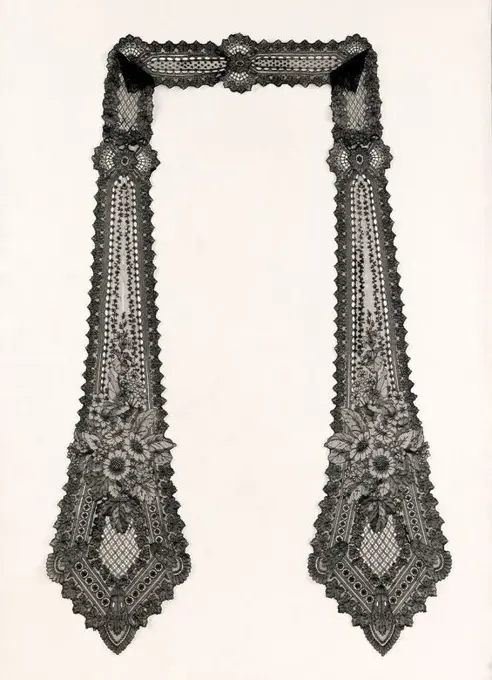
Side collar with hanging roses in semi -circular sculptes, anonymous, c. 1900 Collar of natural -colored bobbin: Bruges flower arrangements. Lying round model with connecting neckline. The repeating pattern consists of hanging roses in semi -circular scallops. The motifs are connected by a soil with double braids that form hexagons. Used cotton (textile) bobbin lace / Bruges flower lace Collar of natural -colored bobbin: Bruges flower arrangements. Lying round model with connecting neckline. The repeating pattern consists of hanging roses in semi -circular scallops. The motifs are connected by a soil with double braids that form hexagons. Used cotton (textile) bobbin lace / Bruges flower laceBOOK;  1. PO. 19th century (1801-00-00-1850-00-00);Kloskant scarf with the scalloped C-Voluten, Anonymous, c. 1875 - c. 1999 Scarf of natural-colored bobbin, Duchesse side. A large three -corner shape ends in narrow, long slips. An open bars stock is rimmed by equal C-volutes turned to the middle, which are sculpted on the outside and are each interrupted by a rose. Wingerd leaves are in the middle and points. Furthermore, branches with rose buttons and within each shell branches of periwinkle. Sluis (Possible) linen (material) bobbin lace Scarf of natural-colored bobbin, Duchesse side. A large three -corner shape ends in narrow, long slips. An open bars stock is rimmed by equal C-volutes turned to the middle, which are sculpted on the outside and are each interrupted by a rose. Wingerd leaves are in the middle and points. Furthermore, branches with rose buttons and within each shell branches of periwinkle. Sluis (Possible) linen (material) bobbin laceBarbe 18th century Flemish. Barbe 222556Lace, 1800s, France, maker unknown. Gift of Mrs G. Acland Allen, 1955.Fragment, Medium: linen Technique: bobbin lace, Border fragment with a scalloped edge and Valenciennes ground. Design of branches with flowers and fruit, curving to the right., France, mid-18th century, lace, FragmentKraag van kloskant met margrietjes.A coarse mesh stock (square mesh) with marbriefs above beads of pearls. Valenciennes side.Bobbin Lace (Appliqué) Handkerchief, 19th century. Flanders, 19th century. Linen center with border of bobbin lace; average: 42.6 x 42.6 cm (16 3/4 x 16 3/4 in.).Collar Made 1701-1800 Philippines. Pineapple fiber, plain weave; cut and drawn work; embroidered with cotton yarns in interlocking lace and single faggot stitches; Roumanian couching and darned wheels; pulled threadwork embroidered in cross, Indian drawn filling, overcast, Roumanian and single faggot stitches; Roumanian couching; embroidered in buttonhole, double running, satin and stem stitches .Collar composed of different pieces of needle side with flowers and exotic fruits. Collar composed of one or more pieces of natural-colored needle side: Argentan side. Curved strip-shaped model. Pattern with flowers, leaves and fruits. A symmetrical motif in the middle consists of a half-circular arc awarded by a rosette. Four long feathered leaves steal above each other from the rosette and flex over the arc. Under the bow a five-bubbed flower, possibly a French lily. The rest of the pattern is not entirely symmetrical and consists of flowers (carnations, rosette flowers), exotic fruits including a pomegranate pattern and voluten. It is reminiscent of patterns of the sides of approximately 1715-1725, which in turn could be inspired by lace patterns. The motifs are made with feston sign with cut-outs, decorative stitches and cordons with and without picots around Flower hearts. The motifs are connected by a hexagonal maas soil. The meshes are close to the feston stitches and equipped wFragment crochet side with flowers and grape food. Fragment of natural-colored Irish crochet side. Pattern of which two flowers and a grape food can be seen and a crocheted irregular Maas land with picots. There is also a part of the edge finish with semi-circular shelters that are trimmed with picoted arcs.Collar; muslin appliqued on netFragment (France); linen; 1897-8-299Collar 19th century British. Collar 102563Batist fall for a toilet table, anonymous, c. 1800 - c. 1920 Batists fall for a toilet table in a boudoir, extended with a mechanical side. Netherlands batiste. Batists fall for a toilet table in a boudoir, extended with a mechanical side. Netherlands batiste.Fragment of the lace;  19th century (1801-00-00-1900-00-00);Cap crown 18th century French. Cap crown. French. 18th century. Needle lace, point dAlençon. Textiles-LacesHandkerchief 1853 Belgian, Brussels When it was established in 1830, the nation of Belgium encompassed some of the greatest lacemaking regions of Flanders. Thus, it is no surprise that some very fine laces were made as presentation pieces for Belgian royalty. This handkerchief, featuring both needle and bobbin lace, was made on the occasion of the wedding of Leopold, duke of Brabant (later King Leopold II of Belgium), and Marie-Henriette, archduchess of Austria, in 1853. Its design includes the arms of Belgium, the arms of Austria, and the initials L and M, entwined and surmounted by a crown. The point de gaze needle-lace inserts demonstrate an extraordinary mastery of the technique.. Handkerchief 221333Strip bobbin with rosette flower between two large palm leaves, anonymous, c. 1925 - c. 1932  Strip of natural -colored bobbin: Bruges flower arrangements. It is a part of a longer strip of gross bobbin side that is intended or used as a furniture decoration. The pattern consists of a rosette flower between two large and deeply incised palm leaves. The motifs have been hit in netslag and linen battle with sparingly applied recesses and openwork edges. The motifs are partly equipped with contour threads and chattered relief contours, they are connected by a braids of double braids that form stars. There is always one picot on each braid. Two different decorative lands have been used in the petals. At the top and bottom are straight. On the side there is a metal seal that says 'Dentelle' and 'Véritable', which can be translated as 'real side'. Used linen (material) bobbin lace / Bruges flower laceBorder (Italy); silk and metallic embroidery, linen foundation; Warp x Weft: 44.5 x 14.5 cm (17 1/2 x 5 11/16 in.); 1976-35-1Woman's Collar. United States, circa 1850. Costumes; Accessories. Linen plain weave, cotton embroideryShawl 1860-70 French. Shawl 168364Fichu ca. 1830 French. Fichu 119029Embroidered Handkerchief, second half of 19th century. Switzerland, second half of 19th century. Embroidery: linen; average: 44.5 x 44.5 cm (17 1/2 x 17 1/2 in.).Under sleeve with embroidery of roses, c. 1860 Onderemen van Tulle, which is wrinkled to the cuff. The sleeve and cuff are both decorated with white embroidery in the form of flowers and leaves. The cuff is trimmed with a scalloped edge, and can be closed with a glass knot. Netherlands whole:. Button: Glass embroidering Onderemen van Tulle, which is wrinkled to the cuff. The sleeve and cuff are both decorated with white embroidery in the form of flowers and leaves. The cuff is trimmed with a scalloped edge, and can be closed with a glass knot. Netherlands whole:. Button: Glass embroideringCuff of linen batist decorated with embroidery and bobbin, anonymous, c. 1890 Cuff made of linen batist to which a strip is attached that consists of a combination of whitework in the form of flowers and leaves with bobbin side. The cuff can be closed by means of three batist knots. West-Europa linen (material). bobbin lace Cuff made of linen batist to which a strip is attached that consists of a combination of whitework in the form of flowers and leaves with bobbin side. The cuff can be closed by means of three batist knots. West-Europa linen (material). bobbin lacePelerine 1825-35 American or European. Pelerine 118956Batist handkerchief on which embroidery with eight richly decorated medallions along the edges and a richly decorated letter T, Anonymous, c. 1890 - c. 1895 Naturel -colored batist handkerchief with embroidery - Whitework with French embroidery - and finished all with a wrinkled strip of bobbin: Valenciennes side. The embroidery pattern consists of two straight profile lists filled with roslingers along the edges. A leaf vank with acorns runs between the lists. The rank is cut by standing oval medallions, each decorated at the top with a putto and at the bottom with two lion heads. In the openwork centers in the medallions, fine fillings have been made with needle lace -up stitches, with small festunned picots, star flower and fine diamonds. Above one corner medallion, a letter T is embroidered, also richly decorated with, among other things, a putto, roses, forget-me-nots and leaf vines with acorns. This may be a monogram TLV or TJV (). The strip of bobbin has a repeating pattern of aKleed of doily van kloskant met c-voluut en rozetbloem.Dress or dilly of natural climbing side: Bruges flower work. Round model with round middle part of Batist. The repeating pattern consists alternately from a C-voltage and rosette flower. The motifs are clamped in a cut-off and linen battle with open editors. The motifs are accentuated by contour wires. An ornamental soil has been applied in the flower hearts, a closed spread ground. There are some connections made between the motifs with double braids with picots, which form three-point stars. The sloping edge stems from the pattern and is finished with picots around.Cap 1815-20 probably American. Cap 98123Barbe 1886 American. Barbe 117616Collar. Culture: European. Date: ca. 1850. Museum: Metropolitan Museum of Art, New York, USA.Collar 1700-1939 American. Collar. American. 1700-1939. cottonFruit basket; Harris, Charles Stuart (Fl. 1852-1897), Harris, C.S. & Sons (London; company z Otnicz; Fl. 1817-1933); 1896/97 (1896-00-00-1897-00-00);Handkerchief fourth quarter 19th century French. Handkerchief 168332Fichu 19th century Spanish. Fichu 102574Souvenir handkerchief, circa 1918, France, maker unknown. Gift of Cathryn Riley, 2012.Fragments of embroidery on tulle unknownBorder 1844 British, Buckinghamshire. Border 227061Hat of Brussels bobbin, Anonymous, c. 1740 Hatsbol van Kloskant. The pattern has a medallion of flower vines within which a palmet crowned by a pigeon with a branch in his mouth. Along the edge the pattern has six bouquets and a palmet in the top. The sphere has been hit in linen stroke on a ground of meshes with decorative stitches and bars. Brussels . Brussels bobbin lace Hatsbol van Kloskant. The pattern has a medallion of flower vines within which a palmet crowned by a pigeon with a branch in his mouth. Along the edge the pattern has six bouquets and a palmet in the top. The sphere has been hit in linen stroke on a ground of meshes with decorative stitches and bars. Brussels . Brussels bobbin laceScarf 19th century Spanish. Scarf. Spanish. 19th century. no medium availableCollar 1700-1945 American or European. Collar 119273Collar unknownBertha late 17th century Flemish. Bertha 218604Collar late 17th century French or Italian. Collar 218103Collar 1850-60 American. Collar 170242Chasuble Made 1675-1725 Italy. Silk, satin weave self-patterned by ground weft floats; embroidered with gilt- and silvered-metall-strip-wrapped hemp in couching and padded couching; metal spangles; edged with woven tape tape .Pair of Lappets (Joined). France. Date: 1725-1735. Dimensions: 141.4 × 8.9 cm (55 3/4 × 3 1/2 in.). Linen, needle lace of a type known as "Point d'Alençon". Origin: France. Museum: The Chicago Art Institute, Chicago, USA.Fragment, Medium: linen Technique: needle lace, Fragment in a design of a flower with five petals, stem and a portion of the leaf or stem. Three of the petals in a diamond diaper pattern. Two largest petals have picot edge., Venice, Italy, 17th century, lace, FragmentComble in Spanish.Collar third quarter 19th century British. Collar 168452Brown and white tie dyed tablecloth, Baisha, Yunnan Province, ChinaHandkerchief fourth quarter 19th century American. Handkerchief 169523Jabot with a round neck of tulle with Mechelen side, anonymous, c. 1850 - c. 1875 Jabot with a round neck of tulle and Mechelse side. Sculpted strips of a side side have been wrinkled on three sides of a middle section of tulle. The side has a motif of flower vines. The scalloped edge is decorated with a rose and fan motif, and trimmed with picots. Mechelen . Mechlin (lace) Jabot with a round neck of tulle and Mechelse side. Sculpted strips of a side side have been wrinkled on three sides of a middle section of tulle. The side has a motif of flower vines. The scalloped edge is decorated with a rose and fan motif, and trimmed with picots. Mechelen . Mechlin (lace)Kraag van gemengde kant met grote compositiebloemen en gevederde bladeren groeiend aan stengels met c-voluten en kleinere bloemen.Collar of natural giant side: Brussels Duchesse. V-shaped model with beveled ends and twice a widening in the middle. Symmetrical pattern with large composition flowers and feathered leaves, growing on stems with c-volutes and smaller flowers. The motifs are clamped in linen stroke with openwork edges, recesses and aldan non-clost relief contours. Some parts of motifs are split into a slot base. In a few larger flowers, needle lace standards are applied, including scented rings.Handkerchief ca. 1882 American. Handkerchief 122253Fragment (Italy); linenCap Streamers (Belgium); linenBorder (France); linenNeedlepoint (Punto in aria) Lace Collar, 16th-17th century. Italy, Venice, 16th-17th century. Lace, needlepoint; overall: 47 x 124 cm (18 1/2 x 48 13/16 in.).Collar, Medium: silk Technique: bobbin lace, blonde style, Deep collar with two rows of flower head halves that form a scalloped egde., Spain, 19th century, lace, CollarPLATA LABRADA. Location: SOCIEDAD DE PLATEROS. CORDOBA. SPAIN.Fragment; linenSaltcellar 1830-35. Saltcellar. 1830-35. Lacy pressed opalescent glassCasket ca. 1745-49 French. Casket 202293Collar fourth quarter 19th century Hungarian This object was collected by Stewart Culin (1858-1929) during a collection expedition in 1920. Culin was the Brooklyn Museum's first Curator of Ethnology, serving from 1903 to 1929. Possessing an insatiable curiosity and appetite for collecting objects of all kinds, Culin conducted over twenty worldwide collecting expeditions between 1901 and 1928. The trips covered American Indian territories, New England, Asia, India, Great Britain, and all of Eastern and Western Europe. The seven expeditions between 1917 and 1928 were specifically focused on collecting regional textiles and costumes from Eastern and Western Europe and, to a lesser extent, New England. Culin's goals for these trips were not just to expand the Museum's holdings, but also to preserve their cultural contexts. He did so through amassing photographs, notebooks, and ephemera which documented the social, commercial, and cultural circumstances surrounding their acquisition. His coLappet. Culture: French. Date: 1877. Museum: Metropolitan Museum of Art, New York, USA.Pair of Fire Fans Made 1875-1900 England. Round enamel metal screen embroidered with flowers, green and white silk fringe; gilt metal handles .Neckerchief 18th century American. Neckerchief 119110Fringe (France); silkJabot American 1860sPowder Flask 1605-1640 Munich. Gilt brass, tortoiseshell, and ivory .Dress of knotted side with loose scoops with three loops and picots, anonymous, c. 1900 Dress of natural -colored knotted side: Frivolité. Round model. Schulpenrand van Schulpen that are attached to the rug at some distance from each other and consist of three loops with picots and a fourth loop that forms the connection with the rug. Europe linen (material) Dress of natural -colored knotted side: Frivolité. Round model. Schulpenrand van Schulpen that are attached to the rug at some distance from each other and consist of three loops with picots and a fourth loop that forms the connection with the rug. Europe linen (material)Silver box Rectangular and shiny silver box with ornaments Copyright: xZoonar.com/Baloncicix 14252160JOYAS DE PERLAS ENGARZADAS EN ORO. Location: MUSEE D'ARTS DECORATIFS. MADRID. SPANIEN.Hat ca. 1900 American or European. Hat. American or European. ca. 1900. cotton, silk, metal