Elegant Lace Patterns

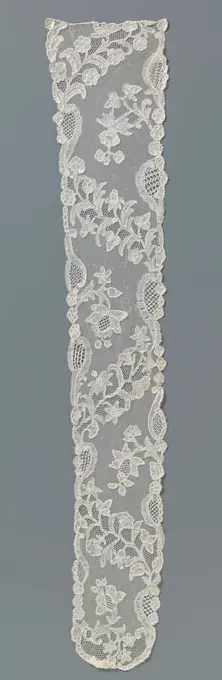
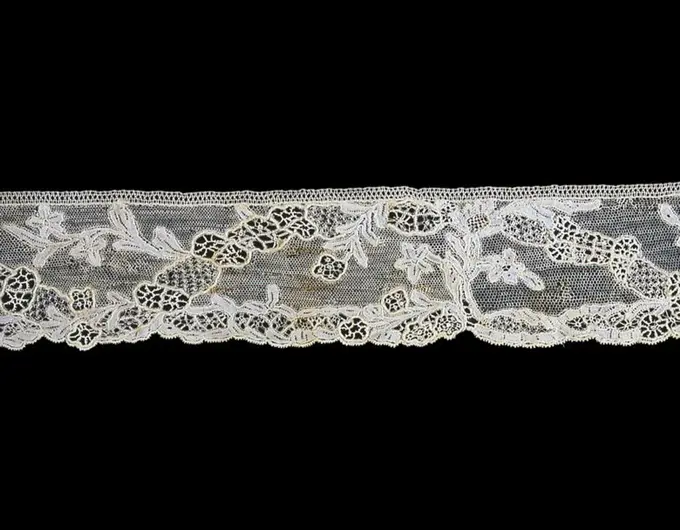
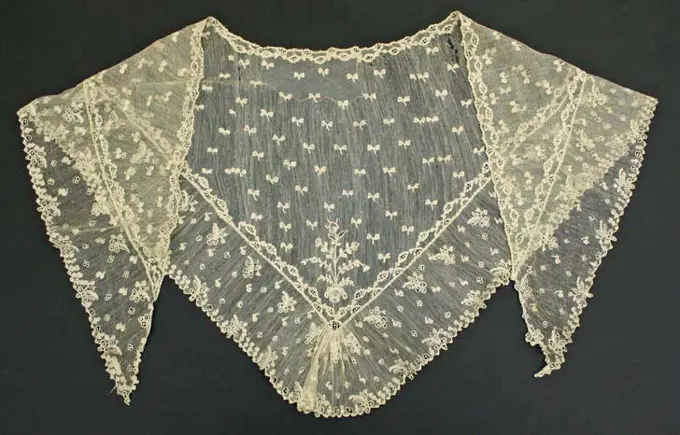
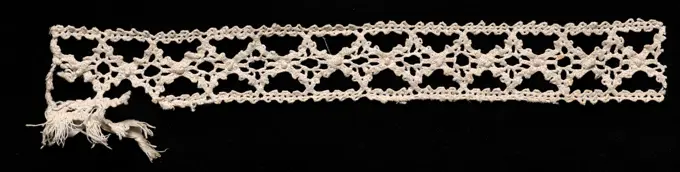
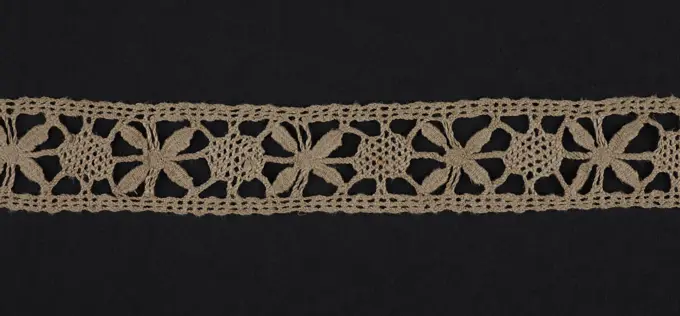
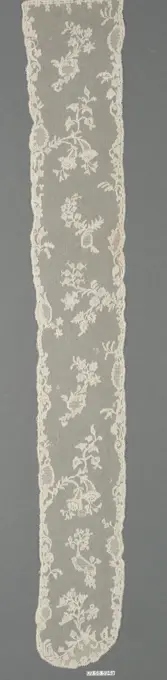
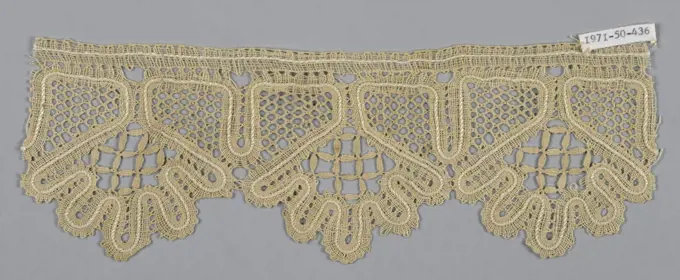
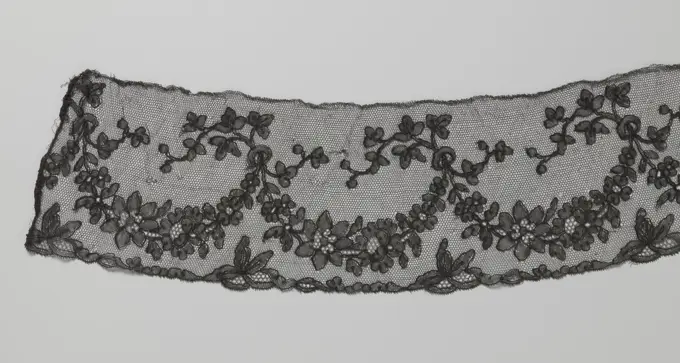
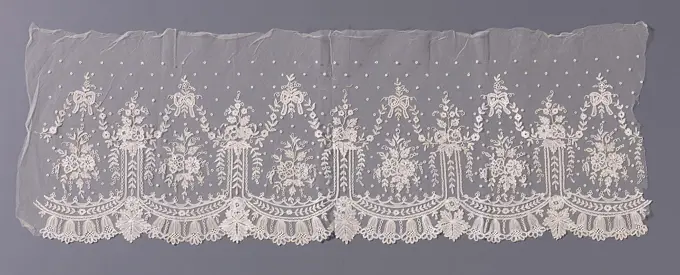
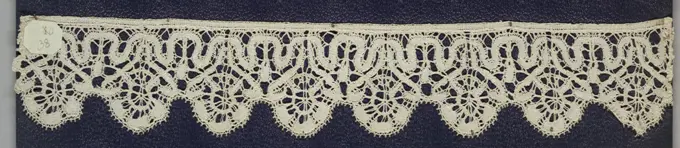
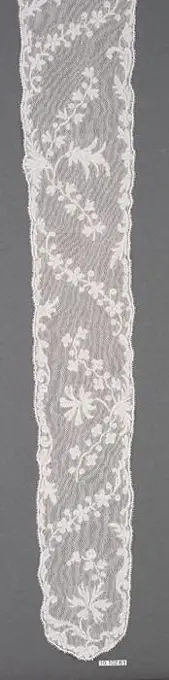
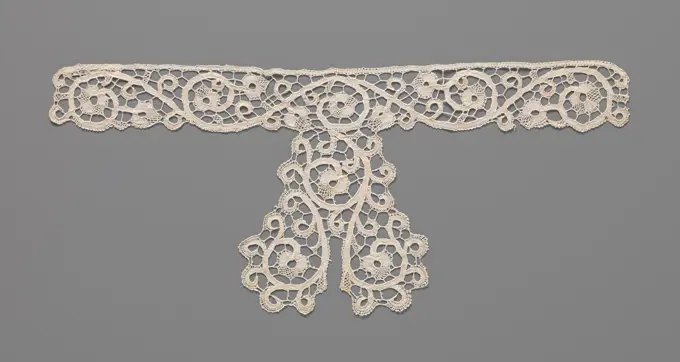
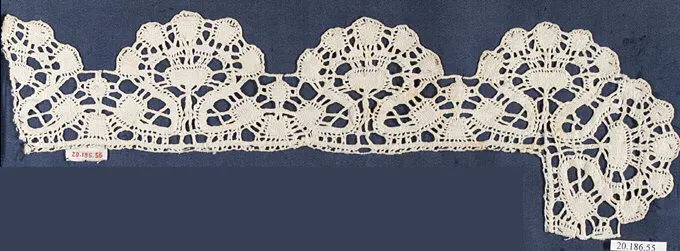
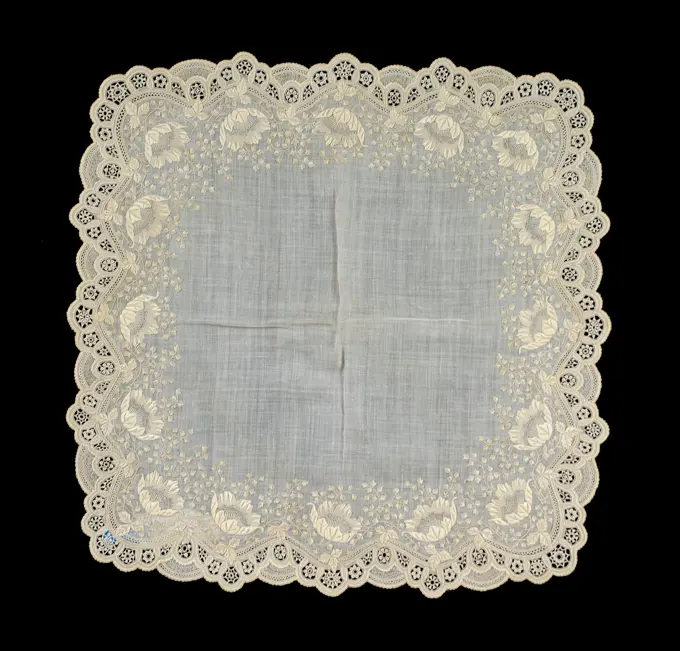
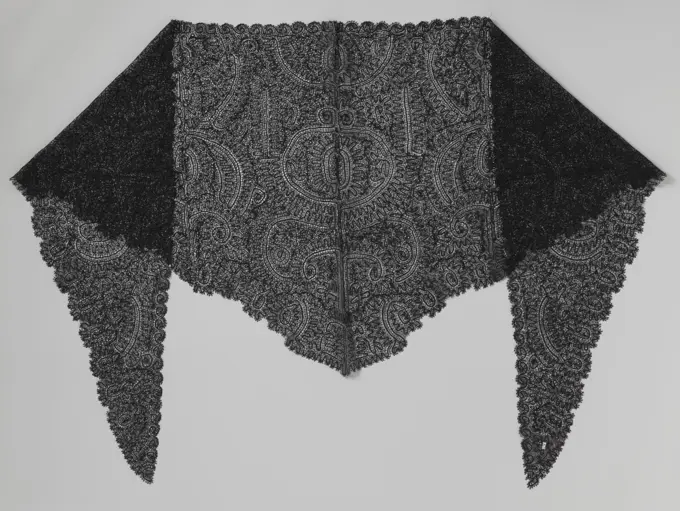
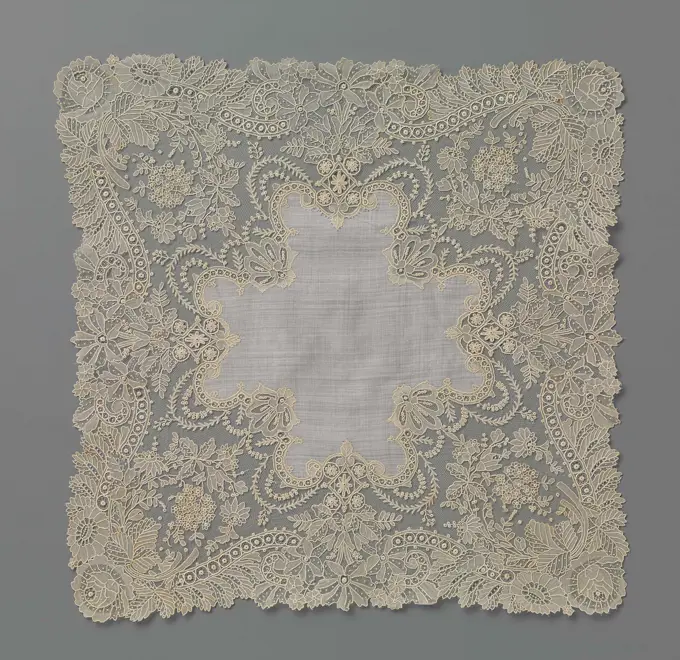
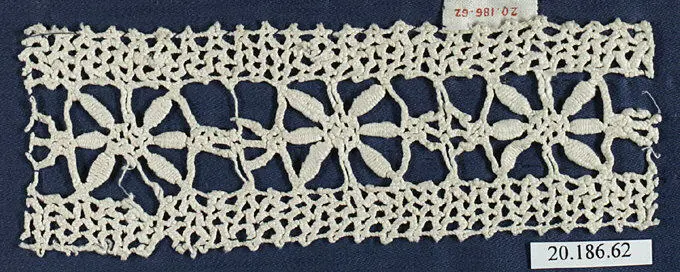
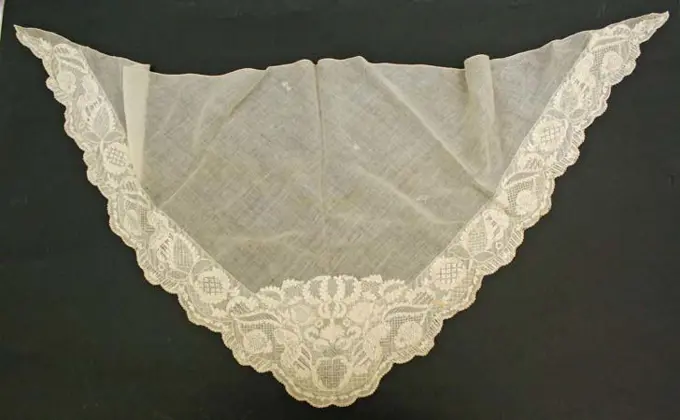
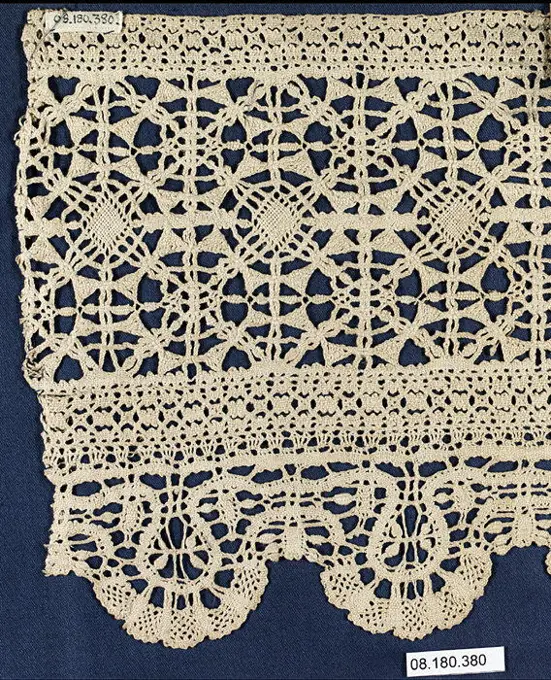
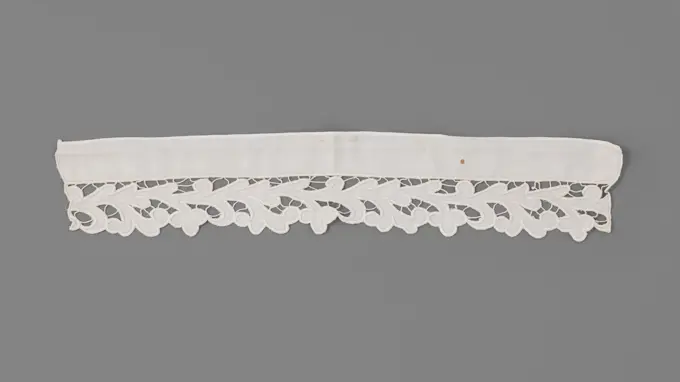
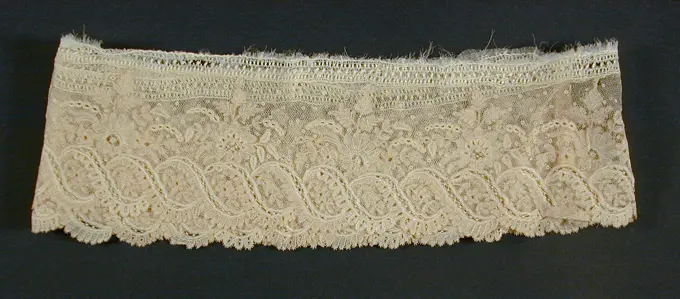
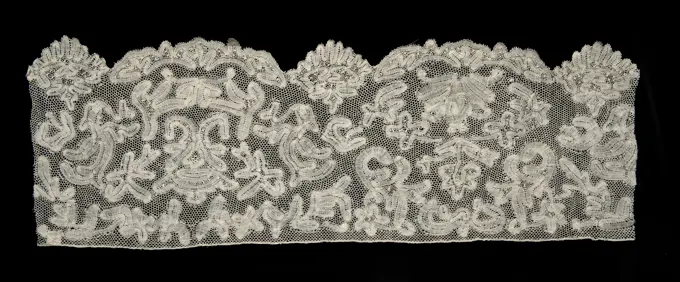
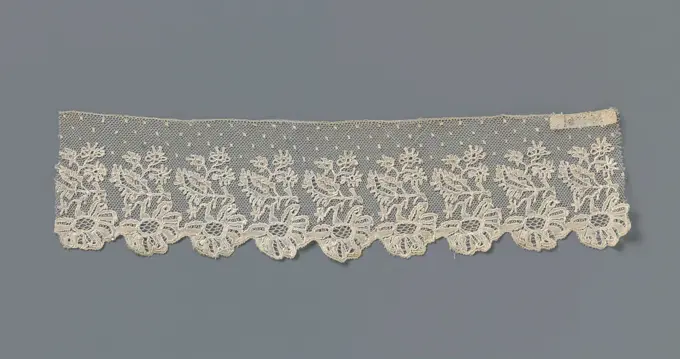
Detailed lace strips and cuffs featuring floral motifs and symmetrical designs, reflecting traditional craftsmanship in various styles.

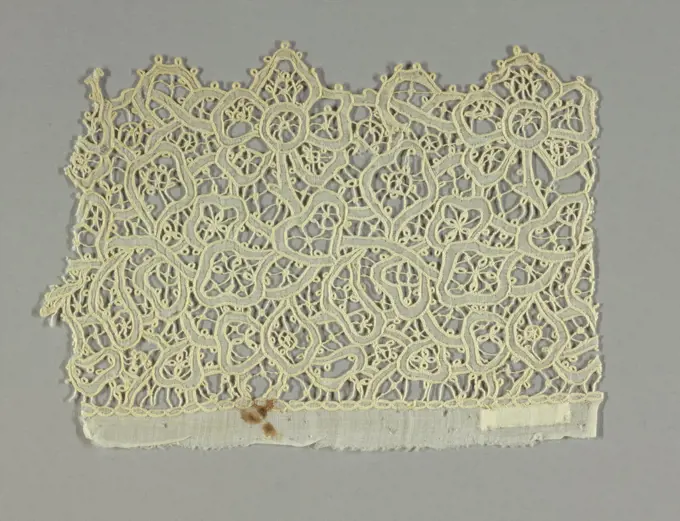
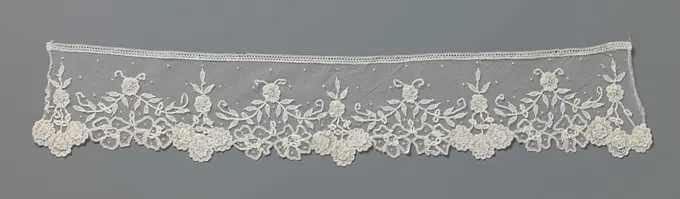
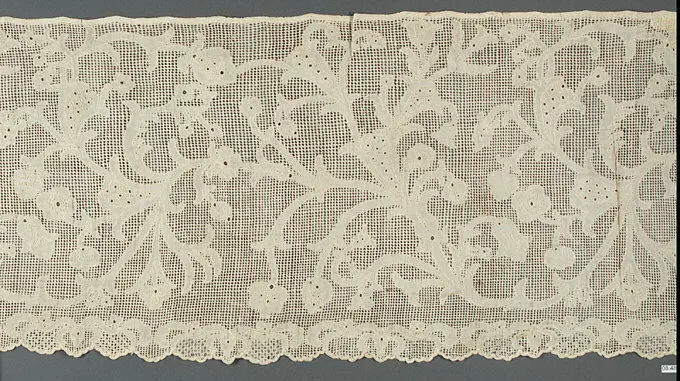
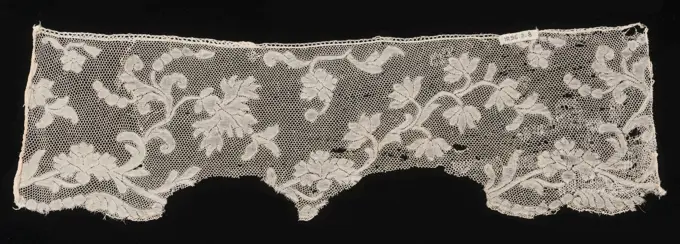
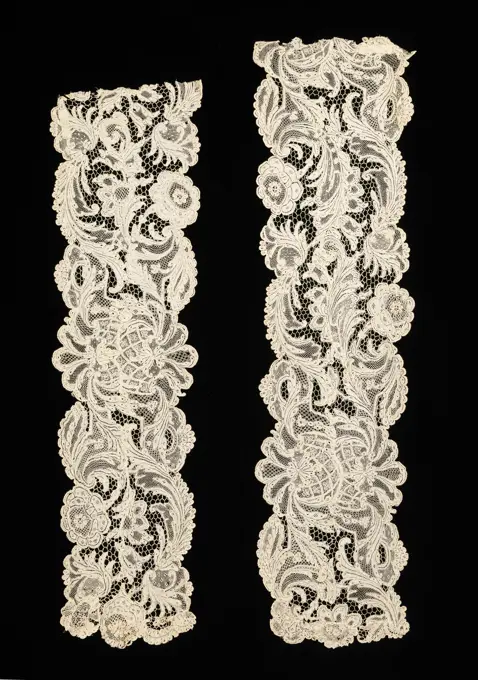
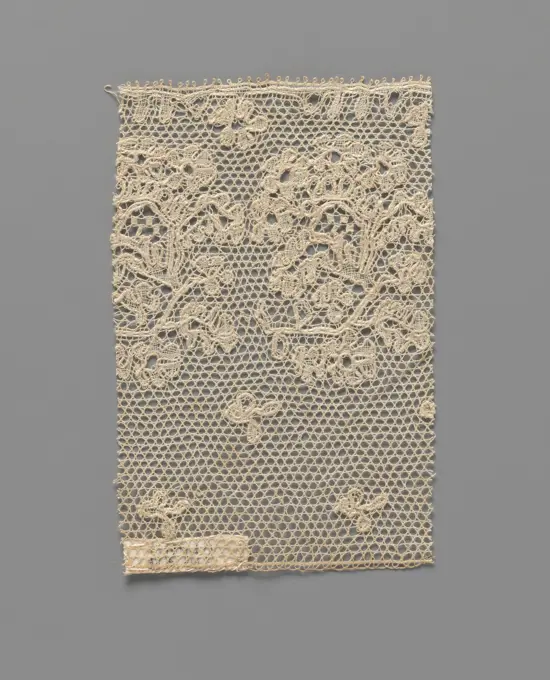
Border, Medium: linen Technique: bobbin lace, Brussels style, Large and small flowers and leaves in close arrangement., Belgium, 19th century, lace, Border
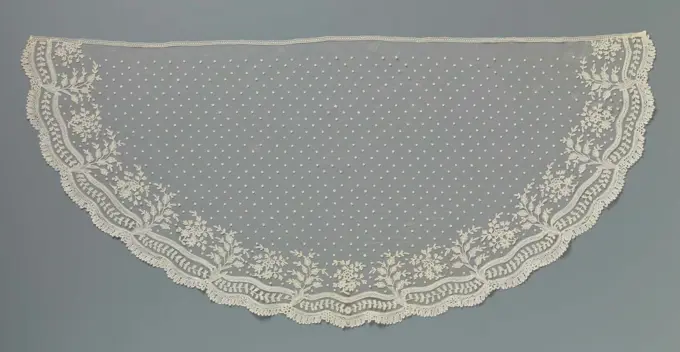
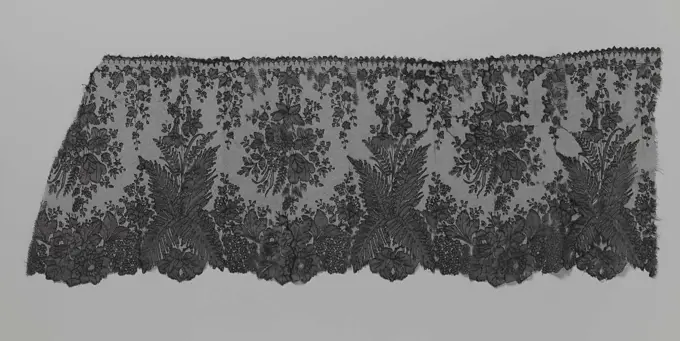
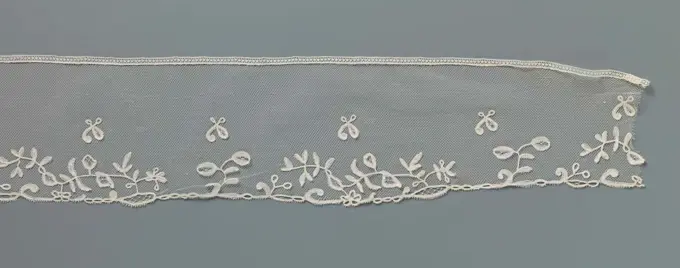
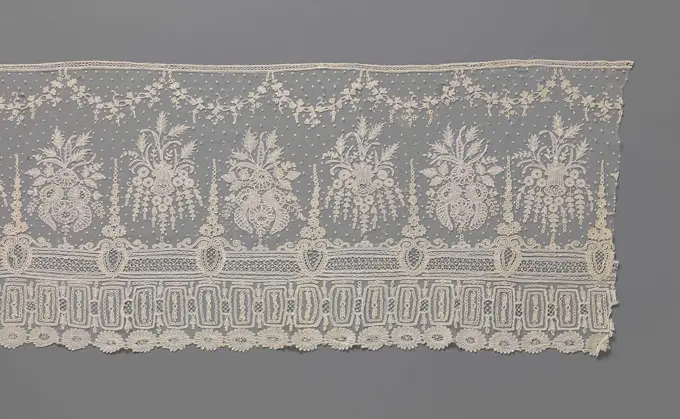
Kloskant dress strip with ferns, anonymous, c. 1850 - c. 1855 Black bobbin jelly strip: Chantilly side. On an empty mesh stock there is a closed edge with scoops, filled with a garland of flowers and leaves. On the intersections there is a small shell with a hanging rose, above which a striker bouquet rises from four large fern leaves and a flower branch, which extends to the top edge. Here a horizontal climbing window with hanging twigs runs, while on the field above the large shell of this climbing crank a large bouquet depends, among other things with a tulip. France (possibly) silk bobbin lace Black bobbin jelly strip: Chantilly side. On an empty mesh stock there is a closed edge with scoops, filled with a garland of flowers and leaves. On the intersections there is a small shell with a hanging rose, above which a striker bouquet rises from four large fern leaves and a flower branch, which extends to the top edge. Here a horizontal climbing window with hanging twigs runs, while on Voile van applicatiekant met golvende campane-rand.Voile of natural-colored application side, climbing side applied to machine tulle. Halveman-shaped. A wavy edge of two tables is running on a sowed sowed distance, within the flat shelters of Campanes, which enclose a leaf branch. This edge is overcurred by half-to-left, half to the right bent twigs with seven leaves. In between, rosette branches are above the wavy edge.Strip bobbin with zigzag-garland and triangular bouquet, anonymous, c. 1800 - c. 1899 Strip of natural -colored bobbin, Parisian side. The repeating and continuous pattern consists of a zigzag garland of connected openwork ovals with a fan flower and a V-shaped bouquet with three flowers. The motifs are connected by a Maas soil, a Parisian soil. The motifs are made in linen battle with thicker and shiny contour threads. As a decorative land, a snowflake soil has been used in the bouquets and a coarser Maas soil in the ovals and the fan flower. At the top and bottom are straight finished, with the bottom with picots. The short sides are finished with a zoompje. France linen (material) bobbin lace / Paris lace Strip of natural -colored bobbin, Parisian side. The repeating and continuous pattern consists of a zigzag garland of connected openwork ovals with a fan flower and a V-shaped bouquet with three flowers. The motifs are connected by a Maas soil, a Parisian soil. The motifs are made Border, Technique: bobbin lace, Bobbin lace edge; late 18th century Maline, late 18th century, lace, BorderBobbin Lace Edging, 18th century. Spain, 18th century. Lace, bobbin; average: 3.9 x 21.7 cm (1 9/16 x 8 9/16 in.).Cuff of needle side with flower branch in U-shaped cartouche, anonymous, c. 1860 - c. 1880 Cuff of natural -colored needle side: Brussels mesh side. The repeating pattern consists of a U-shaped cartouche with a flower branch with two rosette flowers and two chalice flowers. The 'legs' of the U are formed by two straight pillars, crowned by a rosette flower and a three -lobby leaf. There is an oval medallion with a rosette flower in the center under each pillar. Between the pillars and the successive medallions, there is a decorative frame with five lobes and below that a pendulum of three leaves between two rosette flowers. Together with this pendulum, the medallions take care of the scrap edge along the underside of the strip. The motives are equipped with contour threads, the three circles in the pillars and the rosette flower in each medallion are equipped with thicker relief contours. The motifs are connected to each other by a fine mesh ground, a mesh side. The top of the cuff is Doily Made 1850-1900 Europe. Cotton, knotted square netting; embroidered in cloth stitch (lacis or filet work); edged with lopped netting .Japonstrook van kloskant met varens.Japon strip from black climbing side: Chantilly side. On a blank mesh stock is a closed edge with slot, filled with a garland of flowers and leaves. On the intersections there is a small shell with a hanging rose, above which a striker bouquet rises from four large fern leaves and a flower branch, which reaches the top edge. Here a horizontal ivy drink with hanging twigs runs, while a large bouquet depends on the large scallop of this ivy drink, among other things with a tulip.Strook applicatiekant met wijd verspreide vruchtentakjes.Strip natural colored application side, climbing side applicated on machine tulle. There are some scattered leaf branches on an unrecourced fond. The edge consists of three branches growing from the flat sculpture, among other things with couples almond-shaped fruits.Border. Date/Period: 16th century. Border. Medium: linen, metal thread. Technique: embroidered cutwork. Author: UNKNOWN.Border, Medium: linen Technique: cutwork with six bobbins used for connecting bars; the bobbin-made relief decoration with loops was made separately and sewn on using a needle, Fragment of a border has an intertwined floral vine pattern of fine white linen held with connecting bars., Netherlands, 1650-1700, lace, BorderMutsenslip van kloskant met rivières.Hatslip of natural colored Brussels climbing side. A river with a ground ground is overcurred by a branched branch with flowers and lancet leaves, while on the fields with a fine mesh net a twig grows with a flower, whose open heart is pear-shaped. The schulls are flat and have many medallions filled with grid work. In the event of mistake, a matching Brussels Hatslip (BK-B-J-175-a) has set a Mechelen slip (BK-B-J-175-B), while the matching Second Brussels Hatslip (BK-B-J) described here. -177) Did remained separately.Border Made 1830-1849 France. Linen, needle lace of a type known as Point d'AlenÁon .Fragment (Border). Italy, Burano. Date: 1760-1769. Dimensions: 5.2 × 46 cm (2 × 18 1/8 in.)Heading height: .5 cm (1/4 in.). Linen, needle lace. Origin: Burano. Museum: The Chicago Art Institute, Chicago, USA.Flounce (France); linen; Repeat: 27 and 3/4 inches; 1938-30-5Border (Italy); silk embroidery, linen foundation, glass beadsPair of Alb Cuffs. Probably France, circa 1750. Costumes; ecclesiastical. White linen Dresden work on white linen with linen bobbin lace edgingBorder (Belgium); linenFichu 18th century-19th century Italian. Fichu. Italian. 18th century-19th century. no medium availableBobbin Lace Insertion, mid 16th century. Italy, Venice, mid 16th century. Lace, bobbin; average: 3.2 x 25.4 cm (1 1/4 x 10 in.).Cravat End (Belgium); linenEncaje bordado, siglo XVIII. Museu del Disseny de Barcelona.Cap border 18th century Flemish. Cap border. Flemish. 18th century. Bobbin lace, point d'Angleterre. Textiles-LacesFragment 16th century Italian. Fragment. Italian. 16th century. Bobbin lace. Textiles-LacesFragment 18th century French. Fragment 214613Fragment of lace unknown, national coronary schoolLappet (one of a pair) early 19th century French or Flemish. Lappet (one of a pair) 218556Fragment, Medium: Technique: needle lace, Needle lace edge sample, joined, floral pattern; late 18th century, late 18th century, lace, FragmentFragment 18th century Southern German. Fragment 212324Trimming, Medium: linen Technique: bobbin lace, peasant style, A band with blossoms forming tabs., Russia, 19th century, lace, TrimmingBerthe Van Kloskant with garlands and bows, anonymous, c. 1820 - c. 1830 Berthe van Zwarte Kloskant: Chantilly side. There is a pattern of garlands and bows on a coarse mesh stock. Geraardsbergen (Possible) silk bobbin lace Berthe van Zwarte Kloskant: Chantilly side. There is a pattern of garlands and bows on a coarse mesh stock. Geraardsbergen (Possible) silk bobbin laceBorder fragment 16th-17th century Italian or Sicilian. Border fragment 217792Strip Machine side with fuchsia flower in C-shaped branch, anonymous, c. 1875 - c. 1899 Strip of natural-colored machine side: machine valenciennes side. The repeating pattern consists of a C-shaped branch, in which a fuchsia-like flower hangs. A smaller, mirrored C-Volute directly against the branch from the underside. The scallops along the bottom always consist of three small shells, which are created by C-Voluutjes hanging on the bottom of the pattern. The motifs are connected by a diamond -shaped grid. In the motives, recesses were made and ROM the motifs openwork edges. A fine mechanical snowflake soil has been used between the C voluits at the bottom of the pattern. West-Europa (possibly) Strip of natural-colored machine side: machine valenciennes side. The repeating pattern consists of a C-shaped branch, in which a fuchsia-like flower hangs. A smaller, mirrored C-Volute directly against the branch from the underside. The scallops along the bottom always consist of three small sStrook applicatiekant met dubbele rozetbloemen.Strip natural application side, dick side applicated on machining tulle. Spreading pattern with mates on a fine hexagonal maas soil. Repetitive motif that shuts along the lower edge of trickle with three rosette flowers interspersed by two daffodil-like flowers. The stems of the three rosette flowers run vertically and cross each other halfway through the strip width. There is a smaller rosette flower about the intersection of the stems. Above the two daffodils, a symmetrical motif with two curved leaf branches can be seen, with a rosette flower here at the intersection. The large rosette flowers have doubled and consist of a large flower, with a smaller flower switched over it. Motifs split into linen stroke and relief contours with a thicker thread, flower work. Different flowers on the underside are made from scrolled ribbon side. The top is trimmed with a border clamping side.Kloskant intermediary with continuous pattern of curved rose branches, anonymous, c. 1850 - c. 1874  Strip of natural-colored bobbin, Valenciennes side. The repeating pattern consists on the center line of the strip of a slightly curved branch with one rose in the middle and some thick leaves. The ends of the consecutive branches cross each other and thus form a continuous whole. The motifs are connected by a Maas soil, a round Valenciennes ground. The motifs are made in linen battle with openwork edges and a recess in the Bloemharten and the center of the (flower) leaves. The recesses are decorated with crossing couples, the decoration in the flower heart is made with a lace hole stroke. The top and bottom of the strip are straight. One short side is cut diagonally. Belgium (possibly) cotton (textile) Bobbi Lace / Valenciennes LaceStrook applicatiekant met u-vormige cartouches met strikken en bloemslingers erboven en klokjesbloemen eronder.Natural-colored Brussels Application Board: Climbing side with needle lace-up stabbing - Brussels Duchesse - Appliqued on machine tulle. The repeating pattern consists of U-shaped cartouches with a flower branch in each. Above every cartouche a flower garland with a bow. Under every cartouche, four bells of blue leaves hang between two large leaves that each are crowned by a rosette flower. The machining tulet is strewn with annular moots. The motifs are made in linen stroke with openwork edges. The motifs are largely equipped with contour wires and closted relief contours in different places. In the largest flowers, needle lace agent stitches have been applied, whether or not applicated to the pieces of finer tulle. The top of the strip has been cut and not finished. The tube edge stems from the pattern with the U-shaped cartouches, whereby the bells flowers between the leaveStrook gehaakte kant met vier bloemen rondom een cirkel.Strip natural-colored Irish crochet side. A recurring pattern of a circle from which four flowers spring from regular distance, creating a square form. Crochet land with picoted irregular meshes. The top is finished with a straight edge. The straight bottom edge is deposited with picoted arcs.Border, Technique: bobbin lace, Bobbin lace edge, floral tab edge; mid-18th century Flemish, mid-18th century, lace, BorderPattern ca. 1840 British. Pattern. British. ca. 1840. Parchment. Textiles-Methods and MaterialsBorder (France); linenLace laceBarbe 18th century French. Barbe 218810Fragment; linen; Bequest of Marian Hague; 1971-50-414Length of duchesse lace, circa 1900, Europe, maker unknown. Gift of Dr Tom Farrar, 2010.Collar with attached Jabot, Anonymous, c. 1900 - c. 1924  Collar with attached jabot of natural -colored Venetian bobbin. Strip -shaped model under which a heart -shaped jabot hangs. The predominantly symmetrical pattern consists of a wavy slender with five strongly curling side branches with a three or five-lobe flower at each end. The heart -shaped Jabot is formed by three of such curling tendrils with ditto flower at each end. Around the heart, on the curling of tenders, several short side branches that all curl in the same direction. The motifs are largely made in linen battle with openwork edges here and there. A different stroke is used for a few (flower) leaves. The motifs are connected by braids. The top of the whole is straight finished. The curling of tendrils and side branches form a scrap edge along the other edges. Belgium linen (material) bobbin laceFragment, Medium: linen Technique: bobbin lace (Lille style with heavy outlining thread), Fragment of Lille-style lace showing small trefoils along border in two rows. Ground powdered with small square dots., France, 19th century, lace, FragmentWomen's tie from Application side with split flower branch with chalice, anonymous, c. 1875 - c. 1899 Women's tie of natural -colored Brussels Application side: Brussels bobbin lacquered on machine tulle. Narrow elongated model, with widened and rounded ends. Symmetrical pattern with an elongated midfield that is littered with founded rings (needle side) and on which one row of flower branches is mirrored from the middle. A split flower branch at each end closes the row. Two large chalice flowers and some smaller chalice flowers on the branch. One chalice flower is in midfield, the other hangs together with two large spring -shaped leaves and forms the end of the tie. The shells along the outer edge of the tie consist of small rosette flowers, which in great rise to the ends and between which a leaf appears occasionally. A pearl edge (needle side) runs along the inner edge of the rosetten edge, behind which the tulle is cut away. The motifs are made in netslag and linen battle with opeEdge (Belgium); linenStrip bobbin with duck and square, anonymous, c. 1925 - c. 1938  Strip of natural -colored Italian bobbin side. The repeating pattern consists alternately and duck and a square. The motifs are made in linen stroke and they are connected by a grid, a lace-hole traly. The square is divided into eight plains by straight and diagonal lines made with recesses. Top and bottom of the strip are straight finished with the bottom with picots. Piedmont linen (material) bobbin lace water-birds: duckEdging 16th century Italian, Venice. Edging 221099Corner piece 17th century Italian, Genoa. Corner piece 220865Scarf from dick side with lightning bolts. Scarf of black climbing side, Russian or osteuropean side. The three-part model shows a substantially symmetrical pattern that is on an irregular braid soil. Thick branches surrounded by lightning bolt motifs form half and whole circles, within which an oval fruit or flower.Handkerchief 1850-75 Belgian. Handkerchief 169858Edging 18th century Italian, Abruzzi (Pescocostanzo). Edging 221149Border 17th century Italian, Venice. Border 226101Kloskant scarf with lightning bolts, anonymous, c. 1875 - c. 1899 Black bobbin scarf, Russian or Eastern European side. The three -string model shows an almost symmetrical pattern that stands on an irregular braid ground. Thick berries surrounded by lightning bolt motifs form half and whole circles in which an oval fruit or flower. Eastern Europe linen (material) bobbin lace / Russian lace / East European lace Black bobbin scarf, Russian or Eastern European side. The three -string model shows an almost symmetrical pattern that stands on an irregular braid ground. Thick berries surrounded by lightning bolt motifs form half and whole circles in which an oval fruit or flower. Eastern Europe linen (material) bobbin lace / Russian lace / East European laceFlounce 18th century Italian. Flounce 213451Capslip from Valenciennes side, Anonymous, c. 1750 - c. 1800 Cutslip from Kloskant. The pattern has sprinkling flowers and an edge of wavy tendrils. The scalloped edge is trimmed with picots. West-Europa linen (material). Valenciennes lace Cutslip from Kloskant. The pattern has sprinkling flowers and an edge of wavy tendrils. The scalloped edge is trimmed with picots. West-Europa linen (material). Valenciennes laceFragment, Medium: linen Technique: grid of withdrawn element with needle lace (reticella style), Panel with a geometric design based on the square., Italy, 16th century, lace, FragmentRibbon (France); silk, linenLappets (one of a pair) 18th century French. Lappets (one of a pair) 227668Strook applicatiekant met boeketten en drievoudige ornamentrand.Strip natural applicator: dick side with needle lace details applicated on machine tulle. A repetitive motif with two different bouquets stands on a fine hexagonal mesh soil, with a spreading pattern of rings. One bouquet consists of one bells flower surrounded by nine smaller rosette flowers and long hanging leaf packs. The other bouquet consists of four large rosette flowers surrounded by branches with leaves. The three ornament edges consist of from top to bottom: a straight band with needle lace standards, at regular remote cross-cut by a leaf on which a vertical arrow of rosettes; a chain of standing rectangles; A sloping edge along the underside by a concatenation of daisies. Motifs split into linen stroke and relief contours with wide scented thread bundles. Different needle lace stand in cutouts, such as in the hearts of flowers and in the band. The top is trimmed with a border clamping side.Strip of black and silver bobbin with windows, anonymous, anonymous, c. 1870 - c. 1890  Strip of black and silver bobbin: sling. The repeating and geometric pattern consists of a row of windows above a scum of fans. The windows are connected to each other at the top due to a closed pin stroke ground with a row of moes in shape. Silver thread was used in the center of the windows and in the fan -shaped sculptures. The top of the strip is straight finished. Brianza (possibly) silk. silver thread Bobbi lace / lace clothFragment 18th century Spanish. Fragment 212841BOOK;  19th century (1801-00-00-1900-00-00);Strip bobbin with different oval flowers, anonymous, c. 1925  Strip of natural -colored bobbin: fine bridge flower arrangements. The pattern that can be seen on the short piece of strip consists of various oval flowers that are connected to each other with short tifles and leaves. The motifs are made in linen battle, with openwork edges and thin contour threads. The motifs are connected by a potented braid ground. A few 'mats' can be seen between the braids, a kind of squares in linen battle that look like spiders. In the Bloemharten, cubes are made in shape or in linen stroke. A decorative soil with spiders has been used in a volute leaf. The top of the strip is straight finished. The scrap edge is finished with picots. Bruges (possibly) linen (material) bobbin laceCollar. Belgium, Brussels, mid-19th century. Costumes; Accessories. Cotton point de gaze needle laceTextile 1700-1899 Russian. Textile 173402Square, Technique: bobbin lace, Bobbin lace square, floral forms; late 18th century Bruges, Belgium, late 18th century, lace, SquareStrook kloskant met een ruit in een ruitvormig veld gevormd door driehoeken.Strip natural colosside: sloping. The repeating pattern consists of a diamond in a diamond shaped field that is formed by a triangle hanging on the top, with a triangle that lies along the bottom of the strip. The points of the triangles almost touch each other, in the middle of the strip. The motifs are connected to each other by a reinforced closed pin layer. Upper and bottom of the strip are straight finished.Fragment (France); linenStrip bobbin with a pattern pattern of mushes on a straight line, anonymous, c. 1800 - c. 1815 Strip of natural -colored bobbin: Mechelse side. Under a spreading pattern of Moesjes, the repeating and continuous pattern consists of a continuous straight line along the lower half of the strip. On the line, at a regular distance, there are always two mirrored pine cones or leaves in the shape of a flame. The motifs are connected by a fine grid, the Mechelen soil. The motifs are made in linen stroke and are provided with thicker and shiny contour threads. Top and bottom of the strip are straight finished with a separate strap on the top and a picot edge along the bottom. The strip consists of four strips of each other. Mechelen linen (material) bobbin lace / Mechlin (lace) Strip of natural -colored bobbin: Mechelse side. Under a spreading pattern of Moesjes, the repeating and continuous pattern consists of a continuous straight line along the lower half of the strip. On the line, at a reguHandkerchief, Medium: linen Technique: embroidered, needle lace filling stitches, edged with bobbin lace, White handkerchief of fine cream white linen with border decorated with open work in diamond shapes, framing small designs in lace stitches; flower sprays and wheat above border. Edge is scalloped with oval-shaped forms framing open work and lace stitch details. Bobbin lace edge. Corners rounded. Large corner initial: 'P.D.O.', Belgium or France, mid- 19th century, embroidery & stitching, HandkerchiefGloves ca. 1900 Kayser-Roth Glove Co., Inc. Gloves 119797Band (Italy); linenHandkerchief with a border of needle side with four palms and four diamonds. Handkerchief with an edge of natural needle lace, Brussels mesh edge. To a batters center piece in the form of a malteser cross, a wide side strip runs. Four palms and four diamonds stand along the inner edge, connected by fine winds. The corners are formed by deep slippers with a smooth V-shaped volute, which is overcured by a C-shaped branch with an outwardly dirty rose and aster and an inwardly directed snowball. There are three hanging lilies on the middle of the sides. The outer circumference is free right.Gauze kerchief unknownEmbroidered Sleeve, 19th century. America, 19th century. overall: 42.7 x 39.1 cm (16 13/16 x 15 3/8 in.).Insertion 16th century Italian, Genoa. Insertion 220872Border. Probably Italy. Date: 1725-1750. Dimensions: 22.9 x 186.7 cm (9 x 73 3/8 in.)Width repeat: 36.2 cm (14 1/4 in.). Linen, bobbin part lace (continuous clothwork tapes with decorative openings). Origin: Italy. Museum: The Chicago Art Institute, Chicago, USA.Edging early 18th century Flemish. Edging 212521Border, Medium: linen Technique: needle lace, early 17th c. and style, Narrow band with four deep triangular pendants with scrolls and flowers., Italy, early 17th century, lace, BorderApron ca. 1740 British. Apron 121599Edging, Medium: silk Technique: bobbin lace, Edging lace showing a pattern of flowers and leaves that form scallops along one side., Spain, 19th century, lace, EdgingFichu ca. 1789 French. Fichu 120841Handkerchief, circa 1902, maker unknown. Gift of Jean K. Gilmer, 2009.Lappet 1730-1739 French Fine pieces of lace were often reconfigured from their original forms as they passed from one generation to another. These lappets were made by cutting from a single length. The variety of fillings and the compelling movement and dynamism of the design mark it as a high quality piece.. Lappet 156392Piece 18th century Greek. Piece 214732Collar of linen with a richieuwerk, with a running pattern of extending leaf shapes with volute branches, anonymous, c. 1920 Collar of linen with a rich new, with an ongoing pattern of sliding leaf shapes with volute bakes. West-Europa whole: Linen (Material) Collar of linen with a rich new, with an ongoing pattern of sliding leaf shapes with volute bakes. West-Europa whole: Linen (Material)Piece early 19th century French, Lille. Piece 214667BorderLength of Lace. Belgium, Brussels, late 18th to early 19th century. Textiles; textile lengths. Cotton point d'Angleterre bobbin and needle laceFichu van Linnenbatist, triangular and sculpted, embroidered with a border of carnations in needle side stitches and feston work (Plumétis) of white cotton, anonymous, c. 1800 - c. 1820 Fichu van Linnenbatist, triangular and sculpted, embroidered with a border carnations in needle side stitches and feston work (plumétis) of white cotton. The Fichu was probably originally larger. Netherlands whole: Linen (Material). Decoration: Cotton (textile) embroidering Fichu van Linnenbatist, triangular and sculpted, embroidered with a border carnations in needle side stitches and feston work (plumétis) of white cotton. The Fichu was probably originally larger. Netherlands whole: Linen (Material). Decoration: Cotton (textile) embroideringFragment 17th century Italian. Fragment. Italian. 17th century. Metal thread, bobbin lace. Textiles-LacesFragment, Medium: linen, black beads Technique: bobbin lace, discontinuous tape, Band with three plants forming tabs., Italy, 16th century, lace, FragmentSteel bobbin with Paris soil, anonymous, c. 1875 - c. 1899 Steel natural -colored bobbin: Parisian side. Coming from a lifted side school in Turnhout. Turnwood cotton (textile) bobbin lace / Paris lace Steel natural -colored bobbin: Parisian side. Coming from a lifted side school in Turnhout. Turnwood cotton (textile) bobbin lace / Paris laceStrip mixed side with lobed volutes and a palm leaf, anonymous, c. 1850 - c. 1899  Strip of natural -colored mixed side - bobbin in combination with needle side - Brussels Duchesse. The pattern consists of lobed volutes and a palm leaf. The motifs are connected by a burst of braids, with one picot on some braids. The shrewd fullwork is made in linen and mains, largely equipped with contour threads. The decorative soil is from a needle side and consists of a grid of diamonds, made with wide -fisted wire bundles and with a circle of founded wires in the center of each diamond and at all corners, or a pearl. Along both the upper and the bottom of the strip, the pattern forms a scrap edge, finished with picots. Belgium linen (material) mixed lace / mixed BrusselsFragment of Bobbin Lace Flounce, 19th century. Italy, Abruzzi, Pescocostanzo, 19th century. Lace, bobbin: linen; average: 61 x 21.6 cm (24 x 8 1/2 in.).Strook kloskant met hangende bloem en stervormige bloempjes.Strip natural colosside: Lille side. Under a narrow job with a scattering pattern of square moes, it consists of a repeating pattern from a hanging flower, to a curved stalk with a poultry leaf and a few smaller starflowers. The flowers are placed against each other, with a continuous connection between two petals, and form the slot along the bottom of the strip. The motifs are connected by a fine grille, a tulet. The motifs are made in linen stroke with recesses and thicker, shiny contour wires. An ornamental ground is applied in the flower hearts of the hanging flowers and a trim was realized in the leaf and the petals by crossing couples. The Moeses are made in shape stroke. The top of the strip is straight finished. The scivels along the underside are finished with picots.Ruffle Fragment; linen