Elegant Lace Strips

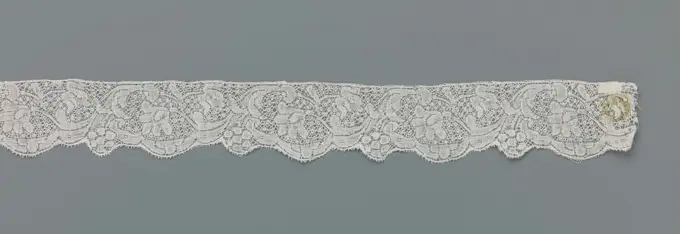
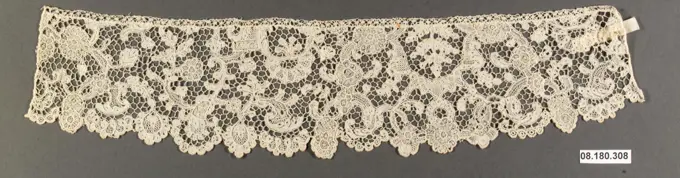
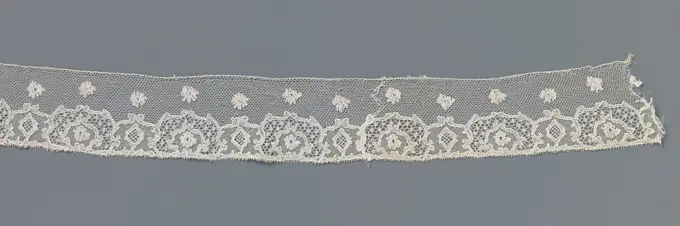
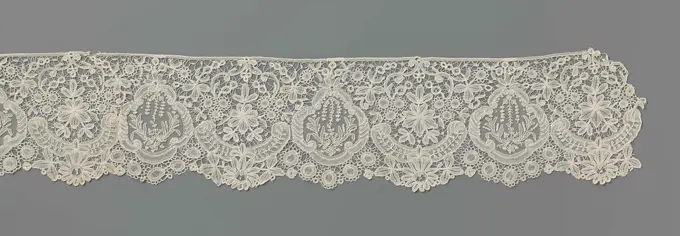
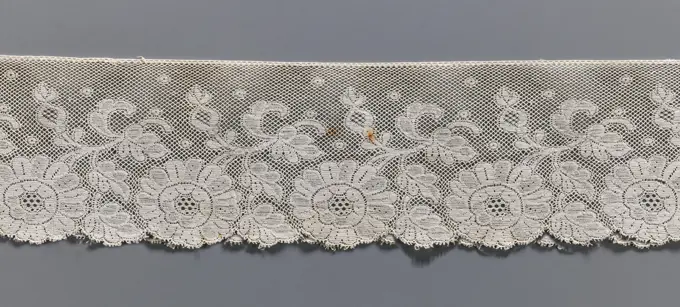
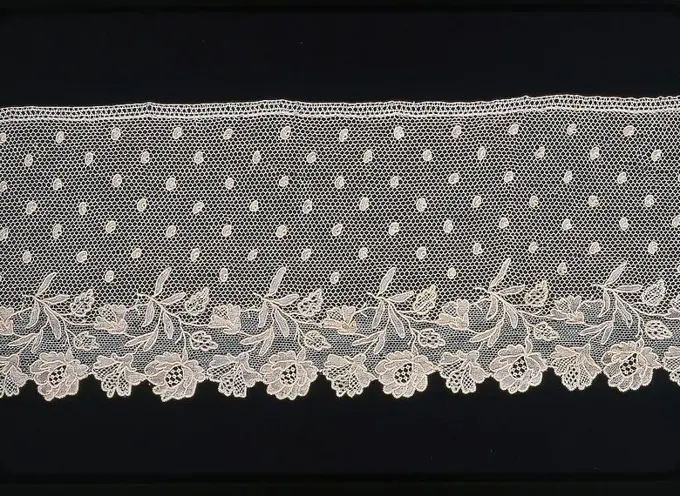
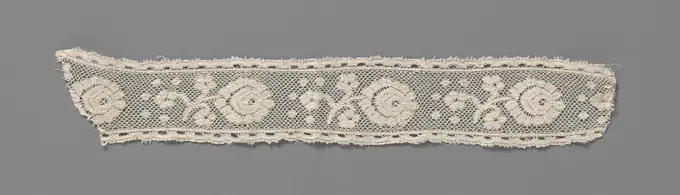
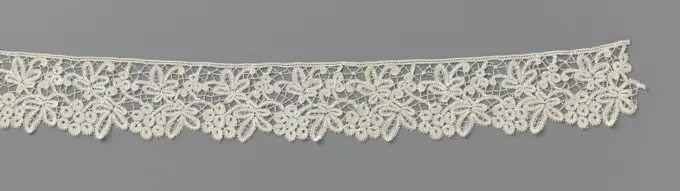
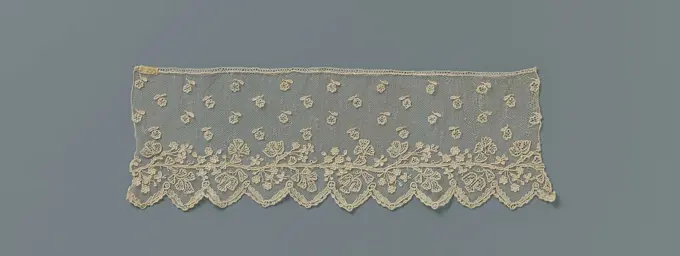
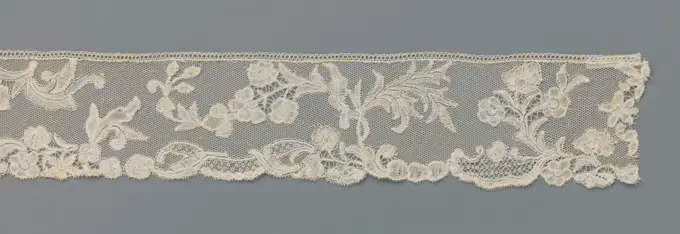
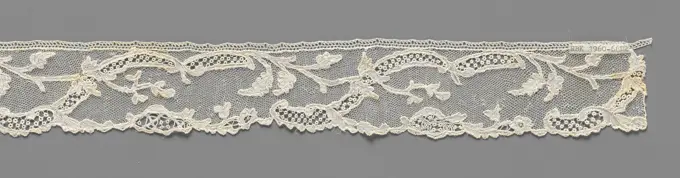
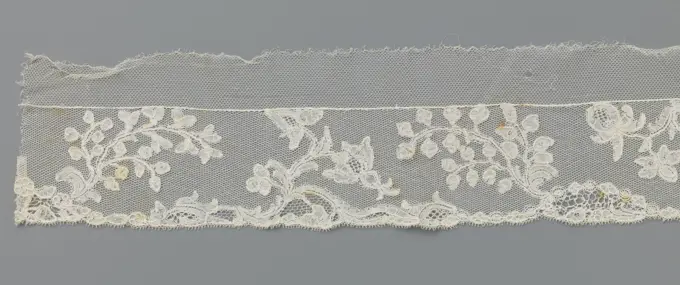
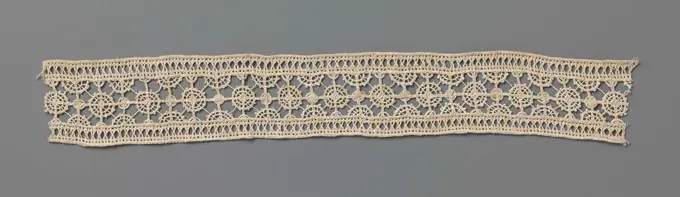
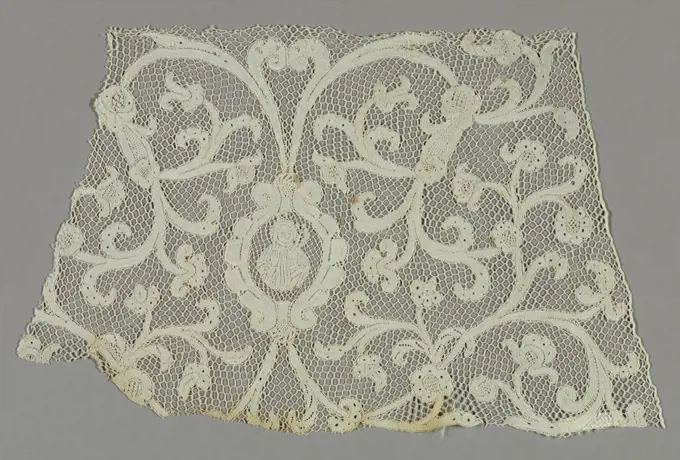
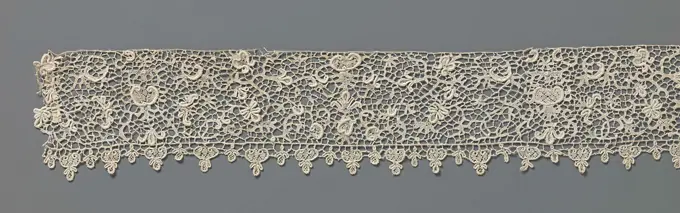
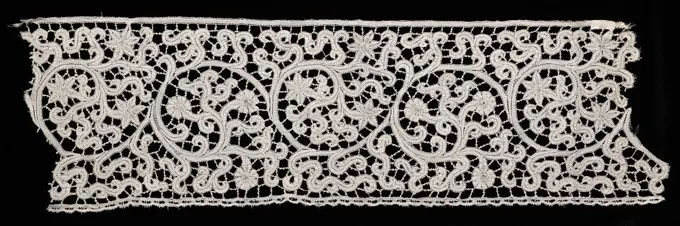
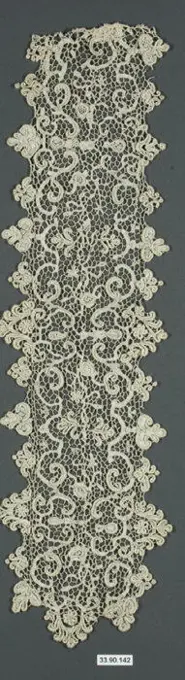
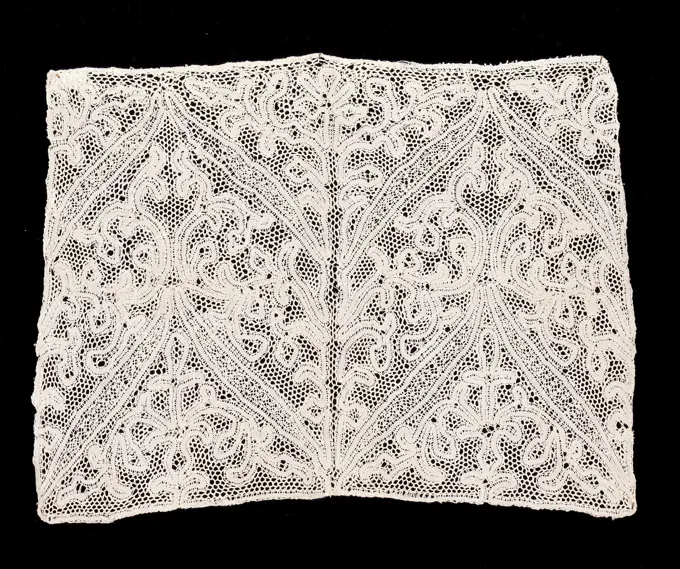
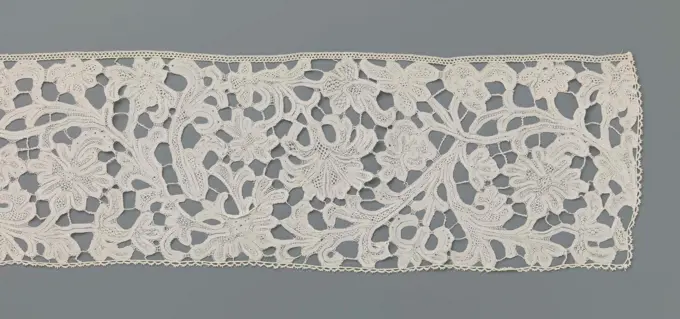
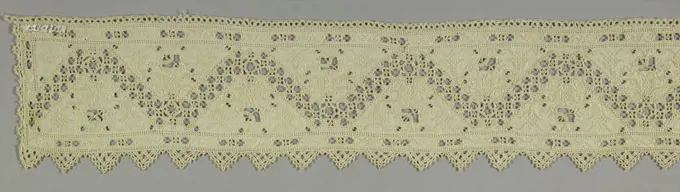
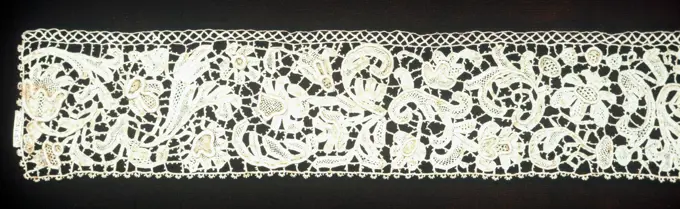
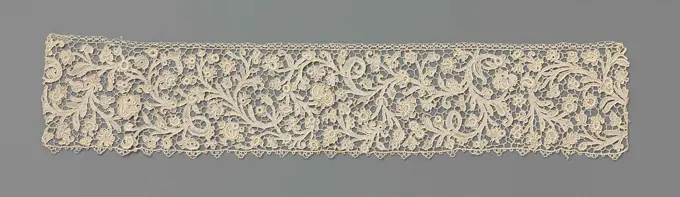
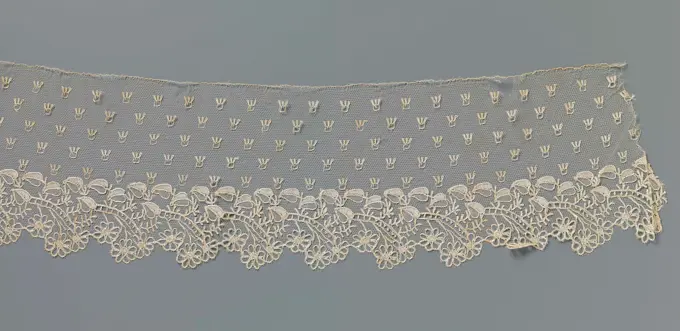
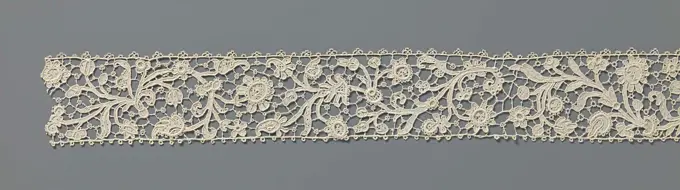
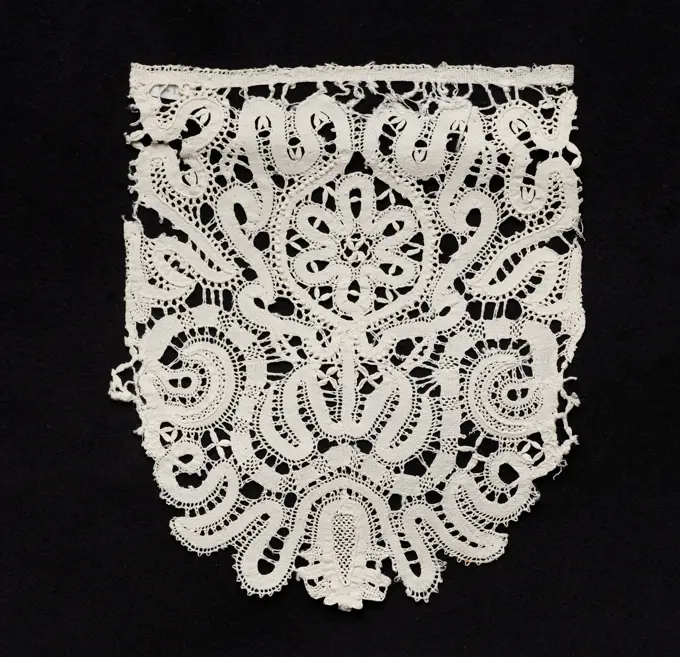
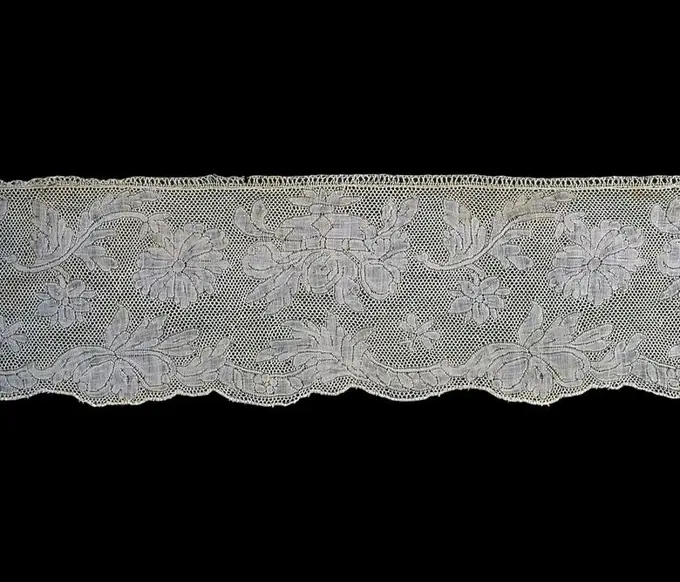
Delicate strips of vintage lace featuring intricate floral and geometric patterns in soft natural tones, showcasing textile craftsmanship.

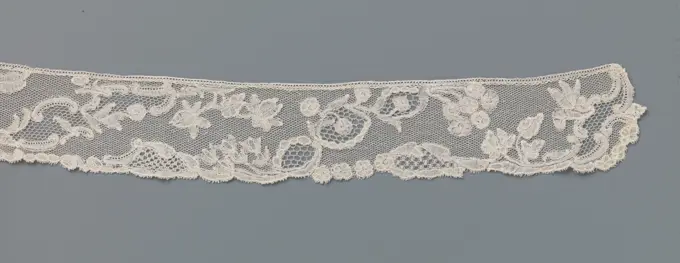
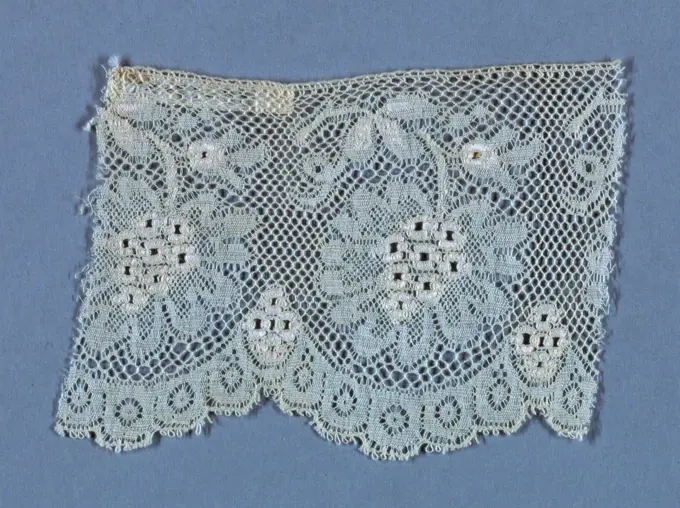
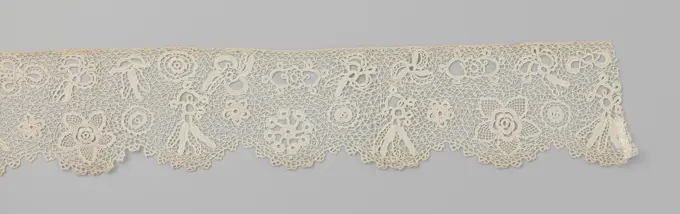
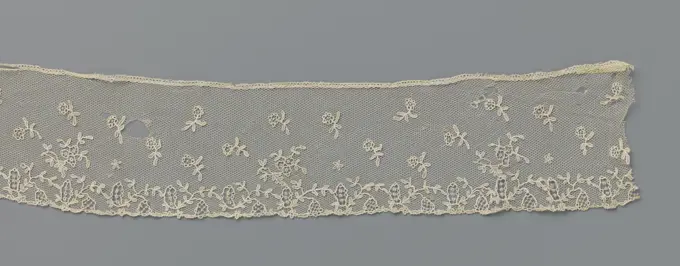
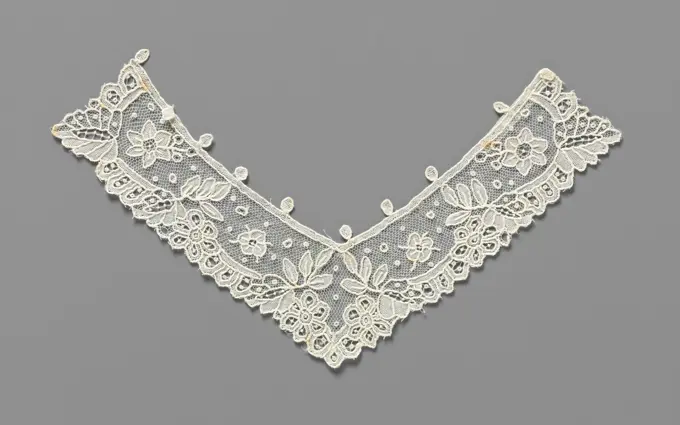
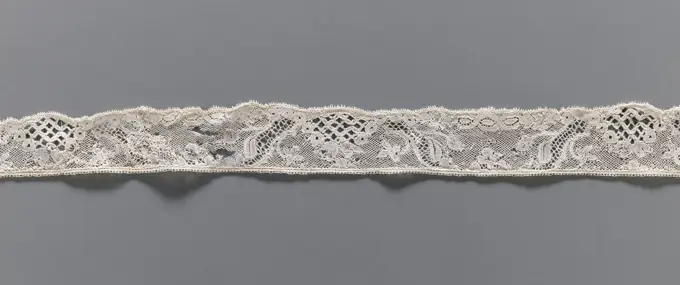
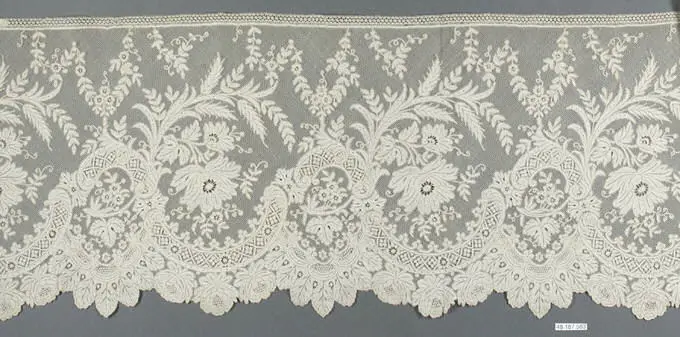
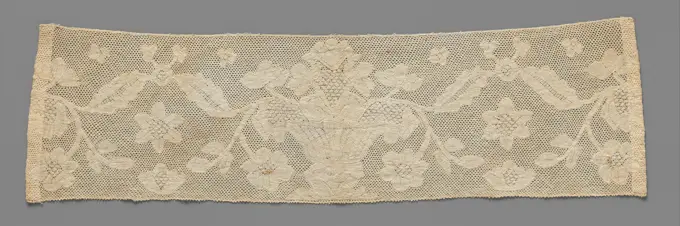
Strip Application side with grape bunches and halved leaves, anonymous, c. 1850 - c. 1890 Strip of natural -colored application side, bobbin lacquered on mechanical tulle. A narrow part, along the inside, shows a running pattern of halved, lobed leaves, which also accompanies a halved medallion with grid filling. On a wide part with a tulle surface are symmetrical, deep sculptures, which are alternately filled with a grape vice and a fan plant. Belgium (possibly) linen (material) Strip of natural -colored application side, bobbin lacquered on mechanical tulle. A narrow part, along the inside, shows a running pattern of halved, lobed leaves, which also accompanies a halved medallion with grid filling. On a wide part with a tulle surface are symmetrical, deep sculptures, which are alternately filled with a grape vice and a fan plant. Belgium (possibly) linen (material)
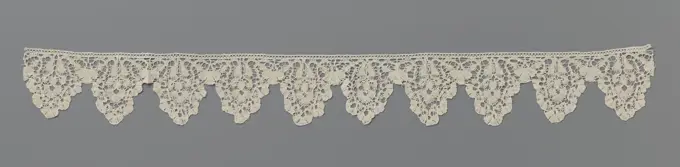
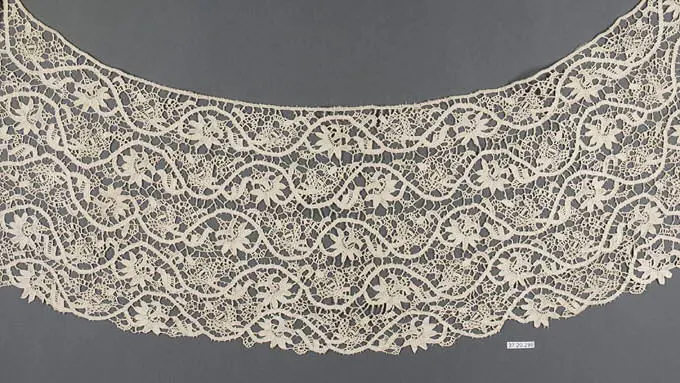
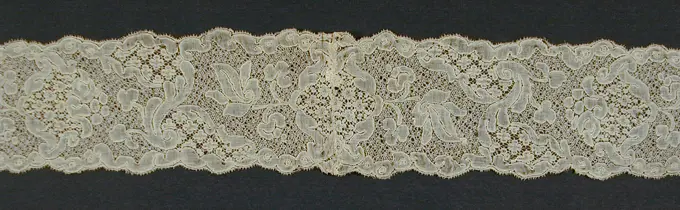
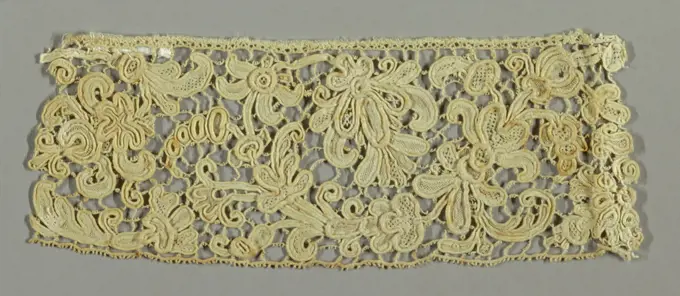
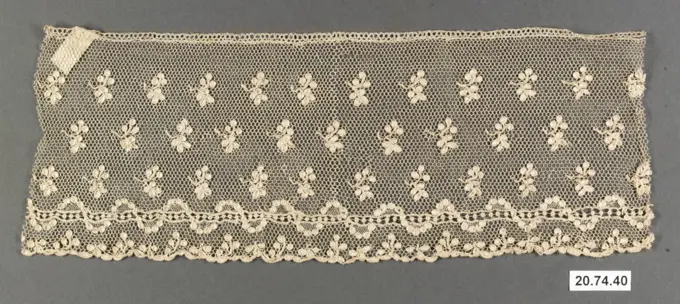
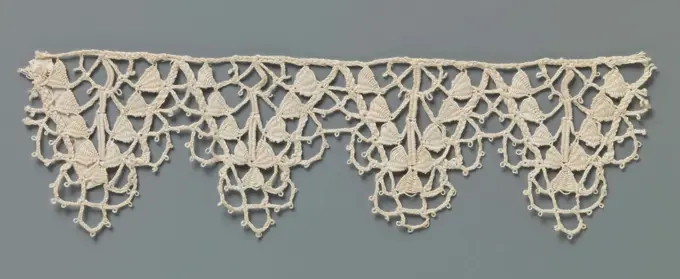
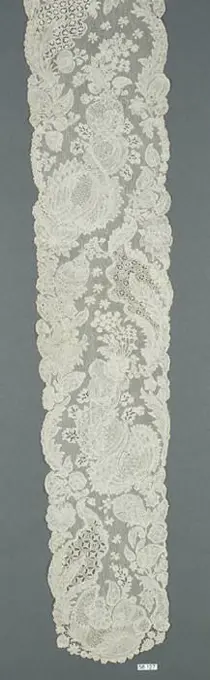
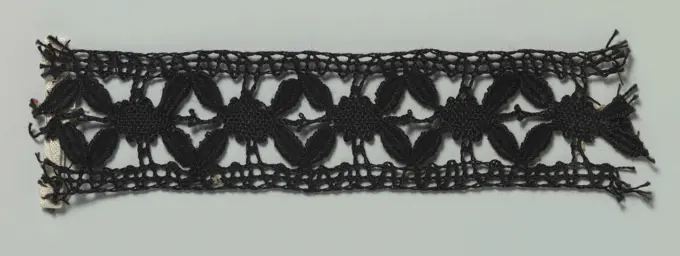
Strip bobbin with slanted tires of connected cartouches, anonymous, c. 1750 Strip of natural -colored Brussels bobbin. The symmetrical pattern consists of slanted tires of a few connected cartouches. Two of these tires with rocaille-like cartouches form a V-shape in the middle of the strip. Parallel to this, three voal cartouches form a sloping band with a bush at the end forget me and a bunch of double chalice flowers at the bottom. The pattern along the underside is further formed by a succession of ovals, rosette flowers and four cartouches. This pattern continues in the short sides. The motifs are largely made in linen battle with openwork edges and some recesses, they are partly in netslag. Many motives are provided with burst relief contours. The motifs are connected by a fine Maas soil, a drachel soil. Different decorative grounds have been applied, especially in the cartouches, including a potented braid and a coarser hexagonal traly round. The top is finished with a separate sStrip Application side with grape bunches and halved leaves, anonymous, c. 1850 - c. 1890 Strip of natural -colored application side, bobbin lacquered on mechanical tulle. A narrow part, along the inside, shows a running pattern of halved, lobed leaves, which also accompanies a halved medallion with grid filling. On a wide part with a tulle surface are symmetrical, deep sculptures, which are alternately filled with a grape vice and a fan plant. Belgium (possibly) linen (material) Strip of natural -colored application side, bobbin lacquered on mechanical tulle. A narrow part, along the inside, shows a running pattern of halved, lobed leaves, which also accompanies a halved medallion with grid filling. On a wide part with a tulle surface are symmetrical, deep sculptures, which are alternately filled with a grape vice and a fan plant. Belgium (possibly) linen (material)Border early 19th century French. Border 226079Strip bobbin with volutes, anonymous, c. 1910 - c. 1930 Strip natural -colored bobbin, possibly Flemish guipure. Symmetrical pattern with volutes of which three, four and five-leaf flowers spring. Several braided bars of bars with picots around the motifs. A honeycomb land within the motives. The top is finished with a straight edge. The bottom is finished with triangles built from arches. Belgium  bobbin lace / Flemish guipure lace Strip natural -colored bobbin, possibly Flemish guipure. Symmetrical pattern with volutes of which three, four and five-leaf flowers spring. Several braided bars of bars with picots around the motifs. A honeycomb land within the motives. The top is finished with a straight edge. The bottom is finished with triangles built from arches. Belgium  bobbin lace / Flemish guipure laceStrip bobbin with whimsically shaped flowers, anonymous, c. 1900 - c. 1924  Strip of natural -colored bobbin, Lille side. The repeating pattern consists of a whimsically shaped flower without a handle, which takes up almost the total width of the strip. Along the underside there are two rows of open worked circles, with the bottom row forming the shells with which the underside of the strip is finished. The flowers are connected by a Maas soil, a tuler floor, which is littered with square mosies. The motifs are made in linen battle with large cut -outs and with thicker and shiny contour threads. A rose soil has been applied as a decorative land. The Mosjes are made in form. The top of the strip is straight finished. The shells along the bottom are equipped with picots. Belgium cotton (textile) bobbin lace / Lille laceFragment of the lace;  approx. 18th century (1740-00-00-1760-00-00);Strook kloskant met ranken en 'hoorn van overvloed'.Strip natural colosside, binche side. There is a running pattern on a ringed snowflakes ground. Two chali flowers grow to a wavy rank and a 'horn of abundance' starting with a blade blade with a bunch of bunch, which in volute leaves forms with these the scallops. The top of the strip is straight finished. The slip edge along the underside is finished with picots.Collar 18th century French. Collar. French. 18th century. Needle lace. Textiles-LacesFragment, Medium: linen Technique: bobbin lace, Brussels style, Fragment of a band with a vine of elaborate leaves and small blossoms., Belgium, mid- 18th century, lace, FragmentStrook kloskant met aaneengeschakelde schildvormige cartouches.Strip natural colosside: Lille side. Under a row of loose rosette flowers, the lower half of strip is filled by a repeating pattern of coated shield-shaped cartouches. This concerns two different symmetrical cartouches. The motifs are connected by a fine grille, a tulet. The motifs are made in linen stroke, with thicker and shiny contour wires. Various ornamental grounds have been applied, alternately in the list and in the center of the cartouches. Upper and bottom are straight finished, with the underside with picots.Japonstrook van gemengde kant met gelobde medaillons.Japon strip of mixed side - climbing side in combination with needle lace - Brussels Duchesse. Standing lobby oval medallions with fine maasing soil and, among other things, treurwilgen leaves (coniferous lace) are connected by lying c-volutes, of which a daisy depends. The remaining land is an irregular braiding ground and is filled with five and three-lawy leaves and 'daisies' (docking side).Fragment of the lace;  19th century (1801-00-00-1900-00-00);Border. France. Date: 1820-1829. Dimensions: 9.8 × 266.5 cm (3 7/8 × 107 7/8 in.)Width repeat: 3.8 cm (1 1/2 in.). Linen and horsehair, needle lace of a type known as "Point d'Argentan" with a whipped mesh ground. Origin: France. Museum: The Chicago Art Institute, Chicago, USA.Tussenzetsel van kloskant met roosjes.Between two arches edges, with openings for a ribbon, a web runs with square meshes, on which a row of roses are on curve sprigs. Valenciennes side.Lace fragment. unknown, authorStrip bobbin with the grapes bunches, anonymous, c. 1875 - c. 1899 Strip of natural-colored bobbin: Duchesse side. On an open braid soil is a running pattern of a short branch with two vine leaves and a grapes. In turns, a leaf and the bunch form the uneven scums. Netherlands linen (material) bobbin lace Strip of natural-colored bobbin: Duchesse side. On an open braid soil is a running pattern of a short branch with two vine leaves and a grapes. In turns, a leaf and the bunch form the uneven scums. Netherlands linen (material) bobbin laceStrook kloskant met rozentakjes.Strip natural colosside: Mechelen side. Under a scattering pattern of bow ties there is a repeating pattern of one-sided directed rose branches with three twigs along the underside of the strip. On the top two twigs there is a leaf or a rose bud and also a rose with five petals. A larger flower depends on the lower twig in a hemisphere shult. The motifs are made in sparingly applied and loose linen, with thicker and shiny contour wires. The motifs are connected by a fine Maas soil, a Mechelen soil. An ornamental ground has been applied in the open worked flower hearts of the larger flowers. The top of the strip is straight finished. The sloping edge along the bottom of the strip is finished with picots.Strook naaldkant met zigzagschulpen.On a sleek, lying branch growing to the right-directed side branches, to which forgetion ties and three types of chali flowers, the sharp zigzag tubes exhibit a double contour, consisting of a leaf and a pearl edge, while a 'seeping' is applied to each point. In the field there is a scattering pattern of the hanging daisies. Alençon side.Strip bobbin with two compositions of C-volutes and daisies, anonymous, c. 1860 Strip of natural -colored bobbin: fine bridge flower arrangements. The repeating pattern consists of two, largely symmetrical compositions of C-volutes and daisies. The one composition consists of two C-Voluten, which are placed together at the bottom of the strip. Along the outside of the volutes have been made in large increasing lobes, with the three largest forming a lobed shell. Between the C-Voluten there are two chalice flowers and a daisy, with a hanging palm leaf above, crowned by three rosette flowers. The other composition consists of three highly curved C-Voluten under an elongated C-Volute. A row with seven contiguous rosette flowers below forms the other lobed shell. Above the lying C-Volut is an A-symmetrical settlement of larger and smaller rosette flowers and daisy. The motifs are connected by a potented braid ground. They are largely made in separate linen battle with openwork edges and reNeedlepoint (Burano Point) Lace Edging, early 18th century. Italy, Burano, early 18th century. Lace, needlepoint; average: 8.3 x 33.7 cm (3 1/4 x 13 1/4 in.).Strook kloskant met bloem- en bladmotieven boven een rand met bloempjes voluten en langwerpige cartouches.Strip natural colored Brussels climbing side. The pattern consists of flower branches, which varied from the top and bottom of the strip alternately. They are large flowers or flower clusters that all differ from each other. To distinguish his rosette flowers, a bunch of plum-shaped flowers, a large lily and a bunch of flowers with five pointed leaves. Along the bottom, the pattern consists of a concatenation of smaller flowers, especially rosette flowers, leaves and elongated cartouches and volutes. The motifs are connected by a fine Maas soil, a slighten ground. The full work is largely made in linen stroke with openwork edges and few cut-outs and partly in the battery. Most motifs are equipped with closted relief contours. Different ornamental grounds have been applied, including panned braid for snow, a snowflakes soil and an ornamental ground with a diamond-shaped pattern. TheFragment; linen; Bequest of Marian Hague; 1971-50-250Strip of needle side with mirrored S-shaped decorative band and iris, anonymous, c. 1760 - c. 1770 Strip of natural-colored needle side: Alençon side. The repeating pattern consists of a flat S-shaped decorative band in mirror image. The band continues at the top in a wavy branch of pointed and feathered leaves and with an iris that lies over the next decorative band. The tires touch the top of the strip and walk downstairs with a faint S-shaped curve to finish along the underside of the strip. The motifs are made up of feston stitches where very fine cut -outs are used sparingly for decoration. The motives are provided with relief contours and are connected by a fine hexagonal Maas soil, an alençon ground. Ornamental grounds with radar picots are used in the decorative tires, rocailles and flower hearts. The flat scrap edge is finished with picots. The top of the strip is finished with a tie. France linen (material) Alençon Lace Strip of natural-colored needle side: Alençon side. The Strip bobbin with curved branches and pomegranates, anonymous, c. 1760 - c. 1770 Strip of natural -colored Brussels bobbin. The pattern consists of curved branches with leaves, flowers and/or berries. The branches randomly bend one or the other and are interspersed with branches with granteds and other larger flowers. The lower edge consists of a succession of small motifs that form different cartouches. The motifs are connected by a fine Maas soil, a drachel soil. The motifs are made in linen battle with openwork edges and largely equipped with burst relief contours. As a decorative soil, picoted braids and a snowflake soil have been used, among other things. The top is finished with a straight edge on which a strip of tulle is sewn. The very bland and irregularly scalloped underside stems from the edge pattern and is finished with picots. Brussels linen (material) bobbin lace / Brussels bobbin lace Strip of natural -colored Brussels bobbin. The pattern consists of curved branches witManchet van gehaakte kant met vierpassen en vierkante godronschulpen.Cuff of natural colored Irish crochet side. Rectangular model with rounded corners. The midfield consists of a diamond-shaped network with three rows of mashes. The collar is finished on three sides with a concatenation of open four passes (rosettes with four flower blades). There is a circle in the center of every four-pass. And under every four-pass a square shell, filled with godrewes. The top of the cuff is straight finished.Strip of a climbing side with drip-shaped motif. Strip natural colosside, sling. The repeating and symmetrical pattern consists of a drip-shaped motif. The successive drops touch each other. In the openwork center of each drop is a stylized flower with twelve oval petals, which are connected to the flower heart with braids. The points of the drops provide triangular fields along the top of the strip, which are filled with a mesh soil, a twisted cross bands land. The largest part of the drop is made in slurbase, petals and flower heart are made linen. The top of the strip is straight finished. The curves of the drop shapes form the shelter along the bottom of the strip, which are finished with arcs made with picoted braids.Strook naaldkant met kleine dichte en grote open cirkels.Strip natural-colored coniferous lace - Reticella - Between edges open sewing: work with pulled out wires. The repeating and symmetrical pattern consists of one row of squares, which are made up of four small squares. Each large square has crossed, at every intersection around and a small closed and a large openwork circle. Along the edges half circles. The top and bottom of the strip are straight finished with open diamonds (work with pulled out wires).Fragment, Medium: linen Technique: bobbin lace, discontinuous tape, Fragment with a bust of a saint in medallion surrounded by a scrolling vine with flowers., Italy, late 17th-early 18th century, lace, FragmentKloskant cuff with hanging tulip, anonymous, c. 1900 - c. 1909 Cuff made of natural-colored bobbin: Valenciennes side. There is a running pattern on a gross traly soil (square grater), which is littered with 'sequins'. Unilaterally targeted hanging tulips are loose above stretched scales of a garland with hanging berries. Netherlands (possibly) linen (material) Bobbi Lace / Valenciennes Lace Cuff made of natural-colored bobbin: Valenciennes side. There is a running pattern on a gross traly soil (square grater), which is littered with 'sequins'. Unilaterally targeted hanging tulips are loose above stretched scales of a garland with hanging berries. Netherlands (possibly) linen (material) Bobbi Lace / Valenciennes LaceBef of needle side with arabesk leaves, anonymous, c. 1875 - c. 1909 BEF of natural -colored needle side: Venetian relief side. There are very large spiral vines on an open bar of land, including here and there with a ring closed. Vlezig arabesk leaves and various flowers show a moderate relief. A (new) bow edge runs on three sides. Burano (possibly) linen (material) Venetian raised work BEF of natural -colored needle side: Venetian relief side. There are very large spiral vines on an open bar of land, including here and there with a ring closed. Vlezig arabesk leaves and various flowers show a moderate relief. A (new) bow edge runs on three sides. Burano (possibly) linen (material) Venetian raised workLace, 1800s , Italy, maker unknown. Bequest of Mrs Alice Bakewell, 1965.Strook naaldkant met kandelaber motieven en koraalranken.Strip natural needle side, point de france. Repetitive motif with two different candelabber motifs between which coral drinks with palm-to-palm and rosette flowers, volutes and C forms. Hexagonal soil with picoted bars. Full work made with feston stitches, with recesses. Motives largely without relief, partly with cordons. On the straight edge on the underside hang hearts and oval-shaped flowers with two leaves of picoted bars. The top is finished with a straight edge.White lace unknownFragment of Lace. Italy, probably Venice, 1650-1700. Textiles; fragments. Linen tape lace with needle lace insertionsBobbin Lace (Punto di Milano) Border, 17th century. Italy, Milan, 17th century. Lace, bobbin; average: 18.5 x 62.2 cm (7 5/16 x 24 1/2 in.).Cuff of needle side with a V-shaped model, anonymous, c. 1900 Cuff of natural -colored needle side: Brussels mesh side. V-shaped model. Symmetrical pattern with a succession of a rosette flower next to a slue -placed leaf and a decorative border with half ovals. This peripheral pattern forms a scrap edge with fine shells. In the field above it a row with a Christmas rose, two loose rosette flowers and another Christmas rose, on a mesh side decorated with ring -shaped mosquitoes. The inner edge is straight, but on the straight edge there are circles of the needle side at some distance from each other. Brussels cotton (textile) Brussels Gaze Point Cuff of natural -colored needle side: Brussels mesh side. V-shaped model. Symmetrical pattern with a succession of a rosette flower next to a slue -placed leaf and a decorative border with half ovals. This peripheral pattern forms a scrap edge with fine shells. In the field above it a row with a Christmas rose, two loose rosette flowers and anoKloskant intermediate mate with zigzag line, anonymous, c. 1875 - c. 1949 Piles of Natural -colored bobbin side: Mechelse side. In the middle of the fine grid, a Mechelen soil (also known as ice soil), an openwork band runs in Zigzaglijn, cut over by two types of rosettes. Belgium linen (material) bobbin lace / Mechlin (lace) Piles of Natural -colored bobbin side: Mechelse side. In the middle of the fine grid, a Mechelen soil (also known as ice soil), an openwork band runs in Zigzaglijn, cut over by two types of rosettes. Belgium linen (material) bobbin lace / Mechlin (lace)Strip of needle side with plumed tendrils, anonymous, c. 1875 - c. 1895 Strip of natural -colored needle side: Venetian rose side. On a bar of land with six -sided meshes, rich branches, to the left and right, are swiveling and right -wing, sometimes dwelling, sometimes walking. There are multifaceted, carefully detailed button -shaped flowers. Here and there the top of a slender has grown through an opening in the branch. Straight finish of alternately an eye and a triangle. BURANO linen (material) Venetian rose point Strip of natural -colored needle side: Venetian rose side. On a bar of land with six -sided meshes, rich branches, to the left and right, are swiveling and right -wing, sometimes dwelling, sometimes walking. There are multifaceted, carefully detailed button -shaped flowers. Here and there the top of a slender has grown through an opening in the branch. Straight finish of alternately an eye and a triangle. BURANO linen (material) Venetian rose pointFragment (USA); Manufactured by A .G. Jennings & Sons; cottonFragment (Italy); linenBobbin Lace Insertion, mid 16th century. Italy, Venice, mid 16th century. Lace, bobbin; average: 4.5 x 17.9 cm (1 3/4 x 7 1/16 in.).Strip bobbin with concatenation of eight -lobe rosette flowers, anonymous, c. 1885 - c. 1899 Strip of natural -colored bobbin: Russian side (ribbon side). The pattern is formed by burst ribbons of equal width. The pattern consists of a succession of symmetrical eight -lobe rosette flowers along the underside of the strip, with a cross of four double braids in the large open work. Above this row with rosette flowers, an ongoing ribbon runs that alternately forms a one -lobe leaf and a three -lobbish leaf, the middle leaf of which sticks between the rosette flowers. The motifs are connected to each other with a few picoted braids. The ribbons are made in linen battle with openwork edges and where a thicker wire in the middle of the ribbon provides relief. The top is straight finished with a dressed and fine decorative strap of connected snowflakes. The scrap edge along the underside of the strip is formed by the lower lobes of the rosette flowers. Russia linen (material) bobbin lace / taGas scarf (wedding veil) unknownEdge, Medium: linen Technique: bobbin lace, Mechlin style, 18th century, lace, EdgeStrip 16th century Italian. Strip 220839Strip of needle side with wavy zigzag-siering and rose branch, anonymous, c. 1900 - c. 1924 Strip of natural -colored needle side: Brussels mesh side. The repeating pattern consists of a regular wavy decorative frame, with a rose branch in each valley. On the rose branch there is one big rose in the center under which a smaller rose hangs, on the thin branch that goes to the top two more open work rosette flowers. Under each wave top, a semi -circular flour hangs on a thin handle with two heart -shaped leaves. The flower consists of a horizontal C-Volut with seven lobes as petals. The wavy decorative frame consists of two sealed contour threads that form a narrow line and under which a strong winding contour wire hangs, which ensures an open zigzag line. Under the open zigzag a succession of circles. The wavy decorative frame forms the scrap edge, along with the hanging circular flour. The connected circles and seven petals ensure the lobes on the scrap edge. The motifs are equipped wiFragment (USA); linen; 1898-4-3Strip Kant, Anonymous, 1898 Strip Egypte (possibly) whole: Silk   Singapore Strip Egypte (possibly) whole: Silk   SingaporeBorder, Medium: silk Technique: bobbin lace, Blonde lace border showing delicate leaf vine pattern with two sizes of mesh., France or Spain, 19th century, lace, BorderStrip bobbin with a star in drip -shaped shell, anonymous, c. 1930 Strip of natural -colored bobbin. The strip is highly bent in shape and the short sides are invisibly put together. It forms a circle when it is laid flat. The repeating pattern consists of a drop -shaped shell that is created from the top of the strip due to two straight -running ties of braided grater work, which are increasingly coming from each other and come together again. Then they move into the drop to form a circle in the center. In the center is a star with eight points, made with potented braids. At the top of the strip, the space between the drops is filled by such a circle with a smaller star with six points. The upper or inside of the strip is straight finished. The scrap edge with semi -circular scallops stems from the drop -shaped motif and are finished with small lobes made with potented braids. Italy linen (material) bobbin lace Strip of natural -colored bobbin. The strip is highly bent in shape and thFragment, Medium: natural linen Technique: needle lace, reticella style, Fragment of a scalloped trim with rounded tabs of radiating circles., Italy, 16th-17th century, lace, FragmentCuff of needle side with flower branch in U-shaped cartouche, anonymous, c. 1860 - c. 1880 Cuff of natural -colored needle side: Brussels mesh side. The repeating pattern consists of a U-shaped cartouche with a flower branch with two rosette flowers and two chalice flowers. The 'legs' of the U are formed by two straight pillars, crowned by a rosette flower and a three -lobby leaf. There is an oval medallion with a rosette flower in the center under each pillar. Between the pillars and the successive medallions, there is a decorative frame with five lobes and below that a pendulum of three leaves between two rosette flowers. Together with this pendulum, the medallions take care of the scrap edge along the underside of the strip. The motives are equipped with contour threads, the three circles in the pillars and the rosette flower in each medallion are equipped with thicker relief contours. The motifs are connected to each other by a fine mesh ground, a mesh side. The top of the cuff is Strip ca. 1700 Flemish. Strip 218252Strip bobbin with flour in triangular scales with lobes, anonymous, c. 1625 - c. 1649 Strip of natural -colored bobbin: Old Flemish side. In triangular scallops there is a symmetrical pattern that consists of a hanging vase containing a four -lobe rosette flower. The flour is surrounded by fan -shaped flowers that form the lobed edge of the scallops. The motifs are made in linen battle with open edges and are connected to each other with a sparingly braid. The top of the strip is finished with a separate strap. The scrap edge along the bottom is finished with picots. Flanders linen (material) bobbin lace / old Flemish lace Strip of natural -colored bobbin: Old Flemish side. In triangular scallops there is a symmetrical pattern that consists of a hanging vase containing a four -lobe rosette flower. The flour is surrounded by fan -shaped flowers that form the lobed edge of the scallops. The motifs are made in linen battle with open edges and are connected to each other with a sparingly bTie. Belgium, Brussels, 1870-1890s. Costumes. Cotton point de gaze needle laceFragment (Belgium); linenCollar 17th century Italian. Collar 226155Strip Application side with ovals and bell flowers on thin rank along the underside, anonymous, c. 1775 - c. 1799 Strip of natural -colored Brussels Application side: Needle side Applicated on Drochelgrond. The repeating pattern consists of a continuous wavy slender along the underside of the strip with oval leaves, openwork ovals and one -sided clock flowers. Above it a stray pattern of loose rosette flowers, a single asterisk and a winding twig. The sparing fullwork is enclosed by founded wire bundles. The top is finished with a separate strap. The virtually straightforward underside is equipped with very fine picots. Brussels linen (material) Brussels Applied Strip of natural -colored Brussels Application side: Needle side Applicated on Drochelgrond. The repeating pattern consists of a continuous wavy slender along the underside of the strip with oval leaves, openwork ovals and one -sided clock flowers. Above it a stray pattern of loose rosette flowers, a single asterisk and a windiLappet (one of a pair) early 18th century French. Lappet (one of a pair) 222829Cuffs, 18th century, 8 1/2 x 12 in. (21.59 x 30.48 cm) (single element), Linen; bobbin lace, Italy, 18th centuryStrook voor een superplie van kloskant met golvende voluutranken.Natural collate strip, old lace. The pattern consists of undulating volunce drinks with large flowers including palmmet flowers, irises and lilies. There are large openings between the motifs, which are connected to each other with very little, but long and double braids with picots. The contours are made with clusted ribbons in linen stroke. Different ornamental grounds have been used between the contours and work is done in linse with many recesses. The top is trimmed with a border clamping side. The bottom and sides are trimmed with a straight edge climbing side with picoted arcs.Border, Medium: linen Technique: withdrawn element, needle and bobbin lace, Pattern shows angular band of reticella and triangular-shaped pieces of linen ornamented with embroidery and reticella. Two borders have needle lace, and one has a narrow band of bobbin lace., Italy, 16th century, embroidery & stitching, BorderBorder (Flanders, Belgium); linenManchet van naaldkant met een v-vormig model.Cuff from natural needle side: Brussels gauze side. V-shaped model. Symmetrical pattern with a concatenation of a rosette flower along the underside next to a shaking placed leaf and a decorative edge with half ovals. This edge pattern forms a slip ridge with fine scallops. In the field above a row with a Christmas rose, two separate rosette flowers and another Christmas rose, decorated on a gauze side with annular meadows. The inner edge is straight, but on the straight edge is at some distance from each other circles of needle side.Strip mixed side with a running flower lriek of double ribbon, anonymous, c. 1690 - c. 1699 Strip of natural mixed side: Venetian ribbon side. Pattern with a running slender over the full width of the strip, on a hexagonal mesh ground. On the slender palm flowers and leaves. The contours of the pattern are formed by a woven ribbon. The ribbon is used double, back and forth along all the edges of the pattern. Within the contours, between the double ribbon, some different decorative grounds, with meshes and with feston stitches. The top is trimmed with a woven edge. The underside is trimmed with a border bobbin. Venice (possibly) linen (material) Venetian tape lace (mixed lace) Strip of natural mixed side: Venetian ribbon side. Pattern with a running slender over the full width of the strip, on a hexagonal mesh ground. On the slender palm flowers and leaves. The contours of the pattern are formed by a woven ribbon. The ribbon is used double, back and forth along all the edges of the pattStrook kloskant met hangende bloemen in schulpenrand.Strip natural colosside: Mechelen side. Under a scattering pattern of flowers, a row is one-sided-facing flower branches, with five small flowers and one large flower. The largest flowers face down and the tube edge form the bottom of the strip long. The motifs are connected by a grille, a Mechelen soil. The motifs are made in linen stroke and the motifs run thicker contour wires. Two types of ornamental grounds are used and decorations in square molded stroke. The top and one side are finished with a straight edge, the other side is not finished.Pair of Lappets. Belgium, Mechlin, 1720s-1730s. Costumes; Accessories. Linen and silk Mechlin bobbin laceDetail from a cap early 19th century Hungarian-Slovak. Detail from a cap 213431Piece early 19th century Italian, Abruzzi. Piece. Italian, Abruzzi. early 19th century. Bobbin lace. Textiles-LacesFragment of the lace;  2 after. 18th century (1751-00-00-1800-00-00);Cuff made of crocheted side with a twist twig and star -shaped flower, anonymous, c. 1890 - c. 1909 Cuff made of natural Irish crocheted side. Pattern in which a flower branch with a rosette flower and several elongated leaves is interspersed with a hanging star -shaped flour on a short stem without leaves. Crochet diamond -shaped Maas soil with picots. The top is finished with a straight edge. The wavy lower edge is trimmed with potentially three -part arches. Ireland cotton (textile) Cuff made of natural Irish crocheted side. Pattern in which a flower branch with a rosette flower and several elongated leaves is interspersed with a hanging star -shaped flour on a short stem without leaves. Crochet diamond -shaped Maas soil with picots. The top is finished with a straight edge. The wavy lower edge is trimmed with potentially three -part arches. Ireland cotton (textile)Cuff of needle side with a V-shaped model, anonymous, c. 1900 Cuff of natural -colored needle side: Brussels mesh side. V-shaped model. Symmetrical pattern with a succession of a rosette flower next to a slue -placed leaf and a decorative border with half ovals. This peripheral pattern forms a scrap edge with fine shells. In the field above it a row with a Christmas rose, two loose rosette flowers and another Christmas rose, on a mesh side decorated with ring -shaped mosquitoes. The inner edge is straight, but on the straight edge there are circles of the needle side at some distance from each other. Brussels cotton (textile) Brussels Gaze Point Cuff of natural -colored needle side: Brussels mesh side. V-shaped model. Symmetrical pattern with a succession of a rosette flower next to a slue -placed leaf and a decorative border with half ovals. This peripheral pattern forms a scrap edge with fine shells. In the field above it a row with a Christmas rose, two loose rosette flowers and anoBorder French second half 19th centuryFragment, Medium: linen Technique: needle lace, Band fragment with elaborate flowers and raised outlines., Italy, 1650-1700, lace, FragmentCuff made of lace pledger with sickle -shaped feathered branch that includes a circle with rays on one side, anonymous, c. 1850 Cuff made of natural -colored lace bobbin: embroidery on mechanical tulle. Rectangular model. The repeating pattern consists of a sickle -shaped feathered branch that includes a circle with rays on one side. Various mechanical decorations have been placed in the circles with the tulle or not removed. The scrap edge along the underside forms semi -circular scallops around the successive sickle -shaped leaves. Netherlands cotton (textile). Cuff made of natural -colored lace bobbin: embroidery on mechanical tulle. Rectangular model. The repeating pattern consists of a sickle -shaped feathered branch that includes a circle with rays on one side. Various mechanical decorations have been placed in the circles with the tulle or not removed. The scrap edge along the underside forms semi -circular scallops around the successive sickle -shaped leaves. Netherlands cottonFragment last quarter 18th century French. Fragment. French. last quarter 18th century. Needle lace, point dAlençon. Textiles-LacesFragment British, Honiton 19th centuryStrook met hangende driehoeken die schulpen vormen.Strip natural colosside. The repeating pattern consists of hanging triangles that form a slip edge. The triangles consist of a vertical center line made in shape stroke with two ribs. With braids, plight-shaped motifs are connected to this, which are piled from bottom to the top along the center line and form the two long sides of each triangle. The funnel-shaped motifs are made in shape stroke with five ribs. The outside of each triangle is finished with a double row of bow, made with picoted braids. The top of the strip is straight finished.Strip of needle side with baroque flower and leaf vines, anonymous, c. 1650 - c. 1675 Strip of natural Venetian needle side "gros point". Pattern of baroque flower and leaf vines. Irregular bar with picots. The top is trimmed with a border bobbin. The underside is finished with a straight edge with rader picots. Venice linen (material) Venetian gros point (heavy raised Venetian lace) Strip of natural Venetian needle side "gros point". Pattern of baroque flower and leaf vines. Irregular bar with picots. The top is trimmed with a border bobbin. The underside is finished with a straight edge with rader picots. Venice linen (material) Venetian gros point (heavy raised Venetian lace)Bobbin lace unknownFragment, Medium: linen Technique: bobbin lace, discontinuous tape, 18th century, lace, FragmentPair of Cuffs. Italy. Date: 1525-1550. Dimensions: a: 16.2 x 21.8 cm (6 3/8 x 6 5/9 in.)b: 16.6 x 21.6 cm (6 1/2 x 8 1/2 in.). Linen, plain weave; cut and drawn work in interlocking lace and overcast stitches; darned and overcast bars; buttonhole ring picots; embroidered in bullion, buttonhole, double faggot, double hem, overcast back, overcast and satin stitches; attached edge of plain weave; cut and drawn work in double hem, darning and overcast stitches; buttonhole and overcast bars; bullion picots. Origin: Italy. Museum: The Chicago Art Institute, Chicago, USA.Pair of joined lappets early 18th century Flemish, Brussels. Pair of joined lappets 228725Frill to crinoline;  2. PO. 19th century (1851-00-00-1900-00-00);Strip bobbin with flowerpot, anonymous, 1700 - 1800 Strip of natural -colored bobbin: pot side. The pattern probably repeats itself, but the strip has been cut off and there is probably one report to be seen. It is a flowerpot from which five more or less fan -shaped flowers raise. On both sides, a long flower stem bends down, with a rosette flower at the end that curls towards the pot. A spring -shaped leaf on this stem curls up and touches the spring -shaped leaf of the following report via a rosette flower that is clamped between the two leaves. Under this rosette flower is a loose star -shaped boom with six petals and a loose crown -shaped flower below. The motives are made in linen battle with recesses and contour threads. The motifs are connected by a Paris soil. A decorative land has been used between the flowers and leaves and in Bloemharten, a snowflake ground. The top and bottom of the strip are straight finished, with the bottom with picots. The short sides are finished withBarbe 18th century Italian, Burano. Barbe 218804Strook kloskant met vier blaadjes rond bloemhart.Strip or intersection of black clamping side, cluny side. The repeating pattern consists on the center line from a flower heart to which petals are attached to four sides. The consecutive flower hearts are connected to each other with a horizontal picotee braid and with double crossing pairs on top and bottom of the strip. The flower hearts are made in linen stroke. The petals are made in shape stroke. Upper and bottom of the strip are directly finished with an open zigzag edge.Strip bobbin with loose S-shaped branches on the center line, anonymous, c. 1800 - c. 1824 Strip of natural -colored bobbin: Lille side. The repeating pattern consists of loose S-shaped branches on the center line, with leaves and one round flower crowned by two leaves and a circle. Along the underside of the strip, a continuous pattern is formed by a succession of leaves, arches, and open -worked ovals, one of which is crowned by a pearl list. The motifs are connected by a fine grid, a tuler land. The motifs are made in linen battle with a few large recesses and with thicker, shiny contour threads. In the ovals along the underside and in a pointed-shaped space between a leaf and the S-shaped branch, decorative lands have been used. The circles on the flowers are decorated with one muse, made in shape, incorporated into a sparing piece of decorative land. The top of the strip is straight finished. The very faintly scalloped underside is finished with picots. Lille linen (material) bobbFragment (Italy); linen; 1933-1-55Strook naaldkant met gepluimde ranken.Strip natural needle side: Venetian rosion side. On a bars soil with six-sided meshes there are rich branched, left and right swiveling tendrils, sometimes drew, sometimes walking. Veeloertige, carefully detailed knob-shaped flowers grow. Here and there the top of a rank has grown through an opening in the branch. Straight finish of alternation an eye and a triangle.Strook kloskant met en strooipatroon van kroontjes en steeds drie madeliefjes onder een rand van hartvormige bladeren.Strip natural colosside, blonde. Under a scattering pattern of crowns, there is a repeating and connected pattern from a web with heart-shaped leaves, including three daisies, each hanging on a thin stem. The motifs are connected by a fine Maas soil, a tulet. The energy-saving fireworks is made in linen stroke and cut-off. The motifs are largely formed by thick and shiny contour wires. The top of the strip is straight finished. The tubing edge along the underside is formed by the concatenation of the daisy flowers and is finished with very fine picots.Strook naaldkant met drie verschillende bloemenranken.Strip natural needle side: Venetian rosary. Pattern with a repetitive motif of four different voluntaries, waving over the full width of the strip. The tendrils don't touch each other, but they are connected by the irregular soil with picoted bars. On the tendrils flowers and leaves with all kinds of different shapes and filled with a variety of ornamental grounds by recesses in the full. The top is trimmed with a straight edge with riderpicots. The underside is finished with a straight picro edge with arcs.Jabot from Machinale Tulle with an edge application side with horizontal C-Voluten and Roosjes, Anonymous, c. 1900 - c. 1930 Jabot of Machinale Tulle that is finished on three sides with a strip of natural -colored Brussels application side: Kloskant applied on tulle. Trapezium -shaped model because the rectangular midfield on the top is equipped with sewn -standing ramps. The strip application side is folded around the corners at the bottom. Side pattern: Under a spreading pattern of Moesjes, the repeating pattern consists of the outer edge of the strip from a row of C-Voluten with a godron edge underneath. Between the C-Voluten one rose above which a branch with three oval leaves. Above each C-Volute a straight thin branch with oval leaves and leaves like a bow. The motifs have been hit in linen battle with recesses and contour threads. In the florets a needle side ring, a festunned circle. The side was probably made around 1900 and it was only used later for finishing the Jabot. BruBand, Technique: bobbin lace, Edge of bobbin lace, leaf forms; early 19th century Buckinghamshire, early 19th century, lace, BandBobbin Lace (Needlepoint Design) Point, 16th century. Italy, Genoa, 16th century. Lace, bobbin; average: 15.3 x 12.1 cm (6 x 4 3/4 in.).Strip of gold side with lobed pointed soils, anonymous, c. 1925  Strip bobbin, gold side. The pattern consists alternately of a larger and smaller Spitsovaal, made of thick cords. Around the smaller Spitsovaal, three thick lobes are made with mains filling at the top and bottom. To the larger Spitsovaal, five narrower and openwork lobes are made of braided threads on top and bottom. In the center of the large oval, a smaller oval has been made in mains filling and an oval -shaped center in linen battle has been made in the other oval, both attached with long turned threads. The scoops on both long sides of the strip come from the pattern with the lobes. France . bobbin laceBorder. France, Valenciennes. Date: 1760-1769. Dimensions: 7.8 x 101.8 cm (3 x 40 1/8 in.)Width repeat: 13.5 cm (5 1/4 in.). Linen, bobbin straight lace of a type known as "Valenciennes" with round Valenciennes mesh ground. Origin: Valenciennes. Museum: The Chicago Art Institute, Chicago, USA.Border, Medium: linen Technique: grid of withdrawn element with needle lace (reticella style), Wide border of squares filled with stylized blossom forms. Edged with pendants on one side., Italy, late 16th-early 17th century, lace, BorderBorder, Medium: cotton, metal Technique: embroidered using satin stitch, Border in a stylized floral design with cutwork embroidery worked in yellow., Balkans, 19th century, embroidery & stitching, BorderOrnament; medium:; 1933-1-252